

Best selection of Endodontic supplies in the UK
















x-smart® pro+ · dentsply sirona · motor with integrated apex locator
reciprocating shapingrotary shapinglength while shapingretreatmentmulti-system practicecordless working
a separate apex locator is a second device on the bracket table, a second set of leads, and a reading you have to stop working to take. the x-smart® pro+ puts the measurement inside the motor: lip clip and file clip run to the unit driving the file, the canal display sits on the 7 in touchscreen in front of you, and at the length you set the motor reverses on its own. it is the x-smart® pro that drives waveone® gold and the reciproc® family – with the locator built in rather than beside it.
| 7.5 n·cm max torque | 3,000 rpm at the file | 7 in touchscreen |
in this box: motor with integrated apex locator · mini contra-angle, integrated led, 360° adjustable · stainless steel handpiece sheath · magnetic handpiece holder · lip clip · file clip · y-connector cable · accessories box with charger and universal adapters
dentsply sirona · two heads from the outset: same motor, extra contra-angle
dentsply sirona call it dynamic accuracy™ and describe it as reading the measurement signal while shaping, with auto-reverse to hold the file on the target you set. that is the difference between a locator you consult and one you work alongside: the coloured canal display updates as the file advances, and at your chosen length the instructions say the motor “automatically rotates in the reverse or non-cutting direction until the finger switch is pressed”. one qualification, and it is the manufacturer's own – that display is a progression indicator, not a ruler. the instructions state that the distance display is not a metric specification of length.
“the apexlocator should be used as an additional aid to supplement the usual root canal treatment measures. it does not replace the radiological determination of the working length.”
dentsply sirona, x-smart® pro+ / x-smart® pro instructions for use, english, 2023-05
if you shape with waveone® gold or anything in the reciproc® family, this is the part of the specification that decides the purchase. reciprocation is not one motion but a specific combination of speed, acceleration, torque and angles, set differently for each system. dentsply sirona have put their position in writing.
“the waveone® gold and reciproc® systems are patented for their unique features. their motion settings, including the combination of speed, acceleration, torque and angles are not public data and cannot be manually programmed by clinicians in any endodontic motor.”
certificate of authenticity, waveone® gold + x-smart® pro+: perfect match, dentsply sirona
the same document names the drive systems carrying those motions: x-smart® pro, x-smart® pro+ and the prior tds / maillefer / vdw reciprocating motors, with some dentsply sirona treatment centres and bien-air ioptima units able to provide them too. it is a short list, and a motor advertising a reciprocating mode without being on it is running an approximation of somebody else's motion.
preset programmes include waveone® gold and reciproc® blue in reciprocation and protaper ultimate® and trunatomy® in rotation, alongside up to 30 sequences of your own. firmware upgrades over wi-fi, so a system launched after the motor is a software update rather than a new purchase. torque runs 0.2 to 7.5 n·cm and speed 100 to 3,000 rpm, on dentsply sirona's published figures.
| reciprocating | reciproc® blue r25 25 mm · minima r25 for narrow canals |
| reciprocating | waveone® gold primary 25 mm · assorted |
| rotary | protaper ultimate® sequence 25 mm |
| rotary | trunatomy® assortment 25 mm |
a mini contra-angle with integrated led and 360° adjustable position on a 5:1 reduction – 15,000 rpm at the motor becomes 3,000 rpm at the file. the stainless steel sheath lifts off, and contra-angle, sheath, file clamp and lip clip are all steam-autoclavable; there is a dac universal adapter if that is how your decontamination room runs. power is lithium-ion, 1.5 h to recharge, and it runs on battery or on mains while charging, so a flat battery mid-list is an inconvenience rather than a cancelled appointment.
1 calibrate. the instructions are explicit: “before every treatment and every time a contra-angle handpiece is changed”. it takes seconds, and it keeps the torque on screen and the torque at the file the same number.
2 choose the system on screen. presets carry the manufacturer's own settings for that file; anything else lives in my sequences.
3 connect for measurement. lip clip on the patient, file clip on the shank, y-connector to the unit. the instructions ask for metal-shafted files and non-conductive gloves, and note that electromagnetic interference can affect accuracy.
4 shape, then confirm on film. at the length you set the motor reverses out of cut until you press the finger switch. the locator supplements the radiograph; it does not stand in for it.
› a second head, as contra-angle alone or with a sheath, plus sheaths on their own.
› measuring parts: lip clips, file clips and the y-connector cable.
› power: rechargeable battery and power supply.
› bench: wireless foot switch, handpiece holder, lubrication adapter.
| hand files | c-pilot® 010 25 mm · a metal shaft for the locator |
| irrigants | chlorax 5.25% · endo-solution 17% edta |
| delivery, activation | navitip™ 29 ga · eddy® tips |
| sealers | neosealer® ezflo bioceramic · ah plus® epoxy · proroot® bio sealer |
| coronal seal | sdr® flow+ refill universal · 4 mm increment, one cure |
can i stop taking a working-length radiograph?
no, and the instructions say so in as many words: the locator supplements the usual measures and does not replace radiological determination of working length. what changes is how often you are working blind between films.
can i run waveone® gold or reciproc® on another motor with a reciprocating setting?
dentsply sirona say not – the motion settings are not public data and cannot be programmed into another motor, and they recommend those files only with the drive systems listed above.
is the foot switch in the box?
no. the wireless foot switch is a separate order – worth deciding at the outset rather than after the first week.
do i want the second contra-angle?
if you run back-to-back endodontic lists, yes: a head in the autoclave is a head you cannot use, and recalibrating on the swap takes seconds. that is what the extra contra version is for. one surgery working a case at a time does not need it on day one.
before first clinical use: the device is indicated for use when endodontic procedures are required, and the instructions record no known contraindications. they do carry warnings worth reading first – niti instruments can fracture from fatigue whatever drives them, electromagnetic interference can affect the accuracy of apex location, and measurement requires metal-shafted files and non-conductive gloves. full warnings, reprocessing and technical data are in the instructions for use, and we will send a copy on request.
x-smart® pro+ endo motor with integrated apex locator · 0.2–7.5 n·cm · 100–3,000 rpm · 5:1 mini contra-angle with led, 360° adjustable · 7 in touchscreen · up to 30 file sequences · wi-fi upgradeable · lithium-ion, 1.5 h recharge · genuine waveone® gold and reciproc® reciprocating motion · dentsply sirona · ref 6779016

endo 3dp™ · #09 upper left central · pre-accessed
where does a trainee learn that the apex is rarely a single hole? not on a straight plastic canal. the endo 3dp #09 is a maxillary central incisor with multiple terminuses in the apical third and a lateral canal in the mid-root section – the anatomy that explains, in one tooth, why irrigation matters as much as instrumentation. the see-through body means the lateral canal either takes up sealer in front of the class, or it does not.
this item: 1 × endo 3dp #09, upper left central incisor (ul1), supplied pre-accessed
made by acadental, usa · mfr code 3d_ae601a_09rl
| multiple terminuses | the canal branches in the apical third rather than ending at one foramen |
| mid-root lateral | a lateral canal in the mid-root section – visible proof of what a sealer does or does not reach |
| single canal body | straightforward to instrument, so the lesson stays on irrigation and obturation |
| see-through | built so the whole canal system stays visible while you work |
› an obturation tooth – a single, accessible canal with complex apical exit is about as clear a demonstration of hydraulics as a bench exercise gets.
› pre-accessed – the cavity is cut, so the session starts at cleaning and shaping.
› the lower equivalent – if you want a small, awkward incisor canal instead, the x2 endo #25 lower central is the radiopaque option.
will the lateral canal actually fill?
that is the exercise, and it is why the tooth is see-through – you can compare a warm vertical technique against single cone and let the tooth settle the argument.
can i radiograph it?
no – the endo 3dp range is radiolucent. for films, use the radiopaque real-t endo #08 or x2 endo #09.
is one tooth enough for a course?
most course leaders pair an incisor with a molar – #19 or #30 – so delegates meet an easy case and a hard one in the same session.
| mount it | modupro endo kit – maxillary and mandibular modules |
| glide path | c-pilot assorted 21 mm – the shorter set for anteriors |
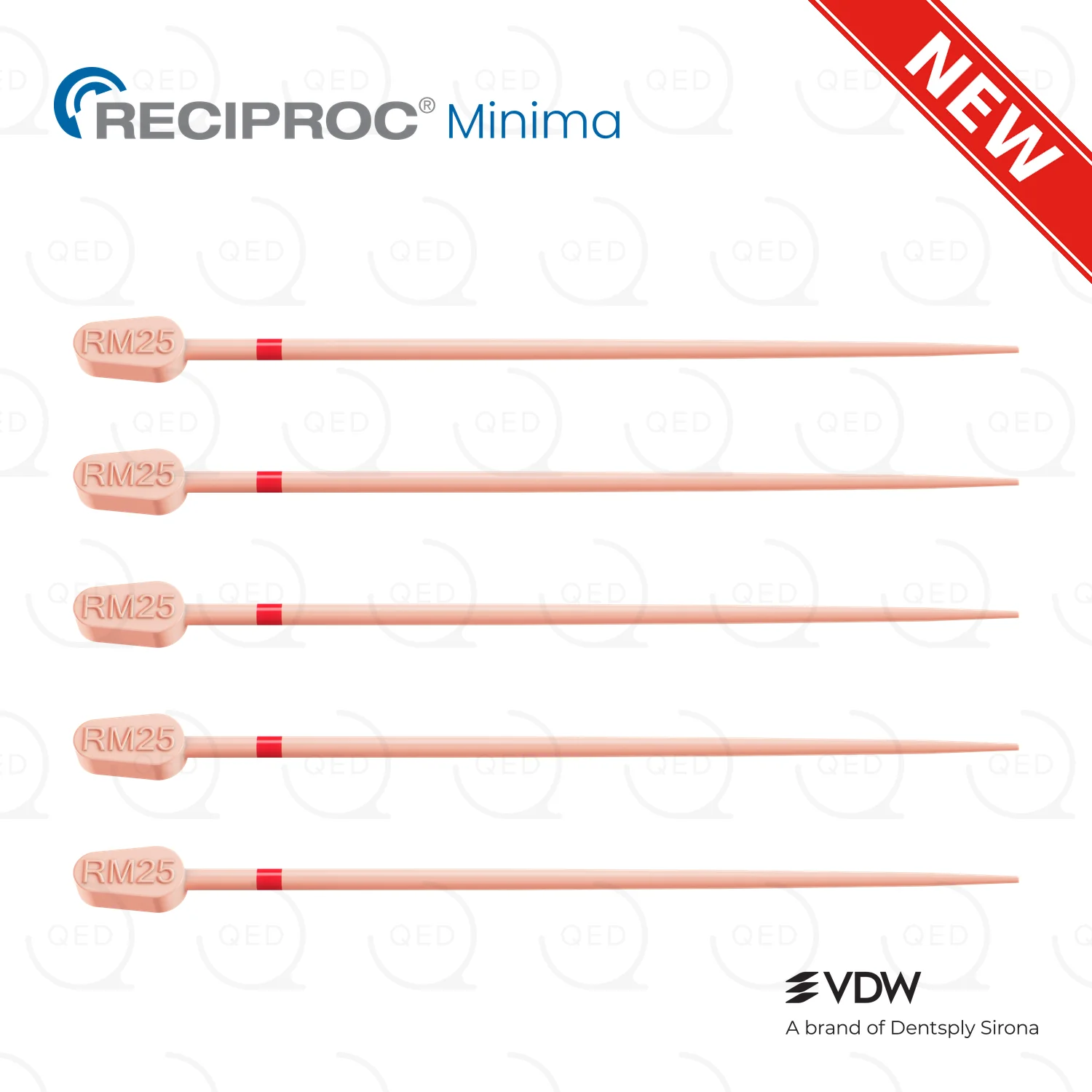
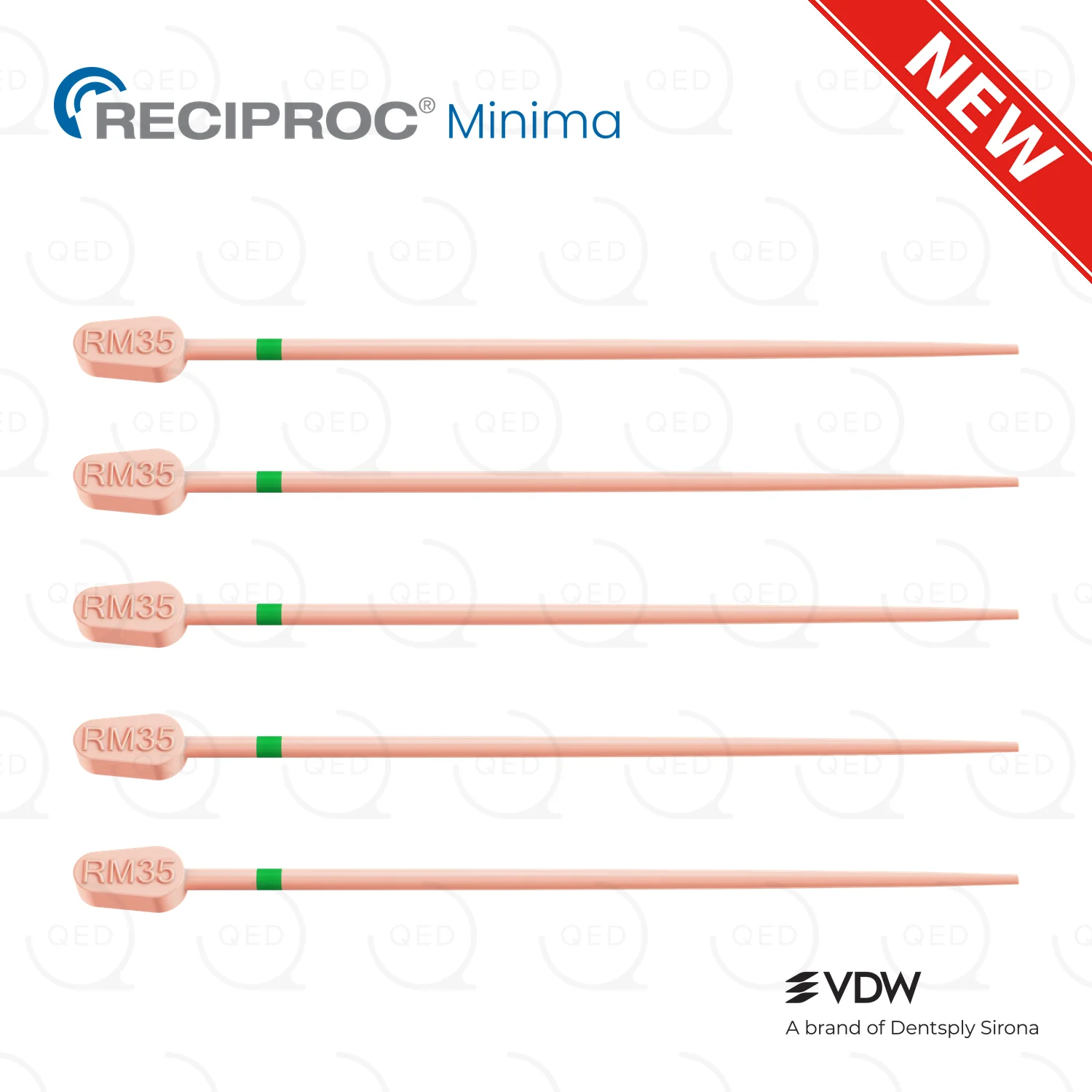
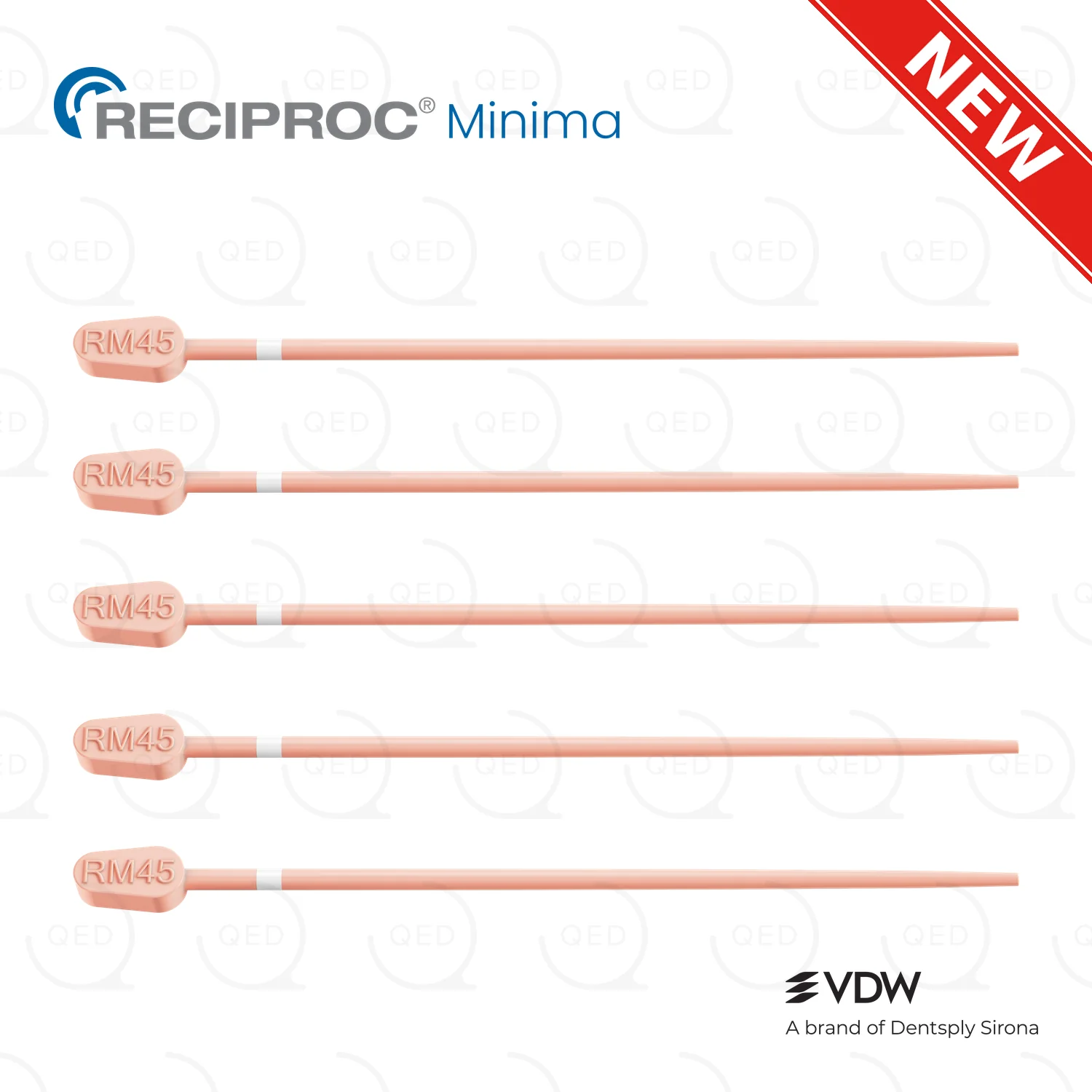
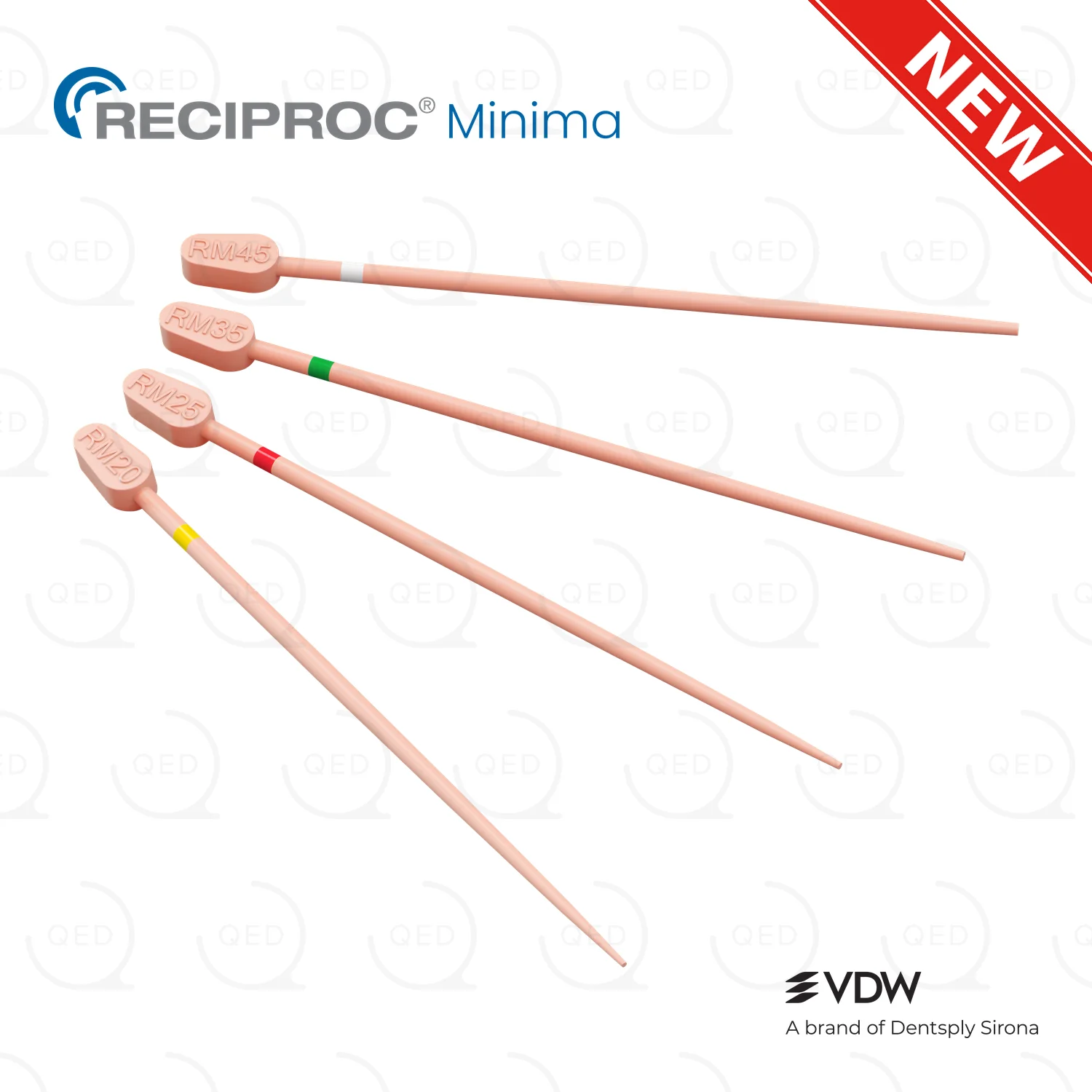
| shape it | reciproc minima assorted – single-file reciprocation |
| dry it | minima paper points – the points matched to those files |
| fill it | minima conform fit® gp – the matching cones |
| seal it | neosealer flo – bioceramic sealer with flex flo tips |
endo 3dp™ #09 · upper left central incisor ul1 · multiple apical terminuses · mid-root lateral canal · pre-accessed · radiolucent · acadental · ref aca-3dae601a09rl

x2 endo™ · #09 upper left central incisor · dual hardness
can a competency exam be fair if the radiograph looks nothing like a patient's? acadental built the x2 range around that problem, and this is the tooth they name for it: authentic internal and external anatomy with realistic radiographic results replicating a natural maxillary central incisor, with a tapered canal constricted close to the apex. their claim is that x2 teeth are undistinguishable from extracted teeth on an x-ray – which is exactly the property a standardised competency examination needs.
this item: 1 × x2 endo #09, upper left central incisor (ul1), radiopaque
made by acadental, usa · mfr code 3d_ae601x2_09
| realistic films | acadental: undistinguishable from extracted teeth on an x-ray, with no radiopacity adjustment needed |
| apical constriction | a tapered canal constricted close to the apex, as in most natural central incisors |
| enamel contrast | the enamel-to-dentin radiopacity contrast highlights crown and root separately on the film |
| dual hardness | distinct enamel and dentin layers – use a diamond bur when accessing, as acadental recommend |
› named for competency work – acadental describe it as excellent for practising all cleaning and shaping techniques as well as standardised competency examinations.
› one canal, one variable – with the anatomy simple, the assessment is genuinely about technique.
› the cheaper cohort option – real-t endo #08 is the upper central at undergraduate pricing, also radiopaque.
what makes this better than a plastic block?
three things a block cannot do: a film that reads like a patient's, an access cavity cut through material that resists the bur, and an apical constriction that stops a file where one should stop.
do we need a diamond bur?
acadental recommend one, because the replicated enamel is comparable in hardness to a natural tooth. a worn tungsten carbide bur will make hard work of the outline.
which anterior for a demonstration instead?
the see-through endo 3dp #09, which adds a mid-root lateral canal you can watch fill – but it is radiolucent, so it is a demonstration tooth, not an assessment one.
| mount it | modupro endo kit – both arches, magnetic modules |
| find the length | x-smart pro+ with apex locator – locator against film |
| glide path | c-pilot assorted 25 mm – hand files first |
| shape it | reciproc minima assorted – single-file reciprocation |
| dry and fill | minima paper points and conform fit® gp |
| seal it | neosealer flo – radiopaque bioceramic sealer |
x2 endo™ #09 · upper left central incisor ul1 · tapered canal, apical constriction · dual hardness · radiopaque · acadental · ref aca3d_ae601x2_09

x-smart® go · dentsply sirona · cordless motor with apex locator
cordless workinglength while shapingreciprocating shapingrotary shapingmulti-surgery practicedifficult access
a corded motor decides where you stand; a separate apex locator decides when you stop. the x-smart® go removes both: 154 g of motor, screen and locator in one cordless handpiece, charging inductively on a power bank that doubles as the stand, with the canal reading on the same display as the torque bar.
| 6.0 ncm max torque | 2,500 rpm at the file | 154 grams in the hand |
in this box: motor handpiece · 6:1 contra-angle · power bank · charger with eur, uk, aus and usa/jap plug adapters · measurement cable · lip clips (2) · file clips (2) · f-type spray nozzle · protective silicone sleeves for the contra-angle (2) · disposable handpiece sleeves (10)
dentsply sirona · class iia medical device · 24-month warranty on handpiece and power bank
› cordless and genuinely light – 210 × 26 × 28 mm, 154 g with the head on, triangular so it stays where you put it.
› apex location in two modes – with a hand file before you start, or live on the same screen while the motor shapes.
› four embedded file libraries – waveone®, reciproc®, protaper ultimate® and trunatomy® – whose parameters are “set to the values recommended by the instrument manufacturer”, plus five rotary programs of your own.
› inductive charging on the power bank, which is also the stand: no socket on the handpiece, nothing to plug in at the chair.
› colour tft display, 360° head rotation and a dominant-hand setting that flips the interface, so the screen faces you in any quadrant.
› 24-month warranty on handpiece and power bank, on dentsply sirona's published terms.
dentsply sirona call it “our most powerful cordless endo motor”, at up to 6 ncm and 2,500 rpm. both figures are theirs and both are true, with one qualification worth having: the instructions publish the torque ceiling as a band that falls as speed rises, so 6 ncm is what you have at slow rotary and reciprocating speeds rather than at 2,500 rpm. that is the right way round for endodontics.
| 50–400 rpm | up to 6.0 ncm |
| 450–650 rpm | up to 5.0, then 4.0 ncm |
| 700–1,500 rpm | up to 3.0, then 2.0 ncm |
| 1,550–2,500 rpm | up to 1.5, then 1.0 ncm |
on battery life dentsply sirona's own figure is three days' use when the handpiece is worked alongside the power bank. the practical version: a flat power bank takes about three hours, a flat handpiece about three hours on it, and the motor does not run while it charges – so the habit that matters is parking it on the stand between cases rather than at the end of the day.
two ways to use it. separate length determination runs in al mode with the motor idle: lip clip on the patient, file clip on the metal shaft of a hand file, two beeps to confirm the circuit. combined length determination reads while you shape, and needs the protective silicone sleeve on the head plus the lip clip alone. at the apical limit the motor can do nothing, reverse, or stop; dr's choice puts your own reference line short of the foramen and alerts there instead.
“the bars indication on the x-smart® go endo motor screen does not represent a distinct length or distance in mm or other linear units. it simply indicates the file progression towards the apex.”
dentsply sirona, x-smart® go instructions for use, section 6.4.5.2
two more things the instructions are firm about, and both are worth knowing before you buy rather than after. radiographic confirmation is mandatory – the locator supplements the film, it does not replace it. and a rubber dam is highly recommended to improve the locator's efficiency, alongside care around metal crowns and bridges, and a canal wet enough to conduct.
ten memory programs: four embedded libraries, an apex-locator-only mode, and five you configure for rotary work. at the torque ceiling you choose torque release – reverse until the load drops, then carry on – or a straight reverse until you press the button.
| p1 · waveone® | waveone® gold primary 25mm · assorted |
| p2 · reciproc® | reciproc® blue r25 25mm · minima r25 for narrow canals |
| p3 · protaper ultimate® | protaper ultimate® sequence 25mm |
| p4 · trunatomy® | trunatomy® assorted 25mm |
| al · m1–m5 | apex locator without rotation, plus five rotary programs of your own |
1 fit the head, sleeve the handpiece. contra-angle in until it clicks; disposable sleeve over the body, checked for tears.
2 calibrate. always, after the head has been sterilised, lubricated or exchanged. file out of the chuck, head seated, seconds to run.
3 choose the program, connect for measurement. cable into the handpiece first, then the lip clip on the patient. two beeps mean the circuit is closed; no beeps means it is not, and the cable connection test says which part to change.
4 shape, then confirm on film. set the apical action you want – off, reverse or stop – and take the radiograph, which the instructions make mandatory.
worth understanding before it arrives. sterilisable: the contra-angle, its silicone sleeve, the lip clip and the file clip – 135°c for 10 minutes or 134°c for 3, class b or s, to a published maximum of 200 cycles each. wipe-disinfect only: the handpiece, power bank, measurement cable and charger. the head is lubricated after every use and before sterilisation through the f-type nozzle, then calibrated again.
| head | 6:1 contra-angle · silicone sleeve (2) |
| measuring | measurement cable · lip clip (5) · file clip (2) |
| power | charger with uk, eur, aus and usa/jap adapters |
| consumables | handpiece sleeves (500) · f-type spray nozzle |
| isolation | hysolate dam · clamp 26 · youngs frame · oraseal™ |
| hand files | c-pilot® 010 25mm · a metal shaft for the file clip |
| irrigants | chlorax 5.25% · endo-solution 17% edta |
| delivery, activation | navitip™ 29g 25mm · eddy® tips |
| sealers | neosealer® ezflo bioceramic · ah plus® epoxy · proroot® bio sealer |
| coronal seal | sdr® flow+ refill universal · 4 mm increment, one cure |
can i stop taking a working-length radiograph?
no. the instructions make radiographic confirmation mandatory, and note that apex locators may not work properly in all conditions. what changes is how much of the case you spend guessing between films.
go or x-smart® pro+?
different arguments, not better and worse. the pro+ is a bench unit – 7 in touchscreen, 7.5 ncm, 3,000 rpm, thirty custom sequences – and it suits one surgery where the motor lives on the same bracket table. the go puts the whole thing in the handpiece, which is the answer if you work across rooms or want nothing trailing from your hand.
what if the battery goes?
it is not a user-replaceable part – the instructions reserve lithium-ion battery replacement to trained service personnel. if a handpiece will not wake up after the power bank has been charged, come to us and we will start it.
is the warranty really 24 months on everything?
no, and it is worth knowing the tiers. dentsply sirona warrant the handpiece and power bank for 24 months, the contra-angle for 12, and the accessories – cable, charger, clips, sleeve and batteries – for 6.
how many spare consumables should i order with it?
the two that run out first are the handpiece sleeves – ten in the box, one per patient – and the lip clips, since two covers one case at a time. a second contra-angle is the day-one decision if you run back-to-back endodontic lists.
› x-smart® go brochure (pdf, 0.7 mb, dentsply sirona) – the motor, the claims and every accessory reference in the range.
› instructions for use (dentsply sirona, 54 pp) – ask us and we will send the current copy.
before first clinical use: the device is indicated for driving files in continuous rotation and reciprocating mode while monitoring the file tip in the canal. dentsply sirona record one contraindication: it is not recommended for use in patients who have a pacemaker or other implanted electrical devices. the instructions also ask that portable rf equipment stays at least 30 cm away, that only original accessories and the original contra-angle are used, and that the push-button is never pressed while the motor runs.
x-smart® go cordless motor with apex locator · 0.4–6.0 ncm · 50–2,500 rpm · 6:1 contra-angle, 360° adjustable, push-button chuck · ø 2.35 mm iso 1797-1 type 1 shank, file length to 46 mm · colour tft display · 3.6 v lithium-ion, 600 mah handpiece and 3,200 mah power bank, inductive charging · 154 g · waveone®, reciproc®, protaper ultimate® and trunatomy® libraries plus 5 user programs · class iia · dentsply sirona · ref b00xsgo000000

reciproc® gutta-percha r25 · 60 cones
filling a reciproc® preparation with a constant-taper cone means filling a shape you did not make. these are vdw's own points for the system: a greater taper that corresponds to the individual instrument shapes, which is what produces an accurate fit and an honest tug back. this box is sized to the r25, the instrument most canals take.
this box: 60 × reciproc® gutta-percha r25 · 28 mm cone length · alpha-phase gutta-percha
made by vdw, munich – genuine reciproc®
| matched to r25 | the greater taper corresponds to the instrument's own shape, which is what vdw say ensures an accurate fit |
| any technique | single cone or lateral compaction cold, or as a master cone for warm vertical condensation |
| one length fits all | sized to the instrument rather than to its length, so one box serves 21, 25 and 31 mm cases |
› carried to length with sealer – the cone and the sealer are one step, not two.
› dry first with the matched points – reciproc® paper points r25, sterile in blister cells of four.
› then seal coronally – the apical seal is only half the job.
can i use these with reciproc® blue or minima?
no – match the cone to the file that cut the canal. blue and minima each have their own points, made to their own geometry. a cone that does not describe the shape you prepared is the wrong cone whatever it says on the box.
what if i gauged larger than r25?
then the preparation finished on an r40 or r50, and it takes the r40 or r50 cone. the assorted box carries all three.
| dry the canal | reciproc® paper points r25 |
| seal | bioceramic neosealer® ezflo with 29 ga tips, or neosealer® flo · resin ah plus® or vdw's 2seal® |
| coronal seal | sdr® flow+ universal · 4 mm bulk increment in one cure |
| the file itself | r25 in 21 mm, 25 mm or 31 mm |
reciproc® gutta-percha r25 · 60 cones · 28 mm · alpha-phase · greater taper corresponding to the r25 instrument · single cone, lateral compaction or master cone for warm vertical condensation · serves 21, 25 and 31 mm preparations · vdw, munich · ref v040214028025

reciproc® gutta-percha r40 · 60 cones
an r40 preparation is a different shape from an r25 one, and it wants its own cone. a 0.40 mm tip on a 6% apical taper leaves a canal that finishes at iso 46 a millimetre from the apex – wider apically, and less tapered along the blade. these are vdw's own points for that shape: a greater taper corresponding to the instrument, which is what they say produces an accurate fit.
this box: 60 × reciproc® gutta-percha r40 · 28 mm cone length · alpha-phase gutta-percha
made by vdw, munich – genuine reciproc®
| matched to r40 | corresponds to the individual shape of the r40 instrument – 0.40 mm tip, 6% over the first 3 mm |
| any technique | single cone or lateral compaction cold, or as a master cone for warm vertical condensation |
| one length fits all | sized to the instrument rather than to its length – one box covers 21, 25 and 31 mm cases |
› two ways to arrive here. either the iso 20 went passively and the iso 30 did not, so r40 was the chosen size; or the r25 preparation gauged larger and r40 finished the apical third.
› carried to length with sealer – cone and sealer are one step.
› dry with the matched points – reciproc® paper points r40.
should i buy this size on its own?
only if you use it often. vdw's own assorted box is weighted the way real caseloads are – 40 r25 with ten each of r40 and r50 – and for most practices that box is the better order.
will an r40 cone fit a blue or minima preparation?
no. match the cone to the file that cut the canal – blue and minima have their own points, made to their own geometry.
| dry the canal | reciproc® paper points r40 |
| seal | neosealer® ezflo or neosealer® flo · resin ah plus® or 2seal® · then sdr® flow+ |
| other sizes | r25 cones · r50 cones · assorted box |
| the file itself | r40 in 21 mm, 25 mm or 31 mm |
reciproc® gutta-percha r40 · 60 cones · 28 mm · alpha-phase · greater taper corresponding to the r40 instrument · single cone, lateral compaction or master cone for warm vertical condensation · serves 21, 25 and 31 mm preparations · vdw, munich · ref v040214028040
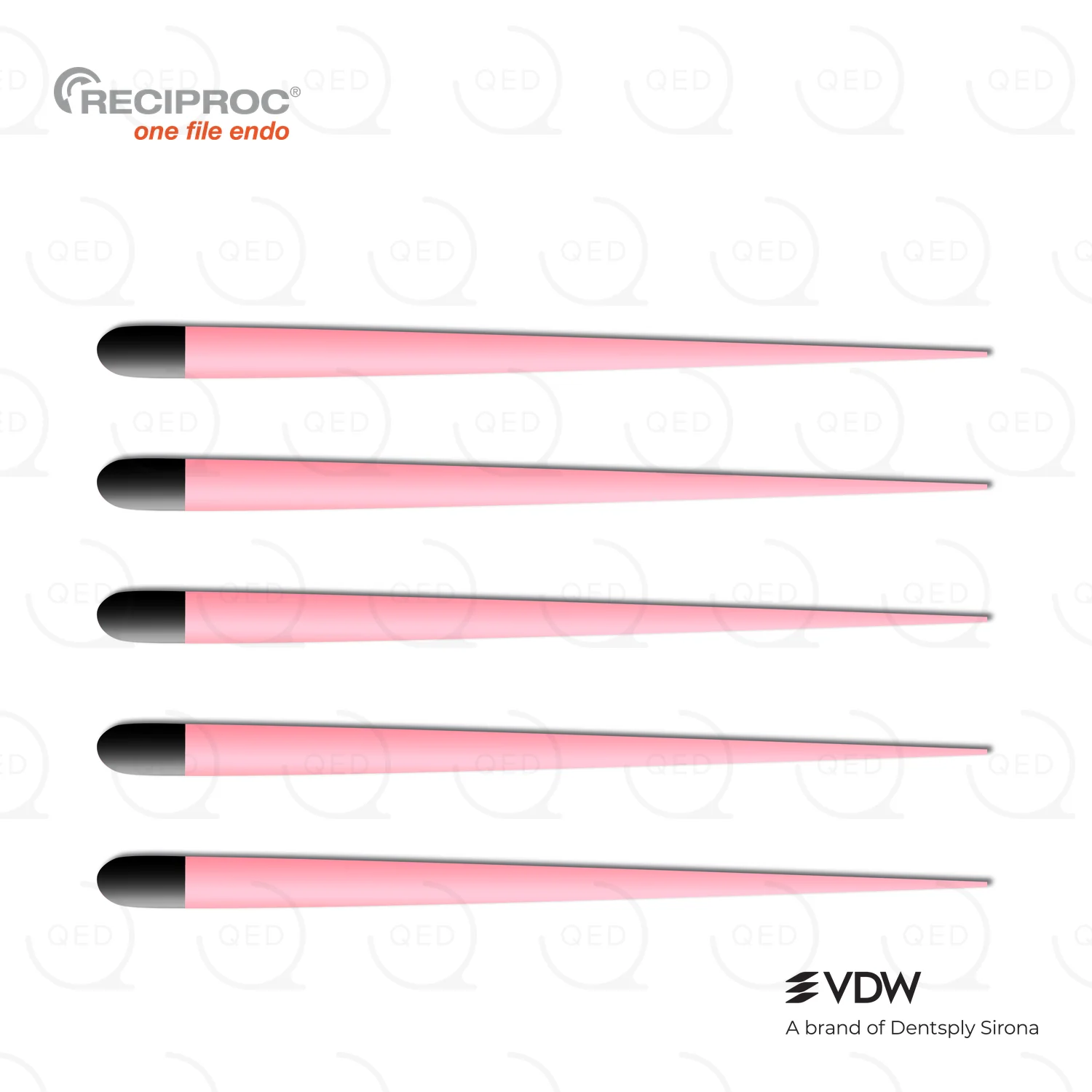
reciproc® gutta-percha assorted · 60 cones
forty r25, ten r40, ten r50. that split is vdw's, and it is worth reading as what it is – the manufacturer's own statement of how often each size gets used. most canals take an r25, so most cones should be r25; the larger two are there for the wide canals and the apical enlargements. one box covers every preparation the system makes, in the proportion you will actually reach for.
this box: 60 cones – 40 × r25, 10 × r40, 10 × r50 · 28 mm cone length · alpha-phase gutta-percha
made by vdw, munich – genuine reciproc®
| all three shapes | each cone carries the greater taper corresponding to its instrument, which is what vdw say ensures an accurate fit |
| any technique | single cone or lateral compaction cold, or as a master cone for warm vertical condensation |
| every length | sized to the instrument, not its length – this one box serves 21, 25 and 31 mm cases |
› no guessing at the gauge. whichever instrument finished the canal, its cone is in the box.
› pairs with the assorted points. reciproc® paper points assorted are weighted the same way, 96 r25 with 24 each of r40 and r50.
› and with the assorted file blister. same logic across the system: r25 by the box, the larger two three at a time.
is this the box to start with?
yes, unless you already know one size dominates your list. it is also what vdw put in the system kit, alongside the assorted paper points and twelve files.
will these fit a blue or minima preparation?
no. match the cone to the file that cut the canal – those ranges have their own points, made to their own geometry.
| dry the canal | assorted paper points, or singly in r25 |
| seal | neosealer® ezflo or neosealer® flo · resin ah plus® or 2seal® · then sdr® flow+ |
| single sizes | r25 · r40 · r50, 60 to a box |
| the files | r25 25 mm · the assorted blister · or the whole system kit |
reciproc® gutta-percha assorted · 60 cones – 40 × r25, 10 × r40, 10 × r50 · 28 mm · alpha-phase · greater taper corresponding to each instrument · single cone, lateral compaction or master cone for warm vertical condensation · serves 21, 25 and 31 mm preparations · vdw, munich · ref v040214028237

reciproc® paper points r40 · 144 per box
a point that is too narrow leaves moisture where the sealer has to go. these are made to correspond to the r40 preparation – a canal that finishes at iso 46 a millimetre from the apex – so drying it takes fewer points and gets closer to length. industrially sterilised, and packed in blister cells of four so the rest of the box stays sealed.
this box: 144 × reciproc® paper points r40 · sterile blister cells of four · markings at 18, 20 and 22 mm
made by vdw, munich – genuine reciproc®
| matched to r40 | corresponding to the instrument size, so the point follows the shape rather than approximating it |
| sterile, four to a cell | industrially sterilised – vdw's own infection-control reason for the packaging |
| marked at 18/20/22 mm | working length control on the point itself |
› highly absorbent, and vdw note they retain good material consistency when fully saturated.
› one box, every length – sized to the instrument, not to its length.
› fill to match – the r40 gutta-percha cone, carried to length with sealer in the same step.
do i need a full box of this size?
only if r40 is a regular finish for you. the assorted box holds 24 r40 alongside 24 r50 and 96 r25 – vdw's own weighting, and closer to how most lists run.
will these fit a blue or minima preparation?
no – those ranges have their own points, in their own pack sizes. match the consumable to the file that cut the canal.
| fill the canal | reciproc® gutta-percha r40, 60 cones |
| seal | neosealer® ezflo or neosealer® flo · resin ah plus® or 2seal® · then sdr® flow+ |
| other sizes | r25 points · r50 points · assorted box |
| the file itself | r40 in 21 mm, 25 mm or 31 mm |
reciproc® paper points r40 · 144 per box · industrially sterilised, blister cells of four · corresponding to the r40 instrument size · highly absorbent, consistent when saturated · markings 18/20/22 mm · serves 21, 25 and 31 mm preparations · vdw, munich · ref v040216029040

reciproc® paper points assorted · 144 per box
ninety-six r25, twenty-four r40, twenty-four r50. that is vdw's own weighting, and it says something useful: most canals finish on an r25, so most points should be r25. whichever instrument the gauge landed on, its point is in the box – industrially sterilised, packed four to a blister cell so the rest stays sealed while you work.
this box: 144 points – 96 × r25, 24 × r40, 24 × r50 · sterile blister cells of four · markings at 18, 20 and 22 mm
made by vdw, munich – genuine reciproc®
| all three sizes | each corresponding to its instrument – r25, r40 and r50 – in the proportion the system is actually used |
| sterile, four to a cell | industrially sterilised, and the packaging is vdw's own infection-control decision rather than a convenience |
| marked at 18/20/22 mm | working length control on the point itself |
› pairs with the assorted cones. reciproc® gutta-percha assorted follows the same logic – 40 r25 with ten each of r40 and r50. several points dry a canal; one cone fills it.
› one box, every length – sized to the instrument, so it serves 21, 25 and 31 mm cases alike.
› highly absorbent, and consistent when fully saturated.
is this the box to start with?
yes, unless one size dominates your list. it is also what vdw put in the system kit, alongside the assorted cones and twelve files.
will these fit a blue or minima preparation?
no – those ranges have their own points, in their own pack sizes. match the consumable to the file that cut the canal.
| fill the canal | assorted gutta-percha, or single sizes in r25 |
| seal | neosealer® ezflo or neosealer® flo · resin ah plus® or 2seal® · then sdr® flow+ |
| single sizes | r25 · r40 · r50, 144 to a box |
| the files | r25 25 mm · the assorted blister · or the whole system kit |
reciproc® paper points assorted · 144 per box – 96 × r25, 24 × r40, 24 × r50 · industrially sterilised, blister cells of four · corresponding to the r25, r40 and r50 instrument sizes · highly absorbent, consistent when saturated · markings 18/20/22 mm · serves 21, 25 and 31 mm preparations · vdw, munich · ref v040216029237
c-pilot® iso 010 · 21 mm · 6 sterile files
second molar, limited opening, and a 25 mm handle fighting the opposing arch? the 21 mm c-pilot® 010 puts the handle where your fingers can control it and matches the 21 mm working length your rotary and reciprocating files are supplied in. same instrument as the longer version – thermally hardened stainless steel, inactive pilot tip – with three fewer millimetres of leverage between your hand and the canal.
this pack: 6 × vdw®sterile c-pilot® iso 010, 21 mm, .02 taper · stoppers fitted · mfr code 368 021 010
made by vdw gmbh, munich, germany
| 21 mm | the posterior working length, and the shortest length the shaping systems we stock are made in |
| 0.10 mm tip | a size 10 loose to length is the accepted definition of a glide path |
| inactive pilot tip | vdw's description: conducts the instrument safely along the canal instead of cutting its own path |
| sterile blister of 6 | gamma sterilised to din en iso 11137, ready to use, stoppers pre-mounted |
| thermally hardened | vdw: “high bending strength thanks to a special thermal hardening process” |
| constant .02 taper | the iso hand file geometry – the blade widens by 0.02 mm for every millimetre back from the tip, so the size you read is the size the canal gets |
› shorter shaft, better control – less instrument between your fingers and the canal is exactly what you want when the access is cramped and the file is fine.
› recapitulate with it – back to a loose 010 between shaping files to confirm the path has not packed with debris.
› irrigant first, lubricant only if you use one – the canal wants a reservoir of irrigant; a chelating gel is a matter of preference rather than a step this file requires. if it is part of your protocol, file-eze™ is the 19% edta gel we stock.
› single use – vdw recommend single use of their pre-sterilised instruments; the uk position since april 2007 is that endodontic reamers and files are treated as single use (cmo(2007)5).
21 mm or 25 mm?
21 mm for molars, short roots and any case where the opposing arch limits you. 25 mm for anteriors, canines and long premolar roots. most practices hold both and reach for 21 mm more often than they expect.
do i still need it with a reciprocating system?
yes. the instructions for reciproc® and reciproc® minima ask you to confirm patency with a small hand instrument and to establish a glide path if the shaping file does not advance.
| if 010 will not go | c-pilot 008, 21 mm |
| next step up | c-pilot iso 12.5, 21 mm · a 25% step, not 50% |
| mechanical glide path | waveone® gold glider 21 mm |
| then shape | reciproc® blue r25 21 mm or waveone® gold primary 21 mm |
| narrow anatomy | reciproc® minima r20 21 mm |
| irrigate | navitip™ 29 ga sideport 21 mm |
vdw® c-pilot® iso 010 · 21 mm · .02 taper · molars · glide path · patency · calcified canals · stainless steel · sterile · single use · 6 files · vdw gmbh · ref v040368021010 · also in 25 mm and 19 mm

vdw® c-pilot® iso 006 · 25 mm · 6 sterile files
sclerosed lower incisor, a pulp stone where the orifice should be, and the 008 has stopped dead? iso 006 is the finest size vdw make in this range, and it exists for the cases where the alternative is cutting dentine you will never get back. at 0.06 mm the tip is a quarter thinner than an 008 – the last honest step before you reach for magnification, ultrasonics or a referral pad.
| 0.06 mm tip diameter | 25 mm working length | 6 sterile blister |
this pack: 6 × vdw®sterile c-pilot® iso 006, 25 mm, .02 taper · pre-mounted silicone stoppers · mfr code 368 025 006
made by vdw gmbh, munich, germany
a 006 is a probe. it is there to tell you whether a path exists, and roughly where it goes, without removing the dentine that a wider instrument would take to answer the same question. used that way it is one of the most conservative instruments in the tray. used as a shaping file it is simply a wire under load, so the discipline matters: find the path, confirm it, and hand the canal over to the next size rather than trying to enlarge with the finest instrument you own.
the material earns its place here more than anywhere else in the range. vdw credit a special thermal hardening process with the file's high bending strength, and the inactive pilot tip is designed to be led by the canal rather than to cut a new one – the distinction between negotiating an obstruction and creating a false path. in a 2021 laboratory comparison in endodontology, stainless steel pathfinding files including c-pilot® resisted buckling better than carbon steel and nickel-titanium instruments (gupta and colleagues, doi 10.4103/endo.endo_126_20); it measures one property on a bench, but it is the property that decides whether a 006 transmits anything useful to your fingers.
| 0.06 mm tip | the finest c-pilot® size – a quarter thinner at d0 than an 008 |
| inactive pilot tip | vdw's description: conducts the instrument safely along the canal rather than cutting its own path |
| thermally hardened | vdw attribute the range's high bending strength to a special thermal hardening process |
| fine but readable | radiopaque calibration rings and stopper, plus the length printed on the cc+ handle |
| sterile, ready to use | gamma sterilised to din en iso 11137, blister of six |
| constant .02 taper | the iso hand file geometry – the blade widens by 0.02 mm for every millimetre back from the tip, so the size you read is the size the canal gets |
create a glide path even in canals which are difficult to penetrate.
— vdw product catalogue, c-pilot® range. the difficult ones are the entire reason the 006 exists.
› magnify first – a 006 is a poor substitute for seeing the orifice. find it, then probe it.
› probe through a reservoir – never dry. irrigant in the chamber does the work; a viscous chelator such as file-eze™ is a preference rather than a requirement, and comes in a the 30 ml indispense™ syringe if you get through it.
› change files, not technique – if a 006 stops advancing and starts to bend, take a fresh one rather than pushing harder on a stressed instrument.
› single use – vdw recommend single use of these pre-sterilised instruments; the uk position since april 2007 is that endodontic reamers and files are treated as single use (cmo(2007)5).
is a 006 not too fragile to be useful?
it is fine, and it should be treated as such. what it gives you is information at the lowest possible cost in dentine: whether there is a path, and in which direction. once you know that, 008 and 010 do the work of making it usable.
do i need 006 if i already stock 008?
not for routine cases. stock it for the calcified anterior and the second molar you would otherwise abandon – the blister that sits in the drawer for a month and then saves an appointment.
which length?
25 mm reaches long anterior roots comfortably. for a second molar with limited opening, the 19 mm version puts the handle where you can actually control it.
| next size up | c-pilot 008, 25 mm · once 006 is loose |
| glide path size | c-pilot 010, 25 mm · the reference size |
| whole sequence | c-pilot assorted 25 mm · two each of 006, 008, 010 |
| lubricant, optional | file-eze™ kit · 19% edta gel, if you use one |
| bulk gel, optional | file-eze™ 30 ml indispense™ · for high volume use |
| narrow anatomy | reciproc® minima r20 25 mm · the slimmest reciprocating file we stock |
| dress it | ultracal™ xs · calcium hydroxide between visits |
| limited opening | c-pilot 006 in 19 mm · short handle reach |
vdw® c-pilot® iso 006 · 25 mm · .02 taper · sclerosed canals · calcified canals · canal scouting · pathfinding · stainless steel · sterile · single use · 6 files · vdw gmbh · ref v040368025006 · also in 21 mm and 19 mm

vdw® c-pilot® iso 008 · 25 mm · 6 sterile files
ten minutes into a lower molar and the 010 is going nowhere? that is the ordinary experience of a sclerosed canal, and it is not a reason to open the access wider. iso 008 is a fifth thinner at the tip than 010, which is often the whole difference between an instrument that stops at a constriction and one that slips past it. c-pilot® 008 is built for exactly that moment: stainless steel, thermally hardened for bending strength, with an inactive pilot tip that is guided by the canal rather than by force.
| 0.08 mm tip diameter | 25 mm working length | 6 sterile blister |
this pack: 6 × vdw®sterile c-pilot® iso 008, 25 mm, .02 taper · pre-mounted silicone stoppers · mfr code 368 025 008
made by vdw gmbh, munich, germany
read the instructions for most reciprocating systems and you will find a small hand instrument written into the sequence: check patency, and if the shaping file does not advance, create a glide path first. iso 008 and iso 010 are the sizes named for that job. buying six of them is not an accessory purchase – it is the step that protects the far more expensive nickel-titanium file that follows, and the tooth it is working in.
at 0.08 mm the wire is very fine, so what it is made of decides how it behaves. vdw credit a special thermal hardening process with the file's high bending strength, and a laboratory comparison of pathfinding instruments in endodontology in 2021 found the stainless steel files, c-pilot® included, more resistant to buckling than the carbon steel and nickel-titanium instruments tested (gupta and colleagues, doi 10.4103/endo.endo_126_20). a bench test is not a clinical result – but buckling is precisely what an 008 does when the canal says no.
| 0.08 mm tip | a fifth finer than an 010 at d0 – usually the step that finds a canal an 010 has been sitting on top of |
| inactive pilot tip | vdw's description: conducts the instrument safely along the canal, which is what keeps a fine file out of a false path |
| thermally hardened | vdw attribute the high bending strength of the range to a special thermal hardening process |
| radiopaque marks | calibration rings and a radiopaque stopper – useful when the file is too fine to see clearly on a film |
| sterile, ready to use | gamma sterilised to din en iso 11137, blister of six, no cycle before first use |
| constant .02 taper | the iso hand file geometry – the blade widens by 0.02 mm for every millimetre back from the tip, so the size you read is the size the canal gets |
for probing in calcified root canals.
— vdw's stated indication for the c-pilot® range. it is a scouting instrument, not a shaping one.
› short amplitude – watch-wind in small arcs with the lightest apical load that still advances the file. force at 008 buys a ledge, not depth.
› pre-curve for a curve you can see – a slight bend at the last few millimetres helps the tip find the direction the canal is already going.
› keep the flutes clear – irrigate and recapitulate rather than asking a lubricant to do it. where a chelating gel is part of your protocol, file-eze™ is the 19% edta option.
› then hand over – once 008 is loose to length, move to 010 and only then to a mechanical glider.
should i stock 008 or 006 as my rescue size?
008 first: it is the one you will use every week, and it is stiff enough to transmit a usable signal. keep a blister of 006 behind it for the genuinely sclerosed cases, where 008 stops as well.
can i autoclave and re-use them?
no. they arrive gamma sterilised in a single blister and vdw recommend single use of their pre-sterilised instruments. since april 2007 the uk position has been that endodontic reamers and files are treated as single use and disposed of after each patient (cmo(2007)5, following the seac statement of 2006).
six files for one canal – is that not a lot?
you will use more than one on a difficult canal, and a fine file that has been stressed is not one to re-introduce. six is the sensible unit for a single sclerosed molar, not for six teeth.
| finer still | c-pilot 006, 25 mm · for sclerosed canals |
| next size up | c-pilot 010, 25 mm · the glide path reference size |
| whole sequence | c-pilot assorted 25 mm · two each of 006, 008, 010 |
| lubricant, optional | file-eze™ kit · 19% edta gel, if you use one |
| mechanical glide path | waveone® gold glider 25 mm |
| narrow anatomy | reciproc® minima r20 25 mm |
| then shape | reciproc® blue r25 25 mm |
| shorter access | c-pilot 008 in 21 mm · posterior teeth, limited opening |
vdw® c-pilot® iso 008 · 25 mm · .02 taper · calcified canals · patency · canal scouting · glide path · stainless steel · sterile · single use · 6 files · vdw gmbh · ref v040368025008 · also in 21 mm and 19 mm

vdw® c-pilot® iso 010 · 25 mm · 6 sterile files
rotary file screwing in, stalling, or refusing the curve? a glide path is not a feeling, it is a measurement. the criterion used across the literature is a size 10 hand file that moves loosely from orifice to working length – and until that is true, every rotary or reciprocating instrument you introduce is doing two jobs at once. c-pilot® 010 is the instrument that establishes it: stainless steel, thermally hardened for bending strength, with an inactive pilot tip that follows the canal instead of cutting its own path.
| 0.10 mm tip diameter | 25 mm working length | 6 sterile blister |
this pack: 6 × vdw®sterile c-pilot® iso 010, 25 mm, .02 taper · pre-mounted silicone stoppers · mfr code 368 025 010
made by vdw gmbh, munich, germany
scouting is a compression problem. you are pushing a very fine wire along a path you cannot see, and the failure mode is not cutting too much – it is the instrument bending, coiling and losing the tactile signal that tells you where the canal goes. that is why the material still matters at this end of the range. in a laboratory comparison of pathfinding instruments published in endodontology in 2021, the stainless steel files, c-pilot® among them, resisted buckling better than the carbon steel and nickel-titanium instruments tested (gupta, mohite, patil and bansal, doi 10.4103/endo.endo_126_20). it is a bench test of one property, not a clinical outcome – but it is the property you are relying on at iso 010.
vdw's answer is a special thermal hardening process, which they credit with the file's high bending strength, and a tip that is deliberately inactive. the point of an inactive tip is that the instrument is guided by the anatomy rather than by you: it will follow a curve it can find, and it will stop rather than start a ledge in one it cannot. combined with the calibration rings and the radiopaque silicone stopper, that gives you something to read on a working-length film rather than something to guess at.
| inactive pilot tip | vdw's description: the tip conducts the instrument safely along the canal, rather than cutting a path of its own |
| thermally hardened | vdw attribute the file's high bending strength to a special thermal hardening process – stiffness where you are pushing |
| radiopaque marks | x-ray visible calibration rings and a radiopaque silicone stopper, so depth is readable on the film |
| cc+ handle | grip designed for fine tactile control, with the length printed on the handle as well as colour coded |
| sterile, ready to use | gamma sterilised to din en iso 11137 and packed in a blister of six – no cycle needed before first use |
| constant .02 taper | the iso hand file geometry – the blade widens by 0.02 mm for every millimetre back from the tip, so the size you read is the size the canal gets |
enables creation of a smooth glide path prior to every rotary preparation.
— vdw's published description of the sterile c-pilot® range. note the word every: the glide path is not the exception, it is the step before the motor.
› watch-winding, not pushing – small reciprocating quarter turns with light apical pressure let the inactive tip find the path. if it stops advancing, come back, irrigate and re-establish before trying again.
› work through a reservoir – scout through irrigant rather than a dry canal. whether to add a viscous chelator on top of that is a matter of preference and opinion is divided, but where one is used, file-eze™ is 19% edta in a water soluble gel.
› recapitulate – return to 010 between shaping instruments to confirm the path is still patent and has not packed with dentine mud.
› single use – vdw recommend single use of their industrially cleaned, pre-sterilised instruments, and since april 2007 the uk position has been that endodontic reamers and files are treated as single use (cmo(2007)5, following the seac statement of 2006).
my system is reciprocating – do i still need this?
yes, and the instructions say so. the reciproc® and reciproc® minima instructions ask you to confirm patency with a small hand instrument, and to establish a glide path if the file does not advance. a blister of six 010s is the cheapest insurance in the drawer against a separated niti file.
why 010 rather than 008 or 015?
010 is the reference size: the accepted description of a glide path is a size 10 that is loose to length (van der vyver and colleagues, south african dental journal 2019). if 010 will not reach, drop to 008 or 006; once it is loose, move up through iso 12.5.
why 25 mm?
it is the length most uk practices stock first: it covers anteriors, canines and long premolar roots, and leaves room for a stopper you can still see. where the opening is tight, the 21 mm and 19 mm versions of this same file put the handle where you can reach it.
| if 010 will not go | c-pilot 008, 25 mm · then 006 if the canal is sclerosed |
| next step up | c-pilot iso 12.5, 25 mm · a 25% step instead of 50% |
| whole sequence | c-pilot assorted 25 mm · two each of 006, 008, 010 |
| lubricant, optional | file-eze™ kit · 19% edta gel, 4 × 1.2 ml, if you use one |
| mechanical glide path | waveone® gold glider 25 mm · takes over once 010 is loose |
| then shape | reciproc® blue r25 25 mm or waveone® gold primary |
| narrow anatomy | reciproc® minima r20 25 mm · the slim reciprocating option |
| irrigate | navitip™ 29 ga sideport 25 mm · delivery without extrusion |
vdw® c-pilot® iso 010 · 25 mm · .02 taper · calcified canals · canal scouting · glide path · patency · recapitulation · stainless steel · sterile · single use · 6 files · vdw gmbh · ref v040368025010 · also in 21 mm and 19 mm

vdw® c-pilot® iso 015 · 25 mm · 6 sterile files
glide path finished by hand, or finished by the glider? either way, 015 is where the manual sequence ends. it is the tip size the mechanical glide path instruments are built around, and the point at which a shaping file meets a canal that has already been measured, opened and confirmed patent rather than one it has to discover for itself. c-pilot® 015 is the last hand instrument in the sequence – thermally hardened stainless steel, inactive pilot tip, radiopaque marks.
| 0.15 mm tip diameter | 25 mm working length | 6 sterile blister |
this pack: 6 × vdw®sterile c-pilot® iso 015, 25 mm, .02 taper · pre-mounted silicone stoppers · mfr code 368 025 015
made by vdw gmbh, munich, germany
a nickel-titanium shaping file entering a canal that has been taken to a loose 015 is doing one job: removing dentine along a path that already exists. the same file entering an unprepared canal is scouting, negotiating and shaping simultaneously, and it is the scouting that loads it in torsion. this is the whole argument for the glide path, and it is why the literature reports fewer canal aberrations and a lower risk of shaping file separation when one is established first (van der vyver and colleagues, south african dental journal 2019).
015 also happens to be the tip size of the mechanical glide path instruments – the waveone® gold glider carries a 015 tip. a hand 015 that reaches length tells you the canal will accept them; a hand 015 that stops short tells you something more useful still, which is to go back rather than forward.
| 0.15 mm tip | the conventional finishing size for a manual glide path, and the tip size of the mechanical gliders |
| inactive pilot tip | vdw's description: conducts the instrument safely along the canal rather than cutting its own path |
| thermally hardened | high bending strength, which vdw attribute to their special thermal hardening process |
| radiopaque marks | calibration rings and a radiopaque silicone stopper for a working length film |
| sterile, ready to use | gamma sterilised to din en iso 11137, blister of six |
| constant .02 taper | the iso hand file geometry – the blade widens by 0.02 mm for every millimetre back from the tip, so the size you read is the size the canal gets |
enables creation of a smooth glide path prior to every rotary preparation.
— vdw's published description of the sterile c-pilot® range.
› loose, not tight – 015 should move freely to length before you consider the glide path finished. if it binds, drop back to iso 12.5 and work again.
› confirm length here – 015 is stiff enough to give a reliable apex locator reading and visible enough on a film.
› keep one for recapitulation – between shaping instruments, a 015 re-establishes patency without enlarging.
› single use – supplied gamma sterilised in a blister of six; vdw recommend single use, in line with the uk position on endodontic files since april 2007 (cmo(2007)5).
if i own a glider, do i need hand 015 at all?
yes, for two reasons: it is how you check the canal is ready for the glider, and it is what you reach for when the glider will not advance. it is also the recapitulation instrument during shaping.
can i start with 015 in an easy canal?
in a wide, straight canal many clinicians do. in anything narrow or curved, starting at 015 is how ledges are made – begin at 010 or below.
does a glide path mean the rotary file cannot separate?
no. it reduces the work the shaping file has to do and the literature associates it with fewer aberrations and a lower fracture risk – but technique, curvature and single use still decide the outcome.
| step before | c-pilot iso 12.5, 25 mm · the gentle way up from 010 |
| recapitulation | c-pilot 010, 25 mm · patency between shaping files |
| mechanical glide path | waveone® gold glider 25 mm · same 015 tip, reciprocating |
| shape it | waveone® gold primary 25 mm or reciproc® blue r25 |
| narrow anatomy | reciproc® minima r20 25 mm |
| motor | vdw.silver®reciproc® with 6:1 contra-angle · x-smart® pro+ · x-smart® go |
| irrigate | navitip™ 29 ga sideport 25 mm |
| shorter access | c-pilot 015 in 21 mm |
vdw® c-pilot® iso 015 · 25 mm · .02 taper · glide path · recapitulation · working length · calcified canals · stainless steel · sterile · single use · 6 files · vdw gmbh · ref v040368025015 · also in 21 mm and 19 mm


 Facebook
 X
 Instagram
 Pinterest
