

Best selection of Endodontic supplies in the UK


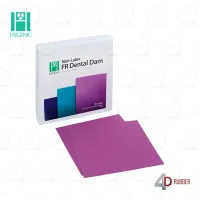
hygenic® fr non-latex · purple · 30
rubber dam isolationlatex-freeendodonticsrestorative
want the dam to stretch further and pull less on the tooth? that is what fr means. four d rubber: "fr designates flexible retraction: choose fr dam for higher elasticity and less retraction force on the isolated area." hygenic® non-latex fr is purple, 152 mm square, 30 sheets to the box.
this pack: hygenic® non-latex fr dental dam, medium, 152 x 152 mm (6 x 6 in), purple (pack of 30)
| material | four d rubber's proprietary non-latex formula |
| retraction | fr – flexible retraction: higher elasticity, less retraction force |
| sheet | 152 x 152 mm (6 x 6 in), purple, textured surface |
| powder | powder-free |
| supplied | 30 sheets |
› four d rubber on the formula: "proprietary formula that is easy to stretch."
› a textured surface, and powder-free.
› no natural rubber latex – for patients or staff with a latex allergy.
› made under an iso 13485 quality system. hygenic® is a dam name dentists have used for decades; four d rubber now supply it direct: "the hygenic® non-latex dental dam you know and trust is now available directly from the manufacturer."
fr is four d rubber's flexible-retraction sheet. also latex-free, and from the same maker: qed non-latex dam, polyisoprene, in medium or heavy. we also stock hysolate flexi-dam non-latex.
| clamps | ksk clamp range · clamp stand |
| punch | ainsworth punch, silicone handle · ivory pattern punch |
| forceps | washington pattern clamp forceps |
| frame | young's rubber dam frame |
| stabilising cord | wedjets non-latex small · wedjets non-latex large |
| sealing the margin | oraseal caulking · rubber-dam liquid |
hygenic® non-latex fr dental dam · flexible retraction · purple · 152 x 152 mm · 30 sheets · powder-free · made by four d rubber · ref 15482
eighteeth ultra x · cordless ultrasonic activator
irrigant activationcordlessultrasonic
eighteeth’s ultra x is a cordless ultrasonic activator for the irrigating solution already in the canal. eighteeth set out its action as cavitation – “millions of gas bubbles” that oscillate and collapse – and acoustic streaming, a unidirectional flow that “accelerates the movement in liquid inside the root canal”.
| 45 khz ultrasonic frequency | 4.5 hrs continuous operation | 3 tip types |
this pack: eighteeth ultra x
made by eighteeth
| frequency | 45 khz |
| battery | 1500 mah lithium; 4.5 hours of continuous operation; battery level indicator |
| modes | two power modes, with led indicator |
| tips | gold, blue and silver, #20 and #25 on a 2% taper, 18 and 21 mm; autoclavable |
› what eighteeth list it for. smear layer removal, dentine chip removal, biofilm disruption and cleaning of complex anatomy – isthmuses, fins and lateral canals – and removing vapour lock.
› cordless, contra-angle design. light and ergonomic by eighteeth’s description, with the option of direct plug-and-play.
› choose the tip. gold is “super powerful”; only blue and silver are flexible.
how do eighteeth say to use it?
shape the canal first and fill it with irrigant – never run ultra x without irrigating solution. choose a tip that fits passively and keep it 2–3 mm short of the apex; activate with short vertical strokes for 30 seconds without breaching the apical 2 mm, never wedging the tip; replenish, suction and repeat 4 to 5 times. rubber dam is always recommended.
which irrigant?
eighteeth leave the disinfectant and flushing agents to you; the irrigants we carry are in the range below.
| the activator | ultra x cordless ultrasonic activator (this page) |
| tips | gold 20/.02, 18 mm · gold 25/.02, 18 mm · silver 20/.02, 21 mm · blue 20/.02, 18 mm · blue 25/.02, 18 mm |
| irrigants | chlorax 5.25% · chlorax 2% · endo-solution 17% edta |
› ultra x leaflet (pdf, 0.5 mb, eighteeth / qed) – features, tips and the activation protocol.
specifications and quotations are from eighteeth’s ultra x leaflet. brand names are the trademarks of their owners.
eighteeth ultra x · eighteeth · ref 8t-6280007

chloraxid® 5.25% · sodium hypochlorite
canal irrigationdead pulp removalchemo-mechanical preparationdentist use only
cerkamed describe chloraxid 5.25% as a liquid for root canal rinsing, for removal of dead pulp residues during mechanical preparation. it sits at the top of the 1%–5.25% range the european society of endodontology names – the guideline states there is insufficient evidence to prefer any concentration, so this is a matter of your own protocol rather than of one being better.
| 5.25% active chlorine | 10 ml per canal, cerkamed | 5 x 200 ml pack |
this pack: chlorax 5.25% sodium hypochlorite (5x200ml)
| active | sodium hypochlorite, 5.25% active chlorine |
| also contains | purified water compliant with ph. eur. |
| presentation | bottle with adapter, screw cap and dispenser |
| use | root canal irrigation during chemo-mechanical preparation |
› cerkamed: for removal of dead pulp residues during mechanical preparation of the root canal.
› the upper end of the 1%–5.25% range the ese guideline names.
› cerkamed note that sodium hypochlorite "inactivates immediately in contact with organic substances" and put the working volume at about 10 ml per canal to allow for it. the volume is the mechanism, not waste – fresh solution is what keeps working.
› cerkamed carry two cautions worth knowing: sodium hypochlorite "can weaken root dentin", and the product has cytotoxic potential, so a rubber dam, gloves and eye protection are called for.
› not for use in patients with hypersensitivity to sodium hypochlorite.
› cerkamed mark the product "to be used by dentist only".
the european society of endodontology's s3-level guideline takes sodium hypochlorite followed by edta as its reference sequence – it is the comparator every other irrigant regimen in the review was measured against. for asymptomatic apical periodontitis in permanent teeth it states that naocl (1%–5.25%) followed by edta, then naocl again, may be considered (open-grade recommendation). concentration is the clinician's choice: the guideline found insufficient evidence to prefer one over another, and we stock both ends of the range it names.
| 1 · sodium hypochlorite | cerkamed: removes the remains of dead pulp and cleans the canal. chloraxid 2% · chloraxid 5.25% |
| 2 · edta | cerkamed: flushes out calcium and magnesium ions, softening the dentine surface layer so the smear layer lifts and the tubule orifices are exposed. endo-solution 17% edta |
| 3 · sodium hypochlorite | a final flush, at the same concentration as step 1. |
rinse with purified water between steps. cerkamed direct that the two are not run straight into one another – "the edta contained in the product neutralises the effect of naocl" – and that "purified water should be used to rinse root canals between the use of fluids". the same applies to citric acid, and to chlorhexidine, which forms a precipitate with either.
because you cannot be sure what is going into the canal. a 2026 randomised trial compared a domestic bleach with a medical-grade sodium hypochlorite, both diluted to what the operators took to be 2.5%. measured afterwards, the domestic product was 6.13% sodium hypochlorite against the medical-grade at 4.83% – and patients in the domestic group reported significantly more pain at six and twelve hours, which the authors put down to the higher chlorine content together with the surfactants household bleach carries. (nasr & hassan, bmc oral health 2026; randomised controlled trial, 60 patients, one product on each side.)
a medical device carries a stated concentration, a batch number, an expiry date and a safety data sheet, and it is manufactured for this purpose. a household bleach is formulated to clean a surface to a price; its strength is not controlled for use in a root canal, and it is not intended for one.
this covers the irrigation step only. the same guideline also addresses diagnosis, instrumentation, intracanal dressing and adjunctive disinfection. › read the full ese guideline – duncan hf et al., international endodontic journal 2023 (open access).
that is your call. the ese guideline names a range of 1%–5.25% and states that there is "insufficient evidence to recommend any type and concentration of irrigant over another". both of ours sit inside that range, and both are the same price.
cerkamed note that sodium hypochlorite "inactivates immediately in contact with organic substances" and put the working volume at about 10 ml per canal to allow for it. the volume is the mechanism, not waste – fresh solution is what keeps working.
no – cerkamed are clear that they cancel each other out: "do not use immediately before/after flushing with citric acid or edta, as these substances neutralise the effect of sodium hypochlorite". rinse with purified water in between. the same applies to chlorhexidine, which forms a brown precipitate with hypochlorite.
| sodium hypochlorite | chloraxid 2% · chloraxid 5.25% |
| chelation | endo-solution 17% edta, 200 ml · 5 x 200 ml · citric acid 40%, 200 g · 5 x 200 g |
| delivery | endo-top side-vented 30 g needles (100) · irriflex 30 g · navitip 29 ga, 25 mm |
| evacuation | endo aspirator (5) · endo aspirator pro |
cerkamed · cerkamed chloraxid 5.25% sodium hypochlorite · ref cer-w-chl5200

qed latex dam · medium · green · 36 sheets
rubber dam isolationendodonticsrestorative
everyday isolation, and no latex allergy on the medical history? qed latex dam is natural rubber latex from four d rubber: low protein, powder-free, green, medium gauge, cut to 152 mm squares, 36 to the box. for a patient or colleague with a latex allergy, reach for qed non-latex dam instead.
this pack: qed latex dental dam, medium gauge, 152 x 152 mm (6 x 6 in), green (pack of 36)
| material | natural rubber latex, low protein |
| protein | less than 50 micrograms per dm2 (four d rubber) |
| powder | powder-free |
| gauge | medium |
| sheet | 152 x 152 mm (6 x 6 in), green |
| supplied | 36 sheets |
› four d rubber make their latex dam from "low-protein material, specifically designed to minimise the risk of patient allergy", at less than 50 micrograms of protein per dm2.
› powder-free – four d rubber: "for greater patient comfort".
› green sheet, medium gauge, in 152 mm squares.
› four d rubber work to an iso 13485 quality system.
› contains natural rubber latex. low protein is not latex-free: not for patients or staff with a latex allergy – the non-latex sheets below are the alternative.
if latex is on the medical history, use non-latex. qed non-latex dam is synthetic polyisoprene from the same maker: medium, 40 sheets · medium, 20 sheets · heavy, 40 sheets.
| clamps | ksk clamp range · clamp stand |
| punch | ainsworth punch, silicone handle · ivory pattern punch |
| forceps | washington pattern clamp forceps |
| frame | young's rubber dam frame |
| stabilising cord | wedjets small · wedjets large · non-latex: small · large |
| sealing the margin | oraseal caulking · rubber-dam liquid |
qed latex dam · natural rubber latex, low protein, powder-free · medium · green · 152 x 152 mm · 36 sheets · made by four d rubber · ref qed4 ews020

qed non-latex dam · heavy · 40 sheets
rubber dam isolationlatex-freeendodonticsrestorative
latex on the medical history? a sheet that splits as it goes over the clamp? qed non-latex dam is made in the uk by four d rubber from synthetic polyisoprene, which four d describe as "a specifically synthesised version of the natural rubber molecule": it handles like rubber, without natural rubber latex. the same polyisoprene sheet as our medium dam, in the heavy gauge: 0.23–0.28 mm against the medium 0.18–0.23 mm.
this pack: qed non-latex dental dam, heavy gauge, 152 x 152 mm (6 x 6 in), light blue (pack of 40) · non-sterile, single use
| material | synthetic polyisoprene – not made with natural rubber latex |
| gauge | heavy, 0.23–0.28 mm |
| sheet | 152 x 152 mm (6 x 6 in), light blue, 100% non-toxic pigment |
| stretch | up to 1200% elongation; at least 1050% at break (four d rubber, iso 37) |
| tear strength | at least 20 n/mm (four d rubber specification) |
| supplied | 40 sheets · non-sterile, single use · low powdered |
› four d rubber on the stretch: "up to 1200% elongation that virtually eliminates tearing even with a punched dam."
› no natural rubber latex, so no latex proteins – the reason to keep it for patients or staff with a latex allergy.
› light blue sheet, coloured with what four d rubber specify as a 100% non-toxic pigment.
› four d rubber work to an iso 13485 quality system and make the sheet in the united kingdom.
› four d rubber: store in a cool, dry place.
four d rubber, a uk manufacturer of latex-free dental dam. this is their polyisoprene sheet, with the same properties, packed under the qed name.
the same material in two thicknesses: medium 0.18–0.23 mm and heavy 0.23–0.28 mm, both 152 mm square. which gauge suits the case is for the clinician. also in this range: medium, 40 sheets · medium, 20 sheets.
no. four d rubber supply it non-sterile and single use.
| clamps | ksk clamp range · clamp stand |
| punch | ainsworth punch, silicone handle · ivory pattern punch |
| forceps | washington pattern clamp forceps |
| frame | young's rubber dam frame |
| stabilising cord | wedjets non-latex small · wedjets non-latex large |
| sealing the margin | oraseal caulking · rubber-dam liquid |
qed non-latex dam · synthetic polyisoprene · heavy, 0.23–0.28 mm · 152 x 152 mm · light blue · 40 sheets · made in the uk by four d rubber · ref qed4 q120h

qed non-latex dam · medium · 40 sheets
rubber dam isolationlatex-freeendodonticsrestorative
latex on the medical history? a sheet that splits as it goes over the clamp? qed non-latex dam is made in the uk by four d rubber from synthetic polyisoprene, which four d describe as "a specifically synthesised version of the natural rubber molecule": it handles like rubber, without natural rubber latex. medium gauge, 40 sheets to the box.
this pack: qed non-latex dental dam, medium gauge, 152 x 152 mm (6 x 6 in), light blue (pack of 40) · non-sterile, single use
| material | synthetic polyisoprene – not made with natural rubber latex |
| gauge | medium, 0.18–0.23 mm |
| sheet | 152 x 152 mm (6 x 6 in), light blue, 100% non-toxic pigment |
| stretch | up to 1200% elongation; at least 1050% at break (four d rubber, iso 37) |
| tear strength | at least 20 n/mm (four d rubber specification) |
| supplied | 40 sheets · non-sterile, single use · low powdered |
› four d rubber on the stretch: "up to 1200% elongation that virtually eliminates tearing even with a punched dam."
› no natural rubber latex, so no latex proteins – the reason to keep it for patients or staff with a latex allergy.
› light blue sheet, coloured with what four d rubber specify as a 100% non-toxic pigment.
› four d rubber work to an iso 13485 quality system and make the sheet in the united kingdom.
› four d rubber: store in a cool, dry place.
four d rubber, a uk manufacturer of latex-free dental dam. this is their polyisoprene sheet, with the same properties, packed under the qed name.
the same material in two thicknesses: medium 0.18–0.23 mm and heavy 0.23–0.28 mm, both 152 mm square. which gauge suits the case is for the clinician. also in this range: medium, 20 sheets · heavy, 40 sheets.
no. four d rubber supply it non-sterile and single use.
| clamps | ksk clamp range · clamp stand |
| punch | ainsworth punch, silicone handle · ivory pattern punch |
| forceps | washington pattern clamp forceps |
| frame | young's rubber dam frame |
| stabilising cord | wedjets non-latex small · wedjets non-latex large |
| sealing the margin | oraseal caulking · rubber-dam liquid |
qed non-latex dam · synthetic polyisoprene · medium, 0.18–0.23 mm · 152 x 152 mm · light blue · 40 sheets · made in the uk by four d rubber · ref qed4 q120p

qed non-latex dam · medium · 20 sheets
rubber dam isolationlatex-freeendodonticsrestorative
latex on the medical history? a sheet that splits as it goes over the clamp? qed non-latex dam is made in the uk by four d rubber from synthetic polyisoprene, which four d describe as "a specifically synthesised version of the natural rubber molecule": it handles like rubber, without natural rubber latex. identical sheet to the 40 box, in half the quantity: a sensible way to try it, or to keep a latex-free stock alongside a latex dam for the patients who need it.
this pack: qed non-latex dental dam, medium gauge, 152 x 152 mm (6 x 6 in), light blue (pack of 20) · non-sterile, single use
| material | synthetic polyisoprene – not made with natural rubber latex |
| gauge | medium, 0.18–0.23 mm |
| sheet | 152 x 152 mm (6 x 6 in), light blue, 100% non-toxic pigment |
| stretch | up to 1200% elongation; at least 1050% at break (four d rubber, iso 37) |
| tear strength | at least 20 n/mm (four d rubber specification) |
| supplied | 20 sheets · non-sterile, single use · low powdered |
› four d rubber on the stretch: "up to 1200% elongation that virtually eliminates tearing even with a punched dam."
› no natural rubber latex, so no latex proteins – the reason to keep it for patients or staff with a latex allergy.
› light blue sheet, coloured with what four d rubber specify as a 100% non-toxic pigment.
› four d rubber work to an iso 13485 quality system and make the sheet in the united kingdom.
› four d rubber: store in a cool, dry place.
four d rubber, a uk manufacturer of latex-free dental dam. this is their polyisoprene sheet, with the same properties, packed under the qed name.
the same material in two thicknesses: medium 0.18–0.23 mm and heavy 0.23–0.28 mm, both 152 mm square. which gauge suits the case is for the clinician. also in this range: medium, 40 sheets · heavy, 40 sheets.
no. four d rubber supply it non-sterile and single use.
| clamps | ksk clamp range · clamp stand |
| punch | ainsworth punch, silicone handle · ivory pattern punch |
| forceps | washington pattern clamp forceps |
| frame | young's rubber dam frame |
| stabilising cord | wedjets non-latex small · wedjets non-latex large |
| sealing the margin | oraseal caulking · rubber-dam liquid |
qed non-latex dam · synthetic polyisoprene · medium, 0.18–0.23 mm · 152 x 152 mm · light blue · 20 sheets · made in the uk by four d rubber · ref qed4q120

ksk 30 · wingless · lower left molar · black
subgingival margins on a lower molar are where clamps stop working, because there is nothing above the gingiva left to hold. the 30 carries a projection on the buccal beak that slips into the furcation, so the clamp locates on anatomy rather than on a margin that has gone. it is handed: this is the lower left clamp, paired with the no.31 for the lower right.
this item: 1 × ksk rubber dam clamp no.30, wingless, black, lower left
made by dentech, japan · black finish · supplied singly
| buccal projection | slips into the furcation of the lower left molar and locates the clamp there |
| subgingival | slightly festooned beaks, drawn for margins below the gingival crest |
| wingless | clamp first, dam over it – nothing sitting over the cervical area you need to watch |
› the other side is the no.31, lower right. they are not interchangeable.
› also for deep margins: the w8a grips a subgingival part of the crown without engaging the furcation.
› seal around it with cerkamed rubber dam liquid – a resin barrier for the gap a subgingival clamp leaves.
does the projection reach a furcation that is not exposed?
it is drawn to slip into the furcation where the anatomy is available to it. on a tooth with an intact cervical contour the standard lower molar clamps – the 7a for instance – are the better choice.
how do i tell 30 from 31 on the tray?
they mirror each other, which is exactly why they are worth keeping on a labelled clamp stand rather than loose in a drawer.
ksk wingless molar clamp 30, black · lower left molar · subgingival · furcation projection · wingless · pairs with 31 · dentech japan · mfr code 01019030 · ref rdb030

ksk 14a · winged · partially erupted molar · black
a partially erupted molar gives you almost no clinical crown and a gingival cuff sitting where the beaks want to be. the 14a is drawn for exactly that: deeply festooned beaks that reach past the tissue to find tooth, in the larger of dentech's two sizes – bigger than their no.14.
this item: 1 × ksk rubber dam clamp no.14a, winged, black
made by dentech, japan · black finish · supplied singly
| deeply festooned | beaks scalloped far enough to reach tooth under a gingival cuff |
| larger size | bigger than the no.14, per dentech |
| winged | dam, frame and clamp go on as one assembly, in a single movement |
› third molars specifically: the 12a and 13a pair.
› subgingival on a fully erupted tooth – the 8a grips below the margin without the depth of festooning.
› protect the operculum with cerkamed rubber dam liquid, which cerkamed list for gingival protection as well as dam sealing.
will it damage the operculum?
it is designed to pass the tissue rather than sit on it, but a partially erupted tooth is an inflamed field. seat the clamp slowly and expect the tissue to blanch.
14 or 14a?
dentech make both; the 14a is the larger. qed stock the 14a.
ksk winged molar clamp 14a, black · partially erupted molar · deeply festooned beaks · winged · stainless · dentech japan · mfr code 01019914 · ref rdb14a

ksk 212 · wingless · anterior · black
a class v on an incisor is a tissue problem before it is a moisture problem. the 212 is the classic cervical retainer form: wingless, with offset beaks that compress the gingiva and hold it clear of a labial margin, so you can see and dry the part of the tooth you actually came for.
this item: 1 × ksk rubber dam clamp no.212, wingless, black
made by dentech, japan · black finish · supplied singly
| gingival compression | offset beaks that press the tissue away from a cervical margin |
| wingless | nothing over the labial surface – the whole point of the design |
| anteriors | incisors and canines |
› holding the dam only? the no.9 is the plain anterior clamp.
› stabilise the ends of a qed non-latex dam (40) with wedjets.
› protect the tissue and seal the gap with cerkamed rubber dam liquid – the 212 opens a field, it does not seal one.
does it need stabilising?
a cervical retainer sits on a conical tooth and is easy to dislodge. many operators stabilise it with compound or putty once it is positioned.
winged version?
no – the design is wingless deliberately. wings would sit directly over the labial field it exists to expose.
ksk wingless incisor clamp 212, black · anterior · cervical retainer · gingival compression · offset beaks · wingless · dentech japan · mfr code 01019212 · ref rdb212

ksk 8a · winged · upper molar · black
once an upper molar margin runs subgingivally, a clamp that sits on the visible crown is holding the wrong part of the tooth. the 8a carries deeply festooned beaks drawn to reach past the gingival crest and take hold of the subgingival crown – dentech's own description of what it is for.
this item: 1 × ksk rubber dam clamp no.8a, winged, black
made by dentech, japan · black finish · supplied singly
| deeply festooned | reaches and grips a subgingival part of the crown |
| upper molars | the counterpart to the flat-beak 7a in the lower arch |
| winged | dam, frame and clamp go on as one assembly, in a single movement |
› wingless version – the w8a, for a clear view of the beaks going down.
› normal cervical contour: the no.5 is enough.
› seal the resulting gap with oraseal™ caulking or cerkamed rubber dam liquid.
will it blanch the tissue?
beaks placed below the gingival margin will. that is expected and recovers; what is not acceptable is forcing a clamp that will only stay by being driven onto bone.
8a or 14a?
the 8a for a fully erupted tooth with a subgingival margin, the 14a for a molar that is only partly erupted.
ksk winged molar clamp 8a, black · upper molar · subgingival · deeply festooned beaks · winged · dentech japan · mfr code 01019908 · ref rdb8a

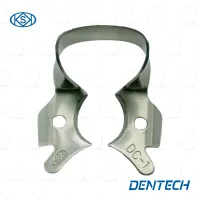
ksk dc-1 distal · winged · molar · matt
the distal box on the last standing molar is the hardest surface in the mouth to isolate and see at the same time. the distal clamp is drawn to open that specific access – dentech list it for molars in both the deciduous and permanent dentition, to reach the distal part of the tooth. matt finished, so it does not throw the operating light back at you while you work into a shadow.
this item: 1 × ksk distal rubber dam clamp dc-1, winged, matt
made by dentech, japan · matt finish · supplied singly
| distal access | drawn to reach the distal part of a molar |
| both dentitions | deciduous and permanent molars, per dentech |
| matt finish | sand-blasted, non-glossy – no glare back from the operating light |
› third molars specifically: the 12a and 13a pair.
› standard molar isolation: the 7a lower, the no.5 upper.
› seal and see – cerkamed rubber dam liquid at a distal margin, young's frame to keep the field open.
is a distal clamp only for a terminal tooth?
that is where it earns its place. on a tooth with a neighbour behind it, a conventional molar clamp and a well-punched dam usually give better access.
why matt rather than black?
dentech supply this pattern in matt. both matt and black are non-reflective; matt is sand-blasted steel, black is an oxide layer.
ksk winged distal clamp dc-1, matt · molar distal access · deciduous and permanent · winged · matt · dentech japan · mfr code 50030000 · ref rdbdc1


 Facebook
 X
 Instagram
 Pinterest
