

Best selection of Endodontic supplies in the UK




opacal® · calcium hydroxide dressing · 3 ml syringe
temporary root canal dressingtwo-visit endodonticsinterappointmentready to usenon-setting
a weeping canal, a patient who cannot come back for a fortnight, and a temporary that has to do the thinking while they are away. opacal® is a radiopaque, creamy, ready-to-use calcium hydroxide paste for temporary root canal dressing. pd's own statement of purpose is plain: it is intended to eliminate remaining microorganisms and prevent reinfection between appointments, and its main properties come from its alkaline ph.
| >12 ph | 300% of dentine | 3 ml syringe |
this pack: 1 × 3 ml syringe · 10 × single-use application tips · 1 × finger grip
made by produits dentaires sa, switzerland · class iia medical device, supplied non-sterile
everything a calcium hydroxide dressing does, it does by being strongly alkaline, and how fast it gets there depends on the vehicle. opacal is an aqueous, non-setting paste at 30% calcium hydroxide – the formulation type that releases its ions quickly rather than over months. that suits a dressing you mean to remove in a fortnight, and it is why it comes out easily: nothing has set.
opacal is an aqueous non-setting material. this characteristic induces rapid ionic release and performant action in short treatment time procedure. in addition, the paste can be easily removed.
— produits dentaires sa, on their own opacal pages
1 prepare, clean and dry the canal meticulously – the ifu's word, not ours.
2 clip the finger grip on, uncap, fit a new tip to the luer-lock, and test the flow onto a pad before going intraorally. never force the plunger.
3 fill from the apical portion outward, staying at least 2 mm shy of the apex, and adjust the volume to the anatomy rather than to habit.
4 seal with a temporary restorative for a tight seal between visits, then confirm the fill radiographically.
5 discard the tip, cap the syringe immediately so the paste does not dry in it, and disinfect the syringe.
6 remove it completely next visit – an endodontic file and a few drops of saline, per the ifu.
| composition | calcium hydroxide 30%, barium sulphate 24%, plus an excipient pd do not disclose |
| ph | above 12, in pd's wording. they publish no measured value |
| radiopacity | pd state more than 300% of the radiopacity of dentine; their earlier flyer gives the figure as greater than 3 mm aluminium |
| the tip | flexible, luer-lock, 20 mm long and angled at 110° on pd's flyer diagram |
| dressing period | pd give 1 to 3 weeks as usual; the ifu sets a maximum of 30 days |
| storage | 15 to 25 °c, protected from direct light. shelf life 3 years |
› tips are single use, per patient. discard after each treatment; a blocked tip is replaced rather than persuaded.
› the syringe is not. pd require it disinfected between every patient, but specify no agent or contact time – use your own validated protocol.
› two millimetres shy of the apex, stated twice in the ifu – in the directions, and again as an extrusion precaution.
› it is a strong alkali. calcium hydroxide is a skin irritant that can cause serious eye damage; pd ask for rubber dam, safety glasses and a waterproof bib for the patient, and gloves, mask and goggles for the operator.
› undesirable effects: the ifu records none known or foreseen when the product is used as intended.
worth being straight about this. the figures above – ph, radiopacity, ionic release – are produits dentaires' own, and pd publish no test data behind them. the one reference they cite is fava and saunders' classification of calcium hydroxide pastes (int endod j 1999), a review of the category rather than a study of this product, cited to support the general point that aqueous non-setting vehicles release their ions quickly. there is no independent published work on opacal itself. none of which makes it a poor choice – a 30% aqueous calcium hydroxide paste does what the category has done for decades – but buy it as a well-made example of a familiar material, not as something with a trial behind it.
how is it delivered – do i need a spiral filler?
pd's method is the syringe and its own tip, and that is the only delivery route their instructions describe: fit the tip, fill from the apical portion outward, stop 2 mm short. they do not discuss any other technique.
how long can it stay in?
pd describe the usual temporisation as one to three weeks. the ifu is firmer about the outer limit: as a temporary root canal dressing, the maximum duration of treatment should be 30 days.
will i get it all out again?
it is non-setting and water-based, and the ifu asks for complete removal at the next appointment with an endodontic file and a few drops of saline. saline specifically – pd name no other solution here.
| isolate | oraseal™ caulking – pd ask for rubber dam with this material, and a dam that weeps is not isolation |
| irrigate | chlorax 5.25% sodium hypochlorite · 5 × 200 ml |
| deliver it | irriflex® with endostops – flexible 30g needle for the curve the dressing must reach past |
| final rinse | endo-solution 17% edta · 200 ml |
| dry it first | reciproc® paper points r25 · 144 – the ifu wants the canal dry first |
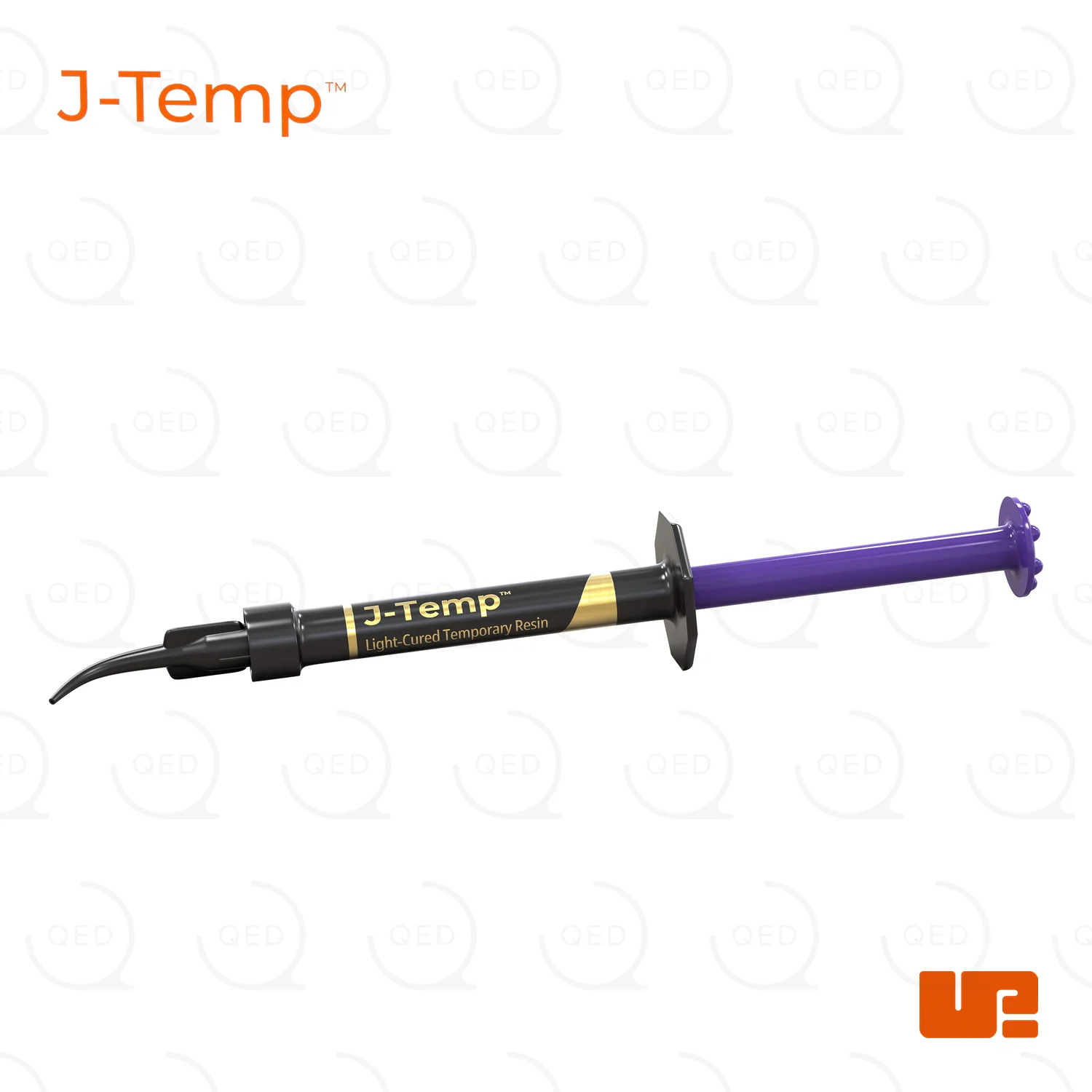
| seal it in | j-temp™ temporary resin – radiopaque, so the film confirms the temporary as well as the dressing |
| longer intervals | bio-c® temp · 4 × 0.5 g – a premixed bioceramic dressing, for gaps running past opacal's 30-day maximum |
| the same material, differently | calcipast calcium hydroxide · 4 × 2.1 g – the same material in a four-syringe pack, if that suits you better |
opacal® · radiopaque calcium hydroxide dressing · calcium hydroxide 30%, barium sulphate 24% · ph above 12 · aqueous, non-setting · 3 ml syringe with 10 single-use tips and a finger grip · class iia · produits dentaires sa, switzerland · ref 11020

sdr® flow+ · universal shade · 15 compules
post-endodontic corebase or liner, class i and iiclass iii and vpit and fissure sealing
how much of the outcome is still in your hands once the last cone is down? and why fill the access cavity with something that shrinks away from the seal you have just placed? sdr® flow+ is a low-viscosity bulk fill composite that self-levels into the chamber and around the orifices, and is designed to be cured in increments up to 4 mm. the chamber is an awkward shape to fill – undercuts, a pulpal floor you cannot see into, orifice plugs you would rather not disturb – and a self-levelling material finds that geometry without condensation.
| 4 mm bulk increment | 20 s cure at 4 mm | 2.6 mm al radiopacity |
this pack: 15 × 0.25 g compula® tips, universal shade
made by dentsply sirona · mfr code 60603040
| increment | cured in increments up to 4 mm depth, per the directions for use |
| cure | 20 s at 4 mm in the universal shade at 550 to 1000 mw/cm2; the a shades need 40 s. minimum output 550 mw/cm2 |
| filler | total filler 47.3% by volume (ifu); 70.5% by weight per dentsply's scientific manual |
| radiopacity | approximately 2.6 mm al – it reads on a post-operative film |
› a base, not the finished surface in a load-bearing class i or ii – the ifu caps it occlusally with a universal or posterior composite.
› watch the eugenol. the ifu says to avoid eugenol and hydrogen peroxide – worth remembering if a zoe sealer or an irm-type temporary has been near the chamber.
› not for known methacrylate hypersensitivity, and not alongside mineral-impregnated retraction cord.
dentsply describe sdr as combining that large molecular structure with a chemical group they call a “polymerization modulator”, embedded in the centre of the polymerisable resin backbone of the sdr monomer.
— dentsply sirona, sdr® flow+ scientific manual, 2017. the same document puts volumetric shrinkage at 3.5%, and attributes an approximately 80% reduction in polymerisation stress against conventional methacrylate resins to its own internal data.
van dijken and pallesen followed 49 paired class ii restorations in 38 patients for six years, sdr under a capping composite against conventional layering, and reported an annual failure rate of 1% in both groups (eur j oral sci 2017;125:303–9). el-damanhoury and platt recorded bottom-to-top hardness above 90% at 4 mm (oper dent 2014;39:374–82). the honest reading: as good as careful incremental layering, not better – and in less chair time.
can i finish the restoration in sdr flow+ alone?
not in a load-bearing class i or ii – the ifu has it capped by a universal or posterior composite. conservative class i, class iii and v restorations and core build-ups are listed as full indications.
does my curing light have enough output?
it needs at least 550 mw/cm2, and the 20 s figure assumes 550 to 1000 mw/cm2. a radiometer check is worth thirty seconds – a tired unit is the usual reason a 4 mm increment cures short.
| shape and restore | reciproc® blue and sdr flow+ procedure kit – 30 r25 files and 30 compules on one code, or the same kit with a free adhesive while that offer runs |
| shape | waveone® gold and sdr flow+ kit – the same pairing on the reciprocating single-file sequence, or the treatment solution box with its own matched cones and points |
| dry | reciproc® paper points r25 · 144 – matched to the r25 preparation |
| fill | reciproc® blue gutta percha r25 · 60 – the cone that matches the file that cut the canal |
| seal the orifice | neoputty® · 0.5 g kit – a premixed bioceramic barrier under the build-up, and for a perforation or open apex |
| between visits | j-temp™ – when the definitive build-up waits for a second appointment |
sdr® flow+ universal · bulk fill flowable composite · self-levelling · 4 mm increment, 20 s cure · 2.6 mm al · 15 × 0.25 g compula® tips · dentsply sirona · ref 60603040
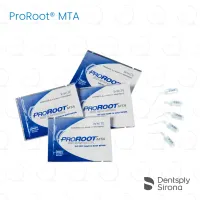
proroot® mta · white · 4 × 0.5 g
root-end fillingperforation repairapexificationpulp cappingpulpotomy, primary teeth
proroot® mta is dentsply sirona’s mineral trioxide aggregate – a fine, hydrophilic powder that sets in the presence of moisture into what their directions call “a strong impermeable barrier”. four 0.5 g pouches, each with its own water ampoule, so every case is mixed fresh and nothing is left open on the shelf.
| 4 mm al min. radiopacity, ifu | ~3 min working time, ifu | > 24 mpa compressive, ifu |
this pack: proroot® mta root canal repair material, white – 4 pouches of 0.5 g powder and 5 ampoules of 0.18 g water · dentsply sirona ref a040500000300
single use · non-sterile, do not sterilise · shelf life 3 years
› six indications in one material. dentsply sirona’s directions list root-end filling, the apical plug in apexification, perforation repair during root canal therapy, repair after internal resorption, pulp capping and pulpotomy of primary teeth.
› sets in a wet field. the powder hydrates to a colloidal gel that, in the directions’ words, “solidifies to form a strong impermeable barrier”. moisture is part of the chemistry, not an enemy of it.
› unit dose. each 0.5 g pouch is matched to a 0.18 g micro-dose water ampoule, so the powder-to-liquid ratio is set by the pack, not the clock. the four-pouch box carries one spare ampoule.
› radiopaque. at least 4 mm of aluminium equivalent (ifu), so placement can be confirmed on the radiograph the directions ask for.
› a permanent part of the filling. in perforation repair and apexification the directions leave the set mta in place and obturate the remaining canal on top of it.
dentsply sirona call it “the first name in root repair”, and on a bench of newer bioceramics it is still the material the others describe themselves against. what you are buying is a known quantity: a composition published in the directions, six indications set out step by step, and a pack that controls the one variable mta punishes – the water.
the four-pouch box suits a practice that places mta occasionally – a perforation here, a pulp cap there – because each pouch stays sealed until the case needs it. the directions insist on that: kept in its sealed packaging and stored dry, because moisture is what sets it. for regular use, the 10 × 0.5 g box is the lower cost per pouch.
proroot® mta root repair material is a powder consisting of fine, hydrophilic particles that set in the presence of moisture. hydration of the powder creates a colloidal gel that solidifies to form a strong impermeable barrier that fully cures over a four-week period.
dentsply sirona, proroot® mta instructions for use (europe, 2025-08)
| material | mineral trioxide aggregate – a fine, hydrophilic powder that sets in the presence of moisture |
| composition | tri- and dicalcium silicates 69–74%, bismuth oxide 17–22%, minor components 2–7% (calcium aluminate, aluminoferrite and sulphate, and others) |
| shade | white (tooth-coloured) |
| mixing | one 0.5 g pouch with one 0.18 g water ampoule, about a minute on the pad |
| cure | checked for hardness after four hours; fully cures over four weeks |
| shelf life | 3 years; store dry, below 30 °c, away from sunlight |
| contraindications | none known |
mixing (all indications). dispense a pouch onto the pad, pull the end off an ampoule and squeeze it out alongside, bring the liquid in gradually and mix for about a minute. it does not set as quickly as other cements – careful mixing is what makes it easy to handle.
1perforation repair, and repair after internal resorption. under dam: debride and irrigate with hypochlorite (for resorption, a week of calcium hydroxide first), dry, and obturate the canal apical to the defect. carry the mta into the defect, compact it with a small plugger, cotton pellet or paper point, and confirm on a radiograph.
2apexification. after a week of calcium hydroxide, carry and compact a three to five millimetre apical barrier, confirm it radiographically, and leave a moist pellet under a temporary.
3after either: at four hours or the next visit, check the mta is hard (if not, rinse and repeat), then obturate the rest of the canal. the mta stays as a permanent part of the filling.
4root-end filling. resect, prepare a class i root-end cavity three to five millimetres deep with an ultrasonic tip, achieve haemostasis, dry, then place and compact the mta, clean the root surface and confirm on a radiograph.
5pulp capping. rinse the exposure with hypochlorite, place a small amount of mta over it, blot the excess moisture, cover it with a light-cured liner, then etch, bond and restore. review sensibility every six months.
6pulpotomy of primary teeth. remove the coronal pulp, achieve haemostasis with pressure, place mta over the pulp stumps and chamber floor to an even three to four millimetres, fill the chamber and restore – the directions finish with a stainless-steel crown.
these are summaries. the directions carry every step, and the materials they name at each stage, in full – see downloads.
how much water, and what if it is too wet or too dry?
use the ampoule supplied with each pouch and mix for about a minute so every particle is hydrated. the directions allow a little extra water – the spare ampoule, or usp purified water – to reach the consistency you want, and they warn that too much or too little liquid reduces the final strength. if the mix starts to dry on the pad, cover it with moist gauze rather than adding more water.
will it discolour the tooth?
the directions are candid about it: a slight discolouration may appear in the months after treatment, and in an aesthetic zone they ask the clinician to weigh the procedure, the surface area exposed and the other restorative materials used.
how long before i can restore over it?
for perforation repair and apexification the directions place a moist pellet and a temporary for at least four hours, then check the mta is hard – at that visit or a later one – before obturating the rest of the canal. for pulp capping they cover it straight away with a light-cured liner, then bond and restore in the same visit.
can i use a pouch across two patients?
no. proroot mta is single use and single patient, and the directions say to place it immediately after mixing; once set it cannot be used again. that is what the 0.5 g unit dose is for.
4 × 0.5 g or 10 × 0.5 g?
same material, same pouch, same ampoule. the four-pack carries one spare ampoule for adjusting a mix; the ten-pack is the lower cost per pouch for practices placing mta every week.
| isolation | qed non-latex dam – the directions use dental dam at every stage. |
| irrigants | chlorax 5.25%, chlorax 2% and endo-solution 17% edta. |
| interim dressing | ultracal xs, calcipast and opacal – calcium hydroxide, which the resorption and apexification protocols place for a week. |
| drying | mmpp paper points 15–40 – or the matched points for your file system. |
| delivery | vista mta carriers 0.80 mm, 0.99 mm and 1.60 mm · cerkamed mta applicator 0.80 mm and 1.20 mm. |
| compaction | penn micro-plugger 060, 100 · root-end: endoblack retroplugger 050, 075. |
| obturation | proroot bio sealer – dentsply sirona’s bioceramic sealer on the same calcium silicate chemistry · ah plus – the epoxy alternative. |
| bonding | prime&bond active – dentsply sirona’s universal adhesive. |
| coronal seal | sdr flow+ refill universal – 4 mm bulk increment, one cure. |
| also in stock | neomta 2 and neoputty – avalon biomed’s bioceramic repair materials, a different formulation and handling. |
› proroot® mta instructions for use (pdf, 1.1 mb, multilingual, dentsply sirona) – the current european edition (2025-08), on dentsply sirona’s site. english is the first section.
indications, composition, physical properties, precautions, adverse reactions, storage and every step above are from dentsply sirona’s proroot® mta instructions for use (end-ifu-proroot-mta-tds-v05, europe, 2025-08; english section, spelling anglicised). “the first name in root repair” is dentsply sirona’s own line. technique is theirs; the clinical decision is yours – we make no claim of our own about seal, healing or outcome. proroot, ah plus, sdr and prime&bond are dentsply sirona trademarks; neomta and neoputty are avalon biomed trademarks.
proroot® mta · root canal repair material, white · 4 × 0.5 g pouches + 5 × 0.18 g water ampoules · dentsply sirona · ref a040500000300
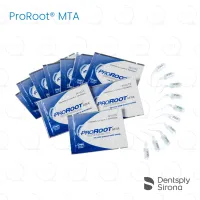
proroot® mta · white · 10 × 0.5 g
root-end fillingperforation repairapexificationpulp cappingpulpotomy, primary teeth
ten single-patient pouches of dentsply sirona’s mineral trioxide aggregate, each with its own 0.18 g water ampoule. the lower cost per pouch, for practices that place mta every week – perforations, apical plugs, root-end fillings and pulp caps.
| 4 mm al min. radiopacity, ifu | ~3 min working time, ifu | > 24 mpa compressive, ifu |
this pack: proroot® mta root canal repair material, white – 10 pouches of 0.5 g powder and 10 ampoules of 0.18 g water · dentsply sirona ref a040500000400
single use · non-sterile, do not sterilise · shelf life 3 years
› six indications in one material. dentsply sirona’s directions list root-end filling, the apical plug in apexification, perforation repair during root canal therapy, repair after internal resorption, pulp capping and pulpotomy of primary teeth.
› sets in a wet field. the powder hydrates to a colloidal gel that, in the directions’ words, “solidifies to form a strong impermeable barrier”. moisture is part of the chemistry, not an enemy of it.
› unit dose. each 0.5 g pouch is matched to a 0.18 g micro-dose water ampoule, so the powder-to-liquid ratio is set by the pack, not the clock. the four-pouch box carries one spare ampoule.
› radiopaque. at least 4 mm of aluminium equivalent (ifu), so placement can be confirmed on the radiograph the directions ask for.
› a permanent part of the filling. in perforation repair and apexification the directions leave the set mta in place and obturate the remaining canal on top of it.
it is the same material, the same 0.5 g pouch and the same unit-dose ampoule as the 4 × 0.5 g box – the difference is volume. each pouch stays sealed until the case needs it, which is what the directions ask for: kept in its sealed packaging and stored dry, because moisture is what sets it. with a three-year shelf life, a ten-pack is a sensible stock item for any practice doing its own perforation repairs and pulp caps.
dentsply sirona call it “the first name in root repair”. the case for it is a known quantity: a composition published in the directions, six indications set out step by step, and a pack that controls the water.
| material | mineral trioxide aggregate – a fine, hydrophilic powder that sets in the presence of moisture |
| composition | tri- and dicalcium silicates 69–74%, bismuth oxide 17–22%, minor components 2–7% (calcium aluminate, aluminoferrite and sulphate, and others) |
| shade | white (tooth-coloured) |
| mixing | one 0.5 g pouch with one 0.18 g water ampoule, about a minute on the pad |
| cure | checked for hardness after four hours; fully cures over four weeks |
| shelf life | 3 years; store dry, below 30 °c, away from sunlight |
| contraindications | none known |
dispense a pouch onto the pad, pull the end off an ampoule and squeeze it out alongside, bring the liquid in gradually and mix for about a minute. carry it into place, compact it, and confirm on a radiograph. in perforation repair and apexification (a three to five millimetre apical barrier), leave a moist pellet under a temporary and check the mta is hard at four hours or the next visit before obturating the rest of the canal. in pulp capping, cover it with a light-cured liner and restore in the same visit.
each indication is set out step by step on the 4 × 0.5 g page and in full in the directions – see downloads.
how much water, and what if it is too wet or too dry?
use the ampoule supplied with each pouch and mix for about a minute so every particle is hydrated. the directions allow a little extra water – the spare ampoule, or usp purified water – to reach the consistency you want, and they warn that too much or too little liquid reduces the final strength. if the mix starts to dry on the pad, cover it with moist gauze rather than adding more water.
will it discolour the tooth?
the directions are candid about it: a slight discolouration may appear in the months after treatment, and in an aesthetic zone they ask the clinician to weigh the procedure, the surface area exposed and the other restorative materials used.
how long before i can restore over it?
for perforation repair and apexification the directions place a moist pellet and a temporary for at least four hours, then check the mta is hard – at that visit or a later one – before obturating the rest of the canal. for pulp capping they cover it straight away with a light-cured liner, then bond and restore in the same visit.
can i use a pouch across two patients?
no. proroot mta is single use and single patient, and the directions say to place it immediately after mixing; once set it cannot be used again. that is what the 0.5 g unit dose is for.
| isolation | qed non-latex dam – the directions use dental dam at every stage. |
| irrigants | chlorax 5.25%, chlorax 2% and endo-solution 17% edta. |
| interim dressing | ultracal xs, calcipast and opacal – calcium hydroxide, which the resorption and apexification protocols place for a week. |
| drying | mmpp paper points 15–40 – or the matched points for your file system. |
| delivery | vista mta carriers 0.80 mm, 0.99 mm and 1.60 mm · cerkamed mta applicator 0.80 mm and 1.20 mm. |
| compaction | penn micro-plugger 060, 100 · root-end: endoblack retroplugger 050, 075. |
| obturation | proroot bio sealer – dentsply sirona’s bioceramic sealer on the same calcium silicate chemistry · ah plus – the epoxy alternative. |
| bonding | prime&bond active – dentsply sirona’s universal adhesive. |
| coronal seal | sdr flow+ refill universal – 4 mm bulk increment, one cure. |
| also in stock | neomta 2 and neoputty – avalon biomed’s bioceramic repair materials, a different formulation and handling. |
› proroot® mta instructions for use (pdf, 1.1 mb, multilingual, dentsply sirona) – the current european edition (2025-08), on dentsply sirona’s site. english is the first section.
indications, composition, physical properties, precautions, adverse reactions, storage and every step above are from dentsply sirona’s proroot® mta instructions for use (end-ifu-proroot-mta-tds-v05, europe, 2025-08; english section, spelling anglicised). “the first name in root repair” is dentsply sirona’s own line. technique is theirs; the clinical decision is yours – we make no claim of our own about seal, healing or outcome. proroot, ah plus, sdr and prime&bond are dentsply sirona trademarks; neomta and neoputty are avalon biomed trademarks.
proroot® mta · root canal repair material, white · 10 × 0.5 g pouches + 10 × 0.18 g water ampoules · dentsply sirona · ref a040500000400
waveone® gold + sdr® flow+ · 15 procedure blisters
per-case costingscout, glide, shapepost-endodontic build-up
how much of your endodontic stock control is really cost control? counting part-used file packs across patients tells you very little. each blister here is one patient's instrument set – a #10 k-flexofile to scout, a gold glider to expand the glide path, a primary to shape – so the per-case figure is the invoice divided by fifteen. alongside them, sdr® flow+ for the restoration that finishes each case.
this kit: 15 × sterile procedure blisters – each holding 1 × #10 k-flexofile, 1 × waveone® gold glider and 1 × waveone® gold primary · 1 × sdr® flow+ refill universal, 15 × 0.25 g compula® tips
made by dentsply sirona
| 15 cases boxed | 15 compules | 4 mm bulk increment |
scout, glide, shape. dentsply's directions for use put a hand-file glide path first – to at least an iso 010, patency confirmed – which is why a k-flexofile is sealed in with the two reciprocating instruments rather than left to the drawer. nothing in the blister is optional.
one set per patient also settles a quieter question: every case starts factory-sterile, on instruments that have cut nothing else.
the root filling is not the end of the case; the coronal seal is. sdr® flow+ is a bulk-fill flowable base and core build-up material – not an obturation material – placed in increments up to 4 mm, self-levelling to the cavity floor. in a load-bearing cavity it is capped with your usual universal composite, per the dentsply sirona instructions for use. fifteen blisters, fifteen compules – one per case, so the box runs out evenly.
| per blister | #10 k-flexofile · waveone® gold glider · waveone® gold primary – sterile, single patient |
| alloy | glider and primary both gold heat-treated nickel-titanium, pre-bendable (waveone® gold scientific manual) |
| motion | reciprocating – one waveone setting for both instruments |
| restorative | 15 × sdr® flow+ universal compula® tips – base and core build-up, increments to 4 mm, capped in load-bearing cavities |
› not a complete case – sealer, cones, points and irrigant are separate. this kit covers shaping and the build-up.
› matched fill still applies – a primary preparation wants a primary cone and primary points.
› why bundle files with a restorative? because they are used in the same appointment. a shaped canal under a temporary dressing is not a finished case, and sdr® flow+ is indicated for the build-up that follows.
› what if the primary is the wrong size? then you have gauged properly, which is the point. drop to small or step up from shelf stock – the blister covers the standard case, not every case.
| other sizes | small · medium · large, all 25 mm |
| dry and fill | paper points primary (180) · conform fit® gp primary (60) |
| restorative refill | sdr® flow+ refill universal · 15 compula® tips |
| whole system | treatment solution box · every size, plus the matched fill |
| a motor | x-smart® pro+ with apex locator · vdw.silver®reciproc® · x-smart® go |
waveone® gold + sdr® flow+ kit · 15 sterile procedure blisters · #10 k-flexofile, gold glider and gold primary in each · 15 × sdr® flow+ universal compula® tips · reciprocating, one motor setting · dentsply sirona · mfr code b00wsdrr2ckit

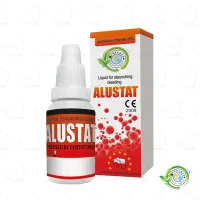
cerkamed alustat · liquid · 10 ml
gingival bleedingswollen gingivabefore impressionsdentist use only
alustat is cerkamed's 25% aluminium chloride liquid for the slight gingival bleeding that gets in the way of an impression, a matrix or a bond. cerkamed's description: aluminium chloride "has the vasoconstrictive effect on tiny blood vessels, as a result of which the gingival swelling and slight bleedings decrease". a dropper bottle, so it goes onto a cotton pellet rather than out of a syringe.
this pack: cerkamed alustat haemostatic liquid, 10 ml bottle with dropper · 25% aluminium chloride
| active | aluminium chloride 25%, water ph. eur., excipients |
| use | to staunch slight gingival bleeding and reduce gingival swelling during dental treatment |
| how it is applied | cerkamed: rub the swollen or injured gingiva with a cotton wool tampon soaked in alustat, rinse with clean water; contact time up to 5 minutes |
| presentation | 10 ml bottle with dropper |
| also in the range | alustat gel (syringe, 25%) · alustat foam (syringe, 20%) |
› cerkamed: "rub gently the swollen or injured gingiva with a cotton wool tampon soaked in alustat and rinse with clean water. repeat if necessary."
› cerkamed caution that it must be removed before an impression is taken, "to avoid inhibiting the polymerisation of the impression material", and that aluminium chloride "can adversely affect the bonding strength of dentin to tooth restoration materials" – rinse well before you bond.
› practical shelf life: stored below 25°c and resealed after each use, cerkamed state the expiry date does not change once opened.
› cerkamed mark the product "to be used by dentist only".
same chemistry, three ways of getting it to the tissue. the liquid goes on a pellet and suits a broad area of weeping gingiva. alustat gel comes in a syringe with fine applicators for a sulcus or a single papilla. alustat foam is 20% aluminium chloride in a foam that cerkamed also direct for tissue retraction, on its own or over a retraction cord. cerkamed give all three the same contact time of up to 5 minutes for the liquid and gel and 2 minutes for the foam.
cerkamed list one: "do not use for patients who are hypersensitive to the product components." they also note the product "has cytotoxic potential" and that aluminium chloride products "may cause local and temporary tissue damage" – keep it to the bleeding site and rinse.
| haemostasis, in a syringe | alustat gel · alustat foam |
| chemical cautery | tcadent – 35% trichloroacetic acid for a granulating lesion, not a bleed |
| gingival protection | rubber-dam liquid – light-cured barrier before etching or whitening |
| applicators | elastic applicator tips (20) · black applicator tips (10) |
alustat · 25% aluminium chloride · 10 ml dropper bottle · made by cerkamed, stalowa wola, poland · ref cer-w-al
*Short Shelf Life*
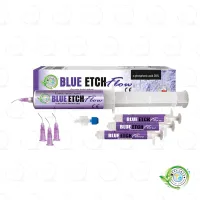
cerkamed blue etch flow · 36% phosphoric acid · 10 ml
enamel and dentine etchingfissure sealingfibre post cementationdentist use only
blue etch flow is cerkamed's 36% orthophosphoric acid in a semi-solid, thixotropic gel: it flows into a fissure under the applicator and stops flowing when the applicator stops. cerkamed's intended use: "etching dentine and enamel fissures prior to composites and cavity seals", and "also recommended for use before cementing glass fibre crown and root inlays". the 10 ml is a reservoir syringe with a dispenser to fill from it.
this pack: cerkamed blue etch flow, 10 ml syringe with connector, delivery syringe (dispenser) and 2 delivery tips · 36% o-phosphoric acid
| active | o-phosphoric acid 36%, gel base, dye |
| use | etching dentine and enamel before composite, fissure sealant, and fibre post or inlay cementation |
| etch time | cerkamed: no longer than 60 seconds; then irrigate with a strong air and water stream for about 15–20 seconds; do not over-dry |
| preparing the 10 ml | cerkamed: swap the white cap for the connector, screw on the dispenser, pump no more than 2 ml into it, fit the metal applicator; leave the connector on the reservoir under its blue cap |
| presentation | 10 ml syringe, connector, dispenser, disposable applicators |
› cerkamed: "apply a thin layer of the etchant onto the dried surface. etch no longer than 60 seconds. irrigate with a strong air stream and water (about 15-20 seconds). do not over-dry." and if the enamel is not clean, repeat.
› on the consistency, cerkamed: "with its carefully formulated semi-solid consistence, blue etch flow reaches inaccessible dental grooves and fissures."
› if the gel is slow to pump into the dispenser, cerkamed: "move the plunger of the syringe with the product several times. the preparation will dilute due to its thixotropic properties."
› cerkamed: "causes severe skin burns and eye damage." cofferdam, gloves, goggles; and their note that etchants "may involve with post-operative hypersensitivity, resulting in temporary pain".
› cerkamed mark the product "to be used by dentist only".
at the end of the case. the coronal seal goes on etched enamel, and a fibre post goes into an etched canal – cerkamed name "glass fibre crown and root inlays" as an indication. it also earns its place next to rubber-dam liquid, since a gingival barrier goes on before the etch does.
cerkamed make 2 ml single syringes, a monster pack of ten 2 ml, and 10 ml and 50 ml reservoirs. the 10 ml with its dispenser is the practice size we stock; ask us about the 2 ml.
| gingival protection first | rubber-dam liquid |
| isolation | irriflex |
| replacement tips | elastic applicator tips (20) |
| haemostasis | alustat gel |
blue etch flow · o-phosphoric acid 36% · 10 ml with connector, dispenser and tips · etch up to 60 s · made by cerkamed, stalowa wola, poland · ref cer-w-wfd
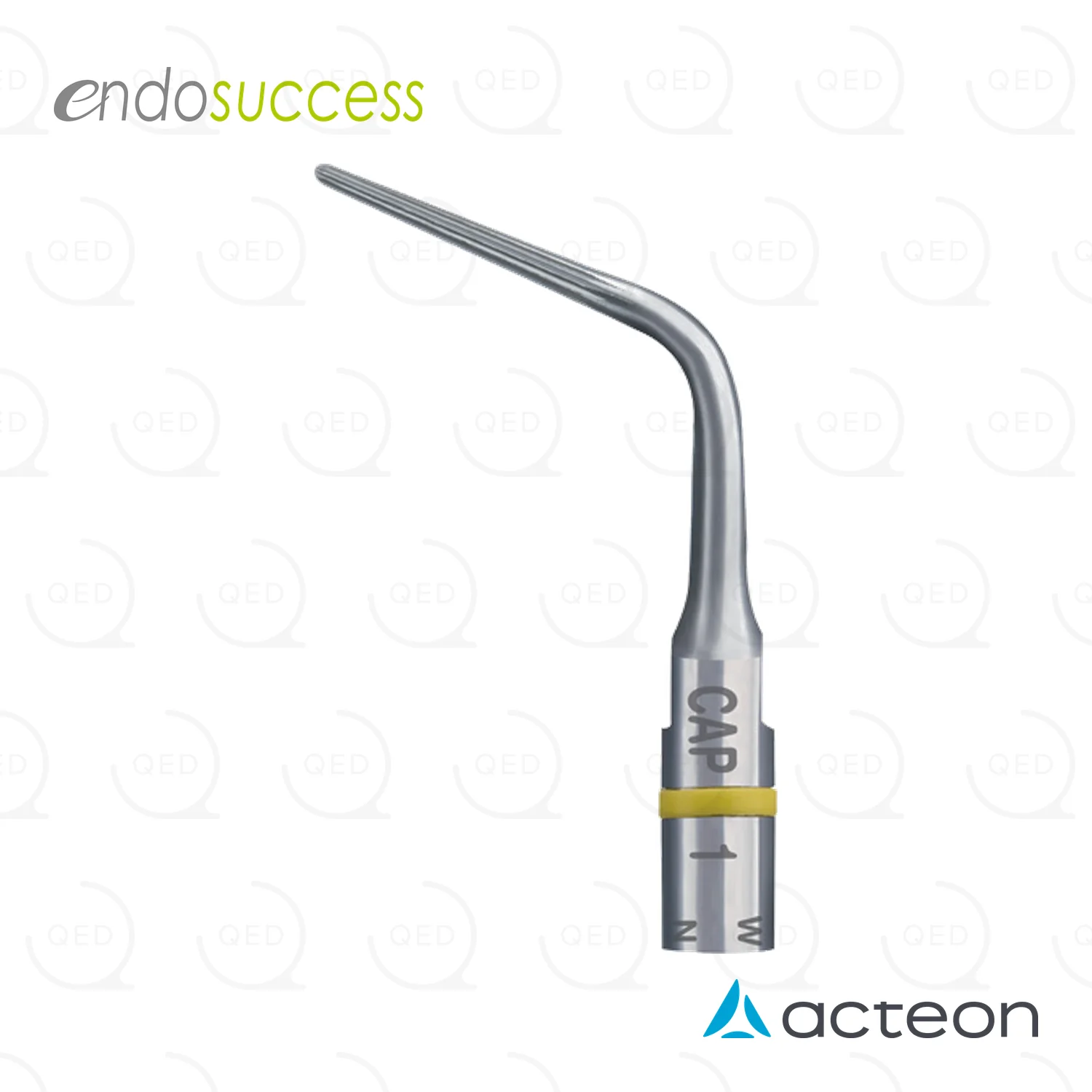
acteon endo success™ · cap1 · canal access preparation
canal access preparationultrasonic tipnewtron®
finishing the access. cap1 is the first of acteon’s three canal access preparation micro-blade tips. the tip sheet describes a “micro-blade tip for the removal of temporary cement and dentinal residues and overhangs”; the brochure adds finishing and polishing walls, used with the active lateral part, and a non-active end.
this pack: 1 × acteon endo success™ cap1 ultrasonic tip · ref f88181
made by satelec, a company of the acteon group, mérignac, france
| acteon reference | cap1 |
| geometry | 12 mm micro-blade, 6% taper |
| material | micro-blade (striated) steel |
| indication | endodontic cavity access preparation (acteon tip sheet) |
| power setting | 10 on a newtron® generator, per acteon’s tip sheet · the colour ring on the tip matches the power zone (colour coding system™) |
| classification | class iia medical device |
| also in | endo success™ cap kit |
› clean, disinfect and sterilise before each use, following acteon’s cleaning, disinfection and sterilisation instructions for tips (j02001).
› replace at least once a year. acteon: because a maximum number of uses cannot be set, tips in routine use should be “replaced at least once a year”, and sooner if the tip no longer vibrates as expected or treatment slows.
› watch the site for heat. acteon’s tip sheets state that the practitioner has to continually monitor the clinical site to immediately identify any heating risk.
which generator does it fit?
acteon’s tip sheet gives settings for the newtron® range, including the p5 xs b.led and booster. acteon advise against using their tips on other makers’ handpieces, and other makers’ tips on theirs.
what temperature can i sterilise at?
acteon (satelec) have certified that endo success cap and apical surgery tips can be sterilised with prevacuum steam at 137°c/138°c (attestation, september 2016). follow the cleaning instructions first.
| the other cap tips | cap2 · cap3 |
| the kit | endo success™ cap kit |
| diamond alternatives | et18d · etbd |
| generators | newtron® p5 xs b.led · newtron® booster |
| tools | acteon universal wrench · autoclavable tip stand |
acteon endo success™ cap1 · 12 mm micro-blade, 6% taper · canal access preparation · newtron® power 10 · satelec / acteon · ref f88181
special offer · adhesive included free
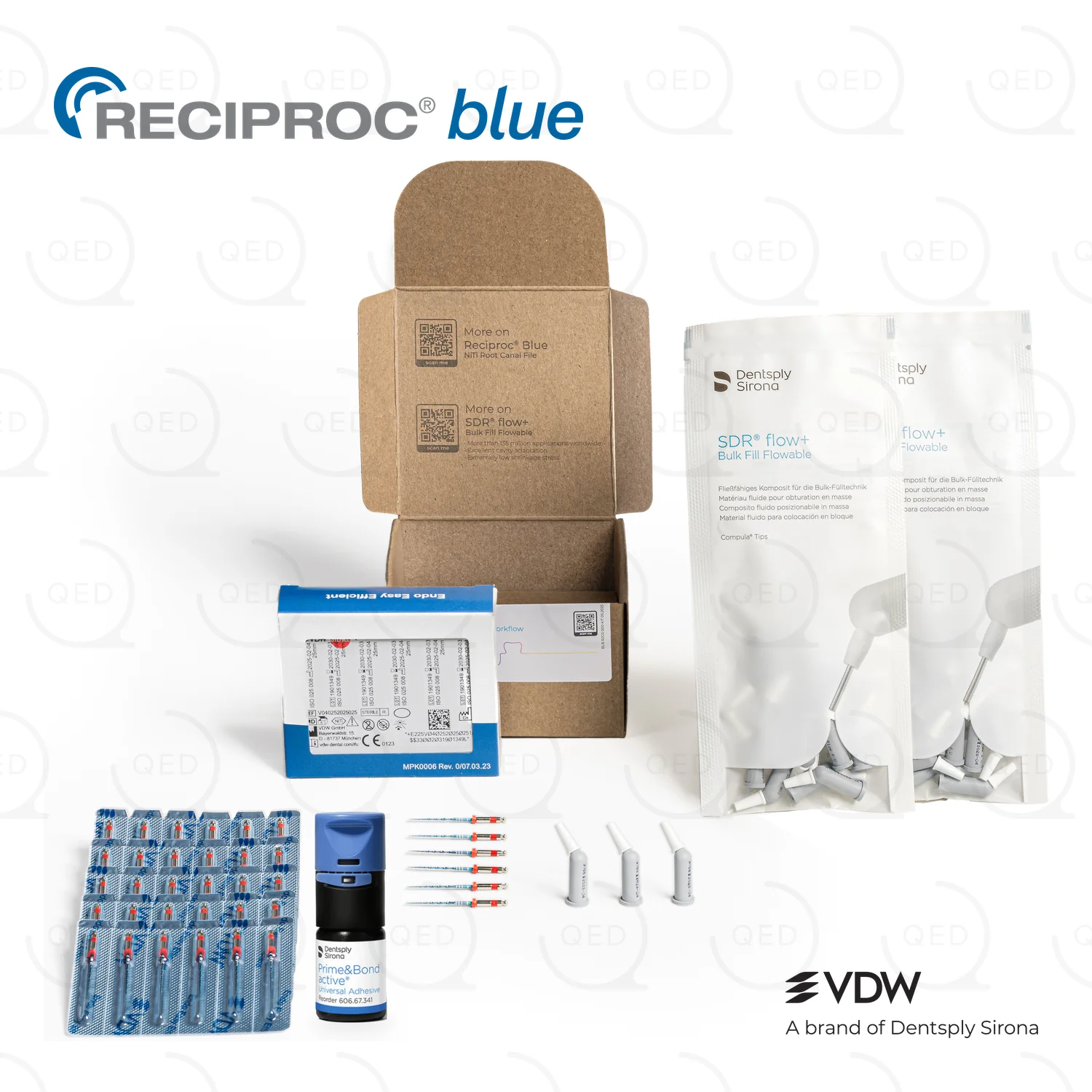
three order lines for one root-filled molar? files from one shelf, compules from another, and the adhesive that turns out to be empty at the wrong moment? this kit puts the back end of the appointment on one code – single-file shaping, a bulk fill build-up for the access cavity, and the adhesive that bonds one to the other, with the prime&bond active bottle free of charge while stocks last.
this kit: 5 × reciproc® blue r25 25 mm (30 files) · 2 × sdr® flow+ refill universal (30 compules) · 1 × prime&bond active® 4 ml, free of charge
made by vdw and dentsply sirona
| the free item | one 4 ml bottle of prime&bond active, the same standard refill sold on its own – while stocks last |
| what it covers | r25 single-file shaping at 25 mm, then a bulk fill base and core build-up cured 4 mm at a time |
| not included | paper points, cones and sealer – it shapes and restores, it does not obturate |
› shape, bond, rebuild – the part of the appointment that decides whether your obturation stays sealed.
› one caution carries through all three: the adhesive and the composite are both contraindicated alongside eugenol-containing materials, so a zoe sealer or an irm-type temporary changes the plan.
how does this differ from the standard kit?
by one bottle. files and compules are identical to the reciproc blue and sdr flow+ procedure kit; this code adds a 4 ml prime&bond active free while the offer runs.
is the composite the obturation material?
no. sdr flow+ is a restorative base and core build-up material – it fills the access cavity after obturation. the canal still needs cones, points and a sealer.
| dry | reciproc® paper points r25 · 144 – matched to the r25 preparation |
| fill | reciproc® blue gutta percha r25 · 60 – the cone that matches the file in this kit |
| top up | sdr® flow+ refill universal – when the compules run out first |
reciproc® blue, sdr® flow+ & prime&bond · 30 r25 25 mm files · 30 sdr flow+ compules · 4 ml adhesive free of charge · vdw and dentsply sirona · ref sp_b00rsdrr2ckit · while stocks last
special offer · adhesive included free
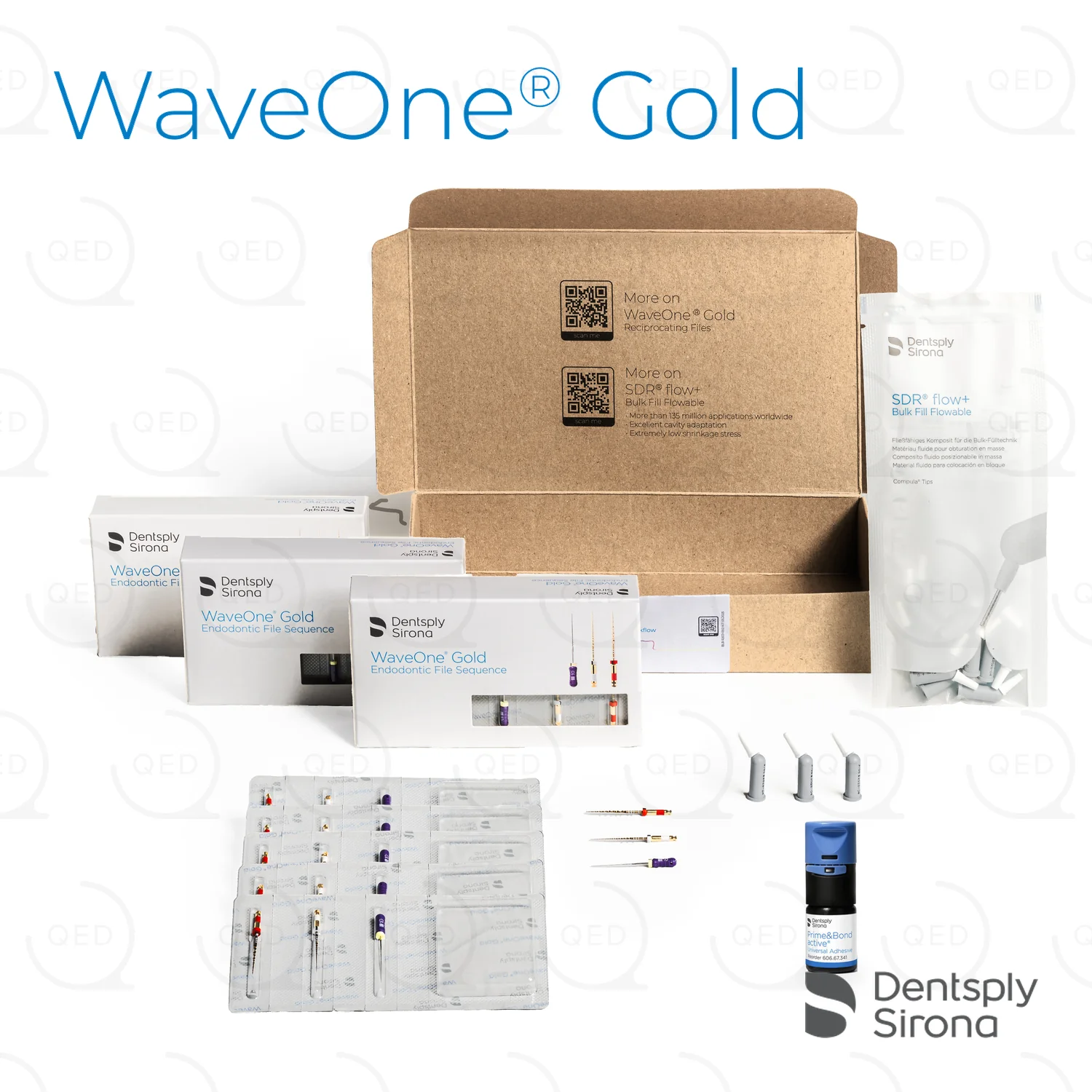
the canal is shaped, the root filling is down – and the access cavity is still open. what is bonding the build-up? this code is the waveone® gold and sdr® flow+ kit with a bottle of prime&bond active® added free of charge while stocks last – the shaping, the coronal seal and the adhesive between them, on one order line.
this kit: 15 × sterile procedure blisters – each holding 1 × #10 k-flexofile, 1 × waveone® gold glider and 1 × waveone® gold primary · 1 × sdr® flow+ refill universal, 15 × 0.25 g compula® tips · 1 × prime&bond active® 4 ml, free of charge
made by dentsply sirona
| the free item | one 4 ml bottle of prime&bond active, the same standard refill sold on its own – while stocks last |
| what it covers | scout, glide and shape from one sterile blister per patient, then a bulk fill build-up cured 4 mm at a time |
| not included | paper points, cones, sealer and irrigant – it shapes and restores, it does not obturate |
› the blister is the sequence – scout, glide, shape, sealed together. every case starts on instruments that have cut nothing else.
› one caution carries through both added materials: the adhesive and the composite are each contraindicated alongside eugenol-containing materials – a zoe sealer or an irm-type temporary changes the plan.
how does this differ from the standard kit?
by one bottle. blisters and compules are identical to the waveone gold and sdr flow+ kit; this code adds a 4 ml prime&bond active free while the offer runs.
is the composite the obturation material?
no. sdr® flow+ is a bulk-fill flowable base and core build-up material – it fills the access cavity after obturation, capped with your usual universal composite in a load-bearing cavity. the canal still needs cones, points and a sealer.
| irrigation | chlorax 5.25% · chlorax 2% · irriflex® 30g · smartlite® pro endoactivator |
| dry | waveone® gold paper points primary · 180 – matched to the primary preparation |
| fill and seal | conform fit® gp primary · 60, carried to length with a sealer – ah plus®, dentsply's own epoxy, or neosealer® ezflo, premixed bioceramic, 25 mm tips · proroot® bio sealer |
| when it runs out | sdr® flow+ refill universal · 15 compula® tips – the coronal seal, sold on its own |
waveone® gold, sdr® flow+ & prime&bond · 15 sterile procedure blisters · #10 k-flexofile, gold glider and gold primary in each · 15 sdr® flow+ compula® tips · 4 ml adhesive free of charge · all instruments 25 mm · dentsply sirona · ref sp_b00wsdrr2ckit
well-root™ pt · premixed bioceramic putty
why open a whole syringe for one pulp cap? well-root™ pt takes a different route to premixed bioceramics: unit-dose capsules. each 0.25 g capsule holds exactly one case’s worth of ready-to-use calcium silicate putty – fresh every time, nothing left drying on the shelf, nothing shared between patients.
| 5.4 mm al radiopacity | 45 min final set | 10 × 0.25 g unit-dose capsules |
this pack: well-root™ pt premixed bioceramic putty, 10 × 0.25 g unit-dose capsules · single use · made by vericom, korea
› unit dose. one capsule, one case – a fresh 0.25 g of putty every time, with no waste and no cross-use between patients.
› premixed, paste only. no powder, no gel, no mixing; it sets in the presence of moisture from the surrounding tissues.
› radiopaque. 5.4 mm al on vericom’s iso 6876:2012 testing – the repair or apical barrier is easy to verify on the radiograph.
› alkaline ph. vericom attribute an antibacterial effect to the high ph as the calcium silicate sets.
› compressive and push-out strength. vericom publish both as strengths of the material against comparator cements in their own bench testing.
› indicated for pulp capping, perforation repair, root-end filling and apexification.
vericom publish these figures measured to the international standard for root canal sealing materials. they are the manufacturer’s own bench data, not an independent study.
| radiopacity | 5.4 mm al |
| film thickness | 38.8 microns (tolerance 4) |
| setting time, initial | 5 minutes (tolerance 2) |
| setting time, final | 45 minutes (tolerance 5) |
vericom’s own clinical guideline for well-root™ pt, reproduced as they publish it. the full guideline, including pulp capping, root-end filling and apexification, is in the download below.
1 apply the putty. apply well-root™ pt to the perforation using the suitable instruments such as a plugger or paper points.
2 place a cotton pellet. place a moderately moist cotton pellet in the root canal.
3 temporise. fill the cavity with a temporary restoration material for more than 4 hours.
4 obturate. if well-root™ pt is fully set, obturate the root canal to complete the treatment.
why capsules rather than a syringe? portion control and freshness. every case starts a new sealed capsule, so the consistency is identical from the first patient in the box to the tenth, and there is no part-used syringe to manage.
do i need to dry the site completely? no. the putty needs moisture to set, drawing it from the surrounding tissues and dentine. vericom’s apexification guidance goes further and has a wet cotton pellet placed against it.
how do i place it? dispense from the capsule and carry it to the site with your preferred instrument – an mta carrier, an applicator or a plugger – then adapt it gently. one capsule is sized for a single case.
| carry the putty | vista apex mta carriers, 0.99 mm or the wider 1.60 mm carriers, and the mta applicator 0.80 mm. |
| temporary restoration | ultradent j-temp™ temporary resin for step 3. |
| patency | vdw c-pilot® 10, 25 mm and c-pilot® 08, 25 mm. |
| irrigants | chlorax 5.25% sodium hypochlorite, chlorax 2% and endo-solution 17% edta. |
| obturation | well-root™ st, vericom’s own premixed bioceramic sealer, for step 4. |
| coronal seal | sdr® flow+ refill, universal – the apical seal is only half the job. |
› well-root™ pt clinical guideline (pdf, 1.6 mb, vericom, 2026) – pulp capping, perforation repair, root-end filling and apexification, step by step.
pulp capping perforation repair root resorption root-end filling apexification unit dose premixed radiopaque
well-root™ pt · premixed calcium silicate putty · 10 × 0.25 g unit-dose capsules · single use · sets with moisture · radiopaque · made by vericom co. ltd, korea. figures are vericom’s own, measured to iso 6876:2012.


 Facebook
 X
 Instagram
 Pinterest
