


Best selection of Endodontic supplies in the UK


MTA Angelus® White · 1 g repair cement
PerforationsResorptionRetrofillPulp cappingPulpotomyApexogenesisApexification
Perforation high in the crown? Pulp cap under thin dentine on a tooth that shows? MTA Angelus® White is the pale formulation of the tricalcium silicate repair cement that has been the reference material for perforations, retrofills and open apices for two decades. Angelus attributes the grey version's dark colour to its iron oxide content; the white has less of it. Same chemistry, same fifteen-minute set, in a material that does not read as a dark mass through thin tooth structure.
| 15 min SETTING TIME | ~7 APPLICATIONS | 8 INDICATIONS |
This pack: 1 g white powder (roughly 7 applications) · 3 ml distilled water · powder dispenser
Made by Angelus, Brazil – the bioceramics specialists
MTA sets in the presence of blood and moisture, seals against dentine, and is tolerated well enough to be left against periradicular tissue. That is why it stays the material of choice for the awkward cases – the furcation perforated while finding a fourth canal, the immature apex with nothing to obturate against, the root end you have just resected.
| 15 minutes | Angelus's published setting time – you are not holding an appointment open, or asking a patient back to check a set |
| Pale shade | Less iron oxide than the grey, which Angelus identifies as what makes the grey formulation dark |
| 44.2 MPa | The compressive strength Angelus publishes for MTA Angelus |
| Radiopaque | Radiographic visualisation of the repair, so placement is confirmed before you close rather than hoped for |
› Perforations of the root canal and furcation, whether iatrogenic or caused by a caries lesion
› Root perforation from internal resorption, treated via the canal
› The same, treated surgically
› Periapical surgery with reverse filling
› Direct pulp capping
› Pulpotomy, preserving the vitality of the remaining pulp tissue
› Apexogenesis in vital teeth with an inflamed coronal pulp
› Apexification, inducing a mineralised barrier at the root tip of immature teeth with a necrotic pulp
1 One spoon to one drop. One dispenser of powder against a single drop of the distilled water supplied, on a sterile glass slab.
2 Thirty seconds. Spatulate to a homogeneous mix with the consistency of wet sand – Angelus's own description, and a useful one: if it slumps, it is too wet.
3 Place and condense. Carry it with an applicator or an MTA carrier, condense with amalgam condensers, a spatula or moistened paper points, then radiograph to verify.
“Do not use MTA ANGELUS® GRAY in areas exposed to light to ensure that staining of the dental structure does not occur.”
— Angelus, MTA Angelus instructions for use. It is the reason the white formulation exists.
› Moisture, before you mix – the powder is very sensitive to it. Open the sachet only when you are ready to use it, and never keep spare mixed material.
› Control the acute phase first – Angelus warns that the acidic pH of endodontic lesions and the tissue around them can compromise solidification.
› Not a root filling – its plasticity and flow are wrong for the job, and removal at retreatment would be difficult.
› Not against the gingival groove – in that contact Angelus states the cement will solubilise completely.
White or grey – does it actually matter?
Where the repair sits under thin or visible tooth structure, the material's own colour does. Angelus's precaution above is explicit about the grey. For posterior and furcation work where nothing shows, Grey 1 g does the same job for the same money.
How do I get it down a canal or into a root end?
Hand instruments are fine for an open furcation. For anything deeper, a disposable carrier places the mix where you want it without smearing it up the walls – 0.80 mm for fine canals, 0.99 mm as the general size, or 1.60 mm for bulk placement in perforation repair and apexification.
How far does a gram actually go?
Roughly seven applications, mixed a drop at a time. If you place MTA most weeks, the 2 g grey pack is cheaper per gram; the white is stocked in 1 g.
The case needs weeks before I can repair it – what goes in first?
BIO-C® TEMP is the Angelus intracanal dressing indicated ahead of definitive repair with MTA Angelus, and Angelus states it can stay in the canal up to 30 days without replacement.
What if discolouration is the deciding factor?
Then look at NeoMTA® 2. It uses tantalite as its radiopacifier, contains no bismuth oxide, and NuSmile state plainly that tantalite does not cause staining. It also sets in about 14 minutes as a putty and lets you vary the powder-to-gel ratio for the consistency you want. If the case is anterior and the aesthetic risk is what is keeping you awake, that is the honest recommendation.
Any contraindication?
MTA Angelus contains components that may cause reactions in susceptible individuals – do not use on patients allergic to them. Confirm allergies as you would before placing anything.
| Grey, 1 g | MTA Angelus Grey – hidden repairs |
| Grey, 2 g | The bulk pack – cheaper per gram |
| Non-staining | NeoMTA® 2 – tantalite radiopacifier, ~10 doses |
| No mixing | NeoPUTTY® – premixed bioceramic putty, 8.1 mm Al |
| Fine canals | MTA carrier 0.80 mm · box of five |
| General use | MTA carrier 0.99 mm · box of five |
| Bulk placement | MTA carrier 1.60 mm · box of five |
| Trying one | Single carrier, 0.99 mm |
| Dress first | BIO-C® TEMP – up to 30 days |
| Then obturate | MTA Fillapex® sealer · 30 g tubes |
MTA Angelus® White · tricalcium silicate repair cement · radiopaque · 15-minute set · 1 g + 3 ml distilled water + powder dispenser · Angelus · REF MTA-8222 · mfr code 822 · grey also in 1 g and 2 g
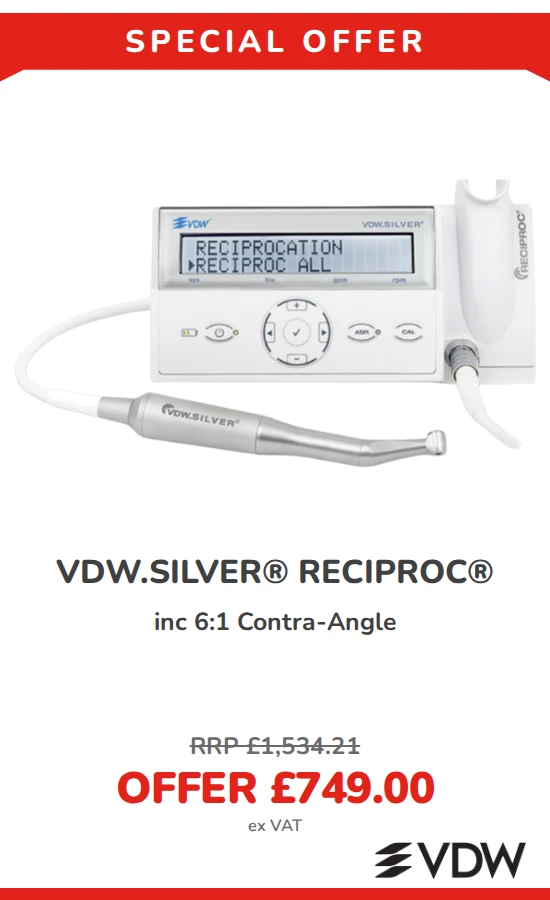
SpotlightRECIPROC® MinimaOne file · slim shaping for narrow canals
Shaping systems
Hand files & finders
Materials & more

 eMail MTA-8222 to a friend
































 Facebook
 Twitter
 Instagram
 Pinterest