


Best selection of Endodontic supplies in the UK


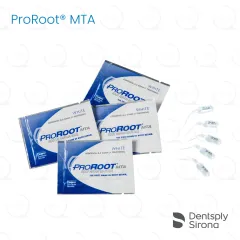
ProRoot® MTA · white · 4 × 0.5 g
Root-end fillingPerforation repairApexificationPulp cappingPulpotomy, primary teeth
ProRoot® MTA is Dentsply Sirona’s mineral trioxide aggregate – a fine, hydrophilic powder that sets in the presence of moisture into what their directions call “a strong impermeable barrier”. Four 0.5 g pouches, each with its own water ampoule, so every case is mixed fresh and nothing is left open on the shelf.
| 4 mm Al MIN. RADIOPACITY, IFU | ~3 min WORKING TIME, IFU | > 24 MPa COMPRESSIVE, IFU |
This pack: ProRoot® MTA Root Canal Repair Material, White – 4 pouches of 0.5 g powder and 5 ampoules of 0.18 g water · Dentsply Sirona REF A040500000300
Single use · non-sterile, do not sterilise · shelf life 3 years
› Six indications in one material. Dentsply Sirona’s directions list root-end filling, the apical plug in apexification, perforation repair during root canal therapy, repair after internal resorption, pulp capping and pulpotomy of primary teeth.
› Sets in a wet field. The powder hydrates to a colloidal gel that, in the directions’ words, “solidifies to form a strong impermeable barrier”. Moisture is part of the chemistry, not an enemy of it.
› Unit dose. Each 0.5 g pouch is matched to a 0.18 g micro-dose water ampoule, so the powder-to-liquid ratio is set by the pack, not the clock. The four-pouch box carries one spare ampoule.
› Radiopaque. At least 4 mm of aluminium equivalent (IFU), so placement can be confirmed on the radiograph the directions ask for.
› A permanent part of the filling. In perforation repair and apexification the directions leave the set MTA in place and obturate the remaining canal on top of it.
Dentsply Sirona call it “the first name in root repair”, and on a bench of newer bioceramics it is still the material the others describe themselves against. What you are buying is a known quantity: a composition published in the directions, six indications set out step by step, and a pack that controls the one variable MTA punishes – the water.
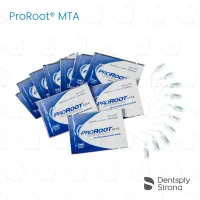
The four-pouch box suits a practice that places MTA occasionally – a perforation here, a pulp cap there – because each pouch stays sealed until the case needs it. The directions insist on that: kept in its sealed packaging and stored dry, because moisture is what sets it. For regular use, the 10 × 0.5 g box is the lower cost per pouch.
ProRoot® MTA root repair material is a powder consisting of fine, hydrophilic particles that set in the presence of moisture. Hydration of the powder creates a colloidal gel that solidifies to form a strong impermeable barrier that fully cures over a four-week period.
Dentsply Sirona, ProRoot® MTA instructions for use (Europe, 2025-08)
| Material | Mineral trioxide aggregate – a fine, hydrophilic powder that sets in the presence of moisture |
| Composition | Tri- and dicalcium silicates 69–74%, bismuth oxide 17–22%, minor components 2–7% (calcium aluminate, aluminoferrite and sulphate, and others) |
| Shade | White (tooth-coloured) |
| Mixing | One 0.5 g pouch with one 0.18 g water ampoule, about a minute on the pad |
| Cure | Checked for hardness after four hours; fully cures over four weeks |
| Shelf life | 3 years; store dry, below 30 °C, away from sunlight |
| Contraindications | None known |
Mixing (all indications). Dispense a pouch onto the pad, pull the end off an ampoule and squeeze it out alongside, bring the liquid in gradually and mix for about a minute. It does not set as quickly as other cements – careful mixing is what makes it easy to handle.
1Perforation repair, and repair after internal resorption. Under dam: debride and irrigate with hypochlorite (for resorption, a week of calcium hydroxide first), dry, and obturate the canal apical to the defect. Carry the MTA into the defect, compact it with a small plugger, cotton pellet or paper point, and confirm on a radiograph.
2Apexification. After a week of calcium hydroxide, carry and compact a three to five millimetre apical barrier, confirm it radiographically, and leave a moist pellet under a temporary.
3After either: at four hours or the next visit, check the MTA is hard (if not, rinse and repeat), then obturate the rest of the canal. The MTA stays as a permanent part of the filling.
4Root-end filling. Resect, prepare a class I root-end cavity three to five millimetres deep with an ultrasonic tip, achieve haemostasis, dry, then place and compact the MTA, clean the root surface and confirm on a radiograph.
5Pulp capping. Rinse the exposure with hypochlorite, place a small amount of MTA over it, blot the excess moisture, cover it with a light-cured liner, then etch, bond and restore. Review sensibility every six months.
6Pulpotomy of primary teeth. Remove the coronal pulp, achieve haemostasis with pressure, place MTA over the pulp stumps and chamber floor to an even three to four millimetres, fill the chamber and restore – the directions finish with a stainless-steel crown.
These are summaries. The directions carry every step, and the materials they name at each stage, in full – see Downloads.
How much water, and what if it is too wet or too dry?
Use the ampoule supplied with each pouch and mix for about a minute so every particle is hydrated. The directions allow a little extra water – the spare ampoule, or USP purified water – to reach the consistency you want, and they warn that too much or too little liquid reduces the final strength. If the mix starts to dry on the pad, cover it with moist gauze rather than adding more water.
Will it discolour the tooth?
The directions are candid about it: a slight discolouration may appear in the months after treatment, and in an aesthetic zone they ask the clinician to weigh the procedure, the surface area exposed and the other restorative materials used.
How long before I can restore over it?
For perforation repair and apexification the directions place a moist pellet and a temporary for at least four hours, then check the MTA is hard – at that visit or a later one – before obturating the rest of the canal. For pulp capping they cover it straight away with a light-cured liner, then bond and restore in the same visit.
Can I use a pouch across two patients?
No. ProRoot MTA is single use and single patient, and the directions say to place it immediately after mixing; once set it cannot be used again. That is what the 0.5 g unit dose is for.
4 × 0.5 g or 10 × 0.5 g?
Same material, same pouch, same ampoule. The four-pack carries one spare ampoule for adjusting a mix; the ten-pack is the lower cost per pouch for practices placing MTA every week.
| Isolation | QED Non-Latex Dam – the directions use dental dam at every stage. |
| Irrigants | Chlorax 5.25%, Chlorax 2% and Endo-Solution 17% EDTA. |
| Interim dressing | UltraCal XS, Calcipast and Opacal – calcium hydroxide, which the resorption and apexification protocols place for a week. |
| Drying | MMPP paper points 15–40 – or the matched points for your file system. |
| Delivery | Vista MTA carriers 0.80 mm, 0.99 mm and 1.60 mm · Cerkamed MTA Applicator 0.80 mm and 1.20 mm. |
| Compaction | PENN Micro-Plugger 060, 100 · root-end: ENDOBLACK Retroplugger 050, 075. |
| Obturation | ProRoot Bio Sealer – Dentsply Sirona’s bioceramic sealer on the same calcium silicate chemistry · AH Plus – the epoxy alternative. |
| Bonding | Prime&Bond active – Dentsply Sirona’s universal adhesive. |
| Coronal seal | SDR flow+ Refill Universal – 4 mm bulk increment, one cure. |
| Also in stock | NeoMTA 2 and NeoPUTTY – Avalon Biomed’s bioceramic repair materials, a different formulation and handling. |
› ProRoot® MTA instructions for use (PDF, 1.1 MB, multilingual, Dentsply Sirona) – the current European edition (2025-08), on Dentsply Sirona’s site. English is the first section.
Indications, composition, physical properties, precautions, adverse reactions, storage and every step above are from Dentsply Sirona’s ProRoot® MTA instructions for use (END-IFU-PROROOT-MTA-TDS-V05, Europe, 2025-08; English section, spelling anglicised). “The first name in root repair” is Dentsply Sirona’s own line. Technique is theirs; the clinical decision is yours – we make no claim of our own about seal, healing or outcome. ProRoot, AH Plus, SDR and Prime&Bond are Dentsply Sirona trademarks; NeoMTA and NeoPUTTY are Avalon Biomed trademarks.
ProRoot® MTA · root canal repair material, white · 4 × 0.5 g pouches + 5 × 0.18 g water ampoules · Dentsply Sirona · REF A040500000300
SpotlightRECIPROC® MinimaOne file · slim shaping for narrow canals
Shaping systems
Hand files & finders
Materials & more
 eMail A040500000300 to a friend
































 Facebook
 Twitter
 Instagram
 Pinterest