


Best selection of Endodontic supplies in the UK


Paper Points · DiaDent® MMPP™ · ISO 50/.02 · 200
A wider canal holds more irrigant, and takes more drying. At an ISO 50 you want a point that wicks and keeps its form rather than folding at the orifice. DiaDent roll each one on a hand jig for size and firmness, in what they describe as a specially formulated, highly absorbent paper. Same millimetre markings as the ML.029 cones.
This pack: 200 × absorbent paper points, DiaDent® MMPP™, ISO 50, .02 taper, mm-marked, cell pack
Made by DiaDent
| Millimetre marked | Read the depth off the point instead of judging it – the same marking system as the matched cones |
| Hand-jig rolled | DiaDent roll each point individually for size and firmness; a point that holds its form reaches length rather than concertinaing |
| Colour coded, cell pack | ISO colour coding, and cells rather than a loose tray – the size you want comes out without tipping the box |
› Fill with DiaDent® ML.029™ Gutta Percha 50/.02 – the matched cone, marked the same way.
› Irrigate with Endo-Solution 17% EDTA – 200 ml, or the 5 x pack.
› Seal with NeoSEALER® EZFlo – premixed bioceramic, 29G cannula, nothing to mix on the bench.
› Reach patency with C-PILOT® 010, 25 mm – the house hand file.
› Close with SDR® flow+ – 4 mm bulk increment, one cure.
Why 200 points against 120 cones?
Consumption, not a discount. Several points dry one canal; one cone fills it.
Are these sterile?
DiaDent do not state sterility either way on this line, so neither do we. Handle them as you would any paper point.
Which size do I need?
The one matching your final apical file – the range runs 15 to 80, or take the 15-40 assorted box.
DiaDent® MMPP™ Paper Points 50/.02 · mm-marked · hand-jig rolled · highly absorbent · colour coded · cell pack of 200 · DiaDent · REF MP201-310
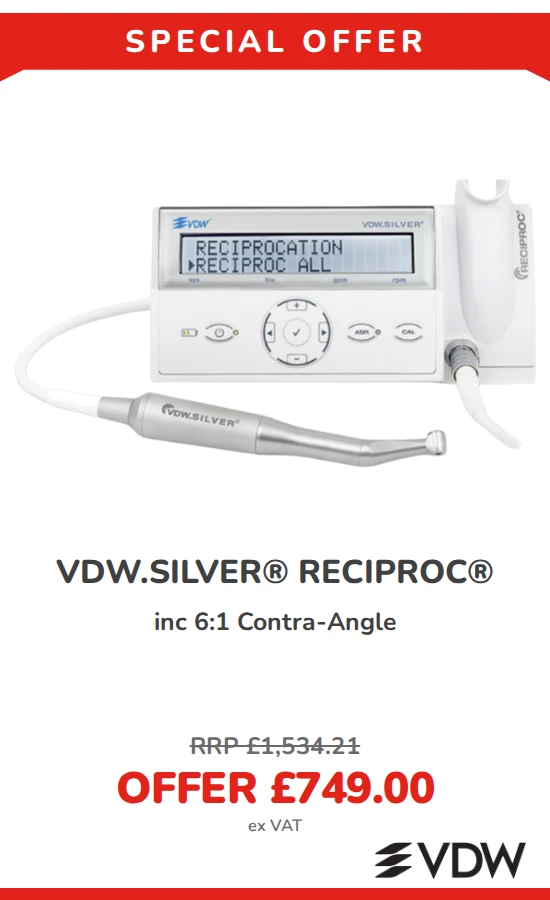
SpotlightRECIPROC® MinimaOne file · slim shaping for narrow canals
Shaping systems
Hand files & finders
Materials & more

 eMail mp201-310 to a friend



















 Facebook
 Twitter
 Instagram
 Pinterest