


Best selection of Endodontic supplies in the UK


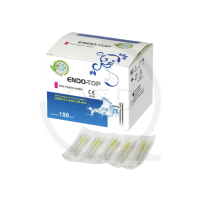
IrriFlex® · 40 needles with 50 endostops
Root canal irrigationCurved canalsSmear layer removalFinal rinseWorking-length control
How far down a curved molar canal does your irrigant actually reach? A rigid needle stops where the curve begins, and everything below that is served by diffusion and optimism. IrriFlex® is a polypropylene needle that bends with the canal – PD's own wording is that the flexibility allows the needle to access the apical region without resistance or damage to the dentinal walls. Two side vents sit at the tip, back-to-back, so irrigant leaves as two jets aimed at the walls rather than one column aimed at the apex. This box adds fifty endostops, so the depth you work to is set on the needle rather than judged through a mirror.
| 30G Ø0.3 MM | 27 mm LENGTH | 4% CONICITY |
This pack: 40 × IrriFlex® needles, individually pouched · 50 × endostops
Ordering REF 21401? That code now ships as this box.
Made by PD Dental, Switzerland · Class IIa medical device
Irrigation does the disinfecting; the file only makes room for it. So the question worth asking of a needle is not what it is made of but how close it gets, and what the fluid does when it arrives. A 4% taper narrows roughly as the preparation does, keeping the gap around it even – and back-to-back vents put the energy sideways into the walls rather than forwards into the periapex.
The tapered shape of the needle adapts to the shape of the canal. Flow thickness of the irrigant is therefore constant as the fluid moves to the coronal area, which maximises shear forces and the elimination of debris, smear layer and biofilm.
— Produits Dentaires SA, on their own IrriFlex pages
1 Fill the syringe with a compatible irrigant – stabilised sodium hypochlorite up to 6%, EDTA 17%, chlorhexidine digluconate 2%, citric acid up to 40%, or Dual Rinse HEDP.
2 Lock it on clockwise and expel residual air. The fitting is Luer-lock; a slip-tip barrel will not hold it.
3 Set the depth. The cannula is marked at 18, 19, 20 and 22 mm; a stop defines working length where it falls between marks.
4 Check two equal jets before the tip goes near an orifice, so you know the pressure needed and that both vents are clear.
5 Start in the chamber, pre-bend the tip for posterior access, and insert passively to 1 to 2 mm short, moving up and down by the same amount.
6 Irrigate 1 to 2 ml after each instrument, check patency, re-irrigate; then finish with EDTA followed by hypochlorite, and discard the needle.
| The needles | Made under clean-room conditions and ready to use. PD's IFU: do not sterilise before use. Single use, 5-year shelf life |
| The endostops | Handling of the stops is set out by PD in their own endostop notice – linked under Downloads, alongside the IFU |
| Free movement | PD's precaution: make sure the needle can move freely, so there is constant flowback up the canal |
| Chamber floor | PD's quick guide: irrigate the pulp chamber, avoiding contact with the pulp chamber floor |
| Stated risk | The IFU records no known contraindications and no known adverse reactions |
Strand, Lægreid and Fristad compared four needle designs in 30° curved simulated canals prepared to 30/.04, and found the flexible polypropylene needle gave the lowest absorbance values, significantly better than both the flat open-ended and the double-vented metallic needles (Dent J 2026;14(5):278 – no external funding, no declared conflicts). Baasch and colleagues, in 3D-printed molar models, left 26.8% remaining tissue in the apical third against 53.9% and 44.9% for two closed-ended needles – though an open-ended needle did better overall at 23.7%, and better again in the middle and coronal thirds (Odontology 2025;113(3):1180–8). Lebbos and colleagues found the smear-layer benefit showed in a 30/.04 preparation but was less evident at 25/.06 (Eur J Dent 2025;19(3):678–87) – a hint that the needle suits a preparation shaped like it is.
The honest summary: this is not a needle that wins everywhere. It is a needle that holds up where a rigid one struggles – curvature, and the apical third – and the published work says so without needing help from us.
Irriflex® is a new standard in root canal irrigation. The sensation of secure and smooth tip insertion, flow control and the increased visibility are the benefits I observe in my daily practice.
— Dr Riccardo Tonini, quoted by PD Dental
IrriFlex® has revolutionized root canal irrigation and has become a fundamental part of my protocol.
— Dr Uwe Radmacher, quoted by PD Dental
Do I need the stops if the needle is marked?
Not always. The marks at 18, 19, 20 and 22 mm cover a lot of cases. A stop earns its place when working length falls between them, or when access is poor enough that reading a mark is optimistic.
To which depth should I set the endostop?
PD's answer: we recommend setting the insertion depth 1 to 2 mm less than the root canal working length. Their quick guide says the same, using either the markers or a stopper.
How are the endostops fitted?
PD say they can be installed on IrriFlex either with the use of an endobloc or by hand, and recommend the endobloc, because the ruler on most endoblocs makes the insertion depth easier to get right.
Is there a risk of over-bending it?
PD's answer is no: IrriFlex is highly flexible and does not break when pre-bending it prior to insertion into a root canal. They add that bending it beyond 90° is neither advised nor needed.
Which hypochlorite concentration is allowed?
The IFU says stabilised sodium hypochlorite up to 6%. PD's product page lists 5.25%; the IFU is the authoritative document, and PD's own quick guide says so.
| Two boxes and syringes | IrriFlex® bundle – two of these boxes, 80 needles and 100 stops, plus 5 ml Luer-lock syringes |
| Hypochlorite | Chlorax 5.25% · Chlorax 2% – both within the IFU's limit |
| Chelate | Endo-Solution 17% EDTA · 200 ml – the final-rinse step in PD's sequence |
| Bulk chelate | Endo-Solution 17% EDTA · 5 × 200 ml |
| Citric acid | Citric Acid 40% · 200 ml – at the ceiling the IFU states |
| Chlorhexidine | CanalPro CHX 2% · 500 ml – the concentration the IFU names |
| Isolate | OraSeal™ Caulking – hypochlorite deserves a dam that does not weep |
› IrriFlex® Quick User Guide (PDF, 0.3 MB, PD Dental) – the technique on one card
› IrriFlex® Directions for Use (IFU) (PDF, 0.4 MB, PD Dental, multilingual) – the authoritative document
› Endostops – sterilisation of single-use products (PDF, PD Dental, multilingual) – PD's notice for the stops in this box
IrriFlex® with endostops · flexible polypropylene irrigation needle · 30G, Ø0.3 mm · 27 mm · 4% conicity · two back-to-back side vents · Luer-lock · single use · 40 needles and 50 stops · PD Dental · REF 21401_PP
SpotlightRECIPROC® MinimaOne file · slim shaping for narrow canals
Shaping systems
Hand files & finders
Materials & more

 eMail 21401_pp to a friend





















 Facebook
 Twitter
 Instagram
 Pinterest