


Best selection of Endodontic supplies in the UK


| deals for this product |
|---|
| buy 10 in Glide Path & Shaping to get 10.00% off |
| buy 15 in Glide Path & Shaping to get 15.00% off |
| buy 2 in Glide Path & Shaping to get 2.00% off |
| buy 5 in Glide Path & Shaping to get 5.00% off |
RECIPROC® Minima R20 · 25 mm · 6 files
Narrow canalsMB2Severe curvatureCalcifiedSingle fileMinimally invasiveSterile, single use
Calcified canal? An MB2 you cannot catch? A curve your files would rather not follow? RECIPROC® Minima is the slim end of the reciprocating family, and R20 is where its instructions for use tell you to begin. A thinner core, a 0.77 mm maximum flute diameter and a 3.6% average taper mean it follows the canal instead of fighting it – which is the whole argument for a conservative preparation in an anatomy that punishes anything wider.
| 96% TO LENGTH, EX VIVO | 0.77 mm MAX FLUTE | 3.6% AVERAGE TAPER |
This pack: 6 × RECIPROC® Minima R20, 25 mm · sterile blister, single use
Made by Dentsply Sirona – Maillefer, Switzerland
The instrument that will not negotiate a canal is usually not the one that lacks cutting efficiency – it is the one that is too stiff and too wide at the point where the anatomy narrows. Minima attacks that directly: a reduced overall taper and a thinner wire, so the file reaches the constriction with less bulk behind it. The practical effect is that a canal you would previously have scouted, opened and only then shaped can often be negotiated by the shaping file itself, and that the pericervical dentine you would have removed to make room simply stays where it is.
The taper figure is worth reading properly, because the headline number understates it. R20's full designation is ISO 20/.08v – a 0.20 mm tip with a .08 (8%) taper apically, the v denoting a variable taper that reduces as the blade runs coronally, averaging 3.6% overall. (On the pack and in the instructions it is printed as 020.008v, which is the same thing in zero-padded three-digit fields – 020 is the ISO size, 008 is the .08 taper.) So it is not a uniformly thin file: it carries a proper apical taper where shaping and irrigant exchange actually matter, then gives the diameter back through the middle and coronal thirds instead of quietly reaming out the dentine that holds the tooth together. That is the minimally invasive argument in one specification – what the literature now calls minimally invasive endodontics (MIE): preserving as much healthy coronal, cervical and radicular tooth structure as the case allows, through access, shaping and obturation alike.
| ISO 20/.08v | 0.20 mm tip with an 8% apical taper that reduces coronally – 3.6% averaged along the blade. Cutting where it has to be, slim where it counts |
| Blue NiTi | Heat-treated for flexibility and resistance to cyclic fatigue, which is what severe curvature actually tests |
| Non-cutting tip | S-shaped cross-section with an inactive tip – it follows the canal path rather than cutting its own |
| 9.5 mm handle | Short shank for posterior access, where limited opening usually decides whether you can work at all |
For narrow and challenging canals, the procedure should start with instrument size R20. In cases of wider canal anatomy, the selection of the initial instrument size is at the clinician's discretion.
— RECIPROC® Minima instructions for use. This is why R20 is the file to stock first.
In a laboratory study of 330 mesial canals in extracted mandibular molars, published in the International Endodontic Journal in 2026, instruments were taken to full working length with no prior scouting and no glide path. R20 reached length in 96.4% of canals, against 83.6% for Minima R25 and 70.9% for RECIPROC® blue R25. No instrument fractured in any group. Where a larger instrument failed, R20 subsequently reached length in about four cases out of five. It is an ex-vivo study rather than a clinical trial – extracted teeth, controlled conditions – but it is peer-reviewed, and it is the reason this file is worth your attention.
1 Reciprocating setting. A dedicated Dentsply Sirona motor and contra-angle on RECIPROC® settings – or by hand in severe curvatures.
2 Short pecks, light hands. In-and-out movements of no more than 3 mm amplitude, with very light pressure. Never force the instrument down the canal.
3 If it stops, stop. The instructions are explicit: do not force it. Remove the file, create a glide path, and confirm patency with an ISO 010 or 008 hand instrument before continuing.
So do I still need a glide path?
Often not – that is the point of the file, and the published study bears it out. But the instructions require one if R20 stops progressing, along with a patency check using an ISO 010 or 008 hand instrument. Treat "frequently unnecessary" and "never necessary" as very different claims, because they are.
Which size do I start with?
R20, in narrow and challenging canals – the instructions say so directly. In wider anatomy the starting size is your call, and R25 is the usual next step. Larger apical sizes can be taken with R35 (ISO 35/.06v) or R45 (ISO 45/.05v) without adding coronal taper – their apical taper steps down to 6% and 5% as the tip diameter goes up, so the coronal profile stays conservative.
Is this what people mean by minimally invasive endodontics?
It is one part of it. Minimally invasive endodontics – MIE, or conservative endodontics – is the principle of keeping as much sound coronal, cervical and radicular dentine as the case allows, and it runs through access design, shaping and obturation. A reduced-taper file addresses the shaping half, and addresses it directly: less coronal enlargement to reach the same apical size, and pericervical dentine left intact. Access design and case selection remain yours.
Does this replace RECIPROC® blue?
No – they sit alongside each other. Dentsply position blue for regular anatomies, wider canals and retreatment, and Minima for narrow and challenging ones. If most of your work is routine, blue R25 stays your everyday file and Minima is what you reach for when the anatomy argues back.
Which motor do I need?
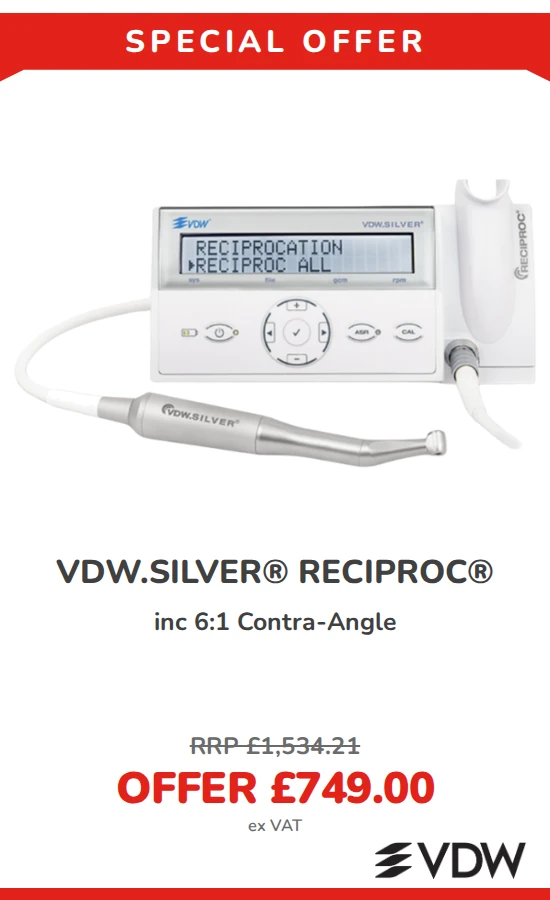
The instructions specify a dedicated Dentsply Sirona motor and contra-angle set to RECIPROC® settings. All three motors we stock carry a RECIPROC® programme: the VDW.SILVER® RECIPROC®, the X-Smart® Pro+ and the X-Smart® Go. No model list is published, so if you are unsure whether your unit carries the programme, ask us before ordering rather than after.
Can I reuse them?
No. Supplied sterile in single-use blisters – reuse raises the risk of cross-contamination and breakage, and with a file this slim the fracture margin is precisely what you are buying.
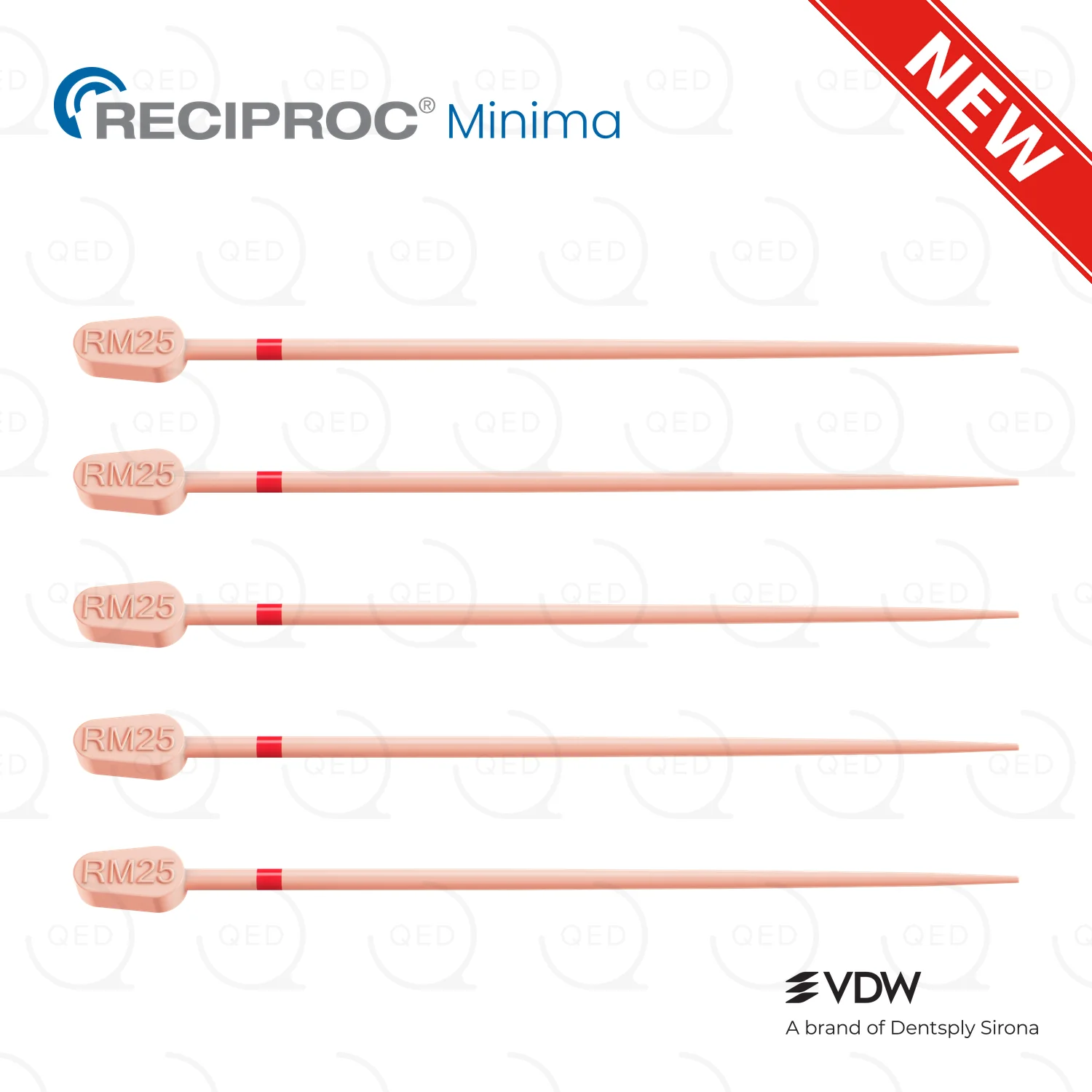
| Next size up | Minima R25 25 mm · 3.3% taper |
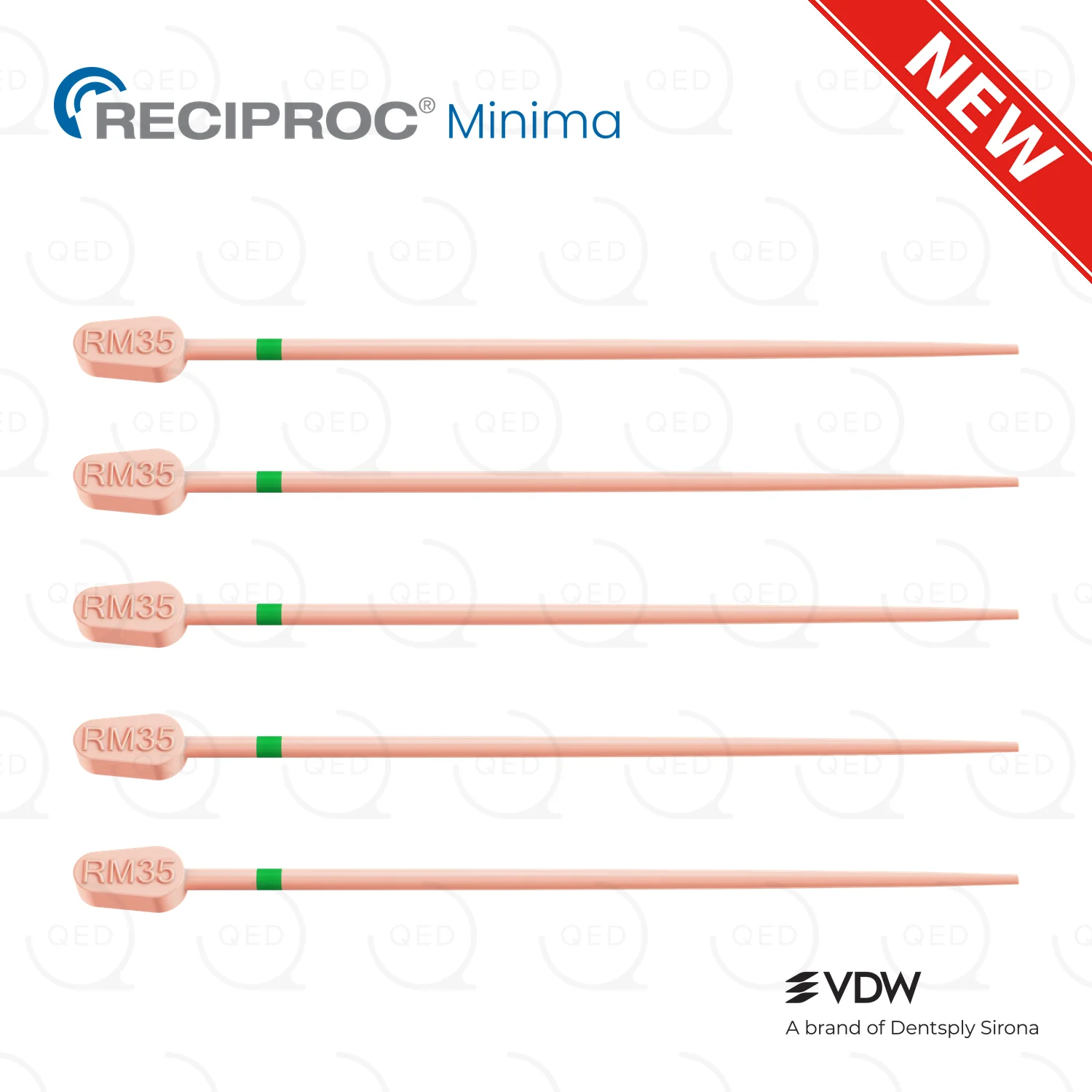
| Larger apical | Minima R35 25 mm · 2.6% taper |
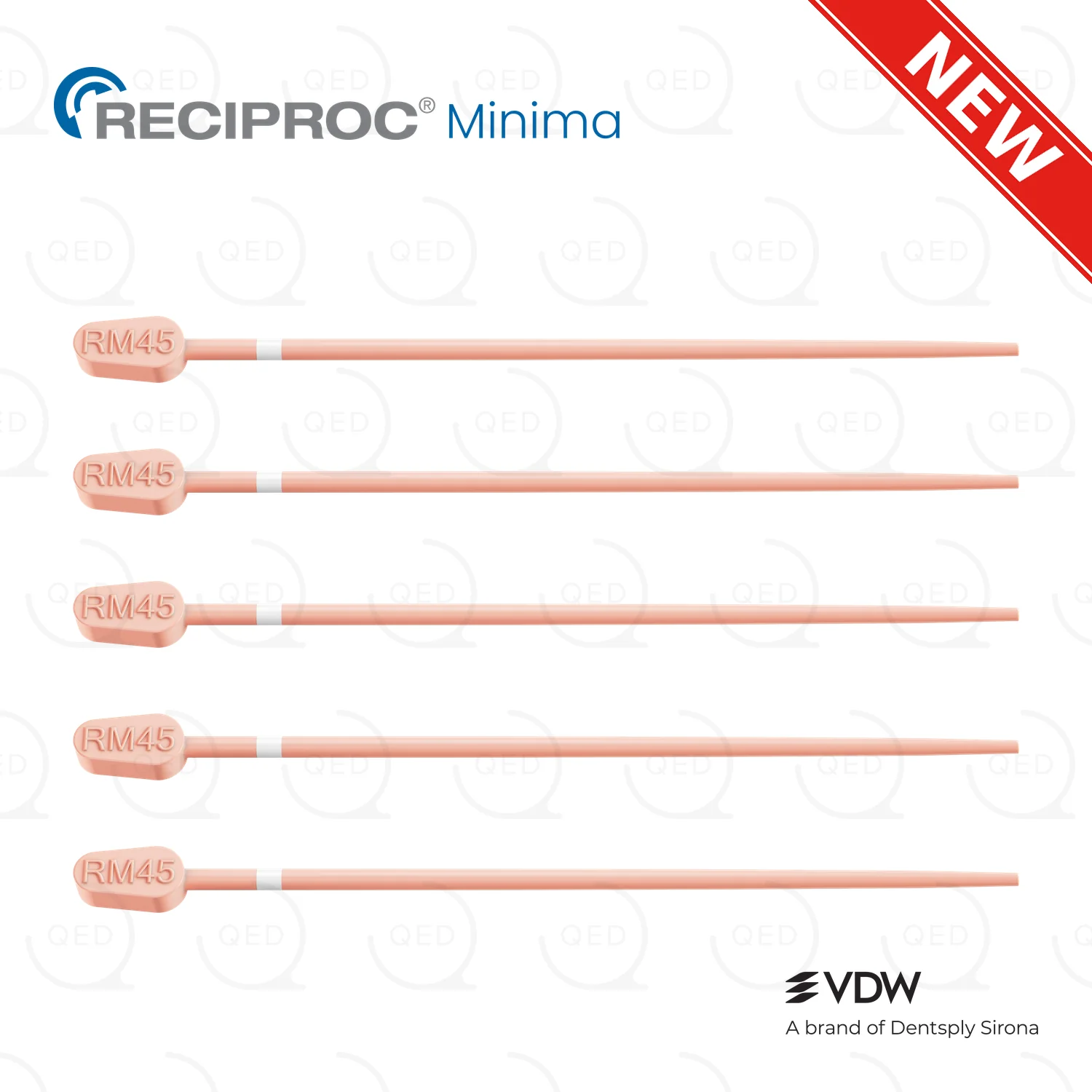
| Largest | Minima R45 25 mm · 2.0% taper |
| Try the system | Minima assorted 25 mm · all four sizes |
| Short roots | R20 in 21 mm |
| Long roots | R20 in 31 mm |
| Everyday file | RECIPROC® blue R25 25 mm |
| Dry the canal | Minima paper points R20 · dedicated points, sized to this file |
| Matched cone | Conform Fit® GP RM20 · the cone moulded to this preparation |
| Slim-prep sealer | NeoSEALER® EZFlo, 25 mm tips · 29 ga delivery for a conservative preparation |
RECIPROC® Minima R20 · reciprocating single-file system · ISO 20/.08v · 8% apical taper, 3.6% average · 0.77 mm max flute · blue heat-treated NiTi · S-shaped, non-cutting tip · 9.5 mm handle · 25 mm · 6 sterile files · Dentsply Sirona · REF MSTRCPM625020 · also in 21 mm and 31 mm

SpotlightRECIPROC® MinimaOne file · slim shaping for narrow canals
Shaping systems
Hand files & finders
Materials & more
 eMail MSTRCPM625020 to a friend































 Facebook
 Twitter
 Instagram
 Pinterest
