


Best selection of Endodontic supplies in the UK


| deals for this product |
|---|
| buy 10 in Glide Path & Shaping to get 10.00% off |
| buy 15 in Glide Path & Shaping to get 15.00% off |
| buy 2 in Glide Path & Shaping to get 2.00% off |
| buy 5 in Glide Path & Shaping to get 5.00% off |
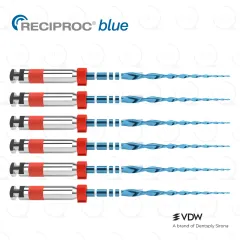
RECIPROC® blue R25 · 25 mm · 6 files
Single fileCurvatureMolarsRetreatmentSterile, single use
Still stepping through a sequence, and reprocessing what is left of it? RECIPROC® blue prepares the whole canal with one reciprocating instrument, and in the majority of canals with no initial glide path. R25 is where VDW's own size-selection protocol lands most often – an ISO 25 tip on a .08v taper, 8% apically and regressing coronally – and 25 mm is the length most cases call for.
| +40% FLEXIBILITY, VDW TEST | 1 file PER MOLAR | 66% FEWER RETREATMENTS |
This pack: 6 × RECIPROC® blue R25, 25 mm · radiopaque rings at 18/19/20/22 mm · sterile blisters, single use – one molar per file, per VDW
Made by VDW, Germany – genuine RECIPROC®
The colour is not a coating – it is the visible result of a thermomechanical treatment of the NiTi itself, and it changes how the instrument behaves. Dentsply Sirona put it at 40% more flexible than the original RECIPROC®, better centred in the canal and more resistant to cyclic fatigue (VDW laboratory test 16-HO-003 to ISO 3630-1, instruments made at the upper dimensional limit to simulate the worst case). De-Deus et al. examined the same thermal treatment independently in the Journal of Endodontics, 2017.
| ISO 25/.08v | 0.25 mm tip, 8% taper apically, regressing coronally – apical shaping where the case needs it, coronal dentine left alone |
| Blue NiTi | Heat-treated for flexibility and fatigue resistance – and it can be slightly pre-curved, to a maximum of 10°, for easier access to an awkward orifice. That is what the directions sanction it for: orifice access, not apical negotiation |
| S-shaped core | Two cutting edges and a non-cutting tip on a short shaft – it follows the canal rather than cutting its own path, and reaches second molars |
VDW settle it before you start, from the radiograph and, where the canal is visible, one hand file. Passively has a definition: the instrument travels directly to working length without watch-winding, and moves up and down 4–5 mm without any filing action.
| R25 | Canal partly or completely invisible on the radiograph – or visible, but an ISO 20 will not go passively |
| R40 | An ISO 20 goes passively to working length, an ISO 30 does not |
| R50 | An ISO 30 hand instrument reaches working length passively |
In most cases, the R25 will be suitable.
— VDW, RECIPROC® blue directions for use (VW000394), summarising its own size-selection protocol.
1 Check the canal is free with an ISO 10 hand instrument – the directions name VDW's own C-PILOT® 010 in 25 mm.
2 Irrigate, throughout. The directions have you irrigate and clean the flutes between passes: a single-file system shortens the mechanical part of the case, not the chemical one. Sodium hypochlorite in 5.25% or 2%, to your own protocol.
3 Shape on the RECIPROC® setting in slow in-and-out pecking movements, no more than three pecks at a time, cleaning the flutes and re-irrigating between every pass. The radiopaque rings at 18/19/20/22 mm give length reference on the radiograph.
4 Gauge the apex with a hand instrument one ISO size larger than the file that reached length: light tug-back 0.7 mm short and no further means no more enlargement is needed. If it reaches full length, finish with R40 or R50.
5 Dry, then obturate. Matched paper points R25, then the matched gutta percha cone carried to length with sealer. The cone mirrors the file's variable taper – VDW put it at up to 40% more dimensionally stable than hand-rolled – so the taper you cut is the taper you fill.
6 Seal it coronally. The apical seal is only half the job – SDR® flow+ places a 4 mm bulk increment straight over the orifices in a single cure.
And the glide path? No initial scouting or glide path in the majority of canals – that is the RECIPROC® concept and the manufacturer's own protocol. The directions still have you confirm the canal is free with an ISO 010 hand file, and if the instrument stops progressing you withdraw it and create a glide path up to ISO 15 rather than forcing it. "Usually unnecessary" and "never necessary" are different claims, and only the first one is ours to make.
A single-file canal is only as good as what goes into it, and this is where we reach for NeoSEALER® EZFlo. Premixed bioceramic – nothing to mix or time on the bench – with around 35 minutes of working time, 5.5 mm Al radiopacity, and delivery through 29 gauge NaviTip™ cannulas. The gauge is the point: a bore that fine places sealer in the apical third rather than wiping it down the coronal walls, and the 25 mm tips match this file's length. Twenty tips per pack. Prefer a wider bore? NeoSEALER® Flo is the same Avalon Biomed chemistry in the familiar kit.
Staying with a resin sealer? AH Plus® is still the epoxy sealer every other one is measured against, and it is Dentsply Sirona's own – the brand-matched choice for a Dentsply or VDW file, and the obvious answer if your protocol is already built around it. The AH Plus Jet® system delivers the same chemistry from an auto-mixing syringe. VDW's own 2Seal® is the other epoxy-amine we stock. Resin or bioceramic is a real choice of technique rather than a ranking – we carry both because both are right in different hands.
R25 is VDW's retreatment instrument as well as their shaping one, and the protocol sits in the same directions. Remove the coronal bulk of the old filling first, with a Gates Glidden or ultrasonically, and soften what remains with a solvent if it is stubborn. Then take R25 to working length – where it meets resistance, withdraw and reapply solvent rather than pushing through – with a brushing motion against the lateral walls, and R40 or R50 after it if the apical third needs enlarging. A carrier-based filling sometimes comes out in one piece.
There is a test for it, and it is quick. If the hand file used for working length still has to be pre-curved after a glide path to ISO 15 has been created, there is an abrupt apical curvature, and the canal should be finished with hand files rather than a reciprocating instrument – a pre-curved C-PILOT® 015 is the remedy the directions point to. VDW add the sentence that puts it in proportion: this limitation also applies to continuous rotary instruments. Otherwise contraindications and warnings alike are recorded as none known. One more piece of candour: the files may look slightly curved in the blister, and VDW note that this is not a manufacturing defect.
Most single-file marketing rests on bench data. This system has better. Elmaasarawi, Mekhemar and Bartols at Kiel followed 14,233 endodontically treated teeth for 5 to 10 years and published in the International Endodontic Journal in June 2025: survival without further intervention 30–40% higher under the RECIPROC® protocol than with hand K-files or multi-file rotary, non-surgical retreatment 66% lower, extractions 21% lower. It is a retrospective single-centre cohort, statistically adjusted, and the authors say only that the result "might be attributed to" the system – but it answers the question a clinician actually has, which is whether the tooth lasts. Dentsply Sirona now cite those figures themselves, alongside a count of more than 650 peer-reviewed papers on the RECIPROC® family.
The fracture of the original RECIPROC is not an issue considering that its fracture rate is very low (0.2%).
— Ghassan Yared, who developed reciprocating single-file preparation. Blue is the more fatigue-resistant of the two alloys.
A rotary sequence spends three to six instruments per case, plus reprocessing. This spends one sterile file per molar – the unit the directions set – so a two-molar appointment is two files, one per canal in extreme curvature. The cost is known in advance and the sterilisation load drops.
What motor do I need?
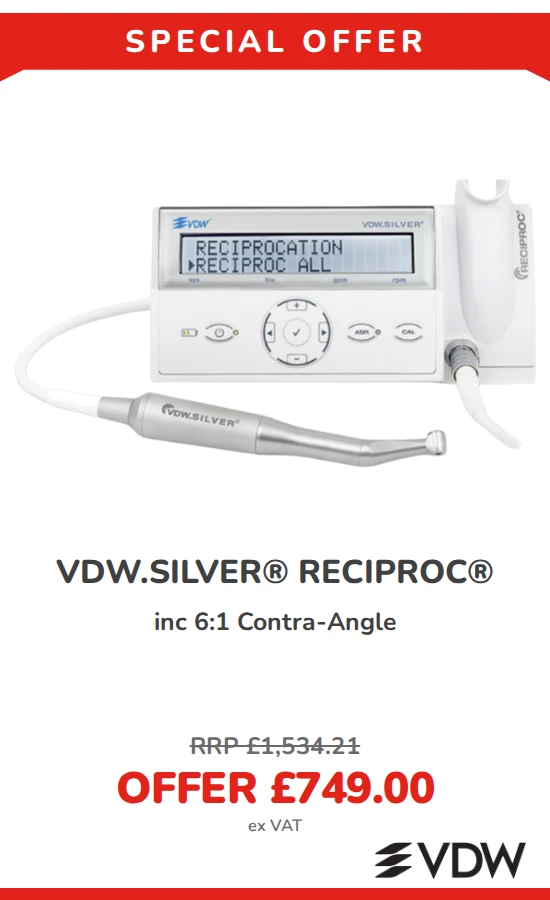
A drive system carrying the original VDW RECIPROC® or RECIPROC® ALL settings – reciprocating motors without them can lead to misuse. We stock the VDW.SILVER® RECIPROC® with 6:1 contra-angle, built for this system, and the X-Smart® Pro+ with an integrated apex locator. The cordless X-Smart® Go carries a RECIPROC® programme too.
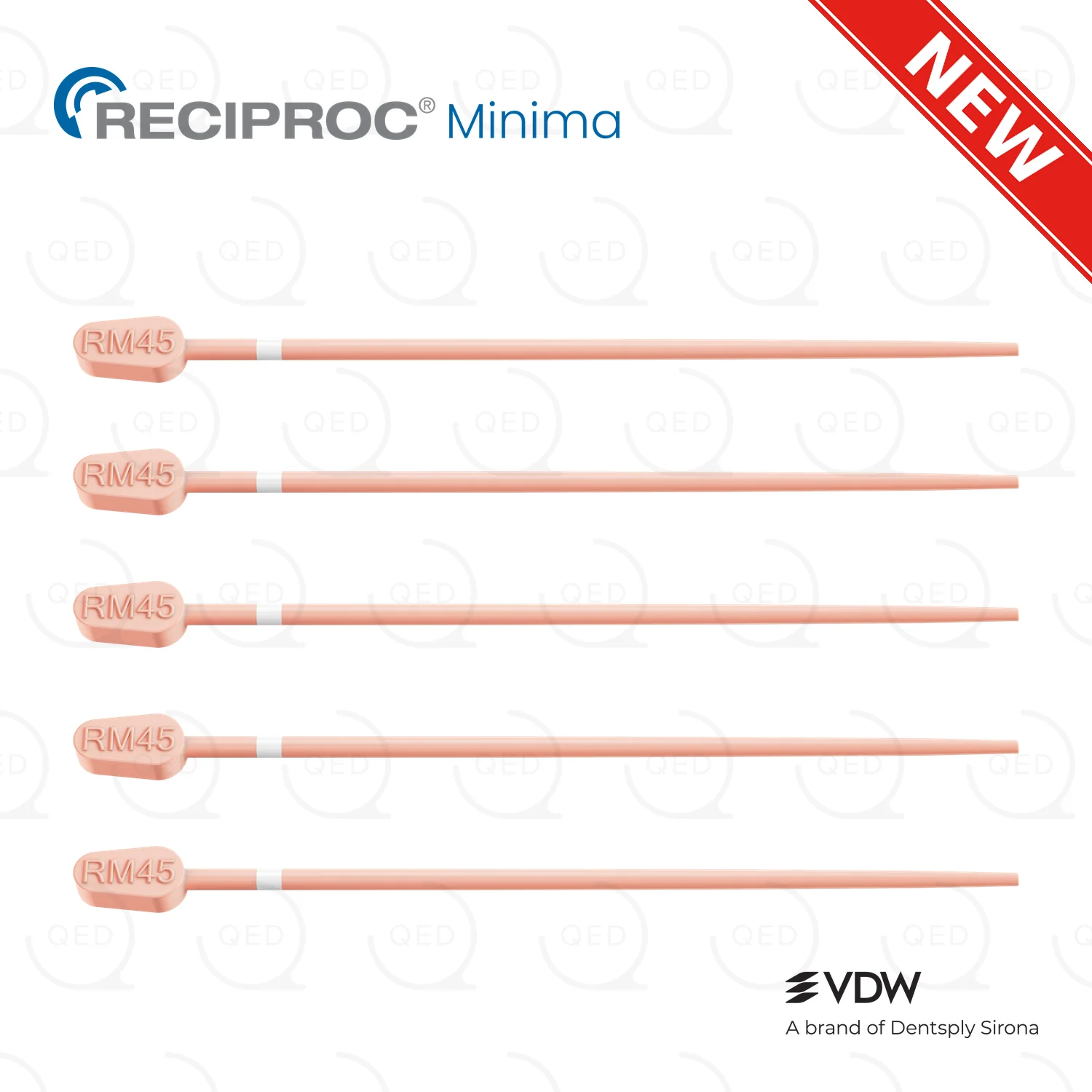
How does this compare with RECIPROC® Minima?
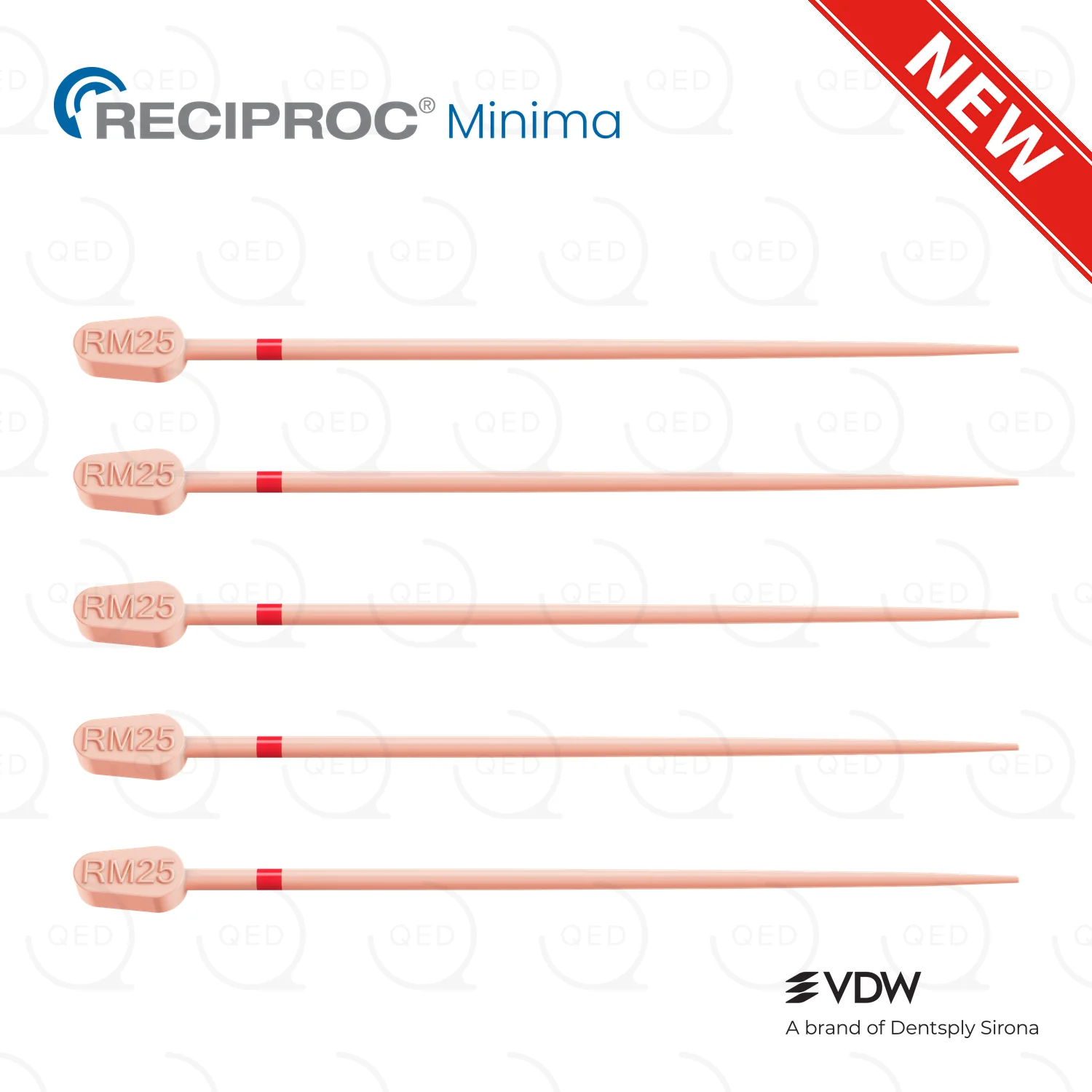
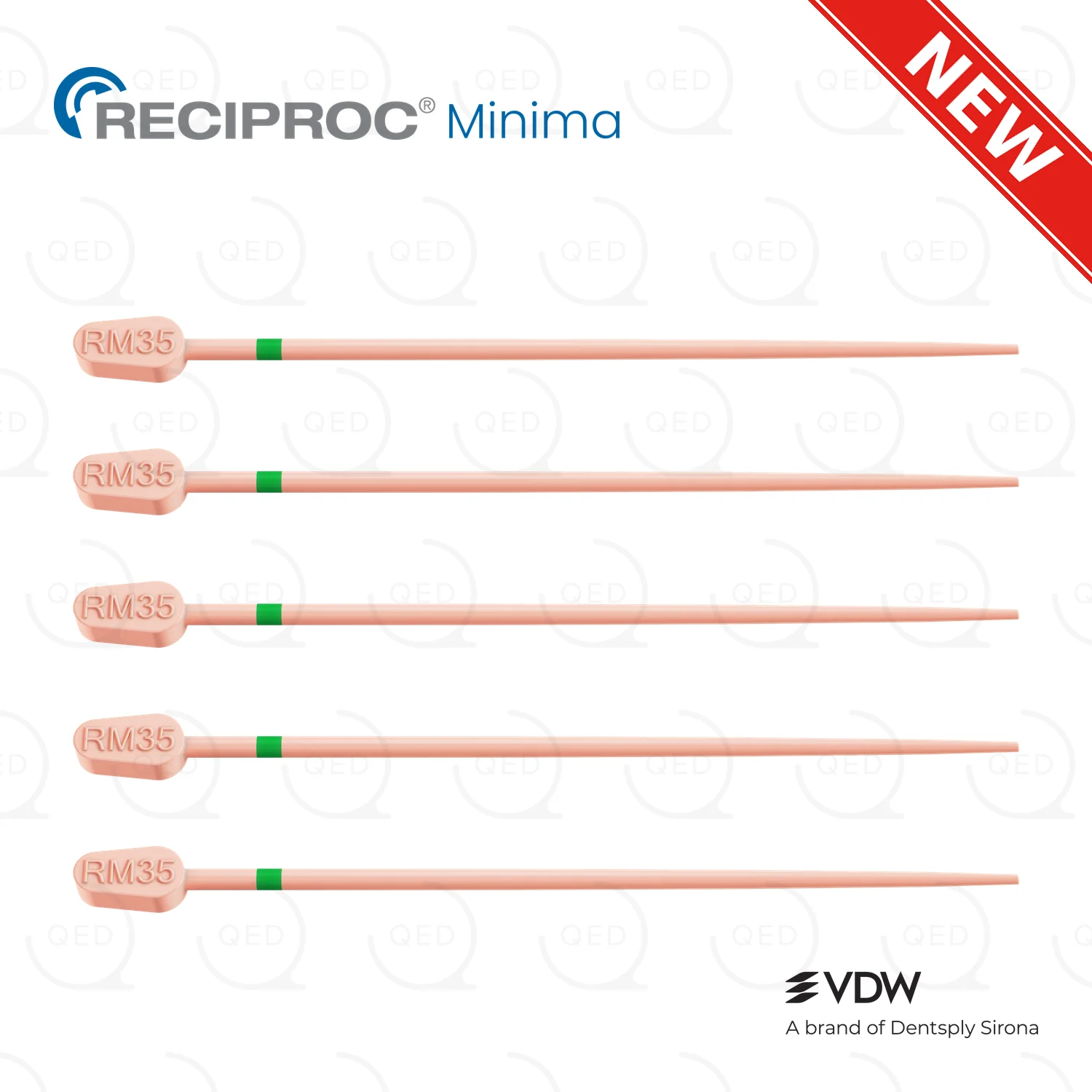
Same tip diameter on the R25, different intent. Blue is the workhorse for regular anatomy, wider canals and retreatment; Minima R25 runs a slimmer body for narrow and strongly curved canals where preserving pericervical dentine is the priority. Companions, not replacements.
| Check patency | C-PILOT® 010 · 008, 25 mm |
| Drive it | A motor with original RECIPROC® settings: VDW.SILVER® · X-Smart® Pro+ · X-Smart® Go |
| Wider canals | R40 25 mm for medium · R50 25 mm for wide |
| Other lengths | R25 in 21 mm for short roots · R25 in 31 mm for long ones |
| Irrigants | Sodium hypochlorite 5.25% or 2% · 17% EDTA · 40% citric acid · 2% CHX |
| Delivery | IrriFlex® 30g flexible needles · NaviTip™ 29 ga, 25 mm |
| Activation | VDW's EDDY® tips · or the SmartLite Pro EndoActivator® |
| Dry and fill | Paper points R25 · gutta percha R25 · or assorted boxes covering all three sizes: points, cones |
| Seal | Bioceramic NeoSEALER® EZFlo with 29 ga 25 mm tips, or NeoSEALER® Flo · resin AH Plus® or 2Seal® |
| Coronal seal | SDR® flow+ Universal · 4 mm bulk increment over the orifices |
| Narrow anatomy | RECIPROC® Minima R25 · same tip diameter, slimmer body |
| Buying in | System Kit, every size with matched fill · or the blue and SDR® flow+ kit |
RECIPROC® blue R25 · reciprocating single-file system · ISO 25/.08v – 8% apical taper, regressing coronally · blue heat-treated NiTi, pre-curvable to 10° · S-shaped cross-section, non-cutting tip · radiopaque rings 18/19/20/22 mm · shaping and retreatment · 6 sterile files, 25 mm · VDW, Germany · REF V040252025025 · also in 21 mm and 31 mm

SpotlightRECIPROC® MinimaOne file · slim shaping for narrow canals
Shaping systems
Hand files & finders
Materials & more
 eMail V040252025025 to a friend






























 Facebook
 Twitter
 Instagram
 Pinterest