


Best selection of Endodontic supplies in the UK


| deals for this product |
|---|
| buy 10 in Glide Path & Shaping to get 10.00% off |
| buy 15 in Glide Path & Shaping to get 15.00% off |
| buy 2 in Glide Path & Shaping to get 2.00% off |
| buy 5 in Glide Path & Shaping to get 5.00% off |
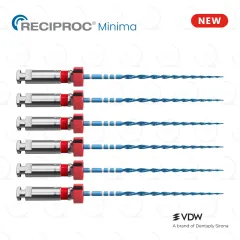
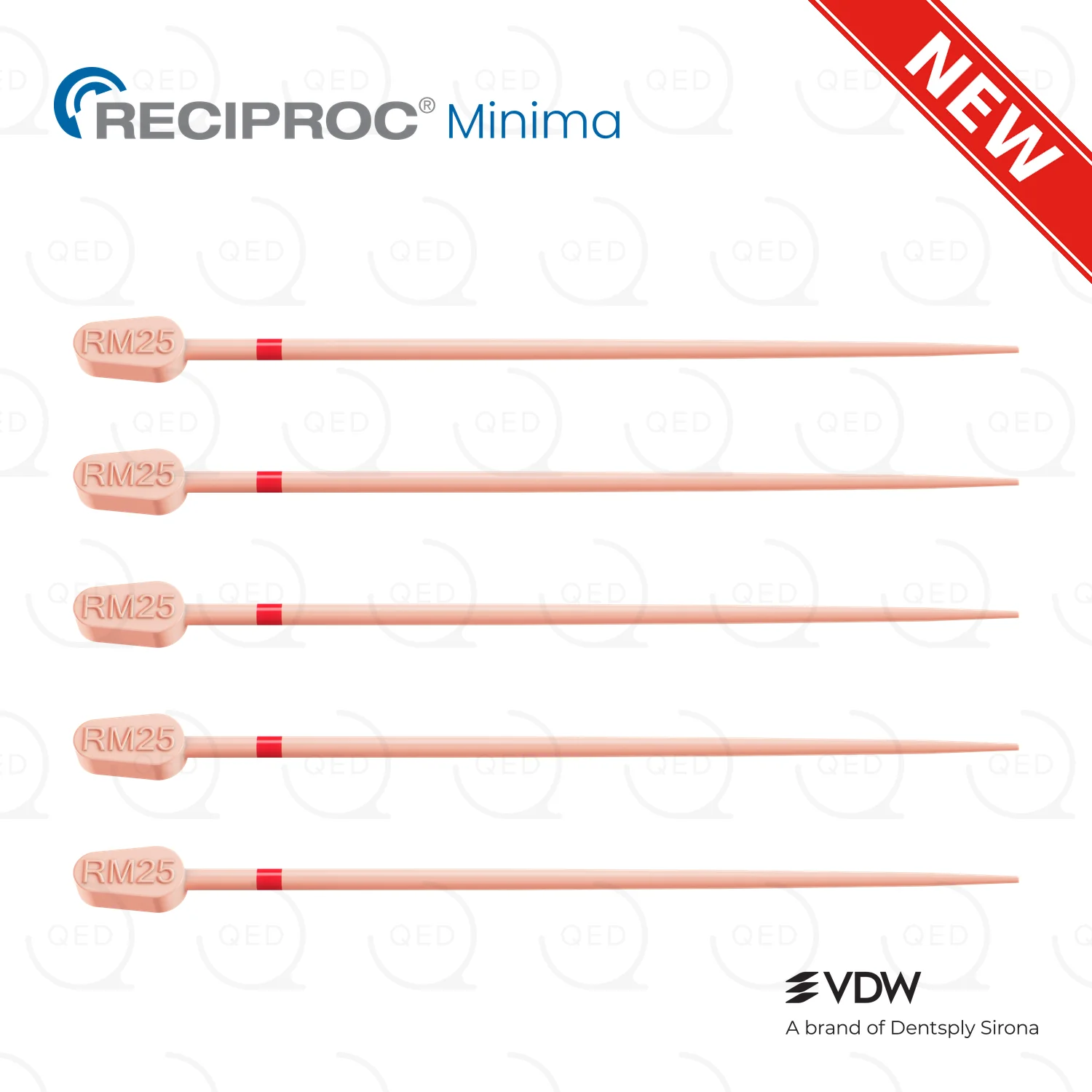
RECIPROC® Minima R25 · 25 mm · 6 files
Narrow canalsCurvatureSingle fileMinimally invasiveSterile, single use
R20 reached length and you want a larger apical preparation? Or the canal was never that narrow to begin with? R25 is where Minima goes next. Same 8% apical taper as R20, a 0.25 mm tip, and an average of 3.3% along the blade – so you gain apical diameter without paying for it in coronal dentine. In wider anatomy the instructions leave the starting size to your judgement, and this is usually where that judgement lands.
| 0.25 mm TIP DIAMETER | 8% APICAL TAPER | 3.3% AVERAGE TAPER |
This pack: 6 × RECIPROC® Minima R25, 25 mm · sterile blister, single use
Made by Dentsply Sirona – Maillefer, Switzerland
The full designation is ISO 25/.08v – a 0.25 mm tip with an 8% taper apically, the v marking a variable taper that reduces coronally to a 3.3% average. Set against R20 that is a step up in apical size on an identical apical taper, so the extra preparation happens where you asked for it rather than being spent widening the canal orifice. That is the minimally invasive endodontics case in practice: take the apical diameter the case needs, and leave the pericervical dentine that determines how the tooth behaves under load.
| ISO 25/.08v | 0.25 mm tip, 8% apical taper reducing coronally – 3.3% averaged along the blade |
| Blue NiTi | Heat-treated for flexibility and cyclic-fatigue resistance, which is what curvature tests |
| Non-cutting tip | S-shaped cross-section with an inactive tip – it follows the canal rather than cutting its own path |
| 9.5 mm handle | Short shank for posterior access where mouth opening is the limiting factor |
In cases of wider canal anatomy, the selection of the initial instrument size is at the clinician's discretion.
— RECIPROC® Minima instructions for use. In narrow and challenging canals they are specific: start with R20.
In a laboratory study of 330 mesial canals in extracted mandibular molars (International Endodontic Journal, 2026), instruments were taken to full working length with no prior scouting and no glide path. R25 reached length in 83.6% of these deliberately narrow canals, against 96.4% for R20 and 70.9% for RECIPROC® blue R25 – a useful ranking, because it shows R25 outperforming a conventional file of the same tip size while still trailing the slimmer R20 in the hardest anatomy. No instrument fractured in any group. It is ex vivo work on extracted teeth, not a clinical trial, but it is peer-reviewed.
1 Reciprocating setting on a dedicated Dentsply Sirona motor and contra-angle – or by hand in severe curvatures.
2 Pecks of no more than 3 mm, very light pressure, never forcing the file down the canal.
3 If it stalls, withdraw. Create a glide path and confirm patency with an ISO 010 or 008 hand instrument before continuing – the instructions are explicit about not forcing it.
Should I be starting with R20 instead?
In narrow and challenging canals, yes – the instructions say to start with R20, and the study data supports it. In wider anatomy the choice is yours, and beginning at R25 saves an instrument and a pass.
Do I need a glide path first?
Frequently not, which is the point of the system. But the instructions require one if the file stops progressing, along with a patency check using an ISO 010 or 008 hand instrument. "Often unnecessary" and "never necessary" are different claims.
How is this different from RECIPROC® blue R25?
Same tip diameter, very different body. Blue R25 runs a .08 regressive taper and is positioned for regular anatomies, wider canals and retreatment; Minima R25 averages 3.3% and is built for narrow and challenging ones. They are companions, not replacements.
What if I need a larger apical size?
Go to R35 or R45. Their apical taper steps down to 6% and 5% as tip diameter rises, so a bigger apical preparation does not bring a bigger coronal one with it.
Can I reuse them?
No – sterile blister, single use. Reuse raises the risk of cross-contamination and breakage.
| Start here | Minima R20 25 mm · the primary file |
| Larger apical | Minima R35 25 mm · 6% apical |
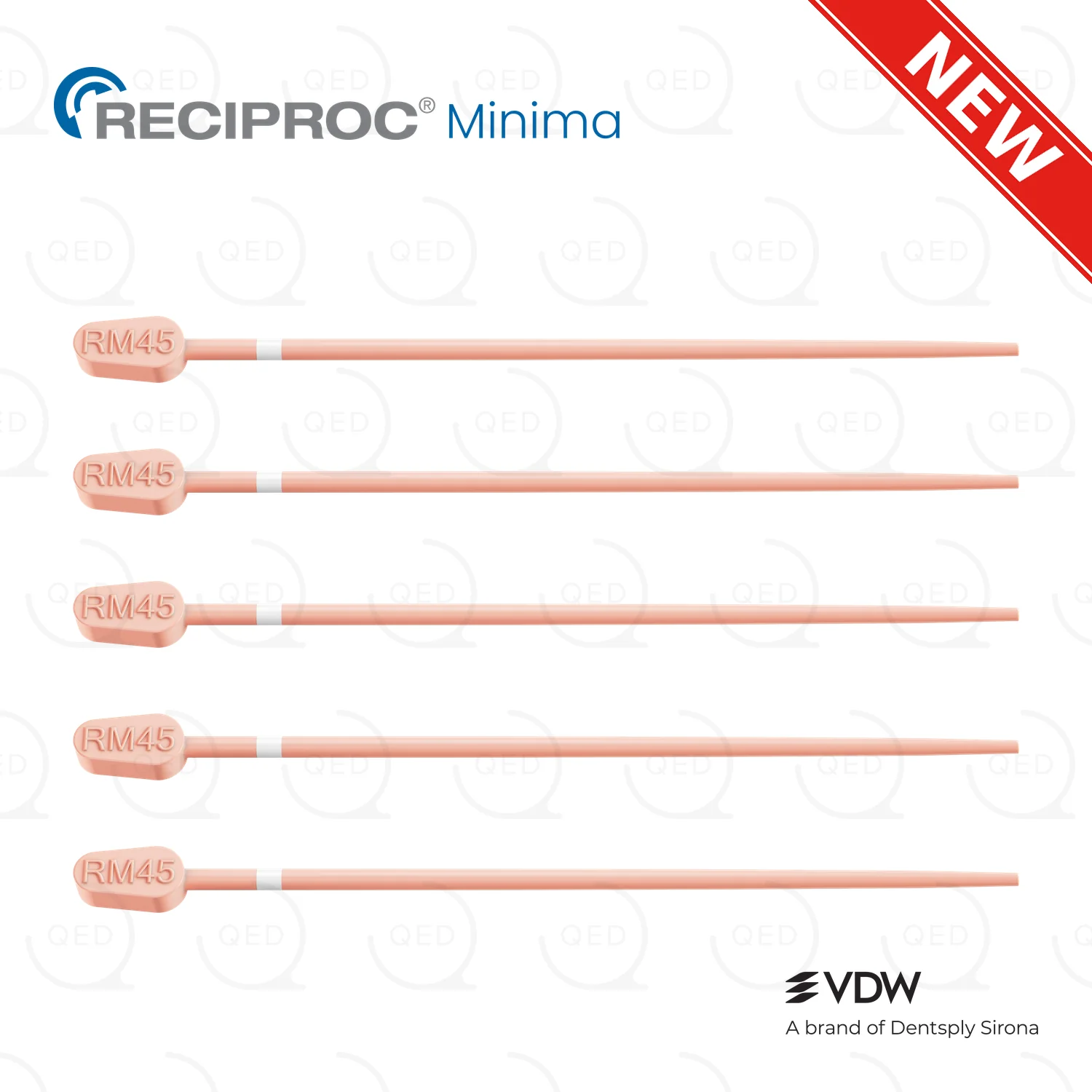
| Largest | Minima R45 25 mm · 5% apical |
| All four sizes | Minima assorted 25 mm |
| Short roots | R25 in 21 mm |
| Long roots | R25 in 31 mm |
| Wider anatomy | RECIPROC® blue R25 25 mm |
| Dry the canal | Minima paper points R25 · dedicated points, sized to this file |
| Matched cone | Conform Fit® GP RM25 · the cone moulded to this preparation |
| Slim-prep sealer | NeoSEALER® EZFlo · 29 ga NaviTips, 25 mm |
RECIPROC® Minima R25 · reciprocating single-file system · ISO 25/.08v · 8% apical taper, 3.3% average · blue heat-treated NiTi · S-shaped, non-cutting tip · 9.5 mm handle · 25 mm · 6 sterile files · Dentsply Sirona · REF MSTRCPM625025 · also in 21 mm and 31 mm

SpotlightRECIPROC® MinimaOne file · slim shaping for narrow canals
Shaping systems
Hand files & finders
Materials & more
 eMail MSTRCPM625025 to a friend































 Facebook
 Twitter
 Instagram
 Pinterest
