


Best selection of Endodontic supplies in the UK


| deals for this product |
|---|
| buy 10 in Glide Path & Shaping to get 10.00% off |
| buy 15 in Glide Path & Shaping to get 15.00% off |
| buy 2 in Glide Path & Shaping to get 2.00% off |
| buy 5 in Glide Path & Shaping to get 5.00% off |
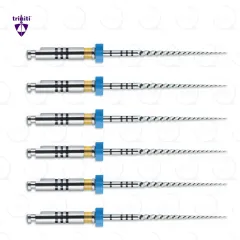
Triniti® 20/.06 · 25 mm · 6 files
Crown-downCoronal shapingStraight canalsRotary NiTiSterile, single use
20/.06 opens the 6% side of the range: a small tip behind a taper steep enough to shape the body of the canal as it goes. VDW set it at 60 gcm – 0.60 Ncm.
| 0.60 Ncm TORQUE (VDW) | 0.20 mm TIP DIAMETER | 16 mm WORKING PART |
This pack: Triniti® Rotary NiTi File, ISO 20 tip, .06 taper, 25 mm, 16 mm working part (Pack of 6) · sterile, single use
REF V201343025020 · Made by Maillefer Instruments Holding Sàrl, Ballaigues, Switzerland
› ISO 20 tip on a constant .06 taper – 0.20 mm across the tip, gaining 0.06 mm in diameter for every millimetre back from it, which is the same figure written as 6%
› 16 mm working part on a 25 mm shank, with the yellow ISO 20 band on the handle
› Three cutting edges on a convex triangular section – VDW describe the geometry as the efficiency of traditional K-type cutting blades, i.e. a convex cross-section to stabilise the instrument core and a cutting blade angle suitable for rotary use
› Cut to clear debris – VDW credit the special K-type cutting edges with efficient removal of debris and dentine chips
› Continuous rotation at approximately 300 rpm, with the torque set to the figure for the size – 60 gcm for this one
› Supplied sterile and single use – ready to use, with no sterilisation before the case and nothing to re-process after it
VDW's own instruction for the system is to take the larger tapers through the straight part of the canal and the smaller ones into the curve. A 20/.06 sits at the junction of those two ideas – enough taper to do real shaping work coronally, a small enough tip to keep going where the canal narrows. It is the file that often decides whether the rest of the sequence needs to be .06 at all.
The goal of root canal preparation is to create optimal conditions for a tightly sealed and long-lasting root filling, which includes a uniformly tapered canal shape.
VDW, on the Triniti® range
It is a crown-down system, and the tapers are the sequence rather than a specification. VDW's larger and medium tapers are the ones they credit with speedy dentine removal and with keeping the number of instrument changes to a minimum – that is this file's part of the work, in the straight portion of the canal. The smaller tapers follow it into the curve and into the apical third.
Triniti® came to the UK market in the early 2000s with one job: to get general practice to try NiTi – to move from stainless steel hand files to rotary nickel-titanium for the first time. The name carries that invitation and two further readings with it. The section is a convex triangle, so the blade cuts on three edges. And the instrument is nickel-titanium. Try NiTi, tri, NiTi – three readings, one name, and it has outlived the campaign that coined it.
| Rotation | Continuous, approximately 300 rpm (VDW give a 250–350 rpm range) |
| Torque | 60 gcm – 0.60 Ncm for this file |
| Handpiece | A torque-controlled endodontic motor with a reduction contra-angle |
| Use | Single use – a fresh file, then discard |
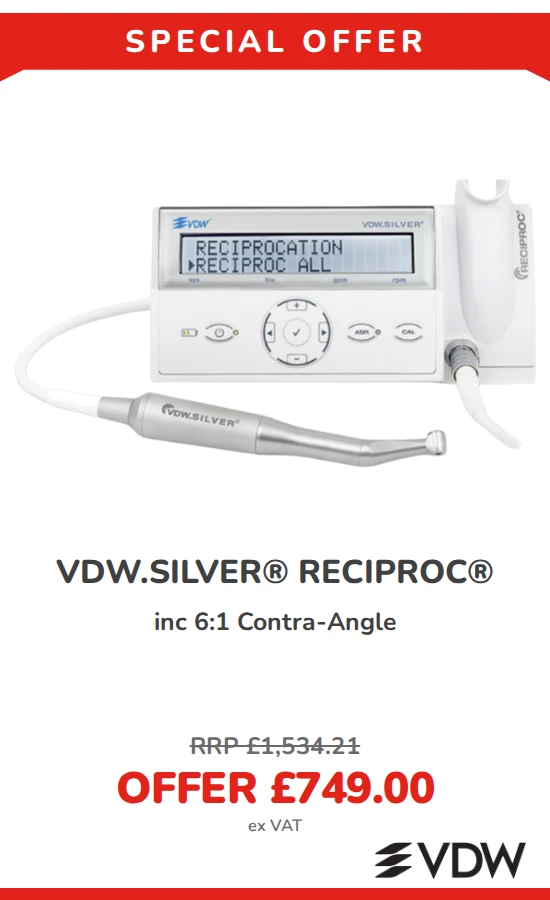
Any torque-limited endodontic motor that can be set to a rotation speed and a torque ceiling will run it. We stock the X-Smart® Pro+ and the VDW.SILVER® RECIPROC, both with a 6:1 contra-angle.
| ISO tip size | 20 (0.20 mm) |
| Taper | .06, constant (6%) |
| Length | 25 mm |
| Active working part | 16 mm |
| Material | Nickel-titanium, rotary |
| Motion | Continuous rotation |
| Supplied | Sterile, single use |
| Pack | Blister of 6 instruments |
| Manufacturer | Maillefer Instruments Holding Sàrl, Ballaigues, Switzerland |
| REF | V201343025020 |
What torque and speed should I set?
VDW's figure for this file is 60 gcm, which is 0.60 Ncm, at a constant rotation of about 300 rpm. The torque is per file, not per range – every size in the range has its own number.
Are they sterile, and can I re-use them?
They are supplied sterile and are single use in the UK. Nothing to autoclave before the case and nothing to re-process after it, so there is no count to keep and no wear to judge – a fresh file every time, which is the whole argument for buying a rotary instrument sterile.
Which cone and paper point fit it?
A constant-taper preparation wants a constant-taper cone of the same size. Pro-Fit® gutta percha 20/.06 and Pro-Fit® paper points 20/.06 match this file exactly on both tip size and taper.
How does it compare with its neighbours?
The range runs two tapers so that tip size and taper can be chosen separately. The nearest alternatives to this file are 20/.04 in 25 mm, 25/.06.
| Step | What we stock |
|---|---|
| Patency | VDW C-PILOT® 08 and C-PILOT® 10 in 25 mm – the house hand file |
| Lubricant | Glyde™ File Prep · File-Eze™ |
| Irrigants | Chlorax 5.25% · Chlorax 2% · Endo-Solution 17% EDTA |
| Delivery | IrriFlex® 30g · NaviTip™ 29 ga |
| Activation | VDW EDDY® tips – VDW's own |
| Dry | Pro-Fit® paper points 20/.06 – matched to this file |
| Obturate | Pro-Fit® gutta percha 20/.06 with sealer, carried to length together |
| Seal, resin | VDW 2Seal® – VDW's own epoxy · AH Plus®, the epoxy sealer every other one is measured against |
| Seal, bioceramic | NeoSEALER® EZFlo – premixed, with 29 ga NaviTip cannulas in 25 mm |
| Coronal seal | SDR® flow+ Refill Universal – 4 mm bulk increment, one cure |
Resin or bioceramic is a real choice of technique rather than a ranking – we carry both because both are right in different hands. Irrigation is the half of the case a file does not do: a crown-down sequence shortens the mechanical part, not the chemical one.
Triniti® 20/.06 · 25 mm · 16 mm working part · nickel-titanium, continuous rotation · 0.60 Ncm at ~300 rpm · sterile, single use · blister of 6 · made by Maillefer, Ballaigues · REF V201343025020
SpotlightRECIPROC® MinimaOne file · slim shaping for narrow canals
Shaping systems
Hand files & finders
Materials & more
 eMail V201343025020 to a friend



































 Facebook
 Twitter
 Instagram
 Pinterest