


Best selection of Endodontic supplies in the UK


| deals for this product |
|---|
| buy 10 in Glide Path & Shaping to get 10.00% off |
| buy 15 in Glide Path & Shaping to get 15.00% off |
| buy 2 in Glide Path & Shaping to get 2.00% off |
| buy 5 in Glide Path & Shaping to get 5.00% off |
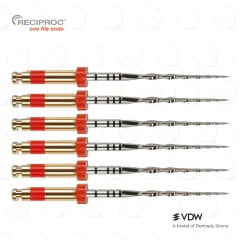
RECIPROC® R25 · 25 mm · 6 files
Still stepping through a sequence, and reprocessing what survives it? RECIPROC® prepares the whole canal with one reciprocating instrument, and in the majority of canals with no initial hand filing. R25 is where VDW's own selection protocol lands most often, and 25 mm is the length most cases call for. It is also the instrument in the published papers: when a study says RECIPROC®, this is usually what was on the bench.
| 93%+ WITHOUT A GLIDE PATH | 1 file PER MOLAR | 66% FEWER RETREATMENTS |
This pack: 6 × RECIPROC® R25, 25 mm · radiopaque depth markings at 18/19/20/22 mm · sterile blisters, single use – one molar per file, per VDW
Made by VDW, Munich – genuine RECIPROC®
A 0.25 mm tip on an 8% taper over the first 3 mm, regressing above it to D16 1.05 mm – apical shaping where the case needs it, coronal dentine left alone. The alloy is M-Wire®, which VDW describe as having greater cyclic fatigue resistance and greater flexibility than traditional nickel-titanium; the core is S-shaped with a non-cutting tip, so it follows the canal rather than cutting its own path; and the shaft is 11 mm against the 13 mm or longer on many instruments, which is felt on a second molar with limited opening.
It is not a rotary file driven differently. The reciprocating angles are set below the point at which the instrument would fail, so binding cannot lock it – which is the whole basis of the glide path argument. VDW's wording, and ours: the angles "are smaller than the angle settings where the elastic limit of the instrument would be met, thus minimising the risk of instrument fractures."
Settled before you start, from the radiograph and, where the canal is visible, one hand file inserted passively – here meaning it travels directly to working length with a gentle watch-winding movement, but with no filing action.
› R25 – canal partly or completely invisible on the radiograph, or visible but an ISO 20 will not go passively.
› R40 – an ISO 20 goes passively, an ISO 30 does not.
› R50 – an ISO 30 reaches working length passively.
In most cases, the R25 will be suitable in size for the root canal treatment.
— VDW, RECIPROC® user brochure, summarising its own instrument-selection protocol.
1 Check the canal is free with an ISO 10 hand instrument – the directions name VDW's own C-PILOT® 010 in 25 mm. No orifice opener first; the design clears the coronal third itself.
2 Irrigate, throughout. The directions have you irrigate the canal and clean the flutes between passes – a single-file system shortens the mechanical part of the case, not the chemical one. Sodium hypochlorite in 5.25% or 2%, to your own protocol.
3 Shape on the RECIPROC® setting in slow in-and-out pecks of no more than 3 mm, very light pressure, three at a time. Then out, flutes cleaned in the Interim Stand, re-irrigate, patency confirmed, back in. A lateral brushing motion is sanctioned for irregular canals.
4 Gauge the apex with a hand instrument one ISO size larger than the file that reached length: light tug-back about 1 mm short and no further means the preparation is done. R25 achieves an ISO 33 at 1 mm from the apex; for a larger apical preparation, R40 or R50 follow.
5 Dry, then obturate. Matched paper points R25, then the matched gutta-percha cone carried to length with sealer – VDW make it in the greater taper corresponding to this instrument, for single cone, lateral compaction or a master cone in warm vertical condensation. The taper you cut is the taper you fill.
6 Seal it coronally. The apical seal is only half the job – SDR® flow+ places a 4 mm bulk increment straight over the orifices in a single cure.
And the glide path? No initial hand filing in the majority of canals – the manufacturer's own headline, unchanged since 2011, with a peer-reviewed figure behind it: De-Deus and colleagues (International Endodontic Journal, 2013) took the R25 to full working length without an initial glide path in more than 93% of canals. Where it does not advance, do not force it: withdraw, clean, irrigate, try again, and if it still will not go, create a glide path with C-PILOT® 015 and continue. "Usually unnecessary" and "never necessary" are different claims, and only the first is ours to make.
A single-file canal is only as good as what goes into it, and this is where we reach for NeoSEALER® EZFlo: premixed bioceramic, nothing to mix or time on the bench, around 35 minutes of working time, 5.5 mm Al radiopacity, delivered through 29 gauge NaviTip™ cannulas. The gauge is the point – a bore that fine places sealer in the apical third rather than wiping it down the coronal walls, and the 25 mm tips match this file's length. Prefer a wider bore? NeoSEALER® Flo is the same chemistry with Flex Flo tips. Staying with resin? AH Plus® is still the epoxy sealer every other one is measured against, and VDW's own 2Seal® is the brand-matched epoxy-amine. Resin or bioceramic is a choice of technique rather than a ranking – we carry both because both are right in different hands.
Bürklein and colleagues (IEJ, 2012) found this system prepared a canal up to 60% faster than multiple-file systems – 73.1 seconds against 185.2 – while maintaining the original curvature and cleaning the apical region more thoroughly; Gavini (JOE, 2012) measured the R25's own cyclic fatigue resistance as significantly higher in reciprocation than in continuous rotation; and Zuolo (IEJ, 2013) found it left the least residual gutta percha and sealer of the retreatment approaches compared, at 4.57%, because R25 retreats as well as it shapes. The newest citation is about teeth rather than benches: Kiel followed 14,233 endodontically treated teeth for five to ten years (IEJ, June 2025) and found survival without further intervention 30–40% higher under the RECIPROC® protocol, non-surgical retreatment 66% lower and extractions 21% lower. It is a retrospective single-centre cohort, statistically adjusted, and the authors say only that the result "might be attributed to" the system – but it answers the question a clinician actually has.
The limit is worth knowing and it is narrow. Severe curvature is what this instrument is for; abrupt apical curvature is a contraindication. If the ISO 10 hand file used for working length still has to be pre-curved to reach it, after the instrument has reached two thirds of the estimated length, finish the canal with hand files. VDW have printed the sentence that puts it in proportion since 2010: this limitation also applies to continuous rotary instruments. And the files may look slightly curved in the blister – VDW note that this is not a manufacturing defect.
The fracture of the original RECIPROC is not an issue considering that its fracture rate is very low (0.2%).
— Ghassan Yared, who developed single-file reciprocation and consults to the RECIPROC® range. His statement in a VDW article, rather than a study result.
What motor do I need?
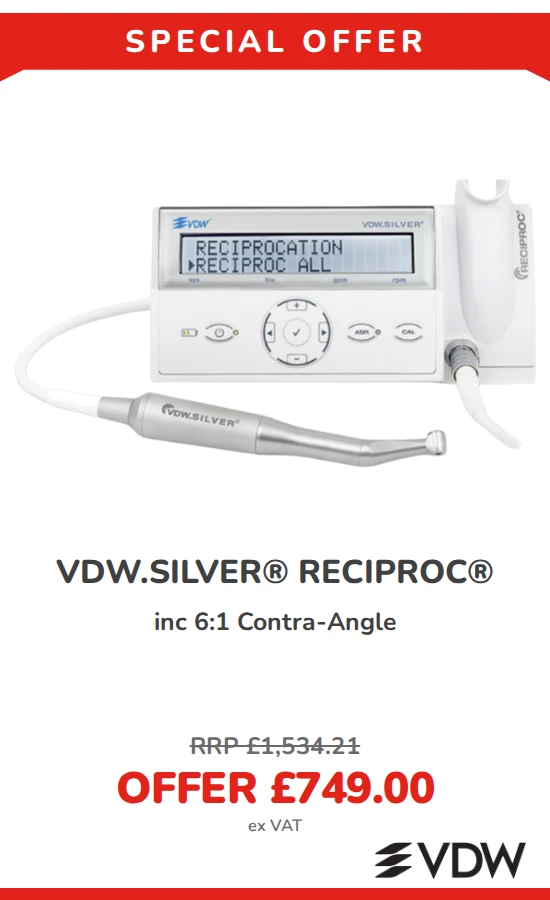
A drive system carrying the original VDW RECIPROC® settings – reciprocating motors without them can lead to misuse. We stock the VDW.SILVER® RECIPROC® with 6:1 contra-angle, the motor this system launched with, and the X-Smart® Pro+ with an integrated apex locator. The cordless X-Smart® Go carries a RECIPROC® programme too.
How does this compare with RECIPROC® blue?
Same geometry, same three sizes, same movement, same motor programme – the difference is the alloy. This is the original in M-Wire®, and the instrument most of the published RECIPROC® literature was measured on. Blue is the later heat-treated version. If your practice is already standardised on this one, nothing about it has changed.
One file per case, really?
Per molar, which is the unit VDW set – so a two-molar appointment is two files, and one per canal in extreme curvature. Against three to six rotary instruments plus reprocessing the arithmetic still works, and the plastic band on the shaft deforms in the autoclave, so the decision is made for you.
| Patency, and between passes | C-PILOT® 010 and 008 in 25 mm · Interim Stand and foam refills for the flutes |
| Drive it | A motor with original RECIPROC® settings: VDW.SILVER® · X-Smart® Pro+ · X-Smart® Go |
| Other sizes and lengths | R40 and R50 in 25 mm, or the assorted blister · R25 in 21 mm or 31 mm |
| Irrigate | Hypochlorite 5.25% or 2% · 17% EDTA · 40% citric acid · 2% CHX · through IrriFlex® 30g or NaviTip™ 29 ga 25 mm, activated with EDDY® |
| Dry and fill | Paper points R25 · gutta-percha R25 · or assorted boxes covering all three sizes: points, cones |
| Buying in | System Kit – 12 files, assorted cones and points, and a training model |
RECIPROC® R25 · reciprocating single-file system · 0.25 mm tip, 8% taper over the first 3 mm, regressive, D16 1.05 mm · M-Wire® NiTi · S-shaped cross-section, non-cutting tip, 11 mm shaft · radiopaque markings 18/19/20/22 mm · shaping, curvature, MB2 and retreatment · 6 sterile files, single use, one molar · 25 mm, also in 21 and 31 mm · VDW, Munich · REF V040212025025

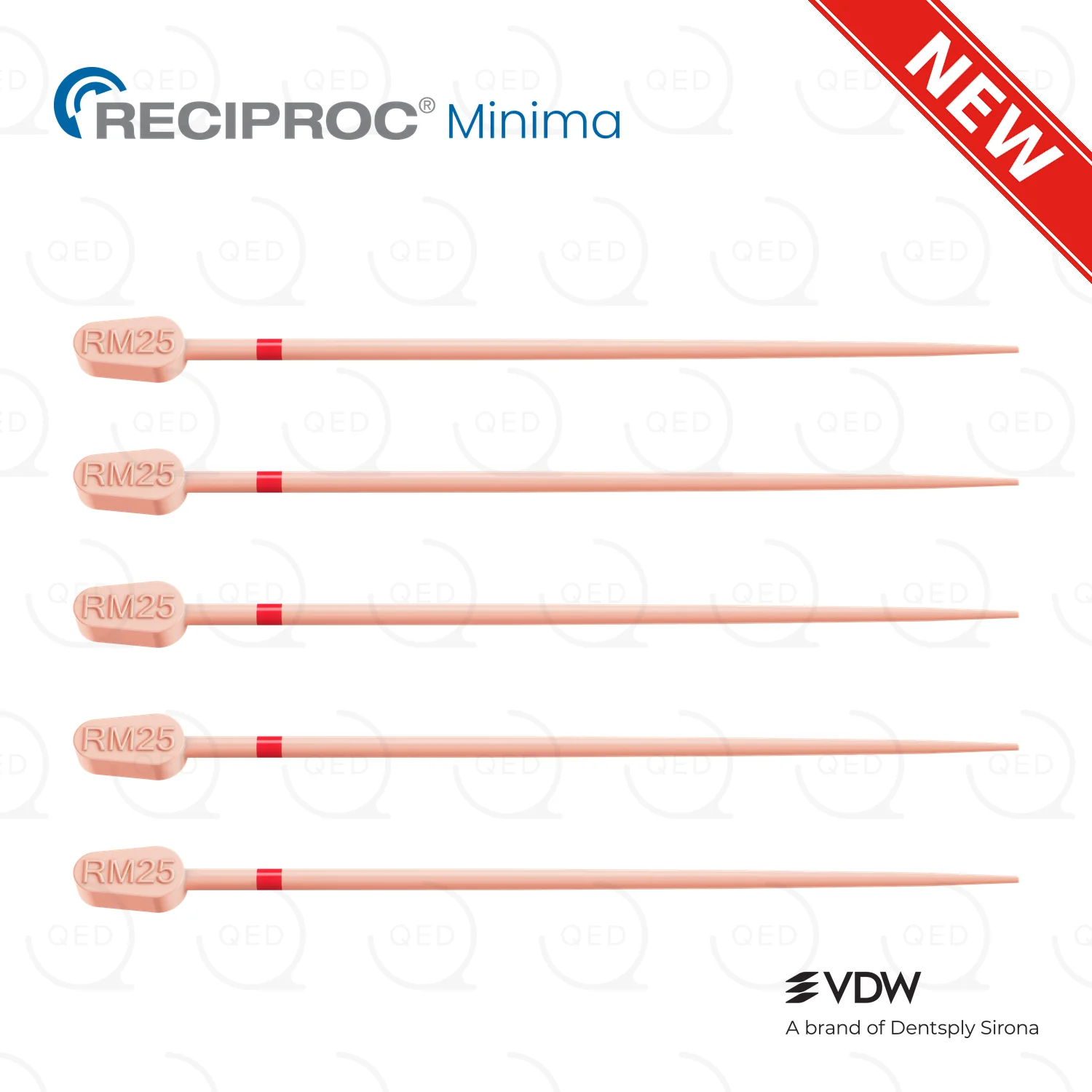
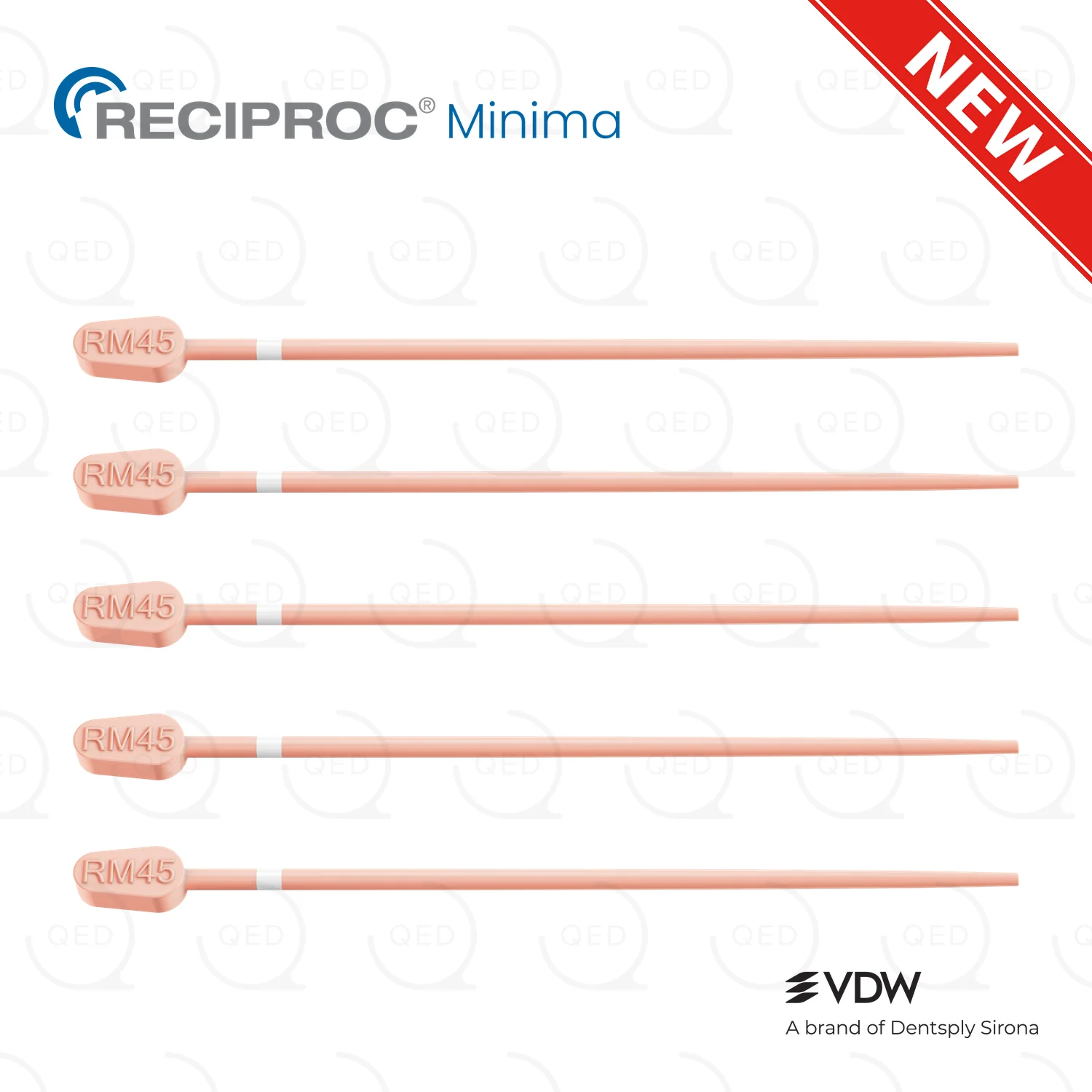
SpotlightRECIPROC® MinimaOne file · slim shaping for narrow canals
Shaping systems
Hand files & finders
Materials & more
 eMail V040212025025 to a friend






























 Facebook
 Twitter
 Instagram
 Pinterest