

Best selection of Endodontic supplies in the UK


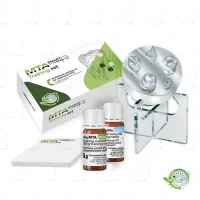
map vpt · n°1 white · 16 plungers
bought the vpt needle and reached for your usual red plungers? they will not fit. map vpt runs at a different scale: the white n°1 needle is ø2.30 mm against ø1.10 mm for the standard red, because pulp capping calls for a wide coronal delivery rather than a fine apical one. the white plunger is the only rod that matches it.
this pack: 16 × vpt plastic plungers, n°1 white
made by pd dental, switzerland
| fits | the map vpt n°1 white needle, ø2.30 mm – and nothing else in the range |
| not interchangeable | pd state that vpt plungers and the vpt cleaning brush are specific to map vpt |
| single use | autoclave at 132 °c for 3 minutes before use, then discard after that patient |
| shelf life | 5 years, per the manufacturer's instructions for use |
› the syringe is shared, the consumables are not. map vpt needles fit the same stainless steel syringe as the rest of the system – it is only the plungers and the cleaning tool that differ.
› clean with the brush, not with floss. the wider vpt lumen is cleaned with the map cleaning brush, still inside the fifteen-minute window.
› what goes through it is mta or a bioceramic cement, which is what pd list the vpt needles as compatible with.
why is a pulp-capping needle so much wider?
because the target is different. an apical repair wants a fine increment placed precisely; a pulp cap wants even coverage across an exposure, and a 2.30 mm bore lays that down in one pass.
do i need the purple ones as well?
only if you own the purple ø3.40 mm needle. each vpt size has its own plunger, and white does not fit purple.
| the needle it serves | vpt needle n°1 white · ø2.30 mm |
| whole vpt set-up | map vpt kit – syringe, white needle, plungers, brush and well |
| clean the lumen | vpt cleaning brush – the vpt-specific tool |
| wider vpt size | vpt plungers n°2 purple · 16 – for the ø3.40 mm needle |
map vpt plastic plungers n°1 · white · single-use, autoclave before use · for the vpt ø2.30 mm needle only · 16 per pack · pd dental · ref 20203
map vpt® · n°1 white · ø2.30 mm
already set up for apical work, and now wanting to place bioceramics on a vital pulp? the white vpt needle is the shortest route there. it fits the map system syringe already on your tray, and at ø2.30 mm it is more than twice the bore of the red apical needle – because a pulp cap wants even coverage across an exposure, not a fine increment driven into a canal.
this pack: 1 × vpt needle n°1 white, ø2.30 mm · 16 × white plungers · 1 × cleaning brush
made by pd dental, switzerland
| bore | ø2.30 mm – pd describe this size as ideal for precise coronal filling |
| fits | map system syringes, the same bayonet catch as the apical needles |
| own consumables | white plungers and the vpt cleaning brush only – standard plungers and floss will not serve it |
| reusable | validated by pd for 50 reprocessing cycles; the plunger inside is single-use |
› indication: pd list the vpt needles for placement of repair materials during pulp capping, with mta or bioceramic cements.
› brush it out within fifteen minutes. a 2.30 mm lumen holds a lot of cement, and pd's warning about set material is no softer for the wide bores.
› white or purple? white for a precise coronal fill; purple at ø3.40 mm where the coverage needs to be broader.
can i use my red plungers with it?
no. the vpt plungers are a different size entirely and pd state they are specific to map vpt. the same goes for the cleaning brush.
needle alone, or the kit?
the needle if you already own a map syringe. the kit adds the syringe and a well, which is the better buy if this is your first map instrument.
| with a syringe | map vpt kit – needle, syringe, plungers, brush and well |
| its consumable | vpt plungers n°1 white · 16 |
| clean the lumen | vpt cleaning brush – the spare, for when the first wears out |
| material to place | neoputty® · 0.5 g – premixed bioceramic |
map vpt needle n°1 · white · ø2.30 mm · pulp capping · with 16 plungers and a cleaning brush · pd dental · ref 20218
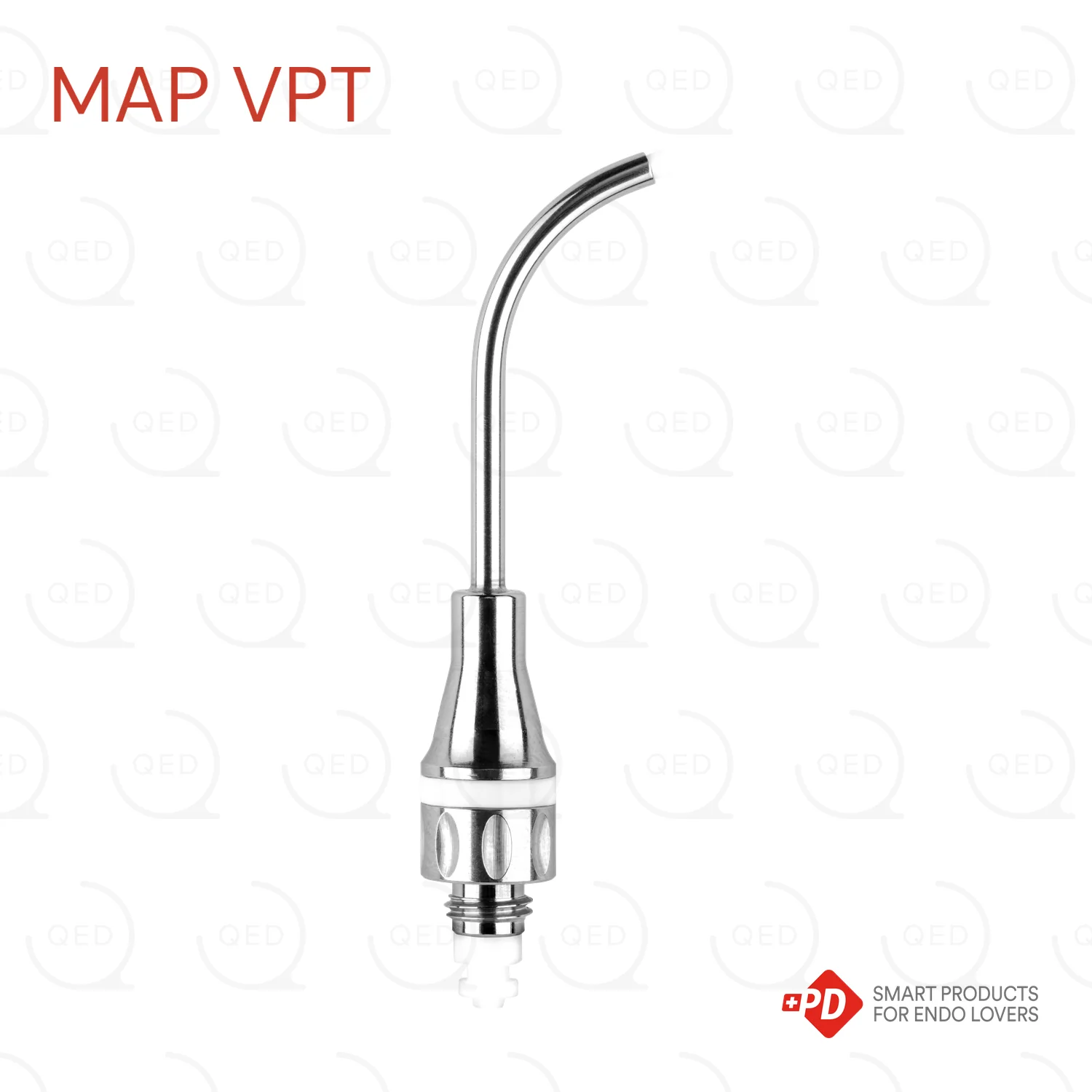
map vpt® · kit · ø2.30 mm white needle
a carious exposure on a vital pulp, a bioceramic that must sit evenly across it, and an amalgam plugger designed for neither? vital pulp therapy asks the opposite of apical work – wide, gentle coverage rather than a fine increment driven deep. map vpt is pd's answer: the same syringe you may already own, fitted with a ø2.30 mm white needle that lays material across an exposure in one delivery.
this kit: 1 × stainless steel syringe · 1 × vpt needle n°1 white, ø2.30 mm · 16 × white plungers · 1 × cleaning brush · 1 × stainless steel well
made by pd dental, switzerland
| indication | pd list it for placement of repair materials during pulp capping procedures |
| bore | ø2.30 mm – pd describe the white needle as ideal for precise coronal filling |
| materials | pd state compatibility with biomaterials used in pulp therapy, such as mta or bioceramic cements |
| reprocessing | needle, syringe, well and brush are reusable and validated for 50 cycles. plungers are single-use |
› clean with the brush, not with floss. the vpt lumen is far too wide for the threads used on the standard needles – and the fifteen-minute window applies here too.
› the syringe is shared, the consumables are not. vpt needles fit map system syringes, but the plungers and the brush are vpt-specific.
› isolation first. pulp capping outcomes turn on a dry field long before they turn on the carrier.
i already own a map syringe – do i need the kit?
not necessarily. the white needle is sold on its own with plungers and brush; the kit suits anyone starting from nothing, or wanting a second syringe kept set up for vpt.
what is the evidence?
a published case series describes clinical use across different vital pulp therapies. it is a case series, not a trial, and no comparative data exists for this or any other carrier – treat it as technique reporting, not proof.
pd publish a map vpt tutorial and a pulp capping case by dr marc kaloustian.
| its consumable | vpt plungers n°1 white · 16 |
| wider needle | vpt needle n°2 purple · ø3.40 mm – for broader pulpotomy work |
| material to place | neoputty® · 0.5 g – premixed bioceramic, ready at the chairside |
| isolate | oraseal™ caulking – seals the dam margin before the pulp is uncovered |
map vpt kit · syringe, ø2.30 mm white needle, 16 plungers, brush and well · vital pulp therapy · autoclavable, 50 cycles · pd dental · ref 20288

map system® · map one · the way in
placing mta with an amalgam carrier and a plugger, and wondering whether a dedicated carrier is worth it? map one is the smallest way to find out. pd call it the simplified kit for clinicians who want to acquire an efficient tool, and it is built around the size that suits most cases – the niti memory shape n°1 at ø1.10 mm, which you bend to the canal and the autoclave straightens again.
this kit: 1 × stainless steel syringe · 1 × niti memory shape needle n°1 · 16 × plastic plungers n°1
made by pd dental, switzerland
| the needle | niti memory shape n°1, ø1.10 mm – bendable, and straightened again by sterilisation |
| grows with you | the syringe takes every geometry in the range, so a second need costs a needle rather than a kit |
| reprocessing | syringe and needle are validated by pd for 50 cycles. the plungers are single-use |
| not included | the material, and a cleaning thread – both bought separately and both needed on day one |
› order floss with it. the fifteen-minute cleaning rule applies from the first case, and cleanyfloss is what pd name for it.
› what pd list the system for: pulp capping, perforation, root resorption, apexification and apexogenesis, and retro-obturation.
› not for biodentine in this needle – the ifu excludes it from the red and yellow bores.
will one size cover my cases?
n°1 covers a great deal of orthograde repair work. if you also do apical surgery, the handed surgery needles are a different geometry rather than a different size, and are bought separately.
map one or the intro kit?
map one if you want the instrument in your hand and will add sizes as cases demand. the intro kit if you already know you want all three bores, since it also brings a mixing well and a pack of floss.
| order with it | cleanyfloss · 30 threads – needed from the first case |
| its consumable | plastic plungers n°1 red · 16 |
| all three bores | map intro kit – n°0, n°1 and n°2 with a well |
| material to place | neoputty® · 0.5 g – premixed bioceramic |
map one · stainless steel syringe, niti memory shape n°1 needle and 16 plungers · autoclavable, 50 cycles · pd dental · ref 20296


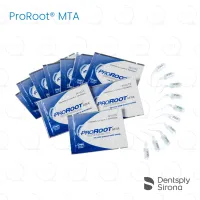
proroot® mta · white · 4 × 0.5 g
root-end fillingperforation repairapexificationpulp cappingpulpotomy, primary teeth
proroot® mta is dentsply sirona’s mineral trioxide aggregate – a fine, hydrophilic powder that sets in the presence of moisture into what their directions call “a strong impermeable barrier”. four 0.5 g pouches, each with its own water ampoule, so every case is mixed fresh and nothing is left open on the shelf.
| 4 mm al min. radiopacity, ifu | ~3 min working time, ifu | > 24 mpa compressive, ifu |
this pack: proroot® mta root canal repair material, white – 4 pouches of 0.5 g powder and 5 ampoules of 0.18 g water · dentsply sirona ref a040500000300
single use · non-sterile, do not sterilise · shelf life 3 years
› six indications in one material. dentsply sirona’s directions list root-end filling, the apical plug in apexification, perforation repair during root canal therapy, repair after internal resorption, pulp capping and pulpotomy of primary teeth.
› sets in a wet field. the powder hydrates to a colloidal gel that, in the directions’ words, “solidifies to form a strong impermeable barrier”. moisture is part of the chemistry, not an enemy of it.
› unit dose. each 0.5 g pouch is matched to a 0.18 g micro-dose water ampoule, so the powder-to-liquid ratio is set by the pack, not the clock. the four-pouch box carries one spare ampoule.
› radiopaque. at least 4 mm of aluminium equivalent (ifu), so placement can be confirmed on the radiograph the directions ask for.
› a permanent part of the filling. in perforation repair and apexification the directions leave the set mta in place and obturate the remaining canal on top of it.
dentsply sirona call it “the first name in root repair”, and on a bench of newer bioceramics it is still the material the others describe themselves against. what you are buying is a known quantity: a composition published in the directions, six indications set out step by step, and a pack that controls the one variable mta punishes – the water.
the four-pouch box suits a practice that places mta occasionally – a perforation here, a pulp cap there – because each pouch stays sealed until the case needs it. the directions insist on that: kept in its sealed packaging and stored dry, because moisture is what sets it. for regular use, the 10 × 0.5 g box is the lower cost per pouch.
proroot® mta root repair material is a powder consisting of fine, hydrophilic particles that set in the presence of moisture. hydration of the powder creates a colloidal gel that solidifies to form a strong impermeable barrier that fully cures over a four-week period.
dentsply sirona, proroot® mta instructions for use (europe, 2025-08)
| material | mineral trioxide aggregate – a fine, hydrophilic powder that sets in the presence of moisture |
| composition | tri- and dicalcium silicates 69–74%, bismuth oxide 17–22%, minor components 2–7% (calcium aluminate, aluminoferrite and sulphate, and others) |
| shade | white (tooth-coloured) |
| mixing | one 0.5 g pouch with one 0.18 g water ampoule, about a minute on the pad |
| cure | checked for hardness after four hours; fully cures over four weeks |
| shelf life | 3 years; store dry, below 30 °c, away from sunlight |
| contraindications | none known |
mixing (all indications). dispense a pouch onto the pad, pull the end off an ampoule and squeeze it out alongside, bring the liquid in gradually and mix for about a minute. it does not set as quickly as other cements – careful mixing is what makes it easy to handle.
1perforation repair, and repair after internal resorption. under dam: debride and irrigate with hypochlorite (for resorption, a week of calcium hydroxide first), dry, and obturate the canal apical to the defect. carry the mta into the defect, compact it with a small plugger, cotton pellet or paper point, and confirm on a radiograph.
2apexification. after a week of calcium hydroxide, carry and compact a three to five millimetre apical barrier, confirm it radiographically, and leave a moist pellet under a temporary.
3after either: at four hours or the next visit, check the mta is hard (if not, rinse and repeat), then obturate the rest of the canal. the mta stays as a permanent part of the filling.
4root-end filling. resect, prepare a class i root-end cavity three to five millimetres deep with an ultrasonic tip, achieve haemostasis, dry, then place and compact the mta, clean the root surface and confirm on a radiograph.
5pulp capping. rinse the exposure with hypochlorite, place a small amount of mta over it, blot the excess moisture, cover it with a light-cured liner, then etch, bond and restore. review sensibility every six months.
6pulpotomy of primary teeth. remove the coronal pulp, achieve haemostasis with pressure, place mta over the pulp stumps and chamber floor to an even three to four millimetres, fill the chamber and restore – the directions finish with a stainless-steel crown.
these are summaries. the directions carry every step, and the materials they name at each stage, in full – see downloads.
how much water, and what if it is too wet or too dry?
use the ampoule supplied with each pouch and mix for about a minute so every particle is hydrated. the directions allow a little extra water – the spare ampoule, or usp purified water – to reach the consistency you want, and they warn that too much or too little liquid reduces the final strength. if the mix starts to dry on the pad, cover it with moist gauze rather than adding more water.
will it discolour the tooth?
the directions are candid about it: a slight discolouration may appear in the months after treatment, and in an aesthetic zone they ask the clinician to weigh the procedure, the surface area exposed and the other restorative materials used.
how long before i can restore over it?
for perforation repair and apexification the directions place a moist pellet and a temporary for at least four hours, then check the mta is hard – at that visit or a later one – before obturating the rest of the canal. for pulp capping they cover it straight away with a light-cured liner, then bond and restore in the same visit.
can i use a pouch across two patients?
no. proroot mta is single use and single patient, and the directions say to place it immediately after mixing; once set it cannot be used again. that is what the 0.5 g unit dose is for.
4 × 0.5 g or 10 × 0.5 g?
same material, same pouch, same ampoule. the four-pack carries one spare ampoule for adjusting a mix; the ten-pack is the lower cost per pouch for practices placing mta every week.
| isolation | qed non-latex dam – the directions use dental dam at every stage. |
| irrigants | chlorax 5.25%, chlorax 2% and endo-solution 17% edta. |
| interim dressing | ultracal xs, calcipast and opacal – calcium hydroxide, which the resorption and apexification protocols place for a week. |
| drying | mmpp paper points 15–40 – or the matched points for your file system. |
| delivery | vista mta carriers 0.80 mm, 0.99 mm and 1.60 mm · cerkamed mta applicator 0.80 mm and 1.20 mm. |
| compaction | penn micro-plugger 060, 100 · root-end: endoblack retroplugger 050, 075. |
| obturation | proroot bio sealer – dentsply sirona’s bioceramic sealer on the same calcium silicate chemistry · ah plus – the epoxy alternative. |
| bonding | prime&bond active – dentsply sirona’s universal adhesive. |
| coronal seal | sdr flow+ refill universal – 4 mm bulk increment, one cure. |
| also in stock | neomta 2 and neoputty – avalon biomed’s bioceramic repair materials, a different formulation and handling. |
› proroot® mta instructions for use (pdf, 1.1 mb, multilingual, dentsply sirona) – the current european edition (2025-08), on dentsply sirona’s site. english is the first section.
indications, composition, physical properties, precautions, adverse reactions, storage and every step above are from dentsply sirona’s proroot® mta instructions for use (end-ifu-proroot-mta-tds-v05, europe, 2025-08; english section, spelling anglicised). “the first name in root repair” is dentsply sirona’s own line. technique is theirs; the clinical decision is yours – we make no claim of our own about seal, healing or outcome. proroot, ah plus, sdr and prime&bond are dentsply sirona trademarks; neomta and neoputty are avalon biomed trademarks.
proroot® mta · root canal repair material, white · 4 × 0.5 g pouches + 5 × 0.18 g water ampoules · dentsply sirona · ref a040500000300
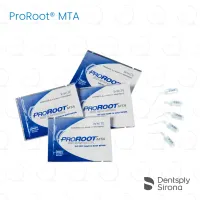
proroot® mta · white · 10 × 0.5 g
root-end fillingperforation repairapexificationpulp cappingpulpotomy, primary teeth
ten single-patient pouches of dentsply sirona’s mineral trioxide aggregate, each with its own 0.18 g water ampoule. the lower cost per pouch, for practices that place mta every week – perforations, apical plugs, root-end fillings and pulp caps.
| 4 mm al min. radiopacity, ifu | ~3 min working time, ifu | > 24 mpa compressive, ifu |
this pack: proroot® mta root canal repair material, white – 10 pouches of 0.5 g powder and 10 ampoules of 0.18 g water · dentsply sirona ref a040500000400
single use · non-sterile, do not sterilise · shelf life 3 years
› six indications in one material. dentsply sirona’s directions list root-end filling, the apical plug in apexification, perforation repair during root canal therapy, repair after internal resorption, pulp capping and pulpotomy of primary teeth.
› sets in a wet field. the powder hydrates to a colloidal gel that, in the directions’ words, “solidifies to form a strong impermeable barrier”. moisture is part of the chemistry, not an enemy of it.
› unit dose. each 0.5 g pouch is matched to a 0.18 g micro-dose water ampoule, so the powder-to-liquid ratio is set by the pack, not the clock. the four-pouch box carries one spare ampoule.
› radiopaque. at least 4 mm of aluminium equivalent (ifu), so placement can be confirmed on the radiograph the directions ask for.
› a permanent part of the filling. in perforation repair and apexification the directions leave the set mta in place and obturate the remaining canal on top of it.
it is the same material, the same 0.5 g pouch and the same unit-dose ampoule as the 4 × 0.5 g box – the difference is volume. each pouch stays sealed until the case needs it, which is what the directions ask for: kept in its sealed packaging and stored dry, because moisture is what sets it. with a three-year shelf life, a ten-pack is a sensible stock item for any practice doing its own perforation repairs and pulp caps.
dentsply sirona call it “the first name in root repair”. the case for it is a known quantity: a composition published in the directions, six indications set out step by step, and a pack that controls the water.
| material | mineral trioxide aggregate – a fine, hydrophilic powder that sets in the presence of moisture |
| composition | tri- and dicalcium silicates 69–74%, bismuth oxide 17–22%, minor components 2–7% (calcium aluminate, aluminoferrite and sulphate, and others) |
| shade | white (tooth-coloured) |
| mixing | one 0.5 g pouch with one 0.18 g water ampoule, about a minute on the pad |
| cure | checked for hardness after four hours; fully cures over four weeks |
| shelf life | 3 years; store dry, below 30 °c, away from sunlight |
| contraindications | none known |
dispense a pouch onto the pad, pull the end off an ampoule and squeeze it out alongside, bring the liquid in gradually and mix for about a minute. carry it into place, compact it, and confirm on a radiograph. in perforation repair and apexification (a three to five millimetre apical barrier), leave a moist pellet under a temporary and check the mta is hard at four hours or the next visit before obturating the rest of the canal. in pulp capping, cover it with a light-cured liner and restore in the same visit.
each indication is set out step by step on the 4 × 0.5 g page and in full in the directions – see downloads.
how much water, and what if it is too wet or too dry?
use the ampoule supplied with each pouch and mix for about a minute so every particle is hydrated. the directions allow a little extra water – the spare ampoule, or usp purified water – to reach the consistency you want, and they warn that too much or too little liquid reduces the final strength. if the mix starts to dry on the pad, cover it with moist gauze rather than adding more water.
will it discolour the tooth?
the directions are candid about it: a slight discolouration may appear in the months after treatment, and in an aesthetic zone they ask the clinician to weigh the procedure, the surface area exposed and the other restorative materials used.
how long before i can restore over it?
for perforation repair and apexification the directions place a moist pellet and a temporary for at least four hours, then check the mta is hard – at that visit or a later one – before obturating the rest of the canal. for pulp capping they cover it straight away with a light-cured liner, then bond and restore in the same visit.
can i use a pouch across two patients?
no. proroot mta is single use and single patient, and the directions say to place it immediately after mixing; once set it cannot be used again. that is what the 0.5 g unit dose is for.
| isolation | qed non-latex dam – the directions use dental dam at every stage. |
| irrigants | chlorax 5.25%, chlorax 2% and endo-solution 17% edta. |
| interim dressing | ultracal xs, calcipast and opacal – calcium hydroxide, which the resorption and apexification protocols place for a week. |
| drying | mmpp paper points 15–40 – or the matched points for your file system. |
| delivery | vista mta carriers 0.80 mm, 0.99 mm and 1.60 mm · cerkamed mta applicator 0.80 mm and 1.20 mm. |
| compaction | penn micro-plugger 060, 100 · root-end: endoblack retroplugger 050, 075. |
| obturation | proroot bio sealer – dentsply sirona’s bioceramic sealer on the same calcium silicate chemistry · ah plus – the epoxy alternative. |
| bonding | prime&bond active – dentsply sirona’s universal adhesive. |
| coronal seal | sdr flow+ refill universal – 4 mm bulk increment, one cure. |
| also in stock | neomta 2 and neoputty – avalon biomed’s bioceramic repair materials, a different formulation and handling. |
› proroot® mta instructions for use (pdf, 1.1 mb, multilingual, dentsply sirona) – the current european edition (2025-08), on dentsply sirona’s site. english is the first section.
indications, composition, physical properties, precautions, adverse reactions, storage and every step above are from dentsply sirona’s proroot® mta instructions for use (end-ifu-proroot-mta-tds-v05, europe, 2025-08; english section, spelling anglicised). “the first name in root repair” is dentsply sirona’s own line. technique is theirs; the clinical decision is yours – we make no claim of our own about seal, healing or outcome. proroot, ah plus, sdr and prime&bond are dentsply sirona trademarks; neomta and neoputty are avalon biomed trademarks.
proroot® mta · root canal repair material, white · 10 × 0.5 g pouches + 10 × 0.18 g water ampoules · dentsply sirona · ref a040500000400
neoputty® · avalon biomed · 0.5 g syringe
nobody's clinical result was ever improved by the mixing. powder, gel, glass slab, consistency judged by eye, working time already ticking – every step is a chance for the material to leave the pad different from the way it left the jar. neoputty® arrives ready. you dispense what the cavity needs, place it, and the variable you were managing at the bench is simply not there.
| 97.1% clinical, 12 mo | 92.8% radiographic | 1 hr+ working time |
this pack: 0.5 g neoputty® premixed bioceramic putty, syringe delivery · about six doses at the 0.075 g avalon quote for an anterior pulpotomy
made by avalon biomed · 3-year shelf life, and it does not dry out between uses
most of what gets claimed for bioceramics comes from cell culture and extracted teeth. neoputty® has something almost nothing else in this category has: a randomised controlled trial in patients. pediatric dentistry, 2023 – 70 primary molars in 42 children, twelve months, against neomta® 2, assessed by two independent evaluators.
| clinical success | 97.1% (34 of 35) for neoputty®, against 100% (34 of 34) for neomta® 2 |
| radiographic | 92.8% (32 of 35) for neoputty®, against 94.1% (32 of 34) for neomta® 2 |
| authors' finding | neoputty® showed comparable success to mineral trioxide aggregate over twelve months |
“neoputty® showed a comparable success to mineral trioxide aggregate in primary molar pulpotomies over 12 months.”
alqahtani as, alsuhaibani nn, sulimany am, bawazir oa. pediatric dentistry 2023;45(3):240–244.
that is a primary molar result at twelve months, and it does not claim superiority over mta. what it establishes is the question that actually matters about a premixed material: the convenience costs you nothing measurable.
the grey shadow older mtas leave in an anterior tooth comes from bismuth oxide, the traditional radiopacifier. avalon use tantalum oxide (tantalite) instead and market neoputty® as never discolouring. we would rather give you the measured figures – there are now two independent ones.
independent spectrophotometry on 96 extracted anterior teeth, followed to twelve months, put neoputty in saline at a colour change of delta e 2.26 – alongside biodentine™ at 2.18, and far below proroot® mta contaminated with blood at 7.42. small, and measured rather than asserted – which is more than the category usually offers. the same study makes a point no radiopacifier can fix: blood contamination worsened colour stability in every material tested. achieve haemostasis first, whatever you are placing.
özüdogru s, düzyol e, türkoglu kayaci s, aly ahmed hm, arslan h. journal of clinical pediatric dentistry 2026;50(1):236–244.
a second group looked at what your irrigants do to it. testing biodentine™ and neoputty against edta, chlorhexidine, hedp and sodium hypochlorite, they found biodentine™ discoloured more against every solution except distilled water, and concluded neoputty “could be an appropriate material in aesthetic areas”. the takeaway is about protocol: chlorhexidine and sodium hypochlorite discoloured both materials most.
usta sn, keskin c. restorative dentistry & endodontics 2024;49:e25.
| chemistry | hydraulic calcium silicate – tricalcium and dicalcium silicate, the same family as mta, supplied premixed as a putty |
| radiopacifier | tantalum oxide (tantalite), not bismuth oxide – which is what removes the classic bismuth discolouration mechanism |
| delivery | syringe. dispense what the cavity takes and recap – no slab, no spatula, no discarded excess from a batch mixed too large |
| sets in ~5 hours | in vivo, in the presence of moisture – but it is immediately washout resistant, so it stays where you put it while you finish the procedure |
| 8.1 mm al | radiopacity avalon describe as the highest in the premixed bioceramic putty class – comfortably above the iso 6876 minimum of 3 mm |
| cytocompatibility | comparable to neomta® plus and mta angelus® on human dental pulp cells (lozano-guillén et al, clin oral investig 2022) |
because it is water-free until it meets the tooth, neoputty® gives over an hour of working time and sets in about five hours in vivo. it will not go off on the pad while you deal with something else – and it needs contact with moisture, from apical tissue, tubules or pulp, to set at all.
the kits contain no applicator tip, which surprises people. express what you need onto a pad and carry it with what you already use – avalon suggest a plastics instrument, a hollenbach, an amalgam carrier or an mta carrier. for apexification, a reversed paper point guides the putty to the apex.
on thickness, avalon are specific: at least 1.5 mm for a pulpotomy, liner, base or pulp cap, and a 3–5 mm apical barrier for apexification.
avalon list twelve indications. the ones that bring people to the material are pulpotomy – what the randomised trial tested – direct and indirect pulp capping, cavity liner and base, apexogenesis and apexification, perforation repair, resorption, root-end filling and obturation. read the instructions for use before each new application.
this is the 0.5 g syringe – the only size avalon supply, and the sensible way in. if it becomes routine, we sell it in twos and threes at a lower cost per gram – sealed spares, not a bigger syringe, which is the better arrangement when shelf life runs from opening.
one honest reason to choose the powder-and-gel neomta® 2 instead: you can mix it thin, from putty to a sealer-like consistency, which a premixed putty cannot do. neoputty® answers with radiopacity – 8.1 mm al against 6.5, about 25% higher on avalon's own comparison.
| multipacks | two syringes (1.0 g) and three (1.5 g) · better value per gram |
| mixable sibling | neomta® 2 1.0 g kit · putty or sealer consistency from one powder |
| try both | neosealer® flo & neoputty® kit · sealer and putty in one box |
| carrying it | vista mta carrier · for root-end and perforation work |
| obturating | neosealer® flo · the matching bioceramic sealer |
| between visits | bio-c® temp · ready-to-use intracanal dressing |
| isolation | oraseal® caulking · a dry field before any calcium silicate |
is a premixed putty really as good as mixing it myself?
on the one indication tested in a randomised trial, yes – 97.1% against 100% clinical success at twelve months, one tooth in thirty-five. what you lose is the ability to vary the consistency; what you gain is that every increment is identical, and over an hour to place it.
how many doses will 0.5 g give me?
about six, on avalon's figure of 0.075 g for a typical anterior pulpotomy. scale it to your own work – a 3–5 mm apical barrier for apexification is a much larger increment than a pulp cap.
can i use it in a primary tooth with a permanent successor?
check the instructions for use for the indication in front of you. avalon's bioceramic sealers are specifically contraindicated there; do not assume the putty's indications match the sealer's.
five hours to set – can i restore before then?
yes, and avalon say so directly: you can complete the restoration or cement a crown immediately after placing it. setting and washout resistance are different things – neoputty® is immediately washout resistant and, per avalon, dimensionally stable with zero shrinkage, so it stays put while the set completes.
neoputty® 0.5 gm kit · premixed bioceramic putty · tricalcium and dicalcium silicate · tantalite radiopacifier · 8.1 mm al · over 1 hr working time · sets ~5 hrs · 12 indications · avalon biomed · ref anpik

neosealer® flo · avalon biomed · 2.2 g kit, 20 tips
root canal obturationpremixedmoisture-setretreatablecone buttering
every clinician has stood there with a fourth paper point wondering how dry is dry enough. with a bioceramic that question changes shape. the instructions are explicit: dry the canal with paper points to remove pooled irrigants or body fluids – and then stop, because moisture from the dentinal tubules and apical tissues is what starts neosealer® flo setting. the residual moisture in the canal wall is not your enemy; it is part of the chemistry.
| 9.5 hrs setting time | 6 mm al radiopacity | 81% less tip waste |
this pack: 2.2 g neosealer® flo premixed bioceramic sealer · 20 × flex flo tips™
made by avalon biomed · 2-year shelf life, store at room temperature
“moisture is required for setting of the sealer, supplied by the dentinal tubules and apical tissues.”
avalon biomed, neosealer® flo frequently asked questions.
the instructions for use give about thirty minutes of working time at room temperature – long enough that a difficult four-canal molar is not a race, and long enough to stop and re-take a radiograph without the syringe going off on the bracket table. avalon put setting at around 9.5 hours in vivo, in the presence of canal moisture – a laboratory iso protocol will give you a longer figure, because it is not measuring the same thing. nothing is mixed, so nothing is mixed wrongly: the powder-to-liquid ratio that decides a conventional sealer's flow and film thickness was set at the factory.
| chemistry | premixed bioactive bioceramic – tricalcium and dicalcium silicate in an organic liquid |
| radiopacifier | tantalum oxide (tantalite), giving about 6 mm al equivalent. avalon state it does not cause staining |
| setting | begins in the presence of moisture from the surrounding tissues – no complete drying required |
| retreatment | conventional instrumentation – hand and rotary files and ultrasonic tips – per avalon's own guidance |
the kit ships with 20 flex flo tips™ at 25.5 gauge, the smallest diameter avalon recommend for this sealer. any 25.5 gauge or larger luer-lock tip fits, so you are not locked to one consumable – but the instructions warn that flo becomes difficult to dispense through finer tips.
two points of technique from the instructions, both easy to get wrong. do not insert the tip past the middle third of the canal, and do not force it until it seals against the canal walls – a wedged tip is how sealer gets expressed beyond the apex. apply gentle, steady pressure with a constant outward movement as the material goes in.
you can also skip the tip entirely: avalon confirm the sealer may be dispensed straight from the syringe for the traditional cone-buttering technique – coat the canal walls lightly first, then coat the dried gutta-percha points before insertion.
working in deliberately narrow preparations? a 25.5 gauge floor is the wrong tool for a canal shaped by a reduced-taper file. reach for neosealer® ezflo instead – same family, designed around a 29 gauge navitip™.
every bioceramic sealer leaves material stranded in the dispensing tip. you pay for it, you never place it, and it goes in the bin with the tip. avalon publish 81% less waste than conventional tips for the flex flo tip™ used with neosealer® flo – a minimal-waste barrel design rather than anything to do with the sealer chemistry.
| flex flo tip™ | 0.027 g left in the tip |
| basic flex tip™ | 0.087 g left in the tip |
those are avalon's own two tips, so you can do the arithmetic yourself and it is the honest version of the claim. across the twenty tips in this kit, the difference between them is about 1.2 g of sealer – more than half a second syringe. on a 2.2 g syringe, the tip you choose changes how many cases you get out of it more than anything else does.
one further line worth knowing, because it explains the occasional puzzling case: setting of tricalcium silicates is inhibited in acidic environments such as infected sites. the chemistry that makes a bioceramic work is the same chemistry that an active infection can slow down.
the 2.2 g kit is where almost everyone starts, and 20 tips is a sensible match to the sealer in the syringe. if bioceramic obturation is already routine, the 4.4 g kit with 40 tips and the 6.6 g kit with 60 tips bring the cost per gram down. if you already have tips in the drawer, the 2.2 g refill and the three-syringe pack leave the tips out – just remember to keep flex flo tips on the shelf, because a refill with nothing to dispense it through is an expensive paperweight.
| larger kits | 4.4 g with 40 tips · 6.6 g with 60 tips |
| refills | 2.2 g, no tips · three-syringe pack |
| tips | flex flo tip™ (40) · 25.5 ga, the one avalon recommend |
| wider bore | basic flex tip™ (40) · 25 ga, for generous preparations |
| narrow canals | neosealer® ezflo · 29 ga navitip™ delivery |
| repair material | neoputty® · neomta® 2 · same bioceramic family |
| sealer and putty | neosealer® flo & neoputty® kit · both in one box |
so do i still dry the canal?
yes – you remove the free irrigant and pooled fluid, because you are placing sealer, not swimming it. what you do not have to chase is bone-dry desiccation. avalon are explicit that complete drying is not needed and that moisture is what sets the material.
can i retreat a case sealed with this?
avalon say yes, using conventional instrumentation including hand and rotary files and ultrasonic tips. that is their published position; plan any retreatment on the case in front of you rather than on a general rule.
flo or ezflo?
bore size, mostly. flo's finest recommended tip is 25.5 ga; ezflo is built around a 29 ga navitip™. if you shape conservatively – reduced-taper single-file systems especially – ezflo reaches where flo's tip will not.
will it stain?
the instructions list “does not discolor teeth” among the material characteristics – tantalite rather than bismuth oxide as the radiopacifier. bismuth is the mechanism behind classic mta discolouration (marciano, duarte and camilleri, clin oral investig 2015).
before first clinical use: neosealer® flo is alkaline, as every tricalcium silicate material is. it is not for use where there is hypersensitivity to caustic solutions, or in a primary tooth that has a permanent successor. full warnings, precautions and handling guidance are in the instructions for use – ask us if you would like a copy before ordering.
neosealer® flo 2.2 gm kit · premixed bioceramic root canal sealer · tantalite radiopacifier · ~6 mm al · ~30 min working time · ~9.5 hr set · ~0.3% shrinkage · 20 flex flo tips™ 25.5 ga · 2-year shelf life · avalon biomed · ref ansfk

cerkamed btr dental training gum · training kit
broken file retrieval practicecourse kitnot for patients
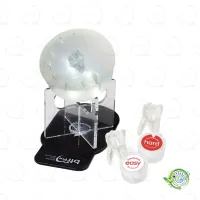
the btr dental training gum is cerkamed's bench kit for the btr pen: a transparent silicone mass, backlit, with eight broken file fragments set into it and a socket for a training tooth; a stand that turns it in three dimensions; an anti-slip mat; and two resin teeth with fragments already in them, one easy and one hard. cerkamed call it an endodontic training kit, and the point of the transparency is that you watch the loop close.
this pack: cerkamed btr dental training gum: silicone training mass (transparent, backlit, 8 embedded fragments, tooth socket), silicone mass stand, anti-slip mat, 2 training teeth (hard and easy)
| training mass | cerkamed: transparent and backlit, 8 pieces of broken endodontic files, a space to place the training tooth |
| stand | cerkamed: allows a 3d rotation |
| mat | anti-slip, for stability while working |
| hard tooth | cerkamed: 3 deeply placed, blocked pieces of files |
| easy tooth | cerkamed: 3 loosely placed pieces of files |
| teeth | modified drsk rct tooth model |
| more teeth | training teeth – easy · training teeth – hard – packs of 10 |
› the mass is the first stage: a fragment you can see, with room to work, so the feel of setting the loop and closing it on steel comes before any tooth is involved.
› the teeth are the second: the same retrieval down a real-shaped canal, first the loosely placed fragments, then the blocked ones.
› cerkamed publish the btr pen work methodology on their product page; the kit is built around it.
› training equipment, not a medical device. it never goes near a patient.
no. the btr pen set is sold separately, and this kit is what you learn it on. the larger btr dental training kit that cerkamed also make adds a digital microscope; ask us if a course needs it.
yes – the training teeth – easy and training teeth – hard are the same teeth in packs of ten, so a course can give every delegate a fresh one.
| the instrument | btr pen set |
| loop tips | 0.3 mm · 0.4 mm · 0.5 mm |
| replacement teeth | training teeth – easy · training teeth – hard |
| mta practice | mta smart system training set |
btr dental training gum · backlit silicone mass with 8 fragments, stand, mat, 2 drsk training teeth · training only · made by cerkamed, stalowa wola, poland · ref cer-w-dtgum
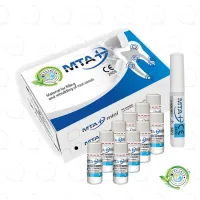
cerkamed mta+ · maxi · 10 x 0.14 g
perforation repairroot-end fillingpulp cappingpulpotomyresorptionopen apex
mta+ is cerkamed's mineral trioxide aggregate: a calcium-silicate powder in single-dose glass vials, mixed with purified water to "the consistency of wet sand". the maxi box carries ten 0.14 g vials and a 1 ml vial of liquid. cerkamed's indications, in their words: "perforations of root canal walls, intracanal resorptions, root tip backfilling, direct pulp capping, during pulp amputation surgery, treatment of teeth with incomplete root development".
this pack: cerkamed mta+ maxi: 10 glass vials of 0.14 g mta+ powder and 1 vial of 1 ml mta+ liquid
| powder | cerkamed: oxides of calcium, silicon, iron, aluminium, sodium, potassium, magnesium, calcium phosphate (approx. three quarters of the total), and bismuth and zirconium oxide |
| liquid | ph. eur. purified water |
| mix | cerkamed: the whole vial with 1–2 drops of liquid, spatulate about 30 seconds to wet sand; another drop if too thick or brittle |
| working time | cerkamed: 6 minutes from mixing |
| setting | cerkamed: approx. 180 minutes |
| standard | cerkamed: meets the requirements of en iso 6876; radiopaque |
| presentation | 10 x 0.14 g single-dose vials, 1 ml liquid |
› cerkamed on what it does: "the high content of calcium ions remineralises the tooth tissue. calcium-silicon compounds support tissue reconstruction following wall perforation and intracanal resorption."
› cerkamed: "one container of the mta+ powder contains a single dose." and "once mixed with the mta+ liquid the mixed dose must be used within 6 minutes."
› cerkamed: "exposure to moisture, including blood, will reduce the curing time."
› three contraindications from cerkamed: "do not use in inflammatory conditions." · "acidic ph values disrupt setting of mta+." · "the mta+ cannot be used as a full root canal filling, as its potential removal will be difficult."
› two cautions cerkamed carry that are worth knowing before the case: "discolouration might occur." and "complete filling of the root canal may reduce the resistance of the root to fracture."
› cerkamed: "avoid creating and inhaling dust." causes serious eye damage. cofferdam, gloves, goggles.
cerkamed carry the discolouration caution themselves. mta+ contains bismuth oxide, and cerkamed state plainly that "discolouration might occur." for an anterior tooth where that matters, our bioceramic range is formulated without bismuth – see the table below. that is a choice of material, not a ranking.
because an opened mta powder takes up moisture, and 0.14 g is what one repair or one pulp cap uses. ten vials is ten cases with nothing left drying in a tub. cerkamed also make a mini box of three.
a carrier. cerkamed make the tools for mta (mx1–mx4) – four tips, two for carrying from a dosing block and two for condensing – and the mta+ applicator 0.8 mm and mta+ applicator 1.2 mm for placing a measured plug. the vista apex mta carriers are the other carrier we stock for every mta.
cerkamed give 6 minutes from mixing to placement. have the site prepared, dry and isolated before the liquid goes on the powder.
| carriers and condensers | tools for mta (mx1–mx4) · mta+ applicator 0.8 mm · mta+ applicator 1.2 mm · vista apex mta carriers |
| practise it first | mta smart system training set – training mta, five drsk teeth with perforations and resorptions, and a backlit mass |
| bismuth-free bioceramic | neomta 2 · neoputty (avalon biomed) |
| isolation | rubber-dam liquid |
| irrigants | chloraxid 5.25% · endo-solution 17% edta |
mta+ maxi · 10 x 0.14 g powder vials, 1 ml liquid · en iso 6876 · radiopaque · 6 min working, approx. 180 min set · made by cerkamed, stalowa wola, poland · ref cer-w-mta maxi
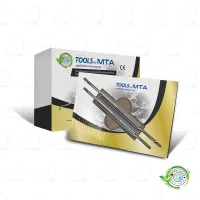
cerkamed tools for mta · mx1–mx4 · stainless steel
mta carryingmta condensingperforation repairretrograde fillingautoclavable
a set of double-ended stainless steel instruments for mta: two ends that carry a measured dose from the dosing block to the site, two that condense and smooth it once it is there, split by anterior and posterior reach. cerkamed's description: "reusable dental tools for handling and application of prepared measure of mta material." non-sterile in the box; autoclave before first use and every use after.
this pack: cerkamed tools for mta, stainless steel instrument set, mx1–mx4, non-sterile, reusable
| mx1 | carrying tip – mta from the dosing block into the prepared canal, perforation or retrograde cavity, posterior teeth |
| mx2 | carrying tip – the same, anterior teeth |
| mx3 | application tip – placing, condensing and smoothing the cement, anterior teeth |
| mx4 | application tip – the same, posterior teeth |
| material | cerkamed: corrosion-resistant stainless steel |
| sterilisation | cerkamed: steam autoclave 134°c for 5 minutes; disinfect, wash, rinse and dry first. ultrasonic cleaning recommended |
| storage | cerkamed: 5–30°c, relative humidity below 70% |
› cerkamed: "the packaged instruments are non – sterile. before sterilisation, these new instruments should be washed thoroughly with warm water and using detergent. before each use these dental instruments must be sterilised."
› cerkamed: "before use protect the instrument against contamination or damage of the material structure (cracks, bends, fractures, peeling, etc.)."
› the mx1–mx4 functions above are from the qed listing, which follows cerkamed's instrument leaflet; their web page describes the set only in general terms.
› cerkamed mark the product "to be used by dentist only".
three different jobs. the tools set carries a formed dose and condenses it. the mta+ applicator 0.8 mm and mta+ applicator 1.2 mm are single-ended placers that pick up a plug of a set diameter. the vista apex mta carriers are spring-loaded carriers for a longer reach. most operators own a carrier and this set.
cerkamed's matrix mta dosing block has grooves from 0.7 to 1.0 mm for forming a dose to size, and mx1/mx2 are described as carrying from it. it is not one we stock at present; a glass slab and a measured pick-up works with the same tips.
| the material | mta+ maxi |
| placers | mta+ applicator 0.8 mm · mta+ applicator 1.2 mm · vista apex mta carriers |
| practise it | mta smart system training set |
| bioceramic alternatives | neomta 2 · neoputty |
tools for mta · mx1–mx4 · stainless steel · non-sterile, autoclave 134°c 5 min · made by cerkamed, stalowa wola, poland · ref cer-w-narz
cerkamed mta+ applicator · 0.8 mm · stainless steel
mta placementperforation repairroot-end fillingautoclavablereusable
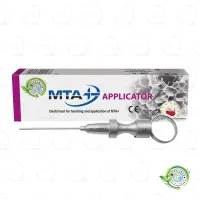
the mta+ applicator is cerkamed's single-ended placer for mixed mta: a stainless steel handle with a ring for the finger, a fine plunger, and a 0.8 mm tip that picks up a measured dose and pushes it out where the repair is. cerkamed's description: "reusable dental tools for handling and application of prepared measure of mta+ material." two diameters; this is the 0.8 mm.
this pack: cerkamed mta+ applicator, 0.8 mm diameter, stainless steel, reusable, non-sterile
| tip diameter | 0.8 mm |
| material | cerkamed: corrosion-resistant stainless steel |
| sterilisation | cerkamed: steam autoclave 134°c for 5 minutes, after disinfecting, washing, rinsing and drying; ultrasonic cleaning recommended |
| storage | cerkamed: 5–30°c, relative humidity below 70% |
| other size | mta+ applicator 1.2 mm |
› cerkamed: "the packaged instruments are non–sterile. before sterilisation, these new instruments should be washed thoroughly with warm water and using detergent. before each use these dental instruments must be sterilised."
› cerkamed: "before use protect the instrument against contamination or damage of the material structure (cracks, bends, fractures, peeling, etc.)."
› clear the barrel before the mta sets in it – cerkamed give 6 minutes from mixing on the mta+ page, and the plunger is the only way through a set plug.
› cerkamed mark the product "to be used by dentist only".
the canal or the cavity decides. 0.8 mm goes down a shaped canal for an apical plug or a lateral perforation; 1.2 mm carries more for a furcation floor, a pulpotomy or a retrograde cavity. many operators keep both. this page is the 0.8 mm; the other is here.
this is a placer: it picks up a plug of one diameter and delivers it. the vista apex mta carriers are spring-loaded carriers with a longer reach, and the tools for mta (mx1–mx4) carry and condense from a dosing block. they are companions rather than substitutes.
| the material | mta+ maxi |
| other instruments | tools for mta (mx1–mx4) · vista apex mta carriers |
| practise it | mta smart system training set |
| bioceramic alternatives | neomta 2 · neoputty |
mta+ applicator · 0.8 mm · stainless steel · reusable, non-sterile, autoclave 134°c 5 min · made by cerkamed, stalowa wola, poland · ref cer-w-narz0.8
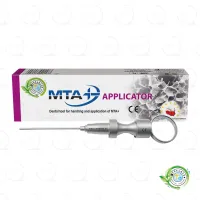
cerkamed mta+ applicator · 1.2 mm · stainless steel
mta placementperforation repairroot-end fillingautoclavablereusable
the mta+ applicator is cerkamed's single-ended placer for mixed mta: a stainless steel handle with a ring for the finger, a fine plunger, and a 1.2 mm tip that picks up a measured dose and pushes it out where the repair is. cerkamed's description: "reusable dental tools for handling and application of prepared measure of mta+ material." two diameters; this is the 1.2 mm.
this pack: cerkamed mta+ applicator, 1.2 mm diameter, stainless steel, reusable, non-sterile
| tip diameter | 1.2 mm |
| material | cerkamed: corrosion-resistant stainless steel |
| sterilisation | cerkamed: steam autoclave 134°c for 5 minutes, after disinfecting, washing, rinsing and drying; ultrasonic cleaning recommended |
| storage | cerkamed: 5–30°c, relative humidity below 70% |
| other size | mta+ applicator 0.8 mm |
› cerkamed: "the packaged instruments are non–sterile. before sterilisation, these new instruments should be washed thoroughly with warm water and using detergent. before each use these dental instruments must be sterilised."
› cerkamed: "before use protect the instrument against contamination or damage of the material structure (cracks, bends, fractures, peeling, etc.)."
› clear the barrel before the mta sets in it – cerkamed give 6 minutes from mixing on the mta+ page, and the plunger is the only way through a set plug.
› cerkamed mark the product "to be used by dentist only".
the canal or the cavity decides. 0.8 mm goes down a shaped canal for an apical plug or a lateral perforation; 1.2 mm carries more for a furcation floor, a pulpotomy or a retrograde cavity. many operators keep both. this page is the 1.2 mm; the other is here.
this is a placer: it picks up a plug of one diameter and delivers it. the vista apex mta carriers are spring-loaded carriers with a longer reach, and the tools for mta (mx1–mx4) carry and condense from a dosing block. they are companions rather than substitutes.
| the material | mta+ maxi |
| other instruments | tools for mta (mx1–mx4) · vista apex mta carriers |
| practise it | mta smart system training set |
| bioceramic alternatives | neomta 2 · neoputty |
mta+ applicator · 1.2 mm · stainless steel · reusable, non-sterile, autoclave 134°c 5 min · made by cerkamed, stalowa wola, poland · ref cer-w-narz1.2
bio-c® temp · bioceramic intracanal dressing
necrotic pulpretreatmentperforationsresorptiontraumaopen apex
necrotic case? retreatment? a review you can't book for a month? bio-c® temp is a ready-to-use bioceramic paste for intracanal dressing. its calcium silicates hydrate to produce calcium hydroxide gradually, releasing calcium and hydroxyl ions over time rather than all at once – and angelus states the paste can stay in the canal for up to 30 days without replacement.
| 30 days angelus maximum | 9+ ph at day 28 | 4 syringes |
this pack: 4 × 0.5 g syringes · 20 intracanal tips
made by angelus, brazil – the bioceramics specialists
a conventional calcium hydroxide paste reaches a high ph quickly and is typically refreshed between visits. bio-c® temp works differently: the calcium silicates generate calcium hydroxide as they hydrate, so the alkalinity arrives gradually and persists. independent work bears this out honestly – lopes and colleagues (european endodontic journal, 2024) recorded ph above 9 from day three through day 28, below a calcium hydroxide control that held around 11.3 to 11.5. the case for this material is that it stays working for weeks, not that it is more alkaline.
| up to 30 days | angelus states the dressing can remain in the canal for up to 30 days without replacement |
| sustained ph | gradual release of calcium and hydroxyl ions holds an alkaline environment, unfavourable to bacterial growth |
| ready to use | no mixing, no spatulation, no waiting – the syringe and tip go straight into the canal |
| radiopaque | clear radiographic check that the canal is filled to length before the patient leaves |
“bio-c® temp can remain in the canal until 30 days” without requiring replacement, unlike calcium hydroxide which needs frequent changes.
— angelus, bio-c temp product information
› necrotic pulp and retreatment – where the canal needs disinfecting between visits and the next appointment is not next week.
› perforations and resorption, internal or external – angelus indicates it ahead of definitive repair with mta angelus.
› incomplete rhizogenesis and trauma – the cases where healing sets the timetable, not the diary.
› long recall intervals – referral practices, patients travelling, anyone you cannot see again in a fortnight.
1 place direct. fit an intracanal tip, insert to about 3 mm short of working length, and fill on withdrawal.
2 remove with hypochlorite. sodium hypochlorite with a k-file in brushing movements, or ultrasonic inserts.
3 then edta. 17% edta activated ultrasonically in three ten-second cycles – angelus's published protocol.
how is it different from a calcium hydroxide paste?
duration rather than peak ph. pastes such as opacal, calcipast and ultracal™ xs reach a higher ph quickly and are typically refreshed between visits. bio-c® temp generates its calcium hydroxide gradually as it hydrates.
will i get all of it out again?
be realistic – no technique fully removes any intracanal dressing. in the lopes study neither manual irrigation nor passive ultrasonic cleared the canal completely, though ultrasonic activation performed significantly better in the apical third. follow the protocol above and expect some residue.
does it cause postoperative pain if it extrudes?
angelus reports no painful symptomatology even where the paste extrudes through the apical foramen. that is the manufacturer's clinical experience rather than a controlled trial, so treat it as reassurance rather than evidence, and place to length as you would with any dressing.
when would i reach for it over a conventional paste?
when the interval is long or healing needs time – trauma follow-ups, resorption management, apexification-type cases. for a routine two-week dressing where you will re-enter anyway, a calcium hydroxide paste does the job and comes ready to use: opacal in a single 3 ml syringe, calcipast with hydroxyapatite, or ultracal™ xs at ph 12.5 through a sideport tip. different tools, not better or worse ones.
how many cases does the pack cover?
four 0.5 g syringes and 20 intracanal tips. each syringe carries several canals' worth, so the tip count is usually the practical limit rather than the paste.
| routine dressing | opacal – 3 ml syringe |
| four-syringe pack | calcipast – with hydroxyapatite, 4 × 2.1 g |
| precision delivery | ultracal™ xs refill |
| repair, white | mta angelus white 1 g |
| repair, grey | mta angelus grey 1 g |
| non-staining repair | neomta® 2 – tantalite, no bismuth oxide |
| no mixing | neoputty® – premixed bioceramic putty, 8.1 mm al |
| placing mta | mta carrier 0.99 mm |
| then obturate | mta fillapex® sealer |
bio-c® temp · calcium silicate bioceramic paste · ready to use · radiopaque · 4 × 0.5 g syringes + 20 tips · angelus, brazil · ref mta-2833 · mfr code 2833

mta angelus® white · 1 g repair cement
perforationsresorptionretrofillpulp cappingpulpotomyapexogenesisapexification
perforation high in the crown? pulp cap under thin dentine on a tooth that shows? mta angelus® white is the pale formulation of the tricalcium silicate repair cement that has been the reference material for perforations, retrofills and open apices for two decades. angelus attributes the grey version's dark colour to its iron oxide content; the white has less of it. same chemistry, same fifteen-minute set, in a material that does not read as a dark mass through thin tooth structure.
| 15 min setting time | ~7 applications | 8 indications |
this pack: 1 g white powder (roughly 7 applications) · 3 ml distilled water · powder dispenser
made by angelus, brazil – the bioceramics specialists
mta sets in the presence of blood and moisture, seals against dentine, and is tolerated well enough to be left against periradicular tissue. that is why it stays the material of choice for the awkward cases – the furcation perforated while finding a fourth canal, the immature apex with nothing to obturate against, the root end you have just resected.
| 15 minutes | angelus's published setting time – you are not holding an appointment open, or asking a patient back to check a set |
| pale shade | less iron oxide than the grey, which angelus identifies as what makes the grey formulation dark |
| 44.2 mpa | the compressive strength angelus publishes for mta angelus |
| radiopaque | radiographic visualisation of the repair, so placement is confirmed before you close rather than hoped for |
› perforations of the root canal and furcation, whether iatrogenic or caused by a caries lesion
› root perforation from internal resorption, treated via the canal
› the same, treated surgically
› periapical surgery with reverse filling
› direct pulp capping
› pulpotomy, preserving the vitality of the remaining pulp tissue
› apexogenesis in vital teeth with an inflamed coronal pulp
› apexification, inducing a mineralised barrier at the root tip of immature teeth with a necrotic pulp
1 one spoon to one drop. one dispenser of powder against a single drop of the distilled water supplied, on a sterile glass slab.
2 thirty seconds. spatulate to a homogeneous mix with the consistency of wet sand – angelus's own description, and a useful one: if it slumps, it is too wet.
3 place and condense. carry it with an applicator or an mta carrier, condense with amalgam condensers, a spatula or moistened paper points, then radiograph to verify.
“do not use mta angelus® gray in areas exposed to light to ensure that staining of the dental structure does not occur.”
— angelus, mta angelus instructions for use. it is the reason the white formulation exists.
› moisture, before you mix – the powder is very sensitive to it. open the sachet only when you are ready to use it, and never keep spare mixed material.
› control the acute phase first – angelus warns that the acidic ph of endodontic lesions and the tissue around them can compromise solidification.
› not a root filling – its plasticity and flow are wrong for the job, and removal at retreatment would be difficult.
› not against the gingival groove – in that contact angelus states the cement will solubilise completely.
white or grey – does it actually matter?
where the repair sits under thin or visible tooth structure, the material's own colour does. angelus's precaution above is explicit about the grey. for posterior and furcation work where nothing shows, grey 1 g does the same job for the same money.
how do i get it down a canal or into a root end?
hand instruments are fine for an open furcation. for anything deeper, a disposable carrier places the mix where you want it without smearing it up the walls – 0.80 mm for fine canals, 0.99 mm as the general size, or 1.60 mm for bulk placement in perforation repair and apexification.
how far does a gram actually go?
roughly seven applications, mixed a drop at a time. if you place mta most weeks, the 2 g grey pack is cheaper per gram; the white is stocked in 1 g.
the case needs weeks before i can repair it – what goes in first?
bio-c® temp is the angelus intracanal dressing indicated ahead of definitive repair with mta angelus, and angelus states it can stay in the canal up to 30 days without replacement.
what if discolouration is the deciding factor?
then look at neomta® 2. it uses tantalite as its radiopacifier, contains no bismuth oxide, and nusmile state plainly that tantalite does not cause staining. it also sets in about 14 minutes as a putty and lets you vary the powder-to-gel ratio for the consistency you want. if the case is anterior and the aesthetic risk is what is keeping you awake, that is the honest recommendation.
any contraindication?
mta angelus contains components that may cause reactions in susceptible individuals – do not use on patients allergic to them. confirm allergies as you would before placing anything.
| grey, 1 g | mta angelus grey – hidden repairs |
| grey, 2 g | the bulk pack – cheaper per gram |
| non-staining | neomta® 2 – tantalite radiopacifier, ~10 doses |
| no mixing | neoputty® – premixed bioceramic putty, 8.1 mm al |
| fine canals | mta carrier 0.80 mm · box of five |
| general use | mta carrier 0.99 mm · box of five |
| bulk placement | mta carrier 1.60 mm · box of five |
| trying one | single carrier, 0.99 mm |
| dress first | bio-c® temp – up to 30 days |
| then obturate | mta fillapex® sealer · 30 g tubes |
mta angelus® white · tricalcium silicate repair cement · radiopaque · 15-minute set · 1 g + 3 ml distilled water + powder dispenser · angelus · ref mta-8222 · mfr code 822 · grey also in 1 g and 2 g

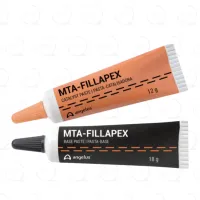
mta fillapex® · mta root canal sealer
single conelateral compactionpermanent dentitionhand mixed 1:1below 150 c for warm
getting through sealer faster than unit-dose syringes can keep up? mta fillapex® is angelus's salicylate-resin sealer carrying a mineral trioxide aggregate filler, supplied here as base and catalyst tubes you mix on the pad. angelus puts the yield of this pack at around 200 cases, with a 23-minute working time to place them in – which is what makes it the format for a practice obturating every list.
| 23 min working time | 6.5 mm al radiopacity | 200 cases per pack |
this pack: 1 tube base (18 g) · 1 tube catalyst (12 g) · mixing pad
made by angelus, brazil
worth being precise, because the name invites assumptions. mta fillapex® is a two-paste resin sealer – salicylate resin, natural resin and sulfonamide resin across the two pastes – carrying mineral trioxide aggregate as a filler, with calcium tungstate as the radiopacifier. it is not a resin-free calcium silicate sealer, and it does not behave like one. what it offers is a long working time, real radiographic contrast, and a cost per case that unit-dose formats cannot match.
| 23 minutes | angelus's published working time – enough for a multi-canal molar without mixing a second batch |
| sets on moisture | setting time two hours thirty, and only in contact with moisture from the dentinal tubules and periapical tissues |
| 6.5 mm al | independently measured to ansi/ada no. 57 (vidotto et al., rsbo 2011) against a 3 mm minimum |
| about 200 cases | angelus's yield estimate for the 30 g pack, tooth depending |
“mta fillapex only sets in contact with moisture. inside the root canal the moisture is derived from the dentinal tubules and from the periapical tissues.”
— angelus. it will not set completely on your mixing pad, and that is not a fault.
1 equal parts. one part base to one part catalyst on the pad supplied, spatulated for 30 seconds.
2 dry the canal first. sealer chemistry and standing irrigant do not mix – capillary tips clear the bulk before paper points finish.
3 single cone or lateral compaction. angelus describes both: a coated master cone, or a spreader making space for accessory points until it no longer penetrates.
it hasn't set on my mixing pad – is the tube off?
no. angelus states mta fillapex® sets only in contact with moisture, and that complete setting will not occur on the mixing surface. in the canal it takes what it needs from the dentinal tubules and periapical tissues.
can i use it with warm vertical compaction?
conditionally, and the condition is a hard ceiling. angelus gives the boiling point as 150 °c and says that if the equipment stays below that, it can be used. check what your obturation unit actually runs at before committing to it.
which points should i use with it?
angelus indicates it for root canal filling in combination with gutta-percha cones. reciproc® blue r25 points match an r25 preparation directly; the assorted pack covers r25, r40 and r50. if the master cone sits between sizes, the intermedium® gauge cuts a half size.
tubes or the double syringe?
tubes are the economy – hand-mixed 1:1, roughly 200 cases a pack. the double syringe mixes automatically through a tip and suits lower volumes; ask us if you would rather have that format.
can i use it without gutta-percha?
angelus advises against it as routine: sealer-only fills are indicated in selected cases only, because partial removal for a post becomes difficult.
i want a resin-free bioceramic sealer – what should i look at?
neosealer® flo. it is a premixed tri/dicalcium silicate sealer with no resin content, radiopacified with tantalite rather than bismuth, setting in the canal from the tooth's own moisture – over 40 minutes working time, and suited to both single-cone and warm vertical. neosealer® ezflo comes with navitip™ tips in the box. genuinely different chemistry to this page's product, and the honest answer if bioceramic is what you are after.
| matched points | reciproc® blue r25 · 60 points |
| assorted points | reciproc® assorted · r25, r40, r50 |
| half sizes | intermedium® gp gauge |
| drying, 20 | capillary tips · pack of 20 |
| drying, 50 | capillary tips · pack of 50 |
| dress first | bio-c® temp – up to 30 days |
| repair material | mta angelus white 1 g |
| resin-free sealer | neosealer® flo – bioceramic, with 20 tips |
| sealer + navitips | neosealer® ezflo 2.2 g |
mta fillapex® · salicylate-resin sealer with mta filler · calcium tungstate radiopacifier · 23-minute working time · 18 g base + 12 g catalyst + mixing pad · angelus, brazil · ref mta-826 · mfr code 826
neomta® 2 · avalon biomed · 1.0 g kit
pulp cappingpulpotomyapexificationresorptionperforation repairroot-end fillingobturation
the reason classic mta cases so often need a second appointment is washout. you place the material, you cannot irrigate over it, you cannot condense a restoration onto it, so you dress the tooth and bring the patient back. avalon's answer is blunt and it is in their own instructions: neomta® 2 is immediately washout resistant – gently rinse and complete the restoration, or cement a crown, straight after placing it.
| 6.5 mm al radiopacity | 14 min working time | 13 indications |
this pack: 1.0 g neomta® 2 powder with water-based gel · 0.1 g scoop, so roughly ten typical doses
made by avalon biomed · 3-year shelf life
“neomta 2 is immediately wash-out resistant. you can gently rinse and complete the restoration or cement a crown, immediately after placing neomta 2.”
avalon biomed, neomta® 2 frequently asked questions (ifu-62).
neomta® 2 is supplied as powder plus a water-based gel, and how much gel you add decides what you have made. that is the trade against a premixed putty: a little bench work in exchange for a material that covers repair and obturation from one jar.
| putty mix | 1–2 drops of gel per scoop · about 14 minutes working time, sets in about 14 minutes · 6.5 mm al radiopacity |
| sealer mix | 2 drops of gel · about 21 minutes working time at a thinner consistency, setting in about 1 hour 10 minutes |
| why it matters | a premixed putty cannot be thinned. if you want one material for a perforation on tuesday and an obturation on thursday, this is the one that does both |
traditional mtas use bismuth oxide to make the material visible on a radiograph, and bismuth is the accepted mechanism behind the grey shadow those materials can leave in a tooth. avalon build on tantalum oxide – tantalite instead, which gives 6.5 mm al equivalent radiopacity at putty consistency without the bismuth in the formulation at all.
put plainly: removing bismuth removes the best-understood staining mechanism. no calcium silicate is immune to discolouration, and blood contamination at placement affects colour stability across the whole class – so get haemostasis first, whatever you are placing.
in a randomised clinical trial of 70 primary molars in 42 children, published in pediatric dentistry in 2023, neomta® 2 achieved 100% clinical success (34 of 34) and 94.1% radiographic success (32 of 34) as a pulpotomy medicament at twelve months. the comparator arm – premixed neoputty® – came in at 97.1% and 92.8%, which the authors reported as comparable.
alqahtani as, alsuhaibani nn, sulimany am, bawazir oa. pediatric dentistry 2023;45(3):240–244.
that trial is primary molar pulpotomy at twelve months. the longer view comes from the predecessor formulation, neomta® plus – a different product from the one in this box, but the same chemistry lineage, and the follow-up runs to four years:
| 4 years, permanent teeth | full pulpotomy in 109 symptomatic mature permanent teeth with carious pulp exposure, ages 14–60. cumulative survival 98%, 97.4%, 93% and 83.8% at six months, one, two and four years; the authors put pulpotomy success at about 90% |
| primary molars | against proroot® mta in 80 primary teeth: 100% clinical and 97.5% radiographic success at twelve months, with no significant difference between the two |
taha na, al-khatib h. journal of endodontics 2022;48(1):87–95. · alsanouni m, bawazir oa. pediatric dentistry 2019;41(2):107–111. both studied neomta® plus, the predecessor formulation.
the four-year study is the one worth dwelling on, because it is the hardest case: symptomatic mature permanent teeth with carious exposure, where the textbook answer used to be root canal treatment. its authors also found the strongest predictor of failure was not the material but severe preoperative pain – and that the coronal seal was critical to long-term survival.
avalon list thirteen, and ask that you read the instructions for use before each application. in practice the ones that bring people to this material are direct and indirect pulp capping, partial pulpotomy and pulpotomy, apexogenesis and apexification, internal and external root resorption, perforation repair, root-end filling, and use as a cavity liner or base – plus obturation, when mixed to the thinner consistency.
| larger kit | neomta® 2 2.5 g kit · 25 doses, with gel to spare |
| no mixing wanted | neoputty® · the premixed putty from the same family |
| carrying it | vista mta carrier · for root-end and perforation work |
| obturating | neosealer® flo · premixed, if you would rather not thin the powder |
| narrow canals | neosealer® ezflo · 29 ga delivery for conservative preparations |
| between visits | bio-c® temp · when the case does need two appointments |
| isolation | oraseal® caulking · a dry field before any calcium silicate |
neomta® 2 or neoputty®?
if you want one material that can be a putty or a sealer, take this. if you never thin your mta and would rather skip the slab entirely, take the putty. the randomised trial found their pulpotomy outcomes comparable, so choose on handling, not on efficacy.
can i really restore in the same visit?
that is avalon's own instruction, quoted above. follow the instructions for use for your indication – and note that the material is washout resistant immediately, which is not the same as fully set.
how many cases will 1.0 g cover?
the scoop is 0.1 g, so roughly ten typical doses. avalon quote 25 doses for the 2.5 g kit, which is the better buy if mta is routine for you.
does it contain bismuth?
no – the radiopacifier is tantalum oxide. if a specific formulation question matters for your case, ask us and we will get it in writing from avalon rather than paraphrasing a brochure.
neomta® 2 1.0 gm kit · tricalcium and dicalcium silicate powder with water-based gel · tantalite radiopacifier · 6.5 mm al · immediately washout resistant · 0.1 g scoop · 3-year shelf life · avalon biomed · ref n2100


 Facebook
 X
 Instagram
 Pinterest
