

Best selection of Endodontic supplies in the UK






opacal® · calcium hydroxide dressing · 3 ml syringe
temporary root canal dressingtwo-visit endodonticsinterappointmentready to usenon-setting
a weeping canal, a patient who cannot come back for a fortnight, and a temporary that has to do the thinking while they are away. opacal® is a radiopaque, creamy, ready-to-use calcium hydroxide paste for temporary root canal dressing. pd's own statement of purpose is plain: it is intended to eliminate remaining microorganisms and prevent reinfection between appointments, and its main properties come from its alkaline ph.
| >12 ph | 300% of dentine | 3 ml syringe |
this pack: 1 × 3 ml syringe · 10 × single-use application tips · 1 × finger grip
made by produits dentaires sa, switzerland · class iia medical device, supplied non-sterile
everything a calcium hydroxide dressing does, it does by being strongly alkaline, and how fast it gets there depends on the vehicle. opacal is an aqueous, non-setting paste at 30% calcium hydroxide – the formulation type that releases its ions quickly rather than over months. that suits a dressing you mean to remove in a fortnight, and it is why it comes out easily: nothing has set.
opacal is an aqueous non-setting material. this characteristic induces rapid ionic release and performant action in short treatment time procedure. in addition, the paste can be easily removed.
— produits dentaires sa, on their own opacal pages
1 prepare, clean and dry the canal meticulously – the ifu's word, not ours.
2 clip the finger grip on, uncap, fit a new tip to the luer-lock, and test the flow onto a pad before going intraorally. never force the plunger.
3 fill from the apical portion outward, staying at least 2 mm shy of the apex, and adjust the volume to the anatomy rather than to habit.
4 seal with a temporary restorative for a tight seal between visits, then confirm the fill radiographically.
5 discard the tip, cap the syringe immediately so the paste does not dry in it, and disinfect the syringe.
6 remove it completely next visit – an endodontic file and a few drops of saline, per the ifu.
| composition | calcium hydroxide 30%, barium sulphate 24%, plus an excipient pd do not disclose |
| ph | above 12, in pd's wording. they publish no measured value |
| radiopacity | pd state more than 300% of the radiopacity of dentine; their earlier flyer gives the figure as greater than 3 mm aluminium |
| the tip | flexible, luer-lock, 20 mm long and angled at 110° on pd's flyer diagram |
| dressing period | pd give 1 to 3 weeks as usual; the ifu sets a maximum of 30 days |
| storage | 15 to 25 °c, protected from direct light. shelf life 3 years |
› tips are single use, per patient. discard after each treatment; a blocked tip is replaced rather than persuaded.
› the syringe is not. pd require it disinfected between every patient, but specify no agent or contact time – use your own validated protocol.
› two millimetres shy of the apex, stated twice in the ifu – in the directions, and again as an extrusion precaution.
› it is a strong alkali. calcium hydroxide is a skin irritant that can cause serious eye damage; pd ask for rubber dam, safety glasses and a waterproof bib for the patient, and gloves, mask and goggles for the operator.
› undesirable effects: the ifu records none known or foreseen when the product is used as intended.
worth being straight about this. the figures above – ph, radiopacity, ionic release – are produits dentaires' own, and pd publish no test data behind them. the one reference they cite is fava and saunders' classification of calcium hydroxide pastes (int endod j 1999), a review of the category rather than a study of this product, cited to support the general point that aqueous non-setting vehicles release their ions quickly. there is no independent published work on opacal itself. none of which makes it a poor choice – a 30% aqueous calcium hydroxide paste does what the category has done for decades – but buy it as a well-made example of a familiar material, not as something with a trial behind it.
how is it delivered – do i need a spiral filler?
pd's method is the syringe and its own tip, and that is the only delivery route their instructions describe: fit the tip, fill from the apical portion outward, stop 2 mm short. they do not discuss any other technique.
how long can it stay in?
pd describe the usual temporisation as one to three weeks. the ifu is firmer about the outer limit: as a temporary root canal dressing, the maximum duration of treatment should be 30 days.
will i get it all out again?
it is non-setting and water-based, and the ifu asks for complete removal at the next appointment with an endodontic file and a few drops of saline. saline specifically – pd name no other solution here.
| isolate | oraseal™ caulking – pd ask for rubber dam with this material, and a dam that weeps is not isolation |
| irrigate | chlorax 5.25% sodium hypochlorite · 5 × 200 ml |
| deliver it | irriflex® with endostops – flexible 30g needle for the curve the dressing must reach past |
| final rinse | endo-solution 17% edta · 200 ml |
| dry it first | reciproc® paper points r25 · 144 – the ifu wants the canal dry first |
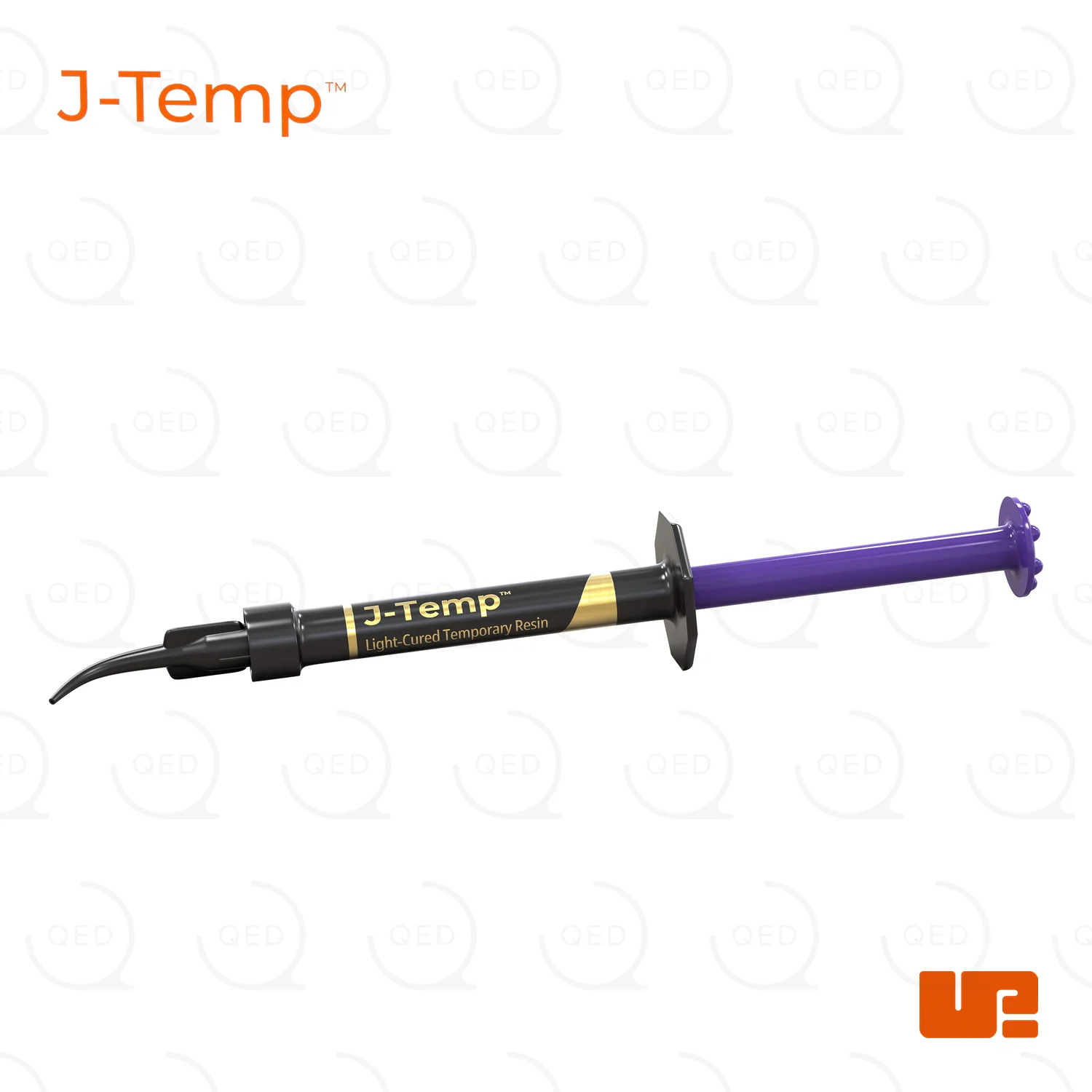
| seal it in | j-temp™ temporary resin – radiopaque, so the film confirms the temporary as well as the dressing |
| longer intervals | bio-c® temp · 4 × 0.5 g – a premixed bioceramic dressing, for gaps running past opacal's 30-day maximum |
| the same material, differently | calcipast calcium hydroxide · 4 × 2.1 g – the same material in a four-syringe pack, if that suits you better |
opacal® · radiopaque calcium hydroxide dressing · calcium hydroxide 30%, barium sulphate 24% · ph above 12 · aqueous, non-setting · 3 ml syringe with 10 single-use tips and a finger grip · class iia · produits dentaires sa, switzerland · ref 11020

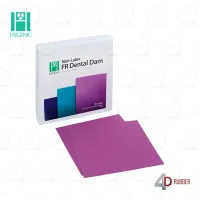
hygenic® fr non-latex · purple · 30
rubber dam isolationlatex-freeendodonticsrestorative
want the dam to stretch further and pull less on the tooth? that is what fr means. four d rubber: "fr designates flexible retraction: choose fr dam for higher elasticity and less retraction force on the isolated area." hygenic® non-latex fr is purple, 152 mm square, 30 sheets to the box.
this pack: hygenic® non-latex fr dental dam, medium, 152 x 152 mm (6 x 6 in), purple (pack of 30)
| material | four d rubber's proprietary non-latex formula |
| retraction | fr – flexible retraction: higher elasticity, less retraction force |
| sheet | 152 x 152 mm (6 x 6 in), purple, textured surface |
| powder | powder-free |
| supplied | 30 sheets |
› four d rubber on the formula: "proprietary formula that is easy to stretch."
› a textured surface, and powder-free.
› no natural rubber latex – for patients or staff with a latex allergy.
› made under an iso 13485 quality system. hygenic® is a dam name dentists have used for decades; four d rubber now supply it direct: "the hygenic® non-latex dental dam you know and trust is now available directly from the manufacturer."
fr is four d rubber's flexible-retraction sheet. also latex-free, and from the same maker: qed non-latex dam, polyisoprene, in medium or heavy. we also stock hysolate flexi-dam non-latex.
| clamps | ksk clamp range · clamp stand |
| punch | ainsworth punch, silicone handle · ivory pattern punch |
| forceps | washington pattern clamp forceps |
| frame | young's rubber dam frame |
| stabilising cord | wedjets non-latex small · wedjets non-latex large |
| sealing the margin | oraseal caulking · rubber-dam liquid |
hygenic® non-latex fr dental dam · flexible retraction · purple · 152 x 152 mm · 30 sheets · powder-free · made by four d rubber · ref 15482
oraseal™ kit · caulking + putty
some days the dam leaks; other days it's an undercut on an implant impression. the oraseal™ kit puts both viscosities in one box – the flowable caulking for sealing, the heavier putty for blocking out – so the decision happens chairside rather than at the next order.
this kit: 2 × 1.2 ml caulking · 2 × 1.2 ml putty
made by ultradent, usa
| two viscosities | flowable caulking for leaks and margins; heavier putty for undercuts, embrasures and screw holes |
| works wet | both adhere to wet dam, tissue and tooth, and function under water and saliva |
| no curing step | placed and removed mechanically – nothing to light cure, nothing to wait for |
| try before committing | the sensible first order if you have not used oraseal and do not yet know which consistency your hands prefer |
› across the practice – endodontic dam repair, isolation for bleaching, tissue protection during porcelain etching, and impression block-out for bridgework and implant bars.
› delivered through black mini™ or white mac™ tips, trimmable to the diameter you want.
› removal – scrape, then wet toothbrush, floss or curette and a firm air/water rinse.
which one will i actually use more?
in endodontic practice, caulking – it is the dam-leak fix. restorative and implant work leans on putty. once you know, the refills are 4 × caulking or 4 × putty.
is it light-cured?
no – there is no cure step in ultradent's instructions for either material.
where should it not go?
not into extraction sites or deep pockets, and not in critical dimension areas.
oraseal™ kit · cellulose-based caulking and block-out · no cure step · 2 × 1.2 ml caulking + 2 × 1.2 ml putty · ultradent · ref 352 · refills available in 4-packs

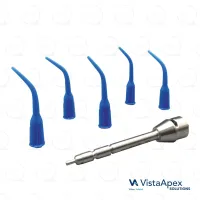
stropko™ irrigator · 2 inch · vista apex
microscope endodonticstroughinginstrument retrievalroot-end preparationdrying before obturation
you are at 16× magnification, troughing for a second mesiobuccal, and the field fills with dentinal dust. the standard three-in-one tip is not built for that moment: it throws a wide, hard stream that clears the debris and your view along with it. the stropko™ irrigator replaces that tip with a fine luer-lock hub, so the same syringe delivers a directed thread of air or water exactly where you are looking – at a pressure you have deliberately turned down.
| 4-7 psi, regulated | 1-3 psi, in canals | 80 autoclave cycles |
this pack: 1 × stropko™ irrigator, 2" · 1 × blue-flo™ tip · 1 × appli-vac™ bendable 20 ga · 1 × 22 ga · 1 × 25 ga
made by inter-med, inc. (vista apex), usa · vista ref 315260-2
› troughing for hidden canals. clearing dust from the pulpal floor a thread at a time, so the map you are following stays visible while you work.
› retrieving a separated instrument. the same controlled clearing, in the one procedure where losing sight of the fragment costs you the tooth.
› root-end preparation in surgery. cleaning and drying a retro-cavity under magnification, where a wide stream would flood the crypt.
› drying before obturation – what the technique card calls a "kiss of air" through the canal system before the cones go down.
› and outside endodontics: vista list restorative, periodontal, implant, surgical and orthodontic uses – air-thinning a deep resin is the one most people find next.
1 turn the pressure down first. a dental syringe normally runs at 30 to 50 psi. vista's ifu says regulate it to between 4 and 7 psi before the instrument goes anywhere near a patient.
2 remove the standard three-way tip and seat the stropko™ snugly in its place. on a press-ring handpiece, check it has locked.
3 screw the tip fully home into the luer-lock hub, so it cannot dislodge in use. tips must not extend back into the instrument past the hub.
4 for air-drying a canal, drop to 1 to 3 psi and use only notched or side-vented needles. this is vista's own instruction, stated without qualification, and it is the one to build into the setup rather than remember at the chairside.
when using for air-drying endodontic canals, reduce the air pressure to 1-3 psi and use only notched or side-vent needles.
— stropko™ irrigator instructions for use, vista apex
| length | 2 inches. the xl is 3.5 inches and is otherwise the same instrument |
| fits | most air/water syringes using a standard 3-way tip, including quick-connect types |
| takes | any luer-lock tip of 27 ga or larger. never a sharp injection needle, and never a tip finer than 27 ga |
| reprocessing | moist heat to iso 17665-1 at 132 or 134 °c for at least 3 minutes, 20 minutes drying. rated for 80 cycles |
| cleaning | neutral-ph detergents only, no abrasives, and do not disassemble it |
› the gauge limit rules out most endodontic irrigation needles. vista's ifu excludes anything finer than 27 ga, which means 29 ga and 30 ga irrigation tips are not for this instrument, however well they work on a syringe. check the gauge before you fit it.
› blunt tips only. no sharp, pointed, injection-type needles – the ones supplied are dead-soft and blunt-ended for a reason.
› one oddity worth knowing: the ifu says not to sterilise it in commercial wraps or pouches carrying sterilisation indicators, which does not sit comfortably with normal uk pouched practice. worth a word with your decontamination lead before it joins the tray.
straight answer: no published study of this instrument exists. dr john stropko is a real and well-cited endodontic clinician – his 1999 paper on maxillary molar canal morphology in the journal of endodontics is still quoted for its mb2 findings – but that is a study of anatomy, not of the device that carries his name, and it would be dishonest to present it as evidence. what the stropko™ has instead is twenty-odd years of use by clinicians working under magnification, and a design that does one obvious thing: it makes the stream small and the pressure low enough to be useful in a place you are looking at very closely.
will it fit my surgery's syringes?
vista say most air/water syringes that use a standard 3-way tip, quick-connect included. if yours is an older three-way, check the air and water buttons are secured – vista note that some older syringes need a retaining pin fitted so the buttons cannot pop out under a regulated supply.
can i use my usual 30 ga irrigation needles in it?
no. the ifu excludes tips finer than 27 ga. use 27 ga or larger, blunt-ended, and for drying a canal specifically, notched or side-vented.
standard or xl?
the only published difference is length – 2" against 3.5". vista do not say why you would pick one over the other, so the honest answer is reach and how you like to hold it, not performance.
| the tip in the box | blue-flo™ 23 ga soft plastic · 100 – or 20 |
| at the gauge limit | appli-vac™ irrigation needles 27 ga · 100 – the finest tip the ifu allows |
| bendable | mst visco-tip™ 25 ga bendable · 50 – shaped to the access you have |
| longer reach | stropko™ irrigator xl · 3.5" – the same instrument, longer |
| irrigate | chlorax 5.25% sodium hypochlorite · 5 × 200 ml |
| final rinse | endo-solution 17% edta · 200 ml |
| dry the canal | reciproc® paper points r25 · 144 – air is the last step, not the only one |
| isolate | oraseal™ caulking – a controlled field is the point of the whole exercise |
stropko™ irrigator · 2" · precise control of air and water · fits most 3-way syringes · luer-lock, 27 ga or larger · autoclavable, 80 cycles · supplied with 4 tips · vista apex · ref 911-030
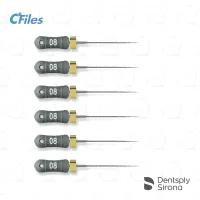
readysteel® c+ file · iso 08 · 18 mm · 6 files
calcified canalsinitial instrumentationsterile blister
dentsply sirona uk: “pre-sterilised c+ files for calcified canal penetration”. they list the c+ as “ideal files for the initial instrumentation of root canals”, with “stronger buckling resistance compared to k-files, which provides easier location of the canal orifices”.
this pack: readysteel® c+ file, size 08, 18 mm (pack of 6)
dentsply sirona · readysteel® range, made by dentsply maillefer
| size | iso 08 · 0.08 mm at the tip |
| length | 18 mm |
| cross-section | square |
| taper | .04 over the first 4 mm from the tip, .02 along the rest of the shaft (kwak et al. 2014, measured on the size 15; see below) |
| pack | 6 files, pre-sterilised blister |
› pyramid tip, square section. dentsply sirona uk: “pyramid shaped tip makes insertion easier during instrumentation and the square section allows better resistance to distortion”
› feel. “better negotiation of calcifications and a better tactile feel”
› depth gauge. “depth gauge makes it easier to determine working length when working with x-rays”
› buckling, size for size. dentsply maillefer's c+ files leaflet charts buckling force against k-files at each size: at iso 08 the c+ file took 47% more load before it buckled. manufacturer's own test data; the method is not published.
› polished. “polished surface of the c+ file allows for better removal of debris as well as smoother insertion”
in the laboratory study dentsply sirona cite for buckling (kwak et al., restorative dentistry & endodontics 2014), four size 15, 25 mm files were compared, and “the cp was shown to require the highest load to buckle and bend the files, and the nt showed the least.” (cp is the c+ file.) the study tested size 15 only. the same paper is the published source for the taper: under the stereomicroscope the size 15 c+ file measured a 4% taper over the 4 mm from the tip and 2% along the rest of the shaft, against the .02 of a standard k-file, and its square section gave it the largest cross-sectional area of the four files. dentsply maillefer describe it simply as a “unique taper for ultra-stiff design”.
c+ file or c-pilot?
both are stainless steel files for calcified canals. dentsply sirona describe the c+ by its pyramid tip and square section, as above; vdw describe c-pilot “for probing in calcified root canals”, with “the inactive pilot tip conducts the instrument safely along the canal”. we stock both, and the choice is yours.
which lengths?
we stock the c+ file in 18, 21 and 25 mm, in sizes 08, 10 and 15.
| other c+ files | iso 10, 18 mm · iso 15, 18 mm · iso 08, 21 mm · iso 10, 21 mm · iso 15, 21 mm · iso 08, 25 mm · iso 10, 25 mm · iso 15, 25 mm |
| other scouting files | vdw c-pilot® 10, 19 mm · mani d-finder 10, 21 mm |
| file lubricant | glyde™ file prep (dentsply sirona) · file-eze™ |
| irrigation | chlorax 5.25% · endo-solution 17% edta · irriflex® needles |
readysteel® c+ file iso 08, 18 mm (6) · calcified canals, sterile · ref a012x00180008
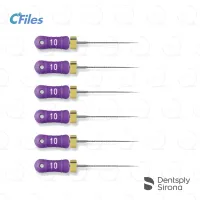
readysteel® c+ file · iso 10 · 18 mm · 6 files
calcified canalsinitial instrumentationsterile blister
dentsply sirona uk: “pre-sterilised c+ files for calcified canal penetration”. they list the c+ as “ideal files for the initial instrumentation of root canals”, with “stronger buckling resistance compared to k-files, which provides easier location of the canal orifices”.
this pack: readysteel® c+ file, size 10, 18 mm (pack of 6)
dentsply sirona · readysteel® range, made by dentsply maillefer
| size | iso 10 · 0.10 mm at the tip |
| length | 18 mm |
| cross-section | square |
| taper | .04 over the first 4 mm from the tip, .02 along the rest of the shaft (kwak et al. 2014, measured on the size 15; see below) |
| pack | 6 files, pre-sterilised blister |
› pyramid tip, square section. dentsply sirona uk: “pyramid shaped tip makes insertion easier during instrumentation and the square section allows better resistance to distortion”
› feel. “better negotiation of calcifications and a better tactile feel”
› depth gauge. “depth gauge makes it easier to determine working length when working with x-rays”
› buckling, size for size. dentsply maillefer's c+ files leaflet charts buckling force against k-files at each size: at iso 10 the c+ file took 69% more load before it buckled. manufacturer's own test data; the method is not published.
› polished. “polished surface of the c+ file allows for better removal of debris as well as smoother insertion”
in the laboratory study dentsply sirona cite for buckling (kwak et al., restorative dentistry & endodontics 2014), four size 15, 25 mm files were compared, and “the cp was shown to require the highest load to buckle and bend the files, and the nt showed the least.” (cp is the c+ file.) the study tested size 15 only. the same paper is the published source for the taper: under the stereomicroscope the size 15 c+ file measured a 4% taper over the 4 mm from the tip and 2% along the rest of the shaft, against the .02 of a standard k-file, and its square section gave it the largest cross-sectional area of the four files. dentsply maillefer describe it simply as a “unique taper for ultra-stiff design”.
c+ file or c-pilot?
both are stainless steel files for calcified canals. dentsply sirona describe the c+ by its pyramid tip and square section, as above; vdw describe c-pilot “for probing in calcified root canals”, with “the inactive pilot tip conducts the instrument safely along the canal”. we stock both, and the choice is yours.
which lengths?
we stock the c+ file in 18, 21 and 25 mm, in sizes 08, 10 and 15.
| other c+ files | iso 08, 18 mm · iso 15, 18 mm · iso 08, 21 mm · iso 10, 21 mm · iso 15, 21 mm · iso 08, 25 mm · iso 10, 25 mm · iso 15, 25 mm |
| other scouting files | vdw c-pilot® 10, 19 mm · mani d-finder 10, 21 mm |
| file lubricant | glyde™ file prep (dentsply sirona) · file-eze™ |
| irrigation | chlorax 5.25% · endo-solution 17% edta · irriflex® needles |
readysteel® c+ file iso 10, 18 mm (6) · calcified canals, sterile · ref a012x00180010
readysteel® c+ file · iso 15 · 18 mm · 6 files
calcified canalsinitial instrumentationsterile blister
dentsply sirona uk: “pre-sterilised c+ files for calcified canal penetration”. they list the c+ as “ideal files for the initial instrumentation of root canals”, with “stronger buckling resistance compared to k-files, which provides easier location of the canal orifices”.
this pack: readysteel® c+ file, size 15, 18 mm (pack of 6)
dentsply sirona · readysteel® range, made by dentsply maillefer
| size | iso 15 · 0.15 mm at the tip |
| length | 18 mm |
| cross-section | square |
| taper | .04 over the first 4 mm from the tip, .02 along the rest of the shaft (kwak et al. 2014, measured on the size 15; see below) |
| pack | 6 files, pre-sterilised blister |
› pyramid tip, square section. dentsply sirona uk: “pyramid shaped tip makes insertion easier during instrumentation and the square section allows better resistance to distortion”
› feel. “better negotiation of calcifications and a better tactile feel”
› depth gauge. “depth gauge makes it easier to determine working length when working with x-rays”
› buckling, size for size. dentsply maillefer's c+ files leaflet charts buckling force against k-files at each size: at iso 15 the c+ file took 142% more load before it buckled. manufacturer's own test data; the method is not published.
› polished. “polished surface of the c+ file allows for better removal of debris as well as smoother insertion”
in the laboratory study dentsply sirona cite for buckling (kwak et al., restorative dentistry & endodontics 2014), four size 15, 25 mm files were compared, and “the cp was shown to require the highest load to buckle and bend the files, and the nt showed the least.” (cp is the c+ file.) this is that size. the same paper is the published source for the taper: under the stereomicroscope the size 15 c+ file measured a 4% taper over the 4 mm from the tip and 2% along the rest of the shaft, against the .02 of a standard k-file, and its square section gave it the largest cross-sectional area of the four files. dentsply maillefer describe it simply as a “unique taper for ultra-stiff design”.
c+ file or c-pilot?
both are stainless steel files for calcified canals. dentsply sirona describe the c+ by its pyramid tip and square section, as above; vdw describe c-pilot “for probing in calcified root canals”, with “the inactive pilot tip conducts the instrument safely along the canal”. we stock both, and the choice is yours.
which lengths?
we stock the c+ file in 18, 21 and 25 mm, in sizes 08, 10 and 15.
| other c+ files | iso 08, 18 mm · iso 10, 18 mm · iso 08, 21 mm · iso 10, 21 mm · iso 15, 21 mm · iso 08, 25 mm · iso 10, 25 mm · iso 15, 25 mm |
| other scouting files | vdw c-pilot® 10, 19 mm · mani d-finder 10, 21 mm |
| file lubricant | glyde™ file prep (dentsply sirona) · file-eze™ |
| irrigation | chlorax 5.25% · endo-solution 17% edta · irriflex® needles |
readysteel® c+ file iso 15, 18 mm (6) · calcified canals, sterile · ref a012x00180015
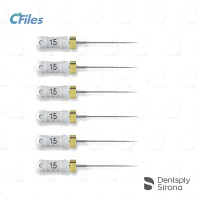
readysteel® c+ file · iso 08 · 21 mm · 6 files
calcified canalsinitial instrumentationsterile blister
dentsply sirona uk: “pre-sterilised c+ files for calcified canal penetration”. they list the c+ as “ideal files for the initial instrumentation of root canals”, with “stronger buckling resistance compared to k-files, which provides easier location of the canal orifices”.
this pack: readysteel® c+ file, size 08, 21 mm (pack of 6)
dentsply sirona · readysteel® range, made by dentsply maillefer
| size | iso 08 · 0.08 mm at the tip |
| length | 21 mm |
| cross-section | square |
| taper | .04 over the first 4 mm from the tip, .02 along the rest of the shaft (kwak et al. 2014, measured on the size 15; see below) |
| pack | 6 files, pre-sterilised blister |
› pyramid tip, square section. dentsply sirona uk: “pyramid shaped tip makes insertion easier during instrumentation and the square section allows better resistance to distortion”
› feel. “better negotiation of calcifications and a better tactile feel”
› depth gauge. “depth gauge makes it easier to determine working length when working with x-rays”
› buckling, size for size. dentsply maillefer's c+ files leaflet charts buckling force against k-files at each size: at iso 08 the c+ file took 47% more load before it buckled. manufacturer's own test data; the method is not published.
› polished. “polished surface of the c+ file allows for better removal of debris as well as smoother insertion”
in the laboratory study dentsply sirona cite for buckling (kwak et al., restorative dentistry & endodontics 2014), four size 15, 25 mm files were compared, and “the cp was shown to require the highest load to buckle and bend the files, and the nt showed the least.” (cp is the c+ file.) the study tested size 15 only. the same paper is the published source for the taper: under the stereomicroscope the size 15 c+ file measured a 4% taper over the 4 mm from the tip and 2% along the rest of the shaft, against the .02 of a standard k-file, and its square section gave it the largest cross-sectional area of the four files. dentsply maillefer describe it simply as a “unique taper for ultra-stiff design”.
c+ file or c-pilot?
both are stainless steel files for calcified canals. dentsply sirona describe the c+ by its pyramid tip and square section, as above; vdw describe c-pilot “for probing in calcified root canals”, with “the inactive pilot tip conducts the instrument safely along the canal”. we stock both, and the choice is yours.
which lengths?
we stock the c+ file in 18, 21 and 25 mm, in sizes 08, 10 and 15.
| other c+ files | iso 08, 18 mm · iso 10, 18 mm · iso 15, 18 mm · iso 10, 21 mm · iso 15, 21 mm · iso 08, 25 mm · iso 10, 25 mm · iso 15, 25 mm |
| other scouting files | vdw c-pilot® 10, 21 mm · mani d-finder 10, 21 mm |
| file lubricant | glyde™ file prep (dentsply sirona) · file-eze™ |
| irrigation | chlorax 5.25% · endo-solution 17% edta · irriflex® needles |
readysteel® c+ file iso 08, 21 mm (6) · calcified canals, sterile · ref a012x00210008
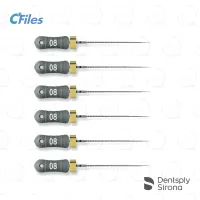
readysteel® c+ file · iso 10 · 21 mm · 6 files
calcified canalsinitial instrumentationsterile blister
dentsply sirona uk: “pre-sterilised c+ files for calcified canal penetration”. they list the c+ as “ideal files for the initial instrumentation of root canals”, with “stronger buckling resistance compared to k-files, which provides easier location of the canal orifices”.
this pack: readysteel® c+ file, size 10, 21 mm (pack of 6)
dentsply sirona · readysteel® range, made by dentsply maillefer
| size | iso 10 · 0.10 mm at the tip |
| length | 21 mm |
| cross-section | square |
| taper | .04 over the first 4 mm from the tip, .02 along the rest of the shaft (kwak et al. 2014, measured on the size 15; see below) |
| pack | 6 files, pre-sterilised blister |
› pyramid tip, square section. dentsply sirona uk: “pyramid shaped tip makes insertion easier during instrumentation and the square section allows better resistance to distortion”
› feel. “better negotiation of calcifications and a better tactile feel”
› depth gauge. “depth gauge makes it easier to determine working length when working with x-rays”
› buckling, size for size. dentsply maillefer's c+ files leaflet charts buckling force against k-files at each size: at iso 10 the c+ file took 69% more load before it buckled. manufacturer's own test data; the method is not published.
› polished. “polished surface of the c+ file allows for better removal of debris as well as smoother insertion”
in the laboratory study dentsply sirona cite for buckling (kwak et al., restorative dentistry & endodontics 2014), four size 15, 25 mm files were compared, and “the cp was shown to require the highest load to buckle and bend the files, and the nt showed the least.” (cp is the c+ file.) the study tested size 15 only. the same paper is the published source for the taper: under the stereomicroscope the size 15 c+ file measured a 4% taper over the 4 mm from the tip and 2% along the rest of the shaft, against the .02 of a standard k-file, and its square section gave it the largest cross-sectional area of the four files. dentsply maillefer describe it simply as a “unique taper for ultra-stiff design”.
c+ file or c-pilot?
both are stainless steel files for calcified canals. dentsply sirona describe the c+ by its pyramid tip and square section, as above; vdw describe c-pilot “for probing in calcified root canals”, with “the inactive pilot tip conducts the instrument safely along the canal”. we stock both, and the choice is yours.
which lengths?
we stock the c+ file in 18, 21 and 25 mm, in sizes 08, 10 and 15.
| other c+ files | iso 08, 18 mm · iso 10, 18 mm · iso 15, 18 mm · iso 08, 21 mm · iso 15, 21 mm · iso 08, 25 mm · iso 10, 25 mm · iso 15, 25 mm |
| other scouting files | vdw c-pilot® 10, 21 mm · mani d-finder 10, 21 mm |
| file lubricant | glyde™ file prep (dentsply sirona) · file-eze™ |
| irrigation | chlorax 5.25% · endo-solution 17% edta · irriflex® needles |
readysteel® c+ file iso 10, 21 mm (6) · calcified canals, sterile · ref a012x00210010
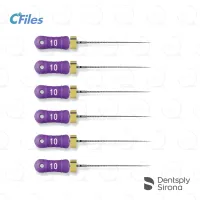
readysteel® c+ file · iso 15 · 21 mm · 6 files
calcified canalsinitial instrumentationsterile blister
dentsply sirona uk: “pre-sterilised c+ files for calcified canal penetration”. they list the c+ as “ideal files for the initial instrumentation of root canals”, with “stronger buckling resistance compared to k-files, which provides easier location of the canal orifices”.
this pack: readysteel® c+ file, size 15, 21 mm (pack of 6)
dentsply sirona · readysteel® range, made by dentsply maillefer
| size | iso 15 · 0.15 mm at the tip |
| length | 21 mm |
| cross-section | square |
| taper | .04 over the first 4 mm from the tip, .02 along the rest of the shaft (kwak et al. 2014, measured on the size 15; see below) |
| pack | 6 files, pre-sterilised blister |
› pyramid tip, square section. dentsply sirona uk: “pyramid shaped tip makes insertion easier during instrumentation and the square section allows better resistance to distortion”
› feel. “better negotiation of calcifications and a better tactile feel”
› depth gauge. “depth gauge makes it easier to determine working length when working with x-rays”
› buckling, size for size. dentsply maillefer's c+ files leaflet charts buckling force against k-files at each size: at iso 15 the c+ file took 142% more load before it buckled. manufacturer's own test data; the method is not published.
› polished. “polished surface of the c+ file allows for better removal of debris as well as smoother insertion”
in the laboratory study dentsply sirona cite for buckling (kwak et al., restorative dentistry & endodontics 2014), four size 15, 25 mm files were compared, and “the cp was shown to require the highest load to buckle and bend the files, and the nt showed the least.” (cp is the c+ file.) this is that size. the same paper is the published source for the taper: under the stereomicroscope the size 15 c+ file measured a 4% taper over the 4 mm from the tip and 2% along the rest of the shaft, against the .02 of a standard k-file, and its square section gave it the largest cross-sectional area of the four files. dentsply maillefer describe it simply as a “unique taper for ultra-stiff design”.
c+ file or c-pilot?
both are stainless steel files for calcified canals. dentsply sirona describe the c+ by its pyramid tip and square section, as above; vdw describe c-pilot “for probing in calcified root canals”, with “the inactive pilot tip conducts the instrument safely along the canal”. we stock both, and the choice is yours.
which lengths?
we stock the c+ file in 18, 21 and 25 mm, in sizes 08, 10 and 15.
| other c+ files | iso 08, 18 mm · iso 10, 18 mm · iso 15, 18 mm · iso 08, 21 mm · iso 10, 21 mm · iso 08, 25 mm · iso 10, 25 mm · iso 15, 25 mm |
| other scouting files | vdw c-pilot® 10, 21 mm · mani d-finder 10, 21 mm |
| file lubricant | glyde™ file prep (dentsply sirona) · file-eze™ |
| irrigation | chlorax 5.25% · endo-solution 17% edta · irriflex® needles |
readysteel® c+ file iso 15, 21 mm (6) · calcified canals, sterile · ref a012x00210015
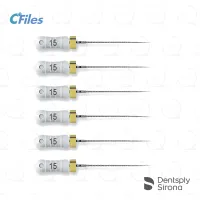
readysteel® c+ file · iso 08 · 25 mm · 6 files
calcified canalsinitial instrumentationsterile blister
dentsply sirona uk: “pre-sterilised c+ files for calcified canal penetration”. they list the c+ as “ideal files for the initial instrumentation of root canals”, with “stronger buckling resistance compared to k-files, which provides easier location of the canal orifices”.
this pack: readysteel® c+ file, size 08, 25 mm (pack of 6)
dentsply sirona · readysteel® range, made by dentsply maillefer
| size | iso 08 · 0.08 mm at the tip |
| length | 25 mm |
| cross-section | square |
| taper | .04 over the first 4 mm from the tip, .02 along the rest of the shaft (kwak et al. 2014, measured on the size 15; see below) |
| pack | 6 files, pre-sterilised blister |
› pyramid tip, square section. dentsply sirona uk: “pyramid shaped tip makes insertion easier during instrumentation and the square section allows better resistance to distortion”
› feel. “better negotiation of calcifications and a better tactile feel”
› depth gauge. “depth gauge makes it easier to determine working length when working with x-rays”
› buckling, size for size. dentsply maillefer's c+ files leaflet charts buckling force against k-files at each size: at iso 08 the c+ file took 47% more load before it buckled. manufacturer's own test data; the method is not published.
› polished. “polished surface of the c+ file allows for better removal of debris as well as smoother insertion”
in the laboratory study dentsply sirona cite for buckling (kwak et al., restorative dentistry & endodontics 2014), four size 15, 25 mm files were compared, and “the cp was shown to require the highest load to buckle and bend the files, and the nt showed the least.” (cp is the c+ file.) the study tested size 15 only. the same paper is the published source for the taper: under the stereomicroscope the size 15 c+ file measured a 4% taper over the 4 mm from the tip and 2% along the rest of the shaft, against the .02 of a standard k-file, and its square section gave it the largest cross-sectional area of the four files. dentsply maillefer describe it simply as a “unique taper for ultra-stiff design”.
c+ file or c-pilot?
both are stainless steel files for calcified canals. dentsply sirona describe the c+ by its pyramid tip and square section, as above; vdw describe c-pilot “for probing in calcified root canals”, with “the inactive pilot tip conducts the instrument safely along the canal”. we stock both, and the choice is yours.
which lengths?
we stock the c+ file in 18, 21 and 25 mm, in sizes 08, 10 and 15.
| other c+ files | iso 08, 18 mm · iso 10, 18 mm · iso 15, 18 mm · iso 08, 21 mm · iso 10, 21 mm · iso 15, 21 mm · iso 10, 25 mm · iso 15, 25 mm |
| other scouting files | vdw c-pilot® 10, 25 mm · mani d-finder 10, 25 mm |
| file lubricant | glyde™ file prep (dentsply sirona) · file-eze™ |
| irrigation | chlorax 5.25% · endo-solution 17% edta · irriflex® needles |
readysteel® c+ file iso 08, 25 mm (6) · calcified canals, sterile · ref a012x00250008
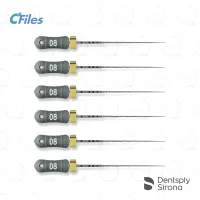
readysteel® c+ file · iso 10 · 25 mm · 6 files
calcified canalsinitial instrumentationsterile blister
dentsply sirona uk: “pre-sterilised c+ files for calcified canal penetration”. they list the c+ as “ideal files for the initial instrumentation of root canals”, with “stronger buckling resistance compared to k-files, which provides easier location of the canal orifices”.
this pack: readysteel® c+ file, size 10, 25 mm (pack of 6)
dentsply sirona · readysteel® range, made by dentsply maillefer
| size | iso 10 · 0.10 mm at the tip |
| length | 25 mm |
| cross-section | square |
| taper | .04 over the first 4 mm from the tip, .02 along the rest of the shaft (kwak et al. 2014, measured on the size 15; see below) |
| pack | 6 files, pre-sterilised blister |
› pyramid tip, square section. dentsply sirona uk: “pyramid shaped tip makes insertion easier during instrumentation and the square section allows better resistance to distortion”
› feel. “better negotiation of calcifications and a better tactile feel”
› depth gauge. “depth gauge makes it easier to determine working length when working with x-rays”
› buckling, size for size. dentsply maillefer's c+ files leaflet charts buckling force against k-files at each size: at iso 10 the c+ file took 69% more load before it buckled. manufacturer's own test data; the method is not published.
› polished. “polished surface of the c+ file allows for better removal of debris as well as smoother insertion”
in the laboratory study dentsply sirona cite for buckling (kwak et al., restorative dentistry & endodontics 2014), four size 15, 25 mm files were compared, and “the cp was shown to require the highest load to buckle and bend the files, and the nt showed the least.” (cp is the c+ file.) the study tested size 15 only. the same paper is the published source for the taper: under the stereomicroscope the size 15 c+ file measured a 4% taper over the 4 mm from the tip and 2% along the rest of the shaft, against the .02 of a standard k-file, and its square section gave it the largest cross-sectional area of the four files. dentsply maillefer describe it simply as a “unique taper for ultra-stiff design”.
c+ file or c-pilot?
both are stainless steel files for calcified canals. dentsply sirona describe the c+ by its pyramid tip and square section, as above; vdw describe c-pilot “for probing in calcified root canals”, with “the inactive pilot tip conducts the instrument safely along the canal”. we stock both, and the choice is yours.
which lengths?
we stock the c+ file in 18, 21 and 25 mm, in sizes 08, 10 and 15.
| other c+ files | iso 08, 18 mm · iso 10, 18 mm · iso 15, 18 mm · iso 08, 21 mm · iso 10, 21 mm · iso 15, 21 mm · iso 08, 25 mm · iso 15, 25 mm |
| other scouting files | vdw c-pilot® 10, 25 mm · mani d-finder 10, 25 mm |
| file lubricant | glyde™ file prep (dentsply sirona) · file-eze™ |
| irrigation | chlorax 5.25% · endo-solution 17% edta · irriflex® needles |
readysteel® c+ file iso 10, 25 mm (6) · calcified canals, sterile · ref a012x00250010
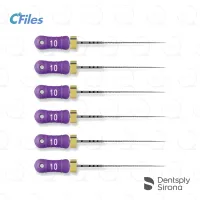
readysteel® c+ file · iso 15 · 25 mm · 6 files
calcified canalsinitial instrumentationsterile blister
dentsply sirona uk: “pre-sterilised c+ files for calcified canal penetration”. they list the c+ as “ideal files for the initial instrumentation of root canals”, with “stronger buckling resistance compared to k-files, which provides easier location of the canal orifices”.
this pack: readysteel® c+ file, size 15, 25 mm (pack of 6)
dentsply sirona · readysteel® range, made by dentsply maillefer
| size | iso 15 · 0.15 mm at the tip |
| length | 25 mm |
| cross-section | square |
| taper | .04 over the first 4 mm from the tip, .02 along the rest of the shaft (kwak et al. 2014, measured on the size 15; see below) |
| pack | 6 files, pre-sterilised blister |
› pyramid tip, square section. dentsply sirona uk: “pyramid shaped tip makes insertion easier during instrumentation and the square section allows better resistance to distortion”
› feel. “better negotiation of calcifications and a better tactile feel”
› depth gauge. “depth gauge makes it easier to determine working length when working with x-rays”
› buckling, size for size. dentsply maillefer's c+ files leaflet charts buckling force against k-files at each size: at iso 15 the c+ file took 142% more load before it buckled. manufacturer's own test data; the method is not published.
› polished. “polished surface of the c+ file allows for better removal of debris as well as smoother insertion”
in the laboratory study dentsply sirona cite for buckling (kwak et al., restorative dentistry & endodontics 2014), four size 15, 25 mm files were compared, and “the cp was shown to require the highest load to buckle and bend the files, and the nt showed the least.” (cp is the c+ file.) this is that size. the same paper is the published source for the taper: under the stereomicroscope the size 15 c+ file measured a 4% taper over the 4 mm from the tip and 2% along the rest of the shaft, against the .02 of a standard k-file, and its square section gave it the largest cross-sectional area of the four files. dentsply maillefer describe it simply as a “unique taper for ultra-stiff design”.
c+ file or c-pilot?
both are stainless steel files for calcified canals. dentsply sirona describe the c+ by its pyramid tip and square section, as above; vdw describe c-pilot “for probing in calcified root canals”, with “the inactive pilot tip conducts the instrument safely along the canal”. we stock both, and the choice is yours.
which lengths?
we stock the c+ file in 18, 21 and 25 mm, in sizes 08, 10 and 15.
| other c+ files | iso 08, 18 mm · iso 10, 18 mm · iso 15, 18 mm · iso 08, 21 mm · iso 10, 21 mm · iso 15, 21 mm · iso 08, 25 mm · iso 10, 25 mm |
| other scouting files | vdw c-pilot® 10, 25 mm · mani d-finder 10, 25 mm |
| file lubricant | glyde™ file prep (dentsply sirona) · file-eze™ |
| irrigation | chlorax 5.25% · endo-solution 17% edta · irriflex® needles |
readysteel® c+ file iso 15, 25 mm (6) · calcified canals, sterile · ref a012x00250015
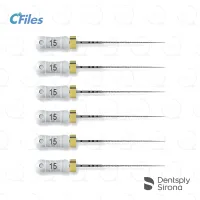
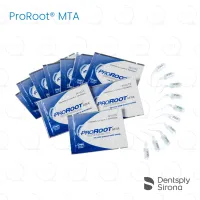
proroot® mta · white · 4 × 0.5 g
root-end fillingperforation repairapexificationpulp cappingpulpotomy, primary teeth
proroot® mta is dentsply sirona’s mineral trioxide aggregate – a fine, hydrophilic powder that sets in the presence of moisture into what their directions call “a strong impermeable barrier”. four 0.5 g pouches, each with its own water ampoule, so every case is mixed fresh and nothing is left open on the shelf.
| 4 mm al min. radiopacity, ifu | ~3 min working time, ifu | > 24 mpa compressive, ifu |
this pack: proroot® mta root canal repair material, white – 4 pouches of 0.5 g powder and 5 ampoules of 0.18 g water · dentsply sirona ref a040500000300
single use · non-sterile, do not sterilise · shelf life 3 years
› six indications in one material. dentsply sirona’s directions list root-end filling, the apical plug in apexification, perforation repair during root canal therapy, repair after internal resorption, pulp capping and pulpotomy of primary teeth.
› sets in a wet field. the powder hydrates to a colloidal gel that, in the directions’ words, “solidifies to form a strong impermeable barrier”. moisture is part of the chemistry, not an enemy of it.
› unit dose. each 0.5 g pouch is matched to a 0.18 g micro-dose water ampoule, so the powder-to-liquid ratio is set by the pack, not the clock. the four-pouch box carries one spare ampoule.
› radiopaque. at least 4 mm of aluminium equivalent (ifu), so placement can be confirmed on the radiograph the directions ask for.
› a permanent part of the filling. in perforation repair and apexification the directions leave the set mta in place and obturate the remaining canal on top of it.
dentsply sirona call it “the first name in root repair”, and on a bench of newer bioceramics it is still the material the others describe themselves against. what you are buying is a known quantity: a composition published in the directions, six indications set out step by step, and a pack that controls the one variable mta punishes – the water.
the four-pouch box suits a practice that places mta occasionally – a perforation here, a pulp cap there – because each pouch stays sealed until the case needs it. the directions insist on that: kept in its sealed packaging and stored dry, because moisture is what sets it. for regular use, the 10 × 0.5 g box is the lower cost per pouch.
proroot® mta root repair material is a powder consisting of fine, hydrophilic particles that set in the presence of moisture. hydration of the powder creates a colloidal gel that solidifies to form a strong impermeable barrier that fully cures over a four-week period.
dentsply sirona, proroot® mta instructions for use (europe, 2025-08)
| material | mineral trioxide aggregate – a fine, hydrophilic powder that sets in the presence of moisture |
| composition | tri- and dicalcium silicates 69–74%, bismuth oxide 17–22%, minor components 2–7% (calcium aluminate, aluminoferrite and sulphate, and others) |
| shade | white (tooth-coloured) |
| mixing | one 0.5 g pouch with one 0.18 g water ampoule, about a minute on the pad |
| cure | checked for hardness after four hours; fully cures over four weeks |
| shelf life | 3 years; store dry, below 30 °c, away from sunlight |
| contraindications | none known |
mixing (all indications). dispense a pouch onto the pad, pull the end off an ampoule and squeeze it out alongside, bring the liquid in gradually and mix for about a minute. it does not set as quickly as other cements – careful mixing is what makes it easy to handle.
1perforation repair, and repair after internal resorption. under dam: debride and irrigate with hypochlorite (for resorption, a week of calcium hydroxide first), dry, and obturate the canal apical to the defect. carry the mta into the defect, compact it with a small plugger, cotton pellet or paper point, and confirm on a radiograph.
2apexification. after a week of calcium hydroxide, carry and compact a three to five millimetre apical barrier, confirm it radiographically, and leave a moist pellet under a temporary.
3after either: at four hours or the next visit, check the mta is hard (if not, rinse and repeat), then obturate the rest of the canal. the mta stays as a permanent part of the filling.
4root-end filling. resect, prepare a class i root-end cavity three to five millimetres deep with an ultrasonic tip, achieve haemostasis, dry, then place and compact the mta, clean the root surface and confirm on a radiograph.
5pulp capping. rinse the exposure with hypochlorite, place a small amount of mta over it, blot the excess moisture, cover it with a light-cured liner, then etch, bond and restore. review sensibility every six months.
6pulpotomy of primary teeth. remove the coronal pulp, achieve haemostasis with pressure, place mta over the pulp stumps and chamber floor to an even three to four millimetres, fill the chamber and restore – the directions finish with a stainless-steel crown.
these are summaries. the directions carry every step, and the materials they name at each stage, in full – see downloads.
how much water, and what if it is too wet or too dry?
use the ampoule supplied with each pouch and mix for about a minute so every particle is hydrated. the directions allow a little extra water – the spare ampoule, or usp purified water – to reach the consistency you want, and they warn that too much or too little liquid reduces the final strength. if the mix starts to dry on the pad, cover it with moist gauze rather than adding more water.
will it discolour the tooth?
the directions are candid about it: a slight discolouration may appear in the months after treatment, and in an aesthetic zone they ask the clinician to weigh the procedure, the surface area exposed and the other restorative materials used.
how long before i can restore over it?
for perforation repair and apexification the directions place a moist pellet and a temporary for at least four hours, then check the mta is hard – at that visit or a later one – before obturating the rest of the canal. for pulp capping they cover it straight away with a light-cured liner, then bond and restore in the same visit.
can i use a pouch across two patients?
no. proroot mta is single use and single patient, and the directions say to place it immediately after mixing; once set it cannot be used again. that is what the 0.5 g unit dose is for.
4 × 0.5 g or 10 × 0.5 g?
same material, same pouch, same ampoule. the four-pack carries one spare ampoule for adjusting a mix; the ten-pack is the lower cost per pouch for practices placing mta every week.
| isolation | qed non-latex dam – the directions use dental dam at every stage. |
| irrigants | chlorax 5.25%, chlorax 2% and endo-solution 17% edta. |
| interim dressing | ultracal xs, calcipast and opacal – calcium hydroxide, which the resorption and apexification protocols place for a week. |
| drying | mmpp paper points 15–40 – or the matched points for your file system. |
| delivery | vista mta carriers 0.80 mm, 0.99 mm and 1.60 mm · cerkamed mta applicator 0.80 mm and 1.20 mm. |
| compaction | penn micro-plugger 060, 100 · root-end: endoblack retroplugger 050, 075. |
| obturation | proroot bio sealer – dentsply sirona’s bioceramic sealer on the same calcium silicate chemistry · ah plus – the epoxy alternative. |
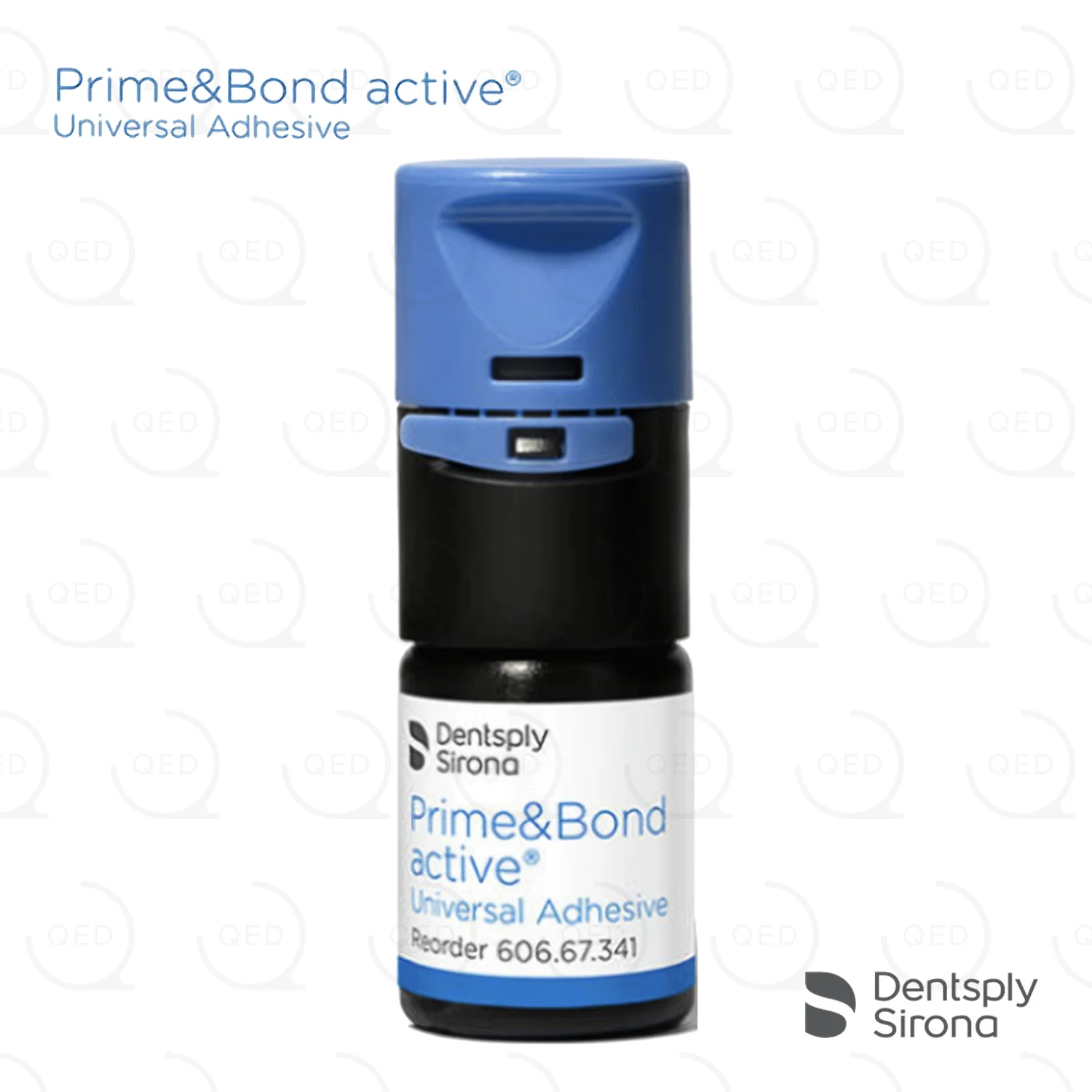
| bonding | prime&bond active – dentsply sirona’s universal adhesive. |
| coronal seal | sdr flow+ refill universal – 4 mm bulk increment, one cure. |
| also in stock | neomta 2 and neoputty – avalon biomed’s bioceramic repair materials, a different formulation and handling. |
› proroot® mta instructions for use (pdf, 1.1 mb, multilingual, dentsply sirona) – the current european edition (2025-08), on dentsply sirona’s site. english is the first section.
indications, composition, physical properties, precautions, adverse reactions, storage and every step above are from dentsply sirona’s proroot® mta instructions for use (end-ifu-proroot-mta-tds-v05, europe, 2025-08; english section, spelling anglicised). “the first name in root repair” is dentsply sirona’s own line. technique is theirs; the clinical decision is yours – we make no claim of our own about seal, healing or outcome. proroot, ah plus, sdr and prime&bond are dentsply sirona trademarks; neomta and neoputty are avalon biomed trademarks.
proroot® mta · root canal repair material, white · 4 × 0.5 g pouches + 5 × 0.18 g water ampoules · dentsply sirona · ref a040500000300
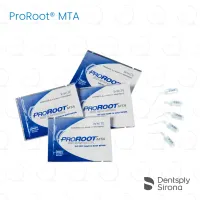
proroot® mta · white · 10 × 0.5 g
root-end fillingperforation repairapexificationpulp cappingpulpotomy, primary teeth
ten single-patient pouches of dentsply sirona’s mineral trioxide aggregate, each with its own 0.18 g water ampoule. the lower cost per pouch, for practices that place mta every week – perforations, apical plugs, root-end fillings and pulp caps.
| 4 mm al min. radiopacity, ifu | ~3 min working time, ifu | > 24 mpa compressive, ifu |
this pack: proroot® mta root canal repair material, white – 10 pouches of 0.5 g powder and 10 ampoules of 0.18 g water · dentsply sirona ref a040500000400
single use · non-sterile, do not sterilise · shelf life 3 years
› six indications in one material. dentsply sirona’s directions list root-end filling, the apical plug in apexification, perforation repair during root canal therapy, repair after internal resorption, pulp capping and pulpotomy of primary teeth.
› sets in a wet field. the powder hydrates to a colloidal gel that, in the directions’ words, “solidifies to form a strong impermeable barrier”. moisture is part of the chemistry, not an enemy of it.
› unit dose. each 0.5 g pouch is matched to a 0.18 g micro-dose water ampoule, so the powder-to-liquid ratio is set by the pack, not the clock. the four-pouch box carries one spare ampoule.
› radiopaque. at least 4 mm of aluminium equivalent (ifu), so placement can be confirmed on the radiograph the directions ask for.
› a permanent part of the filling. in perforation repair and apexification the directions leave the set mta in place and obturate the remaining canal on top of it.
it is the same material, the same 0.5 g pouch and the same unit-dose ampoule as the 4 × 0.5 g box – the difference is volume. each pouch stays sealed until the case needs it, which is what the directions ask for: kept in its sealed packaging and stored dry, because moisture is what sets it. with a three-year shelf life, a ten-pack is a sensible stock item for any practice doing its own perforation repairs and pulp caps.
dentsply sirona call it “the first name in root repair”. the case for it is a known quantity: a composition published in the directions, six indications set out step by step, and a pack that controls the water.
| material | mineral trioxide aggregate – a fine, hydrophilic powder that sets in the presence of moisture |
| composition | tri- and dicalcium silicates 69–74%, bismuth oxide 17–22%, minor components 2–7% (calcium aluminate, aluminoferrite and sulphate, and others) |
| shade | white (tooth-coloured) |
| mixing | one 0.5 g pouch with one 0.18 g water ampoule, about a minute on the pad |
| cure | checked for hardness after four hours; fully cures over four weeks |
| shelf life | 3 years; store dry, below 30 °c, away from sunlight |
| contraindications | none known |
dispense a pouch onto the pad, pull the end off an ampoule and squeeze it out alongside, bring the liquid in gradually and mix for about a minute. carry it into place, compact it, and confirm on a radiograph. in perforation repair and apexification (a three to five millimetre apical barrier), leave a moist pellet under a temporary and check the mta is hard at four hours or the next visit before obturating the rest of the canal. in pulp capping, cover it with a light-cured liner and restore in the same visit.
each indication is set out step by step on the 4 × 0.5 g page and in full in the directions – see downloads.
how much water, and what if it is too wet or too dry?
use the ampoule supplied with each pouch and mix for about a minute so every particle is hydrated. the directions allow a little extra water – the spare ampoule, or usp purified water – to reach the consistency you want, and they warn that too much or too little liquid reduces the final strength. if the mix starts to dry on the pad, cover it with moist gauze rather than adding more water.
will it discolour the tooth?
the directions are candid about it: a slight discolouration may appear in the months after treatment, and in an aesthetic zone they ask the clinician to weigh the procedure, the surface area exposed and the other restorative materials used.
how long before i can restore over it?
for perforation repair and apexification the directions place a moist pellet and a temporary for at least four hours, then check the mta is hard – at that visit or a later one – before obturating the rest of the canal. for pulp capping they cover it straight away with a light-cured liner, then bond and restore in the same visit.
can i use a pouch across two patients?
no. proroot mta is single use and single patient, and the directions say to place it immediately after mixing; once set it cannot be used again. that is what the 0.5 g unit dose is for.
| isolation | qed non-latex dam – the directions use dental dam at every stage. |
| irrigants | chlorax 5.25%, chlorax 2% and endo-solution 17% edta. |
| interim dressing | ultracal xs, calcipast and opacal – calcium hydroxide, which the resorption and apexification protocols place for a week. |
| drying | mmpp paper points 15–40 – or the matched points for your file system. |
| delivery | vista mta carriers 0.80 mm, 0.99 mm and 1.60 mm · cerkamed mta applicator 0.80 mm and 1.20 mm. |
| compaction | penn micro-plugger 060, 100 · root-end: endoblack retroplugger 050, 075. |
| obturation | proroot bio sealer – dentsply sirona’s bioceramic sealer on the same calcium silicate chemistry · ah plus – the epoxy alternative. |
| bonding | prime&bond active – dentsply sirona’s universal adhesive. |
| coronal seal | sdr flow+ refill universal – 4 mm bulk increment, one cure. |
| also in stock | neomta 2 and neoputty – avalon biomed’s bioceramic repair materials, a different formulation and handling. |
› proroot® mta instructions for use (pdf, 1.1 mb, multilingual, dentsply sirona) – the current european edition (2025-08), on dentsply sirona’s site. english is the first section.
indications, composition, physical properties, precautions, adverse reactions, storage and every step above are from dentsply sirona’s proroot® mta instructions for use (end-ifu-proroot-mta-tds-v05, europe, 2025-08; english section, spelling anglicised). “the first name in root repair” is dentsply sirona’s own line. technique is theirs; the clinical decision is yours – we make no claim of our own about seal, healing or outcome. proroot, ah plus, sdr and prime&bond are dentsply sirona trademarks; neomta and neoputty are avalon biomed trademarks.
proroot® mta · root canal repair material, white · 10 × 0.5 g pouches + 10 × 0.18 g water ampoules · dentsply sirona · ref a040500000400
waveone® gold primary · 25 mm · pack of 3
most canalsmolarscurved canalssingle-filepre-sterilised
still stepping through a rotary sequence? waveone® gold shapes the whole canal with one reciprocating instrument – 80% of cases with a single shaping file, on dentsply sirona’s data. the primary is that file, and 25 mm is the length most cases call for.
this pack: 3 × waveone® gold primary, 25 mm · pre-sterilised blister, single-patient use
made by dentsply sirona – maillefer, switzerland
| 80% one shaping file | 30m+ treated cases | ~300 pubmed studies |
a rotating file threads itself into the canal; when it binds, the torsional stress has nowhere to go. waveone® gold moves in unequal back-and-forth angles instead – cutting on one stroke, releasing on the next – and its parallelogram cross-section further reduces screwing-in.
then the gold. a post-machining heat treatment leaves the niti with enhanced flexibility and fatigue resistance – which is why this file can be pre-bent like a hand file to negotiate past a ledge.
“0 out of 1,104 instruments fractured in a total of 2,691 root canals in patients.”
clinical data cited in the waveone® gold scientific manual, dentsply sirona.
small (020/.07v) for fine canals, primary (025/.07v) for most, medium (035/.06v) for wider, large (045/.05v) for the widest. start with the primary. if it will not passively progress, drop to small; if it reaches length loosely, step up to medium or large.
a note on the taper figures. 025/.07v means an iso 0.25 mm tip with a nominal .07 taper that eases coronally – it does not hold .07 up the shaft, and it is not widest at the tip. dentsply publish no average-taper figure for waveone® gold, so none is quoted here. the effect is apical shape without taking the coronal dentine a fixed-taper instrument of the same tip size would remove.
| tip and taper | iso 025, .07 variable taper |
| length | 25 mm · 11 mm handle, molar access |
| alloy | gold heat-treated niti – pre-bendable |
| cross-section | parallelogram – reduces screwing-in |
| motion | reciprocating – waveone mode |
| 1 | scout. secure the canal to length with a #10 hand file and confirm patency. |
| 2 | glide. the waveone® gold glider (015/.02v) expands the secured path in the same reciprocating motion – one motor setting for the whole case. |
| 3 | shape. the primary in gentle pecks, cleaning the flutes and irrigating between passes, to length. |
| 4 | gauge. verify the apical size. a loose primary at length means step up a size. |
| 5 | fill. dry with matched paper points, then seat the conform fit® primary cone – cut to this shape – or go warm with thermafil®. |
one glider and one shaping file for most cases, rather than a three-to-six instrument sequence plus reprocessing. cost per canal becomes a number you know, and every case starts factory-sterile. buying in volume, the waveone® gold + sdr® flow+ kit packs fifteen complete procedure blisters with the restorative on top.
| glide path | gold glider 25 mm · same motion, same setting |
| finer canals | small 25 mm · 020/.07v |
| wider canals | medium 25 mm · large 25 mm |
| other lengths | primary 21 mm · primary 31 mm |
| dry the canal | paper points primary (180) |
| matched fill | conform fit® gp primary (60) · thermafil® obturators |
| starting out | treatment solution box · gliders, sizes, matched fill |
| best value | gold + sdr® flow+ kit · 15 blisters |
| no motor yet | x-smart® pro+ with apex locator · vdw.silver®reciproc® · x-smart® go |
› do i still need a glide path? yes. secure the canal to length with a #10 hand file and confirm patency, then the glider creates the glide path mechanically in the same motion as the primary that follows. the instructions for use are explicit that a secured, patent canal comes first.
› what motor do i need? any reciprocating motor carrying the waveone setting – x-smart® pro+, x-smart® go, vdw.silver® and vdw.gold® reciproc®. one setting covers the glider and every file size.
› will standard gutta-percha cones fit? poorly – a fixed-taper cone does not follow a variable-taper preparation. conform fit® cones are manufactured to match these shapes (dentsply sirona), for cold and warm techniques alike.
waveone® gold primary · 025 · .07 variable taper · 25 mm · gold heat-treated niti · pre-sterilised, single use · pack of 3 · dentsply sirona · mfr code a0753225g0p03

neoputty® · avalon biomed · 0.5 g syringe
nobody's clinical result was ever improved by the mixing. powder, gel, glass slab, consistency judged by eye, working time already ticking – every step is a chance for the material to leave the pad different from the way it left the jar. neoputty® arrives ready. you dispense what the cavity needs, place it, and the variable you were managing at the bench is simply not there.
| 97.1% clinical, 12 mo | 92.8% radiographic | 1 hr+ working time |
this pack: 0.5 g neoputty® premixed bioceramic putty, syringe delivery · about six doses at the 0.075 g avalon quote for an anterior pulpotomy
made by avalon biomed · 3-year shelf life, and it does not dry out between uses
most of what gets claimed for bioceramics comes from cell culture and extracted teeth. neoputty® has something almost nothing else in this category has: a randomised controlled trial in patients. pediatric dentistry, 2023 – 70 primary molars in 42 children, twelve months, against neomta® 2, assessed by two independent evaluators.
| clinical success | 97.1% (34 of 35) for neoputty®, against 100% (34 of 34) for neomta® 2 |
| radiographic | 92.8% (32 of 35) for neoputty®, against 94.1% (32 of 34) for neomta® 2 |
| authors' finding | neoputty® showed comparable success to mineral trioxide aggregate over twelve months |
“neoputty® showed a comparable success to mineral trioxide aggregate in primary molar pulpotomies over 12 months.”
alqahtani as, alsuhaibani nn, sulimany am, bawazir oa. pediatric dentistry 2023;45(3):240–244.
that is a primary molar result at twelve months, and it does not claim superiority over mta. what it establishes is the question that actually matters about a premixed material: the convenience costs you nothing measurable.
the grey shadow older mtas leave in an anterior tooth comes from bismuth oxide, the traditional radiopacifier. avalon use tantalum oxide (tantalite) instead and market neoputty® as never discolouring. we would rather give you the measured figures – there are now two independent ones.
independent spectrophotometry on 96 extracted anterior teeth, followed to twelve months, put neoputty in saline at a colour change of delta e 2.26 – alongside biodentine™ at 2.18, and far below proroot® mta contaminated with blood at 7.42. small, and measured rather than asserted – which is more than the category usually offers. the same study makes a point no radiopacifier can fix: blood contamination worsened colour stability in every material tested. achieve haemostasis first, whatever you are placing.
özüdogru s, düzyol e, türkoglu kayaci s, aly ahmed hm, arslan h. journal of clinical pediatric dentistry 2026;50(1):236–244.
a second group looked at what your irrigants do to it. testing biodentine™ and neoputty against edta, chlorhexidine, hedp and sodium hypochlorite, they found biodentine™ discoloured more against every solution except distilled water, and concluded neoputty “could be an appropriate material in aesthetic areas”. the takeaway is about protocol: chlorhexidine and sodium hypochlorite discoloured both materials most.
usta sn, keskin c. restorative dentistry & endodontics 2024;49:e25.
| chemistry | hydraulic calcium silicate – tricalcium and dicalcium silicate, the same family as mta, supplied premixed as a putty |
| radiopacifier | tantalum oxide (tantalite), not bismuth oxide – which is what removes the classic bismuth discolouration mechanism |
| delivery | syringe. dispense what the cavity takes and recap – no slab, no spatula, no discarded excess from a batch mixed too large |
| sets in ~5 hours | in vivo, in the presence of moisture – but it is immediately washout resistant, so it stays where you put it while you finish the procedure |
| 8.1 mm al | radiopacity avalon describe as the highest in the premixed bioceramic putty class – comfortably above the iso 6876 minimum of 3 mm |
| cytocompatibility | comparable to neomta® plus and mta angelus® on human dental pulp cells (lozano-guillén et al, clin oral investig 2022) |
because it is water-free until it meets the tooth, neoputty® gives over an hour of working time and sets in about five hours in vivo. it will not go off on the pad while you deal with something else – and it needs contact with moisture, from apical tissue, tubules or pulp, to set at all.
the kits contain no applicator tip, which surprises people. express what you need onto a pad and carry it with what you already use – avalon suggest a plastics instrument, a hollenbach, an amalgam carrier or an mta carrier. for apexification, a reversed paper point guides the putty to the apex.
on thickness, avalon are specific: at least 1.5 mm for a pulpotomy, liner, base or pulp cap, and a 3–5 mm apical barrier for apexification.
avalon list twelve indications. the ones that bring people to the material are pulpotomy – what the randomised trial tested – direct and indirect pulp capping, cavity liner and base, apexogenesis and apexification, perforation repair, resorption, root-end filling and obturation. read the instructions for use before each new application.
this is the 0.5 g syringe – the only size avalon supply, and the sensible way in. if it becomes routine, we sell it in twos and threes at a lower cost per gram – sealed spares, not a bigger syringe, which is the better arrangement when shelf life runs from opening.
one honest reason to choose the powder-and-gel neomta® 2 instead: you can mix it thin, from putty to a sealer-like consistency, which a premixed putty cannot do. neoputty® answers with radiopacity – 8.1 mm al against 6.5, about 25% higher on avalon's own comparison.
| multipacks | two syringes (1.0 g) and three (1.5 g) · better value per gram |
| mixable sibling | neomta® 2 1.0 g kit · putty or sealer consistency from one powder |
| try both | neosealer® flo & neoputty® kit · sealer and putty in one box |
| carrying it | vista mta carrier · for root-end and perforation work |
| obturating | neosealer® flo · the matching bioceramic sealer |
| between visits | bio-c® temp · ready-to-use intracanal dressing |
| isolation | oraseal® caulking · a dry field before any calcium silicate |
is a premixed putty really as good as mixing it myself?
on the one indication tested in a randomised trial, yes – 97.1% against 100% clinical success at twelve months, one tooth in thirty-five. what you lose is the ability to vary the consistency; what you gain is that every increment is identical, and over an hour to place it.
how many doses will 0.5 g give me?
about six, on avalon's figure of 0.075 g for a typical anterior pulpotomy. scale it to your own work – a 3–5 mm apical barrier for apexification is a much larger increment than a pulp cap.
can i use it in a primary tooth with a permanent successor?
check the instructions for use for the indication in front of you. avalon's bioceramic sealers are specifically contraindicated there; do not assume the putty's indications match the sealer's.
five hours to set – can i restore before then?
yes, and avalon say so directly: you can complete the restoration or cement a crown immediately after placing it. setting and washout resistance are different things – neoputty® is immediately washout resistant and, per avalon, dimensionally stable with zero shrinkage, so it stays put while the set completes.
neoputty® 0.5 gm kit · premixed bioceramic putty · tricalcium and dicalcium silicate · tantalite radiopacifier · 8.1 mm al · over 1 hr working time · sets ~5 hrs · 12 indications · avalon biomed · ref anpik

procedure kit · shape and rebuild
how many instruments and how many layers does a straightforward molar really need? a reciproc® blue r25 shapes most canals as a single reciprocating file, and sdr® flow+ rebuilds the access cavity in increments of up to 4 mm. this kit buys the two together: 30 files and 30 compules on one code, at the 25 mm length most molars need.
this kit: 5 × reciproc® blue r25 25 mm (30 files) · 2 × sdr® flow+ refill universal (30 compules)
made by vdw and dentsply sirona
| r25 at 25 mm | the single-file size that covers the majority of canals, in the length most molar work needs |
| glide path still applies | the reciproc ifu requires patency with a small hand instrument, and a glide path if the file stalls |
| 4 mm increments | sdr flow+ self-levels into the chamber and cures 20 s at 4 mm, capped by a universal composite |
| restorative, not obturation | sdr flow+ is a base and core build-up material – cones, points and sealer are separate |
› matched consumables matter. an r25 preparation wants r25 points and r25 cones – both linked below, and neither is in the box.
› you will still need an adhesive between the dentine and the build-up, and a curing light giving at least 550 mw/cm2 for the 4 mm figure to hold.
why r25 and not an assortment?
because the kit is built around the single-file case. where the anatomy needs a larger apical size, r40 blisters are bought separately rather than sitting unused in a bundle.
can i get the adhesive with it?
yes – while the offer runs, the reciproc blue, sdr flow+ and prime&bond kit is the same contents with a 4 ml bottle added free of charge.
| bond | prime&bond active® · 4 ml – the adhesive the kit does not include |
| dry | reciproc® paper points r25 · 144 – matched to the preparation these files cut |
| fill | reciproc® blue gutta percha r25 · 60 – the matching cone |
reciproc® blue and sdr® flow+ procedure kit · 30 r25 25 mm reciprocating files · 30 sdr flow+ universal compules · single-file shaping and 4 mm bulk fill build-up · vdw and dentsply sirona · ref b00rsdrr2ckit

waveone® gold + sdr® flow+ · 15 procedure blisters
per-case costingscout, glide, shapepost-endodontic build-up
how much of your endodontic stock control is really cost control? counting part-used file packs across patients tells you very little. each blister here is one patient's instrument set – a #10 k-flexofile to scout, a gold glider to expand the glide path, a primary to shape – so the per-case figure is the invoice divided by fifteen. alongside them, sdr® flow+ for the restoration that finishes each case.
this kit: 15 × sterile procedure blisters – each holding 1 × #10 k-flexofile, 1 × waveone® gold glider and 1 × waveone® gold primary · 1 × sdr® flow+ refill universal, 15 × 0.25 g compula® tips
made by dentsply sirona
| 15 cases boxed | 15 compules | 4 mm bulk increment |
scout, glide, shape. dentsply's directions for use put a hand-file glide path first – to at least an iso 010, patency confirmed – which is why a k-flexofile is sealed in with the two reciprocating instruments rather than left to the drawer. nothing in the blister is optional.
one set per patient also settles a quieter question: every case starts factory-sterile, on instruments that have cut nothing else.
the root filling is not the end of the case; the coronal seal is. sdr® flow+ is a bulk-fill flowable base and core build-up material – not an obturation material – placed in increments up to 4 mm, self-levelling to the cavity floor. in a load-bearing cavity it is capped with your usual universal composite, per the dentsply sirona instructions for use. fifteen blisters, fifteen compules – one per case, so the box runs out evenly.
| per blister | #10 k-flexofile · waveone® gold glider · waveone® gold primary – sterile, single patient |
| alloy | glider and primary both gold heat-treated nickel-titanium, pre-bendable (waveone® gold scientific manual) |
| motion | reciprocating – one waveone setting for both instruments |
| restorative | 15 × sdr® flow+ universal compula® tips – base and core build-up, increments to 4 mm, capped in load-bearing cavities |
› not a complete case – sealer, cones, points and irrigant are separate. this kit covers shaping and the build-up.
› matched fill still applies – a primary preparation wants a primary cone and primary points.
› why bundle files with a restorative? because they are used in the same appointment. a shaped canal under a temporary dressing is not a finished case, and sdr® flow+ is indicated for the build-up that follows.
› what if the primary is the wrong size? then you have gauged properly, which is the point. drop to small or step up from shelf stock – the blister covers the standard case, not every case.
| other sizes | small · medium · large, all 25 mm |
| dry and fill | paper points primary (180) · conform fit® gp primary (60) |
| restorative refill | sdr® flow+ refill universal · 15 compula® tips |
| whole system | treatment solution box · every size, plus the matched fill |
| a motor | x-smart® pro+ with apex locator · vdw.silver®reciproc® · x-smart® go |
waveone® gold + sdr® flow+ kit · 15 sterile procedure blisters · #10 k-flexofile, gold glider and gold primary in each · 15 × sdr® flow+ universal compula® tips · reciprocating, one motor setting · dentsply sirona · mfr code b00wsdrr2ckit

monosteryl® round · 010m · 10
sterile, ready to usesingle useindividually wrapped
mdt’s round diamond, iso shape 001, size 010 (1.0 mm), medium grit with a blue ring, on a 19 mm fg standard shank. monosteryl® is how mdt pack it: the same bur as their standard range, each one individually wrapped on a roll and gamma-sterilised, so it goes from the wrapper to the handpiece with nothing to clean or autoclave first.
this pack: mdt monosteryl® round diamond bur, fg, iso 001 010, medium (blue ring), 19 mm, sterile, single use (pack of 10, individually wrapped)
| shape | round – iso 001 |
| also listed as | 801 – the number mdt’s catalogue gives beside iso 001 |
| head | 1.0 mm diameter (iso 010) |
| grit | medium – blue ring |
| shank | fg standard, 19 mm overall |
| pack | 10, individually wrapped on a roll |
| sterility | gamma irradiation; single use |
open the wrapper, fit the bur, use it, bin it. it arrives sterile, so there is no cleaning, bagging or autoclave cycle, and no used burs waiting to be reprocessed. every bur you pick up is a new one.
mdt’s catalogue sets their burs at 60% diamond exposure against 40% for others. mdt list the features as "stronger bonding", "larger exposure of each diamond crystal" and "uniform diamond coating, including the tips", and the benefits as "faster & cooler cutting/grinding" and "slower clogging due to higher exposure of diamonds".
› the head is a spherical head, diamond-coated over hardened stainless steel – mdt make each bur from a single piece.
› mdt say their “triton” coating process "more than doubles the strength of the diamond bonding to the tool", on "swiss-made heat treated and ground stainless steel shanks".
› mdt’s instructions list diamond burs for restorative work generally, "including but not limited to: removal of caries or old restorations, preparation of cavities for restoration, finishing of restorations, preparation of crowns".
› speed, from mdt’s instructions for a 1.0 mm head: 100,000–220,000 rpm recommended, never more than 450,000 rpm.
› keep the bur moving and do not press hard – mdt warn that excessive pressure and a stationary bur both generate heat.
no. monosteryl® is mdt’s packing, not a different bur. mdt pack sterile burs in a dedicated cleanroom and sterilise them by gamma irradiation; use them by the expiry date printed on the pack.
no. mdt label sterile burs single use and state they "should not be reused or re-processed". once used, it is discarded.
| same shape | round 012m medium · round 016m medium · round 018c coarse |
monosteryl® round · iso 001 010m · medium, blue ring · 19 mm · sterile, single use · pack of 10 · made by mdt micro diamond technologies, israel · ref mdt-001-010m-10
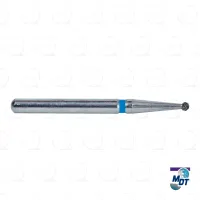
monosteryl® round · 012m · 10
sterile, ready to usesingle useindividually wrapped
mdt’s round diamond, iso shape 001, size 012 (1.2 mm), medium grit with a blue ring, on a 19 mm fg standard shank. monosteryl® is how mdt pack it: the same bur as their standard range, each one individually wrapped on a roll and gamma-sterilised, so it goes from the wrapper to the handpiece with nothing to clean or autoclave first.
this pack: mdt monosteryl® round diamond bur, fg, iso 001 012, medium (blue ring), 19 mm, sterile, single use (pack of 10, individually wrapped)
| shape | round – iso 001 |
| also listed as | 801 – the number mdt’s catalogue gives beside iso 001 |
| head | 1.2 mm diameter (iso 012) |
| grit | medium – blue ring |
| shank | fg standard, 19 mm overall |
| pack | 10, individually wrapped on a roll |
| sterility | gamma irradiation; single use |
open the wrapper, fit the bur, use it, bin it. it arrives sterile, so there is no cleaning, bagging or autoclave cycle, and no used burs waiting to be reprocessed. every bur you pick up is a new one.
mdt’s catalogue sets their burs at 60% diamond exposure against 40% for others. mdt list the features as "stronger bonding", "larger exposure of each diamond crystal" and "uniform diamond coating, including the tips", and the benefits as "faster & cooler cutting/grinding" and "slower clogging due to higher exposure of diamonds".
› the head is a spherical head, diamond-coated over hardened stainless steel – mdt make each bur from a single piece.
› mdt say their “triton” coating process "more than doubles the strength of the diamond bonding to the tool", on "swiss-made heat treated and ground stainless steel shanks".
› mdt’s instructions list diamond burs for restorative work generally, "including but not limited to: removal of caries or old restorations, preparation of cavities for restoration, finishing of restorations, preparation of crowns".
› speed, from mdt’s instructions for a 1.2 mm head: 70,000–220,000 rpm recommended, never more than 450,000 rpm.
› keep the bur moving and do not press hard – mdt warn that excessive pressure and a stationary bur both generate heat.
no. monosteryl® is mdt’s packing, not a different bur. mdt pack sterile burs in a dedicated cleanroom and sterilise them by gamma irradiation; use them by the expiry date printed on the pack.
no. mdt label sterile burs single use and state they "should not be reused or re-processed". once used, it is discarded.
| same shape | round 010m medium · round 016m medium · round 018c coarse |
monosteryl® round · iso 001 012m · medium, blue ring · 19 mm · sterile, single use · pack of 10 · made by mdt micro diamond technologies, israel · ref mdt-001-012m-10
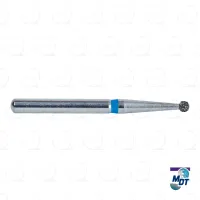
monosteryl® round · 016m · 10
sterile, ready to usesingle useindividually wrapped
mdt’s round diamond, iso shape 001, size 016 (1.6 mm), medium grit with a blue ring, on a 19 mm fg standard shank. monosteryl® is how mdt pack it: the same bur as their standard range, each one individually wrapped on a roll and gamma-sterilised, so it goes from the wrapper to the handpiece with nothing to clean or autoclave first.
this pack: mdt monosteryl® round diamond bur, fg, iso 001 016, medium (blue ring), 19 mm, sterile, single use (pack of 10, individually wrapped)
| shape | round – iso 001 |
| also listed as | 801 – the number mdt’s catalogue gives beside iso 001 |
| head | 1.6 mm diameter (iso 016) |
| grit | medium – blue ring |
| shank | fg standard, 19 mm overall |
| pack | 10, individually wrapped on a roll |
| sterility | gamma irradiation; single use |
open the wrapper, fit the bur, use it, bin it. it arrives sterile, so there is no cleaning, bagging or autoclave cycle, and no used burs waiting to be reprocessed. every bur you pick up is a new one.
mdt’s catalogue sets their burs at 60% diamond exposure against 40% for others. mdt list the features as "stronger bonding", "larger exposure of each diamond crystal" and "uniform diamond coating, including the tips", and the benefits as "faster & cooler cutting/grinding" and "slower clogging due to higher exposure of diamonds".
› the head is a spherical head, diamond-coated over hardened stainless steel – mdt make each bur from a single piece.
› mdt say their “triton” coating process "more than doubles the strength of the diamond bonding to the tool", on "swiss-made heat treated and ground stainless steel shanks".
› mdt’s instructions list diamond burs for restorative work generally, "including but not limited to: removal of caries or old restorations, preparation of cavities for restoration, finishing of restorations, preparation of crowns".
› speed, from mdt’s instructions for a 1.6 mm head: 55,000–160,000 rpm recommended, never more than 450,000 rpm.
› keep the bur moving and do not press hard – mdt warn that excessive pressure and a stationary bur both generate heat.
no. monosteryl® is mdt’s packing, not a different bur. mdt pack sterile burs in a dedicated cleanroom and sterilise them by gamma irradiation; use them by the expiry date printed on the pack.
no. mdt label sterile burs single use and state they "should not be reused or re-processed". once used, it is discarded.
| same shape | round 010m medium · round 012m medium · round 018c coarse |
monosteryl® round · iso 001 016m · medium, blue ring · 19 mm · sterile, single use · pack of 10 · made by mdt micro diamond technologies, israel · ref mdt-001-016m-10
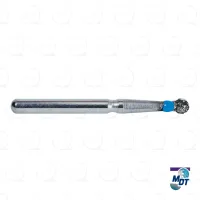
monosteryl® round · 018c · 10
sterile, ready to usesingle useindividually wrapped
mdt’s round diamond, iso shape 001, size 018 (1.8 mm), coarse grit with a green ring, on a 19 mm fg standard shank. monosteryl® is how mdt pack it: the same bur as their standard range, each one individually wrapped on a roll and gamma-sterilised, so it goes from the wrapper to the handpiece with nothing to clean or autoclave first.
this pack: mdt monosteryl® round diamond bur, fg, iso 001 018, coarse (green ring), 19 mm, sterile, single use (pack of 10, individually wrapped)
| shape | round – iso 001 |
| also listed as | 801 – the number mdt’s catalogue gives beside iso 001 |
| head | 1.8 mm diameter (iso 018) |
| grit | coarse – green ring |
| shank | fg standard, 19 mm overall |
| pack | 10, individually wrapped on a roll |
| sterility | gamma irradiation; single use |
open the wrapper, fit the bur, use it, bin it. it arrives sterile, so there is no cleaning, bagging or autoclave cycle, and no used burs waiting to be reprocessed. every bur you pick up is a new one.
mdt’s catalogue sets their burs at 60% diamond exposure against 40% for others. mdt list the features as "stronger bonding", "larger exposure of each diamond crystal" and "uniform diamond coating, including the tips", and the benefits as "faster & cooler cutting/grinding" and "slower clogging due to higher exposure of diamonds".
› the head is a spherical head, diamond-coated over hardened stainless steel – mdt make each bur from a single piece.
› mdt say their “triton” coating process "more than doubles the strength of the diamond bonding to the tool", on "swiss-made heat treated and ground stainless steel shanks".
› mdt’s instructions list diamond burs for restorative work generally, "including but not limited to: removal of caries or old restorations, preparation of cavities for restoration, finishing of restorations, preparation of crowns".
› speed, from mdt’s instructions for a 1.8 mm head: 55,000–160,000 rpm recommended, never more than 450,000 rpm.
› keep the bur moving and do not press hard – mdt warn that excessive pressure and a stationary bur both generate heat.
no. monosteryl® is mdt’s packing, not a different bur. mdt pack sterile burs in a dedicated cleanroom and sterilise them by gamma irradiation; use them by the expiry date printed on the pack.
no. mdt label sterile burs single use and state they "should not be reused or re-processed". once used, it is discarded.
| same shape | round 010m medium · round 012m medium · round 016m medium |
monosteryl® round · iso 001 018c · coarse, green ring · 19 mm · sterile, single use · pack of 10 · made by mdt micro diamond technologies, israel · ref mdt-001-018c-10

monosteryl® wheel · 040sm · 10
sterile, ready to usesingle useindividually wrapped
mdt’s wheel diamond, iso shape 067, size 040 (4.0 mm), medium grit with a blue ring, on a 16 mm fg short shank. monosteryl® is how mdt pack it: the same bur as their standard range, each one individually wrapped on a roll and gamma-sterilised, so it goes from the wrapper to the handpiece with nothing to clean or autoclave first.
this pack: mdt monosteryl® wheel diamond bur, fg, iso 067 040, medium (blue ring), 16 mm, sterile, single use (pack of 10, individually wrapped)
| shape | wheel – iso 067 |
| also listed as | 909 – the number mdt’s catalogue gives beside iso 067 |
| head | 4.0 mm diameter (iso 040), 1.3 mm long |
| grit | medium – blue ring |
| shank | fg short, 16 mm overall |
| pack | 10, individually wrapped on a roll |
| sterility | gamma irradiation; single use |
open the wrapper, fit the bur, use it, bin it. it arrives sterile, so there is no cleaning, bagging or autoclave cycle, and no used burs waiting to be reprocessed. every bur you pick up is a new one.
mdt’s catalogue sets their burs at 60% diamond exposure against 40% for others. mdt list the features as "stronger bonding", "larger exposure of each diamond crystal" and "uniform diamond coating, including the tips", and the benefits as "faster & cooler cutting/grinding" and "slower clogging due to higher exposure of diamonds".
› the head is a short, wide wheel with a rounded rim (mdt: wheel rounded rim), 1.3 mm long, diamond-coated over hardened stainless steel – mdt make each bur from a single piece.
› mdt say their “triton” coating process "more than doubles the strength of the diamond bonding to the tool", on "swiss-made heat treated and ground stainless steel shanks".
› mdt’s instructions list diamond burs for restorative work generally, "including but not limited to: removal of caries or old restorations, preparation of cavities for restoration, finishing of restorations, preparation of crowns".
› speed, from mdt’s instructions for a 4.0 mm head: 25,000–75,000 rpm recommended, never more than 120,000 rpm.
› keep the bur moving and do not press hard – mdt warn that excessive pressure and a stationary bur both generate heat.
no. monosteryl® is mdt’s packing, not a different bur. mdt pack sterile burs in a dedicated cleanroom and sterilise them by gamma irradiation; use them by the expiry date printed on the pack.
no. mdt label sterile burs single use and state they "should not be reused or re-processed". once used, it is discarded.
| the range | search the site for monosteryl to see every shape and grit we stock. |
monosteryl® wheel · iso 067 040sm · medium, blue ring · 16 mm · sterile, single use · pack of 10 · made by mdt micro diamond technologies, israel · ref mdt-067-040sm-10

monosteryl® flat end cylinder · 010m · 10
sterile, ready to usesingle useindividually wrapped
mdt’s flat end cylinder diamond, iso shape 108, size 010 (1.0 mm), medium grit with a blue ring, on a 19 mm fg standard shank. monosteryl® is how mdt pack it: the same bur as their standard range, each one individually wrapped on a roll and gamma-sterilised, so it goes from the wrapper to the handpiece with nothing to clean or autoclave first.
this pack: mdt monosteryl® flat end cylinder diamond bur, fg, iso 108 010, medium (blue ring), 19 mm, sterile, single use (pack of 10, individually wrapped)
| shape | flat end cylinder – iso 108 |
| also listed as | 835 – the number mdt’s catalogue gives beside iso 108 |
| head | 1.0 mm diameter (iso 010), 3.0 mm long |
| grit | medium – blue ring |
| shank | fg standard, 19 mm overall |
| pack | 10, individually wrapped on a roll |
| sterility | gamma irradiation; single use |
open the wrapper, fit the bur, use it, bin it. it arrives sterile, so there is no cleaning, bagging or autoclave cycle, and no used burs waiting to be reprocessed. every bur you pick up is a new one.
mdt’s catalogue sets their burs at 60% diamond exposure against 40% for others. mdt list the features as "stronger bonding", "larger exposure of each diamond crystal" and "uniform diamond coating, including the tips", and the benefits as "faster & cooler cutting/grinding" and "slower clogging due to higher exposure of diamonds".
› the head is a straight cylinder with a flat end, 3.0 mm long, diamond-coated over hardened stainless steel – mdt make each bur from a single piece.
› mdt say their “triton” coating process "more than doubles the strength of the diamond bonding to the tool", on "swiss-made heat treated and ground stainless steel shanks".
› mdt’s instructions list diamond burs for restorative work generally, "including but not limited to: removal of caries or old restorations, preparation of cavities for restoration, finishing of restorations, preparation of crowns".
› speed, from mdt’s instructions for a 1.0 mm head: 100,000–220,000 rpm recommended, never more than 450,000 rpm.
› keep the bur moving and do not press hard – mdt warn that excessive pressure and a stationary bur both generate heat.
no. monosteryl® is mdt’s packing, not a different bur. mdt pack sterile burs in a dedicated cleanroom and sterilise them by gamma irradiation; use them by the expiry date printed on the pack.
no. mdt label sterile burs single use and state they "should not be reused or re-processed". once used, it is discarded.
| related shapes | flat end cylinder 109 014m medium |
monosteryl® flat end cylinder · iso 108 010m · medium, blue ring · 19 mm · sterile, single use · pack of 10 · made by mdt micro diamond technologies, israel · ref mdt-108-010m-10
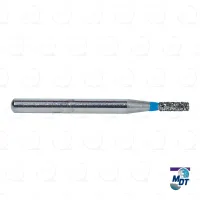
monosteryl® flat end cylinder · 014m · 10
sterile, ready to usesingle useindividually wrapped
mdt’s flat end cylinder diamond, iso shape 109, size 014 (1.4 mm), medium grit with a blue ring, on a 19 mm fg standard shank. monosteryl® is how mdt pack it: the same bur as their standard range, each one individually wrapped on a roll and gamma-sterilised, so it goes from the wrapper to the handpiece with nothing to clean or autoclave first.
this pack: mdt monosteryl® flat end cylinder diamond bur, fg, iso 109 014, medium (blue ring), 19 mm, sterile, single use (pack of 10, individually wrapped)
| shape | flat end cylinder – iso 109 |
| also listed as | 835 – the number mdt’s catalogue gives beside iso 109 |
| head | 1.4 mm diameter (iso 014), 4.0 mm long |
| grit | medium – blue ring |
| shank | fg standard, 19 mm overall |
| pack | 10, individually wrapped on a roll |
| sterility | gamma irradiation; single use |
open the wrapper, fit the bur, use it, bin it. it arrives sterile, so there is no cleaning, bagging or autoclave cycle, and no used burs waiting to be reprocessed. every bur you pick up is a new one.
mdt’s catalogue sets their burs at 60% diamond exposure against 40% for others. mdt list the features as "stronger bonding", "larger exposure of each diamond crystal" and "uniform diamond coating, including the tips", and the benefits as "faster & cooler cutting/grinding" and "slower clogging due to higher exposure of diamonds".
› the head is a straight cylinder with a flat end, 4.0 mm long, diamond-coated over hardened stainless steel – mdt make each bur from a single piece.
› mdt say their “triton” coating process "more than doubles the strength of the diamond bonding to the tool", on "swiss-made heat treated and ground stainless steel shanks".
› mdt’s instructions list diamond burs for restorative work generally, "including but not limited to: removal of caries or old restorations, preparation of cavities for restoration, finishing of restorations, preparation of crowns".
› speed, from mdt’s instructions for a 1.4 mm head: 70,000–220,000 rpm recommended, never more than 450,000 rpm.
› keep the bur moving and do not press hard – mdt warn that excessive pressure and a stationary bur both generate heat.
no. monosteryl® is mdt’s packing, not a different bur. mdt pack sterile burs in a dedicated cleanroom and sterilise them by gamma irradiation; use them by the expiry date printed on the pack.
no. mdt label sterile burs single use and state they "should not be reused or re-processed". once used, it is discarded.
| related shapes | flat end cylinder 108 010m medium |
monosteryl® flat end cylinder · iso 109 014m · medium, blue ring · 19 mm · sterile, single use · pack of 10 · made by mdt micro diamond technologies, israel · ref mdt-109-014m-10
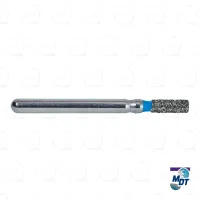
monosteryl® bevelled cylinder · 012c · 10
sterile, ready to usesingle useindividually wrapped
mdt’s bevelled cylinder diamond, iso shape 131, size 012 (1.2 mm), coarse grit with a green ring, on a 19 mm fg standard shank. monosteryl® is how mdt pack it: the same bur as their standard range, each one individually wrapped on a roll and gamma-sterilised, so it goes from the wrapper to the handpiece with nothing to clean or autoclave first.
this pack: mdt monosteryl® bevelled cylinder diamond bur, fg, iso 131 012, coarse (green ring), 19 mm, sterile, single use (pack of 10, individually wrapped)
| shape | bevelled cylinder – iso 131 |
| also listed as | 886 – the number mdt’s catalogue gives beside iso 131 |
| head | 1.2 mm diameter (iso 012), 10.0 mm long |
| grit | coarse – green ring |
| shank | fg standard, 19 mm overall |
| pack | 10, individually wrapped on a roll |
| sterility | gamma irradiation; single use |
open the wrapper, fit the bur, use it, bin it. it arrives sterile, so there is no cleaning, bagging or autoclave cycle, and no used burs waiting to be reprocessed. every bur you pick up is a new one.
mdt’s catalogue sets their burs at 60% diamond exposure against 40% for others. mdt list the features as "stronger bonding", "larger exposure of each diamond crystal" and "uniform diamond coating, including the tips", and the benefits as "faster & cooler cutting/grinding" and "slower clogging due to higher exposure of diamonds".
› the head is a cylinder with a bevelled end, 10.0 mm long, diamond-coated over hardened stainless steel – mdt make each bur from a single piece.
› mdt say their “triton” coating process "more than doubles the strength of the diamond bonding to the tool", on "swiss-made heat treated and ground stainless steel shanks".
› mdt’s instructions list diamond burs for restorative work generally, "including but not limited to: removal of caries or old restorations, preparation of cavities for restoration, finishing of restorations, preparation of crowns".
› speed, from mdt’s instructions for a 1.2 mm head: 70,000–220,000 rpm recommended, never more than 450,000 rpm.
› keep the bur moving and do not press hard – mdt warn that excessive pressure and a stationary bur both generate heat.
no. monosteryl® is mdt’s packing, not a different bur. mdt pack sterile burs in a dedicated cleanroom and sterilise them by gamma irradiation; use them by the expiry date printed on the pack.
no. mdt label sterile burs single use and state they "should not be reused or re-processed". once used, it is discarded.
monosteryl® bevelled cylinder · iso 131 012c · coarse, green ring · 19 mm · sterile, single use · pack of 10 · made by mdt micro diamond technologies, israel · ref mdt-131-012c-10

monosteryl® bevelled cylinder · 012f · 10
sterile, ready to usesingle useindividually wrapped
mdt’s bevelled cylinder diamond, iso shape 131, size 012 (1.2 mm), fine grit with a red ring, on a 19 mm fg standard shank. monosteryl® is how mdt pack it: the same bur as their standard range, each one individually wrapped on a roll and gamma-sterilised, so it goes from the wrapper to the handpiece with nothing to clean or autoclave first.
this pack: mdt monosteryl® bevelled cylinder diamond bur, fg, iso 131 012, fine (red ring), 19 mm, sterile, single use (pack of 10, individually wrapped)
| shape | bevelled cylinder – iso 131 |
| also listed as | 886 – the number mdt’s catalogue gives beside iso 131 |
| head | 1.2 mm diameter (iso 012), 10.0 mm long |
| grit | fine – red ring |
| shank | fg standard, 19 mm overall |
| pack | 10, individually wrapped on a roll |
| sterility | gamma irradiation; single use |
open the wrapper, fit the bur, use it, bin it. it arrives sterile, so there is no cleaning, bagging or autoclave cycle, and no used burs waiting to be reprocessed. every bur you pick up is a new one.
mdt’s catalogue sets their burs at 60% diamond exposure against 40% for others. mdt list the features as "stronger bonding", "larger exposure of each diamond crystal" and "uniform diamond coating, including the tips", and the benefits as "faster & cooler cutting/grinding" and "slower clogging due to higher exposure of diamonds".
› the head is a cylinder with a bevelled end, 10.0 mm long, diamond-coated over hardened stainless steel – mdt make each bur from a single piece.
› mdt say their “triton” coating process "more than doubles the strength of the diamond bonding to the tool", on "swiss-made heat treated and ground stainless steel shanks".
› mdt’s instructions list diamond burs for restorative work generally, "including but not limited to: removal of caries or old restorations, preparation of cavities for restoration, finishing of restorations, preparation of crowns".
› speed, from mdt’s instructions for a 1.2 mm head: 70,000–220,000 rpm recommended, never more than 450,000 rpm.
› keep the bur moving and do not press hard – mdt warn that excessive pressure and a stationary bur both generate heat.
no. monosteryl® is mdt’s packing, not a different bur. mdt pack sterile burs in a dedicated cleanroom and sterilise them by gamma irradiation; use them by the expiry date printed on the pack.
no. mdt label sterile burs single use and state they "should not be reused or re-processed". once used, it is discarded.
monosteryl® bevelled cylinder · iso 131 012f · fine, red ring · 19 mm · sterile, single use · pack of 10 · made by mdt micro diamond technologies, israel · ref mdt-131-012f-10

monosteryl® bevelled cylinder · 016c · 10
sterile, ready to usesingle useindividually wrapped
mdt’s bevelled cylinder diamond, iso shape 131, size 016 (1.6 mm), coarse grit with a green ring, on a 19 mm fg standard shank. monosteryl® is how mdt pack it: the same bur as their standard range, each one individually wrapped on a roll and gamma-sterilised, so it goes from the wrapper to the handpiece with nothing to clean or autoclave first.
this pack: mdt monosteryl® bevelled cylinder diamond bur, fg, iso 131 016, coarse (green ring), 19 mm, sterile, single use (pack of 10, individually wrapped)
| shape | bevelled cylinder – iso 131 |
| also listed as | 886 – the number mdt’s catalogue gives beside iso 131 |
| head | 1.6 mm diameter (iso 016), 10.0 mm long |
| grit | coarse – green ring |
| shank | fg standard, 19 mm overall |
| pack | 10, individually wrapped on a roll |
| sterility | gamma irradiation; single use |
open the wrapper, fit the bur, use it, bin it. it arrives sterile, so there is no cleaning, bagging or autoclave cycle, and no used burs waiting to be reprocessed. every bur you pick up is a new one.
mdt’s catalogue sets their burs at 60% diamond exposure against 40% for others. mdt list the features as "stronger bonding", "larger exposure of each diamond crystal" and "uniform diamond coating, including the tips", and the benefits as "faster & cooler cutting/grinding" and "slower clogging due to higher exposure of diamonds".
› the head is a cylinder with a bevelled end, 10.0 mm long, diamond-coated over hardened stainless steel – mdt make each bur from a single piece.
› mdt say their “triton” coating process "more than doubles the strength of the diamond bonding to the tool", on "swiss-made heat treated and ground stainless steel shanks".
› mdt’s instructions list diamond burs for restorative work generally, "including but not limited to: removal of caries or old restorations, preparation of cavities for restoration, finishing of restorations, preparation of crowns".
› speed, from mdt’s instructions for a 1.6 mm head: 55,000–160,000 rpm recommended, never more than 450,000 rpm.
› keep the bur moving and do not press hard – mdt warn that excessive pressure and a stationary bur both generate heat.
no. monosteryl® is mdt’s packing, not a different bur. mdt pack sterile burs in a dedicated cleanroom and sterilise them by gamma irradiation; use them by the expiry date printed on the pack.
no. mdt label sterile burs single use and state they "should not be reused or re-processed". once used, it is discarded.
monosteryl® bevelled cylinder · iso 131 016c · coarse, green ring · 19 mm · sterile, single use · pack of 10 · made by mdt micro diamond technologies, israel · ref mdt-131-016c-10

monosteryl® bevelled cylinder · 016f · 10
sterile, ready to usesingle useindividually wrapped
mdt’s bevelled cylinder diamond, iso shape 131, size 016 (1.6 mm), fine grit with a red ring, on a 19 mm fg standard shank. monosteryl® is how mdt pack it: the same bur as their standard range, each one individually wrapped on a roll and gamma-sterilised, so it goes from the wrapper to the handpiece with nothing to clean or autoclave first.
this pack: mdt monosteryl® bevelled cylinder diamond bur, fg, iso 131 016, fine (red ring), 19 mm, sterile, single use (pack of 10, individually wrapped)
| shape | bevelled cylinder – iso 131 |
| also listed as | 886 – the number mdt’s catalogue gives beside iso 131 |
| head | 1.6 mm diameter (iso 016), 10.0 mm long |
| grit | fine – red ring |
| shank | fg standard, 19 mm overall |
| pack | 10, individually wrapped on a roll |
| sterility | gamma irradiation; single use |
open the wrapper, fit the bur, use it, bin it. it arrives sterile, so there is no cleaning, bagging or autoclave cycle, and no used burs waiting to be reprocessed. every bur you pick up is a new one.
mdt’s catalogue sets their burs at 60% diamond exposure against 40% for others. mdt list the features as "stronger bonding", "larger exposure of each diamond crystal" and "uniform diamond coating, including the tips", and the benefits as "faster & cooler cutting/grinding" and "slower clogging due to higher exposure of diamonds".
› the head is a cylinder with a bevelled end, 10.0 mm long, diamond-coated over hardened stainless steel – mdt make each bur from a single piece.
› mdt say their “triton” coating process "more than doubles the strength of the diamond bonding to the tool", on "swiss-made heat treated and ground stainless steel shanks".
› mdt’s instructions list diamond burs for restorative work generally, "including but not limited to: removal of caries or old restorations, preparation of cavities for restoration, finishing of restorations, preparation of crowns".
› speed, from mdt’s instructions for a 1.6 mm head: 55,000–160,000 rpm recommended, never more than 450,000 rpm.
› keep the bur moving and do not press hard – mdt warn that excessive pressure and a stationary bur both generate heat.
no. monosteryl® is mdt’s packing, not a different bur. mdt pack sterile burs in a dedicated cleanroom and sterilise them by gamma irradiation; use them by the expiry date printed on the pack.
no. mdt label sterile burs single use and state they "should not be reused or re-processed". once used, it is discarded.
monosteryl® bevelled cylinder · iso 131 016f · fine, red ring · 19 mm · sterile, single use · pack of 10 · made by mdt micro diamond technologies, israel · ref mdt-131-016f-10

monosteryl® round end cylinder · 012m · 10
sterile, ready to usesingle useindividually wrapped
mdt’s round end cylinder diamond, iso shape 139, size 012 (1.2 mm), medium grit with a blue ring, on a 19 mm fg standard shank. monosteryl® is how mdt pack it: the same bur as their standard range, each one individually wrapped on a roll and gamma-sterilised, so it goes from the wrapper to the handpiece with nothing to clean or autoclave first.
this pack: mdt monosteryl® round end cylinder diamond bur, fg, iso 139 012, medium (blue ring), 19 mm, sterile, single use (pack of 10, individually wrapped)
| shape | round end cylinder – iso 139 |
| also listed as | 838 – the number mdt’s catalogue gives beside iso 139 |
| head | 1.2 mm diameter (iso 012), 4.0 mm long |
| grit | medium – blue ring |
| shank | fg standard, 19 mm overall |
| pack | 10, individually wrapped on a roll |
| sterility | gamma irradiation; single use |
open the wrapper, fit the bur, use it, bin it. it arrives sterile, so there is no cleaning, bagging or autoclave cycle, and no used burs waiting to be reprocessed. every bur you pick up is a new one.
mdt’s catalogue sets their burs at 60% diamond exposure against 40% for others. mdt list the features as "stronger bonding", "larger exposure of each diamond crystal" and "uniform diamond coating, including the tips", and the benefits as "faster & cooler cutting/grinding" and "slower clogging due to higher exposure of diamonds".
› the head is a straight cylinder with a rounded end, 4.0 mm long, diamond-coated over hardened stainless steel – mdt make each bur from a single piece.
› mdt say their “triton” coating process "more than doubles the strength of the diamond bonding to the tool", on "swiss-made heat treated and ground stainless steel shanks".
› mdt’s instructions list diamond burs for restorative work generally, "including but not limited to: removal of caries or old restorations, preparation of cavities for restoration, finishing of restorations, preparation of crowns".
› speed, from mdt’s instructions for a 1.2 mm head: 70,000–220,000 rpm recommended, never more than 450,000 rpm.
› keep the bur moving and do not press hard – mdt warn that excessive pressure and a stationary bur both generate heat.
no. monosteryl® is mdt’s packing, not a different bur. mdt pack sterile burs in a dedicated cleanroom and sterilise them by gamma irradiation; use them by the expiry date printed on the pack.
no. mdt label sterile burs single use and state they "should not be reused or re-processed". once used, it is discarded.
| related shapes | round end cylinder 141 012c coarse · round end cylinder 141 012f fine · round end cylinder 141 016c coarse · round end cylinder 141 016f fine |
monosteryl® round end cylinder · iso 139 012m · medium, blue ring · 19 mm · sterile, single use · pack of 10 · made by mdt micro diamond technologies, israel · ref mdt-139-012m-10

monosteryl® round end cylinder · 012c · 10
sterile, ready to usesingle useindividually wrapped
mdt’s round end cylinder diamond, iso shape 141, size 012 (1.2 mm), coarse grit with a green ring, on a 21 mm fg long shank. monosteryl® is how mdt pack it: the same bur as their standard range, each one individually wrapped on a roll and gamma-sterilised, so it goes from the wrapper to the handpiece with nothing to clean or autoclave first.
this pack: mdt monosteryl® round end cylinder diamond bur, fg, iso 141 012, coarse (green ring), 21 mm, sterile, single use (pack of 10, individually wrapped)
| shape | round end cylinder – iso 141 |
| also listed as | 881ks1 – the number mdt’s catalogue gives beside iso 141 |
| head | 1.2 mm diameter (iso 012), 8.0 mm long |
| grit | coarse – green ring |
| shank | fg long, 21 mm overall |
| pack | 10, individually wrapped on a roll |
| sterility | gamma irradiation; single use |
open the wrapper, fit the bur, use it, bin it. it arrives sterile, so there is no cleaning, bagging or autoclave cycle, and no used burs waiting to be reprocessed. every bur you pick up is a new one.
mdt’s catalogue sets their burs at 60% diamond exposure against 40% for others. mdt list the features as "stronger bonding", "larger exposure of each diamond crystal" and "uniform diamond coating, including the tips", and the benefits as "faster & cooler cutting/grinding" and "slower clogging due to higher exposure of diamonds".
› the head is a straight cylinder with a rounded end, 8.0 mm long, diamond-coated over hardened stainless steel – mdt make each bur from a single piece.
› mdt say their “triton” coating process "more than doubles the strength of the diamond bonding to the tool", on "swiss-made heat treated and ground stainless steel shanks".
› mdt’s instructions list diamond burs for restorative work generally, "including but not limited to: removal of caries or old restorations, preparation of cavities for restoration, finishing of restorations, preparation of crowns".
› speed, from mdt’s instructions for a 1.2 mm head: 70,000–220,000 rpm recommended, never more than 450,000 rpm.
› keep the bur moving and do not press hard – mdt warn that excessive pressure and a stationary bur both generate heat.
no. monosteryl® is mdt’s packing, not a different bur. mdt pack sterile burs in a dedicated cleanroom and sterilise them by gamma irradiation; use them by the expiry date printed on the pack.
no. mdt label sterile burs single use and state they "should not be reused or re-processed". once used, it is discarded.
monosteryl® round end cylinder · iso 141 012c · coarse, green ring · 21 mm · sterile, single use · pack of 10 · made by mdt micro diamond technologies, israel · ref mdt-141-012c-10

monosteryl® round end cylinder · 012f · 10
sterile, ready to usesingle useindividually wrapped
mdt’s round end cylinder diamond, iso shape 141, size 012 (1.2 mm), fine grit with a red ring, on a 21 mm fg long shank. monosteryl® is how mdt pack it: the same bur as their standard range, each one individually wrapped on a roll and gamma-sterilised, so it goes from the wrapper to the handpiece with nothing to clean or autoclave first.
this pack: mdt monosteryl® round end cylinder diamond bur, fg, iso 141 012, fine (red ring), 21 mm, sterile, single use (pack of 10, individually wrapped)
| shape | round end cylinder – iso 141 |
| also listed as | 881ks1 – the number mdt’s catalogue gives beside iso 141 |
| head | 1.2 mm diameter (iso 012), 8.0 mm long |
| grit | fine – red ring |
| shank | fg long, 21 mm overall |
| pack | 10, individually wrapped on a roll |
| sterility | gamma irradiation; single use |
open the wrapper, fit the bur, use it, bin it. it arrives sterile, so there is no cleaning, bagging or autoclave cycle, and no used burs waiting to be reprocessed. every bur you pick up is a new one.
mdt’s catalogue sets their burs at 60% diamond exposure against 40% for others. mdt list the features as "stronger bonding", "larger exposure of each diamond crystal" and "uniform diamond coating, including the tips", and the benefits as "faster & cooler cutting/grinding" and "slower clogging due to higher exposure of diamonds".
› the head is a straight cylinder with a rounded end, 8.0 mm long, diamond-coated over hardened stainless steel – mdt make each bur from a single piece.
› mdt say their “triton” coating process "more than doubles the strength of the diamond bonding to the tool", on "swiss-made heat treated and ground stainless steel shanks".
› mdt’s instructions list diamond burs for restorative work generally, "including but not limited to: removal of caries or old restorations, preparation of cavities for restoration, finishing of restorations, preparation of crowns".
› speed, from mdt’s instructions for a 1.2 mm head: 70,000–220,000 rpm recommended, never more than 450,000 rpm.
› keep the bur moving and do not press hard – mdt warn that excessive pressure and a stationary bur both generate heat.
no. monosteryl® is mdt’s packing, not a different bur. mdt pack sterile burs in a dedicated cleanroom and sterilise them by gamma irradiation; use them by the expiry date printed on the pack.
no. mdt label sterile burs single use and state they "should not be reused or re-processed". once used, it is discarded.
monosteryl® round end cylinder · iso 141 012f · fine, red ring · 21 mm · sterile, single use · pack of 10 · made by mdt micro diamond technologies, israel · ref mdt-141-012f-10

monosteryl® round end cylinder · 016c · 10
sterile, ready to usesingle useindividually wrapped
mdt’s round end cylinder diamond, iso shape 141, size 016 (1.6 mm), coarse grit with a green ring, on a 21 mm fg long shank. monosteryl® is how mdt pack it: the same bur as their standard range, each one individually wrapped on a roll and gamma-sterilised, so it goes from the wrapper to the handpiece with nothing to clean or autoclave first.
this pack: mdt monosteryl® round end cylinder diamond bur, fg, iso 141 016, coarse (green ring), 21 mm, sterile, single use (pack of 10, individually wrapped)
| shape | round end cylinder – iso 141 |
| also listed as | 881ks1 – the number mdt’s catalogue gives beside iso 141 |
| head | 1.6 mm diameter (iso 016), 8.0 mm long |
| grit | coarse – green ring |
| shank | fg long, 21 mm overall |
| pack | 10, individually wrapped on a roll |
| sterility | gamma irradiation; single use |
open the wrapper, fit the bur, use it, bin it. it arrives sterile, so there is no cleaning, bagging or autoclave cycle, and no used burs waiting to be reprocessed. every bur you pick up is a new one.
mdt’s catalogue sets their burs at 60% diamond exposure against 40% for others. mdt list the features as "stronger bonding", "larger exposure of each diamond crystal" and "uniform diamond coating, including the tips", and the benefits as "faster & cooler cutting/grinding" and "slower clogging due to higher exposure of diamonds".
› the head is a straight cylinder with a rounded end, 8.0 mm long, diamond-coated over hardened stainless steel – mdt make each bur from a single piece.
› mdt say their “triton” coating process "more than doubles the strength of the diamond bonding to the tool", on "swiss-made heat treated and ground stainless steel shanks".
› mdt’s instructions list diamond burs for restorative work generally, "including but not limited to: removal of caries or old restorations, preparation of cavities for restoration, finishing of restorations, preparation of crowns".
› speed, from mdt’s instructions for a 1.6 mm head: 55,000–160,000 rpm recommended, never more than 450,000 rpm.
› keep the bur moving and do not press hard – mdt warn that excessive pressure and a stationary bur both generate heat.
no. monosteryl® is mdt’s packing, not a different bur. mdt pack sterile burs in a dedicated cleanroom and sterilise them by gamma irradiation; use them by the expiry date printed on the pack.
no. mdt label sterile burs single use and state they "should not be reused or re-processed". once used, it is discarded.
monosteryl® round end cylinder · iso 141 016c · coarse, green ring · 21 mm · sterile, single use · pack of 10 · made by mdt micro diamond technologies, israel · ref mdt-141-016c-10

monosteryl® round end cylinder · 016f · 10
sterile, ready to usesingle useindividually wrapped
mdt’s round end cylinder diamond, iso shape 141, size 016 (1.6 mm), fine grit with a red ring, on a 21 mm fg long shank. monosteryl® is how mdt pack it: the same bur as their standard range, each one individually wrapped on a roll and gamma-sterilised, so it goes from the wrapper to the handpiece with nothing to clean or autoclave first.
this pack: mdt monosteryl® round end cylinder diamond bur, fg, iso 141 016, fine (red ring), 21 mm, sterile, single use (pack of 10, individually wrapped)
| shape | round end cylinder – iso 141 |
| also listed as | 881ks1 – the number mdt’s catalogue gives beside iso 141 |
| head | 1.6 mm diameter (iso 016), 8.0 mm long |
| grit | fine – red ring |
| shank | fg long, 21 mm overall |
| pack | 10, individually wrapped on a roll |
| sterility | gamma irradiation; single use |
open the wrapper, fit the bur, use it, bin it. it arrives sterile, so there is no cleaning, bagging or autoclave cycle, and no used burs waiting to be reprocessed. every bur you pick up is a new one.
mdt’s catalogue sets their burs at 60% diamond exposure against 40% for others. mdt list the features as "stronger bonding", "larger exposure of each diamond crystal" and "uniform diamond coating, including the tips", and the benefits as "faster & cooler cutting/grinding" and "slower clogging due to higher exposure of diamonds".
› the head is a straight cylinder with a rounded end, 8.0 mm long, diamond-coated over hardened stainless steel – mdt make each bur from a single piece.
› mdt say their “triton” coating process "more than doubles the strength of the diamond bonding to the tool", on "swiss-made heat treated and ground stainless steel shanks".
› mdt’s instructions list diamond burs for restorative work generally, "including but not limited to: removal of caries or old restorations, preparation of cavities for restoration, finishing of restorations, preparation of crowns".
› speed, from mdt’s instructions for a 1.6 mm head: 55,000–160,000 rpm recommended, never more than 450,000 rpm.
› keep the bur moving and do not press hard – mdt warn that excessive pressure and a stationary bur both generate heat.
no. monosteryl® is mdt’s packing, not a different bur. mdt pack sterile burs in a dedicated cleanroom and sterilise them by gamma irradiation; use them by the expiry date printed on the pack.
no. mdt label sterile burs single use and state they "should not be reused or re-processed". once used, it is discarded.
monosteryl® round end cylinder · iso 141 016f · fine, red ring · 21 mm · sterile, single use · pack of 10 · made by mdt micro diamond technologies, israel · ref mdt-141-016f-10

monosteryl® pointed cone · 010m · 10
sterile, ready to usesingle useindividually wrapped
mdt’s pointed cone diamond, iso shape 166, size 010 (1.0 mm), medium grit with a blue ring, on a 21 mm fg long shank. monosteryl® is how mdt pack it: the same bur as their standard range, each one individually wrapped on a roll and gamma-sterilised, so it goes from the wrapper to the handpiece with nothing to clean or autoclave first.
this pack: mdt monosteryl® pointed cone diamond bur, fg, iso 166 010, medium (blue ring), 21 mm, sterile, single use (pack of 10, individually wrapped)
| shape | pointed cone – iso 166 |
| also listed as | 859 – the number mdt’s catalogue gives beside iso 166 |
| head | 1.0 mm diameter (iso 010), 10.0 mm long |
| grit | medium – blue ring |
| shank | fg long, 21 mm overall |
| pack | 10, individually wrapped on a roll |
| sterility | gamma irradiation; single use |
open the wrapper, fit the bur, use it, bin it. it arrives sterile, so there is no cleaning, bagging or autoclave cycle, and no used burs waiting to be reprocessed. every bur you pick up is a new one.
mdt’s catalogue sets their burs at 60% diamond exposure against 40% for others. mdt list the features as "stronger bonding", "larger exposure of each diamond crystal" and "uniform diamond coating, including the tips", and the benefits as "faster & cooler cutting/grinding" and "slower clogging due to higher exposure of diamonds".
› the head is a cone tapering to a point, 10.0 mm long, diamond-coated over hardened stainless steel – mdt make each bur from a single piece.
› mdt say their “triton” coating process "more than doubles the strength of the diamond bonding to the tool", on "swiss-made heat treated and ground stainless steel shanks".
› mdt’s instructions list diamond burs for restorative work generally, "including but not limited to: removal of caries or old restorations, preparation of cavities for restoration, finishing of restorations, preparation of crowns".
› speed, from mdt’s instructions for a 1.0 mm head: 100,000–220,000 rpm recommended, never more than 450,000 rpm.
› keep the bur moving and do not press hard – mdt warn that excessive pressure and a stationary bur both generate heat.
no. monosteryl® is mdt’s packing, not a different bur. mdt pack sterile burs in a dedicated cleanroom and sterilise them by gamma irradiation; use them by the expiry date printed on the pack.
no. mdt label sterile burs single use and state they "should not be reused or re-processed". once used, it is discarded.
| related shapes | flat end taper 012m medium · flat end taper 014m medium · flat end taper 016c coarse · flat end taper 016m medium |
monosteryl® pointed cone · iso 166 010m · medium, blue ring · 21 mm · sterile, single use · pack of 10 · made by mdt micro diamond technologies, israel · ref mdt-166-010m-10

monosteryl® flat end taper · 012m · 10
sterile, ready to usesingle useindividually wrapped
mdt’s flat end taper diamond, iso shape 173, size 012 (1.2 mm), medium grit with a blue ring, on a 21 mm fg long shank. monosteryl® is how mdt pack it: the same bur as their standard range, each one individually wrapped on a roll and gamma-sterilised, so it goes from the wrapper to the handpiece with nothing to clean or autoclave first.
this pack: mdt monosteryl® flat end taper diamond bur, fg, iso 173 012, medium (blue ring), 21 mm, sterile, single use (pack of 10, individually wrapped)
| shape | flat end taper – iso 173 |
| also listed as | 848 – the number mdt’s catalogue gives beside iso 173 |
| head | 1.2 mm diameter (iso 012), 10.0 mm long |
| grit | medium – blue ring |
| shank | fg long, 21 mm overall |
| pack | 10, individually wrapped on a roll |
| sterility | gamma irradiation; single use |
open the wrapper, fit the bur, use it, bin it. it arrives sterile, so there is no cleaning, bagging or autoclave cycle, and no used burs waiting to be reprocessed. every bur you pick up is a new one.
mdt’s catalogue sets their burs at 60% diamond exposure against 40% for others. mdt list the features as "stronger bonding", "larger exposure of each diamond crystal" and "uniform diamond coating, including the tips", and the benefits as "faster & cooler cutting/grinding" and "slower clogging due to higher exposure of diamonds".
› the head is a tapered head with a flat end, 10.0 mm long, diamond-coated over hardened stainless steel – mdt make each bur from a single piece.
› mdt say their “triton” coating process "more than doubles the strength of the diamond bonding to the tool", on "swiss-made heat treated and ground stainless steel shanks".
› mdt’s instructions list diamond burs for restorative work generally, "including but not limited to: removal of caries or old restorations, preparation of cavities for restoration, finishing of restorations, preparation of crowns".
› speed, from mdt’s instructions for a 1.2 mm head: 70,000–220,000 rpm recommended, never more than 450,000 rpm.
› keep the bur moving and do not press hard – mdt warn that excessive pressure and a stationary bur both generate heat.
no. monosteryl® is mdt’s packing, not a different bur. mdt pack sterile burs in a dedicated cleanroom and sterilise them by gamma irradiation; use them by the expiry date printed on the pack.
no. mdt label sterile burs single use and state they "should not be reused or re-processed". once used, it is discarded.
monosteryl® flat end taper · iso 173 012m · medium, blue ring · 21 mm · sterile, single use · pack of 10 · made by mdt micro diamond technologies, israel · ref mdt-173-012m-10
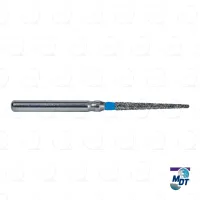
monosteryl® flat end taper · 014m · 10
sterile, ready to usesingle useindividually wrapped
mdt’s flat end taper diamond, iso shape 173, size 014 (1.4 mm), medium grit with a blue ring, on a 21 mm fg long shank. monosteryl® is how mdt pack it: the same bur as their standard range, each one individually wrapped on a roll and gamma-sterilised, so it goes from the wrapper to the handpiece with nothing to clean or autoclave first.
this pack: mdt monosteryl® flat end taper diamond bur, fg, iso 173 014, medium (blue ring), 21 mm, sterile, single use (pack of 10, individually wrapped)
| shape | flat end taper – iso 173 |
| also listed as | 848 – the number mdt’s catalogue gives beside iso 173 |
| head | 1.4 mm diameter (iso 014), 10.0 mm long |
| grit | medium – blue ring |
| shank | fg long, 21 mm overall |
| pack | 10, individually wrapped on a roll |
| sterility | gamma irradiation; single use |
open the wrapper, fit the bur, use it, bin it. it arrives sterile, so there is no cleaning, bagging or autoclave cycle, and no used burs waiting to be reprocessed. every bur you pick up is a new one.
mdt’s catalogue sets their burs at 60% diamond exposure against 40% for others. mdt list the features as "stronger bonding", "larger exposure of each diamond crystal" and "uniform diamond coating, including the tips", and the benefits as "faster & cooler cutting/grinding" and "slower clogging due to higher exposure of diamonds".
› the head is a tapered head with a flat end, 10.0 mm long, diamond-coated over hardened stainless steel – mdt make each bur from a single piece.
› mdt say their “triton” coating process "more than doubles the strength of the diamond bonding to the tool", on "swiss-made heat treated and ground stainless steel shanks".
› mdt’s instructions list diamond burs for restorative work generally, "including but not limited to: removal of caries or old restorations, preparation of cavities for restoration, finishing of restorations, preparation of crowns".
› speed, from mdt’s instructions for a 1.4 mm head: 70,000–220,000 rpm recommended, never more than 450,000 rpm.
› keep the bur moving and do not press hard – mdt warn that excessive pressure and a stationary bur both generate heat.
no. monosteryl® is mdt’s packing, not a different bur. mdt pack sterile burs in a dedicated cleanroom and sterilise them by gamma irradiation; use them by the expiry date printed on the pack.
no. mdt label sterile burs single use and state they "should not be reused or re-processed". once used, it is discarded.
monosteryl® flat end taper · iso 173 014m · medium, blue ring · 21 mm · sterile, single use · pack of 10 · made by mdt micro diamond technologies, israel · ref mdt-173-014m-10

monosteryl® flat end taper · 016c · 10
sterile, ready to usesingle useindividually wrapped
mdt’s flat end taper diamond, iso shape 173, size 016 (1.6 mm), coarse grit with a green ring, on a 21 mm fg long shank. monosteryl® is how mdt pack it: the same bur as their standard range, each one individually wrapped on a roll and gamma-sterilised, so it goes from the wrapper to the handpiece with nothing to clean or autoclave first.
this pack: mdt monosteryl® flat end taper diamond bur, fg, iso 173 016, coarse (green ring), 21 mm, sterile, single use (pack of 10, individually wrapped)
| shape | flat end taper – iso 173 |
| also listed as | 848 – the number mdt’s catalogue gives beside iso 173 |
| head | 1.6 mm diameter (iso 016), 10.0 mm long |
| grit | coarse – green ring |
| shank | fg long, 21 mm overall |
| pack | 10, individually wrapped on a roll |
| sterility | gamma irradiation; single use |
open the wrapper, fit the bur, use it, bin it. it arrives sterile, so there is no cleaning, bagging or autoclave cycle, and no used burs waiting to be reprocessed. every bur you pick up is a new one.
mdt’s catalogue sets their burs at 60% diamond exposure against 40% for others. mdt list the features as "stronger bonding", "larger exposure of each diamond crystal" and "uniform diamond coating, including the tips", and the benefits as "faster & cooler cutting/grinding" and "slower clogging due to higher exposure of diamonds".
› the head is a tapered head with a flat end, 10.0 mm long, diamond-coated over hardened stainless steel – mdt make each bur from a single piece.
› mdt say their “triton” coating process "more than doubles the strength of the diamond bonding to the tool", on "swiss-made heat treated and ground stainless steel shanks".
› mdt’s instructions list diamond burs for restorative work generally, "including but not limited to: removal of caries or old restorations, preparation of cavities for restoration, finishing of restorations, preparation of crowns".
› speed, from mdt’s instructions for a 1.6 mm head: 55,000–160,000 rpm recommended, never more than 450,000 rpm.
› keep the bur moving and do not press hard – mdt warn that excessive pressure and a stationary bur both generate heat.
no. monosteryl® is mdt’s packing, not a different bur. mdt pack sterile burs in a dedicated cleanroom and sterilise them by gamma irradiation; use them by the expiry date printed on the pack.
no. mdt label sterile burs single use and state they "should not be reused or re-processed". once used, it is discarded.
monosteryl® flat end taper · iso 173 016c · coarse, green ring · 21 mm · sterile, single use · pack of 10 · made by mdt micro diamond technologies, israel · ref mdt-173-016c-10
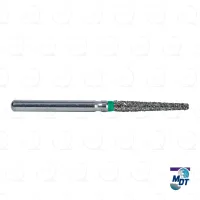
monosteryl® flat end taper · 016m · 10
sterile, ready to usesingle useindividually wrapped
mdt’s flat end taper diamond, iso shape 173, size 016 (1.6 mm), medium grit with a blue ring, on a 21 mm fg long shank. monosteryl® is how mdt pack it: the same bur as their standard range, each one individually wrapped on a roll and gamma-sterilised, so it goes from the wrapper to the handpiece with nothing to clean or autoclave first.
this pack: mdt monosteryl® flat end taper diamond bur, fg, iso 173 016, medium (blue ring), 21 mm, sterile, single use (pack of 10, individually wrapped)
| shape | flat end taper – iso 173 |
| also listed as | 848 – the number mdt’s catalogue gives beside iso 173 |
| head | 1.6 mm diameter (iso 016), 10.0 mm long |
| grit | medium – blue ring |
| shank | fg long, 21 mm overall |
| pack | 10, individually wrapped on a roll |
| sterility | gamma irradiation; single use |
open the wrapper, fit the bur, use it, bin it. it arrives sterile, so there is no cleaning, bagging or autoclave cycle, and no used burs waiting to be reprocessed. every bur you pick up is a new one.
mdt’s catalogue sets their burs at 60% diamond exposure against 40% for others. mdt list the features as "stronger bonding", "larger exposure of each diamond crystal" and "uniform diamond coating, including the tips", and the benefits as "faster & cooler cutting/grinding" and "slower clogging due to higher exposure of diamonds".
› the head is a tapered head with a flat end, 10.0 mm long, diamond-coated over hardened stainless steel – mdt make each bur from a single piece.
› mdt say their “triton” coating process "more than doubles the strength of the diamond bonding to the tool", on "swiss-made heat treated and ground stainless steel shanks".
› mdt’s instructions list diamond burs for restorative work generally, "including but not limited to: removal of caries or old restorations, preparation of cavities for restoration, finishing of restorations, preparation of crowns".
› speed, from mdt’s instructions for a 1.6 mm head: 55,000–160,000 rpm recommended, never more than 450,000 rpm.
› keep the bur moving and do not press hard – mdt warn that excessive pressure and a stationary bur both generate heat.
no. monosteryl® is mdt’s packing, not a different bur. mdt pack sterile burs in a dedicated cleanroom and sterilise them by gamma irradiation; use them by the expiry date printed on the pack.
no. mdt label sterile burs single use and state they "should not be reused or re-processed". once used, it is discarded.
monosteryl® flat end taper · iso 173 016m · medium, blue ring · 21 mm · sterile, single use · pack of 10 · made by mdt micro diamond technologies, israel · ref mdt-173-016m-10
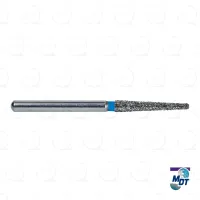
monosteryl® round end taper · 016m · 10
sterile, ready to usesingle useindividually wrapped
mdt’s round end taper diamond, iso shape 198, size 016 (1.6 mm), medium grit with a blue ring, on a 21 mm fg long shank. monosteryl® is how mdt pack it: the same bur as their standard range, each one individually wrapped on a roll and gamma-sterilised, so it goes from the wrapper to the handpiece with nothing to clean or autoclave first.
this pack: mdt monosteryl® round end taper diamond bur, fg, iso 198 016, medium (blue ring), 21 mm, sterile, single use (pack of 10, individually wrapped)
| shape | round end taper – iso 198 |
| also listed as | 856 – the number mdt’s catalogue gives beside iso 198 |
| head | 1.6 mm diameter (iso 016), 8.0 mm long |
| grit | medium – blue ring |
| shank | fg long, 21 mm overall |
| pack | 10, individually wrapped on a roll |
| sterility | gamma irradiation; single use |
open the wrapper, fit the bur, use it, bin it. it arrives sterile, so there is no cleaning, bagging or autoclave cycle, and no used burs waiting to be reprocessed. every bur you pick up is a new one.
mdt’s catalogue sets their burs at 60% diamond exposure against 40% for others. mdt list the features as "stronger bonding", "larger exposure of each diamond crystal" and "uniform diamond coating, including the tips", and the benefits as "faster & cooler cutting/grinding" and "slower clogging due to higher exposure of diamonds".
› the head is a tapered head with a rounded end, 8.0 mm long, diamond-coated over hardened stainless steel – mdt make each bur from a single piece.
› mdt say their “triton” coating process "more than doubles the strength of the diamond bonding to the tool", on "swiss-made heat treated and ground stainless steel shanks".
› mdt’s instructions list diamond burs for restorative work generally, "including but not limited to: removal of caries or old restorations, preparation of cavities for restoration, finishing of restorations, preparation of crowns".
› speed, from mdt’s instructions for a 1.6 mm head: 55,000–160,000 rpm recommended, never more than 450,000 rpm.
› keep the bur moving and do not press hard – mdt warn that excessive pressure and a stationary bur both generate heat.
no. monosteryl® is mdt’s packing, not a different bur. mdt pack sterile burs in a dedicated cleanroom and sterilise them by gamma irradiation; use them by the expiry date printed on the pack.
no. mdt label sterile burs single use and state they "should not be reused or re-processed". once used, it is discarded.
| same shape | round end taper 198 016xc extra coarse |
| related shapes | flat end taper 012m medium · flat end taper 014m medium · flat end taper 016c coarse · flat end taper 016m medium |
monosteryl® round end taper · iso 198 016m · medium, blue ring · 21 mm · sterile, single use · pack of 10 · made by mdt micro diamond technologies, israel · ref mdt-198-016m-10
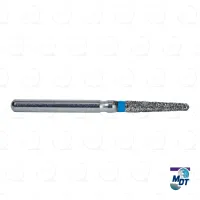
monosteryl® round end taper · 016xc · 10
sterile, ready to usesingle useindividually wrapped
mdt’s round end taper diamond, iso shape 198, size 016 (1.6 mm), extra coarse grit with a black ring, on a 21 mm fg long shank. monosteryl® is how mdt pack it: the same bur as their standard range, each one individually wrapped on a roll and gamma-sterilised, so it goes from the wrapper to the handpiece with nothing to clean or autoclave first.
this pack: mdt monosteryl® round end taper diamond bur, fg, iso 198 016, extra coarse (black ring), 21 mm, sterile, single use (pack of 10, individually wrapped)
| shape | round end taper – iso 198 |
| also listed as | 856 – the number mdt’s catalogue gives beside iso 198 |
| head | 1.6 mm diameter (iso 016), 8.0 mm long |
| grit | extra coarse – black ring |
| shank | fg long, 21 mm overall |
| pack | 10, individually wrapped on a roll |
| sterility | gamma irradiation; single use |
open the wrapper, fit the bur, use it, bin it. it arrives sterile, so there is no cleaning, bagging or autoclave cycle, and no used burs waiting to be reprocessed. every bur you pick up is a new one.
mdt’s catalogue sets their burs at 60% diamond exposure against 40% for others. mdt list the features as "stronger bonding", "larger exposure of each diamond crystal" and "uniform diamond coating, including the tips", and the benefits as "faster & cooler cutting/grinding" and "slower clogging due to higher exposure of diamonds".
› the head is a tapered head with a rounded end, 8.0 mm long, diamond-coated over hardened stainless steel – mdt make each bur from a single piece.
› mdt say their “triton” coating process "more than doubles the strength of the diamond bonding to the tool", on "swiss-made heat treated and ground stainless steel shanks".
› mdt’s instructions list diamond burs for restorative work generally, "including but not limited to: removal of caries or old restorations, preparation of cavities for restoration, finishing of restorations, preparation of crowns".
› speed, from mdt’s instructions for a 1.6 mm head: 55,000–160,000 rpm recommended, never more than 450,000 rpm.
› keep the bur moving and do not press hard – mdt warn that excessive pressure and a stationary bur both generate heat.
no. monosteryl® is mdt’s packing, not a different bur. mdt pack sterile burs in a dedicated cleanroom and sterilise them by gamma irradiation; use them by the expiry date printed on the pack.
no. mdt label sterile burs single use and state they "should not be reused or re-processed". once used, it is discarded.
| same shape | round end taper 198 016m medium |
| related shapes | flat end taper 012m medium · flat end taper 014m medium · flat end taper 016c coarse · flat end taper 016m medium |
monosteryl® round end taper · iso 198 016xc · extra coarse, black ring · 21 mm · sterile, single use · pack of 10 · made by mdt micro diamond technologies, israel · ref mdt-198-016xc-10
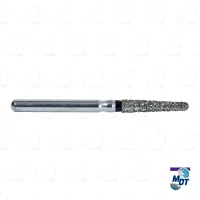
monosteryl® round end taper · 014m · 10
sterile, ready to usesingle useindividually wrapped
mdt’s round end taper diamond, iso shape 199, size 014 (1.4 mm), medium grit with a blue ring, on a 21 mm fg long shank. monosteryl® is how mdt pack it: the same bur as their standard range, each one individually wrapped on a roll and gamma-sterilised, so it goes from the wrapper to the handpiece with nothing to clean or autoclave first.
this pack: mdt monosteryl® round end taper diamond bur, fg, iso 199 014, medium (blue ring), 21 mm, sterile, single use (pack of 10, individually wrapped)
| shape | round end taper – iso 199 |
| also listed as | 850 – the number mdt’s catalogue gives beside iso 199 |
| head | 1.4 mm diameter (iso 014), 10.0 mm long |
| grit | medium – blue ring |
| shank | fg long, 21 mm overall |
| pack | 10, individually wrapped on a roll |
| sterility | gamma irradiation; single use |
open the wrapper, fit the bur, use it, bin it. it arrives sterile, so there is no cleaning, bagging or autoclave cycle, and no used burs waiting to be reprocessed. every bur you pick up is a new one.
mdt’s catalogue sets their burs at 60% diamond exposure against 40% for others. mdt list the features as "stronger bonding", "larger exposure of each diamond crystal" and "uniform diamond coating, including the tips", and the benefits as "faster & cooler cutting/grinding" and "slower clogging due to higher exposure of diamonds".
› the head is a tapered head with a rounded end, 10.0 mm long, diamond-coated over hardened stainless steel – mdt make each bur from a single piece.
› mdt say their “triton” coating process "more than doubles the strength of the diamond bonding to the tool", on "swiss-made heat treated and ground stainless steel shanks".
› mdt’s instructions list diamond burs for restorative work generally, "including but not limited to: removal of caries or old restorations, preparation of cavities for restoration, finishing of restorations, preparation of crowns".
› speed, from mdt’s instructions for a 1.4 mm head: 70,000–220,000 rpm recommended, never more than 450,000 rpm.
› keep the bur moving and do not press hard – mdt warn that excessive pressure and a stationary bur both generate heat.
no. monosteryl® is mdt’s packing, not a different bur. mdt pack sterile burs in a dedicated cleanroom and sterilise them by gamma irradiation; use them by the expiry date printed on the pack.
no. mdt label sterile burs single use and state they "should not be reused or re-processed". once used, it is discarded.
| related shapes | round end taper 198 016m medium · round end taper 198 016xc extra coarse |
monosteryl® round end taper · iso 199 014m · medium, blue ring · 21 mm · sterile, single use · pack of 10 · made by mdt micro diamond technologies, israel · ref mdt-199-014m-10

monosteryl® flame · 012xf · 10
sterile, ready to usesingle useindividually wrapped
mdt’s flame diamond, iso shape 247, size 012 (1.2 mm), extra fine grit with a yellow ring, on a 19 mm fg standard shank. monosteryl® is how mdt pack it: the same bur as their standard range, each one individually wrapped on a roll and gamma-sterilised, so it goes from the wrapper to the handpiece with nothing to clean or autoclave first. this is the 247, the short flame; the 249 in the same size and grit has an 8 mm head on a 21 mm shank.
this pack: mdt monosteryl® flame diamond bur, fg, iso 247 012, extra fine (yellow ring), 19 mm, sterile, single use (pack of 10, individually wrapped)
| shape | flame – iso 247 |
| also listed as | 860 – the number mdt’s catalogue gives beside iso 247 |
| head | 1.2 mm diameter (iso 012), 4.0 mm long |
| grit | extra fine – yellow ring |
| shank | fg standard, 19 mm overall |
| pack | 10, individually wrapped on a roll |
| sterility | gamma irradiation; single use |
open the wrapper, fit the bur, use it, bin it. it arrives sterile, so there is no cleaning, bagging or autoclave cycle, and no used burs waiting to be reprocessed. every bur you pick up is a new one.
mdt’s catalogue sets their burs at 60% diamond exposure against 40% for others. mdt list the features as "stronger bonding", "larger exposure of each diamond crystal" and "uniform diamond coating, including the tips", and the benefits as "faster & cooler cutting/grinding" and "slower clogging due to higher exposure of diamonds".
› the head is a short flame – a head that swells, then tapers to a fine point, 4.0 mm long, diamond-coated over hardened stainless steel – mdt make each bur from a single piece.
› mdt say their “triton” coating process "more than doubles the strength of the diamond bonding to the tool", on "swiss-made heat treated and ground stainless steel shanks".
› mdt’s instructions list diamond burs for restorative work generally, "including but not limited to: removal of caries or old restorations, preparation of cavities for restoration, finishing of restorations, preparation of crowns".
› speed, from mdt’s instructions for a 1.2 mm head: 70,000–220,000 rpm recommended, never more than 450,000 rpm.
› keep the bur moving and do not press hard – mdt warn that excessive pressure and a stationary bur both generate heat.
same size (012), same extra fine grit, same flame shape. mdt’s catalogue gives the 247 a 4.0 mm head on a standard 19 mm shank and the 249 an 8.0 mm head on a long 21 mm shank. the difference is the head length and the overall length.
no. monosteryl® is mdt’s packing, not a different bur. mdt pack sterile burs in a dedicated cleanroom and sterilise them by gamma irradiation; use them by the expiry date printed on the pack.
no. mdt label sterile burs single use and state they "should not be reused or re-processed". once used, it is discarded.
| related shapes | flame 249 012f fine · flame 249 012m medium · flame 249 012uf ultra fine · flame 249 012xf extra fine |
monosteryl® flame · iso 247 012xf · extra fine, yellow ring · 19 mm · sterile, single use · pack of 10 · made by mdt micro diamond technologies, israel · ref mdt-247-012xf-10
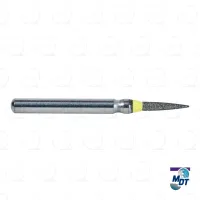
monosteryl® flame · 012f · 10
sterile, ready to usesingle useindividually wrapped
mdt’s flame diamond, iso shape 249, size 012 (1.2 mm), fine grit with a red ring, on a 21 mm fg long shank. monosteryl® is how mdt pack it: the same bur as their standard range, each one individually wrapped on a roll and gamma-sterilised, so it goes from the wrapper to the handpiece with nothing to clean or autoclave first.
this pack: mdt monosteryl® flame diamond bur, fg, iso 249 012, fine (red ring), 21 mm, sterile, single use (pack of 10, individually wrapped)
| shape | flame – iso 249 |
| also listed as | 862 – the number mdt’s catalogue gives beside iso 249 |
| head | 1.2 mm diameter (iso 012), 8.0 mm long |
| grit | fine – red ring |
| shank | fg long, 21 mm overall |
| pack | 10, individually wrapped on a roll |
| sterility | gamma irradiation; single use |
open the wrapper, fit the bur, use it, bin it. it arrives sterile, so there is no cleaning, bagging or autoclave cycle, and no used burs waiting to be reprocessed. every bur you pick up is a new one.
mdt’s catalogue sets their burs at 60% diamond exposure against 40% for others. mdt list the features as "stronger bonding", "larger exposure of each diamond crystal" and "uniform diamond coating, including the tips", and the benefits as "faster & cooler cutting/grinding" and "slower clogging due to higher exposure of diamonds".
› the head is a long flame – a head that swells, then tapers to a fine point, 8.0 mm long, diamond-coated over hardened stainless steel – mdt make each bur from a single piece.
› mdt say their “triton” coating process "more than doubles the strength of the diamond bonding to the tool", on "swiss-made heat treated and ground stainless steel shanks".
› mdt’s instructions list diamond burs for restorative work generally, "including but not limited to: removal of caries or old restorations, preparation of cavities for restoration, finishing of restorations, preparation of crowns".
› speed, from mdt’s instructions for a 1.2 mm head: 70,000–220,000 rpm recommended, never more than 450,000 rpm.
› keep the bur moving and do not press hard – mdt warn that excessive pressure and a stationary bur both generate heat.
no. monosteryl® is mdt’s packing, not a different bur. mdt pack sterile burs in a dedicated cleanroom and sterilise them by gamma irradiation; use them by the expiry date printed on the pack.
no. mdt label sterile burs single use and state they "should not be reused or re-processed". once used, it is discarded.
monosteryl® flame · iso 249 012f · fine, red ring · 21 mm · sterile, single use · pack of 10 · made by mdt micro diamond technologies, israel · ref mdt-249-012f-10
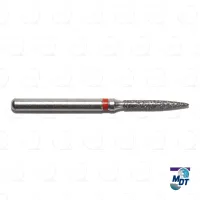
monosteryl® flame · 012m · 10
sterile, ready to usesingle useindividually wrapped
mdt’s flame diamond, iso shape 249, size 012 (1.2 mm), medium grit with a blue ring, on a 21 mm fg long shank. monosteryl® is how mdt pack it: the same bur as their standard range, each one individually wrapped on a roll and gamma-sterilised, so it goes from the wrapper to the handpiece with nothing to clean or autoclave first.
this pack: mdt monosteryl® flame diamond bur, fg, iso 249 012, medium (blue ring), 21 mm, sterile, single use (pack of 10, individually wrapped)
| shape | flame – iso 249 |
| also listed as | 862 – the number mdt’s catalogue gives beside iso 249 |
| head | 1.2 mm diameter (iso 012), 8.0 mm long |
| grit | medium – blue ring |
| shank | fg long, 21 mm overall |
| pack | 10, individually wrapped on a roll |
| sterility | gamma irradiation; single use |
open the wrapper, fit the bur, use it, bin it. it arrives sterile, so there is no cleaning, bagging or autoclave cycle, and no used burs waiting to be reprocessed. every bur you pick up is a new one.
mdt’s catalogue sets their burs at 60% diamond exposure against 40% for others. mdt list the features as "stronger bonding", "larger exposure of each diamond crystal" and "uniform diamond coating, including the tips", and the benefits as "faster & cooler cutting/grinding" and "slower clogging due to higher exposure of diamonds".
› the head is a long flame – a head that swells, then tapers to a fine point, 8.0 mm long, diamond-coated over hardened stainless steel – mdt make each bur from a single piece.
› mdt say their “triton” coating process "more than doubles the strength of the diamond bonding to the tool", on "swiss-made heat treated and ground stainless steel shanks".
› mdt’s instructions list diamond burs for restorative work generally, "including but not limited to: removal of caries or old restorations, preparation of cavities for restoration, finishing of restorations, preparation of crowns".
› speed, from mdt’s instructions for a 1.2 mm head: 70,000–220,000 rpm recommended, never more than 450,000 rpm.
› keep the bur moving and do not press hard – mdt warn that excessive pressure and a stationary bur both generate heat.
no. monosteryl® is mdt’s packing, not a different bur. mdt pack sterile burs in a dedicated cleanroom and sterilise them by gamma irradiation; use them by the expiry date printed on the pack.
no. mdt label sterile burs single use and state they "should not be reused or re-processed". once used, it is discarded.
monosteryl® flame · iso 249 012m · medium, blue ring · 21 mm · sterile, single use · pack of 10 · made by mdt micro diamond technologies, israel · ref mdt-249-012m-10

monosteryl® flame · 012uf · 10
sterile, ready to usesingle useindividually wrapped
mdt’s flame diamond, iso shape 249, size 012 (1.2 mm), ultra fine grit with a white ring, on a 21 mm fg long shank. monosteryl® is how mdt pack it: the same bur as their standard range, each one individually wrapped on a roll and gamma-sterilised, so it goes from the wrapper to the handpiece with nothing to clean or autoclave first.
this pack: mdt monosteryl® flame diamond bur, fg, iso 249 012, ultra fine (white ring), 21 mm, sterile, single use (pack of 10, individually wrapped)
| shape | flame – iso 249 |
| also listed as | 862 – the number mdt’s catalogue gives beside iso 249 |
| head | 1.2 mm diameter (iso 012), 8.0 mm long |
| grit | ultra fine – white ring |
| shank | fg long, 21 mm overall |
| pack | 10, individually wrapped on a roll |
| sterility | gamma irradiation; single use |
open the wrapper, fit the bur, use it, bin it. it arrives sterile, so there is no cleaning, bagging or autoclave cycle, and no used burs waiting to be reprocessed. every bur you pick up is a new one.
mdt’s catalogue sets their burs at 60% diamond exposure against 40% for others. mdt list the features as "stronger bonding", "larger exposure of each diamond crystal" and "uniform diamond coating, including the tips", and the benefits as "faster & cooler cutting/grinding" and "slower clogging due to higher exposure of diamonds".
› the head is a long flame – a head that swells, then tapers to a fine point, 8.0 mm long, diamond-coated over hardened stainless steel – mdt make each bur from a single piece.
› mdt say their “triton” coating process "more than doubles the strength of the diamond bonding to the tool", on "swiss-made heat treated and ground stainless steel shanks".
› mdt’s instructions list diamond burs for restorative work generally, "including but not limited to: removal of caries or old restorations, preparation of cavities for restoration, finishing of restorations, preparation of crowns".
› speed, from mdt’s instructions for a 1.2 mm head: 70,000–220,000 rpm recommended, never more than 450,000 rpm.
› keep the bur moving and do not press hard – mdt warn that excessive pressure and a stationary bur both generate heat.
no. monosteryl® is mdt’s packing, not a different bur. mdt pack sterile burs in a dedicated cleanroom and sterilise them by gamma irradiation; use them by the expiry date printed on the pack.
no. mdt label sterile burs single use and state they "should not be reused or re-processed". once used, it is discarded.
| same shape | flame 249 012f fine · flame 249 012m medium · flame 249 012xf extra fine · flame 249 016f fine · flame 249 016m medium |
| related shapes | flame 247 012xf extra fine · flame 250 014xf extra fine |
monosteryl® flame · iso 249 012uf · ultra fine, white ring · 21 mm · sterile, single use · pack of 10 · made by mdt micro diamond technologies, israel · ref mdt-249-012uf-10
monosteryl® flame · 012xf · 10
sterile, ready to usesingle useindividually wrapped
mdt’s flame diamond, iso shape 249, size 012 (1.2 mm), extra fine grit with a yellow ring, on a 21 mm fg long shank. monosteryl® is how mdt pack it: the same bur as their standard range, each one individually wrapped on a roll and gamma-sterilised, so it goes from the wrapper to the handpiece with nothing to clean or autoclave first. this is the 249, the long flame; the 247 in the same size and grit has a 4 mm head on a 19 mm shank.
this pack: mdt monosteryl® flame diamond bur, fg, iso 249 012, extra fine (yellow ring), 21 mm, sterile, single use (pack of 10, individually wrapped)
| shape | flame – iso 249 |
| also listed as | 862 – the number mdt’s catalogue gives beside iso 249 |
| head | 1.2 mm diameter (iso 012), 8.0 mm long |
| grit | extra fine – yellow ring |
| shank | fg long, 21 mm overall |
| pack | 10, individually wrapped on a roll |
| sterility | gamma irradiation; single use |
open the wrapper, fit the bur, use it, bin it. it arrives sterile, so there is no cleaning, bagging or autoclave cycle, and no used burs waiting to be reprocessed. every bur you pick up is a new one.
mdt’s catalogue sets their burs at 60% diamond exposure against 40% for others. mdt list the features as "stronger bonding", "larger exposure of each diamond crystal" and "uniform diamond coating, including the tips", and the benefits as "faster & cooler cutting/grinding" and "slower clogging due to higher exposure of diamonds".
› the head is a long flame – a head that swells, then tapers to a fine point, 8.0 mm long, diamond-coated over hardened stainless steel – mdt make each bur from a single piece.
› mdt say their “triton” coating process "more than doubles the strength of the diamond bonding to the tool", on "swiss-made heat treated and ground stainless steel shanks".
› mdt’s instructions list diamond burs for restorative work generally, "including but not limited to: removal of caries or old restorations, preparation of cavities for restoration, finishing of restorations, preparation of crowns".
› speed, from mdt’s instructions for a 1.2 mm head: 70,000–220,000 rpm recommended, never more than 450,000 rpm.
› keep the bur moving and do not press hard – mdt warn that excessive pressure and a stationary bur both generate heat.
same size (012), same extra fine grit, same flame shape. mdt’s catalogue gives the 249 an 8.0 mm head on a long 21 mm shank and the 247 a 4.0 mm head on a standard 19 mm shank. the difference is the head length and the overall length.
no. monosteryl® is mdt’s packing, not a different bur. mdt pack sterile burs in a dedicated cleanroom and sterilise them by gamma irradiation; use them by the expiry date printed on the pack.
no. mdt label sterile burs single use and state they "should not be reused or re-processed". once used, it is discarded.
| same shape | flame 249 012f fine · flame 249 012m medium · flame 249 012uf ultra fine · flame 249 016f fine · flame 249 016m medium |
| related shapes | flame 247 012xf extra fine · flame 250 014xf extra fine |
monosteryl® flame · iso 249 012xf · extra fine, yellow ring · 21 mm · sterile, single use · pack of 10 · made by mdt micro diamond technologies, israel · ref mdt-249-012xf-10
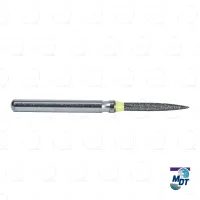
monosteryl® flame · 016f · 10
sterile, ready to usesingle useindividually wrapped
mdt’s flame diamond, iso shape 249, size 016 (1.6 mm), fine grit with a red ring, on a 21 mm fg long shank. monosteryl® is how mdt pack it: the same bur as their standard range, each one individually wrapped on a roll and gamma-sterilised, so it goes from the wrapper to the handpiece with nothing to clean or autoclave first.
this pack: mdt monosteryl® flame diamond bur, fg, iso 249 016, fine (red ring), 21 mm, sterile, single use (pack of 10, individually wrapped)
| shape | flame – iso 249 |
| also listed as | 862 – the number mdt’s catalogue gives beside iso 249 |
| head | 1.6 mm diameter (iso 016), 8.0 mm long |
| grit | fine – red ring |
| shank | fg long, 21 mm overall |
| pack | 10, individually wrapped on a roll |
| sterility | gamma irradiation; single use |
open the wrapper, fit the bur, use it, bin it. it arrives sterile, so there is no cleaning, bagging or autoclave cycle, and no used burs waiting to be reprocessed. every bur you pick up is a new one.
mdt’s catalogue sets their burs at 60% diamond exposure against 40% for others. mdt list the features as "stronger bonding", "larger exposure of each diamond crystal" and "uniform diamond coating, including the tips", and the benefits as "faster & cooler cutting/grinding" and "slower clogging due to higher exposure of diamonds".
› the head is a long flame – a head that swells, then tapers to a fine point, 8.0 mm long, diamond-coated over hardened stainless steel – mdt make each bur from a single piece.
› mdt say their “triton” coating process "more than doubles the strength of the diamond bonding to the tool", on "swiss-made heat treated and ground stainless steel shanks".
› mdt’s instructions list diamond burs for restorative work generally, "including but not limited to: removal of caries or old restorations, preparation of cavities for restoration, finishing of restorations, preparation of crowns".
› speed, from mdt’s instructions for a 1.6 mm head: 55,000–160,000 rpm recommended, never more than 450,000 rpm.
› keep the bur moving and do not press hard – mdt warn that excessive pressure and a stationary bur both generate heat.
no. monosteryl® is mdt’s packing, not a different bur. mdt pack sterile burs in a dedicated cleanroom and sterilise them by gamma irradiation; use them by the expiry date printed on the pack.
no. mdt label sterile burs single use and state they "should not be reused or re-processed". once used, it is discarded.
monosteryl® flame · iso 249 016f · fine, red ring · 21 mm · sterile, single use · pack of 10 · made by mdt micro diamond technologies, israel · ref mdt-249-016f-10

monosteryl® flame · 016m · 10
sterile, ready to usesingle useindividually wrapped
mdt’s flame diamond, iso shape 249, size 016 (1.6 mm), medium grit with a blue ring, on a 21 mm fg long shank. monosteryl® is how mdt pack it: the same bur as their standard range, each one individually wrapped on a roll and gamma-sterilised, so it goes from the wrapper to the handpiece with nothing to clean or autoclave first.
this pack: mdt monosteryl® flame diamond bur, fg, iso 249 016, medium (blue ring), 21 mm, sterile, single use (pack of 10, individually wrapped)
| shape | flame – iso 249 |
| also listed as | 862 – the number mdt’s catalogue gives beside iso 249 |
| head | 1.6 mm diameter (iso 016), 8.0 mm long |
| grit | medium – blue ring |
| shank | fg long, 21 mm overall |
| pack | 10, individually wrapped on a roll |
| sterility | gamma irradiation; single use |
open the wrapper, fit the bur, use it, bin it. it arrives sterile, so there is no cleaning, bagging or autoclave cycle, and no used burs waiting to be reprocessed. every bur you pick up is a new one.
mdt’s catalogue sets their burs at 60% diamond exposure against 40% for others. mdt list the features as "stronger bonding", "larger exposure of each diamond crystal" and "uniform diamond coating, including the tips", and the benefits as "faster & cooler cutting/grinding" and "slower clogging due to higher exposure of diamonds".
› the head is a long flame – a head that swells, then tapers to a fine point, 8.0 mm long, diamond-coated over hardened stainless steel – mdt make each bur from a single piece.
› mdt say their “triton” coating process "more than doubles the strength of the diamond bonding to the tool", on "swiss-made heat treated and ground stainless steel shanks".
› mdt’s instructions list diamond burs for restorative work generally, "including but not limited to: removal of caries or old restorations, preparation of cavities for restoration, finishing of restorations, preparation of crowns".
› speed, from mdt’s instructions for a 1.6 mm head: 55,000–160,000 rpm recommended, never more than 450,000 rpm.
› keep the bur moving and do not press hard – mdt warn that excessive pressure and a stationary bur both generate heat.
no. monosteryl® is mdt’s packing, not a different bur. mdt pack sterile burs in a dedicated cleanroom and sterilise them by gamma irradiation; use them by the expiry date printed on the pack.
no. mdt label sterile burs single use and state they "should not be reused or re-processed". once used, it is discarded.
monosteryl® flame · iso 249 016m · medium, blue ring · 21 mm · sterile, single use · pack of 10 · made by mdt micro diamond technologies, israel · ref mdt-249-016m-10

monosteryl® flame · 014xf · 10
sterile, ready to usesingle useindividually wrapped
mdt’s flame diamond, iso shape 250, size 014 (1.4 mm), extra fine grit with a yellow ring, on a 21 mm fg long shank. monosteryl® is how mdt pack it: the same bur as their standard range, each one individually wrapped on a roll and gamma-sterilised, so it goes from the wrapper to the handpiece with nothing to clean or autoclave first.
this pack: mdt monosteryl® flame diamond bur, fg, iso 250 014, extra fine (yellow ring), 21 mm, sterile, single use (pack of 10, individually wrapped)
| shape | flame – iso 250 |
| also listed as | 863 – the number mdt’s catalogue gives beside iso 250 |
| head | 1.4 mm diameter (iso 014), 10.0 mm long |
| grit | extra fine – yellow ring |
| shank | fg long, 21 mm overall |
| pack | 10, individually wrapped on a roll |
| sterility | gamma irradiation; single use |
open the wrapper, fit the bur, use it, bin it. it arrives sterile, so there is no cleaning, bagging or autoclave cycle, and no used burs waiting to be reprocessed. every bur you pick up is a new one.
mdt’s catalogue sets their burs at 60% diamond exposure against 40% for others. mdt list the features as "stronger bonding", "larger exposure of each diamond crystal" and "uniform diamond coating, including the tips", and the benefits as "faster & cooler cutting/grinding" and "slower clogging due to higher exposure of diamonds".
› the head is a long flame – a head that swells, then tapers to a fine point, 10.0 mm long, diamond-coated over hardened stainless steel – mdt make each bur from a single piece.
› mdt say their “triton” coating process "more than doubles the strength of the diamond bonding to the tool", on "swiss-made heat treated and ground stainless steel shanks".
› mdt’s instructions list diamond burs for restorative work generally, "including but not limited to: removal of caries or old restorations, preparation of cavities for restoration, finishing of restorations, preparation of crowns".
› speed, from mdt’s instructions for a 1.4 mm head: 70,000–220,000 rpm recommended, never more than 450,000 rpm.
› keep the bur moving and do not press hard – mdt warn that excessive pressure and a stationary bur both generate heat.
no. monosteryl® is mdt’s packing, not a different bur. mdt pack sterile burs in a dedicated cleanroom and sterilise them by gamma irradiation; use them by the expiry date printed on the pack.
no. mdt label sterile burs single use and state they "should not be reused or re-processed". once used, it is discarded.
| related shapes | flame 249 012f fine · flame 249 012m medium · flame 249 012uf ultra fine · flame 249 012xf extra fine |
monosteryl® flame · iso 250 014xf · extra fine, yellow ring · 21 mm · sterile, single use · pack of 10 · made by mdt micro diamond technologies, israel · ref mdt-250-014xf-10
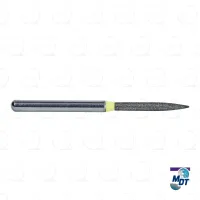
monosteryl® bud · 016uf · 10
sterile, ready to usesingle useindividually wrapped
mdt’s bud diamond, iso shape 257, size 016 (1.6 mm), ultra fine grit with a white ring, on a 19 mm fg standard shank. monosteryl® is how mdt pack it: the same bur as their standard range, each one individually wrapped on a roll and gamma-sterilised, so it goes from the wrapper to the handpiece with nothing to clean or autoclave first.
this pack: mdt monosteryl® bud diamond bur, fg, iso 257 016, ultra fine (white ring), 19 mm, sterile, single use (pack of 10, individually wrapped)
| shape | bud – iso 257 |
| also listed as | 368 – the number mdt’s catalogue gives beside iso 257 |
| head | 1.6 mm diameter (iso 016), 3.2 mm long |
| grit | ultra fine – white ring |
| shank | fg standard, 19 mm overall |
| pack | 10, individually wrapped on a roll |
| sterility | gamma irradiation; single use |
open the wrapper, fit the bur, use it, bin it. it arrives sterile, so there is no cleaning, bagging or autoclave cycle, and no used burs waiting to be reprocessed. every bur you pick up is a new one.
mdt’s catalogue sets their burs at 60% diamond exposure against 40% for others. mdt list the features as "stronger bonding", "larger exposure of each diamond crystal" and "uniform diamond coating, including the tips", and the benefits as "faster & cooler cutting/grinding" and "slower clogging due to higher exposure of diamonds".
› the head is a bud shape, widest in the middle (mdt’s catalogue calls it a football), 3.2 mm long, diamond-coated over hardened stainless steel – mdt make each bur from a single piece.
› mdt say their “triton” coating process "more than doubles the strength of the diamond bonding to the tool", on "swiss-made heat treated and ground stainless steel shanks".
› mdt’s instructions list diamond burs for restorative work generally, "including but not limited to: removal of caries or old restorations, preparation of cavities for restoration, finishing of restorations, preparation of crowns".
› speed, from mdt’s instructions for a 1.6 mm head: 55,000–160,000 rpm recommended, never more than 450,000 rpm.
› keep the bur moving and do not press hard – mdt warn that excessive pressure and a stationary bur both generate heat.
no. monosteryl® is mdt’s packing, not a different bur. mdt pack sterile burs in a dedicated cleanroom and sterilise them by gamma irradiation; use them by the expiry date printed on the pack.
no. mdt label sterile burs single use and state they "should not be reused or re-processed". once used, it is discarded.
| same shape | bud 023m medium · bud 023xf extra fine |
| related shapes | egg 021f fine · egg 023c coarse |
monosteryl® bud · iso 257 016uf · ultra fine, white ring · 19 mm · sterile, single use · pack of 10 · made by mdt micro diamond technologies, israel · ref mdt-257-016uf-10

monosteryl® bud · 023m · 10
sterile, ready to usesingle useindividually wrapped
mdt’s bud diamond, iso shape 257, size 023 (2.3 mm), medium grit with a blue ring, on a 19 mm fg standard shank. monosteryl® is how mdt pack it: the same bur as their standard range, each one individually wrapped on a roll and gamma-sterilised, so it goes from the wrapper to the handpiece with nothing to clean or autoclave first.
this pack: mdt monosteryl® bud diamond bur, fg, iso 257 023, medium (blue ring), 19 mm, sterile, single use (pack of 10, individually wrapped)
| shape | bud – iso 257 |
| also listed as | 368 – the number mdt’s catalogue gives beside iso 257 |
| head | 2.3 mm diameter (iso 023), 5.0 mm long |
| grit | medium – blue ring |
| shank | fg standard, 19 mm overall |
| pack | 10, individually wrapped on a roll |
| sterility | gamma irradiation; single use |
open the wrapper, fit the bur, use it, bin it. it arrives sterile, so there is no cleaning, bagging or autoclave cycle, and no used burs waiting to be reprocessed. every bur you pick up is a new one.
mdt’s catalogue sets their burs at 60% diamond exposure against 40% for others. mdt list the features as "stronger bonding", "larger exposure of each diamond crystal" and "uniform diamond coating, including the tips", and the benefits as "faster & cooler cutting/grinding" and "slower clogging due to higher exposure of diamonds".
› the head is a bud shape, widest in the middle (mdt’s catalogue calls it a football), 5.0 mm long, diamond-coated over hardened stainless steel – mdt make each bur from a single piece.
› mdt say their “triton” coating process "more than doubles the strength of the diamond bonding to the tool", on "swiss-made heat treated and ground stainless steel shanks".
› mdt’s instructions list diamond burs for restorative work generally, "including but not limited to: removal of caries or old restorations, preparation of cavities for restoration, finishing of restorations, preparation of crowns".
› speed, from mdt’s instructions for a 2.3 mm head: 40,000–120,000 rpm recommended, never more than 300,000 rpm.
› keep the bur moving and do not press hard – mdt warn that excessive pressure and a stationary bur both generate heat.
no. monosteryl® is mdt’s packing, not a different bur. mdt pack sterile burs in a dedicated cleanroom and sterilise them by gamma irradiation; use them by the expiry date printed on the pack.
no. mdt label sterile burs single use and state they "should not be reused or re-processed". once used, it is discarded.
| same shape | bud 016uf ultra fine · bud 023xf extra fine |
| related shapes | egg 021f fine · egg 023c coarse |
monosteryl® bud · iso 257 023m · medium, blue ring · 19 mm · sterile, single use · pack of 10 · made by mdt micro diamond technologies, israel · ref mdt-257-023m-10
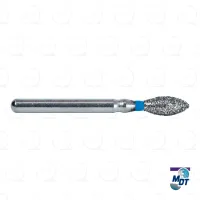
monosteryl® bud · 023xf · 10
sterile, ready to usesingle useindividually wrapped
mdt’s bud diamond, iso shape 257, size 023 (2.3 mm), extra fine grit with a yellow ring, on a 19 mm fg standard shank. monosteryl® is how mdt pack it: the same bur as their standard range, each one individually wrapped on a roll and gamma-sterilised, so it goes from the wrapper to the handpiece with nothing to clean or autoclave first.
this pack: mdt monosteryl® bud diamond bur, fg, iso 257 023, extra fine (yellow ring), 19 mm, sterile, single use (pack of 10, individually wrapped)
| shape | bud – iso 257 |
| also listed as | 368 – the number mdt’s catalogue gives beside iso 257 |
| head | 2.3 mm diameter (iso 023), 5.0 mm long |
| grit | extra fine – yellow ring |
| shank | fg standard, 19 mm overall |
| pack | 10, individually wrapped on a roll |
| sterility | gamma irradiation; single use |
open the wrapper, fit the bur, use it, bin it. it arrives sterile, so there is no cleaning, bagging or autoclave cycle, and no used burs waiting to be reprocessed. every bur you pick up is a new one.
mdt’s catalogue sets their burs at 60% diamond exposure against 40% for others. mdt list the features as "stronger bonding", "larger exposure of each diamond crystal" and "uniform diamond coating, including the tips", and the benefits as "faster & cooler cutting/grinding" and "slower clogging due to higher exposure of diamonds".
› the head is a bud shape, widest in the middle (mdt’s catalogue calls it a football), 5.0 mm long, diamond-coated over hardened stainless steel – mdt make each bur from a single piece.
› mdt say their “triton” coating process "more than doubles the strength of the diamond bonding to the tool", on "swiss-made heat treated and ground stainless steel shanks".
› mdt’s instructions list diamond burs for restorative work generally, "including but not limited to: removal of caries or old restorations, preparation of cavities for restoration, finishing of restorations, preparation of crowns".
› speed, from mdt’s instructions for a 2.3 mm head: 40,000–120,000 rpm recommended, never more than 300,000 rpm.
› keep the bur moving and do not press hard – mdt warn that excessive pressure and a stationary bur both generate heat.
no. monosteryl® is mdt’s packing, not a different bur. mdt pack sterile burs in a dedicated cleanroom and sterilise them by gamma irradiation; use them by the expiry date printed on the pack.
no. mdt label sterile burs single use and state they "should not be reused or re-processed". once used, it is discarded.
| same shape | bud 016uf ultra fine · bud 023m medium |
| related shapes | egg 021f fine · egg 023c coarse |
monosteryl® bud · iso 257 023xf · extra fine, yellow ring · 19 mm · sterile, single use · pack of 10 · made by mdt micro diamond technologies, israel · ref mdt-257-023xf-10
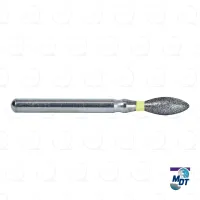
monosteryl® egg · 021f · 10
sterile, ready to usesingle useindividually wrapped
mdt’s egg diamond, iso shape 277, size 021 (2.1 mm), fine grit with a red ring, on a 19 mm fg standard shank. monosteryl® is how mdt pack it: the same bur as their standard range, each one individually wrapped on a roll and gamma-sterilised, so it goes from the wrapper to the handpiece with nothing to clean or autoclave first.
this pack: mdt monosteryl® egg diamond bur, fg, iso 277 021, fine (red ring), 19 mm, sterile, single use (pack of 10, individually wrapped)
| shape | egg – iso 277 |
| also listed as | 379 – the number mdt’s catalogue gives beside iso 277 |
| head | 2.1 mm diameter (iso 021), 4.1 mm long |
| grit | fine – red ring |
| shank | fg standard, 19 mm overall |
| pack | 10, individually wrapped on a roll |
| sterility | gamma irradiation; single use |
open the wrapper, fit the bur, use it, bin it. it arrives sterile, so there is no cleaning, bagging or autoclave cycle, and no used burs waiting to be reprocessed. every bur you pick up is a new one.
mdt’s catalogue sets their burs at 60% diamond exposure against 40% for others. mdt list the features as "stronger bonding", "larger exposure of each diamond crystal" and "uniform diamond coating, including the tips", and the benefits as "faster & cooler cutting/grinding" and "slower clogging due to higher exposure of diamonds".
› the head is an egg shape, 4.1 mm long, diamond-coated over hardened stainless steel – mdt make each bur from a single piece.
› mdt say their “triton” coating process "more than doubles the strength of the diamond bonding to the tool", on "swiss-made heat treated and ground stainless steel shanks".
› mdt’s instructions list diamond burs for restorative work generally, "including but not limited to: removal of caries or old restorations, preparation of cavities for restoration, finishing of restorations, preparation of crowns".
› speed, from mdt’s instructions for a 2.1 mm head: 40,000–120,000 rpm recommended, never more than 300,000 rpm.
› keep the bur moving and do not press hard – mdt warn that excessive pressure and a stationary bur both generate heat.
no. monosteryl® is mdt’s packing, not a different bur. mdt pack sterile burs in a dedicated cleanroom and sterilise them by gamma irradiation; use them by the expiry date printed on the pack.
no. mdt label sterile burs single use and state they "should not be reused or re-processed". once used, it is discarded.
| same shape | egg 023c coarse |
| related shapes | bud 016uf ultra fine · bud 023m medium · bud 023xf extra fine |
monosteryl® egg · iso 277 021f · fine, red ring · 19 mm · sterile, single use · pack of 10 · made by mdt micro diamond technologies, israel · ref mdt-277-021f-10

monosteryl® egg · 023c · 10
sterile, ready to usesingle useindividually wrapped
mdt’s egg diamond, iso shape 277, size 023 (2.3 mm), coarse grit with a green ring, on a 19 mm fg standard shank. monosteryl® is how mdt pack it: the same bur as their standard range, each one individually wrapped on a roll and gamma-sterilised, so it goes from the wrapper to the handpiece with nothing to clean or autoclave first.
this pack: mdt monosteryl® egg diamond bur, fg, iso 277 023, coarse (green ring), 19 mm, sterile, single use (pack of 10, individually wrapped)
| shape | egg – iso 277 |
| also listed as | 379 – the number mdt’s catalogue gives beside iso 277 |
| head | 2.3 mm diameter (iso 023), 4.5 mm long |
| grit | coarse – green ring |
| shank | fg standard, 19 mm overall |
| pack | 10, individually wrapped on a roll |
| sterility | gamma irradiation; single use |
open the wrapper, fit the bur, use it, bin it. it arrives sterile, so there is no cleaning, bagging or autoclave cycle, and no used burs waiting to be reprocessed. every bur you pick up is a new one.
mdt’s catalogue sets their burs at 60% diamond exposure against 40% for others. mdt list the features as "stronger bonding", "larger exposure of each diamond crystal" and "uniform diamond coating, including the tips", and the benefits as "faster & cooler cutting/grinding" and "slower clogging due to higher exposure of diamonds".
› the head is an egg shape, 4.5 mm long, diamond-coated over hardened stainless steel – mdt make each bur from a single piece.
› mdt say their “triton” coating process "more than doubles the strength of the diamond bonding to the tool", on "swiss-made heat treated and ground stainless steel shanks".
› mdt’s instructions list diamond burs for restorative work generally, "including but not limited to: removal of caries or old restorations, preparation of cavities for restoration, finishing of restorations, preparation of crowns".
› speed, from mdt’s instructions for a 2.3 mm head: 40,000–120,000 rpm recommended, never more than 300,000 rpm.
› keep the bur moving and do not press hard – mdt warn that excessive pressure and a stationary bur both generate heat.
no. monosteryl® is mdt’s packing, not a different bur. mdt pack sterile burs in a dedicated cleanroom and sterilise them by gamma irradiation; use them by the expiry date printed on the pack.
no. mdt label sterile burs single use and state they "should not be reused or re-processed". once used, it is discarded.
| same shape | egg 021f fine |
| related shapes | bud 016uf ultra fine · bud 023m medium · bud 023xf extra fine |
monosteryl® egg · iso 277 023c · coarse, green ring · 19 mm · sterile, single use · pack of 10 · made by mdt micro diamond technologies, israel · ref mdt-277-023c-10
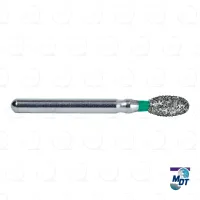
monosteryl® torpedo · 012m · 10
sterile, ready to usesingle useindividually wrapped
mdt’s torpedo diamond, iso shape 288, size 012 (1.2 mm), medium grit with a blue ring, on a 19 mm fg standard shank. monosteryl® is how mdt pack it: the same bur as their standard range, each one individually wrapped on a roll and gamma-sterilised, so it goes from the wrapper to the handpiece with nothing to clean or autoclave first.
this pack: mdt monosteryl® torpedo diamond bur, fg, iso 288 012, medium (blue ring), 19 mm, sterile, single use (pack of 10, individually wrapped)
| shape | torpedo – iso 288 |
| also listed as | 877 – the number mdt’s catalogue gives beside iso 288 |
| head | 1.2 mm diameter (iso 012), 6.0 mm long |
| grit | medium – blue ring |
| shank | fg standard, 19 mm overall |
| pack | 10, individually wrapped on a roll |
| sterility | gamma irradiation; single use |
open the wrapper, fit the bur, use it, bin it. it arrives sterile, so there is no cleaning, bagging or autoclave cycle, and no used burs waiting to be reprocessed. every bur you pick up is a new one.
mdt’s catalogue sets their burs at 60% diamond exposure against 40% for others. mdt list the features as "stronger bonding", "larger exposure of each diamond crystal" and "uniform diamond coating, including the tips", and the benefits as "faster & cooler cutting/grinding" and "slower clogging due to higher exposure of diamonds".
› the head is a torpedo shape, 6.0 mm long, diamond-coated over hardened stainless steel – mdt make each bur from a single piece.
› mdt say their “triton” coating process "more than doubles the strength of the diamond bonding to the tool", on "swiss-made heat treated and ground stainless steel shanks".
› mdt’s instructions list diamond burs for restorative work generally, "including but not limited to: removal of caries or old restorations, preparation of cavities for restoration, finishing of restorations, preparation of crowns".
› speed, from mdt’s instructions for a 1.2 mm head: 70,000–220,000 rpm recommended, never more than 450,000 rpm.
› keep the bur moving and do not press hard – mdt warn that excessive pressure and a stationary bur both generate heat.
no. monosteryl® is mdt’s packing, not a different bur. mdt pack sterile burs in a dedicated cleanroom and sterilise them by gamma irradiation; use them by the expiry date printed on the pack.
no. mdt label sterile burs single use and state they "should not be reused or re-processed". once used, it is discarded.
| related shapes | round end cylinder 141 012c coarse · round end cylinder 141 012f fine · round end cylinder 141 016c coarse · round end cylinder 141 016f fine |
monosteryl® torpedo · iso 288 012m · medium, blue ring · 19 mm · sterile, single use · pack of 10 · made by mdt micro diamond technologies, israel · ref mdt-288-012m-10
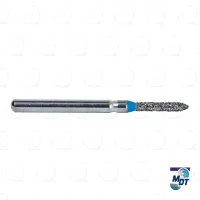
monosteryl® flame needle · 009m · 10
sterile, ready to usesingle useindividually wrapped
mdt’s flame needle diamond, iso shape 539, size 009 (0.9 mm), medium grit with a blue ring, on a 21 mm fg long shank. monosteryl® is how mdt pack it: the same bur as their standard range, each one individually wrapped on a roll and gamma-sterilised, so it goes from the wrapper to the handpiece with nothing to clean or autoclave first.
this pack: mdt monosteryl® flame needle diamond bur, fg, iso 539 009, medium (blue ring), 21 mm, sterile, single use (pack of 10, individually wrapped)
| shape | flame needle – iso 539 |
| also listed as | 883 – the number mdt’s catalogue gives beside iso 539 |
| head | 0.9 mm diameter (iso 009), 3.0 mm long |
| grit | medium – blue ring |
| shank | fg long, 21 mm overall |
| pack | 10, individually wrapped on a roll |
| sterility | gamma irradiation; single use |
open the wrapper, fit the bur, use it, bin it. it arrives sterile, so there is no cleaning, bagging or autoclave cycle, and no used burs waiting to be reprocessed. every bur you pick up is a new one.
mdt’s catalogue sets their burs at 60% diamond exposure against 40% for others. mdt list the features as "stronger bonding", "larger exposure of each diamond crystal" and "uniform diamond coating, including the tips", and the benefits as "faster & cooler cutting/grinding" and "slower clogging due to higher exposure of diamonds".
› the head is a slim flame drawn out to a needle point (mdt: flame needle, short head), 3.0 mm long, diamond-coated over hardened stainless steel – mdt make each bur from a single piece.
› mdt say their “triton” coating process "more than doubles the strength of the diamond bonding to the tool", on "swiss-made heat treated and ground stainless steel shanks".
› mdt’s instructions list diamond burs for restorative work generally, "including but not limited to: removal of caries or old restorations, preparation of cavities for restoration, finishing of restorations, preparation of crowns".
› speed, from mdt’s instructions for a 0.9 mm head: 100,000–220,000 rpm recommended, never more than 450,000 rpm.
› keep the bur moving and do not press hard – mdt warn that excessive pressure and a stationary bur both generate heat.
no. monosteryl® is mdt’s packing, not a different bur. mdt pack sterile burs in a dedicated cleanroom and sterilise them by gamma irradiation; use them by the expiry date printed on the pack.
no. mdt label sterile burs single use and state they "should not be reused or re-processed". once used, it is discarded.
| related shapes | flame 249 012f fine · flame 249 012m medium · flame 249 012uf ultra fine · flame 249 012xf extra fine |
monosteryl® flame needle · iso 539 009m · medium, blue ring · 21 mm · sterile, single use · pack of 10 · made by mdt micro diamond technologies, israel · ref mdt-539-009m-10

monosteryl® round edge taper · 021sf · 10
sterile, ready to usesingle useindividually wrapped
mdt’s round edge taper diamond, iso shape 544, size 021 (2.1 mm), fine grit with a red ring, on a 16 mm fg short shank. monosteryl® is how mdt pack it: the same bur as their standard range, each one individually wrapped on a roll and gamma-sterilised, so it goes from the wrapper to the handpiece with nothing to clean or autoclave first.
this pack: mdt monosteryl® round edge taper diamond bur, fg, iso 544 021, fine (red ring), 16 mm, sterile, single use (pack of 10, individually wrapped)
| shape | round edge taper – iso 544 |
| also listed as | 845kr – the number mdt’s catalogue gives beside iso 544 |
| head | 2.1 mm diameter (iso 021), 3.0 mm long |
| grit | fine – red ring |
| shank | fg short, 16 mm overall |
| pack | 10, individually wrapped on a roll |
| sterility | gamma irradiation; single use |
open the wrapper, fit the bur, use it, bin it. it arrives sterile, so there is no cleaning, bagging or autoclave cycle, and no used burs waiting to be reprocessed. every bur you pick up is a new one.
mdt’s catalogue sets their burs at 60% diamond exposure against 40% for others. mdt list the features as "stronger bonding", "larger exposure of each diamond crystal" and "uniform diamond coating, including the tips", and the benefits as "faster & cooler cutting/grinding" and "slower clogging due to higher exposure of diamonds".
› the head is a taper with a rounded edge at its end, 3.0 mm long, diamond-coated over hardened stainless steel – mdt make each bur from a single piece.
› mdt say their “triton” coating process "more than doubles the strength of the diamond bonding to the tool", on "swiss-made heat treated and ground stainless steel shanks".
› mdt’s instructions list diamond burs for restorative work generally, "including but not limited to: removal of caries or old restorations, preparation of cavities for restoration, finishing of restorations, preparation of crowns".
› speed, from mdt’s instructions for a 2.1 mm head: 40,000–120,000 rpm recommended, never more than 300,000 rpm.
› keep the bur moving and do not press hard – mdt warn that excessive pressure and a stationary bur both generate heat.
no. monosteryl® is mdt’s packing, not a different bur. mdt pack sterile burs in a dedicated cleanroom and sterilise them by gamma irradiation; use them by the expiry date printed on the pack.
no. mdt label sterile burs single use and state they "should not be reused or re-processed". once used, it is discarded.
| same shape | round edge taper 026sf fine |
| related shapes | round end taper 198 016m medium · round end taper 198 016xc extra coarse |
monosteryl® round edge taper · iso 544 021sf · fine, red ring · 16 mm · sterile, single use · pack of 10 · made by mdt micro diamond technologies, israel · ref mdt-544-021sf-10

monosteryl® round edge taper · 026sf · 10
sterile, ready to usesingle useindividually wrapped
mdt’s round edge taper diamond, iso shape 544, size 026 (2.6 mm), fine grit with a red ring, on a 16 mm fg short shank. monosteryl® is how mdt pack it: the same bur as their standard range, each one individually wrapped on a roll and gamma-sterilised, so it goes from the wrapper to the handpiece with nothing to clean or autoclave first.
this pack: mdt monosteryl® round edge taper diamond bur, fg, iso 544 026, fine (red ring), 16 mm, sterile, single use (pack of 10, individually wrapped)
| shape | round edge taper – iso 544 |
| also listed as | 845kr – the number mdt’s catalogue gives beside iso 544 |
| head | 2.6 mm diameter (iso 026), 4.0 mm long |
| grit | fine – red ring |
| shank | fg short, 16 mm overall |
| pack | 10, individually wrapped on a roll |
| sterility | gamma irradiation; single use |
open the wrapper, fit the bur, use it, bin it. it arrives sterile, so there is no cleaning, bagging or autoclave cycle, and no used burs waiting to be reprocessed. every bur you pick up is a new one.
mdt’s catalogue sets their burs at 60% diamond exposure against 40% for others. mdt list the features as "stronger bonding", "larger exposure of each diamond crystal" and "uniform diamond coating, including the tips", and the benefits as "faster & cooler cutting/grinding" and "slower clogging due to higher exposure of diamonds".
› the head is a taper with a rounded edge at its end, 4.0 mm long, diamond-coated over hardened stainless steel – mdt make each bur from a single piece.
› mdt say their “triton” coating process "more than doubles the strength of the diamond bonding to the tool", on "swiss-made heat treated and ground stainless steel shanks".
› mdt’s instructions list diamond burs for restorative work generally, "including but not limited to: removal of caries or old restorations, preparation of cavities for restoration, finishing of restorations, preparation of crowns".
› speed, from mdt’s instructions for a 2.6 mm head: 35,000–110,000 rpm recommended, never more than 160,000 rpm.
› keep the bur moving and do not press hard – mdt warn that excessive pressure and a stationary bur both generate heat.
no. monosteryl® is mdt’s packing, not a different bur. mdt pack sterile burs in a dedicated cleanroom and sterilise them by gamma irradiation; use them by the expiry date printed on the pack.
no. mdt label sterile burs single use and state they "should not be reused or re-processed". once used, it is discarded.
| same shape | round edge taper 021sf fine |
| related shapes | round end taper 198 016m medium · round end taper 198 016xc extra coarse |
monosteryl® round edge taper · iso 544 026sf · fine, red ring · 16 mm · sterile, single use · pack of 10 · made by mdt micro diamond technologies, israel · ref mdt-544-026sf-10

qed latex dam · medium · green · 36 sheets
rubber dam isolationendodonticsrestorative
everyday isolation, and no latex allergy on the medical history? qed latex dam is natural rubber latex from four d rubber: low protein, powder-free, green, medium gauge, cut to 152 mm squares, 36 to the box. for a patient or colleague with a latex allergy, reach for qed non-latex dam instead.
this pack: qed latex dental dam, medium gauge, 152 x 152 mm (6 x 6 in), green (pack of 36)
| material | natural rubber latex, low protein |
| protein | less than 50 micrograms per dm2 (four d rubber) |
| powder | powder-free |
| gauge | medium |
| sheet | 152 x 152 mm (6 x 6 in), green |
| supplied | 36 sheets |
› four d rubber make their latex dam from "low-protein material, specifically designed to minimise the risk of patient allergy", at less than 50 micrograms of protein per dm2.
› powder-free – four d rubber: "for greater patient comfort".
› green sheet, medium gauge, in 152 mm squares.
› four d rubber work to an iso 13485 quality system.
› contains natural rubber latex. low protein is not latex-free: not for patients or staff with a latex allergy – the non-latex sheets below are the alternative.
if latex is on the medical history, use non-latex. qed non-latex dam is synthetic polyisoprene from the same maker: medium, 40 sheets · medium, 20 sheets · heavy, 40 sheets.
| clamps | ksk clamp range · clamp stand |
| punch | ainsworth punch, silicone handle · ivory pattern punch |
| forceps | washington pattern clamp forceps |
| frame | young's rubber dam frame |
| stabilising cord | wedjets small · wedjets large · non-latex: small · large |
| sealing the margin | oraseal caulking · rubber-dam liquid |
qed latex dam · natural rubber latex, low protein, powder-free · medium · green · 152 x 152 mm · 36 sheets · made by four d rubber · ref qed4 ews020

qed non-latex dam · heavy · 40 sheets
rubber dam isolationlatex-freeendodonticsrestorative
latex on the medical history? a sheet that splits as it goes over the clamp? qed non-latex dam is made in the uk by four d rubber from synthetic polyisoprene, which four d describe as "a specifically synthesised version of the natural rubber molecule": it handles like rubber, without natural rubber latex. the same polyisoprene sheet as our medium dam, in the heavy gauge: 0.23–0.28 mm against the medium 0.18–0.23 mm.
this pack: qed non-latex dental dam, heavy gauge, 152 x 152 mm (6 x 6 in), light blue (pack of 40) · non-sterile, single use
| material | synthetic polyisoprene – not made with natural rubber latex |
| gauge | heavy, 0.23–0.28 mm |
| sheet | 152 x 152 mm (6 x 6 in), light blue, 100% non-toxic pigment |
| stretch | up to 1200% elongation; at least 1050% at break (four d rubber, iso 37) |
| tear strength | at least 20 n/mm (four d rubber specification) |
| supplied | 40 sheets · non-sterile, single use · low powdered |
› four d rubber on the stretch: "up to 1200% elongation that virtually eliminates tearing even with a punched dam."
› no natural rubber latex, so no latex proteins – the reason to keep it for patients or staff with a latex allergy.
› light blue sheet, coloured with what four d rubber specify as a 100% non-toxic pigment.
› four d rubber work to an iso 13485 quality system and make the sheet in the united kingdom.
› four d rubber: store in a cool, dry place.
four d rubber, a uk manufacturer of latex-free dental dam. this is their polyisoprene sheet, with the same properties, packed under the qed name.
the same material in two thicknesses: medium 0.18–0.23 mm and heavy 0.23–0.28 mm, both 152 mm square. which gauge suits the case is for the clinician. also in this range: medium, 40 sheets · medium, 20 sheets.
no. four d rubber supply it non-sterile and single use.
| clamps | ksk clamp range · clamp stand |
| punch | ainsworth punch, silicone handle · ivory pattern punch |
| forceps | washington pattern clamp forceps |
| frame | young's rubber dam frame |
| stabilising cord | wedjets non-latex small · wedjets non-latex large |
| sealing the margin | oraseal caulking · rubber-dam liquid |
qed non-latex dam · synthetic polyisoprene · heavy, 0.23–0.28 mm · 152 x 152 mm · light blue · 40 sheets · made in the uk by four d rubber · ref qed4 q120h

qed non-latex dam · medium · 40 sheets
rubber dam isolationlatex-freeendodonticsrestorative
latex on the medical history? a sheet that splits as it goes over the clamp? qed non-latex dam is made in the uk by four d rubber from synthetic polyisoprene, which four d describe as "a specifically synthesised version of the natural rubber molecule": it handles like rubber, without natural rubber latex. medium gauge, 40 sheets to the box.
this pack: qed non-latex dental dam, medium gauge, 152 x 152 mm (6 x 6 in), light blue (pack of 40) · non-sterile, single use
| material | synthetic polyisoprene – not made with natural rubber latex |
| gauge | medium, 0.18–0.23 mm |
| sheet | 152 x 152 mm (6 x 6 in), light blue, 100% non-toxic pigment |
| stretch | up to 1200% elongation; at least 1050% at break (four d rubber, iso 37) |
| tear strength | at least 20 n/mm (four d rubber specification) |
| supplied | 40 sheets · non-sterile, single use · low powdered |
› four d rubber on the stretch: "up to 1200% elongation that virtually eliminates tearing even with a punched dam."
› no natural rubber latex, so no latex proteins – the reason to keep it for patients or staff with a latex allergy.
› light blue sheet, coloured with what four d rubber specify as a 100% non-toxic pigment.
› four d rubber work to an iso 13485 quality system and make the sheet in the united kingdom.
› four d rubber: store in a cool, dry place.
four d rubber, a uk manufacturer of latex-free dental dam. this is their polyisoprene sheet, with the same properties, packed under the qed name.
the same material in two thicknesses: medium 0.18–0.23 mm and heavy 0.23–0.28 mm, both 152 mm square. which gauge suits the case is for the clinician. also in this range: medium, 20 sheets · heavy, 40 sheets.
no. four d rubber supply it non-sterile and single use.
| clamps | ksk clamp range · clamp stand |
| punch | ainsworth punch, silicone handle · ivory pattern punch |
| forceps | washington pattern clamp forceps |
| frame | young's rubber dam frame |
| stabilising cord | wedjets non-latex small · wedjets non-latex large |
| sealing the margin | oraseal caulking · rubber-dam liquid |
qed non-latex dam · synthetic polyisoprene · medium, 0.18–0.23 mm · 152 x 152 mm · light blue · 40 sheets · made in the uk by four d rubber · ref qed4 q120p

qed non-latex dam · medium · 20 sheets
rubber dam isolationlatex-freeendodonticsrestorative
latex on the medical history? a sheet that splits as it goes over the clamp? qed non-latex dam is made in the uk by four d rubber from synthetic polyisoprene, which four d describe as "a specifically synthesised version of the natural rubber molecule": it handles like rubber, without natural rubber latex. identical sheet to the 40 box, in half the quantity: a sensible way to try it, or to keep a latex-free stock alongside a latex dam for the patients who need it.
this pack: qed non-latex dental dam, medium gauge, 152 x 152 mm (6 x 6 in), light blue (pack of 20) · non-sterile, single use
| material | synthetic polyisoprene – not made with natural rubber latex |
| gauge | medium, 0.18–0.23 mm |
| sheet | 152 x 152 mm (6 x 6 in), light blue, 100% non-toxic pigment |
| stretch | up to 1200% elongation; at least 1050% at break (four d rubber, iso 37) |
| tear strength | at least 20 n/mm (four d rubber specification) |
| supplied | 20 sheets · non-sterile, single use · low powdered |
› four d rubber on the stretch: "up to 1200% elongation that virtually eliminates tearing even with a punched dam."
› no natural rubber latex, so no latex proteins – the reason to keep it for patients or staff with a latex allergy.
› light blue sheet, coloured with what four d rubber specify as a 100% non-toxic pigment.
› four d rubber work to an iso 13485 quality system and make the sheet in the united kingdom.
› four d rubber: store in a cool, dry place.
four d rubber, a uk manufacturer of latex-free dental dam. this is their polyisoprene sheet, with the same properties, packed under the qed name.
the same material in two thicknesses: medium 0.18–0.23 mm and heavy 0.23–0.28 mm, both 152 mm square. which gauge suits the case is for the clinician. also in this range: medium, 40 sheets · heavy, 40 sheets.
no. four d rubber supply it non-sterile and single use.
| clamps | ksk clamp range · clamp stand |
| punch | ainsworth punch, silicone handle · ivory pattern punch |
| forceps | washington pattern clamp forceps |
| frame | young's rubber dam frame |
| stabilising cord | wedjets non-latex small · wedjets non-latex large |
| sealing the margin | oraseal caulking · rubber-dam liquid |
qed non-latex dam · synthetic polyisoprene · medium, 0.18–0.23 mm · 152 x 152 mm · light blue · 20 sheets · made in the uk by four d rubber · ref qed4q120

special offer · adhesive included free
three order lines for one root-filled molar? files from one shelf, compules from another, and the adhesive that turns out to be empty at the wrong moment? this kit puts the back end of the appointment on one code – single-file shaping, a bulk fill build-up for the access cavity, and the adhesive that bonds one to the other, with the prime&bond active bottle free of charge while stocks last.
this kit: 5 × reciproc® blue r25 25 mm (30 files) · 2 × sdr® flow+ refill universal (30 compules) · 1 × prime&bond active® 4 ml, free of charge
made by vdw and dentsply sirona
| the free item | one 4 ml bottle of prime&bond active, the same standard refill sold on its own – while stocks last |
| what it covers | r25 single-file shaping at 25 mm, then a bulk fill base and core build-up cured 4 mm at a time |
| not included | paper points, cones and sealer – it shapes and restores, it does not obturate |
› shape, bond, rebuild – the part of the appointment that decides whether your obturation stays sealed.
› one caution carries through all three: the adhesive and the composite are both contraindicated alongside eugenol-containing materials, so a zoe sealer or an irm-type temporary changes the plan.
how does this differ from the standard kit?
by one bottle. files and compules are identical to the reciproc blue and sdr flow+ procedure kit; this code adds a 4 ml prime&bond active free while the offer runs.
is the composite the obturation material?
no. sdr flow+ is a restorative base and core build-up material – it fills the access cavity after obturation. the canal still needs cones, points and a sealer.
| dry | reciproc® paper points r25 · 144 – matched to the r25 preparation |
| fill | reciproc® blue gutta percha r25 · 60 – the cone that matches the file in this kit |
| top up | sdr® flow+ refill universal – when the compules run out first |
reciproc® blue, sdr® flow+ & prime&bond · 30 r25 25 mm files · 30 sdr flow+ compules · 4 ml adhesive free of charge · vdw and dentsply sirona · ref sp_b00rsdrr2ckit · while stocks last
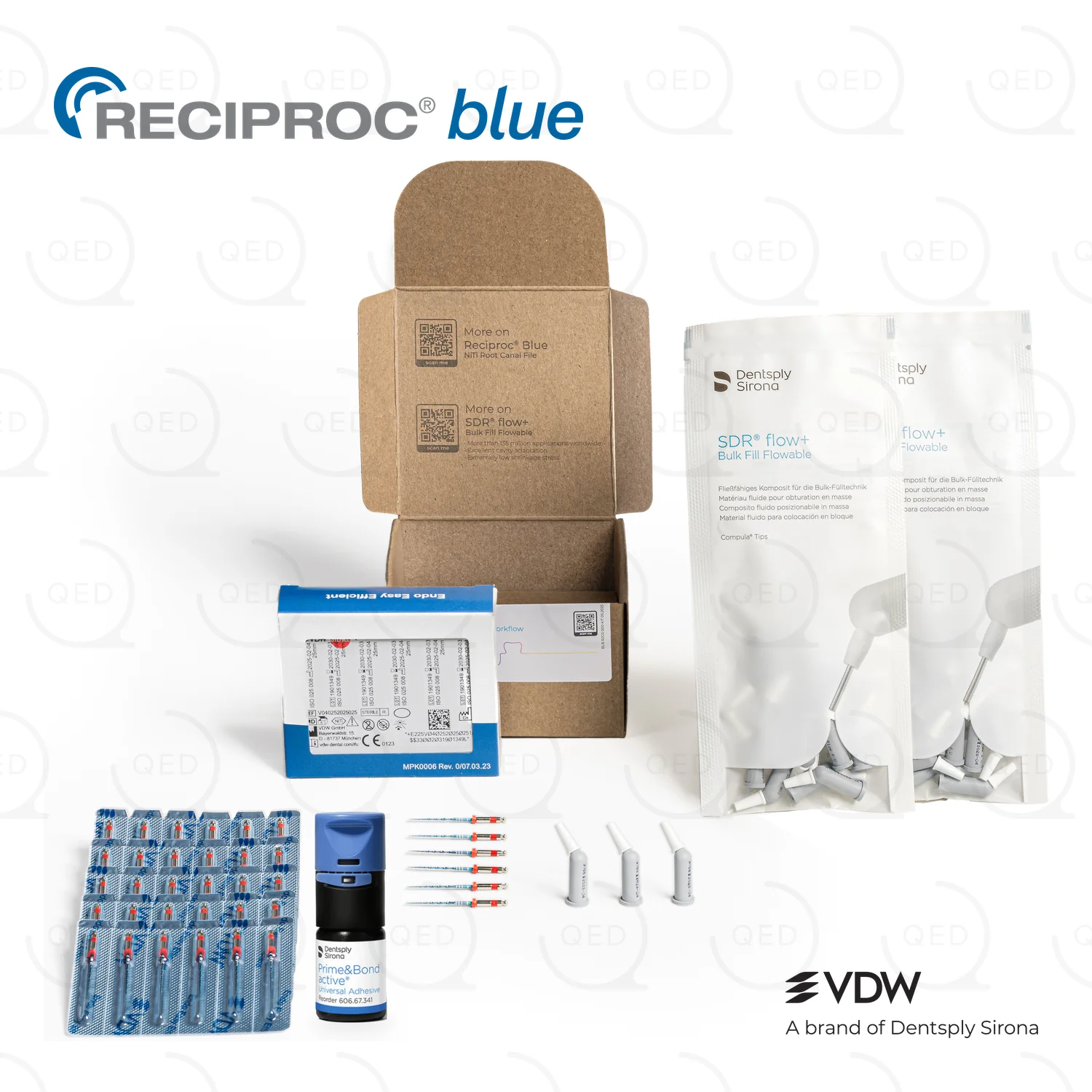
reciproc® system kit · 12 files · 25 mm
trying single-file endodontics usually means assembling six separate orders and hoping you picked the right sizes. this is the alternative: every instrument the system uses, the matched cones and points to fill what they cut, and a training model to learn the pecking motion on before it meets a patient. it is the order to place when the answer to "should we try reciproc®?" is "probably".
this kit: 12 sterile files at 25 mm – a blister of 6 × r25 and a blister of 3 × r40 with 3 × r50 · assorted reciproc® gutta-percha · assorted reciproc® paper points · training model · user card, brochure and directions for use
made by vdw, munich – genuine reciproc®
| one file per canal | the whole preparation with a single reciprocating instrument, and no initial hand filing in the majority of cases – the manufacturer's own qualifier, unchanged since 2011 |
| weighted 6 : 3 : 3 | six r25 because most canals take one, three r40 and three r50 for the wider ones and the apical enlargements |
| matched fill included | assorted cones and points, each corresponding to its instrument, so the first case is done in system from access to obturation |
| practise first | the training model lets you feel the three-peck cycle and the light pressure before it matters |
› the size is chosen, not stepped through. from the radiograph and one passive hand file – and in most cases it is r25.
› faster, and published. bürklein and colleagues (international endodontic journal, 2012) found preparation up to 60% faster than multiple-file systems, 73.1 seconds against 185.2, while maintaining the original canal curvature.
› sterile, single use, one molar per file. nothing to reprocess, and the plastic band on the shaft deforms in the autoclave so the decision is made for you.
what else do i need?
a drive system carrying the original vdw reciproc® settings, and a hand file for patency. we stock the vdw.silver® reciproc® with 6:1 contra-angle – the motor this system launched with – and the x-smart® pro+ with an integrated apex locator. the cordless x-smart® go carries a reciproc® programme too.
is this everything for a first case?
everything reciproc® makes, yes. you will still need your own irrigants, a sealer and a coronal restorative – all linked below.
and when the kit runs out?
every component is sold separately, in the same weighting: r25 six to a blister, the assorted blister of three r40 and three r50, and the assorted cones and points.
| patency, and the flutes | c-pilot® 010 and 008 in 25 mm · interim stand for cleaning between passes |
| irrigate | hypochlorite 5.25% or 2% · 17% edta · through irriflex® 30g or navitip™ 25 mm |
| seal | bioceramic neosealer® ezflo with 29 ga 25 mm tips · resin ah plus® or vdw's 2seal® |
| coronal seal | sdr® flow+ universal · 4 mm bulk increment over the orifices in one cure |
| more practice | vdw training teeth · upper right first molar, five per pack |
reciproc® system kit · 12 sterile files at 25 mm – 6 × r25, 3 × r40, 3 × r50 · assorted gutta-percha and paper points · training model · user card, brochure and directions for use · m-wire® niti, s-shaped cross-section, non-cutting tip, 11 mm shaft · single use, one molar per file · requires a motor with original reciproc® settings · vdw, munich · ref v041211025000
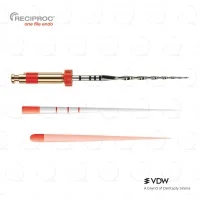


 Facebook
 X
 Instagram
 Pinterest
