

Best selection of Endodontic supplies in the UK


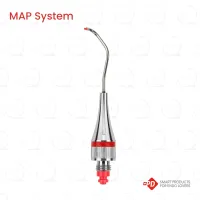
map system® · surgery left · n°1 · ø1.10 mm
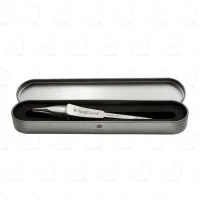
have you ever finished a retrograde fill on the wrong side of the mouth with your wrist somewhere it should not be? that is the case for owning the left-handed needle as well as the right. this is the wider left-hand surgery needle at ø1.10 mm – the one that completes a four-needle surgical set and lets the geometry, rather than your forearm, do the reaching.
this pack: 1 × surgery needle, left, n°1 red, ø1.10 mm, with 16 matching plungers
made by pd dental, switzerland
| approach | retrograde, in apical surgery – the triple-angle geometry pd build for it |
| handed | left, in the wider bore. the fourth needle of the full surgical set |
| bore | ø1.10 mm. there is no surgery n°2 – the range is n°0 and n°1 in each hand |
| reusable | validated by pd for 50 reprocessing cycles; the plunger inside is single-use |
› four needles, one syringe. right and left in both bores covers the arch; they all share the same handpiece and the same well.
› plan the plungers. a surgical list with several root ends will get through them quickly, and they are single-use whatever happens.
› no degree figures exist. pd describe the geometry as triple-angle and publish nothing more precise, so nor do we.
do i really need all four?
if you do apical surgery regularly, yes – and the surgical kit is the cheaper route to them than four separate codes. for occasional cases, one hand in the bore you use most is a reasonable start.
can a niti needle do this instead?
it can be bent towards a retrograde approach, but the surgery needles are the ones pd designed for it, and a fixed surgical geometry does not relax under load the way a bent one might.
| its pair | surgery needle right n°1 · ø1.10 mm |
| finer, same hand | surgery needle left n°0 · ø0.90 mm |
| the whole set | map surgical kit – four surgery needles, two niti, syringe and case |
| retrograde alternative | hooked needle n°1 – the other retrograde geometry |
map surgery needle left n°1 · red · ø1.10 mm · triple-angle, retrograde · autoclavable, 50 cycles · pd dental · ref 20228
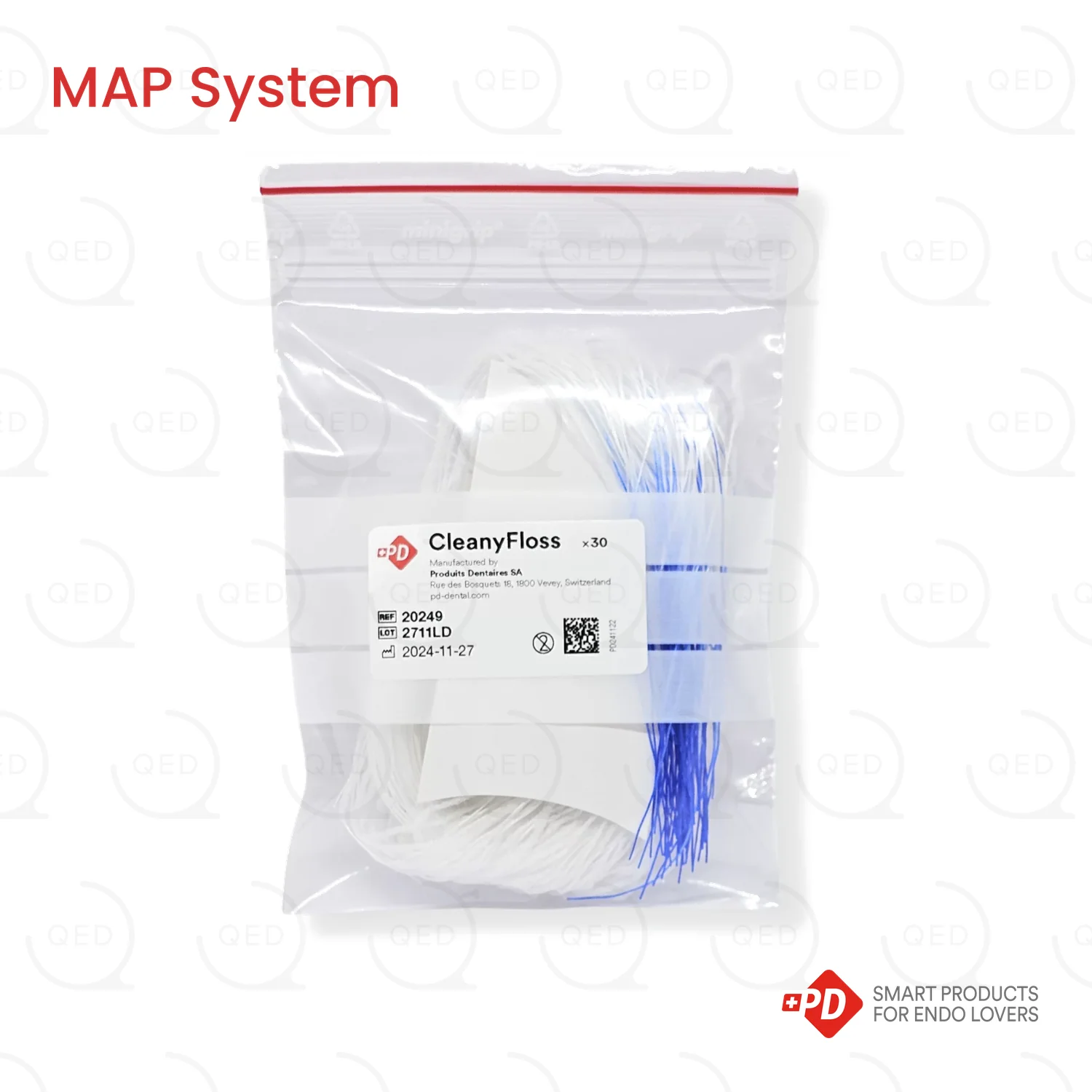
pd cleanyfloss · 30 threads · map needle cleaning
how does an expensive swiss needle become scrap? not by wear. by one operator putting it down at the end of a long appointment. pd validate their reusable components for fifty reprocessing cycles, but the whole of that depends on one step: clearing the lumen within fifteen minutes, with a stiffened thread. cleanyfloss is the thread pd name for it in the instructions for use.
this pack: 30 × threads with a threading aid
made by pd dental, switzerland
| its map job | the ifu says to clean inside the needle with a spongy, stiffened-end dental floss such as pd cleanyfloss |
| timing | within 15 minutes of use, after the plunger has been removed and discarded |
| not for vpt | the ø2.30 and ø3.40 mm vpt needles take the map cleaning brush instead |
| also sold as | an oral hygiene product – pd describe extra-fine nylon fleece threads with a threading aid, for braces, implants, bridges and wider interdental spaces |
› pd's warning, in their words: if the lumen is not cleaned in time it may be very difficult, if not impossible, to unblock and clean the device.
› cleaning is not sterilising. the thread clears the bore; the enzymatic soak, ultrasonic bath and autoclave come afterwards.
› keep it with the syringe, not in a hygiene drawer. a pack in the decontamination room is a pack nobody reaches for at the chairside.
does it have to be this thread?
pd's ifu names cleanyfloss or emoform triofloss. the requirement is a spongy, stiffened-end floss that will pass down the lumen – ordinary waxed floss will not thread and will not scour.
how long does a pack last?
thirty threads, one per needle per use. for most practices that is months; for a busy surgical list it is worth having two.
| for vpt bores | vpt cleaning brush – floss cannot fill a ø2.30 mm lumen |
| what it cleans | niti memory shape n°1 · classic curved n°1 |
| supplied in | map intro kit – which includes a pack |
| earlier kits used | cleaning curette n°1 – the superseded tool |
pd cleanyfloss · stiffened-end threads with a threading aid · named in pd's ifu for cleaning map needle lumens · 30 per pack · pd dental · ref 20249
capillary tips · 0.36 mm · 50 tips
four canals a tooth, several teeth a day, one tip each. same 0.36 mm capillary tip in the pack size that matches how quickly a single-use drying tip actually goes. they attach to the ultradent™ luer vacuum adapter, evacuate the canal directly, and – in ultradent's words – substantially minimise the use of paper points.
this pack: 50 × capillary tips, 0.36 mm with a 0.014" opening
made by ultradent, usa
| 50 per pack | the quantity for a practice drying several canals a day – better cost per tip than the 20 |
| 0.014" opening | 0.36 mm tip – fine enough to reach into the canal, not just the chamber |
| flexible taper | narrow and flexible, accessing curved canals without binding |
| evacuation only | never to be used to deliver irrigating materials or endodontic chemistries – ultradent's own instruction |
› attaches to the ultradent™ luer vacuum adapter for moisture removal from canals.
› pairs with navitip™ 29 ga open-end tips on the delivery side of the tray.
› single use – one tip per canal, discarded after; no published reprocessing protocol.
is this the same tip as the 20-pack?
yes – identical 0.36 mm tip with a 0.014" opening. the only difference is quantity; the 20-pack suits lower volumes.
does it replace paper points entirely?
no, and ultradent does not claim that – it substantially reduces how many you get through. finish with points as usual.
can i use it to deliver chemistry?
not endodontic chemistry – the manufacturer's warning is explicit: never use these tips to deliver irrigating materials or endodontic chemistries. ultradent does list chlorhexidine gel into peri-implant pockets as a delivery application, which sits outside that warning.
capillary tips · canal evacuation and drying · 0.36 mm with 0.014" opening · flexible taper · single use · 50 tips · ultradent · ref 3099 · also in 20
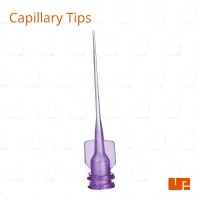
capillary tips · 0.36 mm · 20 tips
six points in and the canal is still damp? capillary tips attach to the ultradent™ luer vacuum adapter and evacuate the canal directly – ultradent states they substantially minimise the use of paper points. the narrow, flexible taper follows curvature instead of stopping at the first bend.
this pack: 20 × capillary tips, 0.36 mm with a 0.014" opening
made by ultradent, usa
| 0.014" opening | a 0.36 mm tip – fine enough to sit in the canal rather than hover over the access cavity |
| flexible taper | narrow and flexible, so it accesses curved canals rather than binding at the coronal third |
| fewer paper points | suction removes the bulk of the liquid; points finish the job instead of doing all of it |
| not for chemistry | ultradent is explicit: never use these to deliver irrigating materials or endodontic chemistries |
› attaches to the ultradent™ luer vacuum adapter for moisture removal from canals.
› where it fits the sequence – after final irrigation, before obturation; a couple of seconds per canal is enough to clear standing liquid.
› beyond the canal – ultradent also lists irrigation of peri-implant pockets with chlorhexidine gel delivered through a capillary tip. that is a periodontal application; the warning above still governs endodontic chemistries.
› for delivering endodontic chemistry – use a navitip™ 29 ga instead.
can i irrigate through them?
not with endodontic chemistry – ultradent warns against using capillary tips to deliver irrigants or endodontic chemistries, so deliver those through a navitip. they do list one delivery use of their own: chlorhexidine gel into peri-implant pockets, which is periodontal rather than endodontic.
twenty or fifty?
twenty for occasional endodontics. if you are drying multiple canals on most lists, the 50-tip pack is the better cost per tip.
single use?
yes – ultradent specifies single-use only and publishes no reprocessing protocol.
capillary tips · canal evacuation and drying · 0.36 mm with 0.014" opening · flexible taper · single use · 20 tips · ultradent · ref 341 · also in 50

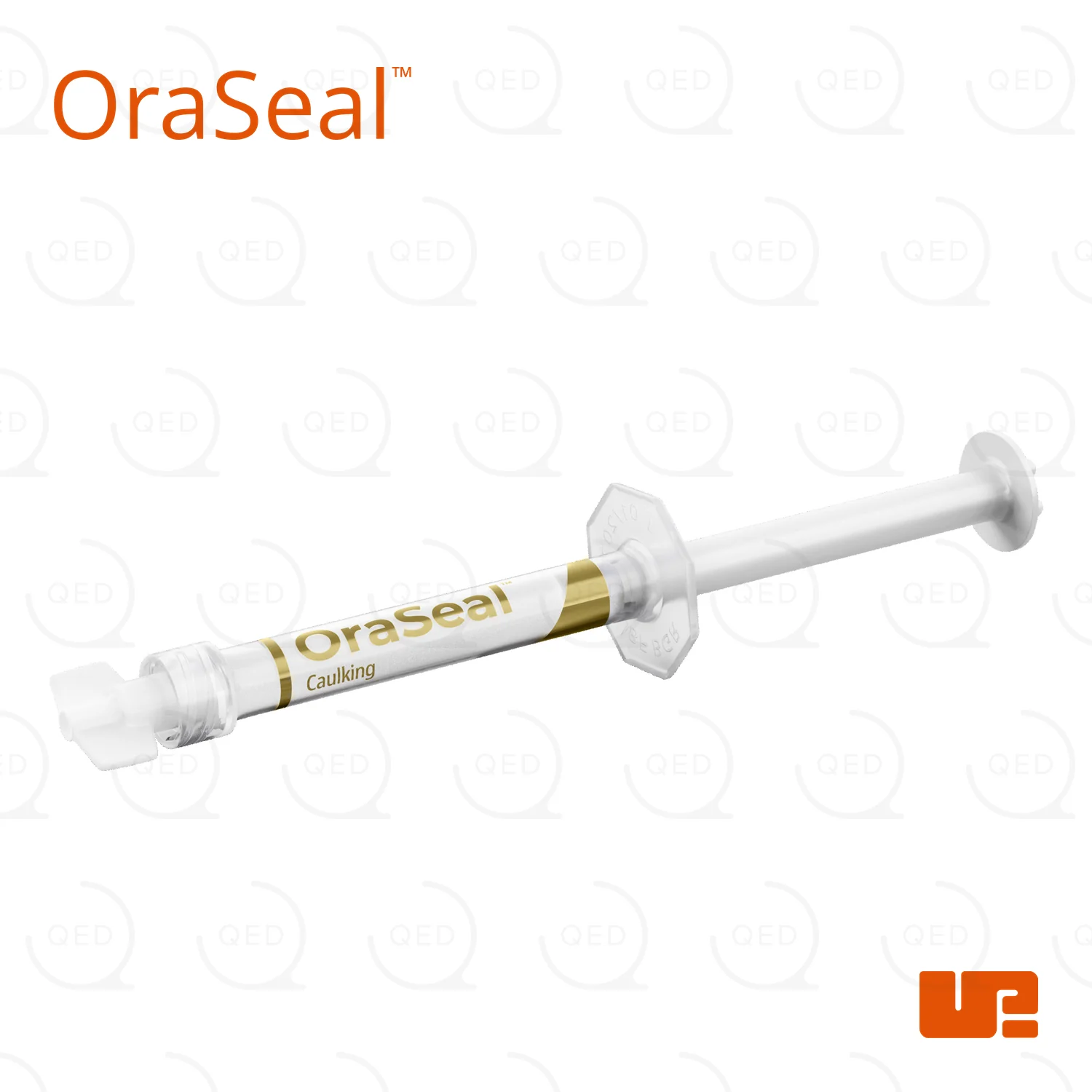
oraseal™ caulking · rubber dam seal
dam sealingendodontic isolationbleachingporcelain etchingimpression block-out
broken-down tooth? dam clamped but weeping at the margin? hypochlorite finding its way where it shouldn't? oraseal™ caulking is a cellulose-based, syringe-delivered sealing material that adheres to a wet rubber dam, to gingival and mucosal tissues and to teeth. ultradent states it functions under water and saliva – which is the entire point, because the field you need to seal is the one that will not stay dry.
| 4 syringes | 1.2 ml each | 5 indications |
this pack: 4 × 1.2 ml syringes of caulking
made by ultradent, usa
most sealing materials ask for a dry surface, which is a problem when the reason you need one is that the site is leaking. a subgingival margin on a broken-down molar will not dry, and neither will the gingival tissue around a poorly adapting dam. oraseal™ is cellulose-based rather than resin-based, so it adheres to wet dam, wet tissue and wet tooth and keeps functioning under water and saliva. it is placed and removed mechanically – nothing to cure, nothing to wait for, no extra instrument on an already crowded bracket table.
| works wet | adheres to a wet dam, tissue and tooth, and functions under water and saliva |
| flowable | the runnier of the two consistencies, so it finds its way into the leak rather than sitting on top of it |
| no curing step | placed and removed mechanically – no light cure, no waiting |
| cellulose-based | ultradent's instructions record no known contraindications for oraseal materials |
› sealing rubber dams to optimise tissue isolation.
› repairing dam leakage where adaptation is difficult during endodontic procedures.
› preventing peroxide seepage during power bleaching.
› blocking hydrofluoric acid exposure when etching porcelain intraorally.
› blocking undercuts when taking impressions around fixed bridgework and implant bars.
cellulose-based caulking and block-out materials that will adhere to a wet rubber dam, gingival and mucosal tissues, and teeth – and function under water and saliva.
— ultradent, oraseal instructions for use
1 test the flow first, outside the mouth, then fit a black mini™ or white mac™ tip – both can be trimmed to the diameter the job wants.
2 run it into the leak along the dam margin or tissue – it will adhere without drying the site first.
3 scrape away the excess afterwards and clean up with a wet toothbrush, floss or curette and a firm air/water rinse.
caulking or putty – which do i need?
caulking flows, so it is the one for sealing leaks and gingival margins. oraseal™ putty is stiffer and suits block-out work, undercuts and embrasures. if you want both on the shelf, the oraseal™ kit holds two syringes of each.
does it need light curing?
no. there is no cure step in ultradent's instructions – it is placed, it works, and it is scraped away afterwards. do not confuse it with a light-cured resin barrier, which behaves differently and is removed differently.
where should it not go?
not into extraction sites or deep pockets, and not in critical dimension areas. do not vacuum large volumes into the suction system.
how long does a pack last?
four 1.2 ml syringes go a long way when a typical repair is a bead along one margin. practices doing regular endodontics tend to reorder on the tips before the material.
is the syringe single use?
no – disinfect it between uses, and treat it as single use if a barrier sleeve is not available. the tips are single use.
| block-out | oraseal™ putty · 4 × 1.2 ml |
| both, one box | oraseal™ kit |
| fine tips | black mini™ · tub of 100 |
| angled tips, 20 | white mac™ · tub of 20 |
| angled tips, 100 | white mac™ · tub of 100 |
| isolation build-up | j-temp™ temporary resin |
oraseal™ caulking · cellulose-based dam sealer · flowable · no cure step · 4 × 1.2 ml syringes · ultradent, usa · ref 351 · also as putty and as a kit
oraseal™ kit · caulking + putty
some days the dam leaks; other days it's an undercut on an implant impression. the oraseal™ kit puts both viscosities in one box – the flowable caulking for sealing, the heavier putty for blocking out – so the decision happens chairside rather than at the next order.
this kit: 2 × 1.2 ml caulking · 2 × 1.2 ml putty
made by ultradent, usa
| two viscosities | flowable caulking for leaks and margins; heavier putty for undercuts, embrasures and screw holes |
| works wet | both adhere to wet dam, tissue and tooth, and function under water and saliva |
| no curing step | placed and removed mechanically – nothing to light cure, nothing to wait for |
| try before committing | the sensible first order if you have not used oraseal and do not yet know which consistency your hands prefer |
› across the practice – endodontic dam repair, isolation for bleaching, tissue protection during porcelain etching, and impression block-out for bridgework and implant bars.
› delivered through black mini™ or white mac™ tips, trimmable to the diameter you want.
› removal – scrape, then wet toothbrush, floss or curette and a firm air/water rinse.
which one will i actually use more?
in endodontic practice, caulking – it is the dam-leak fix. restorative and implant work leans on putty. once you know, the refills are 4 × caulking or 4 × putty.
is it light-cured?
no – there is no cure step in ultradent's instructions for either material.
where should it not go?
not into extraction sites or deep pockets, and not in critical dimension areas.
oraseal™ kit · cellulose-based caulking and block-out · no cure step · 2 × 1.2 ml caulking + 2 × 1.2 ml putty · ultradent · ref 352 · refills available in 4-packs

oraseal™ putty · block-out material
impression around an implant bar? undercuts filling with material you will spend ten minutes picking out? oraseal™ putty is the heavier-bodied member of the oraseal family – ultradent describes it as having the same adhesive qualities as the caulking material in a stiffer consistency, which is what you want when the job is to occupy a space and stay there.
this pack: 4 × 1.2 ml syringes of putty
made by ultradent, usa
| stiffer body | holds its shape in an undercut or embrasure instead of slumping into the field |
| same adhesion | the adhesive qualities of oraseal caulking – sticks to wet dam, tissue and tooth |
| block-out work | closes open spaces between gingiva and attachments when taking impressions around bars and clips |
| no curing step | syringe it in, take the impression, scrape it out – nothing to set and nothing to wait for |
› indicated for blocking undercuts during impressions with fixed bridgework and implant bars, filling gingival embrasures of splints and bridges, filling screw holes on implant impressions, and dam sealing where a firmer material suits.
› delivered through a white mac™ tip – the greater delivery angle earns its keep with the thicker material.
› not for extraction sites, deep pockets, or critical dimension areas.
putty or caulking?
putty for block-out, undercuts and anywhere the material must hold its shape. oraseal caulking flows, so it is the better repair for a leaking dam. plenty of practices keep both – the oraseal kit is the tidy way to do that.
will it distort my impression?
it is placed to block spaces before the impression material goes in, then removed afterwards by scraping and a firm air/water rinse. keep it out of critical dimension areas.
any contraindications?
ultradent's instructions record no known contraindications, but confirm the patient has no known allergies to treatment materials, as with anything you place.
oraseal™ putty · cellulose-based block-out material · heavier bodied · no cure step · 4 × 1.2 ml syringes · ultradent · ref 353 · also as caulking and as a kit

j-temp™ · radiopaque temporary resin
endo accesswalking bleachinlay and onlayimplant splintingbite ramps
multi-visit endodontics, and a temporary that has to survive four weeks and then come out cleanly? j-temp™ is a radiopaque, light-cured, flowable methacrylate resin. it is self-levelling, distinctly purple so it is never mistaken for tooth, and because it is radiopaque you can confirm on a film that every last piece has come out before you obturate.
| 10 s cure per layer | 4 indications | 4 × 1.2 ml syringes |
this pack: 4 × 1.2 ml j-temp™ syringes (4.8 ml) · 20 × black mini™ tips
made by ultradent, usa
a temporary that cannot be seen is a temporary you have to take on trust. fragments left in a chamber floor or a canal orifice compromise the seal you are about to place, and you will not spot them on a dry field alone. because j-temp™ is radiopaque, the same film that confirms your working length also confirms the chamber is clean – which is the difference between believing the access is clear and knowing it.
| radiopaque | visible under x-ray, so complete removal is verified rather than assumed |
| purple | ultradent's distinctive shade – easily differentiated from enamel and dentine, and a visible reminder to the patient that this is temporary |
| under 5% | the shrinkage rate ultradent publishes for the material |
| self-levelling | flowable body adapts to the preparation, then holds its place once cured |
› temporary restorations – endodontic access, the walking bleach technique, inlay and onlay temporaries, cusp build-ups.
› splinting between multiple implant copings when taking an impression.
› isolation structure – building a surface to clamp against, and a barrier against endodontic irrigants, alongside oraseal™ caulking.
› bite ramps and temporary occlusal build-ups during orthodontic treatment.
1 do not etch, do not bond. ultradent is explicit: no acid etch and no bonding agent before placing j-temp over the preparation.
2 build in 2–3 mm layers, curing each for 10 seconds with a light of at least 800 mw/cm2 in the 385–515 nm range.
3 finish with a 20-second cure. then check the occlusion as you would with any temporary.
the shade is light purple because we want just a subtle reminder to the patients that this is still just a temporary restoration.
— ultradent, on why j-temp is the colour it is
how does it come out?
with a bur or a hand instrument where it meets sound tooth structure. take a film if you want certainty that nothing is left in the chamber – that is what the radiopacity buys you.
do i really not etch first?
correct. ultradent's instructions say not to acid etch and not to place a bonding agent, and their own guidance is that no adhesive is required. treat it as a mechanically retained temporary, not a bonded restoration.
which tip do i dispense through?
a black mini™ tip – the opaque plastic is what stops a light-cured material setting in the nozzle between increments. twenty come in the pack; that tub of 100 is the refill.
will it survive four weeks between visits?
it is designed to be durable enough to stay in place, which is why it appears in ultradent's own endodontic access indication. if the interval is long, pair it with a dressing that lasts too – bio-c® temp is indicated for up to 30 days.
any contraindications?
yes – not for patients with a known sensitivity to acrylates or other resins. as with any resin, avoid skin contact with uncured material.
| its own tip | black mini™ tips · tub of 100 |
| dam sealing | oraseal™ caulking · 4 × 1.2 ml |
| both viscosities | oraseal™ kit |
| thick material tip | white mac™ tips · tub of 20 |
| long dressing | bio-c® temp – up to 30 days |
| routine dressing | opacal · 3 ml syringe |
› j-temp™ step-by-step guide (pdf, 0.8 mb, ultradent) – photographed sequences for all five uses, including the walking bleach and implant splinting techniques.
j-temp™ · radiopaque light-cured flowable temporary resin · methacrylate-based · purple · self-levelling · 4 × 1.2 ml syringes (4.8 ml) · 20 black mini™ tips · ultradent, usa · ref 4897
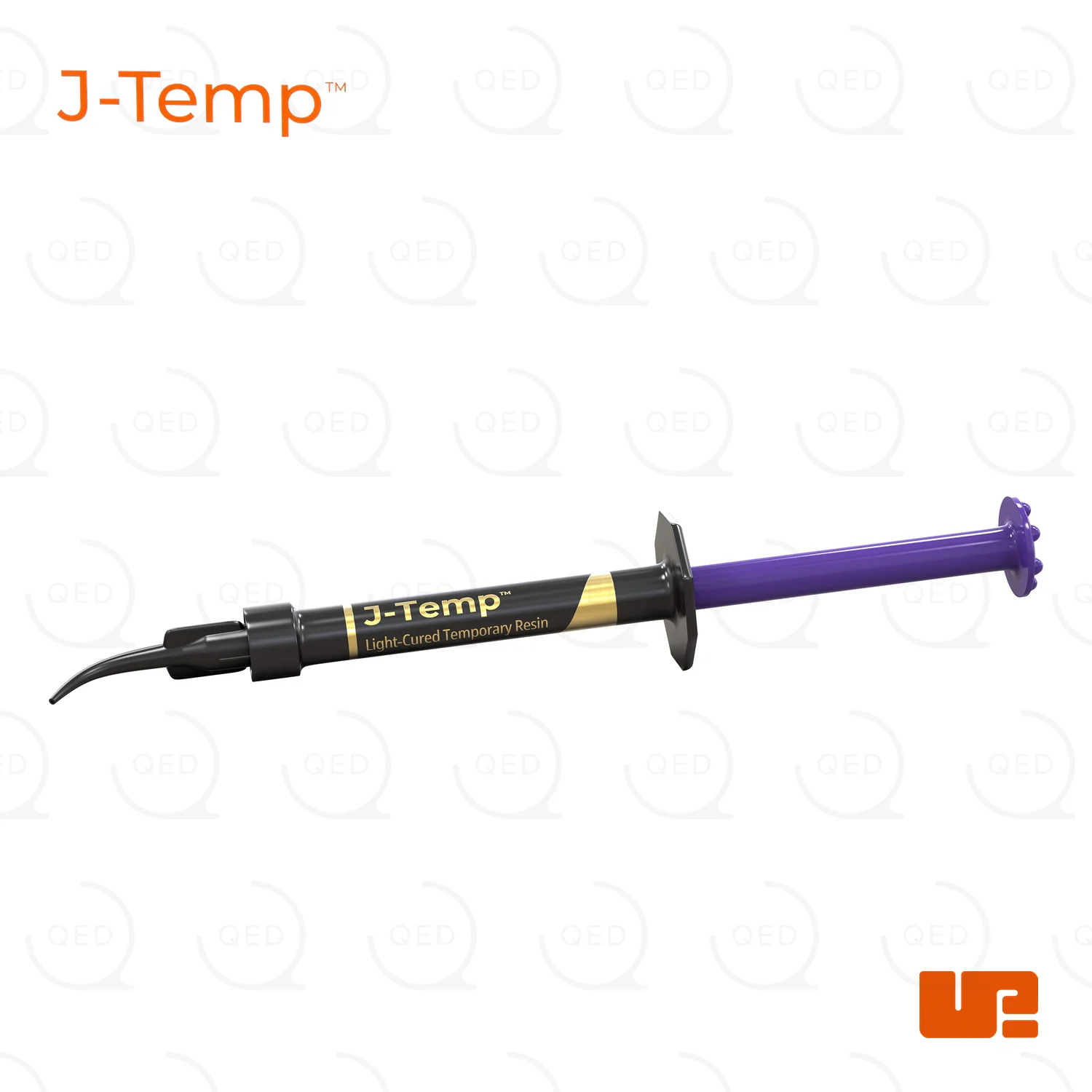
stropko™ irrigator · 2 inch · vista apex
microscope endodonticstroughinginstrument retrievalroot-end preparationdrying before obturation
you are at 16× magnification, troughing for a second mesiobuccal, and the field fills with dentinal dust. the standard three-in-one tip is not built for that moment: it throws a wide, hard stream that clears the debris and your view along with it. the stropko™ irrigator replaces that tip with a fine luer-lock hub, so the same syringe delivers a directed thread of air or water exactly where you are looking – at a pressure you have deliberately turned down.
| 4-7 psi, regulated | 1-3 psi, in canals | 80 autoclave cycles |
this pack: 1 × stropko™ irrigator, 2" · 1 × blue-flo™ tip · 1 × appli-vac™ bendable 20 ga · 1 × 22 ga · 1 × 25 ga
made by inter-med, inc. (vista apex), usa · vista ref 315260-2
› troughing for hidden canals. clearing dust from the pulpal floor a thread at a time, so the map you are following stays visible while you work.
› retrieving a separated instrument. the same controlled clearing, in the one procedure where losing sight of the fragment costs you the tooth.
› root-end preparation in surgery. cleaning and drying a retro-cavity under magnification, where a wide stream would flood the crypt.
› drying before obturation – what the technique card calls a "kiss of air" through the canal system before the cones go down.
› and outside endodontics: vista list restorative, periodontal, implant, surgical and orthodontic uses – air-thinning a deep resin is the one most people find next.
1 turn the pressure down first. a dental syringe normally runs at 30 to 50 psi. vista's ifu says regulate it to between 4 and 7 psi before the instrument goes anywhere near a patient.
2 remove the standard three-way tip and seat the stropko™ snugly in its place. on a press-ring handpiece, check it has locked.
3 screw the tip fully home into the luer-lock hub, so it cannot dislodge in use. tips must not extend back into the instrument past the hub.
4 for air-drying a canal, drop to 1 to 3 psi and use only notched or side-vented needles. this is vista's own instruction, stated without qualification, and it is the one to build into the setup rather than remember at the chairside.
when using for air-drying endodontic canals, reduce the air pressure to 1-3 psi and use only notched or side-vent needles.
— stropko™ irrigator instructions for use, vista apex
| length | 2 inches. the xl is 3.5 inches and is otherwise the same instrument |
| fits | most air/water syringes using a standard 3-way tip, including quick-connect types |
| takes | any luer-lock tip of 27 ga or larger. never a sharp injection needle, and never a tip finer than 27 ga |
| reprocessing | moist heat to iso 17665-1 at 132 or 134 °c for at least 3 minutes, 20 minutes drying. rated for 80 cycles |
| cleaning | neutral-ph detergents only, no abrasives, and do not disassemble it |
› the gauge limit rules out most endodontic irrigation needles. vista's ifu excludes anything finer than 27 ga, which means 29 ga and 30 ga irrigation tips are not for this instrument, however well they work on a syringe. check the gauge before you fit it.
› blunt tips only. no sharp, pointed, injection-type needles – the ones supplied are dead-soft and blunt-ended for a reason.
› one oddity worth knowing: the ifu says not to sterilise it in commercial wraps or pouches carrying sterilisation indicators, which does not sit comfortably with normal uk pouched practice. worth a word with your decontamination lead before it joins the tray.
straight answer: no published study of this instrument exists. dr john stropko is a real and well-cited endodontic clinician – his 1999 paper on maxillary molar canal morphology in the journal of endodontics is still quoted for its mb2 findings – but that is a study of anatomy, not of the device that carries his name, and it would be dishonest to present it as evidence. what the stropko™ has instead is twenty-odd years of use by clinicians working under magnification, and a design that does one obvious thing: it makes the stream small and the pressure low enough to be useful in a place you are looking at very closely.
will it fit my surgery's syringes?
vista say most air/water syringes that use a standard 3-way tip, quick-connect included. if yours is an older three-way, check the air and water buttons are secured – vista note that some older syringes need a retaining pin fitted so the buttons cannot pop out under a regulated supply.
can i use my usual 30 ga irrigation needles in it?
no. the ifu excludes tips finer than 27 ga. use 27 ga or larger, blunt-ended, and for drying a canal specifically, notched or side-vented.
standard or xl?
the only published difference is length – 2" against 3.5". vista do not say why you would pick one over the other, so the honest answer is reach and how you like to hold it, not performance.
| the tip in the box | blue-flo™ 23 ga soft plastic · 100 – or 20 |
| at the gauge limit | appli-vac™ irrigation needles 27 ga · 100 – the finest tip the ifu allows |
| bendable | mst visco-tip™ 25 ga bendable · 50 – shaped to the access you have |
| longer reach | stropko™ irrigator xl · 3.5" – the same instrument, longer |
| irrigate | chlorax 5.25% sodium hypochlorite · 5 × 200 ml |
| final rinse | endo-solution 17% edta · 200 ml |
| dry the canal | reciproc® paper points r25 · 144 – air is the last step, not the only one |
| isolate | oraseal™ caulking – a controlled field is the point of the whole exercise |
stropko™ irrigator · 2" · precise control of air and water · fits most 3-way syringes · luer-lock, 27 ga or larger · autoclavable, 80 cycles · supplied with 4 tips · vista apex · ref 911-030
real-t-endo™ · #14 with breakaway insert · upper left first molar
why is a bench access always easier than a clinical one? because on the bench nobody has to reach past the tooth in front, angle the handpiece under a cheek, or keep the bur off the adjacent contact. this is the real-t endo #14 supplied in a breakaway insert: the insert snaps straight into the maxillary left endo module, so the tooth sits in the arch with its neighbours and the approach angle is the one the student will meet clinically.
this item: 1 × real-t endo #14, upper left first molar (ul6), supplied in a breakaway insert
made by acadental, usa
| breakaway insert | a removable carrier that snaps into the maxillary left endo module – no mounting material needed |
| in the arch | the tooth sits with its neighbours, so access angle and adjacent contacts are part of the exercise |
| built for access | the same #14 designed around removing all pulp horns and straight-line access to every orifice |
| swap in seconds | the insert lifts out and the next one drops in – the point of a modular typodont |
› check your module generation first – acadental changed the modupro endo modules in 2026 and states the latest generation is not compatible with prior versions. inserts are module-specific; confirm which modules you own before ordering.
› the loose version – real-t endo #14 without the insert, for hand-held bench work.
› the module it goes in – the modupro endo kit supplies the maxillary and mandibular modules and the carrier tray.
is the insert worth the extra over a loose tooth?
if the exercise is access, yes – the difficulty of an upper left first molar is mostly about reach and angle, and a tooth held in your fingers removes both. if the exercise is shaping, a loose tooth is the cheaper choice.
will it radiograph?
acadental publishes the insert-mounted #14 in more than one specification, so confirm with us which version your order will ship before planning a radiography session around it. the loose real-t endo #14 is radiopaque throughout.
do i need mounting material?
no – that is the point of the insert. the fixing gel and apex putty in the modupro endo kit are for setting loose replica or natural teeth into a module.
| the module | modupro endo kit – carrier tray, both arches, mounting materials |
| replacements | modupro endo refill kit – modules and mounting materials |
| loose version | real-t endo #14 – radiopaque, no insert |
| find the length | x-smart pro+ with apex locator – used with the module's locator bars |
| shape it | waveone gold assorted – four sizes in one blister |
| seal it | neosealer flo – bioceramic sealer with flex flo tips |
real-t-endo™ #14 with insert · upper left first molar ul6 · breakaway insert, snaps into the endo module · check module generation · acadental · ref aca-rt_ae401wi_14rl

neosealer® flo · avalon biomed · 2.2 g kit, 20 tips
root canal obturationpremixedmoisture-setretreatablecone buttering
every clinician has stood there with a fourth paper point wondering how dry is dry enough. with a bioceramic that question changes shape. the instructions are explicit: dry the canal with paper points to remove pooled irrigants or body fluids – and then stop, because moisture from the dentinal tubules and apical tissues is what starts neosealer® flo setting. the residual moisture in the canal wall is not your enemy; it is part of the chemistry.
| 9.5 hrs setting time | 6 mm al radiopacity | 81% less tip waste |
this pack: 2.2 g neosealer® flo premixed bioceramic sealer · 20 × flex flo tips™
made by avalon biomed · 2-year shelf life, store at room temperature
“moisture is required for setting of the sealer, supplied by the dentinal tubules and apical tissues.”
avalon biomed, neosealer® flo frequently asked questions.
the instructions for use give about thirty minutes of working time at room temperature – long enough that a difficult four-canal molar is not a race, and long enough to stop and re-take a radiograph without the syringe going off on the bracket table. avalon put setting at around 9.5 hours in vivo, in the presence of canal moisture – a laboratory iso protocol will give you a longer figure, because it is not measuring the same thing. nothing is mixed, so nothing is mixed wrongly: the powder-to-liquid ratio that decides a conventional sealer's flow and film thickness was set at the factory.
| chemistry | premixed bioactive bioceramic – tricalcium and dicalcium silicate in an organic liquid |
| radiopacifier | tantalum oxide (tantalite), giving about 6 mm al equivalent. avalon state it does not cause staining |
| setting | begins in the presence of moisture from the surrounding tissues – no complete drying required |
| retreatment | conventional instrumentation – hand and rotary files and ultrasonic tips – per avalon's own guidance |
the kit ships with 20 flex flo tips™ at 25.5 gauge, the smallest diameter avalon recommend for this sealer. any 25.5 gauge or larger luer-lock tip fits, so you are not locked to one consumable – but the instructions warn that flo becomes difficult to dispense through finer tips.
two points of technique from the instructions, both easy to get wrong. do not insert the tip past the middle third of the canal, and do not force it until it seals against the canal walls – a wedged tip is how sealer gets expressed beyond the apex. apply gentle, steady pressure with a constant outward movement as the material goes in.
you can also skip the tip entirely: avalon confirm the sealer may be dispensed straight from the syringe for the traditional cone-buttering technique – coat the canal walls lightly first, then coat the dried gutta-percha points before insertion.
working in deliberately narrow preparations? a 25.5 gauge floor is the wrong tool for a canal shaped by a reduced-taper file. reach for neosealer® ezflo instead – same family, designed around a 29 gauge navitip™.
every bioceramic sealer leaves material stranded in the dispensing tip. you pay for it, you never place it, and it goes in the bin with the tip. avalon publish 81% less waste than conventional tips for the flex flo tip™ used with neosealer® flo – a minimal-waste barrel design rather than anything to do with the sealer chemistry.
| flex flo tip™ | 0.027 g left in the tip |
| basic flex tip™ | 0.087 g left in the tip |
those are avalon's own two tips, so you can do the arithmetic yourself and it is the honest version of the claim. across the twenty tips in this kit, the difference between them is about 1.2 g of sealer – more than half a second syringe. on a 2.2 g syringe, the tip you choose changes how many cases you get out of it more than anything else does.
one further line worth knowing, because it explains the occasional puzzling case: setting of tricalcium silicates is inhibited in acidic environments such as infected sites. the chemistry that makes a bioceramic work is the same chemistry that an active infection can slow down.
the 2.2 g kit is where almost everyone starts, and 20 tips is a sensible match to the sealer in the syringe. if bioceramic obturation is already routine, the 4.4 g kit with 40 tips and the 6.6 g kit with 60 tips bring the cost per gram down. if you already have tips in the drawer, the 2.2 g refill and the three-syringe pack leave the tips out – just remember to keep flex flo tips on the shelf, because a refill with nothing to dispense it through is an expensive paperweight.
| larger kits | 4.4 g with 40 tips · 6.6 g with 60 tips |
| refills | 2.2 g, no tips · three-syringe pack |
| tips | flex flo tip™ (40) · 25.5 ga, the one avalon recommend |
| wider bore | basic flex tip™ (40) · 25 ga, for generous preparations |
| narrow canals | neosealer® ezflo · 29 ga navitip™ delivery |
| repair material | neoputty® · neomta® 2 · same bioceramic family |
| sealer and putty | neosealer® flo & neoputty® kit · both in one box |
so do i still dry the canal?
yes – you remove the free irrigant and pooled fluid, because you are placing sealer, not swimming it. what you do not have to chase is bone-dry desiccation. avalon are explicit that complete drying is not needed and that moisture is what sets the material.
can i retreat a case sealed with this?
avalon say yes, using conventional instrumentation including hand and rotary files and ultrasonic tips. that is their published position; plan any retreatment on the case in front of you rather than on a general rule.
flo or ezflo?
bore size, mostly. flo's finest recommended tip is 25.5 ga; ezflo is built around a 29 ga navitip™. if you shape conservatively – reduced-taper single-file systems especially – ezflo reaches where flo's tip will not.
will it stain?
the instructions list “does not discolor teeth” among the material characteristics – tantalite rather than bismuth oxide as the radiopacifier. bismuth is the mechanism behind classic mta discolouration (marciano, duarte and camilleri, clin oral investig 2015).
before first clinical use: neosealer® flo is alkaline, as every tricalcium silicate material is. it is not for use where there is hypersensitivity to caustic solutions, or in a primary tooth that has a permanent successor. full warnings, precautions and handling guidance are in the instructions for use – ask us if you would like a copy before ordering.
neosealer® flo 2.2 gm kit · premixed bioceramic root canal sealer · tantalite radiopacifier · ~6 mm al · ~30 min working time · ~9.5 hr set · ~0.3% shrinkage · 20 flex flo tips™ 25.5 ga · 2-year shelf life · avalon biomed · ref ansfk

gutta-smart™ · dentsply sirona · cordless warm vertical kit
warm vertical obturationdown packbackfillcordless workingpulp vitality testing
warm vertical obturation takes two instruments: one to pack down, one to backfill. gutta-smart™ puts each half of the technique in its own cordless handpiece – pack for the down pack, flow for the backfill – charging and programmed on one touch-screen base station.
| 400°c pack, up to | 160°c flow, up to | 24 months, handpieces |
pack 100–400°c, flow 130–160°c; temperature ranges and handpiece warranty from dentsply sirona’s directions for use.
this pack: gutta-smart™ warm vertical obturation kit · flow handpiece · pack handpiece · base station with touch-screen · 20 and 23 gauge gutta-percha cartridges · small, medium and large electric heat pluggers · flow heater · cannula bending tool · power adapter with plug adapters · front-end sealing caps
dentsply sirona · made in the usa for maillefer instruments holding sàrl, ballaigues, switzerland
contents from dentsply sirona’s brochure and directions for use. the thermal response tip and 25 gauge cartridges are sold separately.
› two handpieces, two jobs. dentsply sirona: the pack handpiece heats electric heat pluggers “for warming and softening gutta-percha master cones and searing off gutta-percha cones”; the flow handpiece heats and extrudes gutta-percha into the canal.
› settings stored in the handpiece. programme temperature and tone for pack, temperature and flow rate (20–100%) for flow on the base station; the settings travel with the handpiece.
› a gutta-percha level indicator. the flow handpiece shows green, yellow and red as the cartridge empties, from the position of its push-rod.
› 360° activation ring on both. heat or extrude from any grip position.
› lithium iron phosphate battery. dentsply sirona put it at up to five procedures per day on a single charge; a full charge from very low takes at most 5 hours.
› a pulp tester in the same handpiece. fit the thermal response tip and set the pack handpiece to 90°c and it becomes a heat test for pulp vitality.
the argument dentsply sirona make for the system is material, not mechanical: “in both conform fit® master cones and gutta-smart™ cartridges, the gutta-percha formula flows at a lower temperature, requiring less heat from the handpieces.” they add that the two share the same gutta-percha for radiographic consistency, that the formulation is not made with natural rubber latex, and – from their internal testing – that heat transfers up to 4 mm beyond the heat source.
the practical upshot is a buying rule: pair the cartridges with the conform fit® master cones for the file system you shape with. we stock them for waveone® gold · trunatomy® · protaper gold® · protaper next® · protaper ultimate®.
1 down pack with the pack handpiece. plugger in contact with gutta-percha, cuff pressed to heat. never more than 4 seconds in the canal with a heated plugger, and never heated in air.
2 prepare the flow cartridge. bend the cannula with the bending tool so it reaches to within 5 mm of working length. heating to the set temperature takes about 90 seconds.
3 seat, then backfill. extrude a little and wipe the tip, then hold the heated cannula against the packed gutta-percha for 5 seconds.
4 let it back out. hold the handpiece lightly while expressing, so it can back out of the canal – excessive downward pressure can dislocate the cannula.
summarised from dentsply sirona’s gutta-smart™ directions for use. your clinical judgement governs the case; the directions govern the device.
resin or bioceramic is a real choice of technique rather than a ranking – we carry both because both are right in different hands. on a dentsply sirona system, ah plus® is the manufacturer’s own – the epoxy sealer every other one is measured against. if you work bioceramic, neosealer® ezflo comes premixed with fine 29-gauge navitip™ cannulas and is suitable for warm vertical obturation, continuous wave included. avalon biomed’s own instructions for use put it plainly:
optimized for both single cone and warm obturation techniques
avalon biomed, neosealer® ezflo instructions for use, ifu-128 rev 1 (2026). their faq adds that when heated it will maintain its consistency.
can i use another make of cartridge or plugger?
no. the directions are explicit: the device can only be used with dentsply sirona gutta-percha cartridges, flow heaters, electric heat pluggers and thermal response tips.
can a cartridge be used for a second patient?
no – single patient use, and never reheated. dentsply sirona warn that reheating can rupture the cartridge and permanently damage the handpiece, and treat it as misuse that voids the warranty.
what goes in the autoclave?
the pluggers, the thermal response tip and the flow heater – 132°c, before and after every treatment. the handpieces and base station are wiped only, with the front-end sealing caps fitted, and never autoclaved.
what does the warranty cover?
the pack and flow handpieces for 24 months. dentsply sirona treat the pluggers and cartridges as consumables, outside the warranty.
| cartridges | 20 gauge · 23 gauge · 25 gauge (10 per pack) |
| pluggers | small 40/.025 · medium 50/.05 · large 60/.06 |
| vitality testing | thermal response tip · not in the kit |
| master cones | conform fit® for waveone® gold · trunatomy® · protaper gold® · protaper next® · protaper ultimate® |
| sealer | ah plus® · ah plus jet® · neosealer® ezflo, 25 mm tips · 21 mm tips · ezflo is suitable for warm vertical and continuous wave · proroot® bio sealer |
| isolation | hysolate dental dam · mandatory, per the directions |
| coronal seal | sdr® flow+ refill, universal |
› gutta-smart™ + conform fit® brochure (pdf, 3.1 mb, dentsply sirona) – the system, the claims and every reference number.
› directions for use (dentsply sirona, 40 pp) – ask us and we will send the current copy.
before first clinical use: dentsply sirona record one contraindication – not for patients fitted with an implanted heart pacemaker or other electrical equipment who have been cautioned against small electrical appliances. gloves and a rubber dam are mandatory during treatment. do not stay in the canal with a heated electric heat plugger for more than 4 seconds. the device may only be used by trained and qualified dentists, and only with dentsply sirona cartridges, heaters, pluggers and tips. full warnings and reprocessing are in the directions for use.
gutta-smart™ warm vertical kit · pack handpiece 100–400°c, 90°c thermal response mode · flow handpiece 130–160°c, flow 20–100% · lifepo4 3.2 v, 1,500 mah · charger 100–240 v · class iia · 24-month handpiece warranty · dentsply sirona · ref b00gsiq000kit
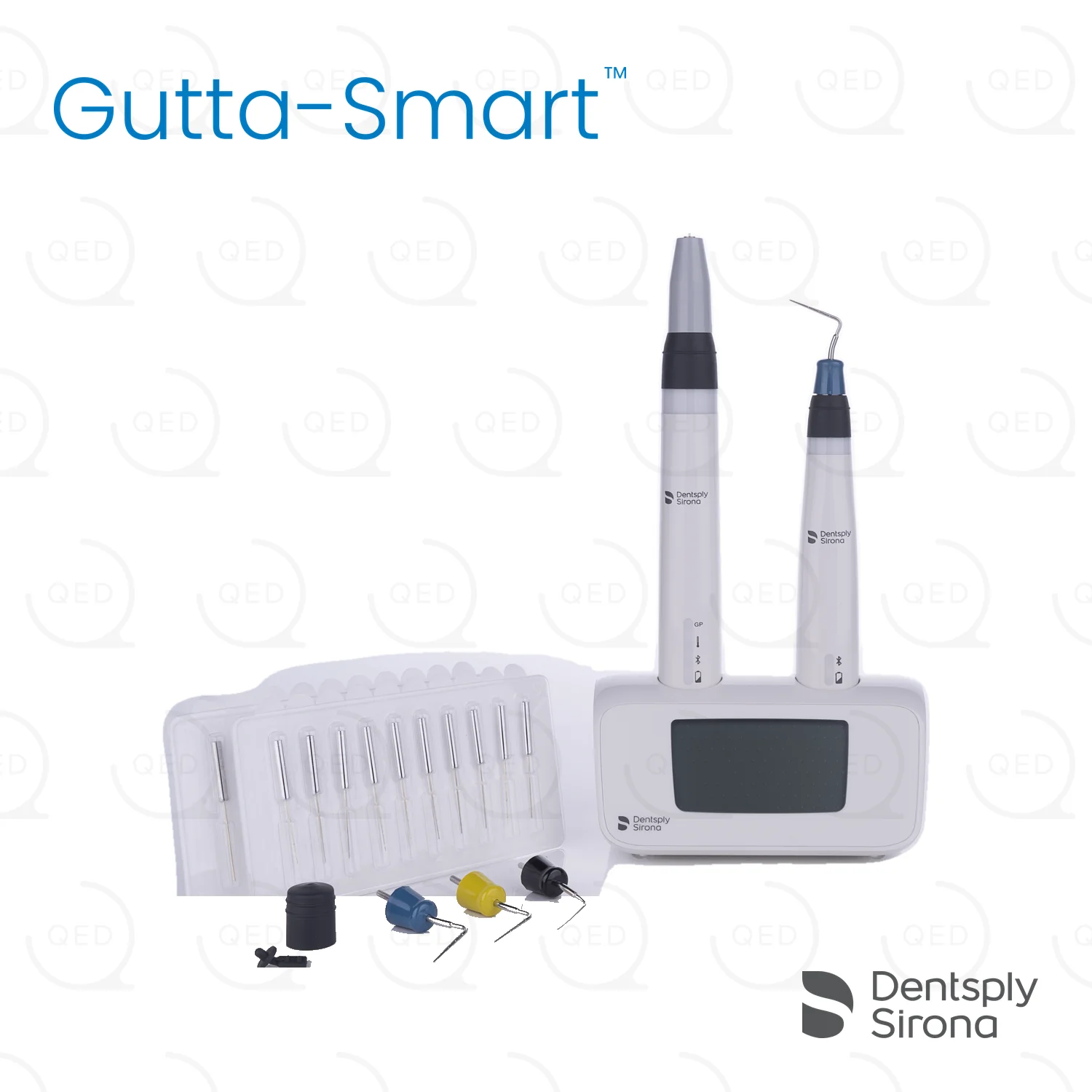
x-smart® go · dentsply sirona · cordless motor with apex locator
cordless workinglength while shapingreciprocating shapingrotary shapingmulti-surgery practicedifficult access
a corded motor decides where you stand; a separate apex locator decides when you stop. the x-smart® go removes both: 154 g of motor, screen and locator in one cordless handpiece, charging inductively on a power bank that doubles as the stand, with the canal reading on the same display as the torque bar.
| 6.0 ncm max torque | 2,500 rpm at the file | 154 grams in the hand |
in this box: motor handpiece · 6:1 contra-angle · power bank · charger with eur, uk, aus and usa/jap plug adapters · measurement cable · lip clips (2) · file clips (2) · f-type spray nozzle · protective silicone sleeves for the contra-angle (2) · disposable handpiece sleeves (10)
dentsply sirona · class iia medical device · 24-month warranty on handpiece and power bank
› cordless and genuinely light – 210 × 26 × 28 mm, 154 g with the head on, triangular so it stays where you put it.
› apex location in two modes – with a hand file before you start, or live on the same screen while the motor shapes.
› four embedded file libraries – waveone®, reciproc®, protaper ultimate® and trunatomy® – whose parameters are “set to the values recommended by the instrument manufacturer”, plus five rotary programs of your own.
› inductive charging on the power bank, which is also the stand: no socket on the handpiece, nothing to plug in at the chair.
› colour tft display, 360° head rotation and a dominant-hand setting that flips the interface, so the screen faces you in any quadrant.
› 24-month warranty on handpiece and power bank, on dentsply sirona's published terms.
dentsply sirona call it “our most powerful cordless endo motor”, at up to 6 ncm and 2,500 rpm. both figures are theirs and both are true, with one qualification worth having: the instructions publish the torque ceiling as a band that falls as speed rises, so 6 ncm is what you have at slow rotary and reciprocating speeds rather than at 2,500 rpm. that is the right way round for endodontics.
| 50–400 rpm | up to 6.0 ncm |
| 450–650 rpm | up to 5.0, then 4.0 ncm |
| 700–1,500 rpm | up to 3.0, then 2.0 ncm |
| 1,550–2,500 rpm | up to 1.5, then 1.0 ncm |
on battery life dentsply sirona's own figure is three days' use when the handpiece is worked alongside the power bank. the practical version: a flat power bank takes about three hours, a flat handpiece about three hours on it, and the motor does not run while it charges – so the habit that matters is parking it on the stand between cases rather than at the end of the day.
two ways to use it. separate length determination runs in al mode with the motor idle: lip clip on the patient, file clip on the metal shaft of a hand file, two beeps to confirm the circuit. combined length determination reads while you shape, and needs the protective silicone sleeve on the head plus the lip clip alone. at the apical limit the motor can do nothing, reverse, or stop; dr's choice puts your own reference line short of the foramen and alerts there instead.
“the bars indication on the x-smart® go endo motor screen does not represent a distinct length or distance in mm or other linear units. it simply indicates the file progression towards the apex.”
dentsply sirona, x-smart® go instructions for use, section 6.4.5.2
two more things the instructions are firm about, and both are worth knowing before you buy rather than after. radiographic confirmation is mandatory – the locator supplements the film, it does not replace it. and a rubber dam is highly recommended to improve the locator's efficiency, alongside care around metal crowns and bridges, and a canal wet enough to conduct.
ten memory programs: four embedded libraries, an apex-locator-only mode, and five you configure for rotary work. at the torque ceiling you choose torque release – reverse until the load drops, then carry on – or a straight reverse until you press the button.
| p1 · waveone® | waveone® gold primary 25mm · assorted |
| p2 · reciproc® | reciproc® blue r25 25mm · minima r25 for narrow canals |
| p3 · protaper ultimate® | protaper ultimate® sequence 25mm |
| p4 · trunatomy® | trunatomy® assorted 25mm |
| al · m1–m5 | apex locator without rotation, plus five rotary programs of your own |
1 fit the head, sleeve the handpiece. contra-angle in until it clicks; disposable sleeve over the body, checked for tears.
2 calibrate. always, after the head has been sterilised, lubricated or exchanged. file out of the chuck, head seated, seconds to run.
3 choose the program, connect for measurement. cable into the handpiece first, then the lip clip on the patient. two beeps mean the circuit is closed; no beeps means it is not, and the cable connection test says which part to change.
4 shape, then confirm on film. set the apical action you want – off, reverse or stop – and take the radiograph, which the instructions make mandatory.
worth understanding before it arrives. sterilisable: the contra-angle, its silicone sleeve, the lip clip and the file clip – 135°c for 10 minutes or 134°c for 3, class b or s, to a published maximum of 200 cycles each. wipe-disinfect only: the handpiece, power bank, measurement cable and charger. the head is lubricated after every use and before sterilisation through the f-type nozzle, then calibrated again.
| head | 6:1 contra-angle · silicone sleeve (2) |
| measuring | measurement cable · lip clip (5) · file clip (2) |
| power | charger with uk, eur, aus and usa/jap adapters |
| consumables | handpiece sleeves (500) · f-type spray nozzle |
| isolation | hysolate dam · clamp 26 · youngs frame · oraseal™ |
| hand files | c-pilot® 010 25mm · a metal shaft for the file clip |
| irrigants | chlorax 5.25% · endo-solution 17% edta |
| delivery, activation | navitip™ 29g 25mm · eddy® tips |
| sealers | neosealer® ezflo bioceramic · ah plus® epoxy · proroot® bio sealer |
| coronal seal | sdr® flow+ refill universal · 4 mm increment, one cure |
can i stop taking a working-length radiograph?
no. the instructions make radiographic confirmation mandatory, and note that apex locators may not work properly in all conditions. what changes is how much of the case you spend guessing between films.
go or x-smart® pro+?
different arguments, not better and worse. the pro+ is a bench unit – 7 in touchscreen, 7.5 ncm, 3,000 rpm, thirty custom sequences – and it suits one surgery where the motor lives on the same bracket table. the go puts the whole thing in the handpiece, which is the answer if you work across rooms or want nothing trailing from your hand.
what if the battery goes?
it is not a user-replaceable part – the instructions reserve lithium-ion battery replacement to trained service personnel. if a handpiece will not wake up after the power bank has been charged, come to us and we will start it.
is the warranty really 24 months on everything?
no, and it is worth knowing the tiers. dentsply sirona warrant the handpiece and power bank for 24 months, the contra-angle for 12, and the accessories – cable, charger, clips, sleeve and batteries – for 6.
how many spare consumables should i order with it?
the two that run out first are the handpiece sleeves – ten in the box, one per patient – and the lip clips, since two covers one case at a time. a second contra-angle is the day-one decision if you run back-to-back endodontic lists.
› x-smart® go brochure (pdf, 0.7 mb, dentsply sirona) – the motor, the claims and every accessory reference in the range.
› instructions for use (dentsply sirona, 54 pp) – ask us and we will send the current copy.
before first clinical use: the device is indicated for driving files in continuous rotation and reciprocating mode while monitoring the file tip in the canal. dentsply sirona record one contraindication: it is not recommended for use in patients who have a pacemaker or other implanted electrical devices. the instructions also ask that portable rf equipment stays at least 30 cm away, that only original accessories and the original contra-angle are used, and that the push-button is never pressed while the motor runs.
x-smart® go cordless motor with apex locator · 0.4–6.0 ncm · 50–2,500 rpm · 6:1 contra-angle, 360° adjustable, push-button chuck · ø 2.35 mm iso 1797-1 type 1 shank, file length to 46 mm · colour tft display · 3.6 v lithium-ion, 600 mah handpiece and 3,200 mah power bank, inductive charging · 154 g · waveone®, reciproc®, protaper ultimate® and trunatomy® libraries plus 5 user programs · class iia · dentsply sirona · ref b00xsgo000000

x-smart® go · dentsply sirona · 6:1 contra-angle
lubricate, pouch, sterilise, dry – the instructions ask for all of it after every single case. that is the maths behind a second contra-angle: with one head, a back-to-back endodontic list waits on the autoclave. this is the original 6:1 head for the x-smart® go, the only one dentsply sirona permit on the motor, and the one the apex locator reads through.
| 6:1 gear reduction | 200 sterilisation cycles | 360° head rotation |
this pack: x-smart® go 6:1 contra-angle · one head, push-button chuck, 360° rotation on the handpiece · ref b00xsgoac0006
dentsply sirona · class i medical device · steam-sterilisable, up to 200 cycles · 12-month warranty
| gear ratio | 6:1 reduction · 360° rotation, so the display faces you whatever the access |
| takes | ø 2.35 mm shank to iso 1797-1 type 1 · minimum fitting length 9.5 mm · file overall length up to 46 mm |
| chuck | push-button – press, seat the file, release, then pull to check it is locked |
| sterilisation | 135°c for 10 min, or 134°c for 3 min · maximum 200 cycles · washer-disinfector permitted |
› lubrication is not optional. dentsply sirona put it plainly: lubricating the contra-angle is mandatory after each use and before sterilisation, through the f-type spray nozzle.
› then recalibrate. “always calibrate the motor handpiece after the contra-angle has been sterilised, lubricated, or exchanged” – it takes seconds and it is what keeps the torque on screen and the torque at the file the same number.
› brush the awkward parts. the reprocessing table asks for manual brushing with a soft nylon, polypropylene or acrylic brush, particularly at the push-button, the chuck and the joints.
› a washer-disinfector is allowed for the head and its sleeve – the worked example is 65°c for 5 minutes cleaning and 90°c for 5 minutes disinfection, ao value above 3,000, to iso 15883. lubricate immediately afterwards.
› never press the push-button while the motor is running or coming to a stop – the instructions warn it will throw the file or overheat the button.
will a contra-angle from another motor fit?
no – the instructions say to use only the original contra-angle, and the head is part of how the motor calculates torque and how the apex locator reads through the file. this is that head.
do i need the silicone sleeve as well?
if you want length readings while you shape, yes. combined length determination only works with the protective silicone sleeve fitted over the head after sterilisation. two sleeves ship with the motor and they sterilise alongside it.
why is the warranty shorter than the motor's?
dentsply sirona warrant the handpiece and power bank for 24 months, the contra-angle for 12 and the accessories for 6. a head is a geared mechanism doing the work; the tiering is the manufacturer's own and it is worth knowing before you plan replacement.
| motor | x-smart® go cordless motor with apex locator |
| maintenance | f-type spray nozzle · silicone sleeve (2) |
| files it drives | waveone® gold primary 25mm · reciproc® minima r25 · trunatomy® assorted 25mm |
| barrier | handpiece sleeves (500) |
x-smart® go 6:1 contra-angle · 360° rotation · push-button chuck · ø 2.35 mm iso 1797-1 type 1 shank · class i · steam-sterilisable 135°c/10 min or 134°c/3 min · maximum 200 cycles · 12-month warranty · dentsply sirona · ref b00xsgoac0006
instruments · original endobender · jordco
anyone can put a curve in a file with pliers. putting it in the right place is the difficulty. bend too far up and the tip still points where it always did. jordco use two matched jaws – a concave upper against a rounded anvil below – so that closing them bends the file, in their own words, up to the very last flute. that is the part that has to change direction if the tip is to find an orifice the shaft cannot see.
this item: original endobender, designed by dr l. stephen buchanan, surgical stainless steel, reusable and fully autoclavable
made by jordco, inc.
| bends to the last flute | jordco’s claim for the matched jaws: the bend goes to the tip rather than stopping short of it |
| for small k-files | the ifu is specific: a #10 or #15 k-file, bent at an acute angle to help locate and negotiate an orifice. their worked example is the mb2 of a maxillary first molar |
| thumb on the paddle | not squeezed like ordinary pliers. the ifu has the thumb on the raised paddle and the fingers securing the lower member – which is what gives the control to place a bend precisely |
| steel, and autoclavable | stainless steel and reusable. pouched steam autoclave at 121°c for 30 minutes, or 132°c for 4 minutes pre-vacuum, after an enzymatic ultrasonic preclean |
› what it bends vdw c-pilot® 008 and c-pilot® 010, 25 mm – the small hand files this is made for.
› the other buchanan bender buchanan endobender 2 – same designer, made by plan b. we stock both and take no view.
› getting to the orifice long neck carbide bur 010 – the ln bur, for access and troughing.
› simpler alternative endo file pre-bender – a different approach to the same job.
why not just use pliers?
you can, and the bend lands wherever the jaws happen to grip – usually a few millimetres short of the tip. on a #10 file that difference is most of the point.
how is it reprocessed?
preclean before use and between patients – brush off visible soil, then an ultrasonic bath with an enzymatic detergent only, one minute soaking and five sonicating. then pouched steam autoclave: 121°c for at least 30 minutes, or 132°c for four minutes pre-vacuum. retire it if you see excessive wear or the hinge joint starting to degrade.
how does it differ from the endobender 2?
same designer, different manufacturer. we stock both and will not tell you one replaces the other – ring us and we will describe both.
› original endobender product sheet (pdf, 0.7 mb, jordco) – the gold series design, the bending anvil and the materials.
› original endobender instructions for use (pdf, 0.6 mb, jordco) – how the bend is made, plus pre-cleaning and autoclave processing.
original endobender by dr l. stephen buchanan · bends small k-files to the last flute · surgical stainless steel · autoclavable · jordco, inc. · ref bdeeb-s

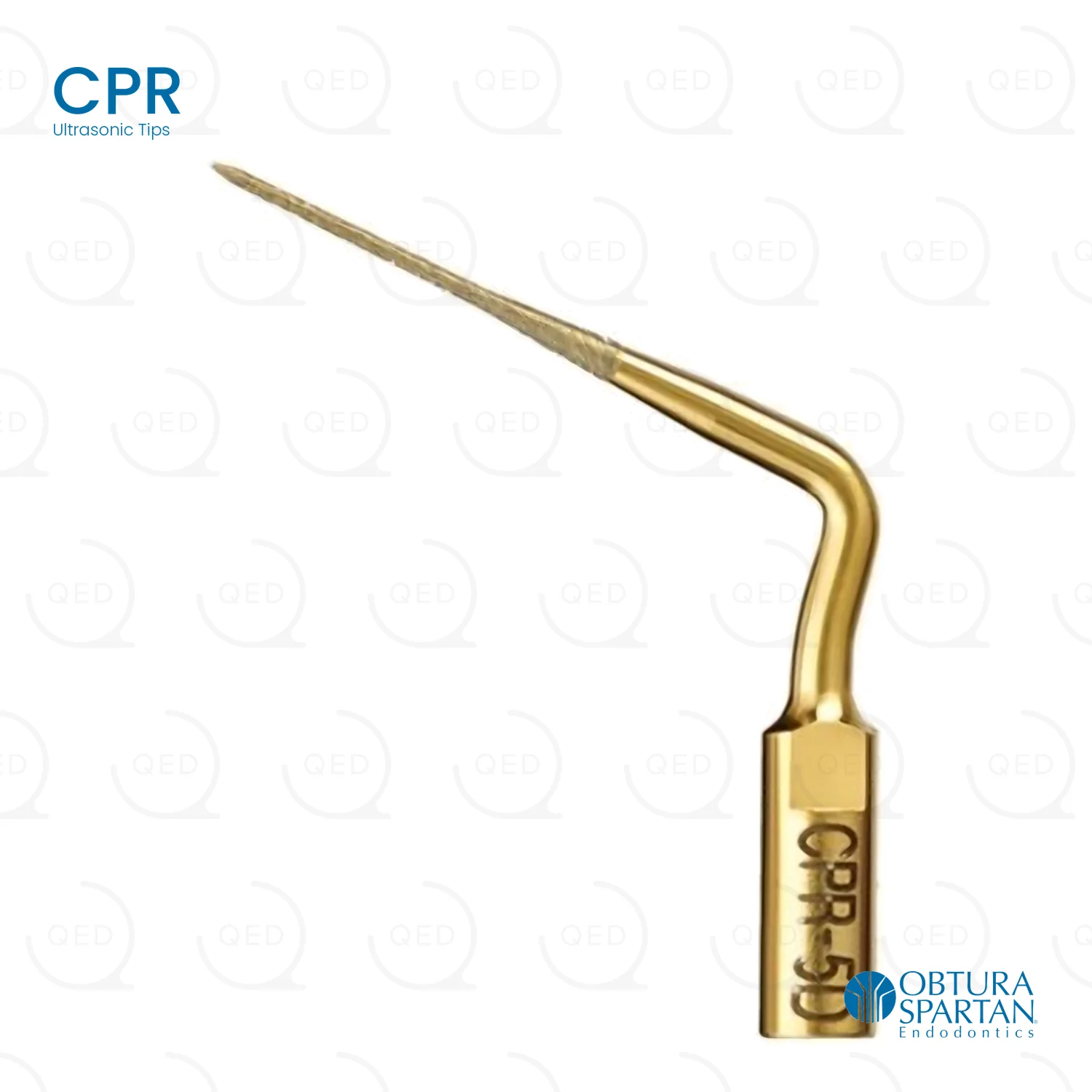
obtura spartan cpr® · 24.0 mm · standard thread
the reach for a long root, with an instruction attached. cpr 5 is the large problem solver: diamond coated, the longest taper of the three, 24.0 mm. obtura spartan carry one line on this tip that they carry on no other in the range – for use on low-intensity only. take that as written.
this pack: spartan cpr® 5d ultrasonic tip, the problem solver large, 24mm · single tip · reusable, steam sterilise before use
made by obtura spartan
| thread | the standard obtura spartan thread; the ems version is a separate code, cpr 5e. unsure what your handpiece takes? send us the make and model and we will check |
| diamond coated | obtura spartan list the d tips in this range as diamond coated. it is the coating doing the cutting, not the shank |
| power | one instruction obtura spartan carry on this tip and on no other in the range: for use on low-intensity only |
› other thread cpr 5e, the ems-threaded version – same tip, different handpiece.
› next along the range cpr 4d, 19.0 mm and cpr 6, 20.0 mm.
› you will want the wrench wrench for spartan tips, and the spartan tip stand to keep six tips out of a drawer.
why low intensity only?
obtura spartan state it and give no further explanation, so neither will we. it is the only tip in the cpr range carrying the instruction, and it is also the longest. how low is a question for your unit’s own manual.
| ultrasonic unit | acteon newtron® handpiece, newtron® p5 xs |
| access | long neck carbide burs 006-016 (6) |
| retreatment | cerkamed eucalyptus oil 10 ml, cerkamed btr pen set |
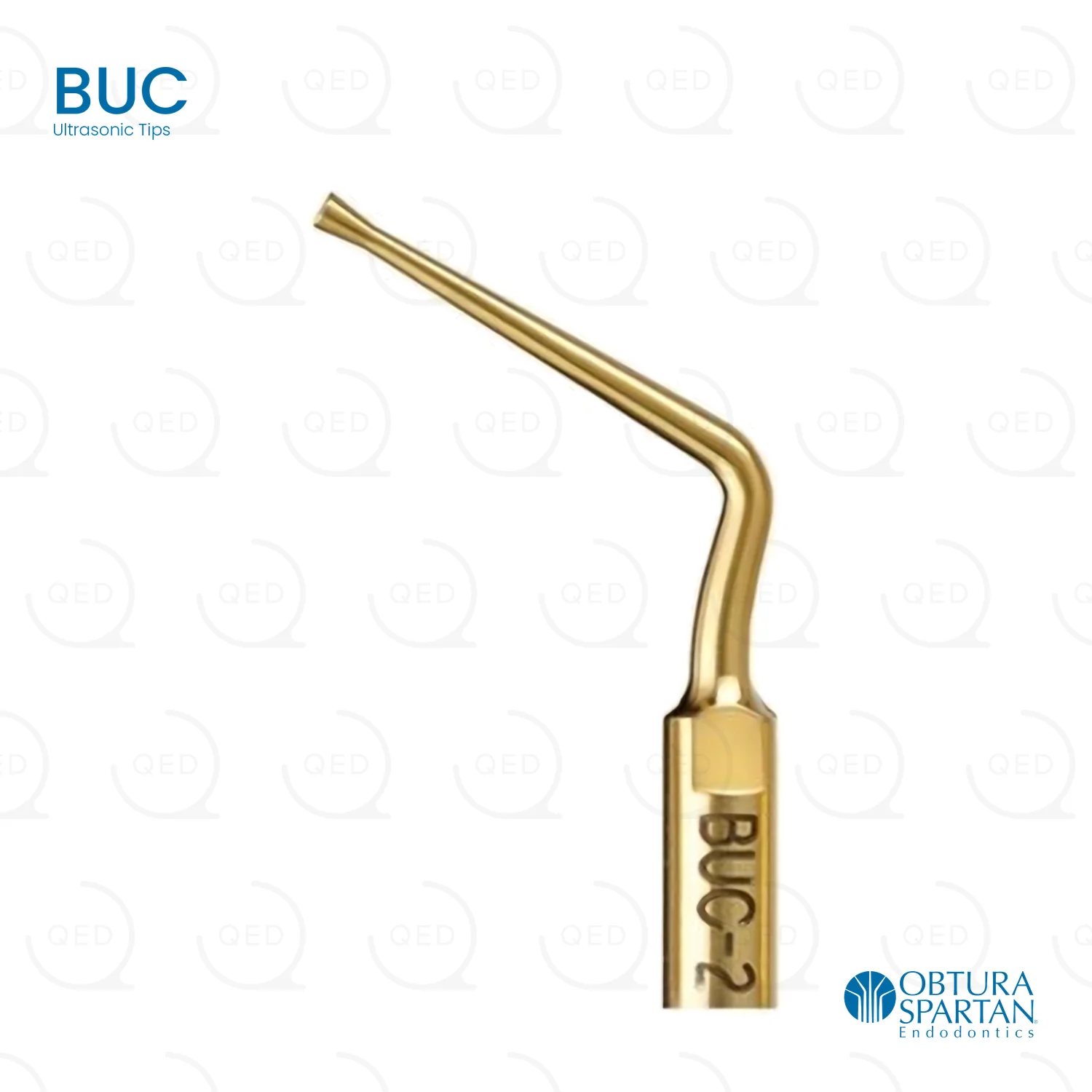
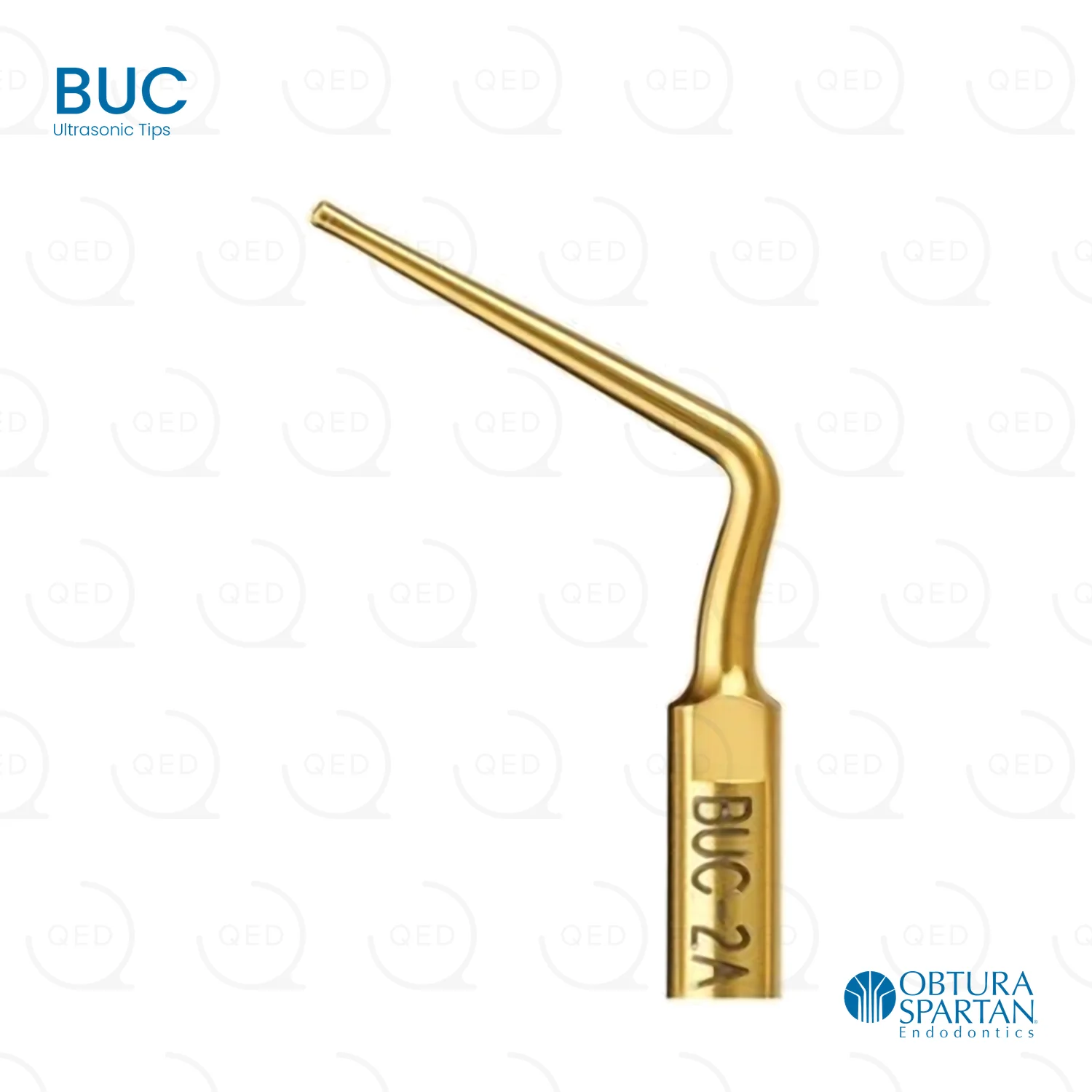
| other spartan tips | buc® 1 the cutter, kis® 1d the general |
obtura spartan cpr 5d · 24.0 mm · diamond coated · standard thread · single tip · ref cpr5
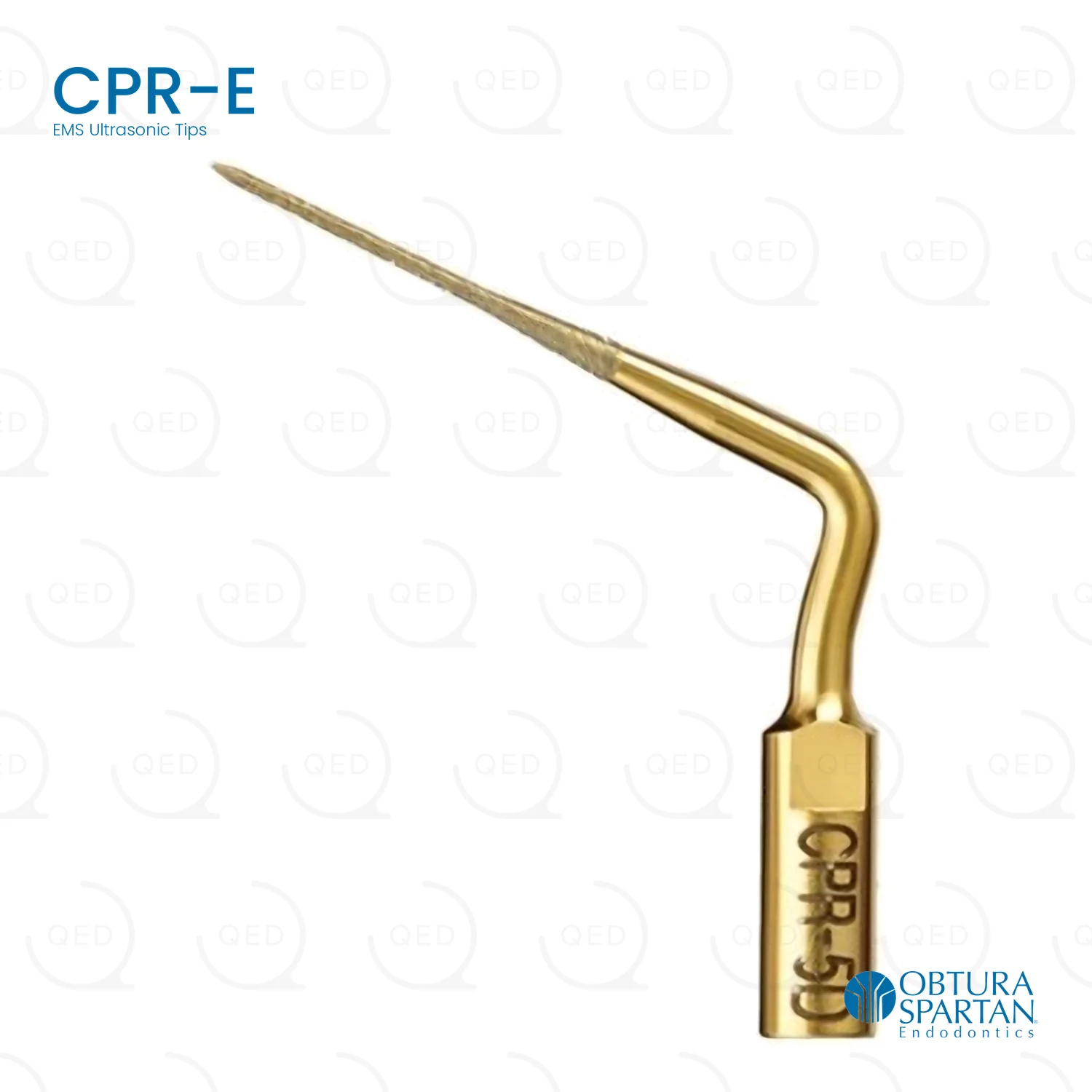
obtura spartan cpr® · 24.0 mm · ems thread
two codes, one tip. obtura spartan build every cpr tip in two threads and put an e on the end of the ems one: their own catalogue entry for this tip reads “ems threaded tip cpr 5e”. if your handpiece takes an ems-threaded tip, this is the code. if it does not, you want cpr 5d instead – the same tip, the other thread.
cpr 5 is the large problem solver: diamond coated, the longest taper of the three, 24.0 mm. obtura spartan carry one line on this tip that they carry on no other in the range – for use on low-intensity only. take that as written.
this pack: spartan cpr® 5 ultrasonic tip, the problem solver large, 24mm, ems fitting · single tip · reusable, steam sterilise before use
made by obtura spartan
| thread | ems – obtura spartan’s own name for this code is “ems threaded tip cpr 5e”. unsure what your handpiece takes? send us the make and model and we will check |
| diamond coated | obtura spartan list the d tips in this range as diamond coated. it is the coating doing the cutting, not the shank |
| power | one instruction obtura spartan carry on this tip and on no other in the range: for use on low-intensity only |
› next along the range cpr 4e, 19.0 mm and cpr 6e, 20.0 mm.
› you will want the wrench wrench for spartan tips, and the spartan tip stand to keep six tips out of a drawer.
why low intensity only?
obtura spartan state it and give no further explanation, so neither will we. it is the only tip in the cpr range carrying the instruction, and it is also the longest. how low is a question for your unit’s own manual.
| ultrasonic unit | acteon newtron® handpiece, newtron® p5 xs |
| access | long neck carbide burs 006-016 (6) |
| retreatment | cerkamed eucalyptus oil 10 ml, cerkamed btr pen set |
| other spartan tips | buc® 1 the cutter, kis® 1d the general |
obtura spartan cpr 5e · 24.0 mm · diamond coated · ems thread · single tip · ref cpr5e
ergoform · peek 210 °c · mirror handle
most plastic handles are a compromise you make at the autoclave. peek is not – hahnenkratt rate the ergoform peek to 210 °c, which covers hot air as well as steam, and describe the material as biocompatible, dimensionally stable and colourfast. it is the lightest way to put a good mirror in your hand, and at this price you can build out a full set of twelve without thinking about it.
this product: 1 × hahnenkratt ergoform mirror handle, peek plastic, ss thread · handle only, mirror cone sold separately
made by e. hahnenkratt gmbh, germany · mfr code 585
| peek, 210 °c | hahnenkratt's stated temperature resistance – enough for autoclave and hot air sterilisation both, rather than steam alone |
| implant-grade material | hahnenkratt describe peek as a biocompatible material also used for implants, and as dimensionally stable and colourfast |
| silk-matt surface | a micro-fine textured finish that hahnenkratt say prevents glare – the same reasoning as their satin and dlc metal handles, on a plastic body |
| shaped to grip | slim at the end, wider through the grip with recesses and rounded edges. hahnenkratt's claim is relaxed gripping over a long list |
› handle only – add the cones: ultravision no. 4 or no. 3, twelve to a pack.
› ss thread – takes any simple-stem hahnenkratt head, from the ø 14 mm no. 0 up.
› light, and it stays light – the argument for plastic over hollow stainless is fatigue over a four-hour list, not price.
› made in germany – hahnenkratt's own description of the range.
plastic or stainless?
plastic is lighter and warmer in the hand and costs a third as much, so it is the one to buy twelve of. stainless feels more substantial and is what most people want for the set they use on the difficult cases – ergotouch duo is the satin one, blackline ergotouch the matt black.
why does 210 °c matter if my autoclave runs at 134?
headroom. a handle rated well above the cycle it sees does not creep, chalk or discolour the way one sitting at its limit does – which is the practical reason hahnenkratt call out dimensional stability and colourfastness.
is there a version with no join at all?
yes. relax fs ultra is moulded in one piece, handle and mirror together, so there is nothing to unscrew and nothing to reassemble.
hahnenkratt ergoform peek · mirror handle · peek plastic · 210 °c · silk-matt surface · grip recesses · ss thread · handle only · germany · mfr code 585

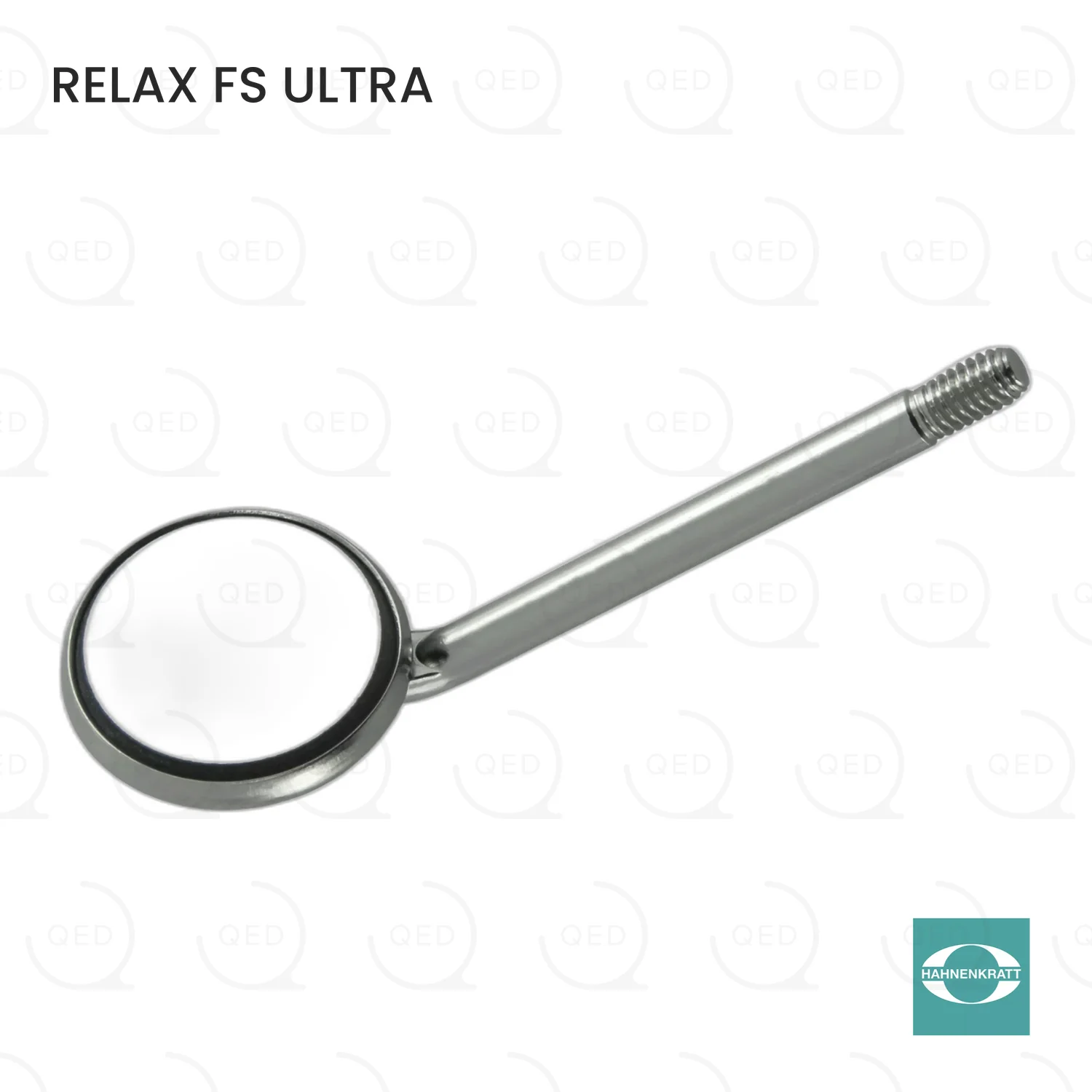
relax fs ultra · no. 4, ø 22 mm · anthracite · pack of 10
every screwed mirror has a seam where the cone meets the handle, and somebody in your practice has to decide what happens to it. relax takes the question away: it is moulded as a single piece, with what hahnenkratt describe as an exactly plane transition from mirror to casing, so there is nothing to unscrew before reprocessing and nothing to reassemble after. this is the fs ultra version – their brightest coating, on the standard ø 22 mm adult head.
this pack: 10 × hahnenkratt relax fs ultra mouth mirrors, no. 4, ø 22 mm · anthracite · one-piece, glass-fibre-reinforced plastic, autoclavable to 134 °c · no separate handle needed
made by e. hahnenkratt gmbh, germany · mfr code 7306
| made from one piece | hahnenkratt designed relax for an exactly plane transition from mirror to casing. no thread, no seam at the head, nothing to take apart |
| no disassembly | hahnenkratt state that disassembly for cleaning is not required, and cite the krinko recommendation of the robert koch institute as the reason the design matters |
| fs ultra coating | their brighter option, from 36 layer packages – a reflection factor hahnenkratt put at over 100% measured against aluminium, up to 25% brighter than fs rhodium |
| 134 °c, 10 per pack | glass-fibre-reinforced plastic body, autoclavable to 134 °c. ten to a pack – a set for every surgery rather than a replacement for one |
› complete as it comes – no handle to buy, no cone to order. ten mirrors is ten working instruments.
› coloured bodies – hahnenkratt make relax in seven colours, which is as useful for telling one set from another as it is for a nervous child. this pack is anthracite (dark grey).
› front surface – one reflection, no faint second image behind the first, the same optical principle as the rest of the hahnenkratt range.
› made in germany – hahnenkratt's own description of the range.
one-piece or cone and handle?
one-piece is simpler through decontamination and cheaper per working mirror, because there is no handle to buy. cone and handle wins on longevity – a scratched head is a few pounds to replace rather than the whole instrument – and lets you mix head sizes on handles you like. ultravision no. 4 is the same size in cone form.
is fs ultra different from the rhodium relax?
yes. both are front-surface mirrors; the coating is what differs. hahnenkratt put fs ultra at up to 25% brighter than their fs rhodium. this sku is the ultra.
what if i need a matt instrument for microscope work?
relax is not that instrument – go to the dlc-coated black ultraretract with a blackline handle, or the ultramicro flex micro mirrors.
hahnenkratt relax fs ultra · no. 4 · ø 22 mm · anthracite · one piece · front surface · ultra coating · glass-fibre-reinforced plastic · autoclavable to 134 °c · 10 per pack · germany · mfr code 7306
komet endo rescue · kit 4601
fragment removalretreatmentniti fracture
komet’s kit “for the removal of instrument fragments” – specifically fractured rotary niti instruments. once access to the head of the fragment is created, two specially developed instruments do the work: a centre drill that excavates the last few millimetres, and an extremely fine trepan bur that seizes the fragment.
| 2 specialist instruments | 300 rpm, drill and trepan | 3 sizes: 070, 090, 110 |
this pack: endo rescue kit
made by komet
| kit 4601 | access and preparation burs (h269gk.315.016, g180a.204.110, g180.204.090), centre drill rkp.204.090, trepan bur rkt.204.090 and 150.155.000, per komet |
| also in 070 and 110 | centre drills and trepan burs sold separately – see below |
| speeds | centre drill and trepan bur 300 rpm, per komet |
› start with the access. komet: “instrument fracture is most frequently caused by incorrect or insufficient preparation of the canal access”, so the first step is re-preparing the access.
› drill, then trepan. the centre drill exposes the fractured surface by drilling around the fragment; the trepan bur surrounds and seizes it and, in anti-clockwise rotation, withdraws it “firmly held in the trepan bur by the residues of dentin”.
› then finish the canal. komet’s sequence ends with the last third correctly prepared and filled.
which size do i need?
the kit carries 090. 070 and 110 centre drills, and trepan burs to match, are sold separately.
| the kit | endo rescue kit 4601 (this page) |
| centre drills | 070 · 090 · 110 |
| trepan burs | 070 · 090 · 110 |
| pulp chamber | komet 191 müller burs |
› endo rescue kit product information (pdf, 1.1 mb, komet) – the clinical sequence, step by step, with speeds.
specifications and quotations are from komet’s endo rescue kit 4601 product information (06/2015, 410265v1). brand names are the trademarks of their owners.
endo rescue kit · komet · ref kom-4601

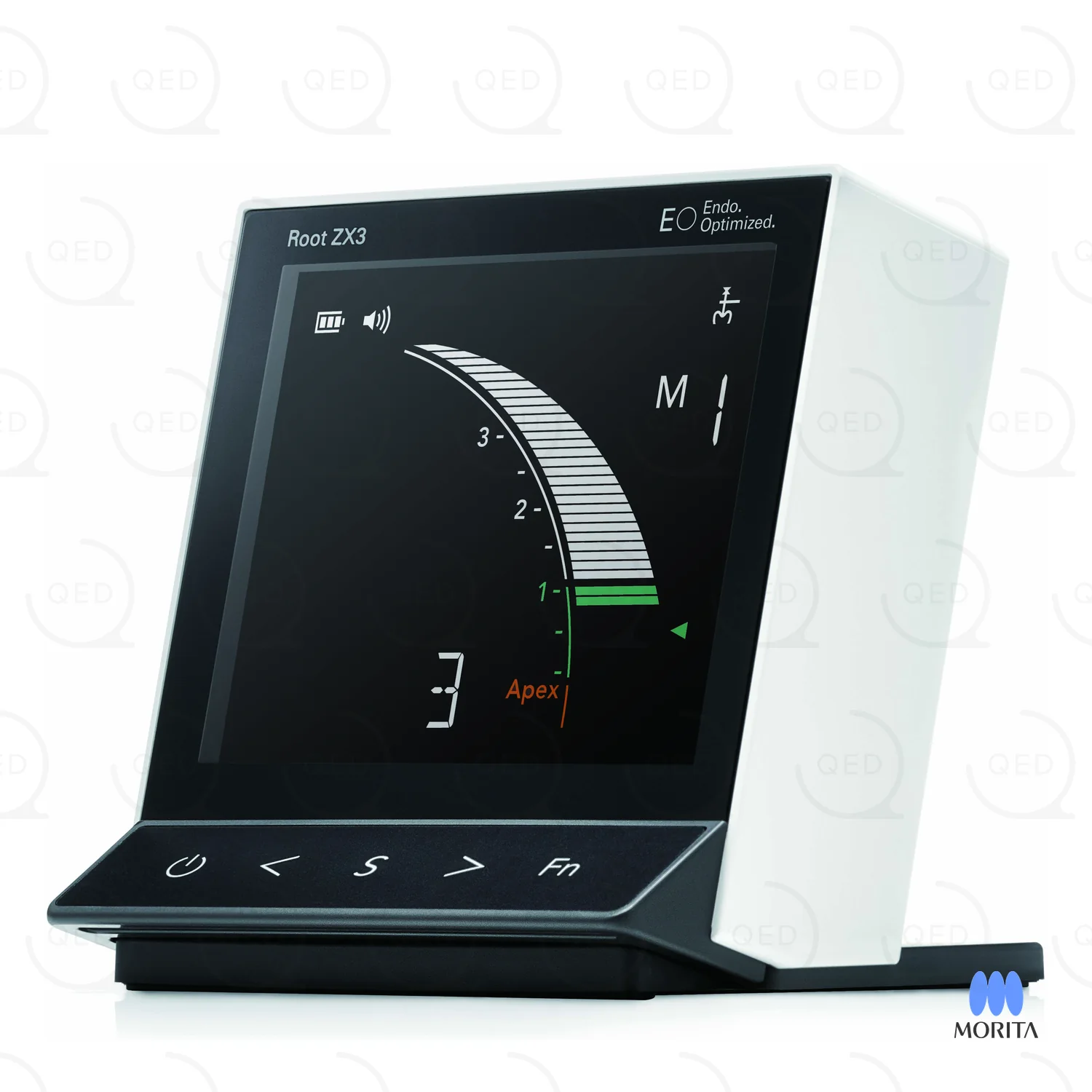
morita · root zx3 · apex locator
working lengthwet or dry canalscompact footprint
root zx3 is the latest generation of morita’s root zx apex locator line. morita describe it as a smaller unit with a larger, high-contrast screen, running the same apex location technology the root zx name was built on – with the reading drawn in real time across 40 indicator bars, in dry canals or wet.
| 40 indicator bars | ~6 months on 4 x aa | 2 yrs warranty |
this pack: morita root zx3 apex locator (apex locator module) · 5 contrary electrodes · 3 file holders · 1 probe cord · 4 aa alkaline batteries
› full functionality in dry or wet canals – morita’s words, and the point of the root zx method.
› automatic calibration to compensate for changes in environment, such as temperature and humidity, and for ageing of the unit. no zero adjustment before each canal.
› real-time reading across 40 indicator bars on a large, easy-to-read lcd.
› customisable working-length point, with adjustable volume and a clearly audible signal.
› approx. 85 x 95 x 100 mm and 390 g with batteries – sized for the bracket table.
the root zx is the benchmark apex locator – when a new locator comes to market, the root zx is the one it is usually compared with. that is the standing the zx3 inherits.
morita state that their apex location technology has been independently evaluated at a 97.5% accuracy rate. their footnote names the study – guise, goodell & imamura, journal of endodontics 2010;36(2):279-81 – and says it was tested with the root zx ii. it is an in vitro comparison of three locators and an earlier model of the family, so we quote it as morita do: a figure for the root zx technology, not a clinical result for this unit.
what the zx3 changes is the working experience: the reading moves smoothly as the file advances, the screen is larger and higher-contrast, and the unit takes less room.
as with every root zx, the meter runs down towards the apex mark as the file advances. morita’s instructions describe the 0.5 reading as the file tip being very near the physiological apical foramen, for use as a working-length reference – and leave the final working length to the clinician’s judgement for each canal.
| root zx3 | this page. the current generation. 40-bar real-time display, 4 x aa, approx. 390 g, 85 x 95 x 100 mm. |
| dentaport root zx | dentaport root zx – the established unit. large colour display with acoustic signals, 3 x aa, approx. 370 g, 105 x 105 x 115 mm. |
| root zx mini | root zx mini – hand-sized. colour lcd, 3 x aaa, approx. 110 g, 57 x 60 x 103 mm. |
| in the motor | x-smart® pro+ – if you would rather the locator sat inside the endo motor. dentsply sirona. |
morita’s instructions state the unit must not be used on a patient fitted with a pacemaker, icd or cochlear implant. the file holders and contrary electrodes are autoclavable (no higher than 135 °c); the probe cord and the unit are wiped, not autoclaved. the full instructions are linked under downloads.
does blood or irrigant in the canal stop it working?
morita state full functionality in dry or wet canals.
do i have to zero it before each canal?
no. morita describe automatic calibration that compensates for environment and ageing.
what does it run on, and for how long?
four aa alkaline batteries, included. morita’s instructions put battery life at approximately six months.
will my existing root zx accessories fit?
the contrary electrode and file holders we stock are morita’s autoclavable parts for the root zx family, and our listings name the root zx3. if you are unsure about a cord or an older part, call us with the model and we will check it.
| contrary electrodes | contrary electrode (all morita) – the lip hook; worth a spare set so one is always through the autoclave |
| file holders | file holder (pack of 3) – clips the file shaft to the probe cord |
| touch probe | long file touch probe – autoclavable; listed by morita as an accessory for this unit |
| hand files | c-pilot® 10, 25 mm · c-pilot® 08, 25 mm |
› root zx3 product flyer (pdf, 0.1 mb, morita) – features, specification and box contents.
› root zx3 instructions for use (pdf, morita website) – the full operating, safety and reprocessing instructions.
morita · root zx3, model rzx3, type rcm · morita product no. 6903 · made by j. morita mfg. corp., kyoto · distributed in europe by j. morita europe gmbh
special offer · adhesive included free
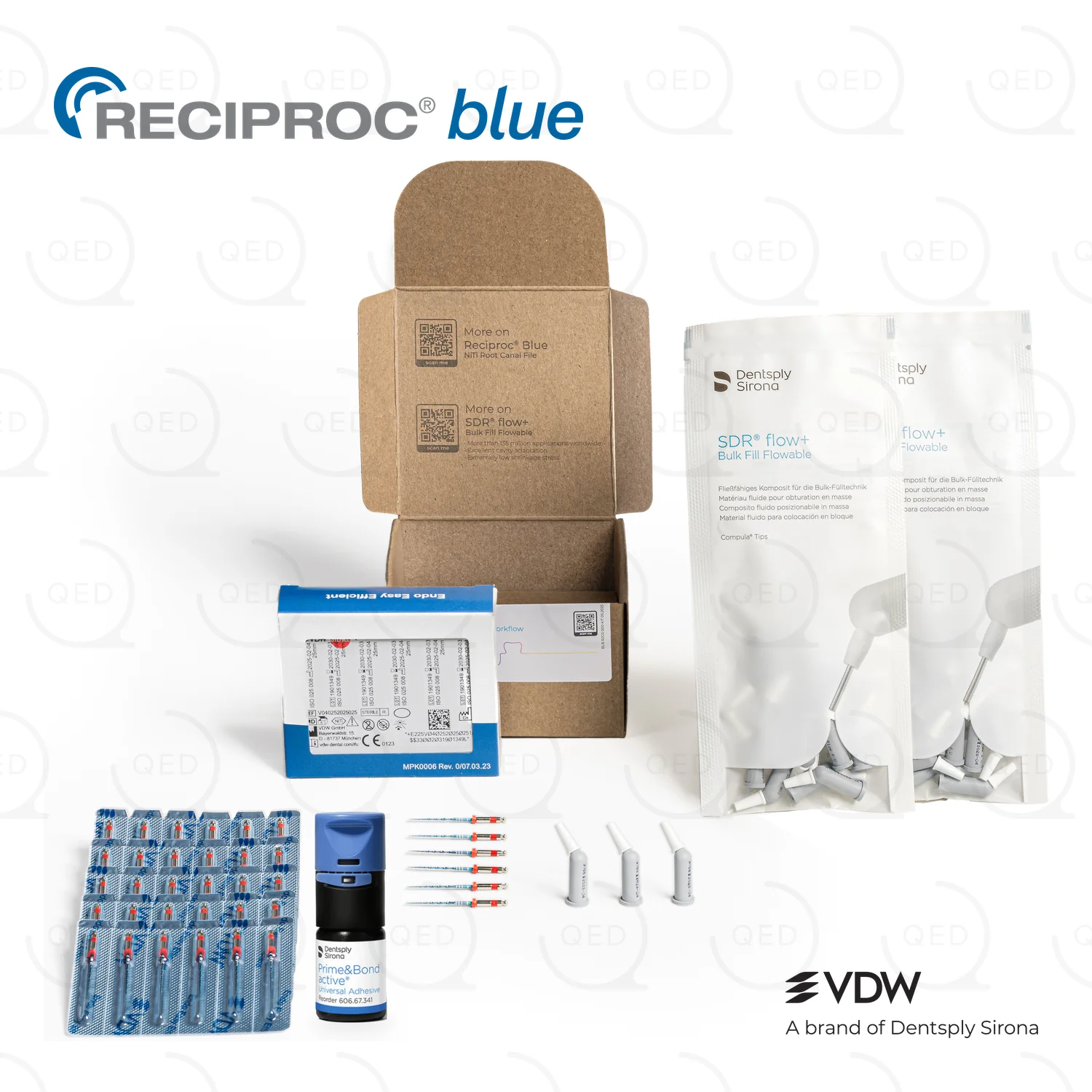
three order lines for one root-filled molar? files from one shelf, compules from another, and the adhesive that turns out to be empty at the wrong moment? this kit puts the back end of the appointment on one code – single-file shaping, a bulk fill build-up for the access cavity, and the adhesive that bonds one to the other, with the prime&bond active bottle free of charge while stocks last.
this kit: 5 × reciproc® blue r25 25 mm (30 files) · 2 × sdr® flow+ refill universal (30 compules) · 1 × prime&bond active® 4 ml, free of charge
made by vdw and dentsply sirona
| the free item | one 4 ml bottle of prime&bond active, the same standard refill sold on its own – while stocks last |
| what it covers | r25 single-file shaping at 25 mm, then a bulk fill base and core build-up cured 4 mm at a time |
| not included | paper points, cones and sealer – it shapes and restores, it does not obturate |
› shape, bond, rebuild – the part of the appointment that decides whether your obturation stays sealed.
› one caution carries through all three: the adhesive and the composite are both contraindicated alongside eugenol-containing materials, so a zoe sealer or an irm-type temporary changes the plan.
how does this differ from the standard kit?
by one bottle. files and compules are identical to the reciproc blue and sdr flow+ procedure kit; this code adds a 4 ml prime&bond active free while the offer runs.
is the composite the obturation material?
no. sdr flow+ is a restorative base and core build-up material – it fills the access cavity after obturation. the canal still needs cones, points and a sealer.
| dry | reciproc® paper points r25 · 144 – matched to the r25 preparation |
| fill | reciproc® blue gutta percha r25 · 60 – the cone that matches the file in this kit |
| top up | sdr® flow+ refill universal – when the compules run out first |
reciproc® blue, sdr® flow+ & prime&bond · 30 r25 25 mm files · 30 sdr flow+ compules · 4 ml adhesive free of charge · vdw and dentsply sirona · ref sp_b00rsdrr2ckit · while stocks last
special offer · adhesive included free
the canal is shaped, the root filling is down – and the access cavity is still open. what is bonding the build-up? this code is the waveone® gold and sdr® flow+ kit with a bottle of prime&bond active® added free of charge while stocks last – the shaping, the coronal seal and the adhesive between them, on one order line.
this kit: 15 × sterile procedure blisters – each holding 1 × #10 k-flexofile, 1 × waveone® gold glider and 1 × waveone® gold primary · 1 × sdr® flow+ refill universal, 15 × 0.25 g compula® tips · 1 × prime&bond active® 4 ml, free of charge
made by dentsply sirona
| the free item | one 4 ml bottle of prime&bond active, the same standard refill sold on its own – while stocks last |
| what it covers | scout, glide and shape from one sterile blister per patient, then a bulk fill build-up cured 4 mm at a time |
| not included | paper points, cones, sealer and irrigant – it shapes and restores, it does not obturate |
› the blister is the sequence – scout, glide, shape, sealed together. every case starts on instruments that have cut nothing else.
› one caution carries through both added materials: the adhesive and the composite are each contraindicated alongside eugenol-containing materials – a zoe sealer or an irm-type temporary changes the plan.
how does this differ from the standard kit?
by one bottle. blisters and compules are identical to the waveone gold and sdr flow+ kit; this code adds a 4 ml prime&bond active free while the offer runs.
is the composite the obturation material?
no. sdr® flow+ is a bulk-fill flowable base and core build-up material – it fills the access cavity after obturation, capped with your usual universal composite in a load-bearing cavity. the canal still needs cones, points and a sealer.
| irrigation | chlorax 5.25% · chlorax 2% · irriflex® 30g · smartlite® pro endoactivator |
| dry | waveone® gold paper points primary · 180 – matched to the primary preparation |
| fill and seal | conform fit® gp primary · 60, carried to length with a sealer – ah plus®, dentsply's own epoxy, or neosealer® ezflo, premixed bioceramic, 25 mm tips · proroot® bio sealer |
| when it runs out | sdr® flow+ refill universal · 15 compula® tips – the coronal seal, sold on its own |
waveone® gold, sdr® flow+ & prime&bond · 15 sterile procedure blisters · #10 k-flexofile, gold glider and gold primary in each · 15 sdr® flow+ compula® tips · 4 ml adhesive free of charge · all instruments 25 mm · dentsply sirona · ref sp_b00wsdrr2ckit
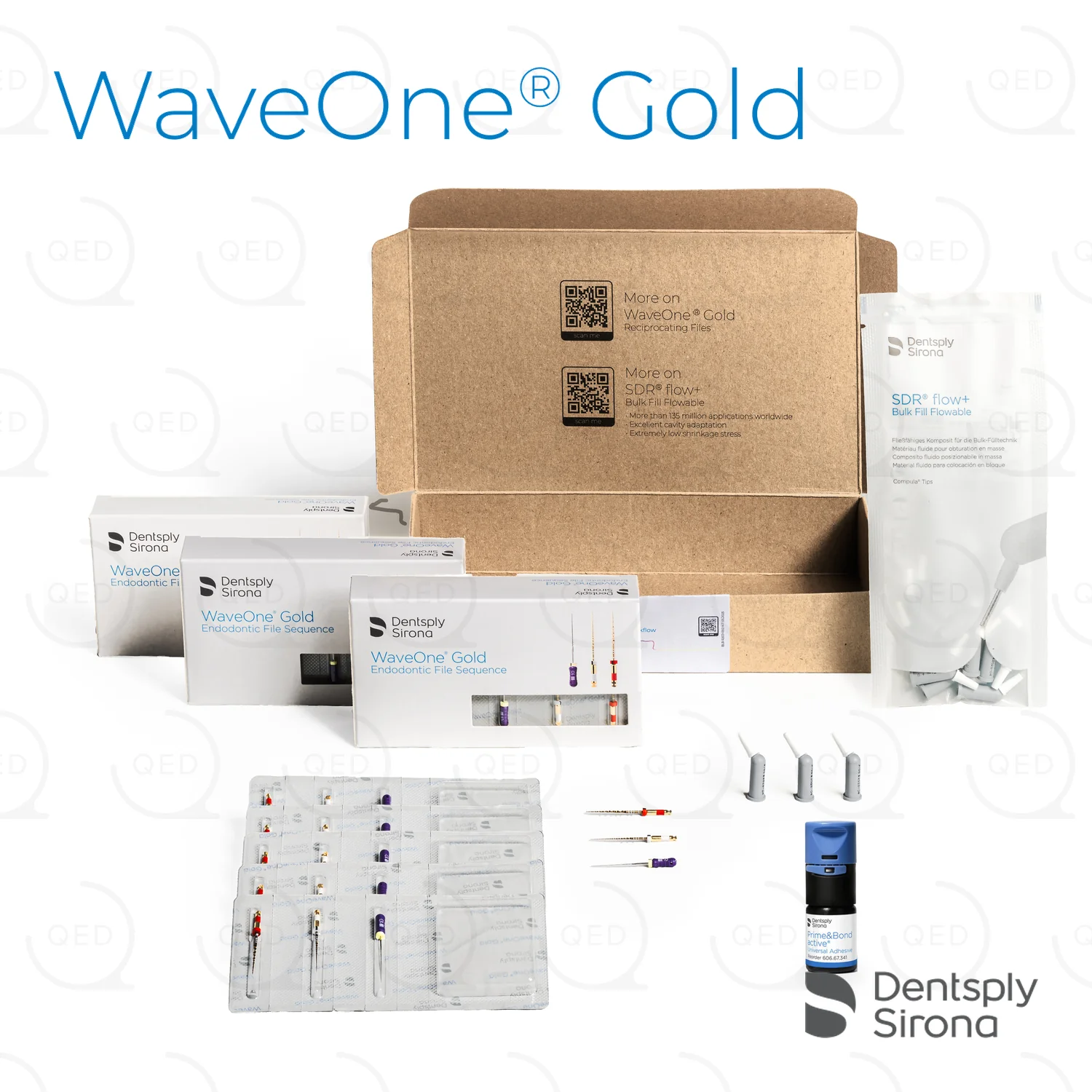
c-pilot® assorted 006-010 · 21 mm · 6 files
the tooth you did not plan for turns up on a thursday afternoon. this blister holds two each of iso 006, 008 and 010 at 21 mm – the whole negotiating sequence for a calcified posterior tooth, in the length that suits it, with a second of every size so a stressed file gets retired rather than re-used.
this pack: 6 × vdw®sterile c-pilot®, 21 mm, .02 taper – two each of iso 006, 008 and 010 · stoppers fitted · mfr code 368 021 210
made by vdw gmbh, munich, germany
| 2 × iso 006 | 0.06 mm – the probe, for a chamber floor that offers nothing |
| 2 × iso 008 | 0.08 mm – where most calcified canals really start |
| 2 × iso 010 | 0.10 mm – loose to length, and you have a glide path by definition |
| 21 mm, sterile | posterior length, gamma sterilised to din en iso 11137, stoppers fitted |
| thermally hardened | vdw: “high bending strength thanks to a special thermal hardening process” |
| constant .02 taper | the iso hand file geometry – the blade widens by 0.02 mm for every millimetre back from the tip, so the size you read is the size the canal gets |
› work down, then back up – try 010, drop until one advances, then rebuild to a loose 010.
› irrigate between sizes – the sequence makes dentine mud; flush it rather than push through it. a chelating gel such as file-eze™ is optional and not universally endorsed.
› use the spare – that is what the second file of each size is for.
› then finish – iso 12.5 and 015 if you complete glide paths by hand.
exactly what is in it?
six files at 21 mm: two iso 006, two iso 008, two iso 010. vdw list the assortment as spanning iso 06 to 10; the split is confirmed with our stock.
assorted or single sizes?
assorted if calcified canals are occasional. single-size blisters – 008 and 010 especially – once you are getting through one size steadily.
| refill a size | c-pilot 010, 21 mm · six of one size |
| finish by hand | iso 12.5 then 015, both 21 mm |
| lubricant, optional | file-eze™ kit · 19% edta gel, if you use one |
| mechanical glide path | waveone® gold glider 21 mm |
| then shape | reciproc® blue r25 21 mm or minima r20 21 mm |
| longer roots | assorted in 25 mm |
vdw® c-pilot® assorted 006-010 · 21 mm · .02 taper · two each of 006, 008, 010 · calcified canals · canal scouting · glide path · stainless steel · sterile · single use · 6 files · vdw gmbh · ref v040368021210 · also in 25 mm and 19 mm

vdw® c-pilot® assorted 006-010 · 25 mm · 6 sterile files
one difficult canal needs three sizes, not three boxes. the assorted c-pilot® blister holds two each of iso 006, 008 and 010 at 25 mm – the exact sequence a calcified canal asks for, in the order it asks for it, with a spare of each in case the first is stressed. it is the pack to keep in the drawer for the tooth you did not plan for.
| 3 iso sizes | 2 each 006, 008, 010 | 25 mm working length |
this pack: 6 × vdw®sterile c-pilot®, 25 mm, .02 taper – two each of iso 006, 008 and 010 · pre-mounted silicone stoppers · mfr code 368 025 210
made by vdw gmbh, munich, germany
006, 008 and 010 are the negotiating sizes. below 010 you are asking a question – is there a path, and where does it go; at 010 you are answering it, because the accepted description of a glide path is a size 10 that runs loosely to working length (van der vyver and colleagues, south african dental journal 2019). everything above that is widening, which is a different job and, increasingly, a job for a motor.
two of each matters more than it sounds. fine instruments get stressed in sclerosed canals, and the correct response to a file that has started to bind or unwind is a fresh one, not a firmer grip. a single blister that contains the spare removes the temptation – and it costs the same as any other c-pilot® blister.
| 2 × iso 006 | 0.06 mm tip – the probe for a sclerosed canal or a chamber floor that offers nothing |
| 2 × iso 008 | 0.08 mm tip – the size most calcified canals really start at, and a named patency instrument |
| 2 × iso 010 | 0.10 mm tip – loose to length, and you have a glide path by definition |
| inactive pilot tips | vdw's description: each tip conducts the instrument safely along the canal rather than cutting its own path |
| sterile, ready to use | gamma sterilised to din en iso 11137, stoppers pre-mounted, no cycle before first use |
| thermally hardened | vdw: “high bending strength thanks to a special thermal hardening process” |
| constant .02 taper | the iso hand file geometry – the blade widens by 0.02 mm for every millimetre back from the tip, so the size you read is the size the canal gets |
for probing in calcified root canals.
— vdw's stated indication for the c-pilot® range. this blister is that indication, packed as a sequence.
› work down, then up – try 010, drop to 008 and then 006 until one advances, then rebuild the sequence upward to a loose 010.
› irrigate between sizes – the sequence makes dentine mud; flush it rather than push through it. a chelating gel such as file-eze™ is optional and not universally endorsed.
› use the spare – the second file of each size is there so that a stressed instrument gets retired, not re-used.
› then go up – iso 12.5 and 015 finish the glide path if you are completing it by hand.
exactly what is in the pack?
six files at 25 mm: two iso 006, two iso 008 and two iso 010. vdw's catalogue lists the assortment as spanning iso 06 to 10; the split is confirmed with our stock.
assorted pack or single sizes?
assorted if you meet calcified canals occasionally and want all three sizes to hand. single-size blisters – 008 and 010 in particular – if you are getting through one size steadily.
does it include 12.5 or 015?
no – the assortment stops at 010, which is where negotiation ends. add iso 12.5 and 015 separately if you finish glide paths by hand.
| refill the size you use | c-pilot 010, 25 mm · six of one size |
| finish by hand | iso 12.5 then 015, both 25 mm |
| lubricant, optional | file-eze™ kit · 19% edta gel, if you use one |
| mechanical glide path | waveone® gold glider 25 mm |
| narrow anatomy | reciproc® minima r20 25 mm |
| then shape | reciproc® blue r25 25 mm or waveone® gold primary |
| dress between visits | ultracal™ xs · calcium hydroxide, 4 × 1.2 ml |
| shorter access | assorted in 21 mm · same three sizes |
vdw® c-pilot® assorted 006-010 · 25 mm · .02 taper · two each of 006, 008, 010 · calcified canals · canal scouting · glide path · patency · stainless steel · sterile · single use · 6 files · vdw gmbh · ref v040368025210 · also in 21 mm and 19 mm

vdw.silver® reciproc® · endo motor · 2 × 6:1 contra-angles
reciproc and waveonecontinuous rotarydr's choice settingssecond contra-angle in the box
the contra-angle is the only part of this system that vdw's manual lets you sterilise. the motor, its cable, the foot switch and the charger stay out of the autoclave. this unit is the vdw.silver® reciproc® endo motor with two 6:1 contra-angles, so one can be ready while the other is being reprocessed.
| 7 pre-set systems | 15 dr's choice slots | 2 contra-angles in box |
this unit: vdw.silver® reciproc® motor (control unit and micromotor) · two vdw | sirona 6:1 contra-angles · foot switch · charger
made by vdw · a brand of dentsply sirona
vdw's operating manual is specific about reprocessing: only the contra-angle may be sterilised, and the micromotor and the other accessories must never go in an autoclave or ultrasonic tank. the contra-angle also has to be kept lubricated, to its own instructions. with one handpiece, that cycle sits between your patients; with two, the second is waiting.
one thing to plan for: the manual has you calibrate the motor whenever the contra-angle has been lubricated, or replaced after sterilising, and at least once a week. swapping to the second contra-angle falls under that, so check the manual for the calibration steps. whether you need two depends on your own sterilisation routine – if you do, this puts both in one box.
| no contra-angle | vdw.silver® reciproc® without contra-angle · motor, foot switch and charger |
| one contra-angle | vdw.silver® reciproc® with 6:1 contra-angle · the complete unit, one handpiece in the box |
| two contra-angles | this page. motor, two 6:1 contra-angles, foot switch and charger |
vdw describe it as an endo motor “for reciprocating and continuous rotary nickel-titanium systems”. the list below is vdw's own, from their user brochure (rev 3, 2011), and is the same on all three versions.
| reciprocating | pre-set programmes for reciproc® and waveone® – including reciproc all on current units |
| continuous rotary | pre-set for mtwo®, flexmaster®, protaper®, k3™ and gates |
| dr's choice | 15 further torque/speed settings you set and store yourself |
| in rotary mode | asr reverses automatically at the set torque limit, with an acoustic warning at reversal and at 75% of the set torque |
| in reciproc mode | reciproc reverse – a two-stage indicator, vdw's comfort function for the single-file technique |
| power | battery operated, and it runs while charging |
why the reciprocation angles are programmed into the motor, and why that makes the reciproc setting a specification rather than a preference, is set out on the one-contra-angle unit's page. for the exact torque and speed values of a system you already run, ask us and we will send you the operating manual before you order.
it has no integrated apex locator. it shapes; it does not measure. length stays with your locator or your radiographs.
reciproc instruments are single-use, and the unit is the molar, not the case – vdw put it as “single treatment use, maximum one molar”. a two-molar appointment is two files.
| the file it was built for | reciproc® blue r25 25 mm · r40 · r50 |
| hand files | c-pilot® 010, 25 mm · patency and glide path where the canal asks for one |
| irrigants | chlorax 5.25% · chlorax 2% · endo-solution 17% edta |
| delivery | irriflex® 30 ga · navitip™ 29 ga 25 mm |
| activation | vdw eddy® tips · vdw's own, driven by an air scaler rather than this motor |
| sealer | vdw 2seal · ah plus® · or bioceramic, neosealer® ezflo 25 mm tips |
| coronal seal | sdr® flow+ refill universal · 4 mm bulk increment, one cure |
| spares for this unit | vdw | sirona 6:1 contra-angle · foot switch · charger |
are both contra-angles the same?
yes – two vdw | sirona 6:1 contra-angles, the same type as the one in the single-contra-angle unit.
do i need to calibrate when i swap?
vdw's manual says to calibrate whenever the contra-angle has been lubricated, or replaced after sterilising, and at least once a week. follow the manual that comes with your unit for the steps.
will it run reciproc blue?
yes. the blue instruments are the current reciproc® range and run on the reciproc setting. the alloy changed; the reciprocation did not.
does it measure working length?
no – there is no apex locator in this unit. length stays with your locator or your radiographs.
can i autoclave the motor?
no. vdw's manual says never to put the micromotor or the other accessories in an autoclave or ultrasonic tank. only the contra-angle may be sterilised, to its own instructions.
before you order: settings, torque values and the full pre-set library are in vdw's operating manual, and the file library on current firmware may differ from the list above – ask us for a copy and we will send it before you buy. instruments are single-use to a maximum of one molar.
vdw.silver® reciproc® endo motor with 2 × 6:1 contra-angles · reciprocating and continuous rotary · pre-set programmes plus 15 dr's choice settings · asr with acoustic warning · reciproc reverse · battery, runs while charging · foot switch and charger included · vdw · ref v041163000000xc


 Facebook
 X
 Instagram
 Pinterest
