

Best selection of Endodontic supplies in the UK


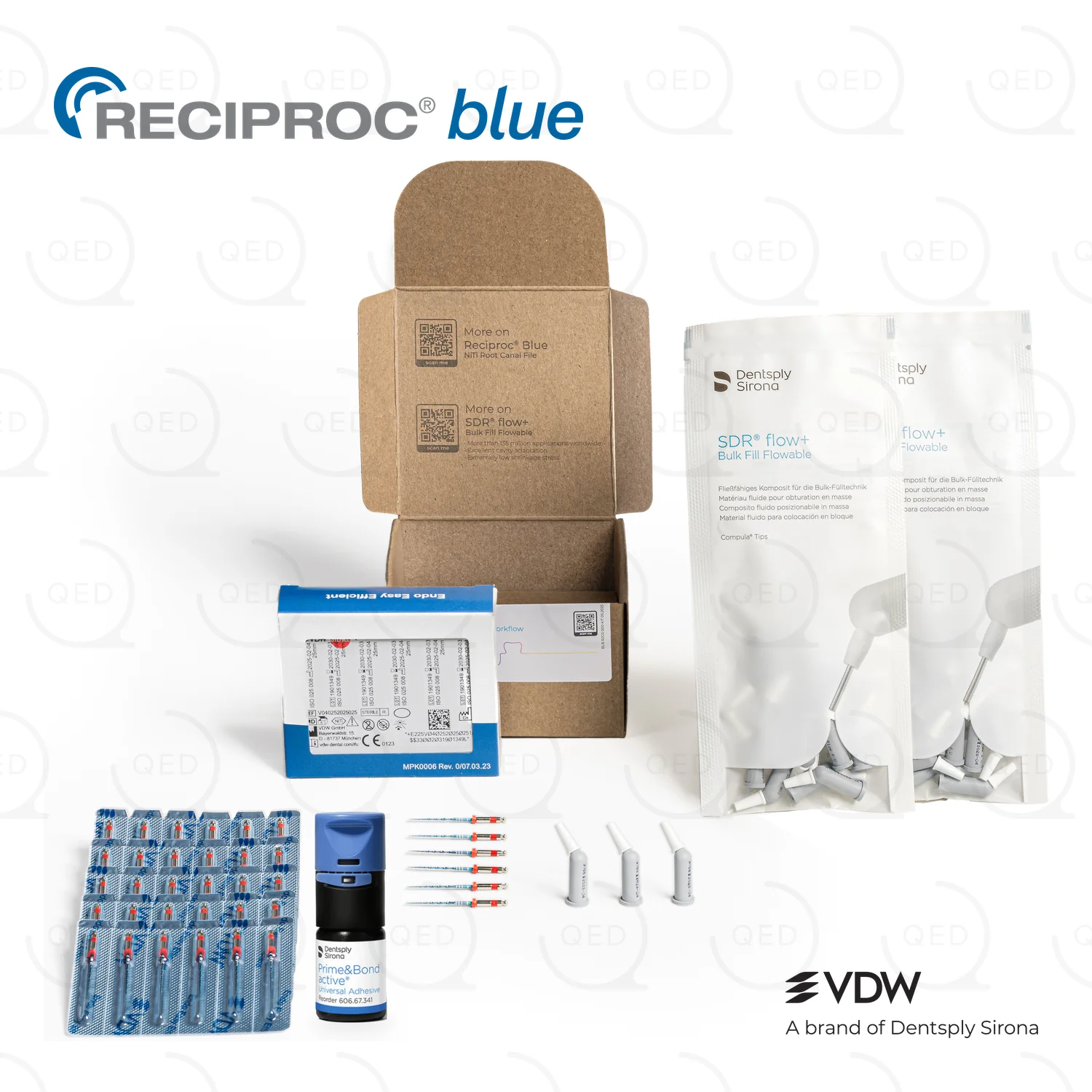






sdr® flow+ · universal shade · 15 compules
post-endodontic corebase or liner, class i and iiclass iii and vpit and fissure sealing
how much of the outcome is still in your hands once the last cone is down? and why fill the access cavity with something that shrinks away from the seal you have just placed? sdr® flow+ is a low-viscosity bulk fill composite that self-levels into the chamber and around the orifices, and is designed to be cured in increments up to 4 mm. the chamber is an awkward shape to fill – undercuts, a pulpal floor you cannot see into, orifice plugs you would rather not disturb – and a self-levelling material finds that geometry without condensation.
| 4 mm bulk increment | 20 s cure at 4 mm | 2.6 mm al radiopacity |
this pack: 15 × 0.25 g compula® tips, universal shade
made by dentsply sirona · mfr code 60603040
| increment | cured in increments up to 4 mm depth, per the directions for use |
| cure | 20 s at 4 mm in the universal shade at 550 to 1000 mw/cm2; the a shades need 40 s. minimum output 550 mw/cm2 |
| filler | total filler 47.3% by volume (ifu); 70.5% by weight per dentsply's scientific manual |
| radiopacity | approximately 2.6 mm al – it reads on a post-operative film |
› a base, not the finished surface in a load-bearing class i or ii – the ifu caps it occlusally with a universal or posterior composite.
› watch the eugenol. the ifu says to avoid eugenol and hydrogen peroxide – worth remembering if a zoe sealer or an irm-type temporary has been near the chamber.
› not for known methacrylate hypersensitivity, and not alongside mineral-impregnated retraction cord.
dentsply describe sdr as combining that large molecular structure with a chemical group they call a “polymerization modulator”, embedded in the centre of the polymerisable resin backbone of the sdr monomer.
— dentsply sirona, sdr® flow+ scientific manual, 2017. the same document puts volumetric shrinkage at 3.5%, and attributes an approximately 80% reduction in polymerisation stress against conventional methacrylate resins to its own internal data.
van dijken and pallesen followed 49 paired class ii restorations in 38 patients for six years, sdr under a capping composite against conventional layering, and reported an annual failure rate of 1% in both groups (eur j oral sci 2017;125:303–9). el-damanhoury and platt recorded bottom-to-top hardness above 90% at 4 mm (oper dent 2014;39:374–82). the honest reading: as good as careful incremental layering, not better – and in less chair time.
can i finish the restoration in sdr flow+ alone?
not in a load-bearing class i or ii – the ifu has it capped by a universal or posterior composite. conservative class i, class iii and v restorations and core build-ups are listed as full indications.
does my curing light have enough output?
it needs at least 550 mw/cm2, and the 20 s figure assumes 550 to 1000 mw/cm2. a radiometer check is worth thirty seconds – a tired unit is the usual reason a 4 mm increment cures short.
| shape and restore | reciproc® blue and sdr flow+ procedure kit – 30 r25 files and 30 compules on one code, or the same kit with a free adhesive while that offer runs |
| shape | waveone® gold and sdr flow+ kit – the same pairing on the reciprocating single-file sequence, or the treatment solution box with its own matched cones and points |
| dry | reciproc® paper points r25 · 144 – matched to the r25 preparation |
| fill | reciproc® blue gutta percha r25 · 60 – the cone that matches the file that cut the canal |
| seal the orifice | neoputty® · 0.5 g kit – a premixed bioceramic barrier under the build-up, and for a perforation or open apex |
| between visits | j-temp™ – when the definitive build-up waits for a second appointment |
sdr® flow+ universal · bulk fill flowable composite · self-levelling · 4 mm increment, 20 s cure · 2.6 mm al · 15 × 0.25 g compula® tips · dentsply sirona · ref 60603040
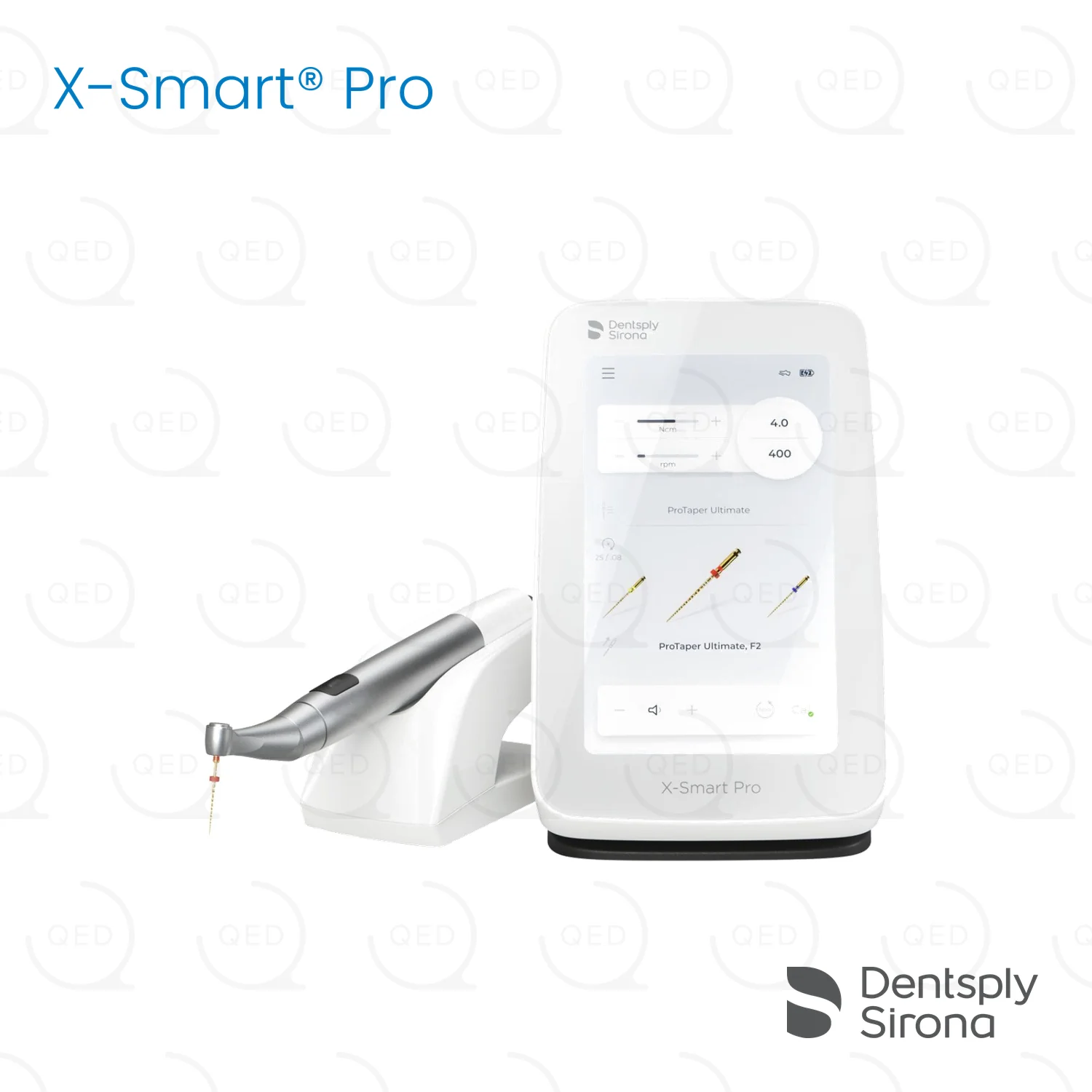
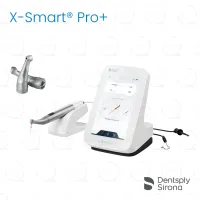
x-smart® pro · endo motor · no apex locator
rotary and reciprocatingtouchscreencordlessmotor only
x-smart pro and x-smart pro+ share one set of instructions for use; the difference, in dentsply sirona’s words, is that the pro is “without apex location function”. if you want the length measured while the file cuts, that is the x-smart pro+.
| 3,000 rpm max at file | 7 in touchscreen | 3 yrs main unit warranty |
this pack: x-smart® pro endo motor
made by dentsply sirona
| apex locator | none – that is the pro+ |
| contra-angle | 5:1, maximum operating speed 3,000 rpm |
| screen | 7 in touchscreen |
| control | finger switch, or the optional wireless foot control |
› same platform as the pro+. same instructions, same 5:1 contra-angle, same accessories – sheaths, battery, power supply, holder and foot switch all fit both.
› mains or battery. a lithium-ion battery, and a 100–240 v power supply with a 12 v output.
› reprocessing is set out. contra-angle and sleeve are steam-sterilised at 134 °c; housing and holders are wiped.
which do i want, pro or pro+?
if you already have a stand-alone apex locator you are happy with, the pro drives the files. if you want one unit that measures while it shapes, the pro+.
do the accessories fit both?
the ones sold as “pro+ & pro” do. lip clips, file clips and the y-connector cable are for the pro+’s apex locator only.
is the foot switch included?
no – the wireless foot switch is a separate order.
the instructions give the device no known contraindications, and carry warnings worth reading first: niti files can fracture from fatigue whatever drives them, and electromagnetic interference can affect apex location. the instructions give 3 years on the main unit including the foot control, 3 years on the handpiece and cable, 2 years on the battery and 1 year on the contra-angle.
| the motor | x-smart pro+ with apex locator · with extra contra |
| heads | 5:1 contra-angle · with sheath · sheath |
| apex locator | lip clips (5) · file clips (2) · y-connector cable |
| power | battery · power supply |
| bench | wireless foot switch · handpiece holder · lubrication adapter · dac universal adapter |
| files it drives | waveone gold primary · reciproc blue r25 · protaper ultimate · trunatomy |
specifications, reprocessing and warnings are from the x-smart® pro / pro+ instructions for use (dentsply sirona, 2023-05); speed, torque and presets are dentsply sirona’s published figures. x-smart, waveone, reciproc, protaper, trunatomy and dac are trademarks of their owners.
x-smart® pro endo motor · dentsply sirona · ref 6779008
x-smart® pro+ · dentsply sirona · motor with integrated apex locator
reciprocating shapingrotary shapinglength while shapingretreatmentmulti-system practicecordless working
a separate apex locator is a second device on the bracket table, a second set of leads, and a reading you have to stop working to take. the x-smart® pro+ puts the measurement inside the motor: lip clip and file clip run to the unit driving the file, the canal display sits on the 7 in touchscreen in front of you, and at the length you set the motor reverses on its own. it is the x-smart® pro that drives waveone® gold and the reciproc® family – with the locator built in rather than beside it.
| 7.5 n·cm max torque | 3,000 rpm at the file | 7 in touchscreen |
in this box: motor with integrated apex locator · mini contra-angle, integrated led, 360° adjustable · stainless steel handpiece sheath · magnetic handpiece holder · lip clip · file clip · y-connector cable · accessories box with charger and universal adapters
dentsply sirona · two heads from the outset: same motor, extra contra-angle
dentsply sirona call it dynamic accuracy™ and describe it as reading the measurement signal while shaping, with auto-reverse to hold the file on the target you set. that is the difference between a locator you consult and one you work alongside: the coloured canal display updates as the file advances, and at your chosen length the instructions say the motor “automatically rotates in the reverse or non-cutting direction until the finger switch is pressed”. one qualification, and it is the manufacturer's own – that display is a progression indicator, not a ruler. the instructions state that the distance display is not a metric specification of length.
“the apexlocator should be used as an additional aid to supplement the usual root canal treatment measures. it does not replace the radiological determination of the working length.”
dentsply sirona, x-smart® pro+ / x-smart® pro instructions for use, english, 2023-05
if you shape with waveone® gold or anything in the reciproc® family, this is the part of the specification that decides the purchase. reciprocation is not one motion but a specific combination of speed, acceleration, torque and angles, set differently for each system. dentsply sirona have put their position in writing.
“the waveone® gold and reciproc® systems are patented for their unique features. their motion settings, including the combination of speed, acceleration, torque and angles are not public data and cannot be manually programmed by clinicians in any endodontic motor.”
certificate of authenticity, waveone® gold + x-smart® pro+: perfect match, dentsply sirona
the same document names the drive systems carrying those motions: x-smart® pro, x-smart® pro+ and the prior tds / maillefer / vdw reciprocating motors, with some dentsply sirona treatment centres and bien-air ioptima units able to provide them too. it is a short list, and a motor advertising a reciprocating mode without being on it is running an approximation of somebody else's motion.
preset programmes include waveone® gold and reciproc® blue in reciprocation and protaper ultimate® and trunatomy® in rotation, alongside up to 30 sequences of your own. firmware upgrades over wi-fi, so a system launched after the motor is a software update rather than a new purchase. torque runs 0.2 to 7.5 n·cm and speed 100 to 3,000 rpm, on dentsply sirona's published figures.
| reciprocating | reciproc® blue r25 25 mm · minima r25 for narrow canals |
| reciprocating | waveone® gold primary 25 mm · assorted |
| rotary | protaper ultimate® sequence 25 mm |
| rotary | trunatomy® assortment 25 mm |
a mini contra-angle with integrated led and 360° adjustable position on a 5:1 reduction – 15,000 rpm at the motor becomes 3,000 rpm at the file. the stainless steel sheath lifts off, and contra-angle, sheath, file clamp and lip clip are all steam-autoclavable; there is a dac universal adapter if that is how your decontamination room runs. power is lithium-ion, 1.5 h to recharge, and it runs on battery or on mains while charging, so a flat battery mid-list is an inconvenience rather than a cancelled appointment.
1 calibrate. the instructions are explicit: “before every treatment and every time a contra-angle handpiece is changed”. it takes seconds, and it keeps the torque on screen and the torque at the file the same number.
2 choose the system on screen. presets carry the manufacturer's own settings for that file; anything else lives in my sequences.
3 connect for measurement. lip clip on the patient, file clip on the shank, y-connector to the unit. the instructions ask for metal-shafted files and non-conductive gloves, and note that electromagnetic interference can affect accuracy.
4 shape, then confirm on film. at the length you set the motor reverses out of cut until you press the finger switch. the locator supplements the radiograph; it does not stand in for it.
› a second head, as contra-angle alone or with a sheath, plus sheaths on their own.
› measuring parts: lip clips, file clips and the y-connector cable.
› power: rechargeable battery and power supply.
› bench: wireless foot switch, handpiece holder, lubrication adapter.
| hand files | c-pilot® 010 25 mm · a metal shaft for the locator |
| irrigants | chlorax 5.25% · endo-solution 17% edta |
| delivery, activation | navitip™ 29 ga · eddy® tips |
| sealers | neosealer® ezflo bioceramic · ah plus® epoxy · proroot® bio sealer |
| coronal seal | sdr® flow+ refill universal · 4 mm increment, one cure |
can i stop taking a working-length radiograph?
no, and the instructions say so in as many words: the locator supplements the usual measures and does not replace radiological determination of working length. what changes is how often you are working blind between films.
can i run waveone® gold or reciproc® on another motor with a reciprocating setting?
dentsply sirona say not – the motion settings are not public data and cannot be programmed into another motor, and they recommend those files only with the drive systems listed above.
is the foot switch in the box?
no. the wireless foot switch is a separate order – worth deciding at the outset rather than after the first week.
do i want the second contra-angle?
if you run back-to-back endodontic lists, yes: a head in the autoclave is a head you cannot use, and recalibrating on the swap takes seconds. that is what the extra contra version is for. one surgery working a case at a time does not need it on day one.
before first clinical use: the device is indicated for use when endodontic procedures are required, and the instructions record no known contraindications. they do carry warnings worth reading first – niti instruments can fracture from fatigue whatever drives them, electromagnetic interference can affect the accuracy of apex location, and measurement requires metal-shafted files and non-conductive gloves. full warnings, reprocessing and technical data are in the instructions for use, and we will send a copy on request.
x-smart® pro+ endo motor with integrated apex locator · 0.2–7.5 n·cm · 100–3,000 rpm · 5:1 mini contra-angle with led, 360° adjustable · 7 in touchscreen · up to 30 file sequences · wi-fi upgradeable · lithium-ion, 1.5 h recharge · genuine waveone® gold and reciproc® reciprocating motion · dentsply sirona · ref 6779016

x-smart® pro+ · motor + apex locator · extra contra-angle
rotary and reciprocatingintegrated apex locatortwo contra-anglesback-to-back lists
the same x-smart pro+ motor with integrated apex locator as our standard pack, with an extra 5:1 contra-angle in the order. one head in use, one in the autoclave – and the instructions ask for a calibration each time the head is changed, which takes seconds.
| 2 contra-angles | 3,000 rpm max at file | 7 in touchscreen |
this pack: x-smart® pro+ motor with extra contra
made by dentsply sirona
| motor | x-smart® pro+ with integrated apex locator |
| extra | a second 5:1 contra-angle |
| speed / torque | 100–3,000 rpm, 0.2–7.5 n·cm (dentsply sirona) |
| screen | 7 in touchscreen |
› genuine reciprocating motion. presets for waveone® gold and reciproc® blue in reciprocation and protaper ultimate® and trunatomy® in rotation, plus up to 30 sequences of your own (dentsply sirona).
› measures while it shapes. at the working length you set, the motor “automatically rotates in the reverse or non-cutting direction until the finger switch is pressed”, as the instructions put it.
› why the second head. the contra-angle is sterilised after every patient; with two, a list is not waiting on the autoclave.
what else comes in the box?
everything in the standard pack – the full list is on the x-smart pro+ page – plus the extra contra-angle.
does the apex locator replace the radiograph?
no. the instructions say it “does not replace the radiological determination of the working length”.
is the foot switch included?
no – the wireless foot switch is a separate order.
the instructions give the device no known contraindications, and carry warnings worth reading first: niti files can fracture from fatigue whatever drives them, and electromagnetic interference can affect apex location. the instructions give 3 years on the main unit including the foot control, 3 years on the handpiece and cable, 2 years on the battery and 1 year on the contra-angle.
| the motor | x-smart pro+ with apex locator · with extra contra (this page) |
| heads | 5:1 contra-angle · with sheath · sheath |
| apex locator | lip clips (5) · file clips (2) · y-connector cable |
| power | battery · power supply |
| bench | wireless foot switch · handpiece holder · lubrication adapter · dac universal adapter |
| files it drives | waveone gold primary · reciproc blue r25 · protaper ultimate · trunatomy |
specifications, reprocessing and warnings are from the x-smart® pro / pro+ instructions for use (dentsply sirona, 2023-05); speed, torque and presets are dentsply sirona’s published figures. x-smart, waveone, reciproc, protaper, trunatomy and dac are trademarks of their owners.
x-smart® pro+ motor with extra contra · dentsply sirona · ref 6779016xc
Special Offer
endo 3dp™ · #11 upper left canine · pre-accessed
is a wide canal the easy case, or the one that catches people out? both, which is why the maxillary canine earns its place on a course bench. the endo 3dp #11 is a single-rooted upper left canine with a type i configuration and, in acadental's words, an extensive and challenging large canal space for intricate cleaning and obturation techniques. wide means the walls are hard to touch with a file, and a single cone rattles. everything a trainee needs to learn about hydraulics and vertical condensation happens here, in full view.
this item: 1 × endo 3dp #11, upper left canine (ul3), supplied pre-accessed
made by acadental, usa · mfr code 3d_ae601a_11rl
| type i canal | one canal, one foramen – a clean single-canal case with no branching to complicate the lesson |
| large canal space | acadental's own description: extensive and challenging, for intricate cleaning and obturation technique |
| longest root | the canine is the longest tooth in the arch – useful for length control and rubber-stop discipline |
| see-through | built so the whole canal and pulp chamber stay visible while you work |
› the condensation tooth – a wide canal is where warm vertical technique earns its keep, and where an unmatched single cone is exposed.
› pre-accessed – straight to cleaning and shaping, with the same starting cavity on every bench.
› for radiographs – the radiopaque x2 endo #11 is the same tooth position with films available.
is this an easy tooth or a hard one?
easy to find, hard to fill well. it is a good second exercise: the access and negotiation are undemanding, so attention goes to touching the walls and to a dense obturation.
our item name says incisor – is this a canine?
it is the canine. universal tooth #11 is the maxillary left canine, ul3 in palmer notation, and that is the tooth acadental supplies under this code.
what pairs with it on a course?
an anterior and a molar. #09 adds a lateral canal and multiple terminuses; #31 adds severe curvature and calcification.
| mount it | modupro endo kit – magnetic modules, replica or natural teeth |
| glide path | c-pilot assorted 25 mm – the length a canine needs |
| shape it | reciproc blue r25 25 mm – single-file reciprocation |
| dry it | reciproc blue paper points – matched to those files |
| fill it | reciproc blue gp assorted – the matching cones |
| condense it | penn endo plugger set – for the wide canal exercise |
endo 3dp™ #11 · upper left canine ul3 · single root, type i canal · large canal space · pre-accessed · radiolucent · acadental · ref aca-3dae601a11rl

x2 endo™ · #11 upper left canine · dual hardness
where does a single cone stop being good enough? in a canine. acadental describe the x2 endo #11 – the maxillary cuspid – as having an extensive and challenging large space for intricate cleaning and obturation techniques. a wide canal is easy to negotiate and hard to touch: files skate down the middle, and a cone that fits the apex rattles everywhere above it. because the tooth radiographs like an extracted one, the resulting voids are visible on the film rather than taken on trust.
this item: 1 × x2 endo #11, upper left canine (ul3), radiopaque
made by acadental, usa · mfr code 3d_ae601x2_11
| large canal space | acadental's own description: extensive and challenging, for intricate cleaning and obturation |
| longest tooth | the canine is the longest in the arch – length control and stop discipline are part of the exercise |
| voids show | radiopaque throughout, so an incomplete fill is visible on the post-operative film |
| dual hardness | distinct enamel and dentin layers – acadental recommend a diamond bur for access |
› the condensation tooth – a wide canal is where warm vertical technique earns its place, and where single cone is exposed.
› our item name says incisor – it is the canine. universal tooth #11 is the maxillary left canine, ul3 in palmer notation, and acadental call it the maxillar cuspid.
› the see-through version – endo 3dp #11 shows the same large canal from outside, pre-accessed, but does not radiograph.
is a wide canal an easy case?
easy to reach length, hard to clean and hard to fill. it is the ideal second or third exercise: negotiation is not the obstacle, so attention goes to wall contact, irrigation and a dense fill.
single cone or warm vertical?
run both, on two teeth, and radiograph them side by side. that comparison is the reason to buy a canine rather than another molar.
which sealer suits a wide canal?
one that flows and shows. neosealer flo is radiopaque and consistent across a teaching bench.
| mount it | modupro endo kit – magnetic modules, both arches |
| glide path | c-pilot assorted 25 mm – the length a canine needs |
| shape it | reciproc blue r25 25 mm – single-file reciprocation |
| dry and fill | reciproc blue paper points and matching gp |
| down-pack | penn endo plugger set – for the wide-canal exercise |
| backfill | obtura iii max kit – needles and gutta percha included |
x2 endo™ #11 · upper left canine ul3 · large, challenging canal space · dual hardness · radiopaque · acadental · ref aca3d_ae601x2_11

x-smart® go · dentsply sirona · cordless motor with apex locator
cordless workinglength while shapingreciprocating shapingrotary shapingmulti-surgery practicedifficult access
a corded motor decides where you stand; a separate apex locator decides when you stop. the x-smart® go removes both: 154 g of motor, screen and locator in one cordless handpiece, charging inductively on a power bank that doubles as the stand, with the canal reading on the same display as the torque bar.
| 6.0 ncm max torque | 2,500 rpm at the file | 154 grams in the hand |
in this box: motor handpiece · 6:1 contra-angle · power bank · charger with eur, uk, aus and usa/jap plug adapters · measurement cable · lip clips (2) · file clips (2) · f-type spray nozzle · protective silicone sleeves for the contra-angle (2) · disposable handpiece sleeves (10)
dentsply sirona · class iia medical device · 24-month warranty on handpiece and power bank
› cordless and genuinely light – 210 × 26 × 28 mm, 154 g with the head on, triangular so it stays where you put it.
› apex location in two modes – with a hand file before you start, or live on the same screen while the motor shapes.
› four embedded file libraries – waveone®, reciproc®, protaper ultimate® and trunatomy® – whose parameters are “set to the values recommended by the instrument manufacturer”, plus five rotary programs of your own.
› inductive charging on the power bank, which is also the stand: no socket on the handpiece, nothing to plug in at the chair.
› colour tft display, 360° head rotation and a dominant-hand setting that flips the interface, so the screen faces you in any quadrant.
› 24-month warranty on handpiece and power bank, on dentsply sirona's published terms.
dentsply sirona call it “our most powerful cordless endo motor”, at up to 6 ncm and 2,500 rpm. both figures are theirs and both are true, with one qualification worth having: the instructions publish the torque ceiling as a band that falls as speed rises, so 6 ncm is what you have at slow rotary and reciprocating speeds rather than at 2,500 rpm. that is the right way round for endodontics.
| 50–400 rpm | up to 6.0 ncm |
| 450–650 rpm | up to 5.0, then 4.0 ncm |
| 700–1,500 rpm | up to 3.0, then 2.0 ncm |
| 1,550–2,500 rpm | up to 1.5, then 1.0 ncm |
on battery life dentsply sirona's own figure is three days' use when the handpiece is worked alongside the power bank. the practical version: a flat power bank takes about three hours, a flat handpiece about three hours on it, and the motor does not run while it charges – so the habit that matters is parking it on the stand between cases rather than at the end of the day.
two ways to use it. separate length determination runs in al mode with the motor idle: lip clip on the patient, file clip on the metal shaft of a hand file, two beeps to confirm the circuit. combined length determination reads while you shape, and needs the protective silicone sleeve on the head plus the lip clip alone. at the apical limit the motor can do nothing, reverse, or stop; dr's choice puts your own reference line short of the foramen and alerts there instead.
“the bars indication on the x-smart® go endo motor screen does not represent a distinct length or distance in mm or other linear units. it simply indicates the file progression towards the apex.”
dentsply sirona, x-smart® go instructions for use, section 6.4.5.2
two more things the instructions are firm about, and both are worth knowing before you buy rather than after. radiographic confirmation is mandatory – the locator supplements the film, it does not replace it. and a rubber dam is highly recommended to improve the locator's efficiency, alongside care around metal crowns and bridges, and a canal wet enough to conduct.
ten memory programs: four embedded libraries, an apex-locator-only mode, and five you configure for rotary work. at the torque ceiling you choose torque release – reverse until the load drops, then carry on – or a straight reverse until you press the button.
| p1 · waveone® | waveone® gold primary 25mm · assorted |
| p2 · reciproc® | reciproc® blue r25 25mm · minima r25 for narrow canals |
| p3 · protaper ultimate® | protaper ultimate® sequence 25mm |
| p4 · trunatomy® | trunatomy® assorted 25mm |
| al · m1–m5 | apex locator without rotation, plus five rotary programs of your own |
1 fit the head, sleeve the handpiece. contra-angle in until it clicks; disposable sleeve over the body, checked for tears.
2 calibrate. always, after the head has been sterilised, lubricated or exchanged. file out of the chuck, head seated, seconds to run.
3 choose the program, connect for measurement. cable into the handpiece first, then the lip clip on the patient. two beeps mean the circuit is closed; no beeps means it is not, and the cable connection test says which part to change.
4 shape, then confirm on film. set the apical action you want – off, reverse or stop – and take the radiograph, which the instructions make mandatory.
worth understanding before it arrives. sterilisable: the contra-angle, its silicone sleeve, the lip clip and the file clip – 135°c for 10 minutes or 134°c for 3, class b or s, to a published maximum of 200 cycles each. wipe-disinfect only: the handpiece, power bank, measurement cable and charger. the head is lubricated after every use and before sterilisation through the f-type nozzle, then calibrated again.
| head | 6:1 contra-angle · silicone sleeve (2) |
| measuring | measurement cable · lip clip (5) · file clip (2) |
| power | charger with uk, eur, aus and usa/jap adapters |
| consumables | handpiece sleeves (500) · f-type spray nozzle |
| isolation | hysolate dam · clamp 26 · youngs frame · oraseal™ |
| hand files | c-pilot® 010 25mm · a metal shaft for the file clip |
| irrigants | chlorax 5.25% · endo-solution 17% edta |
| delivery, activation | navitip™ 29g 25mm · eddy® tips |
| sealers | neosealer® ezflo bioceramic · ah plus® epoxy · proroot® bio sealer |
| coronal seal | sdr® flow+ refill universal · 4 mm increment, one cure |
can i stop taking a working-length radiograph?
no. the instructions make radiographic confirmation mandatory, and note that apex locators may not work properly in all conditions. what changes is how much of the case you spend guessing between films.
go or x-smart® pro+?
different arguments, not better and worse. the pro+ is a bench unit – 7 in touchscreen, 7.5 ncm, 3,000 rpm, thirty custom sequences – and it suits one surgery where the motor lives on the same bracket table. the go puts the whole thing in the handpiece, which is the answer if you work across rooms or want nothing trailing from your hand.
what if the battery goes?
it is not a user-replaceable part – the instructions reserve lithium-ion battery replacement to trained service personnel. if a handpiece will not wake up after the power bank has been charged, come to us and we will start it.
is the warranty really 24 months on everything?
no, and it is worth knowing the tiers. dentsply sirona warrant the handpiece and power bank for 24 months, the contra-angle for 12, and the accessories – cable, charger, clips, sleeve and batteries – for 6.
how many spare consumables should i order with it?
the two that run out first are the handpiece sleeves – ten in the box, one per patient – and the lip clips, since two covers one case at a time. a second contra-angle is the day-one decision if you run back-to-back endodontic lists.
› x-smart® go brochure (pdf, 0.7 mb, dentsply sirona) – the motor, the claims and every accessory reference in the range.
› instructions for use (dentsply sirona, 54 pp) – ask us and we will send the current copy.
before first clinical use: the device is indicated for driving files in continuous rotation and reciprocating mode while monitoring the file tip in the canal. dentsply sirona record one contraindication: it is not recommended for use in patients who have a pacemaker or other implanted electrical devices. the instructions also ask that portable rf equipment stays at least 30 cm away, that only original accessories and the original contra-angle are used, and that the push-button is never pressed while the motor runs.
x-smart® go cordless motor with apex locator · 0.4–6.0 ncm · 50–2,500 rpm · 6:1 contra-angle, 360° adjustable, push-button chuck · ø 2.35 mm iso 1797-1 type 1 shank, file length to 46 mm · colour tft display · 3.6 v lithium-ion, 600 mah handpiece and 3,200 mah power bank, inductive charging · 154 g · waveone®, reciproc®, protaper ultimate® and trunatomy® libraries plus 5 user programs · class iia · dentsply sirona · ref b00xsgo000000

irrigation · dentsply sirona · 30g · 27 mm · pack of 40
curved canalsclosed end, side ventsdepth markedsingle use
a stiff steel cannula stops where the curve starts, and the last few millimetres of the canal get whatever manages to diffuse down to them. dentsply sirona’s irrigation needle is drawn from a soft polymer instead, so it follows the shape the file cut. the end is closed and the two vents sit back to back just short of it – their stated reason being that the solution is aimed at the dentinal walls rather than pushed past the apex. four depth markings let you set it against your working length before you start.
this pack: dentsply sirona irrigation needle, 30 gauge, 27 mm, 4% taper, closed end with back-to-back side vents (pack of 40) · single use
made by dentsply sirona
| 30 gauge, 27 mm | on a 4% taper, with a 60° angulation at the hub. luer lock, so it goes on whatever syringe you already use |
| closed end, two side vents | back to back, near the tip. dentsply’s stated purpose: aim the solution at the dentinal walls rather than force it beyond the apex |
| depth markings at 18, 19, 20 and 22 mm | four of them, so the needle can be set against a working length by eye |
| soft, flexible polymer | dentsply describe it as atraumatic to hard tissue – it curves and flexes rather than cutting a path of its own |
| single use | one needle, one case. forty to a pack |
this is a materials statement about the needle – what the polymer will tolerate – and not a recommendation about how to irrigate a canal. dentsply sirona list stabilised sodium hypochlorite up to 6%, edta 17%, chlorhexidine digluconate 2%, citric acid up to 40%, and dual rinse® hedp. we stock the first four:
› sodium hypochlorite chlorax 5.25% (5 x 200ml) and chlorax 2%.
› edta endo-solution 17% edta (200ml).
› chlorhexidine canalpro chx 2%, 500ml.
› citric acid citric acid 40% (200g).
› activation smartlite® pro endoactivator® complete kit – dentsply’s own, on a dentsply needle.
is this the needle that replaced the trunatomy one?
yes. dentsply sirona now sell it under their own name rather than as part of trunatomy®, and they name it as working with waveone® gold, reciproc® blue, trunatomy® and protaper ultimate®. same maker, same pack of 40. if your reorder list still carries the old code, call 01733 404999 or email sales@qedendo.com and we will update it.
why a closed end?
because the opening then faces sideways. dentsply’s argument for the back-to-back vents is that the solution is directed at the canal wall instead of down the long axis – and they describe the needle as atraumatic to hard tissue for the same reason.
will it fit our syringes?
it is a luer lock fitting – dentsply call it a secure lock connection – so it goes onto a standard irrigation syringe.
dentsply sirona irrigation needle · 30 gauge · 27 mm · 4% taper · 60° angulation · closed end, back-to-back side vents · depth markings 18 / 19 / 20 / 22 mm · luer lock · single use · pack of 40 · dentsply sirona · ref bnsdsind2230g
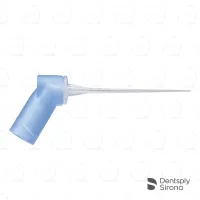
conform fit® gp · reciproc® minima rm20 · 60
a minima preparation is not a constant taper, so a constant-taper cone will not fit it. r20 leaves a canal that is .08 apically and reduces coronally – try to fill that with a standard .02 or .04 point and you are either short at the apex or bound in the middle third. conform fit® points are injection moulded to match the shape the corresponding file leaves behind, which is what gives you a snug apical fit and honest tug back.
this pack: 60 × conform fit® gutta-percha points, rm20
made by dentsply sirona
| matched to rm20 | formed to match the shape of a canal prepared with the corresponding file – dentsply's own description |
| variable taper | the cone tapers the way the preparation does, rather than assuming a constant angle the file never cut |
| injection moulded | dentsply cite a 40% more consistent shape than traditionally rolled gutta percha – a manufacturing consistency figure, not a seal claim |
| 60 per box | enough master cones to see a minima list through without rationing them |
› use with reciproc® minima r20 – the file this cone is cut for.
› dry first – matched r20 paper points reach the same shape the cone will occupy.
› seal with a bioceramic sealer such as neosealer® ezflo, whose 29 ga tips suit a conservative preparation.
can i not just use a standard .04 cone?
you can try, but you are fitting a straight-tapered cone to a variable-tapered canal. the matched cone exists because the file's geometry is unusual – that is the whole argument for minima in the first place.
what about reciproc® blue points?
different preparation entirely. blue cuts a .08 regressive taper; minima averages 3.6% on the r20. use the cone matched to the file you actually used.
which size do i need?
the one matching your final file – rm25, rm35, rm45, or the assorted box.
conform fit® gp rm20 · matched gutta-percha master cones · variable taper · injection moulded · 60 points · dentsply sirona · ref mnsrmgpf00020

conform fit® gp · reciproc® minima rm25 · 60
finished at r25 and reaching for whatever cone is in the drawer? an r25 preparation is .08 apically and averages 3.3% along its length. conform fit® rm25 is moulded to that shape rather than to a straight taper, so the cone seats where the file cut instead of binding somewhere it did not.
this pack: 60 × conform fit® gutta-percha points, rm25
made by dentsply sirona
| matched to rm25 | formed to match the canal shape the corresponding file prepares |
| tug back | dentsply describe a snug apical fit and an accurate tug back – the thing you are checking for before you commit |
| consistent shape | injection moulded rather than hand rolled, which is where the shape consistency comes from |
| 60 per box | the working quantity for a practice using minima regularly |
› use with reciproc® minima r25.
› dry first with matched r25 paper points.
› started at r20? if that was your final file, take rm20 cones instead.
do i match the cone to the last file or the first?
the last – the final instrument determines the shape the cone has to fill.
can i use these with reciproc® blue?
no. blue prepares a different, wider shape; use the conform fit® points matched to that system instead.
is there an assorted box?
yes – assorted conform fit® points, useful while you work out which sizes your cases actually finish on.
conform fit® gp rm25 · matched gutta-percha master cones · variable taper · injection moulded · 60 points · dentsply sirona · ref mnsrmgpf00025
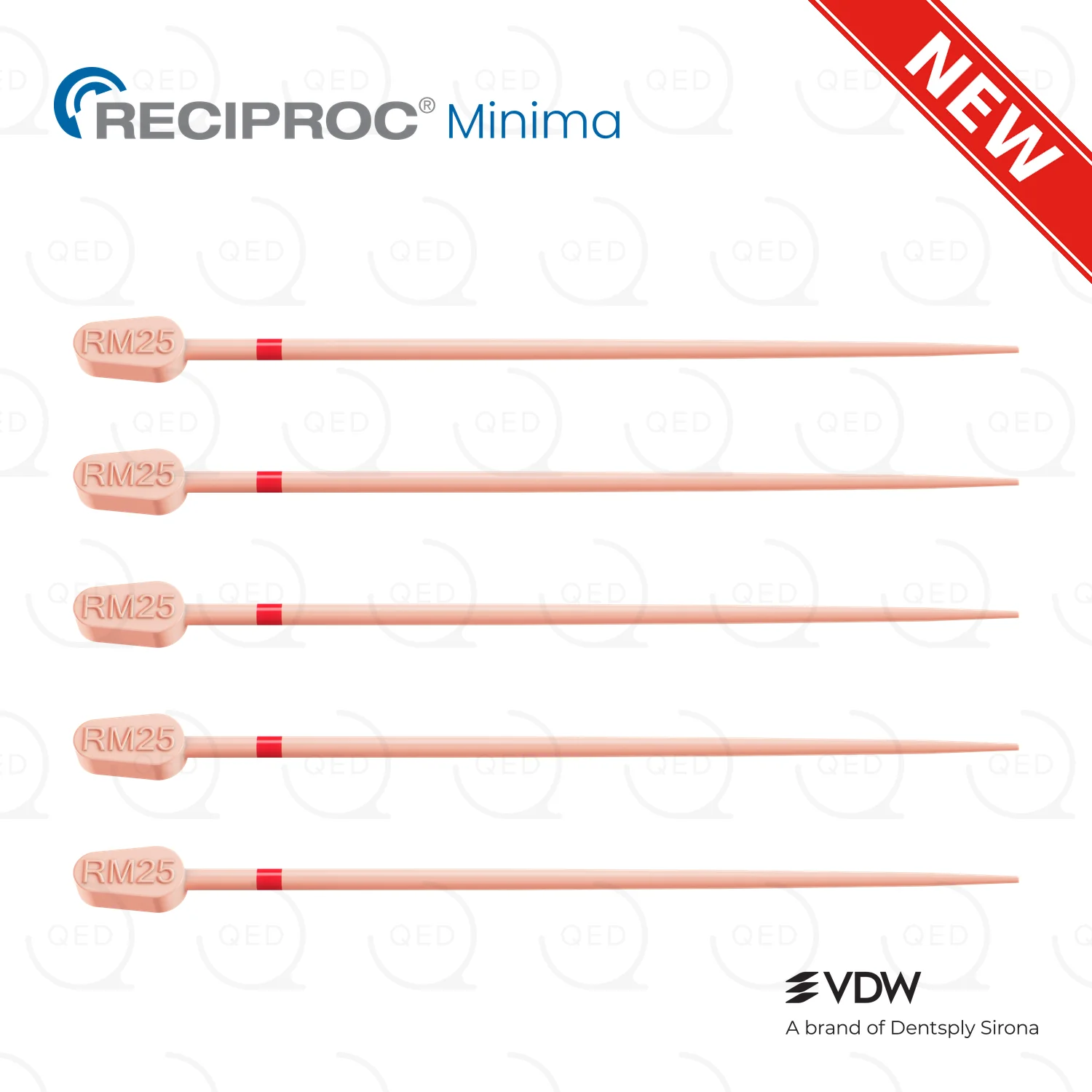
reciproc® minima r20 · 21 mm · 6 files
short roots, or a patient who cannot open far enough for a 25 mm file and a contra-angle? this is r20 – the size the instructions tell you to start with in narrow and challenging canals – in the 21 mm working length. paired with the 9.5 mm short handle, it is the combination that decides whether you can work at all on a lower seven.
this pack: 6 × reciproc® minima r20, 21 mm · sterile, single use
made by dentsply sirona – maillefer, switzerland
| iso 20/.08v | 0.20 mm tip, .08 apical taper reducing coronally – 3.6% averaged along the blade |
| 21 mm | short working length for short roots, and for the posterior access that a longer file cannot reach |
| 0.77 mm | maximum flute diameter – the slimmest body in the range |
| 9.5 mm handle | short shank; with the 21 mm length it is the shortest combination available |
› start here – the instructions specify r20 as the first instrument in narrow and challenging canals.
› technique – pecks of no more than 3 mm, light pressure, and if it stops progressing withdraw it and create a glide path.
› the full story is on the 25 mm r20 page – geometry, published evidence and technique in full.
› obturate with the matched consumables – minima paper points r20 to dry, then conform fit® gp rm20 – sized to this preparation, not to a constant taper.
which length do i need?
21 mm for short roots and limited opening; 25 mm is the everyday length; 31 mm for long roots and canines.
which size after this one?
r25 for a larger apical preparation, or the assorted 21 mm pack to cover the range.
reusable?
no – sterile blister, single use.
reciproc® minima r20 · iso 20/.08v · 0.77 mm max flute · blue heat-treated niti · 9.5 mm handle · 21 mm · 6 sterile files · dentsply sirona · ref mstrcpm621020 · also 25 and 31 mm
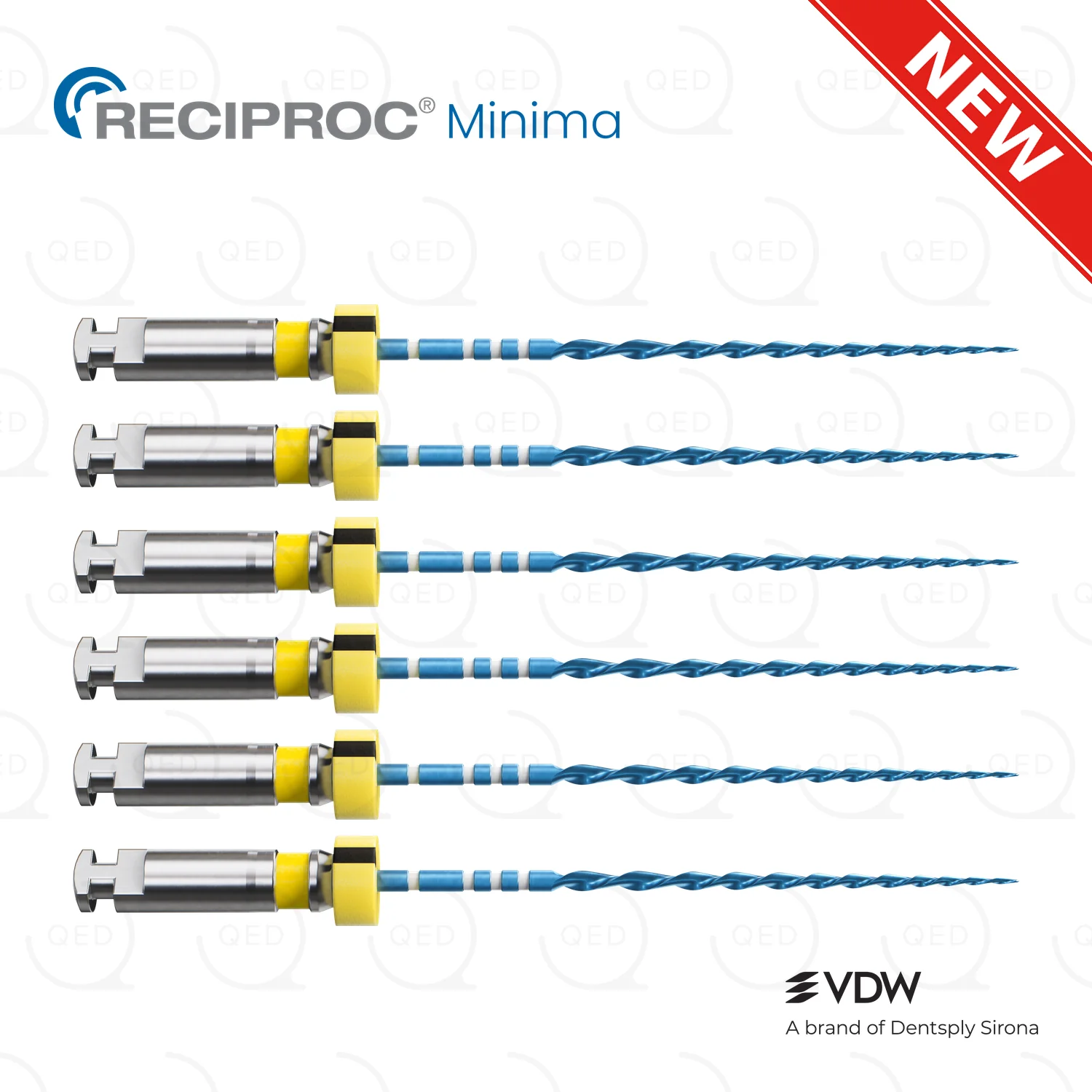
reciproc® minima r25 · 21 mm · 6 files
a stocky molar that needs a 0.25 mm apex, on a patient who barely opens? r25 in the 21 mm length carries the same .08 apical taper as r20 with a wider tip, so the extra preparation lands apically rather than at the orifice – in the working length that suits short roots and awkward access.
this pack: 6 × reciproc® minima r25, 21 mm · sterile, single use
made by dentsply sirona – maillefer, switzerland
| iso 25/.08v | 0.25 mm tip, .08 apical taper reducing coronally – 3.3% averaged along the blade |
| 21 mm | the short working length, for short roots and restricted mouth opening |
| blue niti | heat-treated for flexibility and cyclic-fatigue resistance in curvature |
| non-cutting tip | s-shaped cross-section, inactive tip – follows the canal rather than cutting its own path |
› in wider anatomy the instructions leave the starting size to you, and r25 is where that judgement usually lands.
› in narrow canals start with r20 as the instructions direct.
› full geometry and evidence on the 25 mm r25 page.
› obturate with the matched consumables – minima paper points r25 to dry, then conform fit® gp rm25 – sized to this preparation, not to a constant taper.
how does this differ from reciproc® blue r25?
same tip diameter, very different body – blue runs a .08 regressive taper for regular anatomies and retreatment, minima averages 3.3% for narrow ones. see blue r25.
need a larger apical size?
r35 or r45 in the same length – their apical taper steps down as tip diameter rises.
glide path?
often unnecessary, but the instructions require one if the file stops progressing, with a patency check using an iso 010 or 008 hand instrument.
reciproc® minima r25 · iso 25/.08v · 3.3% average taper · blue heat-treated niti · 9.5 mm handle · 21 mm · 6 sterile files · dentsply sirona · ref mstrcpm621025 · also 25 and 31 mm

reciproc® minima r35 · 21 mm · 6 files
short molar root that still wants a larger apical preparation? r35 is the size where the trade-off breaks: the tip goes up to 0.35 mm while the apical taper steps down to .06 and the average falls to 2.6%. in the 21 mm length, that is a bigger apex in a tooth where you have very little room to work.
this pack: 6 × reciproc® minima r35, 21 mm · sterile, single use
made by dentsply sirona – maillefer, switzerland
| iso 35/.06v | 0.35 mm tip, .06 apical taper reducing coronally – 2.6% averaged along the blade |
| 21 mm | short working length – short roots, and posterior teeth where access is the constraint |
| direct use | its reduced overall taper is why clinicians report going straight to r35 in suitable canals |
| blue niti | heat-treated for flexibility and resistance to cyclic fatigue |
› after r20 or r25, or directly in wider anatomy where the starting size is your choice.
› narrow canal? begin with r20, as the instructions direct.
› full rationale on the 25 mm r35 page.
› obturate with the matched consumables – minima paper points r35 to dry, then conform fit® gp rm35 – sized to this preparation, not to a constant taper.
do the published figures cover r35?
no – the international endodontic journal laboratory study tested r20 and r25 in narrow canals. r35's case is geometric, and we would rather say so than borrow numbers.
is there anything larger?
r45 – 0.45 mm tip on a .05 apical taper, the lowest in the range.
other lengths?
25 mm and 31 mm.
reciproc® minima r35 · iso 35/.06v · 2.6% average taper · blue heat-treated niti · 9.5 mm handle · 21 mm · 6 sterile files · dentsply sirona · ref mstrcpm621035 · also 25 and 31 mm

reciproc® minima r45 · 21 mm · 6 files
wide canal in a short root? a retreatment where the coronal dentine has already been spent? r45 gives a 0.45 mm apical preparation on a .05 apical taper – 2.0% averaged, the slimmest body in the range – in the 21 mm working length.
this pack: 6 × reciproc® minima r45, 21 mm · sterile, single use
made by dentsply sirona – maillefer, switzerland
| iso 45/.05v | 0.45 mm tip, .05 apical taper reducing coronally – 2.0% averaged, the lowest in the range |
| 21 mm | short working length for short roots and constrained access |
| direct use | low overall taper is why it can be used directly in suitable, wider canals |
| blue niti | heat-treated flexibility and fatigue resistance – useful in the largest instrument of the set |
› wide canals, open apices and retreatment finishing – where apical diameter is set by the anatomy.
› not for narrow canals – those start at r20.
› full rationale on the 25 mm r45 page.
› obturate with the matched consumables – minima paper points r45 to dry, then conform fit® gp rm45 – sized to this preparation, not to a constant taper.
one size down?
r35 – 0.35 mm tip on a .06 apical taper.
other lengths?
25 mm and 31 mm.
reusable?
no – sterile blister, single use.
reciproc® minima r45 · iso 45/.05v · 2.0% average taper · blue heat-treated niti · 9.5 mm handle · 21 mm · 6 sterile files · dentsply sirona · ref mstrcpm621045 · also 25 and 31 mm

reciproc® minima assorted · 21 mm · 6 files
mostly posterior work, short roots, limited opening? the assorted blister in 21 mm holds two r20, two r25, one r35 and one r45 – the whole sequence in the length that suits that case mix, without committing to four separate boxes.
this pack: 2 × r20 · 2 × r25 · 1 × r35 · 1 × r45, all 21 mm · sterile, single use
made by dentsply sirona – maillefer, switzerland
| 2 × r20 | iso 20/.08v – the size the instructions say to start with in narrow canals |
| 2 × r25 | iso 25/.08v – the step up, and the usual first file in wider anatomy |
| 1 × r35 | iso 35/.06v – larger apical preparation, lower coronal taper |
| 1 × r45 | iso 45/.05v – widest apex, slimmest body |
› two thirds r20 and r25 – the pack composition is the manufacturer showing you where the work happens.
› single use – six files is a system to learn on, not a case count.
› full breakdown on the 25 mm assorted page.
› obturate with the matched consumables – assorted minima paper points to dry, then assorted conform fit® gp – sized to this preparation, not to a constant taper.
what do i reorder afterwards?
usually single-size packs of r20 and r25, once you know what your case mix consumes.
other lengths?
25 mm and 31 mm.
which motor?
a dedicated dentsply sirona motor and contra-angle on reciproc® settings. all three motors we stock carry a reciproc® programme: the vdw.silver® reciproc®, the x-smart® pro+ and the x-smart® go. ask us if you are unsure your unit carries the programme.
reciproc® minima assorted · 2 × r20, 2 × r25, 1 × r35, 1 × r45 · blue heat-treated niti · 9.5 mm handle · 21 mm · 6 sterile files · dentsply sirona · ref mstrcpm621ast · also 25 and 31 mm
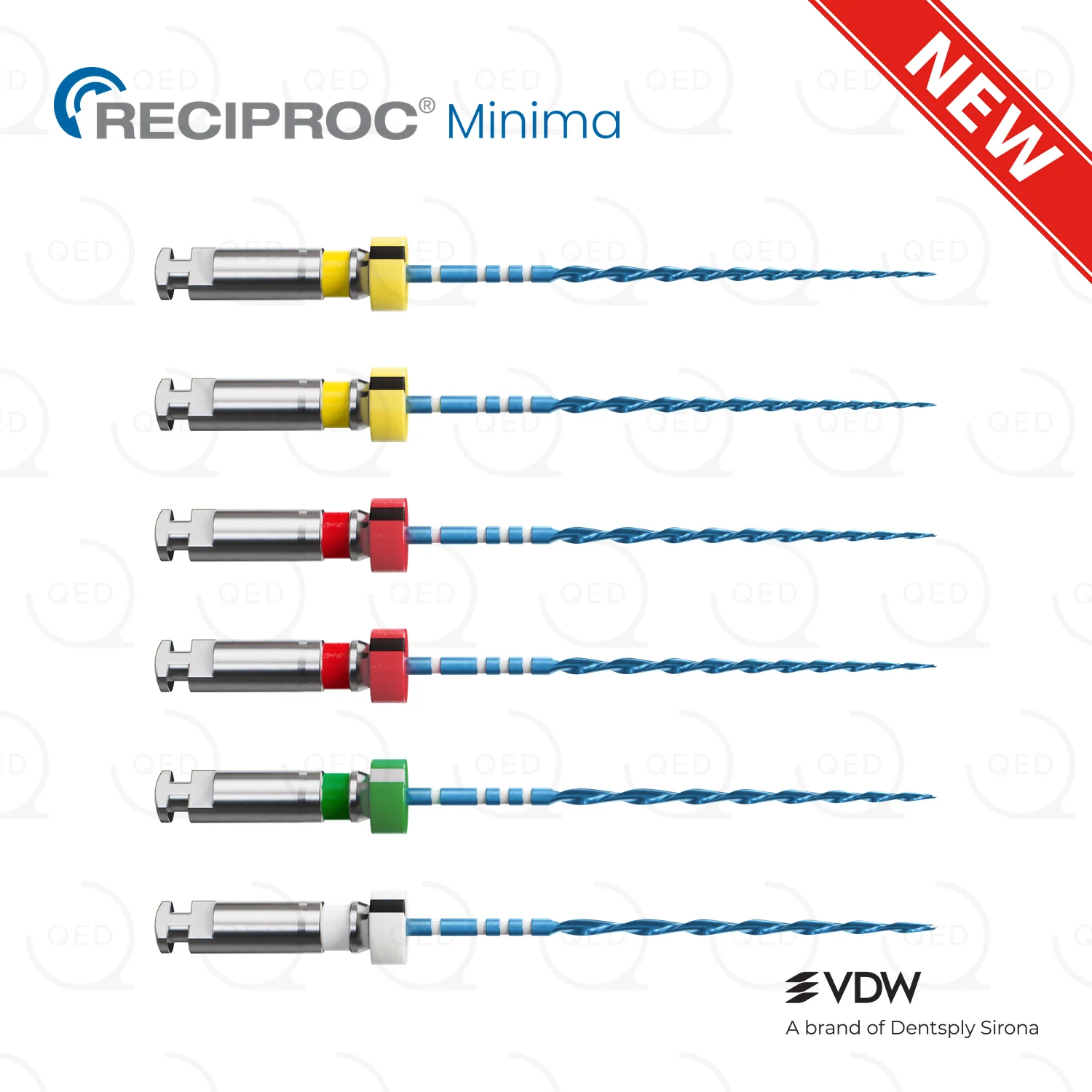
reciproc® minima r20 · 25 mm · 6 files
narrow canalsmb2severe curvaturecalcifiedsingle fileminimally invasivesterile, single use
calcified canal? an mb2 you cannot catch? a curve your files would rather not follow? reciproc® minima is the slim end of the reciprocating family, and r20 is where its instructions for use tell you to begin. a thinner core, a 0.77 mm maximum flute diameter and a 3.6% average taper mean it follows the canal instead of fighting it – which is the whole argument for a conservative preparation in an anatomy that punishes anything wider.
| 96% to length, ex vivo | 0.77 mm max flute | 3.6% average taper |
this pack: 6 × reciproc® minima r20, 25 mm · sterile blister, single use
made by dentsply sirona – maillefer, switzerland
the instrument that will not negotiate a canal is usually not the one that lacks cutting efficiency – it is the one that is too stiff and too wide at the point where the anatomy narrows. minima attacks that directly: a reduced overall taper and a thinner wire, so the file reaches the constriction with less bulk behind it. the practical effect is that a canal you would previously have scouted, opened and only then shaped can often be negotiated by the shaping file itself, and that the pericervical dentine you would have removed to make room simply stays where it is.
the taper figure is worth reading properly, because the headline number understates it. r20's full designation is iso 20/.08v – a 0.20 mm tip with a .08 (8%) taper apically, the v denoting a variable taper that reduces as the blade runs coronally, averaging 3.6% overall. (on the pack and in the instructions it is printed as 020.008v, which is the same thing in zero-padded three-digit fields – 020 is the iso size, 008 is the .08 taper.) so it is not a uniformly thin file: it carries a proper apical taper where shaping and irrigant exchange actually matter, then gives the diameter back through the middle and coronal thirds instead of quietly reaming out the dentine that holds the tooth together. that is the minimally invasive argument in one specification – what the literature now calls minimally invasive endodontics (mie): preserving as much healthy coronal, cervical and radicular tooth structure as the case allows, through access, shaping and obturation alike.
| iso 20/.08v | 0.20 mm tip with an 8% apical taper that reduces coronally – 3.6% averaged along the blade. cutting where it has to be, slim where it counts |
| blue niti | heat-treated for flexibility and resistance to cyclic fatigue, which is what severe curvature actually tests |
| non-cutting tip | s-shaped cross-section with an inactive tip – it follows the canal path rather than cutting its own |
| 9.5 mm handle | short shank for posterior access, where limited opening usually decides whether you can work at all |
for narrow and challenging canals, the procedure should start with instrument size r20. in cases of wider canal anatomy, the selection of the initial instrument size is at the clinician's discretion.
— reciproc® minima instructions for use. this is why r20 is the file to stock first.
in a laboratory study of 330 mesial canals in extracted mandibular molars, published in the international endodontic journal in 2026, instruments were taken to full working length with no prior scouting and no glide path. r20 reached length in 96.4% of canals, against 83.6% for minima r25 and 70.9% for reciproc® blue r25. no instrument fractured in any group. where a larger instrument failed, r20 subsequently reached length in about four cases out of five. it is an ex-vivo study rather than a clinical trial – extracted teeth, controlled conditions – but it is peer-reviewed, and it is the reason this file is worth your attention.
1 reciprocating setting. a dedicated dentsply sirona motor and contra-angle on reciproc® settings – or by hand in severe curvatures.
2 short pecks, light hands. in-and-out movements of no more than 3 mm amplitude, with very light pressure. never force the instrument down the canal.
3 if it stops, stop. the instructions are explicit: do not force it. remove the file, create a glide path, and confirm patency with an iso 010 or 008 hand instrument before continuing.
so do i still need a glide path?
often not – that is the point of the file, and the published study bears it out. but the instructions require one if r20 stops progressing, along with a patency check using an iso 010 or 008 hand instrument. treat "frequently unnecessary" and "never necessary" as very different claims, because they are.
which size do i start with?
r20, in narrow and challenging canals – the instructions say so directly. in wider anatomy the starting size is your call, and r25 is the usual next step. larger apical sizes can be taken with r35 (iso 35/.06v) or r45 (iso 45/.05v) without adding coronal taper – their apical taper steps down to 6% and 5% as the tip diameter goes up, so the coronal profile stays conservative.
is this what people mean by minimally invasive endodontics?
it is one part of it. minimally invasive endodontics – mie, or conservative endodontics – is the principle of keeping as much sound coronal, cervical and radicular dentine as the case allows, and it runs through access design, shaping and obturation. a reduced-taper file addresses the shaping half, and addresses it directly: less coronal enlargement to reach the same apical size, and pericervical dentine left intact. access design and case selection remain yours.
does this replace reciproc® blue?
no – they sit alongside each other. dentsply position blue for regular anatomies, wider canals and retreatment, and minima for narrow and challenging ones. if most of your work is routine, blue r25 stays your everyday file and minima is what you reach for when the anatomy argues back.
which motor do i need?
the instructions specify a dedicated dentsply sirona motor and contra-angle set to reciproc® settings. all three motors we stock carry a reciproc® programme: the vdw.silver® reciproc®, the x-smart® pro+ and the x-smart® go. no model list is published, so if you are unsure whether your unit carries the programme, ask us before ordering rather than after.
can i reuse them?
no. supplied sterile in single-use blisters – reuse raises the risk of cross-contamination and breakage, and with a file this slim the fracture margin is precisely what you are buying.
| next size up | minima r25 25 mm · 3.3% taper |
| larger apical | minima r35 25 mm · 2.6% taper |
| largest | minima r45 25 mm · 2.0% taper |
| try the system | minima assorted 25 mm · all four sizes |
| short roots | r20 in 21 mm |
| long roots | r20 in 31 mm |
| everyday file | reciproc® blue r25 25 mm |
| dry the canal | minima paper points r20 · dedicated points, sized to this file |
| matched cone | conform fit® gp rm20 · the cone moulded to this preparation |
| slim-prep sealer | neosealer® ezflo, 25 mm tips · 29 ga delivery for a conservative preparation |
reciproc® minima r20 · reciprocating single-file system · iso 20/.08v · 8% apical taper, 3.6% average · 0.77 mm max flute · blue heat-treated niti · s-shaped, non-cutting tip · 9.5 mm handle · 25 mm · 6 sterile files · dentsply sirona · ref mstrcpm625020 · also in 21 mm and 31 mm

reciproc® minima r25 · 25 mm · 6 files
narrow canalscurvaturesingle fileminimally invasivesterile, single use
r20 reached length and you want a larger apical preparation? or the canal was never that narrow to begin with? r25 is where minima goes next. same 8% apical taper as r20, a 0.25 mm tip, and an average of 3.3% along the blade – so you gain apical diameter without paying for it in coronal dentine. in wider anatomy the instructions leave the starting size to your judgement, and this is usually where that judgement lands.
| 0.25 mm tip diameter | 8% apical taper | 3.3% average taper |
this pack: 6 × reciproc® minima r25, 25 mm · sterile blister, single use
made by dentsply sirona – maillefer, switzerland
the full designation is iso 25/.08v – a 0.25 mm tip with an 8% taper apically, the v marking a variable taper that reduces coronally to a 3.3% average. set against r20 that is a step up in apical size on an identical apical taper, so the extra preparation happens where you asked for it rather than being spent widening the canal orifice. that is the minimally invasive endodontics case in practice: take the apical diameter the case needs, and leave the pericervical dentine that determines how the tooth behaves under load.
| iso 25/.08v | 0.25 mm tip, 8% apical taper reducing coronally – 3.3% averaged along the blade |
| blue niti | heat-treated for flexibility and cyclic-fatigue resistance, which is what curvature tests |
| non-cutting tip | s-shaped cross-section with an inactive tip – it follows the canal rather than cutting its own path |
| 9.5 mm handle | short shank for posterior access where mouth opening is the limiting factor |
in cases of wider canal anatomy, the selection of the initial instrument size is at the clinician's discretion.
— reciproc® minima instructions for use. in narrow and challenging canals they are specific: start with r20.
in a laboratory study of 330 mesial canals in extracted mandibular molars (international endodontic journal, 2026), instruments were taken to full working length with no prior scouting and no glide path. r25 reached length in 83.6% of these deliberately narrow canals, against 96.4% for r20 and 70.9% for reciproc® blue r25 – a useful ranking, because it shows r25 outperforming a conventional file of the same tip size while still trailing the slimmer r20 in the hardest anatomy. no instrument fractured in any group. it is ex vivo work on extracted teeth, not a clinical trial, but it is peer-reviewed.
1 reciprocating setting on a dedicated dentsply sirona motor and contra-angle – or by hand in severe curvatures.
2 pecks of no more than 3 mm, very light pressure, never forcing the file down the canal.
3 if it stalls, withdraw. create a glide path and confirm patency with an iso 010 or 008 hand instrument before continuing – the instructions are explicit about not forcing it.
should i be starting with r20 instead?
in narrow and challenging canals, yes – the instructions say to start with r20, and the study data supports it. in wider anatomy the choice is yours, and beginning at r25 saves an instrument and a pass.
do i need a glide path first?
frequently not, which is the point of the system. but the instructions require one if the file stops progressing, along with a patency check using an iso 010 or 008 hand instrument. "often unnecessary" and "never necessary" are different claims.
how is this different from reciproc® blue r25?
same tip diameter, very different body. blue r25 runs a .08 regressive taper and is positioned for regular anatomies, wider canals and retreatment; minima r25 averages 3.3% and is built for narrow and challenging ones. they are companions, not replacements.
what if i need a larger apical size?
go to r35 or r45. their apical taper steps down to 6% and 5% as tip diameter rises, so a bigger apical preparation does not bring a bigger coronal one with it.
can i reuse them?
no – sterile blister, single use. reuse raises the risk of cross-contamination and breakage.
| start here | minima r20 25 mm · the primary file |
| larger apical | minima r35 25 mm · 6% apical |
| largest | minima r45 25 mm · 5% apical |
| all four sizes | minima assorted 25 mm |
| short roots | r25 in 21 mm |
| long roots | r25 in 31 mm |
| wider anatomy | reciproc® blue r25 25 mm |
| dry the canal | minima paper points r25 · dedicated points, sized to this file |
| matched cone | conform fit® gp rm25 · the cone moulded to this preparation |
| slim-prep sealer | neosealer® ezflo · 29 ga navitips, 25 mm |
reciproc® minima r25 · reciprocating single-file system · iso 25/.08v · 8% apical taper, 3.3% average · blue heat-treated niti · s-shaped, non-cutting tip · 9.5 mm handle · 25 mm · 6 sterile files · dentsply sirona · ref mstrcpm625025 · also in 21 mm and 31 mm

reciproc® minima r35 · 25 mm · 6 files
larger apicallow coronal tapernecrotic casesminimally invasivesterile, single use
necrotic case wanting a larger apical size? a canal where 0.25 mm simply isn't enough? the old trade-off was that going up in apical diameter meant going up in taper too, and paying for it in coronal dentine. r35 breaks that: a 0.35 mm tip on a 6% apical taper that reduces to just 2.6% averaged along the blade – the lowest-taper way in the range to reach that apical size.
| 0.35 mm tip diameter | 6% apical taper | 2.6% average taper |
this pack: 6 × reciproc® minima r35, 25 mm · sterile blister, single use
made by dentsply sirona – maillefer, switzerland
read the range in order and the design intent is obvious. r20 is 20/.08v, r25 is 25/.08v, and r35 is iso 35/.06v – the tip diameter climbs while the apical taper steps down from 8% to 6%, and the average along the blade falls from 3.6% to 2.6%. so the larger apical preparation is genuinely apical: you are not dragging a wider body up through the coronal third to get there. for anyone working to minimally invasive endodontic principles, that is the whole point – apical size is a clinical decision, pericervical dentine is a structural one, and this range lets you make them separately.
| iso 35/.06v | 0.35 mm tip, 6% apical taper reducing coronally – 2.6% averaged along the blade |
| direct use | its reduced overall taper is why clinicians report going to r35 directly in suitable canals rather than stepping through the smaller sizes |
| blue niti | heat-treated for flexibility and cyclic-fatigue resistance in curvature |
| non-cutting tip | s-shaped cross-section, inactive tip – follows the canal instead of cutting its own path |
r35 and r45 may be used directly, without employing the intermediate instruments, owing to their reduced overall taper.
— yared, de-deus and glassman, writing on the system. a clinical observation rather than an instruction – the instructions for use still put r20 first in narrow and challenging canals.
› after r20 or r25 – when the case calls for a larger apical diameter than the smaller files leave.
› directly, in suitable anatomy – where the canal is not narrow and you want the apical size in one instrument.
› necrotic cases where a larger apical preparation is part of your disinfection strategy, without the coronal enlargement that usually comes with it.
› still narrow? start with r20 as the instructions direct, then step up.
can i go straight to r35?
in wider anatomy the instructions leave the starting size to you, and the reduced overall taper is what makes going directly practical. in narrow and challenging canals they are specific: begin with r20.
isn't a 0.35 mm apical size aggressive?
apically, it is larger by design – that is why you would choose it. what it avoids is the coronal cost: at 2.6% average taper the body of this file is slimmer than most 4% and 6% instruments of a smaller tip size.
do the published study figures apply to r35?
no, and we will not pretend otherwise. the international endodontic journal laboratory study tested r20 and r25 against reciproc® blue r25 in deliberately narrow canals. r35 was not in it. its case rests on the geometry, not on those percentages.
do i still need a glide path?
the instructions require one if the file stops progressing, plus a patency check with an iso 010 or 008 hand instrument. do not force any file down a canal.
can i reuse them?
no – sterile blister, single use.
| start here | minima r20 25 mm · 8% apical |
| step between | minima r25 25 mm · 8% apical |
| largest | minima r45 25 mm · 5% apical |
| all four sizes | minima assorted 25 mm |
| short roots | r35 in 21 mm |
| long roots | r35 in 31 mm |
| dry the canal | minima paper points r35 · dedicated points, sized to this file |
| matched cone | conform fit® gp rm35 · the cone moulded to this preparation |
| slim-prep sealer | neosealer® ezflo · 29 ga navitips, 25 mm |
reciproc® minima r35 · reciprocating single-file system · iso 35/.06v · 6% apical taper, 2.6% average · blue heat-treated niti · s-shaped, non-cutting tip · 9.5 mm handle · 25 mm · 6 sterile files · dentsply sirona · ref mstrcpm625035 · also in 21 mm and 31 mm

reciproc® minima r45 · 25 mm · 6 files
wide canalsopen apexretreatment finishingminimally invasivesterile, single use
wide canal? immature apex? a retreatment where the previous operator already took the easy dentine? r45 gives you a 0.45 mm apical preparation on a 5% apical taper that reduces to 2.0% averaged along the blade – the largest tip in the minima range carried on the slimmest body in it. where a conventional large file would take the coronal third with it, this one leaves it alone.
| 0.45 mm tip diameter | 5% apical taper | 2.0% average taper |
this pack: 6 × reciproc® minima r45, 25 mm · sterile blister, single use
made by dentsply sirona – maillefer, switzerland
it looks counterintuitive until you follow the range: 20/.08v, 25/.08v, 35/.06v and finally iso 45/.05v. as tip diameter rises, apical taper falls – 8%, 8%, 6%, 5% – and the average along the blade falls with it, from 3.6% down to 2.0%. that is a deliberate design decision, and it inverts the usual compromise. ordinarily, reaching a 0.45 mm apical size means accepting whatever the taper does to the canal orifice on the way. here the extra diameter is delivered apically and the body of the file stays conservative, which is what minimally invasive endodontics asks for: shape the apical third to the case, leave the pericervical dentine to hold the tooth together.
| iso 45/.05v | 0.45 mm tip, 5% apical taper reducing coronally – 2.0% averaged, the lowest in the range |
| direct use | its low overall taper is why clinicians report using it directly in suitable canals rather than stepping through smaller sizes |
| blue niti | heat-treated for flexibility and cyclic-fatigue resistance – useful in a larger instrument, which has more to lose |
| non-cutting tip | s-shaped cross-section, inactive tip – follows the canal rather than cutting its own path |
› wide canals where a 0.35 mm apical preparation still leaves the file loose at length.
› immature or open apices, where apical diameter is dictated by the anatomy rather than chosen.
› retreatment finishing, where previous shaping has already spent coronal dentine and you would rather not spend more.
› not for narrow canals – those start with r20, as the instructions direct.
can i use r45 on its own?
in suitable, wider anatomy, yes – the instructions leave the starting size to your discretion outside narrow and challenging canals, and the low overall taper is what makes direct use practical. in a narrow canal, start at r20.
how does it compare with reciproc® blue r40 or r50?
different design philosophy. the blue range runs regressive tapers from .08 and is positioned for regular anatomies, wider canals and retreatment. minima r45 reaches a comparable apical size on a 2.0% average taper. if you want the conservative body, this is the one; if you want the established file for routine cases, blue remains exactly that.
do the published percentages apply here?
no. the international endodontic journal laboratory study covered r20 and r25 in narrow canals; r45 was not tested. its argument is geometric, and we would rather say so than borrow figures that were not measured on this file.
glide path?
required by the instructions if the file stops progressing, along with a patency check using an iso 010 or 008 hand instrument. never force it.
can i reuse them?
no – sterile blister, single use.
| start here | minima r20 25 mm · 8% apical |
| second file | minima r25 25 mm · 8% apical |
| one size down | minima r35 25 mm · 6% apical |
| all four sizes | minima assorted 25 mm |
| short roots | r45 in 21 mm |
| long roots | r45 in 31 mm |
| dry the canal | minima paper points r45 · dedicated points, sized to this file |
| matched cone | conform fit® gp rm45 · the cone moulded to this preparation |
| slim-prep sealer | neosealer® ezflo · 29 ga navitips, 25 mm |
reciproc® minima r45 · reciprocating single-file system · iso 45/.05v · 5% apical taper, 2.0% average · blue heat-treated niti · s-shaped, non-cutting tip · 9.5 mm handle · 25 mm · 6 sterile files · dentsply sirona · ref mstrcpm625045 · also in 21 mm and 31 mm
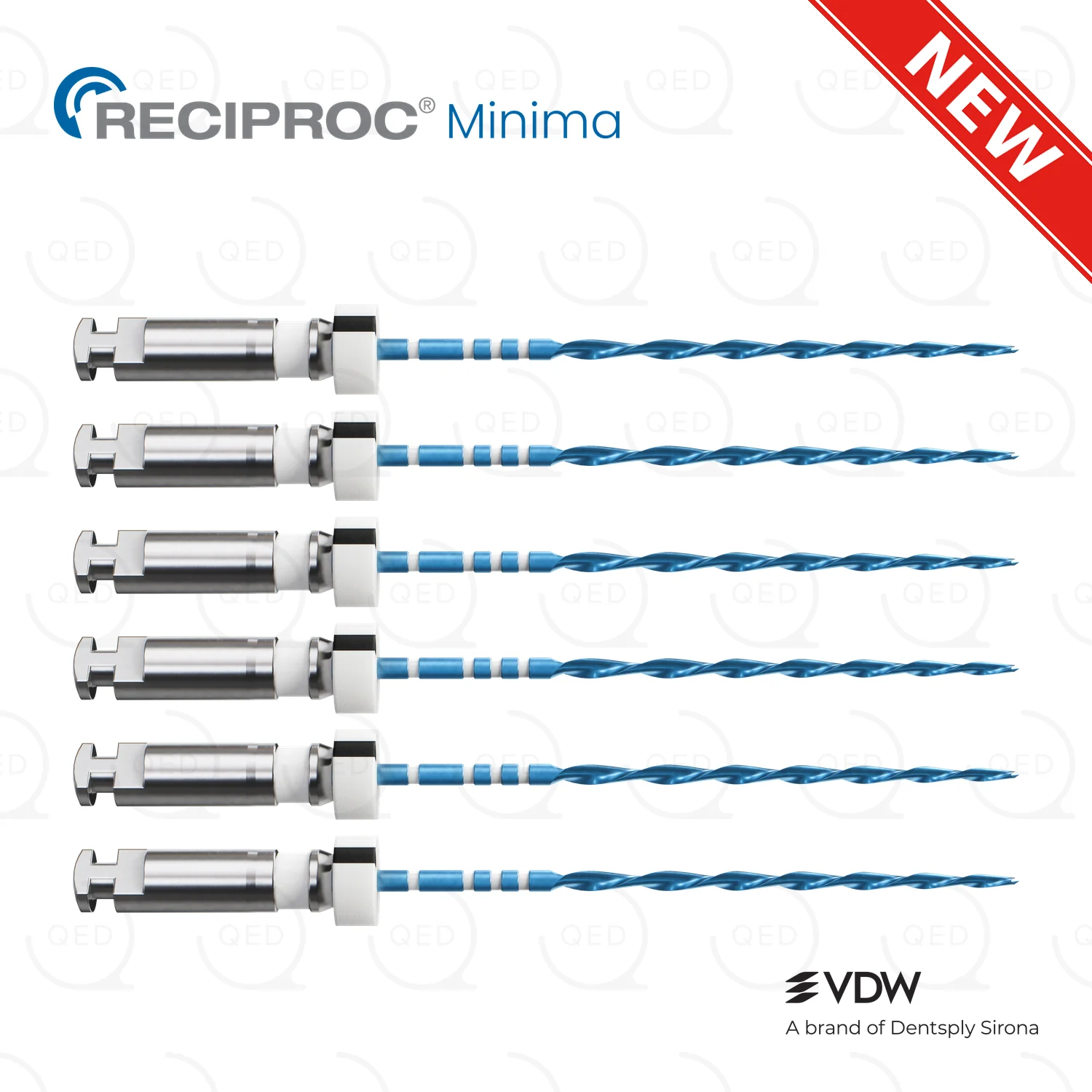
reciproc® minima assorted · 25 mm · 6 files
all four sizesnarrow canalssingle fileminimally invasivesterile, single use
trying minima for the first time, or keeping one pack for whatever the day brings? the assorted blister holds all four sizes – two r20, two r25, one r35 and one r45 – and that ratio is not arbitrary. two thirds of the pack is the small end, which is the manufacturer telling you plainly where these files earn their place: narrow canals, curvature, and the anatomy that makes a routine appointment stop being routine.
| 4 sizes | 6 sterile files | 2.0–3.6% average taper |
this pack: 2 × r20 · 2 × r25 · 1 × r35 · 1 × r45, all 25 mm · sterile blister, single use
made by dentsply sirona – maillefer, switzerland
| 2 × r20 | iso 20/.08v – 8% apical, 3.6% average. the size the instructions tell you to start with in narrow and challenging canals |
| 2 × r25 | iso 25/.08v – 8% apical, 3.3% average. the step up, and the usual starting size in wider anatomy |
| 1 × r35 | iso 35/.06v – 6% apical, 2.6% average. a larger apical preparation without the coronal cost |
| 1 × r45 | iso 45/.05v – 5% apical, 2.0% average. the widest apex in the range on the slimmest body |
run down that table and the engineering logic shows itself: as tip diameter climbs from 0.20 to 0.45 mm, the apical taper steps down from 8% to 5%, and the average along the blade falls from 3.6% to 2.0%. the usual trade-off – a bigger apical size means a wider file all the way up – has been designed out. that is minimally invasive endodontics expressed as a specification: take the apical diameter the case needs, and leave the pericervical dentine that decides how the tooth survives restoration.
for narrow and challenging canals, the procedure should start with instrument size r20.
— reciproc® minima instructions for use. it is also why this blister contains two of them.
in a laboratory study of 330 mesial canals in extracted mandibular molars (international endodontic journal, 2026), the two sizes this pack is weighted towards were taken to full working length with no prior scouting and no glide path: r20 in 96.4% of canals and r25 in 83.6%, against 70.9% for reciproc® blue r25. no instrument fractured in any group. it is ex-vivo work on extracted teeth rather than a clinical trial – but it is peer-reviewed, and it tested precisely the files that make up two thirds of this blister.
is this the right way to start with minima?
for most practices, yes. you get the sequence the system is designed around without committing to four separate boxes, and you find out which sizes your case mix actually consumes. after that, single-size packs of r20 and r25 are usually what you reorder.
will six files cover six cases?
not necessarily – they are single use, and a case may take more than one size. treat the blister as a system to learn on rather than a case count.
do i still need a glide path?
often not, and the study bears that out. but the instructions require one if the file stops progressing, plus a patency check with an iso 010 or 008 hand instrument. never force any file down a canal.
which motor?
a dedicated dentsply sirona motor and contra-angle on reciproc® settings. all three motors we stock carry a reciproc® programme: the vdw.silver® reciproc®, the x-smart® pro+ and the x-smart® go. no model list is published, so check with us before ordering if you are unsure your unit carries the programme.
is it available in other lengths?
yes – the same assortment comes in 21 mm and 31 mm.
| reorder, r20 | minima r20 25 mm · 6 files |
| reorder, r25 | minima r25 25 mm · 6 files |
| reorder, r35 | minima r35 25 mm · 6 files |
| reorder, r45 | minima r45 25 mm · 6 files |
| short roots | assorted, 21 mm |
| long roots | assorted, 31 mm |
| wider anatomy | reciproc® blue r25 25 mm |
| dry the canal | minima paper points, assorted · dedicated points, all sizes |
| matched cone | conform fit® gp, assorted · matched cones across the range |
| slim-prep sealer | neosealer® ezflo · 29 ga navitips, 25 mm |
reciproc® minima assorted · 2 × r20, 2 × r25, 1 × r35, 1 × r45 · blue heat-treated niti · s-shaped, non-cutting tip · 9.5 mm handle · 25 mm · 6 sterile files · dentsply sirona · ref mstrcpm625ast · also in 21 mm and 31 mm

reciproc® minima r20 · 31 mm · 6 files
upper canine at 26 mm? a long-rooted premolar where a 25 mm file leaves you short? this is r20 – the size the instructions tell you to start with in narrow and challenging canals – in the 31 mm working length. the cases that need this reach are often the same ones with a fine, curved canal at the end of it, which is exactly what the slimmest file in the range is for.
this pack: 6 × reciproc® minima r20, 31 mm · sterile, single use
made by dentsply sirona – maillefer, switzerland
| iso 20/.08v | 0.20 mm tip, .08 apical taper reducing coronally – 3.6% averaged along the blade |
| 31 mm | the long working length – canines, long-rooted premolars, and anything a 25 mm file cannot reach to length |
| 0.77 mm | maximum flute diameter – the slimmest body in the range, which matters more the longer the canal |
| blue niti | heat-treated for flexibility and cyclic-fatigue resistance – a longer file sees more of both |
› start here – the instructions specify r20 as the first instrument in narrow and challenging canals.
› technique – pecks of no more than 3 mm, light pressure; if it stops progressing, withdraw and create a glide path.
› the full story is on the 25 mm r20 page – geometry, published evidence and technique in full.
› obturate with the matched consumables – minima paper points r20 to dry, then conform fit® gp rm20 – sized to this preparation, not to a constant taper.
which length do i need?
31 mm for canines and long roots; 25 mm is the everyday length; 21 mm for short roots and limited mouth opening.
which size after this one?
r25 for a larger apical preparation, or the assorted 31 mm pack to cover the range.
reusable?
no – sterile blister, single use.
reciproc® minima r20 · iso 20/.08v · 0.77 mm max flute · blue heat-treated niti · 9.5 mm handle · 31 mm · 6 sterile files · dentsply sirona · ref mstrcpm631020 · also 21 and 25 mm

reciproc® minima r25 · 31 mm · 6 files
long canine that needs a 0.25 mm apex? r25 in the 31 mm length carries the same .08 apical taper as r20 on a wider tip, so the extra preparation lands apically rather than at the orifice – useful in a long tooth, where every extra percent of taper compounds over more millimetres of dentine.
this pack: 6 × reciproc® minima r25, 31 mm · sterile, single use
made by dentsply sirona – maillefer, switzerland
| iso 25/.08v | 0.25 mm tip, .08 apical taper reducing coronally – 3.3% averaged along the blade |
| 31 mm | the long working length, for canines and long-rooted teeth |
| low average taper | 3.3% over 31 mm removes markedly less coronal dentine than a conventional .06 or .08 file of the same tip size |
| non-cutting tip | s-shaped cross-section, inactive tip – follows the canal rather than cutting its own path |
› in wider anatomy the instructions leave the starting size to you, and r25 is where that judgement usually lands.
› in narrow canals start with r20, as the instructions direct.
› full geometry and evidence on the 25 mm r25 page.
› obturate with the matched consumables – minima paper points r25 to dry, then conform fit® gp rm25 – sized to this preparation, not to a constant taper.
how does this differ from reciproc® blue r25?
same tip diameter, very different body – blue runs a .08 regressive taper for regular anatomies and retreatment; minima averages 3.3% for narrow ones. see blue r25.
need a larger apical size?
r35 or r45 in the same length – their apical taper steps down as tip diameter rises.
glide path?
often unnecessary, but the instructions require one if the file stops progressing, with a patency check using an iso 010 or 008 hand instrument.
reciproc® minima r25 · iso 25/.08v · 3.3% average taper · blue heat-treated niti · 9.5 mm handle · 31 mm · 6 sterile files · dentsply sirona · ref mstrcpm631025 · also 21 and 25 mm

reciproc® minima r35 · 31 mm · 6 files
a long tooth that still needs a 0.35 mm apical preparation? this is the combination where conventional geometry hurts most – a larger taper compounded over 31 mm of canal. r35 inverts it: the tip rises to 0.35 mm while the apical taper steps down to .06 and the average falls to 2.6%.
this pack: 6 × reciproc® minima r35, 31 mm · sterile, single use
made by dentsply sirona – maillefer, switzerland
| iso 35/.06v | 0.35 mm tip, .06 apical taper reducing coronally – 2.6% averaged along the blade |
| 31 mm | the long working length – where a low average taper saves the most dentine |
| direct use | its reduced overall taper is why clinicians report going straight to r35 in suitable canals |
| blue niti | heat-treated for flexibility and resistance to cyclic fatigue |
› after r20 or r25, or directly in wider anatomy where the starting size is your choice.
› narrow canal? begin with r20, as the instructions direct.
› full rationale on the 25 mm r35 page.
› obturate with the matched consumables – minima paper points r35 to dry, then conform fit® gp rm35 – sized to this preparation, not to a constant taper.
do the published figures cover r35?
no – the international endodontic journal laboratory study tested r20 and r25 in narrow canals. r35's case is geometric, and we would rather say so than borrow numbers.
is there anything larger?
r45 – 0.45 mm tip on a .05 apical taper, the lowest in the range.
other lengths?
21 mm and 25 mm.
reciproc® minima r35 · iso 35/.06v · 2.6% average taper · blue heat-treated niti · 9.5 mm handle · 31 mm · 6 sterile files · dentsply sirona · ref mstrcpm631035 · also 21 and 25 mm

reciproc® minima r45 · 31 mm · 6 files
long tooth, wide canal, open apex – or a retreatment where the coronal dentine is already spent? r45 in 31 mm gives a 0.45 mm apical preparation on a .05 apical taper, averaging just 2.0% along the blade. over a canal this long, that difference in body diameter is the most dentine any file in the range will save you.
this pack: 6 × reciproc® minima r45, 31 mm · sterile, single use
made by dentsply sirona – maillefer, switzerland
| iso 45/.05v | 0.45 mm tip, .05 apical taper reducing coronally – 2.0% averaged, the lowest in the range |
| 31 mm | the long working length – canines, long premolars and anything a 25 mm file leaves short |
| direct use | low overall taper is why it can be used directly in suitable, wider canals |
| blue niti | heat-treated flexibility and fatigue resistance – the largest instrument of the set has the most to lose |
› wide canals, open apices and retreatment finishing – where apical diameter is set by the anatomy rather than chosen.
› not for narrow canals – those start at r20.
› full rationale on the 25 mm r45 page.
› obturate with the matched consumables – minima paper points r45 to dry, then conform fit® gp rm45 – sized to this preparation, not to a constant taper.
one size down?
r35 – 0.35 mm tip on a .06 apical taper.
other lengths?
21 mm and 25 mm.
reusable?
no – sterile blister, single use.
reciproc® minima r45 · iso 45/.05v · 2.0% average taper · blue heat-treated niti · 9.5 mm handle · 31 mm · 6 sterile files · dentsply sirona · ref mstrcpm631045 · also 21 and 25 mm
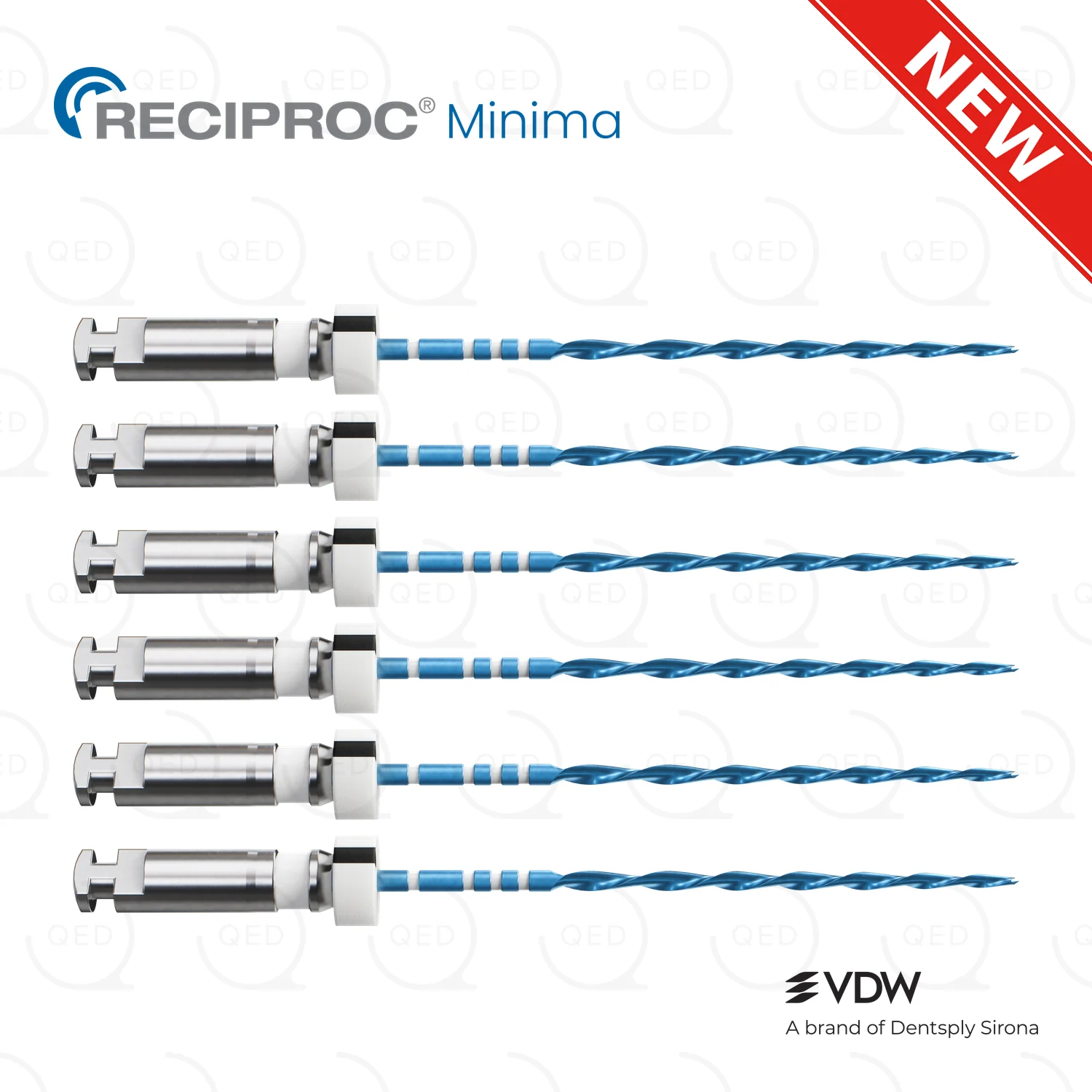
reciproc® minima assorted · 31 mm · 6 files
anterior and canine work, or a referral list of long-rooted teeth? the assorted blister in 31 mm holds two r20, two r25, one r35 and one r45 – the whole sequence in the length those cases need, without stocking four separate boxes of a size you use occasionally.
this pack: 2 × r20 · 2 × r25 · 1 × r35 · 1 × r45, all 31 mm · sterile, single use
made by dentsply sirona – maillefer, switzerland
| 2 × r20 | iso 20/.08v – the size the instructions say to start with in narrow canals |
| 2 × r25 | iso 25/.08v – the step up, and the usual first file in wider anatomy |
| 1 × r35 | iso 35/.06v – larger apical preparation, lower coronal taper |
| 1 × r45 | iso 45/.05v – widest apex, slimmest body |
› two thirds r20 and r25 – the pack composition is the manufacturer showing you where the work happens.
› single use – six files is a system to learn on, not a case count.
› full breakdown on the 25 mm assorted page.
› obturate with the matched consumables – assorted minima paper points to dry, then assorted conform fit® gp – sized to this preparation, not to a constant taper.
what do i reorder afterwards?
usually single-size packs of r20 and r25, once you know what your case mix consumes.
other lengths?
21 mm and 25 mm.
which motor?
a dedicated dentsply sirona motor and contra-angle on reciproc® settings. all three motors we stock carry a reciproc® programme: the vdw.silver® reciproc®, the x-smart® pro+ and the x-smart® go. ask us if you are unsure your unit carries the programme.
reciproc® minima assorted · 2 × r20, 2 × r25, 1 × r35, 1 × r45 · blue heat-treated niti · 9.5 mm handle · 31 mm · 6 sterile files · dentsply sirona · ref mstrcpm631ast · also 21 and 25 mm

paper points · reciproc® minima r20 · 180
step 11 of dentsply's own minima sequence reads: dry the canal with dedicated absorbent paper points. not any paper points – dedicated ones. a minima preparation is deliberately conservative, and a generic .02 point of the same iso tip size behaves differently in it: too slender to wick properly, or binding coronally before the tip ever reaches length. the r20 point is made for the canal the r20 file leaves.
this pack: 180 × absorbent paper points, reciproc® minima r20
made by dentsply sirona
| matched to r20 | sized to the shape the corresponding minima file prepares, so the point reaches length instead of stopping short |
| manufacturer's own step | dentsply's published minima procedure calls for dedicated absorbent points before obturation – this is their instruction, not our recommendation |
| 180 per box | you use several points to dry one canal and one cone to fill it, which is why the point box is three times the cone box |
› prepared with reciproc® minima r20 – the file these points are sized against.
› then fill with conform fit® gp rm20 – the matched cone, moulded to the same preparation.
› seal with neosealer® ezflo – its 29 ga tips are built for exactly this width of canal.
why not just use my usual .02 points?
you can, and plenty do. but the point of a matched range is that the paper reaches the same place the cone will occupy. if your point stops 2 mm short, you have dried the middle third and guessed at the apex.
are reciproc® blue points the same thing?
no. blue and minima cut different shapes. use the points matched to the file you actually used – that is the entire reason both ranges exist.
which size do i need?
the one matching your final file – r25 points, r35 points, r45 points, or the assorted box.
reciproc® minima paper points r20 · dedicated absorbent points · matched to the r20 preparation · 180 per box · dentsply sirona · ref mstrmppm00020

reciproc® r25 · 25 mm · 6 files
still stepping through a sequence, and reprocessing what survives it? reciproc® prepares the whole canal with one reciprocating instrument, and in the majority of canals with no initial hand filing. r25 is where vdw's own selection protocol lands most often, and 25 mm is the length most cases call for. it is also the instrument in the published papers: when a study says reciproc®, this is usually what was on the bench.
| 93%+ without a glide path | 1 file per molar | 66% fewer retreatments |
this pack: 6 × reciproc® r25, 25 mm · radiopaque depth markings at 18/19/20/22 mm · sterile blisters, single use – one molar per file, per vdw
made by vdw, munich – genuine reciproc®
a 0.25 mm tip on an 8% taper over the first 3 mm, regressing above it to d16 1.05 mm – apical shaping where the case needs it, coronal dentine left alone. the alloy is m-wire®, which vdw describe as having greater cyclic fatigue resistance and greater flexibility than traditional nickel-titanium; the core is s-shaped with a non-cutting tip, so it follows the canal rather than cutting its own path; and the shaft is 11 mm against the 13 mm or longer on many instruments, which is felt on a second molar with limited opening.
it is not a rotary file driven differently. the reciprocating angles are set below the point at which the instrument would fail, so binding cannot lock it – which is the whole basis of the glide path argument. vdw's wording, and ours: the angles "are smaller than the angle settings where the elastic limit of the instrument would be met, thus minimising the risk of instrument fractures."
settled before you start, from the radiograph and, where the canal is visible, one hand file inserted passively – here meaning it travels directly to working length with a gentle watch-winding movement, but with no filing action.
› r25 – canal partly or completely invisible on the radiograph, or visible but an iso 20 will not go passively.
› r40 – an iso 20 goes passively, an iso 30 does not.
› r50 – an iso 30 reaches working length passively.
in most cases, the r25 will be suitable in size for the root canal treatment.
— vdw, reciproc® user brochure, summarising its own instrument-selection protocol.
1 check the canal is free with an iso 10 hand instrument – the directions name vdw's own c-pilot® 010 in 25 mm. no orifice opener first; the design clears the coronal third itself.
2 irrigate, throughout. the directions have you irrigate the canal and clean the flutes between passes – a single-file system shortens the mechanical part of the case, not the chemical one. sodium hypochlorite in 5.25% or 2%, to your own protocol.
3 shape on the reciproc® setting in slow in-and-out pecks of no more than 3 mm, very light pressure, three at a time. then out, flutes cleaned in the interim stand, re-irrigate, patency confirmed, back in. a lateral brushing motion is sanctioned for irregular canals.
4 gauge the apex with a hand instrument one iso size larger than the file that reached length: light tug-back about 1 mm short and no further means the preparation is done. r25 achieves an iso 33 at 1 mm from the apex; for a larger apical preparation, r40 or r50 follow.
5 dry, then obturate. matched paper points r25, then the matched gutta-percha cone carried to length with sealer – vdw make it in the greater taper corresponding to this instrument, for single cone, lateral compaction or a master cone in warm vertical condensation. the taper you cut is the taper you fill.
6 seal it coronally. the apical seal is only half the job – sdr® flow+ places a 4 mm bulk increment straight over the orifices in a single cure.
and the glide path? no initial hand filing in the majority of canals – the manufacturer's own headline, unchanged since 2011, with a peer-reviewed figure behind it: de-deus and colleagues (international endodontic journal, 2013) took the r25 to full working length without an initial glide path in more than 93% of canals. where it does not advance, do not force it: withdraw, clean, irrigate, try again, and if it still will not go, create a glide path with c-pilot® 015 and continue. "usually unnecessary" and "never necessary" are different claims, and only the first is ours to make.
a single-file canal is only as good as what goes into it, and this is where we reach for neosealer® ezflo: premixed bioceramic, nothing to mix or time on the bench, around 35 minutes of working time, 5.5 mm al radiopacity, delivered through 29 gauge navitip™ cannulas. the gauge is the point – a bore that fine places sealer in the apical third rather than wiping it down the coronal walls, and the 25 mm tips match this file's length. prefer a wider bore? neosealer® flo is the same chemistry with flex flo tips. staying with resin? ah plus® is still the epoxy sealer every other one is measured against, and vdw's own 2seal® is the brand-matched epoxy-amine. resin or bioceramic is a choice of technique rather than a ranking – we carry both because both are right in different hands.
bürklein and colleagues (iej, 2012) found this system prepared a canal up to 60% faster than multiple-file systems – 73.1 seconds against 185.2 – while maintaining the original curvature and cleaning the apical region more thoroughly; gavini (joe, 2012) measured the r25's own cyclic fatigue resistance as significantly higher in reciprocation than in continuous rotation; and zuolo (iej, 2013) found it left the least residual gutta percha and sealer of the retreatment approaches compared, at 4.57%, because r25 retreats as well as it shapes. the newest citation is about teeth rather than benches: kiel followed 14,233 endodontically treated teeth for five to ten years (iej, june 2025) and found survival without further intervention 30–40% higher under the reciproc® protocol, non-surgical retreatment 66% lower and extractions 21% lower. it is a retrospective single-centre cohort, statistically adjusted, and the authors say only that the result "might be attributed to" the system – but it answers the question a clinician actually has.
the limit is worth knowing and it is narrow. severe curvature is what this instrument is for; abrupt apical curvature is a contraindication. if the iso 10 hand file used for working length still has to be pre-curved to reach it, after the instrument has reached two thirds of the estimated length, finish the canal with hand files. vdw have printed the sentence that puts it in proportion since 2010: this limitation also applies to continuous rotary instruments. and the files may look slightly curved in the blister – vdw note that this is not a manufacturing defect.
the fracture of the original reciproc is not an issue considering that its fracture rate is very low (0.2%).
— ghassan yared, who developed single-file reciprocation and consults to the reciproc® range. his statement in a vdw article, rather than a study result.
what motor do i need?
a drive system carrying the original vdw reciproc® settings – reciprocating motors without them can lead to misuse. we stock the vdw.silver® reciproc® with 6:1 contra-angle, the motor this system launched with, and the x-smart® pro+ with an integrated apex locator. the cordless x-smart® go carries a reciproc® programme too.
how does this compare with reciproc® blue?
same geometry, same three sizes, same movement, same motor programme – the difference is the alloy. this is the original in m-wire®, and the instrument most of the published reciproc® literature was measured on. blue is the later heat-treated version. if your practice is already standardised on this one, nothing about it has changed.
one file per case, really?
per molar, which is the unit vdw set – so a two-molar appointment is two files, and one per canal in extreme curvature. against three to six rotary instruments plus reprocessing the arithmetic still works, and the plastic band on the shaft deforms in the autoclave, so the decision is made for you.
| patency, and between passes | c-pilot® 010 and 008 in 25 mm · interim stand and foam refills for the flutes |
| drive it | a motor with original reciproc® settings: vdw.silver® · x-smart® pro+ · x-smart® go |
| other sizes and lengths | r40 and r50 in 25 mm, or the assorted blister · r25 in 21 mm or 31 mm |
| irrigate | hypochlorite 5.25% or 2% · 17% edta · 40% citric acid · 2% chx · through irriflex® 30g or navitip™ 29 ga 25 mm, activated with eddy® |
| dry and fill | paper points r25 · gutta-percha r25 · or assorted boxes covering all three sizes: points, cones |
| buying in | system kit – 12 files, assorted cones and points, and a training model |
reciproc® r25 · reciprocating single-file system · 0.25 mm tip, 8% taper over the first 3 mm, regressive, d16 1.05 mm · m-wire® niti · s-shaped cross-section, non-cutting tip, 11 mm shaft · radiopaque markings 18/19/20/22 mm · shaping, curvature, mb2 and retreatment · 6 sterile files, single use, one molar · 25 mm, also in 21 and 31 mm · vdw, munich · ref v040212025025

reciproc® gutta-percha r25 · 60 cones
filling a reciproc® preparation with a constant-taper cone means filling a shape you did not make. these are vdw's own points for the system: a greater taper that corresponds to the individual instrument shapes, which is what produces an accurate fit and an honest tug back. this box is sized to the r25, the instrument most canals take.
this box: 60 × reciproc® gutta-percha r25 · 28 mm cone length · alpha-phase gutta-percha
made by vdw, munich – genuine reciproc®
| matched to r25 | the greater taper corresponds to the instrument's own shape, which is what vdw say ensures an accurate fit |
| any technique | single cone or lateral compaction cold, or as a master cone for warm vertical condensation |
| one length fits all | sized to the instrument rather than to its length, so one box serves 21, 25 and 31 mm cases |
› carried to length with sealer – the cone and the sealer are one step, not two.
› dry first with the matched points – reciproc® paper points r25, sterile in blister cells of four.
› then seal coronally – the apical seal is only half the job.
can i use these with reciproc® blue or minima?
no – match the cone to the file that cut the canal. blue and minima each have their own points, made to their own geometry. a cone that does not describe the shape you prepared is the wrong cone whatever it says on the box.
what if i gauged larger than r25?
then the preparation finished on an r40 or r50, and it takes the r40 or r50 cone. the assorted box carries all three.
| dry the canal | reciproc® paper points r25 |
| seal | bioceramic neosealer® ezflo with 29 ga tips, or neosealer® flo · resin ah plus® or vdw's 2seal® |
| coronal seal | sdr® flow+ universal · 4 mm bulk increment in one cure |
| the file itself | r25 in 21 mm, 25 mm or 31 mm |
reciproc® gutta-percha r25 · 60 cones · 28 mm · alpha-phase · greater taper corresponding to the r25 instrument · single cone, lateral compaction or master cone for warm vertical condensation · serves 21, 25 and 31 mm preparations · vdw, munich · ref v040214028025

reciproc® gutta-percha r40 · 60 cones
an r40 preparation is a different shape from an r25 one, and it wants its own cone. a 0.40 mm tip on a 6% apical taper leaves a canal that finishes at iso 46 a millimetre from the apex – wider apically, and less tapered along the blade. these are vdw's own points for that shape: a greater taper corresponding to the instrument, which is what they say produces an accurate fit.
this box: 60 × reciproc® gutta-percha r40 · 28 mm cone length · alpha-phase gutta-percha
made by vdw, munich – genuine reciproc®
| matched to r40 | corresponds to the individual shape of the r40 instrument – 0.40 mm tip, 6% over the first 3 mm |
| any technique | single cone or lateral compaction cold, or as a master cone for warm vertical condensation |
| one length fits all | sized to the instrument rather than to its length – one box covers 21, 25 and 31 mm cases |
› two ways to arrive here. either the iso 20 went passively and the iso 30 did not, so r40 was the chosen size; or the r25 preparation gauged larger and r40 finished the apical third.
› carried to length with sealer – cone and sealer are one step.
› dry with the matched points – reciproc® paper points r40.
should i buy this size on its own?
only if you use it often. vdw's own assorted box is weighted the way real caseloads are – 40 r25 with ten each of r40 and r50 – and for most practices that box is the better order.
will an r40 cone fit a blue or minima preparation?
no. match the cone to the file that cut the canal – blue and minima have their own points, made to their own geometry.
| dry the canal | reciproc® paper points r40 |
| seal | neosealer® ezflo or neosealer® flo · resin ah plus® or 2seal® · then sdr® flow+ |
| other sizes | r25 cones · r50 cones · assorted box |
| the file itself | r40 in 21 mm, 25 mm or 31 mm |
reciproc® gutta-percha r40 · 60 cones · 28 mm · alpha-phase · greater taper corresponding to the r40 instrument · single cone, lateral compaction or master cone for warm vertical condensation · serves 21, 25 and 31 mm preparations · vdw, munich · ref v040214028040
reciproc® gutta-percha assorted · 60 cones
forty r25, ten r40, ten r50. that split is vdw's, and it is worth reading as what it is – the manufacturer's own statement of how often each size gets used. most canals take an r25, so most cones should be r25; the larger two are there for the wide canals and the apical enlargements. one box covers every preparation the system makes, in the proportion you will actually reach for.
this box: 60 cones – 40 × r25, 10 × r40, 10 × r50 · 28 mm cone length · alpha-phase gutta-percha
made by vdw, munich – genuine reciproc®
| all three shapes | each cone carries the greater taper corresponding to its instrument, which is what vdw say ensures an accurate fit |
| any technique | single cone or lateral compaction cold, or as a master cone for warm vertical condensation |
| every length | sized to the instrument, not its length – this one box serves 21, 25 and 31 mm cases |
› no guessing at the gauge. whichever instrument finished the canal, its cone is in the box.
› pairs with the assorted points. reciproc® paper points assorted are weighted the same way, 96 r25 with 24 each of r40 and r50.
› and with the assorted file blister. same logic across the system: r25 by the box, the larger two three at a time.
is this the box to start with?
yes, unless you already know one size dominates your list. it is also what vdw put in the system kit, alongside the assorted paper points and twelve files.
will these fit a blue or minima preparation?
no. match the cone to the file that cut the canal – those ranges have their own points, made to their own geometry.
| dry the canal | assorted paper points, or singly in r25 |
| seal | neosealer® ezflo or neosealer® flo · resin ah plus® or 2seal® · then sdr® flow+ |
| single sizes | r25 · r40 · r50, 60 to a box |
| the files | r25 25 mm · the assorted blister · or the whole system kit |
reciproc® gutta-percha assorted · 60 cones – 40 × r25, 10 × r40, 10 × r50 · 28 mm · alpha-phase · greater taper corresponding to each instrument · single cone, lateral compaction or master cone for warm vertical condensation · serves 21, 25 and 31 mm preparations · vdw, munich · ref v040214028237

reciproc® paper points r40 · 144 per box
a point that is too narrow leaves moisture where the sealer has to go. these are made to correspond to the r40 preparation – a canal that finishes at iso 46 a millimetre from the apex – so drying it takes fewer points and gets closer to length. industrially sterilised, and packed in blister cells of four so the rest of the box stays sealed.
this box: 144 × reciproc® paper points r40 · sterile blister cells of four · markings at 18, 20 and 22 mm
made by vdw, munich – genuine reciproc®
| matched to r40 | corresponding to the instrument size, so the point follows the shape rather than approximating it |
| sterile, four to a cell | industrially sterilised – vdw's own infection-control reason for the packaging |
| marked at 18/20/22 mm | working length control on the point itself |
› highly absorbent, and vdw note they retain good material consistency when fully saturated.
› one box, every length – sized to the instrument, not to its length.
› fill to match – the r40 gutta-percha cone, carried to length with sealer in the same step.
do i need a full box of this size?
only if r40 is a regular finish for you. the assorted box holds 24 r40 alongside 24 r50 and 96 r25 – vdw's own weighting, and closer to how most lists run.
will these fit a blue or minima preparation?
no – those ranges have their own points, in their own pack sizes. match the consumable to the file that cut the canal.
| fill the canal | reciproc® gutta-percha r40, 60 cones |
| seal | neosealer® ezflo or neosealer® flo · resin ah plus® or 2seal® · then sdr® flow+ |
| other sizes | r25 points · r50 points · assorted box |
| the file itself | r40 in 21 mm, 25 mm or 31 mm |
reciproc® paper points r40 · 144 per box · industrially sterilised, blister cells of four · corresponding to the r40 instrument size · highly absorbent, consistent when saturated · markings 18/20/22 mm · serves 21, 25 and 31 mm preparations · vdw, munich · ref v040216029040

reciproc® paper points assorted · 144 per box
ninety-six r25, twenty-four r40, twenty-four r50. that is vdw's own weighting, and it says something useful: most canals finish on an r25, so most points should be r25. whichever instrument the gauge landed on, its point is in the box – industrially sterilised, packed four to a blister cell so the rest stays sealed while you work.
this box: 144 points – 96 × r25, 24 × r40, 24 × r50 · sterile blister cells of four · markings at 18, 20 and 22 mm
made by vdw, munich – genuine reciproc®
| all three sizes | each corresponding to its instrument – r25, r40 and r50 – in the proportion the system is actually used |
| sterile, four to a cell | industrially sterilised, and the packaging is vdw's own infection-control decision rather than a convenience |
| marked at 18/20/22 mm | working length control on the point itself |
› pairs with the assorted cones. reciproc® gutta-percha assorted follows the same logic – 40 r25 with ten each of r40 and r50. several points dry a canal; one cone fills it.
› one box, every length – sized to the instrument, so it serves 21, 25 and 31 mm cases alike.
› highly absorbent, and consistent when fully saturated.
is this the box to start with?
yes, unless one size dominates your list. it is also what vdw put in the system kit, alongside the assorted cones and twelve files.
will these fit a blue or minima preparation?
no – those ranges have their own points, in their own pack sizes. match the consumable to the file that cut the canal.
| fill the canal | assorted gutta-percha, or single sizes in r25 |
| seal | neosealer® ezflo or neosealer® flo · resin ah plus® or 2seal® · then sdr® flow+ |
| single sizes | r25 · r40 · r50, 144 to a box |
| the files | r25 25 mm · the assorted blister · or the whole system kit |
reciproc® paper points assorted · 144 per box – 96 × r25, 24 × r40, 24 × r50 · industrially sterilised, blister cells of four · corresponding to the r25, r40 and r50 instrument sizes · highly absorbent, consistent when saturated · markings 18/20/22 mm · serves 21, 25 and 31 mm preparations · vdw, munich · ref v040216029237
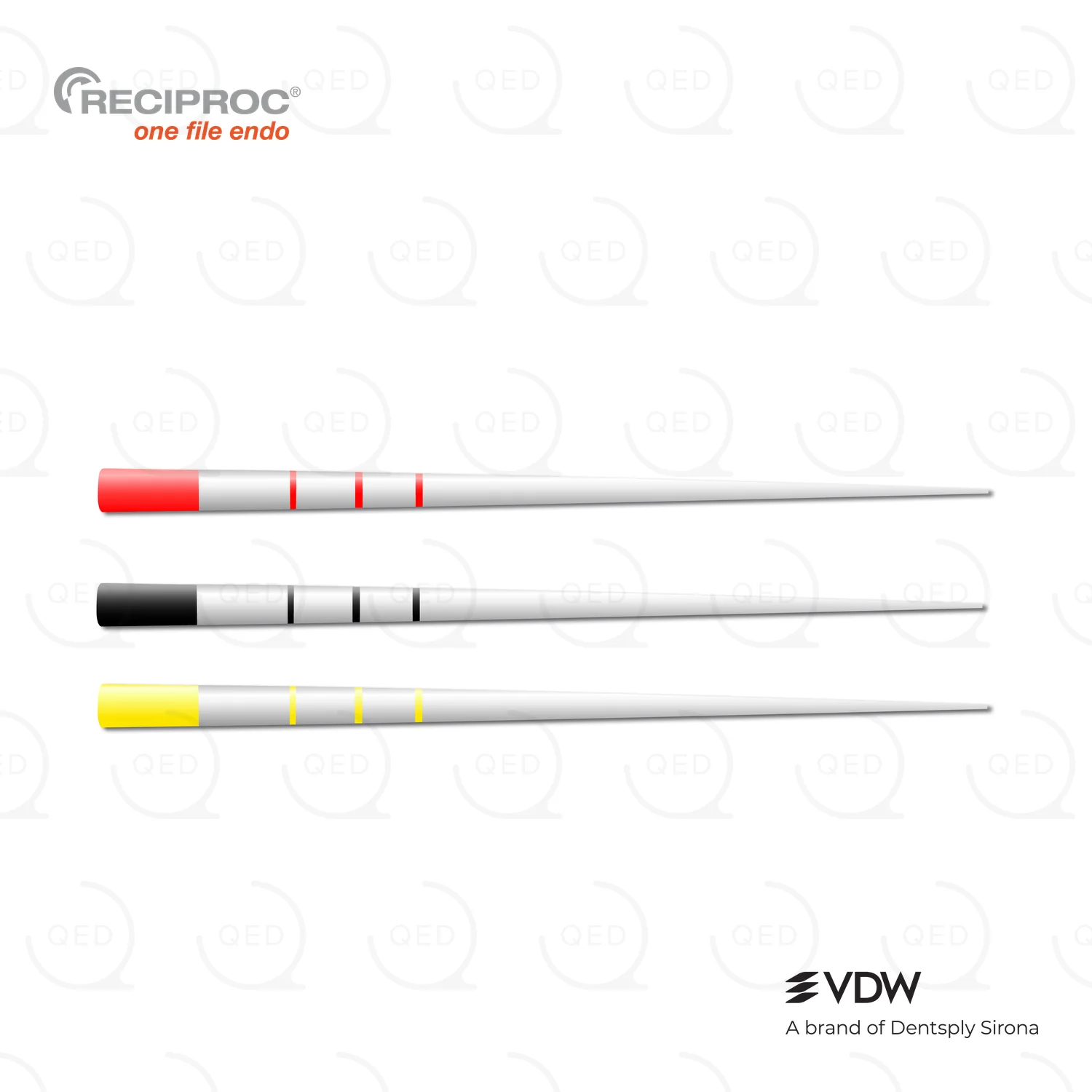
vdw r-pilot® · iso 12.5 · 21 mm · 6 files
glide pathreciprocatingcurved canalsone file to length
r-pilot® cuts the glide path in the same reciprocating motion your reciproc® files already use, on the same motor setting, with no change to the handpiece. at 21 mm it is the length for molars and for patients who cannot open far – which is where the fewest instrument changes are worth the most.
| 12.5 iso tip size | 4% constant taper | 89% to length, ex vivo |
this pack: vdw r-pilot® reciprocating glide path file, iso size 12.5, 21mm (pack of 6) · sterile
ref v040217021012 · made by dentsply sirona (maillefer), switzerland
› one size, iso 12.5, on a constant 4% taper – wider than a .02 glide path file, so it leaves more room for the shaping file that follows.
› reciprocating, and vdw are direct about the practical consequence: "no need to change motor settings if you are already working with reciprocating motion."
› m-wire, with an s-shape cross section that vdw credit for its cutting efficiency.
› sterile, single use, in a blister of six – vdw’s own comparison is with manual files: "sterile instruments and less files needed compared to manual files."
› vdw describe it as "the first motor driven glide path instrument in reciprocating motion", and as a solution "for cases where a glide path is needed" – their wording, and worth keeping, because it does not claim every case needs one.
› three lengths – r-pilot® 25 mm and r-pilot® 31 mm sit beside this one.
the claims on the r-pilot® brochure carry footnotes, and the footnotes matter, so here they are with the claims attached. less risk of instrument fracture and a reduction of cyclic fatigue are compared to rotary multiple-use instruments. better respect of the canal anatomy is versus vdw stainless steel files. neither is a comparison with every other glide path file on the market, and we are not going to write it as though it were.
de-deus and colleagues took r-pilot® through 156 root canals in 52 mandibular molars and counted how often it reached working length, examining every fractured or deformed instrument by scanning electron microscopy. it reached working length in 89.10% of canals, with fracture in 2.56% and deformation in 1.92%. (de-deus g et al., journal of endodontics 2021 – ex vivo, extracted teeth.)
a randomised clinical trial then measured what the patient feels. in 240 patients treated by four specialists, those whose glide path was cut with r-pilot® reported significantly less postoperative pain than those whose glide path was cut with stainless steel k-files. there was no significant difference between r-pilot® and proglider®, the rotary equivalent. (keskin c et al., international endodontic journal 2019 – randomised clinical trial.)
vdw’s own step-by-step card, in their order. not a qed protocol.
1 scout. a c-pilot® file iso size 08 at minimum, or a similar hand file, to ensure patency – c-pilot® 08, 21 mm.
2 working length. by preoperative radiograph, which vdw mark mandatory, and/or an apex locator.
3 irrigant in the access cavity.
4 introduce r-pilot® free, without binding. start the motor when the instrument is at the canal orifice.
5 peck. a slow in-and-out pecking motion, amplitude no more than 3 mm, with only very light pressure. one in-and-out movement is one peck.
6 clean after three pecks. in the interim stand.
7 irrigate.
8 repeat 4 to 7. until full working length is reached.
9 shape. continue with the file system of your choice.
reciproc all – the original vdw reciproc® settings, unchanged. that is the whole point of it on a reciprocating motor. both motors we stock carry the setting: vdw.silver® reciproc® and x-smart® pro+ with apex locator.
| r-pilot® | rotary glide path files | |
| motion | reciprocating | continuous rotation |
| motor | reciproc all – no change | 300 rpm, torque set separately |
| files to length | one | one or three, depending on the system |
| size and taper | iso 12.5, constant 4% | iso 13–19, .02 constant or variable |
| postoperative pain | significantly less than hand files | significantly less than hand files |
the last row is the keskin trial, which found no significant difference between the reciprocating and rotary options. the honest summary is that the choice is usually about which motor is already on the bench.
do i need a different motor?
no, if you already reciprocate. r-pilot® uses the original reciproc® settings, so nothing on the motor changes. if you do not reciprocate, proglider® does the same job in continuous rotation.
is iso 12.5 a real size?
it is vdw’s own designation, printed twice in their current brochure. it sits between an 010 and an 015 hand file, which is the gap a glide path file is meant to close. our stock code ends 012 for historical reasons; the file is a 12.5.
what does it pair with?
anything, but it is vdw’s own file, so the natural sequence is r-pilot® then reciproc® blue r25 on the same motor setting.
can the files be reused?
no. vdw supply them sterile for single patient use.
| patency | c-pilot® 08, 21 mm · c-pilot® 10, 21 mm |
| irrigants | chlorax 5.25% · chlorax 2% · endo-solution 17% edta |
| delivery | navitip™ 29 ga, 25 mm · irriflex® 30g |
| activation | vdw eddy® tips · smartlite pro endoactivator® |
| shape | reciproc® blue r25, 21 mm |
| obturate | vdw 2seal® · ah plus® paste · neosealer® ezflo, 21 mm tips |
| coronal seal | sdr® flow+ refill universal |
vdw 2seal® and ah plus® are the epoxy sealers in the group’s own range; neosealer® ezflo is the premixed bioceramic. resin or bioceramic is a real choice of technique rather than a ranking – we carry both because both are right in different hands.
| proglider®, 21 mm | rotary, one file, iso 16 on a variable progressive taper, 300 rpm. |
| pathfile® assorted, 21 mm | rotary, three files in sequence – 013, 016 and 019, all at a constant .02 taper. |
| waveone® gold glider, 21 mm | reciprocating, one file, matched to the waveone® gold sequence. |
› vdw r-pilot® brochure (pdf, 0.5 mb, vdw) – the geometry, the claims with their footnotes and the product range.
› vdw r-pilot® step-by-step card (pdf, 0.6 mb, vdw) – the nine steps above, as vdw print them.
vdw r-pilot® niti glidepath file · iso 12.5 · constant 4% taper · m-wire · s-shape cross section · 21 mm · sterile, single use · blister of 6 · reciprocating, reciproc all · ref v040217021012

vdw r-pilot® · iso 12.5 · 25 mm · 6 files
glide pathreciprocatingcurved canalsone file to length
r-pilot® is vdw’s glide path instrument, and the argument for it is as much about the motor as the file. it runs on the original reciproc® settings, so a practice already reciprocating changes nothing at all – the same handpiece, the same programme, one extra file.
| 12.5 iso tip size | 4% constant taper | 89% to length, ex vivo |
this pack: vdw r-pilot® reciprocating glide path file, iso size 12.5, 25mm (pack of 6) · sterile
ref v040217025012 · made by dentsply sirona (maillefer), switzerland
› one size, iso 12.5, on a constant 4% taper – wider than a .02 glide path file, so it leaves more room for the shaping file that follows.
› reciprocating, and vdw are direct about the practical consequence: "no need to change motor settings if you are already working with reciprocating motion."
› m-wire, with an s-shape cross section that vdw credit for its cutting efficiency.
› sterile, single use, in a blister of six – vdw’s own comparison is with manual files: "sterile instruments and less files needed compared to manual files."
› vdw describe it as "the first motor driven glide path instrument in reciprocating motion", and as a solution "for cases where a glide path is needed" – their wording, and worth keeping, because it does not claim every case needs one.
› three lengths – r-pilot® 21 mm and r-pilot® 31 mm sit beside this one.
the claims on the r-pilot® brochure carry footnotes, and the footnotes matter, so here they are with the claims attached. less risk of instrument fracture and a reduction of cyclic fatigue are compared to rotary multiple-use instruments. better respect of the canal anatomy is versus vdw stainless steel files. neither is a comparison with every other glide path file on the market, and we are not going to write it as though it were.
de-deus and colleagues took r-pilot® through 156 root canals in 52 mandibular molars and counted how often it reached working length, examining every fractured or deformed instrument by scanning electron microscopy. it reached working length in 89.10% of canals, with fracture in 2.56% and deformation in 1.92%. (de-deus g et al., journal of endodontics 2021 – ex vivo, extracted teeth.)
a randomised clinical trial then measured what the patient feels. in 240 patients treated by four specialists, those whose glide path was cut with r-pilot® reported significantly less postoperative pain than those whose glide path was cut with stainless steel k-files. there was no significant difference between r-pilot® and proglider®, the rotary equivalent. (keskin c et al., international endodontic journal 2019 – randomised clinical trial.)
vdw’s own step-by-step card, in their order. not a qed protocol.
1 scout. a c-pilot® file iso size 08 at minimum, or a similar hand file, to ensure patency – c-pilot® 08, 25 mm.
2 working length. by preoperative radiograph, which vdw mark mandatory, and/or an apex locator.
3 irrigant in the access cavity.
4 introduce r-pilot® free, without binding. start the motor when the instrument is at the canal orifice.
5 peck. a slow in-and-out pecking motion, amplitude no more than 3 mm, with only very light pressure. one in-and-out movement is one peck.
6 clean after three pecks. in the interim stand.
7 irrigate.
8 repeat 4 to 7. until full working length is reached.
9 shape. continue with the file system of your choice.
reciproc all – the original vdw reciproc® settings, unchanged. that is the whole point of it on a reciprocating motor. both motors we stock carry the setting: vdw.silver® reciproc® and x-smart® pro+ with apex locator.
| r-pilot® | rotary glide path files | |
| motion | reciprocating | continuous rotation |
| motor | reciproc all – no change | 300 rpm, torque set separately |
| files to length | one | one or three, depending on the system |
| size and taper | iso 12.5, constant 4% | iso 13–19, .02 constant or variable |
| postoperative pain | significantly less than hand files | significantly less than hand files |
the last row is the keskin trial, which found no significant difference between the reciprocating and rotary options. the honest summary is that the choice is usually about which motor is already on the bench.
do i need a different motor?
no, if you already reciprocate. r-pilot® uses the original reciproc® settings, so nothing on the motor changes. if you do not reciprocate, proglider® does the same job in continuous rotation.
is iso 12.5 a real size?
it is vdw’s own designation, printed twice in their current brochure. it sits between an 010 and an 015 hand file, which is the gap a glide path file is meant to close. our stock code ends 012 for historical reasons; the file is a 12.5.
what does it pair with?
anything, but it is vdw’s own file, so the natural sequence is r-pilot® then reciproc® blue r25 on the same motor setting.
can the files be reused?
no. vdw supply them sterile for single patient use.
| patency | c-pilot® 08, 25 mm · c-pilot® 10, 25 mm |
| irrigants | chlorax 5.25% · chlorax 2% · endo-solution 17% edta |
| delivery | navitip™ 29 ga, 25 mm · irriflex® 30g |
| activation | vdw eddy® tips · smartlite pro endoactivator® |
| shape | reciproc® blue r25, 25 mm |
| obturate | vdw 2seal® · ah plus® paste · neosealer® ezflo, 25 mm tips |
| coronal seal | sdr® flow+ refill universal |
vdw 2seal® and ah plus® are the epoxy sealers in the group’s own range; neosealer® ezflo is the premixed bioceramic. resin or bioceramic is a real choice of technique rather than a ranking – we carry both because both are right in different hands.
| proglider®, 25 mm | rotary, one file, iso 16 on a variable progressive taper, 300 rpm. |
| pathfile® assorted, 25 mm | rotary, three files in sequence – 013, 016 and 019, all at a constant .02 taper. |
| waveone® gold glider, 25 mm | reciprocating, one file, matched to the waveone® gold sequence. |
› vdw r-pilot® brochure (pdf, 0.5 mb, vdw) – the geometry, the claims with their footnotes and the product range.
› vdw r-pilot® step-by-step card (pdf, 0.6 mb, vdw) – the nine steps above, as vdw print them.
vdw r-pilot® niti glidepath file · iso 12.5 · constant 4% taper · m-wire · s-shape cross section · 25 mm · sterile, single use · blister of 6 · reciprocating, reciproc all · ref v040217025012
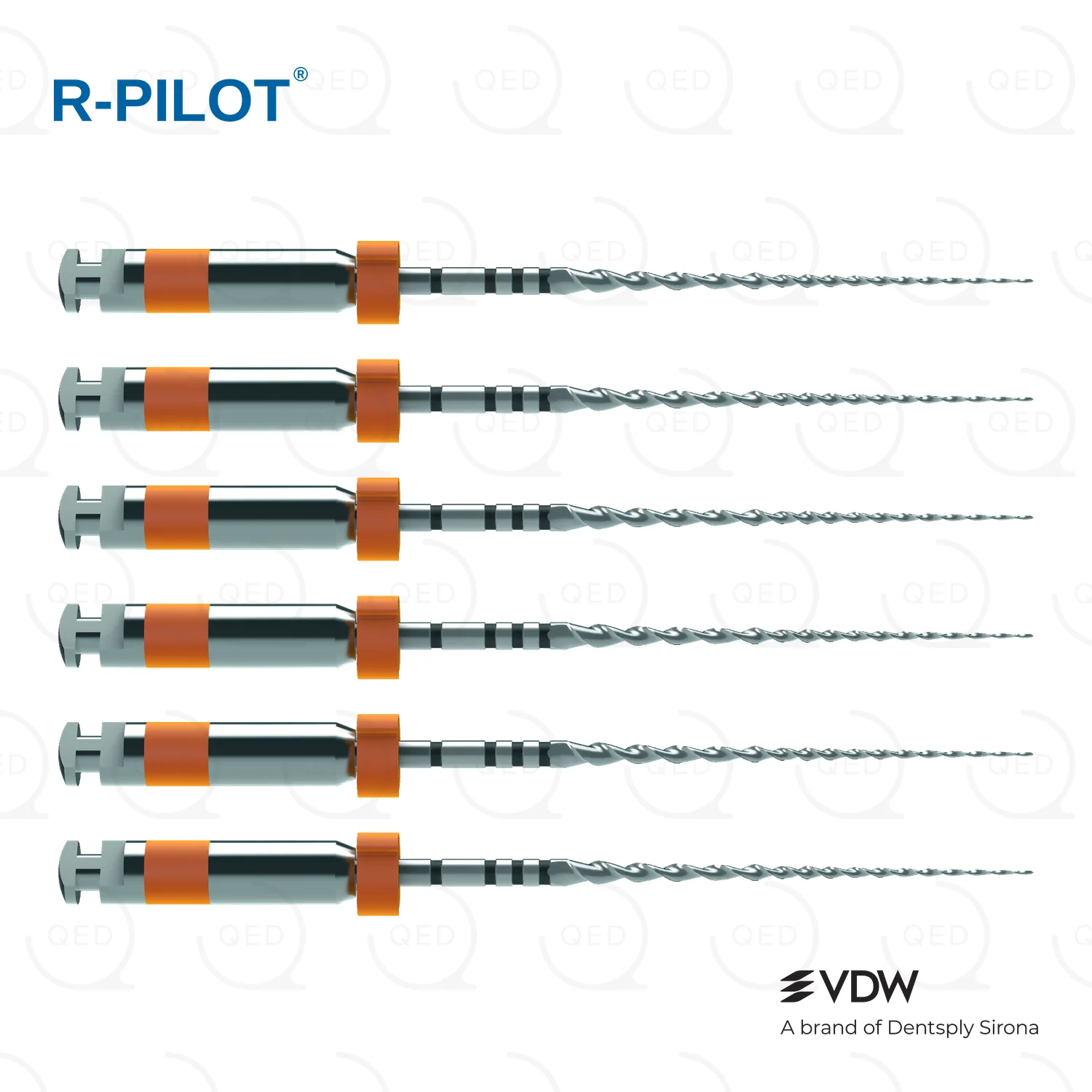
vdw r-pilot® · iso 12.5 · 31 mm · 6 files
glide pathreciprocatingcurved canalsone file to length
r-pilot® in 31 mm is for the canals that need the reach – long roots, and anterior teeth where working length runs past what a 25 mm file will do. the reciprocating motion and the reciproc all setting are the same as the shorter lengths; the scouting step is the part that needs thought, and there is a note on it below.
| 12.5 iso tip size | 4% constant taper | 89% to length, ex vivo |
this pack: vdw r-pilot® reciprocating glide path file, iso size 12.5, 31mm (pack of 6) · sterile
ref v040217031012 · made by dentsply sirona (maillefer), switzerland
› one size, iso 12.5, on a constant 4% taper – wider than a .02 glide path file, so it leaves more room for the shaping file that follows.
› reciprocating, and vdw are direct about the practical consequence: "no need to change motor settings if you are already working with reciprocating motion."
› m-wire, with an s-shape cross section that vdw credit for its cutting efficiency.
› sterile, single use, in a blister of six – vdw’s own comparison is with manual files: "sterile instruments and less files needed compared to manual files."
› vdw describe it as "the first motor driven glide path instrument in reciprocating motion", and as a solution "for cases where a glide path is needed" – their wording, and worth keeping, because it does not claim every case needs one.
› three lengths – r-pilot® 21 mm and r-pilot® 25 mm sit beside this one.
the claims on the r-pilot® brochure carry footnotes, and the footnotes matter, so here they are with the claims attached. less risk of instrument fracture and a reduction of cyclic fatigue are compared to rotary multiple-use instruments. better respect of the canal anatomy is versus vdw stainless steel files. neither is a comparison with every other glide path file on the market, and we are not going to write it as though it were.
de-deus and colleagues took r-pilot® through 156 root canals in 52 mandibular molars and counted how often it reached working length, examining every fractured or deformed instrument by scanning electron microscopy. it reached working length in 89.10% of canals, with fracture in 2.56% and deformation in 1.92%. (de-deus g et al., journal of endodontics 2021 – ex vivo, extracted teeth.)
a randomised clinical trial then measured what the patient feels. in 240 patients treated by four specialists, those whose glide path was cut with r-pilot® reported significantly less postoperative pain than those whose glide path was cut with stainless steel k-files. there was no significant difference between r-pilot® and proglider®, the rotary equivalent. (keskin c et al., international endodontic journal 2019 – randomised clinical trial.)
vdw’s own step-by-step card, in their order. not a qed protocol.
1 scout. a c-pilot® file iso size 08 at minimum, or a similar hand file, to ensure patency – an iso 008 hand file long enough to reach working length at 31 mm.
2 working length. by preoperative radiograph, which vdw mark mandatory, and/or an apex locator.
3 irrigant in the access cavity.
4 introduce r-pilot® free, without binding. start the motor when the instrument is at the canal orifice.
5 peck. a slow in-and-out pecking motion, amplitude no more than 3 mm, with only very light pressure. one in-and-out movement is one peck.
6 clean after three pecks. in the interim stand.
7 irrigate.
8 repeat 4 to 7. until full working length is reached.
9 shape. continue with the file system of your choice.
a note specific to 31 mm. step 1 needs a hand file that reaches working length, and the c-pilot® range stops at 25 mm. take the requirement from vdw’s card – an iso 008 at minimum – and use a 31 mm hand file. a 25 mm file would be shorter than the canal, so we have not linked one here.
reciproc all – the original vdw reciproc® settings, unchanged. that is the whole point of it on a reciprocating motor. both motors we stock carry the setting: vdw.silver® reciproc® and x-smart® pro+ with apex locator.
| r-pilot® | rotary glide path files | |
| motion | reciprocating | continuous rotation |
| motor | reciproc all – no change | 300 rpm, torque set separately |
| files to length | one | one or three, depending on the system |
| size and taper | iso 12.5, constant 4% | iso 13–19, .02 constant or variable |
| postoperative pain | significantly less than hand files | significantly less than hand files |
the last row is the keskin trial, which found no significant difference between the reciprocating and rotary options. the honest summary is that the choice is usually about which motor is already on the bench.
do i need a different motor?
no, if you already reciprocate. r-pilot® uses the original reciproc® settings, so nothing on the motor changes. if you do not reciprocate, proglider® does the same job in continuous rotation.
is iso 12.5 a real size?
it is vdw’s own designation, printed twice in their current brochure. it sits between an 010 and an 015 hand file, which is the gap a glide path file is meant to close. our stock code ends 012 for historical reasons; the file is a 12.5.
what does it pair with?
anything, but it is vdw’s own file, so the natural sequence is r-pilot® then reciproc® blue r25 on the same motor setting.
can the files be reused?
no. vdw supply them sterile for single patient use.
| patency | an iso 008 or 010 hand file in a 31 mm length – the c-pilot® range stops at 25 mm |
| irrigants | chlorax 5.25% · chlorax 2% · endo-solution 17% edta |
| delivery | navitip™ 29 ga, 25 mm · irriflex® 30g |
| activation | vdw eddy® tips · smartlite pro endoactivator® |
| shape | reciproc® blue r25, 31 mm |
| obturate | vdw 2seal® · ah plus® paste · neosealer® ezflo, 25 mm tips |
| coronal seal | sdr® flow+ refill universal |
vdw 2seal® and ah plus® are the epoxy sealers in the group’s own range; neosealer® ezflo is the premixed bioceramic. resin or bioceramic is a real choice of technique rather than a ranking – we carry both because both are right in different hands.
| proglider®, 31 mm | rotary, one file, iso 16 on a variable progressive taper, 300 rpm. |
| pathfile® assorted, 31 mm | rotary, three files in sequence – 013, 016 and 019, all at a constant .02 taper. |
| waveone® gold glider, 31 mm | reciprocating, one file, matched to the waveone® gold sequence. |
› vdw r-pilot® brochure (pdf, 0.5 mb, vdw) – the geometry, the claims with their footnotes and the product range.
› vdw r-pilot® step-by-step card (pdf, 0.6 mb, vdw) – the nine steps above, as vdw print them.
vdw r-pilot® niti glidepath file · iso 12.5 · constant 4% taper · m-wire · s-shape cross section · 31 mm · sterile, single use · blister of 6 · reciprocating, reciproc all · ref v040217031012
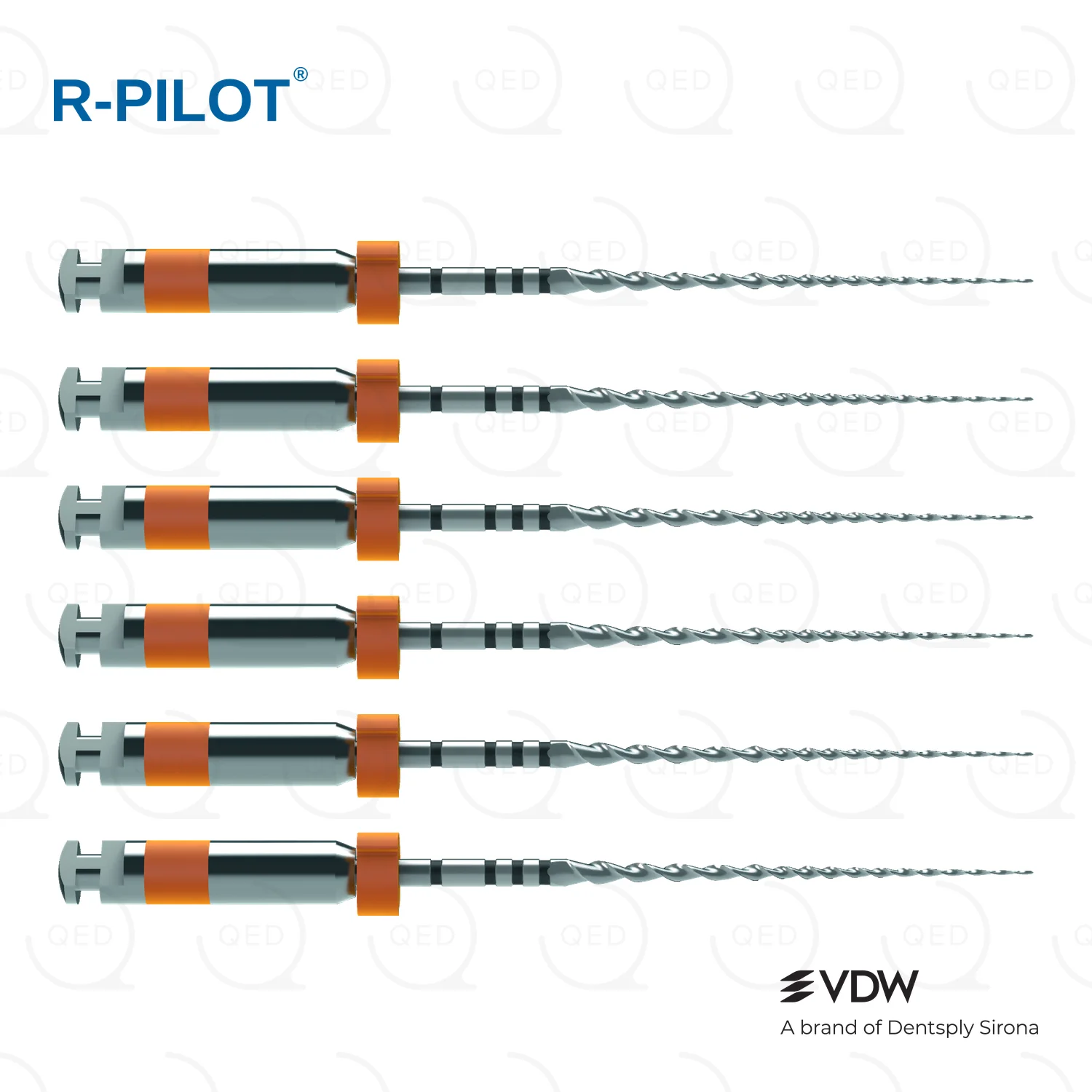
vdw · endo training model castillo
root canal preparation practiceapex locator trainingcourses and study clubs
a loose training tooth teaches the file. it does not teach the reading. vdw's castillo model is a plastic upper jaw, 11 to 17, with a four-canal training tooth at 16, a training block at 17, a fixture for electronic length determination and a minifix gauge in the base – vdw's words: "training model for root canal preparation and electronic length determination". tooth and block are replaceable, so one model serves a course, not a session.
this pack: vdw endo training model castillo, plastic upper jaw 11–17 with endo training tooth (position 16), plastic training block (position 17), fixture for electronic length determination and integrated minifix measuring gauge (1 model)
| model | plastic upper jaw, teeth 11–17 |
| position 16 | vdw endo training tooth – four root canals, three colour-stained, the mb2 left unstained; pulp chamber already accessed (vdw) |
| position 17 | plastic training block |
| length determination | fixture for electronic length determination – the model is made to be used with an apex locator |
| gauge | integrated minifix measuring gauge – vdw: "for precise adjustment of the working length of endo instruments, gutta-percha and paper points" |
› an apex locator reading on the bench. the fixture is what makes this a length-determination trainer as well as a shaping one – the locator has something to connect to, which a tooth held in the fingers never offers.
› access like a mouth. the tooth sits in a jaw at 16, so file, handpiece and mirror meet it as they would a patient's. three of its four canals are stained to be found; the mb2 is not, on purpose.
› a gauge where the file is. the minifix gauge is set into the base, so working length is set without reaching for a ruler.
› training model, not for use on patients. vdw's how-to video is on this page.
vdw describe the fixture only as being for electronic length determination and name no unit. we stock the root zx3 and root zx mini as stand-alone locators, and the x-smart pro+ with the locator built into the motor. buying for a course? tell us which unit the delegates will use and we can advise on clips and cords.
one per delegate per full preparation – a shaped and filled tooth is finished. the model ships with one tooth and one block fitted; vdw list both as reorderable, and the tooth is the vdw training tooth #3 molar ur6 we stock in fives. a study club of six: one pack plus the tooth in the model.
| replacement teeth | vdw training tooth #3 molar ur6 (5) · training blocks: ask us |
| apex locator | root zx3 · root zx mini |
| motor with locator | x-smart pro+ – reciproc all preset on board |
| file to run | reciproc blue r25, 25 mm |
| patency | c-pilot 10, 25 mm |
vdw endo training model castillo · plastic upper jaw 11–17 · training tooth at 16, training block at 17 · fixture for electronic length determination · integrated minifix gauge · training only · made by vdw gmbh, munich, germany · ref v040247000000
c-pilot® iso 010 · 21 mm · 6 sterile files
second molar, limited opening, and a 25 mm handle fighting the opposing arch? the 21 mm c-pilot® 010 puts the handle where your fingers can control it and matches the 21 mm working length your rotary and reciprocating files are supplied in. same instrument as the longer version – thermally hardened stainless steel, inactive pilot tip – with three fewer millimetres of leverage between your hand and the canal.
this pack: 6 × vdw®sterile c-pilot® iso 010, 21 mm, .02 taper · stoppers fitted · mfr code 368 021 010
made by vdw gmbh, munich, germany
| 21 mm | the posterior working length, and the shortest length the shaping systems we stock are made in |
| 0.10 mm tip | a size 10 loose to length is the accepted definition of a glide path |
| inactive pilot tip | vdw's description: conducts the instrument safely along the canal instead of cutting its own path |
| sterile blister of 6 | gamma sterilised to din en iso 11137, ready to use, stoppers pre-mounted |
| thermally hardened | vdw: “high bending strength thanks to a special thermal hardening process” |
| constant .02 taper | the iso hand file geometry – the blade widens by 0.02 mm for every millimetre back from the tip, so the size you read is the size the canal gets |
› shorter shaft, better control – less instrument between your fingers and the canal is exactly what you want when the access is cramped and the file is fine.
› recapitulate with it – back to a loose 010 between shaping files to confirm the path has not packed with debris.
› irrigant first, lubricant only if you use one – the canal wants a reservoir of irrigant; a chelating gel is a matter of preference rather than a step this file requires. if it is part of your protocol, file-eze™ is the 19% edta gel we stock.
› single use – vdw recommend single use of their pre-sterilised instruments; the uk position since april 2007 is that endodontic reamers and files are treated as single use (cmo(2007)5).
21 mm or 25 mm?
21 mm for molars, short roots and any case where the opposing arch limits you. 25 mm for anteriors, canines and long premolar roots. most practices hold both and reach for 21 mm more often than they expect.
do i still need it with a reciprocating system?
yes. the instructions for reciproc® and reciproc® minima ask you to confirm patency with a small hand instrument and to establish a glide path if the shaping file does not advance.
| if 010 will not go | c-pilot 008, 21 mm |
| next step up | c-pilot iso 12.5, 21 mm · a 25% step, not 50% |
| mechanical glide path | waveone® gold glider 21 mm |
| then shape | reciproc® blue r25 21 mm or waveone® gold primary 21 mm |
| narrow anatomy | reciproc® minima r20 21 mm |
| irrigate | navitip™ 29 ga sideport 21 mm |
vdw® c-pilot® iso 010 · 21 mm · .02 taper · molars · glide path · patency · calcified canals · stainless steel · sterile · single use · 6 files · vdw gmbh · ref v040368021010 · also in 25 mm and 19 mm

c-pilot® iso 12.5 · 21 mm · 6 sterile files
the 010 is loose, the 015 binds, and the canal is curved. going straight from 010 to 015 asks for a 50% increase in tip diameter in one instrument. vdw's intermediate iso 12.5 splits it: 25% to get there, another 20% to finish. at 21 mm it is the version for molars and short roots – the teeth where that extra step matters most, because the curve is usually where the binding starts.
this pack: 6 × vdw®sterile c-pilot® iso 12.5, 21 mm, .02 taper · stoppers fitted · mfr code 368 021 012
listed as 012 with us; vdw's designation is the intermediate size iso 12.5
made by vdw gmbh, munich, germany
| iso 12.5 | 0.125 mm at the tip – the intermediate size, listed by vdw as standard stock rather than a special, colour coded brown/bronze |
| two smaller steps | +25% from 010, then +20% to 015, instead of one 50% jump |
| 21 mm | posterior length, matched to the 21 mm rotary and reciprocating files |
| sterile blister of 6 | gamma sterilised to din en iso 11137, stoppers pre-mounted |
| thermally hardened | vdw: “high bending strength thanks to a special thermal hardening process” |
| constant .02 taper | the iso hand file geometry – the blade widens by 0.02 mm for every millimetre back from the tip, so the size you read is the size the canal gets |
› only after 010 runs loose – an intermediate size smooths a transition, it does not create a path.
› recapitulate between sizes – back to 010 to confirm patency before going up.
› irrigate between instruments – every step makes debris the next file would otherwise pack apically.
› single use – per vdw's recommendation and the uk position on endodontic files since april 2007 (cmo(2007)5).
is 012 the same as iso 12.5?
yes – our catalogue shortens vdw's intermediate size to 012. the tip diameter is 0.125 mm; there is no separate iso 12 instrument.
needed if i use a mechanical glider?
often not – a waveone® gold glider takes a loose 010 to a 015 tip on its own. it earns its slot in the canal that will not accept the glider yet, and in practices finishing glide paths by hand.
| step before | c-pilot 010, 21 mm |
| step after | c-pilot 015, 21 mm |
| mechanical glide path | waveone® gold glider 21 mm |
| then shape | waveone® gold primary 21 mm |
| or reciprocate | reciproc® blue r25 21 mm |
| longer roots | iso 12.5 in 25 mm |
vdw® c-pilot® iso 12.5 · 21 mm · .02 taper · intermediate size · brown/bronze · glide path · curved canals · stainless steel · sterile · single use · 6 files · vdw gmbh · ref v040368021012 · also in 25 mm and 19 mm

vdw® c-pilot® iso 008 · 25 mm · 6 sterile files
ten minutes into a lower molar and the 010 is going nowhere? that is the ordinary experience of a sclerosed canal, and it is not a reason to open the access wider. iso 008 is a fifth thinner at the tip than 010, which is often the whole difference between an instrument that stops at a constriction and one that slips past it. c-pilot® 008 is built for exactly that moment: stainless steel, thermally hardened for bending strength, with an inactive pilot tip that is guided by the canal rather than by force.
| 0.08 mm tip diameter | 25 mm working length | 6 sterile blister |
this pack: 6 × vdw®sterile c-pilot® iso 008, 25 mm, .02 taper · pre-mounted silicone stoppers · mfr code 368 025 008
made by vdw gmbh, munich, germany
read the instructions for most reciprocating systems and you will find a small hand instrument written into the sequence: check patency, and if the shaping file does not advance, create a glide path first. iso 008 and iso 010 are the sizes named for that job. buying six of them is not an accessory purchase – it is the step that protects the far more expensive nickel-titanium file that follows, and the tooth it is working in.
at 0.08 mm the wire is very fine, so what it is made of decides how it behaves. vdw credit a special thermal hardening process with the file's high bending strength, and a laboratory comparison of pathfinding instruments in endodontology in 2021 found the stainless steel files, c-pilot® included, more resistant to buckling than the carbon steel and nickel-titanium instruments tested (gupta and colleagues, doi 10.4103/endo.endo_126_20). a bench test is not a clinical result – but buckling is precisely what an 008 does when the canal says no.
| 0.08 mm tip | a fifth finer than an 010 at d0 – usually the step that finds a canal an 010 has been sitting on top of |
| inactive pilot tip | vdw's description: conducts the instrument safely along the canal, which is what keeps a fine file out of a false path |
| thermally hardened | vdw attribute the high bending strength of the range to a special thermal hardening process |
| radiopaque marks | calibration rings and a radiopaque stopper – useful when the file is too fine to see clearly on a film |
| sterile, ready to use | gamma sterilised to din en iso 11137, blister of six, no cycle before first use |
| constant .02 taper | the iso hand file geometry – the blade widens by 0.02 mm for every millimetre back from the tip, so the size you read is the size the canal gets |
for probing in calcified root canals.
— vdw's stated indication for the c-pilot® range. it is a scouting instrument, not a shaping one.
› short amplitude – watch-wind in small arcs with the lightest apical load that still advances the file. force at 008 buys a ledge, not depth.
› pre-curve for a curve you can see – a slight bend at the last few millimetres helps the tip find the direction the canal is already going.
› keep the flutes clear – irrigate and recapitulate rather than asking a lubricant to do it. where a chelating gel is part of your protocol, file-eze™ is the 19% edta option.
› then hand over – once 008 is loose to length, move to 010 and only then to a mechanical glider.
should i stock 008 or 006 as my rescue size?
008 first: it is the one you will use every week, and it is stiff enough to transmit a usable signal. keep a blister of 006 behind it for the genuinely sclerosed cases, where 008 stops as well.
can i autoclave and re-use them?
no. they arrive gamma sterilised in a single blister and vdw recommend single use of their pre-sterilised instruments. since april 2007 the uk position has been that endodontic reamers and files are treated as single use and disposed of after each patient (cmo(2007)5, following the seac statement of 2006).
six files for one canal – is that not a lot?
you will use more than one on a difficult canal, and a fine file that has been stressed is not one to re-introduce. six is the sensible unit for a single sclerosed molar, not for six teeth.
| finer still | c-pilot 006, 25 mm · for sclerosed canals |
| next size up | c-pilot 010, 25 mm · the glide path reference size |
| whole sequence | c-pilot assorted 25 mm · two each of 006, 008, 010 |
| lubricant, optional | file-eze™ kit · 19% edta gel, if you use one |
| mechanical glide path | waveone® gold glider 25 mm |
| narrow anatomy | reciproc® minima r20 25 mm |
| then shape | reciproc® blue r25 25 mm |
| shorter access | c-pilot 008 in 21 mm · posterior teeth, limited opening |
vdw® c-pilot® iso 008 · 25 mm · .02 taper · calcified canals · patency · canal scouting · glide path · stainless steel · sterile · single use · 6 files · vdw gmbh · ref v040368025008 · also in 21 mm and 19 mm

vdw® c-pilot® iso 010 · 25 mm · 6 sterile files
rotary file screwing in, stalling, or refusing the curve? a glide path is not a feeling, it is a measurement. the criterion used across the literature is a size 10 hand file that moves loosely from orifice to working length – and until that is true, every rotary or reciprocating instrument you introduce is doing two jobs at once. c-pilot® 010 is the instrument that establishes it: stainless steel, thermally hardened for bending strength, with an inactive pilot tip that follows the canal instead of cutting its own path.
| 0.10 mm tip diameter | 25 mm working length | 6 sterile blister |
this pack: 6 × vdw®sterile c-pilot® iso 010, 25 mm, .02 taper · pre-mounted silicone stoppers · mfr code 368 025 010
made by vdw gmbh, munich, germany
scouting is a compression problem. you are pushing a very fine wire along a path you cannot see, and the failure mode is not cutting too much – it is the instrument bending, coiling and losing the tactile signal that tells you where the canal goes. that is why the material still matters at this end of the range. in a laboratory comparison of pathfinding instruments published in endodontology in 2021, the stainless steel files, c-pilot® among them, resisted buckling better than the carbon steel and nickel-titanium instruments tested (gupta, mohite, patil and bansal, doi 10.4103/endo.endo_126_20). it is a bench test of one property, not a clinical outcome – but it is the property you are relying on at iso 010.
vdw's answer is a special thermal hardening process, which they credit with the file's high bending strength, and a tip that is deliberately inactive. the point of an inactive tip is that the instrument is guided by the anatomy rather than by you: it will follow a curve it can find, and it will stop rather than start a ledge in one it cannot. combined with the calibration rings and the radiopaque silicone stopper, that gives you something to read on a working-length film rather than something to guess at.
| inactive pilot tip | vdw's description: the tip conducts the instrument safely along the canal, rather than cutting a path of its own |
| thermally hardened | vdw attribute the file's high bending strength to a special thermal hardening process – stiffness where you are pushing |
| radiopaque marks | x-ray visible calibration rings and a radiopaque silicone stopper, so depth is readable on the film |
| cc+ handle | grip designed for fine tactile control, with the length printed on the handle as well as colour coded |
| sterile, ready to use | gamma sterilised to din en iso 11137 and packed in a blister of six – no cycle needed before first use |
| constant .02 taper | the iso hand file geometry – the blade widens by 0.02 mm for every millimetre back from the tip, so the size you read is the size the canal gets |
enables creation of a smooth glide path prior to every rotary preparation.
— vdw's published description of the sterile c-pilot® range. note the word every: the glide path is not the exception, it is the step before the motor.
› watch-winding, not pushing – small reciprocating quarter turns with light apical pressure let the inactive tip find the path. if it stops advancing, come back, irrigate and re-establish before trying again.
› work through a reservoir – scout through irrigant rather than a dry canal. whether to add a viscous chelator on top of that is a matter of preference and opinion is divided, but where one is used, file-eze™ is 19% edta in a water soluble gel.
› recapitulate – return to 010 between shaping instruments to confirm the path is still patent and has not packed with dentine mud.
› single use – vdw recommend single use of their industrially cleaned, pre-sterilised instruments, and since april 2007 the uk position has been that endodontic reamers and files are treated as single use (cmo(2007)5, following the seac statement of 2006).
my system is reciprocating – do i still need this?
yes, and the instructions say so. the reciproc® and reciproc® minima instructions ask you to confirm patency with a small hand instrument, and to establish a glide path if the file does not advance. a blister of six 010s is the cheapest insurance in the drawer against a separated niti file.
why 010 rather than 008 or 015?
010 is the reference size: the accepted description of a glide path is a size 10 that is loose to length (van der vyver and colleagues, south african dental journal 2019). if 010 will not reach, drop to 008 or 006; once it is loose, move up through iso 12.5.
why 25 mm?
it is the length most uk practices stock first: it covers anteriors, canines and long premolar roots, and leaves room for a stopper you can still see. where the opening is tight, the 21 mm and 19 mm versions of this same file put the handle where you can reach it.
| if 010 will not go | c-pilot 008, 25 mm · then 006 if the canal is sclerosed |
| next step up | c-pilot iso 12.5, 25 mm · a 25% step instead of 50% |
| whole sequence | c-pilot assorted 25 mm · two each of 006, 008, 010 |
| lubricant, optional | file-eze™ kit · 19% edta gel, 4 × 1.2 ml, if you use one |
| mechanical glide path | waveone® gold glider 25 mm · takes over once 010 is loose |
| then shape | reciproc® blue r25 25 mm or waveone® gold primary |
| narrow anatomy | reciproc® minima r20 25 mm · the slim reciprocating option |
| irrigate | navitip™ 29 ga sideport 25 mm · delivery without extrusion |
vdw® c-pilot® iso 010 · 25 mm · .02 taper · calcified canals · canal scouting · glide path · patency · recapitulation · stainless steel · sterile · single use · 6 files · vdw gmbh · ref v040368025010 · also in 21 mm and 19 mm

vdw® c-pilot® iso 12.5 · 25 mm · 6 sterile files
the 010 is loose, the 015 will not go, and you are about to push it anyway. that gap is arithmetic, not bad luck: 010 to 015 is a 50% increase in tip diameter in a single instrument, in the part of the canal least able to absorb it. vdw's intermediate iso 12.5 breaks it into two: 010 to 12.5 is a 25% step, 12.5 to 015 another 20%. same file, same inactive pilot tip, one fewer reason to lean on the handle.
| 0.125 mm tip diameter | +25% step from 010 | 6 sterile blister |
this pack: 6 × vdw®sterile c-pilot® iso 12.5, 25 mm, .02 taper · pre-mounted silicone stoppers · mfr code 368 025 012
made by vdw gmbh, munich, germany
note: listed as 012 on our site; vdw's designation is the intermediate size iso 12.5
the iso series is not evenly spaced in the way clinicians instinctively read it. below size 60 the steps rise in fixed increments of 0.05 mm, so at the fine end each one is proportionally enormous: going from 010 to 015 asks the canal to accept half as much again at the tip. that is where the file starts to cut on one wall, where the apical constriction gets nudged, and where a canal that was following you begins to resist.
the intermediate sizes were introduced precisely to soften that transition, and vdw list iso 12.5 as part of the standard c-pilot® range rather than a special order. in a narrow, curved or previously calcified canal it is often the instrument that turns a fight into a sequence – and because it is the same thermally hardened stainless steel with the same inactive pilot tip, it behaves like the 010 you have just finished with rather than like a new instrument.
| iso 12.5 | 0.125 mm at d0 – the intermediate size between 010 and 015, listed by vdw as standard stock, colour coded brown/bronze |
| two smaller steps | +25% from 010, then +20% to 015, instead of one 50% jump |
| inactive pilot tip | vdw's description: conducts the instrument safely along the path you have already established |
| thermally hardened | the bending strength vdw credit to their special hardening process, in a size that is still doing fine work |
| sterile, ready to use | gamma sterilised to din en iso 11137, blister of six, stoppers fitted |
| constant .02 taper | the iso hand file geometry – the blade widens by 0.02 mm for every millimetre back from the tip, so the size you read is the size the canal gets |
intermediate size iso 12.5 available.
— vdw's published specification for the sterile c-pilot® range. very few hand file ranges stocked in the uk include it.
› only after 010 is loose – the intermediate size smooths a transition; it does not replace establishing the path in the first place.
› recapitulate between sizes – a quick return to 010 confirms patency before you go up.
› irrigate between instruments – each step generates dentine mud that the next file will otherwise pack apically.
› single use – supplied gamma sterilised; vdw recommend single use, as does the uk position on endodontic reamers and files since april 2007 (cmo(2007)5).
is 012 the same as iso 12.5?
yes. vdw print it as an intermediate size and our catalogue shortens it to 012. there is no separate iso 12 instrument – the tip diameter is 0.125 mm.
do i need it if i use a mechanical glider?
often not – a waveone® gold glider takes the canal from a loose 010 to a 015 tip on its own. where it earns its place is the canal that will not accept the glider yet, and in practices that prefer to finish the glide path by hand.
where does it sit in the sequence?
006 or 008 to find the path, 010 to define it, iso 12.5 to widen it gently, 015 to finish it. then the motor.
| step before | c-pilot 010, 25 mm · the glide path reference size |
| step after | c-pilot 015, 25 mm · finishes the manual glide path |
| if you drop back | c-pilot 008, 25 mm · when patency is lost |
| lubricant, optional | file-eze™ kit · 19% edta gel, if you use one |
| mechanical glide path | waveone® gold glider 25 mm · 015 tip, reciprocating |
| then shape | waveone® gold primary 25 mm |
| or reciprocate | reciproc® blue r25 25 mm |
| shorter access | iso 12.5 in 21 mm · posterior teeth |
vdw® c-pilot® iso 12.5 · 25 mm · .02 taper · intermediate size · brown/bronze · glide path · calcified canals · stainless steel · sterile · single use · 6 files · vdw gmbh · ref v040368025012 · also in 21 mm and 19 mm

vdw® c-pilot® iso 015 · 25 mm · 6 sterile files
glide path finished by hand, or finished by the glider? either way, 015 is where the manual sequence ends. it is the tip size the mechanical glide path instruments are built around, and the point at which a shaping file meets a canal that has already been measured, opened and confirmed patent rather than one it has to discover for itself. c-pilot® 015 is the last hand instrument in the sequence – thermally hardened stainless steel, inactive pilot tip, radiopaque marks.
| 0.15 mm tip diameter | 25 mm working length | 6 sterile blister |
this pack: 6 × vdw®sterile c-pilot® iso 015, 25 mm, .02 taper · pre-mounted silicone stoppers · mfr code 368 025 015
made by vdw gmbh, munich, germany
a nickel-titanium shaping file entering a canal that has been taken to a loose 015 is doing one job: removing dentine along a path that already exists. the same file entering an unprepared canal is scouting, negotiating and shaping simultaneously, and it is the scouting that loads it in torsion. this is the whole argument for the glide path, and it is why the literature reports fewer canal aberrations and a lower risk of shaping file separation when one is established first (van der vyver and colleagues, south african dental journal 2019).
015 also happens to be the tip size of the mechanical glide path instruments – the waveone® gold glider carries a 015 tip. a hand 015 that reaches length tells you the canal will accept them; a hand 015 that stops short tells you something more useful still, which is to go back rather than forward.
| 0.15 mm tip | the conventional finishing size for a manual glide path, and the tip size of the mechanical gliders |
| inactive pilot tip | vdw's description: conducts the instrument safely along the canal rather than cutting its own path |
| thermally hardened | high bending strength, which vdw attribute to their special thermal hardening process |
| radiopaque marks | calibration rings and a radiopaque silicone stopper for a working length film |
| sterile, ready to use | gamma sterilised to din en iso 11137, blister of six |
| constant .02 taper | the iso hand file geometry – the blade widens by 0.02 mm for every millimetre back from the tip, so the size you read is the size the canal gets |
enables creation of a smooth glide path prior to every rotary preparation.
— vdw's published description of the sterile c-pilot® range.
› loose, not tight – 015 should move freely to length before you consider the glide path finished. if it binds, drop back to iso 12.5 and work again.
› confirm length here – 015 is stiff enough to give a reliable apex locator reading and visible enough on a film.
› keep one for recapitulation – between shaping instruments, a 015 re-establishes patency without enlarging.
› single use – supplied gamma sterilised in a blister of six; vdw recommend single use, in line with the uk position on endodontic files since april 2007 (cmo(2007)5).
if i own a glider, do i need hand 015 at all?
yes, for two reasons: it is how you check the canal is ready for the glider, and it is what you reach for when the glider will not advance. it is also the recapitulation instrument during shaping.
can i start with 015 in an easy canal?
in a wide, straight canal many clinicians do. in anything narrow or curved, starting at 015 is how ledges are made – begin at 010 or below.
does a glide path mean the rotary file cannot separate?
no. it reduces the work the shaping file has to do and the literature associates it with fewer aberrations and a lower fracture risk – but technique, curvature and single use still decide the outcome.
| step before | c-pilot iso 12.5, 25 mm · the gentle way up from 010 |
| recapitulation | c-pilot 010, 25 mm · patency between shaping files |
| mechanical glide path | waveone® gold glider 25 mm · same 015 tip, reciprocating |
| shape it | waveone® gold primary 25 mm or reciproc® blue r25 |
| narrow anatomy | reciproc® minima r20 25 mm |
| motor | vdw.silver®reciproc® with 6:1 contra-angle · x-smart® pro+ · x-smart® go |
| irrigate | navitip™ 29 ga sideport 25 mm |
| shorter access | c-pilot 015 in 21 mm |
vdw® c-pilot® iso 015 · 25 mm · .02 taper · glide path · recapitulation · working length · calcified canals · stainless steel · sterile · single use · 6 files · vdw gmbh · ref v040368025015 · also in 21 mm and 19 mm

vdw.silver® reciproc® · endo motor · no contra-angle
reciproc and waveonecontinuous rotarydr's choice settingscontra-angle separate
already own an original vdw 6:1 contra-angle? then you do not need a second one in the carton. this is the vdw.silver® reciproc® endo motor with its foot switch and charger and no contra-angle – the same motor as our complete unit, with the handpiece left out.
| 7 pre-set systems | 15 dr's choice slots | 0 contra-angles in box |
this unit: vdw.silver® reciproc® motor (control unit and micromotor) · foot switch · charger · no contra-angle
made by vdw · a brand of dentsply sirona
in the box: the motor (control unit and micromotor), its foot switch and the charger. not in the box: the contra-angle. that is worth a moment's thought on this motor, because vdw tie its accuracy to the contra-angle:
“do not use any other contra-angle or other reduction rate than the original one.”
vdw, vdw.silver® reciproc® operating manual (vol. 1 rev. 2, 2011)
vdw's stated reason is that the motor's accuracy of movement, and the torque values on its display, are guaranteed only with the original, properly maintained and lubricated vdw 6:1 contra-angle. so the question on this page is simply which 6:1 you will fit: one you already own, or the vdw | sirona 6:1 contra-angle we sell separately.
| no contra-angle | this page. motor, foot switch and charger |
| one contra-angle | vdw.silver® reciproc® with 6:1 contra-angle · the complete unit, one handpiece in the box |
| two contra-angles | vdw.silver® reciproc® with 2 × 6:1 contra-angles · a second handpiece ready while the first is reprocessed |
vdw describe it as an endo motor “for reciprocating and continuous rotary nickel-titanium systems”. the list below is vdw's own, from their user brochure (rev 3, 2011), and is the same on all three versions.
| reciprocating | pre-set programmes for reciproc® and waveone® – including reciproc all on current units |
| continuous rotary | pre-set for mtwo®, flexmaster®, protaper®, k3™ and gates |
| dr's choice | 15 further torque/speed settings you set and store yourself |
| in rotary mode | asr reverses automatically at the set torque limit, with an acoustic warning at reversal and at 75% of the set torque |
| in reciproc mode | reciproc reverse – a two-stage indicator, vdw's comfort function for the single-file technique |
| power | battery operated, and it runs while charging |
why the reciprocation angles are programmed into the motor, and why that makes the reciproc setting a specification rather than a preference, is set out on the complete unit's page. for the exact torque and speed values of a system you already run, ask us and we will send you the operating manual before you order.
it has no integrated apex locator. it shapes; it does not measure. length stays with your locator or your radiographs.
reciproc instruments are single-use, and the unit is the molar, not the case – vdw put it as “single treatment use, maximum one molar”. a two-molar appointment is two files.
| the contra-angle | vdw | sirona 6:1 contra-angle · the same 6:1 that comes in the box with the complete unit |
| the file it was built for | reciproc® blue r25 25 mm · r40 · r50 |
| hand files | c-pilot® 010, 25 mm · patency and glide path where the canal asks for one |
| irrigants | chlorax 5.25% · chlorax 2% · endo-solution 17% edta |
| delivery | irriflex® 30 ga · navitip™ 29 ga 25 mm |
| activation | vdw eddy® tips · vdw's own, driven by an air scaler rather than this motor |
| sealer | vdw 2seal · ah plus® · or bioceramic, neosealer® ezflo 25 mm tips |
| coronal seal | sdr® flow+ refill universal · 4 mm bulk increment, one cure |
| spares | vdw | sirona 6:1 contra-angle · foot switch · charger |
do i need to buy a contra-angle as well?
unless you already have an original vdw 6:1, yes. the vdw | sirona 6:1 contra-angle is sold separately, and the complete unit has one in the box.
will any 6:1 contra-angle do?
not according to vdw. their manual says to use only the original vdw 6:1, because the motor's accuracy is guaranteed only with it. if you are not sure what you have, ask us before you order.
will it run reciproc blue?
yes. the blue instruments are the current reciproc® range and run on the reciproc setting. the alloy changed; the reciprocation did not.
does it measure working length?
no – there is no apex locator in this unit. length stays with your locator or your radiographs.
can i autoclave the motor?
no. vdw's manual says never to put the micromotor or the other accessories in an autoclave or ultrasonic tank. only the contra-angle may be sterilised, to its own instructions.
before you order: settings, torque values and the full pre-set library are in vdw's operating manual, and the file library on current firmware may differ from the list above – ask us for a copy and we will send it before you buy. instruments are single-use to a maximum of one molar.
vdw.silver® reciproc® endo motor, no contra-angle · reciprocating and continuous rotary · pre-set programmes plus 15 dr's choice settings · asr with acoustic warning · reciproc reverse · battery, runs while charging · foot switch and charger included · vdw · ref v041079nocontra
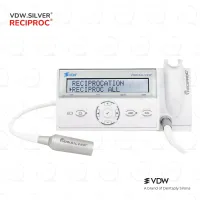
vdw.silver® reciproc® · endo motor · inc 6:1 contra-angle
reciprocation works because the instrument turns further in the cutting direction than it turns back, and releases before it is loaded to breaking point. those angles are not built into the file. they are programmed into the motor – which is why vdw tested the two together, and why the reciproc setting is a specification rather than a preference.
| 7 pre-set systems | 15 dr's choice slots | 6:1 contra-angle in box |
this unit: vdw.silver® reciproc® motor · vdw | sirona 6:1 contra-angle · foot switch · charger
made by vdw · a brand of dentsply sirona
every nickel-titanium instrument has an elastic limit – the point at which, if it is bound in the canal, it will fail rather than flex. the whole argument for reciprocation is that the file is released before it gets there. that release is the motor's job, and vdw are explicit that the two were designed as a pair.
“the angles of reciprocation are precise and specific to the design of the reciproc® instrument and to the vdw.silver® reciproc® motor. they are designed to be smaller than the angle settings where the elastic limit of the instrument would be met, thus minimising the risk of instrument fractures.”
vdw, reciproc® frequently asked questions (rev 0, 2010)
the practical consequence is worth stating plainly: a reciprocating file run on angles it was not tested against is a different instrument. if you are buying into reciproc, the motor is not the accessory – it is the half of the system that decides how the other half behaves.
it is not a single-system motor. vdw describe it as an endo motor “for reciprocating and continuous rotary nickel-titanium systems”, with pre-set programmes for both and a menu you can work without the manual open beside you.
| reciprocating | pre-set programmes for reciproc® and waveone® – including reciproc all on current units |
| continuous rotary | pre-set for mtwo®, flexmaster®, protaper®, k3™ and gates |
| dr's choice | 15 further torque/speed settings you set and store yourself, for rotary systems that are not on the list |
| power | battery operated, and it runs while charging – a flat battery does not cost you the appointment |
the programme list above is vdw's own, from their reciproc user brochure (rev 3, 2011). if you need the full library and the exact torque and speed values for a system you already run, ask us and we will send you the operating manual before you order.
› asr, in rotary mode. automatic reverse rotation when the set torque limit is reached, with an acoustic warning both when it reverses and at 75% of the set torque – so you hear the canal loading up before the motor has to act on it.
› reciproc reverse, in reciproc mode. a two-stage indicator that tells you when to change what you are doing – the comfort function vdw built around the single-file technique.
reciproc instruments are single-use, and the unit is the molar, not the case – vdw put it as “single treatment use, maximum one molar”. a two-molar appointment is two files. that is not a hidden cost so much as the trade the system asks for: one instrument doing the work of several, discarded before fatigue becomes a question. worth doing the arithmetic on your own case mix before you order files.
it has no integrated apex locator. it shapes; it does not measure. if you want length and shaping in one unit that is a different motor and a different budget – talk to us rather than assuming. everything else in the box is here: contra-angle, foot switch and charger, so it works out of the carton.
| the file it was built for | reciproc® blue r25 25 mm · r40 · r50 |
| hand files | c-pilot® 010, 25 mm · patency and glide path where the canal asks for one |
| irrigants | chlorax 5.25% · chlorax 2% · endo-solution 17% edta |
| delivery | irriflex® 30 ga · navitip™ 29 ga 25 mm |
| activation | vdw eddy® tips · vdw's own, driven by an air scaler rather than this motor |
| sealer | vdw 2seal · ah plus® · or bioceramic, neosealer® ezflo 25 mm tips |
| coronal seal | sdr® flow+ refill universal · 4 mm bulk increment, one cure |
| spares for this unit | vdw | sirona 6:1 contra-angle · foot switch · charger |
will it run reciproc blue?
yes. the blue instruments are the current reciproc® range and run on the reciproc setting. the alloy changed; the reciprocation did not.
can i use it for my rotary system as well?
that is the point of the pre-sets and of dr's choice. if your system is not one of the named programmes, you store your own torque and speed in one of the 15 slots.
does it measure working length?
no – there is no apex locator in this unit. length stays with your locator or your radiographs.
is the contra-angle included or extra?
included – the vdw | sirona 6:1 comes in the box. it is also sold separately if you want a second, or a replacement.
can i use it while it is charging?
yes. vdw state it “is battery operated and can also be used while charging”.
before you order: settings, torque values and the full pre-set library are in vdw's operating manual, and the file library on current firmware may differ from the list above – ask us for a copy and we will send it before you buy. instruments are single-use to a maximum of one molar.
vdw.silver® reciproc® endo motor inc 6:1 contra-angle · reciprocating and continuous rotary · pre-set programmes plus 15 dr's choice settings · asr with acoustic warning · reciproc reverse · battery, runs while charging · foot switch and charger included · vdw · ref v041163000000

vdw.silver® reciproc® · endo motor · 2 × 6:1 contra-angles
reciproc and waveonecontinuous rotarydr's choice settingssecond contra-angle in the box
the contra-angle is the only part of this system that vdw's manual lets you sterilise. the motor, its cable, the foot switch and the charger stay out of the autoclave. this unit is the vdw.silver® reciproc® endo motor with two 6:1 contra-angles, so one can be ready while the other is being reprocessed.
| 7 pre-set systems | 15 dr's choice slots | 2 contra-angles in box |
this unit: vdw.silver® reciproc® motor (control unit and micromotor) · two vdw | sirona 6:1 contra-angles · foot switch · charger
made by vdw · a brand of dentsply sirona
vdw's operating manual is specific about reprocessing: only the contra-angle may be sterilised, and the micromotor and the other accessories must never go in an autoclave or ultrasonic tank. the contra-angle also has to be kept lubricated, to its own instructions. with one handpiece, that cycle sits between your patients; with two, the second is waiting.
one thing to plan for: the manual has you calibrate the motor whenever the contra-angle has been lubricated, or replaced after sterilising, and at least once a week. swapping to the second contra-angle falls under that, so check the manual for the calibration steps. whether you need two depends on your own sterilisation routine – if you do, this puts both in one box.
| no contra-angle | vdw.silver® reciproc® without contra-angle · motor, foot switch and charger |
| one contra-angle | vdw.silver® reciproc® with 6:1 contra-angle · the complete unit, one handpiece in the box |
| two contra-angles | this page. motor, two 6:1 contra-angles, foot switch and charger |
vdw describe it as an endo motor “for reciprocating and continuous rotary nickel-titanium systems”. the list below is vdw's own, from their user brochure (rev 3, 2011), and is the same on all three versions.
| reciprocating | pre-set programmes for reciproc® and waveone® – including reciproc all on current units |
| continuous rotary | pre-set for mtwo®, flexmaster®, protaper®, k3™ and gates |
| dr's choice | 15 further torque/speed settings you set and store yourself |
| in rotary mode | asr reverses automatically at the set torque limit, with an acoustic warning at reversal and at 75% of the set torque |
| in reciproc mode | reciproc reverse – a two-stage indicator, vdw's comfort function for the single-file technique |
| power | battery operated, and it runs while charging |
why the reciprocation angles are programmed into the motor, and why that makes the reciproc setting a specification rather than a preference, is set out on the one-contra-angle unit's page. for the exact torque and speed values of a system you already run, ask us and we will send you the operating manual before you order.
it has no integrated apex locator. it shapes; it does not measure. length stays with your locator or your radiographs.
reciproc instruments are single-use, and the unit is the molar, not the case – vdw put it as “single treatment use, maximum one molar”. a two-molar appointment is two files.
| the file it was built for | reciproc® blue r25 25 mm · r40 · r50 |
| hand files | c-pilot® 010, 25 mm · patency and glide path where the canal asks for one |
| irrigants | chlorax 5.25% · chlorax 2% · endo-solution 17% edta |
| delivery | irriflex® 30 ga · navitip™ 29 ga 25 mm |
| activation | vdw eddy® tips · vdw's own, driven by an air scaler rather than this motor |
| sealer | vdw 2seal · ah plus® · or bioceramic, neosealer® ezflo 25 mm tips |
| coronal seal | sdr® flow+ refill universal · 4 mm bulk increment, one cure |
| spares for this unit | vdw | sirona 6:1 contra-angle · foot switch · charger |
are both contra-angles the same?
yes – two vdw | sirona 6:1 contra-angles, the same type as the one in the single-contra-angle unit.
do i need to calibrate when i swap?
vdw's manual says to calibrate whenever the contra-angle has been lubricated, or replaced after sterilising, and at least once a week. follow the manual that comes with your unit for the steps.
will it run reciproc blue?
yes. the blue instruments are the current reciproc® range and run on the reciproc setting. the alloy changed; the reciprocation did not.
does it measure working length?
no – there is no apex locator in this unit. length stays with your locator or your radiographs.
can i autoclave the motor?
no. vdw's manual says never to put the micromotor or the other accessories in an autoclave or ultrasonic tank. only the contra-angle may be sterilised, to its own instructions.
before you order: settings, torque values and the full pre-set library are in vdw's operating manual, and the file library on current firmware may differ from the list above – ask us for a copy and we will send it before you buy. instruments are single-use to a maximum of one molar.
vdw.silver® reciproc® endo motor with 2 × 6:1 contra-angles · reciprocating and continuous rotary · pre-set programmes plus 15 dr's choice settings · asr with acoustic warning · reciproc reverse · battery, runs while charging · foot switch and charger included · vdw · ref v041163000000xc
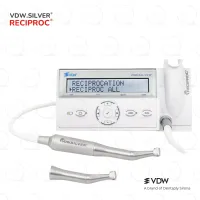

guttafusion® verifier · iso 20 · 6 pack
obturator sizingafter rotary niti preparationguttafusion®
which obturator size fits the prepared canal? vdw’s guttafusion® size verifiers are the instruments for finding out: they are used to determine the correct obturator size after preparation with rotary niti systems. this listing is the iso 20 verifier; each size is sold as its own blister of six.
this pack: guttafusion® size verifier, iso size 20, 25 mm (pack of 6, blister)
| use | to determine the correct obturator size after preparation with rotary niti systems (vdw) |
| material | nickel-titanium, radiopaque, iso colour coded (vdw) |
| size | iso 20, 25 mm |
| taper | .045 (dentsply sirona, who sell the same verifier as the guttacore® size verifier) |
| pack | blister of 6 |
› what it is for. vdw describe the verifiers as instruments to determine the correct obturator size after preparation with rotary niti systems.
› what it is made of. nickel-titanium, and radiopaque.
› sizes. iso colour coded, one size per blister of six.
vdw’s 2023 catalogue says the guttafusion® size verifiers are necessary with rotary niti systems, to make sure the right obturator is selected. for preparations with reciproc® or reciproc® blue it says they are not necessary, because there are only three obturator sizes, r25, r40 and r50: guttafusion® for reciproc® blue r25 (6) · guttafusion® for reciproc® blue r40 (6) · guttafusion® for reciproc® blue r50 (6).
the other sizes we list: size 25 · size 35 · size 40 · size 45.
› guttafusion® brochure (pdf, 2.4 mb, vdw) – the guttafusion® system, size verifiers included.
| obturator, same size | guttacore® 20 (6) – the same iso size, from dentsply sirona |
| bioceramic sealer | neosealer® ezflo kit with 25 mm navitip™ tips – premixed |
| resin sealers | ah plus® paste 8 ml · vdw 2seal® |
resin or bioceramic is a real choice of technique rather than a ranking – we carry both because both are right in different hands.
guttafusion® size verifier · iso 20 · 25 mm · .045 taper · nickel-titanium, radiopaque · blister of 6 · made by vdw gmbh, munich, germany (dentsply sirona) · ref v041508000020
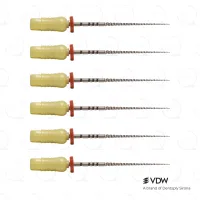
guttafusion® verifier · iso 25 · 6 pack
obturator sizingafter rotary niti preparationguttafusion®
which obturator size fits the prepared canal? vdw’s guttafusion® size verifiers are the instruments for finding out: they are used to determine the correct obturator size after preparation with rotary niti systems. this listing is the iso 25 verifier; each size is sold as its own blister of six.
this pack: guttafusion® size verifier, iso size 25, 25 mm (pack of 6, blister)
| use | to determine the correct obturator size after preparation with rotary niti systems (vdw) |
| material | nickel-titanium, radiopaque, iso colour coded (vdw) |
| size | iso 25, 25 mm |
| taper | .045 (dentsply sirona, who sell the same verifier as the guttacore® size verifier) |
| pack | blister of 6 |
› what it is for. vdw describe the verifiers as instruments to determine the correct obturator size after preparation with rotary niti systems.
› what it is made of. nickel-titanium, and radiopaque.
› sizes. iso colour coded, one size per blister of six.
vdw’s 2023 catalogue says the guttafusion® size verifiers are necessary with rotary niti systems, to make sure the right obturator is selected. for preparations with reciproc® or reciproc® blue it says they are not necessary, because there are only three obturator sizes, r25, r40 and r50: guttafusion® for reciproc® blue r25 (6) · guttafusion® for reciproc® blue r40 (6) · guttafusion® for reciproc® blue r50 (6).
the other sizes we list: size 20 · size 35 · size 40 · size 45.
› guttafusion® brochure (pdf, 2.4 mb, vdw) – the guttafusion® system, size verifiers included.
| obturator, same size | guttacore® 25 (6) – the same iso size, from dentsply sirona |
| bioceramic sealer | neosealer® ezflo kit with 25 mm navitip™ tips – premixed |
| resin sealers | ah plus® paste 8 ml · vdw 2seal® |
resin or bioceramic is a real choice of technique rather than a ranking – we carry both because both are right in different hands.
guttafusion® size verifier · iso 25 · 25 mm · .045 taper · nickel-titanium, radiopaque · blister of 6 · made by vdw gmbh, munich, germany (dentsply sirona) · ref v041508000025
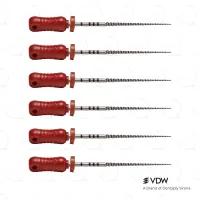
guttafusion® verifier · iso 35 · 6 pack
obturator sizingafter rotary niti preparationguttafusion®
which obturator size fits the prepared canal? vdw’s guttafusion® size verifiers are the instruments for finding out: they are used to determine the correct obturator size after preparation with rotary niti systems. this listing is the iso 35 verifier; each size is sold as its own blister of six.
this pack: guttafusion® size verifier, iso size 35, 25 mm (pack of 6, blister)
| use | to determine the correct obturator size after preparation with rotary niti systems (vdw) |
| material | nickel-titanium, radiopaque, iso colour coded (vdw) |
| size | iso 35, 25 mm |
| taper | .045 (dentsply sirona, who sell the same verifier as the guttacore® size verifier) |
| pack | blister of 6 |
› what it is for. vdw describe the verifiers as instruments to determine the correct obturator size after preparation with rotary niti systems.
› what it is made of. nickel-titanium, and radiopaque.
› sizes. iso colour coded, one size per blister of six.
vdw’s 2023 catalogue says the guttafusion® size verifiers are necessary with rotary niti systems, to make sure the right obturator is selected. for preparations with reciproc® or reciproc® blue it says they are not necessary, because there are only three obturator sizes, r25, r40 and r50: guttafusion® for reciproc® blue r25 (6) · guttafusion® for reciproc® blue r40 (6) · guttafusion® for reciproc® blue r50 (6).
the other sizes we list: size 20 · size 25 · size 40 · size 45.
› guttafusion® brochure (pdf, 2.4 mb, vdw) – the guttafusion® system, size verifiers included.
| obturator, same size | guttacore® 35 (6) – the same iso size, from dentsply sirona |
| bioceramic sealer | neosealer® ezflo kit with 25 mm navitip™ tips – premixed |
| resin sealers | ah plus® paste 8 ml · vdw 2seal® |
resin or bioceramic is a real choice of technique rather than a ranking – we carry both because both are right in different hands.
guttafusion® size verifier · iso 35 · 25 mm · .045 taper · nickel-titanium, radiopaque · blister of 6 · made by vdw gmbh, munich, germany (dentsply sirona) · ref v041508000035
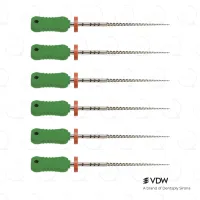
guttafusion® verifier · iso 40 · 6 pack
obturator sizingafter rotary niti preparationguttafusion®
which obturator size fits the prepared canal? vdw’s guttafusion® size verifiers are the instruments for finding out: they are used to determine the correct obturator size after preparation with rotary niti systems. this listing is the iso 40 verifier; each size is sold as its own blister of six.
this pack: guttafusion® size verifier, iso size 40, 25 mm (pack of 6, blister)
| use | to determine the correct obturator size after preparation with rotary niti systems (vdw) |
| material | nickel-titanium, radiopaque, iso colour coded (vdw) |
| size | iso 40, 25 mm |
| taper | .045 (dentsply sirona, who sell the same verifier as the guttacore® size verifier) |
| pack | blister of 6 |
› what it is for. vdw describe the verifiers as instruments to determine the correct obturator size after preparation with rotary niti systems.
› what it is made of. nickel-titanium, and radiopaque.
› sizes. iso colour coded, one size per blister of six.
vdw’s 2023 catalogue says the guttafusion® size verifiers are necessary with rotary niti systems, to make sure the right obturator is selected. for preparations with reciproc® or reciproc® blue it says they are not necessary, because there are only three obturator sizes, r25, r40 and r50: guttafusion® for reciproc® blue r25 (6) · guttafusion® for reciproc® blue r40 (6) · guttafusion® for reciproc® blue r50 (6).
the other sizes we list: size 20 · size 25 · size 35 · size 45.
› guttafusion® brochure (pdf, 2.4 mb, vdw) – the guttafusion® system, size verifiers included.
| obturator, same size | guttacore® 40 (6) – the same iso size, from dentsply sirona |
| bioceramic sealer | neosealer® ezflo kit with 25 mm navitip™ tips – premixed |
| resin sealers | ah plus® paste 8 ml · vdw 2seal® |
resin or bioceramic is a real choice of technique rather than a ranking – we carry both because both are right in different hands.
guttafusion® size verifier · iso 40 · 25 mm · .045 taper · nickel-titanium, radiopaque · blister of 6 · made by vdw gmbh, munich, germany (dentsply sirona) · ref v041508000040
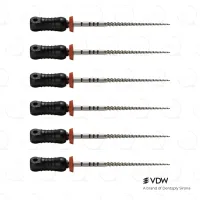
guttafusion® verifier · iso 45 · 6 pack
obturator sizingafter rotary niti preparationguttafusion®
which obturator size fits the prepared canal? vdw’s guttafusion® size verifiers are the instruments for finding out: they are used to determine the correct obturator size after preparation with rotary niti systems. this listing is the iso 45 verifier; each size is sold as its own blister of six.
this pack: guttafusion® size verifier, iso size 45, 25 mm (pack of 6, blister)
| use | to determine the correct obturator size after preparation with rotary niti systems (vdw) |
| material | nickel-titanium, radiopaque, iso colour coded (vdw) |
| size | iso 45, 25 mm |
| taper | .045 (dentsply sirona, who sell the same verifier as the guttacore® size verifier) |
| pack | blister of 6 |
› what it is for. vdw describe the verifiers as instruments to determine the correct obturator size after preparation with rotary niti systems.
› what it is made of. nickel-titanium, and radiopaque.
› sizes. iso colour coded, one size per blister of six.
vdw’s 2023 catalogue says the guttafusion® size verifiers are necessary with rotary niti systems, to make sure the right obturator is selected. for preparations with reciproc® or reciproc® blue it says they are not necessary, because there are only three obturator sizes, r25, r40 and r50: guttafusion® for reciproc® blue r25 (6) · guttafusion® for reciproc® blue r40 (6) · guttafusion® for reciproc® blue r50 (6).
the other sizes we list: size 20 · size 25 · size 35 · size 40.
› guttafusion® brochure (pdf, 2.4 mb, vdw) – the guttafusion® system, size verifiers included.
| obturator, same size | guttacore® 45 (6) – the same iso size, from dentsply sirona |
| bioceramic sealer | neosealer® ezflo kit with 25 mm navitip™ tips – premixed |
| resin sealers | ah plus® paste 8 ml · vdw 2seal® |
resin or bioceramic is a real choice of technique rather than a ranking – we carry both because both are right in different hands.
guttafusion® size verifier · iso 45 · 25 mm · .045 taper · nickel-titanium, radiopaque · blister of 6 · made by vdw gmbh, munich, germany (dentsply sirona) · ref v041508000045
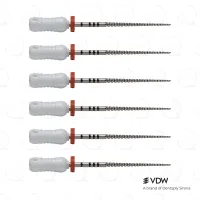


 Facebook
 X
 Instagram
 Pinterest
