

Best selection of Endodontic supplies in the UK



file-eze™ · 19% edta file lubricant
sclerosed canal? fine file binding at the coronal third? file-eze™ is a 19% edta chelating agent in a water-soluble, viscous, lubricating base – ultradent's own description – used with the first two or three instruments to chelate, lubricate and aid debridement while the canal is still tight. it is peroxide-free, so it will not affect the set of resin sealers.
this pack: 4 × 1.2 ml unit-dose syringes
made by ultradent, usa
| 19% edta | chelates dentine while you shape, in an aqueous, water-soluble base that rinses away rather than lingering |
| viscous | gel body stays where it is placed at the orifice instead of running out of the access cavity |
| peroxide-free | ultradent states it will not affect the set of resin sealers – worth knowing if you obturate with a resin system |
| preloaded | four 1.2 ml syringes ready to use from the box – nothing to fill before the list, and a small barrel that sits on the tray |
› technique (ultradent's ifu) – deliver to the canal orifice and express to no more than half the working length; never express material with pressure up the canal past the apical foramen.
› alternate with sodium hypochlorite and a liquid edta through the shaping sequence, then rinse the gel away before obturating.
› delivery – ultradent recommends a 25 mm navitip™; qed stocks the 29 ga open-end in 21 mm. test flow before going intraoral and never force a plunger.
gel or liquid edta – do i need both?
they do different jobs. the gel lubricates and chelates at the file, early in shaping; liquid edta is the final rinse that lifts the smear layer. ultradent's own protocol alternates the two.
will it interfere with my sealer?
file-eze is peroxide-free and ultradent states it will not affect the set of resin sealers. rinse thoroughly before obturation regardless.
is there a bigger pack?
yes – the 30 ml indispense™ syringe dispenses into 1.2 ml empty syringes and works out cheaper per case for a busy endodontic list.
file-eze™ · 19% edta file lubricant · water-soluble · viscous · peroxide-free · 4 × 1.2 ml syringes · ultradent · ref 1075-ce · also as a 30 ml indispense syringe

map system® · n°2 blue · 16 plungers
a wide perforation, an open apex, a resorptive defect that will take a proper increment? the blue n°2 plunger belongs to the ø1.30 mm needles – the largest bore outside the vpt pair, and the one that fills a cavity in fewer passes. only two families run to n°2: niti memory shape and hooked. classic and surgery stop at red.
this pack: 16 × plastic plungers, n°2 blue
made by pd dental, switzerland
| fits | the blue n°2 needles only – niti memory shape n°2 and hooked n°2, at ø1.30 mm |
| why the wider bore | more material per delivery, so fewer passes into a defect you would rather not keep re-entering |
| single use | autoclave at 132 °c for 3 minutes before use, then discard after that patient. never reuse |
| shelf life | 5 years, per the manufacturer's instructions for use |
› blue plunger, blue needle. the colours run yellow n°0, red n°1, blue n°2, and a mismatch either jams or leaks past.
› the wide bore is the forgiving one for thicker mixes – but it still needs flossing out within fifteen minutes of use, like every other needle in the system.
› the biodentine exclusion in the ifu names the yellow and red needles. nothing is stated for blue, so treat that as unanswered rather than as permission.
which needles actually take this size?
two: niti memory shape n°2 and hooked n°2. there is no classic n°2 and no surgery n°2, so a classic or surgery user wants red or yellow.
is a bigger increment better?
not in itself – it is a question of access. where the defect allows ø1.30 mm, fewer passes means less handling; where it does not, the finer needle is the right instrument.
| bendable n°2 | niti memory shape n°2 · ø1.30 mm |
| retrograde n°2 | hooked needle n°2 · ø1.30 mm |
| clean the lumen | cleanyfloss – the thread named in pd's ifu |
| finer sizes | plungers n°1 red · n°0 yellow |
map plastic plungers n°2 · blue · single-use, autoclave before use · fits niti and hooked n°2 ø1.30 mm · 16 per pack · pd dental · ref 20202
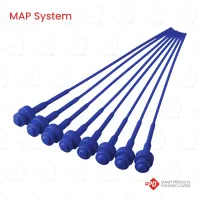
map system® · niti · n°2 blue · ø1.30 mm
an open apex that needs a 4 mm plug, or a resorptive defect the size of a pinhead is never going to fill? the blue n°2 is the widest bore in the standard range at ø1.30 mm, and the reason to reach for it is arithmetic: each delivery carries more, so the same repair takes fewer trips down the canal. it is still memory-shape nitinol, so it bends to the approach and straightens itself in the autoclave.
this pack: 1 × niti memory shape needle n°2 blue, ø1.30 mm, with 16 matching plungers
made by pd dental, switzerland
| bore | ø1.30 mm – the widest standard needle. only niti and hooked are made in n°2 |
| shapeable | bend to the case; sterilisation restores the straight shape. no flame, ever |
| reusable | validated by pd for 50 reprocessing cycles, with a single-use plunger inside |
| biodentine | the ifu excludes it from the yellow and red needles. nothing is published for blue – treat that as unanswered |
› access decides, not preference. a wider bore is only an advantage where the approach admits it; where it does not, the red or yellow needle is the right instrument, not a compromise.
› more bore, more residue. the fifteen-minute cleaning window applies just as strictly here, and there is more lumen to floss.
› blue plungers only. a red plunger in this needle lets material past it instead of ahead of it.
when is n°2 the right call?
apexification plugs, wide perforations and resorptive defects – anywhere the volume is real and the access is generous. for a fine canal or a small retro-cavity it is simply too big.
is there a classic or surgery n°2?
no. only the niti memory shape and the hooked needle run to blue; the classic curved and the surgery needles stop at red.
| its consumable | plastic plungers n°2 blue · 16 |
| the other n°2 | hooked needle n°2 – same bore, retrograde geometry |
| all three sizes | map intro kit – n°0, n°1 and n°2 with syringe and well |
| material to place | neomta® 2 · 1.0 g – apexification and perforation repair |
map niti memory shape needle n°2 · blue · ø1.30 mm · bendable, self-straightening in the autoclave · 50 reprocessing cycles · pd dental · ref 20212
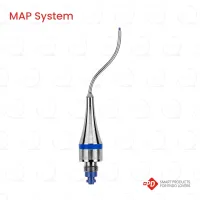
map system® · surgery left · n°0 · ø0.90 mm
why does a retrograde needle come in a left and a right at all? because the operator does not move but the tooth does. approaching a resected root from the buccal on one side of the arch puts the tip at the mirror image of the angle it needs on the other, and a handed needle solves that without you contorting to compensate. this is the fine left-hand needle, ø0.90 mm, for small retro-preparations.
this pack: 1 × surgery needle, left, n°0 yellow, ø0.90 mm, with 16 matching plungers
made by pd dental, switzerland
| approach | retrograde, in apical surgery – pd's stated purpose for the triple-angle geometry |
| handed | left. sold singly, so you can replace one side without replacing the pair |
| bore | ø0.90 mm – the fine size. surgery needles are made in n°0 and n°1 only |
| reusable | validated by pd for 50 reprocessing cycles; the plunger inside is single-use |
› buy the pair, replace singly. a full surgical set-up wants both hands in both sizes; a damaged needle only needs its own code reordering.
› clean it inside fifteen minutes – and a surgical list is exactly the setting where that slips, because the next stage of the operation is more interesting than the needle.
› keep it out of hydrogen peroxide, and out of hypochlorite above 5% for more than five minutes.
how do i tell them apart on the tray?
by the bend, and by keeping them in the kit's aluminium case rather than loose. both are yellow, because the colour codes the bore, not the hand.
yellow or red for surgery?
yellow where the retro-preparation is small or access is tight; red where the cavity will take a fuller increment. owning both sizes in both hands is what the surgical kit is for.
| its pair | surgery needle right n°0 · ø0.90 mm |
| wider, same hand | surgery needle left n°1 · ø1.10 mm |
| its consumable | plastic plungers n°0 yellow · 16 |
| all four handed needles | map surgical kit – the complete surgical set-up |
map surgery needle left n°0 · yellow · ø0.90 mm · triple-angle, retrograde · autoclavable, 50 cycles · pd dental · ref 20226
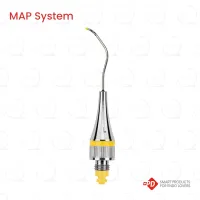
map system® · hooked · n°2 · ø1.30 mm
a generous retro-cavity, or a resorptive defect approached from outside the root? the hooked n°2 is an unusual combination in this range: retrograde geometry at the widest standard bore, ø1.30 mm. the surgery needles stop at red, so if a retrograde case wants a fuller increment than ø1.10 mm, this is the only needle that offers it.
this pack: 1 × hooked needle n°2 blue, ø1.30 mm, with 16 matching plungers
made by pd dental, switzerland
| unique combination | retrograde geometry at ø1.30 mm – the surgery needles are not made in n°2 |
| also useful for | cervical root resorption by the retrograde route, one of the six indications in pd's ifu |
| bore | ø1.30 mm, so fewer deliveries into a defect you would rather not keep re-entering |
| biodentine | the ifu excludes it from the yellow and red needles. nothing is published for blue – treat that as unanswered |
› blue plungers only. a red plunger in a ø1.30 mm lumen lets material past it rather than driving it ahead.
› wide bore, hooked tip, more residue. floss it through inside fifteen minutes and it will give you fifty cycles; leave it and it will give you one.
› access decides. ø1.30 mm is an advantage only where the surgical window admits it, and a liability where it does not.
which needles come in n°2 at all?
two: this one and the niti memory shape n°2. classic curved and surgery both stop at n°1 red.
is it worth owning alongside the red hook?
if your surgical cases vary in size, yes – the two share plungers with nothing else, but they do share the same syringe, so the second needle is the only real cost.
| its consumable | plastic plungers n°2 blue · 16 |
| the other n°2 | niti memory shape n°2 – same bore, bendable, orthograde |
| finer hook | hooked needle n°1 · ø1.10 mm |
| clean the lumen | cleanyfloss – the thread pd name in the ifu |
map hooked needle n°2 · blue · ø1.30 mm · retrograde, widest standard bore · autoclavable, 50 cycles · pd dental · ref 20265
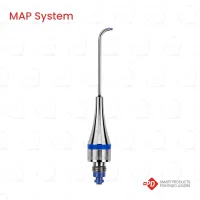
kohler · dg16 endodontic explorer
kohler call this one the dg16 n, extra thin. it is the standard dg16 pattern – differently angled at each end, one for anterior and one for posterior – with a finer working tip than the regular version.
this pack: kohler explorer dg16 n, extra thin · double-ended · single instrument · qed ref 3249
looking for the black-coated one? that is the endoblack explorer dg16. this one is the extra-thin dg16 n and is not part of the endoblack range.
kohler put it this way: in endodontics “the often reduced volume of the access cavity necessitates a very short and delicate working end for greater ease of work and better feedback for the practitioner.” that is the whole case for the n. less tip in the way of the view, and more of what you feel coming back up the shaft.
| this one | dg16 n, extra thin – the finest tip of the four |
| standard | endoblack explorer dg16 – black-coated, cuts glare under the scope |
| two in one | endoblack dg16 / perio probe – explorer one end, cp15 the other |
| lightest | trinovo dg16 endo probe – on kohler's grippy trinovo handle |
› endoblack double-ended mirror handle for the rest of the diagnostic tray.
› endoblack excavator 32l for access-cavity clean-up.
› kohler endo file holder to keep the hand files to length on the bracket table.
made by kohler medizintechnik, germany.

capillary tips · 0.36 mm · 20 tips
six points in and the canal is still damp? capillary tips attach to the ultradent™ luer vacuum adapter and evacuate the canal directly – ultradent states they substantially minimise the use of paper points. the narrow, flexible taper follows curvature instead of stopping at the first bend.
this pack: 20 × capillary tips, 0.36 mm with a 0.014" opening
made by ultradent, usa
| 0.014" opening | a 0.36 mm tip – fine enough to sit in the canal rather than hover over the access cavity |
| flexible taper | narrow and flexible, so it accesses curved canals rather than binding at the coronal third |
| fewer paper points | suction removes the bulk of the liquid; points finish the job instead of doing all of it |
| not for chemistry | ultradent is explicit: never use these to deliver irrigating materials or endodontic chemistries |
› attaches to the ultradent™ luer vacuum adapter for moisture removal from canals.
› where it fits the sequence – after final irrigation, before obturation; a couple of seconds per canal is enough to clear standing liquid.
› beyond the canal – ultradent also lists irrigation of peri-implant pockets with chlorhexidine gel delivered through a capillary tip. that is a periodontal application; the warning above still governs endodontic chemistries.
› for delivering endodontic chemistry – use a navitip™ 29 ga instead.
can i irrigate through them?
not with endodontic chemistry – ultradent warns against using capillary tips to deliver irrigants or endodontic chemistries, so deliver those through a navitip. they do list one delivery use of their own: chlorhexidine gel into peri-implant pockets, which is periodontal rather than endodontic.
twenty or fifty?
twenty for occasional endodontics. if you are drying multiple canals on most lists, the 50-tip pack is the better cost per tip.
single use?
yes – ultradent specifies single-use only and publishes no reprocessing protocol.
capillary tips · canal evacuation and drying · 0.36 mm with 0.014" opening · flexible taper · single use · 20 tips · ultradent · ref 341 · also in 50

navitip™ single sideport · 29 ga · 27 mm
deep access cavity? full-coverage crown adding millimetres before you even enter the canal? at 27 mm this is the longest navitip™ single sideport qed holds – the same capped, rounded end and side-wall port, with enough cannula left over for the cases where every other tip comes up short.
this pack: 20 × navitip 29 ga single sideport, 27 mm
made by ultradent, usa
| 27 mm | the longest sideport length stocked – for crowned teeth, deep access and unusually long roots |
| side port | directs flow out of the side wall before it reaches the area of the apex, reducing the risk of product extrusion |
| 29 gauge | fine stainless cannula with the final 5 mm annealed for curvature |
| single use | discard after the case – ultradent publishes no reprocessing protocol for these tips |
› for calcium hydroxide – pairs with ultracal™ xs, the paste ultradent specifies these tips for.
› technique – rubber stop at 3–4 mm from the apex; the cannula must stay free in the canal, never wedged, before you dispense.
› fits the skini syringe and ultradent luer lock syringes.
do i actually need 27 mm?
only for the long cases. if most of your work sits in premolars and anteriors, 21 mm is the everyday tip and 25 mm the usual second box.
can i trim a longer tip down?
no – these are stainless cannulas with a formed sideport. order the length you need, or take the assorted pack.
open-end or sideport for sealer?
many clinicians prefer an open-end tip for sealer and keep sideport tips for medicaments. the 29 ga open-end 50-pack covers that side of the tray.
navitip™ 29 ga single sideport · 27 mm · single use · 20 tips · ultradent · ref 4989 · also 21 mm, 25 mm and assorted

sdr® flow+ · universal shade · 15 compules
post-endodontic corebase or liner, class i and iiclass iii and vpit and fissure sealing
how much of the outcome is still in your hands once the last cone is down? and why fill the access cavity with something that shrinks away from the seal you have just placed? sdr® flow+ is a low-viscosity bulk fill composite that self-levels into the chamber and around the orifices, and is designed to be cured in increments up to 4 mm. the chamber is an awkward shape to fill – undercuts, a pulpal floor you cannot see into, orifice plugs you would rather not disturb – and a self-levelling material finds that geometry without condensation.
| 4 mm bulk increment | 20 s cure at 4 mm | 2.6 mm al radiopacity |
this pack: 15 × 0.25 g compula® tips, universal shade
made by dentsply sirona · mfr code 60603040
| increment | cured in increments up to 4 mm depth, per the directions for use |
| cure | 20 s at 4 mm in the universal shade at 550 to 1000 mw/cm2; the a shades need 40 s. minimum output 550 mw/cm2 |
| filler | total filler 47.3% by volume (ifu); 70.5% by weight per dentsply's scientific manual |
| radiopacity | approximately 2.6 mm al – it reads on a post-operative film |
› a base, not the finished surface in a load-bearing class i or ii – the ifu caps it occlusally with a universal or posterior composite.
› watch the eugenol. the ifu says to avoid eugenol and hydrogen peroxide – worth remembering if a zoe sealer or an irm-type temporary has been near the chamber.
› not for known methacrylate hypersensitivity, and not alongside mineral-impregnated retraction cord.
dentsply describe sdr as combining that large molecular structure with a chemical group they call a “polymerization modulator”, embedded in the centre of the polymerisable resin backbone of the sdr monomer.
— dentsply sirona, sdr® flow+ scientific manual, 2017. the same document puts volumetric shrinkage at 3.5%, and attributes an approximately 80% reduction in polymerisation stress against conventional methacrylate resins to its own internal data.
van dijken and pallesen followed 49 paired class ii restorations in 38 patients for six years, sdr under a capping composite against conventional layering, and reported an annual failure rate of 1% in both groups (eur j oral sci 2017;125:303–9). el-damanhoury and platt recorded bottom-to-top hardness above 90% at 4 mm (oper dent 2014;39:374–82). the honest reading: as good as careful incremental layering, not better – and in less chair time.
can i finish the restoration in sdr flow+ alone?
not in a load-bearing class i or ii – the ifu has it capped by a universal or posterior composite. conservative class i, class iii and v restorations and core build-ups are listed as full indications.
does my curing light have enough output?
it needs at least 550 mw/cm2, and the 20 s figure assumes 550 to 1000 mw/cm2. a radiometer check is worth thirty seconds – a tired unit is the usual reason a 4 mm increment cures short.
| shape and restore | reciproc® blue and sdr flow+ procedure kit – 30 r25 files and 30 compules on one code, or the same kit with a free adhesive while that offer runs |
| shape | waveone® gold and sdr flow+ kit – the same pairing on the reciprocating single-file sequence, or the treatment solution box with its own matched cones and points |
| dry | reciproc® paper points r25 · 144 – matched to the r25 preparation |
| fill | reciproc® blue gutta percha r25 · 60 – the cone that matches the file that cut the canal |
| seal the orifice | neoputty® · 0.5 g kit – a premixed bioceramic barrier under the build-up, and for a perforation or open apex |
| between visits | j-temp™ – when the definitive build-up waits for a second appointment |
sdr® flow+ universal · bulk fill flowable composite · self-levelling · 4 mm increment, 20 s cure · 2.6 mm al · 15 × 0.25 g compula® tips · dentsply sirona · ref 60603040
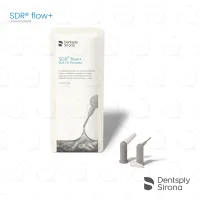
prime&bond active® · universal adhesive · 4 ml bottle
direct compositeveneer cementationcomposite and ceramic repairdentine desensitisationzirconia and metal
over-dried the dentine while chasing a dry field? or left it wetter than you meant to? adhesive failure happens at the moment of application, not months later, and surface moisture is the variable hardest to control in a deep access cavity. prime&bond active® is a universal adhesive designed to spread and wet under both conditions, in self-etch, selective enamel-etch or full etch-and-rinse, from one bottle.
| 20 s agitate | 5 s air dry | 10 s light cure |
this pack: 4 ml standard refill bottle
made by dentsply sirona · mfr code 60667341 · applicator tips and mixing wells ordered separately
| etching modes | self-etch, selective enamel-etch and etch-and-rinse, all from the one bottle |
| application | keep slightly agitated for 20 s, then air-dry at least 5 s to a glossy, uniform layer |
| cure | 10 s at a minimum 800 mw/cm2; at least 20 s where output is 550 to 800 mw/cm2 |
| storage | 2 to 24 °c; use at room temperature, and close the bottle tightly after use |
› etch the enamel you have cut. the ifu is explicit that unprepared enamel must be etched first – 15 s on enamel, with incidental dentine contact held to 15 s or less.
› do not desiccate. after rinsing, the ifu says not to dry the dentine out – and contact with saliva, blood or sulcus fluid during application may cause failure.
› watch the eugenol. do not use eugenol- or hydrogen-peroxide-containing materials with it – the same caution that applies to the composite going in on top.
› not for direct pulp application, or for patients with a history of allergic reaction to (meth)acrylate resins. it is acidic and can burn.
prime&bond active does not seem to be sensitive to the degree of moisture, and presented well-formed hybrid layers when applied to either moist or over-dried dentin.
— prof. andré reis, guarulhos university, on fe-sem and tem imaging of the hybrid layer, reported in dentsply sirona's own scientific compendium, which does not publish the figures behind it.
almeida and colleagues used prime&bond active as the reference adhesive in a double-blind randomised trial of 176 restorations in non-carious cervical lesions – the hardest test there is, since nothing holds the restoration in but the bond. at 18 months, retention was 95.5% in etch-and-rinse mode and 90.9% in self-etch, and self-etch groups showed more marginal discrepancy on fdi criteria (clin oral investig 2023;27:151–63). which is the practical argument for etching the enamel.
which etching mode should i use?
selective enamel-etch is the sensible default and the one dentsply recommend for class ii. the published trial above and the university work in dentsply's compendium point the same way: etching lifts enamel bonding, while dentine is largely unaffected by mode.
can i bond a post or a dual-cure core with it?
only with the self cure activator. the ifu lists dual-cure and self-cure work and post cementation under that combination alone – the bottle on its own is for light-cured work.
| bond then bulk fill | sdr® flow+ refill universal · 15 compules – the 4 mm increment that goes on top |
| all three, one code | reciproc® blue, sdr flow+ and prime&bond – this bottle comes free with that kit while the offer runs |
| files and compules | reciproc® blue and sdr flow+ procedure kit – the standard pairing |
| isolate | oraseal™ caulking – saliva and blood at the margin are the stated failure mode |
| between visits | j-temp™ – radiopaque, so you can confirm the chamber is clean before bonding |
prime&bond active® · universal adhesive · self-etch, selective-etch and etch-and-rinse · 20 s on, 5 s dry, 10 s cure · 4 ml standard refill bottle · dentsply sirona · ref 60667341
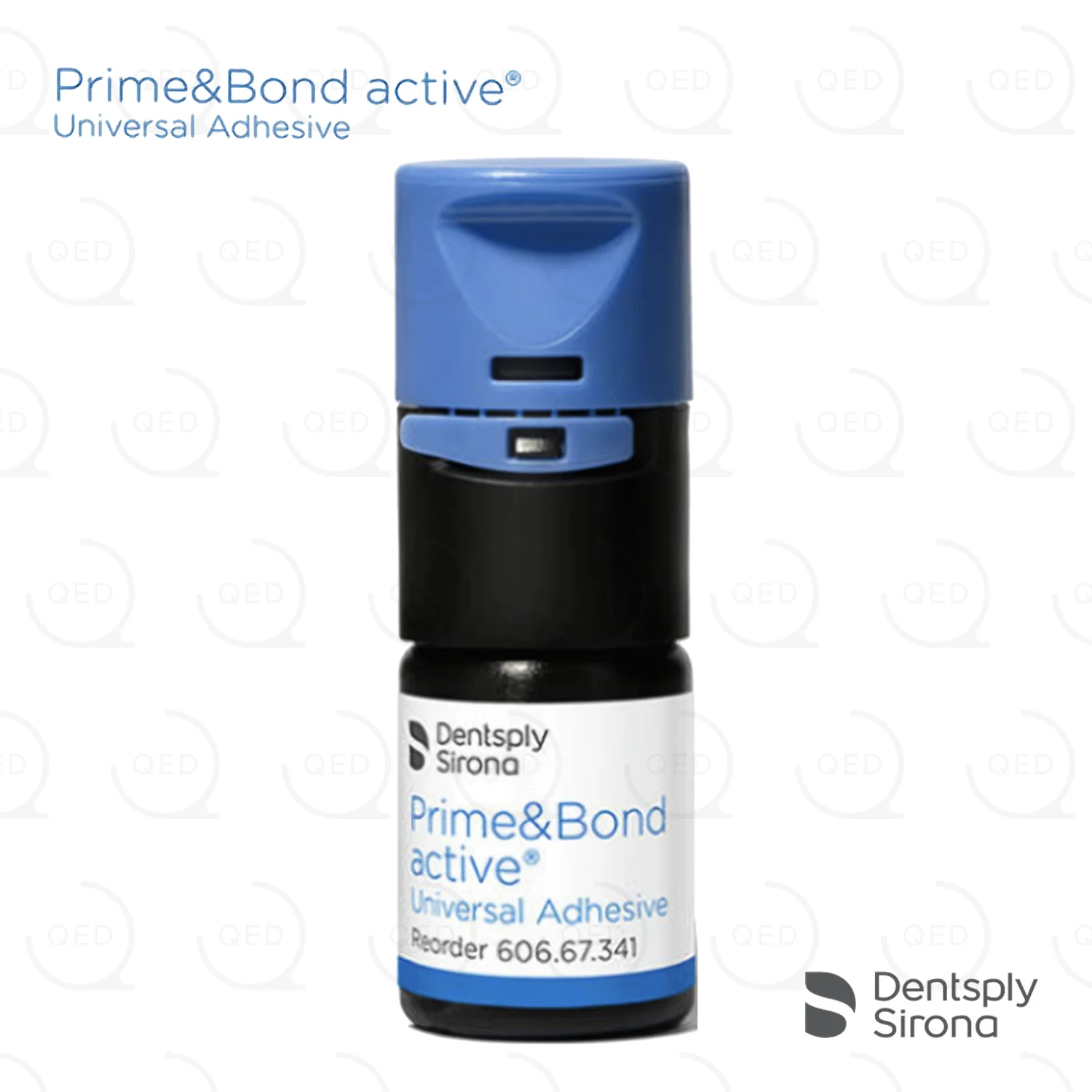
stropko™ irrigator · 2 inch · vista apex
microscope endodonticstroughinginstrument retrievalroot-end preparationdrying before obturation
you are at 16× magnification, troughing for a second mesiobuccal, and the field fills with dentinal dust. the standard three-in-one tip is not built for that moment: it throws a wide, hard stream that clears the debris and your view along with it. the stropko™ irrigator replaces that tip with a fine luer-lock hub, so the same syringe delivers a directed thread of air or water exactly where you are looking – at a pressure you have deliberately turned down.
| 4-7 psi, regulated | 1-3 psi, in canals | 80 autoclave cycles |
this pack: 1 × stropko™ irrigator, 2" · 1 × blue-flo™ tip · 1 × appli-vac™ bendable 20 ga · 1 × 22 ga · 1 × 25 ga
made by inter-med, inc. (vista apex), usa · vista ref 315260-2
› troughing for hidden canals. clearing dust from the pulpal floor a thread at a time, so the map you are following stays visible while you work.
› retrieving a separated instrument. the same controlled clearing, in the one procedure where losing sight of the fragment costs you the tooth.
› root-end preparation in surgery. cleaning and drying a retro-cavity under magnification, where a wide stream would flood the crypt.
› drying before obturation – what the technique card calls a "kiss of air" through the canal system before the cones go down.
› and outside endodontics: vista list restorative, periodontal, implant, surgical and orthodontic uses – air-thinning a deep resin is the one most people find next.
1 turn the pressure down first. a dental syringe normally runs at 30 to 50 psi. vista's ifu says regulate it to between 4 and 7 psi before the instrument goes anywhere near a patient.
2 remove the standard three-way tip and seat the stropko™ snugly in its place. on a press-ring handpiece, check it has locked.
3 screw the tip fully home into the luer-lock hub, so it cannot dislodge in use. tips must not extend back into the instrument past the hub.
4 for air-drying a canal, drop to 1 to 3 psi and use only notched or side-vented needles. this is vista's own instruction, stated without qualification, and it is the one to build into the setup rather than remember at the chairside.
when using for air-drying endodontic canals, reduce the air pressure to 1-3 psi and use only notched or side-vent needles.
— stropko™ irrigator instructions for use, vista apex
| length | 2 inches. the xl is 3.5 inches and is otherwise the same instrument |
| fits | most air/water syringes using a standard 3-way tip, including quick-connect types |
| takes | any luer-lock tip of 27 ga or larger. never a sharp injection needle, and never a tip finer than 27 ga |
| reprocessing | moist heat to iso 17665-1 at 132 or 134 °c for at least 3 minutes, 20 minutes drying. rated for 80 cycles |
| cleaning | neutral-ph detergents only, no abrasives, and do not disassemble it |
› the gauge limit rules out most endodontic irrigation needles. vista's ifu excludes anything finer than 27 ga, which means 29 ga and 30 ga irrigation tips are not for this instrument, however well they work on a syringe. check the gauge before you fit it.
› blunt tips only. no sharp, pointed, injection-type needles – the ones supplied are dead-soft and blunt-ended for a reason.
› one oddity worth knowing: the ifu says not to sterilise it in commercial wraps or pouches carrying sterilisation indicators, which does not sit comfortably with normal uk pouched practice. worth a word with your decontamination lead before it joins the tray.
straight answer: no published study of this instrument exists. dr john stropko is a real and well-cited endodontic clinician – his 1999 paper on maxillary molar canal morphology in the journal of endodontics is still quoted for its mb2 findings – but that is a study of anatomy, not of the device that carries his name, and it would be dishonest to present it as evidence. what the stropko™ has instead is twenty-odd years of use by clinicians working under magnification, and a design that does one obvious thing: it makes the stream small and the pressure low enough to be useful in a place you are looking at very closely.
will it fit my surgery's syringes?
vista say most air/water syringes that use a standard 3-way tip, quick-connect included. if yours is an older three-way, check the air and water buttons are secured – vista note that some older syringes need a retaining pin fitted so the buttons cannot pop out under a regulated supply.
can i use my usual 30 ga irrigation needles in it?
no. the ifu excludes tips finer than 27 ga. use 27 ga or larger, blunt-ended, and for drying a canal specifically, notched or side-vented.
standard or xl?
the only published difference is length – 2" against 3.5". vista do not say why you would pick one over the other, so the honest answer is reach and how you like to hold it, not performance.
| the tip in the box | blue-flo™ 23 ga soft plastic · 100 – or 20 |
| at the gauge limit | appli-vac™ irrigation needles 27 ga · 100 – the finest tip the ifu allows |
| bendable | mst visco-tip™ 25 ga bendable · 50 – shaped to the access you have |
| longer reach | stropko™ irrigator xl · 3.5" – the same instrument, longer |
| irrigate | chlorax 5.25% sodium hypochlorite · 5 × 200 ml |
| final rinse | endo-solution 17% edta · 200 ml |
| dry the canal | reciproc® paper points r25 · 144 – air is the last step, not the only one |
| isolate | oraseal™ caulking – a controlled field is the point of the whole exercise |
stropko™ irrigator · 2" · precise control of air and water · fits most 3-way syringes · luer-lock, 27 ga or larger · autoclavable, 80 cycles · supplied with 4 tips · vista apex · ref 911-030
obtura spartan · buc® ultrasonic tips
cutting line angles, chasing a calcification, opening an mb trough – with a bur you are working blind against the chamber floor. the buc® 1 is obtura spartan's general access-refinement tip: diamond coated, 0.6mm across, with a rounded end that obtura state eliminates clefts and ditches in the pulp chamber floor.
this pack: obtura spartan buc® 1 "the cutter" ultrasonic tip, 0.6mm diameter · single tip · diamond coated · supplied non-sterile
› working end: 0.6mm, fine grit, diamond coated. water port at the working end.
› thread: m3 x 0.6 – the standard buc® thread
› intensity: medium to high – obtura spartan's guidance
› cutting and refinement of line angles
› chasing calcifications
› smoothing access walls
supplied non-sterile. reprocessing is validated to iso 17664-1 and iso 17665-1: pre-clean in a ph-neutral ultrasonic solution, dry, then prevacuum steam at 132°c for 4 minutes.
will it fit my ultrasonic unit? obtura spartan make the range for scalers using m3 x 0.6 threading, and offer every tip again as the e series with m3 x 0.5. this one is m3 x 0.6. check your unit's manual first – they warn that forcing a tip with the wrong thread damages the device. the tip wrench seats it properly.
how long does a tip last? obtura spartan state the tips were tested to 250 reprocessing cycles to iso 18397 without loss of performance or corrosion – but end of life is set by wear in use as well, so inspect each tip during cleaning and retire damaged ones. they also ask for very light pressure: small-diameter tips are subject to breakage at any time.
| fitting and storage | wrench for spartan tips · spartan tip stand |
| patency and irrigation | c-pilot® 008 25mm · chlorax 5.25% · endo-solution 17% edta |
| rest of the range | buc® 1a slim cutter · buc® 2 planer · buc® 3 digger |
diamond coated · fine grit · m3 x 0.6 · autoclavable 132°c · ref 930-041

x-gates · gates 1–4 in one · 32 mm
radicular accessorifice preflaringreplaces gates 1–4low speedendo access kit refill
tired of changing gates glidden drills? dentsply maillefer’s cavity access brochure calls x-gates “a unique instrument” that combines the advantages of gates 1, 2, 3 and 4: the tip of a no.1 for easy insertion into the coronal third of the canal, the maximum diameter of a no.4 for re-locating the canal opening, and the shaft of a no.3 for improved strength.
this pack: 6 × x-gates drills, 32 mm (blister of 6) · ref a000824000703
made by dentsply sirona
| gates 1–4 in one | tip of a no.1, maximum diameter of a no.4, shaft of a no.3 (maillefer cavity access brochure) |
| uses dentsply sirona list | safe, efficient straight-line radicular access · preflaring an orifice · removing the internal triangle of dentine · relocating the coronal aspect of a canal |
| speed and motion | dentsply sirona’s endo access kit brochure: low speed, 500–750 rpm, with a brush-cutting action on the withdrawal stroke |
| depth | the same brochure: limit the depth of insertion so only the active cutting portion extends one head-length, or bud-depth, below the orifice |
› one instrument – where a gates glidden sequence uses several drills, x-gates is the single drill dentsply sirona offer for the same job.
› in the access set – dentsply maillefer’s cavity access set pairs it with round carbide, round diamond and transmetal burs; our round carbides are in the table below.
› your protocol – irrigants, delivery tips and a file lubricant are in the table below. the protocol is yours.
how is it different from a gates glidden pack?
a gates glidden pack gives you one size per drill, no.1 to no.6. x-gates is one drill designed to do the work of nos.1 to 4. if you want the full sequence, or nos.5 and 6, the assorted 32 mm pack has one of each.
do you sell the endo access kit?
dentsply sirona’s endo access kit can no longer be bought complete, but its refills can, and x-gates is one of them. product names differ slightly between markets, so go by the ref and pack shown here: a000824000703, 32 mm, blister of 6. other dentsply sirona access burs we stock: round carbide fg 010 · round carbide fg 014 · transmetal fg 012, 25 mm · round diamond fg 016 · diamendo no.1, 21 mm.
| gates glidden, 32 mm | assorted no.1–6 · dentsply sirona |
| access burs | round carbide fg 010 · round carbide fg 014 · dentsply sirona |
| patency | vdw c-pilot® 10, 25 mm · the house hand file |
| irrigants | chlorax 5.25% · chlorax 2% · endo-solution 17% edta |
| delivery | navitip™ 29 ga, 25 mm |
| file lubricant | glyde™ file prep · dentsply sirona |
x-gates · gates 1–4 in one · 32 mm · radicular access · orifice preflaring · 500–750 rpm · 6 drills · dentsply sirona · ref a000824000703
start-x® no. 1 · satelec thread
access wallsaccess cavitypiezo ultrasonicsatelec thread
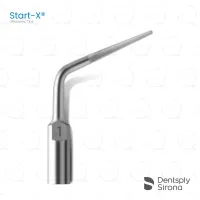
walls that overhang the canal entrances cost you a straight line into the canal. no. 1 is the start-x tip for finishing them: the sides do the cutting, and the tip itself is deliberately non-active so it will not mark the pulp chamber floor while you work.
this pack: dentsply sirona start-x® ultrasonic tip no. 1, access wall refinement · satelec thread (m3 x 0.6 mm) · 1 tip
| indication | finishing of the walls of the access cavity (dentsply sirona directions) |
| thread | satelec type, m3 x 0.6 mm |
| for | satelec-type (acteon) piezo ultrasonic units, piezo generators only |
| power | 16–18 on a satelec p5 / newtron (dentsply sirona brochure) |
| reprocessing | steam sterilisation, 134°c for 18 min |
| dentsply ref | a066000000100 |
› non-active tip – dentsply sirona: avoids accidentally damaging the pulp chamber floor.
› active lateral part – creates a straight access to the canal.
› dentsply sirona's launch material also gives it the removal of restorations, filling materials, caries and dentine interferences from the access cavity.
dentsply sirona developed the five start-x tips with professor berutti, professor cantatore and dr castellucci on a simple principle: one tip, one clinical indication, to facilitate and optimise the preparation of the access cavity.
in dentsply sirona's words: “higher control and precision with ultrasonic inserts specifically designed for access cavity refinement and canal orifice location.”
› micro-milled active part – in dentsply sirona's words, minimising the risk of diamond grit loss in the patient's mouth.
› resistance to fracture – dentsply sirona describe it as excellent.
› satelec thread – m3 x 0.6 mm. need the other fitting? this tip is also made with an ems thread.
| no. 1 | this page. access wall refinement |
| no. 2 | start-x® no. 2 – mb2 canal locator |
| no. 3 | start-x® no. 3 – canal entrance tip |
| no. 4 | start-x® no. 4 – metal post removal |
| no. 5 | start-x® no. 5 – pulp floor anatomy |
› secure the tip to the handpiece with the key before use.
› start at a lower power setting and only increase it if necessary to safely accomplish the task. dentsply sirona give no. 1 a range of 16–18 on a satelec p5 / newtron, adjusted to the clinical application; check your unit's own instructions too.
› irrigation is recommended for procedures that need high power, to avoid overheating.
› a visual aid is recommended, for comfort and safety. never run the generator with a damaged tip.
› contraindications: none known when used as recommended, but dentsply sirona recommend not using the tips in patients with a pacemaker.
why is the end of the tip smooth?
so the walls can be taken back right down to the floor without the tip cutting into it. dentsply sirona designed the non-active end for exactly that: to avoid accidentally damaging the pulp chamber floor.
will it fit my ultrasonic unit?
this is the satelec-thread version (m3 x 0.6 mm). dentsply sirona give its power settings for satelec p5 / newtron units. if your unit takes ems-thread tips, choose the ems version.
not sure? call 01733 404999 or email sales@qedendo.com with the make and model and we will check it for you.
| ultrasonic unit | newtron® p5 xs · newtron® booster |
| negotiation | c-pilot® 08, 21 mm · c-pilot® 10, 21 mm · micro-opener 10/.04 |
| irrigants | chlorax 5.25% · endo-solution 17% edta |
| delivery | navitip™ 29 ga, 25 mm |
| coronal seal | sdr® flow+ universal – 4 mm bulk increment |
› start-x® ultrasonic tips brochure (pdf, 0.5 mb, dentsply sirona) – all five tips and their indications, the power range for each on satelec p5 / newtron and ems minipiezon units, and the order codes by thread.
dentsply sirona · start-x® ultrasonic tip no. 1 · satelec thread m3 x 0.6 mm · dentsply ref a066000000100 · ref a066000000100
start-x® no. 2 · satelec thread
mb2 locationaccess cavitypiezo ultrasonicsatelec thread
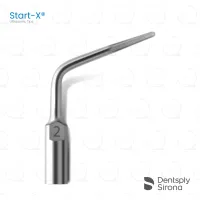
in upper molars, the entrance to the second mesiobuccal canal is often hidden under dentine. no. 2 is the start-x tip dentsply sirona designed for locating it: an active tip that removes that dentine, with active sides to open a straight path to the canal.
this pack: dentsply sirona start-x® ultrasonic tip no. 2, mb2 canal locator · satelec thread (m3 x 0.6 mm) · 1 tip
| indication | locating the mb2 canal (second canal of the mesiobuccal root) (dentsply sirona directions) |
| thread | satelec type, m3 x 0.6 mm |
| for | satelec-type (acteon) piezo ultrasonic units, piezo generators only |
| power | 16–18 on a satelec p5 / newtron (dentsply sirona brochure) |
| reprocessing | steam sterilisation, 134°c for 18 min |
| dentsply ref | a066000000200 |
› active tip – dentsply sirona: removes the dentine that often conceals the mb2 access in upper molars.
› active lateral part – creates a straight access to the canal.
› dentsply sirona's directions give it one indication: locating the mb2 canal, the second canal of the mesiobuccal root.
dentsply sirona developed the five start-x tips with professor berutti, professor cantatore and dr castellucci on a simple principle: one tip, one clinical indication, to facilitate and optimise the preparation of the access cavity.
in dentsply sirona's words: “higher control and precision with ultrasonic inserts specifically designed for access cavity refinement and canal orifice location.”
› micro-milled active part – in dentsply sirona's words, minimising the risk of diamond grit loss in the patient's mouth.
› resistance to fracture – dentsply sirona describe it as excellent.
› satelec thread – m3 x 0.6 mm. need the other fitting? this tip is also made with an ems thread.
| no. 1 | start-x® no. 1 – access wall refinement |
| no. 2 | this page. mb2 canal locator |
| no. 3 | start-x® no. 3 – canal entrance tip |
| no. 4 | start-x® no. 4 – metal post removal |
| no. 5 | start-x® no. 5 – pulp floor anatomy |
› secure the tip to the handpiece with the key before use.
› start at a lower power setting and only increase it if necessary to safely accomplish the task. dentsply sirona give no. 2 a range of 16–18 on a satelec p5 / newtron, adjusted to the clinical application; check your unit's own instructions too.
› irrigation is recommended for procedures that need high power, to avoid overheating.
› a visual aid is recommended, for comfort and safety. never run the generator with a damaged tip.
› contraindications: none known when used as recommended, but dentsply sirona recommend not using the tips in patients with a pacemaker.
once the mb2 entrance is found, what next?
that part is your protocol, not ours. for negotiating a fine canal we stock c-pilot® 08 and c-pilot® 10 in 21 mm, and the micro-opener 10/.04.
will it fit my ultrasonic unit?
this is the satelec-thread version (m3 x 0.6 mm). dentsply sirona give its power settings for satelec p5 / newtron units. if your unit takes ems-thread tips, choose the ems version.
not sure? call 01733 404999 or email sales@qedendo.com with the make and model and we will check it for you.
| ultrasonic unit | newtron® p5 xs · newtron® booster |
| negotiation | c-pilot® 08, 21 mm · c-pilot® 10, 21 mm · micro-opener 10/.04 |
| irrigants | chlorax 5.25% · endo-solution 17% edta |
| delivery | navitip™ 29 ga, 25 mm |
| coronal seal | sdr® flow+ universal – 4 mm bulk increment |
› start-x® ultrasonic tips brochure (pdf, 0.5 mb, dentsply sirona) – all five tips and their indications, the power range for each on satelec p5 / newtron and ems minipiezon units, and the order codes by thread.
dentsply sirona · start-x® ultrasonic tip no. 2 · satelec thread m3 x 0.6 mm · dentsply ref a066000000200 · ref a066000000200
start-x® no. 3 · satelec thread
calcified orificesaccess cavitypiezo ultrasonicsatelec thread
calcified or obstructed orifices are where an access stalls. no. 3 is the start-x tip for freeing the canal entrance: dentsply sirona call it the canal openings scouter, and describe it as removing calcifications from the pulp chamber or the coronal third of the canal.
this pack: dentsply sirona start-x® ultrasonic tip no. 3, canal entrance tip · satelec thread (m3 x 0.6 mm) · 1 tip
| indication | freeing the canal entrance (removal of obstructions) (dentsply sirona directions) |
| thread | satelec type, m3 x 0.6 mm |
| for | satelec-type (acteon) piezo ultrasonic units, piezo generators only |
| power | 10–18 on a satelec p5 / newtron (dentsply sirona brochure) |
| reprocessing | steam sterilisation, 134°c for 18 min |
| dentsply ref | a066000000300 |
› canal openings scouter – dentsply sirona: removes the obstructions that prevent a straight access.
› reach – calcifications in the pulp chamber or the coronal third of the root canal, in dentsply sirona's launch description.
› dentsply sirona's directions give it one indication: freeing the canal entrance by removing obstructions.
dentsply sirona developed the five start-x tips with professor berutti, professor cantatore and dr castellucci on a simple principle: one tip, one clinical indication, to facilitate and optimise the preparation of the access cavity.
in dentsply sirona's words: “higher control and precision with ultrasonic inserts specifically designed for access cavity refinement and canal orifice location.”
› micro-milled active part – in dentsply sirona's words, minimising the risk of diamond grit loss in the patient's mouth.
› resistance to fracture – dentsply sirona describe it as excellent.
› satelec thread – m3 x 0.6 mm. need the other fitting? this tip is also made with an ems thread.
| no. 1 | start-x® no. 1 – access wall refinement |
| no. 2 | start-x® no. 2 – mb2 canal locator |
| no. 3 | this page. canal entrance tip |
| no. 4 | start-x® no. 4 – metal post removal |
| no. 5 | start-x® no. 5 – pulp floor anatomy |
› secure the tip to the handpiece with the key before use.
› start at a lower power setting and only increase it if necessary to safely accomplish the task. dentsply sirona give no. 3 a range of 10–18 on a satelec p5 / newtron, adjusted to the clinical application; check your unit's own instructions too.
› irrigation is recommended for procedures that need high power, to avoid overheating.
› a visual aid is recommended, for comfort and safety. never run the generator with a damaged tip.
› contraindications: none known when used as recommended, but dentsply sirona recommend not using the tips in patients with a pacemaker.
is no. 3 the same as no. 2?
no. no. 2 is designed for one job, finding the mb2 canal in upper molars. no. 3 is for freeing any canal entrance that is calcified or obstructed.
will it fit my ultrasonic unit?
this is the satelec-thread version (m3 x 0.6 mm). dentsply sirona give its power settings for satelec p5 / newtron units. if your unit takes ems-thread tips, choose the ems version.
not sure? call 01733 404999 or email sales@qedendo.com with the make and model and we will check it for you.
| ultrasonic unit | newtron® p5 xs · newtron® booster |
| negotiation | c-pilot® 08, 21 mm · c-pilot® 10, 21 mm · micro-opener 10/.04 |
| irrigants | chlorax 5.25% · endo-solution 17% edta |
| delivery | navitip™ 29 ga, 25 mm |
| coronal seal | sdr® flow+ universal – 4 mm bulk increment |
› start-x® ultrasonic tips brochure (pdf, 0.5 mb, dentsply sirona) – all five tips and their indications, the power range for each on satelec p5 / newtron and ems minipiezon units, and the order codes by thread.
dentsply sirona · start-x® ultrasonic tip no. 3 · satelec thread m3 x 0.6 mm · dentsply ref a066000000300 · ref a066000000300
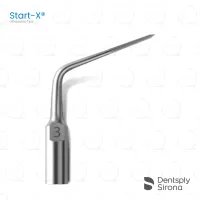
start-x® no. 4 · satelec thread
post removalaccess cavitypiezo ultrasonicsatelec thread
the post has to come out before the retreatment can start. no. 4 is the start-x tip for it: designed, in dentsply sirona's words, for working efficiently on both the top and the sides of a metal post, and described at launch as removing screw and cast posts alike.
this pack: dentsply sirona start-x® ultrasonic tip no. 4, metal post removal · satelec thread (m3 x 0.6 mm) · 1 tip
| indication | removal of metal posts (dentsply sirona directions) |
| thread | satelec type, m3 x 0.6 mm |
| for | satelec-type (acteon) piezo ultrasonic units, piezo generators only |
| power | 18–20 on a satelec p5 / newtron (dentsply sirona brochure) |
| reprocessing | steam sterilisation, 134°c for 18 min |
| dentsply ref | a066000000400 |
› works top and sides – dentsply sirona: suitable for working efficiently both on the top and the sides of the metal post.
› water port – cools the insert and avoids overheating. dentsply sirona single this out as particularly important on metal posts, which usually need high energy.
› the directions set no. 4 at the highest power range of the five start-x tips, and recommend irrigation for procedures that need high power.
dentsply sirona developed the five start-x tips with professor berutti, professor cantatore and dr castellucci on a simple principle: one tip, one clinical indication, to facilitate and optimise the preparation of the access cavity.
in dentsply sirona's words: “higher control and precision with ultrasonic inserts specifically designed for access cavity refinement and canal orifice location.”
› micro-milled active part – in dentsply sirona's words, minimising the risk of diamond grit loss in the patient's mouth.
› resistance to fracture – dentsply sirona describe it as excellent.
› satelec thread – m3 x 0.6 mm. need the other fitting? this tip is also made with an ems thread.
| no. 1 | start-x® no. 1 – access wall refinement |
| no. 2 | start-x® no. 2 – mb2 canal locator |
| no. 3 | start-x® no. 3 – canal entrance tip |
| no. 4 | this page. metal post removal |
| no. 5 | start-x® no. 5 – pulp floor anatomy |
› secure the tip to the handpiece with the key before use.
› start at a lower power setting and only increase it if necessary to safely accomplish the task. dentsply sirona give no. 4 a range of 18–20 on a satelec p5 / newtron, adjusted to the clinical application; check your unit's own instructions too.
› irrigation is recommended for procedures that need high power, to avoid overheating.
› a visual aid is recommended, for comfort and safety. never run the generator with a damaged tip.
› contraindications: none known when used as recommended, but dentsply sirona recommend not using the tips in patients with a pacemaker.
screw posts or cast posts?
both. dentsply sirona's launch description gives no. 4 the removal of screw and cast metal posts.
will it fit my ultrasonic unit?
this is the satelec-thread version (m3 x 0.6 mm). dentsply sirona give its power settings for satelec p5 / newtron units. if your unit takes ems-thread tips, choose the ems version.
not sure? call 01733 404999 or email sales@qedendo.com with the make and model and we will check it for you.
| ultrasonic unit | newtron® p5 xs · newtron® booster |
| retreatment files | protaper® universal retreatment d1–d3 – dentsply sirona's own |
| irrigants | chlorax 5.25% · endo-solution 17% edta |
| delivery | navitip™ 29 ga, 25 mm |
| coronal seal | sdr® flow+ universal – 4 mm bulk increment |
› start-x® ultrasonic tips brochure (pdf, 0.5 mb, dentsply sirona) – all five tips and their indications, the power range for each on satelec p5 / newtron and ems minipiezon units, and the order codes by thread.
dentsply sirona · start-x® ultrasonic tip no. 4 · satelec thread m3 x 0.6 mm · dentsply ref a066000000400 · ref a066000000400
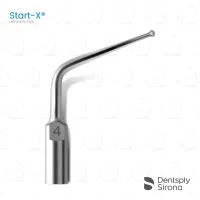
start-x® no. 5 · satelec thread
pulp flooraccess cavitypiezo ultrasonicsatelec thread
calcifications and old filling material can hide the floor you need to read. no. 5 is the start-x tip for revealing the original anatomy of the pulp chamber floor, with a thin, cylindrical active tip.
this pack: dentsply sirona start-x® ultrasonic tip no. 5, pulp floor anatomy · satelec thread (m3 x 0.6 mm) · 1 tip
| indication | locating the original anatomy of the pulp chamber floor (calcifications, removing old filling materials) (dentsply sirona directions) |
| thread | satelec type, m3 x 0.6 mm |
| for | satelec-type (acteon) piezo ultrasonic units, piezo generators only |
| power | 7–18 on a satelec p5 / newtron (dentsply sirona brochure) |
| reprocessing | steam sterilisation, 134°c for 18 min |
| dentsply ref | a066000000500 |
› thin, cylindrical active tip – for close work on the chamber floor.
› active lateral part – creates a straight access to the canal.
› dentsply sirona: canal orifice location made easier by removing the calcifications and filling materials that hide the original pulp chamber floor anatomy, with good visibility.
dentsply sirona developed the five start-x tips with professor berutti, professor cantatore and dr castellucci on a simple principle: one tip, one clinical indication, to facilitate and optimise the preparation of the access cavity.
in dentsply sirona's words: “higher control and precision with ultrasonic inserts specifically designed for access cavity refinement and canal orifice location.”
› micro-milled active part – in dentsply sirona's words, minimising the risk of diamond grit loss in the patient's mouth.
› resistance to fracture – dentsply sirona describe it as excellent.
› satelec thread – m3 x 0.6 mm. need the other fitting? this tip is also made with an ems thread.
| no. 1 | start-x® no. 1 – access wall refinement |
| no. 2 | start-x® no. 2 – mb2 canal locator |
| no. 3 | start-x® no. 3 – canal entrance tip |
| no. 4 | start-x® no. 4 – metal post removal |
| no. 5 | this page. pulp floor anatomy |
› secure the tip to the handpiece with the key before use.
› start at a lower power setting and only increase it if necessary to safely accomplish the task. dentsply sirona give no. 5 a range of 7–18 on a satelec p5 / newtron, adjusted to the clinical application; check your unit's own instructions too.
› irrigation is recommended for procedures that need high power, to avoid overheating.
› a visual aid is recommended, for comfort and safety. never run the generator with a damaged tip.
› contraindications: none known when used as recommended, but dentsply sirona recommend not using the tips in patients with a pacemaker.
how is it different from no. 1?
no. 1 works on the walls and has a non-active end so it leaves the floor alone. no. 5 is the one designed to work on the floor itself.
will it fit my ultrasonic unit?
this is the satelec-thread version (m3 x 0.6 mm). dentsply sirona give its power settings for satelec p5 / newtron units. if your unit takes ems-thread tips, choose the ems version.
not sure? call 01733 404999 or email sales@qedendo.com with the make and model and we will check it for you.
| ultrasonic unit | newtron® p5 xs · newtron® booster |
| negotiation | c-pilot® 08, 21 mm · c-pilot® 10, 21 mm · micro-opener 10/.04 |
| irrigants | chlorax 5.25% · endo-solution 17% edta |
| delivery | navitip™ 29 ga, 25 mm |
| coronal seal | sdr® flow+ universal – 4 mm bulk increment |
› start-x® ultrasonic tips brochure (pdf, 0.5 mb, dentsply sirona) – all five tips and their indications, the power range for each on satelec p5 / newtron and ems minipiezon units, and the order codes by thread.
dentsply sirona · start-x® ultrasonic tip no. 5 · satelec thread m3 x 0.6 mm · dentsply ref a066000000500 · ref a066000000500
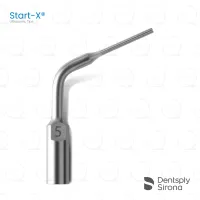
start-x® no. 1 · ems thread
access wallsaccess cavitypiezo ultrasonicems thread
walls that overhang the canal entrances cost you a straight line into the canal. no. 1 is the start-x tip for finishing them: the sides do the cutting, and the tip itself is deliberately non-active so it will not mark the pulp chamber floor while you work.
this pack: dentsply sirona start-x® ultrasonic tip no. 1, access wall refinement · ems thread (m3 x 0.5 mm) · 1 tip
| indication | finishing of the walls of the access cavity (dentsply sirona directions) |
| thread | ems type, m3 x 0.5 mm |
| for | ems-type piezo ultrasonic units, piezo generators only |
| power | 8–9 on a ems minipiezon (dentsply sirona brochure) |
| reprocessing | steam sterilisation, 134°c for 18 min |
| dentsply ref | a06610000100 |
› non-active tip – dentsply sirona: avoids accidentally damaging the pulp chamber floor.
› active lateral part – creates a straight access to the canal.
› dentsply sirona's launch material also gives it the removal of restorations, filling materials, caries and dentine interferences from the access cavity.
dentsply sirona developed the five start-x tips with professor berutti, professor cantatore and dr castellucci on a simple principle: one tip, one clinical indication, to facilitate and optimise the preparation of the access cavity.
in dentsply sirona's words: “higher control and precision with ultrasonic inserts specifically designed for access cavity refinement and canal orifice location.”
› micro-milled active part – in dentsply sirona's words, minimising the risk of diamond grit loss in the patient's mouth.
› resistance to fracture – dentsply sirona describe it as excellent.
› ems thread – m3 x 0.5 mm. need the other fitting? this tip is also made with an satelec thread.
| no. 1 | this page. access wall refinement |
| no. 2 | start-x® no. 2 – mb2 canal locator |
| no. 3 | start-x® no. 3 – canal entrance tip |
| no. 4 | start-x® no. 4 – metal post removal |
| no. 5 | start-x® no. 5 – pulp floor anatomy |
› secure the tip to the handpiece with the key before use.
› start at a lower power setting and only increase it if necessary to safely accomplish the task. dentsply sirona give no. 1 a range of 8–9 on a ems minipiezon, adjusted to the clinical application; check your unit's own instructions too.
› irrigation is recommended for procedures that need high power, to avoid overheating.
› a visual aid is recommended, for comfort and safety. never run the generator with a damaged tip.
› contraindications: none known when used as recommended, but dentsply sirona recommend not using the tips in patients with a pacemaker.
why is the end of the tip smooth?
so the walls can be taken back right down to the floor without the tip cutting into it. dentsply sirona designed the non-active end for exactly that: to avoid accidentally damaging the pulp chamber floor.
will it fit my ultrasonic unit?
this is the ems-thread version (m3 x 0.5 mm), with dentsply sirona power settings for the ems minipiezon. if your unit takes satelec-thread tips, choose the satelec version.
not sure? call 01733 404999 or email sales@qedendo.com with the make and model and we will check it for you.
| negotiation | c-pilot® 08, 21 mm · c-pilot® 10, 21 mm · micro-opener 10/.04 |
| irrigants | chlorax 5.25% · endo-solution 17% edta |
| delivery | navitip™ 29 ga, 25 mm |
| coronal seal | sdr® flow+ universal – 4 mm bulk increment |
› start-x® ultrasonic tips brochure (pdf, 0.5 mb, dentsply sirona) – all five tips and their indications, the power range for each on satelec p5 / newtron and ems minipiezon units, and the order codes by thread.
dentsply sirona · start-x® ultrasonic tip no. 1 · ems thread m3 x 0.5 mm · dentsply ref a06610000100 · ref a0661-1
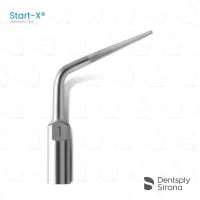
start-x® no. 2 · ems thread
mb2 locationaccess cavitypiezo ultrasonicems thread
in upper molars, the entrance to the second mesiobuccal canal is often hidden under dentine. no. 2 is the start-x tip dentsply sirona designed for locating it: an active tip that removes that dentine, with active sides to open a straight path to the canal.
this pack: dentsply sirona start-x® ultrasonic tip no. 2, mb2 canal locator · ems thread (m3 x 0.5 mm) · 1 tip
| indication | locating the mb2 canal (second canal of the mesiobuccal root) (dentsply sirona directions) |
| thread | ems type, m3 x 0.5 mm |
| for | ems-type piezo ultrasonic units, piezo generators only |
| power | 8–9 on a ems minipiezon (dentsply sirona brochure) |
| reprocessing | steam sterilisation, 134°c for 18 min |
| dentsply ref | a06610000200 |
› active tip – dentsply sirona: removes the dentine that often conceals the mb2 access in upper molars.
› active lateral part – creates a straight access to the canal.
› dentsply sirona's directions give it one indication: locating the mb2 canal, the second canal of the mesiobuccal root.
dentsply sirona developed the five start-x tips with professor berutti, professor cantatore and dr castellucci on a simple principle: one tip, one clinical indication, to facilitate and optimise the preparation of the access cavity.
in dentsply sirona's words: “higher control and precision with ultrasonic inserts specifically designed for access cavity refinement and canal orifice location.”
› micro-milled active part – in dentsply sirona's words, minimising the risk of diamond grit loss in the patient's mouth.
› resistance to fracture – dentsply sirona describe it as excellent.
› ems thread – m3 x 0.5 mm. need the other fitting? this tip is also made with an satelec thread.
| no. 1 | start-x® no. 1 – access wall refinement |
| no. 2 | this page. mb2 canal locator |
| no. 3 | start-x® no. 3 – canal entrance tip |
| no. 4 | start-x® no. 4 – metal post removal |
| no. 5 | start-x® no. 5 – pulp floor anatomy |
› secure the tip to the handpiece with the key before use.
› start at a lower power setting and only increase it if necessary to safely accomplish the task. dentsply sirona give no. 2 a range of 8–9 on a ems minipiezon, adjusted to the clinical application; check your unit's own instructions too.
› irrigation is recommended for procedures that need high power, to avoid overheating.
› a visual aid is recommended, for comfort and safety. never run the generator with a damaged tip.
› contraindications: none known when used as recommended, but dentsply sirona recommend not using the tips in patients with a pacemaker.
once the mb2 entrance is found, what next?
that part is your protocol, not ours. for negotiating a fine canal we stock c-pilot® 08 and c-pilot® 10 in 21 mm, and the micro-opener 10/.04.
will it fit my ultrasonic unit?
this is the ems-thread version (m3 x 0.5 mm), with dentsply sirona power settings for the ems minipiezon. if your unit takes satelec-thread tips, choose the satelec version.
not sure? call 01733 404999 or email sales@qedendo.com with the make and model and we will check it for you.
| negotiation | c-pilot® 08, 21 mm · c-pilot® 10, 21 mm · micro-opener 10/.04 |
| irrigants | chlorax 5.25% · endo-solution 17% edta |
| delivery | navitip™ 29 ga, 25 mm |
| coronal seal | sdr® flow+ universal – 4 mm bulk increment |
› start-x® ultrasonic tips brochure (pdf, 0.5 mb, dentsply sirona) – all five tips and their indications, the power range for each on satelec p5 / newtron and ems minipiezon units, and the order codes by thread.
dentsply sirona · start-x® ultrasonic tip no. 2 · ems thread m3 x 0.5 mm · dentsply ref a06610000200 · ref a0661-2
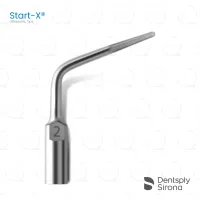
start-x® no. 3 · ems thread
calcified orificesaccess cavitypiezo ultrasonicems thread
calcified or obstructed orifices are where an access stalls. no. 3 is the start-x tip for freeing the canal entrance: dentsply sirona call it the canal openings scouter, and describe it as removing calcifications from the pulp chamber or the coronal third of the canal.
this pack: dentsply sirona start-x® ultrasonic tip no. 3, canal entrance tip · ems thread (m3 x 0.5 mm) · 1 tip
| indication | freeing the canal entrance (removal of obstructions) (dentsply sirona directions) |
| thread | ems type, m3 x 0.5 mm |
| for | ems-type piezo ultrasonic units, piezo generators only |
| power | 4–7 on a ems minipiezon (dentsply sirona brochure) |
| reprocessing | steam sterilisation, 134°c for 18 min |
| dentsply ref | a06610000300 |
› canal openings scouter – dentsply sirona: removes the obstructions that prevent a straight access.
› reach – calcifications in the pulp chamber or the coronal third of the root canal, in dentsply sirona's launch description.
› dentsply sirona's directions give it one indication: freeing the canal entrance by removing obstructions.
dentsply sirona developed the five start-x tips with professor berutti, professor cantatore and dr castellucci on a simple principle: one tip, one clinical indication, to facilitate and optimise the preparation of the access cavity.
in dentsply sirona's words: “higher control and precision with ultrasonic inserts specifically designed for access cavity refinement and canal orifice location.”
› micro-milled active part – in dentsply sirona's words, minimising the risk of diamond grit loss in the patient's mouth.
› resistance to fracture – dentsply sirona describe it as excellent.
› ems thread – m3 x 0.5 mm. need the other fitting? this tip is also made with an satelec thread.
| no. 1 | start-x® no. 1 – access wall refinement |
| no. 2 | start-x® no. 2 – mb2 canal locator |
| no. 3 | this page. canal entrance tip |
| no. 4 | start-x® no. 4 – metal post removal |
| no. 5 | start-x® no. 5 – pulp floor anatomy |
› secure the tip to the handpiece with the key before use.
› start at a lower power setting and only increase it if necessary to safely accomplish the task. dentsply sirona give no. 3 a range of 4–7 on a ems minipiezon, adjusted to the clinical application; check your unit's own instructions too.
› irrigation is recommended for procedures that need high power, to avoid overheating.
› a visual aid is recommended, for comfort and safety. never run the generator with a damaged tip.
› contraindications: none known when used as recommended, but dentsply sirona recommend not using the tips in patients with a pacemaker.
is no. 3 the same as no. 2?
no. no. 2 is designed for one job, finding the mb2 canal in upper molars. no. 3 is for freeing any canal entrance that is calcified or obstructed.
will it fit my ultrasonic unit?
this is the ems-thread version (m3 x 0.5 mm), with dentsply sirona power settings for the ems minipiezon. if your unit takes satelec-thread tips, choose the satelec version.
not sure? call 01733 404999 or email sales@qedendo.com with the make and model and we will check it for you.
| negotiation | c-pilot® 08, 21 mm · c-pilot® 10, 21 mm · micro-opener 10/.04 |
| irrigants | chlorax 5.25% · endo-solution 17% edta |
| delivery | navitip™ 29 ga, 25 mm |
| coronal seal | sdr® flow+ universal – 4 mm bulk increment |
› start-x® ultrasonic tips brochure (pdf, 0.5 mb, dentsply sirona) – all five tips and their indications, the power range for each on satelec p5 / newtron and ems minipiezon units, and the order codes by thread.
dentsply sirona · start-x® ultrasonic tip no. 3 · ems thread m3 x 0.5 mm · dentsply ref a06610000300 · ref a0661-3
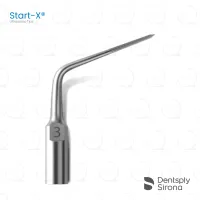
start-x® no. 4 · ems thread
post removalaccess cavitypiezo ultrasonicems thread
the post has to come out before the retreatment can start. no. 4 is the start-x tip for it: designed, in dentsply sirona's words, for working efficiently on both the top and the sides of a metal post, and described at launch as removing screw and cast posts alike.
this pack: dentsply sirona start-x® ultrasonic tip no. 4, metal post removal · ems thread (m3 x 0.5 mm) · 1 tip
| indication | removal of metal posts (dentsply sirona directions) |
| thread | ems type, m3 x 0.5 mm |
| for | ems-type piezo ultrasonic units, piezo generators only |
| power | 9–10 on a ems minipiezon (dentsply sirona brochure) |
| reprocessing | steam sterilisation, 134°c for 18 min |
| dentsply ref | a06610000400 |
› works top and sides – dentsply sirona: suitable for working efficiently both on the top and the sides of the metal post.
› water port – cools the insert and avoids overheating. dentsply sirona single this out as particularly important on metal posts, which usually need high energy.
› the directions set no. 4 at the highest power range of the five start-x tips, and recommend irrigation for procedures that need high power.
dentsply sirona developed the five start-x tips with professor berutti, professor cantatore and dr castellucci on a simple principle: one tip, one clinical indication, to facilitate and optimise the preparation of the access cavity.
in dentsply sirona's words: “higher control and precision with ultrasonic inserts specifically designed for access cavity refinement and canal orifice location.”
› micro-milled active part – in dentsply sirona's words, minimising the risk of diamond grit loss in the patient's mouth.
› resistance to fracture – dentsply sirona describe it as excellent.
› ems thread – m3 x 0.5 mm. need the other fitting? this tip is also made with an satelec thread.
| no. 1 | start-x® no. 1 – access wall refinement |
| no. 2 | start-x® no. 2 – mb2 canal locator |
| no. 3 | start-x® no. 3 – canal entrance tip |
| no. 4 | this page. metal post removal |
| no. 5 | start-x® no. 5 – pulp floor anatomy |
› secure the tip to the handpiece with the key before use.
› start at a lower power setting and only increase it if necessary to safely accomplish the task. dentsply sirona give no. 4 a range of 9–10 on a ems minipiezon, adjusted to the clinical application; check your unit's own instructions too.
› irrigation is recommended for procedures that need high power, to avoid overheating.
› a visual aid is recommended, for comfort and safety. never run the generator with a damaged tip.
› contraindications: none known when used as recommended, but dentsply sirona recommend not using the tips in patients with a pacemaker.
screw posts or cast posts?
both. dentsply sirona's launch description gives no. 4 the removal of screw and cast metal posts.
will it fit my ultrasonic unit?
this is the ems-thread version (m3 x 0.5 mm), with dentsply sirona power settings for the ems minipiezon. if your unit takes satelec-thread tips, choose the satelec version.
not sure? call 01733 404999 or email sales@qedendo.com with the make and model and we will check it for you.
| retreatment files | protaper® universal retreatment d1–d3 – dentsply sirona's own |
| irrigants | chlorax 5.25% · endo-solution 17% edta |
| delivery | navitip™ 29 ga, 25 mm |
| coronal seal | sdr® flow+ universal – 4 mm bulk increment |
› start-x® ultrasonic tips brochure (pdf, 0.5 mb, dentsply sirona) – all five tips and their indications, the power range for each on satelec p5 / newtron and ems minipiezon units, and the order codes by thread.
dentsply sirona · start-x® ultrasonic tip no. 4 · ems thread m3 x 0.5 mm · dentsply ref a06610000400 · ref a0661-4
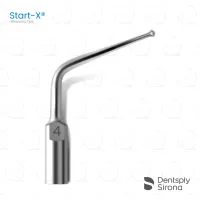
start-x® no. 5 · ems thread
pulp flooraccess cavitypiezo ultrasonicems thread
calcifications and old filling material can hide the floor you need to read. no. 5 is the start-x tip for revealing the original anatomy of the pulp chamber floor, with a thin, cylindrical active tip.
this pack: dentsply sirona start-x® ultrasonic tip no. 5, pulp floor anatomy · ems thread (m3 x 0.5 mm) · 1 tip
| indication | locating the original anatomy of the pulp chamber floor (calcifications, removing old filling materials) (dentsply sirona directions) |
| thread | ems type, m3 x 0.5 mm |
| for | ems-type piezo ultrasonic units, piezo generators only |
| power | 3–8 on a ems minipiezon (dentsply sirona brochure) |
| reprocessing | steam sterilisation, 134°c for 18 min |
| dentsply ref | a06610000500 |
› thin, cylindrical active tip – for close work on the chamber floor.
› active lateral part – creates a straight access to the canal.
› dentsply sirona: canal orifice location made easier by removing the calcifications and filling materials that hide the original pulp chamber floor anatomy, with good visibility.
dentsply sirona developed the five start-x tips with professor berutti, professor cantatore and dr castellucci on a simple principle: one tip, one clinical indication, to facilitate and optimise the preparation of the access cavity.
in dentsply sirona's words: “higher control and precision with ultrasonic inserts specifically designed for access cavity refinement and canal orifice location.”
› micro-milled active part – in dentsply sirona's words, minimising the risk of diamond grit loss in the patient's mouth.
› resistance to fracture – dentsply sirona describe it as excellent.
› ems thread – m3 x 0.5 mm. need the other fitting? this tip is also made with an satelec thread.
| no. 1 | start-x® no. 1 – access wall refinement |
| no. 2 | start-x® no. 2 – mb2 canal locator |
| no. 3 | start-x® no. 3 – canal entrance tip |
| no. 4 | start-x® no. 4 – metal post removal |
| no. 5 | this page. pulp floor anatomy |
› secure the tip to the handpiece with the key before use.
› start at a lower power setting and only increase it if necessary to safely accomplish the task. dentsply sirona give no. 5 a range of 3–8 on a ems minipiezon, adjusted to the clinical application; check your unit's own instructions too.
› irrigation is recommended for procedures that need high power, to avoid overheating.
› a visual aid is recommended, for comfort and safety. never run the generator with a damaged tip.
› contraindications: none known when used as recommended, but dentsply sirona recommend not using the tips in patients with a pacemaker.
how is it different from no. 1?
no. 1 works on the walls and has a non-active end so it leaves the floor alone. no. 5 is the one designed to work on the floor itself.
will it fit my ultrasonic unit?
this is the ems-thread version (m3 x 0.5 mm), with dentsply sirona power settings for the ems minipiezon. if your unit takes satelec-thread tips, choose the satelec version.
not sure? call 01733 404999 or email sales@qedendo.com with the make and model and we will check it for you.
| negotiation | c-pilot® 08, 21 mm · c-pilot® 10, 21 mm · micro-opener 10/.04 |
| irrigants | chlorax 5.25% · endo-solution 17% edta |
| delivery | navitip™ 29 ga, 25 mm |
| coronal seal | sdr® flow+ universal – 4 mm bulk increment |
› start-x® ultrasonic tips brochure (pdf, 0.5 mb, dentsply sirona) – all five tips and their indications, the power range for each on satelec p5 / newtron and ems minipiezon units, and the order codes by thread.
dentsply sirona · start-x® ultrasonic tip no. 5 · ems thread m3 x 0.5 mm · dentsply ref a06610000500 · ref a0661-5
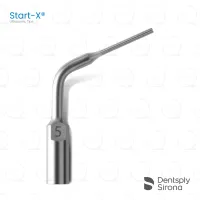
protaper next® xa · 019/.035 · 19 mm · pack of 3
orifice openingcoronal flaringaccessory filesterile, single use19 mm only
xa is not one of the five shaping files. it is an iso 019 instrument on a fixed .035 taper that opens the orifice and the coronal third, so the shaping files meet a canal they can follow rather than one they have to fight. xa comes in one length, 19 mm, because it works the orifice and the coronal third rather than the full canal.
| 019/.035 iso tip and taper | 19 mm length | 300 rpm 3–4 ncm, 2025 ifu |
speed and torque from the june 2025 eu ifu, which supersedes the wider range quoted in the 2017 brochure.
this pack: protaper next® xa rotary file, 19 mm (pack of 3) · sterile, single use
dentsply sirona · legal manufacturer dentsply detrey gmbh, konstanz, germany; uk representative dentsply ih ltd, stonehouse (2025 ifu)
› what dentsply sirona say it is for. verbatim: “recommended for preflaring the orifice, removing triangles of dentin, relocating the coronal aspect of a canal away from an external root concavity, and creating more shape as desired.”
› where it sits in the sequence. the 2025 ifu places it after working length and patency are confirmed and before the glide path is expanded. it is not taken to working length.
› one length, 019 on a .035 taper. xa is made in 19 mm only, which is what an orifice instrument needs and no more.
› its own torque. 300 rpm at 3–4 ncm in the 2025 ifu – higher than the 2–3 ncm the same document gives x1 to x5.
› sterile and single use. the 2025 ifu states sterile – sterilised by radiation, and that the instruments “are single use devices and cannot be reused”.
| iso tip and taper | 019 on a .035 taper · printed 019.035 on the pack |
| length | 19 mm |
| colour ring | yellow |
| pack | 3 sterile files in one blister |
| settings | 300 rpm, 3–4 ncm · 2025 ifu |
| material | nickel titanium · dentsply sirona do not publish the alloy or the cross-section of xa |
what settings?
300 rpm at 3–4 ncm, from the june 2025 ifu. the 2017 brochure quotes 2–5.2 ncm across the whole family and a us technique card quotes 4–5.2 ncm; we follow the current ifu. both x-smart® pro+ and x-smart® pro will run it.
can they be re-used?
no. the ifu is explicit: single use devices that cannot be reused, supplied sterile, sterilised by radiation. re-use raises the risk of cross-contamination and of breakage.
where does xa sit in the sequence?
step six of the ifu’s own list, after working length is confirmed and before the glide path is expanded – to preflare the orifice, remove triangles of dentine, relocate the coronal aspect of a canal away from an external root concavity and improve radicular access. it is a 19 mm instrument and is not taken to working length.
| patency | c-pilot® 010, 19 mm · the ifu has you scout and confirm patency with small hand files before any rotary file goes in |
| glide path | proglider® · the glide path is cut to the canal, not to xa |
| lubricant | glyde™ file prep · dentsply sirona’s own |
| irrigants | chlorax 5.25% · chlorax 2% · endo-solution 17% edta |
| delivery | irriflex® 30g |
| activation | smartlite pro endoactivator® · dentsply sirona’s own |
| dry | protaper next® paper points, x2–x3 · x4–x5 |
| fill and seal | conform fit® gutta percha, x2–x3, carried to length with ah plus®, neosealer® ezflo, 21 mm tips or proroot® bio sealer |
| coronal seal | sdr® flow+ refill, universal |
| motor | x-smart® pro+ · x-smart® pro |
| if it has to come out again | protaper® universal retreatment, d1–d3 · the range the brochure names for unfilling |
› protaper next® brochure (pdf, 2.0 mb, dentsply sirona) – the range brochure. still the current revision – 01/2017, updated 11/2017
tip size and taper are dentsply sirona’s, from the protaper next® ordering table. speed and torque are from the june 2025 ifu; the 2017 brochure quotes a wider 2–5.2 ncm range across the whole family and a us technique card quotes 4–5.2 ncm, so we follow the current regulatory document. dentsply sirona describe the off-centred rectangular cross-section, the swaggering movement and the m-wire® treatment for the protaper next® shaping files x1 to x5. no document we hold states the cross-section or the alloy of xa, so this page does not claim either for it. the colour ring is as it appears on dentsply sirona’s own product render, and is a recognition aid rather than a published specification.
ref a080321900a03 · protaper next® xa, 19 mm, pack of 3 · sterile, single use
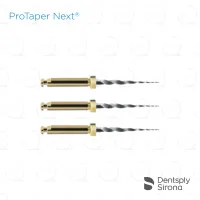
guttacore® · size 20 · pack of 6
carrier-basedwarm gutta perchacrosslinked gp core20/.06 or 25/.04needs an oven
guttacore is a carrier obturator whose carrier is itself gutta percha, crosslinked so it keeps its form while the warm gutta percha around it flows. heat it, take it to length in one movement, and remove the handle at the orifice. size 20 is dentsply sirona’s match for a canal finished to 20/.06 or 25/.04.
| 1 insertion to length | 20/.06 or 25/.04 shape | 18–24 mm depth rings |
this pack: guttacore® crosslinked gutta-percha core obturator, size 20 (pack of 6) · single use
made by dentsply sirona
| fits the shape | 20/.06 or 25/.04 – dentsply sirona’s size table |
| core | crosslinked gutta percha, with gutta percha around it |
| depth marks | calibration rings at 18, 19, 20, 22 and 24 mm, and a silicone stopper |
| heating | dentsply sirona thermaprep® 2 obturator oven |
| pack | 6 obturators, single use |
“its crosslinked gutta-percha core centrally compacts the gutta-percha with a hydraulic force that sends it flowing equally in three dimensions.”
dentsply sirona, guttacore® brochure
› one insertion. dentsply sirona describe it as “an efficient technique that offers the ease of a single insertion” – cold-cone convenience with a warm fill, in their words.
› sized by the table, confirmed by the verifier. you choose the obturator from the shape you finished, then prove it with the guttacore size verifier before anything is heated.
› post space and retreatment are set out. the directions cover post space with a post space instrument or peeso reamer, and removal with rotary files, or a hand file with solvent to soften the gutta percha.
dentsply sirona cite li et al., journal of dentistry 2014, an in vitro study of 30 single-rooted premolars with oval canals, ten per technique. on micro-ct and sem, guttacore had the lowest incidence of gaps and voids; its difference from warm vertical compaction was not statistically significant, and both did significantly better than cold lateral compaction. the authors conclude that obturation quality with guttacore “is not significantly different from that achieved by warm vertical compaction”. a laboratory result, and a fair one.
size by the shape you finished, not by habit. dentsply sirona’s table puts guttacore 20 in a 20/.06 or a 25/.04 preparation. dentsply sirona’s table has no guttacore for a 20/.04 finish – size 20 is the smallest obturator in the range. for a 25/.06 shape it is guttacore 25.
confirm it before you heat anything: the guttacore size verifier should reach working length and fit passively. dentsply sirona are specific that the obturator itself and hand files are not to be used as verifiers.
1shape and flare. finish the canal to your file system’s own directions and flare it coronally so the obturator enters in straight-line access.
2verify. take the guttacore size verifier to working length; it should fit passively.
3irrigate and dry. irrigate, then dry the canal with paper points.
4set the stopper on the obturator at working length, using the calibration rings.
5sealer. a very light coat on the canal wall, placed with a paper point.
6heat in the thermaprep® 2 oven. at the oven’s first signal the obturator is ready.
7place directly into the canal orifice and on to working length, without touching the walls of the access cavity.
8remove the handle at the orifice, by bending it side to side or with a bur. then the coronal seal.
one caution worth passing on: do not strip gutta percha from the apical end before placing it – dentsply sirona warn that it may damage the obturator.
guttacore has to be heated before use, and the oven dentsply sirona’s directions name is their thermaprep® 2 obturator oven. it is not in our online catalogue – if you need one, ask us.
how is it different from thermafil?
both are carrier-based and heated in an oven before placement. the difference is the carrier: in guttacore it is crosslinked gutta percha.
which sealer?
dentsply sirona’s directions name ah plus jet; ah plus is the same chemistry in tubes, the epoxy sealer every other one is measured against. neosealer ezflo is the bioceramic alternative. resin or bioceramic is a real choice of technique rather than a ranking – we carry both because both are right in different hands.
| shape | your file system, finished to 20/.06 or 25/.04. |
| irrigants | chlorax 5.25%, chlorax 2% and endo-solution 17% edta. |
| activation | smartlite pro endoactivator – dentsply sirona’s own. |
| verify the size | the guttacore size verifier. |
| sealer | ah plus jet, ah plus, neosealer ezflo or proroot bio sealer. |
| heat | thermaprep® 2 obturator oven – ask us. |
| coronal seal | sdr flow+ refill universal – 4 mm bulk increment, one cure. |
› guttacore® brochure (pdf, 2.2 mb, dentsply sirona) – how the crosslinked core works, the evidence dentsply sirona cite and the range.
size matching, technique and cautions are from dentsply sirona’s guttacore® directions for use (rev.07, 08/2017); the quotations are from the guttacore® brochure (09/2017). the study is described from its published abstract. the oven note is a qed stock fact. dentsply sirona, guttacore, thermaprep, thermafil, ah plus, smartlite and sdr are their trademarks.
guttacore® size 20 · for 20/.06 or 25/.04 · pack of 6 · carrier-based · oven required · ref a1703b0042000
guttacore® · size 25 · pack of 6
carrier-basedwarm gutta perchacrosslinked gp core25/.06 or 30/.04needs an oven
guttacore is a carrier obturator whose carrier is itself gutta percha, crosslinked so it keeps its form while the warm gutta percha around it flows. heat it, take it to length in one movement, and remove the handle at the orifice. size 25 is dentsply sirona’s match for a canal finished to 25/.06 or 30/.04.
| 1 insertion to length | 25/.06 or 30/.04 shape | 18–24 mm depth rings |
this pack: guttacore® crosslinked gutta-percha core obturator, size 25 (pack of 6) · single use
made by dentsply sirona
| fits the shape | 25/.06 or 30/.04 – dentsply sirona’s size table |
| core | crosslinked gutta percha, with gutta percha around it |
| depth marks | calibration rings at 18, 19, 20, 22 and 24 mm, and a silicone stopper |
| heating | dentsply sirona thermaprep® 2 obturator oven |
| pack | 6 obturators, single use |
“its crosslinked gutta-percha core centrally compacts the gutta-percha with a hydraulic force that sends it flowing equally in three dimensions.”
dentsply sirona, guttacore® brochure
› one insertion. dentsply sirona describe it as “an efficient technique that offers the ease of a single insertion” – cold-cone convenience with a warm fill, in their words.
› sized by the table, confirmed by the verifier. you choose the obturator from the shape you finished, then prove it with the guttacore size verifier before anything is heated.
› post space and retreatment are set out. the directions cover post space with a post space instrument or peeso reamer, and removal with rotary files, or a hand file with solvent to soften the gutta percha.
dentsply sirona cite li et al., journal of dentistry 2014, an in vitro study of 30 single-rooted premolars with oval canals, ten per technique. on micro-ct and sem, guttacore had the lowest incidence of gaps and voids; its difference from warm vertical compaction was not statistically significant, and both did significantly better than cold lateral compaction. the authors conclude that obturation quality with guttacore “is not significantly different from that achieved by warm vertical compaction”. a laboratory result, and a fair one.
size by the shape you finished, not by habit. dentsply sirona’s table puts guttacore 25 in a 25/.06 or a 30/.04 preparation. finished to 25/.04 instead? then the table takes you one size down, to guttacore 20. for a 30/.06 shape it is guttacore 30.
confirm it before you heat anything: the guttacore size verifier should reach working length and fit passively. dentsply sirona are specific that the obturator itself and hand files are not to be used as verifiers.
1shape and flare. finish the canal to your file system’s own directions and flare it coronally so the obturator enters in straight-line access.
2verify. take the guttacore size verifier to working length; it should fit passively.
3irrigate and dry. irrigate, then dry the canal with paper points.
4set the stopper on the obturator at working length, using the calibration rings.
5sealer. a very light coat on the canal wall, placed with a paper point.
6heat in the thermaprep® 2 oven. at the oven’s first signal the obturator is ready.
7place directly into the canal orifice and on to working length, without touching the walls of the access cavity.
8remove the handle at the orifice, by bending it side to side or with a bur. then the coronal seal.
one caution worth passing on: do not strip gutta percha from the apical end before placing it – dentsply sirona warn that it may damage the obturator.
guttacore has to be heated before use, and the oven dentsply sirona’s directions name is their thermaprep® 2 obturator oven. it is not in our online catalogue – if you need one, ask us.
how is it different from thermafil?
both are carrier-based and heated in an oven before placement. the difference is the carrier: in guttacore it is crosslinked gutta percha.
which sealer?
dentsply sirona’s directions name ah plus jet; ah plus is the same chemistry in tubes, the epoxy sealer every other one is measured against. neosealer ezflo is the bioceramic alternative. resin or bioceramic is a real choice of technique rather than a ranking – we carry both because both are right in different hands.
| shape | your file system, finished to 25/.06 or 30/.04. |
| irrigants | chlorax 5.25%, chlorax 2% and endo-solution 17% edta. |
| activation | smartlite pro endoactivator – dentsply sirona’s own. |
| verify the size | the guttacore size verifier. |
| sealer | ah plus jet, ah plus, neosealer ezflo or proroot bio sealer. |
| heat | thermaprep® 2 obturator oven – ask us. |
| coronal seal | sdr flow+ refill universal – 4 mm bulk increment, one cure. |
› guttacore® brochure (pdf, 2.2 mb, dentsply sirona) – how the crosslinked core works, the evidence dentsply sirona cite and the range.
size matching, technique and cautions are from dentsply sirona’s guttacore® directions for use (rev.07, 08/2017); the quotations are from the guttacore® brochure (09/2017). the study is described from its published abstract. the oven note is a qed stock fact. dentsply sirona, guttacore, thermaprep, thermafil, ah plus, smartlite and sdr are their trademarks.
guttacore® size 25 · for 25/.06 or 30/.04 · pack of 6 · carrier-based · oven required · ref a1703b0042500
guttacore® · size 30 · pack of 6
carrier-basedwarm gutta perchacrosslinked gp core30/.06 or 35/.04needs an oven
guttacore is a carrier obturator whose carrier is itself gutta percha, crosslinked so it keeps its form while the warm gutta percha around it flows. heat it, take it to length in one movement, and remove the handle at the orifice. size 30 is dentsply sirona’s match for a canal finished to 30/.06 or 35/.04.
| 1 insertion to length | 30/.06 or 35/.04 shape | 18–24 mm depth rings |
this pack: guttacore® crosslinked gutta-percha core obturator, size 30 (pack of 6) · single use
made by dentsply sirona
| fits the shape | 30/.06 or 35/.04 – dentsply sirona’s size table |
| core | crosslinked gutta percha, with gutta percha around it |
| depth marks | calibration rings at 18, 19, 20, 22 and 24 mm, and a silicone stopper |
| heating | dentsply sirona thermaprep® 2 obturator oven |
| pack | 6 obturators, single use |
“its crosslinked gutta-percha core centrally compacts the gutta-percha with a hydraulic force that sends it flowing equally in three dimensions.”
dentsply sirona, guttacore® brochure
› one insertion. dentsply sirona describe it as “an efficient technique that offers the ease of a single insertion” – cold-cone convenience with a warm fill, in their words.
› sized by the table, confirmed by the verifier. you choose the obturator from the shape you finished, then prove it with the guttacore size verifier before anything is heated.
› post space and retreatment are set out. the directions cover post space with a post space instrument or peeso reamer, and removal with rotary files, or a hand file with solvent to soften the gutta percha.
dentsply sirona cite li et al., journal of dentistry 2014, an in vitro study of 30 single-rooted premolars with oval canals, ten per technique. on micro-ct and sem, guttacore had the lowest incidence of gaps and voids; its difference from warm vertical compaction was not statistically significant, and both did significantly better than cold lateral compaction. the authors conclude that obturation quality with guttacore “is not significantly different from that achieved by warm vertical compaction”. a laboratory result, and a fair one.
size by the shape you finished, not by habit. dentsply sirona’s table puts guttacore 30 in a 30/.06 or a 35/.04 preparation. finished to 30/.04 instead? then the table takes you one size down, to guttacore 25. for a 35/.06 shape it is guttacore 35.
confirm it before you heat anything: the guttacore size verifier should reach working length and fit passively. dentsply sirona are specific that the obturator itself and hand files are not to be used as verifiers.
1shape and flare. finish the canal to your file system’s own directions and flare it coronally so the obturator enters in straight-line access.
2verify. take the guttacore size verifier to working length; it should fit passively.
3irrigate and dry. irrigate, then dry the canal with paper points.
4set the stopper on the obturator at working length, using the calibration rings.
5sealer. a very light coat on the canal wall, placed with a paper point.
6heat in the thermaprep® 2 oven. at the oven’s first signal the obturator is ready.
7place directly into the canal orifice and on to working length, without touching the walls of the access cavity.
8remove the handle at the orifice, by bending it side to side or with a bur. then the coronal seal.
one caution worth passing on: do not strip gutta percha from the apical end before placing it – dentsply sirona warn that it may damage the obturator.
guttacore has to be heated before use, and the oven dentsply sirona’s directions name is their thermaprep® 2 obturator oven. it is not in our online catalogue – if you need one, ask us.
how is it different from thermafil?
both are carrier-based and heated in an oven before placement. the difference is the carrier: in guttacore it is crosslinked gutta percha.
which sealer?
dentsply sirona’s directions name ah plus jet; ah plus is the same chemistry in tubes, the epoxy sealer every other one is measured against. neosealer ezflo is the bioceramic alternative. resin or bioceramic is a real choice of technique rather than a ranking – we carry both because both are right in different hands.
| shape | your file system, finished to 30/.06 or 35/.04. |
| irrigants | chlorax 5.25%, chlorax 2% and endo-solution 17% edta. |
| activation | smartlite pro endoactivator – dentsply sirona’s own. |
| verify the size | the guttacore size verifier. |
| sealer | ah plus jet, ah plus, neosealer ezflo or proroot bio sealer. |
| heat | thermaprep® 2 obturator oven – ask us. |
| coronal seal | sdr flow+ refill universal – 4 mm bulk increment, one cure. |
› guttacore® brochure (pdf, 2.2 mb, dentsply sirona) – how the crosslinked core works, the evidence dentsply sirona cite and the range.
size matching, technique and cautions are from dentsply sirona’s guttacore® directions for use (rev.07, 08/2017); the quotations are from the guttacore® brochure (09/2017). the study is described from its published abstract. the oven note is a qed stock fact. dentsply sirona, guttacore, thermaprep, thermafil, ah plus, smartlite and sdr are their trademarks.
guttacore® size 30 · for 30/.06 or 35/.04 · pack of 6 · carrier-based · oven required · ref a1703b0043000
guttacore® · size 35 · pack of 6
carrier-basedwarm gutta perchacrosslinked gp core35/.06 or 40/.04needs an oven
guttacore is a carrier obturator whose carrier is itself gutta percha, crosslinked so it keeps its form while the warm gutta percha around it flows. heat it, take it to length in one movement, and remove the handle at the orifice. size 35 is dentsply sirona’s match for a canal finished to 35/.06 or 40/.04.
| 1 insertion to length | 35/.06 or 40/.04 shape | 18–24 mm depth rings |
this pack: guttacore® crosslinked gutta-percha core obturator, size 35 (pack of 6) · single use
made by dentsply sirona
| fits the shape | 35/.06 or 40/.04 – dentsply sirona’s size table |
| core | crosslinked gutta percha, with gutta percha around it |
| depth marks | calibration rings at 18, 19, 20, 22 and 24 mm, and a silicone stopper |
| heating | dentsply sirona thermaprep® 2 obturator oven |
| pack | 6 obturators, single use |
“its crosslinked gutta-percha core centrally compacts the gutta-percha with a hydraulic force that sends it flowing equally in three dimensions.”
dentsply sirona, guttacore® brochure
› one insertion. dentsply sirona describe it as “an efficient technique that offers the ease of a single insertion” – cold-cone convenience with a warm fill, in their words.
› sized by the table, confirmed by the verifier. you choose the obturator from the shape you finished, then prove it with the guttacore size verifier before anything is heated.
› post space and retreatment are set out. the directions cover post space with a post space instrument or peeso reamer, and removal with rotary files, or a hand file with solvent to soften the gutta percha.
dentsply sirona cite li et al., journal of dentistry 2014, an in vitro study of 30 single-rooted premolars with oval canals, ten per technique. on micro-ct and sem, guttacore had the lowest incidence of gaps and voids; its difference from warm vertical compaction was not statistically significant, and both did significantly better than cold lateral compaction. the authors conclude that obturation quality with guttacore “is not significantly different from that achieved by warm vertical compaction”. a laboratory result, and a fair one.
size by the shape you finished, not by habit. dentsply sirona’s table puts guttacore 35 in a 35/.06 or a 40/.04 preparation. finished to 35/.04 instead? then the table takes you one size down, to guttacore 30. for a 40/.06 shape it is guttacore 40.
confirm it before you heat anything: the guttacore size verifier should reach working length and fit passively. dentsply sirona are specific that the obturator itself and hand files are not to be used as verifiers.
1shape and flare. finish the canal to your file system’s own directions and flare it coronally so the obturator enters in straight-line access.
2verify. take the guttacore size verifier to working length; it should fit passively.
3irrigate and dry. irrigate, then dry the canal with paper points.
4set the stopper on the obturator at working length, using the calibration rings.
5sealer. a very light coat on the canal wall, placed with a paper point.
6heat in the thermaprep® 2 oven. at the oven’s first signal the obturator is ready.
7place directly into the canal orifice and on to working length, without touching the walls of the access cavity.
8remove the handle at the orifice, by bending it side to side or with a bur. then the coronal seal.
one caution worth passing on: do not strip gutta percha from the apical end before placing it – dentsply sirona warn that it may damage the obturator.
guttacore has to be heated before use, and the oven dentsply sirona’s directions name is their thermaprep® 2 obturator oven. it is not in our online catalogue – if you need one, ask us.
how is it different from thermafil?
both are carrier-based and heated in an oven before placement. the difference is the carrier: in guttacore it is crosslinked gutta percha.
which sealer?
dentsply sirona’s directions name ah plus jet; ah plus is the same chemistry in tubes, the epoxy sealer every other one is measured against. neosealer ezflo is the bioceramic alternative. resin or bioceramic is a real choice of technique rather than a ranking – we carry both because both are right in different hands.
| shape | your file system, finished to 35/.06 or 40/.04. |
| irrigants | chlorax 5.25%, chlorax 2% and endo-solution 17% edta. |
| activation | smartlite pro endoactivator – dentsply sirona’s own. |
| verify the size | the guttacore size verifier. |
| sealer | ah plus jet, ah plus, neosealer ezflo or proroot bio sealer. |
| heat | thermaprep® 2 obturator oven – ask us. |
| coronal seal | sdr flow+ refill universal – 4 mm bulk increment, one cure. |
› guttacore® brochure (pdf, 2.2 mb, dentsply sirona) – how the crosslinked core works, the evidence dentsply sirona cite and the range.
size matching, technique and cautions are from dentsply sirona’s guttacore® directions for use (rev.07, 08/2017); the quotations are from the guttacore® brochure (09/2017). the study is described from its published abstract. the oven note is a qed stock fact. dentsply sirona, guttacore, thermaprep, thermafil, ah plus, smartlite and sdr are their trademarks.
guttacore® size 35 · for 35/.06 or 40/.04 · pack of 6 · carrier-based · oven required · ref a1703b0043500
guttacore® · size 40 · pack of 6
carrier-basedwarm gutta perchacrosslinked gp core40/.06 or 45/.04needs an oven
guttacore is a carrier obturator whose carrier is itself gutta percha, crosslinked so it keeps its form while the warm gutta percha around it flows. heat it, take it to length in one movement, and remove the handle at the orifice. size 40 is dentsply sirona’s match for a canal finished to 40/.06 or 45/.04.
| 1 insertion to length | 40/.06 or 45/.04 shape | 18–24 mm depth rings |
this pack: guttacore® crosslinked gutta-percha core obturator, size 40 (pack of 6) · single use
made by dentsply sirona
| fits the shape | 40/.06 or 45/.04 – dentsply sirona’s size table |
| core | crosslinked gutta percha, with gutta percha around it |
| depth marks | calibration rings at 18, 19, 20, 22 and 24 mm, and a silicone stopper |
| heating | dentsply sirona thermaprep® 2 obturator oven |
| pack | 6 obturators, single use |
“its crosslinked gutta-percha core centrally compacts the gutta-percha with a hydraulic force that sends it flowing equally in three dimensions.”
dentsply sirona, guttacore® brochure
› one insertion. dentsply sirona describe it as “an efficient technique that offers the ease of a single insertion” – cold-cone convenience with a warm fill, in their words.
› sized by the table, confirmed by the verifier. you choose the obturator from the shape you finished, then prove it with the guttacore size verifier before anything is heated.
› post space and retreatment are set out. the directions cover post space with a post space instrument or peeso reamer, and removal with rotary files, or a hand file with solvent to soften the gutta percha.
dentsply sirona cite li et al., journal of dentistry 2014, an in vitro study of 30 single-rooted premolars with oval canals, ten per technique. on micro-ct and sem, guttacore had the lowest incidence of gaps and voids; its difference from warm vertical compaction was not statistically significant, and both did significantly better than cold lateral compaction. the authors conclude that obturation quality with guttacore “is not significantly different from that achieved by warm vertical compaction”. a laboratory result, and a fair one.
size by the shape you finished, not by habit. dentsply sirona’s table puts guttacore 40 in a 40/.06 or a 45/.04 preparation. finished to 40/.04 instead? then the table takes you one size down, to guttacore 35. for a 45/.06 shape it is guttacore 45.
confirm it before you heat anything: the guttacore size verifier should reach working length and fit passively. dentsply sirona are specific that the obturator itself and hand files are not to be used as verifiers.
1shape and flare. finish the canal to your file system’s own directions and flare it coronally so the obturator enters in straight-line access.
2verify. take the guttacore size verifier to working length; it should fit passively.
3irrigate and dry. irrigate, then dry the canal with paper points.
4set the stopper on the obturator at working length, using the calibration rings.
5sealer. a very light coat on the canal wall, placed with a paper point.
6heat in the thermaprep® 2 oven. at the oven’s first signal the obturator is ready.
7place directly into the canal orifice and on to working length, without touching the walls of the access cavity.
8remove the handle at the orifice, by bending it side to side or with a bur. then the coronal seal.
one caution worth passing on: do not strip gutta percha from the apical end before placing it – dentsply sirona warn that it may damage the obturator.
guttacore has to be heated before use, and the oven dentsply sirona’s directions name is their thermaprep® 2 obturator oven. it is not in our online catalogue – if you need one, ask us.
how is it different from thermafil?
both are carrier-based and heated in an oven before placement. the difference is the carrier: in guttacore it is crosslinked gutta percha.
which sealer?
dentsply sirona’s directions name ah plus jet; ah plus is the same chemistry in tubes, the epoxy sealer every other one is measured against. neosealer ezflo is the bioceramic alternative. resin or bioceramic is a real choice of technique rather than a ranking – we carry both because both are right in different hands.
| shape | your file system, finished to 40/.06 or 45/.04. |
| irrigants | chlorax 5.25%, chlorax 2% and endo-solution 17% edta. |
| activation | smartlite pro endoactivator – dentsply sirona’s own. |
| verify the size | the guttacore size verifier. |
| sealer | ah plus jet, ah plus, neosealer ezflo or proroot bio sealer. |
| heat | thermaprep® 2 obturator oven – ask us. |
| coronal seal | sdr flow+ refill universal – 4 mm bulk increment, one cure. |
› guttacore® brochure (pdf, 2.2 mb, dentsply sirona) – how the crosslinked core works, the evidence dentsply sirona cite and the range.
size matching, technique and cautions are from dentsply sirona’s guttacore® directions for use (rev.07, 08/2017); the quotations are from the guttacore® brochure (09/2017). the study is described from its published abstract. the oven note is a qed stock fact. dentsply sirona, guttacore, thermaprep, thermafil, ah plus, smartlite and sdr are their trademarks.
guttacore® size 40 · for 40/.06 or 45/.04 · pack of 6 · carrier-based · oven required · ref a1703b0044000
guttacore® · size 45 · pack of 6
carrier-basedwarm gutta perchacrosslinked gp core45/.06 or 50/.04needs an oven
guttacore is a carrier obturator whose carrier is itself gutta percha, crosslinked so it keeps its form while the warm gutta percha around it flows. heat it, take it to length in one movement, and remove the handle at the orifice. size 45 is dentsply sirona’s match for a canal finished to 45/.06 or 50/.04.
| 1 insertion to length | 45/.06 or 50/.04 shape | 18–24 mm depth rings |
this pack: guttacore® crosslinked gutta-percha core obturator, size 45 (pack of 6) · single use
made by dentsply sirona
| fits the shape | 45/.06 or 50/.04 – dentsply sirona’s size table |
| core | crosslinked gutta percha, with gutta percha around it |
| depth marks | calibration rings at 18, 19, 20, 22 and 24 mm, and a silicone stopper |
| heating | dentsply sirona thermaprep® 2 obturator oven |
| pack | 6 obturators, single use |
“its crosslinked gutta-percha core centrally compacts the gutta-percha with a hydraulic force that sends it flowing equally in three dimensions.”
dentsply sirona, guttacore® brochure
› one insertion. dentsply sirona describe it as “an efficient technique that offers the ease of a single insertion” – cold-cone convenience with a warm fill, in their words.
› sized by the table, confirmed by the verifier. you choose the obturator from the shape you finished, then prove it with the guttacore size verifier before anything is heated.
› post space and retreatment are set out. the directions cover post space with a post space instrument or peeso reamer, and removal with rotary files, or a hand file with solvent to soften the gutta percha.
dentsply sirona cite li et al., journal of dentistry 2014, an in vitro study of 30 single-rooted premolars with oval canals, ten per technique. on micro-ct and sem, guttacore had the lowest incidence of gaps and voids; its difference from warm vertical compaction was not statistically significant, and both did significantly better than cold lateral compaction. the authors conclude that obturation quality with guttacore “is not significantly different from that achieved by warm vertical compaction”. a laboratory result, and a fair one.
size by the shape you finished, not by habit. dentsply sirona’s table puts guttacore 45 in a 45/.06 or a 50/.04 preparation. finished to 45/.04 instead? then the table takes you one size down, to guttacore 40. for a 50/.06 shape it is guttacore 50.
confirm it before you heat anything: the guttacore size verifier should reach working length and fit passively. dentsply sirona are specific that the obturator itself and hand files are not to be used as verifiers.
1shape and flare. finish the canal to your file system’s own directions and flare it coronally so the obturator enters in straight-line access.
2verify. take the guttacore size verifier to working length; it should fit passively.
3irrigate and dry. irrigate, then dry the canal with paper points.
4set the stopper on the obturator at working length, using the calibration rings.
5sealer. a very light coat on the canal wall, placed with a paper point.
6heat in the thermaprep® 2 oven. at the oven’s first signal the obturator is ready.
7place directly into the canal orifice and on to working length, without touching the walls of the access cavity.
8remove the handle at the orifice, by bending it side to side or with a bur. then the coronal seal.
one caution worth passing on: do not strip gutta percha from the apical end before placing it – dentsply sirona warn that it may damage the obturator.
guttacore has to be heated before use, and the oven dentsply sirona’s directions name is their thermaprep® 2 obturator oven. it is not in our online catalogue – if you need one, ask us.
how is it different from thermafil?
both are carrier-based and heated in an oven before placement. the difference is the carrier: in guttacore it is crosslinked gutta percha.
which sealer?
dentsply sirona’s directions name ah plus jet; ah plus is the same chemistry in tubes, the epoxy sealer every other one is measured against. neosealer ezflo is the bioceramic alternative. resin or bioceramic is a real choice of technique rather than a ranking – we carry both because both are right in different hands.
| shape | your file system, finished to 45/.06 or 50/.04. |
| irrigants | chlorax 5.25%, chlorax 2% and endo-solution 17% edta. |
| activation | smartlite pro endoactivator – dentsply sirona’s own. |
| verify the size | the guttacore size verifier. |
| sealer | ah plus jet, ah plus, neosealer ezflo or proroot bio sealer. |
| heat | thermaprep® 2 obturator oven – ask us. |
| coronal seal | sdr flow+ refill universal – 4 mm bulk increment, one cure. |
› guttacore® brochure (pdf, 2.2 mb, dentsply sirona) – how the crosslinked core works, the evidence dentsply sirona cite and the range.
size matching, technique and cautions are from dentsply sirona’s guttacore® directions for use (rev.07, 08/2017); the quotations are from the guttacore® brochure (09/2017). the study is described from its published abstract. the oven note is a qed stock fact. dentsply sirona, guttacore, thermaprep, thermafil, ah plus, smartlite and sdr are their trademarks.
guttacore® size 45 · for 45/.06 or 50/.04 · pack of 6 · carrier-based · oven required · ref a1703b0044500
guttacore® · size 50 · pack of 6
carrier-basedwarm gutta perchacrosslinked gp core50/.06 or 55/.04needs an oven
guttacore is a carrier obturator whose carrier is itself gutta percha, crosslinked so it keeps its form while the warm gutta percha around it flows. heat it, take it to length in one movement, and remove the handle at the orifice. size 50 is dentsply sirona’s match for a canal finished to 50/.06 or 55/.04.
| 1 insertion to length | 50/.06 or 55/.04 shape | 18–24 mm depth rings |
this pack: guttacore® crosslinked gutta-percha core obturator, size 50 (pack of 6) · single use
made by dentsply sirona
| fits the shape | 50/.06 or 55/.04 – dentsply sirona’s size table |
| core | crosslinked gutta percha, with gutta percha around it |
| depth marks | calibration rings at 18, 19, 20, 22 and 24 mm, and a silicone stopper |
| heating | dentsply sirona thermaprep® 2 obturator oven |
| pack | 6 obturators, single use |
“its crosslinked gutta-percha core centrally compacts the gutta-percha with a hydraulic force that sends it flowing equally in three dimensions.”
dentsply sirona, guttacore® brochure
› one insertion. dentsply sirona describe it as “an efficient technique that offers the ease of a single insertion” – cold-cone convenience with a warm fill, in their words.
› sized by the table, confirmed by the verifier. you choose the obturator from the shape you finished, then prove it with the guttacore size verifier before anything is heated.
› post space and retreatment are set out. the directions cover post space with a post space instrument or peeso reamer, and removal with rotary files, or a hand file with solvent to soften the gutta percha.
dentsply sirona cite li et al., journal of dentistry 2014, an in vitro study of 30 single-rooted premolars with oval canals, ten per technique. on micro-ct and sem, guttacore had the lowest incidence of gaps and voids; its difference from warm vertical compaction was not statistically significant, and both did significantly better than cold lateral compaction. the authors conclude that obturation quality with guttacore “is not significantly different from that achieved by warm vertical compaction”. a laboratory result, and a fair one.
size by the shape you finished, not by habit. dentsply sirona’s table puts guttacore 50 in a 50/.06 or a 55/.04 preparation. finished to 50/.04 instead? then the table takes you one size down, to guttacore 45. for a 55/.06 shape it is guttacore 55.
confirm it before you heat anything: the guttacore size verifier should reach working length and fit passively. dentsply sirona are specific that the obturator itself and hand files are not to be used as verifiers.
1shape and flare. finish the canal to your file system’s own directions and flare it coronally so the obturator enters in straight-line access.
2verify. take the guttacore size verifier to working length; it should fit passively.
3irrigate and dry. irrigate, then dry the canal with paper points.
4set the stopper on the obturator at working length, using the calibration rings.
5sealer. a very light coat on the canal wall, placed with a paper point.
6heat in the thermaprep® 2 oven. at the oven’s first signal the obturator is ready.
7place directly into the canal orifice and on to working length, without touching the walls of the access cavity.
8remove the handle at the orifice, by bending it side to side or with a bur. then the coronal seal.
one caution worth passing on: do not strip gutta percha from the apical end before placing it – dentsply sirona warn that it may damage the obturator.
guttacore has to be heated before use, and the oven dentsply sirona’s directions name is their thermaprep® 2 obturator oven. it is not in our online catalogue – if you need one, ask us.
how is it different from thermafil?
both are carrier-based and heated in an oven before placement. the difference is the carrier: in guttacore it is crosslinked gutta percha.
which sealer?
dentsply sirona’s directions name ah plus jet; ah plus is the same chemistry in tubes, the epoxy sealer every other one is measured against. neosealer ezflo is the bioceramic alternative. resin or bioceramic is a real choice of technique rather than a ranking – we carry both because both are right in different hands.
| shape | your file system, finished to 50/.06 or 55/.04. |
| irrigants | chlorax 5.25%, chlorax 2% and endo-solution 17% edta. |
| activation | smartlite pro endoactivator – dentsply sirona’s own. |
| verify the size | the guttacore size verifier. |
| sealer | ah plus jet, ah plus, neosealer ezflo or proroot bio sealer. |
| heat | thermaprep® 2 obturator oven – ask us. |
| coronal seal | sdr flow+ refill universal – 4 mm bulk increment, one cure. |
› guttacore® brochure (pdf, 2.2 mb, dentsply sirona) – how the crosslinked core works, the evidence dentsply sirona cite and the range.
size matching, technique and cautions are from dentsply sirona’s guttacore® directions for use (rev.07, 08/2017); the quotations are from the guttacore® brochure (09/2017). the study is described from its published abstract. the oven note is a qed stock fact. dentsply sirona, guttacore, thermaprep, thermafil, ah plus, smartlite and sdr are their trademarks.
guttacore® size 50 · for 50/.06 or 55/.04 · pack of 6 · carrier-based · oven required · ref a1703b0045000
guttacore® · size 55 · pack of 6
carrier-basedwarm gutta perchacrosslinked gp core55/.06 or 60/.04needs an oven
guttacore is a carrier obturator whose carrier is itself gutta percha, crosslinked so it keeps its form while the warm gutta percha around it flows. heat it, take it to length in one movement, and remove the handle at the orifice. size 55 is dentsply sirona’s match for a canal finished to 55/.06 or 60/.04.
| 1 insertion to length | 55/.06 or 60/.04 shape | 18–24 mm depth rings |
this pack: guttacore® crosslinked gutta-percha core obturator, size 55 (pack of 6) · single use
made by dentsply sirona
| fits the shape | 55/.06 or 60/.04 – dentsply sirona’s size table |
| core | crosslinked gutta percha, with gutta percha around it |
| depth marks | calibration rings at 18, 19, 20, 22 and 24 mm, and a silicone stopper |
| heating | dentsply sirona thermaprep® 2 obturator oven |
| pack | 6 obturators, single use |
“its crosslinked gutta-percha core centrally compacts the gutta-percha with a hydraulic force that sends it flowing equally in three dimensions.”
dentsply sirona, guttacore® brochure
› one insertion. dentsply sirona describe it as “an efficient technique that offers the ease of a single insertion” – cold-cone convenience with a warm fill, in their words.
› sized by the table, confirmed by the verifier. you choose the obturator from the shape you finished, then prove it with the guttacore size verifier before anything is heated.
› post space and retreatment are set out. the directions cover post space with a post space instrument or peeso reamer, and removal with rotary files, or a hand file with solvent to soften the gutta percha.
dentsply sirona cite li et al., journal of dentistry 2014, an in vitro study of 30 single-rooted premolars with oval canals, ten per technique. on micro-ct and sem, guttacore had the lowest incidence of gaps and voids; its difference from warm vertical compaction was not statistically significant, and both did significantly better than cold lateral compaction. the authors conclude that obturation quality with guttacore “is not significantly different from that achieved by warm vertical compaction”. a laboratory result, and a fair one.
size by the shape you finished, not by habit. dentsply sirona’s table puts guttacore 55 in a 55/.06 or a 60/.04 preparation. finished to 55/.04 instead? then the table takes you one size down, to guttacore 50. sizes above 55 exist in dentsply sirona’s range but are not ones we stock.
confirm it before you heat anything: the guttacore size verifier should reach working length and fit passively. dentsply sirona are specific that the obturator itself and hand files are not to be used as verifiers.
1shape and flare. finish the canal to your file system’s own directions and flare it coronally so the obturator enters in straight-line access.
2verify. take the guttacore size verifier to working length; it should fit passively.
3irrigate and dry. irrigate, then dry the canal with paper points.
4set the stopper on the obturator at working length, using the calibration rings.
5sealer. a very light coat on the canal wall, placed with a paper point.
6heat in the thermaprep® 2 oven. at the oven’s first signal the obturator is ready.
7place directly into the canal orifice and on to working length, without touching the walls of the access cavity.
8remove the handle at the orifice, by bending it side to side or with a bur. then the coronal seal.
one caution worth passing on: do not strip gutta percha from the apical end before placing it – dentsply sirona warn that it may damage the obturator.
guttacore has to be heated before use, and the oven dentsply sirona’s directions name is their thermaprep® 2 obturator oven. it is not in our online catalogue – if you need one, ask us.
how is it different from thermafil?
both are carrier-based and heated in an oven before placement. the difference is the carrier: in guttacore it is crosslinked gutta percha.
which sealer?
dentsply sirona’s directions name ah plus jet; ah plus is the same chemistry in tubes, the epoxy sealer every other one is measured against. neosealer ezflo is the bioceramic alternative. resin or bioceramic is a real choice of technique rather than a ranking – we carry both because both are right in different hands.
| shape | your file system, finished to 55/.06 or 60/.04. |
| irrigants | chlorax 5.25%, chlorax 2% and endo-solution 17% edta. |
| activation | smartlite pro endoactivator – dentsply sirona’s own. |
| verify the size | the guttacore size verifier. |
| sealer | ah plus jet, ah plus, neosealer ezflo or proroot bio sealer. |
| heat | thermaprep® 2 obturator oven – ask us. |
| coronal seal | sdr flow+ refill universal – 4 mm bulk increment, one cure. |
› guttacore® brochure (pdf, 2.2 mb, dentsply sirona) – how the crosslinked core works, the evidence dentsply sirona cite and the range.
size matching, technique and cautions are from dentsply sirona’s guttacore® directions for use (rev.07, 08/2017); the quotations are from the guttacore® brochure (09/2017). the study is described from its published abstract. the oven note is a qed stock fact. dentsply sirona, guttacore, thermaprep, thermafil, ah plus, smartlite and sdr are their trademarks.
guttacore® size 55 · for 55/.06 or 60/.04 · pack of 6 · carrier-based · oven required · ref a1703b0045500
endo 3dp™ · #03 upper right first molar · pre-accessed
how do you teach mb2 when nobody can see what the file is doing? every extracted molar is a lottery, and the one tooth in the box with a teachable mb2 gets used once. the endo 3dp #03 is printed from scan data, so the same anatomy arrives every time – a three-rooted maxillary first molar with four canals, two of them in the mesiobuccal root. because the body is see-through, the isthmus, the lateral canal and the fin are visible from outside the tooth while the instrument is still in the canal.
this item: 1 × endo 3dp #03, upper right first molar (ur6), supplied pre-accessed
made by acadental, usa · mfr code 3d_ae601a_03rl
| four canals | three roots, four canals, two of them in the mesiobuccal root – the anatomy the mb2 lesson needs |
| isthmus and fin | acadental notes experience will be gained navigating an isthmus, a lateral canal and a fin |
| pre-accessed | the access cavity is already cut, so a session goes straight to cleaning and shaping |
| see-through | built so the whole canal system and pulp chamber stay visible while you work |
› printed from scan data – acadental's point is that only a select few natural teeth are teachable, and the same is true of printed ones; these are the ones they chose to standardise.
› radiolucent – this tooth is built to be looked at, not radiographed. if the exercise needs films, use the radiopaque x2 endo #03 instead.
› the mirror-image molar – #14 (ul6) covers the other side of the arch, with a different mix of easy and difficult roots.
can i take a radiograph of it?
no. the endo 3dp range is radiolucent, which is the trade-off for being see-through. for working-length films and post-obturation checks, the real-t endo #03 and x2 endo #03 are radiopaque throughout.
why is it already accessed?
so the tooth teaches one thing well. cleaning and shaping starts immediately, and the demonstrator's access is the same in every seat in the room. if cutting the access is the lesson, that is an x2 endo exercise.
does it mount in a typodont?
yes – the modupro endo kit takes replica or natural teeth in maxillary and mandibular modules. acadental changed the module generation in 2026 and the latest modules do not fit prior versions, so check which you have before ordering.
| mount it | modupro endo kit – modular typodont, magnetic modules |
| glide path | c-pilot assorted 25 mm – 006 to 015 for scouting mb2 |
| shape it | reciproc blue system kit – the 24-file teaching kit |
| irrigate | skini syringe with navitip sideport |
| fill it | reciproc blue gp assorted – cones matched to the files above |
| seal it | neosealer flo – bioceramic sealer, 20 flex flo tips |
endo 3dp™ #03 · upper right first molar ur6 · three roots, four canals · pre-accessed · radiolucent · single hardness · acadental · ref aca-3dae601a03

endo 3dp™ · #09 upper left central · pre-accessed
where does a trainee learn that the apex is rarely a single hole? not on a straight plastic canal. the endo 3dp #09 is a maxillary central incisor with multiple terminuses in the apical third and a lateral canal in the mid-root section – the anatomy that explains, in one tooth, why irrigation matters as much as instrumentation. the see-through body means the lateral canal either takes up sealer in front of the class, or it does not.
this item: 1 × endo 3dp #09, upper left central incisor (ul1), supplied pre-accessed
made by acadental, usa · mfr code 3d_ae601a_09rl
| multiple terminuses | the canal branches in the apical third rather than ending at one foramen |
| mid-root lateral | a lateral canal in the mid-root section – visible proof of what a sealer does or does not reach |
| single canal body | straightforward to instrument, so the lesson stays on irrigation and obturation |
| see-through | built so the whole canal system stays visible while you work |
› an obturation tooth – a single, accessible canal with complex apical exit is about as clear a demonstration of hydraulics as a bench exercise gets.
› pre-accessed – the cavity is cut, so the session starts at cleaning and shaping.
› the lower equivalent – if you want a small, awkward incisor canal instead, the x2 endo #25 lower central is the radiopaque option.
will the lateral canal actually fill?
that is the exercise, and it is why the tooth is see-through – you can compare a warm vertical technique against single cone and let the tooth settle the argument.
can i radiograph it?
no – the endo 3dp range is radiolucent. for films, use the radiopaque real-t endo #08 or x2 endo #09.
is one tooth enough for a course?
most course leaders pair an incisor with a molar – #19 or #30 – so delegates meet an easy case and a hard one in the same session.
| mount it | modupro endo kit – maxillary and mandibular modules |
| glide path | c-pilot assorted 21 mm – the shorter set for anteriors |
| shape it | reciproc minima assorted – single-file reciprocation |
| dry it | minima paper points – the points matched to those files |
| fill it | minima conform fit® gp – the matching cones |
| seal it | neosealer flo – bioceramic sealer with flex flo tips |
endo 3dp™ #09 · upper left central incisor ul1 · multiple apical terminuses · mid-root lateral canal · pre-accessed · radiolucent · acadental · ref aca-3dae601a09rl

endo 3dp™ · #11 upper left canine · pre-accessed
is a wide canal the easy case, or the one that catches people out? both, which is why the maxillary canine earns its place on a course bench. the endo 3dp #11 is a single-rooted upper left canine with a type i configuration and, in acadental's words, an extensive and challenging large canal space for intricate cleaning and obturation techniques. wide means the walls are hard to touch with a file, and a single cone rattles. everything a trainee needs to learn about hydraulics and vertical condensation happens here, in full view.
this item: 1 × endo 3dp #11, upper left canine (ul3), supplied pre-accessed
made by acadental, usa · mfr code 3d_ae601a_11rl
| type i canal | one canal, one foramen – a clean single-canal case with no branching to complicate the lesson |
| large canal space | acadental's own description: extensive and challenging, for intricate cleaning and obturation technique |
| longest root | the canine is the longest tooth in the arch – useful for length control and rubber-stop discipline |
| see-through | built so the whole canal and pulp chamber stay visible while you work |
› the condensation tooth – a wide canal is where warm vertical technique earns its keep, and where an unmatched single cone is exposed.
› pre-accessed – straight to cleaning and shaping, with the same starting cavity on every bench.
› for radiographs – the radiopaque x2 endo #11 is the same tooth position with films available.
is this an easy tooth or a hard one?
easy to find, hard to fill well. it is a good second exercise: the access and negotiation are undemanding, so attention goes to touching the walls and to a dense obturation.
our item name says incisor – is this a canine?
it is the canine. universal tooth #11 is the maxillary left canine, ul3 in palmer notation, and that is the tooth acadental supplies under this code.
what pairs with it on a course?
an anterior and a molar. #09 adds a lateral canal and multiple terminuses; #31 adds severe curvature and calcification.
| mount it | modupro endo kit – magnetic modules, replica or natural teeth |
| glide path | c-pilot assorted 25 mm – the length a canine needs |
| shape it | reciproc blue r25 25 mm – single-file reciprocation |
| dry it | reciproc blue paper points – matched to those files |
| fill it | reciproc blue gp assorted – the matching cones |
| condense it | penn endo plugger set – for the wide canal exercise |
endo 3dp™ #11 · upper left canine ul3 · single root, type i canal · large canal space · pre-accessed · radiolucent · acadental · ref aca-3dae601a11rl

endo 3dp™ · #14 upper left first molar · pre-accessed
how do you set a hands-on course exercise that suits the fast delegate and the struggling one? you give them a tooth where the difficulty is built into the roots. acadental calls the endo 3dp #14 a great tooth for hands-on courses because each root has unique complexities ranging from easy, moderate to severe: two canals in the mesiobuccal root, fairly benign curvature in the distobuccal, and slight curvature in the palatal. they also make the practical point that it is easy to hold in the hand and easy to visualise all canals – which matters when a demonstrator is working a room.
this item: 1 × endo 3dp #14, upper left first molar (ul6), supplied pre-accessed
made by acadental, usa · mfr code 3d_ae601a_14rl
| two mb canals | the mesiobuccal root carries two canals – the severe end of the tooth |
| benign db root | fairly benign curvature, so there is somewhere for a struggling delegate to succeed |
| slight palatal curve | the moderate case, and the canal most people use to calibrate their length control |
| easy to hold | acadental's own note – usable in the hand as well as mounted, with all canals visible |
› the course-day molar – one tooth covering three levels of difficulty means one order code for a mixed-ability room.
› pre-accessed – every delegate starts from the same cavity, so the comparison at the end is fair.
› the other upper molar – #03 (ur6) adds an isthmus, a lateral canal and a fin if the group is ready for it.
can i use it out of a typodont?
yes – acadental specifically notes it is easy to hold in the hand, which suits a lecture demonstration or a delegate working through a canal at their own bench.
can i radiograph it?
no. endo 3dp teeth are radiolucent – the trade for being see-through. for films at this position use the radiopaque real-t endo #14.
which molar should a course start with?
this one. the graded roots let a delegate finish something even if the mb2 defeats them, which is a better first molar experience than failing everywhere at once.
| mount it | modupro endo kit – wider sockets for upper first molars |
| glide path | c-pilot assorted 21 mm – scouting the second mb canal |
| shape it | waveone gold assorted – four sizes for four canals |
| irrigate | skini syringe with navitip sideport |
| seal it | neosealer flo – bioceramic sealer, 20 flex flo tips |
| same tooth, on film | real-t endo #14 – radiopaque, for the radiography session |
endo 3dp™ #14 · upper left first molar ul6 · two mb canals · graded easy to severe · pre-accessed · radiolucent · acadental · ref aca-3dae601a14rl

endo 3dp™ · #30 lower right first molar · pre-accessed
what should a first molar attempt look like? three canals, arranged the way the textbook says. the endo 3dp #30 is a mandibular right first molar with two canals in the mesial root and one in the distal – the standard layout, printed the same way every time, with the whole canal system visible through the tooth. it is the tooth for a delegate's first molar, and for demonstrating a full case from access to fill without anything unusual getting in the way of the sequence.
this item: 1 × endo 3dp #30, lower right first molar (lr6), supplied pre-accessed
made by acadental, usa · mfr code 3d_ae601a_30rl
| two mesial canals | mesiobuccal and mesiolingual – two canals in one root, the core molar skill |
| one distal canal | a single, findable distal canal, so the exercise is about doing three canals well |
| pre-accessed | cavity already cut – the session starts at cleaning and shaping |
| see-through | every canal visible from outside while the file is still inside it |
› the undergraduate molar – conventional anatomy, so a first attempt fails for reasons the trainee can fix.
› step up from here – #19 adds secondary curvature and a second distal canal; #31 adds calcification and extreme curves.
› radiolucent – for a radiography exercise at this position, use the dual-hardness x2 endo #30.
which lower molar should we buy first?
this one. it is the standard case; #19 and #31 are the complications, and they teach more once the standard case is solid.
do the mesial canals join?
acadental publishes two canals in the mesial root and one in the distal, and no more detail than that. if you need a specified apical merge, the radiopaque x2 endo #30 is described in more depth.
can it be reused?
no reprocessing protocol is published, and once instrumented and filled the anatomy is gone. budget one tooth per delegate per exercise.
| mount it | modupro endo kit – magnetic modules and mounting materials |
| glide path | c-pilot assorted 21 mm – 006 to 015 hand files |
| shape it | reciproc blue r25 – one file, three canals |
| dry it | reciproc blue paper points – matched to those files |
| fill it | reciproc blue gp assorted – the matching cones |
| seal it | neosealer flo – bioceramic sealer with flex flo tips |
endo 3dp™ #30 · lower right first molar lr6 · two mesial canals, one distal · pre-accessed · radiolucent · single hardness · acadental · ref aca-3dae601a30rl

real-t-endo™ · #03 upper right first molar · radiopaque
how does a student know whether they actually negotiated the second mesiobuccal canal? on a plastic block, they don't. the real-t endo #03 is an upper right first molar with an mb2 canal system and a palatal root that curves slightly to the facial – and, in acadental's words, the entire tooth can be radiographed. working-length films, a mid-treatment check and a final radiograph all behave the way they do on a patient, which is what makes the mb2 lesson land.
this item: 1 × real-t endo #03, upper right first molar (ur6), radiopaque
made by acadental, usa · mfr code rt_ae401_03
| mb2 canal system | the canal students are taught to look for and most often miss – here in a tooth that can be filmed |
| curved palatal root | a slight curve to the facial, so the palatal canal is not a free pass |
| radiographs fully | acadental: the entire tooth can be radiographed – working length, cone fit and final film all work |
| from ct data | acadental builds the real-t range from scan data, so the same anatomy arrives every time |
› complex, but conventional – acadental positions this one as ideal for performing a root canal on a tooth with complex anatomy, without inventing anatomy that never occurs.
› access is yours to cut – unlike the pre-accessed endo 3dp #03, the real-t arrives unopened, so the cavity is part of the exercise.
› the premium alternative – x2 endo #03 adds dual hardness and a published mb1/mb2 merge and divergence.
real-t or x2 for an undergraduate cohort?
real-t. acadental calls it the industry standard for undergraduate endo, and the price difference matters when you are buying by the class. x2 is the postgraduate and hands-on-course tooth.
will an apex locator work on it?
in the modupro endo module it will – the kit includes conductive apex putty and apex locator bars precisely so electronic length determination can be taught alongside the film.
is it reusable?
no reprocessing protocol is published, and once shaped and filled the anatomy is spent. budget one per student per exercise.
| mount it | modupro endo kit – wider sockets for upper first molars |
| find the length | x-smart pro+ with apex locator – motor and locator in one |
| glide path | c-pilot assorted 21 mm – scouting mb2 at 006 to 015 |
| shape it | reciproc blue system kit – the 24-file teaching kit |
| fill it | reciproc blue gp assorted – cones matched to those files |
| seal it | neosealer flo – radiopaque bioceramic sealer, shows on the film |
real-t-endo™ #03 · upper right first molar ur6 · mb2 canal system · radiopaque throughout · from ct data · acadental · ref aca-rt_ae401_03

real-t-endo™ · #12 upper left first premolar · radiopaque
why do upper premolars get perforated? because a round bur meets a chamber that runs buccal to palatal, and the cavity keeps getting wider in the wrong direction. the real-t endo #12 is built for exactly that lesson: two distinct roots, one buccal and one palatal, with the pulp chamber lined centrally between the buccal and lingual cusps. acadental calls it terrific for practising an ovoid access preparation to learn how to prevent perforation of the tooth – and because it radiographs fully, a near miss can be seen rather than argued about.
this item: 1 × real-t endo #12, upper left first premolar (ul4), radiopaque
made by acadental, usa · mfr code rt_ae401_12
| two distinct roots | one buccal, one palatal – two independent working lengths in a manageable tooth |
| central chamber | lined centrally between the buccal and lingual cusps, which is what makes the access ovoid |
| perforation lesson | acadental's stated purpose for this tooth: learning how to prevent perforation |
| radiographs fully | acadental: the entire tooth can be radiographed |
› access is the exercise – the real-t arrives unopened, so cutting the outline is the skill being assessed.
› thin roots, real risk – the danger zone in an upper premolar is the furcal wall, and a film will show how close the bur came.
› the see-through version – endo 3dp #12 is pre-accessed and radiolucent, for shaping practice rather than access.
is this a beginner or an intermediate tooth?
intermediate. it is the natural second exercise after #08: two canals, real perforation risk, still only one film to interpret.
what does a good access look like here?
ovoid, following the chamber buccopalatally, with both orifices visible and no unnecessary extension mesially or distally. that outline is the assessment.
which files suit small premolar canals?
a hand-file glide path first, then a conservative single-file system – the reciproc minima range is designed around narrow preparations.
| mount it | modupro endo kit – magnetic modules, replica or natural teeth |
| glide path | c-pilot assorted 21 mm – 006 to 015 for small canals |
| shape it | reciproc minima assorted – conservative preparations |
| irrigate | navitip sideport 21 mm with the skini syringe |
| fill it | minima conform fit® gp – cones matched to those files |
| seal it | neosealer ezflo – 29 ga tips for narrow shapes |
real-t-endo™ #12 · upper left first premolar ul4 · buccal and palatal roots · ovoid access training · radiopaque throughout · acadental · ref aca-rt_ae401_12

real-t-endo™ · #14 upper left first molar · radiopaque
can you mark an access cavity objectively? only if the tooth was built to have a right answer. acadental designed the real-t endo #14 to perform an ideal access – their wording is that optimal access allows for the removal of all pulp horns and straight-line access to all canal orifices. that gives an examiner something to point at: pulp horns gone, every orifice reachable without deflecting the file, and no more tooth removed than that. the whole tooth radiographs, so the finished cavity and the fill can both be assessed on film.
this item: 1 × real-t endo #14, upper left first molar (ul6), radiopaque
made by acadental, usa
| built for access | acadental designed this tooth specifically for teaching an ideal access preparation |
| all pulp horns | an optimal cavity removes every pulp horn – a checkable outcome, not an opinion |
| straight-line access | every canal orifice reachable without the file bending against a wall |
| radiographs fully | acadental: the entire tooth can be radiographed |
› the teaching molar – where #03 is the mb2 hunt, #14 is the access lesson, and most courses want both.
› also available mounted – the #14 with breakaway insert snaps into the module so the tooth sits with its neighbours.
› cutting with a diamond? – if you want enamel that behaves like enamel under the bur, that is x2 endo, where acadental publishes dual hardness.
why buy a tooth designed for a "correct" access?
because access is the step everything else depends on, and it is the hardest thing to mark consistently across a cohort. a tooth with a defined ideal makes the feedback specific.
loose tooth or insert version?
loose is cheaper and fine for bench work in the hand. the insert version is the one to use when adjacent teeth and a realistic approach angle matter.
what about the see-through option?
endo 3dp #14 comes pre-accessed with graded easy, moderate and severe roots – a shaping exercise, not an access one, and it does not radiograph.
| mount it | modupro endo kit – wider upper first molar sockets |
| mounted version | #14 with breakaway insert – sits with its neighbours |
| find the length | x-smart pro+ with apex locator – motor and locator in one |
| shape it | waveone gold assorted – four sizes for four canals |
| irrigate | skini syringe with navitip sideport |
| seal it | neosealer flo – bioceramic sealer with flex flo tips |
real-t-endo™ #14 · upper left first molar ul6 · built for ideal access · straight-line access to all orifices · radiopaque throughout · acadental · ref aca-rt_ae401_14

x2 endo™ · #09 upper left central incisor · dual hardness
can a competency exam be fair if the radiograph looks nothing like a patient's? acadental built the x2 range around that problem, and this is the tooth they name for it: authentic internal and external anatomy with realistic radiographic results replicating a natural maxillary central incisor, with a tapered canal constricted close to the apex. their claim is that x2 teeth are undistinguishable from extracted teeth on an x-ray – which is exactly the property a standardised competency examination needs.
this item: 1 × x2 endo #09, upper left central incisor (ul1), radiopaque
made by acadental, usa · mfr code 3d_ae601x2_09
| realistic films | acadental: undistinguishable from extracted teeth on an x-ray, with no radiopacity adjustment needed |
| apical constriction | a tapered canal constricted close to the apex, as in most natural central incisors |
| enamel contrast | the enamel-to-dentin radiopacity contrast highlights crown and root separately on the film |
| dual hardness | distinct enamel and dentin layers – use a diamond bur when accessing, as acadental recommend |
› named for competency work – acadental describe it as excellent for practising all cleaning and shaping techniques as well as standardised competency examinations.
› one canal, one variable – with the anatomy simple, the assessment is genuinely about technique.
› the cheaper cohort option – real-t endo #08 is the upper central at undergraduate pricing, also radiopaque.
what makes this better than a plastic block?
three things a block cannot do: a film that reads like a patient's, an access cavity cut through material that resists the bur, and an apical constriction that stops a file where one should stop.
do we need a diamond bur?
acadental recommend one, because the replicated enamel is comparable in hardness to a natural tooth. a worn tungsten carbide bur will make hard work of the outline.
which anterior for a demonstration instead?
the see-through endo 3dp #09, which adds a mid-root lateral canal you can watch fill – but it is radiolucent, so it is a demonstration tooth, not an assessment one.
| mount it | modupro endo kit – both arches, magnetic modules |
| find the length | x-smart pro+ with apex locator – locator against film |
| glide path | c-pilot assorted 25 mm – hand files first |
| shape it | reciproc minima assorted – single-file reciprocation |
| dry and fill | minima paper points and conform fit® gp |
| seal it | neosealer flo – radiopaque bioceramic sealer |
x2 endo™ #09 · upper left central incisor ul1 · tapered canal, apical constriction · dual hardness · radiopaque · acadental · ref aca3d_ae601x2_09

x2 endo™ · #30 lower right first molar · dual hardness
how do you practise an access cavity if the material gives way like plastic? you can't, which is why acadental single this tooth out: real internal and external anatomy derived from ct data, outstanding radiographic results replicating a natural mandibular first molar, and coronal hardness that captures that of real enamel to perfectly fine tune your access skills. underneath sits the standard layout – two canals in the mesial root, one in the distal, a typical pulp chamber – with a fairly straight mesiobuccal and a mesiolingual carrying moderate curvature.
this item: 1 × x2 endo #30, lower right first molar (lr6), radiopaque
made by acadental, usa · mfr code 3d_ae601x2_30
| enamel-like crown | acadental: coronal hardness that captures that of real enamel – use a diamond bur |
| two mesial, one distal | the standard first molar layout, with a typical pulp chamber |
| ml the harder one | mesiobuccal fairly straight, mesiolingual challenging with moderate curvature |
| access or full case | acadental note this tooth may be used to teach access only, or complete root canal treatment |
› the access tooth of the range – if one exercise in the course is cutting a cavity properly, this is the tooth to spend money on.
› films look right – outstanding radiographic results, in acadental's words, with no radiopacity adjustment required.
› cheaper for volume – real-t endo #19 gives the same three-canal lower molar layout for a whole cohort.
access only, or the whole case?
either – acadental design it for both. many courses cut the access, radiograph it, then continue to shaping on the same tooth.
which bur?
a diamond. acadental say so plainly across the x2 range, because the replicated enamel is comparable in hardness to a natural tooth.
what if the mesiolingual defeats them?
drop back to the see-through endo 3dp #30, where the file can be watched through the tooth wall, then return to this one.
| mount it | modupro endo kit – mandibular module and carrier tray |
| find the length | x-smart pro+ with apex locator – motor and locator in one |
| glide path | c-pilot assorted 21 mm – before the ml curve |
| shape it | waveone gold assorted – four sizes in one blister |
| irrigate | skini syringe with navitip sideport |
| seal it | neosealer flo – radiopaque bioceramic sealer |
x2 endo™ #30 · lower right first molar lr6 · from ct data · enamel-like coronal hardness · two mesial canals, one distal · radiopaque · acadental · ref aca3d_ae601x2_30

x2 endo™ · #31 lower right second molar · dual hardness
what makes a second molar harder than a first? access is further back, the crown is smaller, and the roots tend to lean together. acadental describe the x2 endo #31 as a two-rooted mandibular second molar with two canals in the mesial root and one in the distal, and note that both the mesiobuccal and mesiolingual canals carry moderate curvature in the distolingual direction. when every canal curves the same way, a straight-line access is not a formality – and with a crown built to resist a bur like enamel, the cavity has to be earned.
this item: 1 × x2 endo #31, lower right second molar (lr7), radiopaque
made by acadental, usa · mfr code 3d_ae601x2_31
| distolingual curves | both mb and ml canals curve moderately to the distolingual – one direction, compounding |
| two roots, three canals | two in the mesial root, one in the distal – second molar form, not first molar form |
| awkward access | the furthest-back tooth in the range, so reach and angle are part of the difficulty |
| dual hardness | enamel and dentin layers – acadental recommend a diamond bur for access |
› the hardest x2 tooth – postgraduate and hands-on course material rather than a first molar attempt.
› films that read properly – curvature in the distolingual direction is exactly what a single straight-on radiograph hides, which makes this a good angulation exercise too.
› the see-through version – endo 3dp #31 adds a calcified ribbon-shaped distal canal, visible from outside, but does not radiograph.
why does one curve direction matter?
because a file pre-curved for the mesiobuccal is already right for the mesiolingual – and the operator who has not noticed will fight both. it is a small insight that changes how people work.
do we need a glide path?
on moderate curvature in every canal, yes. establish patency and a glide path with small hand files before any engine-driven instrument.
where should this sit in a course?
last. start on #30 for a conventional first molar, then move here once access and three-canal work are solid.
| mount it | modupro endo kit – mandibular module, magnetic mounting |
| glide path | c-pilot assorted 21 mm – pre-curved, before rotation |
| shape it | reciproc minima assorted – curved, narrow canals |
| irrigate | navitip sideport 21 mm with the skini syringe |
| dry and fill | minima paper points and conform fit® gp |
| seal it | neosealer ezflo – 29 ga delivery into a narrow shape |
x2 endo™ #31 · lower right second molar lr7 · two roots, three canals · mb and ml curve distolingually · dual hardness · radiopaque · acadental · ref aca3d_ae601x2_31

procedure kit · shape and rebuild
how many instruments and how many layers does a straightforward molar really need? a reciproc® blue r25 shapes most canals as a single reciprocating file, and sdr® flow+ rebuilds the access cavity in increments of up to 4 mm. this kit buys the two together: 30 files and 30 compules on one code, at the 25 mm length most molars need.
this kit: 5 × reciproc® blue r25 25 mm (30 files) · 2 × sdr® flow+ refill universal (30 compules)
made by vdw and dentsply sirona
| r25 at 25 mm | the single-file size that covers the majority of canals, in the length most molar work needs |
| glide path still applies | the reciproc ifu requires patency with a small hand instrument, and a glide path if the file stalls |
| 4 mm increments | sdr flow+ self-levels into the chamber and cures 20 s at 4 mm, capped by a universal composite |
| restorative, not obturation | sdr flow+ is a base and core build-up material – cones, points and sealer are separate |
› matched consumables matter. an r25 preparation wants r25 points and r25 cones – both linked below, and neither is in the box.
› you will still need an adhesive between the dentine and the build-up, and a curing light giving at least 550 mw/cm2 for the 4 mm figure to hold.
why r25 and not an assortment?
because the kit is built around the single-file case. where the anatomy needs a larger apical size, r40 blisters are bought separately rather than sitting unused in a bundle.
can i get the adhesive with it?
yes – while the offer runs, the reciproc blue, sdr flow+ and prime&bond kit is the same contents with a 4 ml bottle added free of charge.
| bond | prime&bond active® · 4 ml – the adhesive the kit does not include |
| dry | reciproc® paper points r25 · 144 – matched to the preparation these files cut |
| fill | reciproc® blue gutta percha r25 · 60 – the matching cone |
reciproc® blue and sdr® flow+ procedure kit · 30 r25 25 mm reciprocating files · 30 sdr flow+ universal compules · single-file shaping and 4 mm bulk fill build-up · vdw and dentsply sirona · ref b00rsdrr2ckit

trunatomy® conform fit® · assorted · 60 points
matched obturationmaster conelatex free
every trunatomy® case starts shaping with prime; some go on to the medium, some need the small on the way. this box carries the small, prime and medium cones together, for a tray that has to cover all three.
this pack: trunatomy® conform fit® gutta percha points, assorted (pack of 60)
dentsply sirona · gutta-percha and absorbent points made by dentsply tulsa dental specialties, johnson city, usa
| matched to | trunatomy® small, prime and medium |
| taper | variable, to match the file |
| latex | no natural rubber latex |
| box | 60 points · small, prime and medium |
variable tapered to match the shapes created by trunatomy® files. precise fit for the right tug back.
dentsply sirona trunatomy® brochure (updated 06/2025)
› part of the finishing check. step 14: confirm working length by hand with the last trunatomy® file; if it reaches length passively, choose and try in the matching cone. if the fit is not passive, go back to the last shaping file.
› safe for latex allergy. dentsply sirona (trunatomy® brochure, 2022, updated 2023): “no natural rubber latex offers safety for patients with latex allergies.”
› sealer with it, then a coronal seal. their procedure names ah plus®; if you work bioceramic, neosealer® ezflo. then sdr® flow+.
which box do i order?
the size of the last file you used. other boxes: small · prime · medium · large.
will these fit another file system?
do not assume so. they are made for trunatomy® shapes, which are slimmer than most. other dentsply sirona systems have their own matched cones.
| dry first | trunatomy® paper points, assorted |
| sealer | ah plus® · neosealer® ezflo, 25 mm tips · 21 mm tips · proroot® bio sealer |
| coronal seal | sdr® flow+ refill, universal |
| the files | trunatomy® assorted, 25 mm |
› trunatomy® brochure (pdf, 0.7 mb, dentsply sirona, 06/2025) – the four shaping sizes, the product references and the published claims.
› trunatomy® solution guide (pdf, 0.1 mb, dentsply sirona, 06/2025) – the step-by-step technique at 500 rpm / 1.5 ncm, from access cavity to obturation.
trunatomy® conform fit® gutta-percha points, assorted (60) · variable taper · no natural rubber latex · dentsply sirona · ref b00tngpf000ast

trunatomy® conform fit® · large · 60 points
matched obturationmaster conelatex free
finished on large? fill with large. dentsply sirona’s instruction is to select a dedicated conform fit® gutta-percha point matched to the colour code and size of the last instrument used to prepare the canal.
this pack: trunatomy® conform fit® gutta percha points, large (pack of 60)
dentsply sirona · gutta-percha and absorbent points made by dentsply tulsa dental specialties, johnson city, usa
| matched to | trunatomy® large 46.02v · any length |
| taper | variable, to match the file |
| latex | no natural rubber latex |
| box | 60 points |
variable tapered to match the shapes created by trunatomy® files. precise fit for the right tug back.
dentsply sirona trunatomy® brochure (updated 06/2025)
› part of the finishing check. step 14: confirm working length by hand with the last trunatomy® file; if it reaches length passively, choose and try in the matching cone. if the fit is not passive, go back to the last shaping file.
› safe for latex allergy. dentsply sirona (trunatomy® brochure, 2022, updated 2023): “no natural rubber latex offers safety for patients with latex allergies.”
› sealer with it, then a coronal seal. their procedure names ah plus®; if you work bioceramic, neosealer® ezflo. then sdr® flow+.
which box do i order?
the size of the last file you used. other boxes: small · prime · medium · assorted.
will these fit another file system?
do not assume so. they are made for trunatomy® shapes, which are slimmer than most. other dentsply sirona systems have their own matched cones.
| dry first | trunatomy® paper points, large |
| sealer | ah plus® · neosealer® ezflo, 25 mm tips · 21 mm tips · proroot® bio sealer |
| coronal seal | sdr® flow+ refill, universal |
| the files | trunatomy® assorted, 25 mm · large, 25 mm |
› trunatomy® brochure (pdf, 0.7 mb, dentsply sirona, 06/2025) – the four shaping sizes, the product references and the published claims.
› trunatomy® solution guide (pdf, 0.1 mb, dentsply sirona, 06/2025) – the step-by-step technique at 500 rpm / 1.5 ncm, from access cavity to obturation.
trunatomy® conform fit® gutta-percha points, large (60) · variable taper · no natural rubber latex · dentsply sirona · ref b00tngpf000lrg
trunatomy® conform fit® · medium · 60 points
matched obturationmaster conelatex free
finished on medium? fill with medium. dentsply sirona’s instruction is to select a dedicated conform fit® gutta-percha point matched to the colour code and size of the last instrument used to prepare the canal.
this pack: trunatomy® conform fit® gutta percha points, medium (pack of 60)
dentsply sirona · gutta-percha and absorbent points made by dentsply tulsa dental specialties, johnson city, usa
| matched to | trunatomy® medium 36.03v · any length |
| taper | variable, to match the file |
| latex | no natural rubber latex |
| box | 60 points |
variable tapered to match the shapes created by trunatomy® files. precise fit for the right tug back.
dentsply sirona trunatomy® brochure (updated 06/2025)
› part of the finishing check. step 14: confirm working length by hand with the last trunatomy® file; if it reaches length passively, choose and try in the matching cone. if the fit is not passive, go back to the last shaping file.
› safe for latex allergy. dentsply sirona (trunatomy® brochure, 2022, updated 2023): “no natural rubber latex offers safety for patients with latex allergies.”
› sealer with it, then a coronal seal. their procedure names ah plus®; if you work bioceramic, neosealer® ezflo. then sdr® flow+.
which box do i order?
the size of the last file you used. other boxes: small · prime · large · assorted.
will these fit another file system?
do not assume so. they are made for trunatomy® shapes, which are slimmer than most. other dentsply sirona systems have their own matched cones.
| dry first | trunatomy® paper points, medium |
| sealer | ah plus® · neosealer® ezflo, 25 mm tips · 21 mm tips · proroot® bio sealer |
| coronal seal | sdr® flow+ refill, universal |
| the files | trunatomy® assorted, 25 mm · medium, 25 mm |
› trunatomy® brochure (pdf, 0.7 mb, dentsply sirona, 06/2025) – the four shaping sizes, the product references and the published claims.
› trunatomy® solution guide (pdf, 0.1 mb, dentsply sirona, 06/2025) – the step-by-step technique at 500 rpm / 1.5 ncm, from access cavity to obturation.
trunatomy® conform fit® gutta-percha points, medium (60) · variable taper · no natural rubber latex · dentsply sirona · ref b00tngpf000med
trunatomy® conform fit® · prime · 60 points
matched obturationmaster conelatex free
finished on prime? fill with prime. dentsply sirona’s instruction is to select a dedicated conform fit® gutta-percha point matched to the colour code and size of the last instrument used to prepare the canal.
this pack: trunatomy® conform fit® gutta percha points, prime (pack of 60)
dentsply sirona · gutta-percha and absorbent points made by dentsply tulsa dental specialties, johnson city, usa
| matched to | trunatomy® prime 26.04v · any length |
| taper | variable, to match the file |
| latex | no natural rubber latex |
| box | 60 points |
variable tapered to match the shapes created by trunatomy® files. precise fit for the right tug back.
dentsply sirona trunatomy® brochure (updated 06/2025)
› part of the finishing check. step 14: confirm working length by hand with the last trunatomy® file; if it reaches length passively, choose and try in the matching cone. if the fit is not passive, go back to the last shaping file.
› safe for latex allergy. dentsply sirona (trunatomy® brochure, 2022, updated 2023): “no natural rubber latex offers safety for patients with latex allergies.”
› sealer with it, then a coronal seal. their procedure names ah plus®; if you work bioceramic, neosealer® ezflo. then sdr® flow+.
which box do i order?
the size of the last file you used. other boxes: small · medium · large · assorted.
will these fit another file system?
do not assume so. they are made for trunatomy® shapes, which are slimmer than most. other dentsply sirona systems have their own matched cones.
| dry first | trunatomy® paper points, prime |
| sealer | ah plus® · neosealer® ezflo, 25 mm tips · 21 mm tips · proroot® bio sealer |
| coronal seal | sdr® flow+ refill, universal |
| the files | trunatomy® assorted, 25 mm · prime, 25 mm |
› trunatomy® brochure (pdf, 0.7 mb, dentsply sirona, 06/2025) – the four shaping sizes, the product references and the published claims.
› trunatomy® solution guide (pdf, 0.1 mb, dentsply sirona, 06/2025) – the step-by-step technique at 500 rpm / 1.5 ncm, from access cavity to obturation.
trunatomy® conform fit® gutta-percha points, prime (60) · variable taper · no natural rubber latex · dentsply sirona · ref b00tngpf000prm

trunatomy® conform fit® · small · 60 points
matched obturationmaster conelatex free
finished on small? fill with small. dentsply sirona’s instruction is to select a dedicated conform fit® gutta-percha point matched to the colour code and size of the last instrument used to prepare the canal.
this pack: trunatomy® conform fit® gutta percha points, small (pack of 60)
dentsply sirona · gutta-percha and absorbent points made by dentsply tulsa dental specialties, johnson city, usa
| matched to | trunatomy® small 20.04v · any length |
| taper | variable, to match the file |
| latex | no natural rubber latex |
| box | 60 points |
variable tapered to match the shapes created by trunatomy® files. precise fit for the right tug back.
dentsply sirona trunatomy® brochure (updated 06/2025)
› part of the finishing check. step 14: confirm working length by hand with the last trunatomy® file; if it reaches length passively, choose and try in the matching cone. if the fit is not passive, go back to the last shaping file.
› safe for latex allergy. dentsply sirona (trunatomy® brochure, 2022, updated 2023): “no natural rubber latex offers safety for patients with latex allergies.”
› sealer with it, then a coronal seal. their procedure names ah plus®; if you work bioceramic, neosealer® ezflo. then sdr® flow+.
which box do i order?
the size of the last file you used. other boxes: prime · medium · large · assorted.
will these fit another file system?
do not assume so. they are made for trunatomy® shapes, which are slimmer than most. other dentsply sirona systems have their own matched cones.
| dry first | trunatomy® paper points, small |
| sealer | ah plus® · neosealer® ezflo, 25 mm tips · 21 mm tips · proroot® bio sealer |
| coronal seal | sdr® flow+ refill, universal |
| the files | trunatomy® assorted, 25 mm · small, 25 mm |
› trunatomy® brochure (pdf, 0.7 mb, dentsply sirona, 06/2025) – the four shaping sizes, the product references and the published claims.
› trunatomy® solution guide (pdf, 0.1 mb, dentsply sirona, 06/2025) – the step-by-step technique at 500 rpm / 1.5 ncm, from access cavity to obturation.
trunatomy® conform fit® gutta-percha points, small (60) · variable taper · no natural rubber latex · dentsply sirona · ref b00tngpf000sml

trunatomy® · treatment solution box
starting on trunatomyfiles, points and conesone order
moving to trunatomy® means new files and, because the shapes are slim, new matched points and cones as well. the treatment solution box puts them on one order: sequence packs, single packs of every file from orifice modifier to medium, both obturation assortments and irrigation needles, all at 25 mm.
this pack: trunatomy® treatment solution box
dentsply sirona
| sequence packs | 4 × trunatomy® sequence, 3 files, 25 mm |
| orifice modifier | 2 × packs of 3, 16 mm |
| glide path and shaping | 2 × packs of 3 each, 25 mm: glider · small · prime · medium |
| obturation | 1 × conform fit® gutta-percha, assorted (60) · 1 × paper points, assorted (180) |
| irrigation | 2 × trunatomy® irrigation needle packs (5) – supplied in the box; for refills we stock dentsply sirona irrigation needles, 30g (40) |
contents of the uk box as supplied by qed.
› built around prime. dentsply sirona’s procedure always begins shaping with prime, with small and medium when the canal asks for them – the box carries all three.
› one setting for the lot. 500 rpm and 1.5 ncm for every file, and one motion: peck, never brush.
› not in the box. the large 46.02v, other lengths, sealer and a coronal seal – linked below.
which motor settings?
dentsply sirona give one setting for every trunatomy® file: 500 rpm and 1.5 ncm. set it on any of the three endo motors we stock – x-smart® go · x-smart® pro+ · vdw.silver® reciproc®.
is there a step-by-step?
dentsply sirona’s solution guide sets out a 16-step procedure. it is summarised on our trunatomy® prime 25 mm page; ask us for the card.
| larger canals | large 46.02v, 25 mm |
| scouting and patency | c-pilot® 010, 25 mm · for the iso 010 k-file scouting and patency steps |
| lubricant | glyde™ file prep |
| irrigants | chlorax 5.25% · endo-solution 17% edta |
| delivery | dentsply sirona irrigation needles, 30g (40) |
| activation | smartlite pro endoactivator® |
| sealer | ah plus® · neosealer® ezflo, 25 mm tips · proroot® bio sealer |
| coronal seal | sdr® flow+ refill, universal |
| motor | x-smart® go · x-smart® pro+ · vdw.silver® reciproc® |
› trunatomy® brochure (pdf, 0.7 mb, dentsply sirona, 06/2025) – the four shaping sizes, the product references and the published claims.
› trunatomy® solution guide (pdf, 0.1 mb, dentsply sirona, 06/2025) – the step-by-step technique at 500 rpm / 1.5 ncm, from access cavity to obturation.
› trunatomy® scientific manual (pdf, 0.7 mb, dentsply sirona, 12/2022) – the laboratory and clinical research behind the system.
› clinical case – dr jonathan cowie, bath (pdf, 0.2 mb, dentsply sirona) – long roots and a calcified system, reviewed at 14 months.
› trunatomy® clinical case collection (dentsply sirona uk website) – more cases, and the full case booklet to download.
trunatomy® treatment solution box · sequence packs · orifice modifier, glider, small, prime, medium · gp and paper point assortments · irrigation needles · 25 mm · dentsply sirona · ref b00tnmyts0kit

protaper ultimate® hand · sx · 19 mm
restricted accessrelocating the orificehand use
the protaper ultimate® sx, without the motor. dentsply sirona make every file in the range in a hand version, and their fact file is plain about what changes: “a dedicated hand-use version is available for all protaper ultimate® files with the same technical features as the rotary ones.” sx comes in one length, 19 mm.
this pack: protaper ultimate® sx hand file, 19 mm (pack of 6)
dentsply sirona · made by maillefer instruments holding sàrl, ballaigues, switzerland
| printed size | 020.003v – iso 20 tip, .03 variable taper |
| heat treatment | not stated by dentsply sirona for sx |
| role | restrictive space, pre-enlarging the body of the canal, or relocating its coronal aspect away from an external root concavity – the three situations dentsply sirona give for the sx. |
| rotary version | protaper ultimate® sx, 19 mm |
| other lengths | 19 mm only |
› same file, same place in the sequence. slider, shaper, then f1 to f3 as the canal gauges; fx and fxl for larger, straighter canals.
› matched obturation still applies. dentsply sirona match paper points and cones to the colour and size of the last file used – by hand or by motor.
› discard on deformation. their procedure: inspect the flutes on removal, and discard any file showing unwinding, straightening or stretching.
how do i use the hand version?
follow the instructions for use supplied with the hand files. the dentsply sirona literature we hold sets out the motor-driven technique, so we will not describe a manual one in its place – ask us if you would like the ifu chased.
can i mix hand and rotary in one case?
dentsply sirona’s larger-canal sequence names fx and fxl as either mechanically driven or manual, and their fact file gives the hand files the same technical features. beyond that, follow the ifu.
| motor-driven | protaper ultimate® sx, 19 mm |
| full hand set | protaper ultimate® hand sequence, 25 mm (5) · slider, shaper, f1, f2, f3 |
| patency | c-pilot® 010, 19 mm · a small stainless hand file, as the sequence asks for when the slider will not reach |
| dry | paper points, f1–f3 assortment |
| fill and seal | conform fit® gp, f1–f3 assortment · ah plus®, neosealer® ezflo, 21 mm tips or proroot® bio sealer |
protaper ultimate® hand sx, 19 mm (6) · 020.003v · niti hand file · dentsply sirona · ref bstpulh6190sx

protaper ultimate® · sx · 19 mm
restricted accesspre-enlarging the canal bodyrelocating the orifice
a canal orifice that sits hard against a root concavity, or a coronal third too tight to let the slider in cleanly. that is what the sx is for. dentsply sirona call it the auxiliary shaping file: optional, used before the slider, and only where the anatomy asks for it. sx comes in one length, 19 mm.
| 20/.03v tip / taper | 19 mm one length | 400 rpm 4–5.2 ncm |
sizes as dentsply sirona print them. motor settings from their fact file.
this pack: protaper ultimate® sx rotary file, 19 mm (pack of 6)
dentsply sirona · made by maillefer instruments holding sàrl, ballaigues, switzerland
› what it is for, in dentsply sirona’s words. step 3 of their procedure: the sx “may be used when there is restrictive space, to pre-enlarge the body of a canal, or to relocate the coronal-most aspect of a canal away from an external root concavity.”
› optional, not step one. the standard sequence is slider, shaper, finishers. the sx sits outside it, which is why it is sold on its own rather than inside the sequence packs.
› same motor settings as the rest. no change at the motor between the sx and the slider that follows.
1 access first. prepare an access that lets you identify each canal orifice (step 2).
2 sx where space is restricted. pre-enlarge the body of the canal or move its coronal aspect away from a concavity (step 3).
3 then the slider. in the presence of a lubricant, passively follow the canal to its terminus and determine working length (step 4).
paraphrased and quoted from the dentsply sirona, protaper ultimate® step-by-step procedure. your clinical judgement governs the case; the instructions for use govern the file.
| printed size | 020.003v – iso 20 tip, .03 variable taper |
| role | orifice opener, auxiliary shaping file |
| length | 19 mm only |
| motor | 400 rpm · 4–5.2 ncm |
| other lengths | 19 mm only |
| hand version | protaper ultimate® hand sx, 19 mm |
do i need the sx on every case?
no. dentsply sirona write it as something that may be used, and name the three situations. plenty of cases go straight to the slider.
why only 19 mm?
its job, as step 3 describes it, is in the body and coronal aspect of the canal. dentsply sirona list it at 19 mm only, in rotary and hand versions.
is it in the sequence packs?
no – those carry slider, shaper, f1, f2 and f3. the sx is bought separately, as here, and it is in the treatment solution box.
which motor?
400 rpm and 4–5.2 ncm for every file in the range. dentsply sirona list a protaper ultimate® library among the x-smart® go’s presets; on the x-smart® pro+ it is set as a custom sequence, and on the vdw.silver® in a dr’s choice slot (vdw manual: up to 4.1 ncm). all three are linked below.
when do i throw it away?
dentsply sirona’s procedure: inspect the flutes on every removal, and if you see unwinding, straightening or stretching, discard it and use a new file.
| next file | protaper ultimate® slider, 25 mm |
| patency | c-pilot® 010, 19 mm · a small stainless hand file, as the sequence asks for when the slider will not reach |
| lubricant | glyde™ file prep · named on dentsply sirona’s own sequence card |
| irrigants | chlorax 5.25% · chlorax 2% · endo-solution 17% edta |
| delivery | dentsply sirona irrigation needles (40) |
| activation | smartlite pro endoactivator® |
| dry | protaper ultimate® paper points matched to your last finisher (f1–f3 assortment shown) |
| fill and seal | conform fit® gutta-percha, f1–f3 assortment · ah plus®, neosealer® ezflo, 21 mm tips or proroot® bio sealer |
| coronal seal | sdr® flow+ refill, universal |
| motor | x-smart® go · x-smart® pro+ · vdw.silver® reciproc® |
protaper ultimate® sx, 19 mm (6) · 020.003v · niti rotary · 400 rpm, 4–5.2 ncm · dentsply sirona · ref bstpulr6190sx

trunatomy® assorted · 21 mm · 5 files
trying the systemone of eachmixed caseload
you do not know whether a trunatomy® case ends on prime, needs the small on the way, or goes up to medium until the canal tells you. this pack puts one of each on the tray: orifice modifier, glider, small, prime and medium. this is the 21 mm version, for short teeth or where opening is limited.
| 5 files, one of each | 0.8 mm shaping file wire | 500 rpm 1.5 ncm |
sizes as dentsply sirona print them. the “v” means variable taper; the taper shown is the average along the file, not the taper at the tip.
this pack: trunatomy® rotary files, assorted, 21 mm (pack of 5)
dentsply sirona · made by maillefer instruments holding sàrl, ballaigues, switzerland
| orifice modifier | 20.08 · coronal third, 7 mm of flutes |
| glider | 17.02v · glide path |
| small | 20.04v · narrow or severely curved canals, when prime stalls |
| prime | 26.04v · always the first shaping file |
| medium | 36.03v · when prime is loose at length |
| singles, same length | orifice modifier · glider · small · prime · medium |
pack contents as listed for this product. the large 46.02v is sold separately: large, 21 mm.
1 scout, then the orifice modifier. iso 010 k-file to the coronal two-thirds with a lubricant, then the orifice modifier until the coronal third is shaped (steps 4–5).
2 length, then the glider. working length by apex locator and radiograph, patency, then a reproducible glide path with the glider (steps 6–7).
3 always prime next. not progressing: small, then prime. loose at length with clean apical flutes: medium (steps 8–13).
4 confirm and fit. length by hand with the last file, matched cone, 3-d disinfection, matched points, fill (steps 14–16).
summarised from the dentsply sirona trunatomy® solution guide. the instructions for use govern.
why the assortment rather than singles?
because prime is the only shaping file dentsply sirona’s procedure uses on every case; the small and medium depend on the canal. once you know your own pattern, singles in packs of six are cheaper per file for the sizes you use most.
which motor settings?
dentsply sirona give one setting for every trunatomy® file: 500 rpm and 1.5 ncm. set it on any of the three endo motors we stock – x-smart® go · x-smart® pro+ · vdw.silver® reciproc®.
when do i throw a file away?
dentsply sirona’s procedure (step 11): inspect the cutting flutes routinely on removal for unwinding and straightening, and if deformation is noted, discard it and use a new trunatomy® instrument.
| other lengths | 25 mm · 31 mm |
| starting out | trunatomy® treatment solution box |
| scouting and patency | c-pilot® 010, 21 mm · for the iso 010 k-file scouting and patency steps |
| lubricant | glyde™ file prep · named in step 4 of the solution guide |
| irrigants | chlorax 5.25% · chlorax 2% · endo-solution 17% edta |
| delivery | dentsply sirona irrigation needles, 30g (40) |
| activation | smartlite pro endoactivator® |
| dry | trunatomy® paper points, prime · assorted |
| fill and seal | conform fit® gutta-percha, prime · ah plus®, neosealer® ezflo, 21 mm tips or proroot® bio sealer |
| coronal seal | sdr® flow+ refill, universal |
| motor | x-smart® go · x-smart® pro+ · vdw.silver® reciproc® |
› trunatomy® brochure (pdf, 0.7 mb, dentsply sirona, 06/2025) – the four shaping sizes, the product references and the published claims.
› trunatomy® solution guide (pdf, 0.1 mb, dentsply sirona, 06/2025) – the step-by-step technique at 500 rpm / 1.5 ncm, from access cavity to obturation.
› trunatomy® scientific manual (pdf, 0.7 mb, dentsply sirona, 12/2022) – the laboratory and clinical research behind the system.
› clinical case – dr jonathan cowie, bath (pdf, 0.2 mb, dentsply sirona) – long roots and a calcified system, reviewed at 14 months.
› trunatomy® clinical case collection (dentsply sirona uk website) – more cases, and the full case booklet to download.
trunatomy® assorted, 21 mm (5) · orifice modifier 20.08 · glider 17.02v · small 20.04v · prime 26.04v · medium 36.03v · 500 rpm · 1.5 ncm · dentsply sirona · ref bsttnmy521ast

trunatomy® assorted · 25 mm · 5 files
trying the systemone of eachmixed caseload
you do not know whether a trunatomy® case ends on prime, needs the small on the way, or goes up to medium until the canal tells you. this pack puts one of each on the tray: orifice modifier, glider, small, prime and medium. this is the 25 mm version, the middle of the three lengths.
| 5 files, one of each | 0.8 mm shaping file wire | 500 rpm 1.5 ncm |
sizes as dentsply sirona print them. the “v” means variable taper; the taper shown is the average along the file, not the taper at the tip.
this pack: trunatomy® rotary files, assorted, 25 mm (pack of 5)
dentsply sirona · made by maillefer instruments holding sàrl, ballaigues, switzerland
| orifice modifier | 20.08 · coronal third, 7 mm of flutes |
| glider | 17.02v · glide path |
| small | 20.04v · narrow or severely curved canals, when prime stalls |
| prime | 26.04v · always the first shaping file |
| medium | 36.03v · when prime is loose at length |
| singles, same length | orifice modifier · glider · small · prime · medium |
pack contents as listed for this product. the large 46.02v is sold separately: large, 25 mm.
1 scout, then the orifice modifier. iso 010 k-file to the coronal two-thirds with a lubricant, then the orifice modifier until the coronal third is shaped (steps 4–5).
2 length, then the glider. working length by apex locator and radiograph, patency, then a reproducible glide path with the glider (steps 6–7).
3 always prime next. not progressing: small, then prime. loose at length with clean apical flutes: medium (steps 8–13).
4 confirm and fit. length by hand with the last file, matched cone, 3-d disinfection, matched points, fill (steps 14–16).
summarised from the dentsply sirona trunatomy® solution guide. the instructions for use govern.
why the assortment rather than singles?
because prime is the only shaping file dentsply sirona’s procedure uses on every case; the small and medium depend on the canal. once you know your own pattern, singles in packs of six are cheaper per file for the sizes you use most.
which motor settings?
dentsply sirona give one setting for every trunatomy® file: 500 rpm and 1.5 ncm. set it on any of the three endo motors we stock – x-smart® go · x-smart® pro+ · vdw.silver® reciproc®.
when do i throw a file away?
dentsply sirona’s procedure (step 11): inspect the cutting flutes routinely on removal for unwinding and straightening, and if deformation is noted, discard it and use a new trunatomy® instrument.
| other lengths | 21 mm · 31 mm |
| starting out | trunatomy® treatment solution box |
| scouting and patency | c-pilot® 010, 25 mm · for the iso 010 k-file scouting and patency steps |
| lubricant | glyde™ file prep · named in step 4 of the solution guide |
| irrigants | chlorax 5.25% · chlorax 2% · endo-solution 17% edta |
| delivery | dentsply sirona irrigation needles, 30g (40) |
| activation | smartlite pro endoactivator® |
| dry | trunatomy® paper points, prime · assorted |
| fill and seal | conform fit® gutta-percha, prime · ah plus®, neosealer® ezflo, 25 mm tips or proroot® bio sealer |
| coronal seal | sdr® flow+ refill, universal |
| motor | x-smart® go · x-smart® pro+ · vdw.silver® reciproc® |
› trunatomy® brochure (pdf, 0.7 mb, dentsply sirona, 06/2025) – the four shaping sizes, the product references and the published claims.
› trunatomy® solution guide (pdf, 0.1 mb, dentsply sirona, 06/2025) – the step-by-step technique at 500 rpm / 1.5 ncm, from access cavity to obturation.
› trunatomy® scientific manual (pdf, 0.7 mb, dentsply sirona, 12/2022) – the laboratory and clinical research behind the system.
› clinical case – dr jonathan cowie, bath (pdf, 0.2 mb, dentsply sirona) – long roots and a calcified system, reviewed at 14 months.
› trunatomy® clinical case collection (dentsply sirona uk website) – more cases, and the full case booklet to download.
trunatomy® assorted, 25 mm (5) · orifice modifier 20.08 · glider 17.02v · small 20.04v · prime 26.04v · medium 36.03v · 500 rpm · 1.5 ncm · dentsply sirona · ref bsttnmy525ast

trunatomy® assorted · 31 mm · 5 files
trying the systemone of eachmixed caseload
you do not know whether a trunatomy® case ends on prime, needs the small on the way, or goes up to medium until the canal tells you. this pack puts one of each on the tray: orifice modifier, glider, small, prime and medium. this is the 31 mm version, for long roots a 25 mm file will not take to working length.
| 5 files, one of each | 0.8 mm shaping file wire | 500 rpm 1.5 ncm |
sizes as dentsply sirona print them. the “v” means variable taper; the taper shown is the average along the file, not the taper at the tip.
this pack: trunatomy® rotary files, assorted, 31 mm (pack of 5)
dentsply sirona · made by maillefer instruments holding sàrl, ballaigues, switzerland
| orifice modifier | 20.08 · coronal third, 7 mm of flutes |
| glider | 17.02v · glide path |
| small | 20.04v · narrow or severely curved canals, when prime stalls |
| prime | 26.04v · always the first shaping file |
| medium | 36.03v · when prime is loose at length |
| singles, same length | orifice modifier · glider · small · prime · medium |
pack contents as listed for this product. the large 46.02v is sold separately: large, 31 mm.
1 scout, then the orifice modifier. iso 010 k-file to the coronal two-thirds with a lubricant, then the orifice modifier until the coronal third is shaped (steps 4–5).
2 length, then the glider. working length by apex locator and radiograph, patency, then a reproducible glide path with the glider (steps 6–7).
3 always prime next. not progressing: small, then prime. loose at length with clean apical flutes: medium (steps 8–13).
4 confirm and fit. length by hand with the last file, matched cone, 3-d disinfection, matched points, fill (steps 14–16).
summarised from the dentsply sirona trunatomy® solution guide. the instructions for use govern.
why the assortment rather than singles?
because prime is the only shaping file dentsply sirona’s procedure uses on every case; the small and medium depend on the canal. once you know your own pattern, singles in packs of six are cheaper per file for the sizes you use most.
which motor settings?
dentsply sirona give one setting for every trunatomy® file: 500 rpm and 1.5 ncm. set it on any of the three endo motors we stock – x-smart® go · x-smart® pro+ · vdw.silver® reciproc®.
when do i throw a file away?
dentsply sirona’s procedure (step 11): inspect the cutting flutes routinely on removal for unwinding and straightening, and if deformation is noted, discard it and use a new trunatomy® instrument.
| other lengths | 21 mm · 25 mm |
| starting out | trunatomy® treatment solution box |
| scouting and patency | an iso 010 hand file in 31 mm for the scouting and patency steps – there is no 31 mm c-pilot®, so ask us |
| lubricant | glyde™ file prep · named in step 4 of the solution guide |
| irrigants | chlorax 5.25% · chlorax 2% · endo-solution 17% edta |
| delivery | dentsply sirona irrigation needles, 30g (40) |
| activation | smartlite pro endoactivator® |
| dry | trunatomy® paper points, prime · assorted |
| fill and seal | conform fit® gutta-percha, prime · ah plus®, neosealer® ezflo, 25 mm tips or proroot® bio sealer |
| coronal seal | sdr® flow+ refill, universal |
| motor | x-smart® go · x-smart® pro+ · vdw.silver® reciproc® |
› trunatomy® brochure (pdf, 0.7 mb, dentsply sirona, 06/2025) – the four shaping sizes, the product references and the published claims.
› trunatomy® solution guide (pdf, 0.1 mb, dentsply sirona, 06/2025) – the step-by-step technique at 500 rpm / 1.5 ncm, from access cavity to obturation.
› trunatomy® scientific manual (pdf, 0.7 mb, dentsply sirona, 12/2022) – the laboratory and clinical research behind the system.
› clinical case – dr jonathan cowie, bath (pdf, 0.2 mb, dentsply sirona) – long roots and a calcified system, reviewed at 14 months.
› trunatomy® clinical case collection (dentsply sirona uk website) – more cases, and the full case booklet to download.
trunatomy® assorted, 31 mm (5) · orifice modifier 20.08 · glider 17.02v · small 20.04v · prime 26.04v · medium 36.03v · 500 rpm · 1.5 ncm · dentsply sirona · ref bsttnmy531ast

trunatomy® · orifice modifier · 16 mm
coronal accessno straight-line accesspreserving peri-cervical dentine
straight-line access costs dentine at the neck of the tooth, and that is the part trunatomy® is designed to keep. the orifice modifier is the first rotary file in dentsply sirona’s sequence: it shapes the orifice to create the entry point for the glider and shaping files, and works only in the coronal third. the orifice modifier comes in one length, 16 mm.
| 20.08 tip / taper | 7 mm cutting flutes | 500 rpm 1.5 ncm |
sizes as dentsply sirona print them. the “v” means variable taper; the taper shown is the average along the file, not the taper at the tip. motor settings from the solution guide.
this pack: trunatomy® orifice modifier, 16 mm (pack of 6)
dentsply sirona · made by maillefer instruments holding sàrl, ballaigues, switzerland
› entry point, not a straight-line cavity. dentsply sirona’s solution guide: “no need for conventional straight line access.”
› coronal third only. step 5 of the solution guide: “the instrument has 7 mm of cutting flutes, insertion into the canal should not exceed the length of the cutting portion.”
› one length. dentsply sirona list it at 16 mm only – its job never takes it deeper than its flutes.
1 scout the coronal two-thirds. an iso 010 k-file with a lubricant such as glyde™ file prep, then irrigate (step 4).
2 orifice modifier. with irrigant in the canal, 2–3 gentle amplitudes of about 2–5 mm, repeated until the coronal third is shaped. irrigate and clean the flutes (step 5).
3 then the whole canal. scout to length with the iso 010 k-file, working length by apex locator and radiograph, confirm patency (step 6) – then the glider.
quoted and summarised from the dentsply sirona trunatomy® solution guide. your clinical judgement governs the case; the instructions for use govern the file.
| printed size | 20.08 – iso 20 tip, .08 taper |
| role | shapes the orifice, coronal third only |
| motor | 500 rpm · 1.5 ncm |
| other lengths | 16 mm only |
| the range | orifice modifier 20.08 · glider 17.02v · small 20.04v · prime 26.04v · medium 36.03v · large 46.02v |
do i still need to prepare an access cavity?
yes. step 3: “prepare a conservative access cavity sufficient enough to reveal all root canal orifices.” the orifice modifier works from there.
why is there no 21, 25 or 31 mm version?
because it never goes past its 7 mm of flutes. dentsply sirona list it at 16 mm only.
which motor settings?
dentsply sirona give one setting for every trunatomy® file: 500 rpm and 1.5 ncm. set it on any of the three endo motors we stock – x-smart® go · x-smart® pro+ · vdw.silver® reciproc®.
when do i throw a file away?
dentsply sirona’s procedure (step 11): inspect the cutting flutes routinely on removal for unwinding and straightening, and if deformation is noted, discard it and use a new trunatomy® instrument.
| next file | trunatomy® glider 17.02v, 25 mm |
| all five files | trunatomy® assorted, 25 mm (5) · also 21 and 31 mm |
| scouting and patency | c-pilot® 010, 25 mm · for the iso 010 k-file scouting and patency steps |
| lubricant | glyde™ file prep · named in step 4 of the solution guide |
| irrigants | chlorax 5.25% · chlorax 2% · endo-solution 17% edta |
| delivery | dentsply sirona irrigation needles, 30g (40) |
| activation | smartlite pro endoactivator® |
| dry | trunatomy® paper points, prime · assorted |
| fill and seal | conform fit® gutta-percha, prime · ah plus®, neosealer® ezflo, 25 mm tips or proroot® bio sealer |
| coronal seal | sdr® flow+ refill, universal |
| motor | x-smart® go · x-smart® pro+ · vdw.silver® reciproc® |
› trunatomy® brochure (pdf, 0.7 mb, dentsply sirona, 06/2025) – the four shaping sizes, the product references and the published claims.
› trunatomy® solution guide (pdf, 0.1 mb, dentsply sirona, 06/2025) – the step-by-step technique at 500 rpm / 1.5 ncm, from access cavity to obturation.
› trunatomy® scientific manual (pdf, 0.7 mb, dentsply sirona, 12/2022) – the laboratory and clinical research behind the system.
› clinical case – dr jonathan cowie, bath (pdf, 0.2 mb, dentsply sirona) – long roots and a calcified system, reviewed at 14 months.
› trunatomy® clinical case collection (dentsply sirona uk website) – more cases, and the full case booklet to download.
trunatomy® orifice modifier 20.08, 16 mm (6) · heat-treated niti rotary · 500 rpm · 1.5 ncm · dentsply sirona · ref bsttnmy616omd

trunatomy® · glider · 21 mm
glide pathbefore shapingreproducible path to length
dentsply sirona’s procedure does not start shaping until a glide path has been made and confirmed. the glider is the file for that step: 17.02v, run at the same 500 rpm and 1.5 ncm as every other file in the range, and taken to the working length you have already confirmed with an apex locator. this is the 21 mm version, for short teeth or where opening is limited.
| 17.02v tip / taper | step 7 in the procedure | 500 rpm 1.5 ncm |
sizes as dentsply sirona print them. the “v” means variable taper; the taper shown is the average along the file, not the taper at the tip. motor settings from the solution guide.
this pack: trunatomy® glider glide path file, iso size 17, .02v taper, 21 mm (pack of 6)
dentsply sirona · made by maillefer instruments holding sàrl, ballaigues, switzerland
› its step, word for word. step 7: “with irrigant in the canal, create and confirm a reproducible glide path using a trunatomy® glider in 2-3 gentle amplitudes approximately 2-5 mm.”
› after the hand file, not instead of it. dentsply sirona scout the whole canal with an iso 010 k-file and confirm working length and patency first (step 6).
› peck, never brush. the solution guide’s rule for every trunatomy® file: “low torque instruments - never brush, but peck with large amplitudes.”
1 iso 010 k-file to length. working length by apex locator with radiographs, irrigate, confirm patency (step 6).
2 glider to that length. with irrigant in the canal, 2–3 gentle amplitudes of about 2–5 mm. irrigate and repeat until the confirmed working length is reached (step 7).
3 then prime. every case starts shaping with trunatomy® prime (step 8).
quoted and summarised from the dentsply sirona trunatomy® solution guide. your clinical judgement governs the case; the instructions for use govern the file.
| printed size | 17.02v – iso 17 tip, .02 variable taper |
| role | glide path to working length |
| motor | 500 rpm · 1.5 ncm |
| other lengths | 25 mm · 31 mm |
| the range | orifice modifier 20.08 · glider 17.02v · small 20.04v · prime 26.04v · medium 36.03v · large 46.02v |
can i skip the glider?
dentsply sirona’s procedure does not: shaping starts only after a glide path has been created and confirmed. your clinical judgement governs the case; the instructions for use govern the file.
which motor settings?
dentsply sirona give one setting for every trunatomy® file: 500 rpm and 1.5 ncm. set it on any of the three endo motors we stock – x-smart® go · x-smart® pro+ · vdw.silver® reciproc®.
when do i throw a file away?
dentsply sirona’s procedure (step 11): inspect the cutting flutes routinely on removal for unwinding and straightening, and if deformation is noted, discard it and use a new trunatomy® instrument.
| next file | trunatomy® prime 26.04v, 21 mm |
| one of each | trunatomy® assorted, 21 mm (5) |
| scouting and patency | c-pilot® 010, 21 mm · for the iso 010 k-file scouting and patency steps |
| lubricant | glyde™ file prep · named in step 4 of the solution guide |
| irrigants | chlorax 5.25% · chlorax 2% · endo-solution 17% edta |
| delivery | dentsply sirona irrigation needles, 30g (40) |
| activation | smartlite pro endoactivator® |
| dry | trunatomy® paper points, prime · assorted |
| fill and seal | conform fit® gutta-percha, prime · ah plus®, neosealer® ezflo, 21 mm tips or proroot® bio sealer |
| coronal seal | sdr® flow+ refill, universal |
| motor | x-smart® go · x-smart® pro+ · vdw.silver® reciproc® |
› trunatomy® brochure (pdf, 0.7 mb, dentsply sirona, 06/2025) – the four shaping sizes, the product references and the published claims.
› trunatomy® solution guide (pdf, 0.1 mb, dentsply sirona, 06/2025) – the step-by-step technique at 500 rpm / 1.5 ncm, from access cavity to obturation.
› trunatomy® scientific manual (pdf, 0.7 mb, dentsply sirona, 12/2022) – the laboratory and clinical research behind the system.
› clinical case – dr jonathan cowie, bath (pdf, 0.2 mb, dentsply sirona) – long roots and a calcified system, reviewed at 14 months.
› trunatomy® clinical case collection (dentsply sirona uk website) – more cases, and the full case booklet to download.
trunatomy® glider 17.02v, 21 mm (6) · heat-treated niti rotary · 500 rpm · 1.5 ncm · dentsply sirona · ref bsttnmy621glr

trunatomy® · large · 21 mm
large straight canalsmaxillary centralspalatal and distal roots
a maxillary central incisor, some palatal or distal molar canals. those are dentsply sirona’s own examples of where the large belongs. it is the newest and largest trunatomy® shaping file, 46.02v, and it comes after medium – never instead of prime. this is the 21 mm version, for short teeth or where opening is limited.
| 46.02v tip / taper | 0.8 mm wire | 500 rpm 1.5 ncm |
sizes as dentsply sirona print them. the “v” means variable taper; the taper shown is the average along the file, not the taper at the tip. motor settings from the solution guide.
this pack: trunatomy® large rotary file, iso size 46, .02v taper, 21 mm (pack of 6)
dentsply sirona · made by maillefer instruments holding sàrl, ballaigues, switzerland
› where dentsply sirona say to use it. step 13: “use trunatomy® large in larger and straighter canals only, such as maxillary central incisors, some palatal or distal canals of molars.”
› after medium. prime loose at length, then medium, “and subsequently with large if needed”.
› newest size in the range. not in the 2019 launch literature; the current brochure lists it as now available.
1 prime, then medium. prime loose at length with clean apical flutes, medium to full working length (step 13).
2 large, if the canal is larger and straighter. guided gently to full working length (step 13).
3 confirm and fit. confirm working length by hand with the large, then try in the large cone (step 14).
quoted and summarised from the dentsply sirona trunatomy® solution guide. your clinical judgement governs the case; the instructions for use govern the file.
| printed size | 46.02v – iso 46 tip, .02 variable taper |
| role | larger and straighter canals only, after medium |
| motor | 500 rpm · 1.5 ncm |
| other lengths | 25 mm · 31 mm |
| the range | orifice modifier 20.08 · glider 17.02v · small 20.04v · prime 26.04v · medium 36.03v · large 46.02v |
can i use the large in a curved molar canal?
dentsply sirona limit it to larger and straighter canals and give their examples. a curved canal belongs to prime, small or medium.
why is the taper lower than the medium?
the .02v taper sits on a much larger iso 46 tip. dentsply sirona publish the size, not the reasoning, so we will not invent one.
which points and cone?
the large ones, matched to the last instrument used.
which motor settings?
dentsply sirona give one setting for every trunatomy® file: 500 rpm and 1.5 ncm. set it on any of the three endo motors we stock – x-smart® go · x-smart® pro+ · vdw.silver® reciproc®.
when do i throw a file away?
dentsply sirona’s procedure (step 11): inspect the cutting flutes routinely on removal for unwinding and straightening, and if deformation is noted, discard it and use a new trunatomy® instrument.
| one of each | trunatomy® assorted, 21 mm (5) |
| scouting and patency | c-pilot® 010, 21 mm · for the iso 010 k-file scouting and patency steps |
| lubricant | glyde™ file prep · named in step 4 of the solution guide |
| irrigants | chlorax 5.25% · chlorax 2% · endo-solution 17% edta |
| delivery | dentsply sirona irrigation needles, 30g (40) |
| activation | smartlite pro endoactivator® |
| dry | trunatomy® paper points, large · assorted |
| fill and seal | conform fit® gutta-percha, large · ah plus®, neosealer® ezflo, 21 mm tips or proroot® bio sealer |
| coronal seal | sdr® flow+ refill, universal |
| motor | x-smart® go · x-smart® pro+ · vdw.silver® reciproc® |
› trunatomy® brochure (pdf, 0.7 mb, dentsply sirona, 06/2025) – the four shaping sizes, the product references and the published claims.
› trunatomy® solution guide (pdf, 0.1 mb, dentsply sirona, 06/2025) – the step-by-step technique at 500 rpm / 1.5 ncm, from access cavity to obturation.
› trunatomy® scientific manual (pdf, 0.7 mb, dentsply sirona, 12/2022) – the laboratory and clinical research behind the system.
› clinical case – dr jonathan cowie, bath (pdf, 0.2 mb, dentsply sirona) – long roots and a calcified system, reviewed at 14 months.
› trunatomy® clinical case collection (dentsply sirona uk website) – more cases, and the full case booklet to download.
trunatomy® large 46.02v, 21 mm (6) · heat-treated niti rotary · 500 rpm · 1.5 ncm · dentsply sirona · ref bsttnmy621lrg
trunatomy® · medium · 21 mm
larger apexafter primestraighter canals
prime went to length, and came out loose with no dentinal debris in its apical flutes. then the apex is larger than prime, and dentsply sirona’s procedure continues with the medium – 36.03v, the same slim heat-treated niti and the same 500 rpm and 1.5 ncm. this is the 21 mm version, for short teeth or where opening is limited.
| 36.03v tip / taper | 0.8 mm wire | 500 rpm 1.5 ncm |
sizes as dentsply sirona print them. the “v” means variable taper; the taper shown is the average along the file, not the taper at the tip. motor settings from the solution guide.
this pack: trunatomy® medium rotary file, iso size 36, .03v taper, 21 mm (pack of 6)
dentsply sirona · made by maillefer instruments holding sàrl, ballaigues, switzerland
› when, in their words. step 13: “if trunatomy® prime is loose at length with no dentinal debris in the apical flutes, continue shaping with trunatomy® medium and subsequently with large if needed.”
› the same slim build. dedicated heat-treated niti on a 0.8 mm wire, against up to 1.2 mm for most generic variable tapered files, with an off-centred cross-section and regressive taper.
› straight anatomies. the solution guide’s front page puts medium and large after prime “if needed (straight anatomies)”.
1 prime first, and gauge it. prime to length; loose with clean apical flutes means the apex is larger (step 13).
2 medium to length. guide it gently to full working length to ensure completeness of shape (step 13).
3 still loose? large. in larger and straighter canals only. otherwise confirm length by hand and try in the medium cone (step 14).
quoted and summarised from the dentsply sirona trunatomy® solution guide. your clinical judgement governs the case; the instructions for use govern the file.
| printed size | 36.03v – iso 36 tip, .03 variable taper |
| role | larger apex, after prime |
| motor | 500 rpm · 1.5 ncm |
| other lengths | 25 mm · 31 mm |
| the range | orifice modifier 20.08 · glider 17.02v · small 20.04v · prime 26.04v · medium 36.03v · large 46.02v |
can i go straight to the medium?
not in dentsply sirona’s procedure: every case begins shaping with prime, and the medium follows only when prime is loose at length.
which points and cone?
the medium ones, matched to the last instrument used.
which motor settings?
dentsply sirona give one setting for every trunatomy® file: 500 rpm and 1.5 ncm. set it on any of the three endo motors we stock – x-smart® go · x-smart® pro+ · vdw.silver® reciproc®.
when do i throw a file away?
dentsply sirona’s procedure (step 11): inspect the cutting flutes routinely on removal for unwinding and straightening, and if deformation is noted, discard it and use a new trunatomy® instrument.
| if still loose, straight canals | trunatomy® large 46.02v, 21 mm |
| one of each | trunatomy® assorted, 21 mm (5) |
| scouting and patency | c-pilot® 010, 21 mm · for the iso 010 k-file scouting and patency steps |
| lubricant | glyde™ file prep · named in step 4 of the solution guide |
| irrigants | chlorax 5.25% · chlorax 2% · endo-solution 17% edta |
| delivery | dentsply sirona irrigation needles, 30g (40) |
| activation | smartlite pro endoactivator® |
| dry | trunatomy® paper points, medium · assorted |
| fill and seal | conform fit® gutta-percha, medium · ah plus®, neosealer® ezflo, 21 mm tips or proroot® bio sealer |
| coronal seal | sdr® flow+ refill, universal |
| motor | x-smart® go · x-smart® pro+ · vdw.silver® reciproc® |
› trunatomy® brochure (pdf, 0.7 mb, dentsply sirona, 06/2025) – the four shaping sizes, the product references and the published claims.
› trunatomy® solution guide (pdf, 0.1 mb, dentsply sirona, 06/2025) – the step-by-step technique at 500 rpm / 1.5 ncm, from access cavity to obturation.
› trunatomy® scientific manual (pdf, 0.7 mb, dentsply sirona, 12/2022) – the laboratory and clinical research behind the system.
› clinical case – dr jonathan cowie, bath (pdf, 0.2 mb, dentsply sirona) – long roots and a calcified system, reviewed at 14 months.
› trunatomy® clinical case collection (dentsply sirona uk website) – more cases, and the full case booklet to download.
trunatomy® medium 36.03v, 21 mm (6) · heat-treated niti rotary · 500 rpm · 1.5 ncm · dentsply sirona · ref bsttnmy621med

trunatomy® · prime · 21 mm
every caseshapingpreserving dentinecurved canals
“always begin shaping with trunatomy® prime.” that is step 8 of dentsply sirona’s procedure, in capitals. prime is the file the whole system is built around: a 26.04v shaping file on a slim 0.8 mm heat-treated niti wire, designed to shape the canal while removing dentine only where it is needed. this is the 21 mm version, for short teeth or where opening is limited.
| 26.04v tip / taper | 0.8 mm wire | 500 rpm 1.5 ncm |
sizes as dentsply sirona print them. the “v” means variable taper; the taper shown is the average along the file, not the taper at the tip. motor settings from the solution guide.
this pack: trunatomy® prime rotary file, iso size 26, .04v taper, 21 mm (pack of 6)
dentsply sirona · made by maillefer instruments holding sàrl, ballaigues, switzerland
› first, every time. after the orifice modifier and glider, prime goes in passively in the presence of sodium hypochlorite, 2–3 gentle amplitudes of about 2–5 mm, until working length (step 8).
› stop at length. step 8 again: “upon reaching length, remove the file to avoid over-enlarging the apical canal portion.”
› where the shape goes next. not progressing: the small, then back to prime. loose at length with clean apical flutes: medium, then large if needed (steps 10 and 13).
1 orifice modifier, then glider. coronal third shaped, working length confirmed, glide path made (steps 5–7).
2 prime to working length. passively, with sodium hypochlorite, 2–3 gentle amplitudes; irrigate, clean the flutes and repeat (steps 8–9).
3 read the apical flutes. loose at length with no dentinal debris: go to medium. otherwise confirm length by hand with prime and try in the prime cone (steps 13–14).
quoted and summarised from the dentsply sirona trunatomy® solution guide. your clinical judgement governs the case; the instructions for use govern the file.
| printed size | 26.04v – iso 26 tip, .04 variable taper |
| role | the shaping file every case starts with |
| motor | 500 rpm · 1.5 ncm |
| other lengths | 25 mm · 31 mm |
| the range | orifice modifier 20.08 · glider 17.02v · small 20.04v · prime 26.04v · medium 36.03v · large 46.02v |
when do i go past prime?
dentsply sirona’s procedure moves on only when prime is loose at length with no dentinal debris in the apical flutes – then medium, and large in larger, straighter canals.
which points and cone?
the prime ones. dentsply sirona match both to the colour code and size of the last instrument used.
which motor settings?
dentsply sirona give one setting for every trunatomy® file: 500 rpm and 1.5 ncm. set it on any of the three endo motors we stock – x-smart® go · x-smart® pro+ · vdw.silver® reciproc®.
when do i throw a file away?
dentsply sirona’s procedure (step 11): inspect the cutting flutes routinely on removal for unwinding and straightening, and if deformation is noted, discard it and use a new trunatomy® instrument.
| if prime is loose | trunatomy® medium 36.03v, 21 mm |
| one of each | trunatomy® assorted, 21 mm (5) |
| scouting and patency | c-pilot® 010, 21 mm · for the iso 010 k-file scouting and patency steps |
| lubricant | glyde™ file prep · named in step 4 of the solution guide |
| irrigants | chlorax 5.25% · chlorax 2% · endo-solution 17% edta |
| delivery | dentsply sirona irrigation needles, 30g (40) |
| activation | smartlite pro endoactivator® |
| dry | trunatomy® paper points, prime · assorted |
| fill and seal | conform fit® gutta-percha, prime · ah plus®, neosealer® ezflo, 21 mm tips or proroot® bio sealer |
| coronal seal | sdr® flow+ refill, universal |
| motor | x-smart® go · x-smart® pro+ · vdw.silver® reciproc® |
› trunatomy® brochure (pdf, 0.7 mb, dentsply sirona, 06/2025) – the four shaping sizes, the product references and the published claims.
› trunatomy® solution guide (pdf, 0.1 mb, dentsply sirona, 06/2025) – the step-by-step technique at 500 rpm / 1.5 ncm, from access cavity to obturation.
› trunatomy® scientific manual (pdf, 0.7 mb, dentsply sirona, 12/2022) – the laboratory and clinical research behind the system.
› clinical case – dr jonathan cowie, bath (pdf, 0.2 mb, dentsply sirona) – long roots and a calcified system, reviewed at 14 months.
› trunatomy® clinical case collection (dentsply sirona uk website) – more cases, and the full case booklet to download.
trunatomy® prime 26.04v, 21 mm (6) · heat-treated niti rotary · 500 rpm · 1.5 ncm · dentsply sirona · ref bsttnmy621prm

trunatomy® · small · 21 mm
narrow canalssevere curvatureswhen prime will not progress
dentsply sirona are candid about the small: “not needed in most cases”. every trunatomy® case starts shaping with prime. the small is the file you move to when prime does not progress easily, or for severe curvatures and narrow canals – and then you finish with prime. this is the 21 mm version, for short teeth or where opening is limited.
| 20.04v tip / taper | 0.8 mm wire | 500 rpm 1.5 ncm |
sizes as dentsply sirona print them. the “v” means variable taper; the taper shown is the average along the file, not the taper at the tip. motor settings from the solution guide.
this pack: trunatomy® small rotary file, iso size 20, .04v taper, 21 mm (pack of 6)
dentsply sirona · made by maillefer instruments holding sàrl, ballaigues, switzerland
› when, in their words. the solution guide: “small not needed in most cases but can help for severe curvatures or narrow canals” and “if the prime does not progress easily use the small then finish with prime”.
› slim wire, off-centred section. dentsply sirona build the shaping files from dedicated heat-treated niti on a 0.8 mm wire – against up to 1.2 mm for most generic variable tapered files – with an off-centred cross-section and regressive taper.
› always followed by prime. step 12 takes the small to working length, then prime to working length “to optimize the shape”.
1 prime will not progress. remove it, irrigate, and recapitulate with an iso 010 k-file to confirm patency (step 10).
2 small to length. passively, in the presence of sodium hypochlorite, no more than 2–3 gentle amplitudes of about 2–5 mm; irrigate and repeat (step 12).
3 prime to length. the same gentle in-and-out motion, to optimise the shape (step 12).
quoted and summarised from the dentsply sirona trunatomy® solution guide. your clinical judgement governs the case; the instructions for use govern the file.
| printed size | 20.04v – iso 20 tip, .04 variable taper |
| role | shaping file for narrow or severely curved canals, before prime |
| motor | 500 rpm · 1.5 ncm |
| other lengths | 25 mm · 31 mm |
| the range | orifice modifier 20.08 · glider 17.02v · small 20.04v · prime 26.04v · medium 36.03v · large 46.02v |
is the small the first shaping file?
no. step 8 is emphatic: “always begin shaping with trunatomy® prime”. the small comes in only when prime does not progress easily, or for severe curvatures and narrow canals.
which points and cone after the small?
dentsply sirona finish with prime after the small, so the prime ones – matched to the last instrument used.
which motor settings?
dentsply sirona give one setting for every trunatomy® file: 500 rpm and 1.5 ncm. set it on any of the three endo motors we stock – x-smart® go · x-smart® pro+ · vdw.silver® reciproc®.
when do i throw a file away?
dentsply sirona’s procedure (step 11): inspect the cutting flutes routinely on removal for unwinding and straightening, and if deformation is noted, discard it and use a new trunatomy® instrument.
| then finish with | trunatomy® prime 26.04v, 21 mm |
| one of each | trunatomy® assorted, 21 mm (5) |
| scouting and patency | c-pilot® 010, 21 mm · for the iso 010 k-file scouting and patency steps |
| lubricant | glyde™ file prep · named in step 4 of the solution guide |
| irrigants | chlorax 5.25% · chlorax 2% · endo-solution 17% edta |
| delivery | dentsply sirona irrigation needles, 30g (40) |
| activation | smartlite pro endoactivator® |
| dry | trunatomy® paper points, prime · assorted |
| fill and seal | conform fit® gutta-percha, prime · ah plus®, neosealer® ezflo, 21 mm tips or proroot® bio sealer |
| coronal seal | sdr® flow+ refill, universal |
| motor | x-smart® go · x-smart® pro+ · vdw.silver® reciproc® |
› trunatomy® brochure (pdf, 0.7 mb, dentsply sirona, 06/2025) – the four shaping sizes, the product references and the published claims.
› trunatomy® solution guide (pdf, 0.1 mb, dentsply sirona, 06/2025) – the step-by-step technique at 500 rpm / 1.5 ncm, from access cavity to obturation.
› trunatomy® scientific manual (pdf, 0.7 mb, dentsply sirona, 12/2022) – the laboratory and clinical research behind the system.
› clinical case – dr jonathan cowie, bath (pdf, 0.2 mb, dentsply sirona) – long roots and a calcified system, reviewed at 14 months.
› trunatomy® clinical case collection (dentsply sirona uk website) – more cases, and the full case booklet to download.
trunatomy® small 20.04v, 21 mm (6) · heat-treated niti rotary · 500 rpm · 1.5 ncm · dentsply sirona · ref bsttnmy621sml

trunatomy® · glider · 25 mm
glide pathbefore shapingreproducible path to length
dentsply sirona’s procedure does not start shaping until a glide path has been made and confirmed. the glider is the file for that step: 17.02v, run at the same 500 rpm and 1.5 ncm as every other file in the range, and taken to the working length you have already confirmed with an apex locator. this is the 25 mm version, the middle of the three lengths.
| 17.02v tip / taper | step 7 in the procedure | 500 rpm 1.5 ncm |
sizes as dentsply sirona print them. the “v” means variable taper; the taper shown is the average along the file, not the taper at the tip. motor settings from the solution guide.
this pack: trunatomy® glider glide path file, iso size 17, .02v taper, 25 mm (pack of 6)
dentsply sirona · made by maillefer instruments holding sàrl, ballaigues, switzerland
› its step, word for word. step 7: “with irrigant in the canal, create and confirm a reproducible glide path using a trunatomy® glider in 2-3 gentle amplitudes approximately 2-5 mm.”
› after the hand file, not instead of it. dentsply sirona scout the whole canal with an iso 010 k-file and confirm working length and patency first (step 6).
› peck, never brush. the solution guide’s rule for every trunatomy® file: “low torque instruments - never brush, but peck with large amplitudes.”
1 iso 010 k-file to length. working length by apex locator with radiographs, irrigate, confirm patency (step 6).
2 glider to that length. with irrigant in the canal, 2–3 gentle amplitudes of about 2–5 mm. irrigate and repeat until the confirmed working length is reached (step 7).
3 then prime. every case starts shaping with trunatomy® prime (step 8).
quoted and summarised from the dentsply sirona trunatomy® solution guide. your clinical judgement governs the case; the instructions for use govern the file.
| printed size | 17.02v – iso 17 tip, .02 variable taper |
| role | glide path to working length |
| motor | 500 rpm · 1.5 ncm |
| other lengths | 21 mm · 31 mm |
| the range | orifice modifier 20.08 · glider 17.02v · small 20.04v · prime 26.04v · medium 36.03v · large 46.02v |
can i skip the glider?
dentsply sirona’s procedure does not: shaping starts only after a glide path has been created and confirmed. your clinical judgement governs the case; the instructions for use govern the file.
which motor settings?
dentsply sirona give one setting for every trunatomy® file: 500 rpm and 1.5 ncm. set it on any of the three endo motors we stock – x-smart® go · x-smart® pro+ · vdw.silver® reciproc®.
when do i throw a file away?
dentsply sirona’s procedure (step 11): inspect the cutting flutes routinely on removal for unwinding and straightening, and if deformation is noted, discard it and use a new trunatomy® instrument.
| next file | trunatomy® prime 26.04v, 25 mm |
| one of each | trunatomy® assorted, 25 mm (5) |
| scouting and patency | c-pilot® 010, 25 mm · for the iso 010 k-file scouting and patency steps |
| lubricant | glyde™ file prep · named in step 4 of the solution guide |
| irrigants | chlorax 5.25% · chlorax 2% · endo-solution 17% edta |
| delivery | dentsply sirona irrigation needles, 30g (40) |
| activation | smartlite pro endoactivator® |
| dry | trunatomy® paper points, prime · assorted |
| fill and seal | conform fit® gutta-percha, prime · ah plus®, neosealer® ezflo, 25 mm tips or proroot® bio sealer |
| coronal seal | sdr® flow+ refill, universal |
| motor | x-smart® go · x-smart® pro+ · vdw.silver® reciproc® |
› trunatomy® brochure (pdf, 0.7 mb, dentsply sirona, 06/2025) – the four shaping sizes, the product references and the published claims.
› trunatomy® solution guide (pdf, 0.1 mb, dentsply sirona, 06/2025) – the step-by-step technique at 500 rpm / 1.5 ncm, from access cavity to obturation.
› trunatomy® scientific manual (pdf, 0.7 mb, dentsply sirona, 12/2022) – the laboratory and clinical research behind the system.
› clinical case – dr jonathan cowie, bath (pdf, 0.2 mb, dentsply sirona) – long roots and a calcified system, reviewed at 14 months.
› trunatomy® clinical case collection (dentsply sirona uk website) – more cases, and the full case booklet to download.
trunatomy® glider 17.02v, 25 mm (6) · heat-treated niti rotary · 500 rpm · 1.5 ncm · dentsply sirona · ref bsttnmy625glr

trunatomy® · large · 25 mm
large straight canalsmaxillary centralspalatal and distal roots
a maxillary central incisor, some palatal or distal molar canals. those are dentsply sirona’s own examples of where the large belongs. it is the newest and largest trunatomy® shaping file, 46.02v, and it comes after medium – never instead of prime. this is the 25 mm version, the middle of the three lengths.
| 46.02v tip / taper | 0.8 mm wire | 500 rpm 1.5 ncm |
sizes as dentsply sirona print them. the “v” means variable taper; the taper shown is the average along the file, not the taper at the tip. motor settings from the solution guide.
this pack: trunatomy® large rotary file, iso size 46, .02v taper, 25 mm (pack of 6)
dentsply sirona · made by maillefer instruments holding sàrl, ballaigues, switzerland
› where dentsply sirona say to use it. step 13: “use trunatomy® large in larger and straighter canals only, such as maxillary central incisors, some palatal or distal canals of molars.”
› after medium. prime loose at length, then medium, “and subsequently with large if needed”.
› newest size in the range. not in the 2019 launch literature; the current brochure lists it as now available.
1 prime, then medium. prime loose at length with clean apical flutes, medium to full working length (step 13).
2 large, if the canal is larger and straighter. guided gently to full working length (step 13).
3 confirm and fit. confirm working length by hand with the large, then try in the large cone (step 14).
quoted and summarised from the dentsply sirona trunatomy® solution guide. your clinical judgement governs the case; the instructions for use govern the file.
| printed size | 46.02v – iso 46 tip, .02 variable taper |
| role | larger and straighter canals only, after medium |
| motor | 500 rpm · 1.5 ncm |
| other lengths | 21 mm · 31 mm |
| the range | orifice modifier 20.08 · glider 17.02v · small 20.04v · prime 26.04v · medium 36.03v · large 46.02v |
can i use the large in a curved molar canal?
dentsply sirona limit it to larger and straighter canals and give their examples. a curved canal belongs to prime, small or medium.
why is the taper lower than the medium?
the .02v taper sits on a much larger iso 46 tip. dentsply sirona publish the size, not the reasoning, so we will not invent one.
which points and cone?
the large ones, matched to the last instrument used.
which motor settings?
dentsply sirona give one setting for every trunatomy® file: 500 rpm and 1.5 ncm. set it on any of the three endo motors we stock – x-smart® go · x-smart® pro+ · vdw.silver® reciproc®.
when do i throw a file away?
dentsply sirona’s procedure (step 11): inspect the cutting flutes routinely on removal for unwinding and straightening, and if deformation is noted, discard it and use a new trunatomy® instrument.
| one of each | trunatomy® assorted, 25 mm (5) |
| scouting and patency | c-pilot® 010, 25 mm · for the iso 010 k-file scouting and patency steps |
| lubricant | glyde™ file prep · named in step 4 of the solution guide |
| irrigants | chlorax 5.25% · chlorax 2% · endo-solution 17% edta |
| delivery | dentsply sirona irrigation needles, 30g (40) |
| activation | smartlite pro endoactivator® |
| dry | trunatomy® paper points, large · assorted |
| fill and seal | conform fit® gutta-percha, large · ah plus®, neosealer® ezflo, 25 mm tips or proroot® bio sealer |
| coronal seal | sdr® flow+ refill, universal |
| motor | x-smart® go · x-smart® pro+ · vdw.silver® reciproc® |
› trunatomy® brochure (pdf, 0.7 mb, dentsply sirona, 06/2025) – the four shaping sizes, the product references and the published claims.
› trunatomy® solution guide (pdf, 0.1 mb, dentsply sirona, 06/2025) – the step-by-step technique at 500 rpm / 1.5 ncm, from access cavity to obturation.
› trunatomy® scientific manual (pdf, 0.7 mb, dentsply sirona, 12/2022) – the laboratory and clinical research behind the system.
› clinical case – dr jonathan cowie, bath (pdf, 0.2 mb, dentsply sirona) – long roots and a calcified system, reviewed at 14 months.
› trunatomy® clinical case collection (dentsply sirona uk website) – more cases, and the full case booklet to download.
trunatomy® large 46.02v, 25 mm (6) · heat-treated niti rotary · 500 rpm · 1.5 ncm · dentsply sirona · ref bsttnmy625lrg
trunatomy® · medium · 25 mm
larger apexafter primestraighter canals
prime went to length, and came out loose with no dentinal debris in its apical flutes. then the apex is larger than prime, and dentsply sirona’s procedure continues with the medium – 36.03v, the same slim heat-treated niti and the same 500 rpm and 1.5 ncm. this is the 25 mm version, the middle of the three lengths.
| 36.03v tip / taper | 0.8 mm wire | 500 rpm 1.5 ncm |
sizes as dentsply sirona print them. the “v” means variable taper; the taper shown is the average along the file, not the taper at the tip. motor settings from the solution guide.
this pack: trunatomy® medium rotary file, iso size 36, .03v taper, 25 mm (pack of 6)
dentsply sirona · made by maillefer instruments holding sàrl, ballaigues, switzerland
› when, in their words. step 13: “if trunatomy® prime is loose at length with no dentinal debris in the apical flutes, continue shaping with trunatomy® medium and subsequently with large if needed.”
› the same slim build. dedicated heat-treated niti on a 0.8 mm wire, against up to 1.2 mm for most generic variable tapered files, with an off-centred cross-section and regressive taper.
› straight anatomies. the solution guide’s front page puts medium and large after prime “if needed (straight anatomies)”.
1 prime first, and gauge it. prime to length; loose with clean apical flutes means the apex is larger (step 13).
2 medium to length. guide it gently to full working length to ensure completeness of shape (step 13).
3 still loose? large. in larger and straighter canals only. otherwise confirm length by hand and try in the medium cone (step 14).
quoted and summarised from the dentsply sirona trunatomy® solution guide. your clinical judgement governs the case; the instructions for use govern the file.
| printed size | 36.03v – iso 36 tip, .03 variable taper |
| role | larger apex, after prime |
| motor | 500 rpm · 1.5 ncm |
| other lengths | 21 mm · 31 mm |
| the range | orifice modifier 20.08 · glider 17.02v · small 20.04v · prime 26.04v · medium 36.03v · large 46.02v |
can i go straight to the medium?
not in dentsply sirona’s procedure: every case begins shaping with prime, and the medium follows only when prime is loose at length.
which points and cone?
the medium ones, matched to the last instrument used.
which motor settings?
dentsply sirona give one setting for every trunatomy® file: 500 rpm and 1.5 ncm. set it on any of the three endo motors we stock – x-smart® go · x-smart® pro+ · vdw.silver® reciproc®.
when do i throw a file away?
dentsply sirona’s procedure (step 11): inspect the cutting flutes routinely on removal for unwinding and straightening, and if deformation is noted, discard it and use a new trunatomy® instrument.
| if still loose, straight canals | trunatomy® large 46.02v, 25 mm |
| one of each | trunatomy® assorted, 25 mm (5) |
| scouting and patency | c-pilot® 010, 25 mm · for the iso 010 k-file scouting and patency steps |
| lubricant | glyde™ file prep · named in step 4 of the solution guide |
| irrigants | chlorax 5.25% · chlorax 2% · endo-solution 17% edta |
| delivery | dentsply sirona irrigation needles, 30g (40) |
| activation | smartlite pro endoactivator® |
| dry | trunatomy® paper points, medium · assorted |
| fill and seal | conform fit® gutta-percha, medium · ah plus®, neosealer® ezflo, 25 mm tips or proroot® bio sealer |
| coronal seal | sdr® flow+ refill, universal |
| motor | x-smart® go · x-smart® pro+ · vdw.silver® reciproc® |
› trunatomy® brochure (pdf, 0.7 mb, dentsply sirona, 06/2025) – the four shaping sizes, the product references and the published claims.
› trunatomy® solution guide (pdf, 0.1 mb, dentsply sirona, 06/2025) – the step-by-step technique at 500 rpm / 1.5 ncm, from access cavity to obturation.
› trunatomy® scientific manual (pdf, 0.7 mb, dentsply sirona, 12/2022) – the laboratory and clinical research behind the system.
› clinical case – dr jonathan cowie, bath (pdf, 0.2 mb, dentsply sirona) – long roots and a calcified system, reviewed at 14 months.
› trunatomy® clinical case collection (dentsply sirona uk website) – more cases, and the full case booklet to download.
trunatomy® medium 36.03v, 25 mm (6) · heat-treated niti rotary · 500 rpm · 1.5 ncm · dentsply sirona · ref bsttnmy625med

trunatomy® · prime · 25 mm
every caseshapingpreserving dentinecurved canals
“always begin shaping with trunatomy® prime.” that is step 8 of dentsply sirona’s procedure, in capitals. prime is the file the whole system is built around: a 26.04v shaping file on a slim 0.8 mm heat-treated niti wire, designed to shape the canal while removing dentine only where it is needed. this is the 25 mm version, the middle of the three lengths.
| 26.04v tip / taper | 0.8 mm wire | 500 rpm 1.5 ncm |
sizes as dentsply sirona print them. the “v” means variable taper; the taper shown is the average along the file, not the taper at the tip. motor settings from the solution guide.
this pack: trunatomy® prime rotary file, iso size 26, .04v taper, 25 mm (pack of 6)
dentsply sirona · made by maillefer instruments holding sàrl, ballaigues, switzerland
› first, every time. after the orifice modifier and glider, prime goes in passively in the presence of sodium hypochlorite, 2–3 gentle amplitudes of about 2–5 mm, until working length (step 8).
› stop at length. step 8 again: “upon reaching length, remove the file to avoid over-enlarging the apical canal portion.”
› where the shape goes next. not progressing: the small, then back to prime. loose at length with clean apical flutes: medium, then large if needed (steps 10 and 13).
1 orifice modifier, then glider. coronal third shaped, working length confirmed, glide path made (steps 5–7).
2 prime to working length. passively, with sodium hypochlorite, 2–3 gentle amplitudes; irrigate, clean the flutes and repeat (steps 8–9).
3 read the apical flutes. loose at length with no dentinal debris: go to medium. otherwise confirm length by hand with prime and try in the prime cone (steps 13–14).
quoted and summarised from the dentsply sirona trunatomy® solution guide. your clinical judgement governs the case; the instructions for use govern the file.
| printed size | 26.04v – iso 26 tip, .04 variable taper |
| role | the shaping file every case starts with |
| motor | 500 rpm · 1.5 ncm |
| other lengths | 21 mm · 31 mm |
| the range | orifice modifier 20.08 · glider 17.02v · small 20.04v · prime 26.04v · medium 36.03v · large 46.02v |
the idea behind the range is dentine preservation. dentsply sirona’s brochure puts it in one line: a unique combination of features “enables efficient root canal treatment while removing dentin only where needed.” that is their internal data, and they label it so. what they build it from is published in plain terms:
› a 0.8 mm wire. dedicated heat-treated niti, against up to 1.2 mm for most generic variable tapered files.
› an off-centred cross-section with a regressive taper. patented, in dentsply sirona’s words, on the shaping files.
› no conventional straight-line access. the orifice modifier creates the entry point instead; dentsply sirona say trunatomy® preserves dentine in the peri-cervical area while ensuring sufficient apical debridement (data on file).
› low torque, higher speed. one setting across the range, 500 rpm and 1.5 ncm – and one motion: “never brush, but peck with large amplitudes.”
| 1. orifice modifier | orifice modifier 20.08, 16 mm · coronal third, no deeper than its 7 mm of flutes |
| 2. glider | glider 17.02v, 25 mm · reproducible glide path to confirmed length |
| 3. prime | this file · always the first shaping file |
| if prime stalls | small 20.04v, 25 mm · then finish with prime |
| if prime is loose | medium 36.03v, 25 mm · then large 46.02v in larger, straighter canals |
| then | confirm length by hand with the last file, try in the matched conform fit® cone, 3-d disinfection, dry with matched points, fill |
steps 5–16 of the dentsply sirona trunatomy® solution guide, summarised.
the sealer goes in with the cone. dentsply sirona’s procedure names ah plus®, their own epoxy sealer. if you work bioceramic, neosealer® ezflo, 25 mm tips comes premixed with fine 29-gauge navitip™ cannulas – resin or bioceramic is a choice of technique rather than a ranking, and we carry both. then a coronal seal: sdr® flow+ refill, universal.
when do i go past prime?
dentsply sirona’s procedure moves on only when prime is loose at length with no dentinal debris in the apical flutes – then medium, and large in larger, straighter canals.
which points and cone?
the prime ones. dentsply sirona match both to the colour code and size of the last instrument used.
which motor settings?
dentsply sirona give one setting for every trunatomy® file: 500 rpm and 1.5 ncm. set it on any of the three endo motors we stock – x-smart® go · x-smart® pro+ · vdw.silver® reciproc®.
when do i throw a file away?
dentsply sirona’s procedure (step 11): inspect the cutting flutes routinely on removal for unwinding and straightening, and if deformation is noted, discard it and use a new trunatomy® instrument.
| if prime is loose | trunatomy® medium 36.03v, 25 mm |
| one of each | trunatomy® assorted, 25 mm (5) |
| scouting and patency | c-pilot® 010, 25 mm · for the iso 010 k-file scouting and patency steps |
| lubricant | glyde™ file prep · named in step 4 of the solution guide |
| irrigants | chlorax 5.25% · chlorax 2% · endo-solution 17% edta |
| delivery | dentsply sirona irrigation needles, 30g (40) |
| activation | smartlite pro endoactivator® |
| dry | trunatomy® paper points, prime · assorted |
| fill and seal | conform fit® gutta-percha, prime · ah plus®, neosealer® ezflo, 25 mm tips or proroot® bio sealer |
| coronal seal | sdr® flow+ refill, universal |
| motor | x-smart® go · x-smart® pro+ · vdw.silver® reciproc® |
› trunatomy® brochure (pdf, 0.7 mb, dentsply sirona, 06/2025) – the four shaping sizes, the product references and the published claims.
› trunatomy® solution guide (pdf, 0.1 mb, dentsply sirona, 06/2025) – the step-by-step technique at 500 rpm / 1.5 ncm, from access cavity to obturation.
› trunatomy® scientific manual (pdf, 0.7 mb, dentsply sirona, 12/2022) – the laboratory and clinical research behind the system.
› clinical case – dr jonathan cowie, bath (pdf, 0.2 mb, dentsply sirona) – long roots and a calcified system, reviewed at 14 months.
› trunatomy® clinical case collection (dentsply sirona uk website) – more cases, and the full case booklet to download.
trunatomy® prime 26.04v, 25 mm (6) · heat-treated niti rotary · 500 rpm · 1.5 ncm · dentsply sirona · ref bsttnmy625prm

trunatomy® · small · 25 mm
narrow canalssevere curvatureswhen prime will not progress
dentsply sirona are candid about the small: “not needed in most cases”. every trunatomy® case starts shaping with prime. the small is the file you move to when prime does not progress easily, or for severe curvatures and narrow canals – and then you finish with prime. this is the 25 mm version, the middle of the three lengths.
| 20.04v tip / taper | 0.8 mm wire | 500 rpm 1.5 ncm |
sizes as dentsply sirona print them. the “v” means variable taper; the taper shown is the average along the file, not the taper at the tip. motor settings from the solution guide.
this pack: trunatomy® small rotary file, iso size 20, .04v taper, 25 mm (pack of 6)
dentsply sirona · made by maillefer instruments holding sàrl, ballaigues, switzerland
› when, in their words. the solution guide: “small not needed in most cases but can help for severe curvatures or narrow canals” and “if the prime does not progress easily use the small then finish with prime”.
› slim wire, off-centred section. dentsply sirona build the shaping files from dedicated heat-treated niti on a 0.8 mm wire – against up to 1.2 mm for most generic variable tapered files – with an off-centred cross-section and regressive taper.
› always followed by prime. step 12 takes the small to working length, then prime to working length “to optimize the shape”.
1 prime will not progress. remove it, irrigate, and recapitulate with an iso 010 k-file to confirm patency (step 10).
2 small to length. passively, in the presence of sodium hypochlorite, no more than 2–3 gentle amplitudes of about 2–5 mm; irrigate and repeat (step 12).
3 prime to length. the same gentle in-and-out motion, to optimise the shape (step 12).
quoted and summarised from the dentsply sirona trunatomy® solution guide. your clinical judgement governs the case; the instructions for use govern the file.
| printed size | 20.04v – iso 20 tip, .04 variable taper |
| role | shaping file for narrow or severely curved canals, before prime |
| motor | 500 rpm · 1.5 ncm |
| other lengths | 21 mm · 31 mm |
| the range | orifice modifier 20.08 · glider 17.02v · small 20.04v · prime 26.04v · medium 36.03v · large 46.02v |
is the small the first shaping file?
no. step 8 is emphatic: “always begin shaping with trunatomy® prime”. the small comes in only when prime does not progress easily, or for severe curvatures and narrow canals.
which points and cone after the small?
dentsply sirona finish with prime after the small, so the prime ones – matched to the last instrument used.
which motor settings?
dentsply sirona give one setting for every trunatomy® file: 500 rpm and 1.5 ncm. set it on any of the three endo motors we stock – x-smart® go · x-smart® pro+ · vdw.silver® reciproc®.
when do i throw a file away?
dentsply sirona’s procedure (step 11): inspect the cutting flutes routinely on removal for unwinding and straightening, and if deformation is noted, discard it and use a new trunatomy® instrument.
| then finish with | trunatomy® prime 26.04v, 25 mm |
| one of each | trunatomy® assorted, 25 mm (5) |
| scouting and patency | c-pilot® 010, 25 mm · for the iso 010 k-file scouting and patency steps |
| lubricant | glyde™ file prep · named in step 4 of the solution guide |
| irrigants | chlorax 5.25% · chlorax 2% · endo-solution 17% edta |
| delivery | dentsply sirona irrigation needles, 30g (40) |
| activation | smartlite pro endoactivator® |
| dry | trunatomy® paper points, prime · assorted |
| fill and seal | conform fit® gutta-percha, prime · ah plus®, neosealer® ezflo, 25 mm tips or proroot® bio sealer |
| coronal seal | sdr® flow+ refill, universal |
| motor | x-smart® go · x-smart® pro+ · vdw.silver® reciproc® |
› trunatomy® brochure (pdf, 0.7 mb, dentsply sirona, 06/2025) – the four shaping sizes, the product references and the published claims.
› trunatomy® solution guide (pdf, 0.1 mb, dentsply sirona, 06/2025) – the step-by-step technique at 500 rpm / 1.5 ncm, from access cavity to obturation.
› trunatomy® scientific manual (pdf, 0.7 mb, dentsply sirona, 12/2022) – the laboratory and clinical research behind the system.
› clinical case – dr jonathan cowie, bath (pdf, 0.2 mb, dentsply sirona) – long roots and a calcified system, reviewed at 14 months.
› trunatomy® clinical case collection (dentsply sirona uk website) – more cases, and the full case booklet to download.
trunatomy® small 20.04v, 25 mm (6) · heat-treated niti rotary · 500 rpm · 1.5 ncm · dentsply sirona · ref bsttnmy625sml

trunatomy® · glider · 31 mm
glide pathbefore shapingreproducible path to length
dentsply sirona’s procedure does not start shaping until a glide path has been made and confirmed. the glider is the file for that step: 17.02v, run at the same 500 rpm and 1.5 ncm as every other file in the range, and taken to the working length you have already confirmed with an apex locator. this is the 31 mm version, for long roots a 25 mm file will not take to working length.
| 17.02v tip / taper | step 7 in the procedure | 500 rpm 1.5 ncm |
sizes as dentsply sirona print them. the “v” means variable taper; the taper shown is the average along the file, not the taper at the tip. motor settings from the solution guide.
this pack: trunatomy® glider glide path file, iso size 17, .02v taper, 31 mm (pack of 6)
dentsply sirona · made by maillefer instruments holding sàrl, ballaigues, switzerland
› its step, word for word. step 7: “with irrigant in the canal, create and confirm a reproducible glide path using a trunatomy® glider in 2-3 gentle amplitudes approximately 2-5 mm.”
› after the hand file, not instead of it. dentsply sirona scout the whole canal with an iso 010 k-file and confirm working length and patency first (step 6).
› peck, never brush. the solution guide’s rule for every trunatomy® file: “low torque instruments - never brush, but peck with large amplitudes.”
1 iso 010 k-file to length. working length by apex locator with radiographs, irrigate, confirm patency (step 6).
2 glider to that length. with irrigant in the canal, 2–3 gentle amplitudes of about 2–5 mm. irrigate and repeat until the confirmed working length is reached (step 7).
3 then prime. every case starts shaping with trunatomy® prime (step 8).
quoted and summarised from the dentsply sirona trunatomy® solution guide. your clinical judgement governs the case; the instructions for use govern the file.
| printed size | 17.02v – iso 17 tip, .02 variable taper |
| role | glide path to working length |
| motor | 500 rpm · 1.5 ncm |
| other lengths | 21 mm · 25 mm |
| the range | orifice modifier 20.08 · glider 17.02v · small 20.04v · prime 26.04v · medium 36.03v · large 46.02v |
can i skip the glider?
dentsply sirona’s procedure does not: shaping starts only after a glide path has been created and confirmed. your clinical judgement governs the case; the instructions for use govern the file.
which motor settings?
dentsply sirona give one setting for every trunatomy® file: 500 rpm and 1.5 ncm. set it on any of the three endo motors we stock – x-smart® go · x-smart® pro+ · vdw.silver® reciproc®.
when do i throw a file away?
dentsply sirona’s procedure (step 11): inspect the cutting flutes routinely on removal for unwinding and straightening, and if deformation is noted, discard it and use a new trunatomy® instrument.
| next file | trunatomy® prime 26.04v, 31 mm |
| one of each | trunatomy® assorted, 31 mm (5) |
| scouting and patency | an iso 010 hand file in 31 mm for the scouting and patency steps – there is no 31 mm c-pilot®, so ask us |
| lubricant | glyde™ file prep · named in step 4 of the solution guide |
| irrigants | chlorax 5.25% · chlorax 2% · endo-solution 17% edta |
| delivery | dentsply sirona irrigation needles, 30g (40) |
| activation | smartlite pro endoactivator® |
| dry | trunatomy® paper points, prime · assorted |
| fill and seal | conform fit® gutta-percha, prime · ah plus®, neosealer® ezflo, 25 mm tips or proroot® bio sealer |
| coronal seal | sdr® flow+ refill, universal |
| motor | x-smart® go · x-smart® pro+ · vdw.silver® reciproc® |
› trunatomy® brochure (pdf, 0.7 mb, dentsply sirona, 06/2025) – the four shaping sizes, the product references and the published claims.
› trunatomy® solution guide (pdf, 0.1 mb, dentsply sirona, 06/2025) – the step-by-step technique at 500 rpm / 1.5 ncm, from access cavity to obturation.
› trunatomy® scientific manual (pdf, 0.7 mb, dentsply sirona, 12/2022) – the laboratory and clinical research behind the system.
› clinical case – dr jonathan cowie, bath (pdf, 0.2 mb, dentsply sirona) – long roots and a calcified system, reviewed at 14 months.
› trunatomy® clinical case collection (dentsply sirona uk website) – more cases, and the full case booklet to download.
trunatomy® glider 17.02v, 31 mm (6) · heat-treated niti rotary · 500 rpm · 1.5 ncm · dentsply sirona · ref bsttnmy631glr

trunatomy® · large · 31 mm
large straight canalsmaxillary centralspalatal and distal roots
a maxillary central incisor, some palatal or distal molar canals. those are dentsply sirona’s own examples of where the large belongs. it is the newest and largest trunatomy® shaping file, 46.02v, and it comes after medium – never instead of prime. this is the 31 mm version, for long roots a 25 mm file will not take to working length.
| 46.02v tip / taper | 0.8 mm wire | 500 rpm 1.5 ncm |
sizes as dentsply sirona print them. the “v” means variable taper; the taper shown is the average along the file, not the taper at the tip. motor settings from the solution guide.
this pack: trunatomy® large rotary file, iso size 46, .02v taper, 31 mm (pack of 6)
dentsply sirona · made by maillefer instruments holding sàrl, ballaigues, switzerland
› where dentsply sirona say to use it. step 13: “use trunatomy® large in larger and straighter canals only, such as maxillary central incisors, some palatal or distal canals of molars.”
› after medium. prime loose at length, then medium, “and subsequently with large if needed”.
› newest size in the range. not in the 2019 launch literature; the current brochure lists it as now available.
1 prime, then medium. prime loose at length with clean apical flutes, medium to full working length (step 13).
2 large, if the canal is larger and straighter. guided gently to full working length (step 13).
3 confirm and fit. confirm working length by hand with the large, then try in the large cone (step 14).
quoted and summarised from the dentsply sirona trunatomy® solution guide. your clinical judgement governs the case; the instructions for use govern the file.
| printed size | 46.02v – iso 46 tip, .02 variable taper |
| role | larger and straighter canals only, after medium |
| motor | 500 rpm · 1.5 ncm |
| other lengths | 21 mm · 25 mm |
| the range | orifice modifier 20.08 · glider 17.02v · small 20.04v · prime 26.04v · medium 36.03v · large 46.02v |
can i use the large in a curved molar canal?
dentsply sirona limit it to larger and straighter canals and give their examples. a curved canal belongs to prime, small or medium.
why is the taper lower than the medium?
the .02v taper sits on a much larger iso 46 tip. dentsply sirona publish the size, not the reasoning, so we will not invent one.
which points and cone?
the large ones, matched to the last instrument used.
which motor settings?
dentsply sirona give one setting for every trunatomy® file: 500 rpm and 1.5 ncm. set it on any of the three endo motors we stock – x-smart® go · x-smart® pro+ · vdw.silver® reciproc®.
when do i throw a file away?
dentsply sirona’s procedure (step 11): inspect the cutting flutes routinely on removal for unwinding and straightening, and if deformation is noted, discard it and use a new trunatomy® instrument.
| one of each | trunatomy® assorted, 31 mm (5) |
| scouting and patency | an iso 010 hand file in 31 mm for the scouting and patency steps – there is no 31 mm c-pilot®, so ask us |
| lubricant | glyde™ file prep · named in step 4 of the solution guide |
| irrigants | chlorax 5.25% · chlorax 2% · endo-solution 17% edta |
| delivery | dentsply sirona irrigation needles, 30g (40) |
| activation | smartlite pro endoactivator® |
| dry | trunatomy® paper points, large · assorted |
| fill and seal | conform fit® gutta-percha, large · ah plus®, neosealer® ezflo, 25 mm tips or proroot® bio sealer |
| coronal seal | sdr® flow+ refill, universal |
| motor | x-smart® go · x-smart® pro+ · vdw.silver® reciproc® |
› trunatomy® brochure (pdf, 0.7 mb, dentsply sirona, 06/2025) – the four shaping sizes, the product references and the published claims.
› trunatomy® solution guide (pdf, 0.1 mb, dentsply sirona, 06/2025) – the step-by-step technique at 500 rpm / 1.5 ncm, from access cavity to obturation.
› trunatomy® scientific manual (pdf, 0.7 mb, dentsply sirona, 12/2022) – the laboratory and clinical research behind the system.
› clinical case – dr jonathan cowie, bath (pdf, 0.2 mb, dentsply sirona) – long roots and a calcified system, reviewed at 14 months.
› trunatomy® clinical case collection (dentsply sirona uk website) – more cases, and the full case booklet to download.
trunatomy® large 46.02v, 31 mm (6) · heat-treated niti rotary · 500 rpm · 1.5 ncm · dentsply sirona · ref bsttnmy631lrg
trunatomy® · medium · 31 mm
larger apexafter primestraighter canals
prime went to length, and came out loose with no dentinal debris in its apical flutes. then the apex is larger than prime, and dentsply sirona’s procedure continues with the medium – 36.03v, the same slim heat-treated niti and the same 500 rpm and 1.5 ncm. this is the 31 mm version, for long roots a 25 mm file will not take to working length.
| 36.03v tip / taper | 0.8 mm wire | 500 rpm 1.5 ncm |
sizes as dentsply sirona print them. the “v” means variable taper; the taper shown is the average along the file, not the taper at the tip. motor settings from the solution guide.
this pack: trunatomy® medium rotary file, iso size 36, .03v taper, 31 mm (pack of 6)
dentsply sirona · made by maillefer instruments holding sàrl, ballaigues, switzerland
› when, in their words. step 13: “if trunatomy® prime is loose at length with no dentinal debris in the apical flutes, continue shaping with trunatomy® medium and subsequently with large if needed.”
› the same slim build. dedicated heat-treated niti on a 0.8 mm wire, against up to 1.2 mm for most generic variable tapered files, with an off-centred cross-section and regressive taper.
› straight anatomies. the solution guide’s front page puts medium and large after prime “if needed (straight anatomies)”.
1 prime first, and gauge it. prime to length; loose with clean apical flutes means the apex is larger (step 13).
2 medium to length. guide it gently to full working length to ensure completeness of shape (step 13).
3 still loose? large. in larger and straighter canals only. otherwise confirm length by hand and try in the medium cone (step 14).
quoted and summarised from the dentsply sirona trunatomy® solution guide. your clinical judgement governs the case; the instructions for use govern the file.
| printed size | 36.03v – iso 36 tip, .03 variable taper |
| role | larger apex, after prime |
| motor | 500 rpm · 1.5 ncm |
| other lengths | 21 mm · 25 mm |
| the range | orifice modifier 20.08 · glider 17.02v · small 20.04v · prime 26.04v · medium 36.03v · large 46.02v |
can i go straight to the medium?
not in dentsply sirona’s procedure: every case begins shaping with prime, and the medium follows only when prime is loose at length.
which points and cone?
the medium ones, matched to the last instrument used.
which motor settings?
dentsply sirona give one setting for every trunatomy® file: 500 rpm and 1.5 ncm. set it on any of the three endo motors we stock – x-smart® go · x-smart® pro+ · vdw.silver® reciproc®.
when do i throw a file away?
dentsply sirona’s procedure (step 11): inspect the cutting flutes routinely on removal for unwinding and straightening, and if deformation is noted, discard it and use a new trunatomy® instrument.
| if still loose, straight canals | trunatomy® large 46.02v, 31 mm |
| one of each | trunatomy® assorted, 31 mm (5) |
| scouting and patency | an iso 010 hand file in 31 mm for the scouting and patency steps – there is no 31 mm c-pilot®, so ask us |
| lubricant | glyde™ file prep · named in step 4 of the solution guide |
| irrigants | chlorax 5.25% · chlorax 2% · endo-solution 17% edta |
| delivery | dentsply sirona irrigation needles, 30g (40) |
| activation | smartlite pro endoactivator® |
| dry | trunatomy® paper points, medium · assorted |
| fill and seal | conform fit® gutta-percha, medium · ah plus®, neosealer® ezflo, 25 mm tips or proroot® bio sealer |
| coronal seal | sdr® flow+ refill, universal |
| motor | x-smart® go · x-smart® pro+ · vdw.silver® reciproc® |
› trunatomy® brochure (pdf, 0.7 mb, dentsply sirona, 06/2025) – the four shaping sizes, the product references and the published claims.
› trunatomy® solution guide (pdf, 0.1 mb, dentsply sirona, 06/2025) – the step-by-step technique at 500 rpm / 1.5 ncm, from access cavity to obturation.
› trunatomy® scientific manual (pdf, 0.7 mb, dentsply sirona, 12/2022) – the laboratory and clinical research behind the system.
› clinical case – dr jonathan cowie, bath (pdf, 0.2 mb, dentsply sirona) – long roots and a calcified system, reviewed at 14 months.
› trunatomy® clinical case collection (dentsply sirona uk website) – more cases, and the full case booklet to download.
trunatomy® medium 36.03v, 31 mm (6) · heat-treated niti rotary · 500 rpm · 1.5 ncm · dentsply sirona · ref bsttnmy631med

trunatomy® · prime · 31 mm
every caseshapingpreserving dentinecurved canals
“always begin shaping with trunatomy® prime.” that is step 8 of dentsply sirona’s procedure, in capitals. prime is the file the whole system is built around: a 26.04v shaping file on a slim 0.8 mm heat-treated niti wire, designed to shape the canal while removing dentine only where it is needed. this is the 31 mm version, for long roots a 25 mm file will not take to working length.
| 26.04v tip / taper | 0.8 mm wire | 500 rpm 1.5 ncm |
sizes as dentsply sirona print them. the “v” means variable taper; the taper shown is the average along the file, not the taper at the tip. motor settings from the solution guide.
this pack: trunatomy® prime rotary file, iso size 26, .04v taper, 31 mm (pack of 6)
dentsply sirona · made by maillefer instruments holding sàrl, ballaigues, switzerland
› first, every time. after the orifice modifier and glider, prime goes in passively in the presence of sodium hypochlorite, 2–3 gentle amplitudes of about 2–5 mm, until working length (step 8).
› stop at length. step 8 again: “upon reaching length, remove the file to avoid over-enlarging the apical canal portion.”
› where the shape goes next. not progressing: the small, then back to prime. loose at length with clean apical flutes: medium, then large if needed (steps 10 and 13).
1 orifice modifier, then glider. coronal third shaped, working length confirmed, glide path made (steps 5–7).
2 prime to working length. passively, with sodium hypochlorite, 2–3 gentle amplitudes; irrigate, clean the flutes and repeat (steps 8–9).
3 read the apical flutes. loose at length with no dentinal debris: go to medium. otherwise confirm length by hand with prime and try in the prime cone (steps 13–14).
quoted and summarised from the dentsply sirona trunatomy® solution guide. your clinical judgement governs the case; the instructions for use govern the file.
| printed size | 26.04v – iso 26 tip, .04 variable taper |
| role | the shaping file every case starts with |
| motor | 500 rpm · 1.5 ncm |
| other lengths | 21 mm · 25 mm |
| the range | orifice modifier 20.08 · glider 17.02v · small 20.04v · prime 26.04v · medium 36.03v · large 46.02v |
when do i go past prime?
dentsply sirona’s procedure moves on only when prime is loose at length with no dentinal debris in the apical flutes – then medium, and large in larger, straighter canals.
which points and cone?
the prime ones. dentsply sirona match both to the colour code and size of the last instrument used.
which motor settings?
dentsply sirona give one setting for every trunatomy® file: 500 rpm and 1.5 ncm. set it on any of the three endo motors we stock – x-smart® go · x-smart® pro+ · vdw.silver® reciproc®.
when do i throw a file away?
dentsply sirona’s procedure (step 11): inspect the cutting flutes routinely on removal for unwinding and straightening, and if deformation is noted, discard it and use a new trunatomy® instrument.
| if prime is loose | trunatomy® medium 36.03v, 31 mm |
| one of each | trunatomy® assorted, 31 mm (5) |
| scouting and patency | an iso 010 hand file in 31 mm for the scouting and patency steps – there is no 31 mm c-pilot®, so ask us |
| lubricant | glyde™ file prep · named in step 4 of the solution guide |
| irrigants | chlorax 5.25% · chlorax 2% · endo-solution 17% edta |
| delivery | dentsply sirona irrigation needles, 30g (40) |
| activation | smartlite pro endoactivator® |
| dry | trunatomy® paper points, prime · assorted |
| fill and seal | conform fit® gutta-percha, prime · ah plus®, neosealer® ezflo, 25 mm tips or proroot® bio sealer |
| coronal seal | sdr® flow+ refill, universal |
| motor | x-smart® go · x-smart® pro+ · vdw.silver® reciproc® |
› trunatomy® brochure (pdf, 0.7 mb, dentsply sirona, 06/2025) – the four shaping sizes, the product references and the published claims.
› trunatomy® solution guide (pdf, 0.1 mb, dentsply sirona, 06/2025) – the step-by-step technique at 500 rpm / 1.5 ncm, from access cavity to obturation.
› trunatomy® scientific manual (pdf, 0.7 mb, dentsply sirona, 12/2022) – the laboratory and clinical research behind the system.
› clinical case – dr jonathan cowie, bath (pdf, 0.2 mb, dentsply sirona) – long roots and a calcified system, reviewed at 14 months.
› trunatomy® clinical case collection (dentsply sirona uk website) – more cases, and the full case booklet to download.
trunatomy® prime 26.04v, 31 mm (6) · heat-treated niti rotary · 500 rpm · 1.5 ncm · dentsply sirona · ref bsttnmy631prm

trunatomy® · small · 31 mm
narrow canalssevere curvatureswhen prime will not progress
dentsply sirona are candid about the small: “not needed in most cases”. every trunatomy® case starts shaping with prime. the small is the file you move to when prime does not progress easily, or for severe curvatures and narrow canals – and then you finish with prime. this is the 31 mm version, for long roots a 25 mm file will not take to working length.
| 20.04v tip / taper | 0.8 mm wire | 500 rpm 1.5 ncm |
sizes as dentsply sirona print them. the “v” means variable taper; the taper shown is the average along the file, not the taper at the tip. motor settings from the solution guide.
this pack: trunatomy® small rotary file, iso size 20, .04v taper, 31 mm (pack of 6)
dentsply sirona · made by maillefer instruments holding sàrl, ballaigues, switzerland
› when, in their words. the solution guide: “small not needed in most cases but can help for severe curvatures or narrow canals” and “if the prime does not progress easily use the small then finish with prime”.
› slim wire, off-centred section. dentsply sirona build the shaping files from dedicated heat-treated niti on a 0.8 mm wire – against up to 1.2 mm for most generic variable tapered files – with an off-centred cross-section and regressive taper.
› always followed by prime. step 12 takes the small to working length, then prime to working length “to optimize the shape”.
1 prime will not progress. remove it, irrigate, and recapitulate with an iso 010 k-file to confirm patency (step 10).
2 small to length. passively, in the presence of sodium hypochlorite, no more than 2–3 gentle amplitudes of about 2–5 mm; irrigate and repeat (step 12).
3 prime to length. the same gentle in-and-out motion, to optimise the shape (step 12).
quoted and summarised from the dentsply sirona trunatomy® solution guide. your clinical judgement governs the case; the instructions for use govern the file.
| printed size | 20.04v – iso 20 tip, .04 variable taper |
| role | shaping file for narrow or severely curved canals, before prime |
| motor | 500 rpm · 1.5 ncm |
| other lengths | 21 mm · 25 mm |
| the range | orifice modifier 20.08 · glider 17.02v · small 20.04v · prime 26.04v · medium 36.03v · large 46.02v |
is the small the first shaping file?
no. step 8 is emphatic: “always begin shaping with trunatomy® prime”. the small comes in only when prime does not progress easily, or for severe curvatures and narrow canals.
which points and cone after the small?
dentsply sirona finish with prime after the small, so the prime ones – matched to the last instrument used.
which motor settings?
dentsply sirona give one setting for every trunatomy® file: 500 rpm and 1.5 ncm. set it on any of the three endo motors we stock – x-smart® go · x-smart® pro+ · vdw.silver® reciproc®.
when do i throw a file away?
dentsply sirona’s procedure (step 11): inspect the cutting flutes routinely on removal for unwinding and straightening, and if deformation is noted, discard it and use a new trunatomy® instrument.
| then finish with | trunatomy® prime 26.04v, 31 mm |
| one of each | trunatomy® assorted, 31 mm (5) |
| scouting and patency | an iso 010 hand file in 31 mm for the scouting and patency steps – there is no 31 mm c-pilot®, so ask us |
| lubricant | glyde™ file prep · named in step 4 of the solution guide |
| irrigants | chlorax 5.25% · chlorax 2% · endo-solution 17% edta |
| delivery | dentsply sirona irrigation needles, 30g (40) |
| activation | smartlite pro endoactivator® |
| dry | trunatomy® paper points, prime · assorted |
| fill and seal | conform fit® gutta-percha, prime · ah plus®, neosealer® ezflo, 25 mm tips or proroot® bio sealer |
| coronal seal | sdr® flow+ refill, universal |
| motor | x-smart® go · x-smart® pro+ · vdw.silver® reciproc® |
› trunatomy® brochure (pdf, 0.7 mb, dentsply sirona, 06/2025) – the four shaping sizes, the product references and the published claims.
› trunatomy® solution guide (pdf, 0.1 mb, dentsply sirona, 06/2025) – the step-by-step technique at 500 rpm / 1.5 ncm, from access cavity to obturation.
› trunatomy® scientific manual (pdf, 0.7 mb, dentsply sirona, 12/2022) – the laboratory and clinical research behind the system.
› clinical case – dr jonathan cowie, bath (pdf, 0.2 mb, dentsply sirona) – long roots and a calcified system, reviewed at 14 months.
› trunatomy® clinical case collection (dentsply sirona uk website) – more cases, and the full case booklet to download.
trunatomy® small 20.04v, 31 mm (6) · heat-treated niti rotary · 500 rpm · 1.5 ncm · dentsply sirona · ref bsttnmy631sml

trunatomy® paper points · assorted · 180
drying the canalmatched to the file
one box for whichever shaping file the case finished on, small to medium.
this pack: trunatomy® paper points, assorted (pack of 180)
dentsply sirona · gutta-percha and absorbent points made by dentsply tulsa dental specialties, johnson city, usa
| matched to | trunatomy® small, prime and medium |
| when | after 3-d disinfection, before sealer and cone (steps 15–16) |
| box | 180 points · small, prime and medium |
› order by finishing file. the point follows the last file to reach length, the same rule as the cone.
› dry, then seal. sealer and the matched conform fit® assorted come next.
which box do i order?
the one matching the file you finished with. other boxes: small · prime · medium · large.
what else do dentsply sirona publish about them?
that they are dedicated to trunatomy® and matched by colour code and size. we do not quote absorbency figures, because they do not.
| before drying | smartlite pro endoactivator® · irrigation needles, 30g |
| fill | conform fit® gutta-percha, assorted |
| sealer | ah plus® · neosealer® ezflo · proroot® bio sealer |
| coronal seal | sdr® flow+ refill, universal |
› trunatomy® brochure (pdf, 0.7 mb, dentsply sirona, 06/2025) – the four shaping sizes, the product references and the published claims.
› trunatomy® solution guide (pdf, 0.1 mb, dentsply sirona, 06/2025) – the step-by-step technique at 500 rpm / 1.5 ncm, from access cavity to obturation.
trunatomy® paper points, assorted (180) · absorbent points matched to the trunatomy® files · dentsply sirona · ref bsttnpp000ast

trunatomy® paper points · large · 180
drying the canalmatched to the file
shaped to large? dry with large. dentsply sirona’s step 16: “use dedicated trunatomy® paper points to dry the root canals”, matched to the last instrument used.
this pack: trunatomy® paper points, large (pack of 180)
dentsply sirona · gutta-percha and absorbent points made by dentsply tulsa dental specialties, johnson city, usa
| matched to | trunatomy® large 46.02v · any length |
| when | after 3-d disinfection, before sealer and cone (steps 15–16) |
| box | 180 points |
› order by finishing file. the point follows the last file to reach length, the same rule as the cone.
› dry, then seal. sealer and the matched conform fit® large come next.
which box do i order?
the one matching the file you finished with. other boxes: small · prime · medium · assorted.
what else do dentsply sirona publish about them?
that they are dedicated to trunatomy® and matched by colour code and size. we do not quote absorbency figures, because they do not.
| before drying | smartlite pro endoactivator® · irrigation needles, 30g |
| fill | conform fit® gutta-percha, large |
| sealer | ah plus® · neosealer® ezflo · proroot® bio sealer |
| coronal seal | sdr® flow+ refill, universal |
› trunatomy® brochure (pdf, 0.7 mb, dentsply sirona, 06/2025) – the four shaping sizes, the product references and the published claims.
› trunatomy® solution guide (pdf, 0.1 mb, dentsply sirona, 06/2025) – the step-by-step technique at 500 rpm / 1.5 ncm, from access cavity to obturation.
trunatomy® paper points, large (180) · absorbent points matched to the trunatomy® files · dentsply sirona · ref bsttnpp000lrg
trunatomy® paper points · medium · 180
drying the canalmatched to the file
shaped to medium? dry with medium. dentsply sirona’s step 16: “use dedicated trunatomy® paper points to dry the root canals”, matched to the last instrument used.
this pack: trunatomy® paper points, medium (pack of 180)
dentsply sirona · gutta-percha and absorbent points made by dentsply tulsa dental specialties, johnson city, usa
| matched to | trunatomy® medium 36.03v · any length |
| when | after 3-d disinfection, before sealer and cone (steps 15–16) |
| box | 180 points |
› order by finishing file. the point follows the last file to reach length, the same rule as the cone.
› dry, then seal. sealer and the matched conform fit® medium come next.
which box do i order?
the one matching the file you finished with. other boxes: small · prime · large · assorted.
what else do dentsply sirona publish about them?
that they are dedicated to trunatomy® and matched by colour code and size. we do not quote absorbency figures, because they do not.
| before drying | smartlite pro endoactivator® · irrigation needles, 30g |
| fill | conform fit® gutta-percha, medium |
| sealer | ah plus® · neosealer® ezflo · proroot® bio sealer |
| coronal seal | sdr® flow+ refill, universal |
› trunatomy® brochure (pdf, 0.7 mb, dentsply sirona, 06/2025) – the four shaping sizes, the product references and the published claims.
› trunatomy® solution guide (pdf, 0.1 mb, dentsply sirona, 06/2025) – the step-by-step technique at 500 rpm / 1.5 ncm, from access cavity to obturation.
trunatomy® paper points, medium (180) · absorbent points matched to the trunatomy® files · dentsply sirona · ref bsttnpp000med

trunatomy® paper points · prime · 180
drying the canalmatched to the file
shaped to prime? dry with prime. dentsply sirona’s step 16: “use dedicated trunatomy® paper points to dry the root canals”, matched to the last instrument used.
this pack: trunatomy® paper points, prime (pack of 180)
dentsply sirona · gutta-percha and absorbent points made by dentsply tulsa dental specialties, johnson city, usa
| matched to | trunatomy® prime 26.04v · any length |
| when | after 3-d disinfection, before sealer and cone (steps 15–16) |
| box | 180 points |
› order by finishing file. the point follows the last file to reach length, the same rule as the cone.
› dry, then seal. sealer and the matched conform fit® prime come next.
which box do i order?
the one matching the file you finished with. other boxes: small · medium · large · assorted.
what else do dentsply sirona publish about them?
that they are dedicated to trunatomy® and matched by colour code and size. we do not quote absorbency figures, because they do not.
| before drying | smartlite pro endoactivator® · irrigation needles, 30g |
| fill | conform fit® gutta-percha, prime |
| sealer | ah plus® · neosealer® ezflo · proroot® bio sealer |
| coronal seal | sdr® flow+ refill, universal |
› trunatomy® brochure (pdf, 0.7 mb, dentsply sirona, 06/2025) – the four shaping sizes, the product references and the published claims.
› trunatomy® solution guide (pdf, 0.1 mb, dentsply sirona, 06/2025) – the step-by-step technique at 500 rpm / 1.5 ncm, from access cavity to obturation.
trunatomy® paper points, prime (180) · absorbent points matched to the trunatomy® files · dentsply sirona · ref bsttnpp000prm

trunatomy® paper points · small · 180
drying the canalmatched to the file
shaped to small? dry with small. dentsply sirona’s step 16: “use dedicated trunatomy® paper points to dry the root canals”, matched to the last instrument used.
this pack: trunatomy® paper points, small (pack of 180)
dentsply sirona · gutta-percha and absorbent points made by dentsply tulsa dental specialties, johnson city, usa
| matched to | trunatomy® small 20.04v · any length |
| when | after 3-d disinfection, before sealer and cone (steps 15–16) |
| box | 180 points |
› order by finishing file. the point follows the last file to reach length, the same rule as the cone.
› dry, then seal. sealer and the matched conform fit® small come next.
which box do i order?
the one matching the file you finished with. other boxes: prime · medium · large · assorted.
what else do dentsply sirona publish about them?
that they are dedicated to trunatomy® and matched by colour code and size. we do not quote absorbency figures, because they do not.
| before drying | smartlite pro endoactivator® · irrigation needles, 30g |
| fill | conform fit® gutta-percha, small |
| sealer | ah plus® · neosealer® ezflo · proroot® bio sealer |
| coronal seal | sdr® flow+ refill, universal |
› trunatomy® brochure (pdf, 0.7 mb, dentsply sirona, 06/2025) – the four shaping sizes, the product references and the published claims.
› trunatomy® solution guide (pdf, 0.1 mb, dentsply sirona, 06/2025) – the step-by-step technique at 500 rpm / 1.5 ncm, from access cavity to obturation.
trunatomy® paper points, small (180) · absorbent points matched to the trunatomy® files · dentsply sirona · ref bsttnpp000sml

endo-solution · 17% edta · 5 x 200 ml
smear layer removalchelationpractice packdentist use only
the same 17% edta solution as the single bottle, five bottles to a pack. if chelation is a routine step rather than an occasional one, this is the format that keeps a chairside bottle in more than one surgery without reordering every few weeks.
| 17% edta disodium salt | 5 bottles of 200 g | 1 min working time, cerkamed |
this pack: endo-solution 17% edta (5 x 200ml)
| active | edta disodium salt, 17% |
| also contains | purified water ph. eur., benzalkonium bromide, excipients |
| pack | 5 x 200 g bottles, each with adapter, cap and dispenser |
| single bottle | endo-solution 17% edta, 200 ml |
› identical solution to the single bottle – the difference is how often you reorder.
› cerkamed: flushes out calcium and magnesium ions, softening the dentine surface layer so the smear layer lifts and the tubule orifices are exposed.
› cerkamed are explicit: "do not leave product in the canal or the tooth cavity between visits", as it may lead to oversoftening of dentine.
› cerkamed mark the product "to be used by dentist only".
the european society of endodontology's s3-level guideline takes sodium hypochlorite followed by edta as its reference sequence – it is the comparator every other irrigant regimen in the review was measured against. for asymptomatic apical periodontitis in permanent teeth it states that naocl (1%–5.25%) followed by edta, then naocl again, may be considered (open-grade recommendation). concentration is the clinician's choice: the guideline found insufficient evidence to prefer one over another, and we stock both ends of the range it names.
| 1 · sodium hypochlorite | cerkamed: removes the remains of dead pulp and cleans the canal. chloraxid 2% · chloraxid 5.25% |
| 2 · edta | cerkamed: flushes out calcium and magnesium ions, softening the dentine surface layer so the smear layer lifts and the tubule orifices are exposed. endo-solution 17% edta |
| 3 · sodium hypochlorite | a final flush, at the same concentration as step 1. |
rinse with purified water between steps. cerkamed direct that the two are not run straight into one another – "the edta contained in the product neutralises the effect of naocl" – and that "purified water should be used to rinse root canals between the use of fluids". the same applies to citric acid, and to chlorhexidine, which forms a precipitate with either.
because you cannot be sure what is going into the canal. a 2026 randomised trial compared a domestic bleach with a medical-grade sodium hypochlorite, both diluted to what the operators took to be 2.5%. measured afterwards, the domestic product was 6.13% sodium hypochlorite against the medical-grade at 4.83% – and patients in the domestic group reported significantly more pain at six and twelve hours, which the authors put down to the higher chlorine content together with the surfactants household bleach carries. (nasr & hassan, bmc oral health 2026; randomised controlled trial, 60 patients, one product on each side.)
a medical device carries a stated concentration, a batch number, an expiry date and a safety data sheet, and it is manufactured for this purpose. a household bleach is formulated to clean a surface to a price; its strength is not controlled for use in a root canal, and it is not intended for one.
this covers the irrigation step only. the same guideline also addresses diagnosis, instrumentation, intracanal dressing and adjunctive disinfection. › read the full ese guideline – duncan hf et al., international endodontic journal 2023 (open access).
cerkamed describe it as flushing out calcium and magnesium ions, "softening the dentine surface layer to allow its easier removal and canal unblocking", which removes the smear layer left by instrumentation and exposes the tubule orifices.
cerkamed are explicit: "do not leave product in the canal or the tooth cavity between visits", as it may lead to oversoftening of dentine.
no. cerkamed state that the edta "neutralises the effect of naocl", and that "purified water should be used to rinse root canals between the use of fluids".
| sodium hypochlorite | chloraxid 2% · chloraxid 5.25% |
| chelation | endo-solution 17% edta, 200 ml · 5 x 200 ml · citric acid 40%, 200 g · 5 x 200 g |
| delivery | endo-top side-vented 30 g needles (100) · irriflex 30 g · navitip 29 ga, 25 mm |
| evacuation | endo aspirator (5) · endo aspirator pro |
cerkamed · cerkamed endo-solution 17% edta 5 x 200ml · ref cer-w-es1000
*Save 30%*

endo-solution · 17% edta · 200 ml
smear layer removalchelationcanal preparationdentist use only
the smear layer that instrumentation leaves behind is inorganic, and hypochlorite does not lift it. cerkamed describe endo-solution as flushing out calcium and magnesium ions to soften the dentine surface layer so it can be removed, exposing the dentine tubule orifices. it is the middle step of the sequence the ese guideline uses as its reference.
| 17% edta disodium salt | 1 min working time, cerkamed | 200 g bottle |
this pack: endo-solution 17% edta (200ml)
| active | edta disodium salt, 17% |
| also contains | purified water ph. eur., benzalkonium bromide, excipients |
| application | blunt-ended needle with a lateral bore, working the canal mechanically for about 1 minute |
| presentation | 200 g bottle with adapter, cap and dispenser |
› cerkamed: "by flushing out calcium and magnesium ions, disodium edetate (edta) softens dentine surface layer to allow its easier removal and canal unblocking".
› removes the smear layer and exposes the dentine tubule orifices.
› applied with a blunt-ended, lateral-bore needle, working the canal mechanically for about a minute.
› cerkamed are explicit: "do not leave product in the canal or the tooth cavity between visits", as it may lead to oversoftening of dentine.
› cerkamed mark the product "to be used by dentist only".
the european society of endodontology's s3-level guideline takes sodium hypochlorite followed by edta as its reference sequence – it is the comparator every other irrigant regimen in the review was measured against. for asymptomatic apical periodontitis in permanent teeth it states that naocl (1%–5.25%) followed by edta, then naocl again, may be considered (open-grade recommendation). concentration is the clinician's choice: the guideline found insufficient evidence to prefer one over another, and we stock both ends of the range it names.
| 1 · sodium hypochlorite | cerkamed: removes the remains of dead pulp and cleans the canal. chloraxid 2% · chloraxid 5.25% |
| 2 · edta | cerkamed: flushes out calcium and magnesium ions, softening the dentine surface layer so the smear layer lifts and the tubule orifices are exposed. endo-solution 17% edta |
| 3 · sodium hypochlorite | a final flush, at the same concentration as step 1. |
rinse with purified water between steps. cerkamed direct that the two are not run straight into one another – "the edta contained in the product neutralises the effect of naocl" – and that "purified water should be used to rinse root canals between the use of fluids". the same applies to citric acid, and to chlorhexidine, which forms a precipitate with either.
because you cannot be sure what is going into the canal. a 2026 randomised trial compared a domestic bleach with a medical-grade sodium hypochlorite, both diluted to what the operators took to be 2.5%. measured afterwards, the domestic product was 6.13% sodium hypochlorite against the medical-grade at 4.83% – and patients in the domestic group reported significantly more pain at six and twelve hours, which the authors put down to the higher chlorine content together with the surfactants household bleach carries. (nasr & hassan, bmc oral health 2026; randomised controlled trial, 60 patients, one product on each side.)
a medical device carries a stated concentration, a batch number, an expiry date and a safety data sheet, and it is manufactured for this purpose. a household bleach is formulated to clean a surface to a price; its strength is not controlled for use in a root canal, and it is not intended for one.
this covers the irrigation step only. the same guideline also addresses diagnosis, instrumentation, intracanal dressing and adjunctive disinfection. › read the full ese guideline – duncan hf et al., international endodontic journal 2023 (open access).
cerkamed describe it as flushing out calcium and magnesium ions, "softening the dentine surface layer to allow its easier removal and canal unblocking", which removes the smear layer left by instrumentation and exposes the tubule orifices.
cerkamed are explicit: "do not leave product in the canal or the tooth cavity between visits", as it may lead to oversoftening of dentine.
no. cerkamed state that the edta "neutralises the effect of naocl", and that "purified water should be used to rinse root canals between the use of fluids".
| sodium hypochlorite | chloraxid 2% · chloraxid 5.25% |
| chelation | endo-solution 17% edta, 200 ml · 5 x 200 ml · citric acid 40%, 200 g · 5 x 200 g |
| delivery | endo-top side-vented 30 g needles (100) · irriflex 30 g · navitip 29 ga, 25 mm |
| evacuation | endo aspirator (5) · endo aspirator pro |
cerkamed · cerkamed endo-solution 17% edta 200ml · ref cer-w-es200
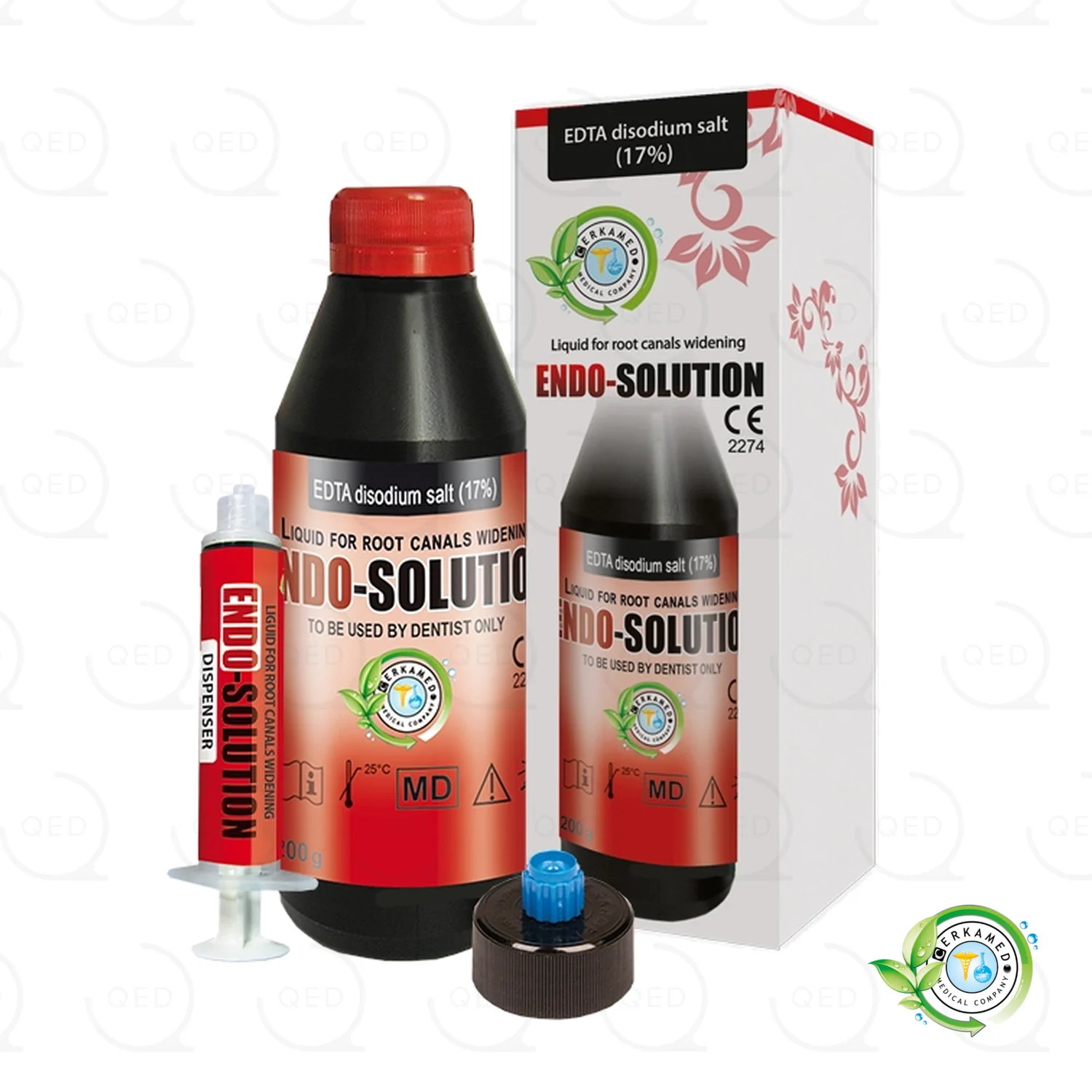
citric acid 40% · 5 x 200 g
smear layer removalchelationpractice packdentist use only
the same 40% solution as the single bottle, five to a pack. worth it once citric acid is the chelator your protocol uses rather than the one you are trying.
| 40% citric acid | 5 bottles of 200 g |
this pack: citric acid 40% (5 x 200 g bottles, approx. 187 ml each)
| active | citric acid, 40% solution |
| pack | 5 x 200 g bottles, each with adapter and dispenser. cerkamed give the density as 1.07 g/ml, so 200 g is approx. 187 ml |
| use | canal rinsing during endodontic treatment, to remove the smear layer |
| single bottle | citric acid 40%, 200 g |
› identical solution to the single bottle – the difference is how often you reorder.
› cerkamed: removes the smear layer from the canal walls, exposing the dentinal tubules.
› cerkamed are explicit: "do not leave product in the canal or the tooth cavity between visits", as it may lead to oversoftening of dentine.
› cerkamed mark the product "to be used by dentist only".
the european society of endodontology's s3-level guideline takes sodium hypochlorite followed by edta as its reference sequence – it is the comparator every other irrigant regimen in the review was measured against. for asymptomatic apical periodontitis in permanent teeth it states that naocl (1%–5.25%) followed by edta, then naocl again, may be considered (open-grade recommendation). concentration is the clinician's choice: the guideline found insufficient evidence to prefer one over another, and we stock both ends of the range it names.
| 1 · sodium hypochlorite | cerkamed: removes the remains of dead pulp and cleans the canal. chloraxid 2% · chloraxid 5.25% |
| 2 · edta | cerkamed: flushes out calcium and magnesium ions, softening the dentine surface layer so the smear layer lifts and the tubule orifices are exposed. endo-solution 17% edta |
| 3 · sodium hypochlorite | a final flush, at the same concentration as step 1. |
rinse with purified water between steps. cerkamed direct that the two are not run straight into one another – "the edta contained in the product neutralises the effect of naocl" – and that "purified water should be used to rinse root canals between the use of fluids". the same applies to citric acid, and to chlorhexidine, which forms a precipitate with either.
because you cannot be sure what is going into the canal. a 2026 randomised trial compared a domestic bleach with a medical-grade sodium hypochlorite, both diluted to what the operators took to be 2.5%. measured afterwards, the domestic product was 6.13% sodium hypochlorite against the medical-grade at 4.83% – and patients in the domestic group reported significantly more pain at six and twelve hours, which the authors put down to the higher chlorine content together with the surfactants household bleach carries. (nasr & hassan, bmc oral health 2026; randomised controlled trial, 60 patients, one product on each side.)
a medical device carries a stated concentration, a batch number, an expiry date and a safety data sheet, and it is manufactured for this purpose. a household bleach is formulated to clean a surface to a price; its strength is not controlled for use in a root canal, and it is not intended for one.
this covers the irrigation step only. the same guideline also addresses diagnosis, instrumentation, intracanal dressing and adjunctive disinfection. › read the full ese guideline – duncan hf et al., international endodontic journal 2023 (open access).
cerkamed describe it as flushing out calcium and magnesium ions, "softening the dentine surface layer to allow its easier removal and canal unblocking", which removes the smear layer left by instrumentation and exposes the tubule orifices.
cerkamed are explicit: "do not leave product in the canal or the tooth cavity between visits", as it may lead to oversoftening of dentine.
no. cerkamed state that the edta "neutralises the effect of naocl", and that "purified water should be used to rinse root canals between the use of fluids".
| sodium hypochlorite | chloraxid 2% · chloraxid 5.25% |
| chelation | endo-solution 17% edta, 200 ml · 5 x 200 ml · citric acid 40%, 200 g · 5 x 200 g |
| delivery | endo-top side-vented 30 g needles (100) · irriflex 30 g · navitip 29 ga, 25 mm |
| evacuation | endo aspirator (5) · endo aspirator pro |
cerkamed · cerkamed citric acid 40% 5 x 200g · ref cer-w-k1000

citric acid 40% · 200 g
smear layer removalchelationcanal irrigationdentist use only
citric acid does the same job as edta by a different route, and some protocols prefer it. cerkamed put it plainly: "it removes smear layer from the walls of root canal exposing the dentinal tubules". at 40% in a 200 g bottle it is the least expensive way into the chelation step.
| 40% citric acid | 200 g bottle |
this pack: citric acid 40% (200 g bottle, approx. 187 ml)
| active | citric acid, 40% solution |
| use | canal rinsing during endodontic treatment, to remove the smear layer |
| presentation | 200 g bottle with adapter and dispenser. cerkamed give the density as 1.07 g/ml, so 200 g is approx. 187 ml |
| larger pack | citric acid 40%, 5 x 200 g |
› cerkamed: "it removes smear layer from the walls of root canal exposing the dentinal tubules".
› an alternative to edta at the same step of the sequence, not an addition to it.
› cerkamed are explicit: "do not leave product in the canal or the tooth cavity between visits", as it may lead to oversoftening of dentine.
› cerkamed caution against running it straight into hypochlorite in either direction, as it may affect dentine microhardness. rinse with purified water between fluids.
› cerkamed mark the product "to be used by dentist only".
the european society of endodontology's s3-level guideline takes sodium hypochlorite followed by edta as its reference sequence – it is the comparator every other irrigant regimen in the review was measured against. for asymptomatic apical periodontitis in permanent teeth it states that naocl (1%–5.25%) followed by edta, then naocl again, may be considered (open-grade recommendation). concentration is the clinician's choice: the guideline found insufficient evidence to prefer one over another, and we stock both ends of the range it names.
| 1 · sodium hypochlorite | cerkamed: removes the remains of dead pulp and cleans the canal. chloraxid 2% · chloraxid 5.25% |
| 2 · edta | cerkamed: flushes out calcium and magnesium ions, softening the dentine surface layer so the smear layer lifts and the tubule orifices are exposed. endo-solution 17% edta |
| 3 · sodium hypochlorite | a final flush, at the same concentration as step 1. |
rinse with purified water between steps. cerkamed direct that the two are not run straight into one another – "the edta contained in the product neutralises the effect of naocl" – and that "purified water should be used to rinse root canals between the use of fluids". the same applies to citric acid, and to chlorhexidine, which forms a precipitate with either.
because you cannot be sure what is going into the canal. a 2026 randomised trial compared a domestic bleach with a medical-grade sodium hypochlorite, both diluted to what the operators took to be 2.5%. measured afterwards, the domestic product was 6.13% sodium hypochlorite against the medical-grade at 4.83% – and patients in the domestic group reported significantly more pain at six and twelve hours, which the authors put down to the higher chlorine content together with the surfactants household bleach carries. (nasr & hassan, bmc oral health 2026; randomised controlled trial, 60 patients, one product on each side.)
a medical device carries a stated concentration, a batch number, an expiry date and a safety data sheet, and it is manufactured for this purpose. a household bleach is formulated to clean a surface to a price; its strength is not controlled for use in a root canal, and it is not intended for one.
this covers the irrigation step only. the same guideline also addresses diagnosis, instrumentation, intracanal dressing and adjunctive disinfection. › read the full ese guideline – duncan hf et al., international endodontic journal 2023 (open access).
cerkamed describe it as flushing out calcium and magnesium ions, "softening the dentine surface layer to allow its easier removal and canal unblocking", which removes the smear layer left by instrumentation and exposes the tubule orifices.
cerkamed are explicit: "do not leave product in the canal or the tooth cavity between visits", as it may lead to oversoftening of dentine.
no. cerkamed state that the edta "neutralises the effect of naocl", and that "purified water should be used to rinse root canals between the use of fluids".
| sodium hypochlorite | chloraxid 2% · chloraxid 5.25% |
| chelation | endo-solution 17% edta, 200 ml · 5 x 200 ml · citric acid 40%, 200 g · 5 x 200 g |
| delivery | endo-top side-vented 30 g needles (100) · irriflex 30 g · navitip 29 ga, 25 mm |
| evacuation | endo aspirator (5) · endo aspirator pro |
cerkamed · cerkamed citric acid 40% 200g · ref cer-w-k200

cerkamed blue etch flow · 36% phosphoric acid · 10 ml
enamel and dentine etchingfissure sealingfibre post cementationdentist use only
blue etch flow is cerkamed's 36% orthophosphoric acid in a semi-solid, thixotropic gel: it flows into a fissure under the applicator and stops flowing when the applicator stops. cerkamed's intended use: "etching dentine and enamel fissures prior to composites and cavity seals", and "also recommended for use before cementing glass fibre crown and root inlays". the 10 ml is a reservoir syringe with a dispenser to fill from it.
this pack: cerkamed blue etch flow, 10 ml syringe with connector, delivery syringe (dispenser) and 2 delivery tips · 36% o-phosphoric acid
| active | o-phosphoric acid 36%, gel base, dye |
| use | etching dentine and enamel before composite, fissure sealant, and fibre post or inlay cementation |
| etch time | cerkamed: no longer than 60 seconds; then irrigate with a strong air and water stream for about 15–20 seconds; do not over-dry |
| preparing the 10 ml | cerkamed: swap the white cap for the connector, screw on the dispenser, pump no more than 2 ml into it, fit the metal applicator; leave the connector on the reservoir under its blue cap |
| presentation | 10 ml syringe, connector, dispenser, disposable applicators |
› cerkamed: "apply a thin layer of the etchant onto the dried surface. etch no longer than 60 seconds. irrigate with a strong air stream and water (about 15-20 seconds). do not over-dry." and if the enamel is not clean, repeat.
› on the consistency, cerkamed: "with its carefully formulated semi-solid consistence, blue etch flow reaches inaccessible dental grooves and fissures."
› if the gel is slow to pump into the dispenser, cerkamed: "move the plunger of the syringe with the product several times. the preparation will dilute due to its thixotropic properties."
› cerkamed: "causes severe skin burns and eye damage." cofferdam, gloves, goggles; and their note that etchants "may involve with post-operative hypersensitivity, resulting in temporary pain".
› cerkamed mark the product "to be used by dentist only".
at the end of the case. the coronal seal goes on etched enamel, and a fibre post goes into an etched canal – cerkamed name "glass fibre crown and root inlays" as an indication. it also earns its place next to rubber-dam liquid, since a gingival barrier goes on before the etch does.
cerkamed make 2 ml single syringes, a monster pack of ten 2 ml, and 10 ml and 50 ml reservoirs. the 10 ml with its dispenser is the practice size we stock; ask us about the 2 ml.
| gingival protection first | rubber-dam liquid |
| isolation | irriflex |
| replacement tips | elastic applicator tips (20) |
| haemostasis | alustat gel |
blue etch flow · o-phosphoric acid 36% · 10 ml with connector, dispenser and tips · etch up to 60 s · made by cerkamed, stalowa wola, poland · ref cer-w-wfd
acteon endo success™ retreatment kit · 6 tips
ultrasonic endodonticskitnewtron®
from access to post removal. acteon’s endo success retreatment kit brings together the tips for finishing the access, locating calcified canals, retreating each third of the canal and loosening posts.
this pack: 6 acteon endo success™ tips (et18d, et20, et25, et25s, etbd, etpr) · a metal holder and an autoclavable universal wrench · ref f00737
made by satelec, a company of the acteon group, mérignac, france
| et18d | the diamond tip for finishing the access cavity · 18 mm, 5% taper, diamond-coated 76 µm · power 10 |
| et20 | the retreatment tip for the coronal third · 20 mm, 6% taper · power 7 |
| et25 | the titanium-niobium tip for the middle and apical thirds · 20 mm, 3% taper · power 7 |
| et25s | the short titanium-niobium tip for the crown third and isthmuses · 15 mm, 4% taper · power 7 |
| etbd | the diamond ball tip for finding calcified canals · 20 mm, 5% taper, diamond-coated ball · power 7 |
| etpr | the tip for loosening posts and crowns · post and crown loosening tip · power 20 |
| also in the kit | a metal holder and an autoclavable universal wrench |
› clean, disinfect and sterilise before each use, following acteon’s cleaning, disinfection and sterilisation instructions for tips (j02001).
› replace at least once a year. acteon: because a maximum number of uses cannot be set, tips in routine use should be “replaced at least once a year”, and sooner if the tip no longer vibrates as expected or treatment slows.
› genuine tips on acteon handpieces. acteon warn that tips from other sources can put patients at risk and damage the equipment.
can i buy the tips singly?
yes – each is stocked on its own: et18d · et20 · et25 · et25s · etbd · etpr.
which generator do i need?
a newtron® generator such as the p5 xs b.led or booster. power settings for each tip are on acteon’s tip sheets.
| generators | newtron® p5 xs b.led · newtron® booster |
| handpieces | newtron® slim b.led · newtron® handpiece |
| tools | acteon universal wrench · autoclavable tip stand |
acteon endo success™ retreatment kit · et18d, et20, et25, et25s, etbd, etpr · holder and wrench · satelec / acteon · ref f00737
acteon endo success™ · et18d · access and retreatment
access and retreatmentultrasonic tipnewtron®
overhangs, calcifications and old filling. et18d is a diamond-coated steel tip. acteon’s tip sheet describes it as a tip “for the finishing of the access cavity and the removal of dentinal overhangs, calcifications and filling materials”.
this pack: 1 × acteon endo success™ et18d ultrasonic tip · ref f88017
made by satelec, a company of the acteon group, mérignac, france
| acteon reference | et18d |
| geometry | 18 mm, 5% taper, diamond-coated 76 µm |
| material | diamond-coated steel |
| indication | non-surgical endodontic retreatment (acteon tip sheet) |
| power setting | 10 on a newtron® generator, per acteon’s tip sheet · the colour ring on the tip matches the power zone (colour coding system™) |
| classification | class iia medical device |
| also in | endo success™ retreatment kit |
› clean, disinfect and sterilise before each use, following acteon’s cleaning, disinfection and sterilisation instructions for tips (j02001).
› replace at least once a year. acteon: because a maximum number of uses cannot be set, tips in routine use should be “replaced at least once a year”, and sooner if the tip no longer vibrates as expected or treatment slows.
› watch the site for heat. acteon’s tip sheets state that the practitioner has to continually monitor the clinical site to immediately identify any heating risk.
which generator does it fit?
acteon’s tip sheet gives settings for the newtron® range, including the p5 xs b.led and booster. acteon advise against using their tips on other makers’ handpieces, and other makers’ tips on theirs.
| related tips | etbd · cap1 |
| the kit | endo success™ retreatment kit |
| irrigants | chlorax 5.25% · endo-solution 17% edta |
| ultrasonic irrigation | irrisafe® 25, 21 mm |
| generators | newtron® p5 xs b.led · newtron® booster |
| tools | acteon universal wrench · autoclavable tip stand |
acteon endo success™ et18d · 18 mm, 5% taper, diamond-coated 76 µm · access and retreatment · newtron® power 10 · satelec / acteon · ref f88017

acteon endo success™ · cap1 · canal access preparation
canal access preparationultrasonic tipnewtron®
finishing the access. cap1 is the first of acteon’s three canal access preparation micro-blade tips. the tip sheet describes a “micro-blade tip for the removal of temporary cement and dentinal residues and overhangs”; the brochure adds finishing and polishing walls, used with the active lateral part, and a non-active end.
this pack: 1 × acteon endo success™ cap1 ultrasonic tip · ref f88181
made by satelec, a company of the acteon group, mérignac, france
| acteon reference | cap1 |
| geometry | 12 mm micro-blade, 6% taper |
| material | micro-blade (striated) steel |
| indication | endodontic cavity access preparation (acteon tip sheet) |
| power setting | 10 on a newtron® generator, per acteon’s tip sheet · the colour ring on the tip matches the power zone (colour coding system™) |
| classification | class iia medical device |
| also in | endo success™ cap kit |
› clean, disinfect and sterilise before each use, following acteon’s cleaning, disinfection and sterilisation instructions for tips (j02001).
› replace at least once a year. acteon: because a maximum number of uses cannot be set, tips in routine use should be “replaced at least once a year”, and sooner if the tip no longer vibrates as expected or treatment slows.
› watch the site for heat. acteon’s tip sheets state that the practitioner has to continually monitor the clinical site to immediately identify any heating risk.
which generator does it fit?
acteon’s tip sheet gives settings for the newtron® range, including the p5 xs b.led and booster. acteon advise against using their tips on other makers’ handpieces, and other makers’ tips on theirs.
what temperature can i sterilise at?
acteon (satelec) have certified that endo success cap and apical surgery tips can be sterilised with prevacuum steam at 137°c/138°c (attestation, september 2016). follow the cleaning instructions first.
| the other cap tips | cap2 · cap3 |
| the kit | endo success™ cap kit |
| diamond alternatives | et18d · etbd |
| generators | newtron® p5 xs b.led · newtron® booster |
| tools | acteon universal wrench · autoclavable tip stand |
acteon endo success™ cap1 · 12 mm micro-blade, 6% taper · canal access preparation · newtron® power 10 · satelec / acteon · ref f88181
acteon endo success™ · cap2 · canal access preparation
canal access preparationultrasonic tipnewtron®
probing the floor. cap2 is the second canal access preparation tip. acteon’s tip sheet describes a “micro-blade tip for canal probing, the location of calcified canals, cleaning the pulp chamber floor and the opening of mesial canals”; their brochure names locating mb2 and removing dentine bridges by a sweeping method.
this pack: 1 × acteon endo success™ cap2 ultrasonic tip · ref f88182
made by satelec, a company of the acteon group, mérignac, france
| acteon reference | cap2 |
| geometry | 9 mm micro-blade, 5% taper |
| material | micro-blade (striated) steel |
| indication | endodontic cavity access preparation (acteon tip sheet) |
| power setting | 10 on a newtron® generator, per acteon’s tip sheet · the colour ring on the tip matches the power zone (colour coding system™) |
| classification | class iia medical device |
| also in | endo success™ cap kit |
› clean, disinfect and sterilise before each use, following acteon’s cleaning, disinfection and sterilisation instructions for tips (j02001).
› replace at least once a year. acteon: because a maximum number of uses cannot be set, tips in routine use should be “replaced at least once a year”, and sooner if the tip no longer vibrates as expected or treatment slows.
› watch the site for heat. acteon’s tip sheets state that the practitioner has to continually monitor the clinical site to immediately identify any heating risk.
which generator does it fit?
acteon’s tip sheet gives settings for the newtron® range, including the p5 xs b.led and booster. acteon advise against using their tips on other makers’ handpieces, and other makers’ tips on theirs.
what temperature can i sterilise at?
acteon (satelec) have certified that endo success cap and apical surgery tips can be sterilised with prevacuum steam at 137°c/138°c (attestation, september 2016). follow the cleaning instructions first.
| the other cap tips | cap1 · cap3 |
| the kit | endo success™ cap kit |
| diamond alternatives | et18d · etbd |
| generators | newtron® p5 xs b.led · newtron® booster |
| tools | acteon universal wrench · autoclavable tip stand |
acteon endo success™ cap2 · 9 mm micro-blade, 5% taper · canal access preparation · newtron® power 10 · satelec / acteon · ref f88182

acteon endo success™ · cap3 · canal access preparation
canal access preparationultrasonic tipnewtron®
the sharpest of the three. cap3 is the third canal access preparation tip. the tip sheet describes a “micro-blade tip for canal entrance location and canal opening, removal of calcifications or dentinal tissue and loosening of fibre posts”. acteon note in their brochure that, because of its very sharp point, it must be handled with care, with visual aids recommended.
this pack: 1 × acteon endo success™ cap3 ultrasonic tip · ref f88183
made by satelec, a company of the acteon group, mérignac, france
| acteon reference | cap3 |
| geometry | 8 mm micro-blade, 6% taper (acteon brochure) |
| material | micro-blade (striated) steel |
| indication | endodontic cavity access preparation (acteon tip sheet) |
| power setting | 10 on a newtron® generator, per acteon’s tip sheet · the colour ring on the tip matches the power zone (colour coding system™) |
| classification | class iia medical device |
| also in | endo success™ cap kit |
› clean, disinfect and sterilise before each use, following acteon’s cleaning, disinfection and sterilisation instructions for tips (j02001).
› replace at least once a year. acteon: because a maximum number of uses cannot be set, tips in routine use should be “replaced at least once a year”, and sooner if the tip no longer vibrates as expected or treatment slows.
› watch the site for heat. acteon’s tip sheets state that the practitioner has to continually monitor the clinical site to immediately identify any heating risk.
which generator does it fit?
acteon’s tip sheet gives settings for the newtron® range, including the p5 xs b.led and booster. acteon advise against using their tips on other makers’ handpieces, and other makers’ tips on theirs.
what temperature can i sterilise at?
acteon (satelec) have certified that endo success cap and apical surgery tips can be sterilised with prevacuum steam at 137°c/138°c (attestation, september 2016). follow the cleaning instructions first.
| the other cap tips | cap1 · cap2 |
| the kit | endo success™ cap kit |
| diamond alternatives | et18d · etbd |
| generators | newtron® p5 xs b.led · newtron® booster |
| tools | acteon universal wrench · autoclavable tip stand |
acteon endo success™ cap3 · 8 mm micro-blade, 6% taper (acteon brochure) · canal access preparation · newtron® power 10 · satelec / acteon · ref f88183
meisinger endo access bur · 005 · 31 mm · pack of 2
endo accesslong neckcarbide headcontra-angle
one of the burs in meisinger’s endo access bur range. meisinger say the long, thin neck keeps the bur from obstructing your view of the working area, and that the burs are designed for safe access into the root canal. this is size 005 (0.5 mm head, pink colour band) at 31 mm.
this pack: meisinger endo access bur 005, 31mm (pack of 2)
made by meisinger, germany
| head | round carbide head, 0.5 mm (size 005) |
| colour band | pink, on the shank, for quick identification |
| shank | ra l (205), 31 mm |
| neck | long, slim neck that steps down from the shank to the head. meisinger say it allows an excellent, unobstructed view into the working area |
| speed | meisinger give 500–800 rpm recommended, 2,000 rpm maximum |
| pack | 2 burs |
| origin | made in germany |
› straight-line access. obtaining straight-line access to the canal.
› axial walls. expanding and flaring the axial walls.
› hidden canals. locating hidden canals.
› separated instruments. gaining access to separated instruments.
› view. excellent view into the working area.
› heat and debris. meisinger describe the burs as designed to create less heat and debris than traditional ultrasonic tips.
› stability. meisinger say the burs’ very stable construction gives them "optimal low-vibration concentricity". concentricity means the head runs true on the shank’s axis.
› carbide head. meisinger list a long-lasting carbide head.
› colour coded. the colour bands allow quick identification and selection.
› lengths. available in 31 mm and 34 mm neck lengths.
meisinger list the 31 mm burs on an ra l (205) shank and the 34 mm burs on an ra xl (206) shank. sizes run 005, 006, 008, 010, 012, 014 and 018 at 31 mm. meisinger make the 34 mm length in six sizes, 005 to 014, so there is no 34 mm 018.
yes. meisinger’s endo access bur kit (endo2) holds all 13 burs in a bur block: meisinger endo access bur set. each size is also sold on its own, in packs of 2, in the table below.
| meisinger endo access bur, 31 mm | 005 (this page) · 006 · 008 · 010 · 012 · 014 · 018 |
| meisinger endo access bur, 34 mm | 005 · 006 · 008 · 010 · 012 · 014 |
| all 13 in one kit | meisinger endo access bur set |
| meisinger goose neck | 100 · 120 · 140 · 160 · 180 · assorted |
› meisinger endo access bur kit flyer (pdf, 0.7 mb, meisinger) – the kit contents, sizes, speeds and uses.
specifications are from meisinger’s endo access bur kit flyer (85fl125en-0318) and the endo access bur kit endo2 listing on meisinger.de; head diameters and colour bands are from meisinger usa’s kit listing. brand names are the trademarks of their owners.
meisinger endo access bur 005, 31mm (pack of 2) · meisinger · ref m191hm205005
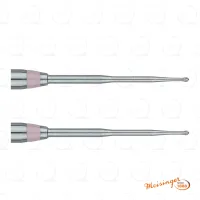
meisinger endo access bur · 006 · 31 mm · pack of 2
endo accesslong neckcarbide headcontra-angle
one of the burs in meisinger’s endo access bur range. meisinger say the long, thin neck keeps the bur from obstructing your view of the working area, and that the burs are designed for safe access into the root canal. this is size 006 (0.6 mm head, grey colour band) at 31 mm.
this pack: meisinger endo access bur 006, 31mm (pack of 2)
made by meisinger, germany
| head | round carbide head, 0.6 mm (size 006) |
| colour band | grey, on the shank, for quick identification |
| shank | ra l (205), 31 mm |
| neck | long, slim neck that steps down from the shank to the head. meisinger say it allows an excellent, unobstructed view into the working area |
| speed | meisinger give 500–800 rpm recommended, 2,000 rpm maximum |
| pack | 2 burs |
| origin | made in germany |
› straight-line access. obtaining straight-line access to the canal.
› axial walls. expanding and flaring the axial walls.
› hidden canals. locating hidden canals.
› separated instruments. gaining access to separated instruments.
› view. excellent view into the working area.
› heat and debris. meisinger describe the burs as designed to create less heat and debris than traditional ultrasonic tips.
› stability. meisinger say the burs’ very stable construction gives them "optimal low-vibration concentricity". concentricity means the head runs true on the shank’s axis.
› carbide head. meisinger list a long-lasting carbide head.
› colour coded. the colour bands allow quick identification and selection.
› lengths. available in 31 mm and 34 mm neck lengths.
meisinger list the 31 mm burs on an ra l (205) shank and the 34 mm burs on an ra xl (206) shank. sizes run 005, 006, 008, 010, 012, 014 and 018 at 31 mm. meisinger make the 34 mm length in six sizes, 005 to 014, so there is no 34 mm 018.
yes. meisinger’s endo access bur kit (endo2) holds all 13 burs in a bur block: meisinger endo access bur set. each size is also sold on its own, in packs of 2, in the table below.
| meisinger endo access bur, 31 mm | 005 · 006 (this page) · 008 · 010 · 012 · 014 · 018 |
| meisinger endo access bur, 34 mm | 005 · 006 · 008 · 010 · 012 · 014 |
| all 13 in one kit | meisinger endo access bur set |
| meisinger goose neck | 100 · 120 · 140 · 160 · 180 · assorted |
› meisinger endo access bur kit flyer (pdf, 0.7 mb, meisinger) – the kit contents, sizes, speeds and uses.
specifications are from meisinger’s endo access bur kit flyer (85fl125en-0318) and the endo access bur kit endo2 listing on meisinger.de; head diameters and colour bands are from meisinger usa’s kit listing. brand names are the trademarks of their owners.
meisinger endo access bur 006, 31mm (pack of 2) · meisinger · ref m191hm205006
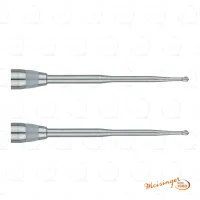
meisinger endo access bur · 008 · 31 mm · pack of 2
endo accesslong neckcarbide headcontra-angle
one of the burs in meisinger’s endo access bur range. meisinger say the long, thin neck keeps the bur from obstructing your view of the working area, and that the burs are designed for safe access into the root canal. this is size 008 (0.8 mm head, purple colour band) at 31 mm.
this pack: meisinger endo access bur 008, 31mm (pack of 2)
made by meisinger, germany
| head | round carbide head, 0.8 mm (size 008) |
| colour band | purple, on the shank, for quick identification |
| shank | ra l (205), 31 mm |
| neck | long, slim neck that steps down from the shank to the head. meisinger say it allows an excellent, unobstructed view into the working area |
| speed | meisinger give 500–800 rpm recommended, 2,000 rpm maximum |
| pack | 2 burs |
| origin | made in germany |
› straight-line access. obtaining straight-line access to the canal.
› axial walls. expanding and flaring the axial walls.
› hidden canals. locating hidden canals.
› separated instruments. gaining access to separated instruments.
› view. excellent view into the working area.
› heat and debris. meisinger describe the burs as designed to create less heat and debris than traditional ultrasonic tips.
› stability. meisinger say the burs’ very stable construction gives them "optimal low-vibration concentricity". concentricity means the head runs true on the shank’s axis.
› carbide head. meisinger list a long-lasting carbide head.
› colour coded. the colour bands allow quick identification and selection.
› lengths. available in 31 mm and 34 mm neck lengths.
meisinger list the 31 mm burs on an ra l (205) shank and the 34 mm burs on an ra xl (206) shank. sizes run 005, 006, 008, 010, 012, 014 and 018 at 31 mm. meisinger make the 34 mm length in six sizes, 005 to 014, so there is no 34 mm 018.
yes. meisinger’s endo access bur kit (endo2) holds all 13 burs in a bur block: meisinger endo access bur set. each size is also sold on its own, in packs of 2, in the table below.
| meisinger endo access bur, 31 mm | 005 · 006 · 008 (this page) · 010 · 012 · 014 · 018 |
| meisinger endo access bur, 34 mm | 005 · 006 · 008 · 010 · 012 · 014 |
| all 13 in one kit | meisinger endo access bur set |
| meisinger goose neck | 100 · 120 · 140 · 160 · 180 · assorted |
› meisinger endo access bur kit flyer (pdf, 0.7 mb, meisinger) – the kit contents, sizes, speeds and uses.
specifications are from meisinger’s endo access bur kit flyer (85fl125en-0318) and the endo access bur kit endo2 listing on meisinger.de; head diameters and colour bands are from meisinger usa’s kit listing. brand names are the trademarks of their owners.
meisinger endo access bur 008, 31mm (pack of 2) · meisinger · ref m191hm205008
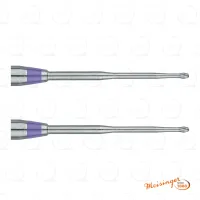
meisinger endo access bur · 010 · 31 mm · pack of 2
endo accesslong neckcarbide headcontra-angle
one of the burs in meisinger’s endo access bur range. meisinger say the long, thin neck keeps the bur from obstructing your view of the working area, and that the burs are designed for safe access into the root canal. this is size 010 (1.0 mm head, white colour band) at 31 mm.
this pack: meisinger endo access bur 010, 31mm (pack of 2)
made by meisinger, germany
| head | round carbide head, 1.0 mm (size 010) |
| colour band | white, on the shank, for quick identification |
| shank | ra l (205), 31 mm |
| neck | long, slim neck that steps down from the shank to the head. meisinger say it allows an excellent, unobstructed view into the working area |
| speed | meisinger give 500–800 rpm recommended, 2,000 rpm maximum |
| pack | 2 burs |
| origin | made in germany |
› straight-line access. obtaining straight-line access to the canal.
› axial walls. expanding and flaring the axial walls.
› hidden canals. locating hidden canals.
› separated instruments. gaining access to separated instruments.
› view. excellent view into the working area.
› heat and debris. meisinger describe the burs as designed to create less heat and debris than traditional ultrasonic tips.
› stability. meisinger say the burs’ very stable construction gives them "optimal low-vibration concentricity". concentricity means the head runs true on the shank’s axis.
› carbide head. meisinger list a long-lasting carbide head.
› colour coded. the colour bands allow quick identification and selection.
› lengths. available in 31 mm and 34 mm neck lengths.
meisinger list the 31 mm burs on an ra l (205) shank and the 34 mm burs on an ra xl (206) shank. sizes run 005, 006, 008, 010, 012, 014 and 018 at 31 mm. meisinger make the 34 mm length in six sizes, 005 to 014, so there is no 34 mm 018.
yes. meisinger’s endo access bur kit (endo2) holds all 13 burs in a bur block: meisinger endo access bur set. each size is also sold on its own, in packs of 2, in the table below.
| meisinger endo access bur, 31 mm | 005 · 006 · 008 · 010 (this page) · 012 · 014 · 018 |
| meisinger endo access bur, 34 mm | 005 · 006 · 008 · 010 · 012 · 014 |
| all 13 in one kit | meisinger endo access bur set |
| meisinger goose neck | 100 · 120 · 140 · 160 · 180 · assorted |
› meisinger endo access bur kit flyer (pdf, 0.7 mb, meisinger) – the kit contents, sizes, speeds and uses.
specifications are from meisinger’s endo access bur kit flyer (85fl125en-0318) and the endo access bur kit endo2 listing on meisinger.de; head diameters and colour bands are from meisinger usa’s kit listing. brand names are the trademarks of their owners.
meisinger endo access bur 010, 31mm (pack of 2) · meisinger · ref m191hm205010
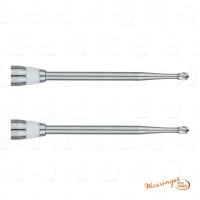
meisinger endo access bur · 012 · 31 mm · pack of 2
endo accesslong neckcarbide headcontra-angle
one of the burs in meisinger’s endo access bur range. meisinger say the long, thin neck keeps the bur from obstructing your view of the working area, and that the burs are designed for safe access into the root canal. this is size 012 (1.2 mm head, yellow colour band) at 31 mm.
this pack: meisinger endo access bur 012, 31mm (pack of 2)
made by meisinger, germany
| head | round carbide head, 1.2 mm (size 012) |
| colour band | yellow, on the shank, for quick identification |
| shank | ra l (205), 31 mm |
| neck | long, slim neck that steps down from the shank to the head. meisinger say it allows an excellent, unobstructed view into the working area |
| speed | meisinger give 500–800 rpm recommended, 2,000 rpm maximum |
| pack | 2 burs |
| origin | made in germany |
› straight-line access. obtaining straight-line access to the canal.
› axial walls. expanding and flaring the axial walls.
› hidden canals. locating hidden canals.
› separated instruments. gaining access to separated instruments.
› view. excellent view into the working area.
› heat and debris. meisinger describe the burs as designed to create less heat and debris than traditional ultrasonic tips.
› stability. meisinger say the burs’ very stable construction gives them "optimal low-vibration concentricity". concentricity means the head runs true on the shank’s axis.
› carbide head. meisinger list a long-lasting carbide head.
› colour coded. the colour bands allow quick identification and selection.
› lengths. available in 31 mm and 34 mm neck lengths.
meisinger list the 31 mm burs on an ra l (205) shank and the 34 mm burs on an ra xl (206) shank. sizes run 005, 006, 008, 010, 012, 014 and 018 at 31 mm. meisinger make the 34 mm length in six sizes, 005 to 014, so there is no 34 mm 018.
yes. meisinger’s endo access bur kit (endo2) holds all 13 burs in a bur block: meisinger endo access bur set. each size is also sold on its own, in packs of 2, in the table below.
| meisinger endo access bur, 31 mm | 005 · 006 · 008 · 010 · 012 (this page) · 014 · 018 |
| meisinger endo access bur, 34 mm | 005 · 006 · 008 · 010 · 012 · 014 |
| all 13 in one kit | meisinger endo access bur set |
| meisinger goose neck | 100 · 120 · 140 · 160 · 180 · assorted |
› meisinger endo access bur kit flyer (pdf, 0.7 mb, meisinger) – the kit contents, sizes, speeds and uses.
specifications are from meisinger’s endo access bur kit flyer (85fl125en-0318) and the endo access bur kit endo2 listing on meisinger.de; head diameters and colour bands are from meisinger usa’s kit listing. brand names are the trademarks of their owners.
meisinger endo access bur 012, 31mm (pack of 2) · meisinger · ref m191hm205012
meisinger endo access bur · 014 · 31 mm · pack of 2
endo accesslong neckcarbide headcontra-angle
one of the burs in meisinger’s endo access bur range. meisinger say the long, thin neck keeps the bur from obstructing your view of the working area, and that the burs are designed for safe access into the root canal. this is size 014 (1.4 mm head, red colour band) at 31 mm.
this pack: meisinger endo access bur 014, 31mm (pack of 2)
made by meisinger, germany
| head | round carbide head, 1.4 mm (size 014) |
| colour band | red, on the shank, for quick identification |
| shank | ra l (205), 31 mm |
| neck | long, slim neck that steps down from the shank to the head. meisinger say it allows an excellent, unobstructed view into the working area |
| speed | meisinger give 500–800 rpm recommended, 2,000 rpm maximum |
| pack | 2 burs |
| origin | made in germany |
› straight-line access. obtaining straight-line access to the canal.
› axial walls. expanding and flaring the axial walls.
› hidden canals. locating hidden canals.
› separated instruments. gaining access to separated instruments.
› view. excellent view into the working area.
› heat and debris. meisinger describe the burs as designed to create less heat and debris than traditional ultrasonic tips.
› stability. meisinger say the burs’ very stable construction gives them "optimal low-vibration concentricity". concentricity means the head runs true on the shank’s axis.
› carbide head. meisinger list a long-lasting carbide head.
› colour coded. the colour bands allow quick identification and selection.
› lengths. available in 31 mm and 34 mm neck lengths.
meisinger list the 31 mm burs on an ra l (205) shank and the 34 mm burs on an ra xl (206) shank. sizes run 005, 006, 008, 010, 012, 014 and 018 at 31 mm. meisinger make the 34 mm length in six sizes, 005 to 014, so there is no 34 mm 018.
yes. meisinger’s endo access bur kit (endo2) holds all 13 burs in a bur block: meisinger endo access bur set. each size is also sold on its own, in packs of 2, in the table below.
| meisinger endo access bur, 31 mm | 005 · 006 · 008 · 010 · 012 · 014 (this page) · 018 |
| meisinger endo access bur, 34 mm | 005 · 006 · 008 · 010 · 012 · 014 |
| all 13 in one kit | meisinger endo access bur set |
| meisinger goose neck | 100 · 120 · 140 · 160 · 180 · assorted |
› meisinger endo access bur kit flyer (pdf, 0.7 mb, meisinger) – the kit contents, sizes, speeds and uses.
specifications are from meisinger’s endo access bur kit flyer (85fl125en-0318) and the endo access bur kit endo2 listing on meisinger.de; head diameters and colour bands are from meisinger usa’s kit listing. brand names are the trademarks of their owners.
meisinger endo access bur 014, 31mm (pack of 2) · meisinger · ref m191hm205014
meisinger endo access bur · 018 · 31 mm · pack of 2
endo accesslong neckcarbide headcontra-angle
one of the burs in meisinger’s endo access bur range. meisinger say the long, thin neck keeps the bur from obstructing your view of the working area, and that the burs are designed for safe access into the root canal. this is size 018 (1.8 mm head, green colour band) at 31 mm.
this pack: meisinger endo access bur 018, 31mm (pack of 2)
made by meisinger, germany
| head | round carbide head, 1.8 mm (size 018) |
| colour band | green, on the shank, for quick identification |
| shank | ra l (205), 31 mm |
| neck | long, slim neck that steps down from the shank to the head. meisinger say it allows an excellent, unobstructed view into the working area |
| speed | meisinger give 500–800 rpm recommended, 2,000 rpm maximum |
| pack | 2 burs |
| origin | made in germany |
› straight-line access. obtaining straight-line access to the canal.
› axial walls. expanding and flaring the axial walls.
› hidden canals. locating hidden canals.
› separated instruments. gaining access to separated instruments.
› view. excellent view into the working area.
› heat and debris. meisinger describe the burs as designed to create less heat and debris than traditional ultrasonic tips.
› stability. meisinger say the burs’ very stable construction gives them "optimal low-vibration concentricity". concentricity means the head runs true on the shank’s axis.
› carbide head. meisinger list a long-lasting carbide head.
› colour coded. the colour bands allow quick identification and selection.
› lengths. available in 31 mm and 34 mm neck lengths.
meisinger list the 31 mm burs on an ra l (205) shank and the 34 mm burs on an ra xl (206) shank. sizes run 005, 006, 008, 010, 012, 014 and 018 at 31 mm. meisinger make the 34 mm length in six sizes, 005 to 014, so there is no 34 mm 018.
yes. meisinger’s endo access bur kit (endo2) holds all 13 burs in a bur block: meisinger endo access bur set. each size is also sold on its own, in packs of 2, in the table below.
| meisinger endo access bur, 31 mm | 005 · 006 · 008 · 010 · 012 · 014 · 018 (this page) |
| meisinger endo access bur, 34 mm | 005 · 006 · 008 · 010 · 012 · 014 |
| all 13 in one kit | meisinger endo access bur set |
| meisinger goose neck | 100 · 120 · 140 · 160 · 180 · assorted |
› meisinger endo access bur kit flyer (pdf, 0.7 mb, meisinger) – the kit contents, sizes, speeds and uses.
specifications are from meisinger’s endo access bur kit flyer (85fl125en-0318) and the endo access bur kit endo2 listing on meisinger.de; head diameters and colour bands are from meisinger usa’s kit listing. brand names are the trademarks of their owners.
meisinger endo access bur 018, 31mm (pack of 2) · meisinger · ref m191hm205018
meisinger endo access bur · 005 · 34 mm · pack of 2
endo accesslong neckcarbide headcontra-angle
one of the burs in meisinger’s endo access bur range. meisinger say the long, thin neck keeps the bur from obstructing your view of the working area, and that the burs are designed for safe access into the root canal. this is size 005 (0.5 mm head, pink colour band) at 34 mm.
this pack: meisinger endo access bur 005, 34mm (pack of 2)
made by meisinger, germany
| head | round carbide head, 0.5 mm (size 005) |
| colour band | pink, on the shank, for quick identification |
| shank | ra xl (206), 34 mm |
| neck | long, slim neck that steps down from the shank to the head. meisinger say it allows an excellent, unobstructed view into the working area |
| speed | meisinger give 500–800 rpm recommended, 2,000 rpm maximum |
| pack | 2 burs |
| origin | made in germany |
› straight-line access. obtaining straight-line access to the canal.
› axial walls. expanding and flaring the axial walls.
› hidden canals. locating hidden canals.
› separated instruments. gaining access to separated instruments.
› view. excellent view into the working area.
› heat and debris. meisinger describe the burs as designed to create less heat and debris than traditional ultrasonic tips.
› stability. meisinger say the burs’ very stable construction gives them "optimal low-vibration concentricity". concentricity means the head runs true on the shank’s axis.
› carbide head. meisinger list a long-lasting carbide head.
› colour coded. the colour bands allow quick identification and selection.
› lengths. available in 31 mm and 34 mm neck lengths.
meisinger list the 31 mm burs on an ra l (205) shank and the 34 mm burs on an ra xl (206) shank. sizes run 005, 006, 008, 010, 012, 014 and 018 at 31 mm. meisinger make the 34 mm length in six sizes, 005 to 014, so there is no 34 mm 018.
yes. meisinger’s endo access bur kit (endo2) holds all 13 burs in a bur block: meisinger endo access bur set. each size is also sold on its own, in packs of 2, in the table below.
| meisinger endo access bur, 31 mm | 005 · 006 · 008 · 010 · 012 · 014 · 018 |
| meisinger endo access bur, 34 mm | 005 (this page) · 006 · 008 · 010 · 012 · 014 |
| all 13 in one kit | meisinger endo access bur set |
| meisinger goose neck | 100 · 120 · 140 · 160 · 180 · assorted |
› meisinger endo access bur kit flyer (pdf, 0.7 mb, meisinger) – the kit contents, sizes, speeds and uses.
specifications are from meisinger’s endo access bur kit flyer (85fl125en-0318) and the endo access bur kit endo2 listing on meisinger.de; head diameters and colour bands are from meisinger usa’s kit listing. brand names are the trademarks of their owners.
meisinger endo access bur 005, 34mm (pack of 2) · meisinger · ref m191hm206005
meisinger endo access bur · 006 · 34 mm · pack of 2
endo accesslong neckcarbide headcontra-angle
one of the burs in meisinger’s endo access bur range. meisinger say the long, thin neck keeps the bur from obstructing your view of the working area, and that the burs are designed for safe access into the root canal. this is size 006 (0.6 mm head, grey colour band) at 34 mm.
this pack: meisinger endo access bur 006, 34mm (pack of 2)
made by meisinger, germany
| head | round carbide head, 0.6 mm (size 006) |
| colour band | grey, on the shank, for quick identification |
| shank | ra xl (206), 34 mm |
| neck | long, slim neck that steps down from the shank to the head. meisinger say it allows an excellent, unobstructed view into the working area |
| speed | meisinger give 500–800 rpm recommended, 2,000 rpm maximum |
| pack | 2 burs |
| origin | made in germany |
› straight-line access. obtaining straight-line access to the canal.
› axial walls. expanding and flaring the axial walls.
› hidden canals. locating hidden canals.
› separated instruments. gaining access to separated instruments.
› view. excellent view into the working area.
› heat and debris. meisinger describe the burs as designed to create less heat and debris than traditional ultrasonic tips.
› stability. meisinger say the burs’ very stable construction gives them "optimal low-vibration concentricity". concentricity means the head runs true on the shank’s axis.
› carbide head. meisinger list a long-lasting carbide head.
› colour coded. the colour bands allow quick identification and selection.
› lengths. available in 31 mm and 34 mm neck lengths.
meisinger list the 31 mm burs on an ra l (205) shank and the 34 mm burs on an ra xl (206) shank. sizes run 005, 006, 008, 010, 012, 014 and 018 at 31 mm. meisinger make the 34 mm length in six sizes, 005 to 014, so there is no 34 mm 018.
yes. meisinger’s endo access bur kit (endo2) holds all 13 burs in a bur block: meisinger endo access bur set. each size is also sold on its own, in packs of 2, in the table below.
| meisinger endo access bur, 31 mm | 005 · 006 · 008 · 010 · 012 · 014 · 018 |
| meisinger endo access bur, 34 mm | 005 · 006 (this page) · 008 · 010 · 012 · 014 |
| all 13 in one kit | meisinger endo access bur set |
| meisinger goose neck | 100 · 120 · 140 · 160 · 180 · assorted |
› meisinger endo access bur kit flyer (pdf, 0.7 mb, meisinger) – the kit contents, sizes, speeds and uses.
specifications are from meisinger’s endo access bur kit flyer (85fl125en-0318) and the endo access bur kit endo2 listing on meisinger.de; head diameters and colour bands are from meisinger usa’s kit listing. brand names are the trademarks of their owners.
meisinger endo access bur 006, 34mm (pack of 2) · meisinger · ref m191hm206006
meisinger endo access bur · 008 · 34 mm · pack of 2
endo accesslong neckcarbide headcontra-angle
one of the burs in meisinger’s endo access bur range. meisinger say the long, thin neck keeps the bur from obstructing your view of the working area, and that the burs are designed for safe access into the root canal. this is size 008 (0.8 mm head, purple colour band) at 34 mm.
this pack: meisinger endo access bur 008, 34mm (pack of 2)
made by meisinger, germany
| head | round carbide head, 0.8 mm (size 008) |
| colour band | purple, on the shank, for quick identification |
| shank | ra xl (206), 34 mm |
| neck | long, slim neck that steps down from the shank to the head. meisinger say it allows an excellent, unobstructed view into the working area |
| speed | meisinger give 500–800 rpm recommended, 2,000 rpm maximum |
| pack | 2 burs |
| origin | made in germany |
› straight-line access. obtaining straight-line access to the canal.
› axial walls. expanding and flaring the axial walls.
› hidden canals. locating hidden canals.
› separated instruments. gaining access to separated instruments.
› view. excellent view into the working area.
› heat and debris. meisinger describe the burs as designed to create less heat and debris than traditional ultrasonic tips.
› stability. meisinger say the burs’ very stable construction gives them "optimal low-vibration concentricity". concentricity means the head runs true on the shank’s axis.
› carbide head. meisinger list a long-lasting carbide head.
› colour coded. the colour bands allow quick identification and selection.
› lengths. available in 31 mm and 34 mm neck lengths.
meisinger list the 31 mm burs on an ra l (205) shank and the 34 mm burs on an ra xl (206) shank. sizes run 005, 006, 008, 010, 012, 014 and 018 at 31 mm. meisinger make the 34 mm length in six sizes, 005 to 014, so there is no 34 mm 018.
yes. meisinger’s endo access bur kit (endo2) holds all 13 burs in a bur block: meisinger endo access bur set. each size is also sold on its own, in packs of 2, in the table below.
| meisinger endo access bur, 31 mm | 005 · 006 · 008 · 010 · 012 · 014 · 018 |
| meisinger endo access bur, 34 mm | 005 · 006 · 008 (this page) · 010 · 012 · 014 |
| all 13 in one kit | meisinger endo access bur set |
| meisinger goose neck | 100 · 120 · 140 · 160 · 180 · assorted |
› meisinger endo access bur kit flyer (pdf, 0.7 mb, meisinger) – the kit contents, sizes, speeds and uses.
specifications are from meisinger’s endo access bur kit flyer (85fl125en-0318) and the endo access bur kit endo2 listing on meisinger.de; head diameters and colour bands are from meisinger usa’s kit listing. brand names are the trademarks of their owners.
meisinger endo access bur 008, 34mm (pack of 2) · meisinger · ref m191hm206008
meisinger endo access bur · 010 · 34 mm · pack of 2
endo accesslong neckcarbide headcontra-angle
one of the burs in meisinger’s endo access bur range. meisinger say the long, thin neck keeps the bur from obstructing your view of the working area, and that the burs are designed for safe access into the root canal. this is size 010 (1.0 mm head, white colour band) at 34 mm.
this pack: meisinger endo access bur 010, 34mm (pack of 2)
made by meisinger, germany
| head | round carbide head, 1.0 mm (size 010) |
| colour band | white, on the shank, for quick identification |
| shank | ra xl (206), 34 mm |
| neck | long, slim neck that steps down from the shank to the head. meisinger say it allows an excellent, unobstructed view into the working area |
| speed | meisinger give 500–800 rpm recommended, 2,000 rpm maximum |
| pack | 2 burs |
| origin | made in germany |
› straight-line access. obtaining straight-line access to the canal.
› axial walls. expanding and flaring the axial walls.
› hidden canals. locating hidden canals.
› separated instruments. gaining access to separated instruments.
› view. excellent view into the working area.
› heat and debris. meisinger describe the burs as designed to create less heat and debris than traditional ultrasonic tips.
› stability. meisinger say the burs’ very stable construction gives them "optimal low-vibration concentricity". concentricity means the head runs true on the shank’s axis.
› carbide head. meisinger list a long-lasting carbide head.
› colour coded. the colour bands allow quick identification and selection.
› lengths. available in 31 mm and 34 mm neck lengths.
meisinger list the 31 mm burs on an ra l (205) shank and the 34 mm burs on an ra xl (206) shank. sizes run 005, 006, 008, 010, 012, 014 and 018 at 31 mm. meisinger make the 34 mm length in six sizes, 005 to 014, so there is no 34 mm 018.
yes. meisinger’s endo access bur kit (endo2) holds all 13 burs in a bur block: meisinger endo access bur set. each size is also sold on its own, in packs of 2, in the table below.
| meisinger endo access bur, 31 mm | 005 · 006 · 008 · 010 · 012 · 014 · 018 |
| meisinger endo access bur, 34 mm | 005 · 006 · 008 · 010 (this page) · 012 · 014 |
| all 13 in one kit | meisinger endo access bur set |
| meisinger goose neck | 100 · 120 · 140 · 160 · 180 · assorted |
› meisinger endo access bur kit flyer (pdf, 0.7 mb, meisinger) – the kit contents, sizes, speeds and uses.
specifications are from meisinger’s endo access bur kit flyer (85fl125en-0318) and the endo access bur kit endo2 listing on meisinger.de; head diameters and colour bands are from meisinger usa’s kit listing. brand names are the trademarks of their owners.
meisinger endo access bur 010, 34mm (pack of 2) · meisinger · ref m191hm206010
meisinger endo access bur · 012 · 34 mm · pack of 2
endo accesslong neckcarbide headcontra-angle
one of the burs in meisinger’s endo access bur range. meisinger say the long, thin neck keeps the bur from obstructing your view of the working area, and that the burs are designed for safe access into the root canal. this is size 012 (1.2 mm head, yellow colour band) at 34 mm.
this pack: meisinger endo access bur 012, 34mm (pack of 2)
made by meisinger, germany
| head | round carbide head, 1.2 mm (size 012) |
| colour band | yellow, on the shank, for quick identification |
| shank | ra xl (206), 34 mm |
| neck | long, slim neck that steps down from the shank to the head. meisinger say it allows an excellent, unobstructed view into the working area |
| speed | meisinger give 500–800 rpm recommended, 2,000 rpm maximum |
| pack | 2 burs |
| origin | made in germany |
› straight-line access. obtaining straight-line access to the canal.
› axial walls. expanding and flaring the axial walls.
› hidden canals. locating hidden canals.
› separated instruments. gaining access to separated instruments.
› view. excellent view into the working area.
› heat and debris. meisinger describe the burs as designed to create less heat and debris than traditional ultrasonic tips.
› stability. meisinger say the burs’ very stable construction gives them "optimal low-vibration concentricity". concentricity means the head runs true on the shank’s axis.
› carbide head. meisinger list a long-lasting carbide head.
› colour coded. the colour bands allow quick identification and selection.
› lengths. available in 31 mm and 34 mm neck lengths.
meisinger list the 31 mm burs on an ra l (205) shank and the 34 mm burs on an ra xl (206) shank. sizes run 005, 006, 008, 010, 012, 014 and 018 at 31 mm. meisinger make the 34 mm length in six sizes, 005 to 014, so there is no 34 mm 018.
yes. meisinger’s endo access bur kit (endo2) holds all 13 burs in a bur block: meisinger endo access bur set. each size is also sold on its own, in packs of 2, in the table below.
| meisinger endo access bur, 31 mm | 005 · 006 · 008 · 010 · 012 · 014 · 018 |
| meisinger endo access bur, 34 mm | 005 · 006 · 008 · 010 · 012 (this page) · 014 |
| all 13 in one kit | meisinger endo access bur set |
| meisinger goose neck | 100 · 120 · 140 · 160 · 180 · assorted |
› meisinger endo access bur kit flyer (pdf, 0.7 mb, meisinger) – the kit contents, sizes, speeds and uses.
specifications are from meisinger’s endo access bur kit flyer (85fl125en-0318) and the endo access bur kit endo2 listing on meisinger.de; head diameters and colour bands are from meisinger usa’s kit listing. brand names are the trademarks of their owners.
meisinger endo access bur 012, 34mm (pack of 2) · meisinger · ref m191hm206012
meisinger endo access bur · 014 · 34 mm · pack of 2
endo accesslong neckcarbide headcontra-angle
one of the burs in meisinger’s endo access bur range. meisinger say the long, thin neck keeps the bur from obstructing your view of the working area, and that the burs are designed for safe access into the root canal. this is size 014 (1.4 mm head, red colour band) at 34 mm.
this pack: meisinger endo access bur 014, 34mm (pack of 2)
made by meisinger, germany
| head | round carbide head, 1.4 mm (size 014) |
| colour band | red, on the shank, for quick identification |
| shank | ra xl (206), 34 mm |
| neck | long, slim neck that steps down from the shank to the head. meisinger say it allows an excellent, unobstructed view into the working area |
| speed | meisinger give 500–800 rpm recommended, 2,000 rpm maximum |
| pack | 2 burs |
| origin | made in germany |
› straight-line access. obtaining straight-line access to the canal.
› axial walls. expanding and flaring the axial walls.
› hidden canals. locating hidden canals.
› separated instruments. gaining access to separated instruments.
› view. excellent view into the working area.
› heat and debris. meisinger describe the burs as designed to create less heat and debris than traditional ultrasonic tips.
› stability. meisinger say the burs’ very stable construction gives them "optimal low-vibration concentricity". concentricity means the head runs true on the shank’s axis.
› carbide head. meisinger list a long-lasting carbide head.
› colour coded. the colour bands allow quick identification and selection.
› lengths. available in 31 mm and 34 mm neck lengths.
meisinger list the 31 mm burs on an ra l (205) shank and the 34 mm burs on an ra xl (206) shank. sizes run 005, 006, 008, 010, 012, 014 and 018 at 31 mm. meisinger make the 34 mm length in six sizes, 005 to 014, so there is no 34 mm 018.
yes. meisinger’s endo access bur kit (endo2) holds all 13 burs in a bur block: meisinger endo access bur set. each size is also sold on its own, in packs of 2, in the table below.
| meisinger endo access bur, 31 mm | 005 · 006 · 008 · 010 · 012 · 014 · 018 |
| meisinger endo access bur, 34 mm | 005 · 006 · 008 · 010 · 012 · 014 (this page) |
| all 13 in one kit | meisinger endo access bur set |
| meisinger goose neck | 100 · 120 · 140 · 160 · 180 · assorted |
› meisinger endo access bur kit flyer (pdf, 0.7 mb, meisinger) – the kit contents, sizes, speeds and uses.
specifications are from meisinger’s endo access bur kit flyer (85fl125en-0318) and the endo access bur kit endo2 listing on meisinger.de; head diameters and colour bands are from meisinger usa’s kit listing. brand names are the trademarks of their owners.
meisinger endo access bur 014, 34mm (pack of 2) · meisinger · ref m191hm206014
acteon pure reflect® micro mirror · 3 mm round
micro-surgeryendodonticspure reflect®
convenient and easy to handle. acteon describe their micro mirrors as making access to the apex easier and giving accurate vision of the pulp chamber, and as ideal for tiny spaces while saving room in the oral cavity. all carry acteon’s pure reflect® coating, which acteon say gives reflection close to 100% of reality, no distortion and authentic colours.
this pack: 1 × acteon pure reflect® micro mirror, 3 mm round, threaded stem · ref mp3303
made by acteon
| head | round shape: ø 3mm (acteon) |
| coating | pure reflect® |
| stem | threaded, to screw on a regular handle (acteon) |
100% level of colour reflection, 0 image distorsion, image reflected directly on the surface of the glass, no double image.
acteon, pure reflect® mouth mirrors
which shape?
acteon describe the round heads as convenient and easy to handle, and the rectangular heads as giving optimal visibility of the isthmus. other sizes: 5 mm round · 7 × 2 mm rectangle · 9 × 3 mm rectangle.
| handle | pure reflect® design handle |
| apical surgery tips | endo success™ apical surgery kit · as3d |
| retractors | minnesota retractor with protrusion · 45° retractor |
| mouth mirrors | pure reflect® no.3, ø 20 mm |
acteon pure reflect® micro mirror, 3 mm round · threaded stem · pure reflect® coating · micro-surgery · endodontics · acteon · ref mp3303
acteon pure reflect® micro mirror · 5 mm round
micro-surgeryendodonticspure reflect®
convenient and easy to handle. acteon describe their micro mirrors as making access to the apex easier and giving accurate vision of the pulp chamber, and as ideal for tiny spaces while saving room in the oral cavity. all carry acteon’s pure reflect® coating, which acteon say gives reflection close to 100% of reality, no distortion and authentic colours.
this pack: 1 × acteon pure reflect® micro mirror, 5 mm round, threaded stem · ref mp3305
made by acteon
| head | round shape: ø 5mm (acteon) |
| coating | pure reflect® |
| stem | threaded, to screw on a regular handle (acteon) |
100% level of colour reflection, 0 image distorsion, image reflected directly on the surface of the glass, no double image.
acteon, pure reflect® mouth mirrors
which shape?
acteon describe the round heads as convenient and easy to handle, and the rectangular heads as giving optimal visibility of the isthmus. other sizes: 3 mm round · 7 × 2 mm rectangle · 9 × 3 mm rectangle.
| handle | pure reflect® design handle |
| apical surgery tips | endo success™ apical surgery kit · as3d |
| retractors | minnesota retractor with protrusion · 45° retractor |
| mouth mirrors | pure reflect® no.3, ø 20 mm |
acteon pure reflect® micro mirror, 5 mm round · threaded stem · pure reflect® coating · micro-surgery · endodontics · acteon · ref mp3305
acteon pure reflect® micro mirror · 7 × 2 mm rectangle
micro-surgeryendodonticspure reflect®
optimal visibility of isthmus. acteon describe their micro mirrors as making access to the apex easier and giving accurate vision of the pulp chamber, and as ideal for tiny spaces while saving room in the oral cavity. all carry acteon’s pure reflect® coating, which acteon say gives reflection close to 100% of reality, no distortion and authentic colours.
this pack: 1 × acteon pure reflect® micro mirror, 7 × 2 mm rectangle, threaded stem · ref mp3306r
made by acteon
| head | rectangular shape: 7x2mm (acteon) |
| coating | pure reflect® |
| stem | threaded, to screw on a regular handle (acteon) |
100% level of colour reflection, 0 image distorsion, image reflected directly on the surface of the glass, no double image.
acteon, pure reflect® mouth mirrors
which shape?
acteon describe the round heads as convenient and easy to handle, and the rectangular heads as giving optimal visibility of the isthmus. other sizes: 3 mm round · 5 mm round · 9 × 3 mm rectangle.
| handle | pure reflect® design handle |
| apical surgery tips | endo success™ apical surgery kit · as3d |
| retractors | minnesota retractor with protrusion · 45° retractor |
| mouth mirrors | pure reflect® no.3, ø 20 mm |
acteon pure reflect® micro mirror, 7 × 2 mm rectangle · threaded stem · pure reflect® coating · micro-surgery · endodontics · acteon · ref mp3306r

acteon pure reflect® micro mirror · 9 × 3 mm rectangle
micro-surgeryendodonticspure reflect®
optimal visibility of isthmus. acteon describe their micro mirrors as making access to the apex easier and giving accurate vision of the pulp chamber, and as ideal for tiny spaces while saving room in the oral cavity. all carry acteon’s pure reflect® coating, which acteon say gives reflection close to 100% of reality, no distortion and authentic colours.
this pack: 1 × acteon pure reflect® micro mirror, 9 × 3 mm rectangle, threaded stem · ref mp3310r
made by acteon
| head | rectangular shape: 9x3mm (acteon) |
| coating | pure reflect® |
| stem | threaded, to screw on a regular handle (acteon) |
100% level of colour reflection, 0 image distorsion, image reflected directly on the surface of the glass, no double image.
acteon, pure reflect® mouth mirrors
which shape?
acteon describe the round heads as convenient and easy to handle, and the rectangular heads as giving optimal visibility of the isthmus. other sizes: 3 mm round · 5 mm round · 7 × 2 mm rectangle.
| handle | pure reflect® design handle |
| apical surgery tips | endo success™ apical surgery kit · as3d |
| retractors | minnesota retractor with protrusion · 45° retractor |
| mouth mirrors | pure reflect® no.3, ø 20 mm |
acteon pure reflect® micro mirror, 9 × 3 mm rectangle · threaded stem · pure reflect® coating · micro-surgery · endodontics · acteon · ref mp3310r
special offer · adhesive included free
three order lines for one root-filled molar? files from one shelf, compules from another, and the adhesive that turns out to be empty at the wrong moment? this kit puts the back end of the appointment on one code – single-file shaping, a bulk fill build-up for the access cavity, and the adhesive that bonds one to the other, with the prime&bond active bottle free of charge while stocks last.
this kit: 5 × reciproc® blue r25 25 mm (30 files) · 2 × sdr® flow+ refill universal (30 compules) · 1 × prime&bond active® 4 ml, free of charge
made by vdw and dentsply sirona
| the free item | one 4 ml bottle of prime&bond active, the same standard refill sold on its own – while stocks last |
| what it covers | r25 single-file shaping at 25 mm, then a bulk fill base and core build-up cured 4 mm at a time |
| not included | paper points, cones and sealer – it shapes and restores, it does not obturate |
› shape, bond, rebuild – the part of the appointment that decides whether your obturation stays sealed.
› one caution carries through all three: the adhesive and the composite are both contraindicated alongside eugenol-containing materials, so a zoe sealer or an irm-type temporary changes the plan.
how does this differ from the standard kit?
by one bottle. files and compules are identical to the reciproc blue and sdr flow+ procedure kit; this code adds a 4 ml prime&bond active free while the offer runs.
is the composite the obturation material?
no. sdr flow+ is a restorative base and core build-up material – it fills the access cavity after obturation. the canal still needs cones, points and a sealer.
| dry | reciproc® paper points r25 · 144 – matched to the r25 preparation |
| fill | reciproc® blue gutta percha r25 · 60 – the cone that matches the file in this kit |
| top up | sdr® flow+ refill universal – when the compules run out first |
reciproc® blue, sdr® flow+ & prime&bond · 30 r25 25 mm files · 30 sdr flow+ compules · 4 ml adhesive free of charge · vdw and dentsply sirona · ref sp_b00rsdrr2ckit · while stocks last
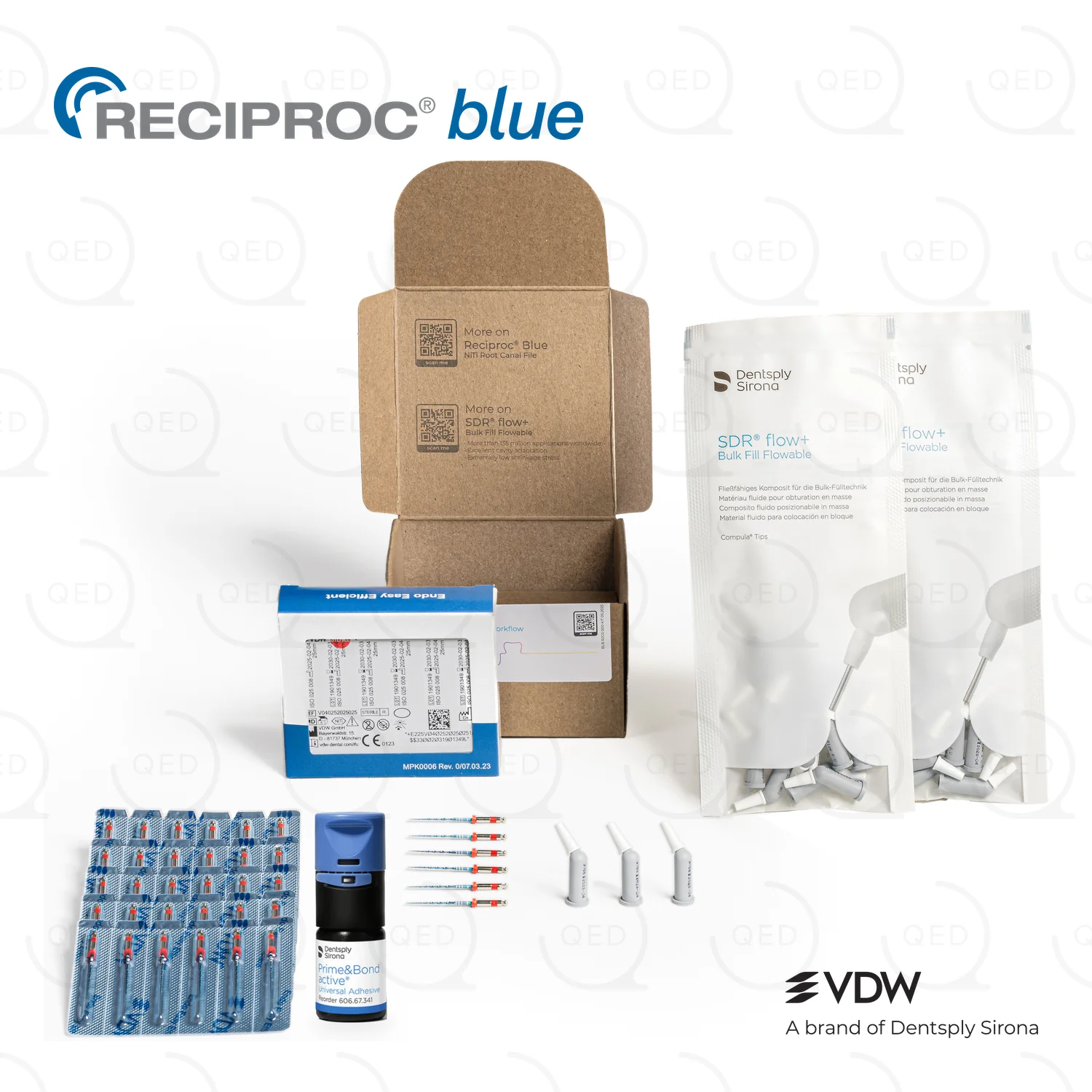
special offer · adhesive included free
the canal is shaped, the root filling is down – and the access cavity is still open. what is bonding the build-up? this code is the waveone® gold and sdr® flow+ kit with a bottle of prime&bond active® added free of charge while stocks last – the shaping, the coronal seal and the adhesive between them, on one order line.
this kit: 15 × sterile procedure blisters – each holding 1 × #10 k-flexofile, 1 × waveone® gold glider and 1 × waveone® gold primary · 1 × sdr® flow+ refill universal, 15 × 0.25 g compula® tips · 1 × prime&bond active® 4 ml, free of charge
made by dentsply sirona
| the free item | one 4 ml bottle of prime&bond active, the same standard refill sold on its own – while stocks last |
| what it covers | scout, glide and shape from one sterile blister per patient, then a bulk fill build-up cured 4 mm at a time |
| not included | paper points, cones, sealer and irrigant – it shapes and restores, it does not obturate |
› the blister is the sequence – scout, glide, shape, sealed together. every case starts on instruments that have cut nothing else.
› one caution carries through both added materials: the adhesive and the composite are each contraindicated alongside eugenol-containing materials – a zoe sealer or an irm-type temporary changes the plan.
how does this differ from the standard kit?
by one bottle. blisters and compules are identical to the waveone gold and sdr flow+ kit; this code adds a 4 ml prime&bond active free while the offer runs.
is the composite the obturation material?
no. sdr® flow+ is a bulk-fill flowable base and core build-up material – it fills the access cavity after obturation, capped with your usual universal composite in a load-bearing cavity. the canal still needs cones, points and a sealer.
| irrigation | chlorax 5.25% · chlorax 2% · irriflex® 30g · smartlite® pro endoactivator |
| dry | waveone® gold paper points primary · 180 – matched to the primary preparation |
| fill and seal | conform fit® gp primary · 60, carried to length with a sealer – ah plus®, dentsply's own epoxy, or neosealer® ezflo, premixed bioceramic, 25 mm tips · proroot® bio sealer |
| when it runs out | sdr® flow+ refill universal · 15 compula® tips – the coronal seal, sold on its own |
waveone® gold, sdr® flow+ & prime&bond · 15 sterile procedure blisters · #10 k-flexofile, gold glider and gold primary in each · 15 sdr® flow+ compula® tips · 4 ml adhesive free of charge · all instruments 25 mm · dentsply sirona · ref sp_b00wsdrr2ckit
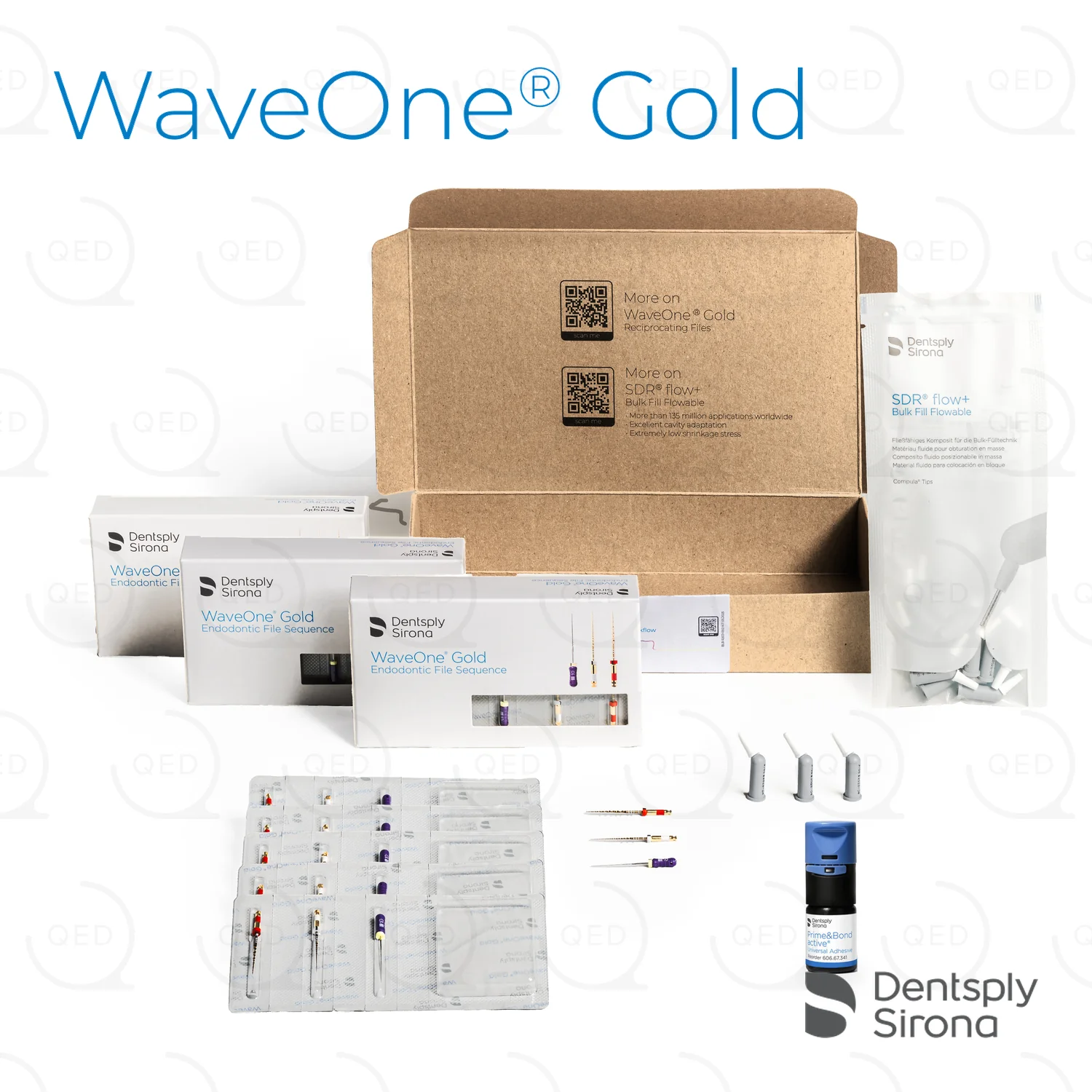
vdw r-pilot® · iso 12.5 · 21 mm · 6 files
glide pathreciprocatingcurved canalsone file to length
r-pilot® cuts the glide path in the same reciprocating motion your reciproc® files already use, on the same motor setting, with no change to the handpiece. at 21 mm it is the length for molars and for patients who cannot open far – which is where the fewest instrument changes are worth the most.
| 12.5 iso tip size | 4% constant taper | 89% to length, ex vivo |
this pack: vdw r-pilot® reciprocating glide path file, iso size 12.5, 21mm (pack of 6) · sterile
ref v040217021012 · made by dentsply sirona (maillefer), switzerland
› one size, iso 12.5, on a constant 4% taper – wider than a .02 glide path file, so it leaves more room for the shaping file that follows.
› reciprocating, and vdw are direct about the practical consequence: "no need to change motor settings if you are already working with reciprocating motion."
› m-wire, with an s-shape cross section that vdw credit for its cutting efficiency.
› sterile, single use, in a blister of six – vdw’s own comparison is with manual files: "sterile instruments and less files needed compared to manual files."
› vdw describe it as "the first motor driven glide path instrument in reciprocating motion", and as a solution "for cases where a glide path is needed" – their wording, and worth keeping, because it does not claim every case needs one.
› three lengths – r-pilot® 25 mm and r-pilot® 31 mm sit beside this one.
the claims on the r-pilot® brochure carry footnotes, and the footnotes matter, so here they are with the claims attached. less risk of instrument fracture and a reduction of cyclic fatigue are compared to rotary multiple-use instruments. better respect of the canal anatomy is versus vdw stainless steel files. neither is a comparison with every other glide path file on the market, and we are not going to write it as though it were.
de-deus and colleagues took r-pilot® through 156 root canals in 52 mandibular molars and counted how often it reached working length, examining every fractured or deformed instrument by scanning electron microscopy. it reached working length in 89.10% of canals, with fracture in 2.56% and deformation in 1.92%. (de-deus g et al., journal of endodontics 2021 – ex vivo, extracted teeth.)
a randomised clinical trial then measured what the patient feels. in 240 patients treated by four specialists, those whose glide path was cut with r-pilot® reported significantly less postoperative pain than those whose glide path was cut with stainless steel k-files. there was no significant difference between r-pilot® and proglider®, the rotary equivalent. (keskin c et al., international endodontic journal 2019 – randomised clinical trial.)
vdw’s own step-by-step card, in their order. not a qed protocol.
1 scout. a c-pilot® file iso size 08 at minimum, or a similar hand file, to ensure patency – c-pilot® 08, 21 mm.
2 working length. by preoperative radiograph, which vdw mark mandatory, and/or an apex locator.
3 irrigant in the access cavity.
4 introduce r-pilot® free, without binding. start the motor when the instrument is at the canal orifice.
5 peck. a slow in-and-out pecking motion, amplitude no more than 3 mm, with only very light pressure. one in-and-out movement is one peck.
6 clean after three pecks. in the interim stand.
7 irrigate.
8 repeat 4 to 7. until full working length is reached.
9 shape. continue with the file system of your choice.
reciproc all – the original vdw reciproc® settings, unchanged. that is the whole point of it on a reciprocating motor. both motors we stock carry the setting: vdw.silver® reciproc® and x-smart® pro+ with apex locator.
| r-pilot® | rotary glide path files | |
| motion | reciprocating | continuous rotation |
| motor | reciproc all – no change | 300 rpm, torque set separately |
| files to length | one | one or three, depending on the system |
| size and taper | iso 12.5, constant 4% | iso 13–19, .02 constant or variable |
| postoperative pain | significantly less than hand files | significantly less than hand files |
the last row is the keskin trial, which found no significant difference between the reciprocating and rotary options. the honest summary is that the choice is usually about which motor is already on the bench.
do i need a different motor?
no, if you already reciprocate. r-pilot® uses the original reciproc® settings, so nothing on the motor changes. if you do not reciprocate, proglider® does the same job in continuous rotation.
is iso 12.5 a real size?
it is vdw’s own designation, printed twice in their current brochure. it sits between an 010 and an 015 hand file, which is the gap a glide path file is meant to close. our stock code ends 012 for historical reasons; the file is a 12.5.
what does it pair with?
anything, but it is vdw’s own file, so the natural sequence is r-pilot® then reciproc® blue r25 on the same motor setting.
can the files be reused?
no. vdw supply them sterile for single patient use.
| patency | c-pilot® 08, 21 mm · c-pilot® 10, 21 mm |
| irrigants | chlorax 5.25% · chlorax 2% · endo-solution 17% edta |
| delivery | navitip™ 29 ga, 25 mm · irriflex® 30g |
| activation | vdw eddy® tips · smartlite pro endoactivator® |
| shape | reciproc® blue r25, 21 mm |
| obturate | vdw 2seal® · ah plus® paste · neosealer® ezflo, 21 mm tips |
| coronal seal | sdr® flow+ refill universal |
vdw 2seal® and ah plus® are the epoxy sealers in the group’s own range; neosealer® ezflo is the premixed bioceramic. resin or bioceramic is a real choice of technique rather than a ranking – we carry both because both are right in different hands.
| proglider®, 21 mm | rotary, one file, iso 16 on a variable progressive taper, 300 rpm. |
| pathfile® assorted, 21 mm | rotary, three files in sequence – 013, 016 and 019, all at a constant .02 taper. |
| waveone® gold glider, 21 mm | reciprocating, one file, matched to the waveone® gold sequence. |
› vdw r-pilot® brochure (pdf, 0.5 mb, vdw) – the geometry, the claims with their footnotes and the product range.
› vdw r-pilot® step-by-step card (pdf, 0.6 mb, vdw) – the nine steps above, as vdw print them.
vdw r-pilot® niti glidepath file · iso 12.5 · constant 4% taper · m-wire · s-shape cross section · 21 mm · sterile, single use · blister of 6 · reciprocating, reciproc all · ref v040217021012

vdw r-pilot® · iso 12.5 · 25 mm · 6 files
glide pathreciprocatingcurved canalsone file to length
r-pilot® is vdw’s glide path instrument, and the argument for it is as much about the motor as the file. it runs on the original reciproc® settings, so a practice already reciprocating changes nothing at all – the same handpiece, the same programme, one extra file.
| 12.5 iso tip size | 4% constant taper | 89% to length, ex vivo |
this pack: vdw r-pilot® reciprocating glide path file, iso size 12.5, 25mm (pack of 6) · sterile
ref v040217025012 · made by dentsply sirona (maillefer), switzerland
› one size, iso 12.5, on a constant 4% taper – wider than a .02 glide path file, so it leaves more room for the shaping file that follows.
› reciprocating, and vdw are direct about the practical consequence: "no need to change motor settings if you are already working with reciprocating motion."
› m-wire, with an s-shape cross section that vdw credit for its cutting efficiency.
› sterile, single use, in a blister of six – vdw’s own comparison is with manual files: "sterile instruments and less files needed compared to manual files."
› vdw describe it as "the first motor driven glide path instrument in reciprocating motion", and as a solution "for cases where a glide path is needed" – their wording, and worth keeping, because it does not claim every case needs one.
› three lengths – r-pilot® 21 mm and r-pilot® 31 mm sit beside this one.
the claims on the r-pilot® brochure carry footnotes, and the footnotes matter, so here they are with the claims attached. less risk of instrument fracture and a reduction of cyclic fatigue are compared to rotary multiple-use instruments. better respect of the canal anatomy is versus vdw stainless steel files. neither is a comparison with every other glide path file on the market, and we are not going to write it as though it were.
de-deus and colleagues took r-pilot® through 156 root canals in 52 mandibular molars and counted how often it reached working length, examining every fractured or deformed instrument by scanning electron microscopy. it reached working length in 89.10% of canals, with fracture in 2.56% and deformation in 1.92%. (de-deus g et al., journal of endodontics 2021 – ex vivo, extracted teeth.)
a randomised clinical trial then measured what the patient feels. in 240 patients treated by four specialists, those whose glide path was cut with r-pilot® reported significantly less postoperative pain than those whose glide path was cut with stainless steel k-files. there was no significant difference between r-pilot® and proglider®, the rotary equivalent. (keskin c et al., international endodontic journal 2019 – randomised clinical trial.)
vdw’s own step-by-step card, in their order. not a qed protocol.
1 scout. a c-pilot® file iso size 08 at minimum, or a similar hand file, to ensure patency – c-pilot® 08, 25 mm.
2 working length. by preoperative radiograph, which vdw mark mandatory, and/or an apex locator.
3 irrigant in the access cavity.
4 introduce r-pilot® free, without binding. start the motor when the instrument is at the canal orifice.
5 peck. a slow in-and-out pecking motion, amplitude no more than 3 mm, with only very light pressure. one in-and-out movement is one peck.
6 clean after three pecks. in the interim stand.
7 irrigate.
8 repeat 4 to 7. until full working length is reached.
9 shape. continue with the file system of your choice.
reciproc all – the original vdw reciproc® settings, unchanged. that is the whole point of it on a reciprocating motor. both motors we stock carry the setting: vdw.silver® reciproc® and x-smart® pro+ with apex locator.
| r-pilot® | rotary glide path files | |
| motion | reciprocating | continuous rotation |
| motor | reciproc all – no change | 300 rpm, torque set separately |
| files to length | one | one or three, depending on the system |
| size and taper | iso 12.5, constant 4% | iso 13–19, .02 constant or variable |
| postoperative pain | significantly less than hand files | significantly less than hand files |
the last row is the keskin trial, which found no significant difference between the reciprocating and rotary options. the honest summary is that the choice is usually about which motor is already on the bench.
do i need a different motor?
no, if you already reciprocate. r-pilot® uses the original reciproc® settings, so nothing on the motor changes. if you do not reciprocate, proglider® does the same job in continuous rotation.
is iso 12.5 a real size?
it is vdw’s own designation, printed twice in their current brochure. it sits between an 010 and an 015 hand file, which is the gap a glide path file is meant to close. our stock code ends 012 for historical reasons; the file is a 12.5.
what does it pair with?
anything, but it is vdw’s own file, so the natural sequence is r-pilot® then reciproc® blue r25 on the same motor setting.
can the files be reused?
no. vdw supply them sterile for single patient use.
| patency | c-pilot® 08, 25 mm · c-pilot® 10, 25 mm |
| irrigants | chlorax 5.25% · chlorax 2% · endo-solution 17% edta |
| delivery | navitip™ 29 ga, 25 mm · irriflex® 30g |
| activation | vdw eddy® tips · smartlite pro endoactivator® |
| shape | reciproc® blue r25, 25 mm |
| obturate | vdw 2seal® · ah plus® paste · neosealer® ezflo, 25 mm tips |
| coronal seal | sdr® flow+ refill universal |
vdw 2seal® and ah plus® are the epoxy sealers in the group’s own range; neosealer® ezflo is the premixed bioceramic. resin or bioceramic is a real choice of technique rather than a ranking – we carry both because both are right in different hands.
| proglider®, 25 mm | rotary, one file, iso 16 on a variable progressive taper, 300 rpm. |
| pathfile® assorted, 25 mm | rotary, three files in sequence – 013, 016 and 019, all at a constant .02 taper. |
| waveone® gold glider, 25 mm | reciprocating, one file, matched to the waveone® gold sequence. |
› vdw r-pilot® brochure (pdf, 0.5 mb, vdw) – the geometry, the claims with their footnotes and the product range.
› vdw r-pilot® step-by-step card (pdf, 0.6 mb, vdw) – the nine steps above, as vdw print them.
vdw r-pilot® niti glidepath file · iso 12.5 · constant 4% taper · m-wire · s-shape cross section · 25 mm · sterile, single use · blister of 6 · reciprocating, reciproc all · ref v040217025012
vdw r-pilot® · iso 12.5 · 31 mm · 6 files
glide pathreciprocatingcurved canalsone file to length
r-pilot® in 31 mm is for the canals that need the reach – long roots, and anterior teeth where working length runs past what a 25 mm file will do. the reciprocating motion and the reciproc all setting are the same as the shorter lengths; the scouting step is the part that needs thought, and there is a note on it below.
| 12.5 iso tip size | 4% constant taper | 89% to length, ex vivo |
this pack: vdw r-pilot® reciprocating glide path file, iso size 12.5, 31mm (pack of 6) · sterile
ref v040217031012 · made by dentsply sirona (maillefer), switzerland
› one size, iso 12.5, on a constant 4% taper – wider than a .02 glide path file, so it leaves more room for the shaping file that follows.
› reciprocating, and vdw are direct about the practical consequence: "no need to change motor settings if you are already working with reciprocating motion."
› m-wire, with an s-shape cross section that vdw credit for its cutting efficiency.
› sterile, single use, in a blister of six – vdw’s own comparison is with manual files: "sterile instruments and less files needed compared to manual files."
› vdw describe it as "the first motor driven glide path instrument in reciprocating motion", and as a solution "for cases where a glide path is needed" – their wording, and worth keeping, because it does not claim every case needs one.
› three lengths – r-pilot® 21 mm and r-pilot® 25 mm sit beside this one.
the claims on the r-pilot® brochure carry footnotes, and the footnotes matter, so here they are with the claims attached. less risk of instrument fracture and a reduction of cyclic fatigue are compared to rotary multiple-use instruments. better respect of the canal anatomy is versus vdw stainless steel files. neither is a comparison with every other glide path file on the market, and we are not going to write it as though it were.
de-deus and colleagues took r-pilot® through 156 root canals in 52 mandibular molars and counted how often it reached working length, examining every fractured or deformed instrument by scanning electron microscopy. it reached working length in 89.10% of canals, with fracture in 2.56% and deformation in 1.92%. (de-deus g et al., journal of endodontics 2021 – ex vivo, extracted teeth.)
a randomised clinical trial then measured what the patient feels. in 240 patients treated by four specialists, those whose glide path was cut with r-pilot® reported significantly less postoperative pain than those whose glide path was cut with stainless steel k-files. there was no significant difference between r-pilot® and proglider®, the rotary equivalent. (keskin c et al., international endodontic journal 2019 – randomised clinical trial.)
vdw’s own step-by-step card, in their order. not a qed protocol.
1 scout. a c-pilot® file iso size 08 at minimum, or a similar hand file, to ensure patency – an iso 008 hand file long enough to reach working length at 31 mm.
2 working length. by preoperative radiograph, which vdw mark mandatory, and/or an apex locator.
3 irrigant in the access cavity.
4 introduce r-pilot® free, without binding. start the motor when the instrument is at the canal orifice.
5 peck. a slow in-and-out pecking motion, amplitude no more than 3 mm, with only very light pressure. one in-and-out movement is one peck.
6 clean after three pecks. in the interim stand.
7 irrigate.
8 repeat 4 to 7. until full working length is reached.
9 shape. continue with the file system of your choice.
a note specific to 31 mm. step 1 needs a hand file that reaches working length, and the c-pilot® range stops at 25 mm. take the requirement from vdw’s card – an iso 008 at minimum – and use a 31 mm hand file. a 25 mm file would be shorter than the canal, so we have not linked one here.
reciproc all – the original vdw reciproc® settings, unchanged. that is the whole point of it on a reciprocating motor. both motors we stock carry the setting: vdw.silver® reciproc® and x-smart® pro+ with apex locator.
| r-pilot® | rotary glide path files | |
| motion | reciprocating | continuous rotation |
| motor | reciproc all – no change | 300 rpm, torque set separately |
| files to length | one | one or three, depending on the system |
| size and taper | iso 12.5, constant 4% | iso 13–19, .02 constant or variable |
| postoperative pain | significantly less than hand files | significantly less than hand files |
the last row is the keskin trial, which found no significant difference between the reciprocating and rotary options. the honest summary is that the choice is usually about which motor is already on the bench.
do i need a different motor?
no, if you already reciprocate. r-pilot® uses the original reciproc® settings, so nothing on the motor changes. if you do not reciprocate, proglider® does the same job in continuous rotation.
is iso 12.5 a real size?
it is vdw’s own designation, printed twice in their current brochure. it sits between an 010 and an 015 hand file, which is the gap a glide path file is meant to close. our stock code ends 012 for historical reasons; the file is a 12.5.
what does it pair with?
anything, but it is vdw’s own file, so the natural sequence is r-pilot® then reciproc® blue r25 on the same motor setting.
can the files be reused?
no. vdw supply them sterile for single patient use.
| patency | an iso 008 or 010 hand file in a 31 mm length – the c-pilot® range stops at 25 mm |
| irrigants | chlorax 5.25% · chlorax 2% · endo-solution 17% edta |
| delivery | navitip™ 29 ga, 25 mm · irriflex® 30g |
| activation | vdw eddy® tips · smartlite pro endoactivator® |
| shape | reciproc® blue r25, 31 mm |
| obturate | vdw 2seal® · ah plus® paste · neosealer® ezflo, 25 mm tips |
| coronal seal | sdr® flow+ refill universal |
vdw 2seal® and ah plus® are the epoxy sealers in the group’s own range; neosealer® ezflo is the premixed bioceramic. resin or bioceramic is a real choice of technique rather than a ranking – we carry both because both are right in different hands.
| proglider®, 31 mm | rotary, one file, iso 16 on a variable progressive taper, 300 rpm. |
| pathfile® assorted, 31 mm | rotary, three files in sequence – 013, 016 and 019, all at a constant .02 taper. |
| waveone® gold glider, 31 mm | reciprocating, one file, matched to the waveone® gold sequence. |
› vdw r-pilot® brochure (pdf, 0.5 mb, vdw) – the geometry, the claims with their footnotes and the product range.
› vdw r-pilot® step-by-step card (pdf, 0.6 mb, vdw) – the nine steps above, as vdw print them.
vdw r-pilot® niti glidepath file · iso 12.5 · constant 4% taper · m-wire · s-shape cross section · 31 mm · sterile, single use · blister of 6 · reciprocating, reciproc all · ref v040217031012


 Facebook
 X
 Instagram
 Pinterest
