

Best selection of Endodontic supplies in the UK







opacal® · calcium hydroxide dressing · 3 ml syringe
temporary root canal dressingtwo-visit endodonticsinterappointmentready to usenon-setting
a weeping canal, a patient who cannot come back for a fortnight, and a temporary that has to do the thinking while they are away. opacal® is a radiopaque, creamy, ready-to-use calcium hydroxide paste for temporary root canal dressing. pd's own statement of purpose is plain: it is intended to eliminate remaining microorganisms and prevent reinfection between appointments, and its main properties come from its alkaline ph.
| >12 ph | 300% of dentine | 3 ml syringe |
this pack: 1 × 3 ml syringe · 10 × single-use application tips · 1 × finger grip
made by produits dentaires sa, switzerland · class iia medical device, supplied non-sterile
everything a calcium hydroxide dressing does, it does by being strongly alkaline, and how fast it gets there depends on the vehicle. opacal is an aqueous, non-setting paste at 30% calcium hydroxide – the formulation type that releases its ions quickly rather than over months. that suits a dressing you mean to remove in a fortnight, and it is why it comes out easily: nothing has set.
opacal is an aqueous non-setting material. this characteristic induces rapid ionic release and performant action in short treatment time procedure. in addition, the paste can be easily removed.
— produits dentaires sa, on their own opacal pages
1 prepare, clean and dry the canal meticulously – the ifu's word, not ours.
2 clip the finger grip on, uncap, fit a new tip to the luer-lock, and test the flow onto a pad before going intraorally. never force the plunger.
3 fill from the apical portion outward, staying at least 2 mm shy of the apex, and adjust the volume to the anatomy rather than to habit.
4 seal with a temporary restorative for a tight seal between visits, then confirm the fill radiographically.
5 discard the tip, cap the syringe immediately so the paste does not dry in it, and disinfect the syringe.
6 remove it completely next visit – an endodontic file and a few drops of saline, per the ifu.
| composition | calcium hydroxide 30%, barium sulphate 24%, plus an excipient pd do not disclose |
| ph | above 12, in pd's wording. they publish no measured value |
| radiopacity | pd state more than 300% of the radiopacity of dentine; their earlier flyer gives the figure as greater than 3 mm aluminium |
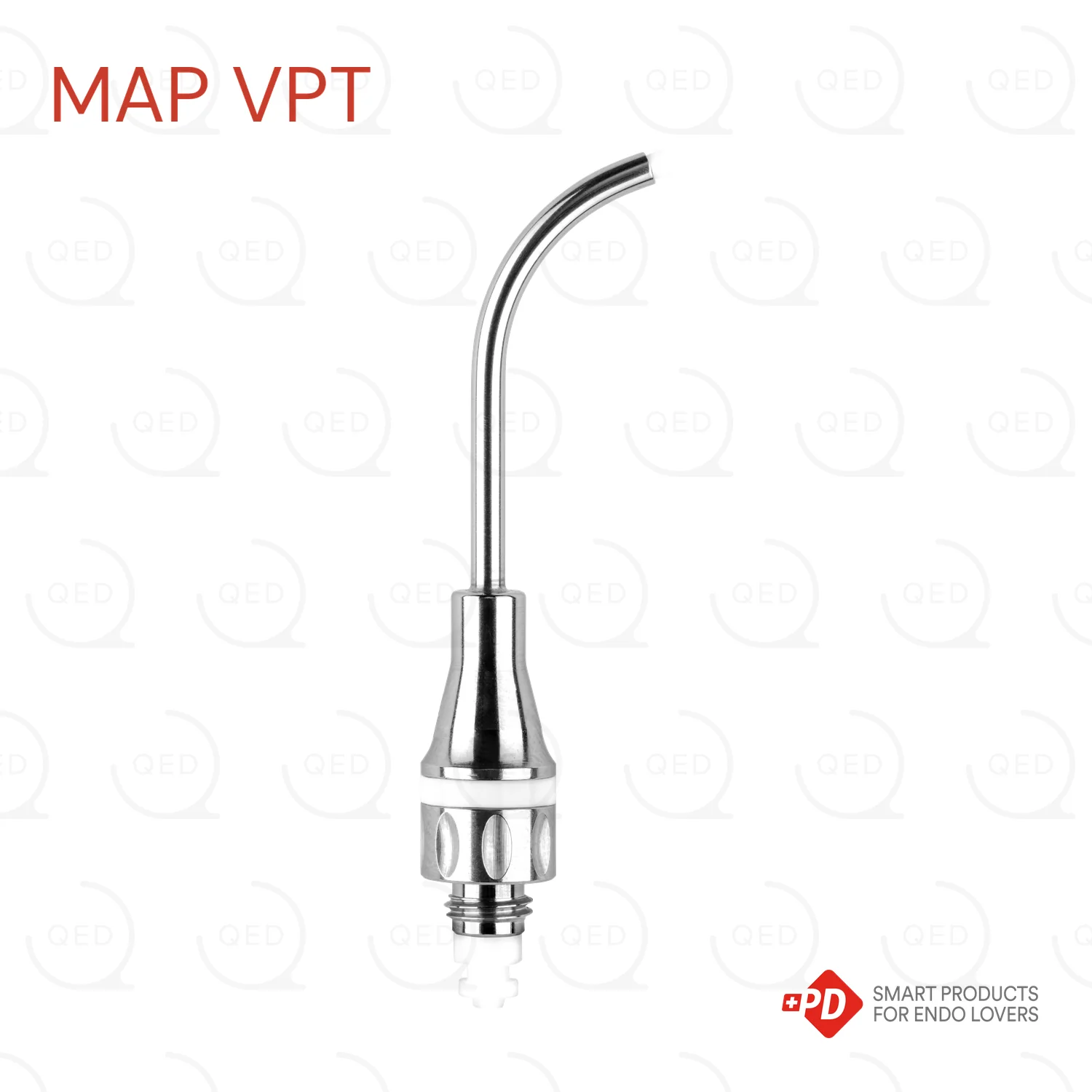
| the tip | flexible, luer-lock, 20 mm long and angled at 110° on pd's flyer diagram |
| dressing period | pd give 1 to 3 weeks as usual; the ifu sets a maximum of 30 days |
| storage | 15 to 25 °c, protected from direct light. shelf life 3 years |
› tips are single use, per patient. discard after each treatment; a blocked tip is replaced rather than persuaded.
› the syringe is not. pd require it disinfected between every patient, but specify no agent or contact time – use your own validated protocol.
› two millimetres shy of the apex, stated twice in the ifu – in the directions, and again as an extrusion precaution.
› it is a strong alkali. calcium hydroxide is a skin irritant that can cause serious eye damage; pd ask for rubber dam, safety glasses and a waterproof bib for the patient, and gloves, mask and goggles for the operator.
› undesirable effects: the ifu records none known or foreseen when the product is used as intended.
worth being straight about this. the figures above – ph, radiopacity, ionic release – are produits dentaires' own, and pd publish no test data behind them. the one reference they cite is fava and saunders' classification of calcium hydroxide pastes (int endod j 1999), a review of the category rather than a study of this product, cited to support the general point that aqueous non-setting vehicles release their ions quickly. there is no independent published work on opacal itself. none of which makes it a poor choice – a 30% aqueous calcium hydroxide paste does what the category has done for decades – but buy it as a well-made example of a familiar material, not as something with a trial behind it.
how is it delivered – do i need a spiral filler?
pd's method is the syringe and its own tip, and that is the only delivery route their instructions describe: fit the tip, fill from the apical portion outward, stop 2 mm short. they do not discuss any other technique.
how long can it stay in?
pd describe the usual temporisation as one to three weeks. the ifu is firmer about the outer limit: as a temporary root canal dressing, the maximum duration of treatment should be 30 days.
will i get it all out again?
it is non-setting and water-based, and the ifu asks for complete removal at the next appointment with an endodontic file and a few drops of saline. saline specifically – pd name no other solution here.
| isolate | oraseal™ caulking – pd ask for rubber dam with this material, and a dam that weeps is not isolation |
| irrigate | chlorax 5.25% sodium hypochlorite · 5 × 200 ml |
| deliver it | irriflex® with endostops – flexible 30g needle for the curve the dressing must reach past |
| final rinse | endo-solution 17% edta · 200 ml |
| dry it first | reciproc® paper points r25 · 144 – the ifu wants the canal dry first |
| seal it in | j-temp™ temporary resin – radiopaque, so the film confirms the temporary as well as the dressing |
| longer intervals | bio-c® temp · 4 × 0.5 g – a premixed bioceramic dressing, for gaps running past opacal's 30-day maximum |
| the same material, differently | calcipast calcium hydroxide · 4 × 2.1 g – the same material in a four-syringe pack, if that suits you better |
opacal® · radiopaque calcium hydroxide dressing · calcium hydroxide 30%, barium sulphate 24% · ph above 12 · aqueous, non-setting · 3 ml syringe with 10 single-use tips and a finger grip · class iia · produits dentaires sa, switzerland · ref 11020

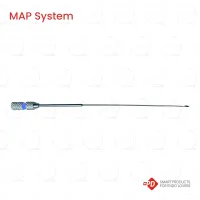
map system® · cleaning curette · n°0 yellow
bought your map set a few years ago, and the yellow curette has gone missing from the tray? this is the replacement. it is the colour-matched scraper that earlier map kits supplied for clearing residue from a ø0.90 mm needle. worth knowing before you order: pd's current instructions for use no longer name it. the cleaning step they now specify is stiffened floss for the standard needles and the map brush for the vpt bores.
this item: 1 × cleaning curette, n°0 yellow
made by pd dental, switzerland
| matched to | the n°0 yellow needles, at ø0.90 mm – the colour codes the bore, as it does throughout the range |
| status | a legacy accessory. pd's current ifu specifies floss or the vpt brush, not a curette |
| buy it if | you work from an earlier map kit that was supplied with curettes and want to keep the set complete |
| timing is the same | whatever you clean with, pd give you 15 minutes from use before set cement stops coming out |
› we would rather tell you this than sell it quietly. if you are equipping a new map set-up, cleanyfloss is what the current documentation calls for.
› colour to colour. a yellow curette is sized for the yellow needle; using the wrong one is at best ineffective.
› it does not replace reprocessing. clearing residue is the first step, not the whole decontamination cycle.
should i be using floss instead?
if you are following pd's current ifu, yes – that is what it names. the curette remains available for practices whose kits were supplied with one and who have a working routine built around it.
is it interchangeable between sizes?
no. yellow for n°0, red for n°1, blue for n°2 – the same coding as the needles and plungers.
| current ifu tool | cleanyfloss · 30 threads – what pd now specify |
| the needle it serves | niti memory shape n°0 · ø0.90 mm |
| its consumable | plastic plungers n°0 yellow · 16 |
| other sizes | curette n°1 red · n°2 blue |
map cleaning curette n°0 · yellow · for ø0.90 mm needles · legacy accessory, superseded in pd's current ifu by stiffened floss · pd dental · ref 20240
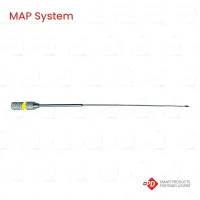
map system® · cleaning curette · n°2 blue
a ø1.30 mm needle holds the most residue of any in the standard range, which is why the blue curette was the one people reached for. it matches the two families made in n°2 – the niti memory shape and the hooked. as with its siblings, it is worth saying plainly that pd's current instructions for use specify stiffened floss rather than a curette; this remains available for kits that were supplied with one.
this item: 1 × cleaning curette, n°2 blue
made by pd dental, switzerland
| matched to | the n°2 blue needles at ø1.30 mm – niti memory shape and hooked only |
| status | a legacy accessory. pd's current ifu names stiffened floss, or the brush for vpt bores |
| buy it if | your kit came with a blue curette and you would rather replace it than change a working routine |
| timing is the same | 15 minutes from use, and a wide bore gives you more to get out, not more time |
› new set-up? cleanyfloss is what pd currently name, and it covers every standard bore rather than one.
› blue means ø1.30 mm – there is no classic or surgery needle in this size, so this curette serves two families, not five.
› clearing is not decontaminating. the full cycle is enzymatic soak, ultrasonic, rinse, dry and autoclave.
which needles is this for?
the niti memory shape n°2 and the hooked n°2. nothing else in the map range is made at ø1.30 mm.
can one curette cover all three sizes?
no – each is sized to its bore, which is why they are colour-coded. floss, by contrast, works across the standard range.
| current ifu tool | cleanyfloss · 30 threads – covers every standard bore |
| the needles it serves | niti n°2 · hooked n°2 |
| its consumable | plastic plungers n°2 blue · 16 |
| other sizes | curette n°0 yellow · n°1 red |
map cleaning curette n°2 · blue · for ø1.30 mm needles · legacy accessory, superseded in pd's current ifu by stiffened floss · pd dental · ref 20243
irriflex® · 40 needles with 50 endostops
root canal irrigationcurved canalssmear layer removalfinal rinseworking-length control
this code now ships with endostops. orders for ref 21401 are dispatched as irriflex® with endostops (ref 21401_pp) – the same 40 needles, with 50 endostops added to the box. nothing to change in your basket or reorder list.
how far down a curved molar canal does your irrigant actually reach? a rigid needle stops where the curve begins, and everything below that is served by diffusion and optimism. irriflex® is a polypropylene needle that bends with the canal – pd's own wording is that the flexibility allows the needle to access the apical region without resistance or damage to the dentinal walls. two side vents sit at the tip, back-to-back, so irrigant leaves as two jets aimed at the walls rather than one column aimed at the apex. the box now includes fifty endostops, so the depth you work to is set on the needle rather than judged through a mirror.
| 30g ø0.3 mm | 27 mm length | 4% conicity |
you receive: 40 × irriflex® needles, individually pouched · 50 × endostops · supplied as ref 21401_pp
made by pd dental, switzerland · class iia medical device
irrigation does the disinfecting; the file only makes room for it. so the question worth asking of a needle is not what it is made of but how close it gets, and what the fluid does when it arrives. a 4% taper narrows roughly as the preparation does, keeping the gap around it even – and back-to-back vents put the energy sideways into the walls rather than forwards into the periapex.
the tapered shape of the needle adapts to the shape of the canal. flow thickness of the irrigant is therefore constant as the fluid moves to the coronal area, which maximises shear forces and the elimination of debris, smear layer and biofilm.
— produits dentaires sa, on their own irriflex pages
1 fill the syringe with a compatible irrigant – stabilised sodium hypochlorite up to 6%, edta 17%, chlorhexidine digluconate 2%, citric acid up to 40%, or dual rinse hedp.
2 lock it on clockwise and expel residual air. the fitting is luer-lock; a slip-tip barrel will not hold it.
3 set the depth. the cannula is marked at 18, 19, 20 and 22 mm; a stop defines working length where it falls between marks.
4 check two equal jets before the tip goes near an orifice, so you know the pressure needed and that both vents are clear.
5 start in the chamber, pre-bend the tip for posterior access, and insert passively to 1 to 2 mm short, moving up and down by the same amount.
6 irrigate 1 to 2 ml after each instrument, check patency, re-irrigate; then finish with edta followed by hypochlorite, and discard the needle.
| the needles | made under clean-room conditions and ready to use. pd's ifu: do not sterilise before use. single use, 5-year shelf life |
| the endostops | handling of the stops is set out by pd in their own endostop notice – linked under downloads, alongside the ifu |
| free movement | pd's precaution: make sure the needle can move freely, so there is constant flowback up the canal |
| chamber floor | pd's quick guide: irrigate the pulp chamber, avoiding contact with the pulp chamber floor |
| stated risk | the ifu records no known contraindications and no known adverse reactions |
strand, lægreid and fristad compared four needle designs in 30° curved simulated canals prepared to 30/.04, and found the flexible polypropylene needle gave the lowest absorbance values, significantly better than both the flat open-ended and the double-vented metallic needles (dent j 2026;14(5):278 – no external funding, no declared conflicts). baasch and colleagues, in 3d-printed molar models, left 26.8% remaining tissue in the apical third against 53.9% and 44.9% for two closed-ended needles – though an open-ended needle did better overall at 23.7%, and better again in the middle and coronal thirds (odontology 2025;113(3):1180–8). lebbos and colleagues found the smear-layer benefit showed in a 30/.04 preparation but was less evident at 25/.06 (eur j dent 2025;19(3):678–87) – a hint that the needle suits a preparation shaped like it is.
the honest summary: this is not a needle that wins everywhere. it is a needle that holds up where a rigid one struggles – curvature, and the apical third – and the published work says so without needing help from us.
irriflex® is a new standard in root canal irrigation. the sensation of secure and smooth tip insertion, flow control and the increased visibility are the benefits i observe in my daily practice.
— dr riccardo tonini, quoted by pd dental
irriflex® has revolutionized root canal irrigation and has become a fundamental part of my protocol.
— dr uwe radmacher, quoted by pd dental
do i need the stops if the needle is marked?
not always. the marks at 18, 19, 20 and 22 mm cover a lot of cases. a stop earns its place when working length falls between them, or when access is poor enough that reading a mark is optimistic.
to which depth should i set the endostop?
pd's answer: we recommend setting the insertion depth 1 to 2 mm less than the root canal working length. their quick guide says the same, using either the markers or a stopper.
how are the endostops fitted?
pd say they can be installed on irriflex either with the use of an endobloc or by hand, and recommend the endobloc, because the ruler on most endoblocs makes the insertion depth easier to get right.
is there a risk of over-bending it?
pd's answer is no: irriflex is highly flexible and does not break when pre-bending it prior to insertion into a root canal. they add that bending it beyond 90° is neither advised nor needed.
which hypochlorite concentration is allowed?
the ifu says stabilised sodium hypochlorite up to 6%. pd's product page lists 5.25%; the ifu is the authoritative document, and pd's own quick guide says so.
| two boxes and syringes | irriflex® bundle – two of these boxes, 80 needles and 100 stops, plus 5 ml luer-lock syringes |
| hypochlorite | chlorax 5.25% · chlorax 2% – both within the ifu's limit |
| chelate | endo-solution 17% edta · 200 ml – the final-rinse step in pd's sequence |
| bulk chelate | endo-solution 17% edta · 5 × 200 ml |
| citric acid | citric acid 40% · 200 ml – at the ceiling the ifu states |
| chlorhexidine | canalpro chx 2% · 500 ml – the concentration the ifu names |
| isolate | oraseal™ caulking – hypochlorite deserves a dam that does not weep |
› irriflex® quick user guide (pdf, 0.3 mb, pd dental) – the technique on one card
› irriflex® directions for use (ifu) (pdf, 0.4 mb, pd dental, multilingual) – the authoritative document
› endostops – sterilisation of single-use products (pdf, pd dental, multilingual) – pd's notice for the stops in this box
irriflex® with endostops · flexible polypropylene irrigation needle · 30g, ø0.3 mm · 27 mm · 4% conicity · two back-to-back side vents · luer-lock · single use · 40 needles and 50 stops · pd dental · ref 21401, supplied as 21401_pp

irriflex® · 40 needles with 50 endostops
root canal irrigationcurved canalssmear layer removalfinal rinseworking-length control
how far down a curved molar canal does your irrigant actually reach? a rigid needle stops where the curve begins, and everything below that is served by diffusion and optimism. irriflex® is a polypropylene needle that bends with the canal – pd's own wording is that the flexibility allows the needle to access the apical region without resistance or damage to the dentinal walls. two side vents sit at the tip, back-to-back, so irrigant leaves as two jets aimed at the walls rather than one column aimed at the apex. this box adds fifty endostops, so the depth you work to is set on the needle rather than judged through a mirror.
| 30g ø0.3 mm | 27 mm length | 4% conicity |
this pack: 40 × irriflex® needles, individually pouched · 50 × endostops
ordering ref 21401? that code now ships as this box.
made by pd dental, switzerland · class iia medical device
irrigation does the disinfecting; the file only makes room for it. so the question worth asking of a needle is not what it is made of but how close it gets, and what the fluid does when it arrives. a 4% taper narrows roughly as the preparation does, keeping the gap around it even – and back-to-back vents put the energy sideways into the walls rather than forwards into the periapex.
the tapered shape of the needle adapts to the shape of the canal. flow thickness of the irrigant is therefore constant as the fluid moves to the coronal area, which maximises shear forces and the elimination of debris, smear layer and biofilm.
— produits dentaires sa, on their own irriflex pages
1 fill the syringe with a compatible irrigant – stabilised sodium hypochlorite up to 6%, edta 17%, chlorhexidine digluconate 2%, citric acid up to 40%, or dual rinse hedp.
2 lock it on clockwise and expel residual air. the fitting is luer-lock; a slip-tip barrel will not hold it.
3 set the depth. the cannula is marked at 18, 19, 20 and 22 mm; a stop defines working length where it falls between marks.
4 check two equal jets before the tip goes near an orifice, so you know the pressure needed and that both vents are clear.
5 start in the chamber, pre-bend the tip for posterior access, and insert passively to 1 to 2 mm short, moving up and down by the same amount.
6 irrigate 1 to 2 ml after each instrument, check patency, re-irrigate; then finish with edta followed by hypochlorite, and discard the needle.
| the needles | made under clean-room conditions and ready to use. pd's ifu: do not sterilise before use. single use, 5-year shelf life |
| the endostops | handling of the stops is set out by pd in their own endostop notice – linked under downloads, alongside the ifu |
| free movement | pd's precaution: make sure the needle can move freely, so there is constant flowback up the canal |
| chamber floor | pd's quick guide: irrigate the pulp chamber, avoiding contact with the pulp chamber floor |
| stated risk | the ifu records no known contraindications and no known adverse reactions |
strand, lægreid and fristad compared four needle designs in 30° curved simulated canals prepared to 30/.04, and found the flexible polypropylene needle gave the lowest absorbance values, significantly better than both the flat open-ended and the double-vented metallic needles (dent j 2026;14(5):278 – no external funding, no declared conflicts). baasch and colleagues, in 3d-printed molar models, left 26.8% remaining tissue in the apical third against 53.9% and 44.9% for two closed-ended needles – though an open-ended needle did better overall at 23.7%, and better again in the middle and coronal thirds (odontology 2025;113(3):1180–8). lebbos and colleagues found the smear-layer benefit showed in a 30/.04 preparation but was less evident at 25/.06 (eur j dent 2025;19(3):678–87) – a hint that the needle suits a preparation shaped like it is.
the honest summary: this is not a needle that wins everywhere. it is a needle that holds up where a rigid one struggles – curvature, and the apical third – and the published work says so without needing help from us.
irriflex® is a new standard in root canal irrigation. the sensation of secure and smooth tip insertion, flow control and the increased visibility are the benefits i observe in my daily practice.
— dr riccardo tonini, quoted by pd dental
irriflex® has revolutionized root canal irrigation and has become a fundamental part of my protocol.
— dr uwe radmacher, quoted by pd dental
do i need the stops if the needle is marked?
not always. the marks at 18, 19, 20 and 22 mm cover a lot of cases. a stop earns its place when working length falls between them, or when access is poor enough that reading a mark is optimistic.
to which depth should i set the endostop?
pd's answer: we recommend setting the insertion depth 1 to 2 mm less than the root canal working length. their quick guide says the same, using either the markers or a stopper.
how are the endostops fitted?
pd say they can be installed on irriflex either with the use of an endobloc or by hand, and recommend the endobloc, because the ruler on most endoblocs makes the insertion depth easier to get right.
is there a risk of over-bending it?
pd's answer is no: irriflex is highly flexible and does not break when pre-bending it prior to insertion into a root canal. they add that bending it beyond 90° is neither advised nor needed.
which hypochlorite concentration is allowed?
the ifu says stabilised sodium hypochlorite up to 6%. pd's product page lists 5.25%; the ifu is the authoritative document, and pd's own quick guide says so.
| two boxes and syringes | irriflex® bundle – two of these boxes, 80 needles and 100 stops, plus 5 ml luer-lock syringes |
| hypochlorite | chlorax 5.25% · chlorax 2% – both within the ifu's limit |
| chelate | endo-solution 17% edta · 200 ml – the final-rinse step in pd's sequence |
| bulk chelate | endo-solution 17% edta · 5 × 200 ml |
| citric acid | citric acid 40% · 200 ml – at the ceiling the ifu states |
| chlorhexidine | canalpro chx 2% · 500 ml – the concentration the ifu names |
| isolate | oraseal™ caulking – hypochlorite deserves a dam that does not weep |
› irriflex® quick user guide (pdf, 0.3 mb, pd dental) – the technique on one card
› irriflex® directions for use (ifu) (pdf, 0.4 mb, pd dental, multilingual) – the authoritative document
› endostops – sterilisation of single-use products (pdf, pd dental, multilingual) – pd's notice for the stops in this box
irriflex® with endostops · flexible polypropylene irrigation needle · 30g, ø0.3 mm · 27 mm · 4% conicity · two back-to-back side vents · luer-lock · single use · 40 needles and 50 stops · pd dental · ref 21401_pp
ultracal™ xs · paste and tips together
new to ultracal™ xs, or out of tips as well as paste? this bundle pairs the four-syringe refill of ultradent's aqueous, radiopaque 35% calcium hydroxide paste with twenty 29-gauge navitip™ single sideport tips across four lengths – so whatever the working length in front of you, the right cannula is already in the drawer. one order, one box, and nothing to discover missing when the case is already open.
| 4 syringes | 20 tips included | 12.5 ph |
this bundle: 4 × 1.2 ml ultracal™ xs syringes · 20 × navitip™ 29 ga single sideport tips across four lengths
made by ultradent, usa
| nothing missing | paste and delivery arrive together – no half-started case because the tips are on back order |
| four lengths | short anteriors through to deep access covered without committing to four separate boxes |
| ph 12.5 | raises dentine ph to strongly alkaline – an environment hostile to remaining microorganisms |
| aqueous | formulated to be both aqueous and radiopaque – it flows to length, and the film shows how far |
› indicated for interappointment dressing, root resorption, pulp capping, apexification and perforations.
› technique – rubber stop at 3–4 mm from the apex, cannula kept free in the canal, dispense gently on withdrawal. never dispense a wedged tip.
› award winner – dentaltown townie choice award, best canal treatment medicaments, 2017.
bundle or syringes only?
this is the one to buy first, because it includes the tips. once you are stocked, the 4-syringe refill is the reorder, with tips replaced as you work through them.
which tip lengths will i actually use?
most practices get through 21 mm fastest, with 25 mm second. both are stocked in boxes of 20 when the bundle's supply runs down.
how do i remove it at the next visit?
ultradent's method is their citric acid with a navitip™ fx™ brush tip; sodium hypochlorite with ultrasonic activation is the common alternative. expect some residue either way.
what if i need a dressing that lasts weeks?
bio-c® temp is the bioceramic alternative – lower peak ph, but angelus states it can remain in the canal up to 30 days without replacement.
| paste refill | ultracal™ xs 4 × 1.2 ml |
| tip refill, 21 mm | 29 ga sideport · 20 tips |
| tip refill, 25 mm | 29 ga sideport · 20 tips |
| long dressing | bio-c® temp |
| routine dressing | opacal · 3 ml syringe |
ultracal™ xs refill + navitip™ sideport tips · 35% calcium hydroxide · aqueous · radiopaque · ph 12.5 · 4 × 1.2 ml + 20 tips · ultradent, usa · ref 5145_2 · mfr code 5144

hyflex edm · orifice opener 18/.11 · 18 mm
coronal accessstraight part of the canalogsf step 1
coltene’s ogsf sequence runs opener, glider, shaper, finisher, and this is the opener. an 18/.11 file on an 18 mm shaft, it creates space for coronal access in the straight part of the canal before the glide path file goes to length. coltene make it in 18 mm only.
| 18/.11 tip / taper | 18 mm one length | 400 rpm up to 2.5 ncm |
sizes as coltene print them: tip diameter / taper. motor settings from coltene’s hyflex edm ogsf instructions for use (rev-03-2023).
this pack: coltene hyflex edm ogsf orifice opener, size 18, .11 taper, 18 mm (pack of 3) · presterilised
coltene · coltène/whaledent gmbh + co. kg, langenau, germany
› its purpose, in the instructions. opener files: “create space for coronal access”
› straight part only. step 1 is plain about where it stops: “do not use this file in the curved part of the root canal.”
› hand over at resistance. coltene: “proceed to step 2 as soon as resistance is felt.” then check patency with a hand file, canal irrigated and lubricated.
1 coronal access. straight-line access, then a hand file (coltene say up to 20/.02) or a rotary glide path file, with irrigant such as naocl in the canal. orifice opener 18/.11 creates space coronally.
2 glide path. glidepath file 15/.03 to working length, at 300 rpm.
3 shape. shaping file 18/.045 to working length.
4 finish. finishing file 30/.04 to working length; larger finishers if needed.
summarised from coltene’s hyflex edm ogsf instructions for use (rev-03-2023). your clinical judgement governs the case; the instructions for use govern the file.
coltene give one handling rule for every file in the range: “place the file in the canal without running engine. when the file cannot proceed any further move it back 1mm until it is free of the walls. then start the engine and proceed forward slowly using tapping movements and without applying pressure.” irrigate the canal frequently, keep it lubricated, and clean the spirals every time the file comes out.
| printed size | 18/.11 – iso 18 tip, .11 taper |
| role | coronal access – creates space in the straight coronal part of the canal |
| motor | 400 rpm · up to 2.5 ncm, continuous rotation |
| length | 18 mm · the only length coltene make |
| pack | 3 files, presterilised |
why 18 mm and not 25 mm?
because it works coronally and is kept out of the curve. coltene list the orifice opener refill at 18 mm only.
is it the same as the older 25/.12 opener?
no. the ogsf sequence has its own 18/.11 orifice opener, which coltene describe as new to the sequence. this page is that file.
which motor settings?
coltene set 400 rpm and up to 2.5 ncm for the hyflex edm files (the 2025 instructions allow 400–500 rpm on the classic files), and 300 rpm and up to 1.8 ncm for the glide path files, in continuous rotation on a low-speed contra-angle. set it in a custom programme on any of the three endo motors we stock: x-smart® go · x-smart® pro+ · vdw.silver® reciproc®.
can i pre-bend them?
coltene say so: “like stainless steel files, the hyflex edm files can be pre-bent.” they put it down to the controlled memory heat treatment of the nickel-titanium.
anything to check before use?
coltene’s instructions carry one patient caution: hyflex edm files “contain nickel and titanium and should not be used on patient with known allergic sensitivity to these metals.” and before each use, a manual check that the file is correctly fixed in the contra-angle.
| the sequence | hyflex edm ogsf sequence set, 25 mm (4) |
| isolation | hysolate dental dam, coltene |
| hand file | c-pilot® 010, 25 mm · 015 · coltene have you check patency with a hand file throughout |
| irrigants | chlorax 5.25% · endo-solution 17% edta · canalpro™ chx 2%, coltene |
| delivery | irriflex® 30g needles (40) |
| dry | hyflex edm paper points 30/.04 |
| fill and seal | hyflex edm gutta percha 30/.04 · neosealer® ezflo, 25 mm tips or ah plus® |
| coronal seal | sdr® flow+ refill, universal |
| motor | x-smart® go · x-smart® pro+ · vdw.silver® reciproc® |
hyflex edm orifice opener 18/.11, 18 mm (3) · heat-treated niti, electric discharge machined · 400 rpm · up to 2.5 ncm · presterilised · coltene · ref 60036140
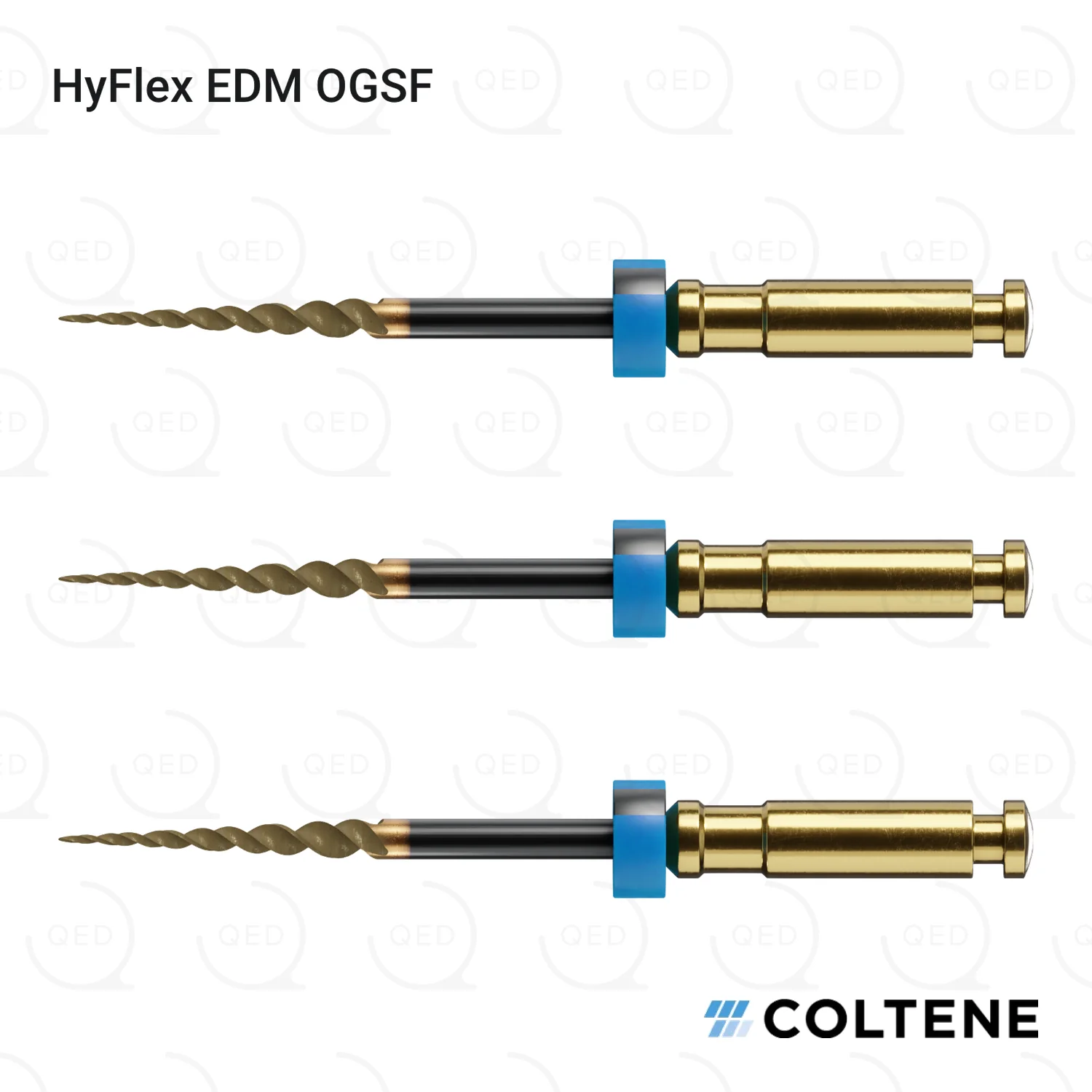
hyflex edm · ogsf sequence set · 25 mm · 4 files
simple and complex canalsone protocolcurved canalsshort learning curve
coltene built the ogsf sequence on a simple idea: the same four steps, in the same order, every time. their catalogue: “evidence shows that by applying checklists and following standard procedures, reproducibility and safety are increased.” so the set is one of each – an orifice opener, a glidepath file, one shaping file and a finishing file – with sizes designed with prof. eugenio pedullà.
| 4 files one protocol | 400 rpm glider 300 rpm | pre-bend like steel, coltene |
speeds from coltene’s hyflex edm ogsf instructions for use (rev-03-2023). pre-bending from coltene’s hyflex edm ogsf sequence catalogue (2023).
this pack: coltene hyflex edm ogsf file sequence set, 25 mm (pack of 4) · presterilised
coltene · coltène/whaledent gmbh + co. kg, langenau, germany
| 1 · opener | orifice opener 18/.11, 18 mm · 400 rpm · up to 2.5 ncm |
| 2 · glider | glidepath file 15/.03, 25 mm · 300 rpm · up to 1.8 ncm |
| 3 · shaper | shaping file 18/.045, 25 mm · 400 rpm · up to 2.5 ncm |
| 4 · finisher | finishing file 30/.04, 25 mm · 400 rpm · up to 2.5 ncm |
| then, if needed | 40/.04 · 50/.03 · 60/.02 finishing files |
| all four | hyflex edm ogsf sequence set, 25 mm (4) |
one of each file; the orifice opener in the set is the 18 mm file, the other three are 25 mm. refills of each file come in packs of 3.
the defined treatment procedure makes the preparation easy and keeps the learning curve short.
coltene’s hyflex edm ogsf sequence catalogue (2023), on the ogsf sequence
with just a few peckings, i reach the measured working length without any stops in between, so to speak. previously, a file had to be inserted into the root canal several times. that is no longer necessary here!
dr thomas rieger, endodontic specialist, memmingen, germany – quoted in coltene’s hyflex edm ogsf sequence catalogue (2025). one clinician’s experience.
1 prepare. after straight-line coronal access, a hand file (up to 20/.02) or a rotary glide path file, and irrigant such as naocl placed in the canal.
2 opener 18/.11, 400 rpm. creates space for coronal access. “do not use this file in the curved part of the root canal.” on to the glider as soon as resistance is felt.
3 glider 15/.03, 300 rpm. a glide path up to working length. coltene: “this file is extremely thin and therefore not as breakage resistant as the other hyflex edm files.”
4 shaper 18/.045, 400 rpm. enlargement up to working length. back to the previous step as soon as resistance is felt.
5 finisher 30/.04, 400 rpm. enlargement up to working length. larger finishing files if the apex needs them.
every step, the same handling. “place the file in the canal without running engine. when the file cannot proceed any further move it back 1mm until it is free of the walls. then start the engine and proceed forward slowly using tapping movements and without applying pressure.” after each file: check patency with a hand file, keep the canal irrigated and lubricated, and clean the spirals.
summarised from coltene’s hyflex edm ogsf instructions for use (rev-03-2023). your clinical judgement governs the case; the instructions for use govern the file.
› cut by spark, not ground. coltene make hyflex edm by electric discharge machining, which they say “creates the unique surface of the new niti files and makes the hyflex edm files durable and more fracture resistant.”
› controlled memory niti. heat treated so the file is flexible and, in coltene’s words, pre-bendable like stainless steel – which they describe as “a crucial advantage in curved root canals to avoid the creation of steps.”
› three cross-sections on one file. coltene describe a quadratic cross-section at the tip, trapezoidal in the middle and triangular at the top – a variable design they credit with the file’s breakage resistance.
› centred preparation. coltene: the controlled-memory effect keeps the preparation evenly centred, reducing the risk of ledging or perforation
› the spirals give before the file does. coltene’s instructions say the spirals may lengthen in response to force, which “prevents binding blockages to the canal walls and considerably reduces the risk of breakage.” spirals wound the opposite way mean the file is plastically deformed: do not use it.
the ogsf sequence finishes on 30/.04, and coltene make paper points and gutta percha at that size: hyflex edm paper points 30/.04 (100) and hyflex edm gutta percha 30/.04 (60). coltene’s brochure calls the hyflex points “ideally matched to the proven nickel-titanium files”.
the sealer goes in with the cone. neosealer® ezflo is a premixed bioceramic sealer delivered through fine 29-gauge navitip™ cannulas – the 25 mm tips suit a 25 mm file set – so sealer goes into the apical third instead of being wiped down the coronal walls. if you work with an epoxy resin sealer, ah plus® is the one every other is measured against. resin or bioceramic is a choice of technique rather than a ranking; we carry both. then a coronal seal: sdr® flow+ refill, universal.
is the set enough for a case?
for many, yes – coltene designed ogsf around “only one shaping file”. larger apices take a finishing file after the 30/.04, and refills of each ogsf file are sold in threes.
which motor settings?
coltene set 400 rpm and up to 2.5 ncm for the hyflex edm files (the 2025 instructions allow 400–500 rpm on the classic files), and 300 rpm and up to 1.8 ncm for the glide path files, in continuous rotation on a low-speed contra-angle. set it in a custom programme on any of the three endo motors we stock: x-smart® go · x-smart® pro+ · vdw.silver® reciproc®.
can i pre-bend them?
coltene say so: “like stainless steel files, the hyflex edm files can be pre-bent.” they put it down to the controlled memory heat treatment of the nickel-titanium.
are they sterile?
yes. coltene: “hyflex edm files are supplied presterilized using gamma irradiation.” sterility holds until the pack is opened or damaged, so a damaged blister is discarded, not used.
anything to check before use?
coltene’s instructions carry one patient caution: hyflex edm files “contain nickel and titanium and should not be used on patient with known allergic sensitivity to these metals.” and before each use, a manual check that the file is correctly fixed in the contra-angle.
ogsf or the classic hyflex edm route?
both use the same edm files and handling. the classic route runs a 10/.05 glide path and the 25/~ onefile, with the 20/.05 where needed; ogsf adds a dedicated opener and uses one 18/.045 shaping file. coltene recommend ogsf as one protocol for simple and complex canals; the choice is yours.
| refills | opener · glider · shaper · finisher |
| isolation | hysolate dental dam · flexi-dam non-latex · both coltene |
| hand file | c-pilot® 010, 25 mm · 015 · coltene have you check patency with a hand file throughout |
| irrigants | chlorax 5.25% · chlorax 2% · endo-solution 17% edta · canalpro™ chx 2%, coltene |
| lubricant | glyde™ file prep |
| delivery | irriflex® 30g needles (40) |
| activation | smartlite pro endoactivator® |
| dry | hyflex edm paper points 30/.04 |
| fill and seal | hyflex edm gutta percha 30/.04 · neosealer® ezflo, 25 mm tips or ah plus® |
| coronal seal | sdr® flow+ refill, universal |
| motor | x-smart® go · x-smart® pro+ · vdw.silver® reciproc® |
hyflex edm ogsf sequence set, 25 mm (4) · orifice opener 18/.11 · glidepath file 15/.03 · shaping file 18/.045 · finishing file 30/.04 · 400 rpm, glider 300 rpm · presterilised · coltene · ref 60036142

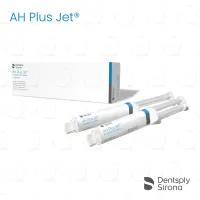
ah plus jet® · starter kit · 15 g syringe + 20 tips
same sealer, no spatula. ah plus jet, launched in 2005, puts the ah plus epoxy-amine pastes in what dentsply sirona call “a user-friendly double-barrel syringe designed for easier application”. they are mixed as they pass through a disposable tip, and dentsply sirona describe the result as “a controlled, homogenous mixture”. the intra oral tip places sealer straight into the canal, or you can dispense onto the pad if you coat the cone. dentsply sirona’s own ah plus scientific manual notes that ah plus “has been described by many authors as the 'gold standard' in root canal sealing materials”, and the benchmark new sealers are evaluated against.
this pack: 1 × ah plus jet® mixing syringe (15 g) · 20 × mixing tips with intra oral tip · 1 × mixing pad · 1 × technique guide · 1 × organizer tray · ref 60620115
made by dentsply sirona
| epoxy-amine resin | dentsply sirona: “a two-component paste-paste permanent root canal sealer based on epoxy-amine resin”, delivered from a double-barrel syringe |
| working time | about 4 hours, with setting within 24 hours – dentsply sirona’s figures for ah plus |
| techniques | dentsply sirona: designed for both cold and warm obturation, including carrier-based systems. their scientific manual reviews clinical studies in cold lateral condensation, carrier-based, warm and single cone obturation |
| indication | “permanent obturation of root canals of teeth of the secondary dentition in combination with root canal points” – directions for use |
| starter kit | the only ah plus jet pack with the tray, pad and guide – buy it once, then reorder syringes and tips |
› bleed a new syringe – dentsply sirona: “to ensure an appropriate mixing ratio, dispense a small amount of paste from the syringe prior to the first clinical application.”
› fit the tip by the notch – attach the mixing tip to the syringe, aligning the notch, as the technique guide shows.
› one tip, one application – “after the sealer application, mixing tip and intraoral tip must be discarded.” recap the syringe.
› check the history – the directions list hypersensitivity to epoxy resins, amines or other components as a contraindication.
is it the same sealer as the ah plus in tubes?
dentsply sirona describe ah plus jet as using the ah plus resin-based formula. the difference is delivery: the jet mixes for you, the 8 ml paste suits a pad and spatula.
what do i reorder?
syringes come as the refill (two 15 g syringes, no tips). tips come separately in boxes of 40.
resin or bioceramic?
resin or bioceramic is a real choice of technique rather than a ranking – we carry both because both are right in different hands. dentsply sirona now have a bioceramic of their own, proroot bio sealer – premixed, 25 gauge proroot flex tip.
| irrigants | chlorax 5.25% · chlorax 2% · endo-solution 17% edta |
| activation | smartlite pro endoactivator® complete kit · dentsply sirona’s own |
| syringe refill | ah plus jet® refill · 2 × 15 g, no tips |
| tips | ah plus jet® mixing tips · 40, one per application |
| same sealer, in tubes | ah plus® 8 ml paste · for a pad-and-spatula routine |
| bioceramic alternative | neosealer® ezflo, 25 mm tips · 21 mm tips · premixed · proroot® bio sealer – dentsply sirona's own |
| coronal seal | sdr® flow+ refill universal · 4 mm bulk increment, one cure |
ah plus jet® starter kit · epoxy-amine resin sealer · automix double-barrel syringe · permanent root canal obturation · cold and warm techniques · carrier-based · 15 g · 20 mixing tips · dentsply sirona · ref 60620115
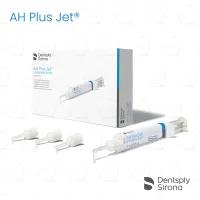
ah plus jet® · 40 mixing tips with intra oral tip
the mixing happens in the tip. the two ah plus pastes leave the jet syringe separately and are mixed on the way through, which is why a used tip cannot go back on. dentsply sirona’s instruction is plain: “after the sealer application, mixing tip and intraoral tip must be discarded.” the starter kit comes with 20. this box is the reorder.
this pack: 40 × ah plus jet® mixing tips with intra oral tip · for the ah plus jet® mixing syringe · ref 60620116
made by dentsply sirona
| fits | the ah plus jet® mixing syringe, supplied in the starter kit and the refill |
| two parts in one | a mixing tip with an intra oral tip, for placing sealer in the canal or dispensing onto a pad |
| single application | discarded after each sealer application, per dentsply sirona |
| 40 tips | twice the number in the starter kit |
› line up the notch – attach the mixing tip to the syringe, aligning the notch, as the technique guide shows.
› bleed a new syringe – dentsply sirona ask for a small amount of paste to be dispensed before the first clinical application.
› recap after use – take the used tip off and put the syringe cap back on.
will they fit another automix syringe?
dentsply sirona supply them for the ah plus jet® syringe, and that is the only use we list them for.
| irrigants | chlorax 5.25% · chlorax 2% · endo-solution 17% edta |
| activation | smartlite pro endoactivator® complete kit · dentsply sirona’s own |
| starter kit | ah plus jet® starter kit · syringe, 20 tips, pad and tray |
| syringe refill | ah plus jet® refill · 2 × 15 g, no tips |
| same sealer, in tubes | ah plus® 8 ml paste · for a pad-and-spatula routine |
| bioceramic alternative | neosealer® ezflo, 25 mm tips · 21 mm tips · premixed · proroot® bio sealer – dentsply sirona's own |
| coronal seal | sdr® flow+ refill universal · 4 mm bulk increment, one cure |
ah plus jet® mixing tips · mixing tip with intra oral tip · single application · for ah plus jet® syringes · 40 tips · dentsply sirona · ref 60620116
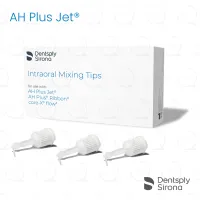
ah plus jet® · refill · 2 × 15 g syringes
out of sealer, not out of tips? this is the syringe-only refill: two 15 g ah plus jet mixing syringes, 30 g in all, for practices that already have the starter kit and a stock of tips. there are no tips in the box, so if yours are running low add a box of 40. dentsply sirona’s own ah plus scientific manual notes that ah plus “has been described by many authors as the 'gold standard' in root canal sealing materials”, and the benchmark new sealers are evaluated against.
this pack: 2 × ah plus jet® mixing syringe (15 g) · mixing tips not included · ref 60620118
made by dentsply sirona
| epoxy-amine resin | dentsply sirona: “a two-component paste-paste permanent root canal sealer based on epoxy-amine resin”, delivered from a double-barrel syringe |
| working time | about 4 hours, with setting within 24 hours – dentsply sirona’s figures for ah plus |
| techniques | dentsply sirona: designed for both cold and warm obturation, including carrier-based systems. their scientific manual reviews clinical studies in cold lateral condensation, carrier-based, warm and single cone obturation |
| indication | “permanent obturation of root canals of teeth of the secondary dentition in combination with root canal points” – directions for use |
| tips | not included – ah plus jet® mixing tips (40) |
› bleed each new syringe – dentsply sirona: dispense a small amount of paste before the first clinical application, “to ensure an appropriate mixing ratio”.
› one tip, one application – “after the sealer application, mixing tip and intraoral tip must be discarded.” recap the syringe.
› check the history – the directions list hypersensitivity to epoxy resins, amines or other components as a contraindication.
starter kit or refill?
the starter kit is one syringe with 20 tips, a mixing pad, technique guide and organizer tray. the refill is two syringes and nothing else. buy the kit first, then this.
resin or bioceramic?
resin or bioceramic is a real choice of technique rather than a ranking – we carry both because both are right in different hands. dentsply sirona now have a bioceramic of their own, proroot bio sealer – premixed, 25 gauge proroot flex tip.
| irrigants | chlorax 5.25% · chlorax 2% · endo-solution 17% edta |
| activation | smartlite pro endoactivator® complete kit · dentsply sirona’s own |
| starter kit | ah plus jet® starter kit · syringe, 20 tips, pad and tray |
| tips | ah plus jet® mixing tips · 40, one per application |
| same sealer, in tubes | ah plus® 8 ml paste · for a pad-and-spatula routine |
| bioceramic alternative | neosealer® ezflo, 25 mm tips · 21 mm tips · premixed · proroot® bio sealer – dentsply sirona's own |
| coronal seal | sdr® flow+ refill universal · 4 mm bulk increment, one cure |
ah plus jet® refill · epoxy-amine resin sealer · 2 automix syringes · 30 g · tips sold separately · permanent root canal obturation · dentsply sirona · ref 60620118
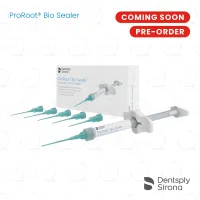
proroot® bio sealer · 2.2 g kit · 20 tips
coming soonpre-orderroot canal sealingpremixed bioceramiccold and warm techniquesresin-free
proroot bio sealer is dentsply sirona’s premixed, injectable, resin-free bioceramic root canal sealer – tricalcium and dicalcium silicate in an organic medium, set by the moisture already in the canal, with non-staining tantalite for radiopacity. one 2.2 g syringe, twenty proroot flex tips, and nothing to mix.
| 6 mm al radiopacity, ifu | ~30 min working time, ifu | 46.6% bioactive cement, ds |
this pack: proroot® bio sealer kit – 1 × 2.2 g syringe and 20 proroot® flex tips · dentsply sirona ref 60620140
made by nusmile ltd, houston, for dentsply sirona · store at room temperature, never refrigerated
coming soon – on pre-order: order it now and it ships as soon as uk stock arrives.
› premixed and resin-free. the directions describe “an extremely fine, inorganic powder of tricalcium/dicalcium silicate in an organic medium”, packaged ready to use. no powder and liquid, no base and catalyst.
› set by the canal, not the clock. designed “to set in vivo in the presence of moisture provided by the surrounding tissues” – the directions say moisture is required, so you dry with paper points and stop there.
› more of the cement that does the work. dentsply sirona’s x-ray diffraction puts the bioactive cement fraction at 46.6% – higher, they say, than the other bioceramic sealers they tested (internal data on file). calcium aluminates sit alongside the silicates; dentsply sirona credit them with faster, more reliable setting and better acid resistance.
› non-staining. tantalite as the radiopacifier and no bismuth oxide – “does not discolor teeth” is a listed material characteristic. radiopacity 6 mm al, twice the iso 6876 minimum.
› cold, warm or carrier-based. dentsply sirona designed it for all three, single cone included.
› less left in the tip. the proroot flex tip is a bendable 25 gauge cannula; dentsply sirona measured 0.087 g stranded per tip, which they put at up to 49% less waste than the competitor tips they tested (internal data on file).
› retreatable. the directions: remove set sealer with conventional instrumentation – hand and rotary files and ultrasonic tips – “as with any other sealer”.
because it is the bioceramic that comes with dentsply sirona’s own name on it, and their own clinical programme behind it. for a practice already running protaper, waveone gold or trunatomy with conform fit cones, it closes the case without leaving the range: the same company’s file, cone, activator and now sealer, and their proroot mta chemistry at the root of it.
dentsply sirona also make plain what is inside. their fact file states that proroot bio sealer “is an equivalent sealer to neosealer® flo (nusmile, ltd, usa)”, and the instructions name nusmile as the manufacturer. we stock neosealer flo too, under the avalon biomed name – so the choice between the two is brand, tip and pack, not material.
“proroot® bio sealer has excellent viscosity allowing me to control placement. it flows into microanatomy and canal irregularities when present. the obturation pops off the screen, giving the post-operative image a dense look with no voids.”
david j. landwehr dds, ms, capital endodontics, madison wi – quoted in dentsply sirona’s proroot bio sealer brochure
dentsply sirona cite two published studies for proroot bio sealer, both carried out on the equivalent neosealer flo. retreatment: carrillo ca et al., journal of endodontics 2022;48(6):781–786 (ex vivo, 130 extracted teeth, straight canals, single-cone fills retreated with rotary niti and no solvent) regained apical patency in 100% of the canals sealed with it, in a mean of 169 seconds. outcome: lepure c et al., clinical oral investigations 2024;28(11):598 – a retrospective analysis of 687 teeth at a minimum of one year – put healed-or-healing at 96.5%.
dentsply sirona also report interim results from an on-going randomised trial (gustavo de-deus, rio de janeiro; unpublished, data on file): very high healing rates at 6 and 12 months, stable radiographic visibility over time, and post-operative sensitivity in line with the resin and bioceramic comparators. we pass that on as their statement, not as a published finding.
| proroot bio sealer | ah plus | |
| chemistry | bioceramic – calcium silicate and aluminate cement, resin-free | epoxy-amine resin |
| mixing | none – premixed syringe | two pastes, 1:1 on the pad (or automixed in the jet) |
| working time | about 30 minutes at room temperature (ifu) | about 4 hours at 23 °c |
| how it sets | on canal moisture; meets iso 6876 | chemical cure, within 24 hours |
| radiopacity | 6 mm al | calcium tungstate and zirconium oxide fillers |
| techniques | cold, warm, carrier-based | cold, warm, carrier-based |
| staining | listed as non-staining | – |
resin or bioceramic is a real choice of technique rather than a ranking – we carry both because both are right in different hands, and dentsply sirona now sell both under their own name.
1finish the irrigation with distilled water, then dry with paper points. moisture is required for setting, so the canal is dried, not desiccated.
2check the flow by extruding a little onto a pad before it goes anywhere near the tooth.
3place with the tip – no deeper than the middle third, never forced until it seals against the walls (that is how sealer ends up past the apex), and with gentle, steady pressure while the tip moves outward. the tip is recommended but optional: without it, coat the walls lightly and coat the dried cone before insertion.
4insert the cone or cones slowly, sear and remove the excess gutta-percha at the orifice per the cone manufacturer, lift excess sealer with a moist cotton pellet, and confirm the fill and any overextension on a radiograph.
worth knowing before you open it. the directions list two contraindications – hypersensitivity to caustic, high-ph solutions, and primary-tooth pulpectomy unless the successor is absent – and warn that the material is caustic, as all tricalcium silicates are: keep unset paste off skin and mucosa, and do not overfill. syringe and tips are supplied clean but not sterile and cannot be sterilised, so it is a new tip every time and a sleeve over the syringe intraorally. and one line that explains the occasional puzzling case: setting is inhibited in acidic environments such as infected sites.
when can i have it?
it is coming soon: you can order it now, and it ships the moment uk stock arrives.
so do i still dry the canal?
yes – final rinse with distilled water, then paper points. what you do not chase is bone-dry, because the moisture in the tubules is what sets the material.
how long does it take to set?
the directions say it meets iso 6876, and dentsply sirona cite a published laboratory figure of about 2 hours 41 minutes (pradelli et al., braz oral res 2025). laboratory setting times for this chemistry vary a great deal with the test method, so treat any single number as a property of the test rather than a promise about the tooth.
is it the same as neosealer flo?
dentsply sirona say so: “an equivalent sealer to neosealer flo”, made for them by nusmile. what differs is the tip supplied, the branding and dentsply sirona’s own clinical programme. for very narrow preparations the same family’s neosealer ezflo places through a 29 gauge navitip instead.
can i use it with guttacore or a warm technique?
dentsply sirona designed it for cold, warm and carrier-based obturation, and their fact file reports its properties stay stable under warm vertical compaction. follow the obturator’s own directions for the carrier itself.
what if i run out of tips?
the 20 tips are sized to the syringe and it is one tip per application. dentsply sirona say other dispensing tips can be used, with the note that finer gauges are harder to push through; avalon’s 25 gauge basic flex tips are the ones supplied with the equivalent neosealer flo syringe.
| irrigants | chlorax 5.25%, chlorax 2% and endo-solution 17% edta. |
| activation | smartlite pro endoactivator – dentsply sirona’s own. |
| points | conform fit, matched to the file: waveone gold, protaper ultimate, protaper gold, trunatomy. |
| carrier-based | guttacore – crosslinked gutta-percha core obturators. |
| extra tips | avalon basic flex tips (40) – 25 gauge, luer-lock. |
| same family | neosealer flo – the equivalent sealer under the avalon biomed name · neosealer ezflo – 29 gauge navitip delivery for narrow canals. |
| resin | ah plus 8 ml paste · ah plus jet starter kit – dentsply sirona’s epoxy sealer. |
| repair material | proroot mta – the chemistry this sealer is built on. |
| coronal seal | sdr flow+ refill universal – 4 mm bulk increment, one cure. |
› proroot® bio sealer fact file (pdf, 0.9 mb, dentsply sirona) – composition, iso 6876 figures, the studies and their references.
› proroot® bio sealer brochure (pdf, 0.7 mb, dentsply sirona) – the two-page sell sheet.
composition, characteristics, contraindications, technique and the iso 6876 figures are from dentsply sirona’s instructions for use (k79200344-00, 2026). bioactive cement content, ph, tip waste, the neosealer flo equivalence and the study summaries are from their proroot® bio sealer fact file (08/2025) and brochure; figures marked internal data on file are theirs and unpublished. we make no claim of our own about seal, healing or outcome. proroot, ah plus, conform fit, guttacore, smartlite, sdr, waveone, protaper and trunatomy are dentsply sirona trademarks; neosealer is a trademark of avalon biomed / nusmile.
proroot® bio sealer kit · premixed bioceramic root canal sealer · 1 × 2.2 g syringe · 20 proroot® flex tips, 25 gauge · dentsply sirona · ref 60620140
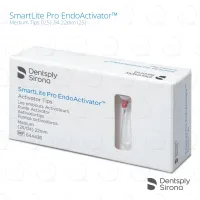
smartlite pro endoactivator® · medium tips · 25/.04 · 22 mm · 25
single-patient use22 mm0.25 mm tipredpack of 25
medium or medium long? they are the same tip at two lengths: 0.25 mm at the tip and a .04 taper on both, 22 mm here and 28 mm on the medium long. this is the 22 mm one, the shorter of the two red tips, for the smartlite pro endoactivator attachment. dentsply sirona make it from flexible, non-cutting, medical-grade plastic, so it is there to move irrigant, not to shape the canal.
this pack: 25 × smartlite pro endoactivator® medium activator tips, 25/.04, 22 mm · blister-packed · single-patient use · ref 644436
made by dentsply sirona
| tip | medium, 25/.04 – 0.25 mm at the tip (instructions for use, size chart) |
| length | 22 mm |
| colour | red (dentsply sirona fact file) |
| depth rings | marked at 18, 19 and 20 mm |
| shape | parallelogram-shaped cross-section, per the fact file; flexible, non-cutting, medical-grade plastic in the brochure’s words |
| use | single patient. a used tip is contaminated and sharp, so it goes in with the contaminated sharps |
| contraindications | none known, per the instructions for use |
| small | small 15/.02 · 22 mm · 0.15 mm tip · yellow · depth rings at 18, 19, 20 mm |
| medium | this page. 22 mm · 0.25 mm tip · red · depth rings at 18, 19, 20 mm |
| medium long | medium long 25/.04 · 28 mm · 0.25 mm tip · red · depth rings at 18, 19, 20, 22, 24, 25, 26 mm |
› choose by fit – prepare the canal to a fully tapered shape, then take the tip that fits loosely within 2 mm of working length
› stay 2 mm short – operate no closer than 2 mm to working length or apex, avoid an incomplete or open apex, and never run the tip without irrigant
› disinfect before use – the tips are not ready to use from the blister. the instructions have you immerse the tip in 5.25% sodium hypochlorite for one minute (chlorax 5.25%), wipe it with sterile gauze moistened in 70% isopropyl alcohol and air dry it. cleaning first is not needed
› never autoclave – dentsply sirona say autoclaving may increase the risk of tip fracture, and steam sterilisation is not recommended for them
› snap on firmly – the tip goes on over the barrier sleeve, and the instructions strongly recommend rubber dam
what are the rings on the shaft for?
depth. the 22 mm tips are marked at 18, 19 and 20 mm, so you can see how far the tip is down the canal rather than estimate it. the rule they serve is the manufacturer’s: operate no closer than 2 mm to working length or apex.
can i steam-sterilise tips between patients?
no. they are single-patient use, and the instructions say autoclaving may increase the risk of tip fracture and that steam sterilisation is not recommended. disinfect each new tip before use as described above; a pack of 25 covers up to 25 patients.
what fits it?
the smartlite pro endoactivator attachment on the smartlite pro handpiece, with a barrier sleeve under the tip.
| handpiece and all | smartlite pro endoactivator® complete kit |
| attachment with consumables | smartlite pro endoactivator® refill kit |
| attachment only | smartlite pro endoactivator® attachment |
| barrier sleeves | smartlite pro endoactivator® barrier sleeves |
| irrigants | chlorax 5.25% · chlorax 2% · endo-solution 17% edta |
| delivery | navitip™ 29 ga, 25 mm · irriflex® 30 ga |
smartlite pro endoactivator® medium tips · 25/.04 · 22 mm · 0.25 mm tip · pack of 25 · single-patient use · dentsply sirona · ref 644436
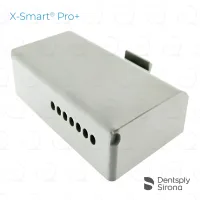
x-smart® pro+ · dentsply sirona · motor with integrated apex locator
reciprocating shapingrotary shapinglength while shapingretreatmentmulti-system practicecordless working
a separate apex locator is a second device on the bracket table, a second set of leads, and a reading you have to stop working to take. the x-smart® pro+ puts the measurement inside the motor: lip clip and file clip run to the unit driving the file, the canal display sits on the 7 in touchscreen in front of you, and at the length you set the motor reverses on its own. it is the x-smart® pro that drives waveone® gold and the reciproc® family – with the locator built in rather than beside it.
| 7.5 n·cm max torque | 3,000 rpm at the file | 7 in touchscreen |
in this box: motor with integrated apex locator · mini contra-angle, integrated led, 360° adjustable · stainless steel handpiece sheath · magnetic handpiece holder · lip clip · file clip · y-connector cable · accessories box with charger and universal adapters
dentsply sirona · two heads from the outset: same motor, extra contra-angle
dentsply sirona call it dynamic accuracy™ and describe it as reading the measurement signal while shaping, with auto-reverse to hold the file on the target you set. that is the difference between a locator you consult and one you work alongside: the coloured canal display updates as the file advances, and at your chosen length the instructions say the motor “automatically rotates in the reverse or non-cutting direction until the finger switch is pressed”. one qualification, and it is the manufacturer's own – that display is a progression indicator, not a ruler. the instructions state that the distance display is not a metric specification of length.
“the apexlocator should be used as an additional aid to supplement the usual root canal treatment measures. it does not replace the radiological determination of the working length.”
dentsply sirona, x-smart® pro+ / x-smart® pro instructions for use, english, 2023-05
if you shape with waveone® gold or anything in the reciproc® family, this is the part of the specification that decides the purchase. reciprocation is not one motion but a specific combination of speed, acceleration, torque and angles, set differently for each system. dentsply sirona have put their position in writing.
“the waveone® gold and reciproc® systems are patented for their unique features. their motion settings, including the combination of speed, acceleration, torque and angles are not public data and cannot be manually programmed by clinicians in any endodontic motor.”
certificate of authenticity, waveone® gold + x-smart® pro+: perfect match, dentsply sirona
the same document names the drive systems carrying those motions: x-smart® pro, x-smart® pro+ and the prior tds / maillefer / vdw reciprocating motors, with some dentsply sirona treatment centres and bien-air ioptima units able to provide them too. it is a short list, and a motor advertising a reciprocating mode without being on it is running an approximation of somebody else's motion.
preset programmes include waveone® gold and reciproc® blue in reciprocation and protaper ultimate® and trunatomy® in rotation, alongside up to 30 sequences of your own. firmware upgrades over wi-fi, so a system launched after the motor is a software update rather than a new purchase. torque runs 0.2 to 7.5 n·cm and speed 100 to 3,000 rpm, on dentsply sirona's published figures.
| reciprocating | reciproc® blue r25 25 mm · minima r25 for narrow canals |
| reciprocating | waveone® gold primary 25 mm · assorted |
| rotary | protaper ultimate® sequence 25 mm |
| rotary | trunatomy® assortment 25 mm |
a mini contra-angle with integrated led and 360° adjustable position on a 5:1 reduction – 15,000 rpm at the motor becomes 3,000 rpm at the file. the stainless steel sheath lifts off, and contra-angle, sheath, file clamp and lip clip are all steam-autoclavable; there is a dac universal adapter if that is how your decontamination room runs. power is lithium-ion, 1.5 h to recharge, and it runs on battery or on mains while charging, so a flat battery mid-list is an inconvenience rather than a cancelled appointment.
1 calibrate. the instructions are explicit: “before every treatment and every time a contra-angle handpiece is changed”. it takes seconds, and it keeps the torque on screen and the torque at the file the same number.
2 choose the system on screen. presets carry the manufacturer's own settings for that file; anything else lives in my sequences.
3 connect for measurement. lip clip on the patient, file clip on the shank, y-connector to the unit. the instructions ask for metal-shafted files and non-conductive gloves, and note that electromagnetic interference can affect accuracy.
4 shape, then confirm on film. at the length you set the motor reverses out of cut until you press the finger switch. the locator supplements the radiograph; it does not stand in for it.
› a second head, as contra-angle alone or with a sheath, plus sheaths on their own.
› measuring parts: lip clips, file clips and the y-connector cable.
› power: rechargeable battery and power supply.
› bench: wireless foot switch, handpiece holder, lubrication adapter.
| hand files | c-pilot® 010 25 mm · a metal shaft for the locator |
| irrigants | chlorax 5.25% · endo-solution 17% edta |
| delivery, activation | navitip™ 29 ga · eddy® tips |
| sealers | neosealer® ezflo bioceramic · ah plus® epoxy · proroot® bio sealer |
| coronal seal | sdr® flow+ refill universal · 4 mm increment, one cure |
can i stop taking a working-length radiograph?
no, and the instructions say so in as many words: the locator supplements the usual measures and does not replace radiological determination of working length. what changes is how often you are working blind between films.
can i run waveone® gold or reciproc® on another motor with a reciprocating setting?
dentsply sirona say not – the motion settings are not public data and cannot be programmed into another motor, and they recommend those files only with the drive systems listed above.
is the foot switch in the box?
no. the wireless foot switch is a separate order – worth deciding at the outset rather than after the first week.
do i want the second contra-angle?
if you run back-to-back endodontic lists, yes: a head in the autoclave is a head you cannot use, and recalibrating on the swap takes seconds. that is what the extra contra version is for. one surgery working a case at a time does not need it on day one.
before first clinical use: the device is indicated for use when endodontic procedures are required, and the instructions record no known contraindications. they do carry warnings worth reading first – niti instruments can fracture from fatigue whatever drives them, electromagnetic interference can affect the accuracy of apex location, and measurement requires metal-shafted files and non-conductive gloves. full warnings, reprocessing and technical data are in the instructions for use, and we will send a copy on request.
x-smart® pro+ endo motor with integrated apex locator · 0.2–7.5 n·cm · 100–3,000 rpm · 5:1 mini contra-angle with led, 360° adjustable · 7 in touchscreen · up to 30 file sequences · wi-fi upgradeable · lithium-ion, 1.5 h recharge · genuine waveone® gold and reciproc® reciprocating motion · dentsply sirona · ref 6779016

x-smart® pro+ & pro · rechargeable battery
spare partuser-replaceablepro+ and pro
the rechargeable battery that lets the x-smart run cordless. the instructions show the user changing it: one screw under the base, cover off, handpiece cable unplugged, old battery out, new one in.
this pack: x-smart® pro+ & pro battery (rechargeable)
made by dentsply sirona
| fits | x-smart® pro+ and x-smart® pro |
| type | lithium-ion |
| tool | a pz1 screwdriver |
| warranty | 2 years on the battery, per the instructions |
› charge before first use. a new battery arrives in protection mode and must be charged to activate it.
› handle it as a lithium cell. do not open, crush, heat above 80 °c or incinerate it; dispose of it under your local rules.
› mains still works. the unit runs on its power supply while charging.
| the motor | x-smart pro+ with apex locator · with extra contra |
| heads | 5:1 contra-angle · with sheath · sheath |
| apex locator | lip clips (5) · file clips (2) · y-connector cable |
| power | battery (this page) · power supply |
| bench | wireless foot switch · handpiece holder · lubrication adapter · dac universal adapter |
specifications, reprocessing and warnings are from the x-smart® pro / pro+ instructions for use (dentsply sirona, 2023-05). x-smart, waveone, reciproc, protaper, trunatomy and dac are trademarks of their owners.
x-smart® pro+ & pro battery (rechargeable) · dentsply sirona · ref 6793496

pathfile® · 013/.02 · 21 mm · 6 files
glide pathcurved canalsbefore shapingrotary
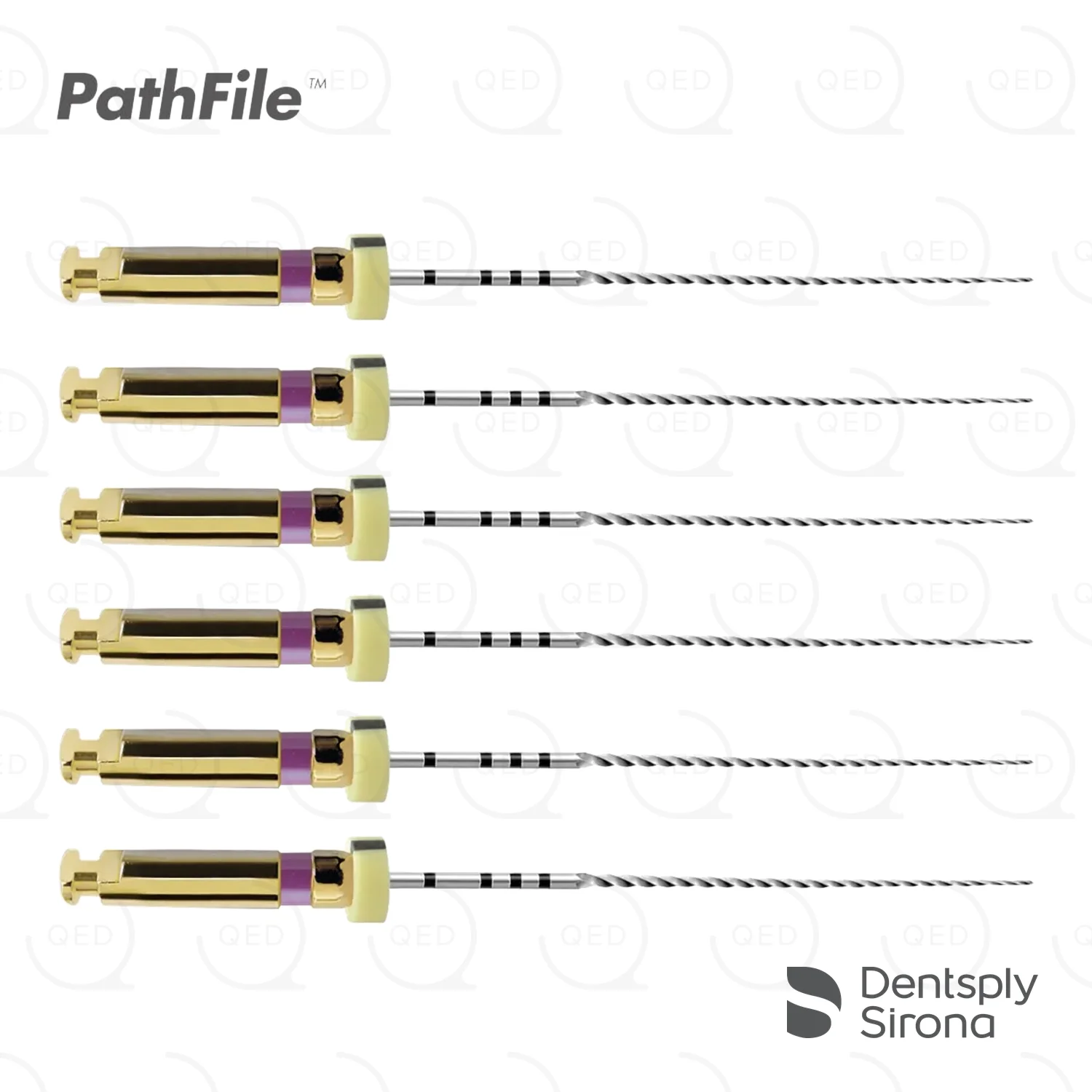
pathfile® 013 is where the sequence starts. it follows the iso 010 hand file that established working length, and it is the file that decides whether the other two have a path to follow. a purple ring on the handle tells it apart on the tray.
| 013 iso tip size | .02 constant taper | 300 rpm motor speed |
this pack: pathfile® rotary glide path file, iso size 13, .02 taper, 21mm (pack of 6) · sterile
ref a001522101303 · made by dentsply sirona (maillefer), switzerland
| tip size | iso 013 |
| taper | constant .02 – the same figure written as a percentage is 2 per cent |
| colour ring | purple |
| length | 21 mm |
| material | nickel-titanium |
| motion | continuous rotation, 300 rpm |
| supplied | sterile, single patient use |
| pack | 6 files |
013 is barely wider than the 010 hand file ahead of it, which is the point: the step up is small enough that the file follows the canal rather than cutting a new one.
pathfile® was developed with dr berutti, dr cantatore and dr castellucci, and it is the range that established the idea of cutting the glide path with a dedicated rotary instrument rather than a sequence of hand files.
berutti and colleagues compared preflaring with hand k-files against pathfile® in one hundred s-shaped training blocks, with an endodontist and an inexperienced clinician each doing both. the pathfile groups showed significantly less modification of canal curvature and significantly fewer canal aberrations – and, notably, the inexperienced clinician using pathfile® produced more conservative shaping than the expert using manual preflaring. (berutti e et al., journal of endodontics 2009 – simulated canals in training blocks, not teeth. berutti co-developed the instrument.)
a later independent study went to extracted teeth. zheng and colleagues scanned sixty mesial canals of mandibular first molars by micro-ct and found pathfile® transported the canal significantly less than hand k-files at every level measured, and extruded less debris apically. (zheng l et al., bmc oral health 2018 – ex vivo, micro-computed tomography.)
do i need the other two sizes?
pathfile® is designed as a sequence, so in normal use yes. the other packs at this length are pathfile® 016, 21 mm · pathfile® 019, 21 mm · pathfile® assorted, 21 mm.
where does it sit against the hand file?
dentsply sirona’s sequence has you establish working length with an iso 008 or 010 hand file first, then take 013, 016 and 019 to length in turn, irrigating between each. the rotary files replace the larger hand files, not the scouting one.
what are the motor settings?
300 rpm, continuous rotation, with light apical pressure and the flutes cleaned frequently. both motors we stock will run it: x-smart® pro+ and vdw.silver® reciproc®.
can the files be reused?
no. they are supplied sterile for single patient use. three files go into one canal in sequence, so the pack of six is one glide path per two canals.
is there a one-file alternative?
two, and we stock both. proglider® cuts the glide path with a single rotary file on a variable progressive taper; r-pilot® does it in one reciprocating file on the reciproc all setting. pathfile® takes three passes and steps up in smaller increments.
| patency | c-pilot® 08, 21 mm · c-pilot® 10, 21 mm |
| lubricant | glyde™ file prep |
| irrigants | chlorax 5.25% · chlorax 2% · endo-solution 17% edta |
| delivery | navitip™ 29 ga, 25 mm · irriflex® 30g |
| activation | smartlite pro endoactivator® · vdw eddy® tips |
| shape | protaper next® x1, 21 mm · protaper gold® s1, 21 mm · waveone® gold primary, 21 mm |
| obturate | ah plus® paste · neosealer® ezflo, 21 mm tips |
| coronal seal | sdr® flow+ refill universal |
pathfile® rotary glide path file · iso 013 tip · constant .02 taper · purple ring · nickel-titanium · 21 mm · sterile, single patient use · blister of 6 · 300 rpm, continuous rotation · ref a001522101303
pathfile® · 013/.02 · 25 mm · 6 files
glide pathcurved canalsbefore shapingrotary
pathfile® 013 is where the sequence starts. it follows the iso 010 hand file that established working length, and it is the file that decides whether the other two have a path to follow. a purple ring on the handle tells it apart on the tray.
| 013 iso tip size | .02 constant taper | 300 rpm motor speed |
this pack: pathfile® rotary glide path file, iso size 13, .02 taper, 25mm (pack of 6) · sterile
ref a001522501303 · made by dentsply sirona (maillefer), switzerland
| tip size | iso 013 |
| taper | constant .02 – the same figure written as a percentage is 2 per cent |
| colour ring | purple |
| length | 25 mm |
| material | nickel-titanium |
| motion | continuous rotation, 300 rpm |
| supplied | sterile, single patient use |
| pack | 6 files |
013 is barely wider than the 010 hand file ahead of it, which is the point: the step up is small enough that the file follows the canal rather than cutting a new one.
pathfile® was developed with dr berutti, dr cantatore and dr castellucci, and it is the range that established the idea of cutting the glide path with a dedicated rotary instrument rather than a sequence of hand files.
berutti and colleagues compared preflaring with hand k-files against pathfile® in one hundred s-shaped training blocks, with an endodontist and an inexperienced clinician each doing both. the pathfile groups showed significantly less modification of canal curvature and significantly fewer canal aberrations – and, notably, the inexperienced clinician using pathfile® produced more conservative shaping than the expert using manual preflaring. (berutti e et al., journal of endodontics 2009 – simulated canals in training blocks, not teeth. berutti co-developed the instrument.)
a later independent study went to extracted teeth. zheng and colleagues scanned sixty mesial canals of mandibular first molars by micro-ct and found pathfile® transported the canal significantly less than hand k-files at every level measured, and extruded less debris apically. (zheng l et al., bmc oral health 2018 – ex vivo, micro-computed tomography.)
do i need the other two sizes?
pathfile® is designed as a sequence, so in normal use yes. the other packs at this length are pathfile® 016, 25 mm · pathfile® 019, 25 mm · pathfile® assorted, 25 mm.
where does it sit against the hand file?
dentsply sirona’s sequence has you establish working length with an iso 008 or 010 hand file first, then take 013, 016 and 019 to length in turn, irrigating between each. the rotary files replace the larger hand files, not the scouting one.
what are the motor settings?
300 rpm, continuous rotation, with light apical pressure and the flutes cleaned frequently. both motors we stock will run it: x-smart® pro+ and vdw.silver® reciproc®.
can the files be reused?
no. they are supplied sterile for single patient use. three files go into one canal in sequence, so the pack of six is one glide path per two canals.
is there a one-file alternative?
two, and we stock both. proglider® cuts the glide path with a single rotary file on a variable progressive taper; r-pilot® does it in one reciprocating file on the reciproc all setting. pathfile® takes three passes and steps up in smaller increments.
| patency | c-pilot® 08, 25 mm · c-pilot® 10, 25 mm |
| lubricant | glyde™ file prep |
| irrigants | chlorax 5.25% · chlorax 2% · endo-solution 17% edta |
| delivery | navitip™ 29 ga, 25 mm · irriflex® 30g |
| activation | smartlite pro endoactivator® · vdw eddy® tips |
| shape | protaper next® x1, 25 mm · protaper gold® s1, 25 mm · waveone® gold primary, 25 mm |
| obturate | ah plus® paste · neosealer® ezflo, 25 mm tips |
| coronal seal | sdr® flow+ refill universal |
pathfile® rotary glide path file · iso 013 tip · constant .02 taper · purple ring · nickel-titanium · 25 mm · sterile, single patient use · blister of 6 · 300 rpm, continuous rotation · ref a001522501303
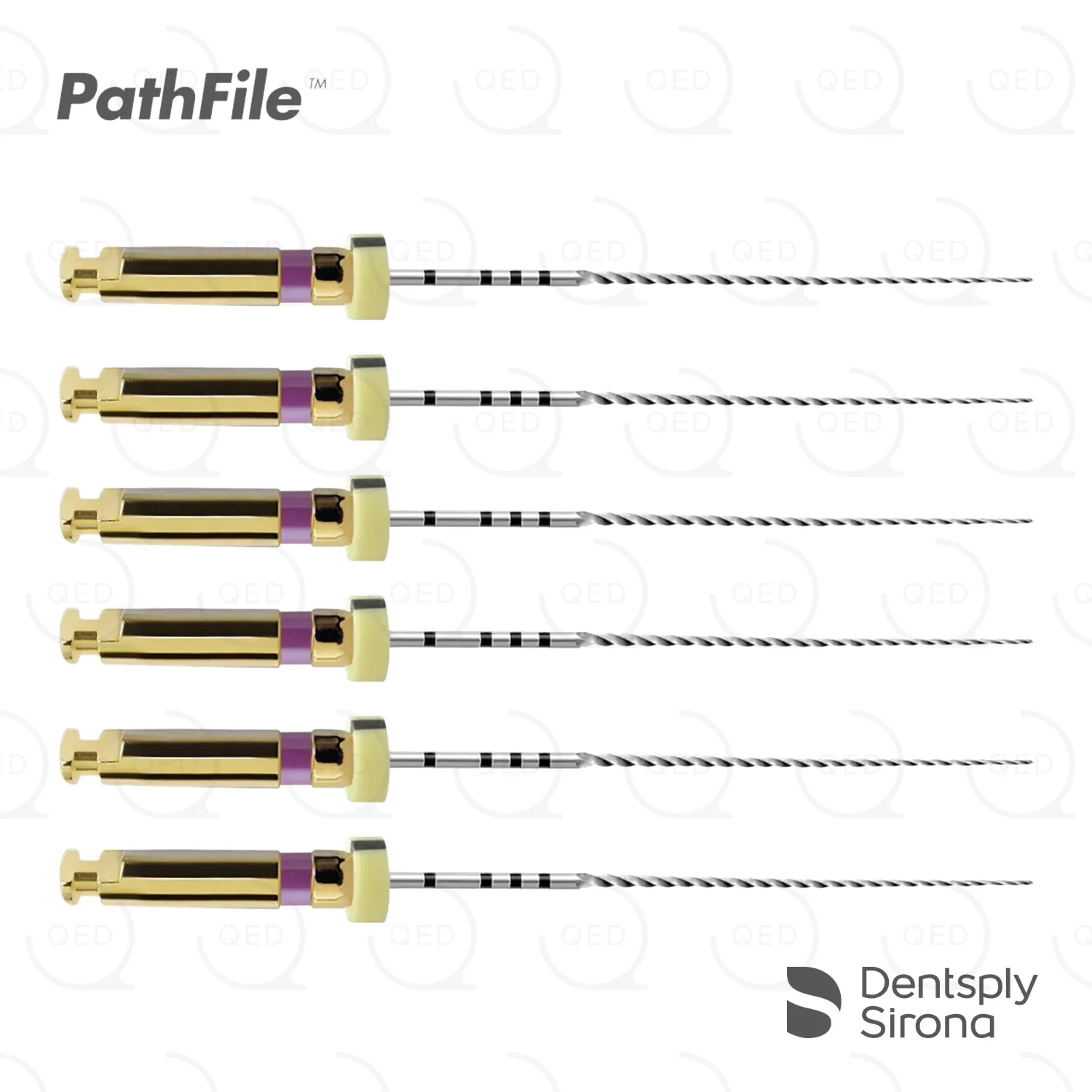
pathfile® · 013/.02 · 31 mm · 6 files
glide pathcurved canalsbefore shapingrotary
pathfile® 013 is where the sequence starts. it follows the iso 010 hand file that established working length, and it is the file that decides whether the other two have a path to follow. a purple ring on the handle tells it apart on the tray.
| 013 iso tip size | .02 constant taper | 300 rpm motor speed |
this pack: pathfile® rotary glide path file, iso size 13, .02 taper, 31mm (pack of 6) · sterile
ref a001523101303 · made by dentsply sirona (maillefer), switzerland
| tip size | iso 013 |
| taper | constant .02 – the same figure written as a percentage is 2 per cent |
| colour ring | purple |
| length | 31 mm |
| material | nickel-titanium |
| motion | continuous rotation, 300 rpm |
| supplied | sterile, single patient use |
| pack | 6 files |
013 is barely wider than the 010 hand file ahead of it, which is the point: the step up is small enough that the file follows the canal rather than cutting a new one.
pathfile® was developed with dr berutti, dr cantatore and dr castellucci, and it is the range that established the idea of cutting the glide path with a dedicated rotary instrument rather than a sequence of hand files.
berutti and colleagues compared preflaring with hand k-files against pathfile® in one hundred s-shaped training blocks, with an endodontist and an inexperienced clinician each doing both. the pathfile groups showed significantly less modification of canal curvature and significantly fewer canal aberrations – and, notably, the inexperienced clinician using pathfile® produced more conservative shaping than the expert using manual preflaring. (berutti e et al., journal of endodontics 2009 – simulated canals in training blocks, not teeth. berutti co-developed the instrument.)
a later independent study went to extracted teeth. zheng and colleagues scanned sixty mesial canals of mandibular first molars by micro-ct and found pathfile® transported the canal significantly less than hand k-files at every level measured, and extruded less debris apically. (zheng l et al., bmc oral health 2018 – ex vivo, micro-computed tomography.)
do i need the other two sizes?
pathfile® is designed as a sequence, so in normal use yes. the other packs at this length are pathfile® 016, 31 mm · pathfile® 019, 31 mm · pathfile® assorted, 31 mm.
where does it sit against the hand file?
dentsply sirona’s sequence has you establish working length with an iso 008 or 010 hand file first, then take 013, 016 and 019 to length in turn, irrigating between each. the rotary files replace the larger hand files, not the scouting one.
what are the motor settings?
300 rpm, continuous rotation, with light apical pressure and the flutes cleaned frequently. both motors we stock will run it: x-smart® pro+ and vdw.silver® reciproc®.
can the files be reused?
no. they are supplied sterile for single patient use. three files go into one canal in sequence, so the pack of six is one glide path per two canals.
is there a one-file alternative?
two, and we stock both. proglider® cuts the glide path with a single rotary file on a variable progressive taper; r-pilot® does it in one reciprocating file on the reciproc all setting. pathfile® takes three passes and steps up in smaller increments.
| patency | an iso 008 or 010 hand file in a 31 mm length – the c-pilot® range stops at 25 mm |
| lubricant | glyde™ file prep |
| irrigants | chlorax 5.25% · chlorax 2% · endo-solution 17% edta |
| delivery | navitip™ 29 ga, 25 mm · irriflex® 30g |
| activation | smartlite pro endoactivator® · vdw eddy® tips |
| shape | protaper next® x1, 31 mm · protaper gold® s1, 31 mm · waveone® gold primary, 31 mm |
| obturate | ah plus® paste · neosealer® ezflo, 25 mm tips |
| coronal seal | sdr® flow+ refill universal |
pathfile® rotary glide path file · iso 013 tip · constant .02 taper · purple ring · nickel-titanium · 31 mm · sterile, single patient use · blister of 6 · 300 rpm, continuous rotation · ref a001523101303
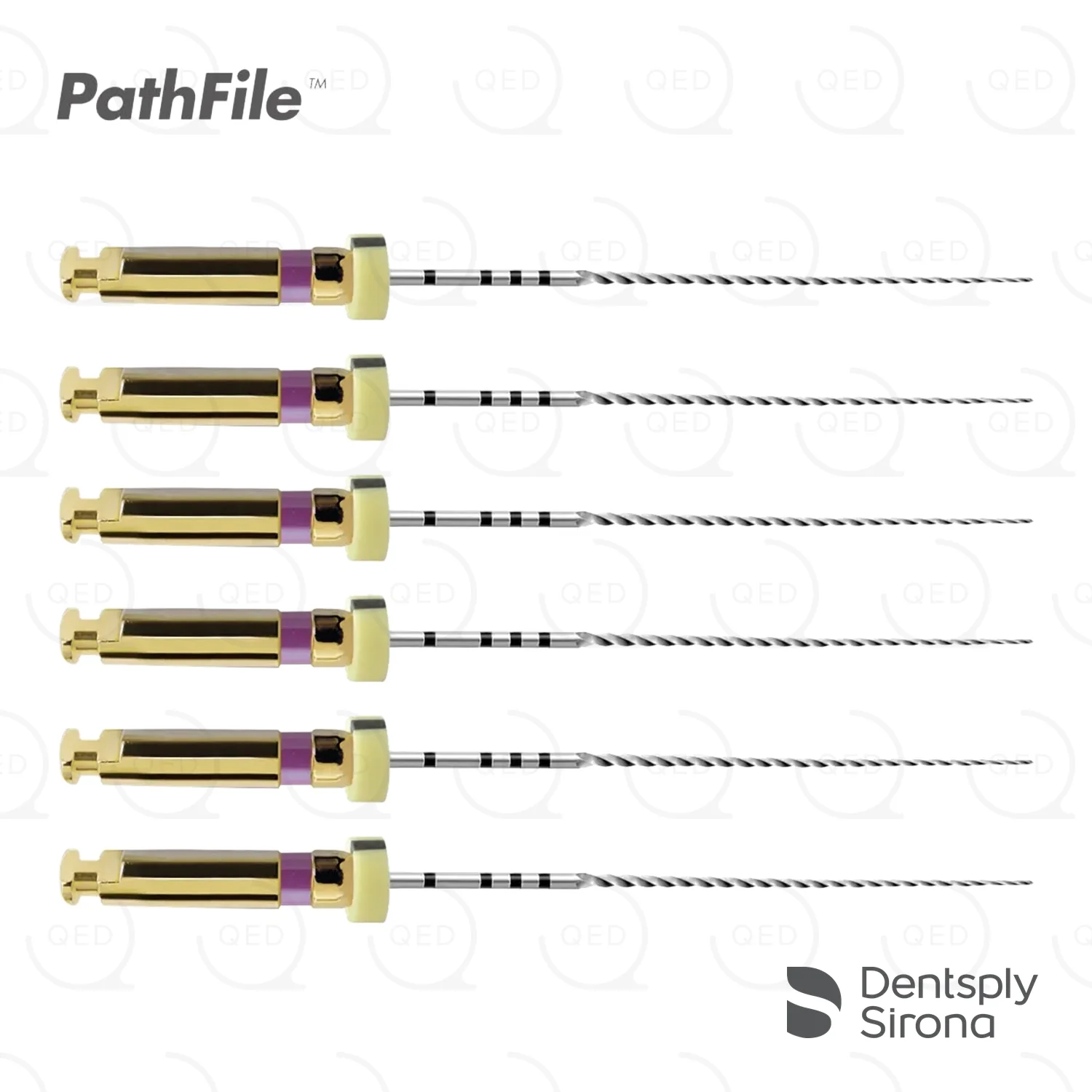
proroot® mta · white · 4 × 0.5 g
root-end fillingperforation repairapexificationpulp cappingpulpotomy, primary teeth
proroot® mta is dentsply sirona’s mineral trioxide aggregate – a fine, hydrophilic powder that sets in the presence of moisture into what their directions call “a strong impermeable barrier”. four 0.5 g pouches, each with its own water ampoule, so every case is mixed fresh and nothing is left open on the shelf.
| 4 mm al min. radiopacity, ifu | ~3 min working time, ifu | > 24 mpa compressive, ifu |
this pack: proroot® mta root canal repair material, white – 4 pouches of 0.5 g powder and 5 ampoules of 0.18 g water · dentsply sirona ref a040500000300
single use · non-sterile, do not sterilise · shelf life 3 years
› six indications in one material. dentsply sirona’s directions list root-end filling, the apical plug in apexification, perforation repair during root canal therapy, repair after internal resorption, pulp capping and pulpotomy of primary teeth.
› sets in a wet field. the powder hydrates to a colloidal gel that, in the directions’ words, “solidifies to form a strong impermeable barrier”. moisture is part of the chemistry, not an enemy of it.
› unit dose. each 0.5 g pouch is matched to a 0.18 g micro-dose water ampoule, so the powder-to-liquid ratio is set by the pack, not the clock. the four-pouch box carries one spare ampoule.
› radiopaque. at least 4 mm of aluminium equivalent (ifu), so placement can be confirmed on the radiograph the directions ask for.
› a permanent part of the filling. in perforation repair and apexification the directions leave the set mta in place and obturate the remaining canal on top of it.
dentsply sirona call it “the first name in root repair”, and on a bench of newer bioceramics it is still the material the others describe themselves against. what you are buying is a known quantity: a composition published in the directions, six indications set out step by step, and a pack that controls the one variable mta punishes – the water.
the four-pouch box suits a practice that places mta occasionally – a perforation here, a pulp cap there – because each pouch stays sealed until the case needs it. the directions insist on that: kept in its sealed packaging and stored dry, because moisture is what sets it. for regular use, the 10 × 0.5 g box is the lower cost per pouch.
proroot® mta root repair material is a powder consisting of fine, hydrophilic particles that set in the presence of moisture. hydration of the powder creates a colloidal gel that solidifies to form a strong impermeable barrier that fully cures over a four-week period.
dentsply sirona, proroot® mta instructions for use (europe, 2025-08)
| material | mineral trioxide aggregate – a fine, hydrophilic powder that sets in the presence of moisture |
| composition | tri- and dicalcium silicates 69–74%, bismuth oxide 17–22%, minor components 2–7% (calcium aluminate, aluminoferrite and sulphate, and others) |
| shade | white (tooth-coloured) |
| mixing | one 0.5 g pouch with one 0.18 g water ampoule, about a minute on the pad |
| cure | checked for hardness after four hours; fully cures over four weeks |
| shelf life | 3 years; store dry, below 30 °c, away from sunlight |
| contraindications | none known |
mixing (all indications). dispense a pouch onto the pad, pull the end off an ampoule and squeeze it out alongside, bring the liquid in gradually and mix for about a minute. it does not set as quickly as other cements – careful mixing is what makes it easy to handle.
1perforation repair, and repair after internal resorption. under dam: debride and irrigate with hypochlorite (for resorption, a week of calcium hydroxide first), dry, and obturate the canal apical to the defect. carry the mta into the defect, compact it with a small plugger, cotton pellet or paper point, and confirm on a radiograph.
2apexification. after a week of calcium hydroxide, carry and compact a three to five millimetre apical barrier, confirm it radiographically, and leave a moist pellet under a temporary.
3after either: at four hours or the next visit, check the mta is hard (if not, rinse and repeat), then obturate the rest of the canal. the mta stays as a permanent part of the filling.
4root-end filling. resect, prepare a class i root-end cavity three to five millimetres deep with an ultrasonic tip, achieve haemostasis, dry, then place and compact the mta, clean the root surface and confirm on a radiograph.
5pulp capping. rinse the exposure with hypochlorite, place a small amount of mta over it, blot the excess moisture, cover it with a light-cured liner, then etch, bond and restore. review sensibility every six months.
6pulpotomy of primary teeth. remove the coronal pulp, achieve haemostasis with pressure, place mta over the pulp stumps and chamber floor to an even three to four millimetres, fill the chamber and restore – the directions finish with a stainless-steel crown.
these are summaries. the directions carry every step, and the materials they name at each stage, in full – see downloads.
how much water, and what if it is too wet or too dry?
use the ampoule supplied with each pouch and mix for about a minute so every particle is hydrated. the directions allow a little extra water – the spare ampoule, or usp purified water – to reach the consistency you want, and they warn that too much or too little liquid reduces the final strength. if the mix starts to dry on the pad, cover it with moist gauze rather than adding more water.
will it discolour the tooth?
the directions are candid about it: a slight discolouration may appear in the months after treatment, and in an aesthetic zone they ask the clinician to weigh the procedure, the surface area exposed and the other restorative materials used.
how long before i can restore over it?
for perforation repair and apexification the directions place a moist pellet and a temporary for at least four hours, then check the mta is hard – at that visit or a later one – before obturating the rest of the canal. for pulp capping they cover it straight away with a light-cured liner, then bond and restore in the same visit.
can i use a pouch across two patients?
no. proroot mta is single use and single patient, and the directions say to place it immediately after mixing; once set it cannot be used again. that is what the 0.5 g unit dose is for.
4 × 0.5 g or 10 × 0.5 g?
same material, same pouch, same ampoule. the four-pack carries one spare ampoule for adjusting a mix; the ten-pack is the lower cost per pouch for practices placing mta every week.
| isolation | qed non-latex dam – the directions use dental dam at every stage. |
| irrigants | chlorax 5.25%, chlorax 2% and endo-solution 17% edta. |
| interim dressing | ultracal xs, calcipast and opacal – calcium hydroxide, which the resorption and apexification protocols place for a week. |
| drying | mmpp paper points 15–40 – or the matched points for your file system. |
| delivery | vista mta carriers 0.80 mm, 0.99 mm and 1.60 mm · cerkamed mta applicator 0.80 mm and 1.20 mm. |
| compaction | penn micro-plugger 060, 100 · root-end: endoblack retroplugger 050, 075. |
| obturation | proroot bio sealer – dentsply sirona’s bioceramic sealer on the same calcium silicate chemistry · ah plus – the epoxy alternative. |
| bonding | prime&bond active – dentsply sirona’s universal adhesive. |
| coronal seal | sdr flow+ refill universal – 4 mm bulk increment, one cure. |
| also in stock | neomta 2 and neoputty – avalon biomed’s bioceramic repair materials, a different formulation and handling. |
› proroot® mta instructions for use (pdf, 1.1 mb, multilingual, dentsply sirona) – the current european edition (2025-08), on dentsply sirona’s site. english is the first section.
indications, composition, physical properties, precautions, adverse reactions, storage and every step above are from dentsply sirona’s proroot® mta instructions for use (end-ifu-proroot-mta-tds-v05, europe, 2025-08; english section, spelling anglicised). “the first name in root repair” is dentsply sirona’s own line. technique is theirs; the clinical decision is yours – we make no claim of our own about seal, healing or outcome. proroot, ah plus, sdr and prime&bond are dentsply sirona trademarks; neomta and neoputty are avalon biomed trademarks.
proroot® mta · root canal repair material, white · 4 × 0.5 g pouches + 5 × 0.18 g water ampoules · dentsply sirona · ref a040500000300
start-x® no. 1 · satelec thread
access wallsaccess cavitypiezo ultrasonicsatelec thread
walls that overhang the canal entrances cost you a straight line into the canal. no. 1 is the start-x tip for finishing them: the sides do the cutting, and the tip itself is deliberately non-active so it will not mark the pulp chamber floor while you work.
this pack: dentsply sirona start-x® ultrasonic tip no. 1, access wall refinement · satelec thread (m3 x 0.6 mm) · 1 tip
| indication | finishing of the walls of the access cavity (dentsply sirona directions) |
| thread | satelec type, m3 x 0.6 mm |
| for | satelec-type (acteon) piezo ultrasonic units, piezo generators only |
| power | 16–18 on a satelec p5 / newtron (dentsply sirona brochure) |
| reprocessing | steam sterilisation, 134°c for 18 min |
| dentsply ref | a066000000100 |
› non-active tip – dentsply sirona: avoids accidentally damaging the pulp chamber floor.
› active lateral part – creates a straight access to the canal.
› dentsply sirona's launch material also gives it the removal of restorations, filling materials, caries and dentine interferences from the access cavity.
dentsply sirona developed the five start-x tips with professor berutti, professor cantatore and dr castellucci on a simple principle: one tip, one clinical indication, to facilitate and optimise the preparation of the access cavity.
in dentsply sirona's words: “higher control and precision with ultrasonic inserts specifically designed for access cavity refinement and canal orifice location.”
› micro-milled active part – in dentsply sirona's words, minimising the risk of diamond grit loss in the patient's mouth.
› resistance to fracture – dentsply sirona describe it as excellent.
› satelec thread – m3 x 0.6 mm. need the other fitting? this tip is also made with an ems thread.
| no. 1 | this page. access wall refinement |
| no. 2 | start-x® no. 2 – mb2 canal locator |
| no. 3 | start-x® no. 3 – canal entrance tip |
| no. 4 | start-x® no. 4 – metal post removal |
| no. 5 | start-x® no. 5 – pulp floor anatomy |
› secure the tip to the handpiece with the key before use.
› start at a lower power setting and only increase it if necessary to safely accomplish the task. dentsply sirona give no. 1 a range of 16–18 on a satelec p5 / newtron, adjusted to the clinical application; check your unit's own instructions too.
› irrigation is recommended for procedures that need high power, to avoid overheating.
› a visual aid is recommended, for comfort and safety. never run the generator with a damaged tip.
› contraindications: none known when used as recommended, but dentsply sirona recommend not using the tips in patients with a pacemaker.
why is the end of the tip smooth?
so the walls can be taken back right down to the floor without the tip cutting into it. dentsply sirona designed the non-active end for exactly that: to avoid accidentally damaging the pulp chamber floor.
will it fit my ultrasonic unit?
this is the satelec-thread version (m3 x 0.6 mm). dentsply sirona give its power settings for satelec p5 / newtron units. if your unit takes ems-thread tips, choose the ems version.
not sure? call 01733 404999 or email sales@qedendo.com with the make and model and we will check it for you.
| ultrasonic unit | newtron® p5 xs · newtron® booster |
| negotiation | c-pilot® 08, 21 mm · c-pilot® 10, 21 mm · micro-opener 10/.04 |
| irrigants | chlorax 5.25% · endo-solution 17% edta |
| delivery | navitip™ 29 ga, 25 mm |
| coronal seal | sdr® flow+ universal – 4 mm bulk increment |
› start-x® ultrasonic tips brochure (pdf, 0.5 mb, dentsply sirona) – all five tips and their indications, the power range for each on satelec p5 / newtron and ems minipiezon units, and the order codes by thread.
dentsply sirona · start-x® ultrasonic tip no. 1 · satelec thread m3 x 0.6 mm · dentsply ref a066000000100 · ref a066000000100
start-x® no. 2 · satelec thread
mb2 locationaccess cavitypiezo ultrasonicsatelec thread
in upper molars, the entrance to the second mesiobuccal canal is often hidden under dentine. no. 2 is the start-x tip dentsply sirona designed for locating it: an active tip that removes that dentine, with active sides to open a straight path to the canal.
this pack: dentsply sirona start-x® ultrasonic tip no. 2, mb2 canal locator · satelec thread (m3 x 0.6 mm) · 1 tip
| indication | locating the mb2 canal (second canal of the mesiobuccal root) (dentsply sirona directions) |
| thread | satelec type, m3 x 0.6 mm |
| for | satelec-type (acteon) piezo ultrasonic units, piezo generators only |
| power | 16–18 on a satelec p5 / newtron (dentsply sirona brochure) |
| reprocessing | steam sterilisation, 134°c for 18 min |
| dentsply ref | a066000000200 |
› active tip – dentsply sirona: removes the dentine that often conceals the mb2 access in upper molars.
› active lateral part – creates a straight access to the canal.
› dentsply sirona's directions give it one indication: locating the mb2 canal, the second canal of the mesiobuccal root.
dentsply sirona developed the five start-x tips with professor berutti, professor cantatore and dr castellucci on a simple principle: one tip, one clinical indication, to facilitate and optimise the preparation of the access cavity.
in dentsply sirona's words: “higher control and precision with ultrasonic inserts specifically designed for access cavity refinement and canal orifice location.”
› micro-milled active part – in dentsply sirona's words, minimising the risk of diamond grit loss in the patient's mouth.
› resistance to fracture – dentsply sirona describe it as excellent.
› satelec thread – m3 x 0.6 mm. need the other fitting? this tip is also made with an ems thread.
| no. 1 | start-x® no. 1 – access wall refinement |
| no. 2 | this page. mb2 canal locator |
| no. 3 | start-x® no. 3 – canal entrance tip |
| no. 4 | start-x® no. 4 – metal post removal |
| no. 5 | start-x® no. 5 – pulp floor anatomy |
› secure the tip to the handpiece with the key before use.
› start at a lower power setting and only increase it if necessary to safely accomplish the task. dentsply sirona give no. 2 a range of 16–18 on a satelec p5 / newtron, adjusted to the clinical application; check your unit's own instructions too.
› irrigation is recommended for procedures that need high power, to avoid overheating.
› a visual aid is recommended, for comfort and safety. never run the generator with a damaged tip.
› contraindications: none known when used as recommended, but dentsply sirona recommend not using the tips in patients with a pacemaker.
once the mb2 entrance is found, what next?
that part is your protocol, not ours. for negotiating a fine canal we stock c-pilot® 08 and c-pilot® 10 in 21 mm, and the micro-opener 10/.04.
will it fit my ultrasonic unit?
this is the satelec-thread version (m3 x 0.6 mm). dentsply sirona give its power settings for satelec p5 / newtron units. if your unit takes ems-thread tips, choose the ems version.
not sure? call 01733 404999 or email sales@qedendo.com with the make and model and we will check it for you.
| ultrasonic unit | newtron® p5 xs · newtron® booster |
| negotiation | c-pilot® 08, 21 mm · c-pilot® 10, 21 mm · micro-opener 10/.04 |
| irrigants | chlorax 5.25% · endo-solution 17% edta |
| delivery | navitip™ 29 ga, 25 mm |
| coronal seal | sdr® flow+ universal – 4 mm bulk increment |
› start-x® ultrasonic tips brochure (pdf, 0.5 mb, dentsply sirona) – all five tips and their indications, the power range for each on satelec p5 / newtron and ems minipiezon units, and the order codes by thread.
dentsply sirona · start-x® ultrasonic tip no. 2 · satelec thread m3 x 0.6 mm · dentsply ref a066000000200 · ref a066000000200
start-x® no. 3 · satelec thread
calcified orificesaccess cavitypiezo ultrasonicsatelec thread
calcified or obstructed orifices are where an access stalls. no. 3 is the start-x tip for freeing the canal entrance: dentsply sirona call it the canal openings scouter, and describe it as removing calcifications from the pulp chamber or the coronal third of the canal.
this pack: dentsply sirona start-x® ultrasonic tip no. 3, canal entrance tip · satelec thread (m3 x 0.6 mm) · 1 tip
| indication | freeing the canal entrance (removal of obstructions) (dentsply sirona directions) |
| thread | satelec type, m3 x 0.6 mm |
| for | satelec-type (acteon) piezo ultrasonic units, piezo generators only |
| power | 10–18 on a satelec p5 / newtron (dentsply sirona brochure) |
| reprocessing | steam sterilisation, 134°c for 18 min |
| dentsply ref | a066000000300 |
› canal openings scouter – dentsply sirona: removes the obstructions that prevent a straight access.
› reach – calcifications in the pulp chamber or the coronal third of the root canal, in dentsply sirona's launch description.
› dentsply sirona's directions give it one indication: freeing the canal entrance by removing obstructions.
dentsply sirona developed the five start-x tips with professor berutti, professor cantatore and dr castellucci on a simple principle: one tip, one clinical indication, to facilitate and optimise the preparation of the access cavity.
in dentsply sirona's words: “higher control and precision with ultrasonic inserts specifically designed for access cavity refinement and canal orifice location.”
› micro-milled active part – in dentsply sirona's words, minimising the risk of diamond grit loss in the patient's mouth.
› resistance to fracture – dentsply sirona describe it as excellent.
› satelec thread – m3 x 0.6 mm. need the other fitting? this tip is also made with an ems thread.
| no. 1 | start-x® no. 1 – access wall refinement |
| no. 2 | start-x® no. 2 – mb2 canal locator |
| no. 3 | this page. canal entrance tip |
| no. 4 | start-x® no. 4 – metal post removal |
| no. 5 | start-x® no. 5 – pulp floor anatomy |
› secure the tip to the handpiece with the key before use.
› start at a lower power setting and only increase it if necessary to safely accomplish the task. dentsply sirona give no. 3 a range of 10–18 on a satelec p5 / newtron, adjusted to the clinical application; check your unit's own instructions too.
› irrigation is recommended for procedures that need high power, to avoid overheating.
› a visual aid is recommended, for comfort and safety. never run the generator with a damaged tip.
› contraindications: none known when used as recommended, but dentsply sirona recommend not using the tips in patients with a pacemaker.
is no. 3 the same as no. 2?
no. no. 2 is designed for one job, finding the mb2 canal in upper molars. no. 3 is for freeing any canal entrance that is calcified or obstructed.
will it fit my ultrasonic unit?
this is the satelec-thread version (m3 x 0.6 mm). dentsply sirona give its power settings for satelec p5 / newtron units. if your unit takes ems-thread tips, choose the ems version.
not sure? call 01733 404999 or email sales@qedendo.com with the make and model and we will check it for you.
| ultrasonic unit | newtron® p5 xs · newtron® booster |
| negotiation | c-pilot® 08, 21 mm · c-pilot® 10, 21 mm · micro-opener 10/.04 |
| irrigants | chlorax 5.25% · endo-solution 17% edta |
| delivery | navitip™ 29 ga, 25 mm |
| coronal seal | sdr® flow+ universal – 4 mm bulk increment |
› start-x® ultrasonic tips brochure (pdf, 0.5 mb, dentsply sirona) – all five tips and their indications, the power range for each on satelec p5 / newtron and ems minipiezon units, and the order codes by thread.
dentsply sirona · start-x® ultrasonic tip no. 3 · satelec thread m3 x 0.6 mm · dentsply ref a066000000300 · ref a066000000300
start-x® no. 4 · satelec thread
post removalaccess cavitypiezo ultrasonicsatelec thread
the post has to come out before the retreatment can start. no. 4 is the start-x tip for it: designed, in dentsply sirona's words, for working efficiently on both the top and the sides of a metal post, and described at launch as removing screw and cast posts alike.
this pack: dentsply sirona start-x® ultrasonic tip no. 4, metal post removal · satelec thread (m3 x 0.6 mm) · 1 tip
| indication | removal of metal posts (dentsply sirona directions) |
| thread | satelec type, m3 x 0.6 mm |
| for | satelec-type (acteon) piezo ultrasonic units, piezo generators only |
| power | 18–20 on a satelec p5 / newtron (dentsply sirona brochure) |
| reprocessing | steam sterilisation, 134°c for 18 min |
| dentsply ref | a066000000400 |
› works top and sides – dentsply sirona: suitable for working efficiently both on the top and the sides of the metal post.
› water port – cools the insert and avoids overheating. dentsply sirona single this out as particularly important on metal posts, which usually need high energy.
› the directions set no. 4 at the highest power range of the five start-x tips, and recommend irrigation for procedures that need high power.
dentsply sirona developed the five start-x tips with professor berutti, professor cantatore and dr castellucci on a simple principle: one tip, one clinical indication, to facilitate and optimise the preparation of the access cavity.
in dentsply sirona's words: “higher control and precision with ultrasonic inserts specifically designed for access cavity refinement and canal orifice location.”
› micro-milled active part – in dentsply sirona's words, minimising the risk of diamond grit loss in the patient's mouth.
› resistance to fracture – dentsply sirona describe it as excellent.
› satelec thread – m3 x 0.6 mm. need the other fitting? this tip is also made with an ems thread.
| no. 1 | start-x® no. 1 – access wall refinement |
| no. 2 | start-x® no. 2 – mb2 canal locator |
| no. 3 | start-x® no. 3 – canal entrance tip |
| no. 4 | this page. metal post removal |
| no. 5 | start-x® no. 5 – pulp floor anatomy |
› secure the tip to the handpiece with the key before use.
› start at a lower power setting and only increase it if necessary to safely accomplish the task. dentsply sirona give no. 4 a range of 18–20 on a satelec p5 / newtron, adjusted to the clinical application; check your unit's own instructions too.
› irrigation is recommended for procedures that need high power, to avoid overheating.
› a visual aid is recommended, for comfort and safety. never run the generator with a damaged tip.
› contraindications: none known when used as recommended, but dentsply sirona recommend not using the tips in patients with a pacemaker.
screw posts or cast posts?
both. dentsply sirona's launch description gives no. 4 the removal of screw and cast metal posts.
will it fit my ultrasonic unit?
this is the satelec-thread version (m3 x 0.6 mm). dentsply sirona give its power settings for satelec p5 / newtron units. if your unit takes ems-thread tips, choose the ems version.
not sure? call 01733 404999 or email sales@qedendo.com with the make and model and we will check it for you.
| ultrasonic unit | newtron® p5 xs · newtron® booster |
| retreatment files | protaper® universal retreatment d1–d3 – dentsply sirona's own |
| irrigants | chlorax 5.25% · endo-solution 17% edta |
| delivery | navitip™ 29 ga, 25 mm |
| coronal seal | sdr® flow+ universal – 4 mm bulk increment |
› start-x® ultrasonic tips brochure (pdf, 0.5 mb, dentsply sirona) – all five tips and their indications, the power range for each on satelec p5 / newtron and ems minipiezon units, and the order codes by thread.
dentsply sirona · start-x® ultrasonic tip no. 4 · satelec thread m3 x 0.6 mm · dentsply ref a066000000400 · ref a066000000400
start-x® no. 5 · satelec thread
pulp flooraccess cavitypiezo ultrasonicsatelec thread
calcifications and old filling material can hide the floor you need to read. no. 5 is the start-x tip for revealing the original anatomy of the pulp chamber floor, with a thin, cylindrical active tip.
this pack: dentsply sirona start-x® ultrasonic tip no. 5, pulp floor anatomy · satelec thread (m3 x 0.6 mm) · 1 tip
| indication | locating the original anatomy of the pulp chamber floor (calcifications, removing old filling materials) (dentsply sirona directions) |
| thread | satelec type, m3 x 0.6 mm |
| for | satelec-type (acteon) piezo ultrasonic units, piezo generators only |
| power | 7–18 on a satelec p5 / newtron (dentsply sirona brochure) |
| reprocessing | steam sterilisation, 134°c for 18 min |
| dentsply ref | a066000000500 |
› thin, cylindrical active tip – for close work on the chamber floor.
› active lateral part – creates a straight access to the canal.
› dentsply sirona: canal orifice location made easier by removing the calcifications and filling materials that hide the original pulp chamber floor anatomy, with good visibility.
dentsply sirona developed the five start-x tips with professor berutti, professor cantatore and dr castellucci on a simple principle: one tip, one clinical indication, to facilitate and optimise the preparation of the access cavity.
in dentsply sirona's words: “higher control and precision with ultrasonic inserts specifically designed for access cavity refinement and canal orifice location.”
› micro-milled active part – in dentsply sirona's words, minimising the risk of diamond grit loss in the patient's mouth.
› resistance to fracture – dentsply sirona describe it as excellent.
› satelec thread – m3 x 0.6 mm. need the other fitting? this tip is also made with an ems thread.
| no. 1 | start-x® no. 1 – access wall refinement |
| no. 2 | start-x® no. 2 – mb2 canal locator |
| no. 3 | start-x® no. 3 – canal entrance tip |
| no. 4 | start-x® no. 4 – metal post removal |
| no. 5 | this page. pulp floor anatomy |
› secure the tip to the handpiece with the key before use.
› start at a lower power setting and only increase it if necessary to safely accomplish the task. dentsply sirona give no. 5 a range of 7–18 on a satelec p5 / newtron, adjusted to the clinical application; check your unit's own instructions too.
› irrigation is recommended for procedures that need high power, to avoid overheating.
› a visual aid is recommended, for comfort and safety. never run the generator with a damaged tip.
› contraindications: none known when used as recommended, but dentsply sirona recommend not using the tips in patients with a pacemaker.
how is it different from no. 1?
no. 1 works on the walls and has a non-active end so it leaves the floor alone. no. 5 is the one designed to work on the floor itself.
will it fit my ultrasonic unit?
this is the satelec-thread version (m3 x 0.6 mm). dentsply sirona give its power settings for satelec p5 / newtron units. if your unit takes ems-thread tips, choose the ems version.
not sure? call 01733 404999 or email sales@qedendo.com with the make and model and we will check it for you.
| ultrasonic unit | newtron® p5 xs · newtron® booster |
| negotiation | c-pilot® 08, 21 mm · c-pilot® 10, 21 mm · micro-opener 10/.04 |
| irrigants | chlorax 5.25% · endo-solution 17% edta |
| delivery | navitip™ 29 ga, 25 mm |
| coronal seal | sdr® flow+ universal – 4 mm bulk increment |
› start-x® ultrasonic tips brochure (pdf, 0.5 mb, dentsply sirona) – all five tips and their indications, the power range for each on satelec p5 / newtron and ems minipiezon units, and the order codes by thread.
dentsply sirona · start-x® ultrasonic tip no. 5 · satelec thread m3 x 0.6 mm · dentsply ref a066000000500 · ref a066000000500
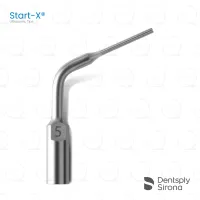
start-x® no. 1 · ems thread
access wallsaccess cavitypiezo ultrasonicems thread
walls that overhang the canal entrances cost you a straight line into the canal. no. 1 is the start-x tip for finishing them: the sides do the cutting, and the tip itself is deliberately non-active so it will not mark the pulp chamber floor while you work.
this pack: dentsply sirona start-x® ultrasonic tip no. 1, access wall refinement · ems thread (m3 x 0.5 mm) · 1 tip
| indication | finishing of the walls of the access cavity (dentsply sirona directions) |
| thread | ems type, m3 x 0.5 mm |
| for | ems-type piezo ultrasonic units, piezo generators only |
| power | 8–9 on a ems minipiezon (dentsply sirona brochure) |
| reprocessing | steam sterilisation, 134°c for 18 min |
| dentsply ref | a06610000100 |
› non-active tip – dentsply sirona: avoids accidentally damaging the pulp chamber floor.
› active lateral part – creates a straight access to the canal.
› dentsply sirona's launch material also gives it the removal of restorations, filling materials, caries and dentine interferences from the access cavity.
dentsply sirona developed the five start-x tips with professor berutti, professor cantatore and dr castellucci on a simple principle: one tip, one clinical indication, to facilitate and optimise the preparation of the access cavity.
in dentsply sirona's words: “higher control and precision with ultrasonic inserts specifically designed for access cavity refinement and canal orifice location.”
› micro-milled active part – in dentsply sirona's words, minimising the risk of diamond grit loss in the patient's mouth.
› resistance to fracture – dentsply sirona describe it as excellent.
› ems thread – m3 x 0.5 mm. need the other fitting? this tip is also made with an satelec thread.
| no. 1 | this page. access wall refinement |
| no. 2 | start-x® no. 2 – mb2 canal locator |
| no. 3 | start-x® no. 3 – canal entrance tip |
| no. 4 | start-x® no. 4 – metal post removal |
| no. 5 | start-x® no. 5 – pulp floor anatomy |
› secure the tip to the handpiece with the key before use.
› start at a lower power setting and only increase it if necessary to safely accomplish the task. dentsply sirona give no. 1 a range of 8–9 on a ems minipiezon, adjusted to the clinical application; check your unit's own instructions too.
› irrigation is recommended for procedures that need high power, to avoid overheating.
› a visual aid is recommended, for comfort and safety. never run the generator with a damaged tip.
› contraindications: none known when used as recommended, but dentsply sirona recommend not using the tips in patients with a pacemaker.
why is the end of the tip smooth?
so the walls can be taken back right down to the floor without the tip cutting into it. dentsply sirona designed the non-active end for exactly that: to avoid accidentally damaging the pulp chamber floor.
will it fit my ultrasonic unit?
this is the ems-thread version (m3 x 0.5 mm), with dentsply sirona power settings for the ems minipiezon. if your unit takes satelec-thread tips, choose the satelec version.
not sure? call 01733 404999 or email sales@qedendo.com with the make and model and we will check it for you.
| negotiation | c-pilot® 08, 21 mm · c-pilot® 10, 21 mm · micro-opener 10/.04 |
| irrigants | chlorax 5.25% · endo-solution 17% edta |
| delivery | navitip™ 29 ga, 25 mm |
| coronal seal | sdr® flow+ universal – 4 mm bulk increment |
› start-x® ultrasonic tips brochure (pdf, 0.5 mb, dentsply sirona) – all five tips and their indications, the power range for each on satelec p5 / newtron and ems minipiezon units, and the order codes by thread.
dentsply sirona · start-x® ultrasonic tip no. 1 · ems thread m3 x 0.5 mm · dentsply ref a06610000100 · ref a0661-1
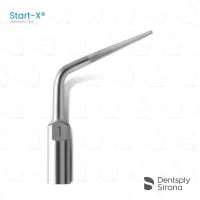
start-x® no. 2 · ems thread
mb2 locationaccess cavitypiezo ultrasonicems thread
in upper molars, the entrance to the second mesiobuccal canal is often hidden under dentine. no. 2 is the start-x tip dentsply sirona designed for locating it: an active tip that removes that dentine, with active sides to open a straight path to the canal.
this pack: dentsply sirona start-x® ultrasonic tip no. 2, mb2 canal locator · ems thread (m3 x 0.5 mm) · 1 tip
| indication | locating the mb2 canal (second canal of the mesiobuccal root) (dentsply sirona directions) |
| thread | ems type, m3 x 0.5 mm |
| for | ems-type piezo ultrasonic units, piezo generators only |
| power | 8–9 on a ems minipiezon (dentsply sirona brochure) |
| reprocessing | steam sterilisation, 134°c for 18 min |
| dentsply ref | a06610000200 |
› active tip – dentsply sirona: removes the dentine that often conceals the mb2 access in upper molars.
› active lateral part – creates a straight access to the canal.
› dentsply sirona's directions give it one indication: locating the mb2 canal, the second canal of the mesiobuccal root.
dentsply sirona developed the five start-x tips with professor berutti, professor cantatore and dr castellucci on a simple principle: one tip, one clinical indication, to facilitate and optimise the preparation of the access cavity.
in dentsply sirona's words: “higher control and precision with ultrasonic inserts specifically designed for access cavity refinement and canal orifice location.”
› micro-milled active part – in dentsply sirona's words, minimising the risk of diamond grit loss in the patient's mouth.
› resistance to fracture – dentsply sirona describe it as excellent.
› ems thread – m3 x 0.5 mm. need the other fitting? this tip is also made with an satelec thread.
| no. 1 | start-x® no. 1 – access wall refinement |
| no. 2 | this page. mb2 canal locator |
| no. 3 | start-x® no. 3 – canal entrance tip |
| no. 4 | start-x® no. 4 – metal post removal |
| no. 5 | start-x® no. 5 – pulp floor anatomy |
› secure the tip to the handpiece with the key before use.
› start at a lower power setting and only increase it if necessary to safely accomplish the task. dentsply sirona give no. 2 a range of 8–9 on a ems minipiezon, adjusted to the clinical application; check your unit's own instructions too.
› irrigation is recommended for procedures that need high power, to avoid overheating.
› a visual aid is recommended, for comfort and safety. never run the generator with a damaged tip.
› contraindications: none known when used as recommended, but dentsply sirona recommend not using the tips in patients with a pacemaker.
once the mb2 entrance is found, what next?
that part is your protocol, not ours. for negotiating a fine canal we stock c-pilot® 08 and c-pilot® 10 in 21 mm, and the micro-opener 10/.04.
will it fit my ultrasonic unit?
this is the ems-thread version (m3 x 0.5 mm), with dentsply sirona power settings for the ems minipiezon. if your unit takes satelec-thread tips, choose the satelec version.
not sure? call 01733 404999 or email sales@qedendo.com with the make and model and we will check it for you.
| negotiation | c-pilot® 08, 21 mm · c-pilot® 10, 21 mm · micro-opener 10/.04 |
| irrigants | chlorax 5.25% · endo-solution 17% edta |
| delivery | navitip™ 29 ga, 25 mm |
| coronal seal | sdr® flow+ universal – 4 mm bulk increment |
› start-x® ultrasonic tips brochure (pdf, 0.5 mb, dentsply sirona) – all five tips and their indications, the power range for each on satelec p5 / newtron and ems minipiezon units, and the order codes by thread.
dentsply sirona · start-x® ultrasonic tip no. 2 · ems thread m3 x 0.5 mm · dentsply ref a06610000200 · ref a0661-2
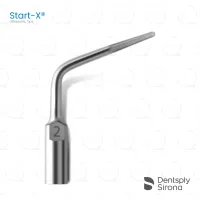
start-x® no. 3 · ems thread
calcified orificesaccess cavitypiezo ultrasonicems thread
calcified or obstructed orifices are where an access stalls. no. 3 is the start-x tip for freeing the canal entrance: dentsply sirona call it the canal openings scouter, and describe it as removing calcifications from the pulp chamber or the coronal third of the canal.
this pack: dentsply sirona start-x® ultrasonic tip no. 3, canal entrance tip · ems thread (m3 x 0.5 mm) · 1 tip
| indication | freeing the canal entrance (removal of obstructions) (dentsply sirona directions) |
| thread | ems type, m3 x 0.5 mm |
| for | ems-type piezo ultrasonic units, piezo generators only |
| power | 4–7 on a ems minipiezon (dentsply sirona brochure) |
| reprocessing | steam sterilisation, 134°c for 18 min |
| dentsply ref | a06610000300 |
› canal openings scouter – dentsply sirona: removes the obstructions that prevent a straight access.
› reach – calcifications in the pulp chamber or the coronal third of the root canal, in dentsply sirona's launch description.
› dentsply sirona's directions give it one indication: freeing the canal entrance by removing obstructions.
dentsply sirona developed the five start-x tips with professor berutti, professor cantatore and dr castellucci on a simple principle: one tip, one clinical indication, to facilitate and optimise the preparation of the access cavity.
in dentsply sirona's words: “higher control and precision with ultrasonic inserts specifically designed for access cavity refinement and canal orifice location.”
› micro-milled active part – in dentsply sirona's words, minimising the risk of diamond grit loss in the patient's mouth.
› resistance to fracture – dentsply sirona describe it as excellent.
› ems thread – m3 x 0.5 mm. need the other fitting? this tip is also made with an satelec thread.
| no. 1 | start-x® no. 1 – access wall refinement |
| no. 2 | start-x® no. 2 – mb2 canal locator |
| no. 3 | this page. canal entrance tip |
| no. 4 | start-x® no. 4 – metal post removal |
| no. 5 | start-x® no. 5 – pulp floor anatomy |
› secure the tip to the handpiece with the key before use.
› start at a lower power setting and only increase it if necessary to safely accomplish the task. dentsply sirona give no. 3 a range of 4–7 on a ems minipiezon, adjusted to the clinical application; check your unit's own instructions too.
› irrigation is recommended for procedures that need high power, to avoid overheating.
› a visual aid is recommended, for comfort and safety. never run the generator with a damaged tip.
› contraindications: none known when used as recommended, but dentsply sirona recommend not using the tips in patients with a pacemaker.
is no. 3 the same as no. 2?
no. no. 2 is designed for one job, finding the mb2 canal in upper molars. no. 3 is for freeing any canal entrance that is calcified or obstructed.
will it fit my ultrasonic unit?
this is the ems-thread version (m3 x 0.5 mm), with dentsply sirona power settings for the ems minipiezon. if your unit takes satelec-thread tips, choose the satelec version.
not sure? call 01733 404999 or email sales@qedendo.com with the make and model and we will check it for you.
| negotiation | c-pilot® 08, 21 mm · c-pilot® 10, 21 mm · micro-opener 10/.04 |
| irrigants | chlorax 5.25% · endo-solution 17% edta |
| delivery | navitip™ 29 ga, 25 mm |
| coronal seal | sdr® flow+ universal – 4 mm bulk increment |
› start-x® ultrasonic tips brochure (pdf, 0.5 mb, dentsply sirona) – all five tips and their indications, the power range for each on satelec p5 / newtron and ems minipiezon units, and the order codes by thread.
dentsply sirona · start-x® ultrasonic tip no. 3 · ems thread m3 x 0.5 mm · dentsply ref a06610000300 · ref a0661-3
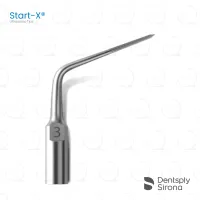
start-x® no. 4 · ems thread
post removalaccess cavitypiezo ultrasonicems thread
the post has to come out before the retreatment can start. no. 4 is the start-x tip for it: designed, in dentsply sirona's words, for working efficiently on both the top and the sides of a metal post, and described at launch as removing screw and cast posts alike.
this pack: dentsply sirona start-x® ultrasonic tip no. 4, metal post removal · ems thread (m3 x 0.5 mm) · 1 tip
| indication | removal of metal posts (dentsply sirona directions) |
| thread | ems type, m3 x 0.5 mm |
| for | ems-type piezo ultrasonic units, piezo generators only |
| power | 9–10 on a ems minipiezon (dentsply sirona brochure) |
| reprocessing | steam sterilisation, 134°c for 18 min |
| dentsply ref | a06610000400 |
› works top and sides – dentsply sirona: suitable for working efficiently both on the top and the sides of the metal post.
› water port – cools the insert and avoids overheating. dentsply sirona single this out as particularly important on metal posts, which usually need high energy.
› the directions set no. 4 at the highest power range of the five start-x tips, and recommend irrigation for procedures that need high power.
dentsply sirona developed the five start-x tips with professor berutti, professor cantatore and dr castellucci on a simple principle: one tip, one clinical indication, to facilitate and optimise the preparation of the access cavity.
in dentsply sirona's words: “higher control and precision with ultrasonic inserts specifically designed for access cavity refinement and canal orifice location.”
› micro-milled active part – in dentsply sirona's words, minimising the risk of diamond grit loss in the patient's mouth.
› resistance to fracture – dentsply sirona describe it as excellent.
› ems thread – m3 x 0.5 mm. need the other fitting? this tip is also made with an satelec thread.
| no. 1 | start-x® no. 1 – access wall refinement |
| no. 2 | start-x® no. 2 – mb2 canal locator |
| no. 3 | start-x® no. 3 – canal entrance tip |
| no. 4 | this page. metal post removal |
| no. 5 | start-x® no. 5 – pulp floor anatomy |
› secure the tip to the handpiece with the key before use.
› start at a lower power setting and only increase it if necessary to safely accomplish the task. dentsply sirona give no. 4 a range of 9–10 on a ems minipiezon, adjusted to the clinical application; check your unit's own instructions too.
› irrigation is recommended for procedures that need high power, to avoid overheating.
› a visual aid is recommended, for comfort and safety. never run the generator with a damaged tip.
› contraindications: none known when used as recommended, but dentsply sirona recommend not using the tips in patients with a pacemaker.
screw posts or cast posts?
both. dentsply sirona's launch description gives no. 4 the removal of screw and cast metal posts.
will it fit my ultrasonic unit?
this is the ems-thread version (m3 x 0.5 mm), with dentsply sirona power settings for the ems minipiezon. if your unit takes satelec-thread tips, choose the satelec version.
not sure? call 01733 404999 or email sales@qedendo.com with the make and model and we will check it for you.
| retreatment files | protaper® universal retreatment d1–d3 – dentsply sirona's own |
| irrigants | chlorax 5.25% · endo-solution 17% edta |
| delivery | navitip™ 29 ga, 25 mm |
| coronal seal | sdr® flow+ universal – 4 mm bulk increment |
› start-x® ultrasonic tips brochure (pdf, 0.5 mb, dentsply sirona) – all five tips and their indications, the power range for each on satelec p5 / newtron and ems minipiezon units, and the order codes by thread.
dentsply sirona · start-x® ultrasonic tip no. 4 · ems thread m3 x 0.5 mm · dentsply ref a06610000400 · ref a0661-4
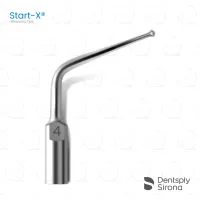
start-x® no. 5 · ems thread
pulp flooraccess cavitypiezo ultrasonicems thread
calcifications and old filling material can hide the floor you need to read. no. 5 is the start-x tip for revealing the original anatomy of the pulp chamber floor, with a thin, cylindrical active tip.
this pack: dentsply sirona start-x® ultrasonic tip no. 5, pulp floor anatomy · ems thread (m3 x 0.5 mm) · 1 tip
| indication | locating the original anatomy of the pulp chamber floor (calcifications, removing old filling materials) (dentsply sirona directions) |
| thread | ems type, m3 x 0.5 mm |
| for | ems-type piezo ultrasonic units, piezo generators only |
| power | 3–8 on a ems minipiezon (dentsply sirona brochure) |
| reprocessing | steam sterilisation, 134°c for 18 min |
| dentsply ref | a06610000500 |
› thin, cylindrical active tip – for close work on the chamber floor.
› active lateral part – creates a straight access to the canal.
› dentsply sirona: canal orifice location made easier by removing the calcifications and filling materials that hide the original pulp chamber floor anatomy, with good visibility.
dentsply sirona developed the five start-x tips with professor berutti, professor cantatore and dr castellucci on a simple principle: one tip, one clinical indication, to facilitate and optimise the preparation of the access cavity.
in dentsply sirona's words: “higher control and precision with ultrasonic inserts specifically designed for access cavity refinement and canal orifice location.”
› micro-milled active part – in dentsply sirona's words, minimising the risk of diamond grit loss in the patient's mouth.
› resistance to fracture – dentsply sirona describe it as excellent.
› ems thread – m3 x 0.5 mm. need the other fitting? this tip is also made with an satelec thread.
| no. 1 | start-x® no. 1 – access wall refinement |
| no. 2 | start-x® no. 2 – mb2 canal locator |
| no. 3 | start-x® no. 3 – canal entrance tip |
| no. 4 | start-x® no. 4 – metal post removal |
| no. 5 | this page. pulp floor anatomy |
› secure the tip to the handpiece with the key before use.
› start at a lower power setting and only increase it if necessary to safely accomplish the task. dentsply sirona give no. 5 a range of 3–8 on a ems minipiezon, adjusted to the clinical application; check your unit's own instructions too.
› irrigation is recommended for procedures that need high power, to avoid overheating.
› a visual aid is recommended, for comfort and safety. never run the generator with a damaged tip.
› contraindications: none known when used as recommended, but dentsply sirona recommend not using the tips in patients with a pacemaker.
how is it different from no. 1?
no. 1 works on the walls and has a non-active end so it leaves the floor alone. no. 5 is the one designed to work on the floor itself.
will it fit my ultrasonic unit?
this is the ems-thread version (m3 x 0.5 mm), with dentsply sirona power settings for the ems minipiezon. if your unit takes satelec-thread tips, choose the satelec version.
not sure? call 01733 404999 or email sales@qedendo.com with the make and model and we will check it for you.
| negotiation | c-pilot® 08, 21 mm · c-pilot® 10, 21 mm · micro-opener 10/.04 |
| irrigants | chlorax 5.25% · endo-solution 17% edta |
| delivery | navitip™ 29 ga, 25 mm |
| coronal seal | sdr® flow+ universal – 4 mm bulk increment |
› start-x® ultrasonic tips brochure (pdf, 0.5 mb, dentsply sirona) – all five tips and their indications, the power range for each on satelec p5 / newtron and ems minipiezon units, and the order codes by thread.
dentsply sirona · start-x® ultrasonic tip no. 5 · ems thread m3 x 0.5 mm · dentsply ref a06610000500 · ref a0661-5
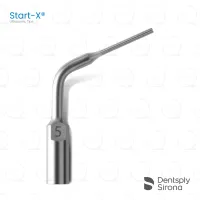
waveone® gold assorted · 21 mm · pack of 4
limited openingfull sequencenew to waveone goldmixed case list
short roots, limited opening? twenty-one millimetres suits a second molar, a patient who cannot open far, or a root that does not need the reach – and it buys handpiece clearance where a 25 mm file fights the opposing arch. this pack carries one of every size, so the sequence is complete before you open it.
this pack: 1 each of small, primary, medium and large, 21 mm · pre-sterilised blister, single-patient use
made by dentsply sirona – maillefer, switzerland
four files: small 020/.07v, primary 025/.07v, medium 035/.06v and large 045/.05v, one of each. it is the pack that lets you run the sequence as written – start at the primary, drop or step up as the canal dictates – without hoping the size you need is in the drawer.
it is also the sensible way to start with waveone® gold. you learn where each size lands in your own hands before committing stock to any one of them.
the primary is the default. if it will not passively progress, drop to the small; if it reaches length loosely, gauge and step up to the medium, then the large. the apical taper steps down as the tip diameter rises, so a bigger apical preparation does not mean a bigger coronal one.
all four run in the same reciprocating motion at the same motor setting, alongside the glider. one case set-up covers the whole sequence.
| sizes | 020/.07v · 025/.07v · 035/.06v · 045/.05v |
| length | 21 mm · 11 mm handle |
| colour codes | yellow, red, green, white |
| alloy | gold heat-treated niti – pre-bendable |
| supply | 4 per blister · pre-sterilised · mfr code a0754221g9a03 |
› one of each size. small, primary, medium and large in a single pack.
› run the sequence as written. drop down or step up without a second order.
› same motion throughout. one motor setting for the glider and all four files.
| other sizes | small · primary · medium · large |
| other lengths | assorted 25 mm · assorted 31 mm |
| glide path | gold glider 21 mm · same motion, same setting |
| dry the canal | paper points primary (180) |
| matched fill | conform fit® gp assorted · the same four sizes |
| best value | gold + sdr® flow+ kit · 15 blisters |
› do i still need a glide path? yes. secure the canal to length with a #10 hand file and confirm patency, then the gold glider creates the glide path in the same reciprocating motion. the instructions for use require a secured, patent canal first.
› is one of each enough? for learning the system, yes. in routine use most practices reorder the primary in quantity and keep the other sizes to hand.
› what motor do i need? any motor carrying the waveone setting – x-smart® pro+, x-smart® go, vdw.silver® and vdw.gold® reciproc®.
waveone® gold assorted · four sizes · 21 mm · gold heat-treated niti · pre-sterilised, single use · dentsply sirona · mfr code a0754221g9a03

waveone® gold assorted · 25 mm · pack of 4
most casesfull sequencenew to waveone goldmixed case list
the default length? twenty-five millimetres is the length most cases call for, and the one most practices stock first. this pack carries one of every size, so the sequence is complete before you open it.
this pack: 1 each of small, primary, medium and large, 25 mm · pre-sterilised blister, single-patient use
made by dentsply sirona – maillefer, switzerland
four files: small 020/.07v, primary 025/.07v, medium 035/.06v and large 045/.05v, one of each. it is the pack that lets you run the sequence as written – start at the primary, drop or step up as the canal dictates – without hoping the size you need is in the drawer.
it is also the sensible way to start with waveone® gold. you learn where each size lands in your own hands before committing stock to any one of them.
the primary is the default. if it will not passively progress, drop to the small; if it reaches length loosely, gauge and step up to the medium, then the large. the apical taper steps down as the tip diameter rises, so a bigger apical preparation does not mean a bigger coronal one.
all four run in the same reciprocating motion at the same motor setting, alongside the glider. one case set-up covers the whole sequence.
| sizes | 020/.07v · 025/.07v · 035/.06v · 045/.05v |
| length | 25 mm · 11 mm handle |
| colour codes | yellow, red, green, white |
| alloy | gold heat-treated niti – pre-bendable |
| supply | 4 per blister · pre-sterilised · mfr code a0754225g9a03 |
› one of each size. small, primary, medium and large in a single pack.
› run the sequence as written. drop down or step up without a second order.
› same motion throughout. one motor setting for the glider and all four files.
| other sizes | small · primary · medium · large |
| other lengths | assorted 21 mm · assorted 31 mm |
| glide path | gold glider 25 mm · same motion, same setting |
| dry the canal | paper points primary (180) |
| matched fill | conform fit® gp assorted · the same four sizes |
| best value | gold + sdr® flow+ kit · 15 blisters |
› do i still need a glide path? yes. secure the canal to length with a #10 hand file and confirm patency, then the gold glider creates the glide path in the same reciprocating motion. the instructions for use require a secured, patent canal first.
› is one of each enough? for learning the system, yes. in routine use most practices reorder the primary in quantity and keep the other sizes to hand.
› what motor do i need? any motor carrying the waveone setting – x-smart® pro+, x-smart® go, vdw.silver® and vdw.gold® reciproc®.
waveone® gold assorted · four sizes · 25 mm · gold heat-treated niti · pre-sterilised, single use · dentsply sirona · mfr code a0754225g9a03

waveone® gold assorted · 31 mm · pack of 4
long canalsfull sequencenew to waveone goldmixed case list
long roots? thirty-one millimetres is the length for a long canine, a tall premolar or any root where a 25 mm file leaves the rubber stop short of the reference cusp. this pack carries one of every size, so the sequence is complete before you open it.
this pack: 1 each of small, primary, medium and large, 31 mm · pre-sterilised blister, single-patient use
made by dentsply sirona – maillefer, switzerland
four files: small 020/.07v, primary 025/.07v, medium 035/.06v and large 045/.05v, one of each. it is the pack that lets you run the sequence as written – start at the primary, drop or step up as the canal dictates – without hoping the size you need is in the drawer.
it is also the sensible way to start with waveone® gold. you learn where each size lands in your own hands before committing stock to any one of them.
the primary is the default. if it will not passively progress, drop to the small; if it reaches length loosely, gauge and step up to the medium, then the large. the apical taper steps down as the tip diameter rises, so a bigger apical preparation does not mean a bigger coronal one.
all four run in the same reciprocating motion at the same motor setting, alongside the glider. one case set-up covers the whole sequence.
| sizes | 020/.07v · 025/.07v · 035/.06v · 045/.05v |
| length | 31 mm · 11 mm handle |
| colour codes | yellow, red, green, white |
| alloy | gold heat-treated niti – pre-bendable |
| supply | 4 per blister · pre-sterilised · mfr code a0754231g9a03 |
› one of each size. small, primary, medium and large in a single pack.
› run the sequence as written. drop down or step up without a second order.
› same motion throughout. one motor setting for the glider and all four files.
| other sizes | small · primary · medium · large |
| other lengths | assorted 21 mm · assorted 25 mm |
| glide path | gold glider 31 mm · same motion, same setting |
| dry the canal | paper points primary (180) |
| matched fill | conform fit® gp assorted · the same four sizes |
| best value | gold + sdr® flow+ kit · 15 blisters |
› do i still need a glide path? yes. secure the canal to length with a #10 hand file and confirm patency, then the gold glider creates the glide path in the same reciprocating motion. the instructions for use require a secured, patent canal first.
› is one of each enough? for learning the system, yes. in routine use most practices reorder the primary in quantity and keep the other sizes to hand.
› what motor do i need? any motor carrying the waveone setting – x-smart® pro+, x-smart® go, vdw.silver® and vdw.gold® reciproc®.
waveone® gold assorted · four sizes · 31 mm · gold heat-treated niti · pre-sterilised, single use · dentsply sirona · mfr code a0754231g9a03

protaper next® x2 · 025/.06v · 25 mm · pack of 3
shapingcurved canalsm-wire® nitisterile, single usevariable taper
protaper next® replaced protaper® universal’s two shaping and five finishing files with five shaping files, and changed how they move: the cross-section is rectangular and set off centre, so the file swaggers down the canal instead of turning about its own middle. dentsply sirona’s own summary is that x1 and x2 do the work that s1, s2, f1 and f2 used to. x2 at 25 mm is where most preparations finish.
| 2 files shape most canals | +25% space for debris | 103 s vs 196 s, lab study |
two files: dentsply sirona uk, x1 and x2 against protaper® universal’s s1, s2, f1 and f2. +25%: dentsply internal data, available volume for debris, x2 and x3 against f2 and f3. 103 seconds against 196: capar et al. 2014, ex vivo, against protaper® universal.
this pack: protaper next® x2 rotary file, 25 mm (pack of 3) · sterile, single use
dentsply sirona · legal manufacturer dentsply detrey gmbh, konstanz, germany; uk representative dentsply ih ltd, stonehouse (2025 ifu)
› off-centred rectangular section. dentsply sirona: “the patented design’s axis of rotation differs from the centre of mass. as a result, only two points of the rectangular cross section touch the canal wall at a time.”
› the swaggering movement. that offset gives the file what they call a snake-like swaggering movement through the canal, and “enlarged space for debris hauling”.
› m-wire® niti. their proprietary thermal treatment: “improves file flexibility, while still retaining cutting efficiency”.
› variable taper. the taper eases coronally rather than running constant, so one instrument does the work of a crown-down step.
› sterile and single use. the 2025 ifu states sterile – sterilised by radiation, and that the instruments “are single use devices and cannot be reused”.
› an 11 mm handle. dentsply sirona’s us literature puts the protaper next handle at 11 mm against 13 mm on the original protaper – useful on second molars.
| iso tip and taper | 025 on a .06v taper · printed 025.006v on the pack |
| length | 25 mm |
| colour ring | red |
| pack | 3 sterile files in one blister |
| settings | 300 rpm, 2–3 ncm · 2025 ifu |
| material | m-wire® niti, off-centred rectangular cross-section |
| the sequence | universal: two shaping files then up to five finishers. next: five shaping files, and dentsply sirona say x1 and x2 cover the majority of canals |
| cross-section | universal: convex triangle, turning about its own centre. next: rectangular and off-centre, two contact points at a time |
| alloy | universal: conventional niti. next: m-wire®, thermally treated |
| where they meet | dentsply sirona pair f1 with x2, f3 with x3, f4 with x4 and f5 with x5 by tip and taper. it is a sequence equivalence, not a like-for-like swap |
| still available | both. universal retreatment files are the range the brochure names for unfilling, whichever system shaped the canal |
1 access and scout. straight-line access, then small hand files to length, working length confirmed and patency checked. irrigate throughout.
2 glide path. expand it by hand or with a mechanical glide path file before x1 goes in.
3 x1, then x2. in the presence of sodium hypochlorite, follow the glide path with x1 in one or more passes to working length. irrigate, recapitulate with a small hand file, re-irrigate, then use x2 the same way.
4 gauge. inspect x2’s apical flutes, or gauge the foramen with an iso 25 hand file. snug at length and the canal is shaped; loose and you continue to x3, then x4 or x5, gauging after each with the matching hand file.
“the protaper next sequence is always the same regardless of the length, diameter or curvature of the canal”
dr clifford j. ruddle, protaper next technique card, dentsply tulsa dental specialties, 2013. a us document – his torque figure differs from the current eu ifu and we follow the ifu.
two independent laboratory groups have measured protaper next against protaper universal and found less debris pushed past the apex: capar et al., journal of endodontics 2014 (ex vivo, mandibular premolars) also recorded shaping at 103 seconds against 196, and cakici et al., international journal of artificial organs 2016 found the same direction in curved canals. on the question that worries people most about a stiffer file in a curved root, de-deus et al., journal of endodontics 2015 scanned the same teeth before and after by micro-ct and concluded that preparation “did not induce the formation of new dentinal microcracks”; miguéns-vila et al., journal of endodontics 2021 repeated it in curved molar roots against protaper gold and waveone gold and found the same. all four are laboratory studies on extracted teeth.
do i need a glide path first?
yes – the ifu has you scout with small hand files, confirm working length and patency, and expand the glide path by hand or with a mechanical glide path file before x1. proglider®, 25 mm · a single 016/.02v file, and the instrument the ifu sequence expects before x1.
what settings?
300 rpm at 2–3 ncm, from the june 2025 ifu. the 2017 brochure quotes 2–5.2 ncm across the whole family and a us technique card quotes 4–5.2 ncm; we follow the current ifu. both x-smart® pro+ and x-smart® pro will run it.
can they be re-used?
no. the ifu is explicit: single use devices that cannot be reused, supplied sterile, sterilised by radiation. re-use raises the risk of cross-contamination and of breakage.
which gutta percha and paper points?
the matched ones: conform fit® gutta percha, x2, and protaper next® paper points, x2 · or the x2–x3 box. a variable-taper preparation wants a cone cut to the same shape.
| patency | c-pilot® 010, 25 mm · the ifu has you scout and confirm patency with small hand files before any rotary file goes in |
| glide path | proglider®, 25 mm · a single 016/.02v file, and the instrument the ifu sequence expects before x1 |
| lubricant | glyde™ file prep · dentsply sirona’s own |
| irrigants | chlorax 5.25% · chlorax 2% · endo-solution 17% edta |
| delivery | irriflex® 30g |
| activation | smartlite pro endoactivator® · dentsply sirona’s own |
| dry | protaper next® paper points, x2 · or the x2–x3 box |
| fill and seal | conform fit® gutta percha, x2, carried to length with ah plus® or neosealer® ezflo, 25 mm tips |
| coronal seal | sdr® flow+ refill, universal |
| motor | x-smart® pro+ · x-smart® pro |
| if it has to come out again | protaper® universal retreatment, d1–d3 · the range the brochure names for unfilling |
› protaper next® brochure (pdf, 2.0 mb, dentsply sirona) – the range brochure. still the current revision – 01/2017, updated 11/2017
tip sizes and tapers are dentsply sirona’s, from the protaper next® tip card and confirmed in the june 2025 ifu. speed and torque are from that ifu; the 2017 brochure quotes a wider 2–5.2 ncm range across the whole family and a us technique card quotes 4–5.2 ncm, so we follow the current regulatory document. x2 red and x3 blue are dentsply sirona’s own, from the conform fit® gutta-percha brochure; the other colour rings are as they appear on dentsply sirona’s product renders, and are a recognition aid rather than a published specification. studies named above are laboratory work on extracted teeth and are not clinical outcome data.
ref a080322500203 · protaper next® x2, 25 mm, pack of 3 · sterile, single use · also in 21 mm and 31 mm

acadental modupro® endo · modular endodontic typodont
undergraduate teachingdft and dct traininghands-on coursesaccess preparationworking lengthapex locator practiceradiographyobturation technique
how do you standardise an endodontic course when every extracted tooth is different? you stop relying on extracted teeth. the modupro endo is acadental's modular endodontic typodont: maxillary and mandibular modules that take replica or natural teeth, attach magnetically to a carrier tray, and come out again when the exercise is finished. everyone in the room works on identical anatomy, films are comparable across a cohort, and the bench resets between sessions in minutes rather than an afternoon.
| 2 arches | magnetic module mount | os3 compatible |
this kit: modupro endo modular typodont, for use with replica or natural teeth
made by acadental, usa
“modular typodont with maxillary and mandibular modules for use with replica or natural teeth. modules attach magnetically to the carrier tray and are compatible with the modupro os3 system. improved radiographic clarity and wider sockets for maxillary first molars enhance access and realism.”
acadental, modupro endo product specification, item mp_et120
| modular | maxillary and mandibular modules that lift on and off the carrier tray, so a bench resets between exercises |
| magnetic mount | modules attach magnetically – no screws, no clamping, and the same seating position every time |
| replica or natural | takes acadental replica teeth or extracted natural teeth, so a department can use both |
| clearer radiographs | acadental cite improved radiographic clarity over the previous generation |
| wider molar sockets | wider sockets for maxillary first molars – better access and, acadental say, more realism |
| os3 compatible | works with the modupro os3 system, so a department already on os3 is not starting again |
1 seat the modules. maxillary and mandibular modules drop onto the magnetic carrier tray in a fixed position, so every bench in the room presents the same arch.
2 set the tooth. acadental supply fixing gel for stabilising a replica or natural tooth in its socket. teeth already carried in a breakaway insert, such as the real-t endo #14 with insert, snap in without it.
3 set up the apex locator. acadental supply conductive apex putty and apex locator bars for use with an electronic apex locator – the conductive path that lets a bench model give a reading at all.
4 work and radiograph. access, length, shaping and obturation on radiopaque teeth such as real-t endo or x2 endo, then compare films across the cohort.
› check your generation before ordering. acadental state plainly that the latest generation modules are not compatible with prior versions. if your department bought modupro endo before 2026, tell us what you have and we will confirm what fits.
› teeth are bought separately. the kit is published as being for use with replica or natural teeth, not as supplying them – which is the point, because it lets one typodont serve an undergraduate cohort and a postgraduate course.
› electronic length and film, side by side. the apex locator bars exist so a student can take a reading and a radiograph of the same canal and be asked why they disagree.
does it come with teeth?
no. acadental publish the modupro endo as a typodont for use with replica or natural teeth. choose the teeth to match the exercise: endo 3dp for see-through shaping practice, real-t endo for radiographable undergraduate work, x2 endo where access and film realism matter.
will my existing modules fit?
only if they are the same generation. acadental changed the modules in 2026 and the new ones do not fit prior versions. ask us before ordering rather than after.
can we use extracted teeth in it?
yes – the sockets and fixing gel are published for replica or natural teeth, which is useful for a department that has a consented extracted-tooth bank as well as a teaching budget.
what gets used up?
the mounting materials, and eventually the modules themselves once sockets have been loaded and unloaded through enough courses. the modupro endo refill kit replaces both as a set.
is it worth it for a small practice?
if one or two people are learning, loose teeth in the hand are cheaper. the typodont earns its place when the exercise is access angle, radiography, or teaching several people the same case at once.
| replacements | modupro endo refill kit – modules and mounting materials |
| see-through teeth | endo 3dp #19 – pre-accessed, ~23 mm working lengths |
| undergraduate teeth | real-t endo #08 – radiopaque, fits the 07-12 module |
| access training | x2 endo #30 – dual hardness, enamel-like crown |
| mounted tooth | real-t endo #14 with insert – snaps straight into the module |
| apex locator | x-smart pro+ with integrated apex locator – motor and locator |
| shape it | reciproc blue system kit – 24 files for a teaching bench |
| irrigate | skini syringe with navitip sideport |
modupro® endo kit · modular endodontic typodont · maxillary and mandibular modules · magnetic carrier tray · replica or natural teeth · modupro os3 compatible · teeth not included · acadental · ref aca-mp_e120mqrpc

intermedium® · gutta-percha point gauge
master cone loose at length, but the next size down binds two millimetres short? the intermedium® gauge is a calibrating ruler for gutta-percha points: it tells you whether the cone in your fingers is genuinely the size on the box, and it lets you cut an intermediate one when the case falls between sizes – a 25 becomes a 27.5, and the tug-back problem goes away.
this pack: 1 × intermedium® calibrating ruler
made by angelus, brazil
| checks the cone | insert into the matching perforation and the point tells you the truth: correct, oversized, or long enough to trim |
| makes half sizes | cut through the front groove and the tip diameter steps up – angelus's example is a 27.5, between 25 and 30 |
| 0.02 mm | angelus's published margin for error after calibration |
| autoclavable | high-performance polymer with metal inserts – 121 °c at 1 atm for 30 minutes, or dry heat at 170 °c for 2 hours |
› three outcomes when you check a cone – the tip reaches the front face evenly and the cone is true; it stops short and the cone is oversized; or it passes straight through, and the excess is trimmed with a new blade.
› larger sizes – angelus notes that 60, 70 and 80 need two continuous cuts to reach the intermediate size.
› two cautions – use a new scalpel blade each time, and keep radiographic chemicals off the ruler, as they can stain it.
why would i need an intermediate size?
because canals do not read the iso chart. when the master cone is a fraction loose and the next size will not seat, cutting a half size gives you tug-back without over-preparing the canal to fit the point.
which points does it work with?
standardised gutta-percha points, calibrated against the perforations in the plate – including assorted reciproc® points and reciproc® blue r25.
does it wear out?
it is a reusable instrument, not a consumable – clean with a neutral detergent and a non-abrasive sponge, never steel wool, then sterilise. pair it with your sealer of choice, such as mta fillapex®.
intermedium® · gutta-percha calibrating ruler · high-performance polymer with metal inserts · autoclavable · 1 unit · angelus · ref ang-8522 · mfr code 854
neoputty® · avalon biomed · 0.5 g syringe
nobody's clinical result was ever improved by the mixing. powder, gel, glass slab, consistency judged by eye, working time already ticking – every step is a chance for the material to leave the pad different from the way it left the jar. neoputty® arrives ready. you dispense what the cavity needs, place it, and the variable you were managing at the bench is simply not there.
| 97.1% clinical, 12 mo | 92.8% radiographic | 1 hr+ working time |
this pack: 0.5 g neoputty® premixed bioceramic putty, syringe delivery · about six doses at the 0.075 g avalon quote for an anterior pulpotomy
made by avalon biomed · 3-year shelf life, and it does not dry out between uses
most of what gets claimed for bioceramics comes from cell culture and extracted teeth. neoputty® has something almost nothing else in this category has: a randomised controlled trial in patients. pediatric dentistry, 2023 – 70 primary molars in 42 children, twelve months, against neomta® 2, assessed by two independent evaluators.
| clinical success | 97.1% (34 of 35) for neoputty®, against 100% (34 of 34) for neomta® 2 |
| radiographic | 92.8% (32 of 35) for neoputty®, against 94.1% (32 of 34) for neomta® 2 |
| authors' finding | neoputty® showed comparable success to mineral trioxide aggregate over twelve months |
“neoputty® showed a comparable success to mineral trioxide aggregate in primary molar pulpotomies over 12 months.”
alqahtani as, alsuhaibani nn, sulimany am, bawazir oa. pediatric dentistry 2023;45(3):240–244.
that is a primary molar result at twelve months, and it does not claim superiority over mta. what it establishes is the question that actually matters about a premixed material: the convenience costs you nothing measurable.
the grey shadow older mtas leave in an anterior tooth comes from bismuth oxide, the traditional radiopacifier. avalon use tantalum oxide (tantalite) instead and market neoputty® as never discolouring. we would rather give you the measured figures – there are now two independent ones.
independent spectrophotometry on 96 extracted anterior teeth, followed to twelve months, put neoputty in saline at a colour change of delta e 2.26 – alongside biodentine™ at 2.18, and far below proroot® mta contaminated with blood at 7.42. small, and measured rather than asserted – which is more than the category usually offers. the same study makes a point no radiopacifier can fix: blood contamination worsened colour stability in every material tested. achieve haemostasis first, whatever you are placing.
özüdogru s, düzyol e, türkoglu kayaci s, aly ahmed hm, arslan h. journal of clinical pediatric dentistry 2026;50(1):236–244.
a second group looked at what your irrigants do to it. testing biodentine™ and neoputty against edta, chlorhexidine, hedp and sodium hypochlorite, they found biodentine™ discoloured more against every solution except distilled water, and concluded neoputty “could be an appropriate material in aesthetic areas”. the takeaway is about protocol: chlorhexidine and sodium hypochlorite discoloured both materials most.
usta sn, keskin c. restorative dentistry & endodontics 2024;49:e25.
| chemistry | hydraulic calcium silicate – tricalcium and dicalcium silicate, the same family as mta, supplied premixed as a putty |
| radiopacifier | tantalum oxide (tantalite), not bismuth oxide – which is what removes the classic bismuth discolouration mechanism |
| delivery | syringe. dispense what the cavity takes and recap – no slab, no spatula, no discarded excess from a batch mixed too large |
| sets in ~5 hours | in vivo, in the presence of moisture – but it is immediately washout resistant, so it stays where you put it while you finish the procedure |
| 8.1 mm al | radiopacity avalon describe as the highest in the premixed bioceramic putty class – comfortably above the iso 6876 minimum of 3 mm |
| cytocompatibility | comparable to neomta® plus and mta angelus® on human dental pulp cells (lozano-guillén et al, clin oral investig 2022) |
because it is water-free until it meets the tooth, neoputty® gives over an hour of working time and sets in about five hours in vivo. it will not go off on the pad while you deal with something else – and it needs contact with moisture, from apical tissue, tubules or pulp, to set at all.
the kits contain no applicator tip, which surprises people. express what you need onto a pad and carry it with what you already use – avalon suggest a plastics instrument, a hollenbach, an amalgam carrier or an mta carrier. for apexification, a reversed paper point guides the putty to the apex.
on thickness, avalon are specific: at least 1.5 mm for a pulpotomy, liner, base or pulp cap, and a 3–5 mm apical barrier for apexification.
avalon list twelve indications. the ones that bring people to the material are pulpotomy – what the randomised trial tested – direct and indirect pulp capping, cavity liner and base, apexogenesis and apexification, perforation repair, resorption, root-end filling and obturation. read the instructions for use before each new application.
this is the 0.5 g syringe – the only size avalon supply, and the sensible way in. if it becomes routine, we sell it in twos and threes at a lower cost per gram – sealed spares, not a bigger syringe, which is the better arrangement when shelf life runs from opening.
one honest reason to choose the powder-and-gel neomta® 2 instead: you can mix it thin, from putty to a sealer-like consistency, which a premixed putty cannot do. neoputty® answers with radiopacity – 8.1 mm al against 6.5, about 25% higher on avalon's own comparison.
| multipacks | two syringes (1.0 g) and three (1.5 g) · better value per gram |
| mixable sibling | neomta® 2 1.0 g kit · putty or sealer consistency from one powder |
| try both | neosealer® flo & neoputty® kit · sealer and putty in one box |
| carrying it | vista mta carrier · for root-end and perforation work |
| obturating | neosealer® flo · the matching bioceramic sealer |
| between visits | bio-c® temp · ready-to-use intracanal dressing |
| isolation | oraseal® caulking · a dry field before any calcium silicate |
is a premixed putty really as good as mixing it myself?
on the one indication tested in a randomised trial, yes – 97.1% against 100% clinical success at twelve months, one tooth in thirty-five. what you lose is the ability to vary the consistency; what you gain is that every increment is identical, and over an hour to place it.
how many doses will 0.5 g give me?
about six, on avalon's figure of 0.075 g for a typical anterior pulpotomy. scale it to your own work – a 3–5 mm apical barrier for apexification is a much larger increment than a pulp cap.
can i use it in a primary tooth with a permanent successor?
check the instructions for use for the indication in front of you. avalon's bioceramic sealers are specifically contraindicated there; do not assume the putty's indications match the sealer's.
five hours to set – can i restore before then?
yes, and avalon say so directly: you can complete the restoration or cement a crown immediately after placing it. setting and washout resistance are different things – neoputty® is immediately washout resistant and, per avalon, dimensionally stable with zero shrinkage, so it stays put while the set completes.
neoputty® 0.5 gm kit · premixed bioceramic putty · tricalcium and dicalcium silicate · tantalite radiopacifier · 8.1 mm al · over 1 hr working time · sets ~5 hrs · 12 indications · avalon biomed · ref anpik

neosealer® ezflo · 4.4 g · 50 tips 25 mm
the pack for a list where conservative shaping is the norm rather than the exception. twice the sealer of the standard kit with fifty 25 mm navitip™ tips – more tips per gram than the smaller kit, which matters because a fine-bore tip is a single-use item and running short of them stops the case, not the sealer.
this pack: 4.4 g neosealer® ezflo · 50 × navitip™ 29 ga, 25 mm
made by avalon biomed · navitip™ is ultradent
| 50 tips | a more generous tip-to-sealer ratio than the 2.2 g kit |
| lower per gram | the sensible step up once ezflo is your default sealer |
| storage | room temperature, not refrigerated, in the foil pouch – and recap the syringe immediately after use |
› the full story – the 21 mm kit page.
› shorter tips – the same pack with 50 tips at 21 mm.
› sealer only – the 6.6 g refill if you already stock tips.
will 4.4 g last?
depends entirely on your case volume and how much sealer your technique uses. if you are new to ezflo, start with the 2.2 g kit and scale once you know.
can i mix tip lengths?
yes – buy whichever kit matches your usual work and add open-end navitips separately for the exceptions.
neosealer® ezflo 4.4 gm with 50 navitip™ 29 ga 25 mm · premixed bioceramic sealer · avalon biomed · ref ansezrfprob

protaper ultimate® · treatment solution box
starting on protaper ultimatestandard sequencematched obturation
moving to protaper ultimate® means new files, and new matched points and cones to go with them. the treatment solution box puts the lot on one order: four 25 mm sequence packs, single packs of the early files, both obturation assortments and irrigation needles.
this pack: protaper ultimate® treatment solution box
dentsply sirona
| sequence packs | 4 × protaper ultimate® sequence, 25 mm (5) |
| single files | 1 × each: sx · slider 25 mm · shaper 25 mm · f1 25 mm · f2 25 mm (packs of 6) |
| obturation | 1 × conform fit® gp, f1–f3 assortment (60) · 1 × paper points, f1–f3 assortment (180) |
| irrigation | 2 × dentsply sirona side-vent polymer irrigation needles (5) |
contents as currently listed for this product. please check the box on arrival.
› built around the standard sequence. slider, shaper, f1, f2, f3 – dentsply sirona’s “1 slider-shaper-finishers sequence to cover a full range of anatomical situations”.
› spare singles on top. full packs of six of the slider, shaper, f1 and f2, plus an sx orifice opener.
› not in the box. f3 singles, fx and fxl, sealer and a coronal seal – linked below.
which motor does it need?
400 rpm and 4–5.2 ncm for every file in the range. dentsply sirona list a protaper ultimate® library among the x-smart® go’s presets; on the x-smart® pro+ it is set as a custom sequence, and on the vdw.silver® in a dr’s choice slot (vdw manual: up to 4.1 ncm).
is there a step-by-step?
yes – see downloads.
› protaper ultimate® step-by-step guide (pdf, 0.4 mb, dentsply sirona, 2021) – both sequences and the 20-step procedure. printed at launch: the smartlite pro endoactivator® it lists as coming soon is now in stock, and the sealer it names is no longer available.
| more finishers | f3 25 mm · fx 25 mm · fxl 25 mm |
| patency | c-pilot® 010, 25 mm · a small stainless hand file, as the sequence asks for when the slider will not reach |
| irrigants | chlorax 5.25% · endo-solution 17% edta |
| activation | smartlite pro endoactivator® |
| sealer | ah plus® · neosealer® ezflo, 25 mm tips · proroot® bio sealer |
| coronal seal | sdr® flow+ refill, universal |
| motor | x-smart® go · x-smart® pro+ · vdw.silver® reciproc® |
protaper ultimate® treatment solution box · 4 sequence packs 25 mm · sx, slider, shaper, f1, f2 singles · gp and paper point assortments · irrigation needles · dentsply sirona · ref b00ptults0kit
trunatomy® · treatment solution box
starting on trunatomyfiles, points and conesone order
moving to trunatomy® means new files and, because the shapes are slim, new matched points and cones as well. the treatment solution box puts them on one order: sequence packs, single packs of every file from orifice modifier to medium, both obturation assortments and irrigation needles, all at 25 mm.
this pack: trunatomy® treatment solution box
dentsply sirona
| sequence packs | 4 × trunatomy® sequence, 3 files, 25 mm |
| orifice modifier | 2 × packs of 3, 16 mm |
| glide path and shaping | 2 × packs of 3 each, 25 mm: glider · small · prime · medium |
| obturation | 1 × conform fit® gutta-percha, assorted (60) · 1 × paper points, assorted (180) |
| irrigation | 2 × trunatomy® irrigation needle packs (5) – supplied in the box; for refills we stock dentsply sirona irrigation needles, 30g (40) |
contents of the uk box as supplied by qed.
› built around prime. dentsply sirona’s procedure always begins shaping with prime, with small and medium when the canal asks for them – the box carries all three.
› one setting for the lot. 500 rpm and 1.5 ncm for every file, and one motion: peck, never brush.
› not in the box. the large 46.02v, other lengths, sealer and a coronal seal – linked below.
which motor settings?
dentsply sirona give one setting for every trunatomy® file: 500 rpm and 1.5 ncm. set it on any of the three endo motors we stock – x-smart® go · x-smart® pro+ · vdw.silver® reciproc®.
is there a step-by-step?
dentsply sirona’s solution guide sets out a 16-step procedure. it is summarised on our trunatomy® prime 25 mm page; ask us for the card.
| larger canals | large 46.02v, 25 mm |
| scouting and patency | c-pilot® 010, 25 mm · for the iso 010 k-file scouting and patency steps |
| lubricant | glyde™ file prep |
| irrigants | chlorax 5.25% · endo-solution 17% edta |
| delivery | dentsply sirona irrigation needles, 30g (40) |
| activation | smartlite pro endoactivator® |
| sealer | ah plus® · neosealer® ezflo, 25 mm tips · proroot® bio sealer |
| coronal seal | sdr® flow+ refill, universal |
| motor | x-smart® go · x-smart® pro+ · vdw.silver® reciproc® |
› trunatomy® brochure (pdf, 0.7 mb, dentsply sirona, 06/2025) – the four shaping sizes, the product references and the published claims.
› trunatomy® solution guide (pdf, 0.1 mb, dentsply sirona, 06/2025) – the step-by-step technique at 500 rpm / 1.5 ncm, from access cavity to obturation.
› trunatomy® scientific manual (pdf, 0.7 mb, dentsply sirona, 12/2022) – the laboratory and clinical research behind the system.
› clinical case – dr jonathan cowie, bath (pdf, 0.2 mb, dentsply sirona) – long roots and a calcified system, reviewed at 14 months.
› trunatomy® clinical case collection (dentsply sirona uk website) – more cases, and the full case booklet to download.
trunatomy® treatment solution box · sequence packs · orifice modifier, glider, small, prime, medium · gp and paper point assortments · irrigation needles · 25 mm · dentsply sirona · ref b00tnmyts0kit

waveone® gold · treatment solution box · complete workflow
adopting the systemrestockingall four sizesmatched fill25 mm
the awkward part of changing system is never the technique. it is the shopping list: gliders in the right length, all four file sizes because the canal decides which one you need, cones that match the shapes those files cut, points that match the cones, and something to irrigate through. miss one line and the first case stalls. the treatment solution box is that list, assembled at the factory.
this kit: 4 × waveone® gold sequence blister · 2 × glider 25 mm (3) · 2 × small 25 mm (3) · 2 × primary 25 mm (3) · 2 × medium 25 mm (3) · 2 × large 25 mm (3) · 1 × conform fit® gp assorted (60) · 1 × paper points primary (180) · 2 × side-vent polymer irrigation needles (5)
made by dentsply sirona
| 6 gliders | 60 matched cones | 180 paper points |
six gliders, because every case begins with a glide path secured by hand and then expanded mechanically – dentsply's directions for use are explicit about that order, and no reciprocating system removes the step.
all four shaping sizes, in multiple packs. the primary shapes most canals; the small is there for the canal that will not let it pass, the medium and large for the apex that gauges wider. stocking only the primary is how a single-file system quietly becomes a three-appointment one.
sixty assorted conform fit® cones and 180 primary paper points, because the fill should belong to the shape that was cut. then ten side-vent irrigation needles, so the case is not held up by the one item nobody remembers to order.
every instrument in the box is 25 mm – the length most cases call for. the 21 and 31 mm singles are there for the short root and the long canine when they turn up.
kit contents per qed’s listing; lengths as supplied by dentsply sirona.
| glide path | 6 × waveone® gold glider, 015/.02v, 25 mm – reciprocating, same motor setting as the files |
| shaping | small 020, primary 025, medium 035 and large 045, all 25 mm, in multiple packs |
| alloy | gold heat-treated nickel-titanium throughout, pre-bendable (waveone® gold scientific manual) |
| obturation | 60 assorted conform fit® cones, made to the shapes these files prepare (dentsply sirona) |
| drying | 180 primary paper points, corresponding with the primary file |
| irrigation | 10 side-vent polymer needles |
| 1 | scout by hand. to at least an iso 010, confirm patency, verify a smooth reproducible path to a loose 010. hand files are not in the box – you will have them. |
| 2 | glide. the glider expands that secured path on the waveone setting. |
| 3 | shape. primary first. drop to small if it will not passively progress; step to medium or large if it reaches length loosely. |
| 4 | irrigate and dry. side-vent needles are in the box; the primary paper points confirm the canal is dry before anything is sealed. |
| 5 | fill. seat the assorted conform fit® cone that matches your finishing file, with your own sealer. |
› what is not in the box? a motor, hand files, irrigant and sealer. everything waveone® gold specific is here; the rest is what your surgery already runs on.
› do i need a particular motor? any reciprocating motor carrying the waveone setting – x-smart® pro+, x-smart® go, vdw.silver®reciproc® and vdw.gold®. one setting covers glider and files alike.
› is this only for practices new to the system? no – it is also the tidiest way to restock the whole range at once instead of chasing eight order lines.
› what do i reorder first? whatever your caseload actually spends – usually primary files and gliders, then points and cones.
| a motor | x-smart® pro+ with apex locator · vdw.silver®reciproc® · x-smart® go |
| file refills | primary · small · medium · large, all 25 mm |
| glider refills | 25 mm · 21 mm · 31 mm |
| other lengths | primary 21 mm · primary 31 mm |
| cone refills | conform fit® assorted (60) · primary (60) |
| point refills | paper points primary (180) |
| warm route | thermafil® for waveone® gold primary (6) |
| by the case | waveone® gold + sdr® flow+ kit · fifteen sterile procedure blisters |
waveone® gold treatment solution box · 6 gliders · shaping files in all four sizes · 60 conform fit® cones · 180 paper points · 10 side-vent needles · 4 sequence blisters · all instruments 25 mm · dentsply sirona · mfr code b00w1g0ts0kit
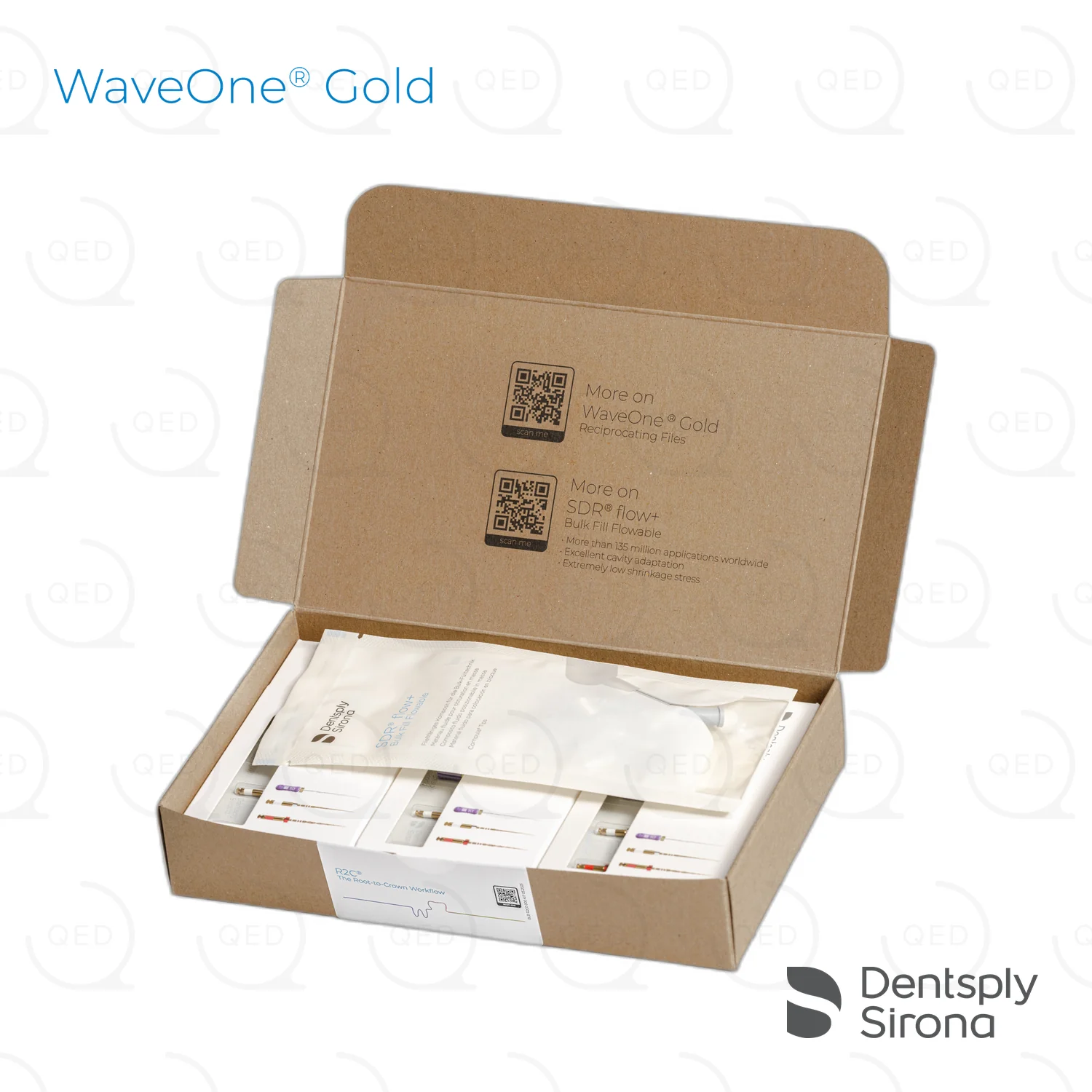
conform fit® gp · assorted
you do not know which size the canal wants until you have gauged it. that is an awkward truth for a stock cupboard: four boxes to hold, four to reorder, and three of them turning over slowly. the assorted box puts small, primary, medium and large together, so the size that turns up unannounced is already on the shelf.
this pack: 60 × conform fit® gutta-percha points, assorted – waveone® gold small, primary, medium and large
made by dentsply sirona
| four sizes | matched to the shapes the waveone® gold small, primary, medium and large files prepare (dentsply sirona) |
| tolerance | ±0.03 mm against iso 6877's ±0.05 mm – a manufacturing figure, internal testing (dentsply sirona) |
| technique | cold lateral and warm vertical alike (dentsply sirona) |
| box | 60 cones in total, colour-coded to the size system |
› for a mixed list – general practice, referral work, or anyone whose caseload will not stay one size.
› the kit box uses this one – the treatment solution box ships with an assorted box inside it.
› then reorder singly – once you know which size you actually spend, buy that one by the box.
› assorted or single sizes? assorted while the caseload is unpredictable or the range is new to you. once the primary box is the one that keeps emptying, single sizes stop you paying for cones you never seat.
› single sizes? small · primary · medium · large, 60 cones each.
| all four files | waveone® gold assorted 25 mm (4) · one of each size |
| glide path | waveone® gold glider 25 mm |
| dry | paper points primary (180) · and the other three sizes |
| whole system | treatment solution box |
conform fit® gutta-percha assorted · small, primary, medium and large · injection moulded, ±0.03 mm tolerance · cold and warm techniques · 60 cones · dentsply sirona · mfr code b00wggpf00ast
x-smart® go · dentsply sirona · handpiece sleeve, box of 500
a cordless motor is a piece of electronics you hold in a wet field. dentsply sirona are clear about what that means: the handpiece, the power bank, the measurement cable and the charger cannot be sterilised – they are wipe-disinfected between patients. the disposable sleeve is what stands between the motor body and the case, replaced for every patient, and the motor ships with ten of them. this box holds five hundred.
this pack: x-smart® go handpiece sleeve, disposable protective sleeves, 500 per box · ref b00xsgoac0009
dentsply sirona · single use, one per patient · the motor box ships 10
| fits | the x-smart® go motor handpiece |
| why | the handpiece is wipe-disinfect only – it is not a sterilisable part |
| use | single use · replace for each patient · check it is not torn after fitting |
| box | 500 · fifty times what comes in the motor box |
› fit it, then look at it. the instructions ask you to check after placement that the sleeve is not torn – a split one is worse than none, because it lets contamination in and hides it.
› remove and discard after use, then wipe the handpiece underneath with an approved aldehyde-free disinfectant. the sleeve does not replace the wipe; it shortens it.
› let the handpiece dry thoroughly before the next sleeve goes on – also the instructions' own wording.
› ten sleeves in the box is a fortnight at best. this is the consumable that runs out first on a new motor, and the one nobody orders until it has.
is this the sleeve that goes on the contra-angle?
no. that one is the sterilisable silicone contra-angle sleeve, and it also switches on apex location while shaping. this is the disposable barrier over the motor body. different part, different job, and most surgeries need both.
could i use a generic barrier sleeve?
the instructions ask for the manufacturer's original accessories, and a sleeve that does not fit the triangular handpiece properly is a sleeve that tears. at this price per patient it is not the place to improvise.
| motor and head | x-smart® go motor · 6:1 contra-angle |
| sterilisable parts | silicone sleeve (2) · lip clip (5) · file clip (2) |
| maintenance | f-type spray nozzle · charger |
| isolation | hysolate dam · clamp 26 · oraseal™ |
x-smart® go handpiece sleeve (500) · disposable barrier for the motor handpiece · single use, one per patient · the handpiece is wipe-disinfect only · dentsply sirona · ref b00xsgoac0009

protaper ultimate® · sx · 19 mm
restricted accesspre-enlarging the canal bodyrelocating the orifice
a canal orifice that sits hard against a root concavity, or a coronal third too tight to let the slider in cleanly. that is what the sx is for. dentsply sirona call it the auxiliary shaping file: optional, used before the slider, and only where the anatomy asks for it. sx comes in one length, 19 mm.
| 20/.03v tip / taper | 19 mm one length | 400 rpm 4–5.2 ncm |
sizes as dentsply sirona print them. motor settings from their fact file.
this pack: protaper ultimate® sx rotary file, 19 mm (pack of 6)
dentsply sirona · made by maillefer instruments holding sàrl, ballaigues, switzerland
› what it is for, in dentsply sirona’s words. step 3 of their procedure: the sx “may be used when there is restrictive space, to pre-enlarge the body of a canal, or to relocate the coronal-most aspect of a canal away from an external root concavity.”
› optional, not step one. the standard sequence is slider, shaper, finishers. the sx sits outside it, which is why it is sold on its own rather than inside the sequence packs.
› same motor settings as the rest. no change at the motor between the sx and the slider that follows.
1 access first. prepare an access that lets you identify each canal orifice (step 2).
2 sx where space is restricted. pre-enlarge the body of the canal or move its coronal aspect away from a concavity (step 3).
3 then the slider. in the presence of a lubricant, passively follow the canal to its terminus and determine working length (step 4).
paraphrased and quoted from the dentsply sirona, protaper ultimate® step-by-step procedure. your clinical judgement governs the case; the instructions for use govern the file.
| printed size | 020.003v – iso 20 tip, .03 variable taper |
| role | orifice opener, auxiliary shaping file |
| length | 19 mm only |
| motor | 400 rpm · 4–5.2 ncm |
| other lengths | 19 mm only |
| hand version | protaper ultimate® hand sx, 19 mm |
do i need the sx on every case?
no. dentsply sirona write it as something that may be used, and name the three situations. plenty of cases go straight to the slider.
why only 19 mm?
its job, as step 3 describes it, is in the body and coronal aspect of the canal. dentsply sirona list it at 19 mm only, in rotary and hand versions.
is it in the sequence packs?
no – those carry slider, shaper, f1, f2 and f3. the sx is bought separately, as here, and it is in the treatment solution box.
which motor?
400 rpm and 4–5.2 ncm for every file in the range. dentsply sirona list a protaper ultimate® library among the x-smart® go’s presets; on the x-smart® pro+ it is set as a custom sequence, and on the vdw.silver® in a dr’s choice slot (vdw manual: up to 4.1 ncm). all three are linked below.
when do i throw it away?
dentsply sirona’s procedure: inspect the flutes on every removal, and if you see unwinding, straightening or stretching, discard it and use a new file.
| next file | protaper ultimate® slider, 25 mm |
| patency | c-pilot® 010, 19 mm · a small stainless hand file, as the sequence asks for when the slider will not reach |
| lubricant | glyde™ file prep · named on dentsply sirona’s own sequence card |
| irrigants | chlorax 5.25% · chlorax 2% · endo-solution 17% edta |
| delivery | dentsply sirona irrigation needles (40) |
| activation | smartlite pro endoactivator® |
| dry | protaper ultimate® paper points matched to your last finisher (f1–f3 assortment shown) |
| fill and seal | conform fit® gutta-percha, f1–f3 assortment · ah plus®, neosealer® ezflo, 21 mm tips or proroot® bio sealer |
| coronal seal | sdr® flow+ refill, universal |
| motor | x-smart® go · x-smart® pro+ · vdw.silver® reciproc® |
protaper ultimate® sx, 19 mm (6) · 020.003v · niti rotary · 400 rpm, 4–5.2 ncm · dentsply sirona · ref bstpulr6190sx

protaper ultimate® · f1 · 21 mm
apical shapingcurved canalsdeep shapegauging the canal
which finisher do i stop at? dentsply sirona answer it with the file itself. take f1 to length, withdraw it and look at the apical flutes: loaded with dentine, the preparation is finished. clean and loose, go to f2. f1 is where that question is asked on every case. this is the 21 mm version – the same file on the shortest shaft, for short teeth or where opening is limited.
| 20/.07v tip / apical taper | gold heat treatment | +75% fatigue vs pt gold f1 |
sizes as dentsply sirona print them. motor settings from their fact file. comparisons are dentsply sirona laboratory data on file.
this pack: protaper ultimate® f1 rotary file, 21 mm (pack of 6)
dentsply sirona · made by maillefer instruments holding sàrl, ballaigues, switzerland
› deep shape, from the smallest finisher. dentsply sirona give every finisher an apical taper of at least 7% – f1 7%, f2 8%, f3 9% – to keep the protaper deep-shape philosophy of increased apical taper.
› against the protaper gold® f1. in dentsply sirona’s own laboratory testing, ultimate f1 showed 13% higher flexibility and 75% higher cyclic fatigue resistance than protaper gold® f1.
› gold heat-treated. post-grinding, like the shaper, f2 and f3.
1 after shaper and reconfirmed length. “select the finisher f1 (020.007v) and passively follow the canal to the wl, in one or more passes” (step 10).
2 inspect the apical flutes. “when loaded with dentinal debris, the preparation is finished.”
3 loose and clean? f2. if f1 is loose at length and its apical flutes are not loaded with debris, move to f2 in the same way (step 11).
paraphrased and quoted from the dentsply sirona, protaper ultimate® step-by-step procedure. your clinical judgement governs the case; the instructions for use govern the file.
| printed size | 020.007v – iso 20 tip, 7% apical taper, variable |
| heat treatment | gold, post-grinding |
| role | first finisher, and the gauge for the next |
| motor | 400 rpm · 4–5.2 ncm |
| other lengths | 25 mm · 31 mm |
| hand version | protaper ultimate® hand f1, 21 mm |
where the figures come from. dentsply sirona laboratory data on file (test 21/039), ultimate f1 against protaper gold® f1. not a published study.
how do i know f1 is enough?
dentsply sirona’s test is in the file: apical flutes loaded with dentine at length means finished; loose and clean means go to f2. the matched cone should then fit at working length.
which cone and point go with it?
the f1 ones. dentsply sirona match both to the colour and size of the last file used. finish on f1, fill with f1.
which motor?
400 rpm and 4–5.2 ncm for every file in the range. dentsply sirona list a protaper ultimate® library among the x-smart® go’s presets; on the x-smart® pro+ it is set as a custom sequence, and on the vdw.silver® in a dr’s choice slot (vdw manual: up to 4.1 ncm). all three are linked below.
when do i throw it away?
dentsply sirona’s procedure: inspect the flutes on every removal, and if you see unwinding, straightening or stretching, discard it and use a new file.
| if f1 is loose | protaper ultimate® f2, 21 mm |
| whole sequence | protaper ultimate® sequence, 21 mm (5) · slider, shaper, f1, f2, f3 |
| patency | c-pilot® 010, 21 mm · a small stainless hand file, as the sequence asks for when the slider will not reach |
| lubricant | glyde™ file prep · named on dentsply sirona’s own sequence card |
| irrigants | chlorax 5.25% · chlorax 2% · endo-solution 17% edta |
| delivery | dentsply sirona irrigation needles (40) |
| activation | smartlite pro endoactivator® |
| dry | protaper ultimate® paper points, f1 |
| fill and seal | conform fit® gutta-percha, f1 · ah plus®, neosealer® ezflo, 21 mm tips or proroot® bio sealer |
| coronal seal | sdr® flow+ refill, universal |
| motor | x-smart® go · x-smart® pro+ · vdw.silver® reciproc® |
protaper ultimate® f1, 21 mm (6) · 020.007v · gold heat treatment · niti rotary · 400 rpm, 4–5.2 ncm · dentsply sirona · ref bstpulr6210f1

protaper ultimate® · f2 · 21 mm
apical shapingcurved canalsdeep shape
f1 was loose at length, and its flutes came out clean. that is when dentsply sirona’s procedure picks up f2 – 25/.08v, gold heat-treated, and 30% more flexible than the protaper gold® f2 in their testing. this is the 21 mm version – the same file on the shortest shaft, for short teeth or where opening is limited.
| +30% flex vs pt gold f2 | +30% fatigue vs pt gold f2 | 400 rpm 4–5.2 ncm |
sizes as dentsply sirona print them. motor settings from their fact file. comparisons are dentsply sirona laboratory data on file.
this pack: protaper ultimate® f2 rotary file, 21 mm (pack of 6)
dentsply sirona · made by maillefer instruments holding sàrl, ballaigues, switzerland
› 8% at the apex. every finisher carries an apical taper of at least 7% to keep the protaper deep-shape philosophy; f2’s is 8%.
› stronger than the file it replaces. dentsply sirona’s laboratory testing: ultimate f2 showed 30% higher flexibility and 30% higher cyclic fatigue resistance than protaper gold® f2.
› gold heat-treated. post-grinding, for negotiating the curve without transportation or unwinding.
1 only after f1. if f1 is loose at length and its apical flutes are not loaded with debris, select f2 and follow the canal passively to working length (step 11).
2 inspect the flutes the same way. loaded with dentine: finished. loose and clean: go to f3 (step 12).
3 clean, irrigate, recapitulate. on removing any file, clean and inspect its flutes, irrigate, recapitulate with a size 10 file or the endoactivator®, then re-irrigate (step 13).
paraphrased and quoted from the dentsply sirona, protaper ultimate® step-by-step procedure. your clinical judgement governs the case; the instructions for use govern the file.
| printed size | 025.008v – iso 25 tip, 8% apical taper, variable |
| heat treatment | gold, post-grinding |
| role | second finisher |
| motor | 400 rpm · 4–5.2 ncm |
| other lengths | 25 mm · 31 mm |
| hand version | protaper ultimate® hand f2, 21 mm |
where the figures come from. dentsply sirona laboratory data on file (test 21/039), ultimate f2 against protaper gold® f2. not a published study.
do i have to go through f1 first?
in dentsply sirona’s procedure, yes – f1 is taken to length and gauged, and f2 follows only if f1 is loose and clean.
which cone and point?
the f2 ones. dentsply sirona match both to the colour and size of the last instrument used.
which motor?
400 rpm and 4–5.2 ncm for every file in the range. dentsply sirona list a protaper ultimate® library among the x-smart® go’s presets; on the x-smart® pro+ it is set as a custom sequence, and on the vdw.silver® in a dr’s choice slot (vdw manual: up to 4.1 ncm). all three are linked below.
when do i throw it away?
dentsply sirona’s procedure: inspect the flutes on every removal, and if you see unwinding, straightening or stretching, discard it and use a new file.
| if f2 is loose | protaper ultimate® f3, 21 mm |
| whole sequence | protaper ultimate® sequence, 21 mm (5) · slider, shaper, f1, f2, f3 |
| patency | c-pilot® 010, 21 mm · a small stainless hand file, as the sequence asks for when the slider will not reach |
| lubricant | glyde™ file prep · named on dentsply sirona’s own sequence card |
| irrigants | chlorax 5.25% · chlorax 2% · endo-solution 17% edta |
| delivery | dentsply sirona irrigation needles (40) |
| activation | smartlite pro endoactivator® |
| dry | protaper ultimate® paper points, f2 |
| fill and seal | conform fit® gutta-percha, f2 · ah plus®, neosealer® ezflo, 21 mm tips or proroot® bio sealer |
| coronal seal | sdr® flow+ refill, universal |
| motor | x-smart® go · x-smart® pro+ · vdw.silver® reciproc® |
protaper ultimate® f2, 21 mm (6) · 025.008v · gold heat treatment · niti rotary · 400 rpm, 4–5.2 ncm · dentsply sirona · ref bstpulr6210f2

protaper ultimate® · f3 · 21 mm
wider canalsapical shapingdeep shape
f2 came out loose and clean as well. then the canal is wider than f2’s tip, and dentsply sirona’s standard sequence finishes on f3: 30/.09v, gold heat-treated, the steepest apical taper of the three standard finishers. this is the 21 mm version – the same file on the shortest shaft, for short teeth or where opening is limited.
| 30/.09v tip / apical taper | gold heat treatment | 400 rpm 4–5.2 ncm |
sizes as dentsply sirona print them. motor settings from their fact file.
this pack: protaper ultimate® f3 rotary file, 21 mm (pack of 6)
dentsply sirona · made by maillefer instruments holding sàrl, ballaigues, switzerland
› 9% at the apex. the deep-shape principle carried to the largest standard finisher – f1 7%, f2 8%, f3 9% apical taper.
› why dentsply sirona want the shape deep. their fact file argues that removing debris and smear layer by irrigation is less predictable apically than coronally, and that apical shape influences it – so the finishers keep the apical taper up.
› gold heat-treated. post-grinding, the same as the shaper, f1 and f2.
1 only after f2. if f2 is loose at length and its apical flutes are not loaded with debris, select f3 and use it the same way (step 12).
2 finished when two things agree. “the preparation is finished when the apical extent of any finisher is loaded with debris, and the corresponding gutta-percha point fits at the wl” (step 15).
3 then disinfect and dry. 3-d disinfection with the endoactivator®, then matched absorbent points (steps 16–17).
paraphrased and quoted from the dentsply sirona, protaper ultimate® step-by-step procedure. your clinical judgement governs the case; the instructions for use govern the file.
| printed size | 030.009v – iso 30 tip, 9% apical taper, variable |
| heat treatment | gold, post-grinding |
| role | third and largest standard finisher |
| motor | 400 rpm · 4–5.2 ncm |
| other lengths | 25 mm · 31 mm |
| hand version | protaper ultimate® hand f3, 21 mm |
what if f3 is loose too?
dentsply sirona’s literature does not go past f3 in the standard sequence. the auxiliary fx and fxl have their own sequence, for larger and straighter canals – it is worth reading their procedure before switching mid-case.
which cone and point?
the f3 ones, matched to the colour and size of the last file used.
which motor?
400 rpm and 4–5.2 ncm for every file in the range. dentsply sirona list a protaper ultimate® library among the x-smart® go’s presets; on the x-smart® pro+ it is set as a custom sequence, and on the vdw.silver® in a dr’s choice slot (vdw manual: up to 4.1 ncm). all three are linked below.
when do i throw it away?
dentsply sirona’s procedure: inspect the flutes on every removal, and if you see unwinding, straightening or stretching, discard it and use a new file.
| whole sequence | protaper ultimate® sequence, 21 mm (5) · slider, shaper, f1, f2, f3 |
| patency | c-pilot® 010, 21 mm · a small stainless hand file, as the sequence asks for when the slider will not reach |
| lubricant | glyde™ file prep · named on dentsply sirona’s own sequence card |
| irrigants | chlorax 5.25% · chlorax 2% · endo-solution 17% edta |
| delivery | dentsply sirona irrigation needles (40) |
| activation | smartlite pro endoactivator® |
| dry | protaper ultimate® paper points, f3 |
| fill and seal | conform fit® gutta-percha, f3 · ah plus®, neosealer® ezflo, 21 mm tips or proroot® bio sealer |
| coronal seal | sdr® flow+ refill, universal |
| motor | x-smart® go · x-smart® pro+ · vdw.silver® reciproc® |
protaper ultimate® f3, 21 mm (6) · 030.009v · gold heat treatment · niti rotary · 400 rpm, 4–5.2 ncm · dentsply sirona · ref bstpulr6210f3
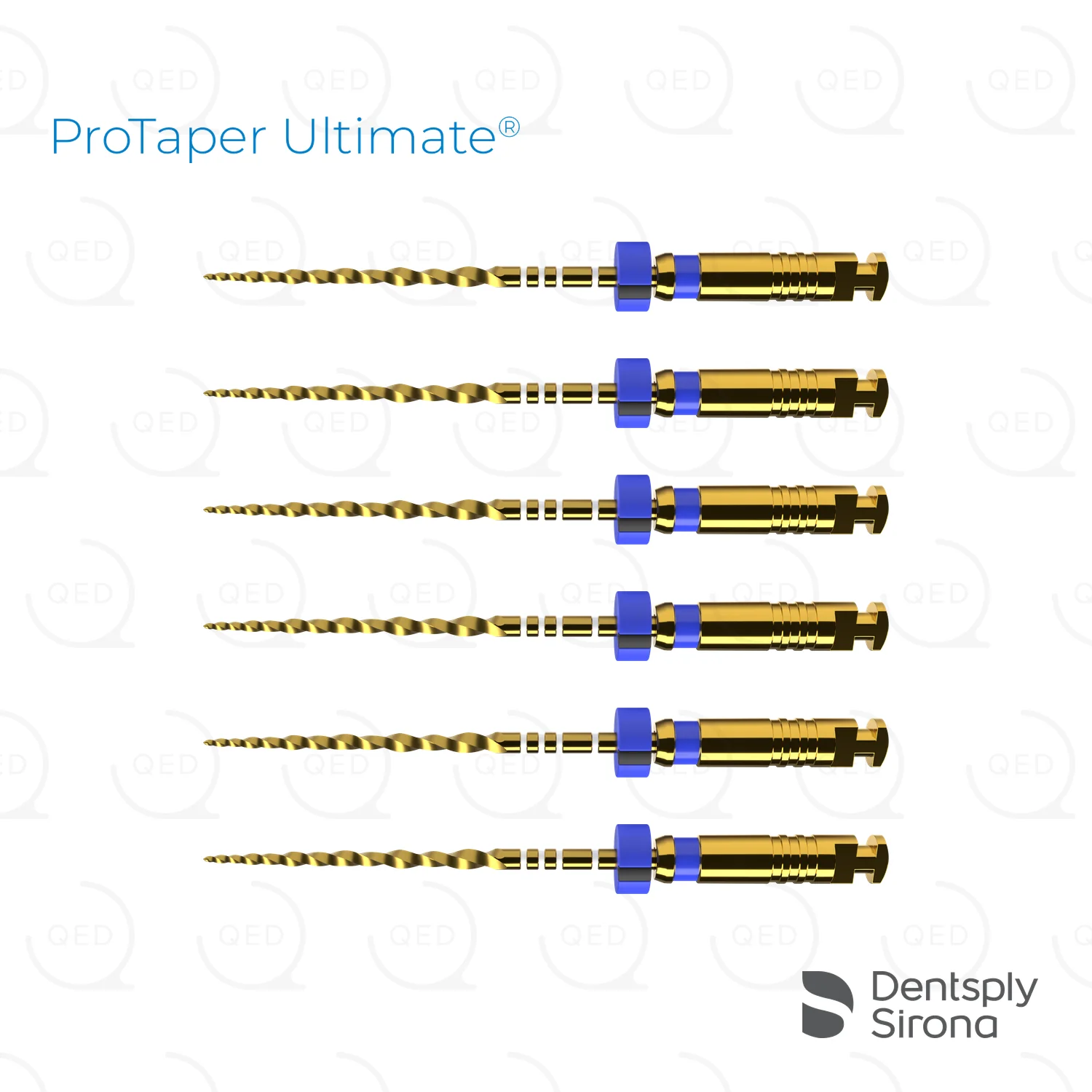
protaper ultimate® · fx · 21 mm
larger canalsstraighter canalsmaxillary centralspalatal and distal roots
a maxillary central incisor, some palatal or distal molar canals, a pathologic or iatrogenic defect. those are dentsply sirona’s own examples of the larger, straighter canals the standard finishers are not written for. they get a separate, shorter sequence: slider, then fx, then fxl if it is needed. this is the 21 mm version – the same file on the shortest shaft, for short teeth or where opening is limited.
| 35/.12v tip / taper | blue heat treatment | 400 rpm 4–5.2 ncm |
sizes as dentsply sirona print them. motor settings from their fact file.
this pack: protaper ultimate® fx rotary file, 21 mm (pack of 6)
dentsply sirona · made by maillefer instruments holding sàrl, ballaigues, switzerland
› where dentsply sirona say to use it. “in larger and straighter canals only, such as maxillary central incisors, some palatal or distal canals of molars, or when there is a pathologic or iatrogenic defect”.
› blue, not gold. fx and fxl are the only files in the range with dentsply sirona’s blue heat treatment.
› rotary or by hand, in the same step. their procedure names either a mechanically driven or a manual fx, so the hand version is a like-for-like alternative.
1 slider first, as usual. follow steps 1 to 6 of the standard procedure – slider to length, patency, irrigation.
2 then fx to length. once working length is established and patency confirmed, passively follow the canal to length in one or more passes and inspect the apical flutes. loaded with debris: finished.
3 loose and clean? fxl. use the fxl the same way. then disinfect, dry and fill as the standard sequence (steps 16–20).
paraphrased and quoted from the dentsply sirona, protaper ultimate® step-by-step procedure. your clinical judgement governs the case; the instructions for use govern the file.
| printed size | 035.012v – iso 35 tip, .12 variable taper |
| heat treatment | blue |
| role | auxiliary finisher, larger and straighter canals only |
| motor | 400 rpm · 4–5.2 ncm |
| other lengths | 25 mm · 31 mm |
| hand version | protaper ultimate® hand fx, 21 mm |
can i use fx in a curved molar canal?
dentsply sirona limit fx and fxl to larger and straighter canals, and give their examples. a curved canal belongs to the standard sequence.
does it replace the shaper?
in their larger-canal sequence, yes – it is slider, then fx. no shaper, no f1 to f3.
which motor?
400 rpm and 4–5.2 ncm for every file in the range. dentsply sirona list a protaper ultimate® library among the x-smart® go’s presets; on the x-smart® pro+ it is set as a custom sequence, and on the vdw.silver® in a dr’s choice slot (vdw manual: up to 4.1 ncm). all three are linked below.
when do i throw it away?
dentsply sirona’s procedure: inspect the flutes on every removal, and if you see unwinding, straightening or stretching, discard it and use a new file.
| if fx is loose | protaper ultimate® fxl, 21 mm |
| whole sequence | protaper ultimate® sequence, 21 mm (5) · slider, shaper, f1, f2, f3 |
| patency | c-pilot® 010, 21 mm · a small stainless hand file, as the sequence asks for when the slider will not reach |
| lubricant | glyde™ file prep · named on dentsply sirona’s own sequence card |
| irrigants | chlorax 5.25% · chlorax 2% · endo-solution 17% edta |
| delivery | dentsply sirona irrigation needles (40) |
| activation | smartlite pro endoactivator® |
| dry | protaper ultimate® paper points, fx |
| fill and seal | conform fit® gutta-percha, fx · ah plus®, neosealer® ezflo, 21 mm tips or proroot® bio sealer |
| coronal seal | sdr® flow+ refill, universal |
| motor | x-smart® go · x-smart® pro+ · vdw.silver® reciproc® |
protaper ultimate® fx, 21 mm (6) · 035.012v · blue heat treatment · niti rotary · 400 rpm, 4–5.2 ncm · dentsply sirona · ref bstpulr6210fx
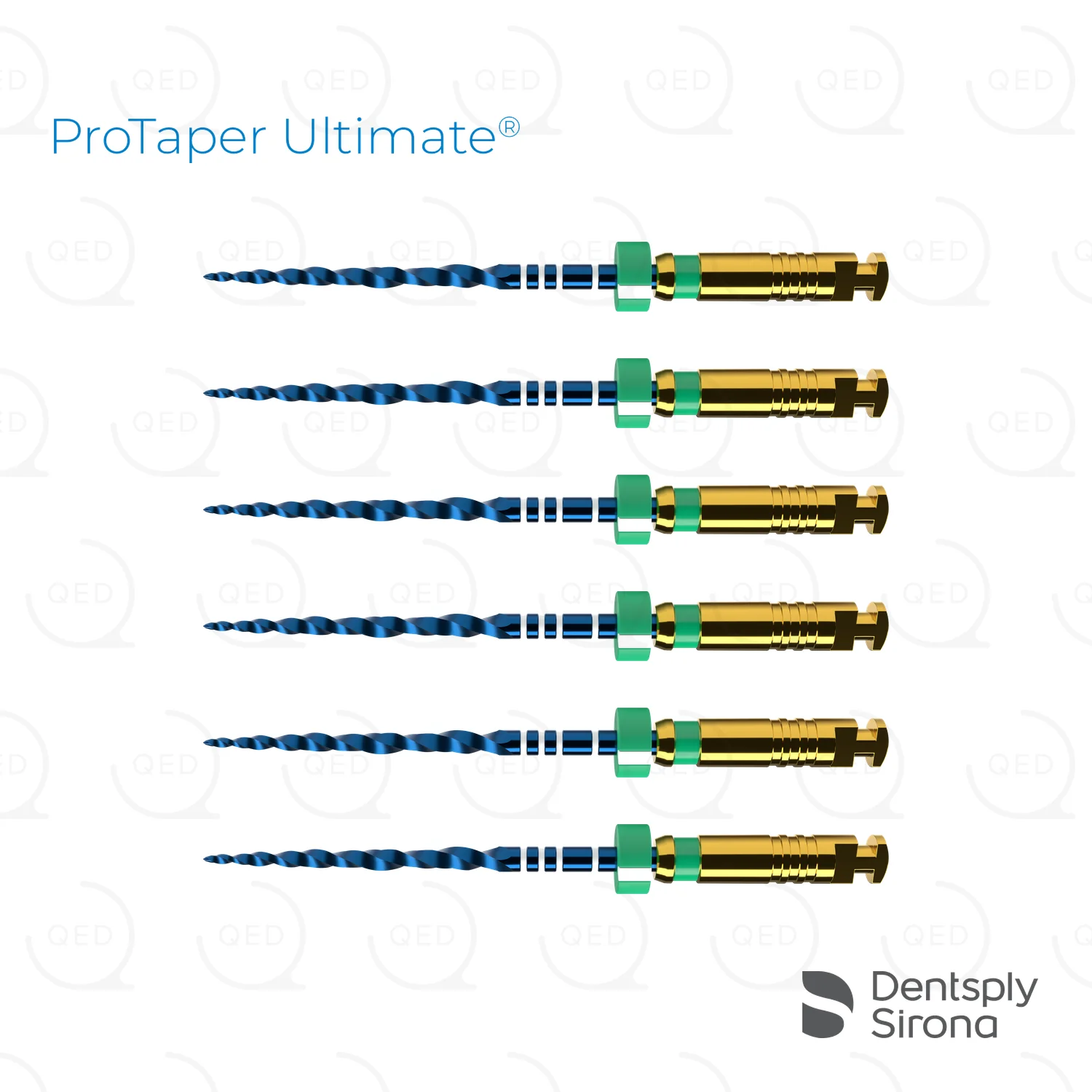
protaper ultimate® · shaper · 21 mm
coronal shapingdebris removalcurved canals
protaper ultimate® splits the shaping between two kinds of file. the finishers make the apical shape; the shaper cuts and clears the coronal two-thirds along the path the slider made, and hands a clean, open canal to whichever finisher comes next. this is the 21 mm version – the same file on the shortest shaft, for short teeth or where opening is limited.
| 20/.04v tip / taper | gold heat treatment | 400 rpm 4–5.2 ncm |
sizes as dentsply sirona print them. motor settings from their fact file.
this pack: protaper ultimate® shaper rotary file, 21 mm (pack of 6)
dentsply sirona · made by maillefer instruments holding sàrl, ballaigues, switzerland
› its job, as dentsply sirona describe it. “the shaper’s enhanced cutting efficiency and hauling of debris in the coronal two-thirds provides an easy and safe access to the apical third for the finishers.”
› gold heat-treated after grinding. the same treatment as f1, f2 and f3, which dentsply sirona apply so the files negotiate the curve “without transportation and without unwinding issues.”
› cross-section tuned along its length. a parallelogram section with acute angles that vary along the file, so cutting efficiency matches the expected workload in each part of the canal.
1 after the slider and an irrigation pass. in the presence of naocl, advance the shaper along the slidepath, in one or more passes, to working length (step 7).
2 irrigate and activate. on removal, irrigate, activate with the endoactivator® to break up debris, then re-irrigate (step 8).
3 reconfirm working length. “especially in curved canals” (step 9), before f1.
paraphrased and quoted from the dentsply sirona, protaper ultimate® step-by-step procedure. your clinical judgement governs the case; the instructions for use govern the file.
| printed size | 020.004v – iso 20 tip, .04 variable taper |
| heat treatment | gold, post-grinding |
| role | cutting and debris removal in the coronal two-thirds |
| motor | 400 rpm · 4–5.2 ncm |
| other lengths | 25 mm · 31 mm |
| hand version | protaper ultimate® hand shaper, 21 mm |
does the shaper go to full working length?
yes, in dentsply sirona’s procedure it advances along the slidepath until working length is reached. its taper is what keeps the cutting work in the coronal two-thirds.
is it used in the larger-canal sequence?
no. for larger, straighter canals dentsply sirona go slider, then fx, then fxl if needed – no shaper.
which motor?
400 rpm and 4–5.2 ncm for every file in the range. dentsply sirona list a protaper ultimate® library among the x-smart® go’s presets; on the x-smart® pro+ it is set as a custom sequence, and on the vdw.silver® in a dr’s choice slot (vdw manual: up to 4.1 ncm). all three are linked below.
when do i throw it away?
dentsply sirona’s procedure: inspect the flutes on every removal, and if you see unwinding, straightening or stretching, discard it and use a new file.
| next file | protaper ultimate® f1, 21 mm |
| whole sequence | protaper ultimate® sequence, 21 mm (5) · slider, shaper, f1, f2, f3 |
| patency | c-pilot® 010, 21 mm · a small stainless hand file, as the sequence asks for when the slider will not reach |
| lubricant | glyde™ file prep · named on dentsply sirona’s own sequence card |
| irrigants | chlorax 5.25% · chlorax 2% · endo-solution 17% edta |
| delivery | dentsply sirona irrigation needles (40) |
| activation | smartlite pro endoactivator® |
| dry | protaper ultimate® paper points matched to your last finisher (f1–f3 assortment shown) |
| fill and seal | conform fit® gutta-percha, f1–f3 assortment · ah plus®, neosealer® ezflo, 21 mm tips or proroot® bio sealer |
| coronal seal | sdr® flow+ refill, universal |
| motor | x-smart® go · x-smart® pro+ · vdw.silver® reciproc® |
protaper ultimate® shaper, 21 mm (6) · 020.004v · gold heat treatment · niti rotary · 400 rpm, 4–5.2 ncm · dentsply sirona · ref bstpulr6210sh
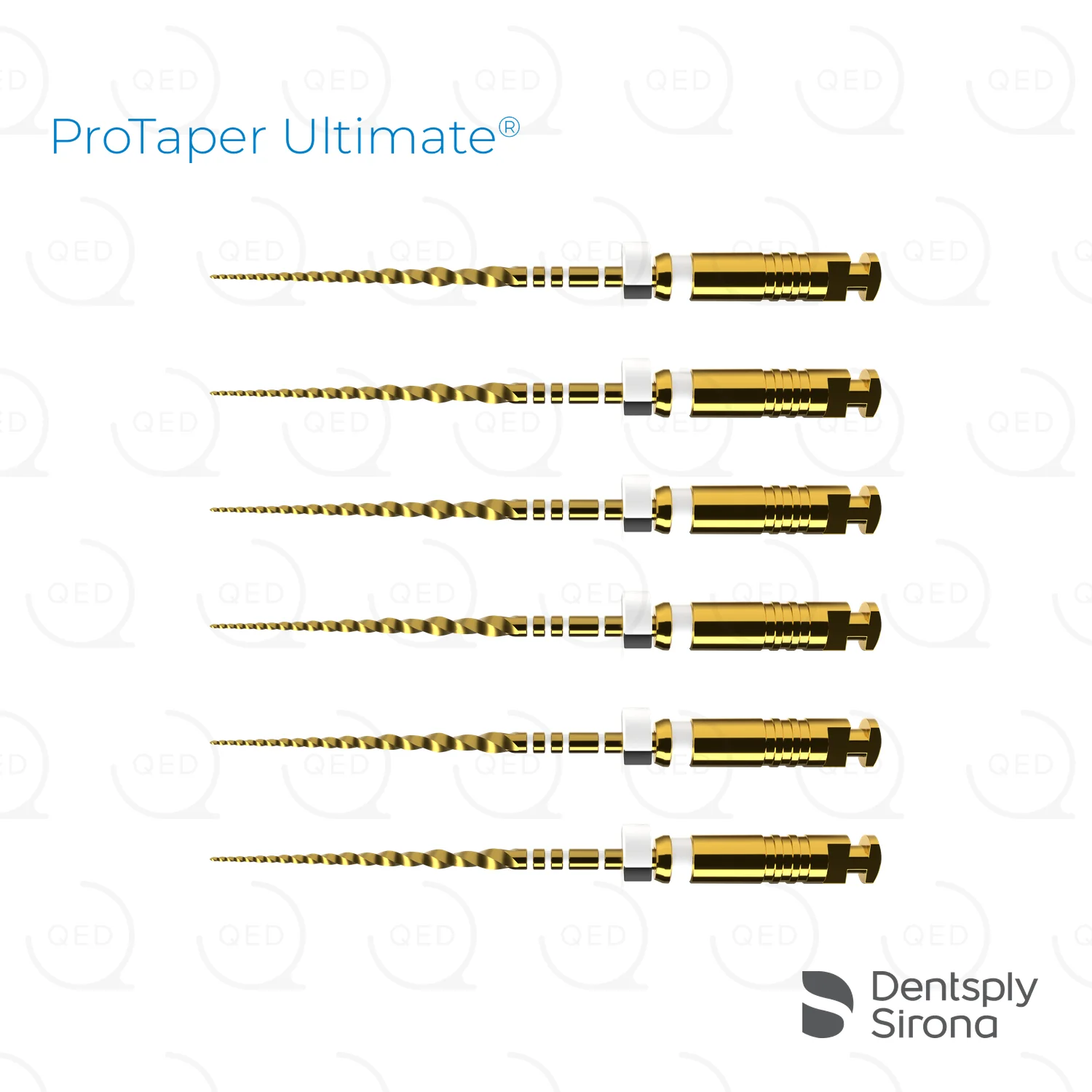
protaper ultimate® · slider · 21 mm
glide pathsecuring the canal pathrestrictive dentine and calcifications
scouting every canal with a hand file before the rotary goes in is the step the slider is designed to take over. it is built stiffer than the files after it so it can secure the canal path itself. in dentsply sirona’s own user evaluation it reached the terminus without a k-file in 63% of canals – and their procedure tells you exactly what to do in the rest. this is the 21 mm version – the same file on the shortest shaft, for short teeth or where opening is limited.
| 16/.02v tip / taper | m-wire® heat treatment | 400 rpm 4–5.2 ncm |
sizes as dentsply sirona print them. motor settings from their fact file.
this pack: protaper ultimate® slider rotary file, 21 mm (pack of 6)
dentsply sirona · made by maillefer instruments holding sàrl, ballaigues, switzerland
› deliberately a little rigid. dentsply sirona’s fact file: the m-wire® pre-treatment “allows a certain rigidity of the file to secure the pathway of the canal and to remove restrictive dentin and other calcifications without the systematic need of a k-file.”
› treated differently from the files after it. the slider’s treatment is applied during wire production; the shaper and finishers are heat-treated after grinding.
› used in both sequences. slider then shaper for the standard sequence; slider then fx for larger, straighter canals.
1 lubricant in, then slider. “select the slider and passively follow the canal, in one or more passes, to its terminus.” determine working length with an apex locator and a radiograph, then confirm patency (step 4).
2 if it will not reach, go to a hand file. “select a small-sized manual stainless steel (sst) hand file”, establish length, confirm patency and verify the slidepath – then repeat the slider (step 5).
3 irrigate, then the shaper. irrigation needle to the coronal two-thirds (step 6), then the shaper along the slidepath to working length (step 7).
paraphrased and quoted from the dentsply sirona, protaper ultimate® step-by-step procedure. your clinical judgement governs the case; the instructions for use govern the file.
| printed size | 016.002v – iso 16 tip, .02 variable taper |
| heat treatment | m-wire®, applied during wire production |
| role | glide path to the canal terminus |
| motor | 400 rpm · 4–5.2 ncm |
| other lengths | 25 mm · 31 mm |
| hand version | protaper ultimate® hand slider, 21 mm |
what the 63% figure is. a dentsply sirona user evaluation: 21 dentists, 210 canals. 95% said the slider gave a smooth, reproducible pathway to the apical terminus, without a k-file in 63% of cases. it is internal data on file rather than a published study, and it is a majority, not every canal – which is why step 5 exists.
so i never need a hand file first?
that is not what dentsply sirona say. the slider can start the glide path in the majority of canals; where it does not easily reach the terminus, the procedure goes to a small stainless hand file, then back to the slider. keep one on the tray.
why is the slider not gold like the others?
different job. the fact file puts its m-wire® treatment down to the rigidity needed to secure the canal and remove restrictive dentine; the shaper and finishers are gold- or blue-treated for flexibility in the curve.
which motor?
400 rpm and 4–5.2 ncm for every file in the range. dentsply sirona list a protaper ultimate® library among the x-smart® go’s presets; on the x-smart® pro+ it is set as a custom sequence, and on the vdw.silver® in a dr’s choice slot (vdw manual: up to 4.1 ncm). all three are linked below.
when do i throw it away?
dentsply sirona’s procedure: inspect the flutes on every removal, and if you see unwinding, straightening or stretching, discard it and use a new file.
| next file | protaper ultimate® shaper, 21 mm |
| whole sequence | protaper ultimate® sequence, 21 mm (5) · slider, shaper, f1, f2, f3 |
| patency | c-pilot® 010, 21 mm · a small stainless hand file, as the sequence asks for when the slider will not reach |
| lubricant | glyde™ file prep · named on dentsply sirona’s own sequence card |
| irrigants | chlorax 5.25% · chlorax 2% · endo-solution 17% edta |
| delivery | dentsply sirona irrigation needles (40) |
| activation | smartlite pro endoactivator® |
| dry | protaper ultimate® paper points matched to your last finisher (f1–f3 assortment shown) |
| fill and seal | conform fit® gutta-percha, f1–f3 assortment · ah plus®, neosealer® ezflo, 21 mm tips or proroot® bio sealer |
| coronal seal | sdr® flow+ refill, universal |
| motor | x-smart® go · x-smart® pro+ · vdw.silver® reciproc® |
protaper ultimate® slider, 21 mm (6) · 016.002v · m-wire® heat treatment · niti rotary · 400 rpm, 4–5.2 ncm · dentsply sirona · ref bstpulr6210sl
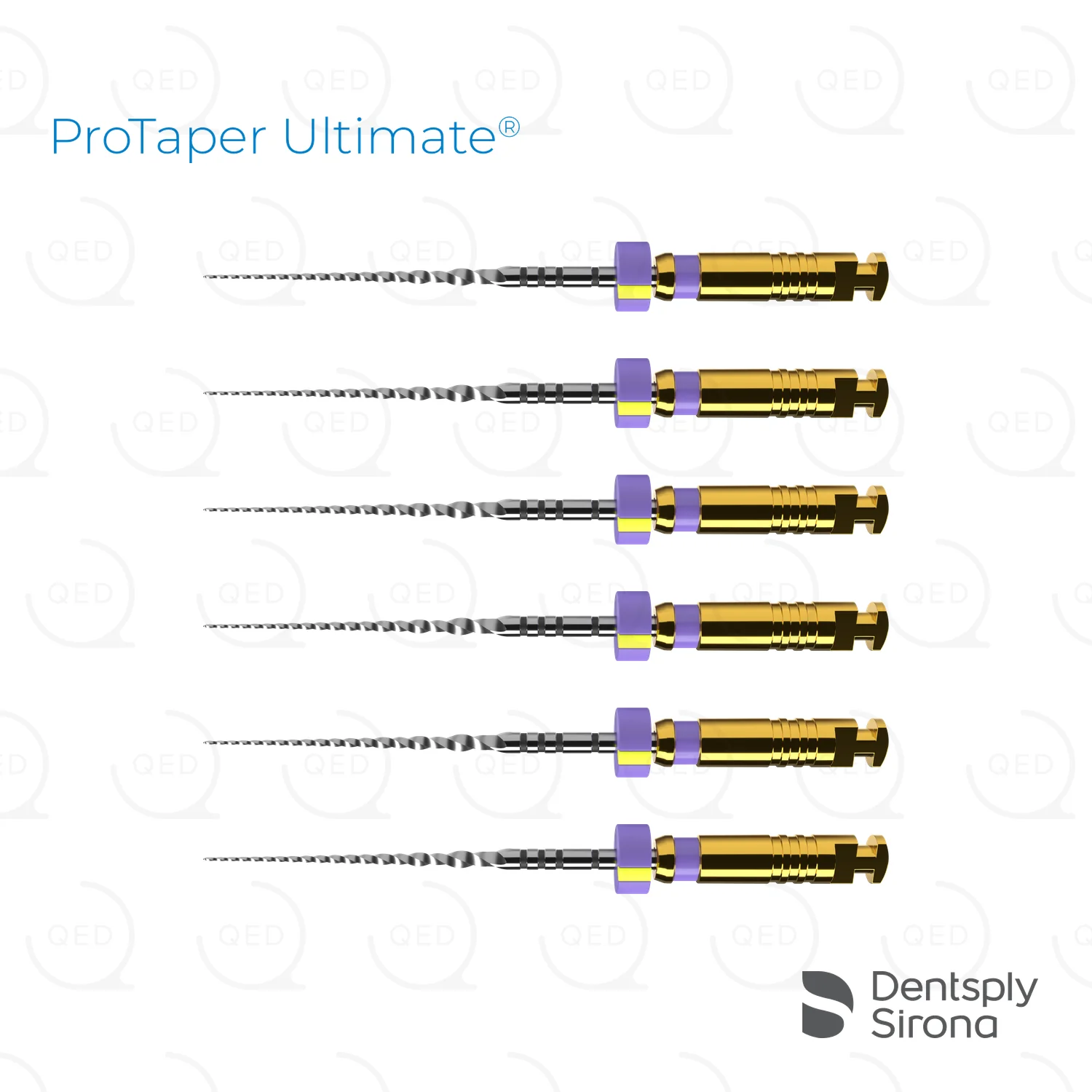
protaper ultimate® · fxl · 21 mm
large canalsstraight canalsmaxillary centralsdefects
fx went to length and its flutes came out clean. the canal is larger still, and dentsply sirona’s larger-canal sequence goes one size up: fxl, an iso 50 tip on a .10 variable taper, blue heat-treated. this is the 21 mm version – the same file on the shortest shaft, for short teeth or where opening is limited.
| 50/.10v tip / taper | blue heat treatment | 400 rpm 4–5.2 ncm |
sizes as dentsply sirona print them. motor settings from their fact file.
this pack: protaper ultimate® fxl rotary file, 21 mm (pack of 6)
dentsply sirona · made by maillefer instruments holding sàrl, ballaigues, switzerland
› larger and straighter canals only. the same limit dentsply sirona put on fx: maxillary central incisors, some palatal or distal molar canals, or a pathologic or iatrogenic defect.
› the end of the range. nothing in the protaper ultimate® range goes larger than a 50 tip.
› blue heat-treated, rotary or hand. dentsply sirona name either a mechanically driven or a manual fxl in their procedure.
1 after fx, never instead of it. if fx is loose at length and its apical flutes are not loaded with debris, select fxl and use it the same way.
2 finished when two things agree. the apical extent of the finisher is loaded with debris, and the corresponding gutta-percha point fits at working length.
3 then as the standard sequence. disinfect, dry with matched points, fill and seal (steps 16–20).
paraphrased and quoted from the dentsply sirona, protaper ultimate® step-by-step procedure. your clinical judgement governs the case; the instructions for use govern the file.
| printed size | 050.010v – iso 50 tip, .10 variable taper |
| heat treatment | blue |
| role | largest auxiliary finisher, larger and straighter canals only |
| motor | 400 rpm · 4–5.2 ncm |
| other lengths | 25 mm · 31 mm |
| hand version | protaper ultimate® hand fxl, 21 mm |
why is the taper lower than the fx?
the .10 taper sits on a much larger 50 tip – the file is still the biggest in the range. dentsply sirona publish the size and taper, not a reason, so we will not invent one.
is there a matched cone?
yes – conform fit® fxl gutta-percha and fxl absorbent points, both linked below.
which motor?
400 rpm and 4–5.2 ncm for every file in the range. dentsply sirona list a protaper ultimate® library among the x-smart® go’s presets; on the x-smart® pro+ it is set as a custom sequence, and on the vdw.silver® in a dr’s choice slot (vdw manual: up to 4.1 ncm). all three are linked below.
when do i throw it away?
dentsply sirona’s procedure: inspect the flutes on every removal, and if you see unwinding, straightening or stretching, discard it and use a new file.
| whole sequence | protaper ultimate® sequence, 21 mm (5) · slider, shaper, f1, f2, f3 |
| patency | c-pilot® 010, 21 mm · a small stainless hand file, as the sequence asks for when the slider will not reach |
| lubricant | glyde™ file prep · named on dentsply sirona’s own sequence card |
| irrigants | chlorax 5.25% · chlorax 2% · endo-solution 17% edta |
| delivery | dentsply sirona irrigation needles (40) |
| activation | smartlite pro endoactivator® |
| dry | protaper ultimate® paper points, fxl |
| fill and seal | conform fit® gutta-percha, fxl · ah plus®, neosealer® ezflo, 21 mm tips or proroot® bio sealer |
| coronal seal | sdr® flow+ refill, universal |
| motor | x-smart® go · x-smart® pro+ · vdw.silver® reciproc® |
protaper ultimate® fxl, 21 mm (6) · 050.010v · blue heat treatment · niti rotary · 400 rpm, 4–5.2 ncm · dentsply sirona · ref bstpulr621fxl

protaper ultimate® · f1 · 25 mm
apical shapingcurved canalsdeep shapegauging the canal
which finisher do i stop at? dentsply sirona answer it with the file itself. take f1 to length, withdraw it and look at the apical flutes: loaded with dentine, the preparation is finished. clean and loose, go to f2. f1 is where that question is asked on every case. this is the 25 mm version, the middle of the three lengths.
| 20/.07v tip / apical taper | gold heat treatment | +75% fatigue vs pt gold f1 |
sizes as dentsply sirona print them. motor settings from their fact file. comparisons are dentsply sirona laboratory data on file.
this pack: protaper ultimate® f1 rotary file, 25 mm (pack of 6)
dentsply sirona · made by maillefer instruments holding sàrl, ballaigues, switzerland
› deep shape, from the smallest finisher. dentsply sirona give every finisher an apical taper of at least 7% – f1 7%, f2 8%, f3 9% – to keep the protaper deep-shape philosophy of increased apical taper.
› against the protaper gold® f1. in dentsply sirona’s own laboratory testing, ultimate f1 showed 13% higher flexibility and 75% higher cyclic fatigue resistance than protaper gold® f1.
› gold heat-treated. post-grinding, like the shaper, f2 and f3.
1 after shaper and reconfirmed length. “select the finisher f1 (020.007v) and passively follow the canal to the wl, in one or more passes” (step 10).
2 inspect the apical flutes. “when loaded with dentinal debris, the preparation is finished.”
3 loose and clean? f2. if f1 is loose at length and its apical flutes are not loaded with debris, move to f2 in the same way (step 11).
paraphrased and quoted from the dentsply sirona, protaper ultimate® step-by-step procedure. your clinical judgement governs the case; the instructions for use govern the file.
| printed size | 020.007v – iso 20 tip, 7% apical taper, variable |
| heat treatment | gold, post-grinding |
| role | first finisher, and the gauge for the next |
| motor | 400 rpm · 4–5.2 ncm |
| other lengths | 21 mm · 31 mm |
| hand version | protaper ultimate® hand f1, 25 mm |
where the figures come from. dentsply sirona laboratory data on file (test 21/039), ultimate f1 against protaper gold® f1. not a published study.
how do i know f1 is enough?
dentsply sirona’s test is in the file: apical flutes loaded with dentine at length means finished; loose and clean means go to f2. the matched cone should then fit at working length.
which cone and point go with it?
the f1 ones. dentsply sirona match both to the colour and size of the last file used. finish on f1, fill with f1.
which motor?
400 rpm and 4–5.2 ncm for every file in the range. dentsply sirona list a protaper ultimate® library among the x-smart® go’s presets; on the x-smart® pro+ it is set as a custom sequence, and on the vdw.silver® in a dr’s choice slot (vdw manual: up to 4.1 ncm). all three are linked below.
when do i throw it away?
dentsply sirona’s procedure: inspect the flutes on every removal, and if you see unwinding, straightening or stretching, discard it and use a new file.
| if f1 is loose | protaper ultimate® f2, 25 mm |
| whole sequence | protaper ultimate® sequence, 25 mm (5) · slider, shaper, f1, f2, f3 |
| patency | c-pilot® 010, 25 mm · a small stainless hand file, as the sequence asks for when the slider will not reach |
| lubricant | glyde™ file prep · named on dentsply sirona’s own sequence card |
| irrigants | chlorax 5.25% · chlorax 2% · endo-solution 17% edta |
| delivery | dentsply sirona irrigation needles (40) |
| activation | smartlite pro endoactivator® |
| dry | protaper ultimate® paper points, f1 |
| fill and seal | conform fit® gutta-percha, f1 · ah plus®, neosealer® ezflo, 25 mm tips or proroot® bio sealer |
| coronal seal | sdr® flow+ refill, universal |
| motor | x-smart® go · x-smart® pro+ · vdw.silver® reciproc® |
protaper ultimate® f1, 25 mm (6) · 020.007v · gold heat treatment · niti rotary · 400 rpm, 4–5.2 ncm · dentsply sirona · ref bstpulr6250f1

protaper ultimate® · finisher f2 · 25 mm, pack of 6
apical shapingcurved canalsdeep shapestandard sequence
f1 went to length loose, and its flutes came out clean. dentsply sirona’s procedure picks up f2: an iso 25 tip on an 8% apical taper, gold heat-treated, and in their laboratory testing 30% more flexible and 30% more resistant to cyclic fatigue than the protaper gold® f2 it follows.
| +30% flex vs pt gold f2 | +30% fatigue vs pt gold f2 | 400 rpm 4–5.2 ncm |
dentsply sirona laboratory data on file (test 21/039), protaper ultimate® f2 against protaper gold® f2. motor settings from their fact file.
this pack: protaper ultimate® f2 rotary file, 25 mm (pack of 6)
dentsply sirona · made by maillefer instruments holding sàrl, ballaigues, switzerland
since its first introduction 20 years ago, each generation of protaper from dentsply sirona has stood for a trusted, reliable and predictable preparation method that enables excellent clinical outcomes for patients worldwide.
dentsply sirona, protaper ultimate® launch copy
the idea that has survived every generation is what dentsply sirona call deep shape – increased apical taper. their fact file sets out why: removing debris and smear layer by irrigation is less predictable in the apical part of the canal than the coronal, and the shape of the apical canal influences it. so every protaper ultimate® finisher carries an apical taper of at least 7%, and f2’s is 8%.
what is new in the fourth generation is how the work is divided. in dentsply sirona’s words: “the slider is used to create a reproducible pathway to the apical/canal terminus and paves the way for the shaper. the shaper’s enhanced cutting efficiency and hauling of debris in the coronal two-thirds provides an easy and safe access to the apical third for the finishers. the finishers finally create the protaper ultimate® deep shape.”
each file is treated for the job it does. the slider is m-wire®, treated during wire production for a certain rigidity to secure the canal path. the shaper and f1 to f3 are gold heat-treated after grinding, for the curve. fx and fxl are blue. every file runs at the same motor setting.
| sx | sx 19 mm · 020.003v · orifice opener, optional |
| slider | slider 25 mm · 016.002v · m-wire® · glide path to the terminus |
| shaper | shaper 25 mm · 020.004v · gold · coronal two-thirds |
| f1 | f1 25 mm · 020.007v · gold · 7% apical |
| f2 | this page · 025.008v · gold · 8% apical |
| f3 | f3 25 mm · 030.009v · gold · 9% apical |
| fx | fx 25 mm · 035.012v · blue · larger, straighter canals only |
| fxl | fxl 25 mm · 050.010v · blue · larger, straighter canals only |
› a parallelogram cross-section that changes along the file. variable acute angles let dentsply sirona tune cutting efficiency to the workload in each part of the canal, which they say also helps flexibility and unwinding resistance.
› off-set, not centred. alternating off-set machining puts the file’s centre of mass off its axis of rotation – less stress during cutting, more room for debris.
dentsply sirona tested protaper ultimate® against its own predecessor – a file we also stock, so the fair comparison. f2: +30% flexibility and +30% cyclic fatigue resistance. f1: +13% and +75%. laboratory data on file (test 21/039), not a published study. in their user evaluation of 21 dentists and 210 canals, 95% reported a sufficient deep shape for disinfection and 85–90% sufficient flexibility and unwinding resistance – internal data, labelled as such.
1 slider to the terminus. in the presence of a lubricant, passively, in one or more passes. working length by apex locator and radiograph; confirm patency. if the slider does not easily reach, a small stainless steel hand file first, then the slider again.
2 irrigate. irrigation needle in gently at the orifice, irrigating abundantly down to the coronal two-thirds.
3 shaper to length. in the presence of naocl, along the slidepath. on removal, irrigate, activate with the endoactivator®, re-irrigate. reconfirm working length.
4 f1, then read it. passively to length. apical flutes loaded with dentine: finished.
5 loose and clean? f2. this file, the same way. loaded: finished. loose and clean again: f3.
6 finished when the cone agrees. “the preparation is finished when the apical extent of any finisher is loaded with debris, and the corresponding gutta-percha point fits at the wl.”
summarised and quoted from the dentsply sirona, protaper ultimate® step-by-step procedure (linked under downloads). throughout: cradle the handpiece, avoid pushing, let the files progress passively; brushing outward or pecking lightly inward. your clinical judgement governs the case; the instructions for use govern the file.
dentsply sirona write irrigation into the procedure – after the slider, after the shaper, after every finisher – with recapitulation using a size 10 file or the endoactivator®, and a final 3-d disinfection before drying. a shorter file sequence shortens the mechanical part of the case, not the chemical one.
| irrigants | chlorax 5.25% · chlorax 2% · endo-solution 17% edta |
| delivery | dentsply sirona irrigation needles (40) · the needle named in the sequence |
| activation | smartlite pro endoactivator® complete kit · medium tips |
dentsply sirona’s obturation step is specific: dedicated protaper ultimate® absorbent points and conform fit® gutta-percha matched to the colour code and size of the last instrument used to prepare the canal. finished on f2, that is f2 paper points and f2 conform fit® cones.
the sealer goes with the cone, in the same step. on a dentsply sirona file, ah plus® is the manufacturer’s own – the epoxy sealer every other one is measured against. if you work bioceramic, neosealer® ezflo comes premixed with fine 29-gauge navitip™ cannulas, 25 mm to match this file – avalon biomed’s instructions take the tip no further than the middle third and express the sealer with a steady outward movement. resin or bioceramic is a real choice of technique rather than a ranking – we carry both because both are right in different hands.
then the coronal seal. the apical seal is only half the job: sdr® flow+ refill, universal places in 4 mm increments with one cure.
is f2 the file i will use most?
dentsply sirona’s procedure reaches f2 only when f1 is loose at length, and goes to f3 when f2 is too. the sequence pack puts all three on the tray until you know your own pattern.
do i still need a hand file before the slider?
not systematically. in dentsply sirona’s user evaluation the slider reached the terminus without a k-file in 63% of canals; where it does not easily reach, their procedure goes to a small stainless hand file – c-pilot® 010, 25 mm – then back to the slider.
which motor?
400 rpm and 4–5.2 ncm for every file in the range. dentsply sirona list a protaper ultimate® library among the x-smart® go’s presets; on the x-smart® pro+ it is set as a custom sequence, and on the vdw.silver® in a dr’s choice slot (vdw manual: up to 4.1 ncm).
when do i throw a file away?
inspect the flutes each time the file comes out. dentsply sirona: if deformation – unwinding, straightening or stretching – is noted, discard it and use a new file.
| if f2 is loose | protaper ultimate® f3, 25 mm |
| other versions | 21 mm · 31 mm · hand f2, 25 mm |
| patency | c-pilot® 010, 25 mm · a small stainless hand file, as the sequence asks for when the slider will not reach |
| dry | protaper ultimate® paper points, f2 |
| fill and seal | conform fit® gutta-percha, f2 · ah plus®, neosealer® ezflo, 25 mm tips or proroot® bio sealer |
| coronal seal | sdr® flow+ refill, universal |
| motor | x-smart® go · x-smart® pro+ · vdw.silver® reciproc® |
| starting out | protaper ultimate® treatment solution box |
› protaper ultimate® step-by-step guide (pdf, 0.4 mb, dentsply sirona, 2021) – both sequences and the full 20-step procedure. printed at launch: the smartlite pro endoactivator® it lists as coming soon is now in stock, and the sealer it names is no longer available – ah plus® is dentsply sirona’s current epoxy sealer.
worth knowing: fx and fxl are for larger and straighter canals only. the figures on this page are dentsply sirona’s own laboratory and user-evaluation data, not published studies. full indications, warnings and reprocessing are in the instructions for use.
protaper ultimate® f2, 25 mm (6) · 025.008v · iso 25, 8% apical taper, variable · gold heat treatment · parallelogram cross-section, off-set · niti rotary · 400 rpm, 4–5.2 ncm · dentsply sirona · ref bstpulr6250f2

protaper ultimate® · f3 · 25 mm
wider canalsapical shapingdeep shape
f2 came out loose and clean as well. then the canal is wider than f2’s tip, and dentsply sirona’s standard sequence finishes on f3: 30/.09v, gold heat-treated, the steepest apical taper of the three standard finishers. this is the 25 mm version, the middle of the three lengths.
| 30/.09v tip / apical taper | gold heat treatment | 400 rpm 4–5.2 ncm |
sizes as dentsply sirona print them. motor settings from their fact file.
this pack: protaper ultimate® f3 rotary file, 25 mm (pack of 6)
dentsply sirona · made by maillefer instruments holding sàrl, ballaigues, switzerland
› 9% at the apex. the deep-shape principle carried to the largest standard finisher – f1 7%, f2 8%, f3 9% apical taper.
› why dentsply sirona want the shape deep. their fact file argues that removing debris and smear layer by irrigation is less predictable apically than coronally, and that apical shape influences it – so the finishers keep the apical taper up.
› gold heat-treated. post-grinding, the same as the shaper, f1 and f2.
1 only after f2. if f2 is loose at length and its apical flutes are not loaded with debris, select f3 and use it the same way (step 12).
2 finished when two things agree. “the preparation is finished when the apical extent of any finisher is loaded with debris, and the corresponding gutta-percha point fits at the wl” (step 15).
3 then disinfect and dry. 3-d disinfection with the endoactivator®, then matched absorbent points (steps 16–17).
paraphrased and quoted from the dentsply sirona, protaper ultimate® step-by-step procedure. your clinical judgement governs the case; the instructions for use govern the file.
| printed size | 030.009v – iso 30 tip, 9% apical taper, variable |
| heat treatment | gold, post-grinding |
| role | third and largest standard finisher |
| motor | 400 rpm · 4–5.2 ncm |
| other lengths | 21 mm · 31 mm |
| hand version | protaper ultimate® hand f3, 25 mm |
what if f3 is loose too?
dentsply sirona’s literature does not go past f3 in the standard sequence. the auxiliary fx and fxl have their own sequence, for larger and straighter canals – it is worth reading their procedure before switching mid-case.
which cone and point?
the f3 ones, matched to the colour and size of the last file used.
which motor?
400 rpm and 4–5.2 ncm for every file in the range. dentsply sirona list a protaper ultimate® library among the x-smart® go’s presets; on the x-smart® pro+ it is set as a custom sequence, and on the vdw.silver® in a dr’s choice slot (vdw manual: up to 4.1 ncm). all three are linked below.
when do i throw it away?
dentsply sirona’s procedure: inspect the flutes on every removal, and if you see unwinding, straightening or stretching, discard it and use a new file.
| whole sequence | protaper ultimate® sequence, 25 mm (5) · slider, shaper, f1, f2, f3 |
| patency | c-pilot® 010, 25 mm · a small stainless hand file, as the sequence asks for when the slider will not reach |
| lubricant | glyde™ file prep · named on dentsply sirona’s own sequence card |
| irrigants | chlorax 5.25% · chlorax 2% · endo-solution 17% edta |
| delivery | dentsply sirona irrigation needles (40) |
| activation | smartlite pro endoactivator® |
| dry | protaper ultimate® paper points, f3 |
| fill and seal | conform fit® gutta-percha, f3 · ah plus®, neosealer® ezflo, 25 mm tips or proroot® bio sealer |
| coronal seal | sdr® flow+ refill, universal |
| motor | x-smart® go · x-smart® pro+ · vdw.silver® reciproc® |
protaper ultimate® f3, 25 mm (6) · 030.009v · gold heat treatment · niti rotary · 400 rpm, 4–5.2 ncm · dentsply sirona · ref bstpulr6250f3

protaper ultimate® · fx · 25 mm
larger canalsstraighter canalsmaxillary centralspalatal and distal roots
a maxillary central incisor, some palatal or distal molar canals, a pathologic or iatrogenic defect. those are dentsply sirona’s own examples of the larger, straighter canals the standard finishers are not written for. they get a separate, shorter sequence: slider, then fx, then fxl if it is needed. this is the 25 mm version, the middle of the three lengths.
| 35/.12v tip / taper | blue heat treatment | 400 rpm 4–5.2 ncm |
sizes as dentsply sirona print them. motor settings from their fact file.
this pack: protaper ultimate® fx rotary file, 25 mm (pack of 6)
dentsply sirona · made by maillefer instruments holding sàrl, ballaigues, switzerland
› where dentsply sirona say to use it. “in larger and straighter canals only, such as maxillary central incisors, some palatal or distal canals of molars, or when there is a pathologic or iatrogenic defect”.
› blue, not gold. fx and fxl are the only files in the range with dentsply sirona’s blue heat treatment.
› rotary or by hand, in the same step. their procedure names either a mechanically driven or a manual fx, so the hand version is a like-for-like alternative.
1 slider first, as usual. follow steps 1 to 6 of the standard procedure – slider to length, patency, irrigation.
2 then fx to length. once working length is established and patency confirmed, passively follow the canal to length in one or more passes and inspect the apical flutes. loaded with debris: finished.
3 loose and clean? fxl. use the fxl the same way. then disinfect, dry and fill as the standard sequence (steps 16–20).
paraphrased and quoted from the dentsply sirona, protaper ultimate® step-by-step procedure. your clinical judgement governs the case; the instructions for use govern the file.
| printed size | 035.012v – iso 35 tip, .12 variable taper |
| heat treatment | blue |
| role | auxiliary finisher, larger and straighter canals only |
| motor | 400 rpm · 4–5.2 ncm |
| other lengths | 21 mm · 31 mm |
| hand version | protaper ultimate® hand fx, 25 mm |
can i use fx in a curved molar canal?
dentsply sirona limit fx and fxl to larger and straighter canals, and give their examples. a curved canal belongs to the standard sequence.
does it replace the shaper?
in their larger-canal sequence, yes – it is slider, then fx. no shaper, no f1 to f3.
which motor?
400 rpm and 4–5.2 ncm for every file in the range. dentsply sirona list a protaper ultimate® library among the x-smart® go’s presets; on the x-smart® pro+ it is set as a custom sequence, and on the vdw.silver® in a dr’s choice slot (vdw manual: up to 4.1 ncm). all three are linked below.
when do i throw it away?
dentsply sirona’s procedure: inspect the flutes on every removal, and if you see unwinding, straightening or stretching, discard it and use a new file.
| if fx is loose | protaper ultimate® fxl, 25 mm |
| whole sequence | protaper ultimate® sequence, 25 mm (5) · slider, shaper, f1, f2, f3 |
| patency | c-pilot® 010, 25 mm · a small stainless hand file, as the sequence asks for when the slider will not reach |
| lubricant | glyde™ file prep · named on dentsply sirona’s own sequence card |
| irrigants | chlorax 5.25% · chlorax 2% · endo-solution 17% edta |
| delivery | dentsply sirona irrigation needles (40) |
| activation | smartlite pro endoactivator® |
| dry | protaper ultimate® paper points, fx |
| fill and seal | conform fit® gutta-percha, fx · ah plus®, neosealer® ezflo, 25 mm tips or proroot® bio sealer |
| coronal seal | sdr® flow+ refill, universal |
| motor | x-smart® go · x-smart® pro+ · vdw.silver® reciproc® |
protaper ultimate® fx, 25 mm (6) · 035.012v · blue heat treatment · niti rotary · 400 rpm, 4–5.2 ncm · dentsply sirona · ref bstpulr6250fx
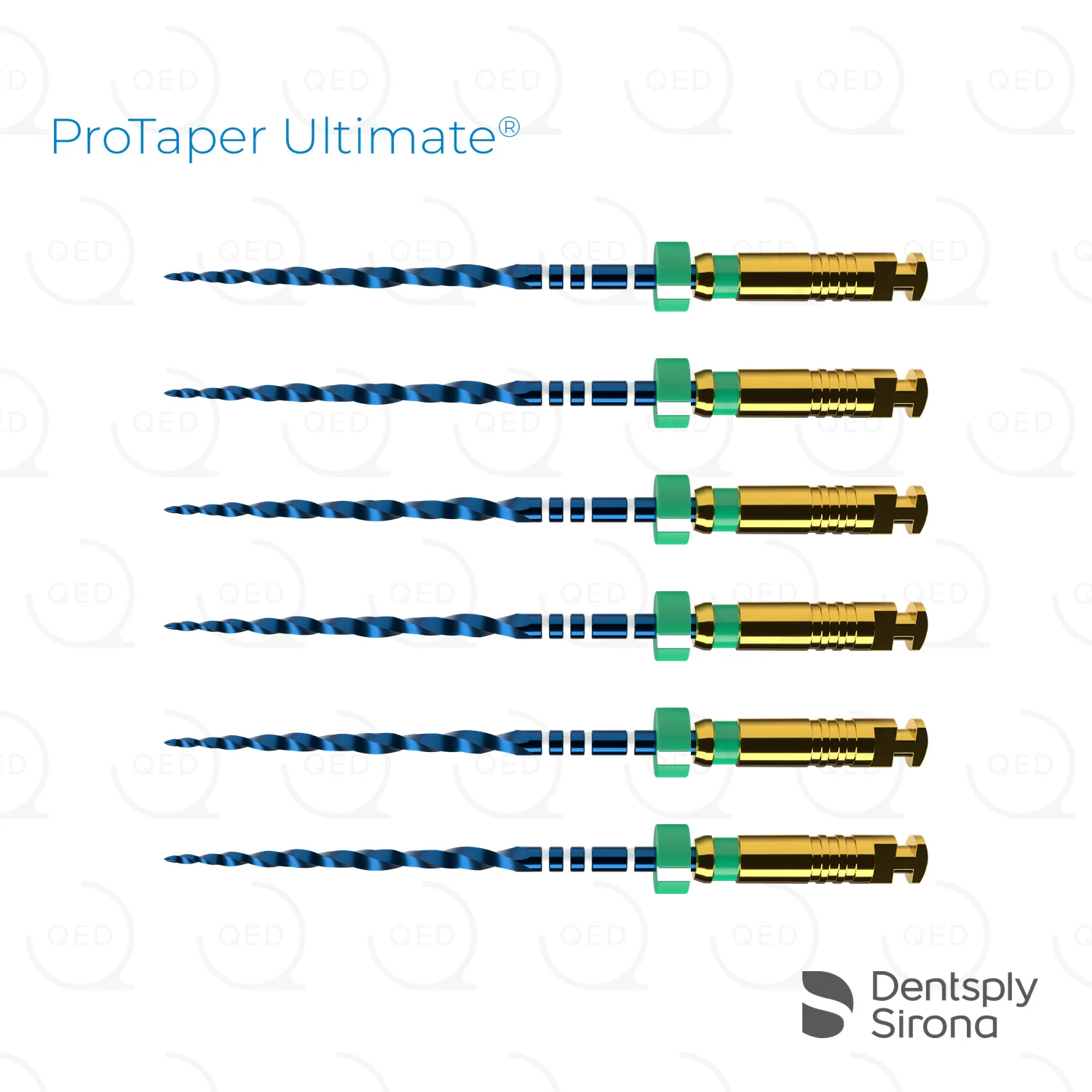
protaper ultimate® · shaper · 25 mm
coronal shapingdebris removalcurved canals
protaper ultimate® splits the shaping between two kinds of file. the finishers make the apical shape; the shaper cuts and clears the coronal two-thirds along the path the slider made, and hands a clean, open canal to whichever finisher comes next. this is the 25 mm version, the middle of the three lengths.
| 20/.04v tip / taper | gold heat treatment | 400 rpm 4–5.2 ncm |
sizes as dentsply sirona print them. motor settings from their fact file.
this pack: protaper ultimate® shaper rotary file, 25 mm (pack of 6)
dentsply sirona · made by maillefer instruments holding sàrl, ballaigues, switzerland
› its job, as dentsply sirona describe it. “the shaper’s enhanced cutting efficiency and hauling of debris in the coronal two-thirds provides an easy and safe access to the apical third for the finishers.”
› gold heat-treated after grinding. the same treatment as f1, f2 and f3, which dentsply sirona apply so the files negotiate the curve “without transportation and without unwinding issues.”
› cross-section tuned along its length. a parallelogram section with acute angles that vary along the file, so cutting efficiency matches the expected workload in each part of the canal.
1 after the slider and an irrigation pass. in the presence of naocl, advance the shaper along the slidepath, in one or more passes, to working length (step 7).
2 irrigate and activate. on removal, irrigate, activate with the endoactivator® to break up debris, then re-irrigate (step 8).
3 reconfirm working length. “especially in curved canals” (step 9), before f1.
paraphrased and quoted from the dentsply sirona, protaper ultimate® step-by-step procedure. your clinical judgement governs the case; the instructions for use govern the file.
| printed size | 020.004v – iso 20 tip, .04 variable taper |
| heat treatment | gold, post-grinding |
| role | cutting and debris removal in the coronal two-thirds |
| motor | 400 rpm · 4–5.2 ncm |
| other lengths | 21 mm · 31 mm |
| hand version | protaper ultimate® hand shaper, 25 mm |
does the shaper go to full working length?
yes, in dentsply sirona’s procedure it advances along the slidepath until working length is reached. its taper is what keeps the cutting work in the coronal two-thirds.
is it used in the larger-canal sequence?
no. for larger, straighter canals dentsply sirona go slider, then fx, then fxl if needed – no shaper.
which motor?
400 rpm and 4–5.2 ncm for every file in the range. dentsply sirona list a protaper ultimate® library among the x-smart® go’s presets; on the x-smart® pro+ it is set as a custom sequence, and on the vdw.silver® in a dr’s choice slot (vdw manual: up to 4.1 ncm). all three are linked below.
when do i throw it away?
dentsply sirona’s procedure: inspect the flutes on every removal, and if you see unwinding, straightening or stretching, discard it and use a new file.
| next file | protaper ultimate® f1, 25 mm |
| whole sequence | protaper ultimate® sequence, 25 mm (5) · slider, shaper, f1, f2, f3 |
| patency | c-pilot® 010, 25 mm · a small stainless hand file, as the sequence asks for when the slider will not reach |
| lubricant | glyde™ file prep · named on dentsply sirona’s own sequence card |
| irrigants | chlorax 5.25% · chlorax 2% · endo-solution 17% edta |
| delivery | dentsply sirona irrigation needles (40) |
| activation | smartlite pro endoactivator® |
| dry | protaper ultimate® paper points matched to your last finisher (f1–f3 assortment shown) |
| fill and seal | conform fit® gutta-percha, f1–f3 assortment · ah plus®, neosealer® ezflo, 25 mm tips or proroot® bio sealer |
| coronal seal | sdr® flow+ refill, universal |
| motor | x-smart® go · x-smart® pro+ · vdw.silver® reciproc® |
protaper ultimate® shaper, 25 mm (6) · 020.004v · gold heat treatment · niti rotary · 400 rpm, 4–5.2 ncm · dentsply sirona · ref bstpulr6250sh
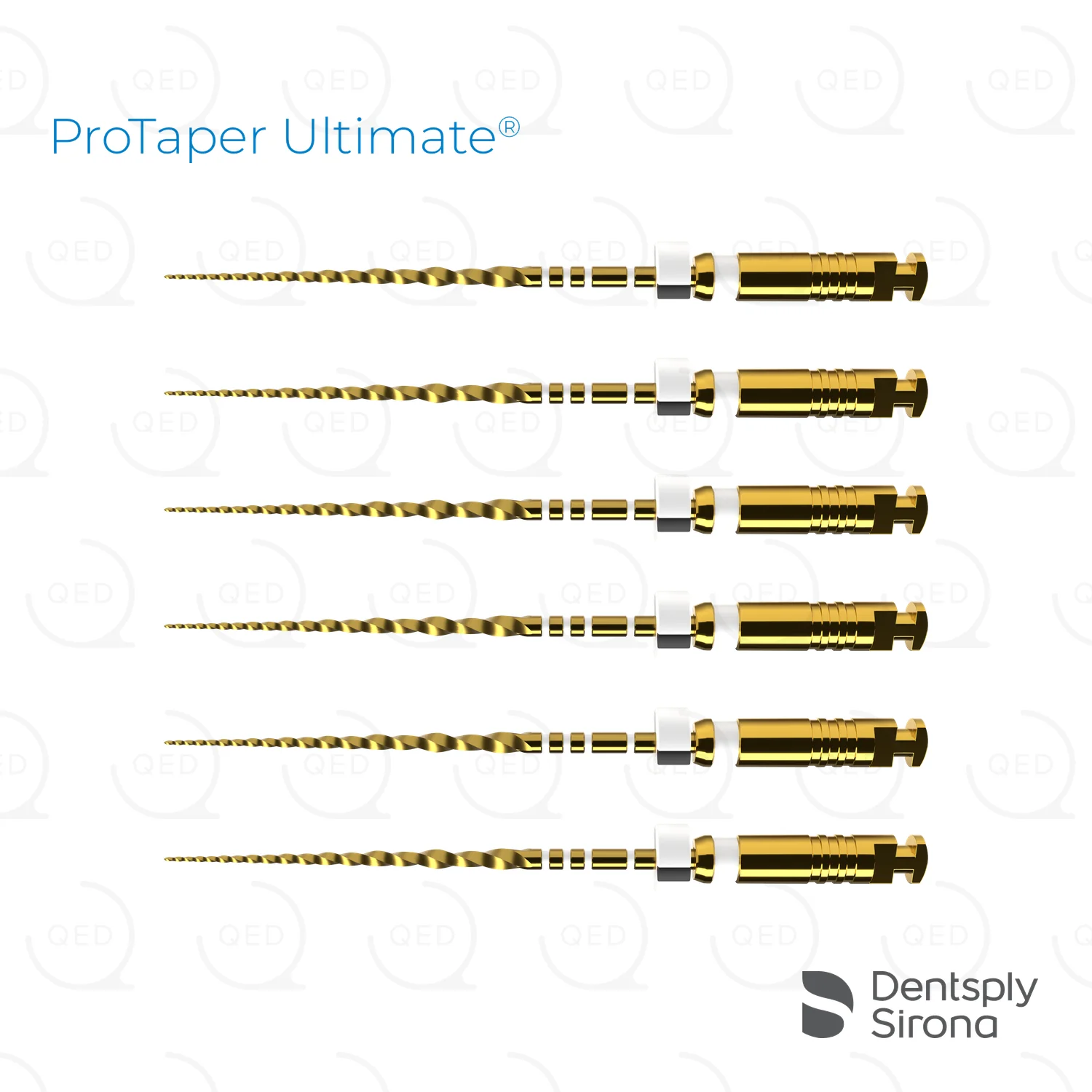
protaper ultimate® · slider · 25 mm
glide pathsecuring the canal pathrestrictive dentine and calcifications
scouting every canal with a hand file before the rotary goes in is the step the slider is designed to take over. it is built stiffer than the files after it so it can secure the canal path itself. in dentsply sirona’s own user evaluation it reached the terminus without a k-file in 63% of canals – and their procedure tells you exactly what to do in the rest. this is the 25 mm version, the middle of the three lengths.
| 16/.02v tip / taper | m-wire® heat treatment | 400 rpm 4–5.2 ncm |
sizes as dentsply sirona print them. motor settings from their fact file.
this pack: protaper ultimate® slider rotary file, 25 mm (pack of 6)
dentsply sirona · made by maillefer instruments holding sàrl, ballaigues, switzerland
› deliberately a little rigid. dentsply sirona’s fact file: the m-wire® pre-treatment “allows a certain rigidity of the file to secure the pathway of the canal and to remove restrictive dentin and other calcifications without the systematic need of a k-file.”
› treated differently from the files after it. the slider’s treatment is applied during wire production; the shaper and finishers are heat-treated after grinding.
› used in both sequences. slider then shaper for the standard sequence; slider then fx for larger, straighter canals.
1 lubricant in, then slider. “select the slider and passively follow the canal, in one or more passes, to its terminus.” determine working length with an apex locator and a radiograph, then confirm patency (step 4).
2 if it will not reach, go to a hand file. “select a small-sized manual stainless steel (sst) hand file”, establish length, confirm patency and verify the slidepath – then repeat the slider (step 5).
3 irrigate, then the shaper. irrigation needle to the coronal two-thirds (step 6), then the shaper along the slidepath to working length (step 7).
paraphrased and quoted from the dentsply sirona, protaper ultimate® step-by-step procedure. your clinical judgement governs the case; the instructions for use govern the file.
| printed size | 016.002v – iso 16 tip, .02 variable taper |
| heat treatment | m-wire®, applied during wire production |
| role | glide path to the canal terminus |
| motor | 400 rpm · 4–5.2 ncm |
| other lengths | 21 mm · 31 mm |
| hand version | protaper ultimate® hand slider, 25 mm |
what the 63% figure is. a dentsply sirona user evaluation: 21 dentists, 210 canals. 95% said the slider gave a smooth, reproducible pathway to the apical terminus, without a k-file in 63% of cases. it is internal data on file rather than a published study, and it is a majority, not every canal – which is why step 5 exists.
so i never need a hand file first?
that is not what dentsply sirona say. the slider can start the glide path in the majority of canals; where it does not easily reach the terminus, the procedure goes to a small stainless hand file, then back to the slider. keep one on the tray.
why is the slider not gold like the others?
different job. the fact file puts its m-wire® treatment down to the rigidity needed to secure the canal and remove restrictive dentine; the shaper and finishers are gold- or blue-treated for flexibility in the curve.
which motor?
400 rpm and 4–5.2 ncm for every file in the range. dentsply sirona list a protaper ultimate® library among the x-smart® go’s presets; on the x-smart® pro+ it is set as a custom sequence, and on the vdw.silver® in a dr’s choice slot (vdw manual: up to 4.1 ncm). all three are linked below.
when do i throw it away?
dentsply sirona’s procedure: inspect the flutes on every removal, and if you see unwinding, straightening or stretching, discard it and use a new file.
| next file | protaper ultimate® shaper, 25 mm |
| whole sequence | protaper ultimate® sequence, 25 mm (5) · slider, shaper, f1, f2, f3 |
| patency | c-pilot® 010, 25 mm · a small stainless hand file, as the sequence asks for when the slider will not reach |
| lubricant | glyde™ file prep · named on dentsply sirona’s own sequence card |
| irrigants | chlorax 5.25% · chlorax 2% · endo-solution 17% edta |
| delivery | dentsply sirona irrigation needles (40) |
| activation | smartlite pro endoactivator® |
| dry | protaper ultimate® paper points matched to your last finisher (f1–f3 assortment shown) |
| fill and seal | conform fit® gutta-percha, f1–f3 assortment · ah plus®, neosealer® ezflo, 25 mm tips or proroot® bio sealer |
| coronal seal | sdr® flow+ refill, universal |
| motor | x-smart® go · x-smart® pro+ · vdw.silver® reciproc® |
protaper ultimate® slider, 25 mm (6) · 016.002v · m-wire® heat treatment · niti rotary · 400 rpm, 4–5.2 ncm · dentsply sirona · ref bstpulr6250sl

protaper ultimate® · fxl · 25 mm
large canalsstraight canalsmaxillary centralsdefects
fx went to length and its flutes came out clean. the canal is larger still, and dentsply sirona’s larger-canal sequence goes one size up: fxl, an iso 50 tip on a .10 variable taper, blue heat-treated. this is the 25 mm version, the middle of the three lengths.
| 50/.10v tip / taper | blue heat treatment | 400 rpm 4–5.2 ncm |
sizes as dentsply sirona print them. motor settings from their fact file.
this pack: protaper ultimate® fxl rotary file, 25 mm (pack of 6)
dentsply sirona · made by maillefer instruments holding sàrl, ballaigues, switzerland
› larger and straighter canals only. the same limit dentsply sirona put on fx: maxillary central incisors, some palatal or distal molar canals, or a pathologic or iatrogenic defect.
› the end of the range. nothing in the protaper ultimate® range goes larger than a 50 tip.
› blue heat-treated, rotary or hand. dentsply sirona name either a mechanically driven or a manual fxl in their procedure.
1 after fx, never instead of it. if fx is loose at length and its apical flutes are not loaded with debris, select fxl and use it the same way.
2 finished when two things agree. the apical extent of the finisher is loaded with debris, and the corresponding gutta-percha point fits at working length.
3 then as the standard sequence. disinfect, dry with matched points, fill and seal (steps 16–20).
paraphrased and quoted from the dentsply sirona, protaper ultimate® step-by-step procedure. your clinical judgement governs the case; the instructions for use govern the file.
| printed size | 050.010v – iso 50 tip, .10 variable taper |
| heat treatment | blue |
| role | largest auxiliary finisher, larger and straighter canals only |
| motor | 400 rpm · 4–5.2 ncm |
| other lengths | 21 mm · 31 mm |
| hand version | protaper ultimate® hand fxl, 25 mm |
why is the taper lower than the fx?
the .10 taper sits on a much larger 50 tip – the file is still the biggest in the range. dentsply sirona publish the size and taper, not a reason, so we will not invent one.
is there a matched cone?
yes – conform fit® fxl gutta-percha and fxl absorbent points, both linked below.
which motor?
400 rpm and 4–5.2 ncm for every file in the range. dentsply sirona list a protaper ultimate® library among the x-smart® go’s presets; on the x-smart® pro+ it is set as a custom sequence, and on the vdw.silver® in a dr’s choice slot (vdw manual: up to 4.1 ncm). all three are linked below.
when do i throw it away?
dentsply sirona’s procedure: inspect the flutes on every removal, and if you see unwinding, straightening or stretching, discard it and use a new file.
| whole sequence | protaper ultimate® sequence, 25 mm (5) · slider, shaper, f1, f2, f3 |
| patency | c-pilot® 010, 25 mm · a small stainless hand file, as the sequence asks for when the slider will not reach |
| lubricant | glyde™ file prep · named on dentsply sirona’s own sequence card |
| irrigants | chlorax 5.25% · chlorax 2% · endo-solution 17% edta |
| delivery | dentsply sirona irrigation needles (40) |
| activation | smartlite pro endoactivator® |
| dry | protaper ultimate® paper points, fxl |
| fill and seal | conform fit® gutta-percha, fxl · ah plus®, neosealer® ezflo, 25 mm tips or proroot® bio sealer |
| coronal seal | sdr® flow+ refill, universal |
| motor | x-smart® go · x-smart® pro+ · vdw.silver® reciproc® |
protaper ultimate® fxl, 25 mm (6) · 050.010v · blue heat treatment · niti rotary · 400 rpm, 4–5.2 ncm · dentsply sirona · ref bstpulr625fxl

protaper ultimate® · f1 · 31 mm
apical shapingcurved canalsdeep shapegauging the canal
which finisher do i stop at? dentsply sirona answer it with the file itself. take f1 to length, withdraw it and look at the apical flutes: loaded with dentine, the preparation is finished. clean and loose, go to f2. f1 is where that question is asked on every case. this is the 31 mm version, for long roots that a 25 mm file will not take to working length.
| 20/.07v tip / apical taper | gold heat treatment | +75% fatigue vs pt gold f1 |
sizes as dentsply sirona print them. motor settings from their fact file. comparisons are dentsply sirona laboratory data on file.
this pack: protaper ultimate® f1 rotary file, 31 mm (pack of 6)
dentsply sirona · made by maillefer instruments holding sàrl, ballaigues, switzerland
› deep shape, from the smallest finisher. dentsply sirona give every finisher an apical taper of at least 7% – f1 7%, f2 8%, f3 9% – to keep the protaper deep-shape philosophy of increased apical taper.
› against the protaper gold® f1. in dentsply sirona’s own laboratory testing, ultimate f1 showed 13% higher flexibility and 75% higher cyclic fatigue resistance than protaper gold® f1.
› gold heat-treated. post-grinding, like the shaper, f2 and f3.
1 after shaper and reconfirmed length. “select the finisher f1 (020.007v) and passively follow the canal to the wl, in one or more passes” (step 10).
2 inspect the apical flutes. “when loaded with dentinal debris, the preparation is finished.”
3 loose and clean? f2. if f1 is loose at length and its apical flutes are not loaded with debris, move to f2 in the same way (step 11).
paraphrased and quoted from the dentsply sirona, protaper ultimate® step-by-step procedure. your clinical judgement governs the case; the instructions for use govern the file.
| printed size | 020.007v – iso 20 tip, 7% apical taper, variable |
| heat treatment | gold, post-grinding |
| role | first finisher, and the gauge for the next |
| motor | 400 rpm · 4–5.2 ncm |
| other lengths | 21 mm · 25 mm |
| hand version | protaper ultimate® hand f1, 31 mm |
where the figures come from. dentsply sirona laboratory data on file (test 21/039), ultimate f1 against protaper gold® f1. not a published study.
how do i know f1 is enough?
dentsply sirona’s test is in the file: apical flutes loaded with dentine at length means finished; loose and clean means go to f2. the matched cone should then fit at working length.
which cone and point go with it?
the f1 ones. dentsply sirona match both to the colour and size of the last file used. finish on f1, fill with f1.
which motor?
400 rpm and 4–5.2 ncm for every file in the range. dentsply sirona list a protaper ultimate® library among the x-smart® go’s presets; on the x-smart® pro+ it is set as a custom sequence, and on the vdw.silver® in a dr’s choice slot (vdw manual: up to 4.1 ncm). all three are linked below.
when do i throw it away?
dentsply sirona’s procedure: inspect the flutes on every removal, and if you see unwinding, straightening or stretching, discard it and use a new file.
| if f1 is loose | protaper ultimate® f2, 31 mm |
| whole sequence | protaper ultimate® sequence, 31 mm (5) · slider, shaper, f1, f2, f3 |
| patency | a small stainless steel hand file in 31 mm, as the sequence asks for when the slider will not reach – there is no 31 mm c-pilot®, so ask us |
| lubricant | glyde™ file prep · named on dentsply sirona’s own sequence card |
| irrigants | chlorax 5.25% · chlorax 2% · endo-solution 17% edta |
| delivery | dentsply sirona irrigation needles (40) |
| activation | smartlite pro endoactivator® |
| dry | protaper ultimate® paper points, f1 |
| fill and seal | conform fit® gutta-percha, f1 · ah plus®, neosealer® ezflo, 25 mm tips or proroot® bio sealer |
| coronal seal | sdr® flow+ refill, universal |
| motor | x-smart® go · x-smart® pro+ · vdw.silver® reciproc® |
protaper ultimate® f1, 31 mm (6) · 020.007v · gold heat treatment · niti rotary · 400 rpm, 4–5.2 ncm · dentsply sirona · ref bstpulr6310f1

protaper ultimate® · f2 · 31 mm
apical shapingcurved canalsdeep shape
f1 was loose at length, and its flutes came out clean. that is when dentsply sirona’s procedure picks up f2 – 25/.08v, gold heat-treated, and 30% more flexible than the protaper gold® f2 in their testing. this is the 31 mm version, for long roots that a 25 mm file will not take to working length.
| +30% flex vs pt gold f2 | +30% fatigue vs pt gold f2 | 400 rpm 4–5.2 ncm |
sizes as dentsply sirona print them. motor settings from their fact file. comparisons are dentsply sirona laboratory data on file.
this pack: protaper ultimate® f2 rotary file, 31 mm (pack of 6)
dentsply sirona · made by maillefer instruments holding sàrl, ballaigues, switzerland
› 8% at the apex. every finisher carries an apical taper of at least 7% to keep the protaper deep-shape philosophy; f2’s is 8%.
› stronger than the file it replaces. dentsply sirona’s laboratory testing: ultimate f2 showed 30% higher flexibility and 30% higher cyclic fatigue resistance than protaper gold® f2.
› gold heat-treated. post-grinding, for negotiating the curve without transportation or unwinding.
1 only after f1. if f1 is loose at length and its apical flutes are not loaded with debris, select f2 and follow the canal passively to working length (step 11).
2 inspect the flutes the same way. loaded with dentine: finished. loose and clean: go to f3 (step 12).
3 clean, irrigate, recapitulate. on removing any file, clean and inspect its flutes, irrigate, recapitulate with a size 10 file or the endoactivator®, then re-irrigate (step 13).
paraphrased and quoted from the dentsply sirona, protaper ultimate® step-by-step procedure. your clinical judgement governs the case; the instructions for use govern the file.
| printed size | 025.008v – iso 25 tip, 8% apical taper, variable |
| heat treatment | gold, post-grinding |
| role | second finisher |
| motor | 400 rpm · 4–5.2 ncm |
| other lengths | 21 mm · 25 mm |
| hand version | protaper ultimate® hand f2, 31 mm |
where the figures come from. dentsply sirona laboratory data on file (test 21/039), ultimate f2 against protaper gold® f2. not a published study.
do i have to go through f1 first?
in dentsply sirona’s procedure, yes – f1 is taken to length and gauged, and f2 follows only if f1 is loose and clean.
which cone and point?
the f2 ones. dentsply sirona match both to the colour and size of the last instrument used.
which motor?
400 rpm and 4–5.2 ncm for every file in the range. dentsply sirona list a protaper ultimate® library among the x-smart® go’s presets; on the x-smart® pro+ it is set as a custom sequence, and on the vdw.silver® in a dr’s choice slot (vdw manual: up to 4.1 ncm). all three are linked below.
when do i throw it away?
dentsply sirona’s procedure: inspect the flutes on every removal, and if you see unwinding, straightening or stretching, discard it and use a new file.
| if f2 is loose | protaper ultimate® f3, 31 mm |
| whole sequence | protaper ultimate® sequence, 31 mm (5) · slider, shaper, f1, f2, f3 |
| patency | a small stainless steel hand file in 31 mm, as the sequence asks for when the slider will not reach – there is no 31 mm c-pilot®, so ask us |
| lubricant | glyde™ file prep · named on dentsply sirona’s own sequence card |
| irrigants | chlorax 5.25% · chlorax 2% · endo-solution 17% edta |
| delivery | dentsply sirona irrigation needles (40) |
| activation | smartlite pro endoactivator® |
| dry | protaper ultimate® paper points, f2 |
| fill and seal | conform fit® gutta-percha, f2 · ah plus®, neosealer® ezflo, 25 mm tips or proroot® bio sealer |
| coronal seal | sdr® flow+ refill, universal |
| motor | x-smart® go · x-smart® pro+ · vdw.silver® reciproc® |
protaper ultimate® f2, 31 mm (6) · 025.008v · gold heat treatment · niti rotary · 400 rpm, 4–5.2 ncm · dentsply sirona · ref bstpulr6310f2

protaper ultimate® · f3 · 31 mm
wider canalsapical shapingdeep shape
f2 came out loose and clean as well. then the canal is wider than f2’s tip, and dentsply sirona’s standard sequence finishes on f3: 30/.09v, gold heat-treated, the steepest apical taper of the three standard finishers. this is the 31 mm version, for long roots that a 25 mm file will not take to working length.
| 30/.09v tip / apical taper | gold heat treatment | 400 rpm 4–5.2 ncm |
sizes as dentsply sirona print them. motor settings from their fact file.
this pack: protaper ultimate® f3 rotary file, 31 mm (pack of 6)
dentsply sirona · made by maillefer instruments holding sàrl, ballaigues, switzerland
› 9% at the apex. the deep-shape principle carried to the largest standard finisher – f1 7%, f2 8%, f3 9% apical taper.
› why dentsply sirona want the shape deep. their fact file argues that removing debris and smear layer by irrigation is less predictable apically than coronally, and that apical shape influences it – so the finishers keep the apical taper up.
› gold heat-treated. post-grinding, the same as the shaper, f1 and f2.
1 only after f2. if f2 is loose at length and its apical flutes are not loaded with debris, select f3 and use it the same way (step 12).
2 finished when two things agree. “the preparation is finished when the apical extent of any finisher is loaded with debris, and the corresponding gutta-percha point fits at the wl” (step 15).
3 then disinfect and dry. 3-d disinfection with the endoactivator®, then matched absorbent points (steps 16–17).
paraphrased and quoted from the dentsply sirona, protaper ultimate® step-by-step procedure. your clinical judgement governs the case; the instructions for use govern the file.
| printed size | 030.009v – iso 30 tip, 9% apical taper, variable |
| heat treatment | gold, post-grinding |
| role | third and largest standard finisher |
| motor | 400 rpm · 4–5.2 ncm |
| other lengths | 21 mm · 25 mm |
| hand version | protaper ultimate® hand f3, 31 mm |
what if f3 is loose too?
dentsply sirona’s literature does not go past f3 in the standard sequence. the auxiliary fx and fxl have their own sequence, for larger and straighter canals – it is worth reading their procedure before switching mid-case.
which cone and point?
the f3 ones, matched to the colour and size of the last file used.
which motor?
400 rpm and 4–5.2 ncm for every file in the range. dentsply sirona list a protaper ultimate® library among the x-smart® go’s presets; on the x-smart® pro+ it is set as a custom sequence, and on the vdw.silver® in a dr’s choice slot (vdw manual: up to 4.1 ncm). all three are linked below.
when do i throw it away?
dentsply sirona’s procedure: inspect the flutes on every removal, and if you see unwinding, straightening or stretching, discard it and use a new file.
| whole sequence | protaper ultimate® sequence, 31 mm (5) · slider, shaper, f1, f2, f3 |
| patency | a small stainless steel hand file in 31 mm, as the sequence asks for when the slider will not reach – there is no 31 mm c-pilot®, so ask us |
| lubricant | glyde™ file prep · named on dentsply sirona’s own sequence card |
| irrigants | chlorax 5.25% · chlorax 2% · endo-solution 17% edta |
| delivery | dentsply sirona irrigation needles (40) |
| activation | smartlite pro endoactivator® |
| dry | protaper ultimate® paper points, f3 |
| fill and seal | conform fit® gutta-percha, f3 · ah plus®, neosealer® ezflo, 25 mm tips or proroot® bio sealer |
| coronal seal | sdr® flow+ refill, universal |
| motor | x-smart® go · x-smart® pro+ · vdw.silver® reciproc® |
protaper ultimate® f3, 31 mm (6) · 030.009v · gold heat treatment · niti rotary · 400 rpm, 4–5.2 ncm · dentsply sirona · ref bstpulr6310f3
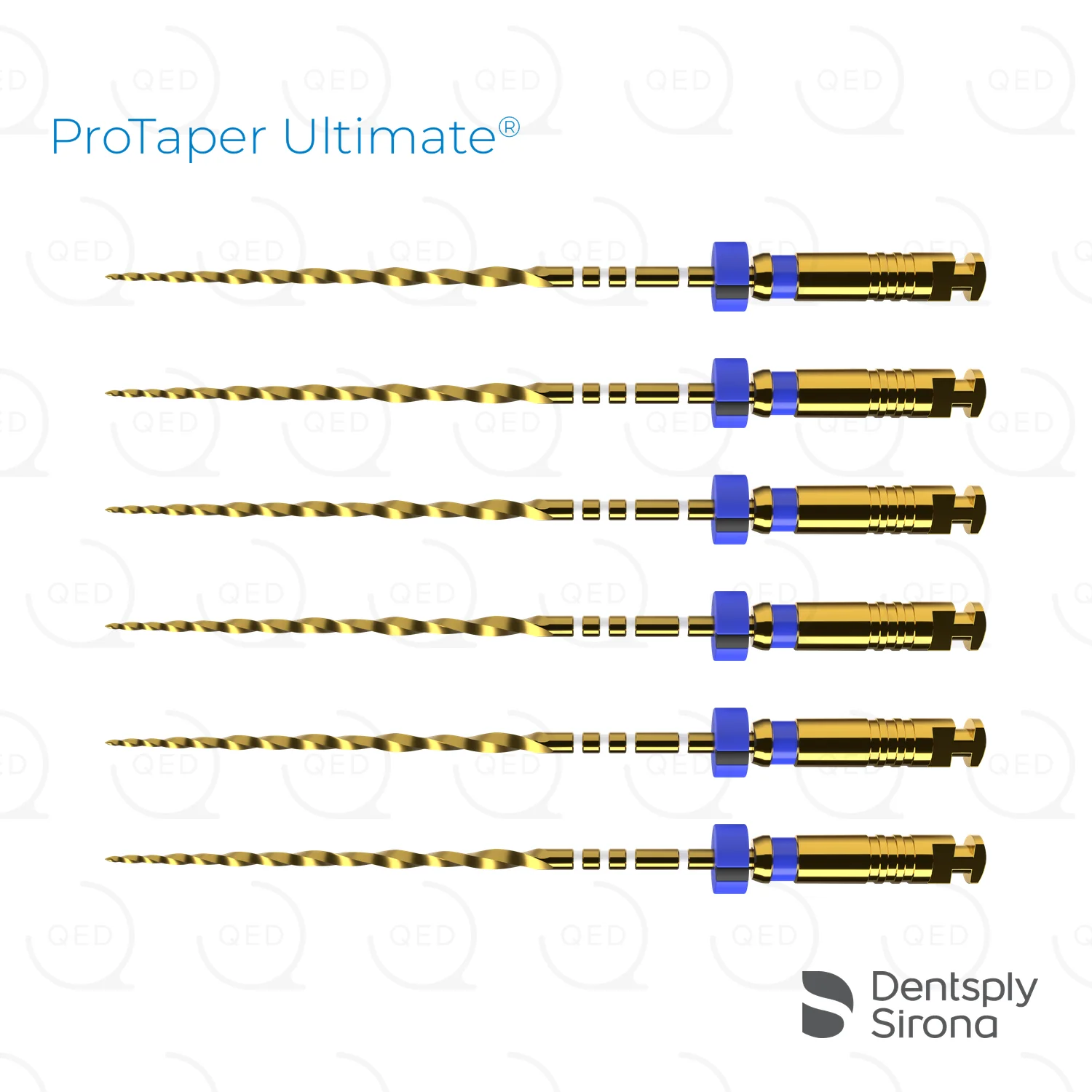
protaper ultimate® · fx · 31 mm
larger canalsstraighter canalsmaxillary centralspalatal and distal roots
a maxillary central incisor, some palatal or distal molar canals, a pathologic or iatrogenic defect. those are dentsply sirona’s own examples of the larger, straighter canals the standard finishers are not written for. they get a separate, shorter sequence: slider, then fx, then fxl if it is needed. this is the 31 mm version, for long roots that a 25 mm file will not take to working length.
| 35/.12v tip / taper | blue heat treatment | 400 rpm 4–5.2 ncm |
sizes as dentsply sirona print them. motor settings from their fact file.
this pack: protaper ultimate® fx rotary file, 31 mm (pack of 6)
dentsply sirona · made by maillefer instruments holding sàrl, ballaigues, switzerland
› where dentsply sirona say to use it. “in larger and straighter canals only, such as maxillary central incisors, some palatal or distal canals of molars, or when there is a pathologic or iatrogenic defect”.
› blue, not gold. fx and fxl are the only files in the range with dentsply sirona’s blue heat treatment.
› rotary or by hand, in the same step. their procedure names either a mechanically driven or a manual fx, so the hand version is a like-for-like alternative.
1 slider first, as usual. follow steps 1 to 6 of the standard procedure – slider to length, patency, irrigation.
2 then fx to length. once working length is established and patency confirmed, passively follow the canal to length in one or more passes and inspect the apical flutes. loaded with debris: finished.
3 loose and clean? fxl. use the fxl the same way. then disinfect, dry and fill as the standard sequence (steps 16–20).
paraphrased and quoted from the dentsply sirona, protaper ultimate® step-by-step procedure. your clinical judgement governs the case; the instructions for use govern the file.
| printed size | 035.012v – iso 35 tip, .12 variable taper |
| heat treatment | blue |
| role | auxiliary finisher, larger and straighter canals only |
| motor | 400 rpm · 4–5.2 ncm |
| other lengths | 21 mm · 25 mm |
| hand version | protaper ultimate® hand fx, 31 mm |
can i use fx in a curved molar canal?
dentsply sirona limit fx and fxl to larger and straighter canals, and give their examples. a curved canal belongs to the standard sequence.
does it replace the shaper?
in their larger-canal sequence, yes – it is slider, then fx. no shaper, no f1 to f3.
which motor?
400 rpm and 4–5.2 ncm for every file in the range. dentsply sirona list a protaper ultimate® library among the x-smart® go’s presets; on the x-smart® pro+ it is set as a custom sequence, and on the vdw.silver® in a dr’s choice slot (vdw manual: up to 4.1 ncm). all three are linked below.
when do i throw it away?
dentsply sirona’s procedure: inspect the flutes on every removal, and if you see unwinding, straightening or stretching, discard it and use a new file.
| if fx is loose | protaper ultimate® fxl, 31 mm |
| whole sequence | protaper ultimate® sequence, 31 mm (5) · slider, shaper, f1, f2, f3 |
| patency | a small stainless steel hand file in 31 mm, as the sequence asks for when the slider will not reach – there is no 31 mm c-pilot®, so ask us |
| lubricant | glyde™ file prep · named on dentsply sirona’s own sequence card |
| irrigants | chlorax 5.25% · chlorax 2% · endo-solution 17% edta |
| delivery | dentsply sirona irrigation needles (40) |
| activation | smartlite pro endoactivator® |
| dry | protaper ultimate® paper points, fx |
| fill and seal | conform fit® gutta-percha, fx · ah plus®, neosealer® ezflo, 25 mm tips or proroot® bio sealer |
| coronal seal | sdr® flow+ refill, universal |
| motor | x-smart® go · x-smart® pro+ · vdw.silver® reciproc® |
protaper ultimate® fx, 31 mm (6) · 035.012v · blue heat treatment · niti rotary · 400 rpm, 4–5.2 ncm · dentsply sirona · ref bstpulr6310fx

protaper ultimate® · shaper · 31 mm
coronal shapingdebris removalcurved canals
protaper ultimate® splits the shaping between two kinds of file. the finishers make the apical shape; the shaper cuts and clears the coronal two-thirds along the path the slider made, and hands a clean, open canal to whichever finisher comes next. this is the 31 mm version, for long roots that a 25 mm file will not take to working length.
| 20/.04v tip / taper | gold heat treatment | 400 rpm 4–5.2 ncm |
sizes as dentsply sirona print them. motor settings from their fact file.
this pack: protaper ultimate® shaper rotary file, 31 mm (pack of 6)
dentsply sirona · made by maillefer instruments holding sàrl, ballaigues, switzerland
› its job, as dentsply sirona describe it. “the shaper’s enhanced cutting efficiency and hauling of debris in the coronal two-thirds provides an easy and safe access to the apical third for the finishers.”
› gold heat-treated after grinding. the same treatment as f1, f2 and f3, which dentsply sirona apply so the files negotiate the curve “without transportation and without unwinding issues.”
› cross-section tuned along its length. a parallelogram section with acute angles that vary along the file, so cutting efficiency matches the expected workload in each part of the canal.
1 after the slider and an irrigation pass. in the presence of naocl, advance the shaper along the slidepath, in one or more passes, to working length (step 7).
2 irrigate and activate. on removal, irrigate, activate with the endoactivator® to break up debris, then re-irrigate (step 8).
3 reconfirm working length. “especially in curved canals” (step 9), before f1.
paraphrased and quoted from the dentsply sirona, protaper ultimate® step-by-step procedure. your clinical judgement governs the case; the instructions for use govern the file.
| printed size | 020.004v – iso 20 tip, .04 variable taper |
| heat treatment | gold, post-grinding |
| role | cutting and debris removal in the coronal two-thirds |
| motor | 400 rpm · 4–5.2 ncm |
| other lengths | 21 mm · 25 mm |
| hand version | protaper ultimate® hand shaper, 31 mm |
does the shaper go to full working length?
yes, in dentsply sirona’s procedure it advances along the slidepath until working length is reached. its taper is what keeps the cutting work in the coronal two-thirds.
is it used in the larger-canal sequence?
no. for larger, straighter canals dentsply sirona go slider, then fx, then fxl if needed – no shaper.
which motor?
400 rpm and 4–5.2 ncm for every file in the range. dentsply sirona list a protaper ultimate® library among the x-smart® go’s presets; on the x-smart® pro+ it is set as a custom sequence, and on the vdw.silver® in a dr’s choice slot (vdw manual: up to 4.1 ncm). all three are linked below.
when do i throw it away?
dentsply sirona’s procedure: inspect the flutes on every removal, and if you see unwinding, straightening or stretching, discard it and use a new file.
| next file | protaper ultimate® f1, 31 mm |
| whole sequence | protaper ultimate® sequence, 31 mm (5) · slider, shaper, f1, f2, f3 |
| patency | a small stainless steel hand file in 31 mm, as the sequence asks for when the slider will not reach – there is no 31 mm c-pilot®, so ask us |
| lubricant | glyde™ file prep · named on dentsply sirona’s own sequence card |
| irrigants | chlorax 5.25% · chlorax 2% · endo-solution 17% edta |
| delivery | dentsply sirona irrigation needles (40) |
| activation | smartlite pro endoactivator® |
| dry | protaper ultimate® paper points matched to your last finisher (f1–f3 assortment shown) |
| fill and seal | conform fit® gutta-percha, f1–f3 assortment · ah plus®, neosealer® ezflo, 25 mm tips or proroot® bio sealer |
| coronal seal | sdr® flow+ refill, universal |
| motor | x-smart® go · x-smart® pro+ · vdw.silver® reciproc® |
protaper ultimate® shaper, 31 mm (6) · 020.004v · gold heat treatment · niti rotary · 400 rpm, 4–5.2 ncm · dentsply sirona · ref bstpulr6310sh
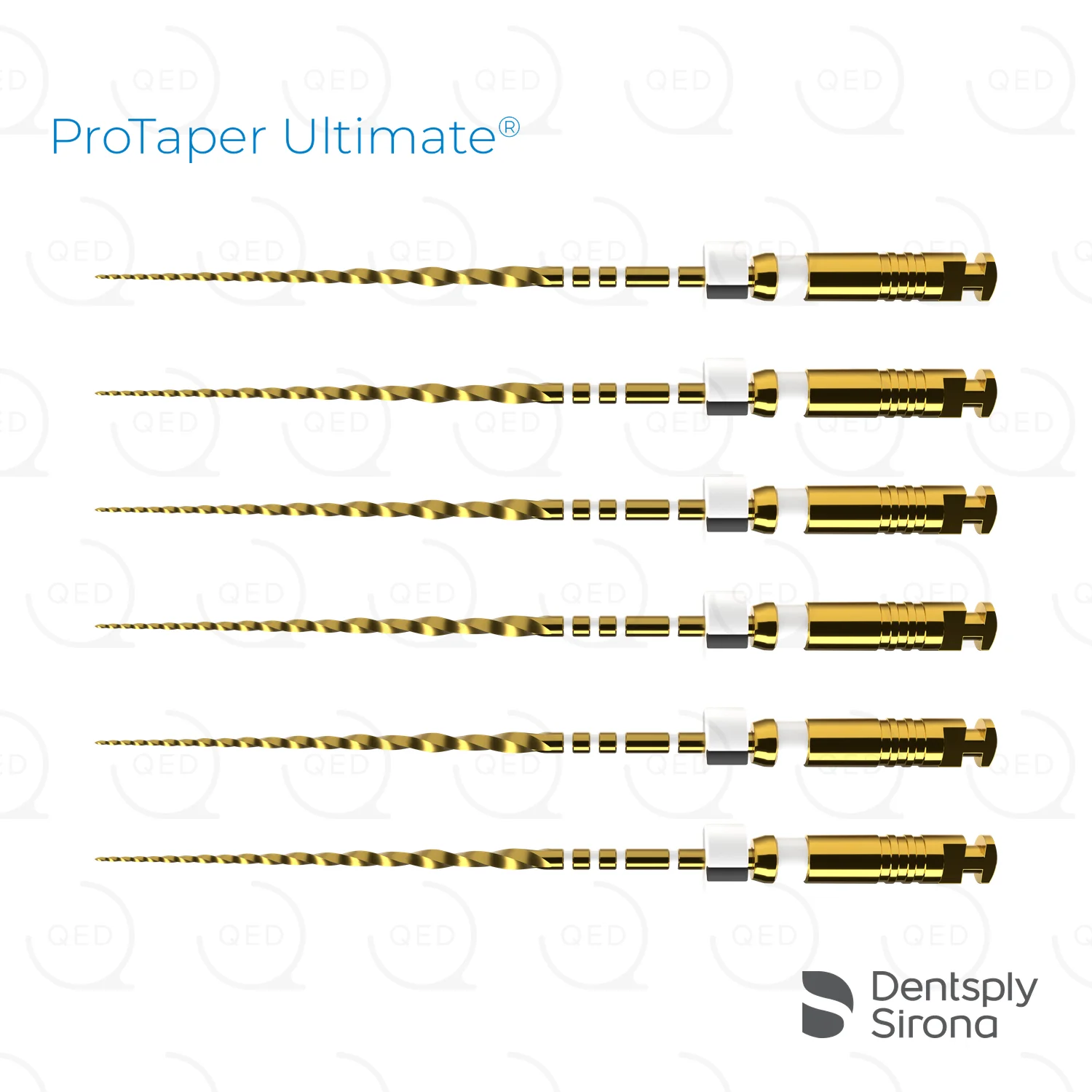
protaper ultimate® · slider · 31 mm
glide pathsecuring the canal pathrestrictive dentine and calcifications
scouting every canal with a hand file before the rotary goes in is the step the slider is designed to take over. it is built stiffer than the files after it so it can secure the canal path itself. in dentsply sirona’s own user evaluation it reached the terminus without a k-file in 63% of canals – and their procedure tells you exactly what to do in the rest. this is the 31 mm version, for long roots that a 25 mm file will not take to working length.
| 16/.02v tip / taper | m-wire® heat treatment | 400 rpm 4–5.2 ncm |
sizes as dentsply sirona print them. motor settings from their fact file.
this pack: protaper ultimate® slider rotary file, 31 mm (pack of 6)
dentsply sirona · made by maillefer instruments holding sàrl, ballaigues, switzerland
› deliberately a little rigid. dentsply sirona’s fact file: the m-wire® pre-treatment “allows a certain rigidity of the file to secure the pathway of the canal and to remove restrictive dentin and other calcifications without the systematic need of a k-file.”
› treated differently from the files after it. the slider’s treatment is applied during wire production; the shaper and finishers are heat-treated after grinding.
› used in both sequences. slider then shaper for the standard sequence; slider then fx for larger, straighter canals.
1 lubricant in, then slider. “select the slider and passively follow the canal, in one or more passes, to its terminus.” determine working length with an apex locator and a radiograph, then confirm patency (step 4).
2 if it will not reach, go to a hand file. “select a small-sized manual stainless steel (sst) hand file”, establish length, confirm patency and verify the slidepath – then repeat the slider (step 5).
3 irrigate, then the shaper. irrigation needle to the coronal two-thirds (step 6), then the shaper along the slidepath to working length (step 7).
paraphrased and quoted from the dentsply sirona, protaper ultimate® step-by-step procedure. your clinical judgement governs the case; the instructions for use govern the file.
| printed size | 016.002v – iso 16 tip, .02 variable taper |
| heat treatment | m-wire®, applied during wire production |
| role | glide path to the canal terminus |
| motor | 400 rpm · 4–5.2 ncm |
| other lengths | 21 mm · 25 mm |
| hand version | protaper ultimate® hand slider, 31 mm |
what the 63% figure is. a dentsply sirona user evaluation: 21 dentists, 210 canals. 95% said the slider gave a smooth, reproducible pathway to the apical terminus, without a k-file in 63% of cases. it is internal data on file rather than a published study, and it is a majority, not every canal – which is why step 5 exists.
so i never need a hand file first?
that is not what dentsply sirona say. the slider can start the glide path in the majority of canals; where it does not easily reach the terminus, the procedure goes to a small stainless hand file, then back to the slider. keep one on the tray.
why is the slider not gold like the others?
different job. the fact file puts its m-wire® treatment down to the rigidity needed to secure the canal and remove restrictive dentine; the shaper and finishers are gold- or blue-treated for flexibility in the curve.
which motor?
400 rpm and 4–5.2 ncm for every file in the range. dentsply sirona list a protaper ultimate® library among the x-smart® go’s presets; on the x-smart® pro+ it is set as a custom sequence, and on the vdw.silver® in a dr’s choice slot (vdw manual: up to 4.1 ncm). all three are linked below.
when do i throw it away?
dentsply sirona’s procedure: inspect the flutes on every removal, and if you see unwinding, straightening or stretching, discard it and use a new file.
| next file | protaper ultimate® shaper, 31 mm |
| whole sequence | protaper ultimate® sequence, 31 mm (5) · slider, shaper, f1, f2, f3 |
| patency | a small stainless steel hand file in 31 mm, as the sequence asks for when the slider will not reach – there is no 31 mm c-pilot®, so ask us |
| lubricant | glyde™ file prep · named on dentsply sirona’s own sequence card |
| irrigants | chlorax 5.25% · chlorax 2% · endo-solution 17% edta |
| delivery | dentsply sirona irrigation needles (40) |
| activation | smartlite pro endoactivator® |
| dry | protaper ultimate® paper points matched to your last finisher (f1–f3 assortment shown) |
| fill and seal | conform fit® gutta-percha, f1–f3 assortment · ah plus®, neosealer® ezflo, 25 mm tips or proroot® bio sealer |
| coronal seal | sdr® flow+ refill, universal |
| motor | x-smart® go · x-smart® pro+ · vdw.silver® reciproc® |
protaper ultimate® slider, 31 mm (6) · 016.002v · m-wire® heat treatment · niti rotary · 400 rpm, 4–5.2 ncm · dentsply sirona · ref bstpulr6310sl
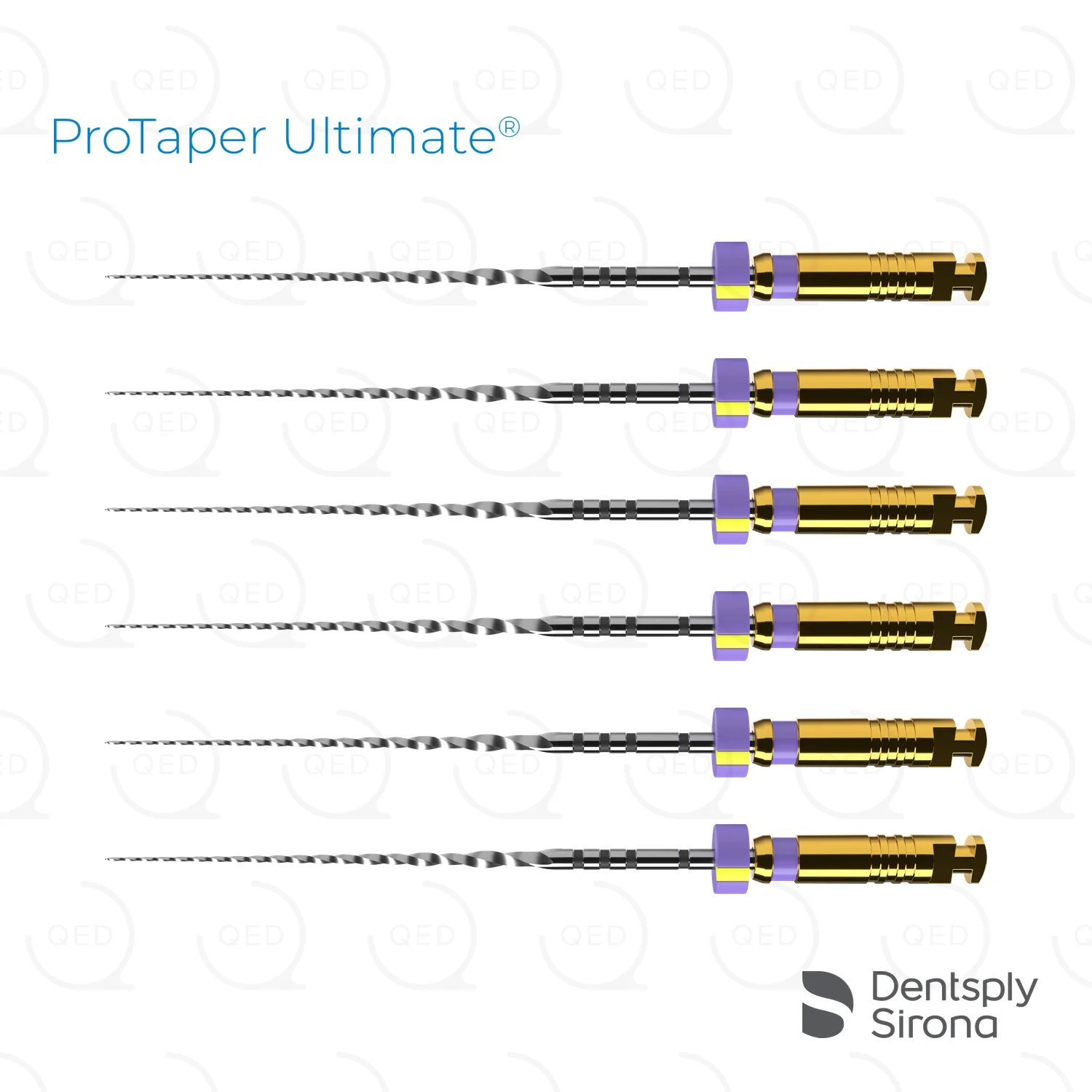
protaper ultimate® · fxl · 31 mm
large canalsstraight canalsmaxillary centralsdefects
fx went to length and its flutes came out clean. the canal is larger still, and dentsply sirona’s larger-canal sequence goes one size up: fxl, an iso 50 tip on a .10 variable taper, blue heat-treated. this is the 31 mm version, for long roots that a 25 mm file will not take to working length.
| 50/.10v tip / taper | blue heat treatment | 400 rpm 4–5.2 ncm |
sizes as dentsply sirona print them. motor settings from their fact file.
this pack: protaper ultimate® fxl rotary file, 31 mm (pack of 6)
dentsply sirona · made by maillefer instruments holding sàrl, ballaigues, switzerland
› larger and straighter canals only. the same limit dentsply sirona put on fx: maxillary central incisors, some palatal or distal molar canals, or a pathologic or iatrogenic defect.
› the end of the range. nothing in the protaper ultimate® range goes larger than a 50 tip.
› blue heat-treated, rotary or hand. dentsply sirona name either a mechanically driven or a manual fxl in their procedure.
1 after fx, never instead of it. if fx is loose at length and its apical flutes are not loaded with debris, select fxl and use it the same way.
2 finished when two things agree. the apical extent of the finisher is loaded with debris, and the corresponding gutta-percha point fits at working length.
3 then as the standard sequence. disinfect, dry with matched points, fill and seal (steps 16–20).
paraphrased and quoted from the dentsply sirona, protaper ultimate® step-by-step procedure. your clinical judgement governs the case; the instructions for use govern the file.
| printed size | 050.010v – iso 50 tip, .10 variable taper |
| heat treatment | blue |
| role | largest auxiliary finisher, larger and straighter canals only |
| motor | 400 rpm · 4–5.2 ncm |
| other lengths | 21 mm · 25 mm |
| hand version | protaper ultimate® hand fxl, 31 mm |
why is the taper lower than the fx?
the .10 taper sits on a much larger 50 tip – the file is still the biggest in the range. dentsply sirona publish the size and taper, not a reason, so we will not invent one.
is there a matched cone?
yes – conform fit® fxl gutta-percha and fxl absorbent points, both linked below.
which motor?
400 rpm and 4–5.2 ncm for every file in the range. dentsply sirona list a protaper ultimate® library among the x-smart® go’s presets; on the x-smart® pro+ it is set as a custom sequence, and on the vdw.silver® in a dr’s choice slot (vdw manual: up to 4.1 ncm). all three are linked below.
when do i throw it away?
dentsply sirona’s procedure: inspect the flutes on every removal, and if you see unwinding, straightening or stretching, discard it and use a new file.
| whole sequence | protaper ultimate® sequence, 31 mm (5) · slider, shaper, f1, f2, f3 |
| patency | a small stainless steel hand file in 31 mm, as the sequence asks for when the slider will not reach – there is no 31 mm c-pilot®, so ask us |
| lubricant | glyde™ file prep · named on dentsply sirona’s own sequence card |
| irrigants | chlorax 5.25% · chlorax 2% · endo-solution 17% edta |
| delivery | dentsply sirona irrigation needles (40) |
| activation | smartlite pro endoactivator® |
| dry | protaper ultimate® paper points, fxl |
| fill and seal | conform fit® gutta-percha, fxl · ah plus®, neosealer® ezflo, 25 mm tips or proroot® bio sealer |
| coronal seal | sdr® flow+ refill, universal |
| motor | x-smart® go · x-smart® pro+ · vdw.silver® reciproc® |
protaper ultimate® fxl, 31 mm (6) · 050.010v · blue heat treatment · niti rotary · 400 rpm, 4–5.2 ncm · dentsply sirona · ref bstpulr631fxl

trunatomy® assorted · 21 mm · 5 files
trying the systemone of eachmixed caseload
you do not know whether a trunatomy® case ends on prime, needs the small on the way, or goes up to medium until the canal tells you. this pack puts one of each on the tray: orifice modifier, glider, small, prime and medium. this is the 21 mm version, for short teeth or where opening is limited.
| 5 files, one of each | 0.8 mm shaping file wire | 500 rpm 1.5 ncm |
sizes as dentsply sirona print them. the “v” means variable taper; the taper shown is the average along the file, not the taper at the tip.
this pack: trunatomy® rotary files, assorted, 21 mm (pack of 5)
dentsply sirona · made by maillefer instruments holding sàrl, ballaigues, switzerland
| orifice modifier | 20.08 · coronal third, 7 mm of flutes |
| glider | 17.02v · glide path |
| small | 20.04v · narrow or severely curved canals, when prime stalls |
| prime | 26.04v · always the first shaping file |
| medium | 36.03v · when prime is loose at length |
| singles, same length | orifice modifier · glider · small · prime · medium |
pack contents as listed for this product. the large 46.02v is sold separately: large, 21 mm.
1 scout, then the orifice modifier. iso 010 k-file to the coronal two-thirds with a lubricant, then the orifice modifier until the coronal third is shaped (steps 4–5).
2 length, then the glider. working length by apex locator and radiograph, patency, then a reproducible glide path with the glider (steps 6–7).
3 always prime next. not progressing: small, then prime. loose at length with clean apical flutes: medium (steps 8–13).
4 confirm and fit. length by hand with the last file, matched cone, 3-d disinfection, matched points, fill (steps 14–16).
summarised from the dentsply sirona trunatomy® solution guide. the instructions for use govern.
why the assortment rather than singles?
because prime is the only shaping file dentsply sirona’s procedure uses on every case; the small and medium depend on the canal. once you know your own pattern, singles in packs of six are cheaper per file for the sizes you use most.
which motor settings?
dentsply sirona give one setting for every trunatomy® file: 500 rpm and 1.5 ncm. set it on any of the three endo motors we stock – x-smart® go · x-smart® pro+ · vdw.silver® reciproc®.
when do i throw a file away?
dentsply sirona’s procedure (step 11): inspect the cutting flutes routinely on removal for unwinding and straightening, and if deformation is noted, discard it and use a new trunatomy® instrument.
| other lengths | 25 mm · 31 mm |
| starting out | trunatomy® treatment solution box |
| scouting and patency | c-pilot® 010, 21 mm · for the iso 010 k-file scouting and patency steps |
| lubricant | glyde™ file prep · named in step 4 of the solution guide |
| irrigants | chlorax 5.25% · chlorax 2% · endo-solution 17% edta |
| delivery | dentsply sirona irrigation needles, 30g (40) |
| activation | smartlite pro endoactivator® |
| dry | trunatomy® paper points, prime · assorted |
| fill and seal | conform fit® gutta-percha, prime · ah plus®, neosealer® ezflo, 21 mm tips or proroot® bio sealer |
| coronal seal | sdr® flow+ refill, universal |
| motor | x-smart® go · x-smart® pro+ · vdw.silver® reciproc® |
› trunatomy® brochure (pdf, 0.7 mb, dentsply sirona, 06/2025) – the four shaping sizes, the product references and the published claims.
› trunatomy® solution guide (pdf, 0.1 mb, dentsply sirona, 06/2025) – the step-by-step technique at 500 rpm / 1.5 ncm, from access cavity to obturation.
› trunatomy® scientific manual (pdf, 0.7 mb, dentsply sirona, 12/2022) – the laboratory and clinical research behind the system.
› clinical case – dr jonathan cowie, bath (pdf, 0.2 mb, dentsply sirona) – long roots and a calcified system, reviewed at 14 months.
› trunatomy® clinical case collection (dentsply sirona uk website) – more cases, and the full case booklet to download.
trunatomy® assorted, 21 mm (5) · orifice modifier 20.08 · glider 17.02v · small 20.04v · prime 26.04v · medium 36.03v · 500 rpm · 1.5 ncm · dentsply sirona · ref bsttnmy521ast

trunatomy® assorted · 25 mm · 5 files
trying the systemone of eachmixed caseload
you do not know whether a trunatomy® case ends on prime, needs the small on the way, or goes up to medium until the canal tells you. this pack puts one of each on the tray: orifice modifier, glider, small, prime and medium. this is the 25 mm version, the middle of the three lengths.
| 5 files, one of each | 0.8 mm shaping file wire | 500 rpm 1.5 ncm |
sizes as dentsply sirona print them. the “v” means variable taper; the taper shown is the average along the file, not the taper at the tip.
this pack: trunatomy® rotary files, assorted, 25 mm (pack of 5)
dentsply sirona · made by maillefer instruments holding sàrl, ballaigues, switzerland
| orifice modifier | 20.08 · coronal third, 7 mm of flutes |
| glider | 17.02v · glide path |
| small | 20.04v · narrow or severely curved canals, when prime stalls |
| prime | 26.04v · always the first shaping file |
| medium | 36.03v · when prime is loose at length |
| singles, same length | orifice modifier · glider · small · prime · medium |
pack contents as listed for this product. the large 46.02v is sold separately: large, 25 mm.
1 scout, then the orifice modifier. iso 010 k-file to the coronal two-thirds with a lubricant, then the orifice modifier until the coronal third is shaped (steps 4–5).
2 length, then the glider. working length by apex locator and radiograph, patency, then a reproducible glide path with the glider (steps 6–7).
3 always prime next. not progressing: small, then prime. loose at length with clean apical flutes: medium (steps 8–13).
4 confirm and fit. length by hand with the last file, matched cone, 3-d disinfection, matched points, fill (steps 14–16).
summarised from the dentsply sirona trunatomy® solution guide. the instructions for use govern.
why the assortment rather than singles?
because prime is the only shaping file dentsply sirona’s procedure uses on every case; the small and medium depend on the canal. once you know your own pattern, singles in packs of six are cheaper per file for the sizes you use most.
which motor settings?
dentsply sirona give one setting for every trunatomy® file: 500 rpm and 1.5 ncm. set it on any of the three endo motors we stock – x-smart® go · x-smart® pro+ · vdw.silver® reciproc®.
when do i throw a file away?
dentsply sirona’s procedure (step 11): inspect the cutting flutes routinely on removal for unwinding and straightening, and if deformation is noted, discard it and use a new trunatomy® instrument.
| other lengths | 21 mm · 31 mm |
| starting out | trunatomy® treatment solution box |
| scouting and patency | c-pilot® 010, 25 mm · for the iso 010 k-file scouting and patency steps |
| lubricant | glyde™ file prep · named in step 4 of the solution guide |
| irrigants | chlorax 5.25% · chlorax 2% · endo-solution 17% edta |
| delivery | dentsply sirona irrigation needles, 30g (40) |
| activation | smartlite pro endoactivator® |
| dry | trunatomy® paper points, prime · assorted |
| fill and seal | conform fit® gutta-percha, prime · ah plus®, neosealer® ezflo, 25 mm tips or proroot® bio sealer |
| coronal seal | sdr® flow+ refill, universal |
| motor | x-smart® go · x-smart® pro+ · vdw.silver® reciproc® |
› trunatomy® brochure (pdf, 0.7 mb, dentsply sirona, 06/2025) – the four shaping sizes, the product references and the published claims.
› trunatomy® solution guide (pdf, 0.1 mb, dentsply sirona, 06/2025) – the step-by-step technique at 500 rpm / 1.5 ncm, from access cavity to obturation.
› trunatomy® scientific manual (pdf, 0.7 mb, dentsply sirona, 12/2022) – the laboratory and clinical research behind the system.
› clinical case – dr jonathan cowie, bath (pdf, 0.2 mb, dentsply sirona) – long roots and a calcified system, reviewed at 14 months.
› trunatomy® clinical case collection (dentsply sirona uk website) – more cases, and the full case booklet to download.
trunatomy® assorted, 25 mm (5) · orifice modifier 20.08 · glider 17.02v · small 20.04v · prime 26.04v · medium 36.03v · 500 rpm · 1.5 ncm · dentsply sirona · ref bsttnmy525ast

trunatomy® assorted · 31 mm · 5 files
trying the systemone of eachmixed caseload
you do not know whether a trunatomy® case ends on prime, needs the small on the way, or goes up to medium until the canal tells you. this pack puts one of each on the tray: orifice modifier, glider, small, prime and medium. this is the 31 mm version, for long roots a 25 mm file will not take to working length.
| 5 files, one of each | 0.8 mm shaping file wire | 500 rpm 1.5 ncm |
sizes as dentsply sirona print them. the “v” means variable taper; the taper shown is the average along the file, not the taper at the tip.
this pack: trunatomy® rotary files, assorted, 31 mm (pack of 5)
dentsply sirona · made by maillefer instruments holding sàrl, ballaigues, switzerland
| orifice modifier | 20.08 · coronal third, 7 mm of flutes |
| glider | 17.02v · glide path |
| small | 20.04v · narrow or severely curved canals, when prime stalls |
| prime | 26.04v · always the first shaping file |
| medium | 36.03v · when prime is loose at length |
| singles, same length | orifice modifier · glider · small · prime · medium |
pack contents as listed for this product. the large 46.02v is sold separately: large, 31 mm.
1 scout, then the orifice modifier. iso 010 k-file to the coronal two-thirds with a lubricant, then the orifice modifier until the coronal third is shaped (steps 4–5).
2 length, then the glider. working length by apex locator and radiograph, patency, then a reproducible glide path with the glider (steps 6–7).
3 always prime next. not progressing: small, then prime. loose at length with clean apical flutes: medium (steps 8–13).
4 confirm and fit. length by hand with the last file, matched cone, 3-d disinfection, matched points, fill (steps 14–16).
summarised from the dentsply sirona trunatomy® solution guide. the instructions for use govern.
why the assortment rather than singles?
because prime is the only shaping file dentsply sirona’s procedure uses on every case; the small and medium depend on the canal. once you know your own pattern, singles in packs of six are cheaper per file for the sizes you use most.
which motor settings?
dentsply sirona give one setting for every trunatomy® file: 500 rpm and 1.5 ncm. set it on any of the three endo motors we stock – x-smart® go · x-smart® pro+ · vdw.silver® reciproc®.
when do i throw a file away?
dentsply sirona’s procedure (step 11): inspect the cutting flutes routinely on removal for unwinding and straightening, and if deformation is noted, discard it and use a new trunatomy® instrument.
| other lengths | 21 mm · 25 mm |
| starting out | trunatomy® treatment solution box |
| scouting and patency | an iso 010 hand file in 31 mm for the scouting and patency steps – there is no 31 mm c-pilot®, so ask us |
| lubricant | glyde™ file prep · named in step 4 of the solution guide |
| irrigants | chlorax 5.25% · chlorax 2% · endo-solution 17% edta |
| delivery | dentsply sirona irrigation needles, 30g (40) |
| activation | smartlite pro endoactivator® |
| dry | trunatomy® paper points, prime · assorted |
| fill and seal | conform fit® gutta-percha, prime · ah plus®, neosealer® ezflo, 25 mm tips or proroot® bio sealer |
| coronal seal | sdr® flow+ refill, universal |
| motor | x-smart® go · x-smart® pro+ · vdw.silver® reciproc® |
› trunatomy® brochure (pdf, 0.7 mb, dentsply sirona, 06/2025) – the four shaping sizes, the product references and the published claims.
› trunatomy® solution guide (pdf, 0.1 mb, dentsply sirona, 06/2025) – the step-by-step technique at 500 rpm / 1.5 ncm, from access cavity to obturation.
› trunatomy® scientific manual (pdf, 0.7 mb, dentsply sirona, 12/2022) – the laboratory and clinical research behind the system.
› clinical case – dr jonathan cowie, bath (pdf, 0.2 mb, dentsply sirona) – long roots and a calcified system, reviewed at 14 months.
› trunatomy® clinical case collection (dentsply sirona uk website) – more cases, and the full case booklet to download.
trunatomy® assorted, 31 mm (5) · orifice modifier 20.08 · glider 17.02v · small 20.04v · prime 26.04v · medium 36.03v · 500 rpm · 1.5 ncm · dentsply sirona · ref bsttnmy531ast

trunatomy® · orifice modifier · 16 mm
coronal accessno straight-line accesspreserving peri-cervical dentine
straight-line access costs dentine at the neck of the tooth, and that is the part trunatomy® is designed to keep. the orifice modifier is the first rotary file in dentsply sirona’s sequence: it shapes the orifice to create the entry point for the glider and shaping files, and works only in the coronal third. the orifice modifier comes in one length, 16 mm.
| 20.08 tip / taper | 7 mm cutting flutes | 500 rpm 1.5 ncm |
sizes as dentsply sirona print them. the “v” means variable taper; the taper shown is the average along the file, not the taper at the tip. motor settings from the solution guide.
this pack: trunatomy® orifice modifier, 16 mm (pack of 6)
dentsply sirona · made by maillefer instruments holding sàrl, ballaigues, switzerland
› entry point, not a straight-line cavity. dentsply sirona’s solution guide: “no need for conventional straight line access.”
› coronal third only. step 5 of the solution guide: “the instrument has 7 mm of cutting flutes, insertion into the canal should not exceed the length of the cutting portion.”
› one length. dentsply sirona list it at 16 mm only – its job never takes it deeper than its flutes.
1 scout the coronal two-thirds. an iso 010 k-file with a lubricant such as glyde™ file prep, then irrigate (step 4).
2 orifice modifier. with irrigant in the canal, 2–3 gentle amplitudes of about 2–5 mm, repeated until the coronal third is shaped. irrigate and clean the flutes (step 5).
3 then the whole canal. scout to length with the iso 010 k-file, working length by apex locator and radiograph, confirm patency (step 6) – then the glider.
quoted and summarised from the dentsply sirona trunatomy® solution guide. your clinical judgement governs the case; the instructions for use govern the file.
| printed size | 20.08 – iso 20 tip, .08 taper |
| role | shapes the orifice, coronal third only |
| motor | 500 rpm · 1.5 ncm |
| other lengths | 16 mm only |
| the range | orifice modifier 20.08 · glider 17.02v · small 20.04v · prime 26.04v · medium 36.03v · large 46.02v |
do i still need to prepare an access cavity?
yes. step 3: “prepare a conservative access cavity sufficient enough to reveal all root canal orifices.” the orifice modifier works from there.
why is there no 21, 25 or 31 mm version?
because it never goes past its 7 mm of flutes. dentsply sirona list it at 16 mm only.
which motor settings?
dentsply sirona give one setting for every trunatomy® file: 500 rpm and 1.5 ncm. set it on any of the three endo motors we stock – x-smart® go · x-smart® pro+ · vdw.silver® reciproc®.
when do i throw a file away?
dentsply sirona’s procedure (step 11): inspect the cutting flutes routinely on removal for unwinding and straightening, and if deformation is noted, discard it and use a new trunatomy® instrument.
| next file | trunatomy® glider 17.02v, 25 mm |
| all five files | trunatomy® assorted, 25 mm (5) · also 21 and 31 mm |
| scouting and patency | c-pilot® 010, 25 mm · for the iso 010 k-file scouting and patency steps |
| lubricant | glyde™ file prep · named in step 4 of the solution guide |
| irrigants | chlorax 5.25% · chlorax 2% · endo-solution 17% edta |
| delivery | dentsply sirona irrigation needles, 30g (40) |
| activation | smartlite pro endoactivator® |
| dry | trunatomy® paper points, prime · assorted |
| fill and seal | conform fit® gutta-percha, prime · ah plus®, neosealer® ezflo, 25 mm tips or proroot® bio sealer |
| coronal seal | sdr® flow+ refill, universal |
| motor | x-smart® go · x-smart® pro+ · vdw.silver® reciproc® |
› trunatomy® brochure (pdf, 0.7 mb, dentsply sirona, 06/2025) – the four shaping sizes, the product references and the published claims.
› trunatomy® solution guide (pdf, 0.1 mb, dentsply sirona, 06/2025) – the step-by-step technique at 500 rpm / 1.5 ncm, from access cavity to obturation.
› trunatomy® scientific manual (pdf, 0.7 mb, dentsply sirona, 12/2022) – the laboratory and clinical research behind the system.
› clinical case – dr jonathan cowie, bath (pdf, 0.2 mb, dentsply sirona) – long roots and a calcified system, reviewed at 14 months.
› trunatomy® clinical case collection (dentsply sirona uk website) – more cases, and the full case booklet to download.
trunatomy® orifice modifier 20.08, 16 mm (6) · heat-treated niti rotary · 500 rpm · 1.5 ncm · dentsply sirona · ref bsttnmy616omd

trunatomy® · glider · 21 mm
glide pathbefore shapingreproducible path to length
dentsply sirona’s procedure does not start shaping until a glide path has been made and confirmed. the glider is the file for that step: 17.02v, run at the same 500 rpm and 1.5 ncm as every other file in the range, and taken to the working length you have already confirmed with an apex locator. this is the 21 mm version, for short teeth or where opening is limited.
| 17.02v tip / taper | step 7 in the procedure | 500 rpm 1.5 ncm |
sizes as dentsply sirona print them. the “v” means variable taper; the taper shown is the average along the file, not the taper at the tip. motor settings from the solution guide.
this pack: trunatomy® glider glide path file, iso size 17, .02v taper, 21 mm (pack of 6)
dentsply sirona · made by maillefer instruments holding sàrl, ballaigues, switzerland
› its step, word for word. step 7: “with irrigant in the canal, create and confirm a reproducible glide path using a trunatomy® glider in 2-3 gentle amplitudes approximately 2-5 mm.”
› after the hand file, not instead of it. dentsply sirona scout the whole canal with an iso 010 k-file and confirm working length and patency first (step 6).
› peck, never brush. the solution guide’s rule for every trunatomy® file: “low torque instruments - never brush, but peck with large amplitudes.”
1 iso 010 k-file to length. working length by apex locator with radiographs, irrigate, confirm patency (step 6).
2 glider to that length. with irrigant in the canal, 2–3 gentle amplitudes of about 2–5 mm. irrigate and repeat until the confirmed working length is reached (step 7).
3 then prime. every case starts shaping with trunatomy® prime (step 8).
quoted and summarised from the dentsply sirona trunatomy® solution guide. your clinical judgement governs the case; the instructions for use govern the file.
| printed size | 17.02v – iso 17 tip, .02 variable taper |
| role | glide path to working length |
| motor | 500 rpm · 1.5 ncm |
| other lengths | 25 mm · 31 mm |
| the range | orifice modifier 20.08 · glider 17.02v · small 20.04v · prime 26.04v · medium 36.03v · large 46.02v |
can i skip the glider?
dentsply sirona’s procedure does not: shaping starts only after a glide path has been created and confirmed. your clinical judgement governs the case; the instructions for use govern the file.
which motor settings?
dentsply sirona give one setting for every trunatomy® file: 500 rpm and 1.5 ncm. set it on any of the three endo motors we stock – x-smart® go · x-smart® pro+ · vdw.silver® reciproc®.
when do i throw a file away?
dentsply sirona’s procedure (step 11): inspect the cutting flutes routinely on removal for unwinding and straightening, and if deformation is noted, discard it and use a new trunatomy® instrument.
| next file | trunatomy® prime 26.04v, 21 mm |
| one of each | trunatomy® assorted, 21 mm (5) |
| scouting and patency | c-pilot® 010, 21 mm · for the iso 010 k-file scouting and patency steps |
| lubricant | glyde™ file prep · named in step 4 of the solution guide |
| irrigants | chlorax 5.25% · chlorax 2% · endo-solution 17% edta |
| delivery | dentsply sirona irrigation needles, 30g (40) |
| activation | smartlite pro endoactivator® |
| dry | trunatomy® paper points, prime · assorted |
| fill and seal | conform fit® gutta-percha, prime · ah plus®, neosealer® ezflo, 21 mm tips or proroot® bio sealer |
| coronal seal | sdr® flow+ refill, universal |
| motor | x-smart® go · x-smart® pro+ · vdw.silver® reciproc® |
› trunatomy® brochure (pdf, 0.7 mb, dentsply sirona, 06/2025) – the four shaping sizes, the product references and the published claims.
› trunatomy® solution guide (pdf, 0.1 mb, dentsply sirona, 06/2025) – the step-by-step technique at 500 rpm / 1.5 ncm, from access cavity to obturation.
› trunatomy® scientific manual (pdf, 0.7 mb, dentsply sirona, 12/2022) – the laboratory and clinical research behind the system.
› clinical case – dr jonathan cowie, bath (pdf, 0.2 mb, dentsply sirona) – long roots and a calcified system, reviewed at 14 months.
› trunatomy® clinical case collection (dentsply sirona uk website) – more cases, and the full case booklet to download.
trunatomy® glider 17.02v, 21 mm (6) · heat-treated niti rotary · 500 rpm · 1.5 ncm · dentsply sirona · ref bsttnmy621glr

trunatomy® · large · 21 mm
large straight canalsmaxillary centralspalatal and distal roots
a maxillary central incisor, some palatal or distal molar canals. those are dentsply sirona’s own examples of where the large belongs. it is the newest and largest trunatomy® shaping file, 46.02v, and it comes after medium – never instead of prime. this is the 21 mm version, for short teeth or where opening is limited.
| 46.02v tip / taper | 0.8 mm wire | 500 rpm 1.5 ncm |
sizes as dentsply sirona print them. the “v” means variable taper; the taper shown is the average along the file, not the taper at the tip. motor settings from the solution guide.
this pack: trunatomy® large rotary file, iso size 46, .02v taper, 21 mm (pack of 6)
dentsply sirona · made by maillefer instruments holding sàrl, ballaigues, switzerland
› where dentsply sirona say to use it. step 13: “use trunatomy® large in larger and straighter canals only, such as maxillary central incisors, some palatal or distal canals of molars.”
› after medium. prime loose at length, then medium, “and subsequently with large if needed”.
› newest size in the range. not in the 2019 launch literature; the current brochure lists it as now available.
1 prime, then medium. prime loose at length with clean apical flutes, medium to full working length (step 13).
2 large, if the canal is larger and straighter. guided gently to full working length (step 13).
3 confirm and fit. confirm working length by hand with the large, then try in the large cone (step 14).
quoted and summarised from the dentsply sirona trunatomy® solution guide. your clinical judgement governs the case; the instructions for use govern the file.
| printed size | 46.02v – iso 46 tip, .02 variable taper |
| role | larger and straighter canals only, after medium |
| motor | 500 rpm · 1.5 ncm |
| other lengths | 25 mm · 31 mm |
| the range | orifice modifier 20.08 · glider 17.02v · small 20.04v · prime 26.04v · medium 36.03v · large 46.02v |
can i use the large in a curved molar canal?
dentsply sirona limit it to larger and straighter canals and give their examples. a curved canal belongs to prime, small or medium.
why is the taper lower than the medium?
the .02v taper sits on a much larger iso 46 tip. dentsply sirona publish the size, not the reasoning, so we will not invent one.
which points and cone?
the large ones, matched to the last instrument used.
which motor settings?
dentsply sirona give one setting for every trunatomy® file: 500 rpm and 1.5 ncm. set it on any of the three endo motors we stock – x-smart® go · x-smart® pro+ · vdw.silver® reciproc®.
when do i throw a file away?
dentsply sirona’s procedure (step 11): inspect the cutting flutes routinely on removal for unwinding and straightening, and if deformation is noted, discard it and use a new trunatomy® instrument.
| one of each | trunatomy® assorted, 21 mm (5) |
| scouting and patency | c-pilot® 010, 21 mm · for the iso 010 k-file scouting and patency steps |
| lubricant | glyde™ file prep · named in step 4 of the solution guide |
| irrigants | chlorax 5.25% · chlorax 2% · endo-solution 17% edta |
| delivery | dentsply sirona irrigation needles, 30g (40) |
| activation | smartlite pro endoactivator® |
| dry | trunatomy® paper points, large · assorted |
| fill and seal | conform fit® gutta-percha, large · ah plus®, neosealer® ezflo, 21 mm tips or proroot® bio sealer |
| coronal seal | sdr® flow+ refill, universal |
| motor | x-smart® go · x-smart® pro+ · vdw.silver® reciproc® |
› trunatomy® brochure (pdf, 0.7 mb, dentsply sirona, 06/2025) – the four shaping sizes, the product references and the published claims.
› trunatomy® solution guide (pdf, 0.1 mb, dentsply sirona, 06/2025) – the step-by-step technique at 500 rpm / 1.5 ncm, from access cavity to obturation.
› trunatomy® scientific manual (pdf, 0.7 mb, dentsply sirona, 12/2022) – the laboratory and clinical research behind the system.
› clinical case – dr jonathan cowie, bath (pdf, 0.2 mb, dentsply sirona) – long roots and a calcified system, reviewed at 14 months.
› trunatomy® clinical case collection (dentsply sirona uk website) – more cases, and the full case booklet to download.
trunatomy® large 46.02v, 21 mm (6) · heat-treated niti rotary · 500 rpm · 1.5 ncm · dentsply sirona · ref bsttnmy621lrg
trunatomy® · medium · 21 mm
larger apexafter primestraighter canals
prime went to length, and came out loose with no dentinal debris in its apical flutes. then the apex is larger than prime, and dentsply sirona’s procedure continues with the medium – 36.03v, the same slim heat-treated niti and the same 500 rpm and 1.5 ncm. this is the 21 mm version, for short teeth or where opening is limited.
| 36.03v tip / taper | 0.8 mm wire | 500 rpm 1.5 ncm |
sizes as dentsply sirona print them. the “v” means variable taper; the taper shown is the average along the file, not the taper at the tip. motor settings from the solution guide.
this pack: trunatomy® medium rotary file, iso size 36, .03v taper, 21 mm (pack of 6)
dentsply sirona · made by maillefer instruments holding sàrl, ballaigues, switzerland
› when, in their words. step 13: “if trunatomy® prime is loose at length with no dentinal debris in the apical flutes, continue shaping with trunatomy® medium and subsequently with large if needed.”
› the same slim build. dedicated heat-treated niti on a 0.8 mm wire, against up to 1.2 mm for most generic variable tapered files, with an off-centred cross-section and regressive taper.
› straight anatomies. the solution guide’s front page puts medium and large after prime “if needed (straight anatomies)”.
1 prime first, and gauge it. prime to length; loose with clean apical flutes means the apex is larger (step 13).
2 medium to length. guide it gently to full working length to ensure completeness of shape (step 13).
3 still loose? large. in larger and straighter canals only. otherwise confirm length by hand and try in the medium cone (step 14).
quoted and summarised from the dentsply sirona trunatomy® solution guide. your clinical judgement governs the case; the instructions for use govern the file.
| printed size | 36.03v – iso 36 tip, .03 variable taper |
| role | larger apex, after prime |
| motor | 500 rpm · 1.5 ncm |
| other lengths | 25 mm · 31 mm |
| the range | orifice modifier 20.08 · glider 17.02v · small 20.04v · prime 26.04v · medium 36.03v · large 46.02v |
can i go straight to the medium?
not in dentsply sirona’s procedure: every case begins shaping with prime, and the medium follows only when prime is loose at length.
which points and cone?
the medium ones, matched to the last instrument used.
which motor settings?
dentsply sirona give one setting for every trunatomy® file: 500 rpm and 1.5 ncm. set it on any of the three endo motors we stock – x-smart® go · x-smart® pro+ · vdw.silver® reciproc®.
when do i throw a file away?
dentsply sirona’s procedure (step 11): inspect the cutting flutes routinely on removal for unwinding and straightening, and if deformation is noted, discard it and use a new trunatomy® instrument.
| if still loose, straight canals | trunatomy® large 46.02v, 21 mm |
| one of each | trunatomy® assorted, 21 mm (5) |
| scouting and patency | c-pilot® 010, 21 mm · for the iso 010 k-file scouting and patency steps |
| lubricant | glyde™ file prep · named in step 4 of the solution guide |
| irrigants | chlorax 5.25% · chlorax 2% · endo-solution 17% edta |
| delivery | dentsply sirona irrigation needles, 30g (40) |
| activation | smartlite pro endoactivator® |
| dry | trunatomy® paper points, medium · assorted |
| fill and seal | conform fit® gutta-percha, medium · ah plus®, neosealer® ezflo, 21 mm tips or proroot® bio sealer |
| coronal seal | sdr® flow+ refill, universal |
| motor | x-smart® go · x-smart® pro+ · vdw.silver® reciproc® |
› trunatomy® brochure (pdf, 0.7 mb, dentsply sirona, 06/2025) – the four shaping sizes, the product references and the published claims.
› trunatomy® solution guide (pdf, 0.1 mb, dentsply sirona, 06/2025) – the step-by-step technique at 500 rpm / 1.5 ncm, from access cavity to obturation.
› trunatomy® scientific manual (pdf, 0.7 mb, dentsply sirona, 12/2022) – the laboratory and clinical research behind the system.
› clinical case – dr jonathan cowie, bath (pdf, 0.2 mb, dentsply sirona) – long roots and a calcified system, reviewed at 14 months.
› trunatomy® clinical case collection (dentsply sirona uk website) – more cases, and the full case booklet to download.
trunatomy® medium 36.03v, 21 mm (6) · heat-treated niti rotary · 500 rpm · 1.5 ncm · dentsply sirona · ref bsttnmy621med

trunatomy® · prime · 21 mm
every caseshapingpreserving dentinecurved canals
“always begin shaping with trunatomy® prime.” that is step 8 of dentsply sirona’s procedure, in capitals. prime is the file the whole system is built around: a 26.04v shaping file on a slim 0.8 mm heat-treated niti wire, designed to shape the canal while removing dentine only where it is needed. this is the 21 mm version, for short teeth or where opening is limited.
| 26.04v tip / taper | 0.8 mm wire | 500 rpm 1.5 ncm |
sizes as dentsply sirona print them. the “v” means variable taper; the taper shown is the average along the file, not the taper at the tip. motor settings from the solution guide.
this pack: trunatomy® prime rotary file, iso size 26, .04v taper, 21 mm (pack of 6)
dentsply sirona · made by maillefer instruments holding sàrl, ballaigues, switzerland
› first, every time. after the orifice modifier and glider, prime goes in passively in the presence of sodium hypochlorite, 2–3 gentle amplitudes of about 2–5 mm, until working length (step 8).
› stop at length. step 8 again: “upon reaching length, remove the file to avoid over-enlarging the apical canal portion.”
› where the shape goes next. not progressing: the small, then back to prime. loose at length with clean apical flutes: medium, then large if needed (steps 10 and 13).
1 orifice modifier, then glider. coronal third shaped, working length confirmed, glide path made (steps 5–7).
2 prime to working length. passively, with sodium hypochlorite, 2–3 gentle amplitudes; irrigate, clean the flutes and repeat (steps 8–9).
3 read the apical flutes. loose at length with no dentinal debris: go to medium. otherwise confirm length by hand with prime and try in the prime cone (steps 13–14).
quoted and summarised from the dentsply sirona trunatomy® solution guide. your clinical judgement governs the case; the instructions for use govern the file.
| printed size | 26.04v – iso 26 tip, .04 variable taper |
| role | the shaping file every case starts with |
| motor | 500 rpm · 1.5 ncm |
| other lengths | 25 mm · 31 mm |
| the range | orifice modifier 20.08 · glider 17.02v · small 20.04v · prime 26.04v · medium 36.03v · large 46.02v |
when do i go past prime?
dentsply sirona’s procedure moves on only when prime is loose at length with no dentinal debris in the apical flutes – then medium, and large in larger, straighter canals.
which points and cone?
the prime ones. dentsply sirona match both to the colour code and size of the last instrument used.
which motor settings?
dentsply sirona give one setting for every trunatomy® file: 500 rpm and 1.5 ncm. set it on any of the three endo motors we stock – x-smart® go · x-smart® pro+ · vdw.silver® reciproc®.
when do i throw a file away?
dentsply sirona’s procedure (step 11): inspect the cutting flutes routinely on removal for unwinding and straightening, and if deformation is noted, discard it and use a new trunatomy® instrument.
| if prime is loose | trunatomy® medium 36.03v, 21 mm |
| one of each | trunatomy® assorted, 21 mm (5) |
| scouting and patency | c-pilot® 010, 21 mm · for the iso 010 k-file scouting and patency steps |
| lubricant | glyde™ file prep · named in step 4 of the solution guide |
| irrigants | chlorax 5.25% · chlorax 2% · endo-solution 17% edta |
| delivery | dentsply sirona irrigation needles, 30g (40) |
| activation | smartlite pro endoactivator® |
| dry | trunatomy® paper points, prime · assorted |
| fill and seal | conform fit® gutta-percha, prime · ah plus®, neosealer® ezflo, 21 mm tips or proroot® bio sealer |
| coronal seal | sdr® flow+ refill, universal |
| motor | x-smart® go · x-smart® pro+ · vdw.silver® reciproc® |
› trunatomy® brochure (pdf, 0.7 mb, dentsply sirona, 06/2025) – the four shaping sizes, the product references and the published claims.
› trunatomy® solution guide (pdf, 0.1 mb, dentsply sirona, 06/2025) – the step-by-step technique at 500 rpm / 1.5 ncm, from access cavity to obturation.
› trunatomy® scientific manual (pdf, 0.7 mb, dentsply sirona, 12/2022) – the laboratory and clinical research behind the system.
› clinical case – dr jonathan cowie, bath (pdf, 0.2 mb, dentsply sirona) – long roots and a calcified system, reviewed at 14 months.
› trunatomy® clinical case collection (dentsply sirona uk website) – more cases, and the full case booklet to download.
trunatomy® prime 26.04v, 21 mm (6) · heat-treated niti rotary · 500 rpm · 1.5 ncm · dentsply sirona · ref bsttnmy621prm

trunatomy® · small · 21 mm
narrow canalssevere curvatureswhen prime will not progress
dentsply sirona are candid about the small: “not needed in most cases”. every trunatomy® case starts shaping with prime. the small is the file you move to when prime does not progress easily, or for severe curvatures and narrow canals – and then you finish with prime. this is the 21 mm version, for short teeth or where opening is limited.
| 20.04v tip / taper | 0.8 mm wire | 500 rpm 1.5 ncm |
sizes as dentsply sirona print them. the “v” means variable taper; the taper shown is the average along the file, not the taper at the tip. motor settings from the solution guide.
this pack: trunatomy® small rotary file, iso size 20, .04v taper, 21 mm (pack of 6)
dentsply sirona · made by maillefer instruments holding sàrl, ballaigues, switzerland
› when, in their words. the solution guide: “small not needed in most cases but can help for severe curvatures or narrow canals” and “if the prime does not progress easily use the small then finish with prime”.
› slim wire, off-centred section. dentsply sirona build the shaping files from dedicated heat-treated niti on a 0.8 mm wire – against up to 1.2 mm for most generic variable tapered files – with an off-centred cross-section and regressive taper.
› always followed by prime. step 12 takes the small to working length, then prime to working length “to optimize the shape”.
1 prime will not progress. remove it, irrigate, and recapitulate with an iso 010 k-file to confirm patency (step 10).
2 small to length. passively, in the presence of sodium hypochlorite, no more than 2–3 gentle amplitudes of about 2–5 mm; irrigate and repeat (step 12).
3 prime to length. the same gentle in-and-out motion, to optimise the shape (step 12).
quoted and summarised from the dentsply sirona trunatomy® solution guide. your clinical judgement governs the case; the instructions for use govern the file.
| printed size | 20.04v – iso 20 tip, .04 variable taper |
| role | shaping file for narrow or severely curved canals, before prime |
| motor | 500 rpm · 1.5 ncm |
| other lengths | 25 mm · 31 mm |
| the range | orifice modifier 20.08 · glider 17.02v · small 20.04v · prime 26.04v · medium 36.03v · large 46.02v |
is the small the first shaping file?
no. step 8 is emphatic: “always begin shaping with trunatomy® prime”. the small comes in only when prime does not progress easily, or for severe curvatures and narrow canals.
which points and cone after the small?
dentsply sirona finish with prime after the small, so the prime ones – matched to the last instrument used.
which motor settings?
dentsply sirona give one setting for every trunatomy® file: 500 rpm and 1.5 ncm. set it on any of the three endo motors we stock – x-smart® go · x-smart® pro+ · vdw.silver® reciproc®.
when do i throw a file away?
dentsply sirona’s procedure (step 11): inspect the cutting flutes routinely on removal for unwinding and straightening, and if deformation is noted, discard it and use a new trunatomy® instrument.
| then finish with | trunatomy® prime 26.04v, 21 mm |
| one of each | trunatomy® assorted, 21 mm (5) |
| scouting and patency | c-pilot® 010, 21 mm · for the iso 010 k-file scouting and patency steps |
| lubricant | glyde™ file prep · named in step 4 of the solution guide |
| irrigants | chlorax 5.25% · chlorax 2% · endo-solution 17% edta |
| delivery | dentsply sirona irrigation needles, 30g (40) |
| activation | smartlite pro endoactivator® |
| dry | trunatomy® paper points, prime · assorted |
| fill and seal | conform fit® gutta-percha, prime · ah plus®, neosealer® ezflo, 21 mm tips or proroot® bio sealer |
| coronal seal | sdr® flow+ refill, universal |
| motor | x-smart® go · x-smart® pro+ · vdw.silver® reciproc® |
› trunatomy® brochure (pdf, 0.7 mb, dentsply sirona, 06/2025) – the four shaping sizes, the product references and the published claims.
› trunatomy® solution guide (pdf, 0.1 mb, dentsply sirona, 06/2025) – the step-by-step technique at 500 rpm / 1.5 ncm, from access cavity to obturation.
› trunatomy® scientific manual (pdf, 0.7 mb, dentsply sirona, 12/2022) – the laboratory and clinical research behind the system.
› clinical case – dr jonathan cowie, bath (pdf, 0.2 mb, dentsply sirona) – long roots and a calcified system, reviewed at 14 months.
› trunatomy® clinical case collection (dentsply sirona uk website) – more cases, and the full case booklet to download.
trunatomy® small 20.04v, 21 mm (6) · heat-treated niti rotary · 500 rpm · 1.5 ncm · dentsply sirona · ref bsttnmy621sml

trunatomy® · glider · 25 mm
glide pathbefore shapingreproducible path to length
dentsply sirona’s procedure does not start shaping until a glide path has been made and confirmed. the glider is the file for that step: 17.02v, run at the same 500 rpm and 1.5 ncm as every other file in the range, and taken to the working length you have already confirmed with an apex locator. this is the 25 mm version, the middle of the three lengths.
| 17.02v tip / taper | step 7 in the procedure | 500 rpm 1.5 ncm |
sizes as dentsply sirona print them. the “v” means variable taper; the taper shown is the average along the file, not the taper at the tip. motor settings from the solution guide.
this pack: trunatomy® glider glide path file, iso size 17, .02v taper, 25 mm (pack of 6)
dentsply sirona · made by maillefer instruments holding sàrl, ballaigues, switzerland
› its step, word for word. step 7: “with irrigant in the canal, create and confirm a reproducible glide path using a trunatomy® glider in 2-3 gentle amplitudes approximately 2-5 mm.”
› after the hand file, not instead of it. dentsply sirona scout the whole canal with an iso 010 k-file and confirm working length and patency first (step 6).
› peck, never brush. the solution guide’s rule for every trunatomy® file: “low torque instruments - never brush, but peck with large amplitudes.”
1 iso 010 k-file to length. working length by apex locator with radiographs, irrigate, confirm patency (step 6).
2 glider to that length. with irrigant in the canal, 2–3 gentle amplitudes of about 2–5 mm. irrigate and repeat until the confirmed working length is reached (step 7).
3 then prime. every case starts shaping with trunatomy® prime (step 8).
quoted and summarised from the dentsply sirona trunatomy® solution guide. your clinical judgement governs the case; the instructions for use govern the file.
| printed size | 17.02v – iso 17 tip, .02 variable taper |
| role | glide path to working length |
| motor | 500 rpm · 1.5 ncm |
| other lengths | 21 mm · 31 mm |
| the range | orifice modifier 20.08 · glider 17.02v · small 20.04v · prime 26.04v · medium 36.03v · large 46.02v |
can i skip the glider?
dentsply sirona’s procedure does not: shaping starts only after a glide path has been created and confirmed. your clinical judgement governs the case; the instructions for use govern the file.
which motor settings?
dentsply sirona give one setting for every trunatomy® file: 500 rpm and 1.5 ncm. set it on any of the three endo motors we stock – x-smart® go · x-smart® pro+ · vdw.silver® reciproc®.
when do i throw a file away?
dentsply sirona’s procedure (step 11): inspect the cutting flutes routinely on removal for unwinding and straightening, and if deformation is noted, discard it and use a new trunatomy® instrument.
| next file | trunatomy® prime 26.04v, 25 mm |
| one of each | trunatomy® assorted, 25 mm (5) |
| scouting and patency | c-pilot® 010, 25 mm · for the iso 010 k-file scouting and patency steps |
| lubricant | glyde™ file prep · named in step 4 of the solution guide |
| irrigants | chlorax 5.25% · chlorax 2% · endo-solution 17% edta |
| delivery | dentsply sirona irrigation needles, 30g (40) |
| activation | smartlite pro endoactivator® |
| dry | trunatomy® paper points, prime · assorted |
| fill and seal | conform fit® gutta-percha, prime · ah plus®, neosealer® ezflo, 25 mm tips or proroot® bio sealer |
| coronal seal | sdr® flow+ refill, universal |
| motor | x-smart® go · x-smart® pro+ · vdw.silver® reciproc® |
› trunatomy® brochure (pdf, 0.7 mb, dentsply sirona, 06/2025) – the four shaping sizes, the product references and the published claims.
› trunatomy® solution guide (pdf, 0.1 mb, dentsply sirona, 06/2025) – the step-by-step technique at 500 rpm / 1.5 ncm, from access cavity to obturation.
› trunatomy® scientific manual (pdf, 0.7 mb, dentsply sirona, 12/2022) – the laboratory and clinical research behind the system.
› clinical case – dr jonathan cowie, bath (pdf, 0.2 mb, dentsply sirona) – long roots and a calcified system, reviewed at 14 months.
› trunatomy® clinical case collection (dentsply sirona uk website) – more cases, and the full case booklet to download.
trunatomy® glider 17.02v, 25 mm (6) · heat-treated niti rotary · 500 rpm · 1.5 ncm · dentsply sirona · ref bsttnmy625glr

trunatomy® · large · 25 mm
large straight canalsmaxillary centralspalatal and distal roots
a maxillary central incisor, some palatal or distal molar canals. those are dentsply sirona’s own examples of where the large belongs. it is the newest and largest trunatomy® shaping file, 46.02v, and it comes after medium – never instead of prime. this is the 25 mm version, the middle of the three lengths.
| 46.02v tip / taper | 0.8 mm wire | 500 rpm 1.5 ncm |
sizes as dentsply sirona print them. the “v” means variable taper; the taper shown is the average along the file, not the taper at the tip. motor settings from the solution guide.
this pack: trunatomy® large rotary file, iso size 46, .02v taper, 25 mm (pack of 6)
dentsply sirona · made by maillefer instruments holding sàrl, ballaigues, switzerland
› where dentsply sirona say to use it. step 13: “use trunatomy® large in larger and straighter canals only, such as maxillary central incisors, some palatal or distal canals of molars.”
› after medium. prime loose at length, then medium, “and subsequently with large if needed”.
› newest size in the range. not in the 2019 launch literature; the current brochure lists it as now available.
1 prime, then medium. prime loose at length with clean apical flutes, medium to full working length (step 13).
2 large, if the canal is larger and straighter. guided gently to full working length (step 13).
3 confirm and fit. confirm working length by hand with the large, then try in the large cone (step 14).
quoted and summarised from the dentsply sirona trunatomy® solution guide. your clinical judgement governs the case; the instructions for use govern the file.
| printed size | 46.02v – iso 46 tip, .02 variable taper |
| role | larger and straighter canals only, after medium |
| motor | 500 rpm · 1.5 ncm |
| other lengths | 21 mm · 31 mm |
| the range | orifice modifier 20.08 · glider 17.02v · small 20.04v · prime 26.04v · medium 36.03v · large 46.02v |
can i use the large in a curved molar canal?
dentsply sirona limit it to larger and straighter canals and give their examples. a curved canal belongs to prime, small or medium.
why is the taper lower than the medium?
the .02v taper sits on a much larger iso 46 tip. dentsply sirona publish the size, not the reasoning, so we will not invent one.
which points and cone?
the large ones, matched to the last instrument used.
which motor settings?
dentsply sirona give one setting for every trunatomy® file: 500 rpm and 1.5 ncm. set it on any of the three endo motors we stock – x-smart® go · x-smart® pro+ · vdw.silver® reciproc®.
when do i throw a file away?
dentsply sirona’s procedure (step 11): inspect the cutting flutes routinely on removal for unwinding and straightening, and if deformation is noted, discard it and use a new trunatomy® instrument.
| one of each | trunatomy® assorted, 25 mm (5) |
| scouting and patency | c-pilot® 010, 25 mm · for the iso 010 k-file scouting and patency steps |
| lubricant | glyde™ file prep · named in step 4 of the solution guide |
| irrigants | chlorax 5.25% · chlorax 2% · endo-solution 17% edta |
| delivery | dentsply sirona irrigation needles, 30g (40) |
| activation | smartlite pro endoactivator® |
| dry | trunatomy® paper points, large · assorted |
| fill and seal | conform fit® gutta-percha, large · ah plus®, neosealer® ezflo, 25 mm tips or proroot® bio sealer |
| coronal seal | sdr® flow+ refill, universal |
| motor | x-smart® go · x-smart® pro+ · vdw.silver® reciproc® |
› trunatomy® brochure (pdf, 0.7 mb, dentsply sirona, 06/2025) – the four shaping sizes, the product references and the published claims.
› trunatomy® solution guide (pdf, 0.1 mb, dentsply sirona, 06/2025) – the step-by-step technique at 500 rpm / 1.5 ncm, from access cavity to obturation.
› trunatomy® scientific manual (pdf, 0.7 mb, dentsply sirona, 12/2022) – the laboratory and clinical research behind the system.
› clinical case – dr jonathan cowie, bath (pdf, 0.2 mb, dentsply sirona) – long roots and a calcified system, reviewed at 14 months.
› trunatomy® clinical case collection (dentsply sirona uk website) – more cases, and the full case booklet to download.
trunatomy® large 46.02v, 25 mm (6) · heat-treated niti rotary · 500 rpm · 1.5 ncm · dentsply sirona · ref bsttnmy625lrg
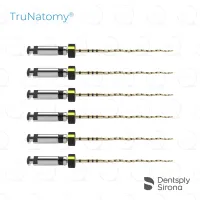
trunatomy® · medium · 25 mm
larger apexafter primestraighter canals
prime went to length, and came out loose with no dentinal debris in its apical flutes. then the apex is larger than prime, and dentsply sirona’s procedure continues with the medium – 36.03v, the same slim heat-treated niti and the same 500 rpm and 1.5 ncm. this is the 25 mm version, the middle of the three lengths.
| 36.03v tip / taper | 0.8 mm wire | 500 rpm 1.5 ncm |
sizes as dentsply sirona print them. the “v” means variable taper; the taper shown is the average along the file, not the taper at the tip. motor settings from the solution guide.
this pack: trunatomy® medium rotary file, iso size 36, .03v taper, 25 mm (pack of 6)
dentsply sirona · made by maillefer instruments holding sàrl, ballaigues, switzerland
› when, in their words. step 13: “if trunatomy® prime is loose at length with no dentinal debris in the apical flutes, continue shaping with trunatomy® medium and subsequently with large if needed.”
› the same slim build. dedicated heat-treated niti on a 0.8 mm wire, against up to 1.2 mm for most generic variable tapered files, with an off-centred cross-section and regressive taper.
› straight anatomies. the solution guide’s front page puts medium and large after prime “if needed (straight anatomies)”.
1 prime first, and gauge it. prime to length; loose with clean apical flutes means the apex is larger (step 13).
2 medium to length. guide it gently to full working length to ensure completeness of shape (step 13).
3 still loose? large. in larger and straighter canals only. otherwise confirm length by hand and try in the medium cone (step 14).
quoted and summarised from the dentsply sirona trunatomy® solution guide. your clinical judgement governs the case; the instructions for use govern the file.
| printed size | 36.03v – iso 36 tip, .03 variable taper |
| role | larger apex, after prime |
| motor | 500 rpm · 1.5 ncm |
| other lengths | 21 mm · 31 mm |
| the range | orifice modifier 20.08 · glider 17.02v · small 20.04v · prime 26.04v · medium 36.03v · large 46.02v |
can i go straight to the medium?
not in dentsply sirona’s procedure: every case begins shaping with prime, and the medium follows only when prime is loose at length.
which points and cone?
the medium ones, matched to the last instrument used.
which motor settings?
dentsply sirona give one setting for every trunatomy® file: 500 rpm and 1.5 ncm. set it on any of the three endo motors we stock – x-smart® go · x-smart® pro+ · vdw.silver® reciproc®.
when do i throw a file away?
dentsply sirona’s procedure (step 11): inspect the cutting flutes routinely on removal for unwinding and straightening, and if deformation is noted, discard it and use a new trunatomy® instrument.
| if still loose, straight canals | trunatomy® large 46.02v, 25 mm |
| one of each | trunatomy® assorted, 25 mm (5) |
| scouting and patency | c-pilot® 010, 25 mm · for the iso 010 k-file scouting and patency steps |
| lubricant | glyde™ file prep · named in step 4 of the solution guide |
| irrigants | chlorax 5.25% · chlorax 2% · endo-solution 17% edta |
| delivery | dentsply sirona irrigation needles, 30g (40) |
| activation | smartlite pro endoactivator® |
| dry | trunatomy® paper points, medium · assorted |
| fill and seal | conform fit® gutta-percha, medium · ah plus®, neosealer® ezflo, 25 mm tips or proroot® bio sealer |
| coronal seal | sdr® flow+ refill, universal |
| motor | x-smart® go · x-smart® pro+ · vdw.silver® reciproc® |
› trunatomy® brochure (pdf, 0.7 mb, dentsply sirona, 06/2025) – the four shaping sizes, the product references and the published claims.
› trunatomy® solution guide (pdf, 0.1 mb, dentsply sirona, 06/2025) – the step-by-step technique at 500 rpm / 1.5 ncm, from access cavity to obturation.
› trunatomy® scientific manual (pdf, 0.7 mb, dentsply sirona, 12/2022) – the laboratory and clinical research behind the system.
› clinical case – dr jonathan cowie, bath (pdf, 0.2 mb, dentsply sirona) – long roots and a calcified system, reviewed at 14 months.
› trunatomy® clinical case collection (dentsply sirona uk website) – more cases, and the full case booklet to download.
trunatomy® medium 36.03v, 25 mm (6) · heat-treated niti rotary · 500 rpm · 1.5 ncm · dentsply sirona · ref bsttnmy625med

trunatomy® · prime · 25 mm
every caseshapingpreserving dentinecurved canals
“always begin shaping with trunatomy® prime.” that is step 8 of dentsply sirona’s procedure, in capitals. prime is the file the whole system is built around: a 26.04v shaping file on a slim 0.8 mm heat-treated niti wire, designed to shape the canal while removing dentine only where it is needed. this is the 25 mm version, the middle of the three lengths.
| 26.04v tip / taper | 0.8 mm wire | 500 rpm 1.5 ncm |
sizes as dentsply sirona print them. the “v” means variable taper; the taper shown is the average along the file, not the taper at the tip. motor settings from the solution guide.
this pack: trunatomy® prime rotary file, iso size 26, .04v taper, 25 mm (pack of 6)
dentsply sirona · made by maillefer instruments holding sàrl, ballaigues, switzerland
› first, every time. after the orifice modifier and glider, prime goes in passively in the presence of sodium hypochlorite, 2–3 gentle amplitudes of about 2–5 mm, until working length (step 8).
› stop at length. step 8 again: “upon reaching length, remove the file to avoid over-enlarging the apical canal portion.”
› where the shape goes next. not progressing: the small, then back to prime. loose at length with clean apical flutes: medium, then large if needed (steps 10 and 13).
1 orifice modifier, then glider. coronal third shaped, working length confirmed, glide path made (steps 5–7).
2 prime to working length. passively, with sodium hypochlorite, 2–3 gentle amplitudes; irrigate, clean the flutes and repeat (steps 8–9).
3 read the apical flutes. loose at length with no dentinal debris: go to medium. otherwise confirm length by hand with prime and try in the prime cone (steps 13–14).
quoted and summarised from the dentsply sirona trunatomy® solution guide. your clinical judgement governs the case; the instructions for use govern the file.
| printed size | 26.04v – iso 26 tip, .04 variable taper |
| role | the shaping file every case starts with |
| motor | 500 rpm · 1.5 ncm |
| other lengths | 21 mm · 31 mm |
| the range | orifice modifier 20.08 · glider 17.02v · small 20.04v · prime 26.04v · medium 36.03v · large 46.02v |
the idea behind the range is dentine preservation. dentsply sirona’s brochure puts it in one line: a unique combination of features “enables efficient root canal treatment while removing dentin only where needed.” that is their internal data, and they label it so. what they build it from is published in plain terms:
› a 0.8 mm wire. dedicated heat-treated niti, against up to 1.2 mm for most generic variable tapered files.
› an off-centred cross-section with a regressive taper. patented, in dentsply sirona’s words, on the shaping files.
› no conventional straight-line access. the orifice modifier creates the entry point instead; dentsply sirona say trunatomy® preserves dentine in the peri-cervical area while ensuring sufficient apical debridement (data on file).
› low torque, higher speed. one setting across the range, 500 rpm and 1.5 ncm – and one motion: “never brush, but peck with large amplitudes.”
| 1. orifice modifier | orifice modifier 20.08, 16 mm · coronal third, no deeper than its 7 mm of flutes |
| 2. glider | glider 17.02v, 25 mm · reproducible glide path to confirmed length |
| 3. prime | this file · always the first shaping file |
| if prime stalls | small 20.04v, 25 mm · then finish with prime |
| if prime is loose | medium 36.03v, 25 mm · then large 46.02v in larger, straighter canals |
| then | confirm length by hand with the last file, try in the matched conform fit® cone, 3-d disinfection, dry with matched points, fill |
steps 5–16 of the dentsply sirona trunatomy® solution guide, summarised.
the sealer goes in with the cone. dentsply sirona’s procedure names ah plus®, their own epoxy sealer. if you work bioceramic, neosealer® ezflo, 25 mm tips comes premixed with fine 29-gauge navitip™ cannulas – resin or bioceramic is a choice of technique rather than a ranking, and we carry both. then a coronal seal: sdr® flow+ refill, universal.
when do i go past prime?
dentsply sirona’s procedure moves on only when prime is loose at length with no dentinal debris in the apical flutes – then medium, and large in larger, straighter canals.
which points and cone?
the prime ones. dentsply sirona match both to the colour code and size of the last instrument used.
which motor settings?
dentsply sirona give one setting for every trunatomy® file: 500 rpm and 1.5 ncm. set it on any of the three endo motors we stock – x-smart® go · x-smart® pro+ · vdw.silver® reciproc®.
when do i throw a file away?
dentsply sirona’s procedure (step 11): inspect the cutting flutes routinely on removal for unwinding and straightening, and if deformation is noted, discard it and use a new trunatomy® instrument.
| if prime is loose | trunatomy® medium 36.03v, 25 mm |
| one of each | trunatomy® assorted, 25 mm (5) |
| scouting and patency | c-pilot® 010, 25 mm · for the iso 010 k-file scouting and patency steps |
| lubricant | glyde™ file prep · named in step 4 of the solution guide |
| irrigants | chlorax 5.25% · chlorax 2% · endo-solution 17% edta |
| delivery | dentsply sirona irrigation needles, 30g (40) |
| activation | smartlite pro endoactivator® |
| dry | trunatomy® paper points, prime · assorted |
| fill and seal | conform fit® gutta-percha, prime · ah plus®, neosealer® ezflo, 25 mm tips or proroot® bio sealer |
| coronal seal | sdr® flow+ refill, universal |
| motor | x-smart® go · x-smart® pro+ · vdw.silver® reciproc® |
› trunatomy® brochure (pdf, 0.7 mb, dentsply sirona, 06/2025) – the four shaping sizes, the product references and the published claims.
› trunatomy® solution guide (pdf, 0.1 mb, dentsply sirona, 06/2025) – the step-by-step technique at 500 rpm / 1.5 ncm, from access cavity to obturation.
› trunatomy® scientific manual (pdf, 0.7 mb, dentsply sirona, 12/2022) – the laboratory and clinical research behind the system.
› clinical case – dr jonathan cowie, bath (pdf, 0.2 mb, dentsply sirona) – long roots and a calcified system, reviewed at 14 months.
› trunatomy® clinical case collection (dentsply sirona uk website) – more cases, and the full case booklet to download.
trunatomy® prime 26.04v, 25 mm (6) · heat-treated niti rotary · 500 rpm · 1.5 ncm · dentsply sirona · ref bsttnmy625prm

trunatomy® · small · 25 mm
narrow canalssevere curvatureswhen prime will not progress
dentsply sirona are candid about the small: “not needed in most cases”. every trunatomy® case starts shaping with prime. the small is the file you move to when prime does not progress easily, or for severe curvatures and narrow canals – and then you finish with prime. this is the 25 mm version, the middle of the three lengths.
| 20.04v tip / taper | 0.8 mm wire | 500 rpm 1.5 ncm |
sizes as dentsply sirona print them. the “v” means variable taper; the taper shown is the average along the file, not the taper at the tip. motor settings from the solution guide.
this pack: trunatomy® small rotary file, iso size 20, .04v taper, 25 mm (pack of 6)
dentsply sirona · made by maillefer instruments holding sàrl, ballaigues, switzerland
› when, in their words. the solution guide: “small not needed in most cases but can help for severe curvatures or narrow canals” and “if the prime does not progress easily use the small then finish with prime”.
› slim wire, off-centred section. dentsply sirona build the shaping files from dedicated heat-treated niti on a 0.8 mm wire – against up to 1.2 mm for most generic variable tapered files – with an off-centred cross-section and regressive taper.
› always followed by prime. step 12 takes the small to working length, then prime to working length “to optimize the shape”.
1 prime will not progress. remove it, irrigate, and recapitulate with an iso 010 k-file to confirm patency (step 10).
2 small to length. passively, in the presence of sodium hypochlorite, no more than 2–3 gentle amplitudes of about 2–5 mm; irrigate and repeat (step 12).
3 prime to length. the same gentle in-and-out motion, to optimise the shape (step 12).
quoted and summarised from the dentsply sirona trunatomy® solution guide. your clinical judgement governs the case; the instructions for use govern the file.
| printed size | 20.04v – iso 20 tip, .04 variable taper |
| role | shaping file for narrow or severely curved canals, before prime |
| motor | 500 rpm · 1.5 ncm |
| other lengths | 21 mm · 31 mm |
| the range | orifice modifier 20.08 · glider 17.02v · small 20.04v · prime 26.04v · medium 36.03v · large 46.02v |
is the small the first shaping file?
no. step 8 is emphatic: “always begin shaping with trunatomy® prime”. the small comes in only when prime does not progress easily, or for severe curvatures and narrow canals.
which points and cone after the small?
dentsply sirona finish with prime after the small, so the prime ones – matched to the last instrument used.
which motor settings?
dentsply sirona give one setting for every trunatomy® file: 500 rpm and 1.5 ncm. set it on any of the three endo motors we stock – x-smart® go · x-smart® pro+ · vdw.silver® reciproc®.
when do i throw a file away?
dentsply sirona’s procedure (step 11): inspect the cutting flutes routinely on removal for unwinding and straightening, and if deformation is noted, discard it and use a new trunatomy® instrument.
| then finish with | trunatomy® prime 26.04v, 25 mm |
| one of each | trunatomy® assorted, 25 mm (5) |
| scouting and patency | c-pilot® 010, 25 mm · for the iso 010 k-file scouting and patency steps |
| lubricant | glyde™ file prep · named in step 4 of the solution guide |
| irrigants | chlorax 5.25% · chlorax 2% · endo-solution 17% edta |
| delivery | dentsply sirona irrigation needles, 30g (40) |
| activation | smartlite pro endoactivator® |
| dry | trunatomy® paper points, prime · assorted |
| fill and seal | conform fit® gutta-percha, prime · ah plus®, neosealer® ezflo, 25 mm tips or proroot® bio sealer |
| coronal seal | sdr® flow+ refill, universal |
| motor | x-smart® go · x-smart® pro+ · vdw.silver® reciproc® |
› trunatomy® brochure (pdf, 0.7 mb, dentsply sirona, 06/2025) – the four shaping sizes, the product references and the published claims.
› trunatomy® solution guide (pdf, 0.1 mb, dentsply sirona, 06/2025) – the step-by-step technique at 500 rpm / 1.5 ncm, from access cavity to obturation.
› trunatomy® scientific manual (pdf, 0.7 mb, dentsply sirona, 12/2022) – the laboratory and clinical research behind the system.
› clinical case – dr jonathan cowie, bath (pdf, 0.2 mb, dentsply sirona) – long roots and a calcified system, reviewed at 14 months.
› trunatomy® clinical case collection (dentsply sirona uk website) – more cases, and the full case booklet to download.
trunatomy® small 20.04v, 25 mm (6) · heat-treated niti rotary · 500 rpm · 1.5 ncm · dentsply sirona · ref bsttnmy625sml

trunatomy® · glider · 31 mm
glide pathbefore shapingreproducible path to length
dentsply sirona’s procedure does not start shaping until a glide path has been made and confirmed. the glider is the file for that step: 17.02v, run at the same 500 rpm and 1.5 ncm as every other file in the range, and taken to the working length you have already confirmed with an apex locator. this is the 31 mm version, for long roots a 25 mm file will not take to working length.
| 17.02v tip / taper | step 7 in the procedure | 500 rpm 1.5 ncm |
sizes as dentsply sirona print them. the “v” means variable taper; the taper shown is the average along the file, not the taper at the tip. motor settings from the solution guide.
this pack: trunatomy® glider glide path file, iso size 17, .02v taper, 31 mm (pack of 6)
dentsply sirona · made by maillefer instruments holding sàrl, ballaigues, switzerland
› its step, word for word. step 7: “with irrigant in the canal, create and confirm a reproducible glide path using a trunatomy® glider in 2-3 gentle amplitudes approximately 2-5 mm.”
› after the hand file, not instead of it. dentsply sirona scout the whole canal with an iso 010 k-file and confirm working length and patency first (step 6).
› peck, never brush. the solution guide’s rule for every trunatomy® file: “low torque instruments - never brush, but peck with large amplitudes.”
1 iso 010 k-file to length. working length by apex locator with radiographs, irrigate, confirm patency (step 6).
2 glider to that length. with irrigant in the canal, 2–3 gentle amplitudes of about 2–5 mm. irrigate and repeat until the confirmed working length is reached (step 7).
3 then prime. every case starts shaping with trunatomy® prime (step 8).
quoted and summarised from the dentsply sirona trunatomy® solution guide. your clinical judgement governs the case; the instructions for use govern the file.
| printed size | 17.02v – iso 17 tip, .02 variable taper |
| role | glide path to working length |
| motor | 500 rpm · 1.5 ncm |
| other lengths | 21 mm · 25 mm |
| the range | orifice modifier 20.08 · glider 17.02v · small 20.04v · prime 26.04v · medium 36.03v · large 46.02v |
can i skip the glider?
dentsply sirona’s procedure does not: shaping starts only after a glide path has been created and confirmed. your clinical judgement governs the case; the instructions for use govern the file.
which motor settings?
dentsply sirona give one setting for every trunatomy® file: 500 rpm and 1.5 ncm. set it on any of the three endo motors we stock – x-smart® go · x-smart® pro+ · vdw.silver® reciproc®.
when do i throw a file away?
dentsply sirona’s procedure (step 11): inspect the cutting flutes routinely on removal for unwinding and straightening, and if deformation is noted, discard it and use a new trunatomy® instrument.
| next file | trunatomy® prime 26.04v, 31 mm |
| one of each | trunatomy® assorted, 31 mm (5) |
| scouting and patency | an iso 010 hand file in 31 mm for the scouting and patency steps – there is no 31 mm c-pilot®, so ask us |
| lubricant | glyde™ file prep · named in step 4 of the solution guide |
| irrigants | chlorax 5.25% · chlorax 2% · endo-solution 17% edta |
| delivery | dentsply sirona irrigation needles, 30g (40) |
| activation | smartlite pro endoactivator® |
| dry | trunatomy® paper points, prime · assorted |
| fill and seal | conform fit® gutta-percha, prime · ah plus®, neosealer® ezflo, 25 mm tips or proroot® bio sealer |
| coronal seal | sdr® flow+ refill, universal |
| motor | x-smart® go · x-smart® pro+ · vdw.silver® reciproc® |
› trunatomy® brochure (pdf, 0.7 mb, dentsply sirona, 06/2025) – the four shaping sizes, the product references and the published claims.
› trunatomy® solution guide (pdf, 0.1 mb, dentsply sirona, 06/2025) – the step-by-step technique at 500 rpm / 1.5 ncm, from access cavity to obturation.
› trunatomy® scientific manual (pdf, 0.7 mb, dentsply sirona, 12/2022) – the laboratory and clinical research behind the system.
› clinical case – dr jonathan cowie, bath (pdf, 0.2 mb, dentsply sirona) – long roots and a calcified system, reviewed at 14 months.
› trunatomy® clinical case collection (dentsply sirona uk website) – more cases, and the full case booklet to download.
trunatomy® glider 17.02v, 31 mm (6) · heat-treated niti rotary · 500 rpm · 1.5 ncm · dentsply sirona · ref bsttnmy631glr

trunatomy® · large · 31 mm
large straight canalsmaxillary centralspalatal and distal roots
a maxillary central incisor, some palatal or distal molar canals. those are dentsply sirona’s own examples of where the large belongs. it is the newest and largest trunatomy® shaping file, 46.02v, and it comes after medium – never instead of prime. this is the 31 mm version, for long roots a 25 mm file will not take to working length.
| 46.02v tip / taper | 0.8 mm wire | 500 rpm 1.5 ncm |
sizes as dentsply sirona print them. the “v” means variable taper; the taper shown is the average along the file, not the taper at the tip. motor settings from the solution guide.
this pack: trunatomy® large rotary file, iso size 46, .02v taper, 31 mm (pack of 6)
dentsply sirona · made by maillefer instruments holding sàrl, ballaigues, switzerland
› where dentsply sirona say to use it. step 13: “use trunatomy® large in larger and straighter canals only, such as maxillary central incisors, some palatal or distal canals of molars.”
› after medium. prime loose at length, then medium, “and subsequently with large if needed”.
› newest size in the range. not in the 2019 launch literature; the current brochure lists it as now available.
1 prime, then medium. prime loose at length with clean apical flutes, medium to full working length (step 13).
2 large, if the canal is larger and straighter. guided gently to full working length (step 13).
3 confirm and fit. confirm working length by hand with the large, then try in the large cone (step 14).
quoted and summarised from the dentsply sirona trunatomy® solution guide. your clinical judgement governs the case; the instructions for use govern the file.
| printed size | 46.02v – iso 46 tip, .02 variable taper |
| role | larger and straighter canals only, after medium |
| motor | 500 rpm · 1.5 ncm |
| other lengths | 21 mm · 25 mm |
| the range | orifice modifier 20.08 · glider 17.02v · small 20.04v · prime 26.04v · medium 36.03v · large 46.02v |
can i use the large in a curved molar canal?
dentsply sirona limit it to larger and straighter canals and give their examples. a curved canal belongs to prime, small or medium.
why is the taper lower than the medium?
the .02v taper sits on a much larger iso 46 tip. dentsply sirona publish the size, not the reasoning, so we will not invent one.
which points and cone?
the large ones, matched to the last instrument used.
which motor settings?
dentsply sirona give one setting for every trunatomy® file: 500 rpm and 1.5 ncm. set it on any of the three endo motors we stock – x-smart® go · x-smart® pro+ · vdw.silver® reciproc®.
when do i throw a file away?
dentsply sirona’s procedure (step 11): inspect the cutting flutes routinely on removal for unwinding and straightening, and if deformation is noted, discard it and use a new trunatomy® instrument.
| one of each | trunatomy® assorted, 31 mm (5) |
| scouting and patency | an iso 010 hand file in 31 mm for the scouting and patency steps – there is no 31 mm c-pilot®, so ask us |
| lubricant | glyde™ file prep · named in step 4 of the solution guide |
| irrigants | chlorax 5.25% · chlorax 2% · endo-solution 17% edta |
| delivery | dentsply sirona irrigation needles, 30g (40) |
| activation | smartlite pro endoactivator® |
| dry | trunatomy® paper points, large · assorted |
| fill and seal | conform fit® gutta-percha, large · ah plus®, neosealer® ezflo, 25 mm tips or proroot® bio sealer |
| coronal seal | sdr® flow+ refill, universal |
| motor | x-smart® go · x-smart® pro+ · vdw.silver® reciproc® |
› trunatomy® brochure (pdf, 0.7 mb, dentsply sirona, 06/2025) – the four shaping sizes, the product references and the published claims.
› trunatomy® solution guide (pdf, 0.1 mb, dentsply sirona, 06/2025) – the step-by-step technique at 500 rpm / 1.5 ncm, from access cavity to obturation.
› trunatomy® scientific manual (pdf, 0.7 mb, dentsply sirona, 12/2022) – the laboratory and clinical research behind the system.
› clinical case – dr jonathan cowie, bath (pdf, 0.2 mb, dentsply sirona) – long roots and a calcified system, reviewed at 14 months.
› trunatomy® clinical case collection (dentsply sirona uk website) – more cases, and the full case booklet to download.
trunatomy® large 46.02v, 31 mm (6) · heat-treated niti rotary · 500 rpm · 1.5 ncm · dentsply sirona · ref bsttnmy631lrg
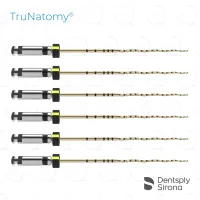
trunatomy® · medium · 31 mm
larger apexafter primestraighter canals
prime went to length, and came out loose with no dentinal debris in its apical flutes. then the apex is larger than prime, and dentsply sirona’s procedure continues with the medium – 36.03v, the same slim heat-treated niti and the same 500 rpm and 1.5 ncm. this is the 31 mm version, for long roots a 25 mm file will not take to working length.
| 36.03v tip / taper | 0.8 mm wire | 500 rpm 1.5 ncm |
sizes as dentsply sirona print them. the “v” means variable taper; the taper shown is the average along the file, not the taper at the tip. motor settings from the solution guide.
this pack: trunatomy® medium rotary file, iso size 36, .03v taper, 31 mm (pack of 6)
dentsply sirona · made by maillefer instruments holding sàrl, ballaigues, switzerland
› when, in their words. step 13: “if trunatomy® prime is loose at length with no dentinal debris in the apical flutes, continue shaping with trunatomy® medium and subsequently with large if needed.”
› the same slim build. dedicated heat-treated niti on a 0.8 mm wire, against up to 1.2 mm for most generic variable tapered files, with an off-centred cross-section and regressive taper.
› straight anatomies. the solution guide’s front page puts medium and large after prime “if needed (straight anatomies)”.
1 prime first, and gauge it. prime to length; loose with clean apical flutes means the apex is larger (step 13).
2 medium to length. guide it gently to full working length to ensure completeness of shape (step 13).
3 still loose? large. in larger and straighter canals only. otherwise confirm length by hand and try in the medium cone (step 14).
quoted and summarised from the dentsply sirona trunatomy® solution guide. your clinical judgement governs the case; the instructions for use govern the file.
| printed size | 36.03v – iso 36 tip, .03 variable taper |
| role | larger apex, after prime |
| motor | 500 rpm · 1.5 ncm |
| other lengths | 21 mm · 25 mm |
| the range | orifice modifier 20.08 · glider 17.02v · small 20.04v · prime 26.04v · medium 36.03v · large 46.02v |
can i go straight to the medium?
not in dentsply sirona’s procedure: every case begins shaping with prime, and the medium follows only when prime is loose at length.
which points and cone?
the medium ones, matched to the last instrument used.
which motor settings?
dentsply sirona give one setting for every trunatomy® file: 500 rpm and 1.5 ncm. set it on any of the three endo motors we stock – x-smart® go · x-smart® pro+ · vdw.silver® reciproc®.
when do i throw a file away?
dentsply sirona’s procedure (step 11): inspect the cutting flutes routinely on removal for unwinding and straightening, and if deformation is noted, discard it and use a new trunatomy® instrument.
| if still loose, straight canals | trunatomy® large 46.02v, 31 mm |
| one of each | trunatomy® assorted, 31 mm (5) |
| scouting and patency | an iso 010 hand file in 31 mm for the scouting and patency steps – there is no 31 mm c-pilot®, so ask us |
| lubricant | glyde™ file prep · named in step 4 of the solution guide |
| irrigants | chlorax 5.25% · chlorax 2% · endo-solution 17% edta |
| delivery | dentsply sirona irrigation needles, 30g (40) |
| activation | smartlite pro endoactivator® |
| dry | trunatomy® paper points, medium · assorted |
| fill and seal | conform fit® gutta-percha, medium · ah plus®, neosealer® ezflo, 25 mm tips or proroot® bio sealer |
| coronal seal | sdr® flow+ refill, universal |
| motor | x-smart® go · x-smart® pro+ · vdw.silver® reciproc® |
› trunatomy® brochure (pdf, 0.7 mb, dentsply sirona, 06/2025) – the four shaping sizes, the product references and the published claims.
› trunatomy® solution guide (pdf, 0.1 mb, dentsply sirona, 06/2025) – the step-by-step technique at 500 rpm / 1.5 ncm, from access cavity to obturation.
› trunatomy® scientific manual (pdf, 0.7 mb, dentsply sirona, 12/2022) – the laboratory and clinical research behind the system.
› clinical case – dr jonathan cowie, bath (pdf, 0.2 mb, dentsply sirona) – long roots and a calcified system, reviewed at 14 months.
› trunatomy® clinical case collection (dentsply sirona uk website) – more cases, and the full case booklet to download.
trunatomy® medium 36.03v, 31 mm (6) · heat-treated niti rotary · 500 rpm · 1.5 ncm · dentsply sirona · ref bsttnmy631med

trunatomy® · prime · 31 mm
every caseshapingpreserving dentinecurved canals
“always begin shaping with trunatomy® prime.” that is step 8 of dentsply sirona’s procedure, in capitals. prime is the file the whole system is built around: a 26.04v shaping file on a slim 0.8 mm heat-treated niti wire, designed to shape the canal while removing dentine only where it is needed. this is the 31 mm version, for long roots a 25 mm file will not take to working length.
| 26.04v tip / taper | 0.8 mm wire | 500 rpm 1.5 ncm |
sizes as dentsply sirona print them. the “v” means variable taper; the taper shown is the average along the file, not the taper at the tip. motor settings from the solution guide.
this pack: trunatomy® prime rotary file, iso size 26, .04v taper, 31 mm (pack of 6)
dentsply sirona · made by maillefer instruments holding sàrl, ballaigues, switzerland
› first, every time. after the orifice modifier and glider, prime goes in passively in the presence of sodium hypochlorite, 2–3 gentle amplitudes of about 2–5 mm, until working length (step 8).
› stop at length. step 8 again: “upon reaching length, remove the file to avoid over-enlarging the apical canal portion.”
› where the shape goes next. not progressing: the small, then back to prime. loose at length with clean apical flutes: medium, then large if needed (steps 10 and 13).
1 orifice modifier, then glider. coronal third shaped, working length confirmed, glide path made (steps 5–7).
2 prime to working length. passively, with sodium hypochlorite, 2–3 gentle amplitudes; irrigate, clean the flutes and repeat (steps 8–9).
3 read the apical flutes. loose at length with no dentinal debris: go to medium. otherwise confirm length by hand with prime and try in the prime cone (steps 13–14).
quoted and summarised from the dentsply sirona trunatomy® solution guide. your clinical judgement governs the case; the instructions for use govern the file.
| printed size | 26.04v – iso 26 tip, .04 variable taper |
| role | the shaping file every case starts with |
| motor | 500 rpm · 1.5 ncm |
| other lengths | 21 mm · 25 mm |
| the range | orifice modifier 20.08 · glider 17.02v · small 20.04v · prime 26.04v · medium 36.03v · large 46.02v |
when do i go past prime?
dentsply sirona’s procedure moves on only when prime is loose at length with no dentinal debris in the apical flutes – then medium, and large in larger, straighter canals.
which points and cone?
the prime ones. dentsply sirona match both to the colour code and size of the last instrument used.
which motor settings?
dentsply sirona give one setting for every trunatomy® file: 500 rpm and 1.5 ncm. set it on any of the three endo motors we stock – x-smart® go · x-smart® pro+ · vdw.silver® reciproc®.
when do i throw a file away?
dentsply sirona’s procedure (step 11): inspect the cutting flutes routinely on removal for unwinding and straightening, and if deformation is noted, discard it and use a new trunatomy® instrument.
| if prime is loose | trunatomy® medium 36.03v, 31 mm |
| one of each | trunatomy® assorted, 31 mm (5) |
| scouting and patency | an iso 010 hand file in 31 mm for the scouting and patency steps – there is no 31 mm c-pilot®, so ask us |
| lubricant | glyde™ file prep · named in step 4 of the solution guide |
| irrigants | chlorax 5.25% · chlorax 2% · endo-solution 17% edta |
| delivery | dentsply sirona irrigation needles, 30g (40) |
| activation | smartlite pro endoactivator® |
| dry | trunatomy® paper points, prime · assorted |
| fill and seal | conform fit® gutta-percha, prime · ah plus®, neosealer® ezflo, 25 mm tips or proroot® bio sealer |
| coronal seal | sdr® flow+ refill, universal |
| motor | x-smart® go · x-smart® pro+ · vdw.silver® reciproc® |
› trunatomy® brochure (pdf, 0.7 mb, dentsply sirona, 06/2025) – the four shaping sizes, the product references and the published claims.
› trunatomy® solution guide (pdf, 0.1 mb, dentsply sirona, 06/2025) – the step-by-step technique at 500 rpm / 1.5 ncm, from access cavity to obturation.
› trunatomy® scientific manual (pdf, 0.7 mb, dentsply sirona, 12/2022) – the laboratory and clinical research behind the system.
› clinical case – dr jonathan cowie, bath (pdf, 0.2 mb, dentsply sirona) – long roots and a calcified system, reviewed at 14 months.
› trunatomy® clinical case collection (dentsply sirona uk website) – more cases, and the full case booklet to download.
trunatomy® prime 26.04v, 31 mm (6) · heat-treated niti rotary · 500 rpm · 1.5 ncm · dentsply sirona · ref bsttnmy631prm

trunatomy® · small · 31 mm
narrow canalssevere curvatureswhen prime will not progress
dentsply sirona are candid about the small: “not needed in most cases”. every trunatomy® case starts shaping with prime. the small is the file you move to when prime does not progress easily, or for severe curvatures and narrow canals – and then you finish with prime. this is the 31 mm version, for long roots a 25 mm file will not take to working length.
| 20.04v tip / taper | 0.8 mm wire | 500 rpm 1.5 ncm |
sizes as dentsply sirona print them. the “v” means variable taper; the taper shown is the average along the file, not the taper at the tip. motor settings from the solution guide.
this pack: trunatomy® small rotary file, iso size 20, .04v taper, 31 mm (pack of 6)
dentsply sirona · made by maillefer instruments holding sàrl, ballaigues, switzerland
› when, in their words. the solution guide: “small not needed in most cases but can help for severe curvatures or narrow canals” and “if the prime does not progress easily use the small then finish with prime”.
› slim wire, off-centred section. dentsply sirona build the shaping files from dedicated heat-treated niti on a 0.8 mm wire – against up to 1.2 mm for most generic variable tapered files – with an off-centred cross-section and regressive taper.
› always followed by prime. step 12 takes the small to working length, then prime to working length “to optimize the shape”.
1 prime will not progress. remove it, irrigate, and recapitulate with an iso 010 k-file to confirm patency (step 10).
2 small to length. passively, in the presence of sodium hypochlorite, no more than 2–3 gentle amplitudes of about 2–5 mm; irrigate and repeat (step 12).
3 prime to length. the same gentle in-and-out motion, to optimise the shape (step 12).
quoted and summarised from the dentsply sirona trunatomy® solution guide. your clinical judgement governs the case; the instructions for use govern the file.
| printed size | 20.04v – iso 20 tip, .04 variable taper |
| role | shaping file for narrow or severely curved canals, before prime |
| motor | 500 rpm · 1.5 ncm |
| other lengths | 21 mm · 25 mm |
| the range | orifice modifier 20.08 · glider 17.02v · small 20.04v · prime 26.04v · medium 36.03v · large 46.02v |
is the small the first shaping file?
no. step 8 is emphatic: “always begin shaping with trunatomy® prime”. the small comes in only when prime does not progress easily, or for severe curvatures and narrow canals.
which points and cone after the small?
dentsply sirona finish with prime after the small, so the prime ones – matched to the last instrument used.
which motor settings?
dentsply sirona give one setting for every trunatomy® file: 500 rpm and 1.5 ncm. set it on any of the three endo motors we stock – x-smart® go · x-smart® pro+ · vdw.silver® reciproc®.
when do i throw a file away?
dentsply sirona’s procedure (step 11): inspect the cutting flutes routinely on removal for unwinding and straightening, and if deformation is noted, discard it and use a new trunatomy® instrument.
| then finish with | trunatomy® prime 26.04v, 31 mm |
| one of each | trunatomy® assorted, 31 mm (5) |
| scouting and patency | an iso 010 hand file in 31 mm for the scouting and patency steps – there is no 31 mm c-pilot®, so ask us |
| lubricant | glyde™ file prep · named in step 4 of the solution guide |
| irrigants | chlorax 5.25% · chlorax 2% · endo-solution 17% edta |
| delivery | dentsply sirona irrigation needles, 30g (40) |
| activation | smartlite pro endoactivator® |
| dry | trunatomy® paper points, prime · assorted |
| fill and seal | conform fit® gutta-percha, prime · ah plus®, neosealer® ezflo, 25 mm tips or proroot® bio sealer |
| coronal seal | sdr® flow+ refill, universal |
| motor | x-smart® go · x-smart® pro+ · vdw.silver® reciproc® |
› trunatomy® brochure (pdf, 0.7 mb, dentsply sirona, 06/2025) – the four shaping sizes, the product references and the published claims.
› trunatomy® solution guide (pdf, 0.1 mb, dentsply sirona, 06/2025) – the step-by-step technique at 500 rpm / 1.5 ncm, from access cavity to obturation.
› trunatomy® scientific manual (pdf, 0.7 mb, dentsply sirona, 12/2022) – the laboratory and clinical research behind the system.
› clinical case – dr jonathan cowie, bath (pdf, 0.2 mb, dentsply sirona) – long roots and a calcified system, reviewed at 14 months.
› trunatomy® clinical case collection (dentsply sirona uk website) – more cases, and the full case booklet to download.
trunatomy® small 20.04v, 31 mm (6) · heat-treated niti rotary · 500 rpm · 1.5 ncm · dentsply sirona · ref bsttnmy631sml

cerkamed btr pen · broken tool remover · set
separated instrument retrievalretreatmentnitinol loopautoclavable
the btr pen is cerkamed's instrument for a separated file: a stainless steel pen that carries a fine nitinol loop down the canal, lassos the fragment and tightens on it. cerkamed's intended use: "btr pen, together with a compatible nitinol loop tip, is designed to remove fragments of broken endodontic instruments from the root canal." the set is the pen, a calibrator for setting the loop, five 0.3 mm tips, spare springs and o-rings.
this pack: cerkamed btr pen set: btr pen (stainless steel), btr calibrator, 5 x btr tip 0.3 mm with nitinol loop, 2 x btr spring (soft and hard; the medium spring is fitted), 3 x silicone o-ring
| pen | stainless steel, reusable; disassemble before sterilisation |
| tips | nitinol loop on a needle, in 0.3, 0.4 and 0.5 mm; single use; supplied non-sterile, autoclave before use without the protective cap |
| calibrator | reusable; cerkamed: disinfect with isopropyl alcohol and inspect before each use – a blunt or bent calibrator needle makes the loop hard to set accurately |
| springs | soft and hard supplied; medium fitted in the pen |
| sterilisation | cerkamed: steam autoclave 134°c for 5 minutes, or 121°c for 20 minutes |
| storage | cerkamed: 5–30°c, relative humidity below 70% |
› cerkamed: "the stainless steel instrument is designed for multiple use, while the btr pen-compatible nitinol loop tip is intended for single use."
› cerkamed: "btr pen must always be disassembled before sterilisation." clean new instruments with a soft brush and an instrument cleaning solution; ultrasonic cleaning is also recommended; rinse with purified water and dry.
› on the tips, cerkamed: "the btr tip is delivered non – sterile. before use, the tip should be sterilised" – and in capitals, "sterilise without the protective cup!"
› cerkamed: "before each use, the instrument should be inspected for contamination, damage to the material structure (cracks, bends, splits, scratches – deeper scratches)."
› cerkamed publish a user manual, a work methodology and the ifu on their product page, and run btr-pen.com for the technique. this page does not describe the technique; those documents do.
› cerkamed mark the product "to be used by dentist only".
learn it on the bench first. cerkamed make a training set for exactly this: the btr dental training gum is a backlit silicone mass with eight embedded fragments and two resin teeth with fragments set easy and hard, and the training teeth – easy and training teeth – hard are the same teeth in tens. a retrieval you have done ten times on the bench is a different proposition at the chair.
cerkamed make the loop tip in three diameters – 0.3 mm, 0.4 mm and 0.5 mm. the set ships with five 0.3 mm. the canal and the fragment decide: the finer the canal, the finer the needle that will reach the fragment. keep all three in the drawer.
they are used together as often as instead of one another: ultrasonics to expose and loosen the head of the fragment, the loop to grip and withdraw it. cerkamed's work methodology covers the sequence; we make no claim for one over the other.
one tip. the pen, calibrator and springs are reusable; the loop tip is single use, five to a pack.
| loop tips | 0.3 mm · 0.4 mm · 0.5 mm |
| training | btr dental training gum · training teeth – easy · training teeth – hard |
| solvents for the filling around it | eucalyptol · orange guttane |
| re-scout afterwards | c-pilot iso 010, 25 mm |
| irrigants | chloraxid 5.25% · endo-solution 17% edta |
| repair a perforation | mta+ maxi · neomta 2 |
btr pen set · stainless steel pen, calibrator, 5 x 0.3 mm nitinol loop tips, springs, o-rings · autoclave 134°c 5 min · made by cerkamed, stalowa wola, poland · ref cer-w-btr-pen
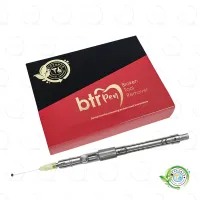
cerkamed tools for mta · mx1–mx4 · stainless steel
mta carryingmta condensingperforation repairretrograde fillingautoclavable
a set of double-ended stainless steel instruments for mta: two ends that carry a measured dose from the dosing block to the site, two that condense and smooth it once it is there, split by anterior and posterior reach. cerkamed's description: "reusable dental tools for handling and application of prepared measure of mta material." non-sterile in the box; autoclave before first use and every use after.
this pack: cerkamed tools for mta, stainless steel instrument set, mx1–mx4, non-sterile, reusable
| mx1 | carrying tip – mta from the dosing block into the prepared canal, perforation or retrograde cavity, posterior teeth |
| mx2 | carrying tip – the same, anterior teeth |
| mx3 | application tip – placing, condensing and smoothing the cement, anterior teeth |
| mx4 | application tip – the same, posterior teeth |
| material | cerkamed: corrosion-resistant stainless steel |
| sterilisation | cerkamed: steam autoclave 134°c for 5 minutes; disinfect, wash, rinse and dry first. ultrasonic cleaning recommended |
| storage | cerkamed: 5–30°c, relative humidity below 70% |
› cerkamed: "the packaged instruments are non – sterile. before sterilisation, these new instruments should be washed thoroughly with warm water and using detergent. before each use these dental instruments must be sterilised."
› cerkamed: "before use protect the instrument against contamination or damage of the material structure (cracks, bends, fractures, peeling, etc.)."
› the mx1–mx4 functions above are from the qed listing, which follows cerkamed's instrument leaflet; their web page describes the set only in general terms.
› cerkamed mark the product "to be used by dentist only".
three different jobs. the tools set carries a formed dose and condenses it. the mta+ applicator 0.8 mm and mta+ applicator 1.2 mm are single-ended placers that pick up a plug of a set diameter. the vista apex mta carriers are spring-loaded carriers for a longer reach. most operators own a carrier and this set.
cerkamed's matrix mta dosing block has grooves from 0.7 to 1.0 mm for forming a dose to size, and mx1/mx2 are described as carrying from it. it is not one we stock at present; a glass slab and a measured pick-up works with the same tips.
| the material | mta+ maxi |
| placers | mta+ applicator 0.8 mm · mta+ applicator 1.2 mm · vista apex mta carriers |
| practise it | mta smart system training set |
| bioceramic alternatives | neomta 2 · neoputty |
tools for mta · mx1–mx4 · stainless steel · non-sterile, autoclave 134°c 5 min · made by cerkamed, stalowa wola, poland · ref cer-w-narz
cerkamed mta+ applicator · 0.8 mm · stainless steel
mta placementperforation repairroot-end fillingautoclavablereusable
the mta+ applicator is cerkamed's single-ended placer for mixed mta: a stainless steel handle with a ring for the finger, a fine plunger, and a 0.8 mm tip that picks up a measured dose and pushes it out where the repair is. cerkamed's description: "reusable dental tools for handling and application of prepared measure of mta+ material." two diameters; this is the 0.8 mm.
this pack: cerkamed mta+ applicator, 0.8 mm diameter, stainless steel, reusable, non-sterile
| tip diameter | 0.8 mm |
| material | cerkamed: corrosion-resistant stainless steel |
| sterilisation | cerkamed: steam autoclave 134°c for 5 minutes, after disinfecting, washing, rinsing and drying; ultrasonic cleaning recommended |
| storage | cerkamed: 5–30°c, relative humidity below 70% |
| other size | mta+ applicator 1.2 mm |
› cerkamed: "the packaged instruments are non–sterile. before sterilisation, these new instruments should be washed thoroughly with warm water and using detergent. before each use these dental instruments must be sterilised."
› cerkamed: "before use protect the instrument against contamination or damage of the material structure (cracks, bends, fractures, peeling, etc.)."
› clear the barrel before the mta sets in it – cerkamed give 6 minutes from mixing on the mta+ page, and the plunger is the only way through a set plug.
› cerkamed mark the product "to be used by dentist only".
the canal or the cavity decides. 0.8 mm goes down a shaped canal for an apical plug or a lateral perforation; 1.2 mm carries more for a furcation floor, a pulpotomy or a retrograde cavity. many operators keep both. this page is the 0.8 mm; the other is here.
this is a placer: it picks up a plug of one diameter and delivers it. the vista apex mta carriers are spring-loaded carriers with a longer reach, and the tools for mta (mx1–mx4) carry and condense from a dosing block. they are companions rather than substitutes.
| the material | mta+ maxi |
| other instruments | tools for mta (mx1–mx4) · vista apex mta carriers |
| practise it | mta smart system training set |
| bioceramic alternatives | neomta 2 · neoputty |
mta+ applicator · 0.8 mm · stainless steel · reusable, non-sterile, autoclave 134°c 5 min · made by cerkamed, stalowa wola, poland · ref cer-w-narz0.8
cerkamed mta+ applicator · 1.2 mm · stainless steel
mta placementperforation repairroot-end fillingautoclavablereusable
the mta+ applicator is cerkamed's single-ended placer for mixed mta: a stainless steel handle with a ring for the finger, a fine plunger, and a 1.2 mm tip that picks up a measured dose and pushes it out where the repair is. cerkamed's description: "reusable dental tools for handling and application of prepared measure of mta+ material." two diameters; this is the 1.2 mm.
this pack: cerkamed mta+ applicator, 1.2 mm diameter, stainless steel, reusable, non-sterile
| tip diameter | 1.2 mm |
| material | cerkamed: corrosion-resistant stainless steel |
| sterilisation | cerkamed: steam autoclave 134°c for 5 minutes, after disinfecting, washing, rinsing and drying; ultrasonic cleaning recommended |
| storage | cerkamed: 5–30°c, relative humidity below 70% |
| other size | mta+ applicator 0.8 mm |
› cerkamed: "the packaged instruments are non–sterile. before sterilisation, these new instruments should be washed thoroughly with warm water and using detergent. before each use these dental instruments must be sterilised."
› cerkamed: "before use protect the instrument against contamination or damage of the material structure (cracks, bends, fractures, peeling, etc.)."
› clear the barrel before the mta sets in it – cerkamed give 6 minutes from mixing on the mta+ page, and the plunger is the only way through a set plug.
› cerkamed mark the product "to be used by dentist only".
the canal or the cavity decides. 0.8 mm goes down a shaped canal for an apical plug or a lateral perforation; 1.2 mm carries more for a furcation floor, a pulpotomy or a retrograde cavity. many operators keep both. this page is the 1.2 mm; the other is here.
this is a placer: it picks up a plug of one diameter and delivers it. the vista apex mta carriers are spring-loaded carriers with a longer reach, and the tools for mta (mx1–mx4) carry and condense from a dosing block. they are companions rather than substitutes.
| the material | mta+ maxi |
| other instruments | tools for mta (mx1–mx4) · vista apex mta carriers |
| practise it | mta smart system training set |
| bioceramic alternatives | neomta 2 · neoputty |
mta+ applicator · 1.2 mm · stainless steel · reusable, non-sterile, autoclave 134°c 5 min · made by cerkamed, stalowa wola, poland · ref cer-w-narz1.2
hand-held · jordco endoring® ii · grey · reduced glare
place a file, measure it, wipe it, put it down – four things that otherwise mean turning away from the tooth. the endoring® ii carries all of them on a ring worn on your hand: jordco describe it as an organiser that lets the clinician directly place, store, measure and clean endodontic hand and rotary instruments. their argument for it is fewer passes of a sharp instrument between people, and less reaching out of the field. this version has the reduced-glare ruler built in.
this kit: endoring® ii assembly in grey with the laser-etched reduced-glare black metal ruler attached – cup, three finger rings (small, medium, large), the reusable gelwell® cup and its adaptor ring
made by jordco, inc.
| ruler attached | jordco’s wording: the laser-etched reduced-glare ruler is attached to the endoring ii, and its black colour reduces head lamp glare when working through surgical telescopes |
| worn, not put down | three interchangeable finger rings in the box. the foam and the cleaning cup travel with your hand rather than sitting on the bracket table |
| measure without unchucking | from the ifu: rotary files are calibrated without removing them from the handpiece, against a scale marked in half-millimetres. curved files flatten in the stabilising channel and spring back afterwards |
| order the foam with it | the ring arrives with its reusable gelwell® cup, not with a supply of the single-use parts. the e-foam® inserts and the single-use gelwell® cups are both consumables and both sold in 48s – linked below, and worth adding to the first order |
› foam refills e-foam® high density (48) or endoring® foam (48).
› gelwell refills endoring® gelwells (48) – the cleaning cups.
› ruler on its own jordco e-ruler®, reduced glare – if you want the ruler without the ring.
› bulk file storage endoring® filecaddy® – for between cases rather than during one.
what makes this one different from the other endoring kits?
the reduced-glare metal ruler is attached to it, and this is the grey. jordco make the endoring ii in several colours and configurations – ring us and we will tell you which we stock.
are the foams and cups reusable?
no, and they are not treated the same way. a new e-foam® insert is autoclaved before use and binned after; the single-use gelwell® cups must not be autoclaved at all – jordco say they deform or melt, so use a high-level disinfectant. the assembly itself is autoclavable: 121°c for 30 minutes, or 132°c for 4 minutes pre-vacuum.
› endoring® ii reduced-glare product sheet (pdf, 0.8 mb, jordco) – the ring with the black non-glare ruler.
› endoring® ii instructions for use (pdf, 0.8 mb, jordco) – the family document – assembly, wearing it, measuring, and every cleaning cycle.
jordco’s product sheet describes their international pack. what qed supplies is the list above – the foam inserts and the single-use cups are ordered separately.
endoring® ii, grey, with reduced-glare metal ruler · worn on the hand · three finger rings · reusable gelwell® cup and adaptor ring · jordco, inc. · ref er2gyrg-ex-s
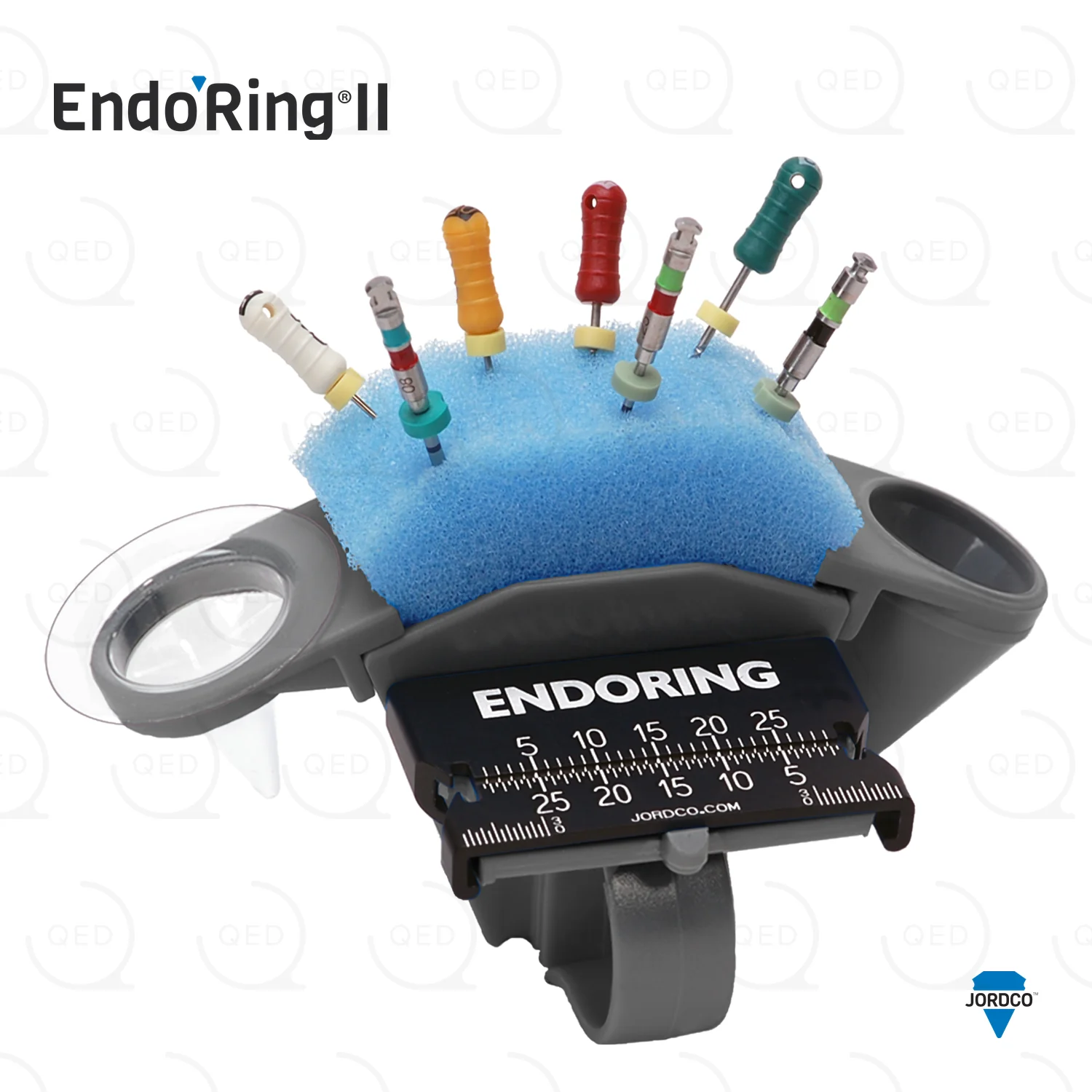
refills · jordco e-foam® · 48 · single use
an endoring without foam is a ring. the insert is what holds the files upright, takes the punctures and wipes the flutes – jordco’s own claim for the patented foam is optimum performance for superior cleaning, storing and organising endodontic files. forty-eight in a pack, and they fit every endoring® product jordco make.
this pack: 48 × jordco® e-foam® single-use inserts, patented foam, fits all endoring® products
made by jordco, inc. · foam made in the usa
| autoclave, then use, then bin | worth reading carefully. the inserts are single use, and a new one is autoclaved before use – 132°c for 15 minutes gravity, or 4 minutes pre-vacuum. jordco are explicit that autoclaving will not remove bioburden from a used insert, so it is not a foam you re-sterilise |
| fits every endoring | jordco state these fit all endoring® products, so one pack covers whichever version is on the shelf |
| 48 per pack | a case consumable. an endoring ii ships with six, so this is the reorder |
› what it fits endoring® ii with reduced-glare ruler and the rest of the endoring® range.
› the cleaning cups endoring® gelwells (48) – the other single-use part.
› for rotary instead e-foam® rotary hd (48) – denser, so it takes a file still turning in the handpiece.
› different foam entirely filecaddy® foam refills – those fit the storage caddy, not the ring.
single use, but autoclavable?
both, and the order is the whole point. a new insert is autoclaved before the case and discarded after it. jordco state plainly that autoclaving will not remove bioburden left behind from prior use – so a used insert does not come back, however hot you run it.
will these fit my endoring?
jordco state they fit all endoring® products. if you are running a filecaddy rather than a ring, that takes its own inserts – linked above.
› jordco e-foam® product sheet (pdf, 0.8 mb, jordco) – the pack options and jordco’s own processing instructions.
› endoring® ii instructions for use (pdf, 0.8 mb, jordco) – the family document – assembly, wearing it, measuring, and every cleaning cycle.
jordco e-foam® insert refill pack · 48 per pack · patented foam · single use, autoclave before use · fits all endoring® products · jordco, inc. · ref erf
refills · jordco e-foam® rotary hd · 48 · silver
push a spinning file into ordinary foam and the foam loses. that is the whole reason this one exists. jordco make the rotary hd dense enough that, in their words, a rotating file secured in a handpiece can be placed directly into the high-density foam to assist in cleaning debris from the flutes – and it will minimise tearing or shearing of the foam while the file is in motion. you clean between passes without changing what your hands are doing.
this pack: 48 × jordco® e-foam® rotary hd single-use inserts, high density, jordco® silver
made by jordco, inc. · made in the usa
| takes a turning file | jordco’s stated use: a rotary file still running in the handpiece goes straight into the foam to clear the flutes, and the density is there to stop the foam tearing or shearing |
| autoclave it new, then bin it | jordco say a new rotary hd insert is steam autoclaved before use, the same as their standard e-foam®, and then discarded. autoclaving will not remove bioburden from a used insert, so it is not a foam you re-sterilise. do not exceed 135°c and do not stack anything on the foam in the chamber |
| silver, 48 per pack | jordco® silver is the only colour in this version, which makes it easy to tell from the blue and yellow standard inserts on the shelf |
› for hand files instead jordco e-foam® inserts (48) – the standard blue and yellow foam, for hand files.
› what it fits endoring® ii with reduced-glare ruler.
› the cleaning cups endoring® gelwells (48).
› rotary files vdw reciproc® minima r25, 25 mm.
hd or standard?
one difference, and it is not reprocessing. the hd is dense enough to take a file that is still turning in the handpiece without tearing; the standard is not. both are single use, and jordco say both are autoclaved new, before the case. so choose on whether files go into the foam under power.
is this the old erflhd-s?
it replaces it. jordco list the silver rotary hd pack as the successor to that model.
› e-foam® rotary hd product sheet (pdf, 0.9 mb, jordco) – what the high-density foam is for, and how to process it.
› endoring® ii instructions for use (pdf, 0.8 mb, jordco) – the family document – assembly, wearing it, measuring, and every cleaning cycle.
jordco e-foam® rotary hd insert refill pack · 48 per pack · high density, for files in motion · single use, autoclave before use · jordco® silver · ref erfshd-s

refills · jordco gelwell® cups · 48 · single use
a dappen dish on the bracket table is one more thing to reach for with a file in your hand. the gelwell® is a small single-use cup that rides on the endoring® ii itself – jordco’s description is storing lubricating gels and liquids while using the endoring ii, held by an adapter ring that clips to the endoring cup. when the case is finished the cup goes in the bin, which is the other half of the point: nothing to clean, nothing to sterilise.
this pack: 48 × endoring® ii single-use gelwell® cups
made by jordco, inc.
| rides on the ring | jordco secure the cup with an adapter ring that attaches to the endoring® cup, so the gel is on your hand rather than across the surgery |
| gels and liquids | jordco’s stated use, and deliberately broad – lubricating gels and liquids. what goes in it is your choice |
| never autoclave them | jordco’s ifu is blunt: the cups deform or melt in an autoclave. they are single use – a new cup per procedure, disposed of afterwards. to disinfect, use an fda-approved high-level disinfectant |
› what it fits endoring® ii with reduced-glare ruler.
› chelators and lubricants file-eze® kit or glyde™ file prep.
› foam inserts e-foam® inserts (48), or rotary hd (48) for files in motion.
› bulk file storage endoring® filecaddy®.
what do i put in them?
jordco say lubricating gels and liquids and leave it there, and so do we – it is your call. the chelators and lubricants we stock are linked above.
can i sterilise and reuse one?
no, on both counts. jordco specify a new cup for every procedure, and the cups must not go in the autoclave – they deform or melt. a reusable cup is supplied with each endoring® assembly if you would rather have one of those.
› endoring® ii gelwell® product sheet (pdf, 0.8 mb, jordco) – the single-use and reusable cups, and what they attach to.
› endoring® ii instructions for use (pdf, 0.8 mb, jordco) – the family document – assembly, wearing it, measuring, and every cleaning cycle.
endoring® ii single-use gelwell® cups · 48 per pack · holds lubricating gel or liquid on the ring · disposed of after the case · jordco, inc. · ref erk-s

bundle · jordco endoring® ii · two rings · grey + yellow
an endoring® is worn, which means that between cases it is either being cleaned or it is on your hand – and a single ring makes that a queue. this bundle is both configurations qed stock: the grey with the laser-etched reduced-glare ruler, and the yellow premium kit that brings the consumables – 48 e-foam® inserts and 48 gelwell® cups. two surgeries, or one surgery that never waits.
this bundle: the grey endoring® ii with reduced-glare black metal ruler, and the yellow endoring® ii premium kit with its 48 e-foam® inserts, 48 gelwell® cups, ruler, finger rings, reusable cup and adaptor ring – each as supplied
made by jordco, inc.
| both rulers | the grey carries the reduced-glare black ruler, which jordco make to cut head lamp glare under surgical telescopes. the premium carries the standard metal ruler |
| the consumables come with it | 48 foam inserts and 48 gelwell® cups from the premium side – a working supply rather than the handful a single ring ships with |
| two colours, on purpose | grey and yellow are easy to tell apart mid-list. whether that means one per surgery or one per operator is up to you |
› the grey on its own endoring® ii, grey, reduced-glare ruler.
› the premium on its own endoring® ii premium kit, yellow.
› foam refills e-foam® inserts (48), or rotary hd (48) if you run rotary.
› gelwell refills gelwell® cups (48).
which of the two do i actually use?
both, or either. if you work in loupes with a headlamp the grey is the one you will reach for; the yellow is the one carrying the consumable stock. they are the same instrument underneath.
are the foams in this bundle autoclavable?
before use, yes. these are the standard e-foam® inserts: a new one is autoclaved before the case and discarded after it, and jordco are clear that autoclaving will not bring a used insert back. the rotary hd foam is handled the same way – what differs is its density, not its processing.
› endoring® ii product sheet (pdf, 0.8 mb, jordco) – the yellow ring in this bundle.
› endoring® ii reduced-glare product sheet (pdf, 0.8 mb, jordco) – the grey ring in this bundle.
› endoring® ii instructions for use (pdf, 0.8 mb, jordco) – the family document – assembly, wearing it, measuring, and every cleaning cycle.
endoring® ii bundle, grey and yellow · two complete rings · reduced-glare and standard rulers · 48 e-foam® inserts, 48 gelwell® cups · jordco, inc. · ref erk2sp
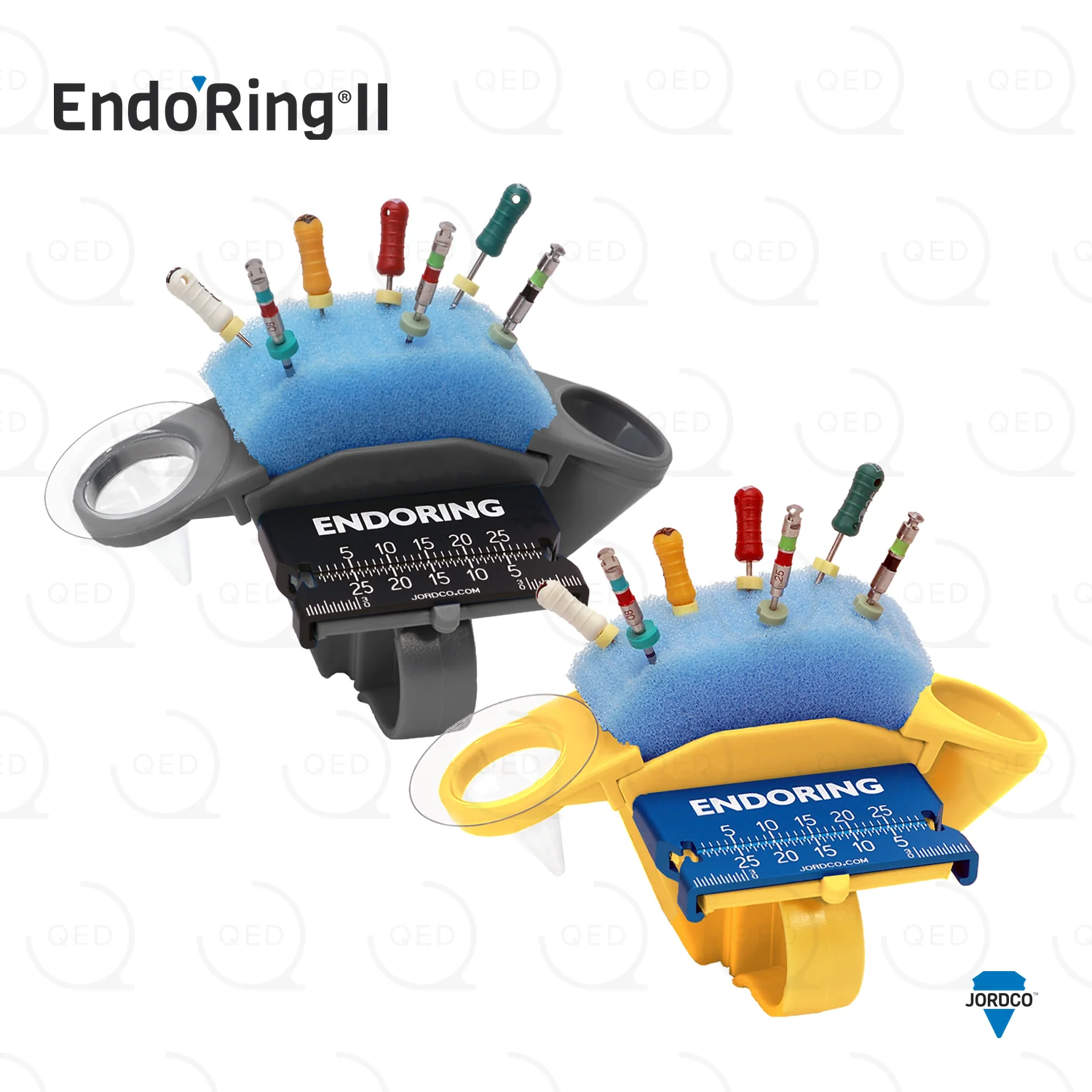
bundle · jordco endoring® ii · grey · rotary hd foam
two problems, and this pairing answers both. a polished ruler under a headlamp throws light back at you – so the ring is the grey endoring® ii with the laser-etched reduced-glare black ruler, which jordco make specifically to cut head lamp glare when you are working through surgical telescopes. and ordinary foam shreds when a file is still turning – so the inserts are e-foam® rotary hd, dense enough that a rotating file in a handpiece goes straight in to clear the flutes without tearing the foam.
this bundle: the grey endoring® ii with reduced-glare black metal ruler, three finger rings and the reusable gelwell® cup, together with a pack of 48 single-use e-foam® rotary hd inserts in jordco® silver
made by jordco, inc.
| reduced-glare ruler | laser etched and black. jordco’s stated reason: less head lamp glare when operating with surgical telescopes |
| foam that takes a turning file | the rotary hd is built so a file still running in the handpiece can go into the foam to clear debris, minimising tearing or shearing while it moves |
| autoclave it new, then bin it | jordco say a new rotary hd insert is steam autoclaved before use, the same as their standard e-foam®, and discarded afterwards – autoclaving will not remove bioburden from a used one. do not exceed 135°c, and keep anything heavy off the foam in the chamber |
› the ring on its own endoring® ii, grey, reduced-glare ruler.
› the foam on its own e-foam® rotary hd (48).
› for hand files standard e-foam® inserts (48) – the blue and yellow foam, for hand files.
› gelwell refills gelwell® cups (48).
› rotary files vdw reciproc® minima r25, 25 mm.
why buy the two together?
because they answer the same working style. if you are running rotary under magnification, the glare and the foam are the two things that get in the way, and this pairing deals with both. either part can be bought separately if you only have one of the problems.
can i use hand files with it?
of course – the ring is the same endoring® ii. if most of your work is hand files, the standard e-foam® is the insert to reorder – both foams are processed the same way, so it is only the density you are choosing.
› endoring® ii reduced-glare product sheet (pdf, 0.8 mb, jordco) – the grey ring.
› e-foam® rotary hd product sheet (pdf, 0.9 mb, jordco) – the foam that comes with it.
› endoring® ii instructions for use (pdf, 0.8 mb, jordco) – the family document – assembly, wearing it, measuring, and every cleaning cycle.
jordco’s product sheet describes their international pack. what qed supplies is the list above – the foam inserts and the single-use cups are ordered separately.
endoring® ii, grey, with e-foam® rotary hd · reduced-glare laser-etched ruler · high-density foam for files in motion · hd foam single use, autoclave before use · jordco, inc. · ref erk2_gray kit
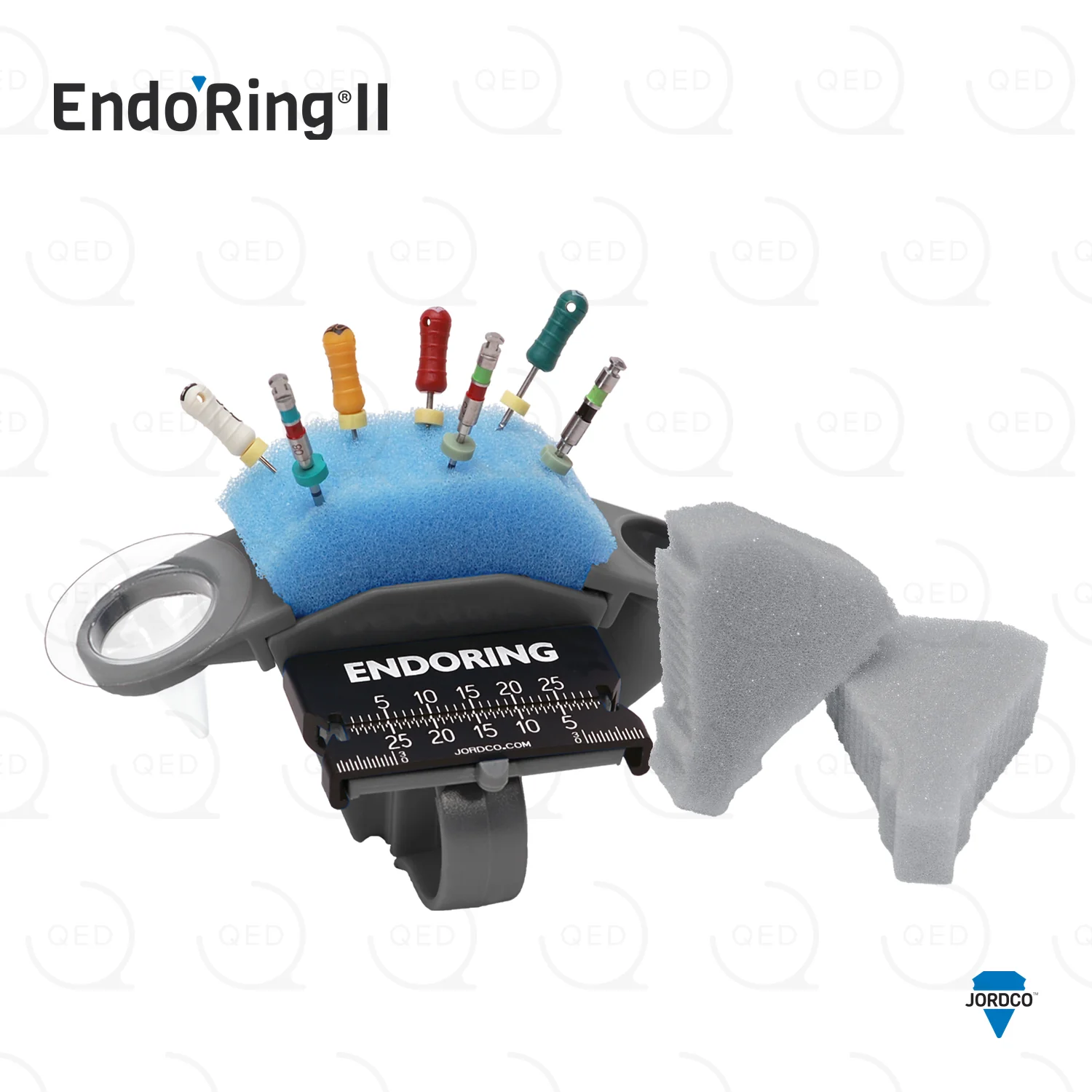
acteon endo success™ · as3d · apical surgery
apical surgeryultrasonic tipnewtron®
where the 3-6-9 sequence starts. as3d is the universal tip in acteon’s endo success apical surgery range. the tip sheet describes a “universal diamond-coated apical surgery tip for the retro-preparation of canals of anterior teeth”, and the brochure says it should be used without pressure, at the lowest possible effective power.
this pack: 1 × acteon endo success™ as3d ultrasonic tip · ref f00065
made by satelec, a company of the acteon group, mérignac, france
| acteon reference | as3d |
| geometry | 3 mm, 9% taper, diamond-coated 30 µm |
| material | diamond-coated steel |
| indication | endodontic apical surgery (acteon tip sheet) |
| power setting | 7 on a newtron® generator, per acteon’s tip sheet · the colour ring on the tip matches the power zone (colour coding system™) |
| classification | class iia medical device |
| also in | endo success™ apical surgery kit |
› clean, disinfect and sterilise before each use, following acteon’s cleaning, disinfection and sterilisation instructions for tips (j02001).
› replace at least once a year. acteon: because a maximum number of uses cannot be set, tips in routine use should be “replaced at least once a year”, and sooner if the tip no longer vibrates as expected or treatment slows.
› watch the site for heat. acteon’s tip sheets state that the practitioner has to continually monitor the clinical site to immediately identify any heating risk.
which generator does it fit?
acteon’s tip sheet gives settings for the newtron® range, including the p5 xs b.led and booster. acteon advise against using their tips on other makers’ handpieces, and other makers’ tips on theirs.
what temperature can i sterilise at?
acteon (satelec) have certified that endo success cap and apical surgery tips can be sterilised with prevacuum steam at 137°c/138°c (attestation, september 2016). follow the cleaning instructions first.
| rest of the sequence | as6d · as9d |
| the kit | endo success™ apical surgery kit |
| micro mirrors | pure reflect® 3 mm round · 7 × 2 mm rectangle |
| root-end filling materials | neoputty® · neomta® 2 |
| generators | newtron® p5 xs b.led · newtron® booster |
| tools | acteon universal wrench · autoclavable tip stand |
acteon endo success™ as3d · 3 mm, 9% taper, diamond-coated 30 µm · apical surgery · newtron® power 7 · satelec / acteon · ref f00065
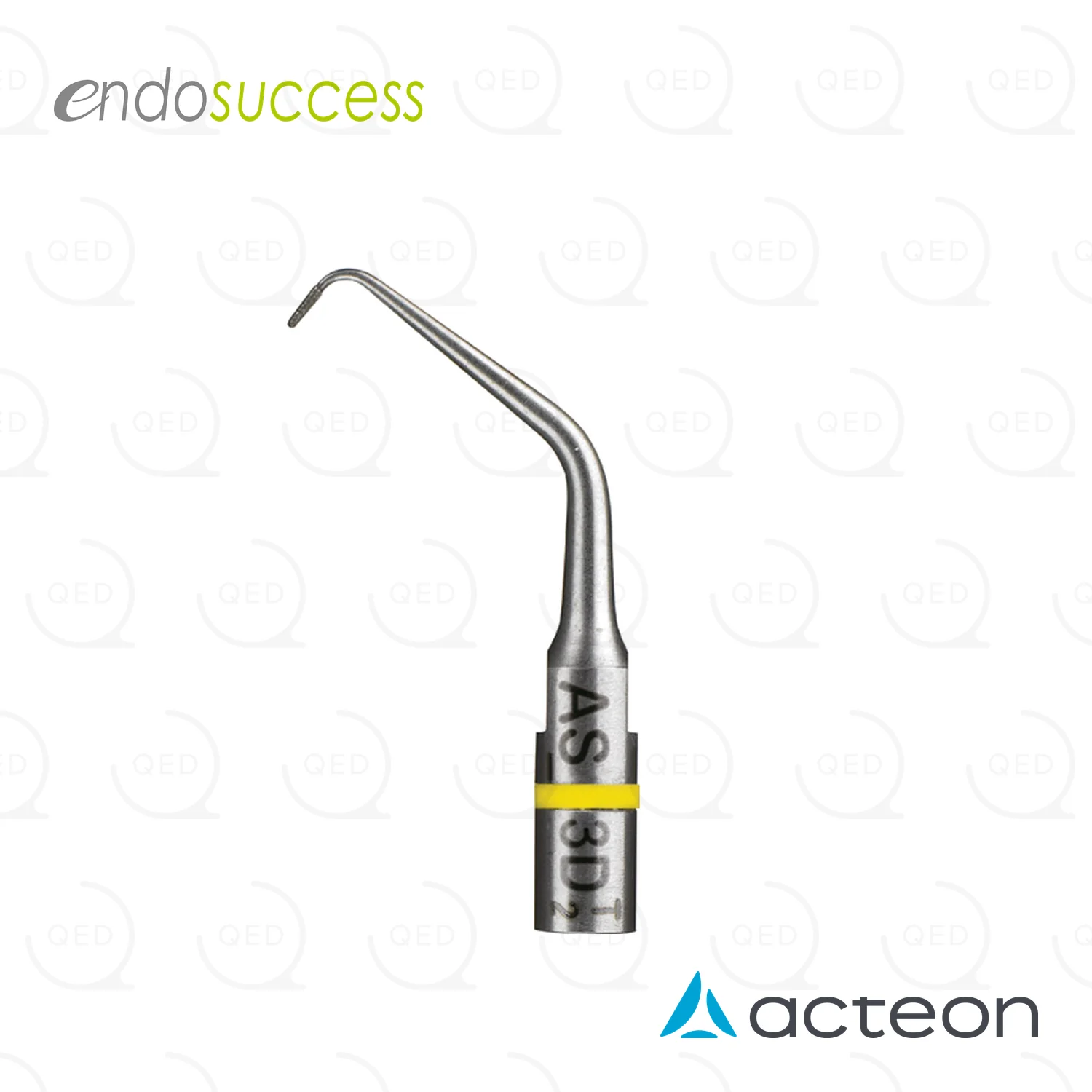
acteon endo success™ · as9d · apical surgery
apical surgeryultrasonic tipnewtron®
up towards the coronal third. as9d completes the sequence. acteon describe it as “complementing the as3d and as6d tips, for complex cases and for the preparation of the root canal to the crown third of anterior teeth”. their brochure adds that the diamond coating is only on the extremity so as not to over-prepare the canal, and that the tip should be introduced into the canal and oriented in the root axis before being activated.
this pack: 1 × acteon endo success™ as9d ultrasonic tip · ref f00067
made by satelec, a company of the acteon group, mérignac, france
| acteon reference | as9d |
| geometry | 9 mm, diamond-coated 30 µm at the extremity |
| material | diamond-coated steel |
| indication | endodontic apical surgery (acteon tip sheet) |
| power setting | 6 on a newtron® generator, per acteon’s tip sheet · the colour ring on the tip matches the power zone (colour coding system™) |
| classification | class iia medical device |
| also in | endo success™ apical surgery kit |
› clean, disinfect and sterilise before each use, following acteon’s cleaning, disinfection and sterilisation instructions for tips (j02001).
› replace at least once a year. acteon: because a maximum number of uses cannot be set, tips in routine use should be “replaced at least once a year”, and sooner if the tip no longer vibrates as expected or treatment slows.
› watch the site for heat. acteon’s tip sheets state that the practitioner has to continually monitor the clinical site to immediately identify any heating risk.
which generator does it fit?
acteon’s tip sheet gives settings for the newtron® range, including the p5 xs b.led and booster. acteon advise against using their tips on other makers’ handpieces, and other makers’ tips on theirs.
what temperature can i sterilise at?
acteon (satelec) have certified that endo success cap and apical surgery tips can be sterilised with prevacuum steam at 137°c/138°c (attestation, september 2016). follow the cleaning instructions first.
| rest of the sequence | as3d · as6d |
| the kit | endo success™ apical surgery kit |
| micro mirrors | pure reflect® 3 mm round · 7 × 2 mm rectangle |
| root-end filling materials | neoputty® · neomta® 2 |
| generators | newtron® p5 xs b.led · newtron® booster |
| tools | acteon universal wrench · autoclavable tip stand |
acteon endo success™ as9d · 9 mm, diamond-coated 30 µm at the extremity · apical surgery · newtron® power 6 · satelec / acteon · ref f00067
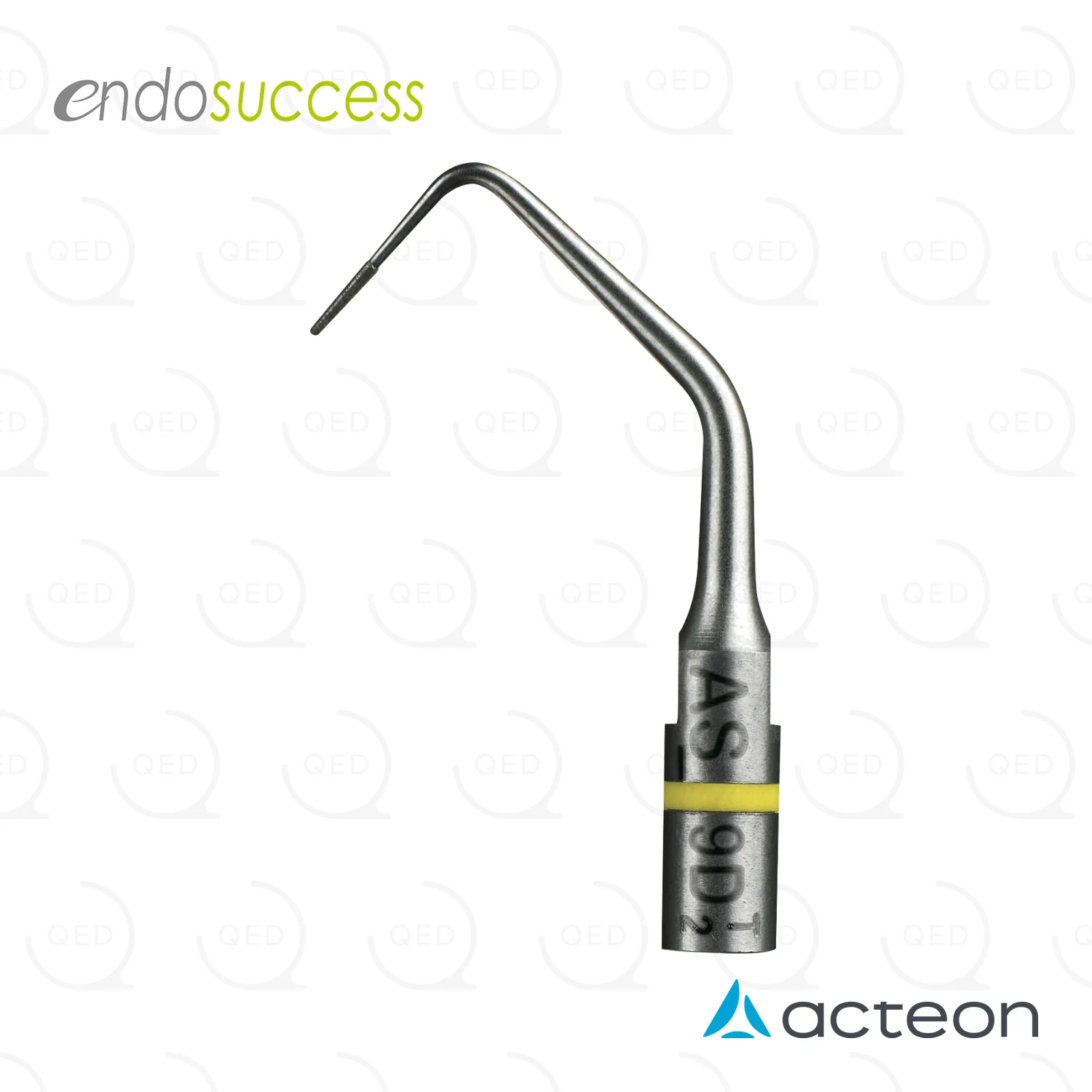
acteon endo success™ apical surgery kit · 5 tips
ultrasonic endodonticskitnewtron®
controlled retro-preparation. acteon describe the apical surgery kit as offering, “with its unique 3-6-9mm concept”, a controlled retrograde endodontic treatment with greater preservation of bone and dental tissue. the asld and asrd tips add posterior access.
this pack: 5 acteon endo success™ tips (as3d, as6d, as9d, asld, asrd) · a metal holder and an autoclavable universal wrench · ref f00069
made by satelec, a company of the acteon group, mérignac, france
| as3d | the first 3 mm of a retro-preparation in anterior teeth · 3 mm, 9% taper, diamond-coated 30 µm · power 7 |
| as6d | the second tip in the 3-6-9 sequence · 6 mm, 9% taper, diamond-coated 30 µm · power 7 |
| as9d | the third tip, for complex cases · 9 mm, diamond-coated 30 µm at the extremity · power 6 |
| asld | the left-angled apical surgery tip for premolars and molars · 3 mm, diamond-coated 30 µm, left-angled · power 7 |
| asrd | the right-angled apical surgery tip for premolars and molars · 3 mm, diamond-coated 30 µm, right-angled · power 7 |
| also in the kit | a metal holder and an autoclavable universal wrench |
› clean, disinfect and sterilise before each use, following acteon’s cleaning, disinfection and sterilisation instructions for tips (j02001).
› replace at least once a year. acteon: because a maximum number of uses cannot be set, tips in routine use should be “replaced at least once a year”, and sooner if the tip no longer vibrates as expected or treatment slows.
› genuine tips on acteon handpieces. acteon warn that tips from other sources can put patients at risk and damage the equipment.
can i buy the tips singly?
yes – each is stocked on its own: as3d · as6d · as9d · asld · asrd.
which generator do i need?
a newtron® generator such as the p5 xs b.led or booster. power settings for each tip are on acteon’s tip sheets.
| generators | newtron® p5 xs b.led · newtron® booster |
| handpieces | newtron® slim b.led · newtron® handpiece |
| tools | acteon universal wrench · autoclavable tip stand |
acteon endo success™ apical surgery kit · as3d, as6d, as9d, asld, asrd · holder and wrench · satelec / acteon · ref f00069

acteon endo success™ · as6d · apical surgery
apical surgeryultrasonic tipnewtron®
for a retro-preparation of at least 5 mm. as6d follows as3d. acteon’s tip sheet describes it as “complementing the as3d tip, for the retro-preparation of canals of anterior teeth for a preparation length of about 5mm”.
this pack: 1 × acteon endo success™ as6d ultrasonic tip · ref f00079
made by satelec, a company of the acteon group, mérignac, france
| acteon reference | as6d |
| geometry | 6 mm, 9% taper, diamond-coated 30 µm |
| material | diamond-coated steel |
| indication | endodontic apical surgery (acteon tip sheet) |
| power setting | 7 on a newtron® generator, per acteon’s tip sheet · the colour ring on the tip matches the power zone (colour coding system™) |
| classification | class iia medical device |
| also in | endo success™ apical surgery kit |
› clean, disinfect and sterilise before each use, following acteon’s cleaning, disinfection and sterilisation instructions for tips (j02001).
› replace at least once a year. acteon: because a maximum number of uses cannot be set, tips in routine use should be “replaced at least once a year”, and sooner if the tip no longer vibrates as expected or treatment slows.
› watch the site for heat. acteon’s tip sheets state that the practitioner has to continually monitor the clinical site to immediately identify any heating risk.
which generator does it fit?
acteon’s tip sheet gives settings for the newtron® range, including the p5 xs b.led and booster. acteon advise against using their tips on other makers’ handpieces, and other makers’ tips on theirs.
what temperature can i sterilise at?
acteon (satelec) have certified that endo success cap and apical surgery tips can be sterilised with prevacuum steam at 137°c/138°c (attestation, september 2016). follow the cleaning instructions first.
| rest of the sequence | as3d · as9d |
| the kit | endo success™ apical surgery kit |
| micro mirrors | pure reflect® 3 mm round · 7 × 2 mm rectangle |
| root-end filling materials | neoputty® · neomta® 2 |
| generators | newtron® p5 xs b.led · newtron® booster |
| tools | acteon universal wrench · autoclavable tip stand |
acteon endo success™ as6d · 6 mm, 9% taper, diamond-coated 30 µm · apical surgery · newtron® power 7 · satelec / acteon · ref f00079

acteon endo success™ · asld · apical surgery
apical surgeryultrasonic tipnewtron®
posterior access, left side. asld is the left-oriented tip in the endo success apical surgery range. the tip sheet describes a “diamond-coated left-angled tip for the retro-treatment of pre-molars and molars”, and acteon’s brochure says it should be used with very light pressure.
this pack: 1 × acteon endo success™ asld ultrasonic tip · ref f00080
made by satelec, a company of the acteon group, mérignac, france
| acteon reference | asld |
| geometry | 3 mm, diamond-coated 30 µm, left-angled |
| material | diamond-coated steel |
| indication | endodontic apical surgery (acteon tip sheet) |
| power setting | 7 on a newtron® generator, per acteon’s tip sheet · the colour ring on the tip matches the power zone (colour coding system™) |
| classification | class iia medical device |
| also in | endo success™ apical surgery kit |
› clean, disinfect and sterilise before each use, following acteon’s cleaning, disinfection and sterilisation instructions for tips (j02001).
› replace at least once a year. acteon: because a maximum number of uses cannot be set, tips in routine use should be “replaced at least once a year”, and sooner if the tip no longer vibrates as expected or treatment slows.
› watch the site for heat. acteon’s tip sheets state that the practitioner has to continually monitor the clinical site to immediately identify any heating risk.
which generator does it fit?
acteon’s tip sheet gives settings for the newtron® range, including the p5 xs b.led and booster. acteon advise against using their tips on other makers’ handpieces, and other makers’ tips on theirs.
what temperature can i sterilise at?
acteon (satelec) have certified that endo success cap and apical surgery tips can be sterilised with prevacuum steam at 137°c/138°c (attestation, september 2016). follow the cleaning instructions first.
| rest of the sequence | asrd · as3d |
| the kit | endo success™ apical surgery kit |
| micro mirrors | pure reflect® 3 mm round · 7 × 2 mm rectangle |
| root-end filling materials | neoputty® · neomta® 2 |
| generators | newtron® p5 xs b.led · newtron® booster |
| tools | acteon universal wrench · autoclavable tip stand |
acteon endo success™ asld · 3 mm, diamond-coated 30 µm, left-angled · apical surgery · newtron® power 7 · satelec / acteon · ref f00080

acteon endo success™ · asrd · apical surgery
apical surgeryultrasonic tipnewtron®
posterior access, right side. asrd is the right-oriented partner to asld. acteon’s brochure recommends it for apical surgery of premolars and molars.
this pack: 1 × acteon endo success™ asrd ultrasonic tip · ref f00081
made by satelec, a company of the acteon group, mérignac, france
| acteon reference | asrd |
| geometry | 3 mm, diamond-coated 30 µm, right-angled |
| material | diamond-coated steel |
| indication | endodontic apical surgery (acteon tip sheet) |
| power setting | 7 on a newtron® generator, per acteon’s tip sheet · the colour ring on the tip matches the power zone (colour coding system™) |
| classification | class iia medical device |
| also in | endo success™ apical surgery kit |
› clean, disinfect and sterilise before each use, following acteon’s cleaning, disinfection and sterilisation instructions for tips (j02001).
› replace at least once a year. acteon: because a maximum number of uses cannot be set, tips in routine use should be “replaced at least once a year”, and sooner if the tip no longer vibrates as expected or treatment slows.
› watch the site for heat. acteon’s tip sheets state that the practitioner has to continually monitor the clinical site to immediately identify any heating risk.
which generator does it fit?
acteon’s tip sheet gives settings for the newtron® range, including the p5 xs b.led and booster. acteon advise against using their tips on other makers’ handpieces, and other makers’ tips on theirs.
what temperature can i sterilise at?
acteon (satelec) have certified that endo success cap and apical surgery tips can be sterilised with prevacuum steam at 137°c/138°c (attestation, september 2016). follow the cleaning instructions first.
| rest of the sequence | asld · as3d |
| the kit | endo success™ apical surgery kit |
| micro mirrors | pure reflect® 3 mm round · 7 × 2 mm rectangle |
| root-end filling materials | neoputty® · neomta® 2 |
| generators | newtron® p5 xs b.led · newtron® booster |
| tools | acteon universal wrench · autoclavable tip stand |
acteon endo success™ asrd · 3 mm, diamond-coated 30 µm, right-angled · apical surgery · newtron® power 7 · satelec / acteon · ref f00081

acteon scaling tip · 1s · newtron®
supra & subgingivalprophylaxisnewtron®
what acteon make it for. acteon’s tip sheet describes tip 1s as: “supra- and subgingival scaling, shallow pocket debridement”. acteon’s brochure calls it a slim tip, finer and longer than tip no.1.
this pack: 1 × acteon scaling tip 1s · ref f00245
made by satelec, a company of the acteon group, mérignac, france
| acteon reference | 1s |
| tip type | smooth, surgical stainless steel |
| use | periodontics and prophylaxis (acteon tip sheet) |
| power setting | 14 on a newtron® generator, per acteon’s tip sheet · the colour ring on the tip matches the power zone (colour coding system™) |
| classification | class iia medical device |
› clean, disinfect and sterilise before each use, following acteon’s cleaning, disinfection and sterilisation instructions for tips (j02001).
› replace at least once a year. acteon: because a maximum number of uses cannot be set, tips in routine use should be “replaced at least once a year”, and sooner if the tip no longer vibrates as expected or treatment slows.
› genuine tips on acteon handpieces. acteon warn that tips from other sources can put patients at risk and damage the equipment.
other scaling tips?
we stock no.1 · no.2 · 10z · 10x.
| other scaling tips | no.1 · no.2 · 10z · 10x |
| generators | newtron® p5 xs b.led · newtron® booster |
| handpieces | newtron® slim b.led, white · newtron® handpiece |
| tools | acteon universal wrench · autoclavable tip stand |
acteon scaling tip 1s · supra & subgingival scaling · newtron® power 14 · satelec / acteon · ref f00245
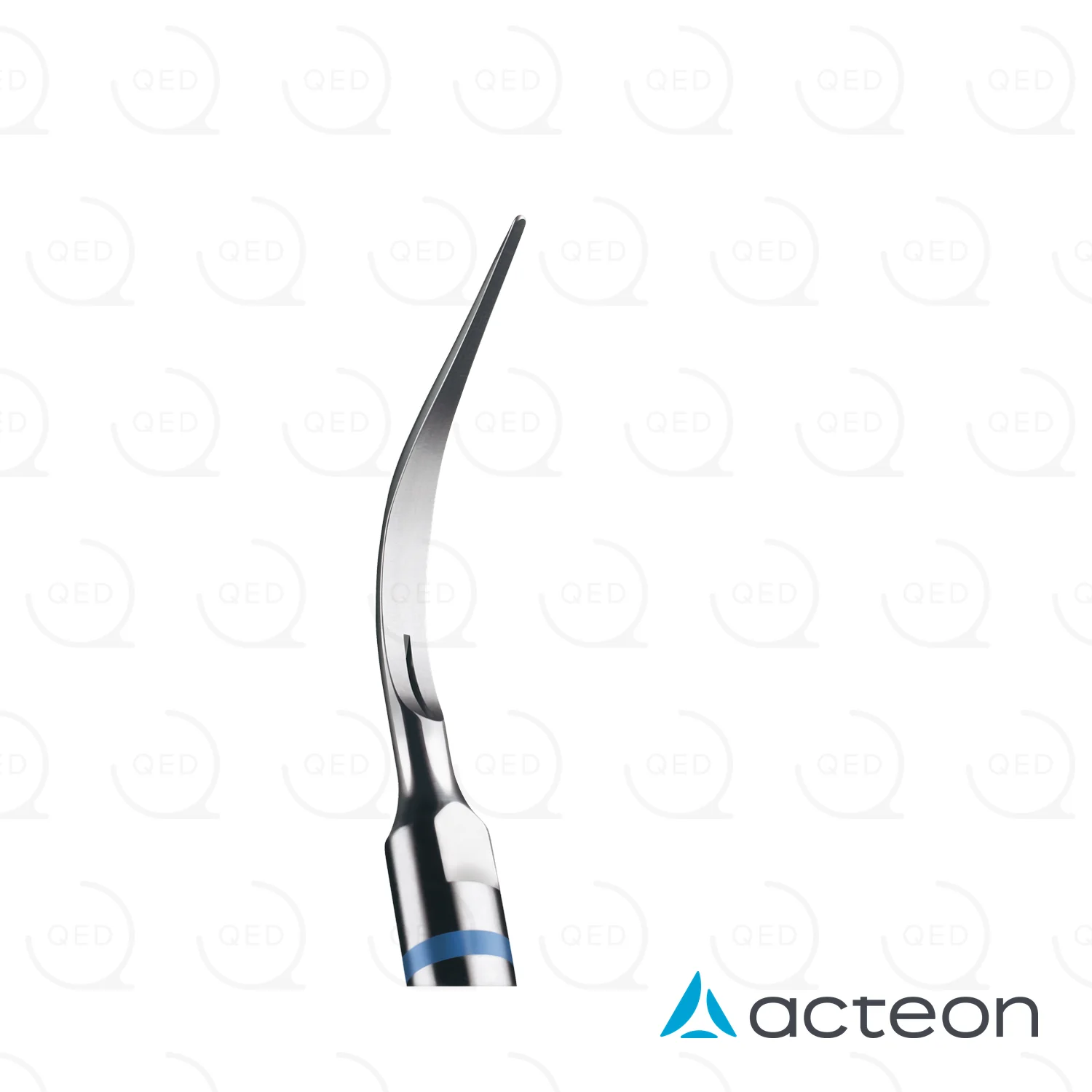
acteon scaling tip · no.1 · newtron®
supragingivalprophylaxisnewtron®
what acteon make it for. acteon’s tip sheet describes tip no.1 as: “treating simple cases and gross supra-gingival scaling”. acteon’s brochure: apply the flat part to the tooth surfaces.
this pack: 1 × acteon scaling tip no.1 · ref f00246
made by satelec, a company of the acteon group, mérignac, france
| acteon reference | no.1 |
| tip type | smooth, surgical stainless steel |
| use | periodontics and prophylaxis (acteon tip sheet) |
| power setting | 14 on a newtron® generator, per acteon’s tip sheet · the colour ring on the tip matches the power zone (colour coding system™) |
| classification | class iia medical device |
› clean, disinfect and sterilise before each use, following acteon’s cleaning, disinfection and sterilisation instructions for tips (j02001).
› replace at least once a year. acteon: because a maximum number of uses cannot be set, tips in routine use should be “replaced at least once a year”, and sooner if the tip no longer vibrates as expected or treatment slows.
› genuine tips on acteon handpieces. acteon warn that tips from other sources can put patients at risk and damage the equipment.
other scaling tips?
we stock 1s · no.2 · 10z · 10x.
| other scaling tips | 1s · no.2 · 10z · 10x |
| generators | newtron® p5 xs b.led · newtron® booster |
| handpieces | newtron® slim b.led, white · newtron® handpiece |
| tools | acteon universal wrench · autoclavable tip stand |
acteon scaling tip no.1 · supragingival scaling · newtron® power 14 · satelec / acteon · ref f00246

acteon scaling tip · no.2 · newtron®
supragingivalprophylaxisnewtron®
what acteon make it for. acteon’s tip sheet describes tip no.2 as: “for removing voluminous supragingival deposits”. acteon’s brochure: its more active lateral edges also suit the interproximal spaces.
this pack: 1 × acteon scaling tip no.2 · ref f00247
made by satelec, a company of the acteon group, mérignac, france
| acteon reference | no.2 |
| tip type | smooth, surgical stainless steel |
| use | periodontics and prophylaxis (acteon tip sheet) |
| power setting | 14 on a newtron® generator, per acteon’s tip sheet · the colour ring on the tip matches the power zone (colour coding system™) |
| classification | class iia medical device |
› clean, disinfect and sterilise before each use, following acteon’s cleaning, disinfection and sterilisation instructions for tips (j02001).
› replace at least once a year. acteon: because a maximum number of uses cannot be set, tips in routine use should be “replaced at least once a year”, and sooner if the tip no longer vibrates as expected or treatment slows.
› genuine tips on acteon handpieces. acteon warn that tips from other sources can put patients at risk and damage the equipment.
other scaling tips?
we stock 1s · no.1 · 10z · 10x.
| other scaling tips | 1s · no.1 · 10z · 10x |
| generators | newtron® p5 xs b.led · newtron® booster |
| handpieces | newtron® slim b.led, white · newtron® handpiece |
| tools | acteon universal wrench · autoclavable tip stand |
acteon scaling tip no.2 · supragingival scaling · newtron® power 14 · satelec / acteon · ref f00247
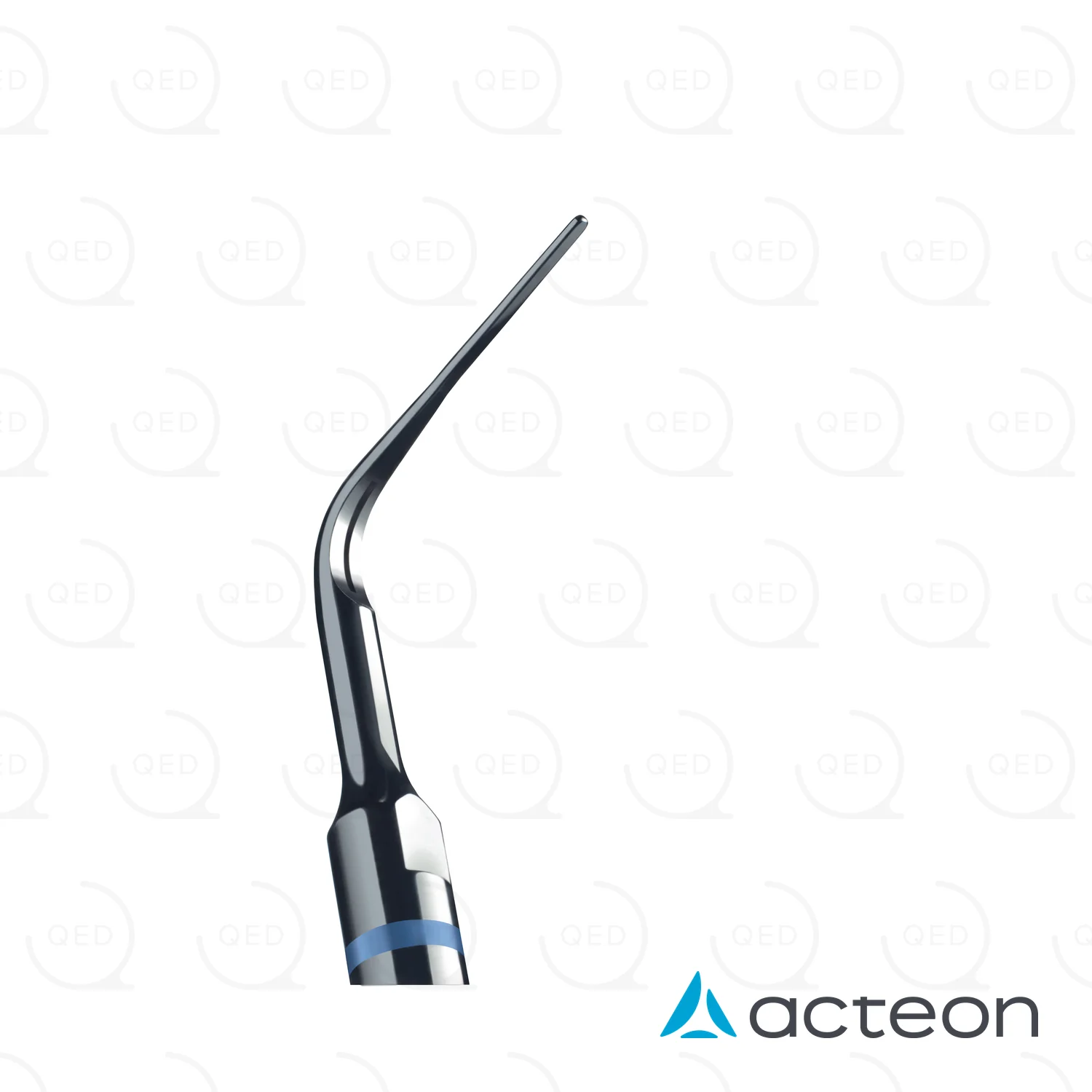
acteon scaling tip · 10z · newtron®
subgingivalprophylaxisnewtron®
what acteon make it for. acteon’s tip sheet describes tip 10z as: “scaling of pockets < 4mm. biofilm and soft deposit removal. pocket depth measurement with the marking”. acteon’s brochure: marks every 3 mm help evaluate pocket depth.
this pack: 1 × acteon scaling tip 10z · ref f00254
made by satelec, a company of the acteon group, mérignac, france
| acteon reference | 10z |
| tip type | smooth, surgical stainless steel |
| use | periodontics and prophylaxis (acteon tip sheet) |
| power setting | 12 on a newtron® generator, per acteon’s tip sheet · the colour ring on the tip matches the power zone (colour coding system™) |
| classification | class iia medical device |
› clean, disinfect and sterilise before each use, following acteon’s cleaning, disinfection and sterilisation instructions for tips (j02001).
› replace at least once a year. acteon: because a maximum number of uses cannot be set, tips in routine use should be “replaced at least once a year”, and sooner if the tip no longer vibrates as expected or treatment slows.
› genuine tips on acteon handpieces. acteon warn that tips from other sources can put patients at risk and damage the equipment.
other scaling tips?
we stock 1s · no.1 · no.2 · 10x.
| other scaling tips | 1s · no.1 · no.2 · 10x |
| generators | newtron® p5 xs b.led · newtron® booster |
| handpieces | newtron® slim b.led, white · newtron® handpiece |
| tools | acteon universal wrench · autoclavable tip stand |
acteon scaling tip 10z · subgingival scaling · newtron® power 12 · satelec / acteon · ref f00254

acteon scaling tip · 10x · newtron®
interproximalprophylaxisnewtron®
what acteon make it for. acteon’s tip sheet describes tip 10x as: “interproximal spaces scaling”. acteon’s brochure: its flat active part is particularly suited to the interproximal spaces and supra-gingival scaling.
this pack: 1 × acteon scaling tip 10x · ref f00359
made by satelec, a company of the acteon group, mérignac, france
| acteon reference | 10x |
| tip type | smooth, surgical stainless steel |
| use | periodontics and prophylaxis (acteon tip sheet) |
| power setting | 12 on a newtron® generator, per acteon’s tip sheet · the colour ring on the tip matches the power zone (colour coding system™) |
| classification | class iia medical device |
› clean, disinfect and sterilise before each use, following acteon’s cleaning, disinfection and sterilisation instructions for tips (j02001).
› replace at least once a year. acteon: because a maximum number of uses cannot be set, tips in routine use should be “replaced at least once a year”, and sooner if the tip no longer vibrates as expected or treatment slows.
› genuine tips on acteon handpieces. acteon warn that tips from other sources can put patients at risk and damage the equipment.
other scaling tips?
we stock 1s · no.1 · no.2 · 10z.
| other scaling tips | 1s · no.1 · no.2 · 10z |
| generators | newtron® p5 xs b.led · newtron® booster |
| handpieces | newtron® slim b.led, white · newtron® handpiece |
| tools | acteon universal wrench · autoclavable tip stand |
acteon scaling tip 10x · interproximal scaling · newtron® power 12 · satelec / acteon · ref f00359

acteon endo success™ retreatment kit · 6 tips
ultrasonic endodonticskitnewtron®
from access to post removal. acteon’s endo success retreatment kit brings together the tips for finishing the access, locating calcified canals, retreating each third of the canal and loosening posts.
this pack: 6 acteon endo success™ tips (et18d, et20, et25, et25s, etbd, etpr) · a metal holder and an autoclavable universal wrench · ref f00737
made by satelec, a company of the acteon group, mérignac, france
| et18d | the diamond tip for finishing the access cavity · 18 mm, 5% taper, diamond-coated 76 µm · power 10 |
| et20 | the retreatment tip for the coronal third · 20 mm, 6% taper · power 7 |
| et25 | the titanium-niobium tip for the middle and apical thirds · 20 mm, 3% taper · power 7 |
| et25s | the short titanium-niobium tip for the crown third and isthmuses · 15 mm, 4% taper · power 7 |
| etbd | the diamond ball tip for finding calcified canals · 20 mm, 5% taper, diamond-coated ball · power 7 |
| etpr | the tip for loosening posts and crowns · post and crown loosening tip · power 20 |
| also in the kit | a metal holder and an autoclavable universal wrench |
› clean, disinfect and sterilise before each use, following acteon’s cleaning, disinfection and sterilisation instructions for tips (j02001).
› replace at least once a year. acteon: because a maximum number of uses cannot be set, tips in routine use should be “replaced at least once a year”, and sooner if the tip no longer vibrates as expected or treatment slows.
› genuine tips on acteon handpieces. acteon warn that tips from other sources can put patients at risk and damage the equipment.
can i buy the tips singly?
yes – each is stocked on its own: et18d · et20 · et25 · et25s · etbd · etpr.
which generator do i need?
a newtron® generator such as the p5 xs b.led or booster. power settings for each tip are on acteon’s tip sheets.
| generators | newtron® p5 xs b.led · newtron® booster |
| handpieces | newtron® slim b.led · newtron® handpiece |
| tools | acteon universal wrench · autoclavable tip stand |
acteon endo success™ retreatment kit · et18d, et20, et25, et25s, etbd, etpr · holder and wrench · satelec / acteon · ref f00737
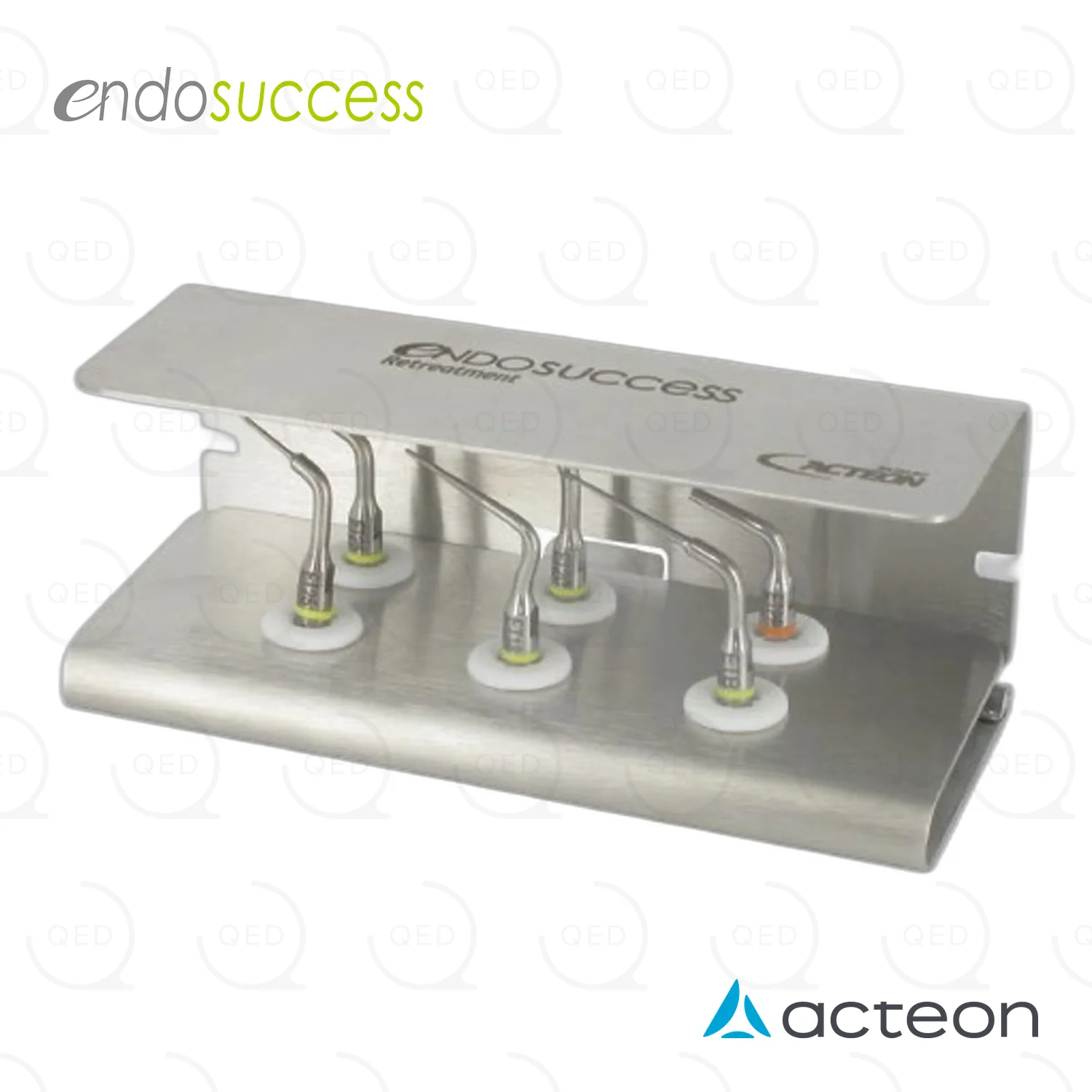
acteon ultrasonic k-file · 10 · 21 mm · 4 files
ultrasonic irrigationbroken instrument removalnewtron®
files that fit the handpiece, not the hand. these are acteon’s k-files for ultrasonic use, with a 2% taper. acteon’s tip sheet gives the indications as “irrigation, the removal of calcified dentine and gutta percha and the removal of broken instruments”. this blister holds four iso 10 files at 21 mm.
this pack: 4 × acteon k-file, iso 10, 21 mm, 2% taper · acteon reference k10-21 · ref f43710
made by satelec, a company of the acteon group, mérignac, france
| size | iso 10, 2% taper |
| length | 21 mm |
| indications | endodontic irrigation and broken instrument removal (acteon tip sheet) |
| power setting | 6 on a newtron® generator, per acteon’s tip sheet · the colour ring on the tip matches the power zone (colour coding system™) |
| classification | class iia medical device |
› handle with care. acteon’s brochure notes that ultrasonic k-files are very flexible and should be handled with precision, and can be pre-bent.
› clean, disinfect and sterilise before each use, following acteon’s cleaning, disinfection and sterilisation instructions for tips (j02001).
› replace at least once a year. acteon: because a maximum number of uses cannot be set, tips in routine use should be “replaced at least once a year”, and sooner if the tip no longer vibrates as expected or treatment slows.
other sizes?
acteon make these in iso 10, 15, 25 and 30, at 21 and 25 mm: 10/25 · 15/21 · 15/25 · 25/21 · 25/25 · 30/21 · 30/25.
irrisafe or k-file for irrigation?
acteon make both. irrisafe® is their passive ultrasonic irrigation file; the k-files add calcified dentine, gutta-percha and broken instrument removal to irrigation.
| passive ultrasonic irrigation | irrisafe® 25, 21 mm · 20, 21 mm |
| irrigants | chlorax 5.25% · chlorax 2% · endo-solution 17% edta |
| generators | newtron® p5 xs b.led · newtron® booster |
| tools | acteon universal wrench · autoclavable tip stand |
acteon k-file 10, 21 mm (4) · ultrasonic k-file · 2% taper · irrigation · broken instrument removal · newtron® power 6 · satelec / acteon · ref f43710
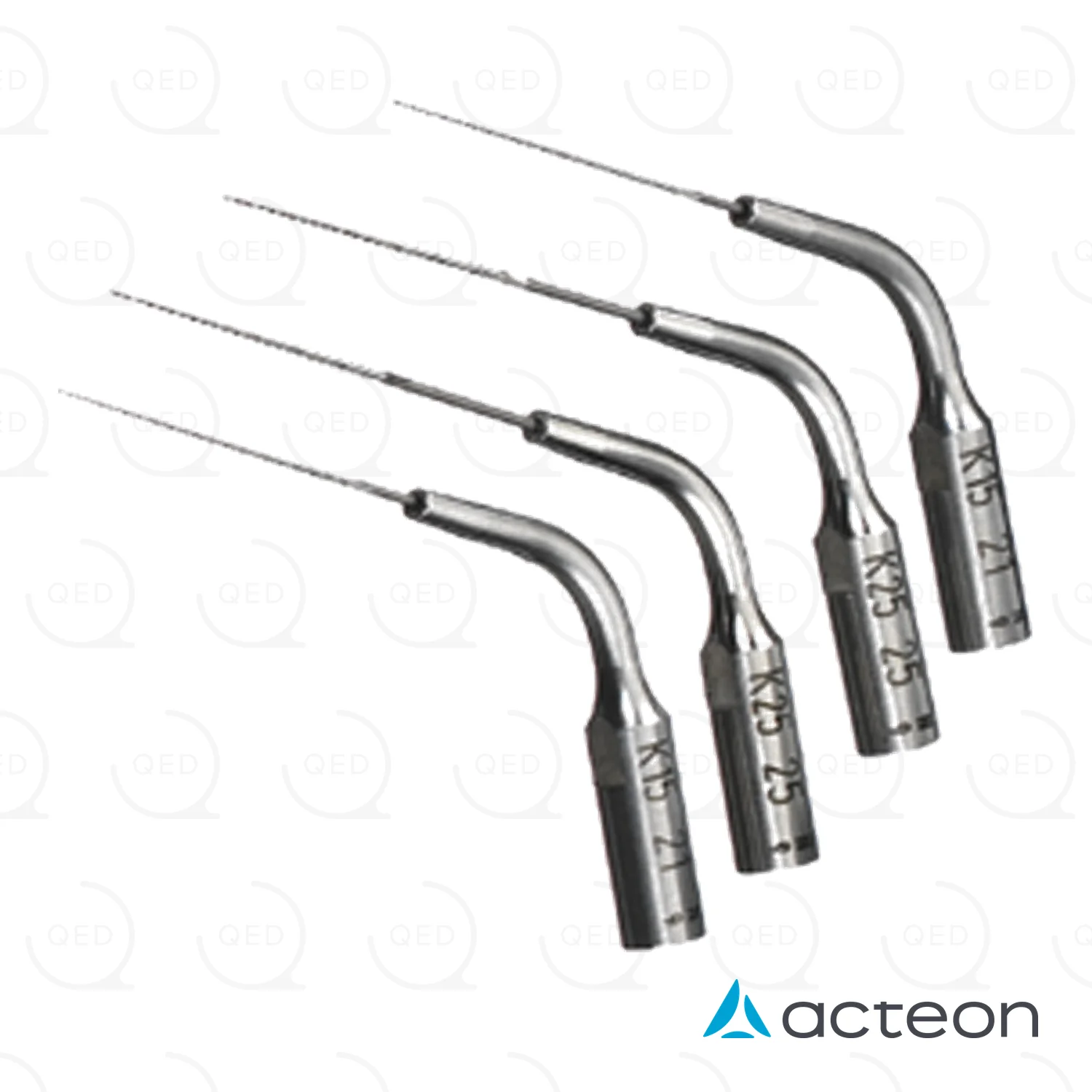
acteon ultrasonic k-file · 10 · 25 mm · 4 files
ultrasonic irrigationbroken instrument removalnewtron®
files that fit the handpiece, not the hand. these are acteon’s k-files for ultrasonic use, with a 2% taper. acteon’s tip sheet gives the indications as “irrigation, the removal of calcified dentine and gutta percha and the removal of broken instruments”. this blister holds four iso 10 files at 25 mm.
this pack: 4 × acteon k-file, iso 10, 25 mm, 2% taper · acteon reference k10-25 · ref f43712
made by satelec, a company of the acteon group, mérignac, france
| size | iso 10, 2% taper |
| length | 25 mm |
| indications | endodontic irrigation and broken instrument removal (acteon tip sheet) |
| power setting | 6 on a newtron® generator, per acteon’s tip sheet · the colour ring on the tip matches the power zone (colour coding system™) |
| classification | class iia medical device |
› handle with care. acteon’s brochure notes that ultrasonic k-files are very flexible and should be handled with precision, and can be pre-bent.
› clean, disinfect and sterilise before each use, following acteon’s cleaning, disinfection and sterilisation instructions for tips (j02001).
› replace at least once a year. acteon: because a maximum number of uses cannot be set, tips in routine use should be “replaced at least once a year”, and sooner if the tip no longer vibrates as expected or treatment slows.
other sizes?
acteon make these in iso 10, 15, 25 and 30, at 21 and 25 mm: 10/21 · 15/21 · 15/25 · 25/21 · 25/25 · 30/21 · 30/25.
irrisafe or k-file for irrigation?
acteon make both. irrisafe® is their passive ultrasonic irrigation file; the k-files add calcified dentine, gutta-percha and broken instrument removal to irrigation.
| passive ultrasonic irrigation | irrisafe® 25, 21 mm · 20, 21 mm |
| irrigants | chlorax 5.25% · chlorax 2% · endo-solution 17% edta |
| generators | newtron® p5 xs b.led · newtron® booster |
| tools | acteon universal wrench · autoclavable tip stand |
acteon k-file 10, 25 mm (4) · ultrasonic k-file · 2% taper · irrigation · broken instrument removal · newtron® power 6 · satelec / acteon · ref f43712
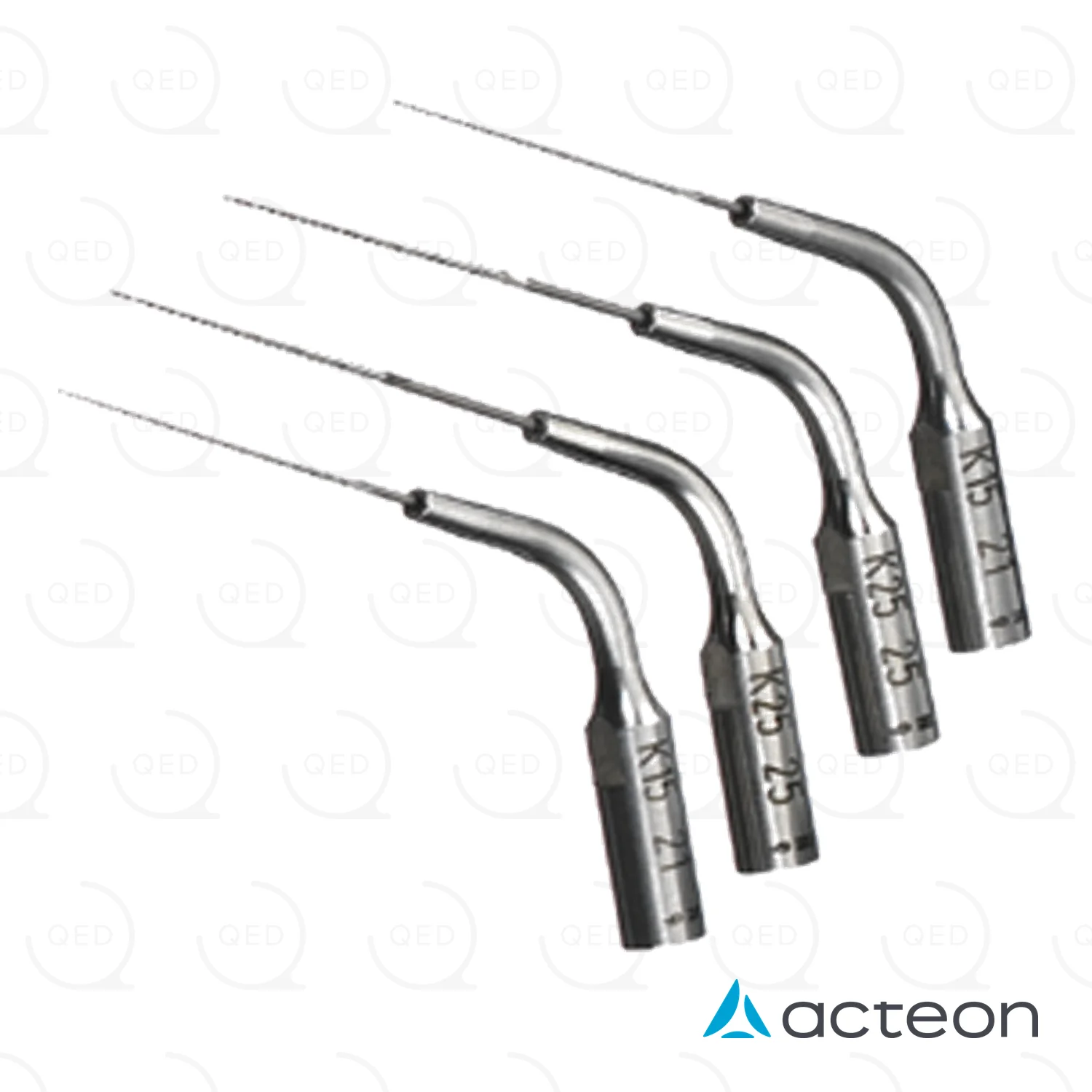
acteon ultrasonic k-file · 15 · 21 mm · 4 files
ultrasonic irrigationbroken instrument removalnewtron®
files that fit the handpiece, not the hand. these are acteon’s k-files for ultrasonic use, with a 2% taper. acteon’s tip sheet gives the indications as “irrigation, the removal of calcified dentine and gutta percha and the removal of broken instruments”. this blister holds four iso 15 files at 21 mm.
this pack: 4 × acteon k-file, iso 15, 21 mm, 2% taper · acteon reference k15-21 · ref f43715
made by satelec, a company of the acteon group, mérignac, france
| size | iso 15, 2% taper |
| length | 21 mm |
| indications | endodontic irrigation and broken instrument removal (acteon tip sheet) |
| power setting | 6 on a newtron® generator, per acteon’s tip sheet · the colour ring on the tip matches the power zone (colour coding system™) |
| classification | class iia medical device |
› handle with care. acteon’s brochure notes that ultrasonic k-files are very flexible and should be handled with precision, and can be pre-bent.
› clean, disinfect and sterilise before each use, following acteon’s cleaning, disinfection and sterilisation instructions for tips (j02001).
› replace at least once a year. acteon: because a maximum number of uses cannot be set, tips in routine use should be “replaced at least once a year”, and sooner if the tip no longer vibrates as expected or treatment slows.
other sizes?
acteon make these in iso 10, 15, 25 and 30, at 21 and 25 mm: 10/21 · 10/25 · 15/25 · 25/21 · 25/25 · 30/21 · 30/25.
irrisafe or k-file for irrigation?
acteon make both. irrisafe® is their passive ultrasonic irrigation file; the k-files add calcified dentine, gutta-percha and broken instrument removal to irrigation.
| passive ultrasonic irrigation | irrisafe® 25, 21 mm · 20, 21 mm |
| irrigants | chlorax 5.25% · chlorax 2% · endo-solution 17% edta |
| generators | newtron® p5 xs b.led · newtron® booster |
| tools | acteon universal wrench · autoclavable tip stand |
acteon k-file 15, 21 mm (4) · ultrasonic k-file · 2% taper · irrigation · broken instrument removal · newtron® power 6 · satelec / acteon · ref f43715
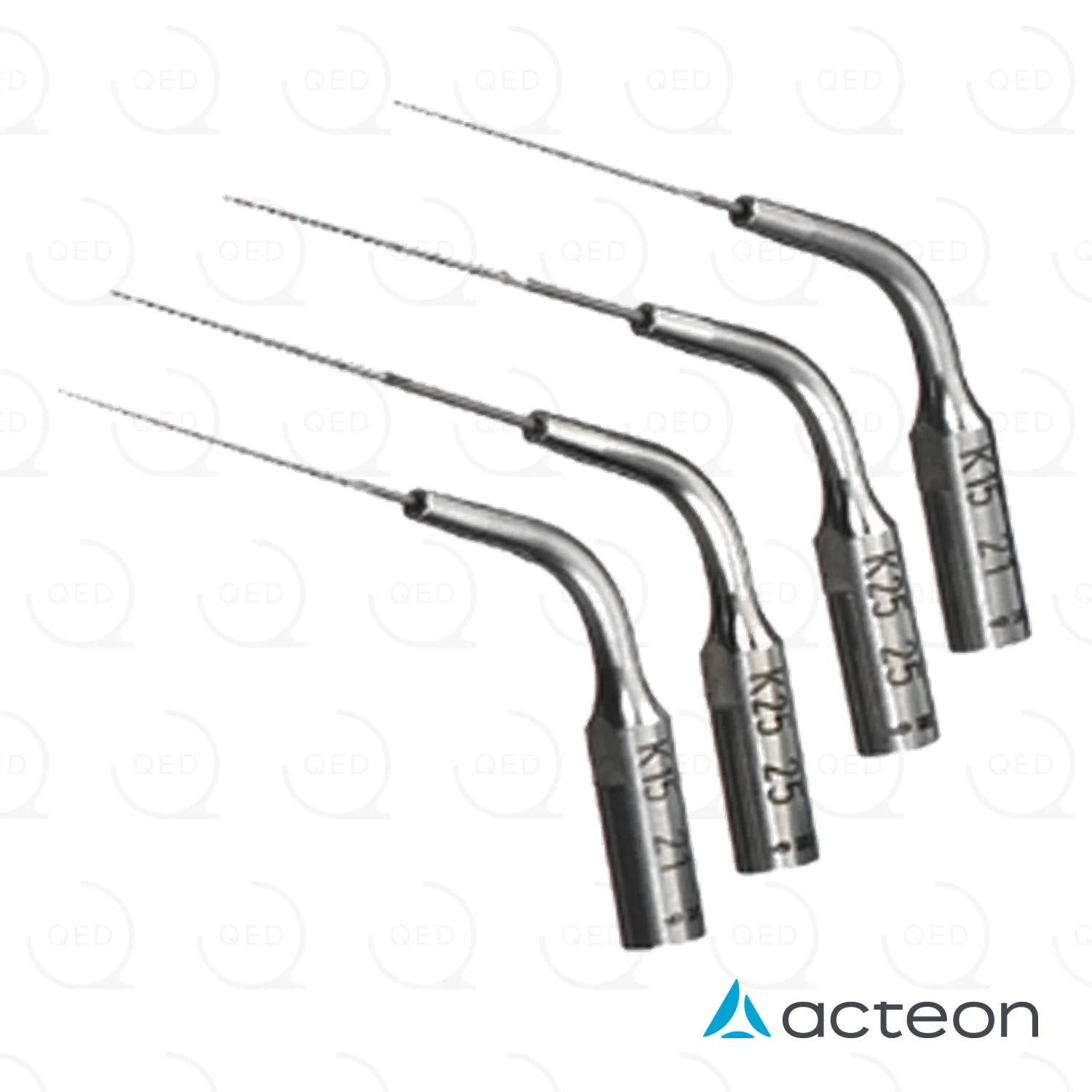
acteon ultrasonic k-file · 15 · 25 mm · 4 files
ultrasonic irrigationbroken instrument removalnewtron®
files that fit the handpiece, not the hand. these are acteon’s k-files for ultrasonic use, with a 2% taper. acteon’s tip sheet gives the indications as “irrigation, the removal of calcified dentine and gutta percha and the removal of broken instruments”. this blister holds four iso 15 files at 25 mm.
this pack: 4 × acteon k-file, iso 15, 25 mm, 2% taper · acteon reference k15-25 · ref f43717
made by satelec, a company of the acteon group, mérignac, france
| size | iso 15, 2% taper |
| length | 25 mm |
| indications | endodontic irrigation and broken instrument removal (acteon tip sheet) |
| power setting | 6 on a newtron® generator, per acteon’s tip sheet · the colour ring on the tip matches the power zone (colour coding system™) |
| classification | class iia medical device |
› handle with care. acteon’s brochure notes that ultrasonic k-files are very flexible and should be handled with precision, and can be pre-bent.
› clean, disinfect and sterilise before each use, following acteon’s cleaning, disinfection and sterilisation instructions for tips (j02001).
› replace at least once a year. acteon: because a maximum number of uses cannot be set, tips in routine use should be “replaced at least once a year”, and sooner if the tip no longer vibrates as expected or treatment slows.
other sizes?
acteon make these in iso 10, 15, 25 and 30, at 21 and 25 mm: 10/21 · 10/25 · 15/21 · 25/21 · 25/25 · 30/21 · 30/25.
irrisafe or k-file for irrigation?
acteon make both. irrisafe® is their passive ultrasonic irrigation file; the k-files add calcified dentine, gutta-percha and broken instrument removal to irrigation.
| passive ultrasonic irrigation | irrisafe® 25, 21 mm · 20, 21 mm |
| irrigants | chlorax 5.25% · chlorax 2% · endo-solution 17% edta |
| generators | newtron® p5 xs b.led · newtron® booster |
| tools | acteon universal wrench · autoclavable tip stand |
acteon k-file 15, 25 mm (4) · ultrasonic k-file · 2% taper · irrigation · broken instrument removal · newtron® power 6 · satelec / acteon · ref f43717
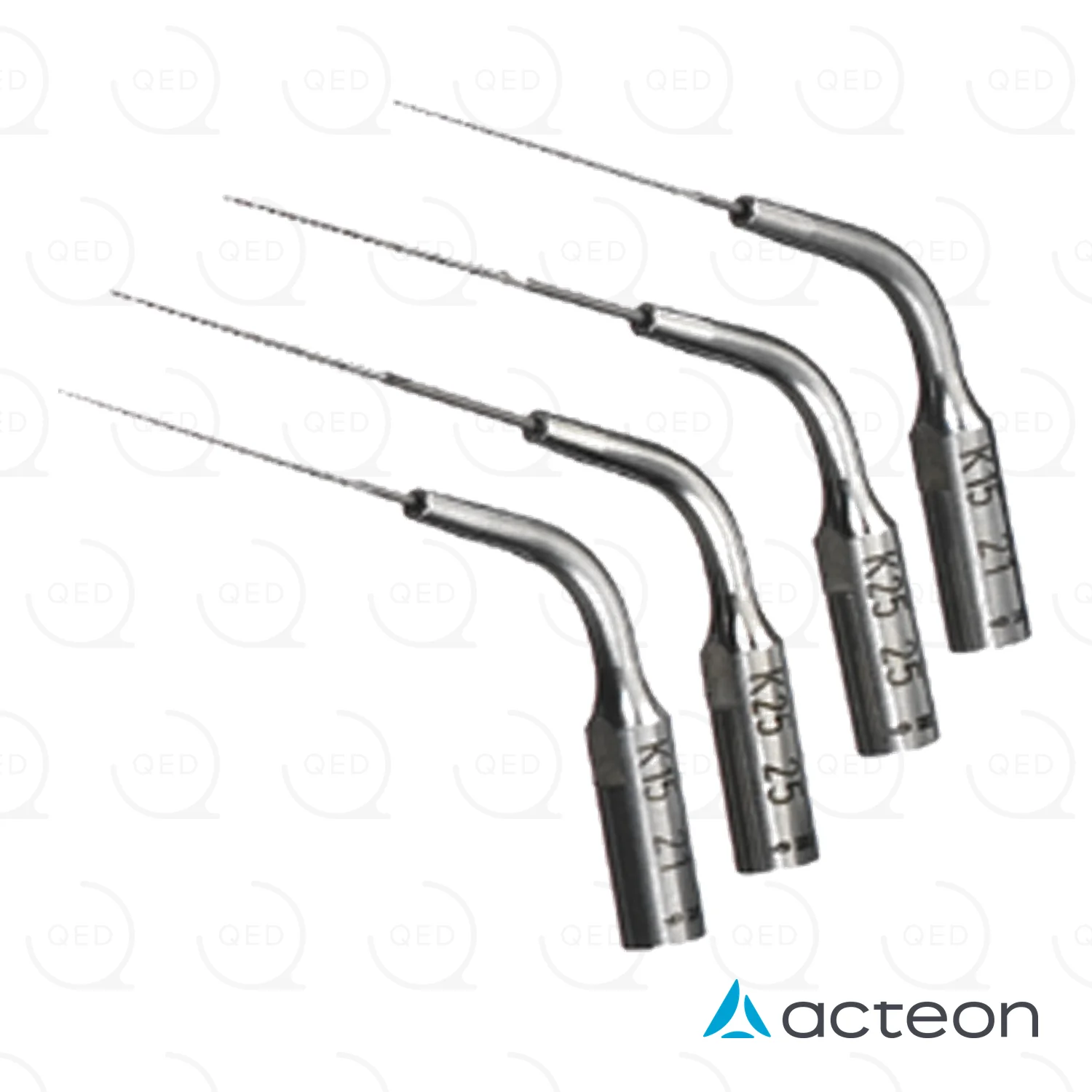
acteon ultrasonic k-file · 25 · 21 mm · 4 files
ultrasonic irrigationbroken instrument removalnewtron®
files that fit the handpiece, not the hand. these are acteon’s k-files for ultrasonic use, with a 2% taper. acteon’s tip sheet gives the indications as “irrigation, the removal of calcified dentine and gutta percha and the removal of broken instruments”. this blister holds four iso 25 files at 21 mm.
this pack: 4 × acteon k-file, iso 25, 21 mm, 2% taper · acteon reference k25-21 · ref f43725
made by satelec, a company of the acteon group, mérignac, france
| size | iso 25, 2% taper |
| length | 21 mm |
| indications | endodontic irrigation and broken instrument removal (acteon tip sheet) |
| power setting | 6 on a newtron® generator, per acteon’s tip sheet · the colour ring on the tip matches the power zone (colour coding system™) |
| classification | class iia medical device |
› handle with care. acteon’s brochure notes that ultrasonic k-files are very flexible and should be handled with precision, and can be pre-bent.
› clean, disinfect and sterilise before each use, following acteon’s cleaning, disinfection and sterilisation instructions for tips (j02001).
› replace at least once a year. acteon: because a maximum number of uses cannot be set, tips in routine use should be “replaced at least once a year”, and sooner if the tip no longer vibrates as expected or treatment slows.
other sizes?
acteon make these in iso 10, 15, 25 and 30, at 21 and 25 mm: 10/21 · 10/25 · 15/21 · 15/25 · 25/25 · 30/21 · 30/25.
irrisafe or k-file for irrigation?
acteon make both. irrisafe® is their passive ultrasonic irrigation file; the k-files add calcified dentine, gutta-percha and broken instrument removal to irrigation.
| passive ultrasonic irrigation | irrisafe® 25, 21 mm · 20, 21 mm |
| irrigants | chlorax 5.25% · chlorax 2% · endo-solution 17% edta |
| generators | newtron® p5 xs b.led · newtron® booster |
| tools | acteon universal wrench · autoclavable tip stand |
acteon k-file 25, 21 mm (4) · ultrasonic k-file · 2% taper · irrigation · broken instrument removal · newtron® power 6 · satelec / acteon · ref f43725
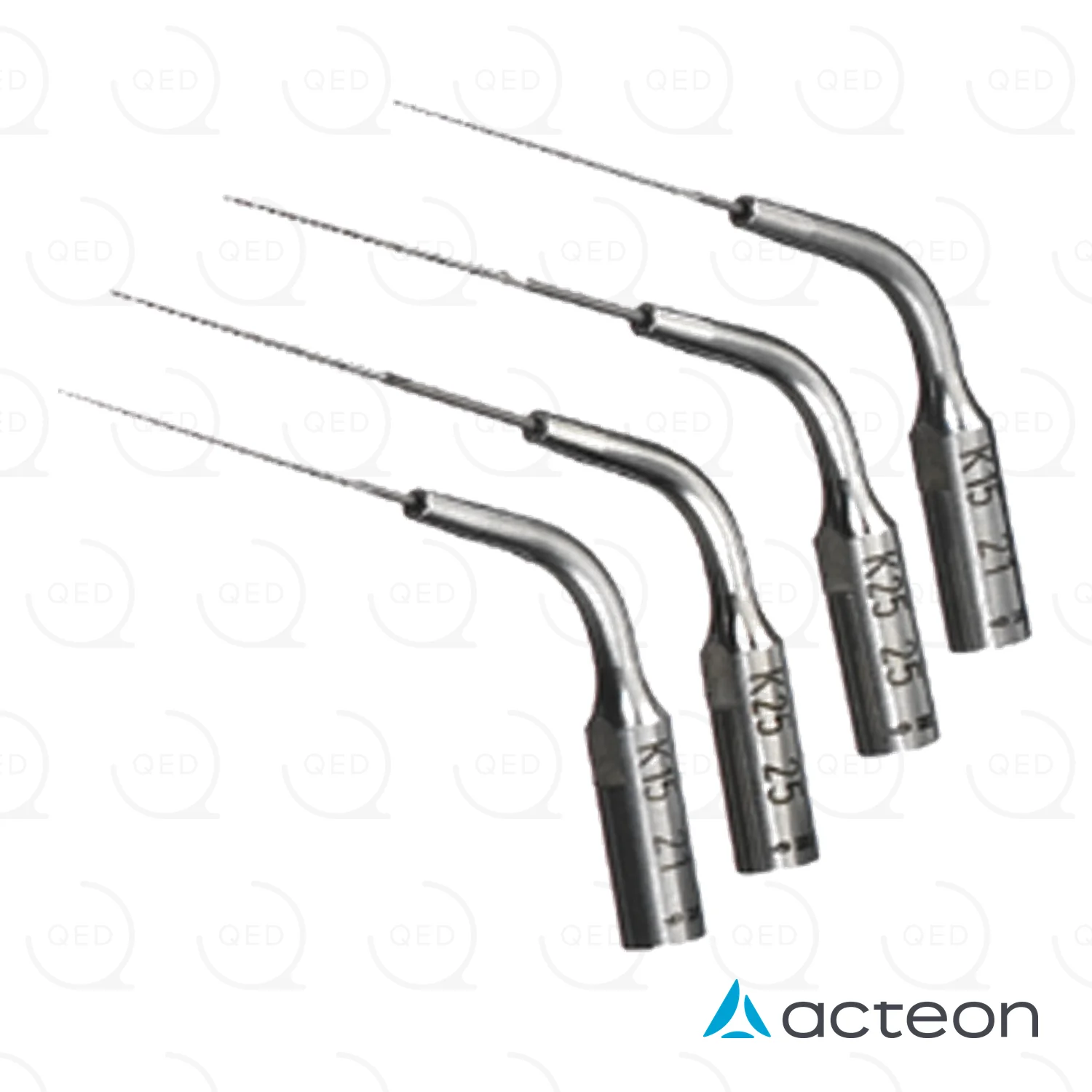
acteon ultrasonic k-file · 25 · 25 mm · 4 files
ultrasonic irrigationbroken instrument removalnewtron®
files that fit the handpiece, not the hand. these are acteon’s k-files for ultrasonic use, with a 2% taper. acteon’s tip sheet gives the indications as “irrigation, the removal of calcified dentine and gutta percha and the removal of broken instruments”. this blister holds four iso 25 files at 25 mm.
this pack: 4 × acteon k-file, iso 25, 25 mm, 2% taper · acteon reference k25-25 · ref f43727
made by satelec, a company of the acteon group, mérignac, france
| size | iso 25, 2% taper |
| length | 25 mm |
| indications | endodontic irrigation and broken instrument removal (acteon tip sheet) |
| power setting | 6 on a newtron® generator, per acteon’s tip sheet · the colour ring on the tip matches the power zone (colour coding system™) |
| classification | class iia medical device |
› handle with care. acteon’s brochure notes that ultrasonic k-files are very flexible and should be handled with precision, and can be pre-bent.
› clean, disinfect and sterilise before each use, following acteon’s cleaning, disinfection and sterilisation instructions for tips (j02001).
› replace at least once a year. acteon: because a maximum number of uses cannot be set, tips in routine use should be “replaced at least once a year”, and sooner if the tip no longer vibrates as expected or treatment slows.
other sizes?
acteon make these in iso 10, 15, 25 and 30, at 21 and 25 mm: 10/21 · 10/25 · 15/21 · 15/25 · 25/21 · 30/21 · 30/25.
irrisafe or k-file for irrigation?
acteon make both. irrisafe® is their passive ultrasonic irrigation file; the k-files add calcified dentine, gutta-percha and broken instrument removal to irrigation.
| passive ultrasonic irrigation | irrisafe® 25, 21 mm · 20, 21 mm |
| irrigants | chlorax 5.25% · chlorax 2% · endo-solution 17% edta |
| generators | newtron® p5 xs b.led · newtron® booster |
| tools | acteon universal wrench · autoclavable tip stand |
acteon k-file 25, 25 mm (4) · ultrasonic k-file · 2% taper · irrigation · broken instrument removal · newtron® power 6 · satelec / acteon · ref f43727
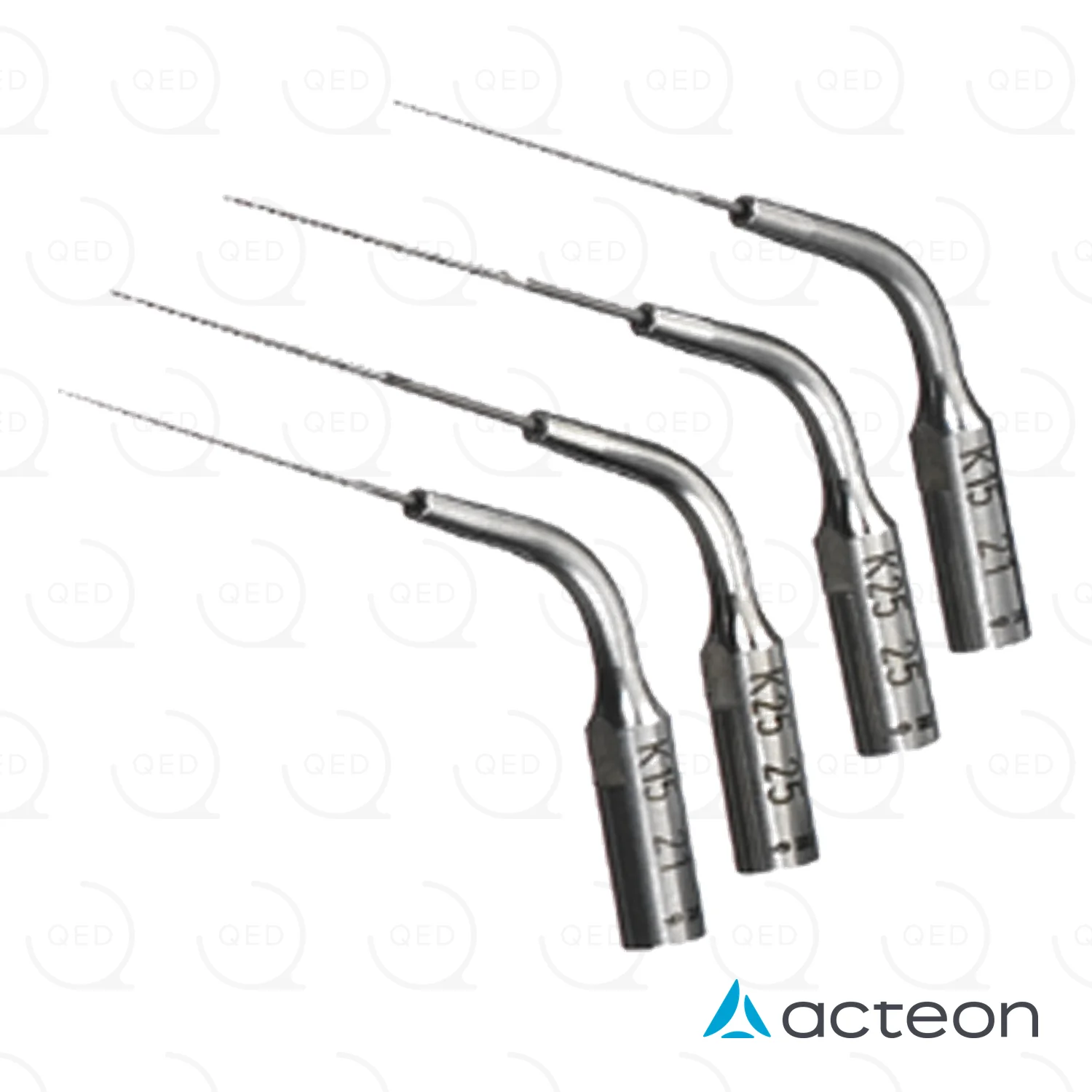
acteon ultrasonic k-file · 30 · 21 mm · 4 files
ultrasonic irrigationbroken instrument removalnewtron®
files that fit the handpiece, not the hand. these are acteon’s k-files for ultrasonic use, with a 2% taper. acteon’s tip sheet gives the indications as “irrigation, the removal of calcified dentine and gutta percha and the removal of broken instruments”. this blister holds four iso 30 files at 21 mm.
this pack: 4 × acteon k-file, iso 30, 21 mm, 2% taper · acteon reference k30-21 · ref f43730
made by satelec, a company of the acteon group, mérignac, france
| size | iso 30, 2% taper |
| length | 21 mm |
| indications | endodontic irrigation and broken instrument removal (acteon tip sheet) |
| power setting | 6 on a newtron® generator, per acteon’s tip sheet · the colour ring on the tip matches the power zone (colour coding system™) |
| classification | class iia medical device |
› handle with care. acteon’s brochure notes that ultrasonic k-files are very flexible and should be handled with precision, and can be pre-bent.
› clean, disinfect and sterilise before each use, following acteon’s cleaning, disinfection and sterilisation instructions for tips (j02001).
› replace at least once a year. acteon: because a maximum number of uses cannot be set, tips in routine use should be “replaced at least once a year”, and sooner if the tip no longer vibrates as expected or treatment slows.
other sizes?
acteon make these in iso 10, 15, 25 and 30, at 21 and 25 mm: 10/21 · 10/25 · 15/21 · 15/25 · 25/21 · 25/25 · 30/25.
irrisafe or k-file for irrigation?
acteon make both. irrisafe® is their passive ultrasonic irrigation file; the k-files add calcified dentine, gutta-percha and broken instrument removal to irrigation.
| passive ultrasonic irrigation | irrisafe® 25, 21 mm · 20, 21 mm |
| irrigants | chlorax 5.25% · chlorax 2% · endo-solution 17% edta |
| generators | newtron® p5 xs b.led · newtron® booster |
| tools | acteon universal wrench · autoclavable tip stand |
acteon k-file 30, 21 mm (4) · ultrasonic k-file · 2% taper · irrigation · broken instrument removal · newtron® power 6 · satelec / acteon · ref f43730
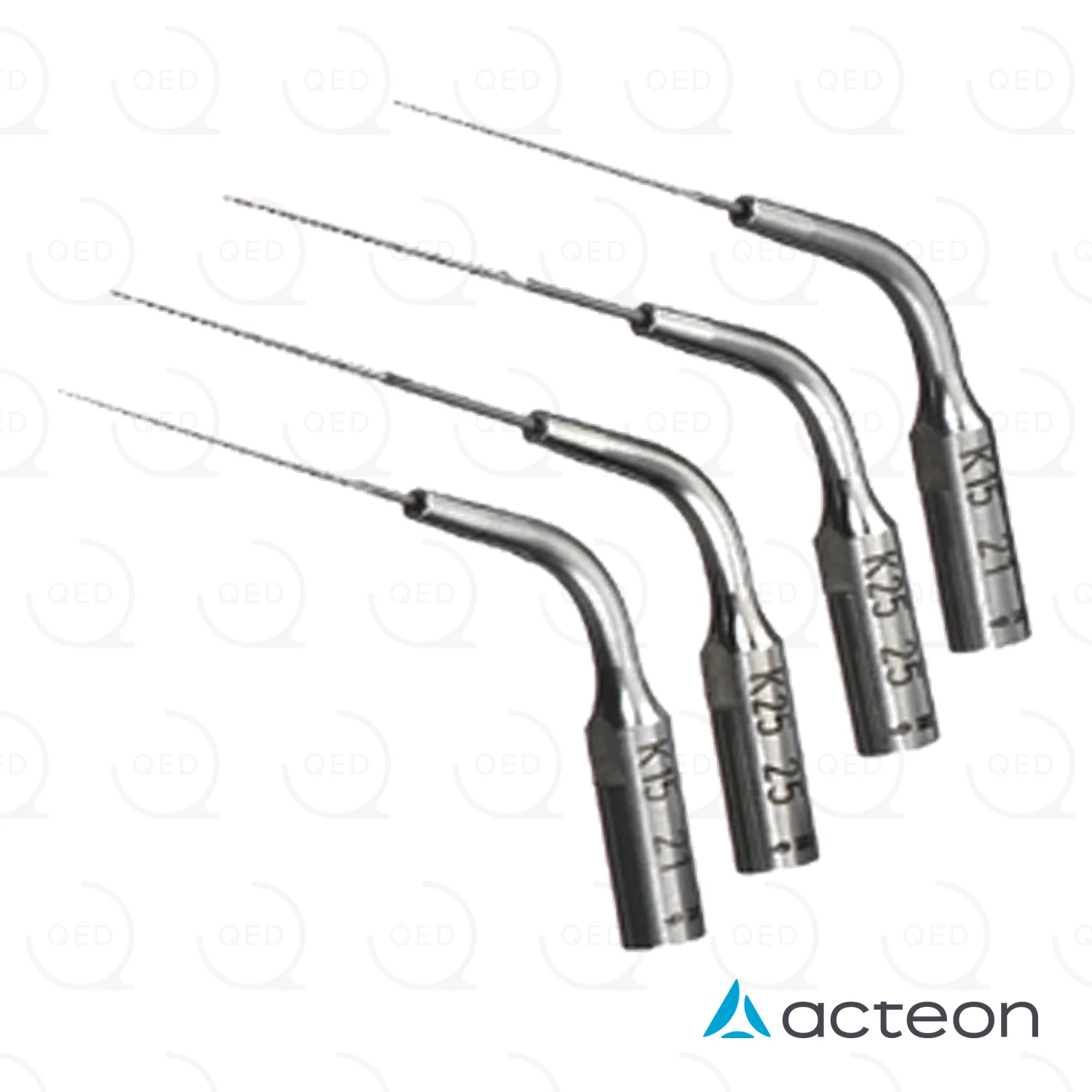
acteon ultrasonic k-file · 30 · 25 mm · 4 files
ultrasonic irrigationbroken instrument removalnewtron®
files that fit the handpiece, not the hand. these are acteon’s k-files for ultrasonic use, with a 2% taper. acteon’s tip sheet gives the indications as “irrigation, the removal of calcified dentine and gutta percha and the removal of broken instruments”. this blister holds four iso 30 files at 25 mm.
this pack: 4 × acteon k-file, iso 30, 25 mm, 2% taper · acteon reference k30-25 · ref f43732
made by satelec, a company of the acteon group, mérignac, france
| size | iso 30, 2% taper |
| length | 25 mm |
| indications | endodontic irrigation and broken instrument removal (acteon tip sheet) |
| power setting | 6 on a newtron® generator, per acteon’s tip sheet · the colour ring on the tip matches the power zone (colour coding system™) |
| classification | class iia medical device |
› handle with care. acteon’s brochure notes that ultrasonic k-files are very flexible and should be handled with precision, and can be pre-bent.
› clean, disinfect and sterilise before each use, following acteon’s cleaning, disinfection and sterilisation instructions for tips (j02001).
› replace at least once a year. acteon: because a maximum number of uses cannot be set, tips in routine use should be “replaced at least once a year”, and sooner if the tip no longer vibrates as expected or treatment slows.
other sizes?
acteon make these in iso 10, 15, 25 and 30, at 21 and 25 mm: 10/21 · 10/25 · 15/21 · 15/25 · 25/21 · 25/25 · 30/21.
irrisafe or k-file for irrigation?
acteon make both. irrisafe® is their passive ultrasonic irrigation file; the k-files add calcified dentine, gutta-percha and broken instrument removal to irrigation.
| passive ultrasonic irrigation | irrisafe® 25, 21 mm · 20, 21 mm |
| irrigants | chlorax 5.25% · chlorax 2% · endo-solution 17% edta |
| generators | newtron® p5 xs b.led · newtron® booster |
| tools | acteon universal wrench · autoclavable tip stand |
acteon k-file 30, 25 mm (4) · ultrasonic k-file · 2% taper · irrigation · broken instrument removal · newtron® power 6 · satelec / acteon · ref f43732
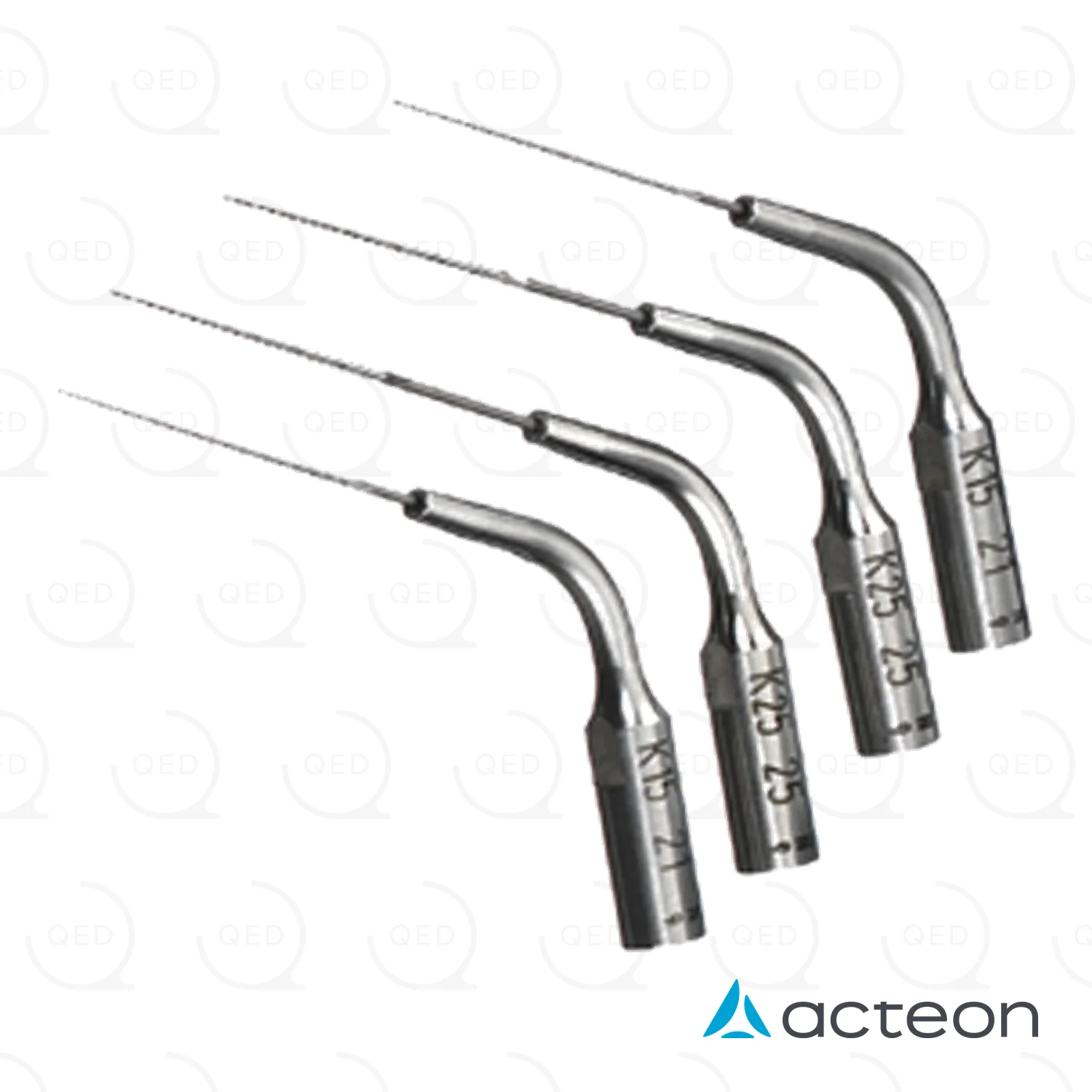
acteon irrisafe® · 25 · 21 mm · 4 files
passive ultrasonic irrigationendodonticsnewtron®
for the irrigant, once the shaping is done. acteon’s tip sheet says irrisafe files “are used to irrigate the root canal at the end of preparations”. their brochure describes the technique: the file is inserted 2 mm short of the working length and activated with withdrawal movements to flush debris and the smear layer upwards. this blister holds four iso 25 files at 21 mm.
this pack: 4 × acteon irrisafe® file, iso 25, 21 mm · acteon reference irr25-21 · ref f43805
made by satelec, a company of the acteon group, mérignac, france
| size | iso 25 |
| length | 21 mm |
| indication | ultrasonic irrigation (acteon tip sheet) |
| power setting | 6 on a newtron® generator, per acteon’s tip sheet · the colour ring on the tip matches the power zone (colour coding system™) |
| classification | class iia medical device |
passive ultrasonic irrigation of the root canal: a review of the literature.
van der sluis lwm et al., international endodontic journal 2007;40(6):415–426 – the review acteon cite for the pui concept
› clean, disinfect and sterilise before each use, following acteon’s cleaning, disinfection and sterilisation instructions for tips (j02001).
› replace at least once a year. acteon: because a maximum number of uses cannot be set, tips in routine use should be “replaced at least once a year”, and sooner if the tip no longer vibrates as expected or treatment slows.
› genuine tips on acteon handpieces. acteon warn that tips from other sources can put patients at risk and damage the equipment.
which size?
acteon make irrisafe in iso 20 and 25, each at 21 and 25 mm: 25, 25 mm · 20, 21 mm · 20, 25 mm.
| irrigants | chlorax 5.25% · chlorax 2% · endo-solution 17% edta |
| delivery | navitip™ 29 ga, 25 mm · irriflex® 30 ga |
| ultrasonic k-files | k15, 21 mm · k25, 21 mm |
| generators | newtron® p5 xs b.led · newtron® booster |
| tools | acteon universal wrench · autoclavable tip stand |
acteon irrisafe® 25, 21 mm (4) · passive ultrasonic irrigation file · newtron® power 6 · satelec / acteon · ref f43805
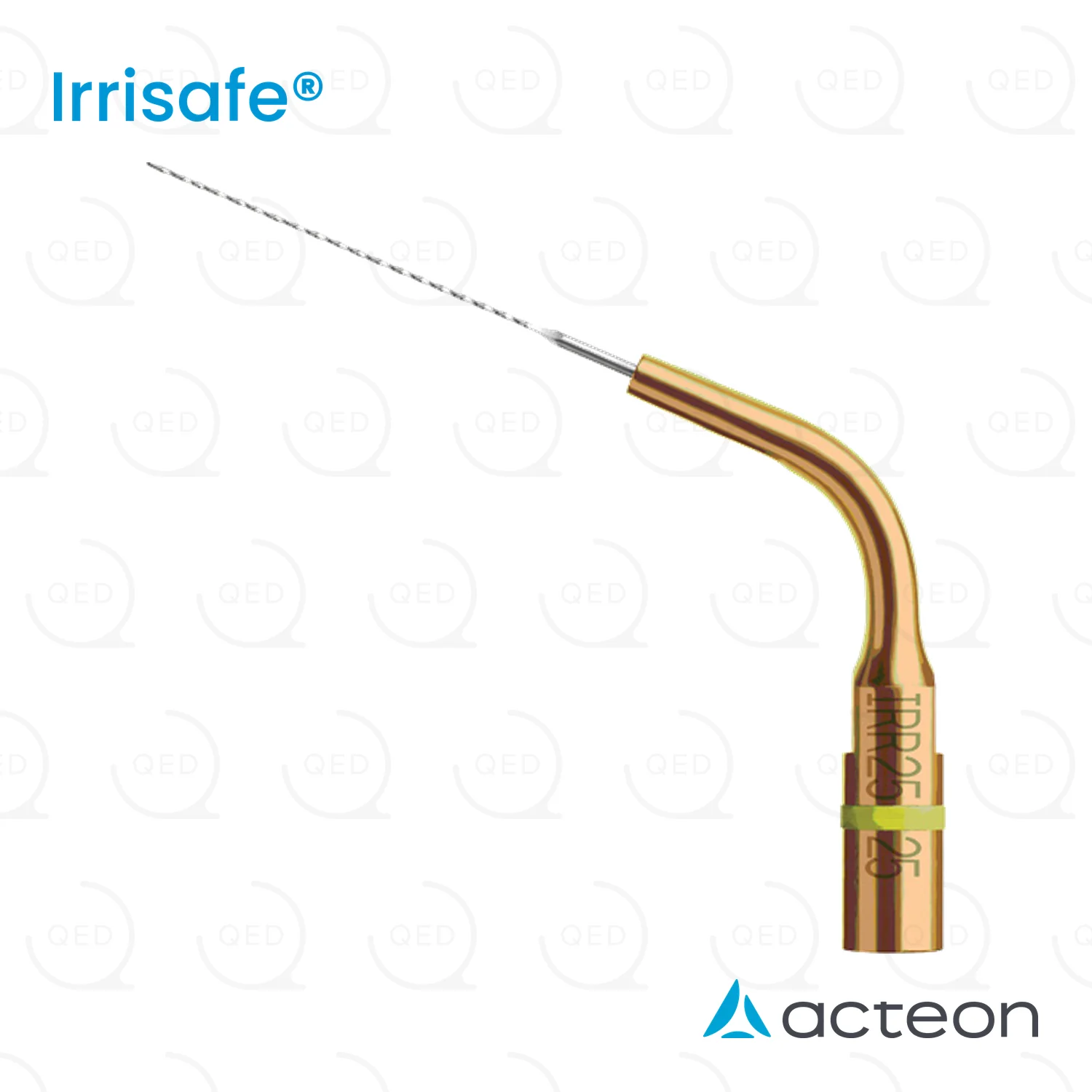
acteon irrisafe® · 25 · 25 mm · 4 files
passive ultrasonic irrigationendodonticsnewtron®
for the irrigant, once the shaping is done. acteon’s tip sheet says irrisafe files “are used to irrigate the root canal at the end of preparations”. their brochure describes the technique: the file is inserted 2 mm short of the working length and activated with withdrawal movements to flush debris and the smear layer upwards. this blister holds four iso 25 files at 25 mm.
this pack: 4 × acteon irrisafe® file, iso 25, 25 mm · acteon reference irr25-25 · ref f43806
made by satelec, a company of the acteon group, mérignac, france
| size | iso 25 |
| length | 25 mm |
| indication | ultrasonic irrigation (acteon tip sheet) |
| power setting | 6 on a newtron® generator, per acteon’s tip sheet · the colour ring on the tip matches the power zone (colour coding system™) |
| classification | class iia medical device |
passive ultrasonic irrigation of the root canal: a review of the literature.
van der sluis lwm et al., international endodontic journal 2007;40(6):415–426 – the review acteon cite for the pui concept
› clean, disinfect and sterilise before each use, following acteon’s cleaning, disinfection and sterilisation instructions for tips (j02001).
› replace at least once a year. acteon: because a maximum number of uses cannot be set, tips in routine use should be “replaced at least once a year”, and sooner if the tip no longer vibrates as expected or treatment slows.
› genuine tips on acteon handpieces. acteon warn that tips from other sources can put patients at risk and damage the equipment.
which size?
acteon make irrisafe in iso 20 and 25, each at 21 and 25 mm: 25, 21 mm · 20, 21 mm · 20, 25 mm.
| irrigants | chlorax 5.25% · chlorax 2% · endo-solution 17% edta |
| delivery | navitip™ 29 ga, 25 mm · irriflex® 30 ga |
| ultrasonic k-files | k15, 21 mm · k25, 21 mm |
| generators | newtron® p5 xs b.led · newtron® booster |
| tools | acteon universal wrench · autoclavable tip stand |
acteon irrisafe® 25, 25 mm (4) · passive ultrasonic irrigation file · newtron® power 6 · satelec / acteon · ref f43806
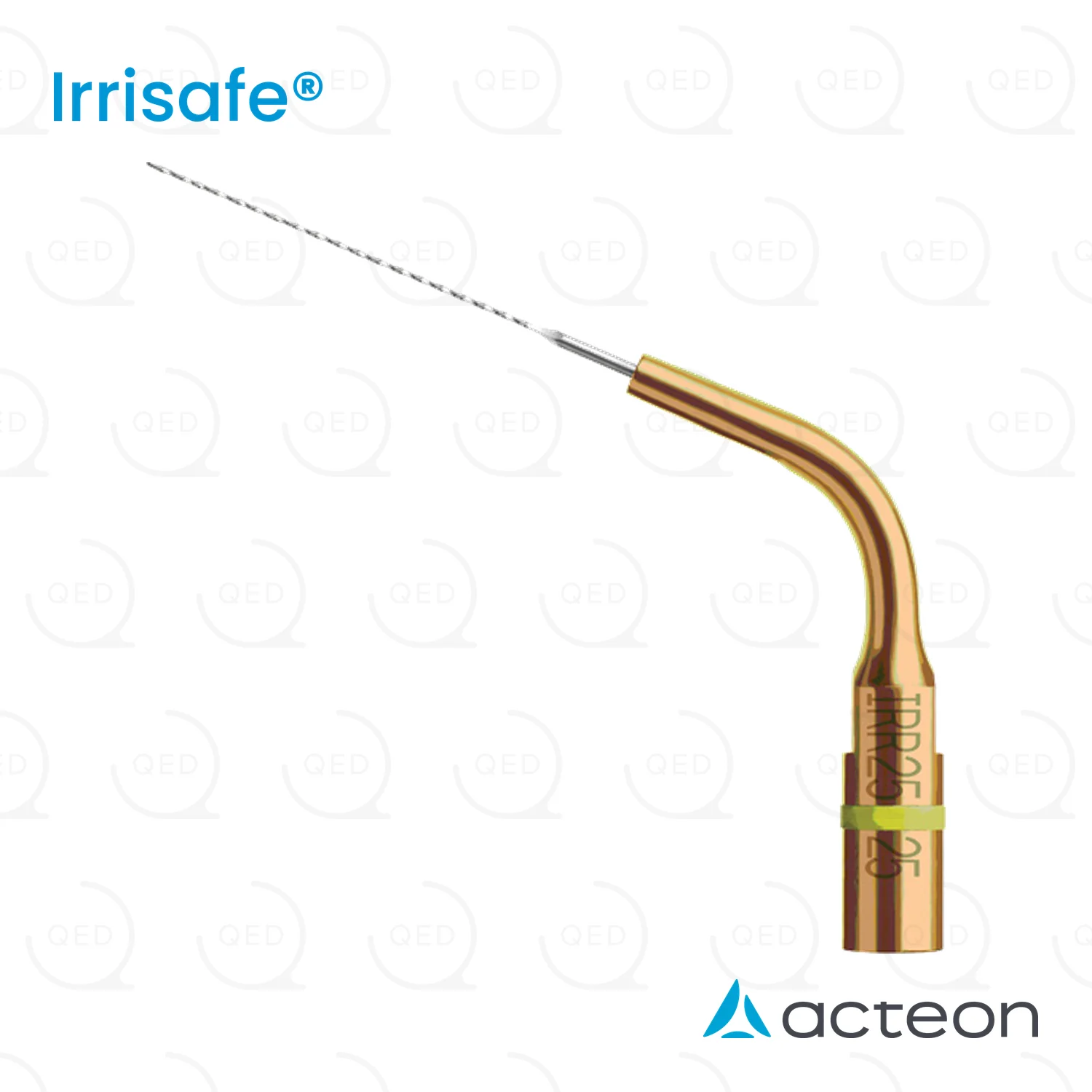
acteon irrisafe® · 20 · 21 mm · 4 files
passive ultrasonic irrigationendodonticsnewtron®
for the irrigant, once the shaping is done. acteon’s tip sheet says irrisafe files “are used to irrigate the root canal at the end of preparations”. their brochure describes the technique: the file is inserted 2 mm short of the working length and activated with withdrawal movements to flush debris and the smear layer upwards. this blister holds four iso 20 files at 21 mm.
this pack: 4 × acteon irrisafe® file, iso 20, 21 mm · acteon reference irr20-21 · ref f43807
made by satelec, a company of the acteon group, mérignac, france
| size | iso 20 |
| length | 21 mm |
| indication | ultrasonic irrigation (acteon tip sheet) |
| power setting | 6 on a newtron® generator, per acteon’s tip sheet · the colour ring on the tip matches the power zone (colour coding system™) |
| classification | class iia medical device |
passive ultrasonic irrigation of the root canal: a review of the literature.
van der sluis lwm et al., international endodontic journal 2007;40(6):415–426 – the review acteon cite for the pui concept
› clean, disinfect and sterilise before each use, following acteon’s cleaning, disinfection and sterilisation instructions for tips (j02001).
› replace at least once a year. acteon: because a maximum number of uses cannot be set, tips in routine use should be “replaced at least once a year”, and sooner if the tip no longer vibrates as expected or treatment slows.
› genuine tips on acteon handpieces. acteon warn that tips from other sources can put patients at risk and damage the equipment.
which size?
acteon make irrisafe in iso 20 and 25, each at 21 and 25 mm: 25, 21 mm · 25, 25 mm · 20, 25 mm.
| irrigants | chlorax 5.25% · chlorax 2% · endo-solution 17% edta |
| delivery | navitip™ 29 ga, 25 mm · irriflex® 30 ga |
| ultrasonic k-files | k15, 21 mm · k25, 21 mm |
| generators | newtron® p5 xs b.led · newtron® booster |
| tools | acteon universal wrench · autoclavable tip stand |
acteon irrisafe® 20, 21 mm (4) · passive ultrasonic irrigation file · newtron® power 6 · satelec / acteon · ref f43807
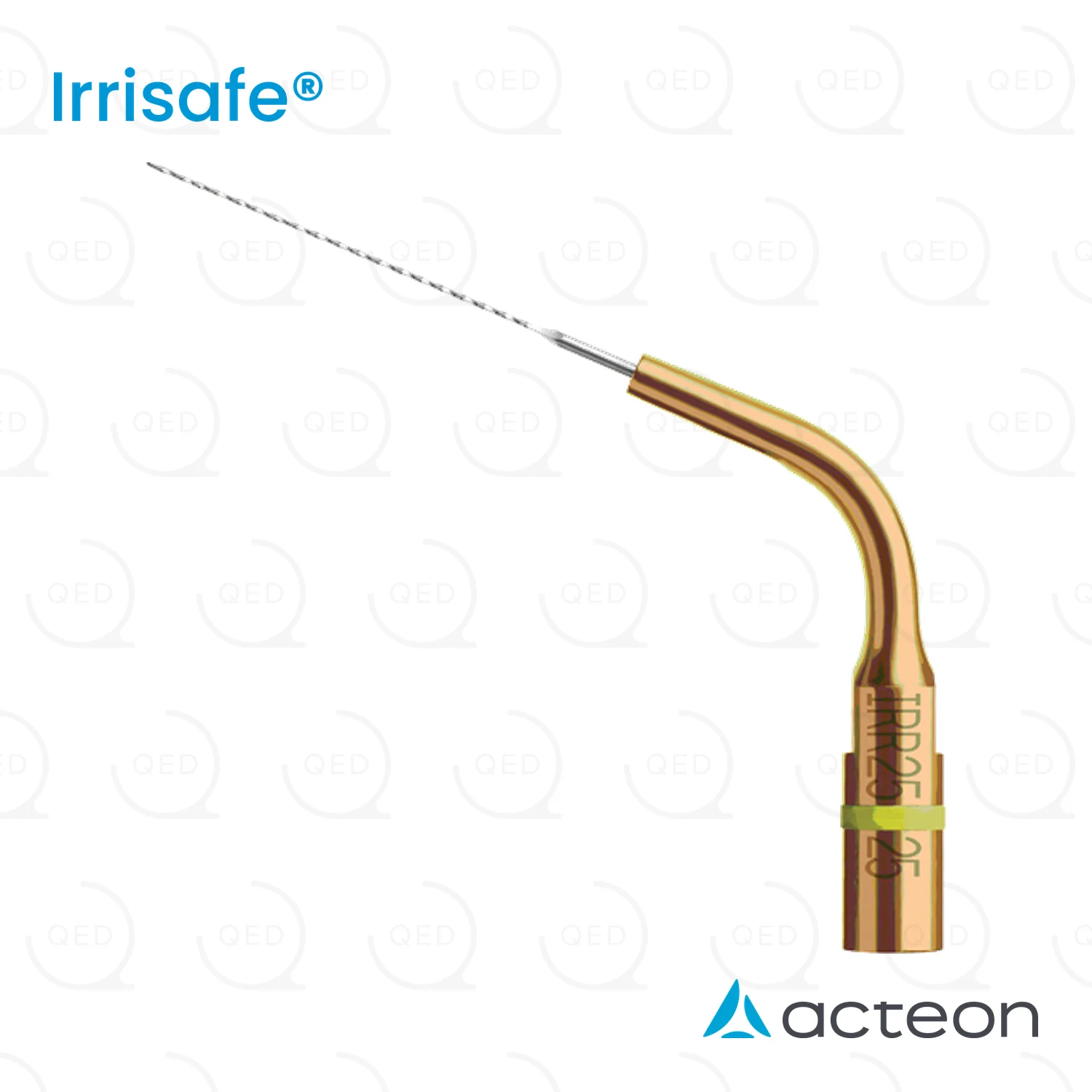
acteon irrisafe® · 20 · 25 mm · 4 files
passive ultrasonic irrigationendodonticsnewtron®
for the irrigant, once the shaping is done. acteon’s tip sheet says irrisafe files “are used to irrigate the root canal at the end of preparations”. their brochure describes the technique: the file is inserted 2 mm short of the working length and activated with withdrawal movements to flush debris and the smear layer upwards. this blister holds four iso 20 files at 25 mm.
this pack: 4 × acteon irrisafe® file, iso 20, 25 mm · acteon reference irr20-25 · ref f43808
made by satelec, a company of the acteon group, mérignac, france
| size | iso 20 |
| length | 25 mm |
| indication | ultrasonic irrigation (acteon tip sheet) |
| power setting | 6 on a newtron® generator, per acteon’s tip sheet · the colour ring on the tip matches the power zone (colour coding system™) |
| classification | class iia medical device |
passive ultrasonic irrigation of the root canal: a review of the literature.
van der sluis lwm et al., international endodontic journal 2007;40(6):415–426 – the review acteon cite for the pui concept
› clean, disinfect and sterilise before each use, following acteon’s cleaning, disinfection and sterilisation instructions for tips (j02001).
› replace at least once a year. acteon: because a maximum number of uses cannot be set, tips in routine use should be “replaced at least once a year”, and sooner if the tip no longer vibrates as expected or treatment slows.
› genuine tips on acteon handpieces. acteon warn that tips from other sources can put patients at risk and damage the equipment.
which size?
acteon make irrisafe in iso 20 and 25, each at 21 and 25 mm: 25, 21 mm · 25, 25 mm · 20, 21 mm.
| irrigants | chlorax 5.25% · chlorax 2% · endo-solution 17% edta |
| delivery | navitip™ 29 ga, 25 mm · irriflex® 30 ga |
| ultrasonic k-files | k15, 21 mm · k25, 21 mm |
| generators | newtron® p5 xs b.led · newtron® booster |
| tools | acteon universal wrench · autoclavable tip stand |
acteon irrisafe® 20, 25 mm (4) · passive ultrasonic irrigation file · newtron® power 6 · satelec / acteon · ref f43808
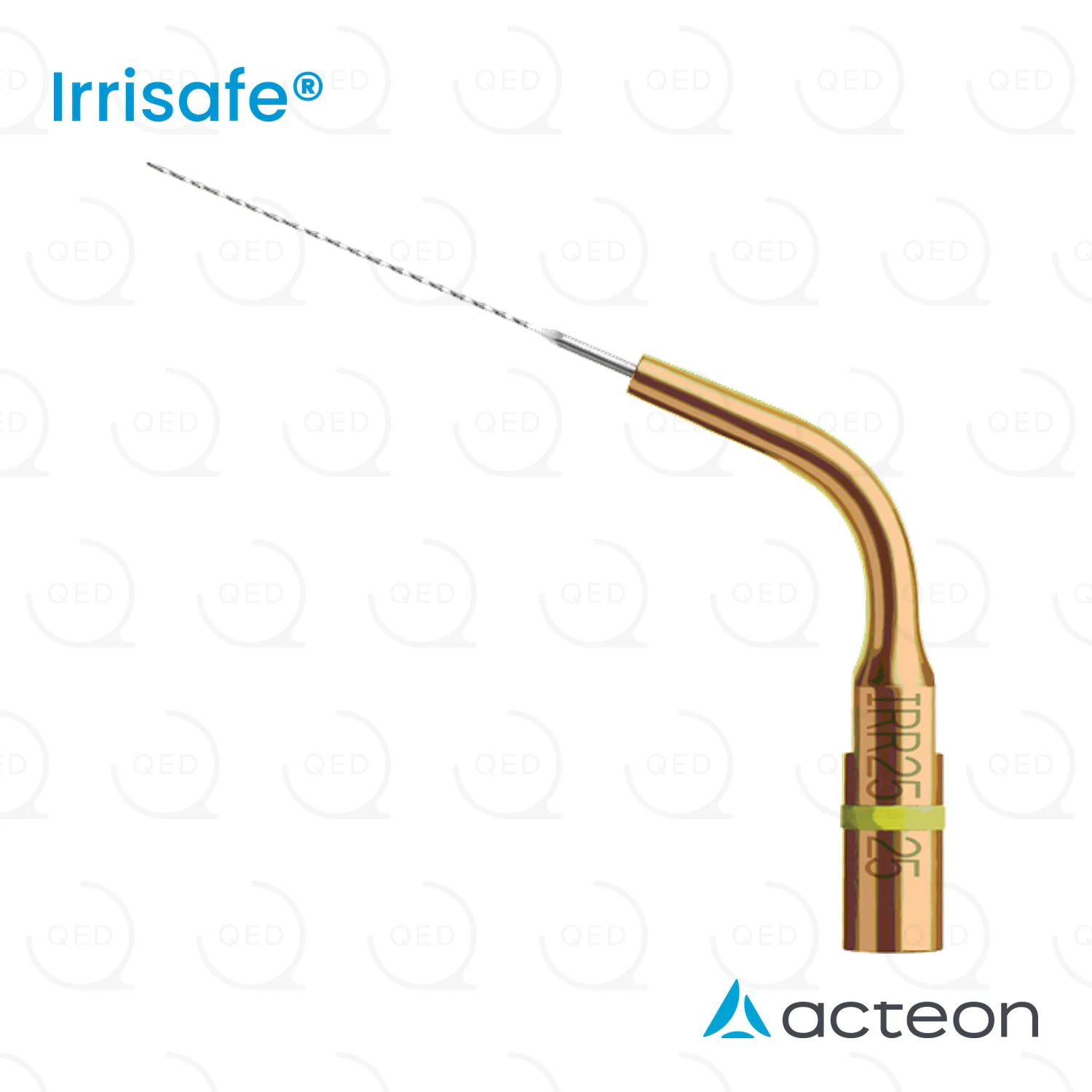
acteon endo success™ · s04 · obturation
obturationultrasonic tipnewtron®
lateral condensation by heat. s04 is acteon’s fine condenser. their brochure describes it as designed “for lateral condensation of gutta percha by heating effect”, used dry, without irrigation.
this pack: 1 × acteon endo success™ s04 ultrasonic tip · ref f88009
made by satelec, a company of the acteon group, mérignac, france
| acteon reference | s04 |
| geometry | 40 mm, 4% taper |
| material | smooth stainless steel |
| indication | non-surgical endodontics, obturation (acteon tip sheet) |
| power setting | 7 on a newtron® generator, per acteon’s tip sheet · the colour ring on the tip matches the power zone (colour coding system™) |
| classification | class iia medical device |
› clean, disinfect and sterilise before each use, following acteon’s cleaning, disinfection and sterilisation instructions for tips (j02001).
› replace at least once a year. acteon: because a maximum number of uses cannot be set, tips in routine use should be “replaced at least once a year”, and sooner if the tip no longer vibrates as expected or treatment slows.
› used dry. acteon’s brochure says s04 is used without irrigation. their general instructions set out the conditions for irrigation-free use, including magnification, an assistant and continual monitoring for heat.
which generator does it fit?
acteon’s tip sheet gives settings for the newtron® range, including the p5 xs b.led and booster. acteon advise against using their tips on other makers’ handpieces, and other makers’ tips on theirs.
| long retreatment tips | et40 · et25l |
| sealers | ah plus® · neosealer® ezflo |
| generators | newtron® p5 xs b.led · newtron® booster |
| tools | acteon universal wrench · autoclavable tip stand |
acteon endo success™ s04 · 40 mm, 4% taper · obturation · newtron® power 7 · satelec / acteon · ref f88009
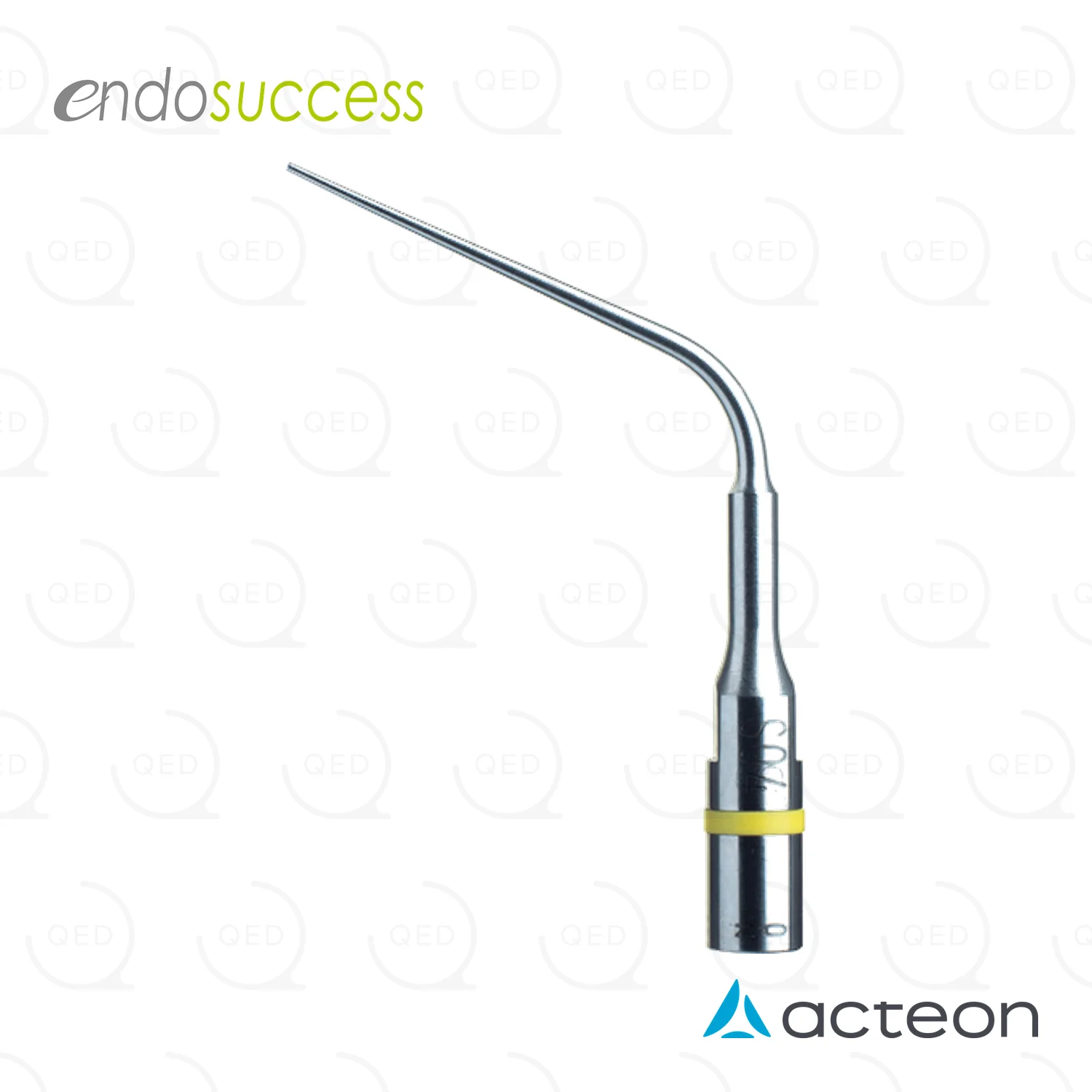
acteon endo success™ · et20 · retreatment
retreatmentultrasonic tipnewtron®
filling material, silver points and broken instruments. et20 is acteon’s smooth steel retreatment tip. acteon’s tip sheet describes it as a “retreatment tip for the extraction of filling materials, silver cones and broken instruments, and the removal of the smear layer and debris”, and their brochure places it in the first coronal third.
this pack: 1 × acteon endo success™ et20 ultrasonic tip · ref f88011
made by satelec, a company of the acteon group, mérignac, france
| acteon reference | et20 |
| geometry | 20 mm, 6% taper |
| material | smooth stainless steel |
| indication | non-surgical endodontic retreatment (acteon tip sheet) |
| power setting | 7 on a newtron® generator, per acteon’s tip sheet · the colour ring on the tip matches the power zone (colour coding system™) |
| classification | class iia medical device |
| also in | endo success™ retreatment kit |
› clean, disinfect and sterilise before each use, following acteon’s cleaning, disinfection and sterilisation instructions for tips (j02001).
› replace at least once a year. acteon: because a maximum number of uses cannot be set, tips in routine use should be “replaced at least once a year”, and sooner if the tip no longer vibrates as expected or treatment slows.
› watch the site for heat. acteon’s tip sheets state that the practitioner has to continually monitor the clinical site to immediately identify any heating risk.
which generator does it fit?
acteon’s tip sheet gives settings for the newtron® range, including the p5 xs b.led and booster. acteon advise against using their tips on other makers’ handpieces, and other makers’ tips on theirs.
| related tips | et20d · et25 · et25s |
| the kit | endo success™ retreatment kit |
| irrigants | chlorax 5.25% · endo-solution 17% edta |
| ultrasonic irrigation | irrisafe® 25, 21 mm |
| generators | newtron® p5 xs b.led · newtron® booster |
| tools | acteon universal wrench · autoclavable tip stand |
acteon endo success™ et20 · 20 mm, 6% taper · retreatment · newtron® power 7 · satelec / acteon · ref f88011

acteon endo success™ · et40 · retreatment
retreatmentultrasonic tipnewtron®
reaching further down a wide, straight canal. et40 is acteon’s long steel retreatment tip. the tip sheet describes it as a “long retreatment tip for the removal of broken instruments in the middle third of large and straight canals”.
this pack: 1 × acteon endo success™ et40 ultrasonic tip · ref f88012
made by satelec, a company of the acteon group, mérignac, france
| acteon reference | et40 |
| geometry | 40 mm, 4% taper |
| material | smooth stainless steel |
| indication | non-surgical endodontic retreatment (acteon tip sheet) |
| power setting | 7 on a newtron® generator, per acteon’s tip sheet · the colour ring on the tip matches the power zone (colour coding system™) |
| classification | class iia medical device |
› clean, disinfect and sterilise before each use, following acteon’s cleaning, disinfection and sterilisation instructions for tips (j02001).
› replace at least once a year. acteon: because a maximum number of uses cannot be set, tips in routine use should be “replaced at least once a year”, and sooner if the tip no longer vibrates as expected or treatment slows.
› watch the site for heat. acteon’s tip sheets state that the practitioner has to continually monitor the clinical site to immediately identify any heating risk.
which generator does it fit?
acteon’s tip sheet gives settings for the newtron® range, including the p5 xs b.led and booster. acteon advise against using their tips on other makers’ handpieces, and other makers’ tips on theirs.
| related tips | et40d · et25l |
| the kit | endo success™ retreatment kit |
| irrigants | chlorax 5.25% · endo-solution 17% edta |
| ultrasonic irrigation | irrisafe® 25, 21 mm |
| generators | newtron® p5 xs b.led · newtron® booster |
| tools | acteon universal wrench · autoclavable tip stand |
acteon endo success™ et40 · 40 mm, 4% taper · retreatment · newtron® power 7 · satelec / acteon · ref f88012
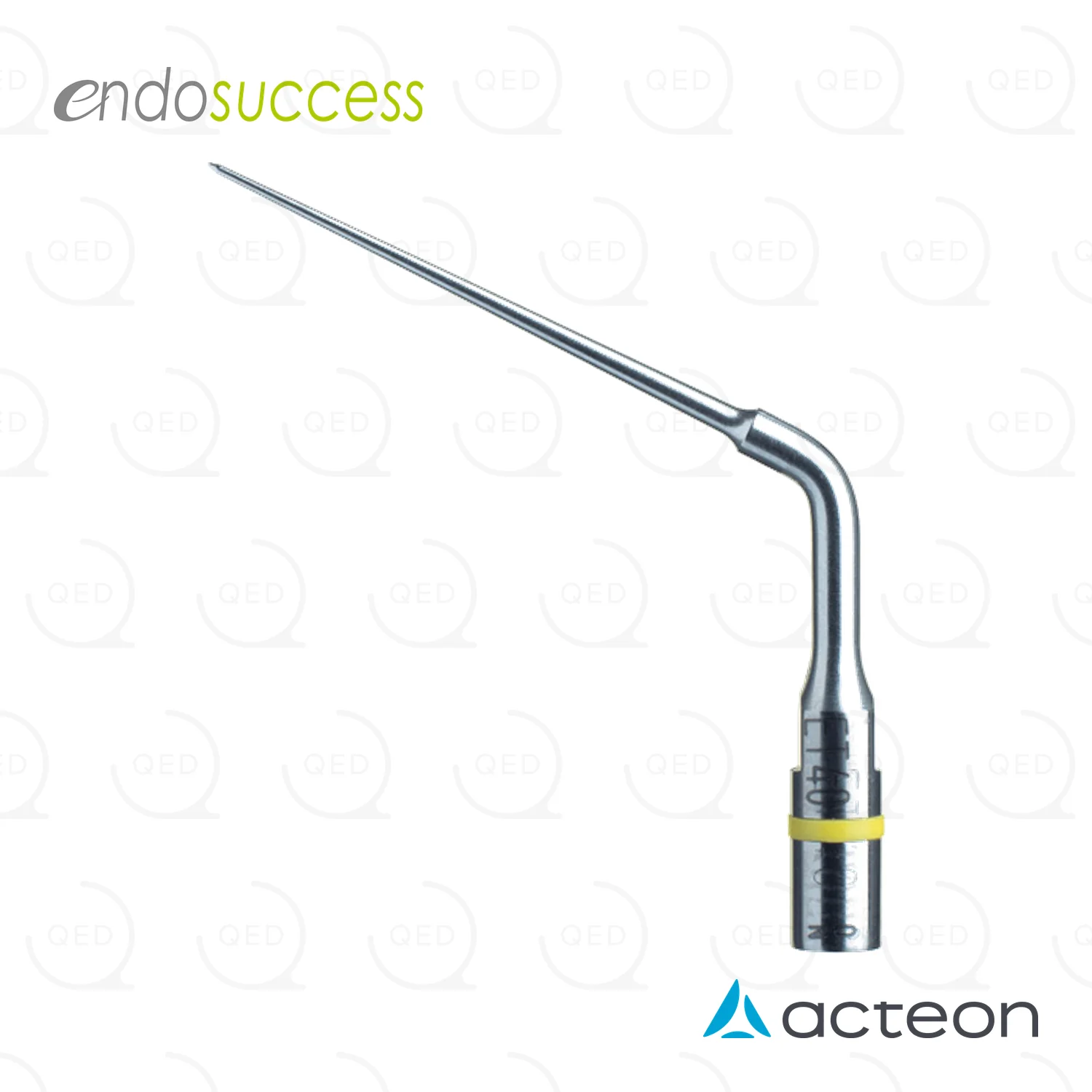
acteon endo success™ · et20d · retreatment
retreatmentultrasonic tipnewtron®
when et20 is not enough. et20d is the diamond-coated version of acteon’s coronal retreatment tip. acteon’s tip sheet gives its use as “the removal of very hard materials in the first crown third”, and their brochure adds that it works by brushing the walls, with the diamond coating increasing the cutting and lateral abrasion effect.
this pack: 1 × acteon endo success™ et20d ultrasonic tip · ref f88013
made by satelec, a company of the acteon group, mérignac, france
| acteon reference | et20d |
| geometry | 20 mm, 5% taper, diamond-coated 30 µm |
| material | diamond-coated steel |
| indication | non-surgical endodontic retreatment (acteon tip sheet) |
| power setting | 7 on a newtron® generator, per acteon’s tip sheet · the colour ring on the tip matches the power zone (colour coding system™) |
| classification | class iia medical device |
› clean, disinfect and sterilise before each use, following acteon’s cleaning, disinfection and sterilisation instructions for tips (j02001).
› replace at least once a year. acteon: because a maximum number of uses cannot be set, tips in routine use should be “replaced at least once a year”, and sooner if the tip no longer vibrates as expected or treatment slows.
› watch the site for heat. acteon’s tip sheets state that the practitioner has to continually monitor the clinical site to immediately identify any heating risk.
which generator does it fit?
acteon’s tip sheet gives settings for the newtron® range, including the p5 xs b.led and booster. acteon advise against using their tips on other makers’ handpieces, and other makers’ tips on theirs.
| related tips | et20 · et40d |
| the kit | endo success™ retreatment kit |
| irrigants | chlorax 5.25% · endo-solution 17% edta |
| ultrasonic irrigation | irrisafe® 25, 21 mm |
| generators | newtron® p5 xs b.led · newtron® booster |
| tools | acteon universal wrench · autoclavable tip stand |
acteon endo success™ et20d · 20 mm, 5% taper, diamond-coated 30 µm · retreatment · newtron® power 7 · satelec / acteon · ref f88013

acteon endo success™ · et40d · retreatment
retreatmentultrasonic tipnewtron®
length and abrasion together. et40d is the diamond-coated long retreatment tip. acteon’s tip sheet gives its use as “the retreatment of very hard materials in the middle third”.
this pack: 1 × acteon endo success™ et40d ultrasonic tip · ref f88014
made by satelec, a company of the acteon group, mérignac, france
| acteon reference | et40d |
| geometry | 40 mm, 4% taper, diamond-coated 30 µm |
| material | diamond-coated steel |
| indication | non-surgical endodontic retreatment (acteon tip sheet) |
| power setting | 7 on a newtron® generator, per acteon’s tip sheet · the colour ring on the tip matches the power zone (colour coding system™) |
| classification | class iia medical device |
› clean, disinfect and sterilise before each use, following acteon’s cleaning, disinfection and sterilisation instructions for tips (j02001).
› replace at least once a year. acteon: because a maximum number of uses cannot be set, tips in routine use should be “replaced at least once a year”, and sooner if the tip no longer vibrates as expected or treatment slows.
› watch the site for heat. acteon’s tip sheets state that the practitioner has to continually monitor the clinical site to immediately identify any heating risk.
which generator does it fit?
acteon’s tip sheet gives settings for the newtron® range, including the p5 xs b.led and booster. acteon advise against using their tips on other makers’ handpieces, and other makers’ tips on theirs.
| related tips | et40 · et20d |
| the kit | endo success™ retreatment kit |
| irrigants | chlorax 5.25% · endo-solution 17% edta |
| ultrasonic irrigation | irrisafe® 25, 21 mm |
| generators | newtron® p5 xs b.led · newtron® booster |
| tools | acteon universal wrench · autoclavable tip stand |
acteon endo success™ et40d · 40 mm, 4% taper, diamond-coated 30 µm · retreatment · newtron® power 7 · satelec / acteon · ref f88014

acteon endo success™ · et18d · access and retreatment
access and retreatmentultrasonic tipnewtron®
overhangs, calcifications and old filling. et18d is a diamond-coated steel tip. acteon’s tip sheet describes it as a tip “for the finishing of the access cavity and the removal of dentinal overhangs, calcifications and filling materials”.
this pack: 1 × acteon endo success™ et18d ultrasonic tip · ref f88017
made by satelec, a company of the acteon group, mérignac, france
| acteon reference | et18d |
| geometry | 18 mm, 5% taper, diamond-coated 76 µm |
| material | diamond-coated steel |
| indication | non-surgical endodontic retreatment (acteon tip sheet) |
| power setting | 10 on a newtron® generator, per acteon’s tip sheet · the colour ring on the tip matches the power zone (colour coding system™) |
| classification | class iia medical device |
| also in | endo success™ retreatment kit |
› clean, disinfect and sterilise before each use, following acteon’s cleaning, disinfection and sterilisation instructions for tips (j02001).
› replace at least once a year. acteon: because a maximum number of uses cannot be set, tips in routine use should be “replaced at least once a year”, and sooner if the tip no longer vibrates as expected or treatment slows.
› watch the site for heat. acteon’s tip sheets state that the practitioner has to continually monitor the clinical site to immediately identify any heating risk.
which generator does it fit?
acteon’s tip sheet gives settings for the newtron® range, including the p5 xs b.led and booster. acteon advise against using their tips on other makers’ handpieces, and other makers’ tips on theirs.
| related tips | etbd · cap1 |
| the kit | endo success™ retreatment kit |
| irrigants | chlorax 5.25% · endo-solution 17% edta |
| ultrasonic irrigation | irrisafe® 25, 21 mm |
| generators | newtron® p5 xs b.led · newtron® booster |
| tools | acteon universal wrench · autoclavable tip stand |
acteon endo success™ et18d · 18 mm, 5% taper, diamond-coated 76 µm · access and retreatment · newtron® power 10 · satelec / acteon · ref f88017

acteon endo success™ · et25 · retreatment
retreatmentultrasonic tipnewtron®
a slimmer, flexible alloy for deeper work. et25 is made from a titanium-niobium alloy rather than steel. acteon describe it as a tip “for retreatment in the middle and apical thirds and the extraction of broken instruments”, and note in their brochure that et25 tips can be pre-formed for curved canals.
this pack: 1 × acteon endo success™ et25 ultrasonic tip · ref f88018
made by satelec, a company of the acteon group, mérignac, france
| acteon reference | et25 |
| geometry | 20 mm, 3% taper |
| material | titanium-niobium alloy |
| indication | non-surgical endodontic retreatment (acteon tip sheet) |
| power setting | 7 on a newtron® generator, per acteon’s tip sheet · the colour ring on the tip matches the power zone (colour coding system™) |
| classification | class iia medical device |
| also in | endo success™ retreatment kit |
› clean, disinfect and sterilise before each use, following acteon’s cleaning, disinfection and sterilisation instructions for tips (j02001).
› replace at least once a year. acteon: because a maximum number of uses cannot be set, tips in routine use should be “replaced at least once a year”, and sooner if the tip no longer vibrates as expected or treatment slows.
› watch the site for heat. acteon’s tip sheets state that the practitioner has to continually monitor the clinical site to immediately identify any heating risk.
which generator does it fit?
acteon’s tip sheet gives settings for the newtron® range, including the p5 xs b.led and booster. acteon advise against using their tips on other makers’ handpieces, and other makers’ tips on theirs.
| related tips | et25s · et25l |
| the kit | endo success™ retreatment kit |
| irrigants | chlorax 5.25% · endo-solution 17% edta |
| ultrasonic irrigation | irrisafe® 25, 21 mm |
| generators | newtron® p5 xs b.led · newtron® booster |
| tools | acteon universal wrench · autoclavable tip stand |
acteon endo success™ et25 · 20 mm, 3% taper · retreatment · newtron® power 7 · satelec / acteon · ref f88018
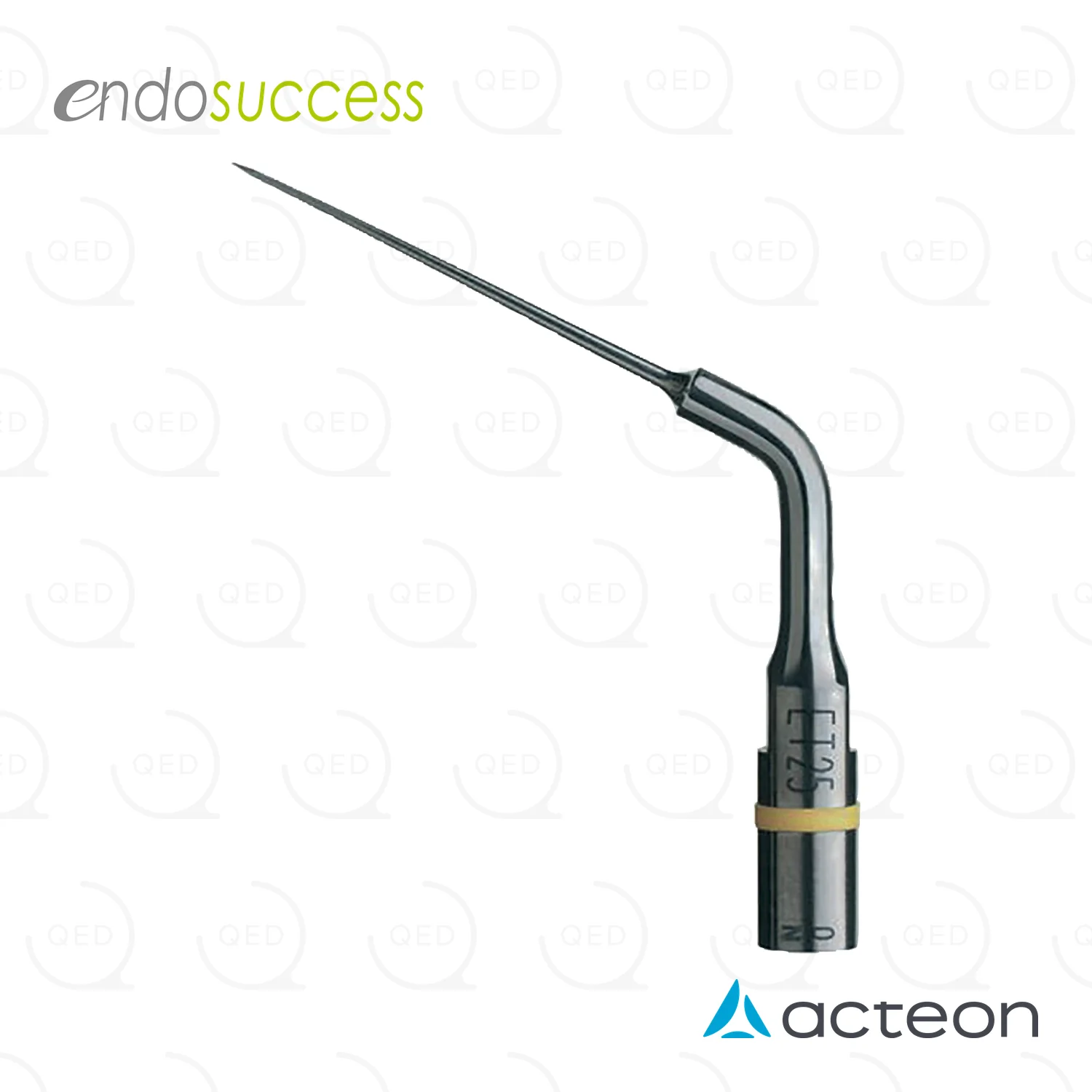
acteon endo success™ · etpr · post removal
post removalultrasonic tipnewtron®
for the items that will not come out. etpr is acteon’s loosening tip. the tip sheet describes a “tip for loosening of posts and crowns for the extraction of the most difficult items”, and it runs at the top of the power scale.
this pack: 1 × acteon endo success™ etpr ultrasonic tip · ref f88019
made by satelec, a company of the acteon group, mérignac, france
| acteon reference | etpr |
| geometry | post and crown loosening tip |
| material | smooth stainless steel |
| indication | tip for loosening (post removal) (acteon tip sheet) |
| power setting | 20 on a newtron® generator, per acteon’s tip sheet · the colour ring on the tip matches the power zone (colour coding system™) |
| classification | class iia medical device |
| also in | endo success™ retreatment kit |
› clean, disinfect and sterilise before each use, following acteon’s cleaning, disinfection and sterilisation instructions for tips (j02001).
› replace at least once a year. acteon: because a maximum number of uses cannot be set, tips in routine use should be “replaced at least once a year”, and sooner if the tip no longer vibrates as expected or treatment slows.
› watch the site for heat. acteon’s tip sheets state that the practitioner has to continually monitor the clinical site to immediately identify any heating risk.
which generator does it fit?
acteon’s tip sheet gives settings for the newtron® range, including the p5 xs b.led and booster. acteon advise against using their tips on other makers’ handpieces, and other makers’ tips on theirs.
| related tips | et20 · cap3 |
| the kit | endo success™ retreatment kit |
| irrigants | chlorax 5.25% · endo-solution 17% edta |
| ultrasonic irrigation | irrisafe® 25, 21 mm |
| generators | newtron® p5 xs b.led · newtron® booster |
| tools | acteon universal wrench · autoclavable tip stand |
acteon endo success™ etpr · post and crown loosening tip · post removal · newtron® power 20 · satelec / acteon · ref f88019

acteon endo success™ · etbd · access and retreatment
access and retreatmentultrasonic tipnewtron®
searching the floor for an orifice. etbd is acteon’s diamond-coated ball tip. the tip sheet describes a “diamond-coated spherical tip for canal probing and the location of calcified canals”.
this pack: 1 × acteon endo success™ etbd ultrasonic tip · ref f88020
made by satelec, a company of the acteon group, mérignac, france
| acteon reference | etbd |
| geometry | 20 mm, 5% taper, diamond-coated ball |
| material | diamond-coated steel |
| indication | non-surgical endodontic retreatment (acteon tip sheet) |
| power setting | 7 on a newtron® generator, per acteon’s tip sheet · the colour ring on the tip matches the power zone (colour coding system™) |
| classification | class iia medical device |
| also in | endo success™ retreatment kit |
› clean, disinfect and sterilise before each use, following acteon’s cleaning, disinfection and sterilisation instructions for tips (j02001).
› replace at least once a year. acteon: because a maximum number of uses cannot be set, tips in routine use should be “replaced at least once a year”, and sooner if the tip no longer vibrates as expected or treatment slows.
› watch the site for heat. acteon’s tip sheets state that the practitioner has to continually monitor the clinical site to immediately identify any heating risk.
which generator does it fit?
acteon’s tip sheet gives settings for the newtron® range, including the p5 xs b.led and booster. acteon advise against using their tips on other makers’ handpieces, and other makers’ tips on theirs.
| related tips | et18d · cap3 |
| the kit | endo success™ retreatment kit |
| irrigants | chlorax 5.25% · endo-solution 17% edta |
| ultrasonic irrigation | irrisafe® 25, 21 mm |
| generators | newtron® p5 xs b.led · newtron® booster |
| tools | acteon universal wrench · autoclavable tip stand |
acteon endo success™ etbd · 20 mm, 5% taper, diamond-coated ball · access and retreatment · newtron® power 7 · satelec / acteon · ref f88020

acteon endo success™ · et25s · retreatment
retreatmentultrasonic tipnewtron®
short, for the coronal work. et25s is the short member of acteon’s titanium-niobium et25 family. the tip sheet describes a “short titanium-niobium tip for retreatment in the crown third and isthmuses”.
this pack: 1 × acteon endo success™ et25s ultrasonic tip · ref f88021
made by satelec, a company of the acteon group, mérignac, france
| acteon reference | et25s |
| geometry | 15 mm, 4% taper |
| material | titanium-niobium alloy |
| indication | non-surgical endodontic retreatment (acteon tip sheet) |
| power setting | 7 on a newtron® generator, per acteon’s tip sheet · the colour ring on the tip matches the power zone (colour coding system™) |
| classification | class iia medical device |
| also in | endo success™ retreatment kit |
› clean, disinfect and sterilise before each use, following acteon’s cleaning, disinfection and sterilisation instructions for tips (j02001).
› replace at least once a year. acteon: because a maximum number of uses cannot be set, tips in routine use should be “replaced at least once a year”, and sooner if the tip no longer vibrates as expected or treatment slows.
› watch the site for heat. acteon’s tip sheets state that the practitioner has to continually monitor the clinical site to immediately identify any heating risk.
which generator does it fit?
acteon’s tip sheet gives settings for the newtron® range, including the p5 xs b.led and booster. acteon advise against using their tips on other makers’ handpieces, and other makers’ tips on theirs.
| related tips | et25 · et25l |
| the kit | endo success™ retreatment kit |
| irrigants | chlorax 5.25% · endo-solution 17% edta |
| ultrasonic irrigation | irrisafe® 25, 21 mm |
| generators | newtron® p5 xs b.led · newtron® booster |
| tools | acteon universal wrench · autoclavable tip stand |
acteon endo success™ et25s · 15 mm, 4% taper · retreatment · newtron® power 7 · satelec / acteon · ref f88021

acteon endo success™ · et25l · retreatment
retreatmentultrasonic tipnewtron®
long and straight canals. et25l is the long member of the et25 family. acteon describe a “long titanium-niobium tip for retreatment in the apical third and long, straight canals”.
this pack: 1 × acteon endo success™ et25l ultrasonic tip · ref f88022
made by satelec, a company of the acteon group, mérignac, france
| acteon reference | et25l |
| geometry | 25 mm, 3% taper |
| material | titanium-niobium alloy |
| indication | non-surgical endodontic retreatment (acteon tip sheet) |
| power setting | 7 on a newtron® generator, per acteon’s tip sheet · the colour ring on the tip matches the power zone (colour coding system™) |
| classification | class iia medical device |
› clean, disinfect and sterilise before each use, following acteon’s cleaning, disinfection and sterilisation instructions for tips (j02001).
› replace at least once a year. acteon: because a maximum number of uses cannot be set, tips in routine use should be “replaced at least once a year”, and sooner if the tip no longer vibrates as expected or treatment slows.
› watch the site for heat. acteon’s tip sheets state that the practitioner has to continually monitor the clinical site to immediately identify any heating risk.
which generator does it fit?
acteon’s tip sheet gives settings for the newtron® range, including the p5 xs b.led and booster. acteon advise against using their tips on other makers’ handpieces, and other makers’ tips on theirs.
| related tips | et25 · et25s |
| the kit | endo success™ retreatment kit |
| irrigants | chlorax 5.25% · endo-solution 17% edta |
| ultrasonic irrigation | irrisafe® 25, 21 mm |
| generators | newtron® p5 xs b.led · newtron® booster |
| tools | acteon universal wrench · autoclavable tip stand |
acteon endo success™ et25l · 25 mm, 3% taper · retreatment · newtron® power 7 · satelec / acteon · ref f88022

acteon endo success™ cap kit · 3 tips
ultrasonic endodonticskitnewtron®
finishing, locating, opening. acteon’s canal access preparation kit holds the three cap micro-blade tips. acteon describe the micro-blades as less aggressive than diamond tips, and the coating as making them very durable.
this pack: 3 acteon endo success™ tips (cap1, cap2, cap3) · a metal holder and an autoclavable universal wrench · ref f88180
made by satelec, a company of the acteon group, mérignac, france
| cap1 | the micro-blade tip for walls, cement and overhangs · 12 mm micro-blade, 6% taper · power 10 |
| cap2 | the micro-blade tip for mb2 and hidden canals · 9 mm micro-blade, 5% taper · power 10 |
| cap3 | the pointed micro-blade tip for calcifications and fibre posts · 8 mm micro-blade, 6% taper (acteon brochure) · power 10 |
| also in the kit | a metal holder and an autoclavable universal wrench |
› clean, disinfect and sterilise before each use, following acteon’s cleaning, disinfection and sterilisation instructions for tips (j02001).
› replace at least once a year. acteon: because a maximum number of uses cannot be set, tips in routine use should be “replaced at least once a year”, and sooner if the tip no longer vibrates as expected or treatment slows.
› genuine tips on acteon handpieces. acteon warn that tips from other sources can put patients at risk and damage the equipment.
can i buy the tips singly?
yes – each is stocked on its own: cap1 · cap2 · cap3.
which generator do i need?
a newtron® generator such as the p5 xs b.led or booster. power settings for each tip are on acteon’s tip sheets.
| generators | newtron® p5 xs b.led · newtron® booster |
| handpieces | newtron® slim b.led · newtron® handpiece |
| tools | acteon universal wrench · autoclavable tip stand |
acteon endo success™ cap kit · cap1, cap2, cap3 · holder and wrench · satelec / acteon · ref f88180

acteon endo success™ · cap1 · canal access preparation
canal access preparationultrasonic tipnewtron®
finishing the access. cap1 is the first of acteon’s three canal access preparation micro-blade tips. the tip sheet describes a “micro-blade tip for the removal of temporary cement and dentinal residues and overhangs”; the brochure adds finishing and polishing walls, used with the active lateral part, and a non-active end.
this pack: 1 × acteon endo success™ cap1 ultrasonic tip · ref f88181
made by satelec, a company of the acteon group, mérignac, france
| acteon reference | cap1 |
| geometry | 12 mm micro-blade, 6% taper |
| material | micro-blade (striated) steel |
| indication | endodontic cavity access preparation (acteon tip sheet) |
| power setting | 10 on a newtron® generator, per acteon’s tip sheet · the colour ring on the tip matches the power zone (colour coding system™) |
| classification | class iia medical device |
| also in | endo success™ cap kit |
› clean, disinfect and sterilise before each use, following acteon’s cleaning, disinfection and sterilisation instructions for tips (j02001).
› replace at least once a year. acteon: because a maximum number of uses cannot be set, tips in routine use should be “replaced at least once a year”, and sooner if the tip no longer vibrates as expected or treatment slows.
› watch the site for heat. acteon’s tip sheets state that the practitioner has to continually monitor the clinical site to immediately identify any heating risk.
which generator does it fit?
acteon’s tip sheet gives settings for the newtron® range, including the p5 xs b.led and booster. acteon advise against using their tips on other makers’ handpieces, and other makers’ tips on theirs.
what temperature can i sterilise at?
acteon (satelec) have certified that endo success cap and apical surgery tips can be sterilised with prevacuum steam at 137°c/138°c (attestation, september 2016). follow the cleaning instructions first.
| the other cap tips | cap2 · cap3 |
| the kit | endo success™ cap kit |
| diamond alternatives | et18d · etbd |
| generators | newtron® p5 xs b.led · newtron® booster |
| tools | acteon universal wrench · autoclavable tip stand |
acteon endo success™ cap1 · 12 mm micro-blade, 6% taper · canal access preparation · newtron® power 10 · satelec / acteon · ref f88181
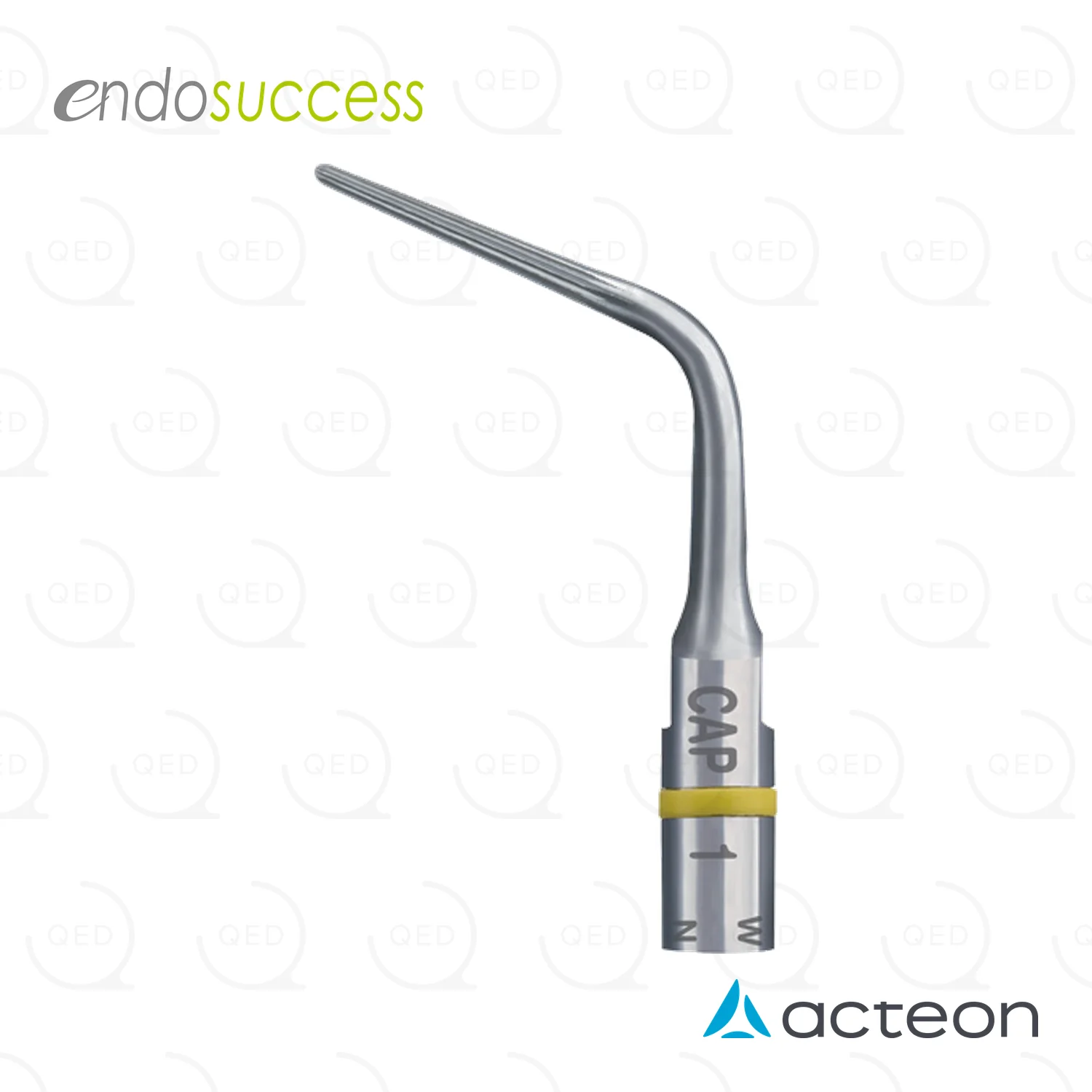
acteon endo success™ · cap2 · canal access preparation
canal access preparationultrasonic tipnewtron®
probing the floor. cap2 is the second canal access preparation tip. acteon’s tip sheet describes a “micro-blade tip for canal probing, the location of calcified canals, cleaning the pulp chamber floor and the opening of mesial canals”; their brochure names locating mb2 and removing dentine bridges by a sweeping method.
this pack: 1 × acteon endo success™ cap2 ultrasonic tip · ref f88182
made by satelec, a company of the acteon group, mérignac, france
| acteon reference | cap2 |
| geometry | 9 mm micro-blade, 5% taper |
| material | micro-blade (striated) steel |
| indication | endodontic cavity access preparation (acteon tip sheet) |
| power setting | 10 on a newtron® generator, per acteon’s tip sheet · the colour ring on the tip matches the power zone (colour coding system™) |
| classification | class iia medical device |
| also in | endo success™ cap kit |
› clean, disinfect and sterilise before each use, following acteon’s cleaning, disinfection and sterilisation instructions for tips (j02001).
› replace at least once a year. acteon: because a maximum number of uses cannot be set, tips in routine use should be “replaced at least once a year”, and sooner if the tip no longer vibrates as expected or treatment slows.
› watch the site for heat. acteon’s tip sheets state that the practitioner has to continually monitor the clinical site to immediately identify any heating risk.
which generator does it fit?
acteon’s tip sheet gives settings for the newtron® range, including the p5 xs b.led and booster. acteon advise against using their tips on other makers’ handpieces, and other makers’ tips on theirs.
what temperature can i sterilise at?
acteon (satelec) have certified that endo success cap and apical surgery tips can be sterilised with prevacuum steam at 137°c/138°c (attestation, september 2016). follow the cleaning instructions first.
| the other cap tips | cap1 · cap3 |
| the kit | endo success™ cap kit |
| diamond alternatives | et18d · etbd |
| generators | newtron® p5 xs b.led · newtron® booster |
| tools | acteon universal wrench · autoclavable tip stand |
acteon endo success™ cap2 · 9 mm micro-blade, 5% taper · canal access preparation · newtron® power 10 · satelec / acteon · ref f88182

acteon endo success™ · cap3 · canal access preparation
canal access preparationultrasonic tipnewtron®
the sharpest of the three. cap3 is the third canal access preparation tip. the tip sheet describes a “micro-blade tip for canal entrance location and canal opening, removal of calcifications or dentinal tissue and loosening of fibre posts”. acteon note in their brochure that, because of its very sharp point, it must be handled with care, with visual aids recommended.
this pack: 1 × acteon endo success™ cap3 ultrasonic tip · ref f88183
made by satelec, a company of the acteon group, mérignac, france
| acteon reference | cap3 |
| geometry | 8 mm micro-blade, 6% taper (acteon brochure) |
| material | micro-blade (striated) steel |
| indication | endodontic cavity access preparation (acteon tip sheet) |
| power setting | 10 on a newtron® generator, per acteon’s tip sheet · the colour ring on the tip matches the power zone (colour coding system™) |
| classification | class iia medical device |
| also in | endo success™ cap kit |
› clean, disinfect and sterilise before each use, following acteon’s cleaning, disinfection and sterilisation instructions for tips (j02001).
› replace at least once a year. acteon: because a maximum number of uses cannot be set, tips in routine use should be “replaced at least once a year”, and sooner if the tip no longer vibrates as expected or treatment slows.
› watch the site for heat. acteon’s tip sheets state that the practitioner has to continually monitor the clinical site to immediately identify any heating risk.
which generator does it fit?
acteon’s tip sheet gives settings for the newtron® range, including the p5 xs b.led and booster. acteon advise against using their tips on other makers’ handpieces, and other makers’ tips on theirs.
what temperature can i sterilise at?
acteon (satelec) have certified that endo success cap and apical surgery tips can be sterilised with prevacuum steam at 137°c/138°c (attestation, september 2016). follow the cleaning instructions first.
| the other cap tips | cap1 · cap2 |
| the kit | endo success™ cap kit |
| diamond alternatives | et18d · etbd |
| generators | newtron® p5 xs b.led · newtron® booster |
| tools | acteon universal wrench · autoclavable tip stand |
acteon endo success™ cap3 · 8 mm micro-blade, 6% taper (acteon brochure) · canal access preparation · newtron® power 10 · satelec / acteon · ref f88183
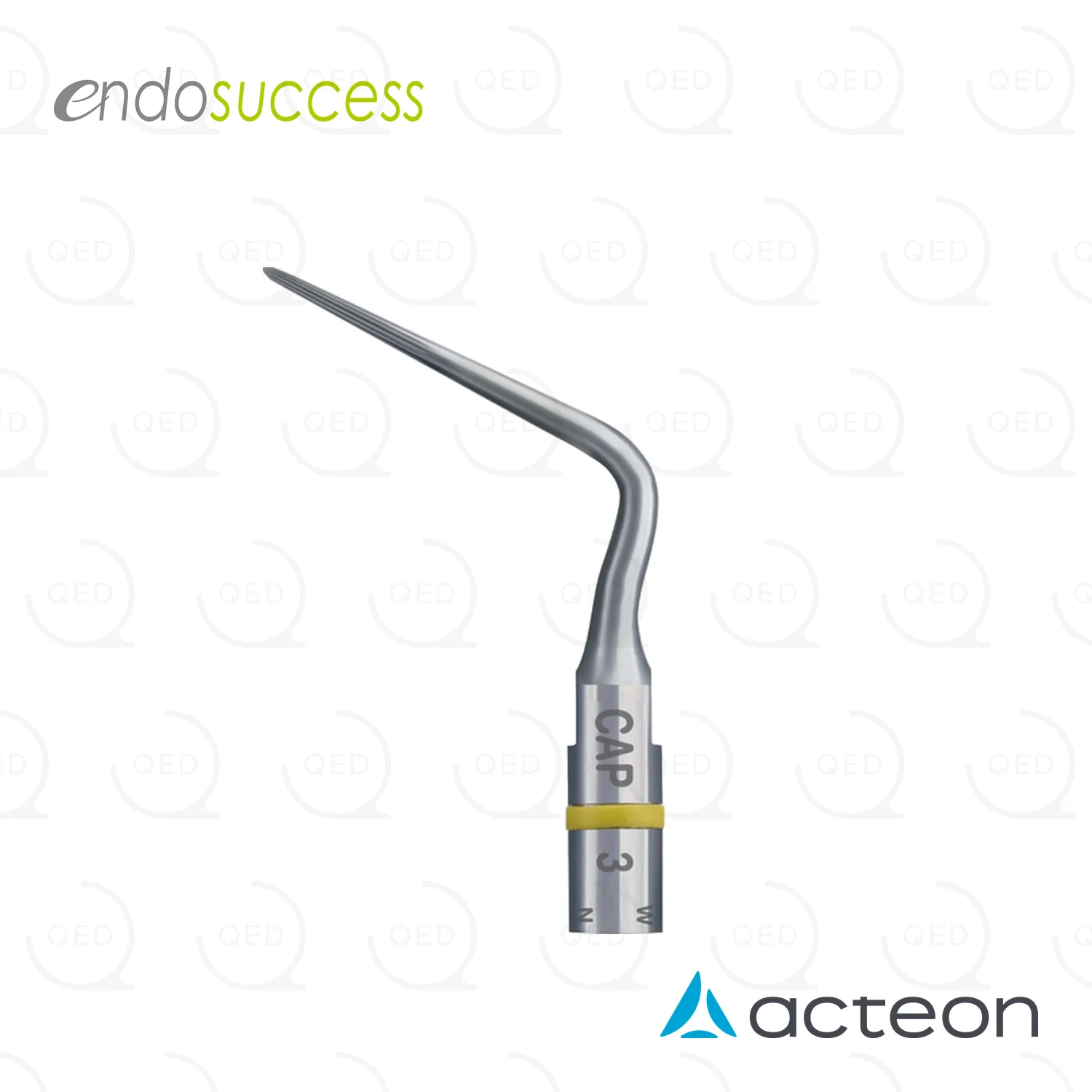

ultravision fs · no. 3, ø 20 mm · pack of 12
how many of your mirrors are scratched, dulled or quietly two generations old? most surgeries buy mirrors one at a time and end up with a drawer of unequal ones. the no. 3 at ø 20 mm is the size that suits a smaller mouth or a tighter posterior approach without dropping all the way to a paediatric head, and twelve is enough to restock every set at once and retire the rest.
this pack: 12 × hahnenkratt ultravision mouth mirrors, no. 3, ø 20 mm, ss thread · mirror cones only, handles sold separately
made by e. hahnenkratt gmbh, germany · mfr code 533x3
| ø 20 mm, size 3 | one step down from the routine no. 4. useful in smaller mouths and where the cheek will not give you the room you wanted |
| 113% reflection | hahnenkratt's figure for the ultra coating, measured against aluminium – up to 25% brighter than their fs rhodium, from 36 layer packages |
| true colour | hahnenkratt claim natural colour accuracy and a 1:1 image with no distortion – the point being that shade and tissue look like themselves in the mirror |
| 12 per pack | a full restock rather than a replacement. cones unscrew, so handles you already own carry straight over |
› standardise the drawer – twelve identical heads means the mirror in your hand behaves the same way in every set.
› handles to match – ergoform peek at ten pounds is the sensible way to build twelve complete mirrors.
› working under the scope? the polished cone can catch the light. black ultraretract and the blackline handle are the matt-finished answer to that.
› made in germany – hahnenkratt's own description of the whole range.
no. 3 or no. 4?
no. 4 at ø 22 mm shows you more and is what most clinicians default to. no. 3 buys you two millimetres of clearance, which matters more often than it sounds – a small mouth, a heavy cheek, a patient who cannot open wide. plenty of practices stock both: no. 4 is here.
do i need new handles as well?
only if you do not already run ss thread. these are standard simple-stem cones and screw onto any ss handle hahnenkratt make.
is there a one-piece version?
yes – relax fs ultra is moulded as a single piece with nothing to unscrew, if the decontamination lead would rather not have a joint at all.
hahnenkratt ultravision fs · no. 3 · ø 20 mm · front surface · ultra coating · ss thread · cones only · 12 per pack · germany · mfr code 533x3 · also in no. 0 and no. 4

obtura spartan · kis® microsurgical tips
a root-end preparation has to follow the long axis of the canal, in a crypt you are viewing through a microscope. the kis® 1d is obtura spartan's general-purpose microsurgical tip for anterior and posterior teeth alike: angled 80° at the working end, 0.5mm across with a 3.0mm cutting surface, and diamond coated.
this pack: obtura spartan kis® 1d microsurgical ultrasonic tip, 0.5mm diameter, 3.0mm cutting surface · single tip · diamond coated · supplied non-sterile
› working end: 0.5mm diameter, 3.0mm cutting surface, angled 80°. improved irrigation port.
› coating: diamond coated. obtura spartan state the coating reduces the risk of microfractures while allowing better adaptation of filling materials
› thread: m3 x 0.6 – the standard kis® thread
› intensity: medium to high – obtura spartan's guidance for every kis® tip, with new users starting low to medium
› general purpose, anterior and posterior areas
› angled 80° at the working end
› obtura spartan describe it as slightly longer than other microsurgical instruments, for better access
supplied non-sterile. reprocessing is validated to iso 17664-1 and iso 17665-1: pre-clean in a ph-neutral ultrasonic solution, dry, then prevacuum steam at 132°c for 4 minutes.
will it fit my ultrasonic unit? obtura spartan make the range for scalers using m3 x 0.6 threading, and offer every tip again as the e series with m3 x 0.5. this one is m3 x 0.6. check your unit's manual first – they warn that forcing a tip with the wrong thread damages the device. the tip wrench seats it properly.
how long does a tip last? obtura spartan state the tips were tested to 250 reprocessing cycles to iso 18397 without loss of performance or corrosion – but end of life is set by wear in use as well, so inspect each tip during cleaning and retire damaged ones. they also ask for very light pressure: small-diameter tips are subject to breakage at any time.
| fitting and storage | wrench for spartan tips · spartan tip stand |
| root-end filling materials | neoputty® 0.5g · neomta® 2 1.0g kit · vista apex mta carriers 0.80mm |
| non-surgical tips | buc® 1 the cutter · cpr® 1 the mover |
| rest of the range | kis® 2d · kis® 3d · kis® 4d |
diamond coated · microsurgical · m3 x 0.6 · autoclavable 132°c · ref kis-1
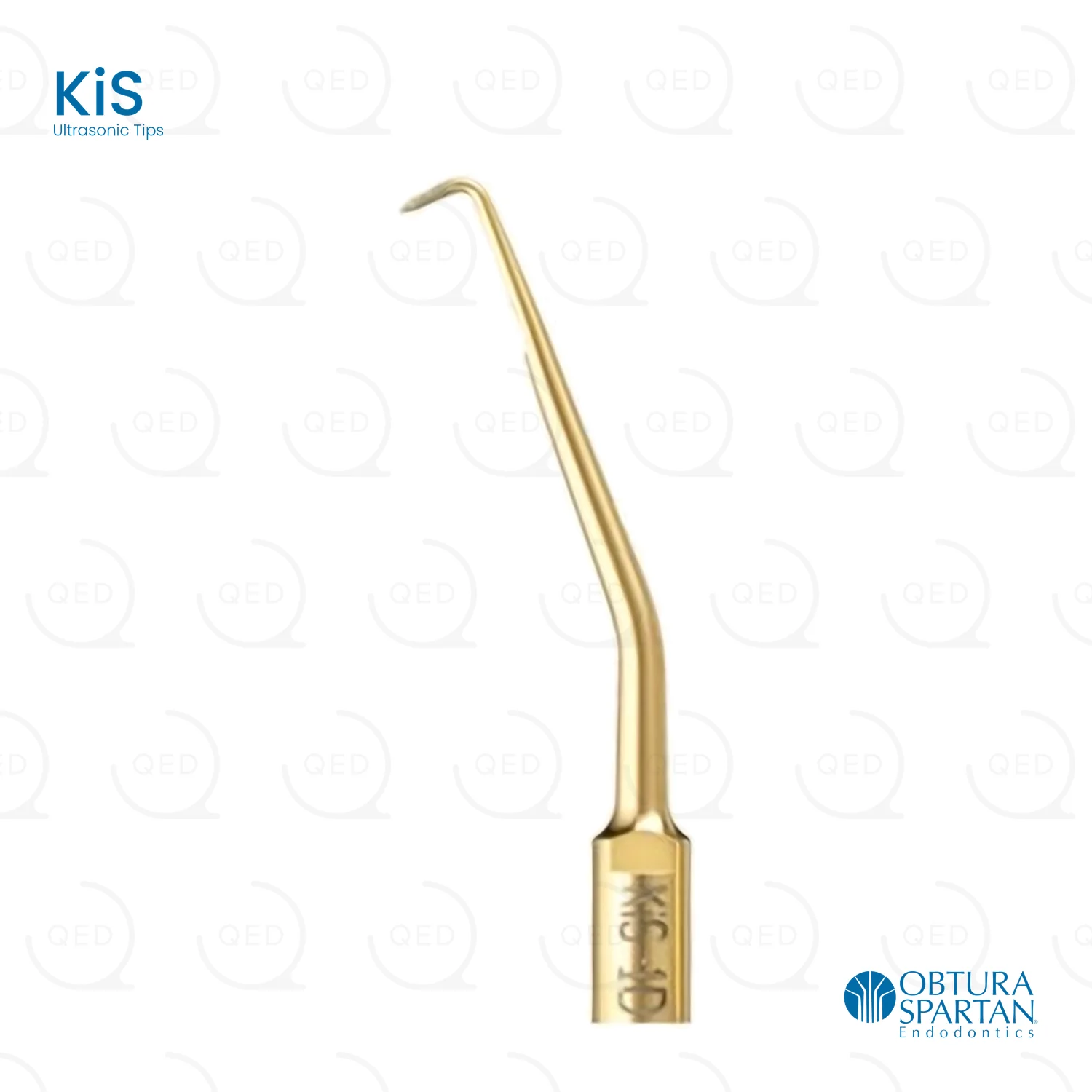
obtura spartan · kis® microsurgical tips, ems
a root-end preparation has to follow the long axis of the canal, in a crypt you are viewing through a microscope. the kis® 1d is obtura spartan's general-purpose microsurgical tip for anterior and posterior teeth alike: angled 80° at the working end, 0.5mm across with a 3.0mm cutting surface, and diamond coated. this is the ems version: the same instrument cut with the m3 x 0.5 thread, which fits an ems-threaded scaler.
this pack: obtura spartan kis® 1d ems microsurgical ultrasonic tip, 0.5mm diameter, 3.0mm cutting surface · single tip · diamond coated · supplied non-sterile
› working end: 0.5mm diameter, 3.0mm cutting surface, angled 80°. improved irrigation port.
› coating: diamond coated. obtura spartan state the coating reduces the risk of microfractures while allowing better adaptation of filling materials
› thread: m3 x 0.5 – fits an ems-threaded scaler
› intensity: medium to high – obtura spartan's guidance for every kis® tip, with new users starting low to medium
› general purpose, anterior and posterior areas
› angled 80° at the working end
› obtura spartan describe it as slightly longer than other microsurgical instruments, for better access
supplied non-sterile. reprocessing is validated to iso 17664-1 and iso 17665-1: pre-clean in a ph-neutral ultrasonic solution, dry, then prevacuum steam at 132°c for 4 minutes.
will it fit my ultrasonic unit? obtura spartan make the range for scalers using m3 x 0.6 threading, and offer every tip again as the e series with m3 x 0.5. this one is m3 x 0.5. check your unit's manual first – they warn that forcing a tip with the wrong thread damages the device. the tip wrench seats it properly.
how long does a tip last? obtura spartan state the tips were tested to 250 reprocessing cycles to iso 18397 without loss of performance or corrosion – but end of life is set by wear in use as well, so inspect each tip during cleaning and retire damaged ones. they also ask for very light pressure: small-diameter tips are subject to breakage at any time.
| fitting and storage | wrench for spartan tips · spartan tip stand |
| root-end filling materials | neoputty® 0.5g · neomta® 2 1.0g kit · vista apex mta carriers 0.80mm |
| non-surgical tips | buc® 1 the cutter · cpr® 1 the mover |
| rest of the range | kis® 2d ems · kis® 3d ems · kis® 4d ems |
diamond coated · microsurgical · m3 x 0.5 · autoclavable 132°c · ref kis-1e
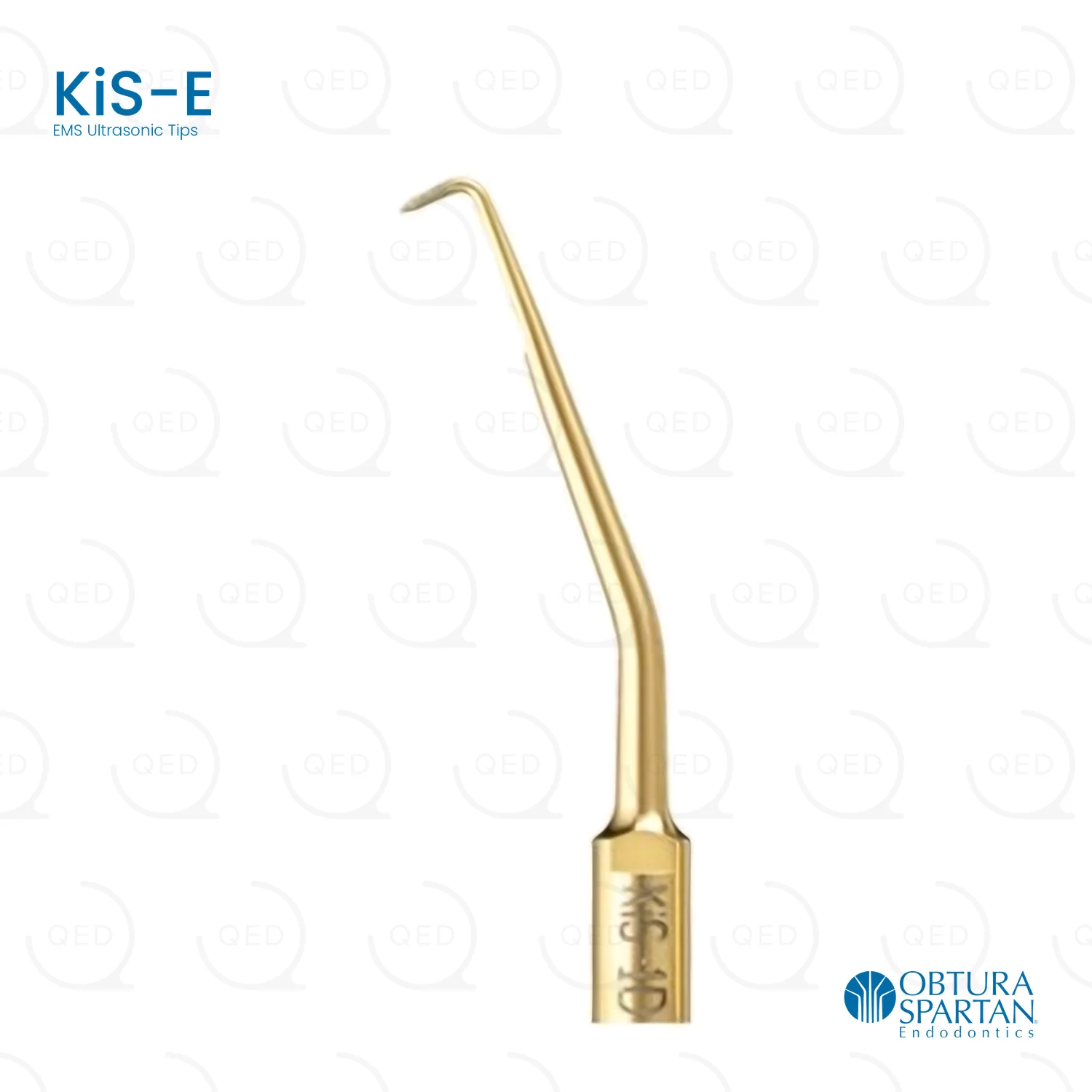
obtura spartan · kis® microsurgical tips
a 0.5mm tip is the wrong instrument in a wide root end. the kis® 2d is the same general-purpose microsurgical design as the kis® 1d at 0.7mm across, which obtura spartan built to access larger diameter roots. same 80° working end, same 3.0mm cutting surface, diamond coated.
this pack: obtura spartan kis® 2d microsurgical ultrasonic tip, 0.7mm diameter, 3.0mm cutting surface · single tip · diamond coated · supplied non-sterile
› working end: 0.7mm diameter, 3.0mm cutting surface, angled 80°. improved irrigation port.
› coating: diamond coated. obtura spartan state the coating reduces the risk of microfractures while allowing better adaptation of filling materials
› thread: m3 x 0.6 – the standard kis® thread
› intensity: medium to high – obtura spartan's guidance for every kis® tip, with new users starting low to medium
› general purpose, for larger diameter roots
› angled 80° at the working end
› obtura spartan describe it as slightly longer than other microsurgical instruments, for better access
supplied non-sterile. reprocessing is validated to iso 17664-1 and iso 17665-1: pre-clean in a ph-neutral ultrasonic solution, dry, then prevacuum steam at 132°c for 4 minutes.
will it fit my ultrasonic unit? obtura spartan make the range for scalers using m3 x 0.6 threading, and offer every tip again as the e series with m3 x 0.5. this one is m3 x 0.6. check your unit's manual first – they warn that forcing a tip with the wrong thread damages the device. the tip wrench seats it properly.
how long does a tip last? obtura spartan state the tips were tested to 250 reprocessing cycles to iso 18397 without loss of performance or corrosion – but end of life is set by wear in use as well, so inspect each tip during cleaning and retire damaged ones. they also ask for very light pressure: small-diameter tips are subject to breakage at any time.
| fitting and storage | wrench for spartan tips · spartan tip stand |
| root-end filling materials | neoputty® 0.5g · neomta® 2 1.0g kit · vista apex mta carriers 0.80mm |
| non-surgical tips | buc® 1 the cutter · cpr® 1 the mover |
| rest of the range | kis® 1d · kis® 3d · kis® 4d |
diamond coated · microsurgical · m3 x 0.6 · autoclavable 132°c · ref kis-2

obtura spartan · kis® microsurgical tips, ems
a 0.5mm tip is the wrong instrument in a wide root end. the kis® 2d is the same general-purpose microsurgical design as the kis® 1d at 0.7mm across, which obtura spartan built to access larger diameter roots. same 80° working end, same 3.0mm cutting surface, diamond coated. this is the ems version: the same instrument cut with the m3 x 0.5 thread, which fits an ems-threaded scaler.
this pack: obtura spartan kis® 2d ems microsurgical ultrasonic tip, 0.7mm diameter, 3.0mm cutting surface · single tip · diamond coated · supplied non-sterile
› working end: 0.7mm diameter, 3.0mm cutting surface, angled 80°. improved irrigation port.
› coating: diamond coated. obtura spartan state the coating reduces the risk of microfractures while allowing better adaptation of filling materials
› thread: m3 x 0.5 – fits an ems-threaded scaler
› intensity: medium to high – obtura spartan's guidance for every kis® tip, with new users starting low to medium
› general purpose, for larger diameter roots
› angled 80° at the working end
› obtura spartan describe it as slightly longer than other microsurgical instruments, for better access
supplied non-sterile. reprocessing is validated to iso 17664-1 and iso 17665-1: pre-clean in a ph-neutral ultrasonic solution, dry, then prevacuum steam at 132°c for 4 minutes.
will it fit my ultrasonic unit? obtura spartan make the range for scalers using m3 x 0.6 threading, and offer every tip again as the e series with m3 x 0.5. this one is m3 x 0.5. check your unit's manual first – they warn that forcing a tip with the wrong thread damages the device. the tip wrench seats it properly.
how long does a tip last? obtura spartan state the tips were tested to 250 reprocessing cycles to iso 18397 without loss of performance or corrosion – but end of life is set by wear in use as well, so inspect each tip during cleaning and retire damaged ones. they also ask for very light pressure: small-diameter tips are subject to breakage at any time.
| fitting and storage | wrench for spartan tips · spartan tip stand |
| root-end filling materials | neoputty® 0.5g · neomta® 2 1.0g kit · vista apex mta carriers 0.80mm |
| non-surgical tips | buc® 1 the cutter · cpr® 1 the mover |
| rest of the range | kis® 1d ems · kis® 3d ems · kis® 4d ems |
diamond coated · microsurgical · m3 x 0.5 · autoclavable 132°c · ref kis-2e
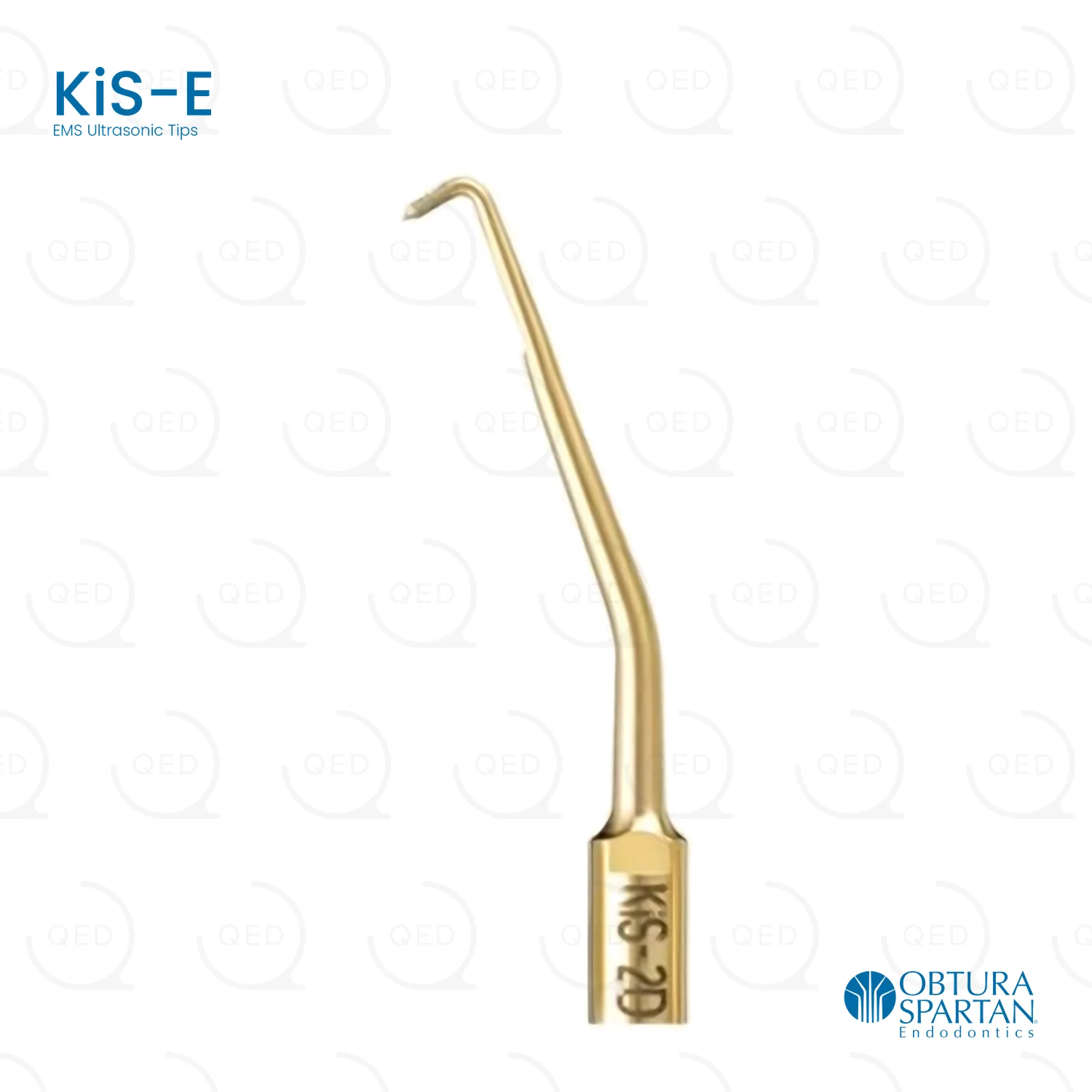
obtura spartan · kis® microsurgical tips
a straight tip cannot reach a buccal root end from a buccal window. the kis® 3d is double angled at 75° for the buccal root of the mandibular right molar and the mesiobuccal of the maxillary left molar, in obtura spartan's own words. 0.5mm across, 3.0mm cutting surface, diamond coated.
this pack: obtura spartan kis® 3d microsurgical ultrasonic tip, 0.5mm diameter, 3.0mm cutting surface · single tip · diamond coated · supplied non-sterile
› working end: 0.5mm diameter, 3.0mm cutting surface, angled 75° and double angled. water ports.
› coating: diamond coated. obtura spartan state the coating reduces the risk of microfractures while allowing better adaptation of filling materials
› thread: m3 x 0.6 – the standard kis® thread
› intensity: medium to high – obtura spartan's guidance for every kis® tip, with new users starting low to medium
› buccal root of the mandibular right molar
› mesiobuccal of the maxillary left molar
› double angled at 75°, with water ports
supplied non-sterile. reprocessing is validated to iso 17664-1 and iso 17665-1: pre-clean in a ph-neutral ultrasonic solution, dry, then prevacuum steam at 132°c for 4 minutes.
will it fit my ultrasonic unit? obtura spartan make the range for scalers using m3 x 0.6 threading, and offer every tip again as the e series with m3 x 0.5. this one is m3 x 0.6. check your unit's manual first – they warn that forcing a tip with the wrong thread damages the device. the tip wrench seats it properly.
how long does a tip last? obtura spartan state the tips were tested to 250 reprocessing cycles to iso 18397 without loss of performance or corrosion – but end of life is set by wear in use as well, so inspect each tip during cleaning and retire damaged ones. they also ask for very light pressure: small-diameter tips are subject to breakage at any time.
do i need the matching tip for the other side? the kis® 3d and its mirror image are a pair – obtura spartan design each for named roots on one side of the arch. practices doing routine apical surgery usually hold both.
| fitting and storage | wrench for spartan tips · spartan tip stand |
| root-end filling materials | neoputty® 0.5g · neomta® 2 1.0g kit · vista apex mta carriers 0.80mm |
| non-surgical tips | buc® 1 the cutter · cpr® 1 the mover |
| rest of the range | kis® 5d · kis® 1d · kis® 2d |
diamond coated · microsurgical · m3 x 0.6 · autoclavable 132°c · ref kis-3
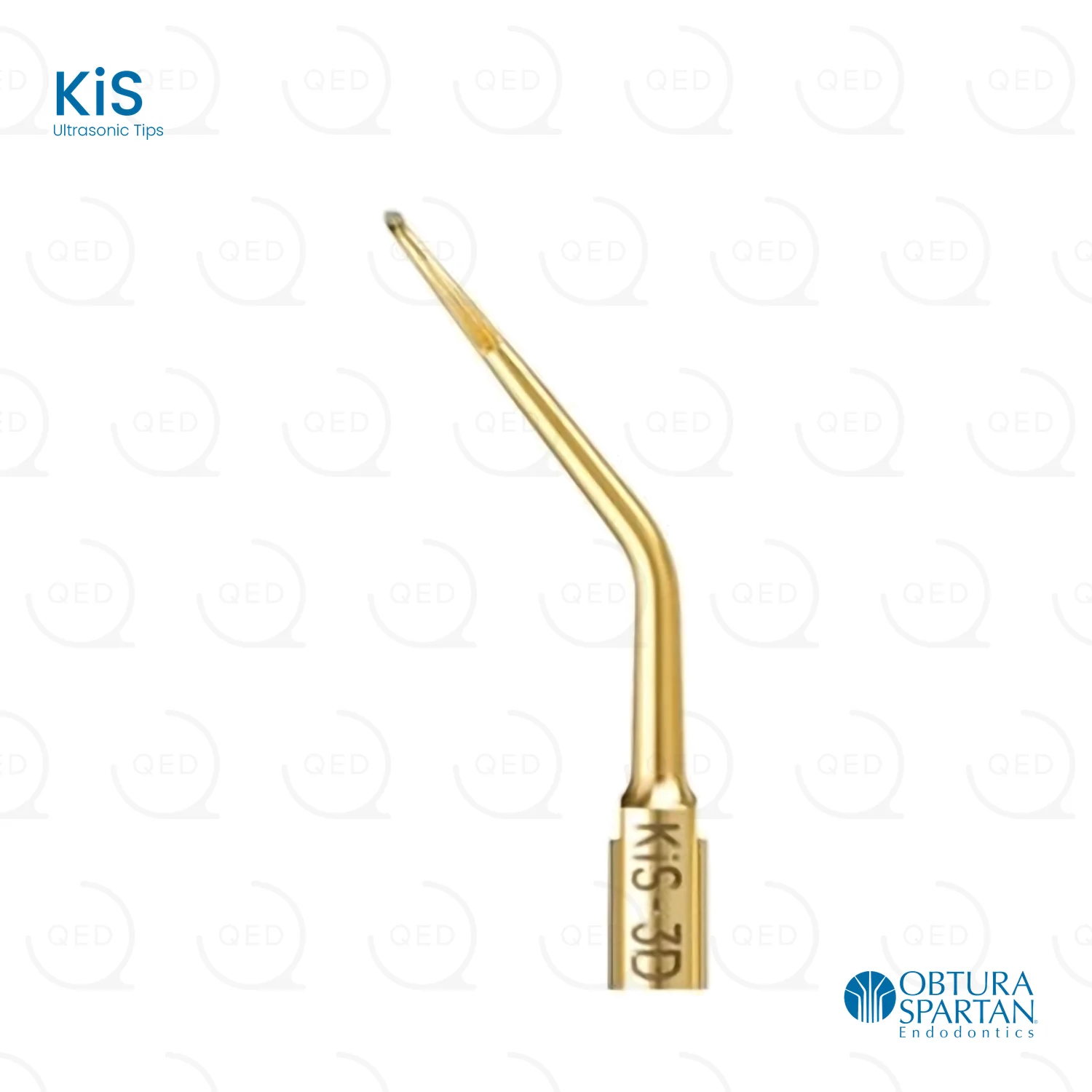
obtura spartan · kis® microsurgical tips, ems
a straight tip cannot reach a buccal root end from a buccal window. the kis® 3d is double angled at 75° for the buccal root of the mandibular right molar and the mesiobuccal of the maxillary left molar, in obtura spartan's own words. 0.5mm across, 3.0mm cutting surface, diamond coated. this is the ems version: the same instrument cut with the m3 x 0.5 thread, which fits an ems-threaded scaler.
this pack: obtura spartan kis® 3d ems microsurgical ultrasonic tip, 0.5mm diameter, 3.0mm cutting surface · single tip · diamond coated · supplied non-sterile
› working end: 0.5mm diameter, 3.0mm cutting surface, angled 75° and double angled. water ports.
› coating: diamond coated. obtura spartan state the coating reduces the risk of microfractures while allowing better adaptation of filling materials
› thread: m3 x 0.5 – fits an ems-threaded scaler
› intensity: medium to high – obtura spartan's guidance for every kis® tip, with new users starting low to medium
› buccal root of the mandibular right molar
› mesiobuccal of the maxillary left molar
› double angled at 75°, with water ports
supplied non-sterile. reprocessing is validated to iso 17664-1 and iso 17665-1: pre-clean in a ph-neutral ultrasonic solution, dry, then prevacuum steam at 132°c for 4 minutes.
will it fit my ultrasonic unit? obtura spartan make the range for scalers using m3 x 0.6 threading, and offer every tip again as the e series with m3 x 0.5. this one is m3 x 0.5. check your unit's manual first – they warn that forcing a tip with the wrong thread damages the device. the tip wrench seats it properly.
how long does a tip last? obtura spartan state the tips were tested to 250 reprocessing cycles to iso 18397 without loss of performance or corrosion – but end of life is set by wear in use as well, so inspect each tip during cleaning and retire damaged ones. they also ask for very light pressure: small-diameter tips are subject to breakage at any time.
do i need the matching tip for the other side? the kis® 3d ems and its mirror image are a pair – obtura spartan design each for named roots on one side of the arch. practices doing routine apical surgery usually hold both.
| fitting and storage | wrench for spartan tips · spartan tip stand |
| root-end filling materials | neoputty® 0.5g · neomta® 2 1.0g kit · vista apex mta carriers 0.80mm |
| non-surgical tips | buc® 1 the cutter · cpr® 1 the mover |
| rest of the range | kis® 5d ems · kis® 1d ems · kis® 2d ems |
diamond coated · microsurgical · m3 x 0.5 · autoclavable 132°c · ref kis-3e
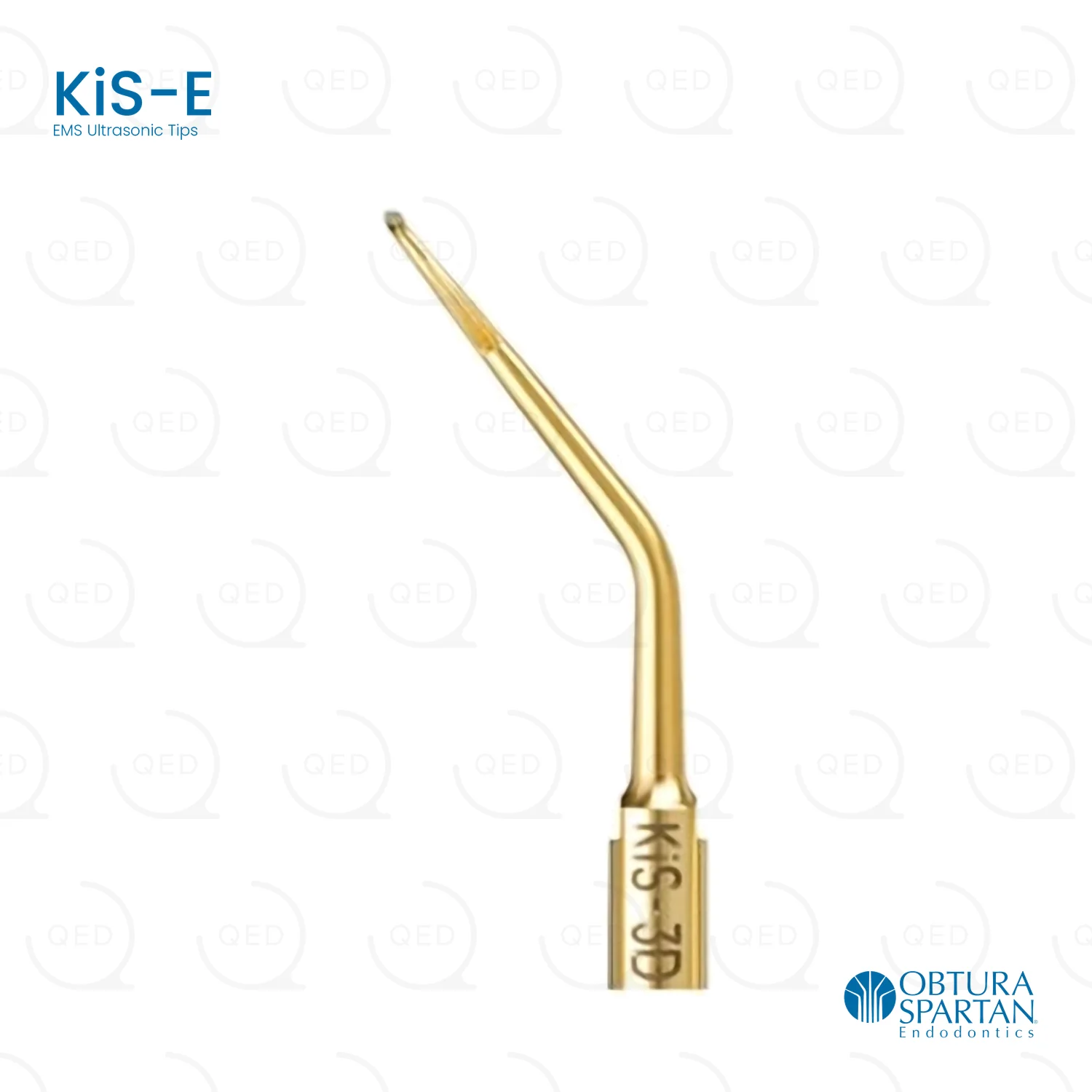
obtura spartan · kis® microsurgical tips
a lingual root end sits behind the buccal plate you cut through to see it. the kis® 4d is double angled at 110° for the lingual root of the mandibular left molar and the distobuccal of the maxillary right molar, as obtura spartan set it out. 0.5mm across, 3.0mm cutting surface, diamond coated.
this pack: obtura spartan kis® 4d microsurgical ultrasonic tip, 0.5mm diameter, 3.0mm cutting surface · single tip · diamond coated · supplied non-sterile
› working end: 0.5mm diameter, 3.0mm cutting surface, angled 110° and double angled. water ports.
› coating: diamond coated. obtura spartan state the coating reduces the risk of microfractures while allowing better adaptation of filling materials
› thread: m3 x 0.6 – the standard kis® thread
› intensity: medium to high – obtura spartan's guidance for every kis® tip, with new users starting low to medium
› lingual root of the mandibular left molar
› distobuccal of the maxillary right molar
› double angled at 110°, with water ports
supplied non-sterile. reprocessing is validated to iso 17664-1 and iso 17665-1: pre-clean in a ph-neutral ultrasonic solution, dry, then prevacuum steam at 132°c for 4 minutes.
will it fit my ultrasonic unit? obtura spartan make the range for scalers using m3 x 0.6 threading, and offer every tip again as the e series with m3 x 0.5. this one is m3 x 0.6. check your unit's manual first – they warn that forcing a tip with the wrong thread damages the device. the tip wrench seats it properly.
how long does a tip last? obtura spartan state the tips were tested to 250 reprocessing cycles to iso 18397 without loss of performance or corrosion – but end of life is set by wear in use as well, so inspect each tip during cleaning and retire damaged ones. they also ask for very light pressure: small-diameter tips are subject to breakage at any time.
do i need the matching tip for the other side? the kis® 4d and its mirror image are a pair – obtura spartan design each for named roots on one side of the arch. practices doing routine apical surgery usually hold both.
| fitting and storage | wrench for spartan tips · spartan tip stand |
| root-end filling materials | neoputty® 0.5g · neomta® 2 1.0g kit · vista apex mta carriers 0.80mm |
| non-surgical tips | buc® 1 the cutter · cpr® 1 the mover |
| rest of the range | kis® 6d · kis® 1d · kis® 2d |
diamond coated · microsurgical · m3 x 0.6 · autoclavable 132°c · ref kis-4
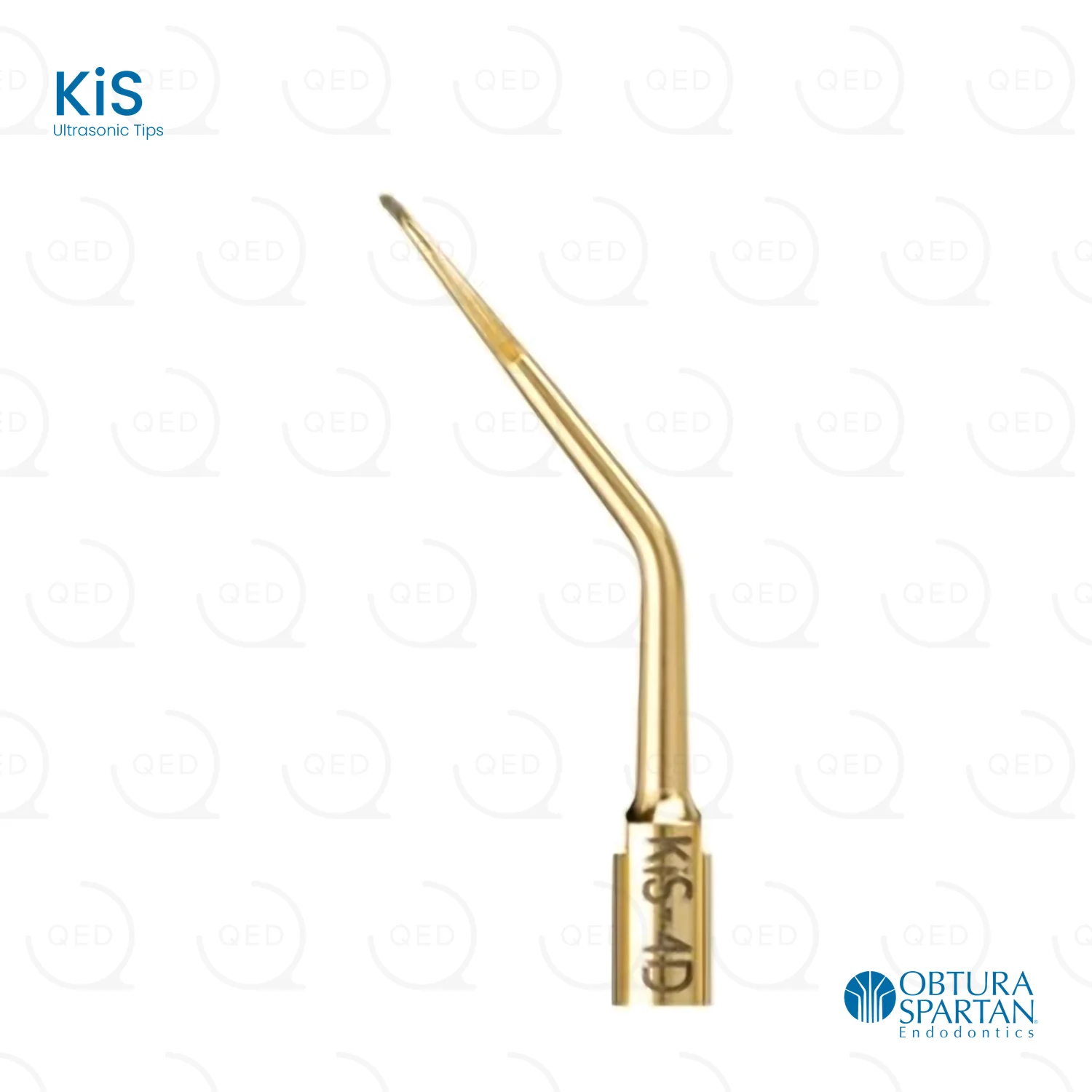
obtura spartan · kis® microsurgical tips, ems
a lingual root end sits behind the buccal plate you cut through to see it. the kis® 4d is double angled at 110° for the lingual root of the mandibular left molar and the distobuccal of the maxillary right molar, as obtura spartan set it out. 0.5mm across, 3.0mm cutting surface, diamond coated. this is the ems version: the same instrument cut with the m3 x 0.5 thread, which fits an ems-threaded scaler.
this pack: obtura spartan kis® 4d ems microsurgical ultrasonic tip, 0.5mm diameter, 3.0mm cutting surface · single tip · diamond coated · supplied non-sterile
› working end: 0.5mm diameter, 3.0mm cutting surface, angled 110° and double angled. water ports.
› coating: diamond coated. obtura spartan state the coating reduces the risk of microfractures while allowing better adaptation of filling materials
› thread: m3 x 0.5 – fits an ems-threaded scaler
› intensity: medium to high – obtura spartan's guidance for every kis® tip, with new users starting low to medium
› lingual root of the mandibular left molar
› distobuccal of the maxillary right molar
› double angled at 110°, with water ports
supplied non-sterile. reprocessing is validated to iso 17664-1 and iso 17665-1: pre-clean in a ph-neutral ultrasonic solution, dry, then prevacuum steam at 132°c for 4 minutes.
will it fit my ultrasonic unit? obtura spartan make the range for scalers using m3 x 0.6 threading, and offer every tip again as the e series with m3 x 0.5. this one is m3 x 0.5. check your unit's manual first – they warn that forcing a tip with the wrong thread damages the device. the tip wrench seats it properly.
how long does a tip last? obtura spartan state the tips were tested to 250 reprocessing cycles to iso 18397 without loss of performance or corrosion – but end of life is set by wear in use as well, so inspect each tip during cleaning and retire damaged ones. they also ask for very light pressure: small-diameter tips are subject to breakage at any time.
do i need the matching tip for the other side? the kis® 4d ems and its mirror image are a pair – obtura spartan design each for named roots on one side of the arch. practices doing routine apical surgery usually hold both.
| fitting and storage | wrench for spartan tips · spartan tip stand |
| root-end filling materials | neoputty® 0.5g · neomta® 2 1.0g kit · vista apex mta carriers 0.80mm |
| non-surgical tips | buc® 1 the cutter · cpr® 1 the mover |
| rest of the range | kis® 6d ems · kis® 1d ems · kis® 2d ems |
diamond coated · microsurgical · m3 x 0.5 · autoclavable 132°c · ref kis-4e
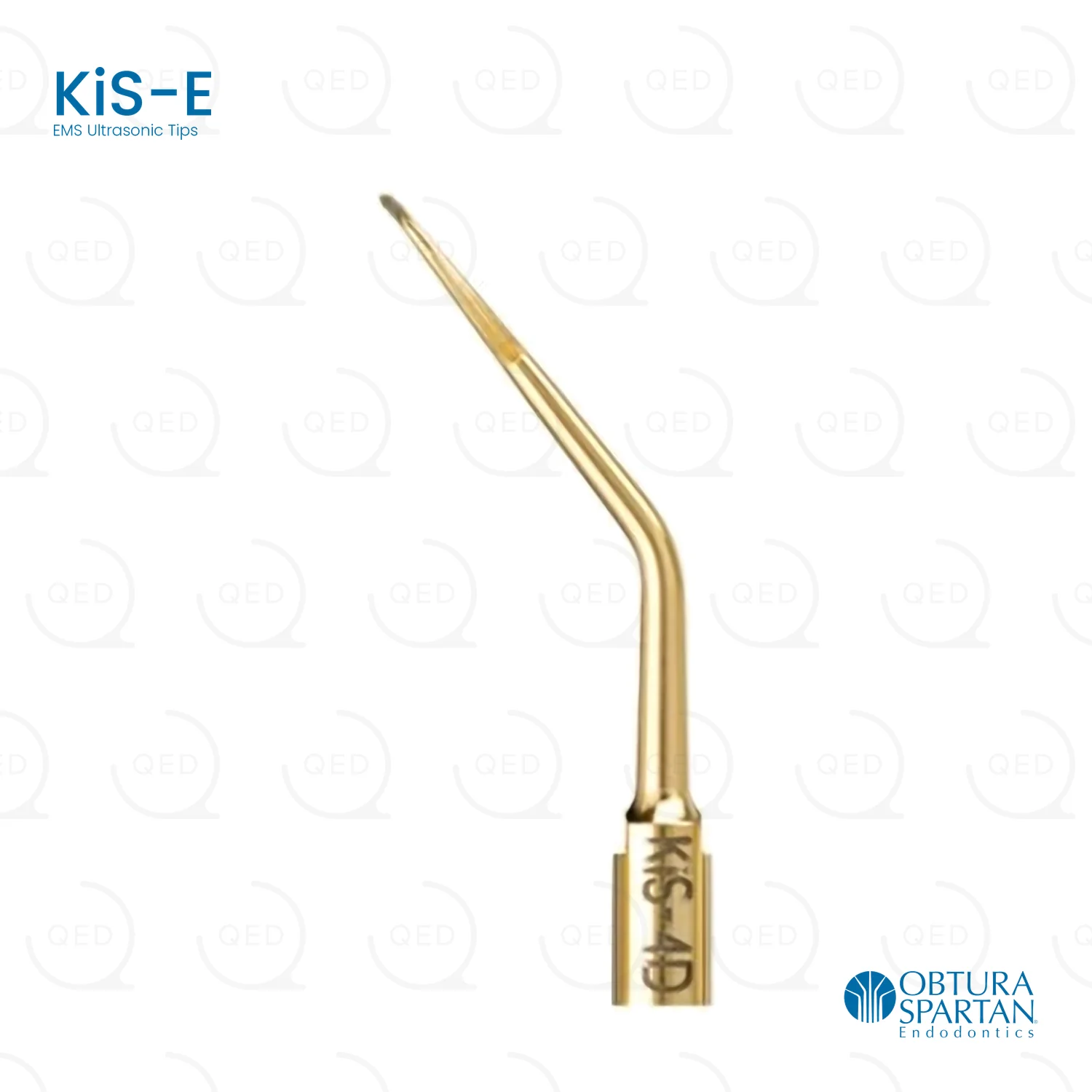
obtura spartan · kis® microsurgical tips
the other side of the mouth needs the other instrument. the kis® 5d is the mirror image of the kis® 3d – obtura spartan's own description – for the buccal root of the mandibular left molar and the mesiobuccal of the maxillary right molar. double angled at 75°, 0.5mm across, 3.0mm cutting surface, diamond coated.
this pack: obtura spartan kis® 5d microsurgical ultrasonic tip, 0.5mm diameter, 3.0mm cutting surface · single tip · diamond coated · supplied non-sterile
› working end: 0.5mm diameter, 3.0mm cutting surface, angled 75° and double angled. water ports.
› coating: diamond coated. obtura spartan state the coating reduces the risk of microfractures while allowing better adaptation of filling materials
› thread: m3 x 0.6 – the standard kis® thread
› intensity: medium to high – obtura spartan's guidance for every kis® tip, with new users starting low to medium
› buccal root of the mandibular left molar
› mesiobuccal of the maxillary right molar
› mirror image of the kis® 3d, double angled at 75°
supplied non-sterile. reprocessing is validated to iso 17664-1 and iso 17665-1: pre-clean in a ph-neutral ultrasonic solution, dry, then prevacuum steam at 132°c for 4 minutes.
will it fit my ultrasonic unit? obtura spartan make the range for scalers using m3 x 0.6 threading, and offer every tip again as the e series with m3 x 0.5. this one is m3 x 0.6. check your unit's manual first – they warn that forcing a tip with the wrong thread damages the device. the tip wrench seats it properly.
how long does a tip last? obtura spartan state the tips were tested to 250 reprocessing cycles to iso 18397 without loss of performance or corrosion – but end of life is set by wear in use as well, so inspect each tip during cleaning and retire damaged ones. they also ask for very light pressure: small-diameter tips are subject to breakage at any time.
do i need the matching tip for the other side? the kis® 5d and its mirror image are a pair – obtura spartan design each for named roots on one side of the arch. practices doing routine apical surgery usually hold both.
| fitting and storage | wrench for spartan tips · spartan tip stand |
| root-end filling materials | neoputty® 0.5g · neomta® 2 1.0g kit · vista apex mta carriers 0.80mm |
| non-surgical tips | buc® 1 the cutter · cpr® 1 the mover |
| rest of the range | kis® 3d · kis® 1d · kis® 2d |
diamond coated · microsurgical · m3 x 0.6 · autoclavable 132°c · ref kis-5
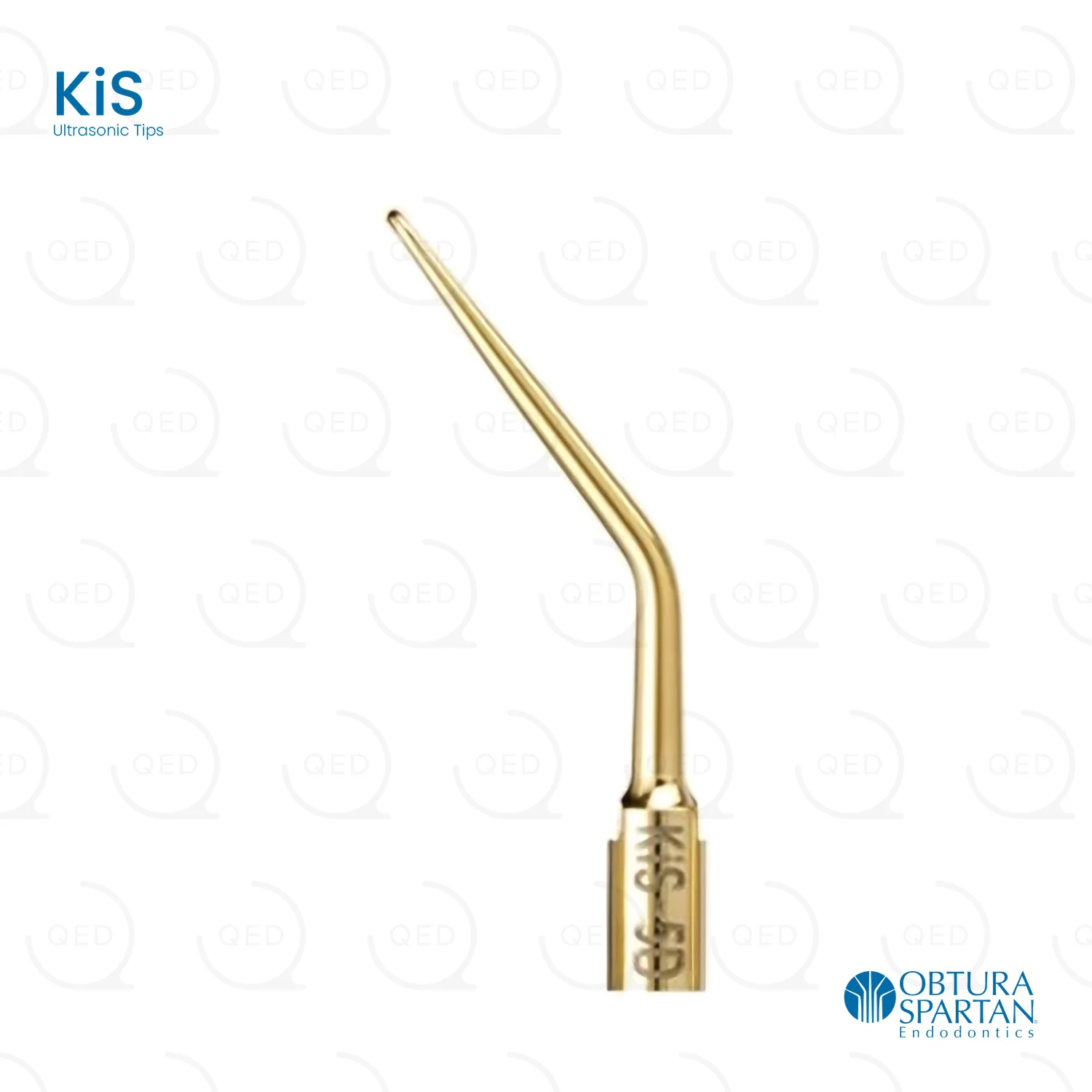
obtura spartan · kis® microsurgical tips, ems
the other side of the mouth needs the other instrument. the kis® 5d is the mirror image of the kis® 3d – obtura spartan's own description – for the buccal root of the mandibular left molar and the mesiobuccal of the maxillary right molar. double angled at 75°, 0.5mm across, 3.0mm cutting surface, diamond coated. this is the ems version: the same instrument cut with the m3 x 0.5 thread, which fits an ems-threaded scaler.
this pack: obtura spartan kis® 5d ems microsurgical ultrasonic tip, 0.5mm diameter, 3.0mm cutting surface · single tip · diamond coated · supplied non-sterile
› working end: 0.5mm diameter, 3.0mm cutting surface, angled 75° and double angled. water ports.
› coating: diamond coated. obtura spartan state the coating reduces the risk of microfractures while allowing better adaptation of filling materials
› thread: m3 x 0.5 – fits an ems-threaded scaler
› intensity: medium to high – obtura spartan's guidance for every kis® tip, with new users starting low to medium
› buccal root of the mandibular left molar
› mesiobuccal of the maxillary right molar
› mirror image of the kis® 3d, double angled at 75°
supplied non-sterile. reprocessing is validated to iso 17664-1 and iso 17665-1: pre-clean in a ph-neutral ultrasonic solution, dry, then prevacuum steam at 132°c for 4 minutes.
will it fit my ultrasonic unit? obtura spartan make the range for scalers using m3 x 0.6 threading, and offer every tip again as the e series with m3 x 0.5. this one is m3 x 0.5. check your unit's manual first – they warn that forcing a tip with the wrong thread damages the device. the tip wrench seats it properly.
how long does a tip last? obtura spartan state the tips were tested to 250 reprocessing cycles to iso 18397 without loss of performance or corrosion – but end of life is set by wear in use as well, so inspect each tip during cleaning and retire damaged ones. they also ask for very light pressure: small-diameter tips are subject to breakage at any time.
do i need the matching tip for the other side? the kis® 5d ems and its mirror image are a pair – obtura spartan design each for named roots on one side of the arch. practices doing routine apical surgery usually hold both.
| fitting and storage | wrench for spartan tips · spartan tip stand |
| root-end filling materials | neoputty® 0.5g · neomta® 2 1.0g kit · vista apex mta carriers 0.80mm |
| non-surgical tips | buc® 1 the cutter · cpr® 1 the mover |
| rest of the range | kis® 3d ems · kis® 1d ems · kis® 2d ems |
diamond coated · microsurgical · m3 x 0.5 · autoclavable 132°c · ref kis-5e
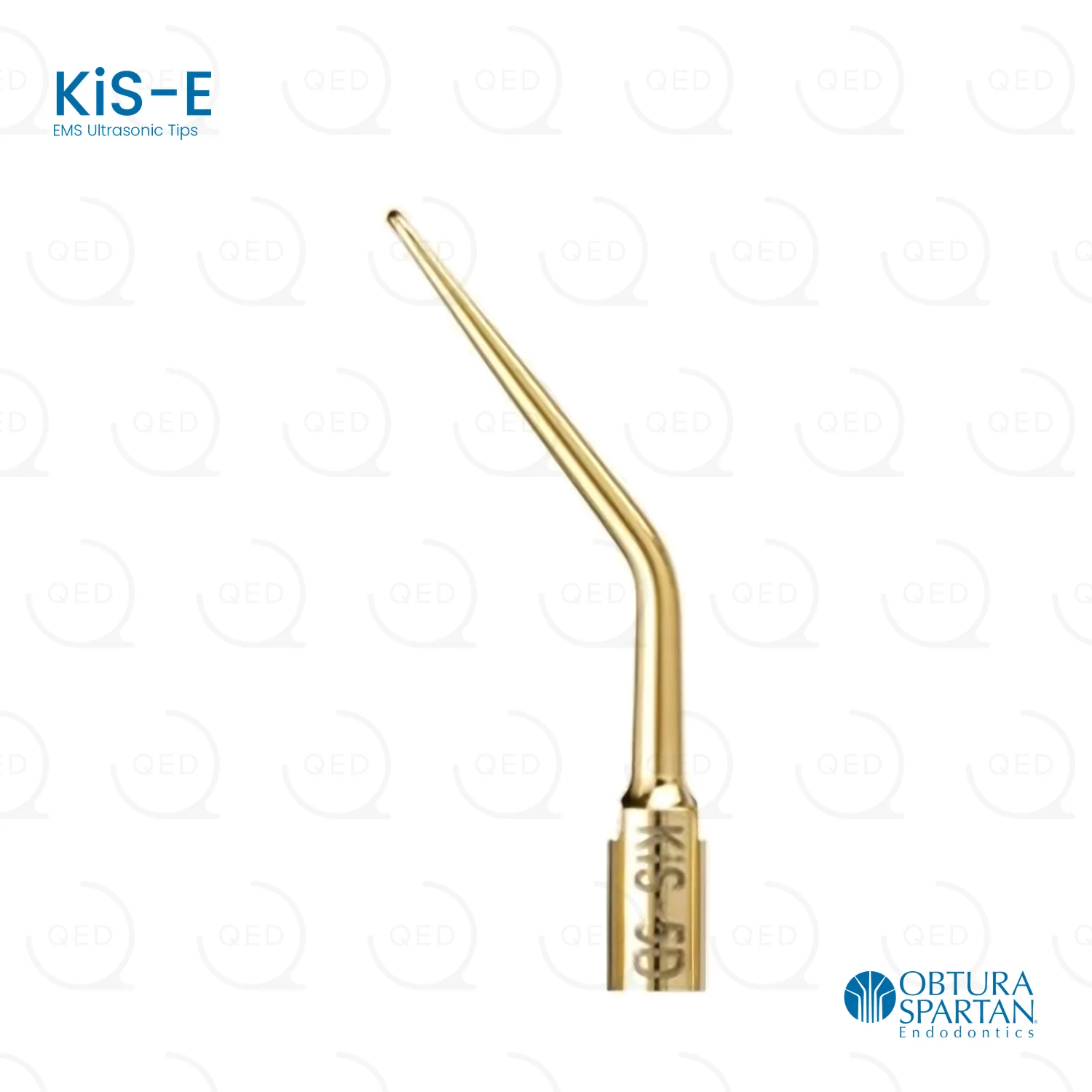
obtura spartan · kis® microsurgical tips
the other side of the mouth needs the other instrument. the kis® 6d is the mirror image of the kis® 4d – obtura spartan's own description – for the lingual root of the mandibular right molar and the distobuccal of the maxillary left molar. double angled at 110°, 0.5mm across, 3.0mm cutting surface, diamond coated.
this pack: obtura spartan kis® 6d microsurgical ultrasonic tip, 0.5mm diameter, 3.0mm cutting surface · single tip · diamond coated · supplied non-sterile
› working end: 0.5mm diameter, 3.0mm cutting surface, angled 110° and double angled. water ports.
› coating: diamond coated. obtura spartan state the coating reduces the risk of microfractures while allowing better adaptation of filling materials
› thread: m3 x 0.6 – the standard kis® thread
› intensity: medium to high – obtura spartan's guidance for every kis® tip, with new users starting low to medium
› lingual root of the mandibular right molar
› distobuccal of the maxillary left molar
› mirror image of the kis® 4d, double angled at 110°
supplied non-sterile. reprocessing is validated to iso 17664-1 and iso 17665-1: pre-clean in a ph-neutral ultrasonic solution, dry, then prevacuum steam at 132°c for 4 minutes.
will it fit my ultrasonic unit? obtura spartan make the range for scalers using m3 x 0.6 threading, and offer every tip again as the e series with m3 x 0.5. this one is m3 x 0.6. check your unit's manual first – they warn that forcing a tip with the wrong thread damages the device. the tip wrench seats it properly.
how long does a tip last? obtura spartan state the tips were tested to 250 reprocessing cycles to iso 18397 without loss of performance or corrosion – but end of life is set by wear in use as well, so inspect each tip during cleaning and retire damaged ones. they also ask for very light pressure: small-diameter tips are subject to breakage at any time.
do i need the matching tip for the other side? the kis® 6d and its mirror image are a pair – obtura spartan design each for named roots on one side of the arch. practices doing routine apical surgery usually hold both.
| fitting and storage | wrench for spartan tips · spartan tip stand |
| root-end filling materials | neoputty® 0.5g · neomta® 2 1.0g kit · vista apex mta carriers 0.80mm |
| non-surgical tips | buc® 1 the cutter · cpr® 1 the mover |
| rest of the range | kis® 4d · kis® 1d · kis® 2d |
diamond coated · microsurgical · m3 x 0.6 · autoclavable 132°c · ref kis-6
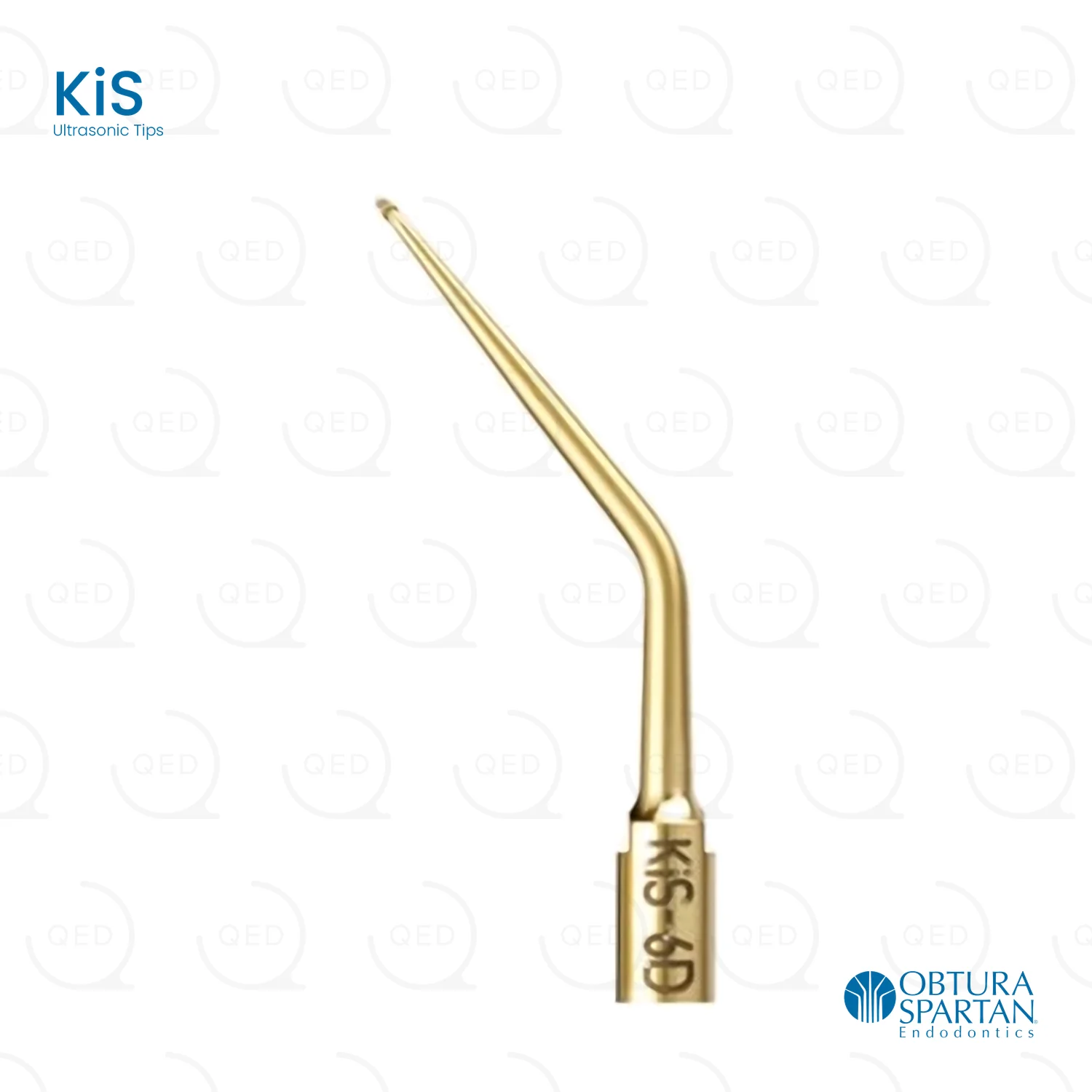
obtura spartan · kis® microsurgical tips, ems
the other side of the mouth needs the other instrument. the kis® 6d is the mirror image of the kis® 4d – obtura spartan's own description – for the lingual root of the mandibular right molar and the distobuccal of the maxillary left molar. double angled at 110°, 0.5mm across, 3.0mm cutting surface, diamond coated. this is the ems version: the same instrument cut with the m3 x 0.5 thread, which fits an ems-threaded scaler.
this pack: obtura spartan kis® 6d ems microsurgical ultrasonic tip, 0.5mm diameter, 3.0mm cutting surface · single tip · diamond coated · supplied non-sterile
› working end: 0.5mm diameter, 3.0mm cutting surface, angled 110° and double angled. water ports.
› coating: diamond coated. obtura spartan state the coating reduces the risk of microfractures while allowing better adaptation of filling materials
› thread: m3 x 0.5 – fits an ems-threaded scaler
› intensity: medium to high – obtura spartan's guidance for every kis® tip, with new users starting low to medium
› lingual root of the mandibular right molar
› distobuccal of the maxillary left molar
› mirror image of the kis® 4d, double angled at 110°
supplied non-sterile. reprocessing is validated to iso 17664-1 and iso 17665-1: pre-clean in a ph-neutral ultrasonic solution, dry, then prevacuum steam at 132°c for 4 minutes.
will it fit my ultrasonic unit? obtura spartan make the range for scalers using m3 x 0.6 threading, and offer every tip again as the e series with m3 x 0.5. this one is m3 x 0.5. check your unit's manual first – they warn that forcing a tip with the wrong thread damages the device. the tip wrench seats it properly.
how long does a tip last? obtura spartan state the tips were tested to 250 reprocessing cycles to iso 18397 without loss of performance or corrosion – but end of life is set by wear in use as well, so inspect each tip during cleaning and retire damaged ones. they also ask for very light pressure: small-diameter tips are subject to breakage at any time.
do i need the matching tip for the other side? the kis® 6d ems and its mirror image are a pair – obtura spartan design each for named roots on one side of the arch. practices doing routine apical surgery usually hold both.
| fitting and storage | wrench for spartan tips · spartan tip stand |
| root-end filling materials | neoputty® 0.5g · neomta® 2 1.0g kit · vista apex mta carriers 0.80mm |
| non-surgical tips | buc® 1 the cutter · cpr® 1 the mover |
| rest of the range | kis® 4d ems · kis® 1d ems · kis® 2d ems |
diamond coated · microsurgical · m3 x 0.5 · autoclavable 132°c · ref kis-6e
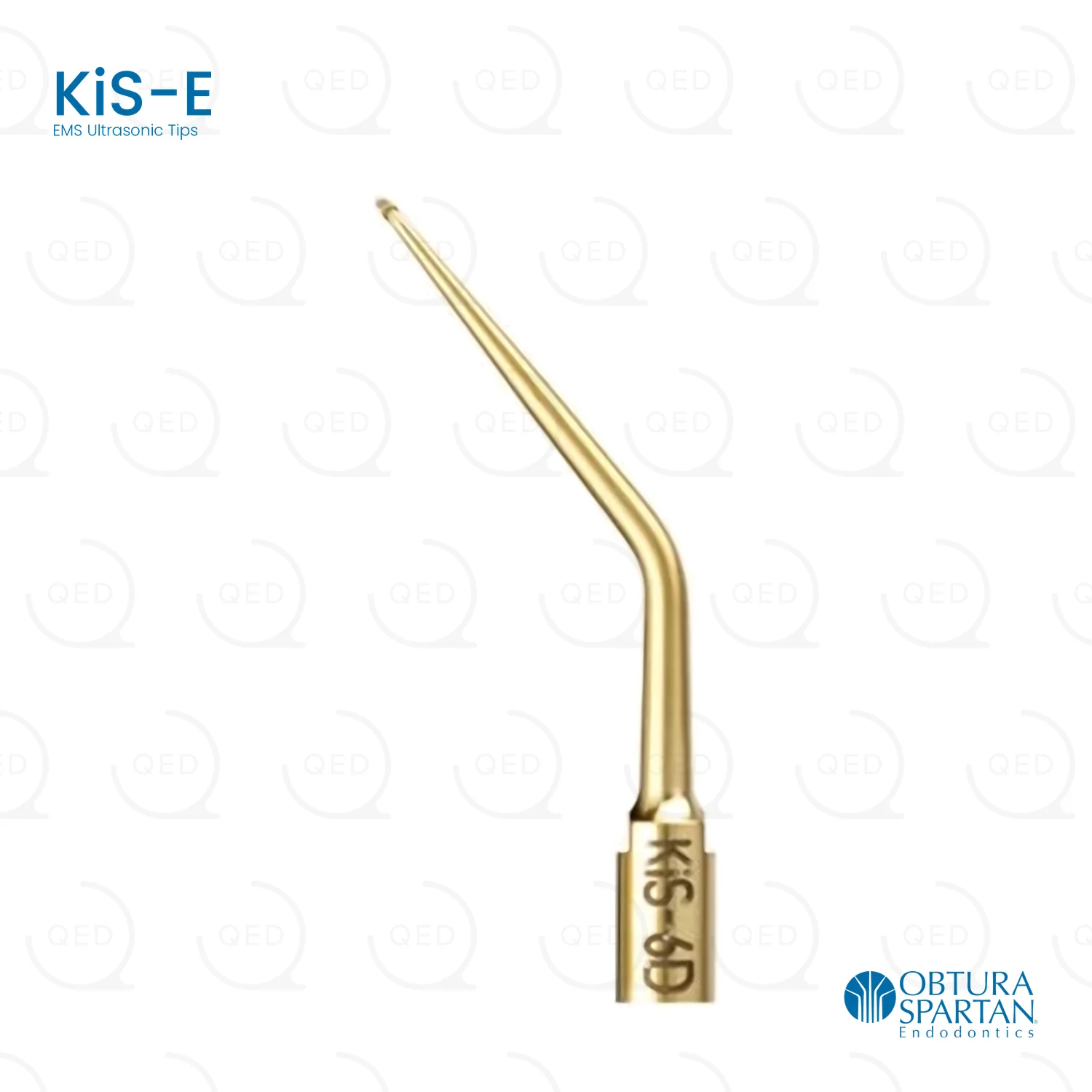
monosteryl® round · 010m · 10
sterile, ready to usesingle useindividually wrapped
mdt’s round diamond, iso shape 001, size 010 (1.0 mm), medium grit with a blue ring, on a 19 mm fg standard shank. monosteryl® is how mdt pack it: the same bur as their standard range, each one individually wrapped on a roll and gamma-sterilised, so it goes from the wrapper to the handpiece with nothing to clean or autoclave first.
this pack: mdt monosteryl® round diamond bur, fg, iso 001 010, medium (blue ring), 19 mm, sterile, single use (pack of 10, individually wrapped)
| shape | round – iso 001 |
| also listed as | 801 – the number mdt’s catalogue gives beside iso 001 |
| head | 1.0 mm diameter (iso 010) |
| grit | medium – blue ring |
| shank | fg standard, 19 mm overall |
| pack | 10, individually wrapped on a roll |
| sterility | gamma irradiation; single use |
open the wrapper, fit the bur, use it, bin it. it arrives sterile, so there is no cleaning, bagging or autoclave cycle, and no used burs waiting to be reprocessed. every bur you pick up is a new one.
mdt’s catalogue sets their burs at 60% diamond exposure against 40% for others. mdt list the features as "stronger bonding", "larger exposure of each diamond crystal" and "uniform diamond coating, including the tips", and the benefits as "faster & cooler cutting/grinding" and "slower clogging due to higher exposure of diamonds".
› the head is a spherical head, diamond-coated over hardened stainless steel – mdt make each bur from a single piece.
› mdt say their “triton” coating process "more than doubles the strength of the diamond bonding to the tool", on "swiss-made heat treated and ground stainless steel shanks".
› mdt’s instructions list diamond burs for restorative work generally, "including but not limited to: removal of caries or old restorations, preparation of cavities for restoration, finishing of restorations, preparation of crowns".
› speed, from mdt’s instructions for a 1.0 mm head: 100,000–220,000 rpm recommended, never more than 450,000 rpm.
› keep the bur moving and do not press hard – mdt warn that excessive pressure and a stationary bur both generate heat.
no. monosteryl® is mdt’s packing, not a different bur. mdt pack sterile burs in a dedicated cleanroom and sterilise them by gamma irradiation; use them by the expiry date printed on the pack.
no. mdt label sterile burs single use and state they "should not be reused or re-processed". once used, it is discarded.
| same shape | round 012m medium · round 016m medium · round 018c coarse |
monosteryl® round · iso 001 010m · medium, blue ring · 19 mm · sterile, single use · pack of 10 · made by mdt micro diamond technologies, israel · ref mdt-001-010m-10
monosteryl® round · 012m · 10
sterile, ready to usesingle useindividually wrapped
mdt’s round diamond, iso shape 001, size 012 (1.2 mm), medium grit with a blue ring, on a 19 mm fg standard shank. monosteryl® is how mdt pack it: the same bur as their standard range, each one individually wrapped on a roll and gamma-sterilised, so it goes from the wrapper to the handpiece with nothing to clean or autoclave first.
this pack: mdt monosteryl® round diamond bur, fg, iso 001 012, medium (blue ring), 19 mm, sterile, single use (pack of 10, individually wrapped)
| shape | round – iso 001 |
| also listed as | 801 – the number mdt’s catalogue gives beside iso 001 |
| head | 1.2 mm diameter (iso 012) |
| grit | medium – blue ring |
| shank | fg standard, 19 mm overall |
| pack | 10, individually wrapped on a roll |
| sterility | gamma irradiation; single use |
open the wrapper, fit the bur, use it, bin it. it arrives sterile, so there is no cleaning, bagging or autoclave cycle, and no used burs waiting to be reprocessed. every bur you pick up is a new one.
mdt’s catalogue sets their burs at 60% diamond exposure against 40% for others. mdt list the features as "stronger bonding", "larger exposure of each diamond crystal" and "uniform diamond coating, including the tips", and the benefits as "faster & cooler cutting/grinding" and "slower clogging due to higher exposure of diamonds".
› the head is a spherical head, diamond-coated over hardened stainless steel – mdt make each bur from a single piece.
› mdt say their “triton” coating process "more than doubles the strength of the diamond bonding to the tool", on "swiss-made heat treated and ground stainless steel shanks".
› mdt’s instructions list diamond burs for restorative work generally, "including but not limited to: removal of caries or old restorations, preparation of cavities for restoration, finishing of restorations, preparation of crowns".
› speed, from mdt’s instructions for a 1.2 mm head: 70,000–220,000 rpm recommended, never more than 450,000 rpm.
› keep the bur moving and do not press hard – mdt warn that excessive pressure and a stationary bur both generate heat.
no. monosteryl® is mdt’s packing, not a different bur. mdt pack sterile burs in a dedicated cleanroom and sterilise them by gamma irradiation; use them by the expiry date printed on the pack.
no. mdt label sterile burs single use and state they "should not be reused or re-processed". once used, it is discarded.
| same shape | round 010m medium · round 016m medium · round 018c coarse |
monosteryl® round · iso 001 012m · medium, blue ring · 19 mm · sterile, single use · pack of 10 · made by mdt micro diamond technologies, israel · ref mdt-001-012m-10
monosteryl® round · 016m · 10
sterile, ready to usesingle useindividually wrapped
mdt’s round diamond, iso shape 001, size 016 (1.6 mm), medium grit with a blue ring, on a 19 mm fg standard shank. monosteryl® is how mdt pack it: the same bur as their standard range, each one individually wrapped on a roll and gamma-sterilised, so it goes from the wrapper to the handpiece with nothing to clean or autoclave first.
this pack: mdt monosteryl® round diamond bur, fg, iso 001 016, medium (blue ring), 19 mm, sterile, single use (pack of 10, individually wrapped)
| shape | round – iso 001 |
| also listed as | 801 – the number mdt’s catalogue gives beside iso 001 |
| head | 1.6 mm diameter (iso 016) |
| grit | medium – blue ring |
| shank | fg standard, 19 mm overall |
| pack | 10, individually wrapped on a roll |
| sterility | gamma irradiation; single use |
open the wrapper, fit the bur, use it, bin it. it arrives sterile, so there is no cleaning, bagging or autoclave cycle, and no used burs waiting to be reprocessed. every bur you pick up is a new one.
mdt’s catalogue sets their burs at 60% diamond exposure against 40% for others. mdt list the features as "stronger bonding", "larger exposure of each diamond crystal" and "uniform diamond coating, including the tips", and the benefits as "faster & cooler cutting/grinding" and "slower clogging due to higher exposure of diamonds".
› the head is a spherical head, diamond-coated over hardened stainless steel – mdt make each bur from a single piece.
› mdt say their “triton” coating process "more than doubles the strength of the diamond bonding to the tool", on "swiss-made heat treated and ground stainless steel shanks".
› mdt’s instructions list diamond burs for restorative work generally, "including but not limited to: removal of caries or old restorations, preparation of cavities for restoration, finishing of restorations, preparation of crowns".
› speed, from mdt’s instructions for a 1.6 mm head: 55,000–160,000 rpm recommended, never more than 450,000 rpm.
› keep the bur moving and do not press hard – mdt warn that excessive pressure and a stationary bur both generate heat.
no. monosteryl® is mdt’s packing, not a different bur. mdt pack sterile burs in a dedicated cleanroom and sterilise them by gamma irradiation; use them by the expiry date printed on the pack.
no. mdt label sterile burs single use and state they "should not be reused or re-processed". once used, it is discarded.
| same shape | round 010m medium · round 012m medium · round 018c coarse |
monosteryl® round · iso 001 016m · medium, blue ring · 19 mm · sterile, single use · pack of 10 · made by mdt micro diamond technologies, israel · ref mdt-001-016m-10
monosteryl® round · 018c · 10
sterile, ready to usesingle useindividually wrapped
mdt’s round diamond, iso shape 001, size 018 (1.8 mm), coarse grit with a green ring, on a 19 mm fg standard shank. monosteryl® is how mdt pack it: the same bur as their standard range, each one individually wrapped on a roll and gamma-sterilised, so it goes from the wrapper to the handpiece with nothing to clean or autoclave first.
this pack: mdt monosteryl® round diamond bur, fg, iso 001 018, coarse (green ring), 19 mm, sterile, single use (pack of 10, individually wrapped)
| shape | round – iso 001 |
| also listed as | 801 – the number mdt’s catalogue gives beside iso 001 |
| head | 1.8 mm diameter (iso 018) |
| grit | coarse – green ring |
| shank | fg standard, 19 mm overall |
| pack | 10, individually wrapped on a roll |
| sterility | gamma irradiation; single use |
open the wrapper, fit the bur, use it, bin it. it arrives sterile, so there is no cleaning, bagging or autoclave cycle, and no used burs waiting to be reprocessed. every bur you pick up is a new one.
mdt’s catalogue sets their burs at 60% diamond exposure against 40% for others. mdt list the features as "stronger bonding", "larger exposure of each diamond crystal" and "uniform diamond coating, including the tips", and the benefits as "faster & cooler cutting/grinding" and "slower clogging due to higher exposure of diamonds".
› the head is a spherical head, diamond-coated over hardened stainless steel – mdt make each bur from a single piece.
› mdt say their “triton” coating process "more than doubles the strength of the diamond bonding to the tool", on "swiss-made heat treated and ground stainless steel shanks".
› mdt’s instructions list diamond burs for restorative work generally, "including but not limited to: removal of caries or old restorations, preparation of cavities for restoration, finishing of restorations, preparation of crowns".
› speed, from mdt’s instructions for a 1.8 mm head: 55,000–160,000 rpm recommended, never more than 450,000 rpm.
› keep the bur moving and do not press hard – mdt warn that excessive pressure and a stationary bur both generate heat.
no. monosteryl® is mdt’s packing, not a different bur. mdt pack sterile burs in a dedicated cleanroom and sterilise them by gamma irradiation; use them by the expiry date printed on the pack.
no. mdt label sterile burs single use and state they "should not be reused or re-processed". once used, it is discarded.
| same shape | round 010m medium · round 012m medium · round 016m medium |
monosteryl® round · iso 001 018c · coarse, green ring · 19 mm · sterile, single use · pack of 10 · made by mdt micro diamond technologies, israel · ref mdt-001-018c-10

monosteryl® wheel · 040sm · 10
sterile, ready to usesingle useindividually wrapped
mdt’s wheel diamond, iso shape 067, size 040 (4.0 mm), medium grit with a blue ring, on a 16 mm fg short shank. monosteryl® is how mdt pack it: the same bur as their standard range, each one individually wrapped on a roll and gamma-sterilised, so it goes from the wrapper to the handpiece with nothing to clean or autoclave first.
this pack: mdt monosteryl® wheel diamond bur, fg, iso 067 040, medium (blue ring), 16 mm, sterile, single use (pack of 10, individually wrapped)
| shape | wheel – iso 067 |
| also listed as | 909 – the number mdt’s catalogue gives beside iso 067 |
| head | 4.0 mm diameter (iso 040), 1.3 mm long |
| grit | medium – blue ring |
| shank | fg short, 16 mm overall |
| pack | 10, individually wrapped on a roll |
| sterility | gamma irradiation; single use |
open the wrapper, fit the bur, use it, bin it. it arrives sterile, so there is no cleaning, bagging or autoclave cycle, and no used burs waiting to be reprocessed. every bur you pick up is a new one.
mdt’s catalogue sets their burs at 60% diamond exposure against 40% for others. mdt list the features as "stronger bonding", "larger exposure of each diamond crystal" and "uniform diamond coating, including the tips", and the benefits as "faster & cooler cutting/grinding" and "slower clogging due to higher exposure of diamonds".
› the head is a short, wide wheel with a rounded rim (mdt: wheel rounded rim), 1.3 mm long, diamond-coated over hardened stainless steel – mdt make each bur from a single piece.
› mdt say their “triton” coating process "more than doubles the strength of the diamond bonding to the tool", on "swiss-made heat treated and ground stainless steel shanks".
› mdt’s instructions list diamond burs for restorative work generally, "including but not limited to: removal of caries or old restorations, preparation of cavities for restoration, finishing of restorations, preparation of crowns".
› speed, from mdt’s instructions for a 4.0 mm head: 25,000–75,000 rpm recommended, never more than 120,000 rpm.
› keep the bur moving and do not press hard – mdt warn that excessive pressure and a stationary bur both generate heat.
no. monosteryl® is mdt’s packing, not a different bur. mdt pack sterile burs in a dedicated cleanroom and sterilise them by gamma irradiation; use them by the expiry date printed on the pack.
no. mdt label sterile burs single use and state they "should not be reused or re-processed". once used, it is discarded.
| the range | search the site for monosteryl to see every shape and grit we stock. |
monosteryl® wheel · iso 067 040sm · medium, blue ring · 16 mm · sterile, single use · pack of 10 · made by mdt micro diamond technologies, israel · ref mdt-067-040sm-10

monosteryl® flat end cylinder · 010m · 10
sterile, ready to usesingle useindividually wrapped
mdt’s flat end cylinder diamond, iso shape 108, size 010 (1.0 mm), medium grit with a blue ring, on a 19 mm fg standard shank. monosteryl® is how mdt pack it: the same bur as their standard range, each one individually wrapped on a roll and gamma-sterilised, so it goes from the wrapper to the handpiece with nothing to clean or autoclave first.
this pack: mdt monosteryl® flat end cylinder diamond bur, fg, iso 108 010, medium (blue ring), 19 mm, sterile, single use (pack of 10, individually wrapped)
| shape | flat end cylinder – iso 108 |
| also listed as | 835 – the number mdt’s catalogue gives beside iso 108 |
| head | 1.0 mm diameter (iso 010), 3.0 mm long |
| grit | medium – blue ring |
| shank | fg standard, 19 mm overall |
| pack | 10, individually wrapped on a roll |
| sterility | gamma irradiation; single use |
open the wrapper, fit the bur, use it, bin it. it arrives sterile, so there is no cleaning, bagging or autoclave cycle, and no used burs waiting to be reprocessed. every bur you pick up is a new one.
mdt’s catalogue sets their burs at 60% diamond exposure against 40% for others. mdt list the features as "stronger bonding", "larger exposure of each diamond crystal" and "uniform diamond coating, including the tips", and the benefits as "faster & cooler cutting/grinding" and "slower clogging due to higher exposure of diamonds".
› the head is a straight cylinder with a flat end, 3.0 mm long, diamond-coated over hardened stainless steel – mdt make each bur from a single piece.
› mdt say their “triton” coating process "more than doubles the strength of the diamond bonding to the tool", on "swiss-made heat treated and ground stainless steel shanks".
› mdt’s instructions list diamond burs for restorative work generally, "including but not limited to: removal of caries or old restorations, preparation of cavities for restoration, finishing of restorations, preparation of crowns".
› speed, from mdt’s instructions for a 1.0 mm head: 100,000–220,000 rpm recommended, never more than 450,000 rpm.
› keep the bur moving and do not press hard – mdt warn that excessive pressure and a stationary bur both generate heat.
no. monosteryl® is mdt’s packing, not a different bur. mdt pack sterile burs in a dedicated cleanroom and sterilise them by gamma irradiation; use them by the expiry date printed on the pack.
no. mdt label sterile burs single use and state they "should not be reused or re-processed". once used, it is discarded.
| related shapes | flat end cylinder 109 014m medium |
monosteryl® flat end cylinder · iso 108 010m · medium, blue ring · 19 mm · sterile, single use · pack of 10 · made by mdt micro diamond technologies, israel · ref mdt-108-010m-10
monosteryl® flat end cylinder · 014m · 10
sterile, ready to usesingle useindividually wrapped
mdt’s flat end cylinder diamond, iso shape 109, size 014 (1.4 mm), medium grit with a blue ring, on a 19 mm fg standard shank. monosteryl® is how mdt pack it: the same bur as their standard range, each one individually wrapped on a roll and gamma-sterilised, so it goes from the wrapper to the handpiece with nothing to clean or autoclave first.
this pack: mdt monosteryl® flat end cylinder diamond bur, fg, iso 109 014, medium (blue ring), 19 mm, sterile, single use (pack of 10, individually wrapped)
| shape | flat end cylinder – iso 109 |
| also listed as | 835 – the number mdt’s catalogue gives beside iso 109 |
| head | 1.4 mm diameter (iso 014), 4.0 mm long |
| grit | medium – blue ring |
| shank | fg standard, 19 mm overall |
| pack | 10, individually wrapped on a roll |
| sterility | gamma irradiation; single use |
open the wrapper, fit the bur, use it, bin it. it arrives sterile, so there is no cleaning, bagging or autoclave cycle, and no used burs waiting to be reprocessed. every bur you pick up is a new one.
mdt’s catalogue sets their burs at 60% diamond exposure against 40% for others. mdt list the features as "stronger bonding", "larger exposure of each diamond crystal" and "uniform diamond coating, including the tips", and the benefits as "faster & cooler cutting/grinding" and "slower clogging due to higher exposure of diamonds".
› the head is a straight cylinder with a flat end, 4.0 mm long, diamond-coated over hardened stainless steel – mdt make each bur from a single piece.
› mdt say their “triton” coating process "more than doubles the strength of the diamond bonding to the tool", on "swiss-made heat treated and ground stainless steel shanks".
› mdt’s instructions list diamond burs for restorative work generally, "including but not limited to: removal of caries or old restorations, preparation of cavities for restoration, finishing of restorations, preparation of crowns".
› speed, from mdt’s instructions for a 1.4 mm head: 70,000–220,000 rpm recommended, never more than 450,000 rpm.
› keep the bur moving and do not press hard – mdt warn that excessive pressure and a stationary bur both generate heat.
no. monosteryl® is mdt’s packing, not a different bur. mdt pack sterile burs in a dedicated cleanroom and sterilise them by gamma irradiation; use them by the expiry date printed on the pack.
no. mdt label sterile burs single use and state they "should not be reused or re-processed". once used, it is discarded.
| related shapes | flat end cylinder 108 010m medium |
monosteryl® flat end cylinder · iso 109 014m · medium, blue ring · 19 mm · sterile, single use · pack of 10 · made by mdt micro diamond technologies, israel · ref mdt-109-014m-10
monosteryl® bevelled cylinder · 012c · 10
sterile, ready to usesingle useindividually wrapped
mdt’s bevelled cylinder diamond, iso shape 131, size 012 (1.2 mm), coarse grit with a green ring, on a 19 mm fg standard shank. monosteryl® is how mdt pack it: the same bur as their standard range, each one individually wrapped on a roll and gamma-sterilised, so it goes from the wrapper to the handpiece with nothing to clean or autoclave first.
this pack: mdt monosteryl® bevelled cylinder diamond bur, fg, iso 131 012, coarse (green ring), 19 mm, sterile, single use (pack of 10, individually wrapped)
| shape | bevelled cylinder – iso 131 |
| also listed as | 886 – the number mdt’s catalogue gives beside iso 131 |
| head | 1.2 mm diameter (iso 012), 10.0 mm long |
| grit | coarse – green ring |
| shank | fg standard, 19 mm overall |
| pack | 10, individually wrapped on a roll |
| sterility | gamma irradiation; single use |
open the wrapper, fit the bur, use it, bin it. it arrives sterile, so there is no cleaning, bagging or autoclave cycle, and no used burs waiting to be reprocessed. every bur you pick up is a new one.
mdt’s catalogue sets their burs at 60% diamond exposure against 40% for others. mdt list the features as "stronger bonding", "larger exposure of each diamond crystal" and "uniform diamond coating, including the tips", and the benefits as "faster & cooler cutting/grinding" and "slower clogging due to higher exposure of diamonds".
› the head is a cylinder with a bevelled end, 10.0 mm long, diamond-coated over hardened stainless steel – mdt make each bur from a single piece.
› mdt say their “triton” coating process "more than doubles the strength of the diamond bonding to the tool", on "swiss-made heat treated and ground stainless steel shanks".
› mdt’s instructions list diamond burs for restorative work generally, "including but not limited to: removal of caries or old restorations, preparation of cavities for restoration, finishing of restorations, preparation of crowns".
› speed, from mdt’s instructions for a 1.2 mm head: 70,000–220,000 rpm recommended, never more than 450,000 rpm.
› keep the bur moving and do not press hard – mdt warn that excessive pressure and a stationary bur both generate heat.
no. monosteryl® is mdt’s packing, not a different bur. mdt pack sterile burs in a dedicated cleanroom and sterilise them by gamma irradiation; use them by the expiry date printed on the pack.
no. mdt label sterile burs single use and state they "should not be reused or re-processed". once used, it is discarded.
monosteryl® bevelled cylinder · iso 131 012c · coarse, green ring · 19 mm · sterile, single use · pack of 10 · made by mdt micro diamond technologies, israel · ref mdt-131-012c-10

monosteryl® bevelled cylinder · 012f · 10
sterile, ready to usesingle useindividually wrapped
mdt’s bevelled cylinder diamond, iso shape 131, size 012 (1.2 mm), fine grit with a red ring, on a 19 mm fg standard shank. monosteryl® is how mdt pack it: the same bur as their standard range, each one individually wrapped on a roll and gamma-sterilised, so it goes from the wrapper to the handpiece with nothing to clean or autoclave first.
this pack: mdt monosteryl® bevelled cylinder diamond bur, fg, iso 131 012, fine (red ring), 19 mm, sterile, single use (pack of 10, individually wrapped)
| shape | bevelled cylinder – iso 131 |
| also listed as | 886 – the number mdt’s catalogue gives beside iso 131 |
| head | 1.2 mm diameter (iso 012), 10.0 mm long |
| grit | fine – red ring |
| shank | fg standard, 19 mm overall |
| pack | 10, individually wrapped on a roll |
| sterility | gamma irradiation; single use |
open the wrapper, fit the bur, use it, bin it. it arrives sterile, so there is no cleaning, bagging or autoclave cycle, and no used burs waiting to be reprocessed. every bur you pick up is a new one.
mdt’s catalogue sets their burs at 60% diamond exposure against 40% for others. mdt list the features as "stronger bonding", "larger exposure of each diamond crystal" and "uniform diamond coating, including the tips", and the benefits as "faster & cooler cutting/grinding" and "slower clogging due to higher exposure of diamonds".
› the head is a cylinder with a bevelled end, 10.0 mm long, diamond-coated over hardened stainless steel – mdt make each bur from a single piece.
› mdt say their “triton” coating process "more than doubles the strength of the diamond bonding to the tool", on "swiss-made heat treated and ground stainless steel shanks".
› mdt’s instructions list diamond burs for restorative work generally, "including but not limited to: removal of caries or old restorations, preparation of cavities for restoration, finishing of restorations, preparation of crowns".
› speed, from mdt’s instructions for a 1.2 mm head: 70,000–220,000 rpm recommended, never more than 450,000 rpm.
› keep the bur moving and do not press hard – mdt warn that excessive pressure and a stationary bur both generate heat.
no. monosteryl® is mdt’s packing, not a different bur. mdt pack sterile burs in a dedicated cleanroom and sterilise them by gamma irradiation; use them by the expiry date printed on the pack.
no. mdt label sterile burs single use and state they "should not be reused or re-processed". once used, it is discarded.
monosteryl® bevelled cylinder · iso 131 012f · fine, red ring · 19 mm · sterile, single use · pack of 10 · made by mdt micro diamond technologies, israel · ref mdt-131-012f-10

monosteryl® bevelled cylinder · 016c · 10
sterile, ready to usesingle useindividually wrapped
mdt’s bevelled cylinder diamond, iso shape 131, size 016 (1.6 mm), coarse grit with a green ring, on a 19 mm fg standard shank. monosteryl® is how mdt pack it: the same bur as their standard range, each one individually wrapped on a roll and gamma-sterilised, so it goes from the wrapper to the handpiece with nothing to clean or autoclave first.
this pack: mdt monosteryl® bevelled cylinder diamond bur, fg, iso 131 016, coarse (green ring), 19 mm, sterile, single use (pack of 10, individually wrapped)
| shape | bevelled cylinder – iso 131 |
| also listed as | 886 – the number mdt’s catalogue gives beside iso 131 |
| head | 1.6 mm diameter (iso 016), 10.0 mm long |
| grit | coarse – green ring |
| shank | fg standard, 19 mm overall |
| pack | 10, individually wrapped on a roll |
| sterility | gamma irradiation; single use |
open the wrapper, fit the bur, use it, bin it. it arrives sterile, so there is no cleaning, bagging or autoclave cycle, and no used burs waiting to be reprocessed. every bur you pick up is a new one.
mdt’s catalogue sets their burs at 60% diamond exposure against 40% for others. mdt list the features as "stronger bonding", "larger exposure of each diamond crystal" and "uniform diamond coating, including the tips", and the benefits as "faster & cooler cutting/grinding" and "slower clogging due to higher exposure of diamonds".
› the head is a cylinder with a bevelled end, 10.0 mm long, diamond-coated over hardened stainless steel – mdt make each bur from a single piece.
› mdt say their “triton” coating process "more than doubles the strength of the diamond bonding to the tool", on "swiss-made heat treated and ground stainless steel shanks".
› mdt’s instructions list diamond burs for restorative work generally, "including but not limited to: removal of caries or old restorations, preparation of cavities for restoration, finishing of restorations, preparation of crowns".
› speed, from mdt’s instructions for a 1.6 mm head: 55,000–160,000 rpm recommended, never more than 450,000 rpm.
› keep the bur moving and do not press hard – mdt warn that excessive pressure and a stationary bur both generate heat.
no. monosteryl® is mdt’s packing, not a different bur. mdt pack sterile burs in a dedicated cleanroom and sterilise them by gamma irradiation; use them by the expiry date printed on the pack.
no. mdt label sterile burs single use and state they "should not be reused or re-processed". once used, it is discarded.
monosteryl® bevelled cylinder · iso 131 016c · coarse, green ring · 19 mm · sterile, single use · pack of 10 · made by mdt micro diamond technologies, israel · ref mdt-131-016c-10

monosteryl® bevelled cylinder · 016f · 10
sterile, ready to usesingle useindividually wrapped
mdt’s bevelled cylinder diamond, iso shape 131, size 016 (1.6 mm), fine grit with a red ring, on a 19 mm fg standard shank. monosteryl® is how mdt pack it: the same bur as their standard range, each one individually wrapped on a roll and gamma-sterilised, so it goes from the wrapper to the handpiece with nothing to clean or autoclave first.
this pack: mdt monosteryl® bevelled cylinder diamond bur, fg, iso 131 016, fine (red ring), 19 mm, sterile, single use (pack of 10, individually wrapped)
| shape | bevelled cylinder – iso 131 |
| also listed as | 886 – the number mdt’s catalogue gives beside iso 131 |
| head | 1.6 mm diameter (iso 016), 10.0 mm long |
| grit | fine – red ring |
| shank | fg standard, 19 mm overall |
| pack | 10, individually wrapped on a roll |
| sterility | gamma irradiation; single use |
open the wrapper, fit the bur, use it, bin it. it arrives sterile, so there is no cleaning, bagging or autoclave cycle, and no used burs waiting to be reprocessed. every bur you pick up is a new one.
mdt’s catalogue sets their burs at 60% diamond exposure against 40% for others. mdt list the features as "stronger bonding", "larger exposure of each diamond crystal" and "uniform diamond coating, including the tips", and the benefits as "faster & cooler cutting/grinding" and "slower clogging due to higher exposure of diamonds".
› the head is a cylinder with a bevelled end, 10.0 mm long, diamond-coated over hardened stainless steel – mdt make each bur from a single piece.
› mdt say their “triton” coating process "more than doubles the strength of the diamond bonding to the tool", on "swiss-made heat treated and ground stainless steel shanks".
› mdt’s instructions list diamond burs for restorative work generally, "including but not limited to: removal of caries or old restorations, preparation of cavities for restoration, finishing of restorations, preparation of crowns".
› speed, from mdt’s instructions for a 1.6 mm head: 55,000–160,000 rpm recommended, never more than 450,000 rpm.
› keep the bur moving and do not press hard – mdt warn that excessive pressure and a stationary bur both generate heat.
no. monosteryl® is mdt’s packing, not a different bur. mdt pack sterile burs in a dedicated cleanroom and sterilise them by gamma irradiation; use them by the expiry date printed on the pack.
no. mdt label sterile burs single use and state they "should not be reused or re-processed". once used, it is discarded.
monosteryl® bevelled cylinder · iso 131 016f · fine, red ring · 19 mm · sterile, single use · pack of 10 · made by mdt micro diamond technologies, israel · ref mdt-131-016f-10

monosteryl® round end cylinder · 012m · 10
sterile, ready to usesingle useindividually wrapped
mdt’s round end cylinder diamond, iso shape 139, size 012 (1.2 mm), medium grit with a blue ring, on a 19 mm fg standard shank. monosteryl® is how mdt pack it: the same bur as their standard range, each one individually wrapped on a roll and gamma-sterilised, so it goes from the wrapper to the handpiece with nothing to clean or autoclave first.
this pack: mdt monosteryl® round end cylinder diamond bur, fg, iso 139 012, medium (blue ring), 19 mm, sterile, single use (pack of 10, individually wrapped)
| shape | round end cylinder – iso 139 |
| also listed as | 838 – the number mdt’s catalogue gives beside iso 139 |
| head | 1.2 mm diameter (iso 012), 4.0 mm long |
| grit | medium – blue ring |
| shank | fg standard, 19 mm overall |
| pack | 10, individually wrapped on a roll |
| sterility | gamma irradiation; single use |
open the wrapper, fit the bur, use it, bin it. it arrives sterile, so there is no cleaning, bagging or autoclave cycle, and no used burs waiting to be reprocessed. every bur you pick up is a new one.
mdt’s catalogue sets their burs at 60% diamond exposure against 40% for others. mdt list the features as "stronger bonding", "larger exposure of each diamond crystal" and "uniform diamond coating, including the tips", and the benefits as "faster & cooler cutting/grinding" and "slower clogging due to higher exposure of diamonds".
› the head is a straight cylinder with a rounded end, 4.0 mm long, diamond-coated over hardened stainless steel – mdt make each bur from a single piece.
› mdt say their “triton” coating process "more than doubles the strength of the diamond bonding to the tool", on "swiss-made heat treated and ground stainless steel shanks".
› mdt’s instructions list diamond burs for restorative work generally, "including but not limited to: removal of caries or old restorations, preparation of cavities for restoration, finishing of restorations, preparation of crowns".
› speed, from mdt’s instructions for a 1.2 mm head: 70,000–220,000 rpm recommended, never more than 450,000 rpm.
› keep the bur moving and do not press hard – mdt warn that excessive pressure and a stationary bur both generate heat.
no. monosteryl® is mdt’s packing, not a different bur. mdt pack sterile burs in a dedicated cleanroom and sterilise them by gamma irradiation; use them by the expiry date printed on the pack.
no. mdt label sterile burs single use and state they "should not be reused or re-processed". once used, it is discarded.
| related shapes | round end cylinder 141 012c coarse · round end cylinder 141 012f fine · round end cylinder 141 016c coarse · round end cylinder 141 016f fine |
monosteryl® round end cylinder · iso 139 012m · medium, blue ring · 19 mm · sterile, single use · pack of 10 · made by mdt micro diamond technologies, israel · ref mdt-139-012m-10

monosteryl® round end cylinder · 012c · 10
sterile, ready to usesingle useindividually wrapped
mdt’s round end cylinder diamond, iso shape 141, size 012 (1.2 mm), coarse grit with a green ring, on a 21 mm fg long shank. monosteryl® is how mdt pack it: the same bur as their standard range, each one individually wrapped on a roll and gamma-sterilised, so it goes from the wrapper to the handpiece with nothing to clean or autoclave first.
this pack: mdt monosteryl® round end cylinder diamond bur, fg, iso 141 012, coarse (green ring), 21 mm, sterile, single use (pack of 10, individually wrapped)
| shape | round end cylinder – iso 141 |
| also listed as | 881ks1 – the number mdt’s catalogue gives beside iso 141 |
| head | 1.2 mm diameter (iso 012), 8.0 mm long |
| grit | coarse – green ring |
| shank | fg long, 21 mm overall |
| pack | 10, individually wrapped on a roll |
| sterility | gamma irradiation; single use |
open the wrapper, fit the bur, use it, bin it. it arrives sterile, so there is no cleaning, bagging or autoclave cycle, and no used burs waiting to be reprocessed. every bur you pick up is a new one.
mdt’s catalogue sets their burs at 60% diamond exposure against 40% for others. mdt list the features as "stronger bonding", "larger exposure of each diamond crystal" and "uniform diamond coating, including the tips", and the benefits as "faster & cooler cutting/grinding" and "slower clogging due to higher exposure of diamonds".
› the head is a straight cylinder with a rounded end, 8.0 mm long, diamond-coated over hardened stainless steel – mdt make each bur from a single piece.
› mdt say their “triton” coating process "more than doubles the strength of the diamond bonding to the tool", on "swiss-made heat treated and ground stainless steel shanks".
› mdt’s instructions list diamond burs for restorative work generally, "including but not limited to: removal of caries or old restorations, preparation of cavities for restoration, finishing of restorations, preparation of crowns".
› speed, from mdt’s instructions for a 1.2 mm head: 70,000–220,000 rpm recommended, never more than 450,000 rpm.
› keep the bur moving and do not press hard – mdt warn that excessive pressure and a stationary bur both generate heat.
no. monosteryl® is mdt’s packing, not a different bur. mdt pack sterile burs in a dedicated cleanroom and sterilise them by gamma irradiation; use them by the expiry date printed on the pack.
no. mdt label sterile burs single use and state they "should not be reused or re-processed". once used, it is discarded.
monosteryl® round end cylinder · iso 141 012c · coarse, green ring · 21 mm · sterile, single use · pack of 10 · made by mdt micro diamond technologies, israel · ref mdt-141-012c-10

monosteryl® round end cylinder · 012f · 10
sterile, ready to usesingle useindividually wrapped
mdt’s round end cylinder diamond, iso shape 141, size 012 (1.2 mm), fine grit with a red ring, on a 21 mm fg long shank. monosteryl® is how mdt pack it: the same bur as their standard range, each one individually wrapped on a roll and gamma-sterilised, so it goes from the wrapper to the handpiece with nothing to clean or autoclave first.
this pack: mdt monosteryl® round end cylinder diamond bur, fg, iso 141 012, fine (red ring), 21 mm, sterile, single use (pack of 10, individually wrapped)
| shape | round end cylinder – iso 141 |
| also listed as | 881ks1 – the number mdt’s catalogue gives beside iso 141 |
| head | 1.2 mm diameter (iso 012), 8.0 mm long |
| grit | fine – red ring |
| shank | fg long, 21 mm overall |
| pack | 10, individually wrapped on a roll |
| sterility | gamma irradiation; single use |
open the wrapper, fit the bur, use it, bin it. it arrives sterile, so there is no cleaning, bagging or autoclave cycle, and no used burs waiting to be reprocessed. every bur you pick up is a new one.
mdt’s catalogue sets their burs at 60% diamond exposure against 40% for others. mdt list the features as "stronger bonding", "larger exposure of each diamond crystal" and "uniform diamond coating, including the tips", and the benefits as "faster & cooler cutting/grinding" and "slower clogging due to higher exposure of diamonds".
› the head is a straight cylinder with a rounded end, 8.0 mm long, diamond-coated over hardened stainless steel – mdt make each bur from a single piece.
› mdt say their “triton” coating process "more than doubles the strength of the diamond bonding to the tool", on "swiss-made heat treated and ground stainless steel shanks".
› mdt’s instructions list diamond burs for restorative work generally, "including but not limited to: removal of caries or old restorations, preparation of cavities for restoration, finishing of restorations, preparation of crowns".
› speed, from mdt’s instructions for a 1.2 mm head: 70,000–220,000 rpm recommended, never more than 450,000 rpm.
› keep the bur moving and do not press hard – mdt warn that excessive pressure and a stationary bur both generate heat.
no. monosteryl® is mdt’s packing, not a different bur. mdt pack sterile burs in a dedicated cleanroom and sterilise them by gamma irradiation; use them by the expiry date printed on the pack.
no. mdt label sterile burs single use and state they "should not be reused or re-processed". once used, it is discarded.
monosteryl® round end cylinder · iso 141 012f · fine, red ring · 21 mm · sterile, single use · pack of 10 · made by mdt micro diamond technologies, israel · ref mdt-141-012f-10

monosteryl® round end cylinder · 016c · 10
sterile, ready to usesingle useindividually wrapped
mdt’s round end cylinder diamond, iso shape 141, size 016 (1.6 mm), coarse grit with a green ring, on a 21 mm fg long shank. monosteryl® is how mdt pack it: the same bur as their standard range, each one individually wrapped on a roll and gamma-sterilised, so it goes from the wrapper to the handpiece with nothing to clean or autoclave first.
this pack: mdt monosteryl® round end cylinder diamond bur, fg, iso 141 016, coarse (green ring), 21 mm, sterile, single use (pack of 10, individually wrapped)
| shape | round end cylinder – iso 141 |
| also listed as | 881ks1 – the number mdt’s catalogue gives beside iso 141 |
| head | 1.6 mm diameter (iso 016), 8.0 mm long |
| grit | coarse – green ring |
| shank | fg long, 21 mm overall |
| pack | 10, individually wrapped on a roll |
| sterility | gamma irradiation; single use |
open the wrapper, fit the bur, use it, bin it. it arrives sterile, so there is no cleaning, bagging or autoclave cycle, and no used burs waiting to be reprocessed. every bur you pick up is a new one.
mdt’s catalogue sets their burs at 60% diamond exposure against 40% for others. mdt list the features as "stronger bonding", "larger exposure of each diamond crystal" and "uniform diamond coating, including the tips", and the benefits as "faster & cooler cutting/grinding" and "slower clogging due to higher exposure of diamonds".
› the head is a straight cylinder with a rounded end, 8.0 mm long, diamond-coated over hardened stainless steel – mdt make each bur from a single piece.
› mdt say their “triton” coating process "more than doubles the strength of the diamond bonding to the tool", on "swiss-made heat treated and ground stainless steel shanks".
› mdt’s instructions list diamond burs for restorative work generally, "including but not limited to: removal of caries or old restorations, preparation of cavities for restoration, finishing of restorations, preparation of crowns".
› speed, from mdt’s instructions for a 1.6 mm head: 55,000–160,000 rpm recommended, never more than 450,000 rpm.
› keep the bur moving and do not press hard – mdt warn that excessive pressure and a stationary bur both generate heat.
no. monosteryl® is mdt’s packing, not a different bur. mdt pack sterile burs in a dedicated cleanroom and sterilise them by gamma irradiation; use them by the expiry date printed on the pack.
no. mdt label sterile burs single use and state they "should not be reused or re-processed". once used, it is discarded.
monosteryl® round end cylinder · iso 141 016c · coarse, green ring · 21 mm · sterile, single use · pack of 10 · made by mdt micro diamond technologies, israel · ref mdt-141-016c-10

monosteryl® round end cylinder · 016f · 10
sterile, ready to usesingle useindividually wrapped
mdt’s round end cylinder diamond, iso shape 141, size 016 (1.6 mm), fine grit with a red ring, on a 21 mm fg long shank. monosteryl® is how mdt pack it: the same bur as their standard range, each one individually wrapped on a roll and gamma-sterilised, so it goes from the wrapper to the handpiece with nothing to clean or autoclave first.
this pack: mdt monosteryl® round end cylinder diamond bur, fg, iso 141 016, fine (red ring), 21 mm, sterile, single use (pack of 10, individually wrapped)
| shape | round end cylinder – iso 141 |
| also listed as | 881ks1 – the number mdt’s catalogue gives beside iso 141 |
| head | 1.6 mm diameter (iso 016), 8.0 mm long |
| grit | fine – red ring |
| shank | fg long, 21 mm overall |
| pack | 10, individually wrapped on a roll |
| sterility | gamma irradiation; single use |
open the wrapper, fit the bur, use it, bin it. it arrives sterile, so there is no cleaning, bagging or autoclave cycle, and no used burs waiting to be reprocessed. every bur you pick up is a new one.
mdt’s catalogue sets their burs at 60% diamond exposure against 40% for others. mdt list the features as "stronger bonding", "larger exposure of each diamond crystal" and "uniform diamond coating, including the tips", and the benefits as "faster & cooler cutting/grinding" and "slower clogging due to higher exposure of diamonds".
› the head is a straight cylinder with a rounded end, 8.0 mm long, diamond-coated over hardened stainless steel – mdt make each bur from a single piece.
› mdt say their “triton” coating process "more than doubles the strength of the diamond bonding to the tool", on "swiss-made heat treated and ground stainless steel shanks".
› mdt’s instructions list diamond burs for restorative work generally, "including but not limited to: removal of caries or old restorations, preparation of cavities for restoration, finishing of restorations, preparation of crowns".
› speed, from mdt’s instructions for a 1.6 mm head: 55,000–160,000 rpm recommended, never more than 450,000 rpm.
› keep the bur moving and do not press hard – mdt warn that excessive pressure and a stationary bur both generate heat.
no. monosteryl® is mdt’s packing, not a different bur. mdt pack sterile burs in a dedicated cleanroom and sterilise them by gamma irradiation; use them by the expiry date printed on the pack.
no. mdt label sterile burs single use and state they "should not be reused or re-processed". once used, it is discarded.
monosteryl® round end cylinder · iso 141 016f · fine, red ring · 21 mm · sterile, single use · pack of 10 · made by mdt micro diamond technologies, israel · ref mdt-141-016f-10

monosteryl® pointed cone · 010m · 10
sterile, ready to usesingle useindividually wrapped
mdt’s pointed cone diamond, iso shape 166, size 010 (1.0 mm), medium grit with a blue ring, on a 21 mm fg long shank. monosteryl® is how mdt pack it: the same bur as their standard range, each one individually wrapped on a roll and gamma-sterilised, so it goes from the wrapper to the handpiece with nothing to clean or autoclave first.
this pack: mdt monosteryl® pointed cone diamond bur, fg, iso 166 010, medium (blue ring), 21 mm, sterile, single use (pack of 10, individually wrapped)
| shape | pointed cone – iso 166 |
| also listed as | 859 – the number mdt’s catalogue gives beside iso 166 |
| head | 1.0 mm diameter (iso 010), 10.0 mm long |
| grit | medium – blue ring |
| shank | fg long, 21 mm overall |
| pack | 10, individually wrapped on a roll |
| sterility | gamma irradiation; single use |
open the wrapper, fit the bur, use it, bin it. it arrives sterile, so there is no cleaning, bagging or autoclave cycle, and no used burs waiting to be reprocessed. every bur you pick up is a new one.
mdt’s catalogue sets their burs at 60% diamond exposure against 40% for others. mdt list the features as "stronger bonding", "larger exposure of each diamond crystal" and "uniform diamond coating, including the tips", and the benefits as "faster & cooler cutting/grinding" and "slower clogging due to higher exposure of diamonds".
› the head is a cone tapering to a point, 10.0 mm long, diamond-coated over hardened stainless steel – mdt make each bur from a single piece.
› mdt say their “triton” coating process "more than doubles the strength of the diamond bonding to the tool", on "swiss-made heat treated and ground stainless steel shanks".
› mdt’s instructions list diamond burs for restorative work generally, "including but not limited to: removal of caries or old restorations, preparation of cavities for restoration, finishing of restorations, preparation of crowns".
› speed, from mdt’s instructions for a 1.0 mm head: 100,000–220,000 rpm recommended, never more than 450,000 rpm.
› keep the bur moving and do not press hard – mdt warn that excessive pressure and a stationary bur both generate heat.
no. monosteryl® is mdt’s packing, not a different bur. mdt pack sterile burs in a dedicated cleanroom and sterilise them by gamma irradiation; use them by the expiry date printed on the pack.
no. mdt label sterile burs single use and state they "should not be reused or re-processed". once used, it is discarded.
| related shapes | flat end taper 012m medium · flat end taper 014m medium · flat end taper 016c coarse · flat end taper 016m medium |
monosteryl® pointed cone · iso 166 010m · medium, blue ring · 21 mm · sterile, single use · pack of 10 · made by mdt micro diamond technologies, israel · ref mdt-166-010m-10

monosteryl® flat end taper · 012m · 10
sterile, ready to usesingle useindividually wrapped
mdt’s flat end taper diamond, iso shape 173, size 012 (1.2 mm), medium grit with a blue ring, on a 21 mm fg long shank. monosteryl® is how mdt pack it: the same bur as their standard range, each one individually wrapped on a roll and gamma-sterilised, so it goes from the wrapper to the handpiece with nothing to clean or autoclave first.
this pack: mdt monosteryl® flat end taper diamond bur, fg, iso 173 012, medium (blue ring), 21 mm, sterile, single use (pack of 10, individually wrapped)
| shape | flat end taper – iso 173 |
| also listed as | 848 – the number mdt’s catalogue gives beside iso 173 |
| head | 1.2 mm diameter (iso 012), 10.0 mm long |
| grit | medium – blue ring |
| shank | fg long, 21 mm overall |
| pack | 10, individually wrapped on a roll |
| sterility | gamma irradiation; single use |
open the wrapper, fit the bur, use it, bin it. it arrives sterile, so there is no cleaning, bagging or autoclave cycle, and no used burs waiting to be reprocessed. every bur you pick up is a new one.
mdt’s catalogue sets their burs at 60% diamond exposure against 40% for others. mdt list the features as "stronger bonding", "larger exposure of each diamond crystal" and "uniform diamond coating, including the tips", and the benefits as "faster & cooler cutting/grinding" and "slower clogging due to higher exposure of diamonds".
› the head is a tapered head with a flat end, 10.0 mm long, diamond-coated over hardened stainless steel – mdt make each bur from a single piece.
› mdt say their “triton” coating process "more than doubles the strength of the diamond bonding to the tool", on "swiss-made heat treated and ground stainless steel shanks".
› mdt’s instructions list diamond burs for restorative work generally, "including but not limited to: removal of caries or old restorations, preparation of cavities for restoration, finishing of restorations, preparation of crowns".
› speed, from mdt’s instructions for a 1.2 mm head: 70,000–220,000 rpm recommended, never more than 450,000 rpm.
› keep the bur moving and do not press hard – mdt warn that excessive pressure and a stationary bur both generate heat.
no. monosteryl® is mdt’s packing, not a different bur. mdt pack sterile burs in a dedicated cleanroom and sterilise them by gamma irradiation; use them by the expiry date printed on the pack.
no. mdt label sterile burs single use and state they "should not be reused or re-processed". once used, it is discarded.
monosteryl® flat end taper · iso 173 012m · medium, blue ring · 21 mm · sterile, single use · pack of 10 · made by mdt micro diamond technologies, israel · ref mdt-173-012m-10
monosteryl® flat end taper · 014m · 10
sterile, ready to usesingle useindividually wrapped
mdt’s flat end taper diamond, iso shape 173, size 014 (1.4 mm), medium grit with a blue ring, on a 21 mm fg long shank. monosteryl® is how mdt pack it: the same bur as their standard range, each one individually wrapped on a roll and gamma-sterilised, so it goes from the wrapper to the handpiece with nothing to clean or autoclave first.
this pack: mdt monosteryl® flat end taper diamond bur, fg, iso 173 014, medium (blue ring), 21 mm, sterile, single use (pack of 10, individually wrapped)
| shape | flat end taper – iso 173 |
| also listed as | 848 – the number mdt’s catalogue gives beside iso 173 |
| head | 1.4 mm diameter (iso 014), 10.0 mm long |
| grit | medium – blue ring |
| shank | fg long, 21 mm overall |
| pack | 10, individually wrapped on a roll |
| sterility | gamma irradiation; single use |
open the wrapper, fit the bur, use it, bin it. it arrives sterile, so there is no cleaning, bagging or autoclave cycle, and no used burs waiting to be reprocessed. every bur you pick up is a new one.
mdt’s catalogue sets their burs at 60% diamond exposure against 40% for others. mdt list the features as "stronger bonding", "larger exposure of each diamond crystal" and "uniform diamond coating, including the tips", and the benefits as "faster & cooler cutting/grinding" and "slower clogging due to higher exposure of diamonds".
› the head is a tapered head with a flat end, 10.0 mm long, diamond-coated over hardened stainless steel – mdt make each bur from a single piece.
› mdt say their “triton” coating process "more than doubles the strength of the diamond bonding to the tool", on "swiss-made heat treated and ground stainless steel shanks".
› mdt’s instructions list diamond burs for restorative work generally, "including but not limited to: removal of caries or old restorations, preparation of cavities for restoration, finishing of restorations, preparation of crowns".
› speed, from mdt’s instructions for a 1.4 mm head: 70,000–220,000 rpm recommended, never more than 450,000 rpm.
› keep the bur moving and do not press hard – mdt warn that excessive pressure and a stationary bur both generate heat.
no. monosteryl® is mdt’s packing, not a different bur. mdt pack sterile burs in a dedicated cleanroom and sterilise them by gamma irradiation; use them by the expiry date printed on the pack.
no. mdt label sterile burs single use and state they "should not be reused or re-processed". once used, it is discarded.
monosteryl® flat end taper · iso 173 014m · medium, blue ring · 21 mm · sterile, single use · pack of 10 · made by mdt micro diamond technologies, israel · ref mdt-173-014m-10

monosteryl® flat end taper · 016c · 10
sterile, ready to usesingle useindividually wrapped
mdt’s flat end taper diamond, iso shape 173, size 016 (1.6 mm), coarse grit with a green ring, on a 21 mm fg long shank. monosteryl® is how mdt pack it: the same bur as their standard range, each one individually wrapped on a roll and gamma-sterilised, so it goes from the wrapper to the handpiece with nothing to clean or autoclave first.
this pack: mdt monosteryl® flat end taper diamond bur, fg, iso 173 016, coarse (green ring), 21 mm, sterile, single use (pack of 10, individually wrapped)
| shape | flat end taper – iso 173 |
| also listed as | 848 – the number mdt’s catalogue gives beside iso 173 |
| head | 1.6 mm diameter (iso 016), 10.0 mm long |
| grit | coarse – green ring |
| shank | fg long, 21 mm overall |
| pack | 10, individually wrapped on a roll |
| sterility | gamma irradiation; single use |
open the wrapper, fit the bur, use it, bin it. it arrives sterile, so there is no cleaning, bagging or autoclave cycle, and no used burs waiting to be reprocessed. every bur you pick up is a new one.
mdt’s catalogue sets their burs at 60% diamond exposure against 40% for others. mdt list the features as "stronger bonding", "larger exposure of each diamond crystal" and "uniform diamond coating, including the tips", and the benefits as "faster & cooler cutting/grinding" and "slower clogging due to higher exposure of diamonds".
› the head is a tapered head with a flat end, 10.0 mm long, diamond-coated over hardened stainless steel – mdt make each bur from a single piece.
› mdt say their “triton” coating process "more than doubles the strength of the diamond bonding to the tool", on "swiss-made heat treated and ground stainless steel shanks".
› mdt’s instructions list diamond burs for restorative work generally, "including but not limited to: removal of caries or old restorations, preparation of cavities for restoration, finishing of restorations, preparation of crowns".
› speed, from mdt’s instructions for a 1.6 mm head: 55,000–160,000 rpm recommended, never more than 450,000 rpm.
› keep the bur moving and do not press hard – mdt warn that excessive pressure and a stationary bur both generate heat.
no. monosteryl® is mdt’s packing, not a different bur. mdt pack sterile burs in a dedicated cleanroom and sterilise them by gamma irradiation; use them by the expiry date printed on the pack.
no. mdt label sterile burs single use and state they "should not be reused or re-processed". once used, it is discarded.
monosteryl® flat end taper · iso 173 016c · coarse, green ring · 21 mm · sterile, single use · pack of 10 · made by mdt micro diamond technologies, israel · ref mdt-173-016c-10
monosteryl® flat end taper · 016m · 10
sterile, ready to usesingle useindividually wrapped
mdt’s flat end taper diamond, iso shape 173, size 016 (1.6 mm), medium grit with a blue ring, on a 21 mm fg long shank. monosteryl® is how mdt pack it: the same bur as their standard range, each one individually wrapped on a roll and gamma-sterilised, so it goes from the wrapper to the handpiece with nothing to clean or autoclave first.
this pack: mdt monosteryl® flat end taper diamond bur, fg, iso 173 016, medium (blue ring), 21 mm, sterile, single use (pack of 10, individually wrapped)
| shape | flat end taper – iso 173 |
| also listed as | 848 – the number mdt’s catalogue gives beside iso 173 |
| head | 1.6 mm diameter (iso 016), 10.0 mm long |
| grit | medium – blue ring |
| shank | fg long, 21 mm overall |
| pack | 10, individually wrapped on a roll |
| sterility | gamma irradiation; single use |
open the wrapper, fit the bur, use it, bin it. it arrives sterile, so there is no cleaning, bagging or autoclave cycle, and no used burs waiting to be reprocessed. every bur you pick up is a new one.
mdt’s catalogue sets their burs at 60% diamond exposure against 40% for others. mdt list the features as "stronger bonding", "larger exposure of each diamond crystal" and "uniform diamond coating, including the tips", and the benefits as "faster & cooler cutting/grinding" and "slower clogging due to higher exposure of diamonds".
› the head is a tapered head with a flat end, 10.0 mm long, diamond-coated over hardened stainless steel – mdt make each bur from a single piece.
› mdt say their “triton” coating process "more than doubles the strength of the diamond bonding to the tool", on "swiss-made heat treated and ground stainless steel shanks".
› mdt’s instructions list diamond burs for restorative work generally, "including but not limited to: removal of caries or old restorations, preparation of cavities for restoration, finishing of restorations, preparation of crowns".
› speed, from mdt’s instructions for a 1.6 mm head: 55,000–160,000 rpm recommended, never more than 450,000 rpm.
› keep the bur moving and do not press hard – mdt warn that excessive pressure and a stationary bur both generate heat.
no. monosteryl® is mdt’s packing, not a different bur. mdt pack sterile burs in a dedicated cleanroom and sterilise them by gamma irradiation; use them by the expiry date printed on the pack.
no. mdt label sterile burs single use and state they "should not be reused or re-processed". once used, it is discarded.
monosteryl® flat end taper · iso 173 016m · medium, blue ring · 21 mm · sterile, single use · pack of 10 · made by mdt micro diamond technologies, israel · ref mdt-173-016m-10
monosteryl® round end taper · 016m · 10
sterile, ready to usesingle useindividually wrapped
mdt’s round end taper diamond, iso shape 198, size 016 (1.6 mm), medium grit with a blue ring, on a 21 mm fg long shank. monosteryl® is how mdt pack it: the same bur as their standard range, each one individually wrapped on a roll and gamma-sterilised, so it goes from the wrapper to the handpiece with nothing to clean or autoclave first.
this pack: mdt monosteryl® round end taper diamond bur, fg, iso 198 016, medium (blue ring), 21 mm, sterile, single use (pack of 10, individually wrapped)
| shape | round end taper – iso 198 |
| also listed as | 856 – the number mdt’s catalogue gives beside iso 198 |
| head | 1.6 mm diameter (iso 016), 8.0 mm long |
| grit | medium – blue ring |
| shank | fg long, 21 mm overall |
| pack | 10, individually wrapped on a roll |
| sterility | gamma irradiation; single use |
open the wrapper, fit the bur, use it, bin it. it arrives sterile, so there is no cleaning, bagging or autoclave cycle, and no used burs waiting to be reprocessed. every bur you pick up is a new one.
mdt’s catalogue sets their burs at 60% diamond exposure against 40% for others. mdt list the features as "stronger bonding", "larger exposure of each diamond crystal" and "uniform diamond coating, including the tips", and the benefits as "faster & cooler cutting/grinding" and "slower clogging due to higher exposure of diamonds".
› the head is a tapered head with a rounded end, 8.0 mm long, diamond-coated over hardened stainless steel – mdt make each bur from a single piece.
› mdt say their “triton” coating process "more than doubles the strength of the diamond bonding to the tool", on "swiss-made heat treated and ground stainless steel shanks".
› mdt’s instructions list diamond burs for restorative work generally, "including but not limited to: removal of caries or old restorations, preparation of cavities for restoration, finishing of restorations, preparation of crowns".
› speed, from mdt’s instructions for a 1.6 mm head: 55,000–160,000 rpm recommended, never more than 450,000 rpm.
› keep the bur moving and do not press hard – mdt warn that excessive pressure and a stationary bur both generate heat.
no. monosteryl® is mdt’s packing, not a different bur. mdt pack sterile burs in a dedicated cleanroom and sterilise them by gamma irradiation; use them by the expiry date printed on the pack.
no. mdt label sterile burs single use and state they "should not be reused or re-processed". once used, it is discarded.
| same shape | round end taper 198 016xc extra coarse |
| related shapes | flat end taper 012m medium · flat end taper 014m medium · flat end taper 016c coarse · flat end taper 016m medium |
monosteryl® round end taper · iso 198 016m · medium, blue ring · 21 mm · sterile, single use · pack of 10 · made by mdt micro diamond technologies, israel · ref mdt-198-016m-10
monosteryl® round end taper · 016xc · 10
sterile, ready to usesingle useindividually wrapped
mdt’s round end taper diamond, iso shape 198, size 016 (1.6 mm), extra coarse grit with a black ring, on a 21 mm fg long shank. monosteryl® is how mdt pack it: the same bur as their standard range, each one individually wrapped on a roll and gamma-sterilised, so it goes from the wrapper to the handpiece with nothing to clean or autoclave first.
this pack: mdt monosteryl® round end taper diamond bur, fg, iso 198 016, extra coarse (black ring), 21 mm, sterile, single use (pack of 10, individually wrapped)
| shape | round end taper – iso 198 |
| also listed as | 856 – the number mdt’s catalogue gives beside iso 198 |
| head | 1.6 mm diameter (iso 016), 8.0 mm long |
| grit | extra coarse – black ring |
| shank | fg long, 21 mm overall |
| pack | 10, individually wrapped on a roll |
| sterility | gamma irradiation; single use |
open the wrapper, fit the bur, use it, bin it. it arrives sterile, so there is no cleaning, bagging or autoclave cycle, and no used burs waiting to be reprocessed. every bur you pick up is a new one.
mdt’s catalogue sets their burs at 60% diamond exposure against 40% for others. mdt list the features as "stronger bonding", "larger exposure of each diamond crystal" and "uniform diamond coating, including the tips", and the benefits as "faster & cooler cutting/grinding" and "slower clogging due to higher exposure of diamonds".
› the head is a tapered head with a rounded end, 8.0 mm long, diamond-coated over hardened stainless steel – mdt make each bur from a single piece.
› mdt say their “triton” coating process "more than doubles the strength of the diamond bonding to the tool", on "swiss-made heat treated and ground stainless steel shanks".
› mdt’s instructions list diamond burs for restorative work generally, "including but not limited to: removal of caries or old restorations, preparation of cavities for restoration, finishing of restorations, preparation of crowns".
› speed, from mdt’s instructions for a 1.6 mm head: 55,000–160,000 rpm recommended, never more than 450,000 rpm.
› keep the bur moving and do not press hard – mdt warn that excessive pressure and a stationary bur both generate heat.
no. monosteryl® is mdt’s packing, not a different bur. mdt pack sterile burs in a dedicated cleanroom and sterilise them by gamma irradiation; use them by the expiry date printed on the pack.
no. mdt label sterile burs single use and state they "should not be reused or re-processed". once used, it is discarded.
| same shape | round end taper 198 016m medium |
| related shapes | flat end taper 012m medium · flat end taper 014m medium · flat end taper 016c coarse · flat end taper 016m medium |
monosteryl® round end taper · iso 198 016xc · extra coarse, black ring · 21 mm · sterile, single use · pack of 10 · made by mdt micro diamond technologies, israel · ref mdt-198-016xc-10
monosteryl® round end taper · 014m · 10
sterile, ready to usesingle useindividually wrapped
mdt’s round end taper diamond, iso shape 199, size 014 (1.4 mm), medium grit with a blue ring, on a 21 mm fg long shank. monosteryl® is how mdt pack it: the same bur as their standard range, each one individually wrapped on a roll and gamma-sterilised, so it goes from the wrapper to the handpiece with nothing to clean or autoclave first.
this pack: mdt monosteryl® round end taper diamond bur, fg, iso 199 014, medium (blue ring), 21 mm, sterile, single use (pack of 10, individually wrapped)
| shape | round end taper – iso 199 |
| also listed as | 850 – the number mdt’s catalogue gives beside iso 199 |
| head | 1.4 mm diameter (iso 014), 10.0 mm long |
| grit | medium – blue ring |
| shank | fg long, 21 mm overall |
| pack | 10, individually wrapped on a roll |
| sterility | gamma irradiation; single use |
open the wrapper, fit the bur, use it, bin it. it arrives sterile, so there is no cleaning, bagging or autoclave cycle, and no used burs waiting to be reprocessed. every bur you pick up is a new one.
mdt’s catalogue sets their burs at 60% diamond exposure against 40% for others. mdt list the features as "stronger bonding", "larger exposure of each diamond crystal" and "uniform diamond coating, including the tips", and the benefits as "faster & cooler cutting/grinding" and "slower clogging due to higher exposure of diamonds".
› the head is a tapered head with a rounded end, 10.0 mm long, diamond-coated over hardened stainless steel – mdt make each bur from a single piece.
› mdt say their “triton” coating process "more than doubles the strength of the diamond bonding to the tool", on "swiss-made heat treated and ground stainless steel shanks".
› mdt’s instructions list diamond burs for restorative work generally, "including but not limited to: removal of caries or old restorations, preparation of cavities for restoration, finishing of restorations, preparation of crowns".
› speed, from mdt’s instructions for a 1.4 mm head: 70,000–220,000 rpm recommended, never more than 450,000 rpm.
› keep the bur moving and do not press hard – mdt warn that excessive pressure and a stationary bur both generate heat.
no. monosteryl® is mdt’s packing, not a different bur. mdt pack sterile burs in a dedicated cleanroom and sterilise them by gamma irradiation; use them by the expiry date printed on the pack.
no. mdt label sterile burs single use and state they "should not be reused or re-processed". once used, it is discarded.
| related shapes | round end taper 198 016m medium · round end taper 198 016xc extra coarse |
monosteryl® round end taper · iso 199 014m · medium, blue ring · 21 mm · sterile, single use · pack of 10 · made by mdt micro diamond technologies, israel · ref mdt-199-014m-10

monosteryl® flame · 012xf · 10
sterile, ready to usesingle useindividually wrapped
mdt’s flame diamond, iso shape 247, size 012 (1.2 mm), extra fine grit with a yellow ring, on a 19 mm fg standard shank. monosteryl® is how mdt pack it: the same bur as their standard range, each one individually wrapped on a roll and gamma-sterilised, so it goes from the wrapper to the handpiece with nothing to clean or autoclave first. this is the 247, the short flame; the 249 in the same size and grit has an 8 mm head on a 21 mm shank.
this pack: mdt monosteryl® flame diamond bur, fg, iso 247 012, extra fine (yellow ring), 19 mm, sterile, single use (pack of 10, individually wrapped)
| shape | flame – iso 247 |
| also listed as | 860 – the number mdt’s catalogue gives beside iso 247 |
| head | 1.2 mm diameter (iso 012), 4.0 mm long |
| grit | extra fine – yellow ring |
| shank | fg standard, 19 mm overall |
| pack | 10, individually wrapped on a roll |
| sterility | gamma irradiation; single use |
open the wrapper, fit the bur, use it, bin it. it arrives sterile, so there is no cleaning, bagging or autoclave cycle, and no used burs waiting to be reprocessed. every bur you pick up is a new one.
mdt’s catalogue sets their burs at 60% diamond exposure against 40% for others. mdt list the features as "stronger bonding", "larger exposure of each diamond crystal" and "uniform diamond coating, including the tips", and the benefits as "faster & cooler cutting/grinding" and "slower clogging due to higher exposure of diamonds".
› the head is a short flame – a head that swells, then tapers to a fine point, 4.0 mm long, diamond-coated over hardened stainless steel – mdt make each bur from a single piece.
› mdt say their “triton” coating process "more than doubles the strength of the diamond bonding to the tool", on "swiss-made heat treated and ground stainless steel shanks".
› mdt’s instructions list diamond burs for restorative work generally, "including but not limited to: removal of caries or old restorations, preparation of cavities for restoration, finishing of restorations, preparation of crowns".
› speed, from mdt’s instructions for a 1.2 mm head: 70,000–220,000 rpm recommended, never more than 450,000 rpm.
› keep the bur moving and do not press hard – mdt warn that excessive pressure and a stationary bur both generate heat.
same size (012), same extra fine grit, same flame shape. mdt’s catalogue gives the 247 a 4.0 mm head on a standard 19 mm shank and the 249 an 8.0 mm head on a long 21 mm shank. the difference is the head length and the overall length.
no. monosteryl® is mdt’s packing, not a different bur. mdt pack sterile burs in a dedicated cleanroom and sterilise them by gamma irradiation; use them by the expiry date printed on the pack.
no. mdt label sterile burs single use and state they "should not be reused or re-processed". once used, it is discarded.
| related shapes | flame 249 012f fine · flame 249 012m medium · flame 249 012uf ultra fine · flame 249 012xf extra fine |
monosteryl® flame · iso 247 012xf · extra fine, yellow ring · 19 mm · sterile, single use · pack of 10 · made by mdt micro diamond technologies, israel · ref mdt-247-012xf-10
monosteryl® flame · 012f · 10
sterile, ready to usesingle useindividually wrapped
mdt’s flame diamond, iso shape 249, size 012 (1.2 mm), fine grit with a red ring, on a 21 mm fg long shank. monosteryl® is how mdt pack it: the same bur as their standard range, each one individually wrapped on a roll and gamma-sterilised, so it goes from the wrapper to the handpiece with nothing to clean or autoclave first.
this pack: mdt monosteryl® flame diamond bur, fg, iso 249 012, fine (red ring), 21 mm, sterile, single use (pack of 10, individually wrapped)
| shape | flame – iso 249 |
| also listed as | 862 – the number mdt’s catalogue gives beside iso 249 |
| head | 1.2 mm diameter (iso 012), 8.0 mm long |
| grit | fine – red ring |
| shank | fg long, 21 mm overall |
| pack | 10, individually wrapped on a roll |
| sterility | gamma irradiation; single use |
open the wrapper, fit the bur, use it, bin it. it arrives sterile, so there is no cleaning, bagging or autoclave cycle, and no used burs waiting to be reprocessed. every bur you pick up is a new one.
mdt’s catalogue sets their burs at 60% diamond exposure against 40% for others. mdt list the features as "stronger bonding", "larger exposure of each diamond crystal" and "uniform diamond coating, including the tips", and the benefits as "faster & cooler cutting/grinding" and "slower clogging due to higher exposure of diamonds".
› the head is a long flame – a head that swells, then tapers to a fine point, 8.0 mm long, diamond-coated over hardened stainless steel – mdt make each bur from a single piece.
› mdt say their “triton” coating process "more than doubles the strength of the diamond bonding to the tool", on "swiss-made heat treated and ground stainless steel shanks".
› mdt’s instructions list diamond burs for restorative work generally, "including but not limited to: removal of caries or old restorations, preparation of cavities for restoration, finishing of restorations, preparation of crowns".
› speed, from mdt’s instructions for a 1.2 mm head: 70,000–220,000 rpm recommended, never more than 450,000 rpm.
› keep the bur moving and do not press hard – mdt warn that excessive pressure and a stationary bur both generate heat.
no. monosteryl® is mdt’s packing, not a different bur. mdt pack sterile burs in a dedicated cleanroom and sterilise them by gamma irradiation; use them by the expiry date printed on the pack.
no. mdt label sterile burs single use and state they "should not be reused or re-processed". once used, it is discarded.
monosteryl® flame · iso 249 012f · fine, red ring · 21 mm · sterile, single use · pack of 10 · made by mdt micro diamond technologies, israel · ref mdt-249-012f-10
monosteryl® flame · 012m · 10
sterile, ready to usesingle useindividually wrapped
mdt’s flame diamond, iso shape 249, size 012 (1.2 mm), medium grit with a blue ring, on a 21 mm fg long shank. monosteryl® is how mdt pack it: the same bur as their standard range, each one individually wrapped on a roll and gamma-sterilised, so it goes from the wrapper to the handpiece with nothing to clean or autoclave first.
this pack: mdt monosteryl® flame diamond bur, fg, iso 249 012, medium (blue ring), 21 mm, sterile, single use (pack of 10, individually wrapped)
| shape | flame – iso 249 |
| also listed as | 862 – the number mdt’s catalogue gives beside iso 249 |
| head | 1.2 mm diameter (iso 012), 8.0 mm long |
| grit | medium – blue ring |
| shank | fg long, 21 mm overall |
| pack | 10, individually wrapped on a roll |
| sterility | gamma irradiation; single use |
open the wrapper, fit the bur, use it, bin it. it arrives sterile, so there is no cleaning, bagging or autoclave cycle, and no used burs waiting to be reprocessed. every bur you pick up is a new one.
mdt’s catalogue sets their burs at 60% diamond exposure against 40% for others. mdt list the features as "stronger bonding", "larger exposure of each diamond crystal" and "uniform diamond coating, including the tips", and the benefits as "faster & cooler cutting/grinding" and "slower clogging due to higher exposure of diamonds".
› the head is a long flame – a head that swells, then tapers to a fine point, 8.0 mm long, diamond-coated over hardened stainless steel – mdt make each bur from a single piece.
› mdt say their “triton” coating process "more than doubles the strength of the diamond bonding to the tool", on "swiss-made heat treated and ground stainless steel shanks".
› mdt’s instructions list diamond burs for restorative work generally, "including but not limited to: removal of caries or old restorations, preparation of cavities for restoration, finishing of restorations, preparation of crowns".
› speed, from mdt’s instructions for a 1.2 mm head: 70,000–220,000 rpm recommended, never more than 450,000 rpm.
› keep the bur moving and do not press hard – mdt warn that excessive pressure and a stationary bur both generate heat.
no. monosteryl® is mdt’s packing, not a different bur. mdt pack sterile burs in a dedicated cleanroom and sterilise them by gamma irradiation; use them by the expiry date printed on the pack.
no. mdt label sterile burs single use and state they "should not be reused or re-processed". once used, it is discarded.
monosteryl® flame · iso 249 012m · medium, blue ring · 21 mm · sterile, single use · pack of 10 · made by mdt micro diamond technologies, israel · ref mdt-249-012m-10

monosteryl® flame · 012uf · 10
sterile, ready to usesingle useindividually wrapped
mdt’s flame diamond, iso shape 249, size 012 (1.2 mm), ultra fine grit with a white ring, on a 21 mm fg long shank. monosteryl® is how mdt pack it: the same bur as their standard range, each one individually wrapped on a roll and gamma-sterilised, so it goes from the wrapper to the handpiece with nothing to clean or autoclave first.
this pack: mdt monosteryl® flame diamond bur, fg, iso 249 012, ultra fine (white ring), 21 mm, sterile, single use (pack of 10, individually wrapped)
| shape | flame – iso 249 |
| also listed as | 862 – the number mdt’s catalogue gives beside iso 249 |
| head | 1.2 mm diameter (iso 012), 8.0 mm long |
| grit | ultra fine – white ring |
| shank | fg long, 21 mm overall |
| pack | 10, individually wrapped on a roll |
| sterility | gamma irradiation; single use |
open the wrapper, fit the bur, use it, bin it. it arrives sterile, so there is no cleaning, bagging or autoclave cycle, and no used burs waiting to be reprocessed. every bur you pick up is a new one.
mdt’s catalogue sets their burs at 60% diamond exposure against 40% for others. mdt list the features as "stronger bonding", "larger exposure of each diamond crystal" and "uniform diamond coating, including the tips", and the benefits as "faster & cooler cutting/grinding" and "slower clogging due to higher exposure of diamonds".
› the head is a long flame – a head that swells, then tapers to a fine point, 8.0 mm long, diamond-coated over hardened stainless steel – mdt make each bur from a single piece.
› mdt say their “triton” coating process "more than doubles the strength of the diamond bonding to the tool", on "swiss-made heat treated and ground stainless steel shanks".
› mdt’s instructions list diamond burs for restorative work generally, "including but not limited to: removal of caries or old restorations, preparation of cavities for restoration, finishing of restorations, preparation of crowns".
› speed, from mdt’s instructions for a 1.2 mm head: 70,000–220,000 rpm recommended, never more than 450,000 rpm.
› keep the bur moving and do not press hard – mdt warn that excessive pressure and a stationary bur both generate heat.
no. monosteryl® is mdt’s packing, not a different bur. mdt pack sterile burs in a dedicated cleanroom and sterilise them by gamma irradiation; use them by the expiry date printed on the pack.
no. mdt label sterile burs single use and state they "should not be reused or re-processed". once used, it is discarded.
| same shape | flame 249 012f fine · flame 249 012m medium · flame 249 012xf extra fine · flame 249 016f fine · flame 249 016m medium |
| related shapes | flame 247 012xf extra fine · flame 250 014xf extra fine |
monosteryl® flame · iso 249 012uf · ultra fine, white ring · 21 mm · sterile, single use · pack of 10 · made by mdt micro diamond technologies, israel · ref mdt-249-012uf-10
monosteryl® flame · 012xf · 10
sterile, ready to usesingle useindividually wrapped
mdt’s flame diamond, iso shape 249, size 012 (1.2 mm), extra fine grit with a yellow ring, on a 21 mm fg long shank. monosteryl® is how mdt pack it: the same bur as their standard range, each one individually wrapped on a roll and gamma-sterilised, so it goes from the wrapper to the handpiece with nothing to clean or autoclave first. this is the 249, the long flame; the 247 in the same size and grit has a 4 mm head on a 19 mm shank.
this pack: mdt monosteryl® flame diamond bur, fg, iso 249 012, extra fine (yellow ring), 21 mm, sterile, single use (pack of 10, individually wrapped)
| shape | flame – iso 249 |
| also listed as | 862 – the number mdt’s catalogue gives beside iso 249 |
| head | 1.2 mm diameter (iso 012), 8.0 mm long |
| grit | extra fine – yellow ring |
| shank | fg long, 21 mm overall |
| pack | 10, individually wrapped on a roll |
| sterility | gamma irradiation; single use |
open the wrapper, fit the bur, use it, bin it. it arrives sterile, so there is no cleaning, bagging or autoclave cycle, and no used burs waiting to be reprocessed. every bur you pick up is a new one.
mdt’s catalogue sets their burs at 60% diamond exposure against 40% for others. mdt list the features as "stronger bonding", "larger exposure of each diamond crystal" and "uniform diamond coating, including the tips", and the benefits as "faster & cooler cutting/grinding" and "slower clogging due to higher exposure of diamonds".
› the head is a long flame – a head that swells, then tapers to a fine point, 8.0 mm long, diamond-coated over hardened stainless steel – mdt make each bur from a single piece.
› mdt say their “triton” coating process "more than doubles the strength of the diamond bonding to the tool", on "swiss-made heat treated and ground stainless steel shanks".
› mdt’s instructions list diamond burs for restorative work generally, "including but not limited to: removal of caries or old restorations, preparation of cavities for restoration, finishing of restorations, preparation of crowns".
› speed, from mdt’s instructions for a 1.2 mm head: 70,000–220,000 rpm recommended, never more than 450,000 rpm.
› keep the bur moving and do not press hard – mdt warn that excessive pressure and a stationary bur both generate heat.
same size (012), same extra fine grit, same flame shape. mdt’s catalogue gives the 249 an 8.0 mm head on a long 21 mm shank and the 247 a 4.0 mm head on a standard 19 mm shank. the difference is the head length and the overall length.
no. monosteryl® is mdt’s packing, not a different bur. mdt pack sterile burs in a dedicated cleanroom and sterilise them by gamma irradiation; use them by the expiry date printed on the pack.
no. mdt label sterile burs single use and state they "should not be reused or re-processed". once used, it is discarded.
| same shape | flame 249 012f fine · flame 249 012m medium · flame 249 012uf ultra fine · flame 249 016f fine · flame 249 016m medium |
| related shapes | flame 247 012xf extra fine · flame 250 014xf extra fine |
monosteryl® flame · iso 249 012xf · extra fine, yellow ring · 21 mm · sterile, single use · pack of 10 · made by mdt micro diamond technologies, israel · ref mdt-249-012xf-10
monosteryl® flame · 016f · 10
sterile, ready to usesingle useindividually wrapped
mdt’s flame diamond, iso shape 249, size 016 (1.6 mm), fine grit with a red ring, on a 21 mm fg long shank. monosteryl® is how mdt pack it: the same bur as their standard range, each one individually wrapped on a roll and gamma-sterilised, so it goes from the wrapper to the handpiece with nothing to clean or autoclave first.
this pack: mdt monosteryl® flame diamond bur, fg, iso 249 016, fine (red ring), 21 mm, sterile, single use (pack of 10, individually wrapped)
| shape | flame – iso 249 |
| also listed as | 862 – the number mdt’s catalogue gives beside iso 249 |
| head | 1.6 mm diameter (iso 016), 8.0 mm long |
| grit | fine – red ring |
| shank | fg long, 21 mm overall |
| pack | 10, individually wrapped on a roll |
| sterility | gamma irradiation; single use |
open the wrapper, fit the bur, use it, bin it. it arrives sterile, so there is no cleaning, bagging or autoclave cycle, and no used burs waiting to be reprocessed. every bur you pick up is a new one.
mdt’s catalogue sets their burs at 60% diamond exposure against 40% for others. mdt list the features as "stronger bonding", "larger exposure of each diamond crystal" and "uniform diamond coating, including the tips", and the benefits as "faster & cooler cutting/grinding" and "slower clogging due to higher exposure of diamonds".
› the head is a long flame – a head that swells, then tapers to a fine point, 8.0 mm long, diamond-coated over hardened stainless steel – mdt make each bur from a single piece.
› mdt say their “triton” coating process "more than doubles the strength of the diamond bonding to the tool", on "swiss-made heat treated and ground stainless steel shanks".
› mdt’s instructions list diamond burs for restorative work generally, "including but not limited to: removal of caries or old restorations, preparation of cavities for restoration, finishing of restorations, preparation of crowns".
› speed, from mdt’s instructions for a 1.6 mm head: 55,000–160,000 rpm recommended, never more than 450,000 rpm.
› keep the bur moving and do not press hard – mdt warn that excessive pressure and a stationary bur both generate heat.
no. monosteryl® is mdt’s packing, not a different bur. mdt pack sterile burs in a dedicated cleanroom and sterilise them by gamma irradiation; use them by the expiry date printed on the pack.
no. mdt label sterile burs single use and state they "should not be reused or re-processed". once used, it is discarded.
monosteryl® flame · iso 249 016f · fine, red ring · 21 mm · sterile, single use · pack of 10 · made by mdt micro diamond technologies, israel · ref mdt-249-016f-10

monosteryl® flame · 016m · 10
sterile, ready to usesingle useindividually wrapped
mdt’s flame diamond, iso shape 249, size 016 (1.6 mm), medium grit with a blue ring, on a 21 mm fg long shank. monosteryl® is how mdt pack it: the same bur as their standard range, each one individually wrapped on a roll and gamma-sterilised, so it goes from the wrapper to the handpiece with nothing to clean or autoclave first.
this pack: mdt monosteryl® flame diamond bur, fg, iso 249 016, medium (blue ring), 21 mm, sterile, single use (pack of 10, individually wrapped)
| shape | flame – iso 249 |
| also listed as | 862 – the number mdt’s catalogue gives beside iso 249 |
| head | 1.6 mm diameter (iso 016), 8.0 mm long |
| grit | medium – blue ring |
| shank | fg long, 21 mm overall |
| pack | 10, individually wrapped on a roll |
| sterility | gamma irradiation; single use |
open the wrapper, fit the bur, use it, bin it. it arrives sterile, so there is no cleaning, bagging or autoclave cycle, and no used burs waiting to be reprocessed. every bur you pick up is a new one.
mdt’s catalogue sets their burs at 60% diamond exposure against 40% for others. mdt list the features as "stronger bonding", "larger exposure of each diamond crystal" and "uniform diamond coating, including the tips", and the benefits as "faster & cooler cutting/grinding" and "slower clogging due to higher exposure of diamonds".
› the head is a long flame – a head that swells, then tapers to a fine point, 8.0 mm long, diamond-coated over hardened stainless steel – mdt make each bur from a single piece.
› mdt say their “triton” coating process "more than doubles the strength of the diamond bonding to the tool", on "swiss-made heat treated and ground stainless steel shanks".
› mdt’s instructions list diamond burs for restorative work generally, "including but not limited to: removal of caries or old restorations, preparation of cavities for restoration, finishing of restorations, preparation of crowns".
› speed, from mdt’s instructions for a 1.6 mm head: 55,000–160,000 rpm recommended, never more than 450,000 rpm.
› keep the bur moving and do not press hard – mdt warn that excessive pressure and a stationary bur both generate heat.
no. monosteryl® is mdt’s packing, not a different bur. mdt pack sterile burs in a dedicated cleanroom and sterilise them by gamma irradiation; use them by the expiry date printed on the pack.
no. mdt label sterile burs single use and state they "should not be reused or re-processed". once used, it is discarded.
monosteryl® flame · iso 249 016m · medium, blue ring · 21 mm · sterile, single use · pack of 10 · made by mdt micro diamond technologies, israel · ref mdt-249-016m-10

monosteryl® flame · 014xf · 10
sterile, ready to usesingle useindividually wrapped
mdt’s flame diamond, iso shape 250, size 014 (1.4 mm), extra fine grit with a yellow ring, on a 21 mm fg long shank. monosteryl® is how mdt pack it: the same bur as their standard range, each one individually wrapped on a roll and gamma-sterilised, so it goes from the wrapper to the handpiece with nothing to clean or autoclave first.
this pack: mdt monosteryl® flame diamond bur, fg, iso 250 014, extra fine (yellow ring), 21 mm, sterile, single use (pack of 10, individually wrapped)
| shape | flame – iso 250 |
| also listed as | 863 – the number mdt’s catalogue gives beside iso 250 |
| head | 1.4 mm diameter (iso 014), 10.0 mm long |
| grit | extra fine – yellow ring |
| shank | fg long, 21 mm overall |
| pack | 10, individually wrapped on a roll |
| sterility | gamma irradiation; single use |
open the wrapper, fit the bur, use it, bin it. it arrives sterile, so there is no cleaning, bagging or autoclave cycle, and no used burs waiting to be reprocessed. every bur you pick up is a new one.
mdt’s catalogue sets their burs at 60% diamond exposure against 40% for others. mdt list the features as "stronger bonding", "larger exposure of each diamond crystal" and "uniform diamond coating, including the tips", and the benefits as "faster & cooler cutting/grinding" and "slower clogging due to higher exposure of diamonds".
› the head is a long flame – a head that swells, then tapers to a fine point, 10.0 mm long, diamond-coated over hardened stainless steel – mdt make each bur from a single piece.
› mdt say their “triton” coating process "more than doubles the strength of the diamond bonding to the tool", on "swiss-made heat treated and ground stainless steel shanks".
› mdt’s instructions list diamond burs for restorative work generally, "including but not limited to: removal of caries or old restorations, preparation of cavities for restoration, finishing of restorations, preparation of crowns".
› speed, from mdt’s instructions for a 1.4 mm head: 70,000–220,000 rpm recommended, never more than 450,000 rpm.
› keep the bur moving and do not press hard – mdt warn that excessive pressure and a stationary bur both generate heat.
no. monosteryl® is mdt’s packing, not a different bur. mdt pack sterile burs in a dedicated cleanroom and sterilise them by gamma irradiation; use them by the expiry date printed on the pack.
no. mdt label sterile burs single use and state they "should not be reused or re-processed". once used, it is discarded.
| related shapes | flame 249 012f fine · flame 249 012m medium · flame 249 012uf ultra fine · flame 249 012xf extra fine |
monosteryl® flame · iso 250 014xf · extra fine, yellow ring · 21 mm · sterile, single use · pack of 10 · made by mdt micro diamond technologies, israel · ref mdt-250-014xf-10
monosteryl® bud · 016uf · 10
sterile, ready to usesingle useindividually wrapped
mdt’s bud diamond, iso shape 257, size 016 (1.6 mm), ultra fine grit with a white ring, on a 19 mm fg standard shank. monosteryl® is how mdt pack it: the same bur as their standard range, each one individually wrapped on a roll and gamma-sterilised, so it goes from the wrapper to the handpiece with nothing to clean or autoclave first.
this pack: mdt monosteryl® bud diamond bur, fg, iso 257 016, ultra fine (white ring), 19 mm, sterile, single use (pack of 10, individually wrapped)
| shape | bud – iso 257 |
| also listed as | 368 – the number mdt’s catalogue gives beside iso 257 |
| head | 1.6 mm diameter (iso 016), 3.2 mm long |
| grit | ultra fine – white ring |
| shank | fg standard, 19 mm overall |
| pack | 10, individually wrapped on a roll |
| sterility | gamma irradiation; single use |
open the wrapper, fit the bur, use it, bin it. it arrives sterile, so there is no cleaning, bagging or autoclave cycle, and no used burs waiting to be reprocessed. every bur you pick up is a new one.
mdt’s catalogue sets their burs at 60% diamond exposure against 40% for others. mdt list the features as "stronger bonding", "larger exposure of each diamond crystal" and "uniform diamond coating, including the tips", and the benefits as "faster & cooler cutting/grinding" and "slower clogging due to higher exposure of diamonds".
› the head is a bud shape, widest in the middle (mdt’s catalogue calls it a football), 3.2 mm long, diamond-coated over hardened stainless steel – mdt make each bur from a single piece.
› mdt say their “triton” coating process "more than doubles the strength of the diamond bonding to the tool", on "swiss-made heat treated and ground stainless steel shanks".
› mdt’s instructions list diamond burs for restorative work generally, "including but not limited to: removal of caries or old restorations, preparation of cavities for restoration, finishing of restorations, preparation of crowns".
› speed, from mdt’s instructions for a 1.6 mm head: 55,000–160,000 rpm recommended, never more than 450,000 rpm.
› keep the bur moving and do not press hard – mdt warn that excessive pressure and a stationary bur both generate heat.
no. monosteryl® is mdt’s packing, not a different bur. mdt pack sterile burs in a dedicated cleanroom and sterilise them by gamma irradiation; use them by the expiry date printed on the pack.
no. mdt label sterile burs single use and state they "should not be reused or re-processed". once used, it is discarded.
| same shape | bud 023m medium · bud 023xf extra fine |
| related shapes | egg 021f fine · egg 023c coarse |
monosteryl® bud · iso 257 016uf · ultra fine, white ring · 19 mm · sterile, single use · pack of 10 · made by mdt micro diamond technologies, israel · ref mdt-257-016uf-10

monosteryl® bud · 023m · 10
sterile, ready to usesingle useindividually wrapped
mdt’s bud diamond, iso shape 257, size 023 (2.3 mm), medium grit with a blue ring, on a 19 mm fg standard shank. monosteryl® is how mdt pack it: the same bur as their standard range, each one individually wrapped on a roll and gamma-sterilised, so it goes from the wrapper to the handpiece with nothing to clean or autoclave first.
this pack: mdt monosteryl® bud diamond bur, fg, iso 257 023, medium (blue ring), 19 mm, sterile, single use (pack of 10, individually wrapped)
| shape | bud – iso 257 |
| also listed as | 368 – the number mdt’s catalogue gives beside iso 257 |
| head | 2.3 mm diameter (iso 023), 5.0 mm long |
| grit | medium – blue ring |
| shank | fg standard, 19 mm overall |
| pack | 10, individually wrapped on a roll |
| sterility | gamma irradiation; single use |
open the wrapper, fit the bur, use it, bin it. it arrives sterile, so there is no cleaning, bagging or autoclave cycle, and no used burs waiting to be reprocessed. every bur you pick up is a new one.
mdt’s catalogue sets their burs at 60% diamond exposure against 40% for others. mdt list the features as "stronger bonding", "larger exposure of each diamond crystal" and "uniform diamond coating, including the tips", and the benefits as "faster & cooler cutting/grinding" and "slower clogging due to higher exposure of diamonds".
› the head is a bud shape, widest in the middle (mdt’s catalogue calls it a football), 5.0 mm long, diamond-coated over hardened stainless steel – mdt make each bur from a single piece.
› mdt say their “triton” coating process "more than doubles the strength of the diamond bonding to the tool", on "swiss-made heat treated and ground stainless steel shanks".
› mdt’s instructions list diamond burs for restorative work generally, "including but not limited to: removal of caries or old restorations, preparation of cavities for restoration, finishing of restorations, preparation of crowns".
› speed, from mdt’s instructions for a 2.3 mm head: 40,000–120,000 rpm recommended, never more than 300,000 rpm.
› keep the bur moving and do not press hard – mdt warn that excessive pressure and a stationary bur both generate heat.
no. monosteryl® is mdt’s packing, not a different bur. mdt pack sterile burs in a dedicated cleanroom and sterilise them by gamma irradiation; use them by the expiry date printed on the pack.
no. mdt label sterile burs single use and state they "should not be reused or re-processed". once used, it is discarded.
| same shape | bud 016uf ultra fine · bud 023xf extra fine |
| related shapes | egg 021f fine · egg 023c coarse |
monosteryl® bud · iso 257 023m · medium, blue ring · 19 mm · sterile, single use · pack of 10 · made by mdt micro diamond technologies, israel · ref mdt-257-023m-10
monosteryl® bud · 023xf · 10
sterile, ready to usesingle useindividually wrapped
mdt’s bud diamond, iso shape 257, size 023 (2.3 mm), extra fine grit with a yellow ring, on a 19 mm fg standard shank. monosteryl® is how mdt pack it: the same bur as their standard range, each one individually wrapped on a roll and gamma-sterilised, so it goes from the wrapper to the handpiece with nothing to clean or autoclave first.
this pack: mdt monosteryl® bud diamond bur, fg, iso 257 023, extra fine (yellow ring), 19 mm, sterile, single use (pack of 10, individually wrapped)
| shape | bud – iso 257 |
| also listed as | 368 – the number mdt’s catalogue gives beside iso 257 |
| head | 2.3 mm diameter (iso 023), 5.0 mm long |
| grit | extra fine – yellow ring |
| shank | fg standard, 19 mm overall |
| pack | 10, individually wrapped on a roll |
| sterility | gamma irradiation; single use |
open the wrapper, fit the bur, use it, bin it. it arrives sterile, so there is no cleaning, bagging or autoclave cycle, and no used burs waiting to be reprocessed. every bur you pick up is a new one.
mdt’s catalogue sets their burs at 60% diamond exposure against 40% for others. mdt list the features as "stronger bonding", "larger exposure of each diamond crystal" and "uniform diamond coating, including the tips", and the benefits as "faster & cooler cutting/grinding" and "slower clogging due to higher exposure of diamonds".
› the head is a bud shape, widest in the middle (mdt’s catalogue calls it a football), 5.0 mm long, diamond-coated over hardened stainless steel – mdt make each bur from a single piece.
› mdt say their “triton” coating process "more than doubles the strength of the diamond bonding to the tool", on "swiss-made heat treated and ground stainless steel shanks".
› mdt’s instructions list diamond burs for restorative work generally, "including but not limited to: removal of caries or old restorations, preparation of cavities for restoration, finishing of restorations, preparation of crowns".
› speed, from mdt’s instructions for a 2.3 mm head: 40,000–120,000 rpm recommended, never more than 300,000 rpm.
› keep the bur moving and do not press hard – mdt warn that excessive pressure and a stationary bur both generate heat.
no. monosteryl® is mdt’s packing, not a different bur. mdt pack sterile burs in a dedicated cleanroom and sterilise them by gamma irradiation; use them by the expiry date printed on the pack.
no. mdt label sterile burs single use and state they "should not be reused or re-processed". once used, it is discarded.
| same shape | bud 016uf ultra fine · bud 023m medium |
| related shapes | egg 021f fine · egg 023c coarse |
monosteryl® bud · iso 257 023xf · extra fine, yellow ring · 19 mm · sterile, single use · pack of 10 · made by mdt micro diamond technologies, israel · ref mdt-257-023xf-10
monosteryl® egg · 021f · 10
sterile, ready to usesingle useindividually wrapped
mdt’s egg diamond, iso shape 277, size 021 (2.1 mm), fine grit with a red ring, on a 19 mm fg standard shank. monosteryl® is how mdt pack it: the same bur as their standard range, each one individually wrapped on a roll and gamma-sterilised, so it goes from the wrapper to the handpiece with nothing to clean or autoclave first.
this pack: mdt monosteryl® egg diamond bur, fg, iso 277 021, fine (red ring), 19 mm, sterile, single use (pack of 10, individually wrapped)
| shape | egg – iso 277 |
| also listed as | 379 – the number mdt’s catalogue gives beside iso 277 |
| head | 2.1 mm diameter (iso 021), 4.1 mm long |
| grit | fine – red ring |
| shank | fg standard, 19 mm overall |
| pack | 10, individually wrapped on a roll |
| sterility | gamma irradiation; single use |
open the wrapper, fit the bur, use it, bin it. it arrives sterile, so there is no cleaning, bagging or autoclave cycle, and no used burs waiting to be reprocessed. every bur you pick up is a new one.
mdt’s catalogue sets their burs at 60% diamond exposure against 40% for others. mdt list the features as "stronger bonding", "larger exposure of each diamond crystal" and "uniform diamond coating, including the tips", and the benefits as "faster & cooler cutting/grinding" and "slower clogging due to higher exposure of diamonds".
› the head is an egg shape, 4.1 mm long, diamond-coated over hardened stainless steel – mdt make each bur from a single piece.
› mdt say their “triton” coating process "more than doubles the strength of the diamond bonding to the tool", on "swiss-made heat treated and ground stainless steel shanks".
› mdt’s instructions list diamond burs for restorative work generally, "including but not limited to: removal of caries or old restorations, preparation of cavities for restoration, finishing of restorations, preparation of crowns".
› speed, from mdt’s instructions for a 2.1 mm head: 40,000–120,000 rpm recommended, never more than 300,000 rpm.
› keep the bur moving and do not press hard – mdt warn that excessive pressure and a stationary bur both generate heat.
no. monosteryl® is mdt’s packing, not a different bur. mdt pack sterile burs in a dedicated cleanroom and sterilise them by gamma irradiation; use them by the expiry date printed on the pack.
no. mdt label sterile burs single use and state they "should not be reused or re-processed". once used, it is discarded.
| same shape | egg 023c coarse |
| related shapes | bud 016uf ultra fine · bud 023m medium · bud 023xf extra fine |
monosteryl® egg · iso 277 021f · fine, red ring · 19 mm · sterile, single use · pack of 10 · made by mdt micro diamond technologies, israel · ref mdt-277-021f-10

monosteryl® egg · 023c · 10
sterile, ready to usesingle useindividually wrapped
mdt’s egg diamond, iso shape 277, size 023 (2.3 mm), coarse grit with a green ring, on a 19 mm fg standard shank. monosteryl® is how mdt pack it: the same bur as their standard range, each one individually wrapped on a roll and gamma-sterilised, so it goes from the wrapper to the handpiece with nothing to clean or autoclave first.
this pack: mdt monosteryl® egg diamond bur, fg, iso 277 023, coarse (green ring), 19 mm, sterile, single use (pack of 10, individually wrapped)
| shape | egg – iso 277 |
| also listed as | 379 – the number mdt’s catalogue gives beside iso 277 |
| head | 2.3 mm diameter (iso 023), 4.5 mm long |
| grit | coarse – green ring |
| shank | fg standard, 19 mm overall |
| pack | 10, individually wrapped on a roll |
| sterility | gamma irradiation; single use |
open the wrapper, fit the bur, use it, bin it. it arrives sterile, so there is no cleaning, bagging or autoclave cycle, and no used burs waiting to be reprocessed. every bur you pick up is a new one.
mdt’s catalogue sets their burs at 60% diamond exposure against 40% for others. mdt list the features as "stronger bonding", "larger exposure of each diamond crystal" and "uniform diamond coating, including the tips", and the benefits as "faster & cooler cutting/grinding" and "slower clogging due to higher exposure of diamonds".
› the head is an egg shape, 4.5 mm long, diamond-coated over hardened stainless steel – mdt make each bur from a single piece.
› mdt say their “triton” coating process "more than doubles the strength of the diamond bonding to the tool", on "swiss-made heat treated and ground stainless steel shanks".
› mdt’s instructions list diamond burs for restorative work generally, "including but not limited to: removal of caries or old restorations, preparation of cavities for restoration, finishing of restorations, preparation of crowns".
› speed, from mdt’s instructions for a 2.3 mm head: 40,000–120,000 rpm recommended, never more than 300,000 rpm.
› keep the bur moving and do not press hard – mdt warn that excessive pressure and a stationary bur both generate heat.
no. monosteryl® is mdt’s packing, not a different bur. mdt pack sterile burs in a dedicated cleanroom and sterilise them by gamma irradiation; use them by the expiry date printed on the pack.
no. mdt label sterile burs single use and state they "should not be reused or re-processed". once used, it is discarded.
| same shape | egg 021f fine |
| related shapes | bud 016uf ultra fine · bud 023m medium · bud 023xf extra fine |
monosteryl® egg · iso 277 023c · coarse, green ring · 19 mm · sterile, single use · pack of 10 · made by mdt micro diamond technologies, israel · ref mdt-277-023c-10
monosteryl® torpedo · 012m · 10
sterile, ready to usesingle useindividually wrapped
mdt’s torpedo diamond, iso shape 288, size 012 (1.2 mm), medium grit with a blue ring, on a 19 mm fg standard shank. monosteryl® is how mdt pack it: the same bur as their standard range, each one individually wrapped on a roll and gamma-sterilised, so it goes from the wrapper to the handpiece with nothing to clean or autoclave first.
this pack: mdt monosteryl® torpedo diamond bur, fg, iso 288 012, medium (blue ring), 19 mm, sterile, single use (pack of 10, individually wrapped)
| shape | torpedo – iso 288 |
| also listed as | 877 – the number mdt’s catalogue gives beside iso 288 |
| head | 1.2 mm diameter (iso 012), 6.0 mm long |
| grit | medium – blue ring |
| shank | fg standard, 19 mm overall |
| pack | 10, individually wrapped on a roll |
| sterility | gamma irradiation; single use |
open the wrapper, fit the bur, use it, bin it. it arrives sterile, so there is no cleaning, bagging or autoclave cycle, and no used burs waiting to be reprocessed. every bur you pick up is a new one.
mdt’s catalogue sets their burs at 60% diamond exposure against 40% for others. mdt list the features as "stronger bonding", "larger exposure of each diamond crystal" and "uniform diamond coating, including the tips", and the benefits as "faster & cooler cutting/grinding" and "slower clogging due to higher exposure of diamonds".
› the head is a torpedo shape, 6.0 mm long, diamond-coated over hardened stainless steel – mdt make each bur from a single piece.
› mdt say their “triton” coating process "more than doubles the strength of the diamond bonding to the tool", on "swiss-made heat treated and ground stainless steel shanks".
› mdt’s instructions list diamond burs for restorative work generally, "including but not limited to: removal of caries or old restorations, preparation of cavities for restoration, finishing of restorations, preparation of crowns".
› speed, from mdt’s instructions for a 1.2 mm head: 70,000–220,000 rpm recommended, never more than 450,000 rpm.
› keep the bur moving and do not press hard – mdt warn that excessive pressure and a stationary bur both generate heat.
no. monosteryl® is mdt’s packing, not a different bur. mdt pack sterile burs in a dedicated cleanroom and sterilise them by gamma irradiation; use them by the expiry date printed on the pack.
no. mdt label sterile burs single use and state they "should not be reused or re-processed". once used, it is discarded.
| related shapes | round end cylinder 141 012c coarse · round end cylinder 141 012f fine · round end cylinder 141 016c coarse · round end cylinder 141 016f fine |
monosteryl® torpedo · iso 288 012m · medium, blue ring · 19 mm · sterile, single use · pack of 10 · made by mdt micro diamond technologies, israel · ref mdt-288-012m-10
monosteryl® flame needle · 009m · 10
sterile, ready to usesingle useindividually wrapped
mdt’s flame needle diamond, iso shape 539, size 009 (0.9 mm), medium grit with a blue ring, on a 21 mm fg long shank. monosteryl® is how mdt pack it: the same bur as their standard range, each one individually wrapped on a roll and gamma-sterilised, so it goes from the wrapper to the handpiece with nothing to clean or autoclave first.
this pack: mdt monosteryl® flame needle diamond bur, fg, iso 539 009, medium (blue ring), 21 mm, sterile, single use (pack of 10, individually wrapped)
| shape | flame needle – iso 539 |
| also listed as | 883 – the number mdt’s catalogue gives beside iso 539 |
| head | 0.9 mm diameter (iso 009), 3.0 mm long |
| grit | medium – blue ring |
| shank | fg long, 21 mm overall |
| pack | 10, individually wrapped on a roll |
| sterility | gamma irradiation; single use |
open the wrapper, fit the bur, use it, bin it. it arrives sterile, so there is no cleaning, bagging or autoclave cycle, and no used burs waiting to be reprocessed. every bur you pick up is a new one.
mdt’s catalogue sets their burs at 60% diamond exposure against 40% for others. mdt list the features as "stronger bonding", "larger exposure of each diamond crystal" and "uniform diamond coating, including the tips", and the benefits as "faster & cooler cutting/grinding" and "slower clogging due to higher exposure of diamonds".
› the head is a slim flame drawn out to a needle point (mdt: flame needle, short head), 3.0 mm long, diamond-coated over hardened stainless steel – mdt make each bur from a single piece.
› mdt say their “triton” coating process "more than doubles the strength of the diamond bonding to the tool", on "swiss-made heat treated and ground stainless steel shanks".
› mdt’s instructions list diamond burs for restorative work generally, "including but not limited to: removal of caries or old restorations, preparation of cavities for restoration, finishing of restorations, preparation of crowns".
› speed, from mdt’s instructions for a 0.9 mm head: 100,000–220,000 rpm recommended, never more than 450,000 rpm.
› keep the bur moving and do not press hard – mdt warn that excessive pressure and a stationary bur both generate heat.
no. monosteryl® is mdt’s packing, not a different bur. mdt pack sterile burs in a dedicated cleanroom and sterilise them by gamma irradiation; use them by the expiry date printed on the pack.
no. mdt label sterile burs single use and state they "should not be reused or re-processed". once used, it is discarded.
| related shapes | flame 249 012f fine · flame 249 012m medium · flame 249 012uf ultra fine · flame 249 012xf extra fine |
monosteryl® flame needle · iso 539 009m · medium, blue ring · 21 mm · sterile, single use · pack of 10 · made by mdt micro diamond technologies, israel · ref mdt-539-009m-10

monosteryl® round edge taper · 021sf · 10
sterile, ready to usesingle useindividually wrapped
mdt’s round edge taper diamond, iso shape 544, size 021 (2.1 mm), fine grit with a red ring, on a 16 mm fg short shank. monosteryl® is how mdt pack it: the same bur as their standard range, each one individually wrapped on a roll and gamma-sterilised, so it goes from the wrapper to the handpiece with nothing to clean or autoclave first.
this pack: mdt monosteryl® round edge taper diamond bur, fg, iso 544 021, fine (red ring), 16 mm, sterile, single use (pack of 10, individually wrapped)
| shape | round edge taper – iso 544 |
| also listed as | 845kr – the number mdt’s catalogue gives beside iso 544 |
| head | 2.1 mm diameter (iso 021), 3.0 mm long |
| grit | fine – red ring |
| shank | fg short, 16 mm overall |
| pack | 10, individually wrapped on a roll |
| sterility | gamma irradiation; single use |
open the wrapper, fit the bur, use it, bin it. it arrives sterile, so there is no cleaning, bagging or autoclave cycle, and no used burs waiting to be reprocessed. every bur you pick up is a new one.
mdt’s catalogue sets their burs at 60% diamond exposure against 40% for others. mdt list the features as "stronger bonding", "larger exposure of each diamond crystal" and "uniform diamond coating, including the tips", and the benefits as "faster & cooler cutting/grinding" and "slower clogging due to higher exposure of diamonds".
› the head is a taper with a rounded edge at its end, 3.0 mm long, diamond-coated over hardened stainless steel – mdt make each bur from a single piece.
› mdt say their “triton” coating process "more than doubles the strength of the diamond bonding to the tool", on "swiss-made heat treated and ground stainless steel shanks".
› mdt’s instructions list diamond burs for restorative work generally, "including but not limited to: removal of caries or old restorations, preparation of cavities for restoration, finishing of restorations, preparation of crowns".
› speed, from mdt’s instructions for a 2.1 mm head: 40,000–120,000 rpm recommended, never more than 300,000 rpm.
› keep the bur moving and do not press hard – mdt warn that excessive pressure and a stationary bur both generate heat.
no. monosteryl® is mdt’s packing, not a different bur. mdt pack sterile burs in a dedicated cleanroom and sterilise them by gamma irradiation; use them by the expiry date printed on the pack.
no. mdt label sterile burs single use and state they "should not be reused or re-processed". once used, it is discarded.
| same shape | round edge taper 026sf fine |
| related shapes | round end taper 198 016m medium · round end taper 198 016xc extra coarse |
monosteryl® round edge taper · iso 544 021sf · fine, red ring · 16 mm · sterile, single use · pack of 10 · made by mdt micro diamond technologies, israel · ref mdt-544-021sf-10

monosteryl® round edge taper · 026sf · 10
sterile, ready to usesingle useindividually wrapped
mdt’s round edge taper diamond, iso shape 544, size 026 (2.6 mm), fine grit with a red ring, on a 16 mm fg short shank. monosteryl® is how mdt pack it: the same bur as their standard range, each one individually wrapped on a roll and gamma-sterilised, so it goes from the wrapper to the handpiece with nothing to clean or autoclave first.
this pack: mdt monosteryl® round edge taper diamond bur, fg, iso 544 026, fine (red ring), 16 mm, sterile, single use (pack of 10, individually wrapped)
| shape | round edge taper – iso 544 |
| also listed as | 845kr – the number mdt’s catalogue gives beside iso 544 |
| head | 2.6 mm diameter (iso 026), 4.0 mm long |
| grit | fine – red ring |
| shank | fg short, 16 mm overall |
| pack | 10, individually wrapped on a roll |
| sterility | gamma irradiation; single use |
open the wrapper, fit the bur, use it, bin it. it arrives sterile, so there is no cleaning, bagging or autoclave cycle, and no used burs waiting to be reprocessed. every bur you pick up is a new one.
mdt’s catalogue sets their burs at 60% diamond exposure against 40% for others. mdt list the features as "stronger bonding", "larger exposure of each diamond crystal" and "uniform diamond coating, including the tips", and the benefits as "faster & cooler cutting/grinding" and "slower clogging due to higher exposure of diamonds".
› the head is a taper with a rounded edge at its end, 4.0 mm long, diamond-coated over hardened stainless steel – mdt make each bur from a single piece.
› mdt say their “triton” coating process "more than doubles the strength of the diamond bonding to the tool", on "swiss-made heat treated and ground stainless steel shanks".
› mdt’s instructions list diamond burs for restorative work generally, "including but not limited to: removal of caries or old restorations, preparation of cavities for restoration, finishing of restorations, preparation of crowns".
› speed, from mdt’s instructions for a 2.6 mm head: 35,000–110,000 rpm recommended, never more than 160,000 rpm.
› keep the bur moving and do not press hard – mdt warn that excessive pressure and a stationary bur both generate heat.
no. monosteryl® is mdt’s packing, not a different bur. mdt pack sterile burs in a dedicated cleanroom and sterilise them by gamma irradiation; use them by the expiry date printed on the pack.
no. mdt label sterile burs single use and state they "should not be reused or re-processed". once used, it is discarded.
| same shape | round edge taper 021sf fine |
| related shapes | round end taper 198 016m medium · round end taper 198 016xc extra coarse |
monosteryl® round edge taper · iso 544 026sf · fine, red ring · 16 mm · sterile, single use · pack of 10 · made by mdt micro diamond technologies, israel · ref mdt-544-026sf-10

mdt daisy™ · composite · hg · 10
composite restorationshg – high glosspack of 10
mdt’s daisy™ contour polishine® spiral for composite restorations, in the hg (fine) grit – the high-gloss second step. a 14 mm open spiral of flexible lamellae, grey, run at 7,000–10,000 rpm. paired with the composite sf.
this pack: mdt daisy™ contour polishine® composite spiral polisher, hg (fine grit, grey), 14 x 1.6 mm, ra (pack of 10)
| for | composite restorations |
| step | hg – fine grit, high-gloss second step |
| colour | grey |
| size | 14 mm diameter, 1.6 mm thick |
| speed | 7,000–10,000 rpm (mdt) |
| shank | ra |
| pack | 10 |
› mdt describe daisy as a new generation of open-shape polishers with flexible lamellae, which they say adapt easily to the surface, increase contact with the material, keep a constant air supply and reduce frictional heat.
› for composite mdt list: "2-step polisher for high shine on all composite materials", "polishers specifically adapted to each processing step", "special mix of diamonds for better performance" and "best results even on very hard composites".
› mdt’s recommended speed for the composite daisy: 7,000–10,000 rpm.
› reusable: mdt’s pack label carries the 134°c steam-sterilisation symbol.
each daisy comes in two grits, used as a pair. mdt’s sheet lists sf as the medium grit and hg as the fine grit, so sf comes first and hg gives the final gloss. both are 14 mm across and 1.6 mm thick, and each material has its own colour pair so the two steps are easy to tell apart.
| the other step | daisy composite sf |
| other materials, hg | zirconia hg · lidisi hg |
mdt daisy™ composite hg · fine grit, grey · 14 x 1.6 mm · 7,000–10,000 rpm · ra · pack of 10 · made by mdt micro diamond technologies, israel · ref mdt-dcp-14hg

mdt daisy™ · composite · sf · 10
composite restorationssf – first steppack of 10
mdt’s daisy™ contour polishine® spiral for composite restorations, in the sf (medium) grit – the first step. a 14 mm open spiral of flexible lamellae, pink, run at 7,000–10,000 rpm. paired with the composite hg.
this pack: mdt daisy™ contour polishine® composite spiral polisher, sf (medium grit, pink), 14 x 1.6 mm, ra (pack of 10)
| for | composite restorations |
| step | sf – medium grit, first step |
| colour | pink |
| size | 14 mm diameter, 1.6 mm thick |
| speed | 7,000–10,000 rpm (mdt) |
| shank | ra |
| pack | 10 |
› mdt describe daisy as a new generation of open-shape polishers with flexible lamellae, which they say adapt easily to the surface, increase contact with the material, keep a constant air supply and reduce frictional heat.
› for composite mdt list: "2-step polisher for high shine on all composite materials", "polishers specifically adapted to each processing step", "special mix of diamonds for better performance" and "best results even on very hard composites".
› mdt’s recommended speed for the composite daisy: 7,000–10,000 rpm.
› reusable: mdt’s pack label carries the 134°c steam-sterilisation symbol.
each daisy comes in two grits, used as a pair. mdt’s sheet lists sf as the medium grit and hg as the fine grit, so sf comes first and hg gives the final gloss. both are 14 mm across and 1.6 mm thick, and each material has its own colour pair so the two steps are easy to tell apart.
| the other step | daisy composite hg |
| other materials, sf | zirconia sf · lidisi sf |
mdt daisy™ composite sf · medium grit, pink · 14 x 1.6 mm · 7,000–10,000 rpm · ra · pack of 10 · made by mdt micro diamond technologies, israel · ref mdt-dcp-14sf
mdt daisy™ · lidisi · hg · 10
lithium disilicatehg – high glosspack of 10
mdt’s daisy™ contour polishine® spiral for lithium disilicate and silicate ceramics, in the hg (fine) grit – the high-gloss second step. a 14 mm open spiral of flexible lamellae, yellow, run at 7,000–10,000 rpm. paired with the lidisi sf.
this pack: mdt daisy™ contour polishine® lidisi spiral polisher, hg (fine grit, yellow), 14 x 1.6 mm, ra (pack of 10)
| for | lithium disilicate and silicate ceramics |
| step | hg – fine grit, high-gloss second step |
| colour | yellow |
| size | 14 mm diameter, 1.6 mm thick |
| speed | 7,000–10,000 rpm (mdt) |
| shank | ra |
| pack | 10 |
› mdt describe daisy as a new generation of open-shape polishers with flexible lamellae, which they say adapt easily to the surface, increase contact with the material, keep a constant air supply and reduce frictional heat.
› for lithium disilicate mdt say it is "especially suitable for silicate porcelain", with "diamond grit for high efficiency" and a "polishing result [that] matches glazing".
› mdt’s recommended speed for the lidisi daisy: 7,000–10,000 rpm.
› reusable: mdt’s pack label carries the 134°c steam-sterilisation symbol.
each daisy comes in two grits, used as a pair. mdt’s sheet lists sf as the medium grit and hg as the fine grit, so sf comes first and hg gives the final gloss. both are 14 mm across and 1.6 mm thick, and each material has its own colour pair so the two steps are easy to tell apart.
| the other step | daisy lidisi sf |
| other materials, hg | composite hg · zirconia hg |
mdt daisy™ lidisi hg · fine grit, yellow · 14 x 1.6 mm · 7,000–10,000 rpm · ra · pack of 10 · made by mdt micro diamond technologies, israel · ref mdt-dlp-14hg

mdt daisy™ · lidisi · sf · 10
lithium disilicatesf – first steppack of 10
mdt’s daisy™ contour polishine® spiral for lithium disilicate and silicate ceramics, in the sf (medium) grit – the first step. a 14 mm open spiral of flexible lamellae, brown, run at 7,000–10,000 rpm. paired with the lidisi hg.
this pack: mdt daisy™ contour polishine® lidisi spiral polisher, sf (medium grit, brown), 14 x 1.6 mm, ra (pack of 10)
| for | lithium disilicate and silicate ceramics |
| step | sf – medium grit, first step |
| colour | brown |
| size | 14 mm diameter, 1.6 mm thick |
| speed | 7,000–10,000 rpm (mdt) |
| shank | ra |
| pack | 10 |
› mdt describe daisy as a new generation of open-shape polishers with flexible lamellae, which they say adapt easily to the surface, increase contact with the material, keep a constant air supply and reduce frictional heat.
› for lithium disilicate mdt say it is "especially suitable for silicate porcelain", with "diamond grit for high efficiency" and a "polishing result [that] matches glazing".
› mdt’s recommended speed for the lidisi daisy: 7,000–10,000 rpm.
› reusable: mdt’s pack label carries the 134°c steam-sterilisation symbol.
each daisy comes in two grits, used as a pair. mdt’s sheet lists sf as the medium grit and hg as the fine grit, so sf comes first and hg gives the final gloss. both are 14 mm across and 1.6 mm thick, and each material has its own colour pair so the two steps are easy to tell apart.
| the other step | daisy lidisi hg |
| other materials, sf | composite sf · zirconia sf |
mdt daisy™ lidisi sf · medium grit, brown · 14 x 1.6 mm · 7,000–10,000 rpm · ra · pack of 10 · made by mdt micro diamond technologies, israel · ref mdt-dlp-14sf

mdt daisy™ · zirconia · hg · 10
zirconiahg – high glosspack of 10
mdt’s daisy™ contour polishine® spiral for zirconia and alumina, in the hg (fine) grit – the high-gloss second step. a 14 mm open spiral of flexible lamellae, orange, run at 7,000–10,000 rpm. paired with the zirconia sf.
this pack: mdt daisy™ contour polishine® zirconia spiral polisher, hg (fine grit, orange), 14 x 1.6 mm, ra (pack of 10)
| for | zirconia and alumina |
| step | hg – fine grit, high-gloss second step |
| colour | orange |
| size | 14 mm diameter, 1.6 mm thick |
| speed | 7,000–10,000 rpm (mdt) |
| shank | ra |
| pack | 10 |
› mdt describe daisy as a new generation of open-shape polishers with flexible lamellae, which they say adapt easily to the surface, increase contact with the material, keep a constant air supply and reduce frictional heat.
› for zirconia mdt say: "high diamond concentration for more efficiency. makes glazing unnecessary."
› mdt’s recommended speed for the zirconia daisy: 7,000–10,000 rpm.
› reusable: mdt’s pack label carries the 134°c steam-sterilisation symbol.
each daisy comes in two grits, used as a pair. mdt’s sheet lists sf as the medium grit and hg as the fine grit, so sf comes first and hg gives the final gloss. both are 14 mm across and 1.6 mm thick, and each material has its own colour pair so the two steps are easy to tell apart.
| the other step | daisy zirconia sf |
| other materials, hg | composite hg · lidisi hg |
mdt daisy™ zirconia hg · fine grit, orange · 14 x 1.6 mm · 7,000–10,000 rpm · ra · pack of 10 · made by mdt micro diamond technologies, israel · ref mdt-dzp-14hg
mdt daisy™ · zirconia · sf · 10
zirconiasf – first steppack of 10
mdt’s daisy™ contour polishine® spiral for zirconia and alumina, in the sf (medium) grit – the first step. a 14 mm open spiral of flexible lamellae, green, run at 7,000–10,000 rpm. paired with the zirconia hg.
this pack: mdt daisy™ contour polishine® zirconia spiral polisher, sf (medium grit, green), 14 x 1.6 mm, ra (pack of 10)
| for | zirconia and alumina |
| step | sf – medium grit, first step |
| colour | green |
| size | 14 mm diameter, 1.6 mm thick |
| speed | 7,000–10,000 rpm (mdt) |
| shank | ra |
| pack | 10 |
› mdt describe daisy as a new generation of open-shape polishers with flexible lamellae, which they say adapt easily to the surface, increase contact with the material, keep a constant air supply and reduce frictional heat.
› for zirconia mdt say: "high diamond concentration for more efficiency. makes glazing unnecessary."
› mdt’s recommended speed for the zirconia daisy: 7,000–10,000 rpm.
› reusable: mdt’s pack label carries the 134°c steam-sterilisation symbol.
each daisy comes in two grits, used as a pair. mdt’s sheet lists sf as the medium grit and hg as the fine grit, so sf comes first and hg gives the final gloss. both are 14 mm across and 1.6 mm thick, and each material has its own colour pair so the two steps are easy to tell apart.
| the other step | daisy zirconia hg |
| other materials, sf | composite sf · lidisi sf |
mdt daisy™ zirconia sf · medium grit, green · 14 x 1.6 mm · 7,000–10,000 rpm · ra · pack of 10 · made by mdt micro diamond technologies, israel · ref mdt-dzp-14sf
mdt zirconit® adj · round 022 · 5
zirconia adjustmentpfmlithium disilicate
from mdt’s zirconit® adj series, which mdt file under "zirconia adjustments": the z001 round, 2.2 mm across with a 2.2 mm head, on a 21 mm fg shank.
this pack: mdt zirconit® adj z001 round diamond bur, fg, size 022, 2.2 mm head, 21 mm (pack of 5, non-sterile)
| series | zirconit® adj – zirconia adjustments |
| shape | round – mdt z001 |
| head | 2.2 mm diameter (size 022), 2.2 mm long |
| shank | fg, 21 mm overall |
| pack | 5, non-sterile, reusable |
mdt: "improved specialty diamonds with bonding that allows precise and quick calibration and adjustments of zirconia crowns. the new zirconit® adj series is also designed for pfm crowns, lithium di silicate and other advanced ceramic crowns and bridges adjustments."
mdt supply these burs "mechanically clean, but not sterile": clean and steam-sterilise them before first use and before each reuse – mdt’s instructions give 134°c with a 4-minute hold and 15 minutes’ drying. "do not use worn-out or dull instruments."
› mdt’s catalogue sets their diamonds at 60% diamond exposure against 40% for others – "more diamond per diamond®" – listing "stronger bonding" and "uniform diamond coating, including the tips" among the features, and "faster & cooler cutting/grinding" and "slower clogging" among the benefits.
› mdt say their “triton” coating process "more than doubles the strength of the diamond bonding to the tool", on "swiss-made heat treated and ground stainless steel shanks".
› speed, from mdt’s instructions for a 2.2 mm head: 40,000–120,000 rpm recommended, never more than 300,000 rpm.
› keep the bur moving and do not press hard – mdt warn that excessive pressure and a stationary bur both generate heat.
| removing zirconia crowns | zirconit® zrt |
| pfm crowns | kwikcut® kc1 · kc2 |
mdt zirconit® adj z001 · round 022 · 2.2 mm head · fg 21 mm · pack of 5 · non-sterile · ref mdt-z001-022-adj · made by mdt micro diamond technologies, israel

monosteryl® · e165 014c · 10
sterile, ready to usesingle usesafe end
mdt’s e165 – a pointed-cone diamond with an uncoated tip, 1.4 mm across with a 9 mm head on a 21 mm fg shank; coarse grit, green ring – in monosteryl® packing: the same bur as the standard pack, each one individually wrapped on a roll and gamma-sterilised.
this pack: mdt monosteryl® e165 safe end diamond bur, pointed cone with uncoated tip, fg, size 014, coarse (green ring), 21 mm, sterile, single use (pack of 10, individually wrapped)
| shape | pointed cone, uncoated tip (safe end) – mdt e165 |
| head | 1.4 mm diameter (size 014), 9.0 mm long |
| grit | coarse – green ring |
| shank | fg long, 21 mm overall |
| pack | 10, individually wrapped on a roll |
| sterility | gamma irradiation; single use |
open the wrapper, fit the bur, use it, bin it. it arrives sterile, so there is no cleaning, bagging or autoclave cycle, and no used burs waiting to be reprocessed. every bur you pick up is a new one.
› mdt’s catalogue sets their diamonds at 60% diamond exposure against 40% for others – "more diamond per diamond®" – listing "stronger bonding" and "uniform diamond coating, including the tips" among the features, and "faster & cooler cutting/grinding" and "slower clogging" among the benefits.
› mdt say their “triton” coating process "more than doubles the strength of the diamond bonding to the tool", on "swiss-made heat treated and ground stainless steel shanks".
› speed, from mdt’s instructions for a 1.4 mm head: 70,000–220,000 rpm recommended, never more than 450,000 rpm.
› keep the bur moving and do not press hard – mdt warn that excessive pressure and a stationary bur both generate heat.
no. monosteryl® is mdt’s packing, not a different bur: mdt sterilise it by gamma irradiation and label it single use. use it by the expiry date printed on the pack. the same bur comes non-sterile in fives: 21 mm or 25 mm.
no. mdt label sterile burs single use; once used, it is discarded.
| non-sterile, 5 | e165 21 mm · e165 25 mm |
| coated tip | ball-ended taper 011 · ball-ended taper 015 · ball-ended taper 018 |
| the whole set | endo access kit |
monosteryl® e165 · 014 coarse, green ring · uncoated tip · 9 mm head · fg 21 mm · sterile, single use · pack of 10 · ref mdte165-014c-10 · made by mdt micro diamond technologies, israel

conform fit® gp · reciproc® minima assorted · 60
cases finishing on different sizes, and no wish to stock four boxes of cones? the assorted conform fit® box spans the minima range, so whichever file you finished on there is a cone moulded to that shape – which is the point of a matched system rather than a drawer of approximations.
this pack: 60 × conform fit® gutta-percha points, assorted
made by dentsply sirona
| across the range | matched cones for the minima sizes, without committing to a box of each |
| variable taper | each cone tapers the way its file's preparation does, rather than assuming a constant angle |
| consistent shape | injection moulded rather than hand rolled |
| 60 per box | the sensible first order alongside a minima assorted file pack |
› pairs with the minima assorted file blister – the two assorted packs are the natural way into the system.
› dry first with assorted matched paper points.
› seal with neosealer® ezflo.
what is in the assortment?
matched cones spanning the minima sizes. ask us for the current breakdown before ordering if you need a specific split – we would rather check than guess.
single sizes?
rm20, rm25, rm35 and rm45 are each stocked in boxes of 60.
new to minima?
start with the r20 file – the size the instructions tell you to begin with.
conform fit® gp assorted · matched gutta-percha master cones · variable taper · injection moulded · 60 points · dentsply sirona · ref mnsrmgpf00ast
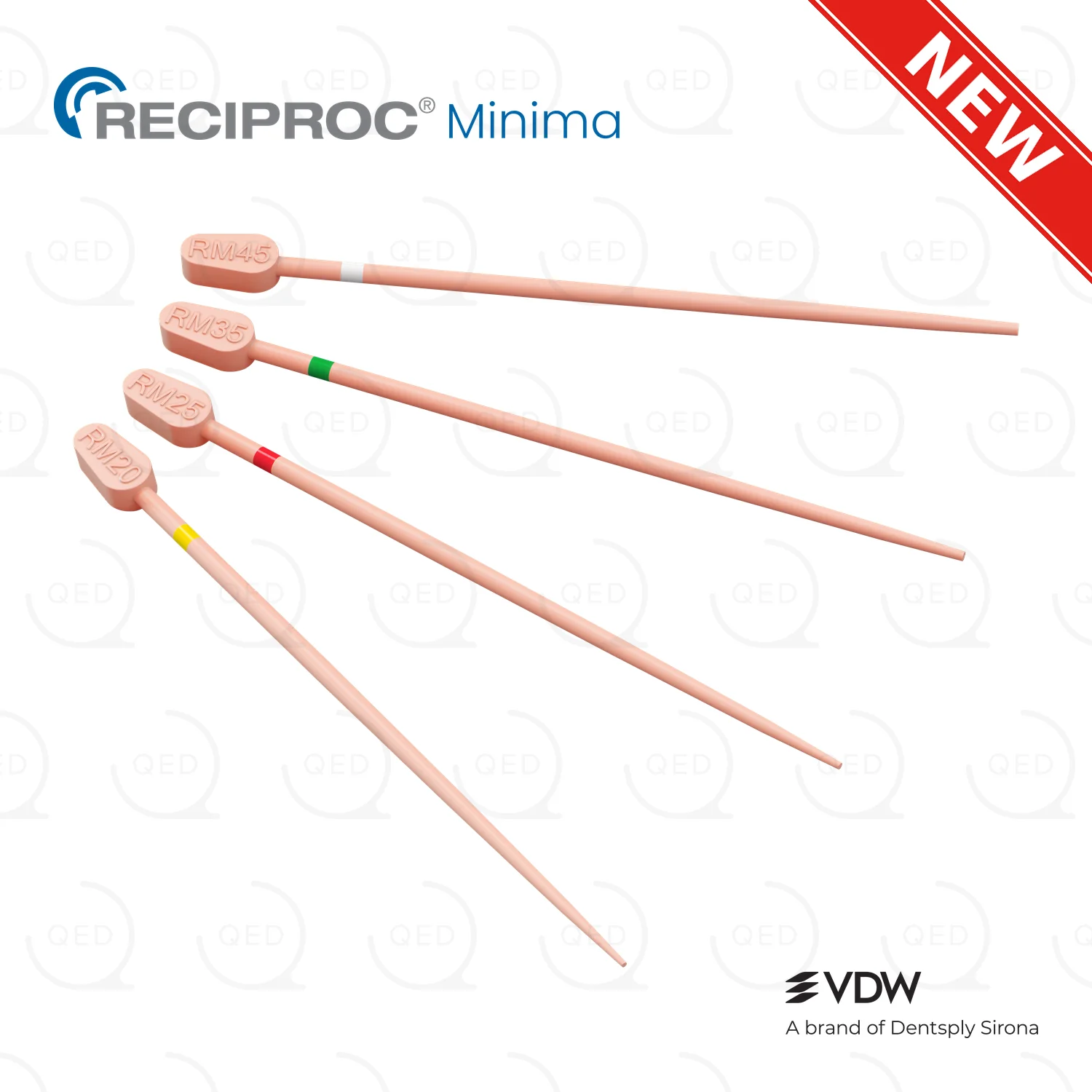
morita · dentaport root zx · apex locator
working lengthwet or dry canalsacoustic guidance
the dentaport root zx is morita’s established desktop apex locator. morita put its case simply: the patented quotient method gives precise results irrespective of irrigation solution or blood in the root canal, shown on a large colour display with acoustic signals as the file approaches the apex.
the root zx is the benchmark apex locator – when a new locator comes to market, the root zx is the one it is usually compared with. the dentaport root zx is morita’s established desktop version of it.
| ~100 hours on 3 x aa | 370 g approx. weight | 2 yrs warranty |
this pack: morita dentaport root zx apex locator · 1 measuring cable (probe cord) · 5 contrary electrodes · 3 file holders · 1 test plug · 3 aa batteries
› precise, reliable measurement – morita state it is unaffected by irrigant or blood in the canal.
› large colour display showing the file’s position as it advances.
› acoustic signals as the file reaches, or nears, the apex – so you can keep your eyes on the tooth.
› no zero adjustment – always ready to use, with automatic calibration.
› weekly self-check with the test plug supplied: it plugs into the probe cord and the meter should read within 3 bars of the “1” mark.
the meter runs down towards the apex mark as the file advances. morita’s instructions use the 0.5 reading as the working-length reference, with the final working length a matter of clinical judgement for each canal.
| root zx3 | root zx3 – the current generation. 40-bar real-time display, 4 x aa, approx. 390 g, 85 x 95 x 100 mm. |
| dentaport root zx | this page. the established unit. large colour display with acoustic signals, 3 x aa, approx. 370 g, 105 x 105 x 115 mm. |
| root zx mini | root zx mini – hand-sized. colour lcd, 3 x aaa, approx. 110 g, 57 x 60 x 103 mm. |
| in the motor | x-smart® pro+ – if you would rather the locator sat inside the endo motor. dentsply sirona. |
morita’s instructions state the unit must not be used on a patient fitted with a pacemaker or icd. the file holders and contrary electrodes are autoclavable up to 135 °c. the probe cord is approx. 1.6 m. the full instructions are linked below.
how long do the batteries last?
morita’s instructions give approximately 100 hours of use – roughly six to twelve months at a normal rate.
my probe cord has failed. which one do i need?
the current cord for the dentaport root zx is the probe cord root zx (mk2). not sure? call us with the unit and we will check it.
is the root zx3 a replacement for this unit?
the root zx3 is morita’s current generation, with a 40-bar real-time display on a smaller footprint. the dentaport root zx remains a proven choice; the table above sets the two side by side.
| contrary electrodes | contrary electrode (all morita) – the lip hook; worth a spare set so one is always through the autoclave |
| file holders | file holder (pack of 3) – clips the file shaft to the probe cord |
| probe cord | probe cord root zx (mk2) – the current cord for the dentaport root zx |
| touch probe | long file touch probe – autoclavable; listed by morita as an accessory for this unit |
| hand files | c-pilot® 10, 25 mm · c-pilot® 08, 25 mm |
› dentaport zx instructions for use (pdf, morita website) – operating, safety and reprocessing instructions for the apex locator module.
morita · dentaport root zx set, morita order no. 6960 · model dp-zx, canal measurement module · made by j. morita mfg. corp., kyoto
*Lower Price*
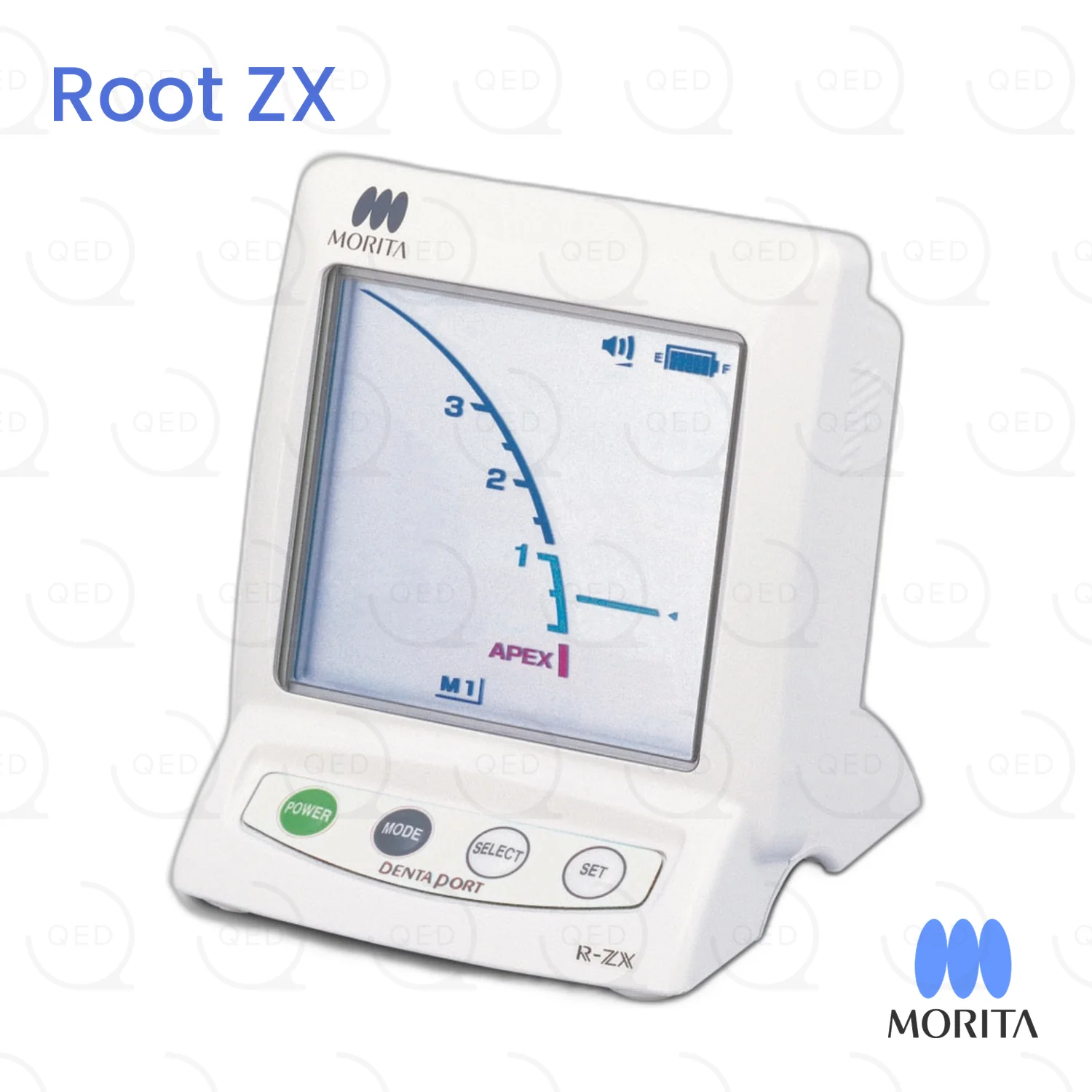
morita · root zx3 · apex locator
working lengthwet or dry canalscompact footprint
root zx3 is the latest generation of morita’s root zx apex locator line. morita describe it as a smaller unit with a larger, high-contrast screen, running the same apex location technology the root zx name was built on – with the reading drawn in real time across 40 indicator bars, in dry canals or wet.
| 40 indicator bars | ~6 months on 4 x aa | 2 yrs warranty |
this pack: morita root zx3 apex locator (apex locator module) · 5 contrary electrodes · 3 file holders · 1 probe cord · 4 aa alkaline batteries
› full functionality in dry or wet canals – morita’s words, and the point of the root zx method.
› automatic calibration to compensate for changes in environment, such as temperature and humidity, and for ageing of the unit. no zero adjustment before each canal.
› real-time reading across 40 indicator bars on a large, easy-to-read lcd.
› customisable working-length point, with adjustable volume and a clearly audible signal.
› approx. 85 x 95 x 100 mm and 390 g with batteries – sized for the bracket table.
the root zx is the benchmark apex locator – when a new locator comes to market, the root zx is the one it is usually compared with. that is the standing the zx3 inherits.
morita state that their apex location technology has been independently evaluated at a 97.5% accuracy rate. their footnote names the study – guise, goodell & imamura, journal of endodontics 2010;36(2):279-81 – and says it was tested with the root zx ii. it is an in vitro comparison of three locators and an earlier model of the family, so we quote it as morita do: a figure for the root zx technology, not a clinical result for this unit.
what the zx3 changes is the working experience: the reading moves smoothly as the file advances, the screen is larger and higher-contrast, and the unit takes less room.
as with every root zx, the meter runs down towards the apex mark as the file advances. morita’s instructions describe the 0.5 reading as the file tip being very near the physiological apical foramen, for use as a working-length reference – and leave the final working length to the clinician’s judgement for each canal.
| root zx3 | this page. the current generation. 40-bar real-time display, 4 x aa, approx. 390 g, 85 x 95 x 100 mm. |
| dentaport root zx | dentaport root zx – the established unit. large colour display with acoustic signals, 3 x aa, approx. 370 g, 105 x 105 x 115 mm. |
| root zx mini | root zx mini – hand-sized. colour lcd, 3 x aaa, approx. 110 g, 57 x 60 x 103 mm. |
| in the motor | x-smart® pro+ – if you would rather the locator sat inside the endo motor. dentsply sirona. |
morita’s instructions state the unit must not be used on a patient fitted with a pacemaker, icd or cochlear implant. the file holders and contrary electrodes are autoclavable (no higher than 135 °c); the probe cord and the unit are wiped, not autoclaved. the full instructions are linked under downloads.
does blood or irrigant in the canal stop it working?
morita state full functionality in dry or wet canals.
do i have to zero it before each canal?
no. morita describe automatic calibration that compensates for environment and ageing.
what does it run on, and for how long?
four aa alkaline batteries, included. morita’s instructions put battery life at approximately six months.
will my existing root zx accessories fit?
the contrary electrode and file holders we stock are morita’s autoclavable parts for the root zx family, and our listings name the root zx3. if you are unsure about a cord or an older part, call us with the model and we will check it.
| contrary electrodes | contrary electrode (all morita) – the lip hook; worth a spare set so one is always through the autoclave |
| file holders | file holder (pack of 3) – clips the file shaft to the probe cord |
| touch probe | long file touch probe – autoclavable; listed by morita as an accessory for this unit |
| hand files | c-pilot® 10, 25 mm · c-pilot® 08, 25 mm |
› root zx3 product flyer (pdf, 0.1 mb, morita) – features, specification and box contents.
› root zx3 instructions for use (pdf, morita website) – the full operating, safety and reprocessing instructions.
morita · root zx3, model rzx3, type rcm · morita product no. 6903 · made by j. morita mfg. corp., kyoto · distributed in europe by j. morita europe gmbh
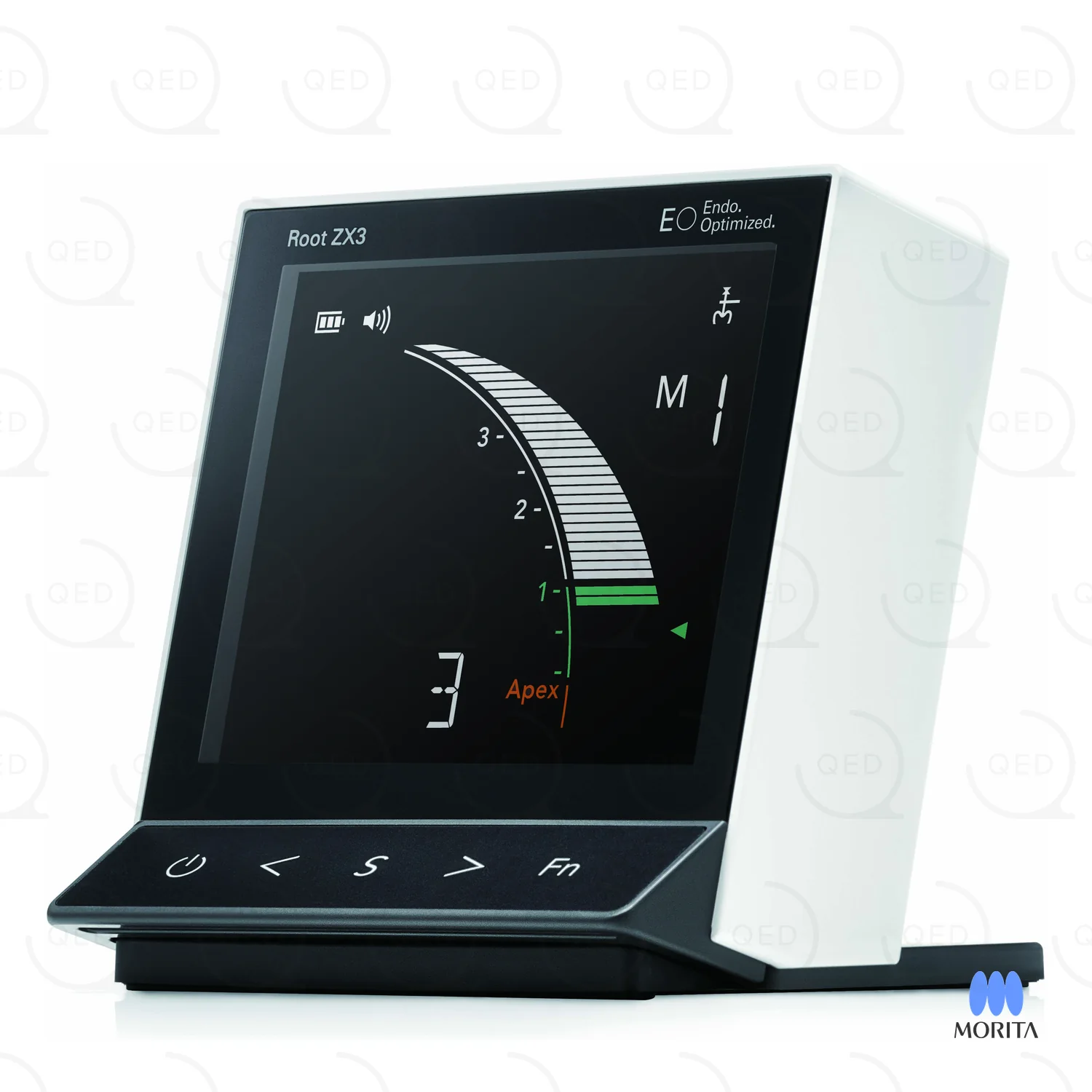
morita · root zx mini · apex locator
working lengthwet or dry canalscompact
the root zx mini is compact, lightweight and designed to fit the hand – morita suggest it sits on a tray, the patient’s apron or anywhere convenient. inside is the same proven root zx ratio technique, with no calibration or zero adjustment before each canal.
| 110 g approx. weight | ~70 hours on 3 x aaa | 1 yr warranty |
this pack: morita root zx mini apex locator · 1 mini measuring cable (probe cord) · 5 contrary electrodes · 3 file holders · 1 mini test plug · 3 aaa batteries
› accurate – morita’s ratio technique; they state the reading is not affected by the presence or absence of fluids in the canal.
› simple – automatically adjusts to changes in temperature, moisture and so on inside the canal, even during treatment.
› large colour lcd with a high-contrast bar display.
› memory bar to mark the start of a sharp curve, or a set distance from the apex, as a guide to a consistent working length.
› flash bar set anywhere between 2 and apex as your reference point.
“the meter’s 0.5 reading indicates that the file tip is located very near the physiological apical foramen. use this to determine the working length depending on the individual case. the exact working length depends on the shape and condition of the canal, and a clinical judgement must be made by the dentist.”
morita, root zx mini brochure
the root zx is the benchmark apex locator – when a new locator comes to market, the root zx is the one it is usually compared with. the mini puts the same method in a hand-sized unit.
morita state the root zx technology has been independently evaluated at a 97.5% accuracy rate. the study they cite for it in their root zx3 literature is guise, goodell & imamura, journal of endodontics 2010;36(2):279-81, an in vitro comparison tested with the root zx ii – a figure for the technology, not a clinical result for this unit.
| root zx3 | root zx3 – the current generation. 40-bar real-time display, 4 x aa, approx. 390 g, 85 x 95 x 100 mm. |
| dentaport root zx | dentaport root zx – the established unit. large colour display with acoustic signals, 3 x aa, approx. 370 g, 105 x 105 x 115 mm. |
| root zx mini | this page. -sized. colour lcd, 3 x aaa, approx. 110 g, 57 x 60 x 103 mm. |
| in the motor | x-smart® pro+ – if you would rather the locator sat inside the endo motor. dentsply sirona. |
morita’s instructions state the unit must not be used on a patient fitted with a pacemaker or icd, and set out further precautions. file holders and contrary electrodes are autoclavable at no more than 135 °c. check it weekly with the test plug: it plugs into the probe cord jack and the meter should read within 3 bars of the “1” mark.
how long do the batteries last?
morita’s instructions give about 70 hours of use from three aaa alkaline cells – six to twelve months at a normal rate.
does it need a different probe cord from the bigger units?
yes – the root zx mini probe cord has an angled plug made for the mini’s curved body.
mini or root zx3?
both use morita’s root zx method. the root zx3 is the current desktop generation with a 40-bar real-time display; the mini is the one to choose where space, or carrying it between surgeries, matters.
| contrary electrodes | contrary electrode (all morita) – the lip hook; worth a spare set so one is always through the autoclave |
| file holders | file holder (pack of 3) – clips the file shaft to the probe cord |
| probe cord | probe cord root zx mini – angled plug made for the mini |
| tester | root zx mini multi function tester – the weekly accuracy check |
| touch probe | long file touch probe – autoclavable; listed by morita as an accessory for this unit |
| hand files | c-pilot® 10, 25 mm · c-pilot® 08, 25 mm |
› root zx mini brochure (pdf, 0.4 mb, morita) – display guide, specification and accessories.
› root zx mini instructions for use (pdf, morita website) – operating, safety and reprocessing instructions.
morita · root zx mini, model rcm-7 · dc 4.5 v, 0.2 w · approx. 57 x 60 x 103 mm · made by j. morita mfg. corp., kyoto

obtura spartan · complete system, ref 823-800
a downpack leaves you with a canal to fill and a viscosity problem. the obtura iii max heats gutta percha in the handpiece and delivers it through a bendable applicator needle, so the material arrives warm enough to adapt rather than cool enough to fight. mains powered, cartridge free, and built round a closed-loop heater that reads its own temperature several hundred times a second.
| 200°c maximum set point | 180 sec to full temperature | 5 memory presets |
this pack: obtura iii max heated gutta percha system · control unit, plug-in handpiece, handpiece stand, power supply with interchangeable blades, multi-tool, thermal protector, 23g applicator needles, gutta percha pellets and the obtura cleaning kit
obtura spartan describe the iii max as the instrument that heats gutta percha to its ideal viscosity for backfill, and put over 25 years of clinical performance behind the platform. the engineering underneath it is straightforward: a thermocouple sits inside the heating element, the control unit reads it several hundred times a second and switches the heater to match, and the manual puts the displayed temperature within +/-5°c.
› digital set point, in single degrees. five memory positions, factory set to 140, 150, 170, 180 and 200°c, and they survive a power cut.
› cartridge free. one gutta percha stick loads through the top of the handpiece – no cartridge to change mid-procedure.
› mains, not battery. obtura spartan make the point plainly: no downtime for charging.
› enhanced thermal protector. obtura spartan state the redesigned protector significantly reduces heat around patient contact surfaces, drawing warm air away from the tip.
› interchangeable handpiece. any iii max handpiece works with any iii max base unit – but it will not retrofit to an obtura iii or earlier.
| model | 823-800. dc 12v, 1.0a, via external power supply – mains voltage never enters the unit |
| classification | medical device class iia · electrical class ii · type bf applied part · en 60601-1 and en 60601-1-2 |
| temperature | set in single degrees to a 200°c maximum, accurate to +/-5°c. about 180 seconds from room temperature to 200°c |
| needles | 20g, 23g or 25g applicator needles, bendable, single use |
| in normal use | 0-40°c ambient, 10-90% relative humidity, non-condensing |
› one stick of gutta percha at a time. the mechanical lengths inside the handpiece are designed for a single piece; more can cause excessive back pressure and damage the seal. never leave a partial stick in the chamber between procedures.
› clean the chamber daily, ideally after each use. skipping it lets old gutta percha harden in the heater bore. obtura spartan note that failure to clean to the manual can void the warranty.
› the handpiece is not autoclavable. only the thermal protectors and the multi-tool go in the autoclave – 132°c prevacuum, 4 minutes. the base and handpiece are wiped and disinfected instead, and never sprayed directly.
› a new applicator needle for every patient. needles are single use, and bend once only, at the largest diameter, using the multi-tool.
is it battery or mains? mains, through an external 12v supply with interchangeable plug blades. obtura spartan sell the absence of a battery as a feature – nothing to charge, nothing flat at the wrong moment.
how long before i can use it? about three minutes from cold to the 200°c maximum. lower set points are reached sooner, and the five memory positions mean you are not dialling in from scratch each session.
what does it cost to run? applicator needles are single use, and gutta percha is consumed a stick at a time. the plunger seal, needle nuts, bushing and thermal protectors are replaceable wear parts – all listed below, and all held here.
| applicator needles | 20g black (5) · 23g blue (5) · 25g green (5) |
| cleaning | obtura cleaning kit · cleaning brushes (2) |
| wear parts | thermal protectors (4) · plunger seal assembly · needle lock nuts (2) · handpiece bushing |
| tools and power | multi-tool · plunger shaft assembly · ac adapter |
| sealer | neosealer® ezflo kit · ah plus® paste 8ml · vdw 2seal |
| coronal seal | sdr® flow+ refill universal – the apical seal is only half the job |
| ultrasonics | buc® 1 the cutter · cpr® 1 the mover |
mains powered · class iia · type bf · 200°c maximum · 1 year warranty · ref obt-823-800kit · mfr code 823-800
obtura spartan · wear parts
you can check this one without taking anything apart. obtura spartan point out that gutta percha expressed through the handpiece gives a quick and accurate indication of the plunger seal's condition. if material is passing back by the seal rather than forward down the needle, the seal is the part to change.
this pack: obtura plunger seal assembly · one assembly · screws onto the plunger shaft of the obtura iii max · fitted with the multi-tool’s hex opening
› replace when: the seal is torn, missing, worn or broken, or excessive gutta percha passes by it
› fitting: insert the assembly into the small hex opening on the multi-tool, unscrew it from the plunger shaft, and fit the new one the same way – do not over-tighten
› consumable: obtura spartan name plunger seals as consumable items, outside the one-year parts warranty
› more than one stick of gutta percha. the manual's capitalised warning: using more than one stick at a time may damage the seal. the mechanical lengths inside the handpiece are designed for a single piece.
› a partial stick left in the chamber. never between procedures.
› a skipped clean. hardened gutta percha on the seal is exactly what the daily brush-and-solvent routine exists to prevent.
obtura spartan list repeated plunger seal failure as one of the three triggers for extended maintenance – the deeper clean that uses the heater reamer tool. if a new seal fails again quickly, the plunger shaft itself is the next thing to inspect, for exposed metal threads at the tip or other obvious erosion.
how often should it be changed? on condition, not on a schedule. obtura spartan say to observe the seal for wear and replace it if it is torn or missing – that inspection is step six of the regular maintenance routine, so it happens every clean.
is the seal included with a new plunger shaft? yes. obtura spartan supply 823-812 as the plunger shaft with plunger seal, so if the shaft is going too you do not need both – see plunger shaft with seal.
| the unit | obtura iii max system |
| needed to fit | multi-tool |
| bigger job | plunger shaft with seal |
| keeping it clean | obtura cleaning kit · cleaning brushes (2) |
single assembly · obtura iii max · consumable · ref obt-823618 · mfr code 823-618
obtura spartan · applicator needles
the needle is what gets warm gutta percha to the right depth, and it is single use. obtura spartan's applicator needles are soft silver, designed to conduct heat so the tip stays at working temperature, and bendable so you can shape one to the tooth in front of you. 20g is the widest of the three – the least resistance to express through, and the choice when the canal takes it.
this pack: obtura applicator needles, 20g, black · pack of 5 · single use · fits the obtura iii max handpiece
› gauge: 20g, colour coded black
› pack: 5 needles
› use: single use. obtura spartan require a new needle for every patient, and whenever damage is detected or suspected
› bending: once only, at the largest diameter, as close to the thermal protector as possible, using the multi-tool
› express about 3cm of gutta percha before you start, so up-to-temperature material is sitting at the needle tip.
› let the fill push the needle out of the canal rather than withdrawing it – obtura spartan warn that pulling it out can leave voids.
› never bend at a taper, and never bend twice. a kink blocks flow, and repeated bending weakens the needle to the point of breakage.
› for awkward access, loosen the needle nut, rotate the needle and re-tighten – do not leave the nut loose to swivel during use.
which gauge should i stock? the iii max system ships with 23g, which is the usual working choice. practices doing a wide spread of cases tend to keep a wider gauge for generous canals and a narrower one for tight ones – 23g and 25g are the alternatives to this needle. the narrower the needle, the more the gutta percha has to be properly up to temperature to pass.
can a needle be sterilised and re-used? no. these are single use. obtura spartan are explicit that the needle is changed after each patient, both for correct operation and to prevent cross-infection.
| other gauges | 23g blue · 25g green |
| the unit | obtura iii max system |
| needed alongside | multi-tool · needle lock nuts (2) · thermal protectors (4) |
| keeping it clean | obtura cleaning kit |
single use · 20g · black · pack of 5 · bendable · ref obt-823620 · mfr code 823-620
obtura spartan · applicator needles
the needle is what gets warm gutta percha to the right depth, and it is single use. obtura spartan's applicator needles are soft silver, designed to conduct heat so the tip stays at working temperature, and bendable so you can shape one to the tooth in front of you. 23g is the middle gauge, and the one supplied in the iii max system box.
this pack: obtura applicator needles, 23g, blue · pack of 5 · single use · fits the obtura iii max handpiece
› gauge: 23g, colour coded blue
› pack: 5 needles
› use: single use. obtura spartan require a new needle for every patient, and whenever damage is detected or suspected
› bending: once only, at the largest diameter, as close to the thermal protector as possible, using the multi-tool
› express about 3cm of gutta percha before you start, so up-to-temperature material is sitting at the needle tip.
› let the fill push the needle out of the canal rather than withdrawing it – obtura spartan warn that pulling it out can leave voids.
› never bend at a taper, and never bend twice. a kink blocks flow, and repeated bending weakens the needle to the point of breakage.
› for awkward access, loosen the needle nut, rotate the needle and re-tighten – do not leave the nut loose to swivel during use.
which gauge should i stock? the iii max system ships with 23g, which is the usual working choice. practices doing a wide spread of cases tend to keep a wider gauge for generous canals and a narrower one for tight ones – 20g and 25g are the alternatives to this needle. the narrower the needle, the more the gutta percha has to be properly up to temperature to pass.
can a needle be sterilised and re-used? no. these are single use. obtura spartan are explicit that the needle is changed after each patient, both for correct operation and to prevent cross-infection.
| other gauges | 20g black · 25g green |
| the unit | obtura iii max system |
| needed alongside | multi-tool · needle lock nuts (2) · thermal protectors (4) |
| keeping it clean | obtura cleaning kit |
single use · 23g · blue · pack of 5 · bendable · ref obt-823623 · mfr code 823-623
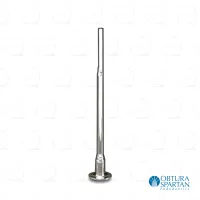
obtura spartan · applicator needles
the needle is what gets warm gutta percha to the right depth, and it is single use. obtura spartan's applicator needles are soft silver, designed to conduct heat so the tip stays at working temperature, and bendable so you can shape one to the tooth in front of you. 25g is the narrowest of the three, for the tighter canal – expect to need the gutta percha properly up to temperature before it will pass.
this pack: obtura applicator needles, 25g, green · pack of 5 · single use · fits the obtura iii max handpiece
› gauge: 25g, colour coded green
› pack: 5 needles
› use: single use. obtura spartan require a new needle for every patient, and whenever damage is detected or suspected
› bending: once only, at the largest diameter, as close to the thermal protector as possible, using the multi-tool
› express about 3cm of gutta percha before you start, so up-to-temperature material is sitting at the needle tip.
› let the fill push the needle out of the canal rather than withdrawing it – obtura spartan warn that pulling it out can leave voids.
› never bend at a taper, and never bend twice. a kink blocks flow, and repeated bending weakens the needle to the point of breakage.
› for awkward access, loosen the needle nut, rotate the needle and re-tighten – do not leave the nut loose to swivel during use.
which gauge should i stock? the iii max system ships with 23g, which is the usual working choice. practices doing a wide spread of cases tend to keep a wider gauge for generous canals and a narrower one for tight ones – 20g and 23g are the alternatives to this needle. the narrower the needle, the more the gutta percha has to be properly up to temperature to pass.
can a needle be sterilised and re-used? no. these are single use. obtura spartan are explicit that the needle is changed after each patient, both for correct operation and to prevent cross-infection.
| other gauges | 20g black · 23g blue |
| the unit | obtura iii max system |
| needed alongside | multi-tool · needle lock nuts (2) · thermal protectors (4) |
| keeping it clean | obtura cleaning kit |
single use · 25g · green · pack of 5 · bendable · ref obt-823635 · mfr code 823-635
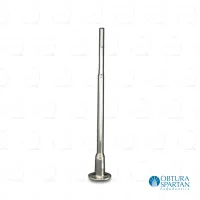
obtura spartan · wear parts
obtura spartan give you a bench test for this one. the plunger shaft should roll smoothly on a piece of glass or a flat tabletop. if it will not, it is bowed or bent – and they warn that a bent shaft may cause damage to the heater bore. that is the expensive failure this part exists to head off.
this pack: obtura iii max plunger shaft with plunger seal · one assembly · seal supplied fitted · for the obtura iii max
› check the teeth: inspected for wear and chipping. replace the shaft if the teeth are badly chipped, or if slipping occurs during testing
› check the tip: exposed metal threads at the tip of the shaft, or other obvious erosion, mean it is time
› check it is straight: roll it. a bow or bend is a replacement, not something to work around
› seal included: obtura spartan supply this as the shaft with plunger seal
pressing the handpiece trigger drives the shaft forward through a spring-loaded pawl, and the shaft pushes the gutta percha into the heating chamber. the whole feel of the instrument – whether the trigger bites, whether the material moves – comes back to the teeth on this shaft and the pawl that engages them.
obtura spartan list “the plunger shaft repeatedly gets stuck in handpiece” as one of the three triggers for extended maintenance, alongside repeated plunger seal failure. if a new seal keeps going, or the shaft binds after a proper clean, this is the next part to look at.
do i need a separate plunger seal too? no – the seal comes fitted. the plunger seal assembly is sold on its own for when the shaft is sound and only the seal has gone.
will it fit an older obtura iii? obtura spartan list this as the obtura iii max shaft, and note separately that the iii max handpiece will not retrofit to the obtura iii or any previous model. if you are running an older unit, check with us before ordering.
| the unit | obtura iii max system |
| seal only | plunger seal assembly |
| the tools | multi-tool |
| keeping it clean | obtura cleaning kit · cleaning brushes (2) |
shaft + seal · obtura iii max · ref obt-823812 · mfr code 823-812
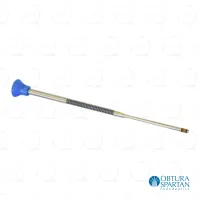
ah plus® · 8 ml paste · tube set
epoxy-amine resincold and warm techniquescarrier-basedpermanent obturationmixed 1:1 on the pad
ah plus is dentsply sirona’s epoxy-amine root canal sealer, launched in 1995 and, in their own scientific manual’s words, “described by many authors as the ‘gold standard’ in root canal sealing materials”. this is the tube set: two pastes, mixed 1:1 on the pad, for as much or as little as the case needs.
| 1995 year launched | 36 studies, ds review | 4 hrs working time, 23 °c |
this pack: ah plus® root canal sealer tube set – paste a 4 ml, paste b 4 ml and a mixing pad (8 ml of paste in all)
made by dentsply sirona · dentsply detrey gmbh, konstanz
› epoxy-amine chemistry. an epoxide paste and an amine paste. dentsply sirona credit the composition with “low solubility, self-adhesive properties with adhesion to dentin, outstanding low leakage, and excellent sealing performance”.
› radiopaque by design. finely ground calcium tungstate and zirconium oxide, at a filler content of about 76%, per the scientific manual.
› time to work. about 4 hours’ working time at 23 °c, setting within 24 hours – dentsply sirona’s figures.
› cold, warm or carrier-based. dentsply sirona design ah plus for both cold and warm obturation, including carrier-based systems.
› the reference point. the manual calls it “the benchmark for evaluating new sealers in both clinical and laboratory settings”.
dentsply sirona’s ah plus scientific manual (2025) collects 36 clinical studies published between 2007 and 2024 – 21 randomised trials, 7 non-randomised trials and 8 retrospective studies – covering 3,407 patients and 3,735 treated teeth. their summary:
“the use of ah plus resulted in a high treatment success rate regardless of the obturation technique (including single cone obturation) and type of treatment (primary or secondary). in most studies, the long-term success rate exceeded 80%.”
dentsply sirona, ah plus® scientific manual, 2025
where post-obturation pain occurred in those studies it was mild to moderate, and fell significantly within 48 to 72 hours. it is dentsply sirona’s own selection of the clinical literature, and we pass it on as that – the manual is in the downloads below, with every study named.
| ah plus 8 ml paste | this page. two tubes, mixed 1:1 on a pad or glass slab with a metal spatula. you mix what the case needs, and the pad suits coating a cone. |
| ah plus jet | the same epoxy-amine sealer in a double-barrel syringe, mixed as it passes through a disposable tip – one tip per application. start with the starter kit, then reorder the refill and mixing tips. |
1mix. equal volume units (1:1) of paste a and paste b, on a glass slab or mixing pad, with a metal spatula, to a homogeneous consistency.
2coat. apply a light coating to the canal walls, or use a lentulo spiral at low speed.
3obturate. dip the disinfected, dry points into the sealer and insert them into the canal. warm and carrier-based techniques follow their own directions.
worth knowing before you open it: the directions list hypersensitivity to epoxy resins, amines or other components as a contraindication, and warn that the unset pastes may cause sensitisation in susceptible people – gloves and eye protection, and keep unset paste off skin and mucosa.
is it the same sealer as ah plus jet?
dentsply sirona describe the jet as the ah plus formula in a double-barrel syringe. the difference is delivery: the jet mixes for you, the tubes suit a pad and spatula.
how long have i got once it is mixed?
about 4 hours at 23 °c, by dentsply sirona’s figures, and it sets within 24 hours.
which points go with it?
the cone matched to the file that cut the canal – for example waveone gold conform fit primary, protaper ultimate conform fit f2, protaper gold conform fit f2 or trunatomy conform fit prime. for carrier-based obturation, guttacore.
resin or bioceramic?
a real choice of technique rather than a ranking – we carry both because both are right in different hands. for bioceramic, neosealer ezflo is premixed and places sealer through 29 gauge navitip cannulas (25 mm tips; 21 mm tips too). dentsply sirona now have a bioceramic of their own, proroot bio sealer – premixed, 25 gauge proroot flex tip.
| irrigants | chlorax 5.25%, chlorax 2% and endo-solution 17% edta. |
| activation | smartlite pro endoactivator – dentsply sirona’s own. |
| points | conform fit, matched to the file: waveone gold, protaper ultimate, protaper gold, trunatomy. |
| carrier-based | guttacore – crosslinked gutta-percha core obturators. |
| automix | ah plus jet starter kit – the same sealer, mixed in the tip. |
| bioceramic | neosealer ezflo – premixed, 29 gauge navitip delivery · proroot bio sealer – dentsply sirona's own. |
| coronal seal | sdr flow+ refill universal – 4 mm bulk increment, one cure. |
› ah plus® scientific manual (pdf, 0.6 mb, dentsply sirona) – 30 years of clinical studies, each one summarised.
› ah plus® brochure (pdf, 1.4 mb, dentsply sirona) – the ah plus and ah plus jet range.
composition, the 1995 launch, the 36-study review and its conclusion are from dentsply sirona’s ah plus® scientific manual (2025). working and setting times, technique and cautions are from dentsply sirona’s directions for use; pack contents from their ah plus brochure. we make no claim of our own about seal, leakage or outcome. dentsply sirona, ah plus, ah plus jet, waveone, protaper, trunatomy, conform fit, guttacore, smartlite and sdr are their trademarks.
ah plus® root canal sealer · epoxy-amine resin · paste a 4 ml + paste b 4 ml · mixing pad · dentsply sirona · ref qedahplus
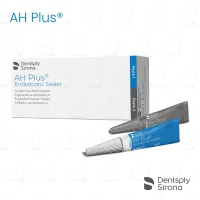
ss white endoguide® bur eg2 · 27 mm · pack of 5
de-roofingorifice enlargementcalcified canals
which endoguide® bur is eg2? ss white’s reference chart gives eg2 a 2.5 mm head on a 27 mm right angle shank, and lists it for: de-roofing pulp chamber; deep orifice enlargement and calcified canals. the endoguide® range is a set of carbide burs with a micro-diameter conical tip, made for root canal access and exploration.
this pack: ss white endoguide® bur eg2, carbide, right angle shank, 27 mm (pack of 5)
| type | carbide micro endodontic bur (ss white) |
| head length | 2.5 mm |
| tip diameter | 0.33 mm |
| back diameter | 1.07 mm |
| overall length | 27 mm |
| shank | right angle, surgical length (ss white code slra) – for slow-speed right-angle handpieces |
| pack | pack of 5 |
| ss white lists it for | • de-roofing pulp chamber • deep orifice enlargement and calcified canals |
› what they are. ss white describe endoguide® as an innovative set of carbide burs designed for non-surgical endodontic procedures, developed in conjunction with dr david clark dds and dr john a khademi dds ms.
› what they are designed for. root canal access and exploration; tactile and magnification-enhanced endodontics; use by endodontists and general dentists.
› design aims they list. funnel-shaped access for file introduction, access to calcified and hidden canals, conserving peri-cervical dentin, and reduced dependence on ultrasonic tips.
› tip and shape. against conventional access burs, ss white describe the micro-diameter tip as leading to more conservative access and the conical shape to more efficient access. they describe the tip as a self-centring guide, and the straight-line pathway as reducing the risk of gouging and perforation when used with an incisal access technique for canal entry.
“this is an ideal bur series for magnification-driven endodontics.”
eric herbranson, bs, dds, ms – quoted in ss white’s endoguide® brochure
the eight burs in ss white’s chart, with the figures ss white print for each:
| eg1a | endoguide® eg1a (5) 27 mm · friction grip · head 2.5 mm · tip 0.33 mm – initial access in non-restored anterior and bicuspid teeth |
| eg1 | endoguide® eg1 (5) 27 mm · right angle · head 3.5 mm · tip 0.28 mm – deep troughing; deeper orifice enlargement and calcified canals |
| eg2 | this page. 27 mm · right angle · head 2.5 mm · tip 0.33 mm – de-roofing pulp chamber; deep orifice enlargement and calcified canals |
| eg3 | endoguide® eg3 (5) 27 mm · friction grip · head 1.5 mm · tip 0.28 mm – initial access for small incisors; troughing and navigating calcified canals |
| eg4 | endoguide® eg4 (5) 29 mm · friction grip · head 3.5 mm · tip 0.28 mm – deep troughing; navigating super ovoid and calcified canals |
| eg5 | endoguide® eg5 (5) 34 mm · right angle · head 1.5 mm · tip 0.28 mm – deep troughing; retrieving separated instruments; navigating deeply calcified canals |
| eg6 | endoguide® eg6 (5) 34 mm · right angle · head 2.5 mm · tip 0.28 mm – deep troughing; retrieving separated instruments; navigating deeply calcified canals |
| eg7 | endoguide® eg7 (5) 34 mm · right angle · head 1.5 mm · tip 0.33 mm – deep troughing; retrieving separated instruments; navigating deeply calcified canals |
ss white include eg2 in the endoguide® molar kit and endoguide® anterior/bicuspid kit. ss white add a note to the kit listings: initial access and de-roofing in molars should be performed with either the great white® #2 bur or the great white® z diamonds supplied in the endoguide® anterior/bicuspid kit, order number 18052.
| kits | endoguide® molar kit · endoguide® anterior/bicuspid kit |
| hand file | vdw c-pilot™ 08, 25 mm · c-pilot™ 10, 25 mm |
| irrigants | chlorax 5.25% sodium hypochlorite · chlorax 2% |
endoguide® bur eg2 · right angle shank (slra) · 27 mm · head 2.5 mm · tip 0.33 mm · back 1.07 mm · carbide · pack of 5 · made by ss white burs, inc., lakewood, new jersey, usa · mfr code 14779 · ref ssw-14779
ss white endoguide® bur eg1 · 27 mm · pack of 5
deep troughingorifice enlargementcalcified canals
which endoguide® bur is eg1? ss white’s reference chart gives eg1 a 3.5 mm head on a 27 mm right angle shank, and lists it for: deep troughing; deeper orifice enlargement and calcified canals. the endoguide® range is a set of carbide burs with a micro-diameter conical tip, made for root canal access and exploration.
this pack: ss white endoguide® bur eg1, carbide, right angle shank, 27 mm (pack of 5)
| type | carbide micro endodontic bur (ss white) |
| head length | 3.5 mm |
| tip diameter | 0.28 mm |
| back diameter | 0.71 mm |
| overall length | 27 mm |
| shank | right angle, surgical length (ss white code slra) – for slow-speed right-angle handpieces |
| pack | pack of 5 |
| ss white lists it for | • deep troughing • deeper orifice enlargement and calcified canals |
› what they are. ss white describe endoguide® as an innovative set of carbide burs designed for non-surgical endodontic procedures, developed in conjunction with dr david clark dds and dr john a khademi dds ms.
› what they are designed for. root canal access and exploration; tactile and magnification-enhanced endodontics; use by endodontists and general dentists.
› design aims they list. funnel-shaped access for file introduction, access to calcified and hidden canals, conserving peri-cervical dentin, and reduced dependence on ultrasonic tips.
› tip and shape. against conventional access burs, ss white describe the micro-diameter tip as leading to more conservative access and the conical shape to more efficient access. they describe the tip as a self-centring guide, and the straight-line pathway as reducing the risk of gouging and perforation when used with an incisal access technique for canal entry.
“this is an ideal bur series for magnification-driven endodontics.”
eric herbranson, bs, dds, ms – quoted in ss white’s endoguide® brochure
the eight burs in ss white’s chart, with the figures ss white print for each:
| eg1a | endoguide® eg1a (5) 27 mm · friction grip · head 2.5 mm · tip 0.33 mm – initial access in non-restored anterior and bicuspid teeth |
| eg1 | this page. 27 mm · right angle · head 3.5 mm · tip 0.28 mm – deep troughing; deeper orifice enlargement and calcified canals |
| eg2 | endoguide® eg2 (5) 27 mm · right angle · head 2.5 mm · tip 0.33 mm – de-roofing pulp chamber; deep orifice enlargement and calcified canals |
| eg3 | endoguide® eg3 (5) 27 mm · friction grip · head 1.5 mm · tip 0.28 mm – initial access for small incisors; troughing and navigating calcified canals |
| eg4 | endoguide® eg4 (5) 29 mm · friction grip · head 3.5 mm · tip 0.28 mm – deep troughing; navigating super ovoid and calcified canals |
| eg5 | endoguide® eg5 (5) 34 mm · right angle · head 1.5 mm · tip 0.28 mm – deep troughing; retrieving separated instruments; navigating deeply calcified canals |
| eg6 | endoguide® eg6 (5) 34 mm · right angle · head 2.5 mm · tip 0.28 mm – deep troughing; retrieving separated instruments; navigating deeply calcified canals |
| eg7 | endoguide® eg7 (5) 34 mm · right angle · head 1.5 mm · tip 0.33 mm – deep troughing; retrieving separated instruments; navigating deeply calcified canals |
ss white include eg1 in the endoguide® molar kit and endoguide® anterior/bicuspid kit.
| kits | endoguide® molar kit · endoguide® anterior/bicuspid kit |
| hand file | vdw c-pilot™ 08, 25 mm · c-pilot™ 10, 25 mm |
| irrigants | chlorax 5.25% sodium hypochlorite · chlorax 2% |
endoguide® bur eg1 · right angle shank (slra) · 27 mm · head 3.5 mm · tip 0.28 mm · back 0.71 mm · carbide · pack of 5 · made by ss white burs, inc., lakewood, new jersey, usa · mfr code 14780 · ref ssw-14780
ss white endoguide® bur eg7 · 34 mm · pack of 5
deep troughingseparated instrumentsdeeply calcified canals
which endoguide® bur is eg7? ss white’s reference chart gives eg7 a 1.5 mm head on a 34 mm right angle shank, and lists it for: deep troughing; retrieving separated instruments; navigating deeply calcified canals. the endoguide® range is a set of carbide burs with a micro-diameter conical tip, made for root canal access and exploration.
this pack: ss white endoguide® bur eg7, carbide, right angle shank, 34 mm (pack of 5)
| type | carbide micro endodontic bur (ss white) |
| head length | 1.5 mm |
| tip diameter | 0.33 mm |
| back diameter | 1.07 mm |
| overall length | 34 mm |
| shank | right angle, extra long (ss white code xlra) – for slow-speed right-angle handpieces |
| pack | pack of 5 |
| ss white lists it for | • deep troughing • retrieving separated instruments • navigating deeply calcified canals |
› what they are. ss white describe endoguide® as an innovative set of carbide burs designed for non-surgical endodontic procedures, developed in conjunction with dr david clark dds and dr john a khademi dds ms.
› what they are designed for. root canal access and exploration; tactile and magnification-enhanced endodontics; use by endodontists and general dentists.
› design aims they list. funnel-shaped access for file introduction, access to calcified and hidden canals, conserving peri-cervical dentin, and reduced dependence on ultrasonic tips.
› tip and shape. against conventional access burs, ss white describe the micro-diameter tip as leading to more conservative access and the conical shape to more efficient access. they describe the tip as a self-centring guide, and the straight-line pathway as reducing the risk of gouging and perforation when used with an incisal access technique for canal entry.
“this is an ideal bur series for magnification-driven endodontics.”
eric herbranson, bs, dds, ms – quoted in ss white’s endoguide® brochure
the eight burs in ss white’s chart, with the figures ss white print for each:
| eg1a | endoguide® eg1a (5) 27 mm · friction grip · head 2.5 mm · tip 0.33 mm – initial access in non-restored anterior and bicuspid teeth |
| eg1 | endoguide® eg1 (5) 27 mm · right angle · head 3.5 mm · tip 0.28 mm – deep troughing; deeper orifice enlargement and calcified canals |
| eg2 | endoguide® eg2 (5) 27 mm · right angle · head 2.5 mm · tip 0.33 mm – de-roofing pulp chamber; deep orifice enlargement and calcified canals |
| eg3 | endoguide® eg3 (5) 27 mm · friction grip · head 1.5 mm · tip 0.28 mm – initial access for small incisors; troughing and navigating calcified canals |
| eg4 | endoguide® eg4 (5) 29 mm · friction grip · head 3.5 mm · tip 0.28 mm – deep troughing; navigating super ovoid and calcified canals |
| eg5 | endoguide® eg5 (5) 34 mm · right angle · head 1.5 mm · tip 0.28 mm – deep troughing; retrieving separated instruments; navigating deeply calcified canals |
| eg6 | endoguide® eg6 (5) 34 mm · right angle · head 2.5 mm · tip 0.28 mm – deep troughing; retrieving separated instruments; navigating deeply calcified canals |
| eg7 | this page. 34 mm · right angle · head 1.5 mm · tip 0.33 mm – deep troughing; retrieving separated instruments; navigating deeply calcified canals |
ss white include eg7 in the endoguide® molar kit.
| kits | endoguide® molar kit · endoguide® anterior/bicuspid kit |
| hand file | vdw c-pilot™ 08, 25 mm · c-pilot™ 10, 25 mm |
| irrigants | chlorax 5.25% sodium hypochlorite · chlorax 2% |
endoguide® bur eg7 · right angle shank (xlra) · 34 mm · head 1.5 mm · tip 0.33 mm · back 1.07 mm · carbide · pack of 5 · made by ss white burs, inc., lakewood, new jersey, usa · mfr code 14786 · ref ssw-14786
ss white endoguide® bur eg5 · 34 mm · pack of 5
deep troughingseparated instrumentsdeeply calcified canals
which endoguide® bur is eg5? ss white’s reference chart gives eg5 a 1.5 mm head on a 34 mm right angle shank, and lists it for: deep troughing; retrieving separated instruments; navigating deeply calcified canals. the endoguide® range is a set of carbide burs with a micro-diameter conical tip, made for root canal access and exploration.
this pack: ss white endoguide® bur eg5, carbide, right angle shank, 34 mm (pack of 5)
| type | carbide micro endodontic bur (ss white) |
| head length | 1.5 mm |
| tip diameter | 0.28 mm |
| back diameter | 0.71 mm |
| overall length | 34 mm |
| shank | right angle, extra long (ss white code xlra) – for slow-speed right-angle handpieces |
| pack | pack of 5 |
| ss white lists it for | • deep troughing • retrieving separated instruments • navigating deeply calcified canals |
› what they are. ss white describe endoguide® as an innovative set of carbide burs designed for non-surgical endodontic procedures, developed in conjunction with dr david clark dds and dr john a khademi dds ms.
› what they are designed for. root canal access and exploration; tactile and magnification-enhanced endodontics; use by endodontists and general dentists.
› design aims they list. funnel-shaped access for file introduction, access to calcified and hidden canals, conserving peri-cervical dentin, and reduced dependence on ultrasonic tips.
› tip and shape. against conventional access burs, ss white describe the micro-diameter tip as leading to more conservative access and the conical shape to more efficient access. they describe the tip as a self-centring guide, and the straight-line pathway as reducing the risk of gouging and perforation when used with an incisal access technique for canal entry.
“this is an ideal bur series for magnification-driven endodontics.”
eric herbranson, bs, dds, ms – quoted in ss white’s endoguide® brochure
the eight burs in ss white’s chart, with the figures ss white print for each:
| eg1a | endoguide® eg1a (5) 27 mm · friction grip · head 2.5 mm · tip 0.33 mm – initial access in non-restored anterior and bicuspid teeth |
| eg1 | endoguide® eg1 (5) 27 mm · right angle · head 3.5 mm · tip 0.28 mm – deep troughing; deeper orifice enlargement and calcified canals |
| eg2 | endoguide® eg2 (5) 27 mm · right angle · head 2.5 mm · tip 0.33 mm – de-roofing pulp chamber; deep orifice enlargement and calcified canals |
| eg3 | endoguide® eg3 (5) 27 mm · friction grip · head 1.5 mm · tip 0.28 mm – initial access for small incisors; troughing and navigating calcified canals |
| eg4 | endoguide® eg4 (5) 29 mm · friction grip · head 3.5 mm · tip 0.28 mm – deep troughing; navigating super ovoid and calcified canals |
| eg5 | this page. 34 mm · right angle · head 1.5 mm · tip 0.28 mm – deep troughing; retrieving separated instruments; navigating deeply calcified canals |
| eg6 | endoguide® eg6 (5) 34 mm · right angle · head 2.5 mm · tip 0.28 mm – deep troughing; retrieving separated instruments; navigating deeply calcified canals |
| eg7 | endoguide® eg7 (5) 34 mm · right angle · head 1.5 mm · tip 0.33 mm – deep troughing; retrieving separated instruments; navigating deeply calcified canals |
ss white include eg5 in the endoguide® molar kit.
| kits | endoguide® molar kit · endoguide® anterior/bicuspid kit |
| hand file | vdw c-pilot™ 08, 25 mm · c-pilot™ 10, 25 mm |
| irrigants | chlorax 5.25% sodium hypochlorite · chlorax 2% |
endoguide® bur eg5 · right angle shank (xlra) · 34 mm · head 1.5 mm · tip 0.28 mm · back 0.71 mm · carbide · pack of 5 · made by ss white burs, inc., lakewood, new jersey, usa · mfr code 14794 · ref ssw-14794
ss white endoguide® bur eg6 · 34 mm · pack of 5
deep troughingseparated instrumentsdeeply calcified canals
which endoguide® bur is eg6? ss white’s reference chart gives eg6 a 2.5 mm head on a 34 mm right angle shank, and lists it for: deep troughing; retrieving separated instruments; navigating deeply calcified canals. the endoguide® range is a set of carbide burs with a micro-diameter conical tip, made for root canal access and exploration.
this pack: ss white endoguide® bur eg6, carbide, right angle shank, 34 mm (pack of 5)
| type | carbide micro endodontic bur (ss white) |
| head length | 2.5 mm |
| tip diameter | 0.28 mm |
| back diameter | 0.71 mm |
| overall length | 34 mm |
| shank | right angle, extra long (ss white code xlra) – for slow-speed right-angle handpieces |
| pack | pack of 5 |
| ss white lists it for | • deep troughing • retrieving separated instruments • navigating deeply calcified canals |
› what they are. ss white describe endoguide® as an innovative set of carbide burs designed for non-surgical endodontic procedures, developed in conjunction with dr david clark dds and dr john a khademi dds ms.
› what they are designed for. root canal access and exploration; tactile and magnification-enhanced endodontics; use by endodontists and general dentists.
› design aims they list. funnel-shaped access for file introduction, access to calcified and hidden canals, conserving peri-cervical dentin, and reduced dependence on ultrasonic tips.
› tip and shape. against conventional access burs, ss white describe the micro-diameter tip as leading to more conservative access and the conical shape to more efficient access. they describe the tip as a self-centring guide, and the straight-line pathway as reducing the risk of gouging and perforation when used with an incisal access technique for canal entry.
“this is an ideal bur series for magnification-driven endodontics.”
eric herbranson, bs, dds, ms – quoted in ss white’s endoguide® brochure
the eight burs in ss white’s chart, with the figures ss white print for each:
| eg1a | endoguide® eg1a (5) 27 mm · friction grip · head 2.5 mm · tip 0.33 mm – initial access in non-restored anterior and bicuspid teeth |
| eg1 | endoguide® eg1 (5) 27 mm · right angle · head 3.5 mm · tip 0.28 mm – deep troughing; deeper orifice enlargement and calcified canals |
| eg2 | endoguide® eg2 (5) 27 mm · right angle · head 2.5 mm · tip 0.33 mm – de-roofing pulp chamber; deep orifice enlargement and calcified canals |
| eg3 | endoguide® eg3 (5) 27 mm · friction grip · head 1.5 mm · tip 0.28 mm – initial access for small incisors; troughing and navigating calcified canals |
| eg4 | endoguide® eg4 (5) 29 mm · friction grip · head 3.5 mm · tip 0.28 mm – deep troughing; navigating super ovoid and calcified canals |
| eg5 | endoguide® eg5 (5) 34 mm · right angle · head 1.5 mm · tip 0.28 mm – deep troughing; retrieving separated instruments; navigating deeply calcified canals |
| eg6 | this page. 34 mm · right angle · head 2.5 mm · tip 0.28 mm – deep troughing; retrieving separated instruments; navigating deeply calcified canals |
| eg7 | endoguide® eg7 (5) 34 mm · right angle · head 1.5 mm · tip 0.33 mm – deep troughing; retrieving separated instruments; navigating deeply calcified canals |
ss white include eg6 in the endoguide® molar kit.
| kits | endoguide® molar kit · endoguide® anterior/bicuspid kit |
| hand file | vdw c-pilot™ 08, 25 mm · c-pilot™ 10, 25 mm |
| irrigants | chlorax 5.25% sodium hypochlorite · chlorax 2% |
endoguide® bur eg6 · right angle shank (xlra) · 34 mm · head 2.5 mm · tip 0.28 mm · back 0.71 mm · carbide · pack of 5 · made by ss white burs, inc., lakewood, new jersey, usa · mfr code 14795 · ref ssw-14795
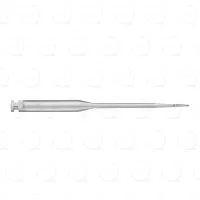
ss white endoguide® bur eg3 · 27 mm · pack of 5
small incisorstroughingcalcified canals
which endoguide® bur is eg3? ss white’s reference chart gives eg3 a 1.5 mm head on a 27 mm friction grip shank, and lists it for: initial access for small incisors; troughing and navigating calcified canals. the endoguide® range is a set of carbide burs with a micro-diameter conical tip, made for root canal access and exploration.
this pack: ss white endoguide® bur eg3, carbide, friction grip shank, 27 mm (pack of 5)
| type | carbide micro endodontic bur (ss white) |
| head length | 1.5 mm |
| tip diameter | 0.28 mm |
| back diameter | 0.71 mm |
| overall length | 27 mm |
| shank | friction grip, surgical length (ss white code slfg) – for friction grip high-speed handpieces |
| pack | pack of 5 |
| ss white lists it for | • initial access for small incisors • troughing and navigating calcified canals |
› what they are. ss white describe endoguide® as an innovative set of carbide burs designed for non-surgical endodontic procedures, developed in conjunction with dr david clark dds and dr john a khademi dds ms.
› what they are designed for. root canal access and exploration; tactile and magnification-enhanced endodontics; use by endodontists and general dentists.
› design aims they list. funnel-shaped access for file introduction, access to calcified and hidden canals, conserving peri-cervical dentin, and reduced dependence on ultrasonic tips.
› tip and shape. against conventional access burs, ss white describe the micro-diameter tip as leading to more conservative access and the conical shape to more efficient access. they describe the tip as a self-centring guide, and the straight-line pathway as reducing the risk of gouging and perforation when used with an incisal access technique for canal entry.
“this is an ideal bur series for magnification-driven endodontics.”
eric herbranson, bs, dds, ms – quoted in ss white’s endoguide® brochure
the eight burs in ss white’s chart, with the figures ss white print for each:
| eg1a | endoguide® eg1a (5) 27 mm · friction grip · head 2.5 mm · tip 0.33 mm – initial access in non-restored anterior and bicuspid teeth |
| eg1 | endoguide® eg1 (5) 27 mm · right angle · head 3.5 mm · tip 0.28 mm – deep troughing; deeper orifice enlargement and calcified canals |
| eg2 | endoguide® eg2 (5) 27 mm · right angle · head 2.5 mm · tip 0.33 mm – de-roofing pulp chamber; deep orifice enlargement and calcified canals |
| eg3 | this page. 27 mm · friction grip · head 1.5 mm · tip 0.28 mm – initial access for small incisors; troughing and navigating calcified canals |
| eg4 | endoguide® eg4 (5) 29 mm · friction grip · head 3.5 mm · tip 0.28 mm – deep troughing; navigating super ovoid and calcified canals |
| eg5 | endoguide® eg5 (5) 34 mm · right angle · head 1.5 mm · tip 0.28 mm – deep troughing; retrieving separated instruments; navigating deeply calcified canals |
| eg6 | endoguide® eg6 (5) 34 mm · right angle · head 2.5 mm · tip 0.28 mm – deep troughing; retrieving separated instruments; navigating deeply calcified canals |
| eg7 | endoguide® eg7 (5) 34 mm · right angle · head 1.5 mm · tip 0.33 mm – deep troughing; retrieving separated instruments; navigating deeply calcified canals |
ss white include eg3 in the endoguide® molar kit and endoguide® anterior/bicuspid kit.
| kits | endoguide® molar kit · endoguide® anterior/bicuspid kit |
| hand file | vdw c-pilot™ 08, 25 mm · c-pilot™ 10, 25 mm |
| irrigants | chlorax 5.25% sodium hypochlorite · chlorax 2% |
endoguide® bur eg3 · friction grip shank (slfg) · 27 mm · head 1.5 mm · tip 0.28 mm · back 0.71 mm · carbide · pack of 5 · made by ss white burs, inc., lakewood, new jersey, usa · mfr code 15023 · ref ssw-15023
ss white endoguide® bur eg4 · 29 mm · pack of 5
deep troughingsuper ovoid canalscalcified canals
which endoguide® bur is eg4? ss white’s reference chart gives eg4 a 3.5 mm head on a 29 mm friction grip shank, and lists it for: deep troughing; navigating super ovoid and calcified canals. the endoguide® range is a set of carbide burs with a micro-diameter conical tip, made for root canal access and exploration.
this pack: ss white endoguide® bur eg4, carbide, friction grip shank, 29 mm (pack of 5)
| type | carbide micro endodontic bur (ss white) |
| head length | 3.5 mm |
| tip diameter | 0.28 mm |
| back diameter | 0.71 mm |
| overall length | 29 mm |
| shank | friction grip, surgical length (ss white code slfg) – for friction grip high-speed handpieces |
| pack | pack of 5 |
| ss white lists it for | • deep troughing • navigating super ovoid and calcified canals |
› what they are. ss white describe endoguide® as an innovative set of carbide burs designed for non-surgical endodontic procedures, developed in conjunction with dr david clark dds and dr john a khademi dds ms.
› what they are designed for. root canal access and exploration; tactile and magnification-enhanced endodontics; use by endodontists and general dentists.
› design aims they list. funnel-shaped access for file introduction, access to calcified and hidden canals, conserving peri-cervical dentin, and reduced dependence on ultrasonic tips.
› tip and shape. against conventional access burs, ss white describe the micro-diameter tip as leading to more conservative access and the conical shape to more efficient access. they describe the tip as a self-centring guide, and the straight-line pathway as reducing the risk of gouging and perforation when used with an incisal access technique for canal entry.
“this is an ideal bur series for magnification-driven endodontics.”
eric herbranson, bs, dds, ms – quoted in ss white’s endoguide® brochure
the eight burs in ss white’s chart, with the figures ss white print for each:
| eg1a | endoguide® eg1a (5) 27 mm · friction grip · head 2.5 mm · tip 0.33 mm – initial access in non-restored anterior and bicuspid teeth |
| eg1 | endoguide® eg1 (5) 27 mm · right angle · head 3.5 mm · tip 0.28 mm – deep troughing; deeper orifice enlargement and calcified canals |
| eg2 | endoguide® eg2 (5) 27 mm · right angle · head 2.5 mm · tip 0.33 mm – de-roofing pulp chamber; deep orifice enlargement and calcified canals |
| eg3 | endoguide® eg3 (5) 27 mm · friction grip · head 1.5 mm · tip 0.28 mm – initial access for small incisors; troughing and navigating calcified canals |
| eg4 | this page. 29 mm · friction grip · head 3.5 mm · tip 0.28 mm – deep troughing; navigating super ovoid and calcified canals |
| eg5 | endoguide® eg5 (5) 34 mm · right angle · head 1.5 mm · tip 0.28 mm – deep troughing; retrieving separated instruments; navigating deeply calcified canals |
| eg6 | endoguide® eg6 (5) 34 mm · right angle · head 2.5 mm · tip 0.28 mm – deep troughing; retrieving separated instruments; navigating deeply calcified canals |
| eg7 | endoguide® eg7 (5) 34 mm · right angle · head 1.5 mm · tip 0.33 mm – deep troughing; retrieving separated instruments; navigating deeply calcified canals |
ss white include eg4 in the endoguide® molar kit.
| kits | endoguide® molar kit · endoguide® anterior/bicuspid kit |
| hand file | vdw c-pilot™ 08, 25 mm · c-pilot™ 10, 25 mm |
| irrigants | chlorax 5.25% sodium hypochlorite · chlorax 2% |
endoguide® bur eg4 · friction grip shank (slfg) · 29 mm · head 3.5 mm · tip 0.28 mm · back 0.71 mm · carbide · pack of 5 · made by ss white burs, inc., lakewood, new jersey, usa · mfr code 15029 · ref ssw-15029
ss white endoguide® bur eg1a · 27 mm · pack of 5
anterior teethbicuspid teethinitial access
which endoguide® bur is eg1a? ss white’s reference chart gives eg1a a 2.5 mm head on a 27 mm friction grip shank, and lists it for: initial access in non-restored anterior and bicuspid teeth. the endoguide® range is a set of carbide burs with a micro-diameter conical tip, made for root canal access and exploration.
this pack: ss white endoguide® bur eg1a, carbide, friction grip shank, 27 mm (pack of 5)
| type | carbide micro endodontic bur (ss white) |
| head length | 2.5 mm |
| tip diameter | 0.33 mm |
| back diameter | 1.07 mm |
| overall length | 27 mm |
| shank | friction grip, surgical length (ss white code slfg) – for friction grip high-speed handpieces |
| pack | pack of 5 |
| ss white lists it for | • initial access in non-restored anterior and bicuspid teeth |
› what they are. ss white describe endoguide® as an innovative set of carbide burs designed for non-surgical endodontic procedures, developed in conjunction with dr david clark dds and dr john a khademi dds ms.
› what they are designed for. root canal access and exploration; tactile and magnification-enhanced endodontics; use by endodontists and general dentists.
› design aims they list. funnel-shaped access for file introduction, access to calcified and hidden canals, conserving peri-cervical dentin, and reduced dependence on ultrasonic tips.
› tip and shape. against conventional access burs, ss white describe the micro-diameter tip as leading to more conservative access and the conical shape to more efficient access. they describe the tip as a self-centring guide, and the straight-line pathway as reducing the risk of gouging and perforation when used with an incisal access technique for canal entry.
“this is an ideal bur series for magnification-driven endodontics.”
eric herbranson, bs, dds, ms – quoted in ss white’s endoguide® brochure
the eight burs in ss white’s chart, with the figures ss white print for each:
| eg1a | this page. 27 mm · friction grip · head 2.5 mm · tip 0.33 mm – initial access in non-restored anterior and bicuspid teeth |
| eg1 | endoguide® eg1 (5) 27 mm · right angle · head 3.5 mm · tip 0.28 mm – deep troughing; deeper orifice enlargement and calcified canals |
| eg2 | endoguide® eg2 (5) 27 mm · right angle · head 2.5 mm · tip 0.33 mm – de-roofing pulp chamber; deep orifice enlargement and calcified canals |
| eg3 | endoguide® eg3 (5) 27 mm · friction grip · head 1.5 mm · tip 0.28 mm – initial access for small incisors; troughing and navigating calcified canals |
| eg4 | endoguide® eg4 (5) 29 mm · friction grip · head 3.5 mm · tip 0.28 mm – deep troughing; navigating super ovoid and calcified canals |
| eg5 | endoguide® eg5 (5) 34 mm · right angle · head 1.5 mm · tip 0.28 mm – deep troughing; retrieving separated instruments; navigating deeply calcified canals |
| eg6 | endoguide® eg6 (5) 34 mm · right angle · head 2.5 mm · tip 0.28 mm – deep troughing; retrieving separated instruments; navigating deeply calcified canals |
| eg7 | endoguide® eg7 (5) 34 mm · right angle · head 1.5 mm · tip 0.33 mm – deep troughing; retrieving separated instruments; navigating deeply calcified canals |
ss white include eg1a in the endoguide® anterior/bicuspid kit.
| kits | endoguide® molar kit · endoguide® anterior/bicuspid kit |
| hand file | vdw c-pilot™ 08, 25 mm · c-pilot™ 10, 25 mm |
| irrigants | chlorax 5.25% sodium hypochlorite · chlorax 2% |
endoguide® bur eg1a · friction grip shank (slfg) · 27 mm · head 2.5 mm · tip 0.33 mm · back 1.07 mm · carbide · pack of 5 · made by ss white burs, inc., lakewood, new jersey, usa · mfr code 15066 · ref ssw-15066
ss white endoguide® molar kit · 7 burs
molar explorationhidden canalstroughing
which burs come in the endoguide® molar kit? seven: eg1 to eg7. ss white say they are designed to increase visibility and control during endodontic exploration in molars, when locating hidden canals, navigating deeply calcified canals and troughing between canals.
this kit: ss white endoguide® molar kit, order number 18051 – seven carbide burs, eg1 to eg7, in a stand
one of each, as photographed in the stand. the figures are ss white’s own chart entries for each bur:
| eg1 | 27 mm · right angle · head 3.5 mm · tip 0.28 mm – deep troughing; deeper orifice enlargement and calcified canals |
| eg2 | 27 mm · right angle · head 2.5 mm · tip 0.33 mm – de-roofing pulp chamber; deep orifice enlargement and calcified canals |
| eg3 | 27 mm · friction grip · head 1.5 mm · tip 0.28 mm – initial access for small incisors; troughing and navigating calcified canals |
| eg4 | 29 mm · friction grip · head 3.5 mm · tip 0.28 mm – deep troughing; navigating super ovoid and calcified canals |
| eg5 | 34 mm · right angle · head 1.5 mm · tip 0.28 mm – deep troughing; retrieving separated instruments; navigating deeply calcified canals |
| eg6 | 34 mm · right angle · head 2.5 mm · tip 0.28 mm – deep troughing; retrieving separated instruments; navigating deeply calcified canals |
| eg7 | 34 mm · right angle · head 1.5 mm · tip 0.33 mm – deep troughing; retrieving separated instruments; navigating deeply calcified canals |
› what they are. ss white describe endoguide® as an innovative set of carbide burs designed for non-surgical endodontic procedures, developed in conjunction with dr david clark dds and dr john a khademi dds ms.
› what they are designed for. root canal access and exploration; tactile and magnification-enhanced endodontics; use by endodontists and general dentists.
› design aims they list. funnel-shaped access for file introduction, access to calcified and hidden canals, conserving peri-cervical dentin, and reduced dependence on ultrasonic tips.
› tip and shape. against conventional access burs, ss white describe the micro-diameter tip as leading to more conservative access and the conical shape to more efficient access. they describe the tip as a self-centring guide, and the straight-line pathway as reducing the risk of gouging and perforation when used with an incisal access technique for canal entry.
“this is an ideal bur series for magnification-driven endodontics.”
eric herbranson, bs, dds, ms – quoted in ss white’s endoguide® brochure
ss white add a note to the kit listings: initial access and de-roofing in molars should be performed with either the great white® #2 bur or the great white® z diamonds supplied in the endoguide® anterior/bicuspid kit, order number 18052.
| single burs (5) | eg1 · eg2 · eg3 · eg4 · eg5 · eg6 · eg7 |
| kits | endoguide® anterior/bicuspid kit |
| hand file | vdw c-pilot™ 08, 25 mm · c-pilot™ 10, 25 mm |
| irrigants | chlorax 5.25% sodium hypochlorite · chlorax 2% |
endoguide® molar kit · order number 18051 · seven carbide burs eg1 to eg7 · made by ss white burs, inc., lakewood, new jersey, usa · ref ssw-18051
ss white endoguide® anterior/bicuspid kit · 7 burs
metal, porcelain, zirconiaanterior and bicuspidaccess and exploration
what is in the endoguide® anterior/bicuspid kit? ss white say it contains all the instrumentation to create endodontic access through metal, porcelain and zirconia: a great white® #2 metal-cutting bur, great white® z diamonds and four endoguide® burs, eg1a, eg1, eg2 and eg3, for locating and accessing single root canals in anterior and bicuspid teeth.
this kit: ss white endoguide® anterior/bicuspid kit, order number 18052 – four endoguide® burs and three great white® burs, in a stand
one of each, as photographed in the stand. the figures are ss white’s own chart entries:
| eg1a | 27 mm · friction grip · head 2.5 mm · tip 0.33 mm – initial access in non-restored anterior and bicuspid teeth |
| eg1 | 27 mm · right angle · head 3.5 mm · tip 0.28 mm – deep troughing; deeper orifice enlargement and calcified canals |
| eg2 | 27 mm · right angle · head 2.5 mm · tip 0.33 mm – de-roofing pulp chamber; deep orifice enlargement and calcified canals |
| eg3 | 27 mm · friction grip · head 1.5 mm · tip 0.28 mm – initial access for small incisors; troughing and navigating calcified canals |
| gw2 | great white® #2, friction grip, 19 mm, head 4.0 mm, back 1.19 mm – metal crown access or removal; amalgam restoration and decay removal; molar initial access and de-roofing |
| gwz 856-018 | great white® z diamond, round end cone, friction grip, 22 mm, head 8.0 mm, tip 1.10 mm, back 2.2 mm – ceramic/zirconia crown removal; molar initial access and de-roofing |
| gwz 801-018 | great white® z diamond, round, friction grip, 19 mm, head 1.8 mm, back 1.90 mm – initial access through ceramic/zirconia crowns; molar initial access and de-roofing |
› what they are. ss white describe endoguide® as an innovative set of carbide burs designed for non-surgical endodontic procedures, developed in conjunction with dr david clark dds and dr john a khademi dds ms.
› what they are designed for. root canal access and exploration; tactile and magnification-enhanced endodontics; use by endodontists and general dentists.
› design aims they list. funnel-shaped access for file introduction, access to calcified and hidden canals, conserving peri-cervical dentin, and reduced dependence on ultrasonic tips.
› tip and shape. against conventional access burs, ss white describe the micro-diameter tip as leading to more conservative access and the conical shape to more efficient access. they describe the tip as a self-centring guide, and the straight-line pathway as reducing the risk of gouging and perforation when used with an incisal access technique for canal entry.
“this is an ideal bur series for magnification-driven endodontics.”
eric herbranson, bs, dds, ms – quoted in ss white’s endoguide® brochure
ss white add a note to the kit listings: initial access and de-roofing in molars should be performed with either the great white® #2 bur or the great white® z diamonds supplied in the endoguide® anterior/bicuspid kit, order number 18052.
| single burs (5) | eg1a · eg1 · eg2 · eg3 |
| kits | endoguide® molar kit |
| hand file | vdw c-pilot™ 08, 25 mm · c-pilot™ 10, 25 mm |
| irrigants | chlorax 5.25% sodium hypochlorite · chlorax 2% |
endoguide® anterior/bicuspid kit · order number 18052 · eg1a, eg1, eg2, eg3, great white® gw2, gwz 856-018, gwz 801-018 · made by ss white burs, inc., lakewood, new jersey, usa · ref ssw-18052


reciproc® r25 · 25 mm · 6 files
still stepping through a sequence, and reprocessing what survives it? reciproc® prepares the whole canal with one reciprocating instrument, and in the majority of canals with no initial hand filing. r25 is where vdw's own selection protocol lands most often, and 25 mm is the length most cases call for. it is also the instrument in the published papers: when a study says reciproc®, this is usually what was on the bench.
| 93%+ without a glide path | 1 file per molar | 66% fewer retreatments |
this pack: 6 × reciproc® r25, 25 mm · radiopaque depth markings at 18/19/20/22 mm · sterile blisters, single use – one molar per file, per vdw
made by vdw, munich – genuine reciproc®
a 0.25 mm tip on an 8% taper over the first 3 mm, regressing above it to d16 1.05 mm – apical shaping where the case needs it, coronal dentine left alone. the alloy is m-wire®, which vdw describe as having greater cyclic fatigue resistance and greater flexibility than traditional nickel-titanium; the core is s-shaped with a non-cutting tip, so it follows the canal rather than cutting its own path; and the shaft is 11 mm against the 13 mm or longer on many instruments, which is felt on a second molar with limited opening.
it is not a rotary file driven differently. the reciprocating angles are set below the point at which the instrument would fail, so binding cannot lock it – which is the whole basis of the glide path argument. vdw's wording, and ours: the angles "are smaller than the angle settings where the elastic limit of the instrument would be met, thus minimising the risk of instrument fractures."
settled before you start, from the radiograph and, where the canal is visible, one hand file inserted passively – here meaning it travels directly to working length with a gentle watch-winding movement, but with no filing action.
› r25 – canal partly or completely invisible on the radiograph, or visible but an iso 20 will not go passively.
› r40 – an iso 20 goes passively, an iso 30 does not.
› r50 – an iso 30 reaches working length passively.
in most cases, the r25 will be suitable in size for the root canal treatment.
— vdw, reciproc® user brochure, summarising its own instrument-selection protocol.
1 check the canal is free with an iso 10 hand instrument – the directions name vdw's own c-pilot® 010 in 25 mm. no orifice opener first; the design clears the coronal third itself.
2 irrigate, throughout. the directions have you irrigate the canal and clean the flutes between passes – a single-file system shortens the mechanical part of the case, not the chemical one. sodium hypochlorite in 5.25% or 2%, to your own protocol.
3 shape on the reciproc® setting in slow in-and-out pecks of no more than 3 mm, very light pressure, three at a time. then out, flutes cleaned in the interim stand, re-irrigate, patency confirmed, back in. a lateral brushing motion is sanctioned for irregular canals.
4 gauge the apex with a hand instrument one iso size larger than the file that reached length: light tug-back about 1 mm short and no further means the preparation is done. r25 achieves an iso 33 at 1 mm from the apex; for a larger apical preparation, r40 or r50 follow.
5 dry, then obturate. matched paper points r25, then the matched gutta-percha cone carried to length with sealer – vdw make it in the greater taper corresponding to this instrument, for single cone, lateral compaction or a master cone in warm vertical condensation. the taper you cut is the taper you fill.
6 seal it coronally. the apical seal is only half the job – sdr® flow+ places a 4 mm bulk increment straight over the orifices in a single cure.
and the glide path? no initial hand filing in the majority of canals – the manufacturer's own headline, unchanged since 2011, with a peer-reviewed figure behind it: de-deus and colleagues (international endodontic journal, 2013) took the r25 to full working length without an initial glide path in more than 93% of canals. where it does not advance, do not force it: withdraw, clean, irrigate, try again, and if it still will not go, create a glide path with c-pilot® 015 and continue. "usually unnecessary" and "never necessary" are different claims, and only the first is ours to make.
a single-file canal is only as good as what goes into it, and this is where we reach for neosealer® ezflo: premixed bioceramic, nothing to mix or time on the bench, around 35 minutes of working time, 5.5 mm al radiopacity, delivered through 29 gauge navitip™ cannulas. the gauge is the point – a bore that fine places sealer in the apical third rather than wiping it down the coronal walls, and the 25 mm tips match this file's length. prefer a wider bore? neosealer® flo is the same chemistry with flex flo tips. staying with resin? ah plus® is still the epoxy sealer every other one is measured against, and vdw's own 2seal® is the brand-matched epoxy-amine. resin or bioceramic is a choice of technique rather than a ranking – we carry both because both are right in different hands.
bürklein and colleagues (iej, 2012) found this system prepared a canal up to 60% faster than multiple-file systems – 73.1 seconds against 185.2 – while maintaining the original curvature and cleaning the apical region more thoroughly; gavini (joe, 2012) measured the r25's own cyclic fatigue resistance as significantly higher in reciprocation than in continuous rotation; and zuolo (iej, 2013) found it left the least residual gutta percha and sealer of the retreatment approaches compared, at 4.57%, because r25 retreats as well as it shapes. the newest citation is about teeth rather than benches: kiel followed 14,233 endodontically treated teeth for five to ten years (iej, june 2025) and found survival without further intervention 30–40% higher under the reciproc® protocol, non-surgical retreatment 66% lower and extractions 21% lower. it is a retrospective single-centre cohort, statistically adjusted, and the authors say only that the result "might be attributed to" the system – but it answers the question a clinician actually has.
the limit is worth knowing and it is narrow. severe curvature is what this instrument is for; abrupt apical curvature is a contraindication. if the iso 10 hand file used for working length still has to be pre-curved to reach it, after the instrument has reached two thirds of the estimated length, finish the canal with hand files. vdw have printed the sentence that puts it in proportion since 2010: this limitation also applies to continuous rotary instruments. and the files may look slightly curved in the blister – vdw note that this is not a manufacturing defect.
the fracture of the original reciproc is not an issue considering that its fracture rate is very low (0.2%).
— ghassan yared, who developed single-file reciprocation and consults to the reciproc® range. his statement in a vdw article, rather than a study result.
what motor do i need?
a drive system carrying the original vdw reciproc® settings – reciprocating motors without them can lead to misuse. we stock the vdw.silver® reciproc® with 6:1 contra-angle, the motor this system launched with, and the x-smart® pro+ with an integrated apex locator. the cordless x-smart® go carries a reciproc® programme too.
how does this compare with reciproc® blue?
same geometry, same three sizes, same movement, same motor programme – the difference is the alloy. this is the original in m-wire®, and the instrument most of the published reciproc® literature was measured on. blue is the later heat-treated version. if your practice is already standardised on this one, nothing about it has changed.
one file per case, really?
per molar, which is the unit vdw set – so a two-molar appointment is two files, and one per canal in extreme curvature. against three to six rotary instruments plus reprocessing the arithmetic still works, and the plastic band on the shaft deforms in the autoclave, so the decision is made for you.
| patency, and between passes | c-pilot® 010 and 008 in 25 mm · interim stand and foam refills for the flutes |
| drive it | a motor with original reciproc® settings: vdw.silver® · x-smart® pro+ · x-smart® go |
| other sizes and lengths | r40 and r50 in 25 mm, or the assorted blister · r25 in 21 mm or 31 mm |
| irrigate | hypochlorite 5.25% or 2% · 17% edta · 40% citric acid · 2% chx · through irriflex® 30g or navitip™ 29 ga 25 mm, activated with eddy® |
| dry and fill | paper points r25 · gutta-percha r25 · or assorted boxes covering all three sizes: points, cones |
| buying in | system kit – 12 files, assorted cones and points, and a training model |
reciproc® r25 · reciprocating single-file system · 0.25 mm tip, 8% taper over the first 3 mm, regressive, d16 1.05 mm · m-wire® niti · s-shaped cross-section, non-cutting tip, 11 mm shaft · radiopaque markings 18/19/20/22 mm · shaping, curvature, mb2 and retreatment · 6 sterile files, single use, one molar · 25 mm, also in 21 and 31 mm · vdw, munich · ref v040212025025

mtwo® · 10/.04 · 21 mm · wp 16 mm · 6 files
s-shaped sectionsterile blistersingle length technique
vdw’s long-standing rotary file. vdw describe an “s-shaped cross-section with two active cutting edges” and a “small instrument core for high flexibility” – the same s-section family as reciproc® blue and vdw.rotate®. every instrument is taken to full working length rather than stepping back.
this pack: vdw mtwo® rotary file, iso size 10, .04 taper, 21 mm, 16 mm working part (pack of 6)
vdw · vdw gmbh, munich, germany (dentsply sirona) · mtwo® is licensed by sweden & martina
| tip (d0) | 0.10 mm |
| taper | .04 |
| length | 21 mm |
| working part | 16 mm |
| handle | iso colour (purple) |
| material | nickel titanium |
| supplied | sterile, pack of 6 |
› s-shaped section, two cutting edges. vdw’s own description, with a “small instrument core for high flexibility”.
› one sequence, one length. vdw: “single length: all instruments are brought to full working length”.
› progressive pitch. vdw describe “active cutting blades and a progressive pitch”.
› wp 16 mm. the flutes run 16 mm from the tip on a 21 mm instrument. vdw list “16 mm working part (21 or 25 mm working length)” and a 21 mm working part at 25 or 31 mm.
“superior cutting efficiency and flexibility, for an efficient root canal preparation”
vdw, vdw dental product catalogue 2023.
what does wp 16 mm mean?
the working part – how far the flutes run up from the tip. this one is 16 mm of cutting on a 21 mm instrument. a shorter working part gives you more shank, which helps in a posterior tooth with limited opening.
should i be looking at vdw.rotate instead?
it is the newer file in the same s-section family, with a heat treatment vdw say lowers the risk of breakage, plus taper rings and radiopaque calibration rings on the handle. we stock both. our suggestion for this size is below.
› the basic sequence: 15/.05 · 20/.06 · 25/.06, 21 mm
› same size, other lengths: 25 mm, wp 16 mm · 25 mm, wp 21 mm · 31 mm, wp 21 mm
› larger anatomies: 30/.05 · 35/.04 · 40/.04 · 45/.04
› moving to vdw.rotate: vdw.rotate® 15/.04, 21 mm – the nearest size in the newer range
› retreatment: mtwo® retreatment assorted, 21 mm
› obturation: the dia-pro .04 range stops at 45, so there is no matched cone at 10/.04. fit from 45/.04.
› motor: x-smart® pro+ with apex locator
› lubricant and irrigation: glyde™ file prep · chlorax 5.25% · irriflex® needles
mtwo® is licensed by sweden & martina. sizes, tapers and working parts are as vdw list them in the vdw dental product catalogue 2023. single use. follow the instructions supplied with the product.
mtwo® 10/.04, 21 mm, wp 16 mm (6) · nickel titanium · ref v040234021010

mtwo® · 35/.04 · 21 mm · wp 16 mm · 6 files
s-shaped sectionsterile blistersingle length technique
vdw’s long-standing rotary file. vdw describe an “s-shaped cross-section with two active cutting edges” and a “small instrument core for high flexibility” – the same s-section family as reciproc® blue and vdw.rotate®. every instrument is taken to full working length rather than stepping back.
this pack: vdw mtwo® rotary file, iso size 35, .04 taper, 21 mm, 16 mm working part (pack of 6)
vdw · vdw gmbh, munich, germany (dentsply sirona) · mtwo® is licensed by sweden & martina
| tip (d0) | 0.35 mm |
| taper | .04 |
| length | 21 mm |
| working part | 16 mm |
| handle | iso colour (green) |
| material | nickel titanium |
| supplied | sterile, pack of 6 |
› s-shaped section, two cutting edges. vdw’s own description, with a “small instrument core for high flexibility”.
› one sequence, one length. vdw: “single length: all instruments are brought to full working length”.
› progressive pitch. vdw describe “active cutting blades and a progressive pitch”.
› wp 16 mm. the flutes run 16 mm from the tip on a 21 mm instrument. vdw list “16 mm working part (21 or 25 mm working length)” and a 21 mm working part at 25 or 31 mm.
“superior cutting efficiency and flexibility, for an efficient root canal preparation”
vdw, vdw dental product catalogue 2023.
what does wp 16 mm mean?
the working part – how far the flutes run up from the tip. this one is 16 mm of cutting on a 21 mm instrument. a shorter working part gives you more shank, which helps in a posterior tooth with limited opening.
should i be looking at vdw.rotate instead?
it is the newer file in the same s-section family, with a heat treatment vdw say lowers the risk of breakage, plus taper rings and radiopaque calibration rings on the handle. we stock both. our suggestion for this size is below.
› the basic sequence: 10/.04 · 15/.05 · 20/.06 · 25/.06, 21 mm
› same size, other lengths: 25 mm, wp 16 mm · 31 mm, wp 21 mm
› larger anatomies: 30/.05 · 40/.04 · 45/.04 · 50/.04
› moving to vdw.rotate: vdw.rotate® 35/.04, 21 mm – the same size and taper, on heat-treated wire
› retreatment: mtwo® retreatment assorted, 21 mm
› obturation: diadent® dia-pro iso gutta-percha 35/.04 · paper points 35/.04 – the same size and taper
› motor: x-smart® pro+ with apex locator
› lubricant and irrigation: glyde™ file prep · chlorax 5.25% · irriflex® needles
mtwo® is licensed by sweden & martina. sizes, tapers and working parts are as vdw list them in the vdw dental product catalogue 2023. single use. follow the instructions supplied with the product.
mtwo® 35/.04, 21 mm, wp 16 mm (6) · nickel titanium · ref v040234021035
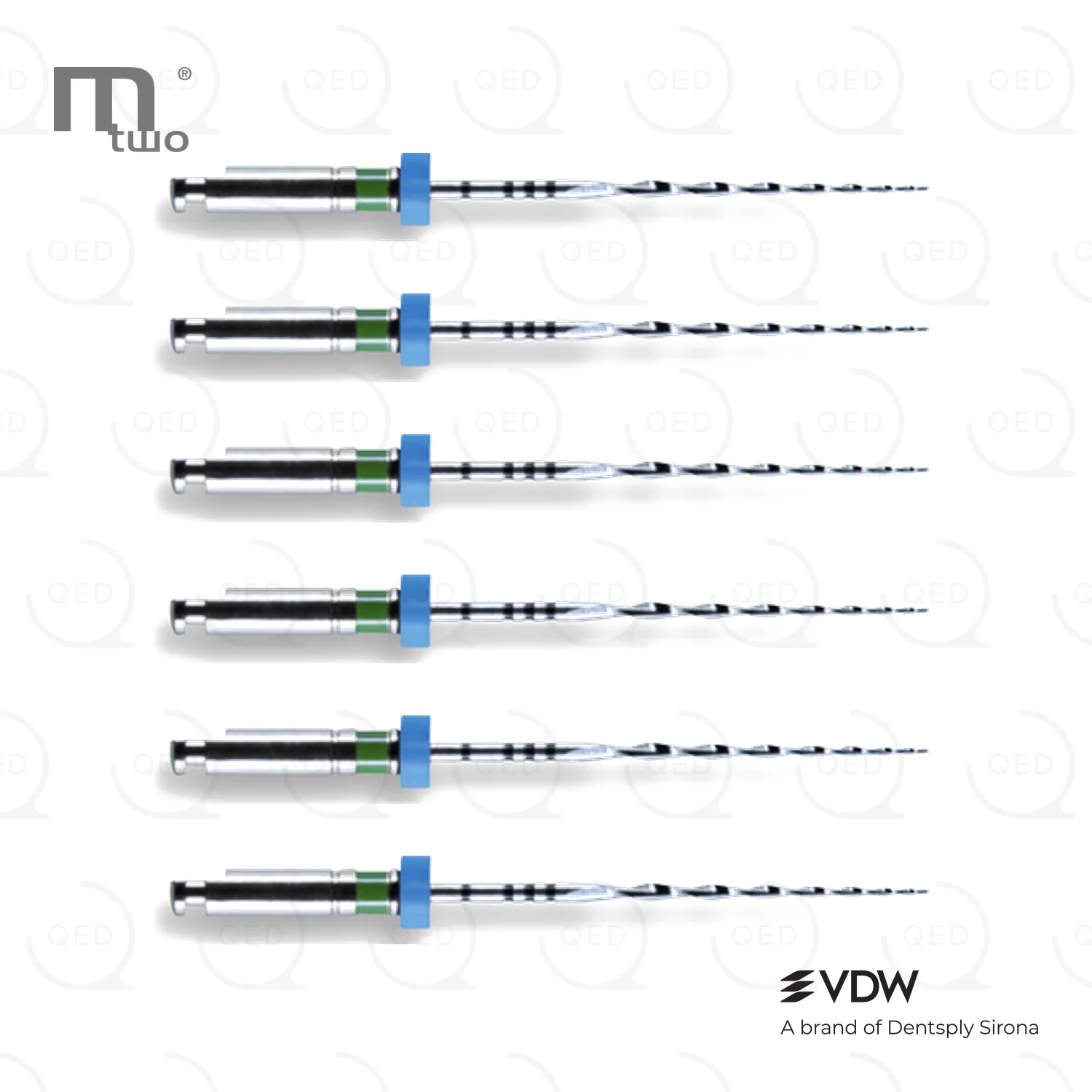
mtwo® · 40/.04 · 21 mm · wp 16 mm · 6 files
s-shaped sectionsterile blistersingle length technique
vdw’s long-standing rotary file. vdw describe an “s-shaped cross-section with two active cutting edges” and a “small instrument core for high flexibility” – the same s-section family as reciproc® blue and vdw.rotate®. every instrument is taken to full working length rather than stepping back.
this pack: vdw mtwo® rotary file, iso size 40, .04 taper, 21 mm, 16 mm working part (pack of 6)
vdw · vdw gmbh, munich, germany (dentsply sirona) · mtwo® is licensed by sweden & martina
| tip (d0) | 0.40 mm |
| taper | .04 |
| length | 21 mm |
| working part | 16 mm |
| handle | iso colour (black) |
| material | nickel titanium |
| supplied | sterile, pack of 6 |
› s-shaped section, two cutting edges. vdw’s own description, with a “small instrument core for high flexibility”.
› one sequence, one length. vdw: “single length: all instruments are brought to full working length”.
› progressive pitch. vdw describe “active cutting blades and a progressive pitch”.
› wp 16 mm. the flutes run 16 mm from the tip on a 21 mm instrument. vdw list “16 mm working part (21 or 25 mm working length)” and a 21 mm working part at 25 or 31 mm.
“superior cutting efficiency and flexibility, for an efficient root canal preparation”
vdw, vdw dental product catalogue 2023.
what does wp 16 mm mean?
the working part – how far the flutes run up from the tip. this one is 16 mm of cutting on a 21 mm instrument. a shorter working part gives you more shank, which helps in a posterior tooth with limited opening.
should i be looking at vdw.rotate instead?
it is the newer file in the same s-section family, with a heat treatment vdw say lowers the risk of breakage, plus taper rings and radiopaque calibration rings on the handle. we stock both. our suggestion for this size is below.
› the basic sequence: 10/.04 · 15/.05 · 20/.06 · 25/.06, 21 mm
› same size, other lengths: 25 mm, wp 16 mm · 31 mm, wp 21 mm
› larger anatomies: 30/.05 · 35/.04 · 45/.04 · 50/.04
› moving to vdw.rotate: vdw.rotate® 40/.04, 21 mm – the same size and taper, on heat-treated wire
› retreatment: mtwo® retreatment assorted, 21 mm
› obturation: diadent® dia-pro iso gutta-percha 40/.04 · paper points 40/.04 – the same size and taper
› motor: x-smart® pro+ with apex locator
› lubricant and irrigation: glyde™ file prep · chlorax 5.25% · irriflex® needles
mtwo® is licensed by sweden & martina. sizes, tapers and working parts are as vdw list them in the vdw dental product catalogue 2023. single use. follow the instructions supplied with the product.
mtwo® 40/.04, 21 mm, wp 16 mm (6) · nickel titanium · ref v040234021040
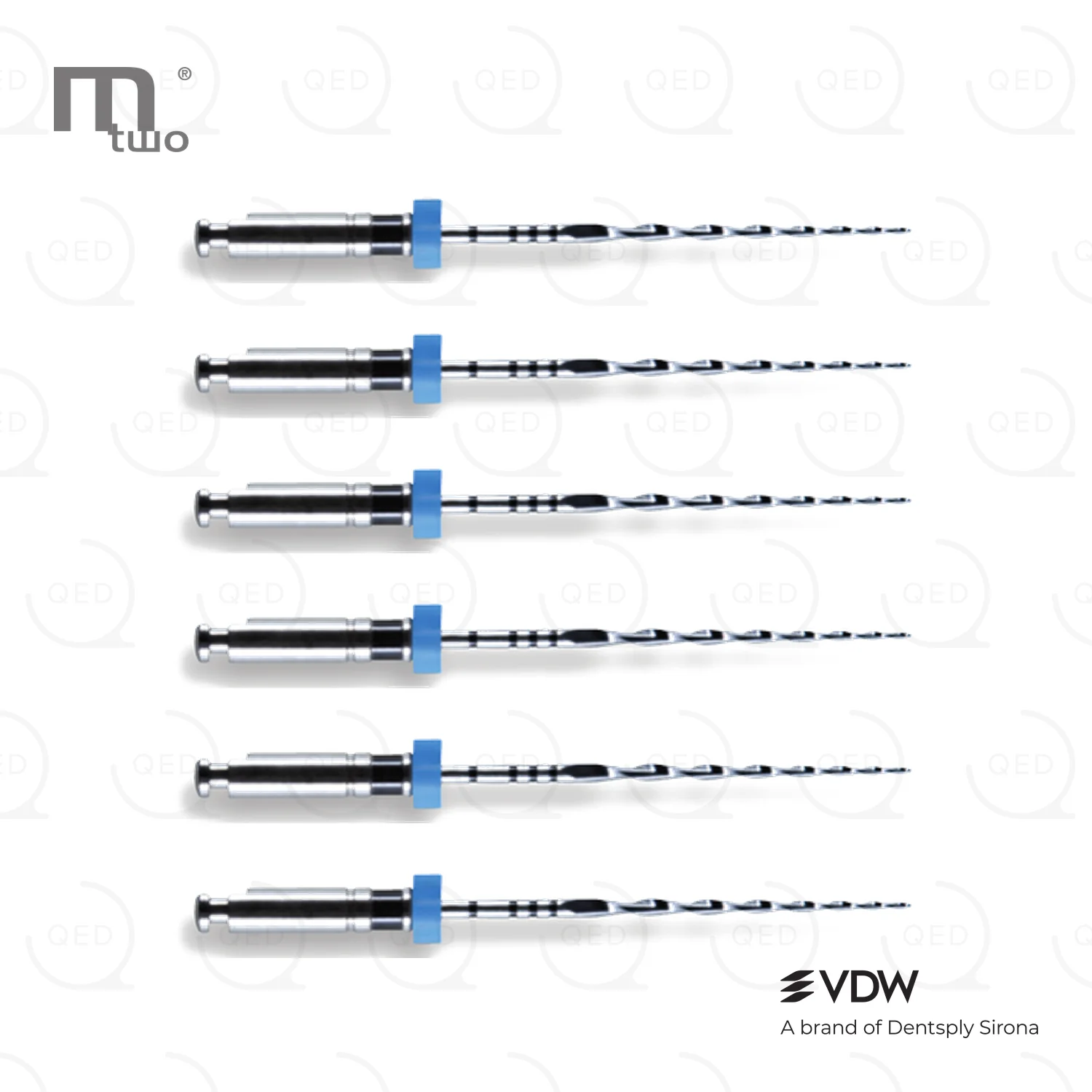
mtwo® · 45/.04 · 21 mm · wp 16 mm · 6 files
s-shaped sectionsterile blistersingle length technique
vdw’s long-standing rotary file. vdw describe an “s-shaped cross-section with two active cutting edges” and a “small instrument core for high flexibility” – the same s-section family as reciproc® blue and vdw.rotate®. every instrument is taken to full working length rather than stepping back.
this pack: vdw mtwo® rotary file, iso size 45, .04 taper, 21 mm, 16 mm working part (pack of 6)
vdw · vdw gmbh, munich, germany (dentsply sirona) · mtwo® is licensed by sweden & martina
| tip (d0) | 0.45 mm |
| taper | .04 |
| length | 21 mm |
| working part | 16 mm |
| handle | iso colour (white) |
| material | nickel titanium |
| supplied | sterile, pack of 6 |
› s-shaped section, two cutting edges. vdw’s own description, with a “small instrument core for high flexibility”.
› one sequence, one length. vdw: “single length: all instruments are brought to full working length”.
› progressive pitch. vdw describe “active cutting blades and a progressive pitch”.
› wp 16 mm. the flutes run 16 mm from the tip on a 21 mm instrument. vdw list “16 mm working part (21 or 25 mm working length)” and a 21 mm working part at 25 or 31 mm.
“superior cutting efficiency and flexibility, for an efficient root canal preparation”
vdw, vdw dental product catalogue 2023.
what does wp 16 mm mean?
the working part – how far the flutes run up from the tip. this one is 16 mm of cutting on a 21 mm instrument. a shorter working part gives you more shank, which helps in a posterior tooth with limited opening.
should i be looking at vdw.rotate instead?
it is the newer file in the same s-section family, with a heat treatment vdw say lowers the risk of breakage, plus taper rings and radiopaque calibration rings on the handle. we stock both. our suggestion for this size is below.
› the basic sequence: 10/.04 · 15/.05 · 20/.06 · 25/.06, 21 mm
› same size, other lengths: 25 mm, wp 16 mm · 31 mm, wp 21 mm
› larger anatomies: 30/.05 · 35/.04 · 40/.04 · 50/.04
› moving to vdw.rotate: vdw.rotate® 50/.04, 21 mm – the nearest size in the newer range
› retreatment: mtwo® retreatment assorted, 21 mm
› obturation: diadent® dia-pro iso gutta-percha 45/.04 – the same size and taper. the dia-pro paper points stop at 40, so gauge with 40/.04 or a standard point.
› motor: x-smart® pro+ with apex locator
› lubricant and irrigation: glyde™ file prep · chlorax 5.25% · irriflex® needles
mtwo® is licensed by sweden & martina. sizes, tapers and working parts are as vdw list them in the vdw dental product catalogue 2023. single use. follow the instructions supplied with the product.
mtwo® 45/.04, 21 mm, wp 16 mm (6) · nickel titanium · ref v040234021045
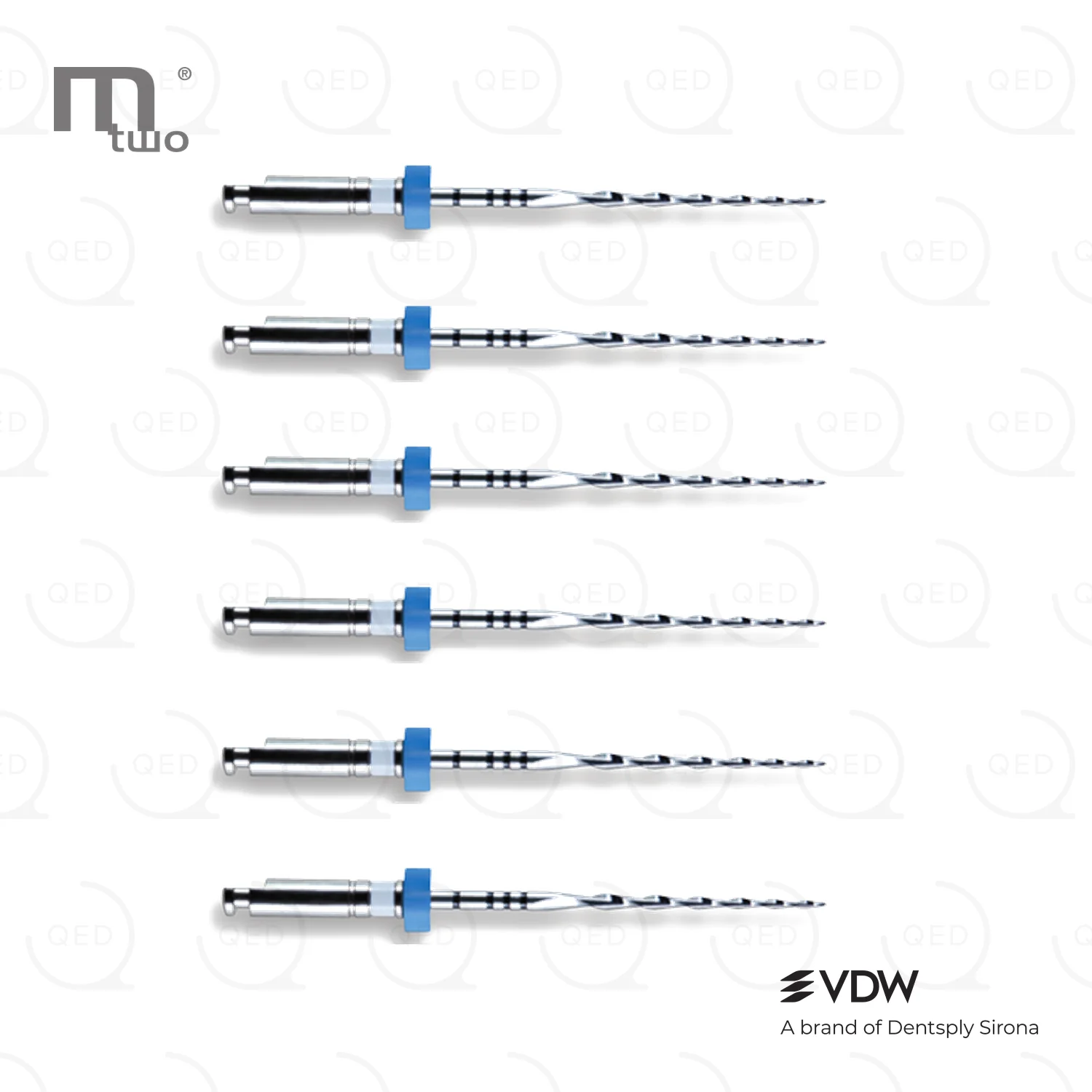
mtwo® · 50/.04 · 21 mm · wp 16 mm · 6 files
s-shaped sectionsterile blistersingle length technique
vdw’s long-standing rotary file. vdw describe an “s-shaped cross-section with two active cutting edges” and a “small instrument core for high flexibility” – the same s-section family as reciproc® blue and vdw.rotate®. every instrument is taken to full working length rather than stepping back.
this pack: vdw mtwo® rotary file, iso size 50, .04 taper, 21 mm, 16 mm working part (pack of 6)
vdw · vdw gmbh, munich, germany (dentsply sirona) · mtwo® is licensed by sweden & martina
| tip (d0) | 0.50 mm |
| taper | .04 |
| length | 21 mm |
| working part | 16 mm |
| handle | iso colour (yellow) |
| material | nickel titanium |
| supplied | sterile, pack of 6 |
› s-shaped section, two cutting edges. vdw’s own description, with a “small instrument core for high flexibility”.
› one sequence, one length. vdw: “single length: all instruments are brought to full working length”.
› progressive pitch. vdw describe “active cutting blades and a progressive pitch”.
› wp 16 mm. the flutes run 16 mm from the tip on a 21 mm instrument. vdw list “16 mm working part (21 or 25 mm working length)” and a 21 mm working part at 25 or 31 mm.
“superior cutting efficiency and flexibility, for an efficient root canal preparation”
vdw, vdw dental product catalogue 2023.
what does wp 16 mm mean?
the working part – how far the flutes run up from the tip. this one is 16 mm of cutting on a 21 mm instrument. a shorter working part gives you more shank, which helps in a posterior tooth with limited opening.
should i be looking at vdw.rotate instead?
it is the newer file in the same s-section family, with a heat treatment vdw say lowers the risk of breakage, plus taper rings and radiopaque calibration rings on the handle. we stock both. our suggestion for this size is below.
› the basic sequence: 10/.04 · 15/.05 · 20/.06 · 25/.06, 21 mm
› same size, other lengths: 25 mm, wp 16 mm · 31 mm, wp 21 mm
› larger anatomies: 30/.05 · 35/.04 · 40/.04 · 45/.04
› moving to vdw.rotate: vdw.rotate® 50/.04, 21 mm – the same size and taper, on heat-treated wire
› retreatment: mtwo® retreatment assorted, 21 mm
› obturation: the dia-pro .04 range stops at 45, so there is no matched cone at 50/.04. fit from 45/.04 or the standard ml.029™ 50/.02.
› motor: x-smart® pro+ with apex locator
› lubricant and irrigation: glyde™ file prep · chlorax 5.25% · irriflex® needles
mtwo® is licensed by sweden & martina. sizes, tapers and working parts are as vdw list them in the vdw dental product catalogue 2023. single use. follow the instructions supplied with the product.
mtwo® 50/.04, 21 mm, wp 16 mm (6) · nickel titanium · ref v040234021050
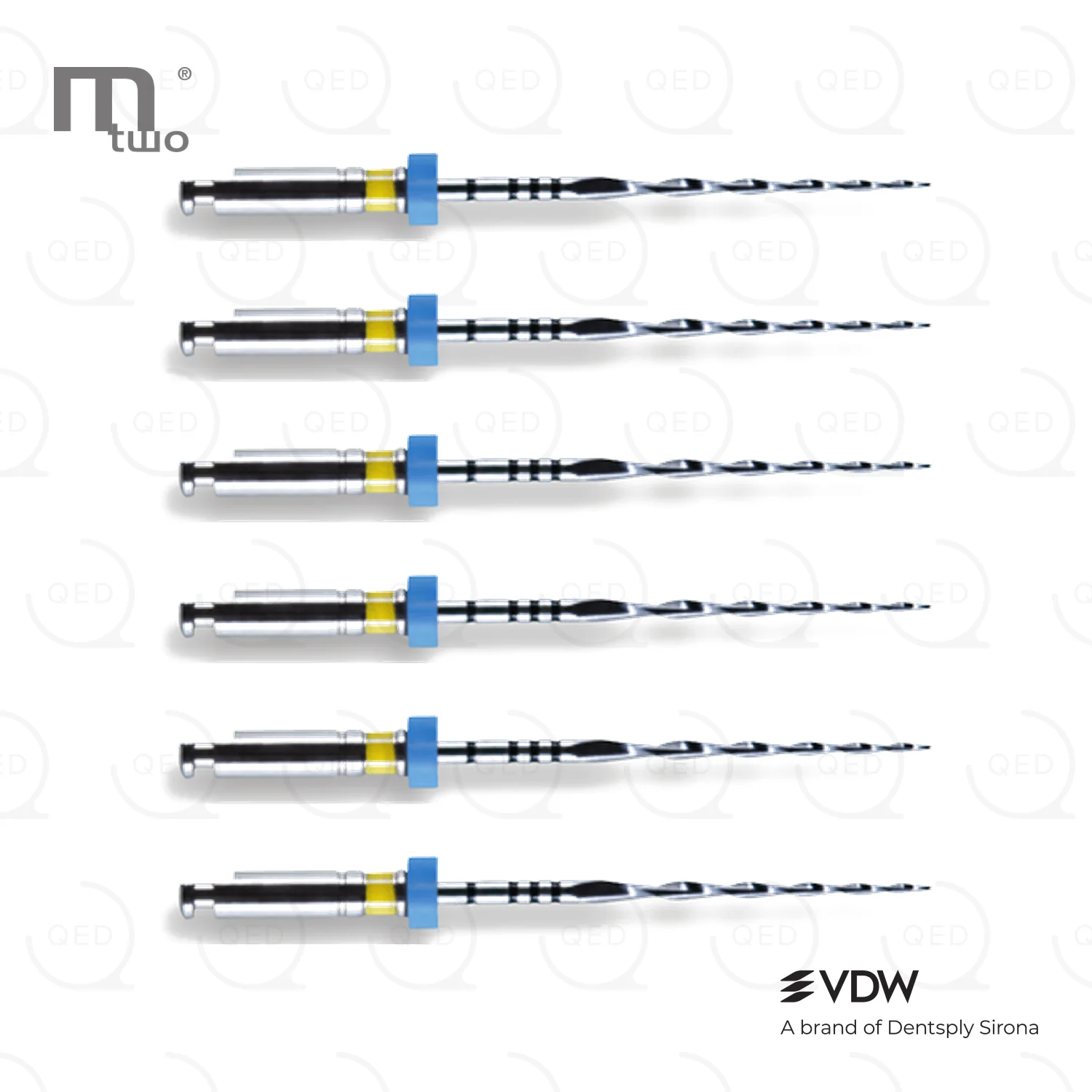
mtwo® · 60/.04 · 21 mm · wp 16 mm · 6 files
s-shaped sectionsterile blistersingle length technique
vdw’s long-standing rotary file. vdw describe an “s-shaped cross-section with two active cutting edges” and a “small instrument core for high flexibility” – the same s-section family as reciproc® blue and vdw.rotate®. every instrument is taken to full working length rather than stepping back.
this pack: vdw mtwo® rotary file, iso size 60, .04 taper, 21 mm, 16 mm working part (pack of 6)
vdw · vdw gmbh, munich, germany (dentsply sirona) · mtwo® is licensed by sweden & martina
| tip (d0) | 0.60 mm |
| taper | .04 |
| length | 21 mm |
| working part | 16 mm |
| handle | iso colour (blue) |
| material | nickel titanium |
| supplied | sterile, pack of 6 |
› s-shaped section, two cutting edges. vdw’s own description, with a “small instrument core for high flexibility”.
› one sequence, one length. vdw: “single length: all instruments are brought to full working length”.
› progressive pitch. vdw describe “active cutting blades and a progressive pitch”.
› wp 16 mm. the flutes run 16 mm from the tip on a 21 mm instrument. vdw list “16 mm working part (21 or 25 mm working length)” and a 21 mm working part at 25 or 31 mm.
“superior cutting efficiency and flexibility, for an efficient root canal preparation”
vdw, vdw dental product catalogue 2023.
what does wp 16 mm mean?
the working part – how far the flutes run up from the tip. this one is 16 mm of cutting on a 21 mm instrument. a shorter working part gives you more shank, which helps in a posterior tooth with limited opening.
should i be looking at vdw.rotate instead?
it is the newer file in the same s-section family, with a heat treatment vdw say lowers the risk of breakage, plus taper rings and radiopaque calibration rings on the handle. we stock both. our suggestion for this size is below.
› the basic sequence: 10/.04 · 15/.05 · 20/.06 · 25/.06, 21 mm
› same size, other lengths: 25 mm, wp 16 mm · 31 mm, wp 21 mm
› larger anatomies: 30/.05 · 35/.04 · 40/.04 · 45/.04
› moving to vdw.rotate: vdw.rotate® 60/.04, 21 mm – the same size and taper, on heat-treated wire
› retreatment: mtwo® retreatment assorted, 21 mm
› obturation: the dia-pro .04 range stops at 45, so there is no matched cone at 60/.04. fit from 45/.04 or the standard ml.029™ 60/.02.
› motor: x-smart® pro+ with apex locator
› lubricant and irrigation: glyde™ file prep · chlorax 5.25% · irriflex® needles
mtwo® is licensed by sweden & martina. sizes, tapers and working parts are as vdw list them in the vdw dental product catalogue 2023. single use. follow the instructions supplied with the product.
mtwo® 60/.04, 21 mm, wp 16 mm (6) · nickel titanium · ref v040234021060
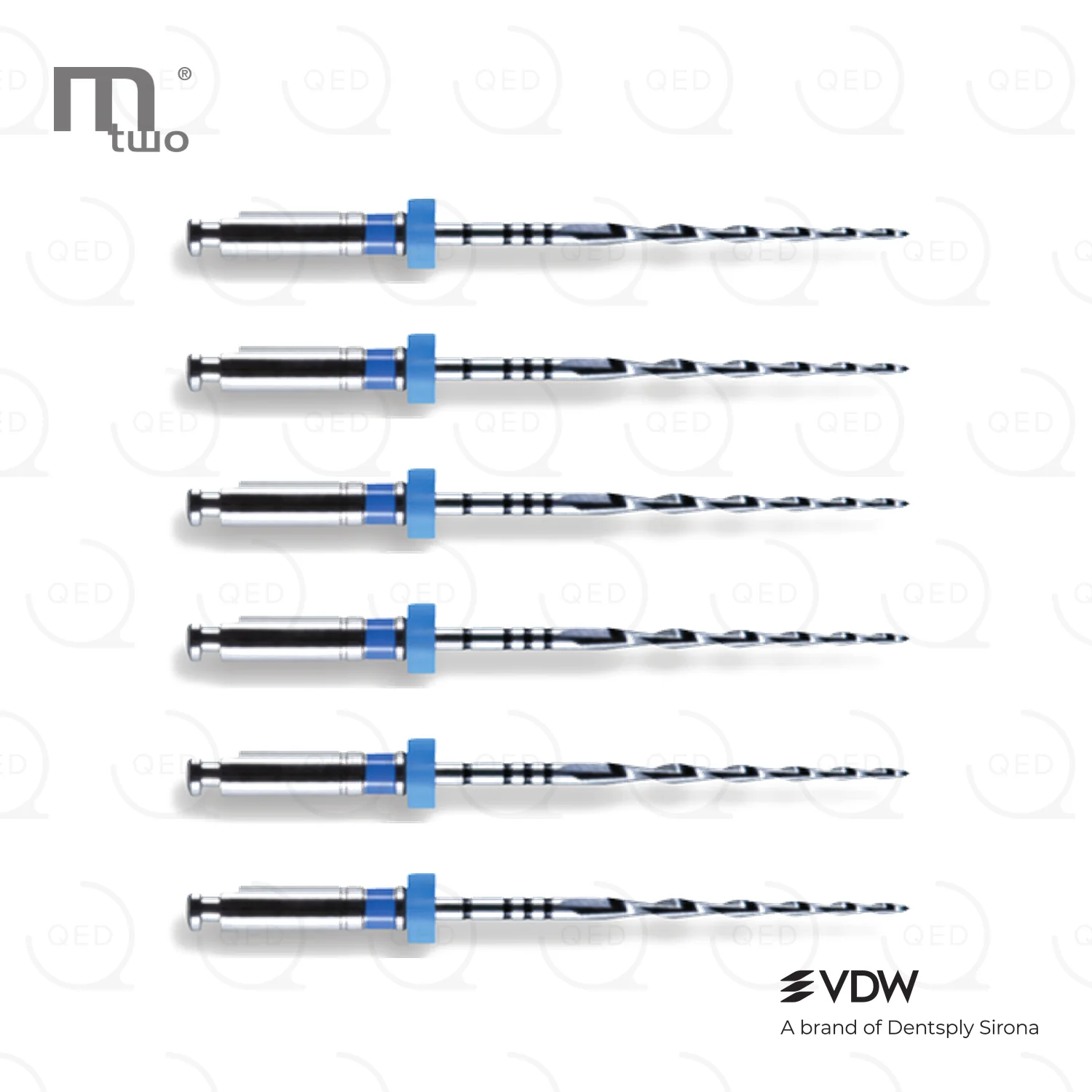
mtwo® · 10/.04 · 25 mm · wp 16 mm · 6 files
s-shaped sectionsterile blistersingle length technique
vdw’s long-standing rotary file. vdw describe an “s-shaped cross-section with two active cutting edges” and a “small instrument core for high flexibility” – the same s-section family as reciproc® blue and vdw.rotate®. every instrument is taken to full working length rather than stepping back.
this pack: vdw mtwo® rotary file, iso size 10, .04 taper, 25 mm, 16 mm working part (pack of 6)
vdw · vdw gmbh, munich, germany (dentsply sirona) · mtwo® is licensed by sweden & martina
| tip (d0) | 0.10 mm |
| taper | .04 |
| length | 25 mm |
| working part | 16 mm |
| handle | iso colour (purple) |
| material | nickel titanium |
| supplied | sterile, pack of 6 |
› s-shaped section, two cutting edges. vdw’s own description, with a “small instrument core for high flexibility”.
› one sequence, one length. vdw: “single length: all instruments are brought to full working length”.
› progressive pitch. vdw describe “active cutting blades and a progressive pitch”.
› wp 16 mm. the flutes run 16 mm from the tip on a 25 mm instrument. vdw list “16 mm working part (21 or 25 mm working length)” and a 21 mm working part at 25 or 31 mm.
“superior cutting efficiency and flexibility, for an efficient root canal preparation”
vdw, vdw dental product catalogue 2023.
what does wp 16 mm mean?
the working part – how far the flutes run up from the tip. this one is 16 mm of cutting on a 25 mm instrument. a shorter working part gives you more shank, which helps in a posterior tooth with limited opening.
should i be looking at vdw.rotate instead?
it is the newer file in the same s-section family, with a heat treatment vdw say lowers the risk of breakage, plus taper rings and radiopaque calibration rings on the handle. we stock both. our suggestion for this size is below.
› the basic sequence: 15/.05 · 20/.06 · 25/.06, 25 mm
› same size, other lengths: 21 mm, wp 16 mm · 25 mm, wp 21 mm · 31 mm, wp 21 mm
› larger anatomies: 30/.05 · 35/.04 · 40/.04 · 45/.04
› moving to vdw.rotate: vdw.rotate® 15/.04, 25 mm – the nearest size in the newer range
› retreatment: mtwo® retreatment assorted, 21 mm
› obturation: the dia-pro .04 range stops at 45, so there is no matched cone at 10/.04. fit from 45/.04.
› motor: x-smart® pro+ with apex locator
› lubricant and irrigation: glyde™ file prep · chlorax 5.25% · irriflex® needles
mtwo® is licensed by sweden & martina. sizes, tapers and working parts are as vdw list them in the vdw dental product catalogue 2023. single use. follow the instructions supplied with the product.
mtwo® 10/.04, 25 mm, wp 16 mm (6) · nickel titanium · ref v040234025010
mtwo® · 35/.04 · 25 mm · wp 16 mm · 6 files
s-shaped sectionsterile blistersingle length technique
vdw’s long-standing rotary file. vdw describe an “s-shaped cross-section with two active cutting edges” and a “small instrument core for high flexibility” – the same s-section family as reciproc® blue and vdw.rotate®. every instrument is taken to full working length rather than stepping back.
this pack: vdw mtwo® rotary file, iso size 35, .04 taper, 25 mm, 16 mm working part (pack of 6)
vdw · vdw gmbh, munich, germany (dentsply sirona) · mtwo® is licensed by sweden & martina
| tip (d0) | 0.35 mm |
| taper | .04 |
| length | 25 mm |
| working part | 16 mm |
| handle | iso colour (green) |
| material | nickel titanium |
| supplied | sterile, pack of 6 |
› s-shaped section, two cutting edges. vdw’s own description, with a “small instrument core for high flexibility”.
› one sequence, one length. vdw: “single length: all instruments are brought to full working length”.
› progressive pitch. vdw describe “active cutting blades and a progressive pitch”.
› wp 16 mm. the flutes run 16 mm from the tip on a 25 mm instrument. vdw list “16 mm working part (21 or 25 mm working length)” and a 21 mm working part at 25 or 31 mm.
“superior cutting efficiency and flexibility, for an efficient root canal preparation”
vdw, vdw dental product catalogue 2023.
what does wp 16 mm mean?
the working part – how far the flutes run up from the tip. this one is 16 mm of cutting on a 25 mm instrument. a shorter working part gives you more shank, which helps in a posterior tooth with limited opening.
should i be looking at vdw.rotate instead?
it is the newer file in the same s-section family, with a heat treatment vdw say lowers the risk of breakage, plus taper rings and radiopaque calibration rings on the handle. we stock both. our suggestion for this size is below.
› the basic sequence: 10/.04 · 15/.05 · 20/.06 · 25/.06, 25 mm
› same size, other lengths: 21 mm, wp 16 mm · 31 mm, wp 21 mm
› larger anatomies: 30/.05 · 40/.04 · 45/.04 · 50/.04
› moving to vdw.rotate: vdw.rotate® 35/.04, 25 mm – the same size and taper, on heat-treated wire
› retreatment: mtwo® retreatment assorted, 21 mm
› obturation: diadent® dia-pro iso gutta-percha 35/.04 · paper points 35/.04 – the same size and taper
› motor: x-smart® pro+ with apex locator
› lubricant and irrigation: glyde™ file prep · chlorax 5.25% · irriflex® needles
mtwo® is licensed by sweden & martina. sizes, tapers and working parts are as vdw list them in the vdw dental product catalogue 2023. single use. follow the instructions supplied with the product.
mtwo® 35/.04, 25 mm, wp 16 mm (6) · nickel titanium · ref v040234025035
mtwo® · 40/.04 · 25 mm · wp 16 mm · 6 files
s-shaped sectionsterile blistersingle length technique
vdw’s long-standing rotary file. vdw describe an “s-shaped cross-section with two active cutting edges” and a “small instrument core for high flexibility” – the same s-section family as reciproc® blue and vdw.rotate®. every instrument is taken to full working length rather than stepping back.
this pack: vdw mtwo® rotary file, iso size 40, .04 taper, 25 mm, 16 mm working part (pack of 6)
vdw · vdw gmbh, munich, germany (dentsply sirona) · mtwo® is licensed by sweden & martina
| tip (d0) | 0.40 mm |
| taper | .04 |
| length | 25 mm |
| working part | 16 mm |
| handle | iso colour (black) |
| material | nickel titanium |
| supplied | sterile, pack of 6 |
› s-shaped section, two cutting edges. vdw’s own description, with a “small instrument core for high flexibility”.
› one sequence, one length. vdw: “single length: all instruments are brought to full working length”.
› progressive pitch. vdw describe “active cutting blades and a progressive pitch”.
› wp 16 mm. the flutes run 16 mm from the tip on a 25 mm instrument. vdw list “16 mm working part (21 or 25 mm working length)” and a 21 mm working part at 25 or 31 mm.
“superior cutting efficiency and flexibility, for an efficient root canal preparation”
vdw, vdw dental product catalogue 2023.
what does wp 16 mm mean?
the working part – how far the flutes run up from the tip. this one is 16 mm of cutting on a 25 mm instrument. a shorter working part gives you more shank, which helps in a posterior tooth with limited opening.
should i be looking at vdw.rotate instead?
it is the newer file in the same s-section family, with a heat treatment vdw say lowers the risk of breakage, plus taper rings and radiopaque calibration rings on the handle. we stock both. our suggestion for this size is below.
› the basic sequence: 10/.04 · 15/.05 · 20/.06 · 25/.06, 25 mm
› same size, other lengths: 21 mm, wp 16 mm · 31 mm, wp 21 mm
› larger anatomies: 30/.05 · 35/.04 · 45/.04 · 50/.04
› moving to vdw.rotate: vdw.rotate® 40/.04, 25 mm – the same size and taper, on heat-treated wire
› retreatment: mtwo® retreatment assorted, 21 mm
› obturation: diadent® dia-pro iso gutta-percha 40/.04 · paper points 40/.04 – the same size and taper
› motor: x-smart® pro+ with apex locator
› lubricant and irrigation: glyde™ file prep · chlorax 5.25% · irriflex® needles
mtwo® is licensed by sweden & martina. sizes, tapers and working parts are as vdw list them in the vdw dental product catalogue 2023. single use. follow the instructions supplied with the product.
mtwo® 40/.04, 25 mm, wp 16 mm (6) · nickel titanium · ref v040234025040
mtwo® · 45/.04 · 25 mm · wp 16 mm · 6 files
s-shaped sectionsterile blistersingle length technique
vdw’s long-standing rotary file. vdw describe an “s-shaped cross-section with two active cutting edges” and a “small instrument core for high flexibility” – the same s-section family as reciproc® blue and vdw.rotate®. every instrument is taken to full working length rather than stepping back.
this pack: vdw mtwo® rotary file, iso size 45, .04 taper, 25 mm, 16 mm working part (pack of 6)
vdw · vdw gmbh, munich, germany (dentsply sirona) · mtwo® is licensed by sweden & martina
| tip (d0) | 0.45 mm |
| taper | .04 |
| length | 25 mm |
| working part | 16 mm |
| handle | iso colour (white) |
| material | nickel titanium |
| supplied | sterile, pack of 6 |
› s-shaped section, two cutting edges. vdw’s own description, with a “small instrument core for high flexibility”.
› one sequence, one length. vdw: “single length: all instruments are brought to full working length”.
› progressive pitch. vdw describe “active cutting blades and a progressive pitch”.
› wp 16 mm. the flutes run 16 mm from the tip on a 25 mm instrument. vdw list “16 mm working part (21 or 25 mm working length)” and a 21 mm working part at 25 or 31 mm.
“superior cutting efficiency and flexibility, for an efficient root canal preparation”
vdw, vdw dental product catalogue 2023.
what does wp 16 mm mean?
the working part – how far the flutes run up from the tip. this one is 16 mm of cutting on a 25 mm instrument. a shorter working part gives you more shank, which helps in a posterior tooth with limited opening.
should i be looking at vdw.rotate instead?
it is the newer file in the same s-section family, with a heat treatment vdw say lowers the risk of breakage, plus taper rings and radiopaque calibration rings on the handle. we stock both. our suggestion for this size is below.
› the basic sequence: 10/.04 · 15/.05 · 20/.06 · 25/.06, 25 mm
› same size, other lengths: 21 mm, wp 16 mm · 31 mm, wp 21 mm
› larger anatomies: 30/.05 · 35/.04 · 40/.04 · 50/.04
› moving to vdw.rotate: vdw.rotate® 50/.04, 25 mm – the nearest size in the newer range
› retreatment: mtwo® retreatment assorted, 21 mm
› obturation: diadent® dia-pro iso gutta-percha 45/.04 – the same size and taper. the dia-pro paper points stop at 40, so gauge with 40/.04 or a standard point.
› motor: x-smart® pro+ with apex locator
› lubricant and irrigation: glyde™ file prep · chlorax 5.25% · irriflex® needles
mtwo® is licensed by sweden & martina. sizes, tapers and working parts are as vdw list them in the vdw dental product catalogue 2023. single use. follow the instructions supplied with the product.
mtwo® 45/.04, 25 mm, wp 16 mm (6) · nickel titanium · ref v040234025045
mtwo® · 50/.04 · 25 mm · wp 16 mm · 6 files
s-shaped sectionsterile blistersingle length technique
vdw’s long-standing rotary file. vdw describe an “s-shaped cross-section with two active cutting edges” and a “small instrument core for high flexibility” – the same s-section family as reciproc® blue and vdw.rotate®. every instrument is taken to full working length rather than stepping back.
this pack: vdw mtwo® rotary file, iso size 50, .04 taper, 25 mm, 16 mm working part (pack of 6)
vdw · vdw gmbh, munich, germany (dentsply sirona) · mtwo® is licensed by sweden & martina
| tip (d0) | 0.50 mm |
| taper | .04 |
| length | 25 mm |
| working part | 16 mm |
| handle | iso colour (yellow) |
| material | nickel titanium |
| supplied | sterile, pack of 6 |
› s-shaped section, two cutting edges. vdw’s own description, with a “small instrument core for high flexibility”.
› one sequence, one length. vdw: “single length: all instruments are brought to full working length”.
› progressive pitch. vdw describe “active cutting blades and a progressive pitch”.
› wp 16 mm. the flutes run 16 mm from the tip on a 25 mm instrument. vdw list “16 mm working part (21 or 25 mm working length)” and a 21 mm working part at 25 or 31 mm.
“superior cutting efficiency and flexibility, for an efficient root canal preparation”
vdw, vdw dental product catalogue 2023.
what does wp 16 mm mean?
the working part – how far the flutes run up from the tip. this one is 16 mm of cutting on a 25 mm instrument. a shorter working part gives you more shank, which helps in a posterior tooth with limited opening.
should i be looking at vdw.rotate instead?
it is the newer file in the same s-section family, with a heat treatment vdw say lowers the risk of breakage, plus taper rings and radiopaque calibration rings on the handle. we stock both. our suggestion for this size is below.
› the basic sequence: 10/.04 · 15/.05 · 20/.06 · 25/.06, 25 mm
› same size, other lengths: 21 mm, wp 16 mm · 31 mm, wp 21 mm
› larger anatomies: 30/.05 · 35/.04 · 40/.04 · 45/.04
› moving to vdw.rotate: vdw.rotate® 50/.04, 25 mm – the same size and taper, on heat-treated wire
› retreatment: mtwo® retreatment assorted, 21 mm
› obturation: the dia-pro .04 range stops at 45, so there is no matched cone at 50/.04. fit from 45/.04 or the standard ml.029™ 50/.02.
› motor: x-smart® pro+ with apex locator
› lubricant and irrigation: glyde™ file prep · chlorax 5.25% · irriflex® needles
mtwo® is licensed by sweden & martina. sizes, tapers and working parts are as vdw list them in the vdw dental product catalogue 2023. single use. follow the instructions supplied with the product.
mtwo® 50/.04, 25 mm, wp 16 mm (6) · nickel titanium · ref v040234025050
mtwo® · 60/.04 · 25 mm · wp 16 mm · 6 files
s-shaped sectionsterile blistersingle length technique
vdw’s long-standing rotary file. vdw describe an “s-shaped cross-section with two active cutting edges” and a “small instrument core for high flexibility” – the same s-section family as reciproc® blue and vdw.rotate®. every instrument is taken to full working length rather than stepping back.
this pack: vdw mtwo® rotary file, iso size 60, .04 taper, 25 mm, 16 mm working part (pack of 6)
vdw · vdw gmbh, munich, germany (dentsply sirona) · mtwo® is licensed by sweden & martina
| tip (d0) | 0.60 mm |
| taper | .04 |
| length | 25 mm |
| working part | 16 mm |
| handle | iso colour (blue) |
| material | nickel titanium |
| supplied | sterile, pack of 6 |
› s-shaped section, two cutting edges. vdw’s own description, with a “small instrument core for high flexibility”.
› one sequence, one length. vdw: “single length: all instruments are brought to full working length”.
› progressive pitch. vdw describe “active cutting blades and a progressive pitch”.
› wp 16 mm. the flutes run 16 mm from the tip on a 25 mm instrument. vdw list “16 mm working part (21 or 25 mm working length)” and a 21 mm working part at 25 or 31 mm.
“superior cutting efficiency and flexibility, for an efficient root canal preparation”
vdw, vdw dental product catalogue 2023.
what does wp 16 mm mean?
the working part – how far the flutes run up from the tip. this one is 16 mm of cutting on a 25 mm instrument. a shorter working part gives you more shank, which helps in a posterior tooth with limited opening.
should i be looking at vdw.rotate instead?
it is the newer file in the same s-section family, with a heat treatment vdw say lowers the risk of breakage, plus taper rings and radiopaque calibration rings on the handle. we stock both. our suggestion for this size is below.
› the basic sequence: 10/.04 · 15/.05 · 20/.06 · 25/.06, 25 mm
› same size, other lengths: 21 mm, wp 16 mm · 31 mm, wp 21 mm
› larger anatomies: 30/.05 · 35/.04 · 40/.04 · 45/.04
› moving to vdw.rotate: vdw.rotate® 60/.04, 25 mm – the same size and taper, on heat-treated wire
› retreatment: mtwo® retreatment assorted, 21 mm
› obturation: the dia-pro .04 range stops at 45, so there is no matched cone at 60/.04. fit from 45/.04 or the standard ml.029™ 60/.02.
› motor: x-smart® pro+ with apex locator
› lubricant and irrigation: glyde™ file prep · chlorax 5.25% · irriflex® needles
mtwo® is licensed by sweden & martina. sizes, tapers and working parts are as vdw list them in the vdw dental product catalogue 2023. single use. follow the instructions supplied with the product.
mtwo® 60/.04, 25 mm, wp 16 mm (6) · nickel titanium · ref v040234025060
mtwo® · 15/.05 · 21 mm · wp 16 mm · 6 files
s-shaped sectionsterile blistersingle length technique
vdw’s long-standing rotary file. vdw describe an “s-shaped cross-section with two active cutting edges” and a “small instrument core for high flexibility” – the same s-section family as reciproc® blue and vdw.rotate®. every instrument is taken to full working length rather than stepping back.
this pack: vdw mtwo® rotary file, iso size 15, .05 taper, 21 mm, 16 mm working part (pack of 6)
vdw · vdw gmbh, munich, germany (dentsply sirona) · mtwo® is licensed by sweden & martina
| tip (d0) | 0.15 mm |
| taper | .05 |
| length | 21 mm |
| working part | 16 mm |
| handle | iso colour (white) |
| material | nickel titanium |
| supplied | sterile, pack of 6 |
› s-shaped section, two cutting edges. vdw’s own description, with a “small instrument core for high flexibility”.
› one sequence, one length. vdw: “single length: all instruments are brought to full working length”.
› progressive pitch. vdw describe “active cutting blades and a progressive pitch”.
› wp 16 mm. the flutes run 16 mm from the tip on a 21 mm instrument. vdw list “16 mm working part (21 or 25 mm working length)” and a 21 mm working part at 25 or 31 mm.
“superior cutting efficiency and flexibility, for an efficient root canal preparation”
vdw, vdw dental product catalogue 2023.
what does wp 16 mm mean?
the working part – how far the flutes run up from the tip. this one is 16 mm of cutting on a 21 mm instrument. a shorter working part gives you more shank, which helps in a posterior tooth with limited opening.
should i be looking at vdw.rotate instead?
it is the newer file in the same s-section family, with a heat treatment vdw say lowers the risk of breakage, plus taper rings and radiopaque calibration rings on the handle. we stock both. our suggestion for this size is below.
› the basic sequence: 10/.04 · 20/.06 · 25/.06, 21 mm
› same size, other lengths: 25 mm, wp 16 mm · 25 mm, wp 21 mm · 31 mm, wp 21 mm
› larger anatomies: 30/.05 · 35/.04 · 40/.04 · 45/.04
› moving to vdw.rotate: vdw.rotate® 15/.04, 21 mm – the nearest size in the newer range
› retreatment: mtwo® retreatment assorted, 21 mm
› obturation: dia-pro iso is made in .04 and .06 only, so there is no matched cone for a .05 preparation. fit from the .04 assorted pack or the standard ml.029™ .02 range.
› motor: x-smart® pro+ with apex locator
› lubricant and irrigation: glyde™ file prep · chlorax 5.25% · irriflex® needles
mtwo® is licensed by sweden & martina. sizes, tapers and working parts are as vdw list them in the vdw dental product catalogue 2023. single use. follow the instructions supplied with the product.
mtwo® 15/.05, 21 mm, wp 16 mm (6) · nickel titanium · ref v040235021015

mtwo® · 30/.05 · 21 mm · wp 16 mm · 6 files
s-shaped sectionsterile blistersingle length technique
vdw’s long-standing rotary file. vdw describe an “s-shaped cross-section with two active cutting edges” and a “small instrument core for high flexibility” – the same s-section family as reciproc® blue and vdw.rotate®. every instrument is taken to full working length rather than stepping back.
this pack: vdw mtwo® rotary file, iso size 30, .05 taper, 21 mm, 16 mm working part (pack of 6)
vdw · vdw gmbh, munich, germany (dentsply sirona) · mtwo® is licensed by sweden & martina
| tip (d0) | 0.30 mm |
| taper | .05 |
| length | 21 mm |
| working part | 16 mm |
| handle | iso colour (blue) |
| material | nickel titanium |
| supplied | sterile, pack of 6 |
› s-shaped section, two cutting edges. vdw’s own description, with a “small instrument core for high flexibility”.
› one sequence, one length. vdw: “single length: all instruments are brought to full working length”.
› progressive pitch. vdw describe “active cutting blades and a progressive pitch”.
› wp 16 mm. the flutes run 16 mm from the tip on a 21 mm instrument. vdw list “16 mm working part (21 or 25 mm working length)” and a 21 mm working part at 25 or 31 mm.
“superior cutting efficiency and flexibility, for an efficient root canal preparation”
vdw, vdw dental product catalogue 2023.
what does wp 16 mm mean?
the working part – how far the flutes run up from the tip. this one is 16 mm of cutting on a 21 mm instrument. a shorter working part gives you more shank, which helps in a posterior tooth with limited opening.
should i be looking at vdw.rotate instead?
it is the newer file in the same s-section family, with a heat treatment vdw say lowers the risk of breakage, plus taper rings and radiopaque calibration rings on the handle. we stock both. our suggestion for this size is below.
› the basic sequence: 10/.04 · 15/.05 · 20/.06 · 25/.06, 21 mm
› same size, other lengths: 25 mm, wp 16 mm · 31 mm, wp 21 mm
› larger anatomies: 35/.04 · 40/.04 · 45/.04 · 50/.04
› moving to vdw.rotate: vdw.rotate® 30/.04, 21 mm – the nearest size in the newer range
› retreatment: mtwo® retreatment assorted, 21 mm
› obturation: dia-pro iso is made in .04 and .06 only, so there is no matched cone for a .05 preparation. fit from the .04 assorted pack or the standard ml.029™ .02 range.
› motor: x-smart® pro+ with apex locator
› lubricant and irrigation: glyde™ file prep · chlorax 5.25% · irriflex® needles
mtwo® is licensed by sweden & martina. sizes, tapers and working parts are as vdw list them in the vdw dental product catalogue 2023. single use. follow the instructions supplied with the product.
mtwo® 30/.05, 21 mm, wp 16 mm (6) · nickel titanium · ref v040235021030
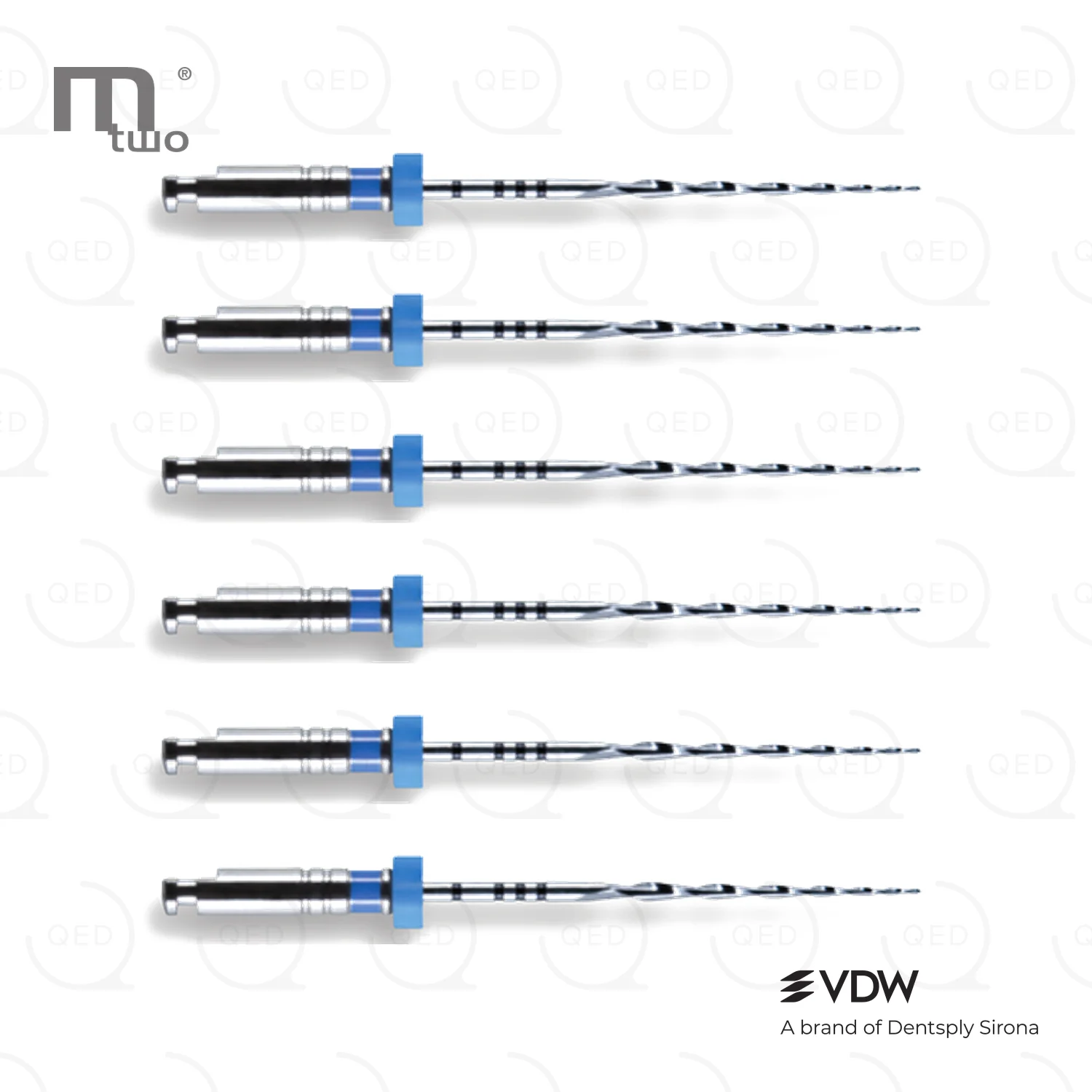
mtwo® · 15/.05 · 25 mm · wp 16 mm · 6 files
s-shaped sectionsterile blistersingle length technique
vdw’s long-standing rotary file. vdw describe an “s-shaped cross-section with two active cutting edges” and a “small instrument core for high flexibility” – the same s-section family as reciproc® blue and vdw.rotate®. every instrument is taken to full working length rather than stepping back.
this pack: vdw mtwo® rotary file, iso size 15, .05 taper, 25 mm, 16 mm working part (pack of 6)
vdw · vdw gmbh, munich, germany (dentsply sirona) · mtwo® is licensed by sweden & martina
| tip (d0) | 0.15 mm |
| taper | .05 |
| length | 25 mm |
| working part | 16 mm |
| handle | iso colour (white) |
| material | nickel titanium |
| supplied | sterile, pack of 6 |
› s-shaped section, two cutting edges. vdw’s own description, with a “small instrument core for high flexibility”.
› one sequence, one length. vdw: “single length: all instruments are brought to full working length”.
› progressive pitch. vdw describe “active cutting blades and a progressive pitch”.
› wp 16 mm. the flutes run 16 mm from the tip on a 25 mm instrument. vdw list “16 mm working part (21 or 25 mm working length)” and a 21 mm working part at 25 or 31 mm.
“superior cutting efficiency and flexibility, for an efficient root canal preparation”
vdw, vdw dental product catalogue 2023.
what does wp 16 mm mean?
the working part – how far the flutes run up from the tip. this one is 16 mm of cutting on a 25 mm instrument. a shorter working part gives you more shank, which helps in a posterior tooth with limited opening.
should i be looking at vdw.rotate instead?
it is the newer file in the same s-section family, with a heat treatment vdw say lowers the risk of breakage, plus taper rings and radiopaque calibration rings on the handle. we stock both. our suggestion for this size is below.
› the basic sequence: 10/.04 · 20/.06 · 25/.06, 25 mm
› same size, other lengths: 21 mm, wp 16 mm · 25 mm, wp 21 mm · 31 mm, wp 21 mm
› larger anatomies: 30/.05 · 35/.04 · 40/.04 · 45/.04
› moving to vdw.rotate: vdw.rotate® 15/.04, 25 mm – the nearest size in the newer range
› retreatment: mtwo® retreatment assorted, 21 mm
› obturation: dia-pro iso is made in .04 and .06 only, so there is no matched cone for a .05 preparation. fit from the .04 assorted pack or the standard ml.029™ .02 range.
› motor: x-smart® pro+ with apex locator
› lubricant and irrigation: glyde™ file prep · chlorax 5.25% · irriflex® needles
mtwo® is licensed by sweden & martina. sizes, tapers and working parts are as vdw list them in the vdw dental product catalogue 2023. single use. follow the instructions supplied with the product.
mtwo® 15/.05, 25 mm, wp 16 mm (6) · nickel titanium · ref v040235025015
mtwo® · 30/.05 · 25 mm · wp 16 mm · 6 files
s-shaped sectionsterile blistersingle length technique
vdw’s long-standing rotary file. vdw describe an “s-shaped cross-section with two active cutting edges” and a “small instrument core for high flexibility” – the same s-section family as reciproc® blue and vdw.rotate®. every instrument is taken to full working length rather than stepping back.
this pack: vdw mtwo® rotary file, iso size 30, .05 taper, 25 mm, 16 mm working part (pack of 6)
vdw · vdw gmbh, munich, germany (dentsply sirona) · mtwo® is licensed by sweden & martina
| tip (d0) | 0.30 mm |
| taper | .05 |
| length | 25 mm |
| working part | 16 mm |
| handle | iso colour (blue) |
| material | nickel titanium |
| supplied | sterile, pack of 6 |
› s-shaped section, two cutting edges. vdw’s own description, with a “small instrument core for high flexibility”.
› one sequence, one length. vdw: “single length: all instruments are brought to full working length”.
› progressive pitch. vdw describe “active cutting blades and a progressive pitch”.
› wp 16 mm. the flutes run 16 mm from the tip on a 25 mm instrument. vdw list “16 mm working part (21 or 25 mm working length)” and a 21 mm working part at 25 or 31 mm.
“superior cutting efficiency and flexibility, for an efficient root canal preparation”
vdw, vdw dental product catalogue 2023.
what does wp 16 mm mean?
the working part – how far the flutes run up from the tip. this one is 16 mm of cutting on a 25 mm instrument. a shorter working part gives you more shank, which helps in a posterior tooth with limited opening.
should i be looking at vdw.rotate instead?
it is the newer file in the same s-section family, with a heat treatment vdw say lowers the risk of breakage, plus taper rings and radiopaque calibration rings on the handle. we stock both. our suggestion for this size is below.
› the basic sequence: 10/.04 · 15/.05 · 20/.06 · 25/.06, 25 mm
› same size, other lengths: 21 mm, wp 16 mm · 31 mm, wp 21 mm
› larger anatomies: 35/.04 · 40/.04 · 45/.04 · 50/.04
› moving to vdw.rotate: vdw.rotate® 30/.04, 25 mm – the nearest size in the newer range
› retreatment: mtwo® retreatment assorted, 21 mm
› obturation: dia-pro iso is made in .04 and .06 only, so there is no matched cone for a .05 preparation. fit from the .04 assorted pack or the standard ml.029™ .02 range.
› motor: x-smart® pro+ with apex locator
› lubricant and irrigation: glyde™ file prep · chlorax 5.25% · irriflex® needles
mtwo® is licensed by sweden & martina. sizes, tapers and working parts are as vdw list them in the vdw dental product catalogue 2023. single use. follow the instructions supplied with the product.
mtwo® 30/.05, 25 mm, wp 16 mm (6) · nickel titanium · ref v040235025030
mtwo® · 20/.06 · 21 mm · wp 16 mm · 6 files
s-shaped sectionsterile blistersingle length technique
vdw’s long-standing rotary file. vdw describe an “s-shaped cross-section with two active cutting edges” and a “small instrument core for high flexibility” – the same s-section family as reciproc® blue and vdw.rotate®. every instrument is taken to full working length rather than stepping back.
this pack: vdw mtwo® rotary file, iso size 20, .06 taper, 21 mm, 16 mm working part (pack of 6)
vdw · vdw gmbh, munich, germany (dentsply sirona) · mtwo® is licensed by sweden & martina
| tip (d0) | 0.20 mm |
| taper | .06 |
| length | 21 mm |
| working part | 16 mm |
| handle | iso colour (yellow) |
| material | nickel titanium |
| supplied | sterile, pack of 6 |
› s-shaped section, two cutting edges. vdw’s own description, with a “small instrument core for high flexibility”.
› one sequence, one length. vdw: “single length: all instruments are brought to full working length”.
› progressive pitch. vdw describe “active cutting blades and a progressive pitch”.
› wp 16 mm. the flutes run 16 mm from the tip on a 21 mm instrument. vdw list “16 mm working part (21 or 25 mm working length)” and a 21 mm working part at 25 or 31 mm.
“superior cutting efficiency and flexibility, for an efficient root canal preparation”
vdw, vdw dental product catalogue 2023.
what does wp 16 mm mean?
the working part – how far the flutes run up from the tip. this one is 16 mm of cutting on a 21 mm instrument. a shorter working part gives you more shank, which helps in a posterior tooth with limited opening.
should i be looking at vdw.rotate instead?
it is the newer file in the same s-section family, with a heat treatment vdw say lowers the risk of breakage, plus taper rings and radiopaque calibration rings on the handle. we stock both. our suggestion for this size is below.
› the basic sequence: 10/.04 · 15/.05 · 25/.06, 21 mm
› same size, other lengths: 25 mm, wp 16 mm · 25 mm, wp 21 mm · 31 mm, wp 21 mm
› larger anatomies: 30/.05 · 35/.04 · 40/.04 · 45/.04
› moving to vdw.rotate: vdw.rotate® 20/.05, 21 mm – the nearest size in the newer range
› retreatment: mtwo® retreatment assorted, 21 mm
› obturation: diadent® dia-pro iso gutta-percha 20/.06 · paper points 20/.06 – the same size and taper
› motor: x-smart® pro+ with apex locator
› lubricant and irrigation: glyde™ file prep · chlorax 5.25% · irriflex® needles
mtwo® is licensed by sweden & martina. sizes, tapers and working parts are as vdw list them in the vdw dental product catalogue 2023. single use. follow the instructions supplied with the product.
mtwo® 20/.06, 21 mm, wp 16 mm (6) · nickel titanium · ref v040236021020
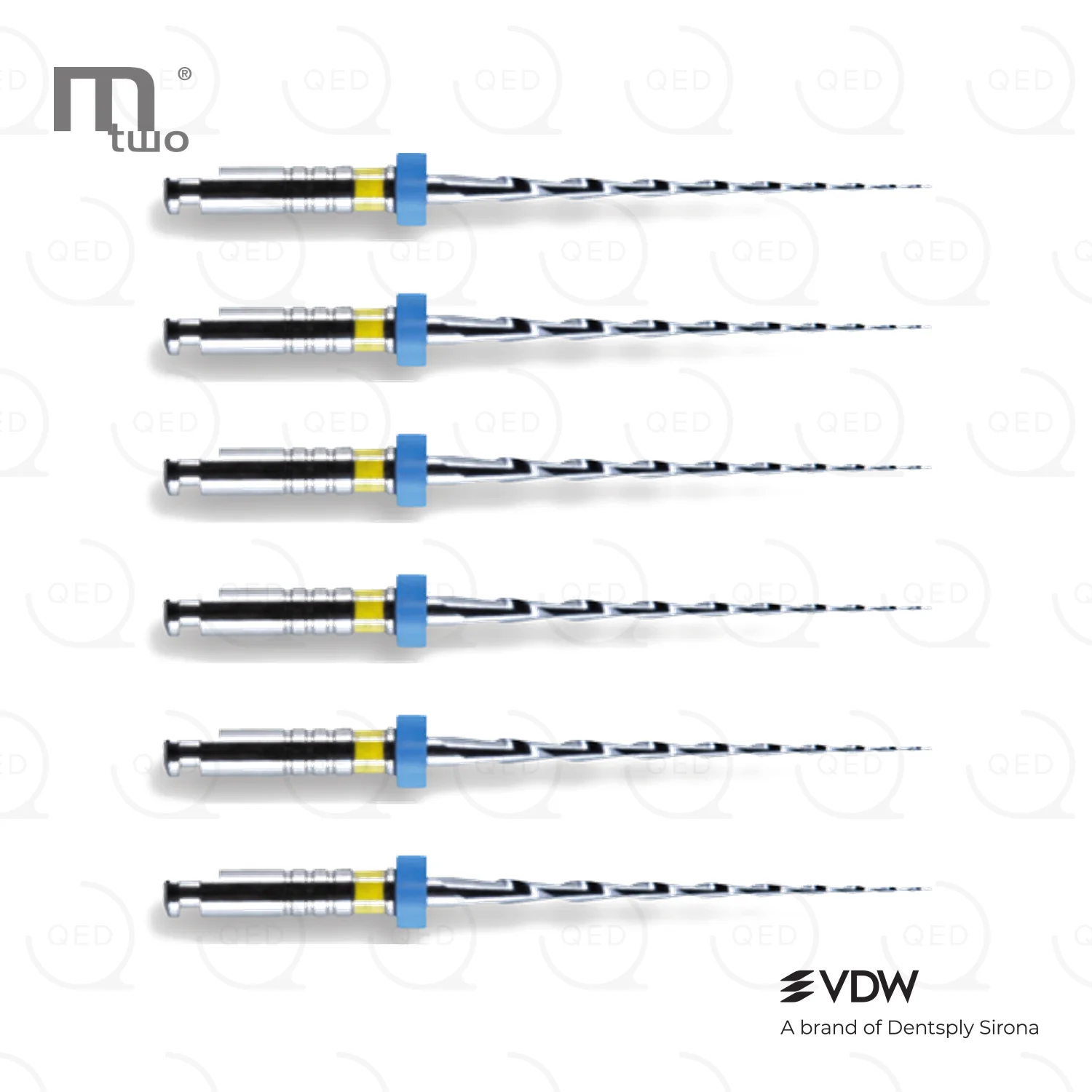
mtwo® · 25/.06 · 21 mm · wp 16 mm · 6 files
s-shaped sectionsterile blistersingle length technique
vdw’s long-standing rotary file. vdw describe an “s-shaped cross-section with two active cutting edges” and a “small instrument core for high flexibility” – the same s-section family as reciproc® blue and vdw.rotate®. every instrument is taken to full working length rather than stepping back.
this pack: vdw mtwo® rotary file, iso size 25, .06 taper, 21 mm, 16 mm working part (pack of 6)
vdw · vdw gmbh, munich, germany (dentsply sirona) · mtwo® is licensed by sweden & martina
| tip (d0) | 0.25 mm |
| taper | .06 |
| length | 21 mm |
| working part | 16 mm |
| handle | iso colour (red) |
| material | nickel titanium |
| supplied | sterile, pack of 6 |
› s-shaped section, two cutting edges. vdw’s own description, with a “small instrument core for high flexibility”.
› one sequence, one length. vdw: “single length: all instruments are brought to full working length”.
› progressive pitch. vdw describe “active cutting blades and a progressive pitch”.
› wp 16 mm. the flutes run 16 mm from the tip on a 21 mm instrument. vdw list “16 mm working part (21 or 25 mm working length)” and a 21 mm working part at 25 or 31 mm.
“superior cutting efficiency and flexibility, for an efficient root canal preparation”
vdw, vdw dental product catalogue 2023.
what does wp 16 mm mean?
the working part – how far the flutes run up from the tip. this one is 16 mm of cutting on a 21 mm instrument. a shorter working part gives you more shank, which helps in a posterior tooth with limited opening.
should i be looking at vdw.rotate instead?
it is the newer file in the same s-section family, with a heat treatment vdw say lowers the risk of breakage, plus taper rings and radiopaque calibration rings on the handle. we stock both. our suggestion for this size is below.
› the basic sequence: 10/.04 · 15/.05 · 20/.06, 21 mm
› same size, other lengths: 25 mm, wp 16 mm · 25 mm, wp 21 mm · 31 mm, wp 21 mm
› larger anatomies: 30/.05 · 35/.04 · 40/.04 · 45/.04
› moving to vdw.rotate: vdw.rotate® 25/.06, 21 mm – the same size and taper, on heat-treated wire
› retreatment: mtwo® retreatment assorted, 21 mm
› obturation: diadent® dia-pro iso gutta-percha 25/.06 · paper points 25/.06 – the same size and taper
› motor: x-smart® pro+ with apex locator
› lubricant and irrigation: glyde™ file prep · chlorax 5.25% · irriflex® needles
mtwo® is licensed by sweden & martina. sizes, tapers and working parts are as vdw list them in the vdw dental product catalogue 2023. single use. follow the instructions supplied with the product.
mtwo® 25/.06, 21 mm, wp 16 mm (6) · nickel titanium · ref v040236021025
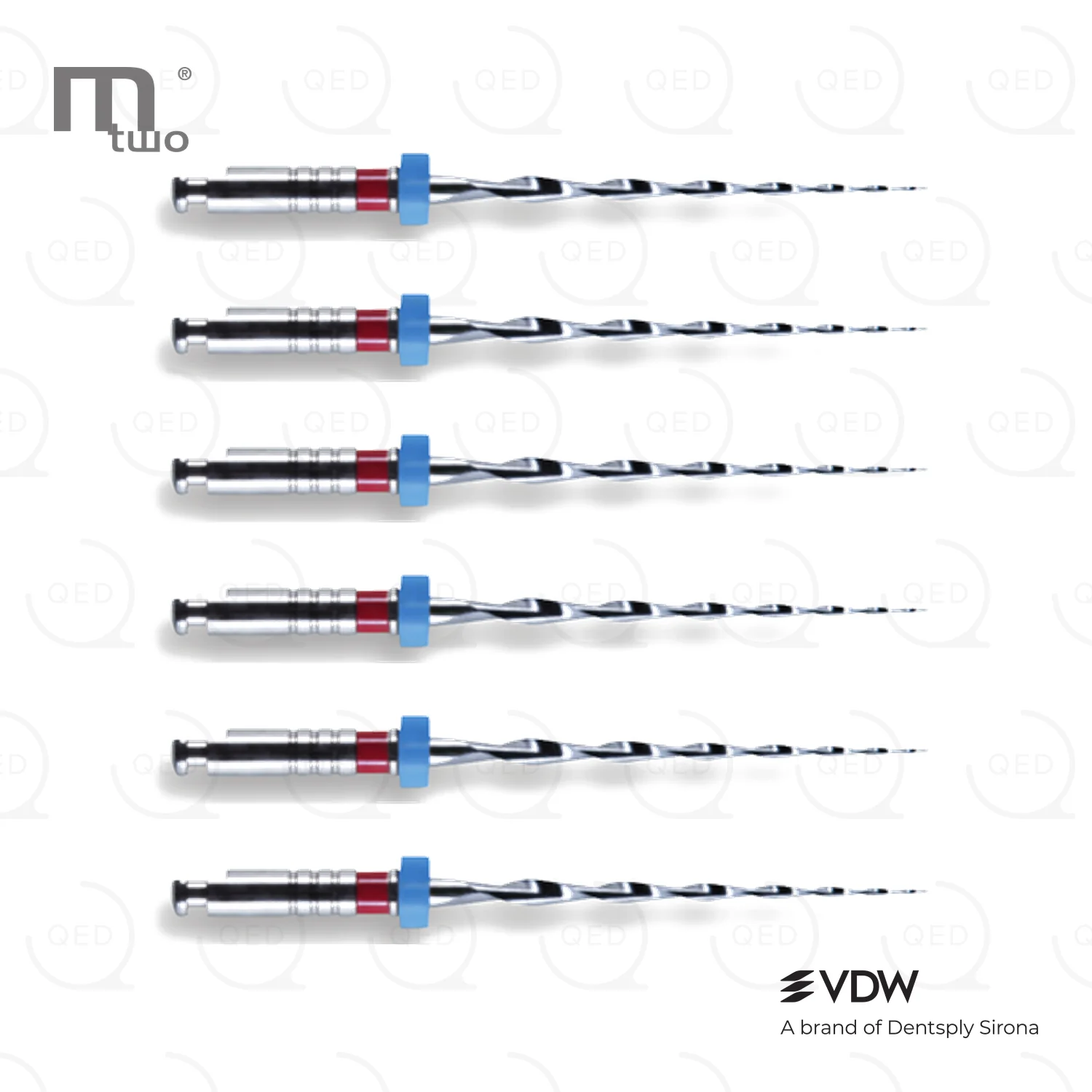
mtwo® · 30/.06 · 21 mm · wp 16 mm · 6 files
s-shaped sectionsterile blistersingle length technique
vdw’s long-standing rotary file. vdw describe an “s-shaped cross-section with two active cutting edges” and a “small instrument core for high flexibility” – the same s-section family as reciproc® blue and vdw.rotate®. every instrument is taken to full working length rather than stepping back.
this pack: vdw mtwo® rotary file, iso size 30, .06 taper, 21 mm, 16 mm working part (pack of 6)
vdw · vdw gmbh, munich, germany (dentsply sirona) · mtwo® is licensed by sweden & martina
| tip (d0) | 0.30 mm |
| taper | .06 |
| length | 21 mm |
| working part | 16 mm |
| handle | iso colour (blue) |
| material | nickel titanium |
| supplied | sterile, pack of 6 |
› s-shaped section, two cutting edges. vdw’s own description, with a “small instrument core for high flexibility”.
› one sequence, one length. vdw: “single length: all instruments are brought to full working length”.
› progressive pitch. vdw describe “active cutting blades and a progressive pitch”.
› wp 16 mm. the flutes run 16 mm from the tip on a 21 mm instrument. vdw list “16 mm working part (21 or 25 mm working length)” and a 21 mm working part at 25 or 31 mm.
“superior cutting efficiency and flexibility, for an efficient root canal preparation”
vdw, vdw dental product catalogue 2023.
what does wp 16 mm mean?
the working part – how far the flutes run up from the tip. this one is 16 mm of cutting on a 21 mm instrument. a shorter working part gives you more shank, which helps in a posterior tooth with limited opening.
should i be looking at vdw.rotate instead?
it is the newer file in the same s-section family, with a heat treatment vdw say lowers the risk of breakage, plus taper rings and radiopaque calibration rings on the handle. we stock both. our suggestion for this size is below.
› the basic sequence: 10/.04 · 15/.05 · 20/.06 · 25/.06, 21 mm
› same size, other lengths: 25 mm, wp 16 mm · 31 mm, wp 21 mm
› larger anatomies: 30/.05 · 35/.04 · 40/.04 · 45/.04
› moving to vdw.rotate: vdw.rotate® 30/.06, 21 mm – the same size and taper, on heat-treated wire
› retreatment: mtwo® retreatment assorted, 21 mm
› obturation: diadent® dia-pro iso gutta-percha 30/.06 · paper points 30/.06 – the same size and taper
› motor: x-smart® pro+ with apex locator
› lubricant and irrigation: glyde™ file prep · chlorax 5.25% · irriflex® needles
mtwo® is licensed by sweden & martina. sizes, tapers and working parts are as vdw list them in the vdw dental product catalogue 2023. single use. follow the instructions supplied with the product.
mtwo® 30/.06, 21 mm, wp 16 mm (6) · nickel titanium · ref v040236021030

mtwo® · 35/.06 · 21 mm · wp 16 mm · 6 files
s-shaped sectionsterile blistersingle length technique
vdw’s long-standing rotary file. vdw describe an “s-shaped cross-section with two active cutting edges” and a “small instrument core for high flexibility” – the same s-section family as reciproc® blue and vdw.rotate®. every instrument is taken to full working length rather than stepping back.
this pack: vdw mtwo® rotary file, iso size 35, .06 taper, 21 mm, 16 mm working part (pack of 6)
vdw · vdw gmbh, munich, germany (dentsply sirona) · mtwo® is licensed by sweden & martina
| tip (d0) | 0.35 mm |
| taper | .06 |
| length | 21 mm |
| working part | 16 mm |
| handle | iso colour (green) |
| material | nickel titanium |
| supplied | sterile, pack of 6 |
› s-shaped section, two cutting edges. vdw’s own description, with a “small instrument core for high flexibility”.
› one sequence, one length. vdw: “single length: all instruments are brought to full working length”.
› progressive pitch. vdw describe “active cutting blades and a progressive pitch”.
› wp 16 mm. the flutes run 16 mm from the tip on a 21 mm instrument. vdw list “16 mm working part (21 or 25 mm working length)” and a 21 mm working part at 25 or 31 mm.
“superior cutting efficiency and flexibility, for an efficient root canal preparation”
vdw, vdw dental product catalogue 2023.
what does wp 16 mm mean?
the working part – how far the flutes run up from the tip. this one is 16 mm of cutting on a 21 mm instrument. a shorter working part gives you more shank, which helps in a posterior tooth with limited opening.
should i be looking at vdw.rotate instead?
it is the newer file in the same s-section family, with a heat treatment vdw say lowers the risk of breakage, plus taper rings and radiopaque calibration rings on the handle. we stock both. our suggestion for this size is below.
› the basic sequence: 10/.04 · 15/.05 · 20/.06 · 25/.06, 21 mm
› same size, other lengths: 25 mm, wp 16 mm · 31 mm, wp 21 mm
› larger anatomies: 30/.05 · 35/.04 · 40/.04 · 45/.04
› moving to vdw.rotate: vdw.rotate® 35/.06, 21 mm – the same size and taper, on heat-treated wire
› retreatment: mtwo® retreatment assorted, 21 mm
› obturation: diadent® dia-pro iso gutta-percha 35/.06 · paper points 35/.06 – the same size and taper
› motor: x-smart® pro+ with apex locator
› lubricant and irrigation: glyde™ file prep · chlorax 5.25% · irriflex® needles
mtwo® is licensed by sweden & martina. sizes, tapers and working parts are as vdw list them in the vdw dental product catalogue 2023. single use. follow the instructions supplied with the product.
mtwo® 35/.06, 21 mm, wp 16 mm (6) · nickel titanium · ref v040236021035
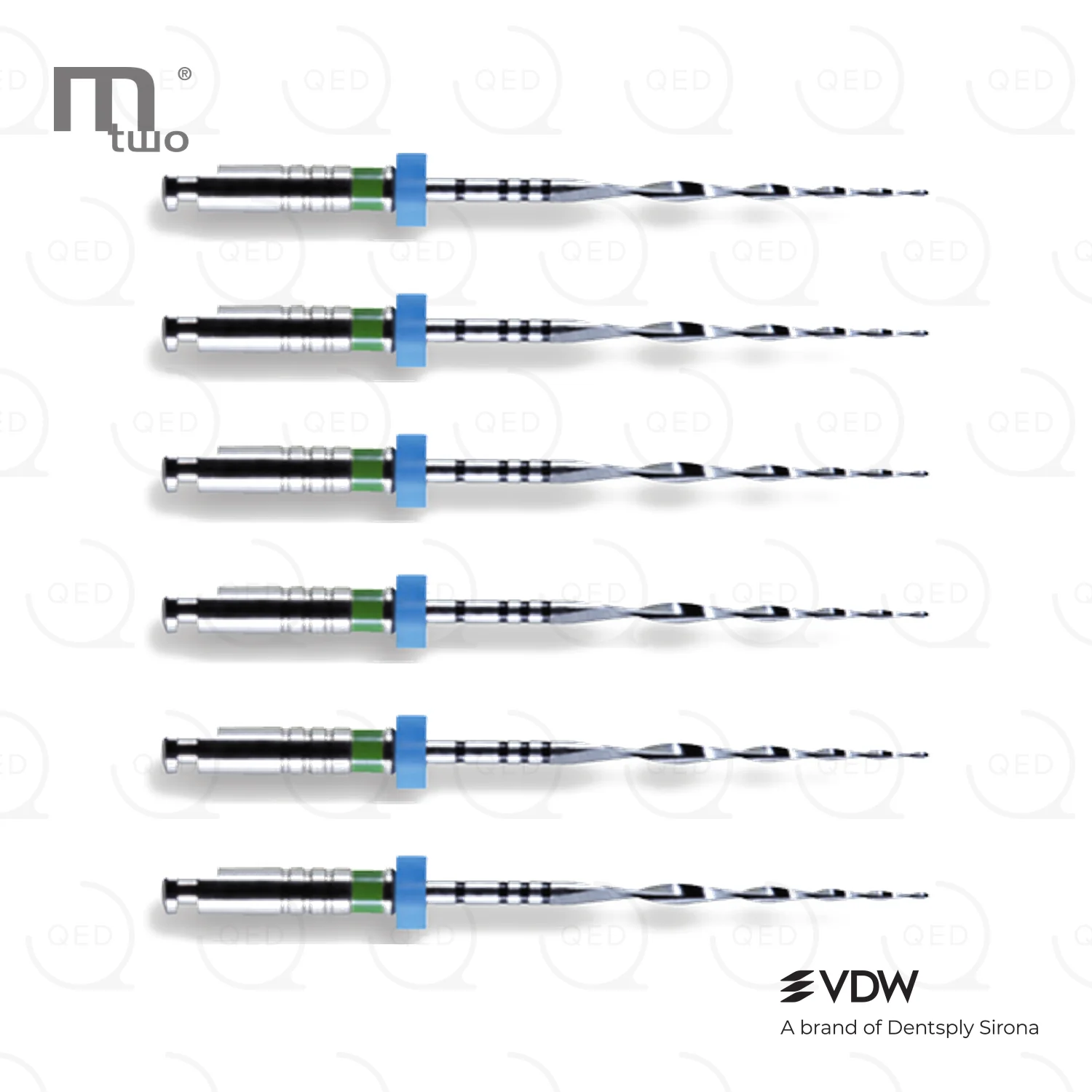
mtwo® · 40/.06 · 21 mm · wp 16 mm · 6 files
s-shaped sectionsterile blistersingle length technique
vdw’s long-standing rotary file. vdw describe an “s-shaped cross-section with two active cutting edges” and a “small instrument core for high flexibility” – the same s-section family as reciproc® blue and vdw.rotate®. every instrument is taken to full working length rather than stepping back.
this pack: vdw mtwo® rotary file, iso size 40, .06 taper, 21 mm, 16 mm working part (pack of 6)
vdw · vdw gmbh, munich, germany (dentsply sirona) · mtwo® is licensed by sweden & martina
| tip (d0) | 0.40 mm |
| taper | .06 |
| length | 21 mm |
| working part | 16 mm |
| handle | iso colour (black) |
| material | nickel titanium |
| supplied | sterile, pack of 6 |
› s-shaped section, two cutting edges. vdw’s own description, with a “small instrument core for high flexibility”.
› one sequence, one length. vdw: “single length: all instruments are brought to full working length”.
› progressive pitch. vdw describe “active cutting blades and a progressive pitch”.
› wp 16 mm. the flutes run 16 mm from the tip on a 21 mm instrument. vdw list “16 mm working part (21 or 25 mm working length)” and a 21 mm working part at 25 or 31 mm.
“superior cutting efficiency and flexibility, for an efficient root canal preparation”
vdw, vdw dental product catalogue 2023.
what does wp 16 mm mean?
the working part – how far the flutes run up from the tip. this one is 16 mm of cutting on a 21 mm instrument. a shorter working part gives you more shank, which helps in a posterior tooth with limited opening.
should i be looking at vdw.rotate instead?
it is the newer file in the same s-section family, with a heat treatment vdw say lowers the risk of breakage, plus taper rings and radiopaque calibration rings on the handle. we stock both. our suggestion for this size is below.
› the basic sequence: 10/.04 · 15/.05 · 20/.06 · 25/.06, 21 mm
› same size, other lengths: 25 mm, wp 16 mm · 31 mm, wp 21 mm
› larger anatomies: 30/.05 · 35/.04 · 40/.04 · 45/.04
› moving to vdw.rotate: vdw.rotate® 40/.06, 21 mm – the same size and taper, on heat-treated wire
› retreatment: mtwo® retreatment assorted, 21 mm
› obturation: diadent® dia-pro iso gutta-percha 40/.06 · paper points 40/.06 – the same size and taper
› motor: x-smart® pro+ with apex locator
› lubricant and irrigation: glyde™ file prep · chlorax 5.25% · irriflex® needles
mtwo® is licensed by sweden & martina. sizes, tapers and working parts are as vdw list them in the vdw dental product catalogue 2023. single use. follow the instructions supplied with the product.
mtwo® 40/.06, 21 mm, wp 16 mm (6) · nickel titanium · ref v040236021040
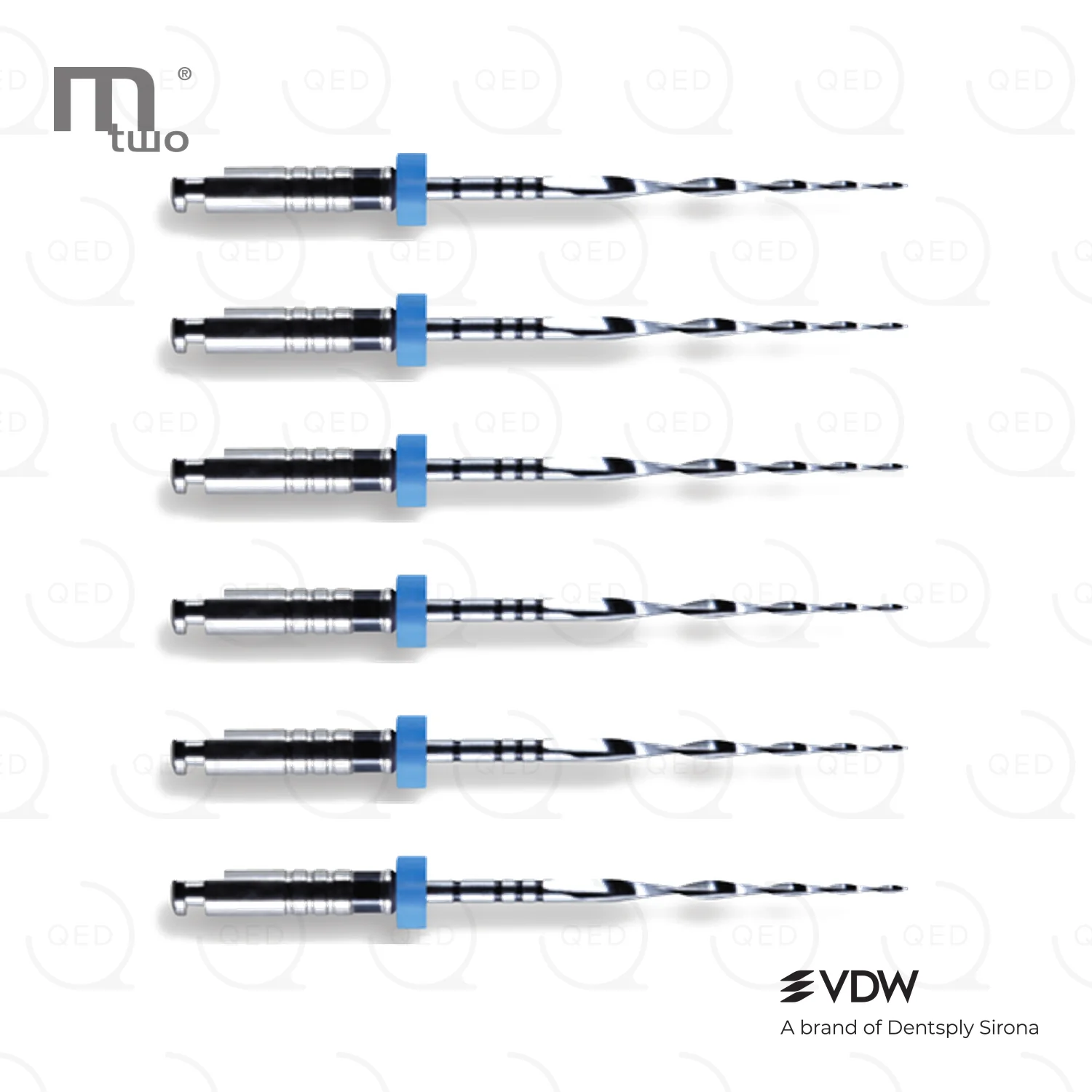
mtwo® · 20/.06 · 25 mm · wp 16 mm · 6 files
s-shaped sectionsterile blistersingle length technique
vdw’s long-standing rotary file. vdw describe an “s-shaped cross-section with two active cutting edges” and a “small instrument core for high flexibility” – the same s-section family as reciproc® blue and vdw.rotate®. every instrument is taken to full working length rather than stepping back.
this pack: vdw mtwo® rotary file, iso size 20, .06 taper, 25 mm, 16 mm working part (pack of 6)
vdw · vdw gmbh, munich, germany (dentsply sirona) · mtwo® is licensed by sweden & martina
| tip (d0) | 0.20 mm |
| taper | .06 |
| length | 25 mm |
| working part | 16 mm |
| handle | iso colour (yellow) |
| material | nickel titanium |
| supplied | sterile, pack of 6 |
› s-shaped section, two cutting edges. vdw’s own description, with a “small instrument core for high flexibility”.
› one sequence, one length. vdw: “single length: all instruments are brought to full working length”.
› progressive pitch. vdw describe “active cutting blades and a progressive pitch”.
› wp 16 mm. the flutes run 16 mm from the tip on a 25 mm instrument. vdw list “16 mm working part (21 or 25 mm working length)” and a 21 mm working part at 25 or 31 mm.
“superior cutting efficiency and flexibility, for an efficient root canal preparation”
vdw, vdw dental product catalogue 2023.
what does wp 16 mm mean?
the working part – how far the flutes run up from the tip. this one is 16 mm of cutting on a 25 mm instrument. a shorter working part gives you more shank, which helps in a posterior tooth with limited opening.
should i be looking at vdw.rotate instead?
it is the newer file in the same s-section family, with a heat treatment vdw say lowers the risk of breakage, plus taper rings and radiopaque calibration rings on the handle. we stock both. our suggestion for this size is below.
› the basic sequence: 10/.04 · 15/.05 · 25/.06, 25 mm
› same size, other lengths: 21 mm, wp 16 mm · 25 mm, wp 21 mm · 31 mm, wp 21 mm
› larger anatomies: 30/.05 · 35/.04 · 40/.04 · 45/.04
› moving to vdw.rotate: vdw.rotate® 20/.05, 25 mm – the nearest size in the newer range
› retreatment: mtwo® retreatment assorted, 21 mm
› obturation: diadent® dia-pro iso gutta-percha 20/.06 · paper points 20/.06 – the same size and taper
› motor: x-smart® pro+ with apex locator
› lubricant and irrigation: glyde™ file prep · chlorax 5.25% · irriflex® needles
mtwo® is licensed by sweden & martina. sizes, tapers and working parts are as vdw list them in the vdw dental product catalogue 2023. single use. follow the instructions supplied with the product.
mtwo® 20/.06, 25 mm, wp 16 mm (6) · nickel titanium · ref v040236025020
mtwo® · 25/.06 · 25 mm · wp 16 mm · 6 files
s-shaped sectionsterile blistersingle length technique
vdw’s long-standing rotary file. vdw describe an “s-shaped cross-section with two active cutting edges” and a “small instrument core for high flexibility” – the same s-section family as reciproc® blue and vdw.rotate®. every instrument is taken to full working length rather than stepping back.
this pack: vdw mtwo® rotary file, iso size 25, .06 taper, 25 mm, 16 mm working part (pack of 6)
vdw · vdw gmbh, munich, germany (dentsply sirona) · mtwo® is licensed by sweden & martina
| tip (d0) | 0.25 mm |
| taper | .06 |
| length | 25 mm |
| working part | 16 mm |
| handle | iso colour (red) |
| material | nickel titanium |
| supplied | sterile, pack of 6 |
› s-shaped section, two cutting edges. vdw’s own description, with a “small instrument core for high flexibility”.
› one sequence, one length. vdw: “single length: all instruments are brought to full working length”.
› progressive pitch. vdw describe “active cutting blades and a progressive pitch”.
› wp 16 mm. the flutes run 16 mm from the tip on a 25 mm instrument. vdw list “16 mm working part (21 or 25 mm working length)” and a 21 mm working part at 25 or 31 mm.
“superior cutting efficiency and flexibility, for an efficient root canal preparation”
vdw, vdw dental product catalogue 2023.
what does wp 16 mm mean?
the working part – how far the flutes run up from the tip. this one is 16 mm of cutting on a 25 mm instrument. a shorter working part gives you more shank, which helps in a posterior tooth with limited opening.
should i be looking at vdw.rotate instead?
it is the newer file in the same s-section family, with a heat treatment vdw say lowers the risk of breakage, plus taper rings and radiopaque calibration rings on the handle. we stock both. our suggestion for this size is below.
› the basic sequence: 10/.04 · 15/.05 · 20/.06, 25 mm
› same size, other lengths: 21 mm, wp 16 mm · 25 mm, wp 21 mm · 31 mm, wp 21 mm
› larger anatomies: 30/.05 · 35/.04 · 40/.04 · 45/.04
› moving to vdw.rotate: vdw.rotate® 25/.06, 25 mm – the same size and taper, on heat-treated wire
› retreatment: mtwo® retreatment assorted, 21 mm
› obturation: diadent® dia-pro iso gutta-percha 25/.06 · paper points 25/.06 – the same size and taper
› motor: x-smart® pro+ with apex locator
› lubricant and irrigation: glyde™ file prep · chlorax 5.25% · irriflex® needles
mtwo® is licensed by sweden & martina. sizes, tapers and working parts are as vdw list them in the vdw dental product catalogue 2023. single use. follow the instructions supplied with the product.
mtwo® 25/.06, 25 mm, wp 16 mm (6) · nickel titanium · ref v040236025025
mtwo® · 30/.06 · 25 mm · wp 16 mm · 6 files
s-shaped sectionsterile blistersingle length technique
vdw’s long-standing rotary file. vdw describe an “s-shaped cross-section with two active cutting edges” and a “small instrument core for high flexibility” – the same s-section family as reciproc® blue and vdw.rotate®. every instrument is taken to full working length rather than stepping back.
this pack: vdw mtwo® rotary file, iso size 30, .06 taper, 25 mm, 16 mm working part (pack of 6)
vdw · vdw gmbh, munich, germany (dentsply sirona) · mtwo® is licensed by sweden & martina
| tip (d0) | 0.30 mm |
| taper | .06 |
| length | 25 mm |
| working part | 16 mm |
| handle | iso colour (blue) |
| material | nickel titanium |
| supplied | sterile, pack of 6 |
› s-shaped section, two cutting edges. vdw’s own description, with a “small instrument core for high flexibility”.
› one sequence, one length. vdw: “single length: all instruments are brought to full working length”.
› progressive pitch. vdw describe “active cutting blades and a progressive pitch”.
› wp 16 mm. the flutes run 16 mm from the tip on a 25 mm instrument. vdw list “16 mm working part (21 or 25 mm working length)” and a 21 mm working part at 25 or 31 mm.
“superior cutting efficiency and flexibility, for an efficient root canal preparation”
vdw, vdw dental product catalogue 2023.
what does wp 16 mm mean?
the working part – how far the flutes run up from the tip. this one is 16 mm of cutting on a 25 mm instrument. a shorter working part gives you more shank, which helps in a posterior tooth with limited opening.
should i be looking at vdw.rotate instead?
it is the newer file in the same s-section family, with a heat treatment vdw say lowers the risk of breakage, plus taper rings and radiopaque calibration rings on the handle. we stock both. our suggestion for this size is below.
› the basic sequence: 10/.04 · 15/.05 · 20/.06 · 25/.06, 25 mm
› same size, other lengths: 21 mm, wp 16 mm · 31 mm, wp 21 mm
› larger anatomies: 30/.05 · 35/.04 · 40/.04 · 45/.04
› moving to vdw.rotate: vdw.rotate® 30/.06, 25 mm – the same size and taper, on heat-treated wire
› retreatment: mtwo® retreatment assorted, 21 mm
› obturation: diadent® dia-pro iso gutta-percha 30/.06 · paper points 30/.06 – the same size and taper
› motor: x-smart® pro+ with apex locator
› lubricant and irrigation: glyde™ file prep · chlorax 5.25% · irriflex® needles
mtwo® is licensed by sweden & martina. sizes, tapers and working parts are as vdw list them in the vdw dental product catalogue 2023. single use. follow the instructions supplied with the product.
mtwo® 30/.06, 25 mm, wp 16 mm (6) · nickel titanium · ref v040236025030
mtwo® · 35/.06 · 25 mm · wp 16 mm · 6 files
s-shaped sectionsterile blistersingle length technique
vdw’s long-standing rotary file. vdw describe an “s-shaped cross-section with two active cutting edges” and a “small instrument core for high flexibility” – the same s-section family as reciproc® blue and vdw.rotate®. every instrument is taken to full working length rather than stepping back.
this pack: vdw mtwo® rotary file, iso size 35, .06 taper, 25 mm, 16 mm working part (pack of 6)
vdw · vdw gmbh, munich, germany (dentsply sirona) · mtwo® is licensed by sweden & martina
| tip (d0) | 0.35 mm |
| taper | .06 |
| length | 25 mm |
| working part | 16 mm |
| handle | iso colour (green) |
| material | nickel titanium |
| supplied | sterile, pack of 6 |
› s-shaped section, two cutting edges. vdw’s own description, with a “small instrument core for high flexibility”.
› one sequence, one length. vdw: “single length: all instruments are brought to full working length”.
› progressive pitch. vdw describe “active cutting blades and a progressive pitch”.
› wp 16 mm. the flutes run 16 mm from the tip on a 25 mm instrument. vdw list “16 mm working part (21 or 25 mm working length)” and a 21 mm working part at 25 or 31 mm.
“superior cutting efficiency and flexibility, for an efficient root canal preparation”
vdw, vdw dental product catalogue 2023.
what does wp 16 mm mean?
the working part – how far the flutes run up from the tip. this one is 16 mm of cutting on a 25 mm instrument. a shorter working part gives you more shank, which helps in a posterior tooth with limited opening.
should i be looking at vdw.rotate instead?
it is the newer file in the same s-section family, with a heat treatment vdw say lowers the risk of breakage, plus taper rings and radiopaque calibration rings on the handle. we stock both. our suggestion for this size is below.
› the basic sequence: 10/.04 · 15/.05 · 20/.06 · 25/.06, 25 mm
› same size, other lengths: 21 mm, wp 16 mm · 31 mm, wp 21 mm
› larger anatomies: 30/.05 · 35/.04 · 40/.04 · 45/.04
› moving to vdw.rotate: vdw.rotate® 35/.06, 25 mm – the same size and taper, on heat-treated wire
› retreatment: mtwo® retreatment assorted, 21 mm
› obturation: diadent® dia-pro iso gutta-percha 35/.06 · paper points 35/.06 – the same size and taper
› motor: x-smart® pro+ with apex locator
› lubricant and irrigation: glyde™ file prep · chlorax 5.25% · irriflex® needles
mtwo® is licensed by sweden & martina. sizes, tapers and working parts are as vdw list them in the vdw dental product catalogue 2023. single use. follow the instructions supplied with the product.
mtwo® 35/.06, 25 mm, wp 16 mm (6) · nickel titanium · ref v040236025035
mtwo® · 40/.06 · 25 mm · wp 16 mm · 6 files
s-shaped sectionsterile blistersingle length technique
vdw’s long-standing rotary file. vdw describe an “s-shaped cross-section with two active cutting edges” and a “small instrument core for high flexibility” – the same s-section family as reciproc® blue and vdw.rotate®. every instrument is taken to full working length rather than stepping back.
this pack: vdw mtwo® rotary file, iso size 40, .06 taper, 25 mm, 16 mm working part (pack of 6)
vdw · vdw gmbh, munich, germany (dentsply sirona) · mtwo® is licensed by sweden & martina
| tip (d0) | 0.40 mm |
| taper | .06 |
| length | 25 mm |
| working part | 16 mm |
| handle | iso colour (black) |
| material | nickel titanium |
| supplied | sterile, pack of 6 |
› s-shaped section, two cutting edges. vdw’s own description, with a “small instrument core for high flexibility”.
› one sequence, one length. vdw: “single length: all instruments are brought to full working length”.
› progressive pitch. vdw describe “active cutting blades and a progressive pitch”.
› wp 16 mm. the flutes run 16 mm from the tip on a 25 mm instrument. vdw list “16 mm working part (21 or 25 mm working length)” and a 21 mm working part at 25 or 31 mm.
“superior cutting efficiency and flexibility, for an efficient root canal preparation”
vdw, vdw dental product catalogue 2023.
what does wp 16 mm mean?
the working part – how far the flutes run up from the tip. this one is 16 mm of cutting on a 25 mm instrument. a shorter working part gives you more shank, which helps in a posterior tooth with limited opening.
should i be looking at vdw.rotate instead?
it is the newer file in the same s-section family, with a heat treatment vdw say lowers the risk of breakage, plus taper rings and radiopaque calibration rings on the handle. we stock both. our suggestion for this size is below.
› the basic sequence: 10/.04 · 15/.05 · 20/.06 · 25/.06, 25 mm
› same size, other lengths: 21 mm, wp 16 mm · 31 mm, wp 21 mm
› larger anatomies: 30/.05 · 35/.04 · 40/.04 · 45/.04
› moving to vdw.rotate: vdw.rotate® 40/.06, 25 mm – the same size and taper, on heat-treated wire
› retreatment: mtwo® retreatment assorted, 21 mm
› obturation: diadent® dia-pro iso gutta-percha 40/.06 · paper points 40/.06 – the same size and taper
› motor: x-smart® pro+ with apex locator
› lubricant and irrigation: glyde™ file prep · chlorax 5.25% · irriflex® needles
mtwo® is licensed by sweden & martina. sizes, tapers and working parts are as vdw list them in the vdw dental product catalogue 2023. single use. follow the instructions supplied with the product.
mtwo® 40/.06, 25 mm, wp 16 mm (6) · nickel titanium · ref v040236025040
mtwo® · 25/.07 · 21 mm · wp 16 mm · 6 files
s-shaped sectionsterile blistersingle length technique
vdw’s long-standing rotary file. vdw describe an “s-shaped cross-section with two active cutting edges” and a “small instrument core for high flexibility” – the same s-section family as reciproc® blue and vdw.rotate®. every instrument is taken to full working length rather than stepping back.
this pack: vdw mtwo® rotary file, iso size 25, .07 taper, 21 mm, 16 mm working part (pack of 6)
vdw · vdw gmbh, munich, germany (dentsply sirona) · mtwo® is licensed by sweden & martina
| tip (d0) | 0.25 mm |
| taper | .07 |
| length | 21 mm |
| working part | 16 mm |
| handle | iso colour (red) |
| material | nickel titanium |
| supplied | sterile, pack of 6 |
› s-shaped section, two cutting edges. vdw’s own description, with a “small instrument core for high flexibility”.
› one sequence, one length. vdw: “single length: all instruments are brought to full working length”.
› progressive pitch. vdw describe “active cutting blades and a progressive pitch”.
› wp 16 mm. the flutes run 16 mm from the tip on a 21 mm instrument. vdw list “16 mm working part (21 or 25 mm working length)” and a 21 mm working part at 25 or 31 mm.
“superior cutting efficiency and flexibility, for an efficient root canal preparation”
vdw, vdw dental product catalogue 2023.
what does wp 16 mm mean?
the working part – how far the flutes run up from the tip. this one is 16 mm of cutting on a 21 mm instrument. a shorter working part gives you more shank, which helps in a posterior tooth with limited opening.
should i be looking at vdw.rotate instead?
it is the newer file in the same s-section family, with a heat treatment vdw say lowers the risk of breakage, plus taper rings and radiopaque calibration rings on the handle. we stock both. our suggestion for this size is below.
› the basic sequence: 10/.04 · 15/.05 · 20/.06 · 25/.06, 21 mm
› same size, other lengths: 25 mm, wp 16 mm · 31 mm, wp 21 mm
› larger anatomies: 30/.05 · 35/.04 · 40/.04 · 45/.04
› moving to vdw.rotate: vdw.rotate® 25/.06, 21 mm – the nearest size in the newer range
› retreatment: mtwo® retreatment assorted, 21 mm
› obturation: dia-pro iso is made in .04 and .06 only, so there is no matched cone for a .07 preparation. fit from the .04 assorted pack or the standard ml.029™ .02 range.
› motor: x-smart® pro+ with apex locator
› lubricant and irrigation: glyde™ file prep · chlorax 5.25% · irriflex® needles
mtwo® is licensed by sweden & martina. sizes, tapers and working parts are as vdw list them in the vdw dental product catalogue 2023. single use. follow the instructions supplied with the product.
mtwo® 25/.07, 21 mm, wp 16 mm (6) · nickel titanium · ref v040237021025

mtwo® · 25/.07 · 25 mm · wp 16 mm · 6 files
s-shaped sectionsterile blistersingle length technique
vdw’s long-standing rotary file. vdw describe an “s-shaped cross-section with two active cutting edges” and a “small instrument core for high flexibility” – the same s-section family as reciproc® blue and vdw.rotate®. every instrument is taken to full working length rather than stepping back.
this pack: vdw mtwo® rotary file, iso size 25, .07 taper, 25 mm, 16 mm working part (pack of 6)
vdw · vdw gmbh, munich, germany (dentsply sirona) · mtwo® is licensed by sweden & martina
| tip (d0) | 0.25 mm |
| taper | .07 |
| length | 25 mm |
| working part | 16 mm |
| handle | iso colour (red) |
| material | nickel titanium |
| supplied | sterile, pack of 6 |
› s-shaped section, two cutting edges. vdw’s own description, with a “small instrument core for high flexibility”.
› one sequence, one length. vdw: “single length: all instruments are brought to full working length”.
› progressive pitch. vdw describe “active cutting blades and a progressive pitch”.
› wp 16 mm. the flutes run 16 mm from the tip on a 25 mm instrument. vdw list “16 mm working part (21 or 25 mm working length)” and a 21 mm working part at 25 or 31 mm.
“superior cutting efficiency and flexibility, for an efficient root canal preparation”
vdw, vdw dental product catalogue 2023.
what does wp 16 mm mean?
the working part – how far the flutes run up from the tip. this one is 16 mm of cutting on a 25 mm instrument. a shorter working part gives you more shank, which helps in a posterior tooth with limited opening.
should i be looking at vdw.rotate instead?
it is the newer file in the same s-section family, with a heat treatment vdw say lowers the risk of breakage, plus taper rings and radiopaque calibration rings on the handle. we stock both. our suggestion for this size is below.
› the basic sequence: 10/.04 · 15/.05 · 20/.06 · 25/.06, 25 mm
› same size, other lengths: 21 mm, wp 16 mm · 31 mm, wp 21 mm
› larger anatomies: 30/.05 · 35/.04 · 40/.04 · 45/.04
› moving to vdw.rotate: vdw.rotate® 25/.06, 25 mm – the nearest size in the newer range
› retreatment: mtwo® retreatment assorted, 21 mm
› obturation: dia-pro iso is made in .04 and .06 only, so there is no matched cone for a .07 preparation. fit from the .04 assorted pack or the standard ml.029™ .02 range.
› motor: x-smart® pro+ with apex locator
› lubricant and irrigation: glyde™ file prep · chlorax 5.25% · irriflex® needles
mtwo® is licensed by sweden & martina. sizes, tapers and working parts are as vdw list them in the vdw dental product catalogue 2023. single use. follow the instructions supplied with the product.
mtwo® 25/.07, 25 mm, wp 16 mm (6) · nickel titanium · ref v040237025025
vdw® c-pilot® iso 006 · 25 mm · 6 sterile files
sclerosed lower incisor, a pulp stone where the orifice should be, and the 008 has stopped dead? iso 006 is the finest size vdw make in this range, and it exists for the cases where the alternative is cutting dentine you will never get back. at 0.06 mm the tip is a quarter thinner than an 008 – the last honest step before you reach for magnification, ultrasonics or a referral pad.
| 0.06 mm tip diameter | 25 mm working length | 6 sterile blister |
this pack: 6 × vdw®sterile c-pilot® iso 006, 25 mm, .02 taper · pre-mounted silicone stoppers · mfr code 368 025 006
made by vdw gmbh, munich, germany
a 006 is a probe. it is there to tell you whether a path exists, and roughly where it goes, without removing the dentine that a wider instrument would take to answer the same question. used that way it is one of the most conservative instruments in the tray. used as a shaping file it is simply a wire under load, so the discipline matters: find the path, confirm it, and hand the canal over to the next size rather than trying to enlarge with the finest instrument you own.
the material earns its place here more than anywhere else in the range. vdw credit a special thermal hardening process with the file's high bending strength, and the inactive pilot tip is designed to be led by the canal rather than to cut a new one – the distinction between negotiating an obstruction and creating a false path. in a 2021 laboratory comparison in endodontology, stainless steel pathfinding files including c-pilot® resisted buckling better than carbon steel and nickel-titanium instruments (gupta and colleagues, doi 10.4103/endo.endo_126_20); it measures one property on a bench, but it is the property that decides whether a 006 transmits anything useful to your fingers.
| 0.06 mm tip | the finest c-pilot® size – a quarter thinner at d0 than an 008 |
| inactive pilot tip | vdw's description: conducts the instrument safely along the canal rather than cutting its own path |
| thermally hardened | vdw attribute the range's high bending strength to a special thermal hardening process |
| fine but readable | radiopaque calibration rings and stopper, plus the length printed on the cc+ handle |
| sterile, ready to use | gamma sterilised to din en iso 11137, blister of six |
| constant .02 taper | the iso hand file geometry – the blade widens by 0.02 mm for every millimetre back from the tip, so the size you read is the size the canal gets |
create a glide path even in canals which are difficult to penetrate.
— vdw product catalogue, c-pilot® range. the difficult ones are the entire reason the 006 exists.
› magnify first – a 006 is a poor substitute for seeing the orifice. find it, then probe it.
› probe through a reservoir – never dry. irrigant in the chamber does the work; a viscous chelator such as file-eze™ is a preference rather than a requirement, and comes in a the 30 ml indispense™ syringe if you get through it.
› change files, not technique – if a 006 stops advancing and starts to bend, take a fresh one rather than pushing harder on a stressed instrument.
› single use – vdw recommend single use of these pre-sterilised instruments; the uk position since april 2007 is that endodontic reamers and files are treated as single use (cmo(2007)5).
is a 006 not too fragile to be useful?
it is fine, and it should be treated as such. what it gives you is information at the lowest possible cost in dentine: whether there is a path, and in which direction. once you know that, 008 and 010 do the work of making it usable.
do i need 006 if i already stock 008?
not for routine cases. stock it for the calcified anterior and the second molar you would otherwise abandon – the blister that sits in the drawer for a month and then saves an appointment.
which length?
25 mm reaches long anterior roots comfortably. for a second molar with limited opening, the 19 mm version puts the handle where you can actually control it.
| next size up | c-pilot 008, 25 mm · once 006 is loose |
| glide path size | c-pilot 010, 25 mm · the reference size |
| whole sequence | c-pilot assorted 25 mm · two each of 006, 008, 010 |
| lubricant, optional | file-eze™ kit · 19% edta gel, if you use one |
| bulk gel, optional | file-eze™ 30 ml indispense™ · for high volume use |
| narrow anatomy | reciproc® minima r20 25 mm · the slimmest reciprocating file we stock |
| dress it | ultracal™ xs · calcium hydroxide between visits |
| limited opening | c-pilot 006 in 19 mm · short handle reach |
vdw® c-pilot® iso 006 · 25 mm · .02 taper · sclerosed canals · calcified canals · canal scouting · pathfinding · stainless steel · sterile · single use · 6 files · vdw gmbh · ref v040368025006 · also in 21 mm and 19 mm

vdw® c-pilot® iso 12.5 · 25 mm · 6 sterile files
the 010 is loose, the 015 will not go, and you are about to push it anyway. that gap is arithmetic, not bad luck: 010 to 015 is a 50% increase in tip diameter in a single instrument, in the part of the canal least able to absorb it. vdw's intermediate iso 12.5 breaks it into two: 010 to 12.5 is a 25% step, 12.5 to 015 another 20%. same file, same inactive pilot tip, one fewer reason to lean on the handle.
| 0.125 mm tip diameter | +25% step from 010 | 6 sterile blister |
this pack: 6 × vdw®sterile c-pilot® iso 12.5, 25 mm, .02 taper · pre-mounted silicone stoppers · mfr code 368 025 012
made by vdw gmbh, munich, germany
note: listed as 012 on our site; vdw's designation is the intermediate size iso 12.5
the iso series is not evenly spaced in the way clinicians instinctively read it. below size 60 the steps rise in fixed increments of 0.05 mm, so at the fine end each one is proportionally enormous: going from 010 to 015 asks the canal to accept half as much again at the tip. that is where the file starts to cut on one wall, where the apical constriction gets nudged, and where a canal that was following you begins to resist.
the intermediate sizes were introduced precisely to soften that transition, and vdw list iso 12.5 as part of the standard c-pilot® range rather than a special order. in a narrow, curved or previously calcified canal it is often the instrument that turns a fight into a sequence – and because it is the same thermally hardened stainless steel with the same inactive pilot tip, it behaves like the 010 you have just finished with rather than like a new instrument.
| iso 12.5 | 0.125 mm at d0 – the intermediate size between 010 and 015, listed by vdw as standard stock, colour coded brown/bronze |
| two smaller steps | +25% from 010, then +20% to 015, instead of one 50% jump |
| inactive pilot tip | vdw's description: conducts the instrument safely along the path you have already established |
| thermally hardened | the bending strength vdw credit to their special hardening process, in a size that is still doing fine work |
| sterile, ready to use | gamma sterilised to din en iso 11137, blister of six, stoppers fitted |
| constant .02 taper | the iso hand file geometry – the blade widens by 0.02 mm for every millimetre back from the tip, so the size you read is the size the canal gets |
intermediate size iso 12.5 available.
— vdw's published specification for the sterile c-pilot® range. very few hand file ranges stocked in the uk include it.
› only after 010 is loose – the intermediate size smooths a transition; it does not replace establishing the path in the first place.
› recapitulate between sizes – a quick return to 010 confirms patency before you go up.
› irrigate between instruments – each step generates dentine mud that the next file will otherwise pack apically.
› single use – supplied gamma sterilised; vdw recommend single use, as does the uk position on endodontic reamers and files since april 2007 (cmo(2007)5).
is 012 the same as iso 12.5?
yes. vdw print it as an intermediate size and our catalogue shortens it to 012. there is no separate iso 12 instrument – the tip diameter is 0.125 mm.
do i need it if i use a mechanical glider?
often not – a waveone® gold glider takes the canal from a loose 010 to a 015 tip on its own. where it earns its place is the canal that will not accept the glider yet, and in practices that prefer to finish the glide path by hand.
where does it sit in the sequence?
006 or 008 to find the path, 010 to define it, iso 12.5 to widen it gently, 015 to finish it. then the motor.
| step before | c-pilot 010, 25 mm · the glide path reference size |
| step after | c-pilot 015, 25 mm · finishes the manual glide path |
| if you drop back | c-pilot 008, 25 mm · when patency is lost |
| lubricant, optional | file-eze™ kit · 19% edta gel, if you use one |
| mechanical glide path | waveone® gold glider 25 mm · 015 tip, reciprocating |
| then shape | waveone® gold primary 25 mm |
| or reciprocate | reciproc® blue r25 25 mm |
| shorter access | iso 12.5 in 21 mm · posterior teeth |
vdw® c-pilot® iso 12.5 · 25 mm · .02 taper · intermediate size · brown/bronze · glide path · calcified canals · stainless steel · sterile · single use · 6 files · vdw gmbh · ref v040368025012 · also in 21 mm and 19 mm

mtwo® · 10/.04 · 25 mm · wp 21 mm · 6 files
s-shaped sectionsterile blistersingle length technique
vdw’s long-standing rotary file. vdw describe an “s-shaped cross-section with two active cutting edges” and a “small instrument core for high flexibility” – the same s-section family as reciproc® blue and vdw.rotate®. every instrument is taken to full working length rather than stepping back.
this pack: vdw mtwo® rotary file, iso size 10, .04 taper, 25 mm, 21 mm working part (pack of 6)
vdw · vdw gmbh, munich, germany (dentsply sirona) · mtwo® is licensed by sweden & martina
| tip (d0) | 0.10 mm |
| taper | .04 |
| length | 25 mm |
| working part | 21 mm |
| handle | iso colour (purple) |
| material | nickel titanium |
| supplied | sterile, pack of 6 |
› s-shaped section, two cutting edges. vdw’s own description, with a “small instrument core for high flexibility”.
› one sequence, one length. vdw: “single length: all instruments are brought to full working length”.
› progressive pitch. vdw describe “active cutting blades and a progressive pitch”.
› wp 21 mm. the flutes run 21 mm from the tip on a 25 mm instrument. vdw list “16 mm working part (21 or 25 mm working length)” and a 21 mm working part at 25 or 31 mm.
“superior cutting efficiency and flexibility, for an efficient root canal preparation”
vdw, vdw dental product catalogue 2023.
what does wp 21 mm mean?
the working part – how far the flutes run up from the tip. this one is 21 mm of cutting on a 25 mm instrument. a shorter working part gives you more shank, which helps in a posterior tooth with limited opening.
should i be looking at vdw.rotate instead?
it is the newer file in the same s-section family, with a heat treatment vdw say lowers the risk of breakage, plus taper rings and radiopaque calibration rings on the handle. we stock both. our suggestion for this size is below.
› the basic sequence: 15/.05 · 20/.06 · 25/.06, 25 mm
› same size, other lengths: 21 mm, wp 16 mm · 25 mm, wp 16 mm · 31 mm, wp 21 mm
› moving to vdw.rotate: vdw.rotate® 15/.04, 25 mm – the nearest size in the newer range
› retreatment: mtwo® retreatment assorted, 21 mm
› obturation: the dia-pro .04 range stops at 45, so there is no matched cone at 10/.04. fit from 45/.04.
› motor: x-smart® pro+ with apex locator
› lubricant and irrigation: glyde™ file prep · chlorax 5.25% · irriflex® needles
mtwo® is licensed by sweden & martina. sizes, tapers and working parts are as vdw list them in the vdw dental product catalogue 2023. single use. follow the instructions supplied with the product.
mtwo® 10/.04, 25 mm, wp 21 mm (6) · nickel titanium · ref v041234025010
mtwo® · 10/.04 · 31 mm · wp 21 mm · 6 files
s-shaped sectionsterile blistersingle length technique
vdw’s long-standing rotary file. vdw describe an “s-shaped cross-section with two active cutting edges” and a “small instrument core for high flexibility” – the same s-section family as reciproc® blue and vdw.rotate®. every instrument is taken to full working length rather than stepping back.
this pack: vdw mtwo® rotary file, iso size 10, .04 taper, 31 mm, 21 mm working part (pack of 6)
vdw · vdw gmbh, munich, germany (dentsply sirona) · mtwo® is licensed by sweden & martina
| tip (d0) | 0.10 mm |
| taper | .04 |
| length | 31 mm |
| working part | 21 mm |
| handle | iso colour (purple) |
| material | nickel titanium |
| supplied | sterile, pack of 6 |
› s-shaped section, two cutting edges. vdw’s own description, with a “small instrument core for high flexibility”.
› one sequence, one length. vdw: “single length: all instruments are brought to full working length”.
› progressive pitch. vdw describe “active cutting blades and a progressive pitch”.
› wp 21 mm. the flutes run 21 mm from the tip on a 31 mm instrument. vdw list “16 mm working part (21 or 25 mm working length)” and a 21 mm working part at 25 or 31 mm.
“superior cutting efficiency and flexibility, for an efficient root canal preparation”
vdw, vdw dental product catalogue 2023.
what does wp 21 mm mean?
the working part – how far the flutes run up from the tip. this one is 21 mm of cutting on a 31 mm instrument. a shorter working part gives you more shank, which helps in a posterior tooth with limited opening.
should i be looking at vdw.rotate instead?
it is the newer file in the same s-section family, with a heat treatment vdw say lowers the risk of breakage, plus taper rings and radiopaque calibration rings on the handle. we stock both. our suggestion for this size is below.
› the basic sequence: 15/.05 · 20/.06 · 25/.06, 31 mm
› same size, other lengths: 21 mm, wp 16 mm · 25 mm, wp 16 mm · 25 mm, wp 21 mm
› larger anatomies: 30/.05 · 35/.04 · 40/.04 · 45/.04
› moving to vdw.rotate: vdw.rotate® 15/.04, 31 mm – the nearest size in the newer range
› retreatment: mtwo® retreatment assorted, 21 mm
› obturation: the dia-pro .04 range stops at 45, so there is no matched cone at 10/.04. fit from 45/.04.
› motor: x-smart® pro+ with apex locator
› lubricant and irrigation: glyde™ file prep · chlorax 5.25% · irriflex® needles
mtwo® is licensed by sweden & martina. sizes, tapers and working parts are as vdw list them in the vdw dental product catalogue 2023. single use. follow the instructions supplied with the product.
mtwo® 10/.04, 31 mm, wp 21 mm (6) · nickel titanium · ref v041234031010
mtwo® · 35/.04 · 31 mm · wp 21 mm · 6 files
s-shaped sectionsterile blistersingle length technique
vdw’s long-standing rotary file. vdw describe an “s-shaped cross-section with two active cutting edges” and a “small instrument core for high flexibility” – the same s-section family as reciproc® blue and vdw.rotate®. every instrument is taken to full working length rather than stepping back.
this pack: vdw mtwo® rotary file, iso size 35, .04 taper, 31 mm, 21 mm working part (pack of 6)
vdw · vdw gmbh, munich, germany (dentsply sirona) · mtwo® is licensed by sweden & martina
| tip (d0) | 0.35 mm |
| taper | .04 |
| length | 31 mm |
| working part | 21 mm |
| handle | iso colour (green) |
| material | nickel titanium |
| supplied | sterile, pack of 6 |
› s-shaped section, two cutting edges. vdw’s own description, with a “small instrument core for high flexibility”.
› one sequence, one length. vdw: “single length: all instruments are brought to full working length”.
› progressive pitch. vdw describe “active cutting blades and a progressive pitch”.
› wp 21 mm. the flutes run 21 mm from the tip on a 31 mm instrument. vdw list “16 mm working part (21 or 25 mm working length)” and a 21 mm working part at 25 or 31 mm.
“superior cutting efficiency and flexibility, for an efficient root canal preparation”
vdw, vdw dental product catalogue 2023.
what does wp 21 mm mean?
the working part – how far the flutes run up from the tip. this one is 21 mm of cutting on a 31 mm instrument. a shorter working part gives you more shank, which helps in a posterior tooth with limited opening.
should i be looking at vdw.rotate instead?
it is the newer file in the same s-section family, with a heat treatment vdw say lowers the risk of breakage, plus taper rings and radiopaque calibration rings on the handle. we stock both. our suggestion for this size is below.
› the basic sequence: 10/.04 · 15/.05 · 20/.06 · 25/.06, 31 mm
› same size, other lengths: 21 mm, wp 16 mm · 25 mm, wp 16 mm
› larger anatomies: 30/.05 · 40/.04 · 45/.04 · 50/.04
› moving to vdw.rotate: vdw.rotate® 35/.04, 31 mm – the same size and taper, on heat-treated wire
› retreatment: mtwo® retreatment assorted, 21 mm
› obturation: diadent® dia-pro iso gutta-percha 35/.04 · paper points 35/.04 – the same size and taper
› motor: x-smart® pro+ with apex locator
› lubricant and irrigation: glyde™ file prep · chlorax 5.25% · irriflex® needles
mtwo® is licensed by sweden & martina. sizes, tapers and working parts are as vdw list them in the vdw dental product catalogue 2023. single use. follow the instructions supplied with the product.
mtwo® 35/.04, 31 mm, wp 21 mm (6) · nickel titanium · ref v041234031035

mtwo® · 40/.04 · 31 mm · wp 21 mm · 6 files
s-shaped sectionsterile blistersingle length technique
vdw’s long-standing rotary file. vdw describe an “s-shaped cross-section with two active cutting edges” and a “small instrument core for high flexibility” – the same s-section family as reciproc® blue and vdw.rotate®. every instrument is taken to full working length rather than stepping back.
this pack: vdw mtwo® rotary file, iso size 40, .04 taper, 31 mm, 21 mm working part (pack of 6)
vdw · vdw gmbh, munich, germany (dentsply sirona) · mtwo® is licensed by sweden & martina
| tip (d0) | 0.40 mm |
| taper | .04 |
| length | 31 mm |
| working part | 21 mm |
| handle | iso colour (black) |
| material | nickel titanium |
| supplied | sterile, pack of 6 |
› s-shaped section, two cutting edges. vdw’s own description, with a “small instrument core for high flexibility”.
› one sequence, one length. vdw: “single length: all instruments are brought to full working length”.
› progressive pitch. vdw describe “active cutting blades and a progressive pitch”.
› wp 21 mm. the flutes run 21 mm from the tip on a 31 mm instrument. vdw list “16 mm working part (21 or 25 mm working length)” and a 21 mm working part at 25 or 31 mm.
“superior cutting efficiency and flexibility, for an efficient root canal preparation”
vdw, vdw dental product catalogue 2023.
what does wp 21 mm mean?
the working part – how far the flutes run up from the tip. this one is 21 mm of cutting on a 31 mm instrument. a shorter working part gives you more shank, which helps in a posterior tooth with limited opening.
should i be looking at vdw.rotate instead?
it is the newer file in the same s-section family, with a heat treatment vdw say lowers the risk of breakage, plus taper rings and radiopaque calibration rings on the handle. we stock both. our suggestion for this size is below.
› the basic sequence: 10/.04 · 15/.05 · 20/.06 · 25/.06, 31 mm
› same size, other lengths: 21 mm, wp 16 mm · 25 mm, wp 16 mm
› larger anatomies: 30/.05 · 35/.04 · 45/.04 · 50/.04
› moving to vdw.rotate: vdw.rotate® 40/.04, 31 mm – the same size and taper, on heat-treated wire
› retreatment: mtwo® retreatment assorted, 21 mm
› obturation: diadent® dia-pro iso gutta-percha 40/.04 · paper points 40/.04 – the same size and taper
› motor: x-smart® pro+ with apex locator
› lubricant and irrigation: glyde™ file prep · chlorax 5.25% · irriflex® needles
mtwo® is licensed by sweden & martina. sizes, tapers and working parts are as vdw list them in the vdw dental product catalogue 2023. single use. follow the instructions supplied with the product.
mtwo® 40/.04, 31 mm, wp 21 mm (6) · nickel titanium · ref v041234031040
mtwo® · 45/.04 · 31 mm · wp 21 mm · 6 files
s-shaped sectionsterile blistersingle length technique
vdw’s long-standing rotary file. vdw describe an “s-shaped cross-section with two active cutting edges” and a “small instrument core for high flexibility” – the same s-section family as reciproc® blue and vdw.rotate®. every instrument is taken to full working length rather than stepping back.
this pack: vdw mtwo® rotary file, iso size 45, .04 taper, 31 mm, 21 mm working part (pack of 6)
vdw · vdw gmbh, munich, germany (dentsply sirona) · mtwo® is licensed by sweden & martina
| tip (d0) | 0.45 mm |
| taper | .04 |
| length | 31 mm |
| working part | 21 mm |
| handle | iso colour (white) |
| material | nickel titanium |
| supplied | sterile, pack of 6 |
› s-shaped section, two cutting edges. vdw’s own description, with a “small instrument core for high flexibility”.
› one sequence, one length. vdw: “single length: all instruments are brought to full working length”.
› progressive pitch. vdw describe “active cutting blades and a progressive pitch”.
› wp 21 mm. the flutes run 21 mm from the tip on a 31 mm instrument. vdw list “16 mm working part (21 or 25 mm working length)” and a 21 mm working part at 25 or 31 mm.
“superior cutting efficiency and flexibility, for an efficient root canal preparation”
vdw, vdw dental product catalogue 2023.
what does wp 21 mm mean?
the working part – how far the flutes run up from the tip. this one is 21 mm of cutting on a 31 mm instrument. a shorter working part gives you more shank, which helps in a posterior tooth with limited opening.
should i be looking at vdw.rotate instead?
it is the newer file in the same s-section family, with a heat treatment vdw say lowers the risk of breakage, plus taper rings and radiopaque calibration rings on the handle. we stock both. our suggestion for this size is below.
› the basic sequence: 10/.04 · 15/.05 · 20/.06 · 25/.06, 31 mm
› same size, other lengths: 21 mm, wp 16 mm · 25 mm, wp 16 mm
› larger anatomies: 30/.05 · 35/.04 · 40/.04 · 50/.04
› moving to vdw.rotate: vdw.rotate® 50/.04, 31 mm – the nearest size in the newer range
› retreatment: mtwo® retreatment assorted, 21 mm
› obturation: diadent® dia-pro iso gutta-percha 45/.04 – the same size and taper. the dia-pro paper points stop at 40, so gauge with 40/.04 or a standard point.
› motor: x-smart® pro+ with apex locator
› lubricant and irrigation: glyde™ file prep · chlorax 5.25% · irriflex® needles
mtwo® is licensed by sweden & martina. sizes, tapers and working parts are as vdw list them in the vdw dental product catalogue 2023. single use. follow the instructions supplied with the product.
mtwo® 45/.04, 31 mm, wp 21 mm (6) · nickel titanium · ref v041234031045
mtwo® · 50/.04 · 31 mm · wp 21 mm · 6 files
s-shaped sectionsterile blistersingle length technique
vdw’s long-standing rotary file. vdw describe an “s-shaped cross-section with two active cutting edges” and a “small instrument core for high flexibility” – the same s-section family as reciproc® blue and vdw.rotate®. every instrument is taken to full working length rather than stepping back.
this pack: vdw mtwo® rotary file, iso size 50, .04 taper, 31 mm, 21 mm working part (pack of 6)
vdw · vdw gmbh, munich, germany (dentsply sirona) · mtwo® is licensed by sweden & martina
| tip (d0) | 0.50 mm |
| taper | .04 |
| length | 31 mm |
| working part | 21 mm |
| handle | iso colour (yellow) |
| material | nickel titanium |
| supplied | sterile, pack of 6 |
› s-shaped section, two cutting edges. vdw’s own description, with a “small instrument core for high flexibility”.
› one sequence, one length. vdw: “single length: all instruments are brought to full working length”.
› progressive pitch. vdw describe “active cutting blades and a progressive pitch”.
› wp 21 mm. the flutes run 21 mm from the tip on a 31 mm instrument. vdw list “16 mm working part (21 or 25 mm working length)” and a 21 mm working part at 25 or 31 mm.
“superior cutting efficiency and flexibility, for an efficient root canal preparation”
vdw, vdw dental product catalogue 2023.
what does wp 21 mm mean?
the working part – how far the flutes run up from the tip. this one is 21 mm of cutting on a 31 mm instrument. a shorter working part gives you more shank, which helps in a posterior tooth with limited opening.
should i be looking at vdw.rotate instead?
it is the newer file in the same s-section family, with a heat treatment vdw say lowers the risk of breakage, plus taper rings and radiopaque calibration rings on the handle. we stock both. our suggestion for this size is below.
› the basic sequence: 10/.04 · 15/.05 · 20/.06 · 25/.06, 31 mm
› same size, other lengths: 21 mm, wp 16 mm · 25 mm, wp 16 mm
› larger anatomies: 30/.05 · 35/.04 · 40/.04 · 45/.04
› moving to vdw.rotate: vdw.rotate® 50/.04, 31 mm – the same size and taper, on heat-treated wire
› retreatment: mtwo® retreatment assorted, 21 mm
› obturation: the dia-pro .04 range stops at 45, so there is no matched cone at 50/.04. fit from 45/.04 or the standard ml.029™ 50/.02.
› motor: x-smart® pro+ with apex locator
› lubricant and irrigation: glyde™ file prep · chlorax 5.25% · irriflex® needles
mtwo® is licensed by sweden & martina. sizes, tapers and working parts are as vdw list them in the vdw dental product catalogue 2023. single use. follow the instructions supplied with the product.
mtwo® 50/.04, 31 mm, wp 21 mm (6) · nickel titanium · ref v041234031050
mtwo® · 60/.04 · 31 mm · wp 21 mm · 6 files
s-shaped sectionsterile blistersingle length technique
vdw’s long-standing rotary file. vdw describe an “s-shaped cross-section with two active cutting edges” and a “small instrument core for high flexibility” – the same s-section family as reciproc® blue and vdw.rotate®. every instrument is taken to full working length rather than stepping back.
this pack: vdw mtwo® rotary file, iso size 60, .04 taper, 31 mm, 21 mm working part (pack of 6)
vdw · vdw gmbh, munich, germany (dentsply sirona) · mtwo® is licensed by sweden & martina
| tip (d0) | 0.60 mm |
| taper | .04 |
| length | 31 mm |
| working part | 21 mm |
| handle | iso colour (blue) |
| material | nickel titanium |
| supplied | sterile, pack of 6 |
› s-shaped section, two cutting edges. vdw’s own description, with a “small instrument core for high flexibility”.
› one sequence, one length. vdw: “single length: all instruments are brought to full working length”.
› progressive pitch. vdw describe “active cutting blades and a progressive pitch”.
› wp 21 mm. the flutes run 21 mm from the tip on a 31 mm instrument. vdw list “16 mm working part (21 or 25 mm working length)” and a 21 mm working part at 25 or 31 mm.
“superior cutting efficiency and flexibility, for an efficient root canal preparation”
vdw, vdw dental product catalogue 2023.
what does wp 21 mm mean?
the working part – how far the flutes run up from the tip. this one is 21 mm of cutting on a 31 mm instrument. a shorter working part gives you more shank, which helps in a posterior tooth with limited opening.
should i be looking at vdw.rotate instead?
it is the newer file in the same s-section family, with a heat treatment vdw say lowers the risk of breakage, plus taper rings and radiopaque calibration rings on the handle. we stock both. our suggestion for this size is below.
› the basic sequence: 10/.04 · 15/.05 · 20/.06 · 25/.06, 31 mm
› same size, other lengths: 21 mm, wp 16 mm · 25 mm, wp 16 mm
› larger anatomies: 30/.05 · 35/.04 · 40/.04 · 45/.04
› moving to vdw.rotate: vdw.rotate® 60/.04, 31 mm – the same size and taper, on heat-treated wire
› retreatment: mtwo® retreatment assorted, 21 mm
› obturation: the dia-pro .04 range stops at 45, so there is no matched cone at 60/.04. fit from 45/.04 or the standard ml.029™ 60/.02.
› motor: x-smart® pro+ with apex locator
› lubricant and irrigation: glyde™ file prep · chlorax 5.25% · irriflex® needles
mtwo® is licensed by sweden & martina. sizes, tapers and working parts are as vdw list them in the vdw dental product catalogue 2023. single use. follow the instructions supplied with the product.
mtwo® 60/.04, 31 mm, wp 21 mm (6) · nickel titanium · ref v041234031060
mtwo® · 15/.05 · 25 mm · wp 21 mm · 6 files
s-shaped sectionsterile blistersingle length technique
vdw’s long-standing rotary file. vdw describe an “s-shaped cross-section with two active cutting edges” and a “small instrument core for high flexibility” – the same s-section family as reciproc® blue and vdw.rotate®. every instrument is taken to full working length rather than stepping back.
this pack: vdw mtwo® rotary file, iso size 15, .05 taper, 25 mm, 21 mm working part (pack of 6)
vdw · vdw gmbh, munich, germany (dentsply sirona) · mtwo® is licensed by sweden & martina
| tip (d0) | 0.15 mm |
| taper | .05 |
| length | 25 mm |
| working part | 21 mm |
| handle | iso colour (white) |
| material | nickel titanium |
| supplied | sterile, pack of 6 |
› s-shaped section, two cutting edges. vdw’s own description, with a “small instrument core for high flexibility”.
› one sequence, one length. vdw: “single length: all instruments are brought to full working length”.
› progressive pitch. vdw describe “active cutting blades and a progressive pitch”.
› wp 21 mm. the flutes run 21 mm from the tip on a 25 mm instrument. vdw list “16 mm working part (21 or 25 mm working length)” and a 21 mm working part at 25 or 31 mm.
“superior cutting efficiency and flexibility, for an efficient root canal preparation”
vdw, vdw dental product catalogue 2023.
what does wp 21 mm mean?
the working part – how far the flutes run up from the tip. this one is 21 mm of cutting on a 25 mm instrument. a shorter working part gives you more shank, which helps in a posterior tooth with limited opening.
should i be looking at vdw.rotate instead?
it is the newer file in the same s-section family, with a heat treatment vdw say lowers the risk of breakage, plus taper rings and radiopaque calibration rings on the handle. we stock both. our suggestion for this size is below.
› the basic sequence: 10/.04 · 20/.06 · 25/.06, 25 mm
› same size, other lengths: 21 mm, wp 16 mm · 25 mm, wp 16 mm · 31 mm, wp 21 mm
› moving to vdw.rotate: vdw.rotate® 15/.04, 25 mm – the nearest size in the newer range
› retreatment: mtwo® retreatment assorted, 21 mm
› obturation: dia-pro iso is made in .04 and .06 only, so there is no matched cone for a .05 preparation. fit from the .04 assorted pack or the standard ml.029™ .02 range.
› motor: x-smart® pro+ with apex locator
› lubricant and irrigation: glyde™ file prep · chlorax 5.25% · irriflex® needles
mtwo® is licensed by sweden & martina. sizes, tapers and working parts are as vdw list them in the vdw dental product catalogue 2023. single use. follow the instructions supplied with the product.
mtwo® 15/.05, 25 mm, wp 21 mm (6) · nickel titanium · ref v041235025015
mtwo® · 15/.05 · 31 mm · wp 21 mm · 6 files
s-shaped sectionsterile blistersingle length technique
vdw’s long-standing rotary file. vdw describe an “s-shaped cross-section with two active cutting edges” and a “small instrument core for high flexibility” – the same s-section family as reciproc® blue and vdw.rotate®. every instrument is taken to full working length rather than stepping back.
this pack: vdw mtwo® rotary file, iso size 15, .05 taper, 31 mm, 21 mm working part (pack of 6)
vdw · vdw gmbh, munich, germany (dentsply sirona) · mtwo® is licensed by sweden & martina
| tip (d0) | 0.15 mm |
| taper | .05 |
| length | 31 mm |
| working part | 21 mm |
| handle | iso colour (white) |
| material | nickel titanium |
| supplied | sterile, pack of 6 |
› s-shaped section, two cutting edges. vdw’s own description, with a “small instrument core for high flexibility”.
› one sequence, one length. vdw: “single length: all instruments are brought to full working length”.
› progressive pitch. vdw describe “active cutting blades and a progressive pitch”.
› wp 21 mm. the flutes run 21 mm from the tip on a 31 mm instrument. vdw list “16 mm working part (21 or 25 mm working length)” and a 21 mm working part at 25 or 31 mm.
“superior cutting efficiency and flexibility, for an efficient root canal preparation”
vdw, vdw dental product catalogue 2023.
what does wp 21 mm mean?
the working part – how far the flutes run up from the tip. this one is 21 mm of cutting on a 31 mm instrument. a shorter working part gives you more shank, which helps in a posterior tooth with limited opening.
should i be looking at vdw.rotate instead?
it is the newer file in the same s-section family, with a heat treatment vdw say lowers the risk of breakage, plus taper rings and radiopaque calibration rings on the handle. we stock both. our suggestion for this size is below.
› the basic sequence: 10/.04 · 20/.06 · 25/.06, 31 mm
› same size, other lengths: 21 mm, wp 16 mm · 25 mm, wp 16 mm · 25 mm, wp 21 mm
› larger anatomies: 30/.05 · 35/.04 · 40/.04 · 45/.04
› moving to vdw.rotate: vdw.rotate® 15/.04, 31 mm – the nearest size in the newer range
› retreatment: mtwo® retreatment assorted, 21 mm
› obturation: dia-pro iso is made in .04 and .06 only, so there is no matched cone for a .05 preparation. fit from the .04 assorted pack or the standard ml.029™ .02 range.
› motor: x-smart® pro+ with apex locator
› lubricant and irrigation: glyde™ file prep · chlorax 5.25% · irriflex® needles
mtwo® is licensed by sweden & martina. sizes, tapers and working parts are as vdw list them in the vdw dental product catalogue 2023. single use. follow the instructions supplied with the product.
mtwo® 15/.05, 31 mm, wp 21 mm (6) · nickel titanium · ref v041235031015
mtwo® · 30/.05 · 31 mm · wp 21 mm · 6 files
s-shaped sectionsterile blistersingle length technique
vdw’s long-standing rotary file. vdw describe an “s-shaped cross-section with two active cutting edges” and a “small instrument core for high flexibility” – the same s-section family as reciproc® blue and vdw.rotate®. every instrument is taken to full working length rather than stepping back.
this pack: vdw mtwo® rotary file, iso size 30, .05 taper, 31 mm, 21 mm working part (pack of 6)
vdw · vdw gmbh, munich, germany (dentsply sirona) · mtwo® is licensed by sweden & martina
| tip (d0) | 0.30 mm |
| taper | .05 |
| length | 31 mm |
| working part | 21 mm |
| handle | iso colour (blue) |
| material | nickel titanium |
| supplied | sterile, pack of 6 |
› s-shaped section, two cutting edges. vdw’s own description, with a “small instrument core for high flexibility”.
› one sequence, one length. vdw: “single length: all instruments are brought to full working length”.
› progressive pitch. vdw describe “active cutting blades and a progressive pitch”.
› wp 21 mm. the flutes run 21 mm from the tip on a 31 mm instrument. vdw list “16 mm working part (21 or 25 mm working length)” and a 21 mm working part at 25 or 31 mm.
“superior cutting efficiency and flexibility, for an efficient root canal preparation”
vdw, vdw dental product catalogue 2023.
what does wp 21 mm mean?
the working part – how far the flutes run up from the tip. this one is 21 mm of cutting on a 31 mm instrument. a shorter working part gives you more shank, which helps in a posterior tooth with limited opening.
should i be looking at vdw.rotate instead?
it is the newer file in the same s-section family, with a heat treatment vdw say lowers the risk of breakage, plus taper rings and radiopaque calibration rings on the handle. we stock both. our suggestion for this size is below.
› the basic sequence: 10/.04 · 15/.05 · 20/.06 · 25/.06, 31 mm
› same size, other lengths: 21 mm, wp 16 mm · 25 mm, wp 16 mm
› larger anatomies: 35/.04 · 40/.04 · 45/.04 · 50/.04
› moving to vdw.rotate: vdw.rotate® 30/.04, 31 mm – the nearest size in the newer range
› retreatment: mtwo® retreatment assorted, 21 mm
› obturation: dia-pro iso is made in .04 and .06 only, so there is no matched cone for a .05 preparation. fit from the .04 assorted pack or the standard ml.029™ .02 range.
› motor: x-smart® pro+ with apex locator
› lubricant and irrigation: glyde™ file prep · chlorax 5.25% · irriflex® needles
mtwo® is licensed by sweden & martina. sizes, tapers and working parts are as vdw list them in the vdw dental product catalogue 2023. single use. follow the instructions supplied with the product.
mtwo® 30/.05, 31 mm, wp 21 mm (6) · nickel titanium · ref v041235031030
mtwo® · 20/.06 · 25 mm · wp 21 mm · 6 files
s-shaped sectionsterile blistersingle length technique
vdw’s long-standing rotary file. vdw describe an “s-shaped cross-section with two active cutting edges” and a “small instrument core for high flexibility” – the same s-section family as reciproc® blue and vdw.rotate®. every instrument is taken to full working length rather than stepping back.
this pack: vdw mtwo® rotary file, iso size 20, .06 taper, 25 mm, 21 mm working part (pack of 6)
vdw · vdw gmbh, munich, germany (dentsply sirona) · mtwo® is licensed by sweden & martina
| tip (d0) | 0.20 mm |
| taper | .06 |
| length | 25 mm |
| working part | 21 mm |
| handle | iso colour (yellow) |
| material | nickel titanium |
| supplied | sterile, pack of 6 |
› s-shaped section, two cutting edges. vdw’s own description, with a “small instrument core for high flexibility”.
› one sequence, one length. vdw: “single length: all instruments are brought to full working length”.
› progressive pitch. vdw describe “active cutting blades and a progressive pitch”.
› wp 21 mm. the flutes run 21 mm from the tip on a 25 mm instrument. vdw list “16 mm working part (21 or 25 mm working length)” and a 21 mm working part at 25 or 31 mm.
“superior cutting efficiency and flexibility, for an efficient root canal preparation”
vdw, vdw dental product catalogue 2023.
what does wp 21 mm mean?
the working part – how far the flutes run up from the tip. this one is 21 mm of cutting on a 25 mm instrument. a shorter working part gives you more shank, which helps in a posterior tooth with limited opening.
should i be looking at vdw.rotate instead?
it is the newer file in the same s-section family, with a heat treatment vdw say lowers the risk of breakage, plus taper rings and radiopaque calibration rings on the handle. we stock both. our suggestion for this size is below.
› the basic sequence: 10/.04 · 15/.05 · 25/.06, 25 mm
› same size, other lengths: 21 mm, wp 16 mm · 25 mm, wp 16 mm · 31 mm, wp 21 mm
› moving to vdw.rotate: vdw.rotate® 20/.05, 25 mm – the nearest size in the newer range
› retreatment: mtwo® retreatment assorted, 21 mm
› obturation: diadent® dia-pro iso gutta-percha 20/.06 · paper points 20/.06 – the same size and taper
› motor: x-smart® pro+ with apex locator
› lubricant and irrigation: glyde™ file prep · chlorax 5.25% · irriflex® needles
mtwo® is licensed by sweden & martina. sizes, tapers and working parts are as vdw list them in the vdw dental product catalogue 2023. single use. follow the instructions supplied with the product.
mtwo® 20/.06, 25 mm, wp 21 mm (6) · nickel titanium · ref v041236025020
mtwo® · 25/.06 · 25 mm · wp 21 mm · 6 files
s-shaped sectionsterile blistersingle length technique
vdw’s long-standing rotary file. vdw describe an “s-shaped cross-section with two active cutting edges” and a “small instrument core for high flexibility” – the same s-section family as reciproc® blue and vdw.rotate®. every instrument is taken to full working length rather than stepping back.
this pack: vdw mtwo® rotary file, iso size 25, .06 taper, 25 mm, 21 mm working part (pack of 6)
vdw · vdw gmbh, munich, germany (dentsply sirona) · mtwo® is licensed by sweden & martina
| tip (d0) | 0.25 mm |
| taper | .06 |
| length | 25 mm |
| working part | 21 mm |
| handle | iso colour (red) |
| material | nickel titanium |
| supplied | sterile, pack of 6 |
› s-shaped section, two cutting edges. vdw’s own description, with a “small instrument core for high flexibility”.
› one sequence, one length. vdw: “single length: all instruments are brought to full working length”.
› progressive pitch. vdw describe “active cutting blades and a progressive pitch”.
› wp 21 mm. the flutes run 21 mm from the tip on a 25 mm instrument. vdw list “16 mm working part (21 or 25 mm working length)” and a 21 mm working part at 25 or 31 mm.
“superior cutting efficiency and flexibility, for an efficient root canal preparation”
vdw, vdw dental product catalogue 2023.
what does wp 21 mm mean?
the working part – how far the flutes run up from the tip. this one is 21 mm of cutting on a 25 mm instrument. a shorter working part gives you more shank, which helps in a posterior tooth with limited opening.
should i be looking at vdw.rotate instead?
it is the newer file in the same s-section family, with a heat treatment vdw say lowers the risk of breakage, plus taper rings and radiopaque calibration rings on the handle. we stock both. our suggestion for this size is below.
› the basic sequence: 10/.04 · 15/.05 · 20/.06, 25 mm
› same size, other lengths: 21 mm, wp 16 mm · 25 mm, wp 16 mm · 31 mm, wp 21 mm
› moving to vdw.rotate: vdw.rotate® 25/.06, 25 mm – the same size and taper, on heat-treated wire
› retreatment: mtwo® retreatment assorted, 21 mm
› obturation: diadent® dia-pro iso gutta-percha 25/.06 · paper points 25/.06 – the same size and taper
› motor: x-smart® pro+ with apex locator
› lubricant and irrigation: glyde™ file prep · chlorax 5.25% · irriflex® needles
mtwo® is licensed by sweden & martina. sizes, tapers and working parts are as vdw list them in the vdw dental product catalogue 2023. single use. follow the instructions supplied with the product.
mtwo® 25/.06, 25 mm, wp 21 mm (6) · nickel titanium · ref v041236025025
mtwo® · 20/.06 · 31 mm · wp 21 mm · 6 files
s-shaped sectionsterile blistersingle length technique
vdw’s long-standing rotary file. vdw describe an “s-shaped cross-section with two active cutting edges” and a “small instrument core for high flexibility” – the same s-section family as reciproc® blue and vdw.rotate®. every instrument is taken to full working length rather than stepping back.
this pack: vdw mtwo® rotary file, iso size 20, .06 taper, 31 mm, 21 mm working part (pack of 6)
vdw · vdw gmbh, munich, germany (dentsply sirona) · mtwo® is licensed by sweden & martina
| tip (d0) | 0.20 mm |
| taper | .06 |
| length | 31 mm |
| working part | 21 mm |
| handle | iso colour (yellow) |
| material | nickel titanium |
| supplied | sterile, pack of 6 |
› s-shaped section, two cutting edges. vdw’s own description, with a “small instrument core for high flexibility”.
› one sequence, one length. vdw: “single length: all instruments are brought to full working length”.
› progressive pitch. vdw describe “active cutting blades and a progressive pitch”.
› wp 21 mm. the flutes run 21 mm from the tip on a 31 mm instrument. vdw list “16 mm working part (21 or 25 mm working length)” and a 21 mm working part at 25 or 31 mm.
“superior cutting efficiency and flexibility, for an efficient root canal preparation”
vdw, vdw dental product catalogue 2023.
what does wp 21 mm mean?
the working part – how far the flutes run up from the tip. this one is 21 mm of cutting on a 31 mm instrument. a shorter working part gives you more shank, which helps in a posterior tooth with limited opening.
should i be looking at vdw.rotate instead?
it is the newer file in the same s-section family, with a heat treatment vdw say lowers the risk of breakage, plus taper rings and radiopaque calibration rings on the handle. we stock both. our suggestion for this size is below.
› the basic sequence: 10/.04 · 15/.05 · 25/.06, 31 mm
› same size, other lengths: 21 mm, wp 16 mm · 25 mm, wp 16 mm · 25 mm, wp 21 mm
› larger anatomies: 30/.05 · 35/.04 · 40/.04 · 45/.04
› moving to vdw.rotate: vdw.rotate® 20/.05, 31 mm – the nearest size in the newer range
› retreatment: mtwo® retreatment assorted, 21 mm
› obturation: diadent® dia-pro iso gutta-percha 20/.06 · paper points 20/.06 – the same size and taper
› motor: x-smart® pro+ with apex locator
› lubricant and irrigation: glyde™ file prep · chlorax 5.25% · irriflex® needles
mtwo® is licensed by sweden & martina. sizes, tapers and working parts are as vdw list them in the vdw dental product catalogue 2023. single use. follow the instructions supplied with the product.
mtwo® 20/.06, 31 mm, wp 21 mm (6) · nickel titanium · ref v041236031020
mtwo® · 25/.06 · 31 mm · wp 21 mm · 6 files
s-shaped sectionsterile blistersingle length technique
vdw’s long-standing rotary file. vdw describe an “s-shaped cross-section with two active cutting edges” and a “small instrument core for high flexibility” – the same s-section family as reciproc® blue and vdw.rotate®. every instrument is taken to full working length rather than stepping back.
this pack: vdw mtwo® rotary file, iso size 25, .06 taper, 31 mm, 21 mm working part (pack of 6)
vdw · vdw gmbh, munich, germany (dentsply sirona) · mtwo® is licensed by sweden & martina
| tip (d0) | 0.25 mm |
| taper | .06 |
| length | 31 mm |
| working part | 21 mm |
| handle | iso colour (red) |
| material | nickel titanium |
| supplied | sterile, pack of 6 |
› s-shaped section, two cutting edges. vdw’s own description, with a “small instrument core for high flexibility”.
› one sequence, one length. vdw: “single length: all instruments are brought to full working length”.
› progressive pitch. vdw describe “active cutting blades and a progressive pitch”.
› wp 21 mm. the flutes run 21 mm from the tip on a 31 mm instrument. vdw list “16 mm working part (21 or 25 mm working length)” and a 21 mm working part at 25 or 31 mm.
“superior cutting efficiency and flexibility, for an efficient root canal preparation”
vdw, vdw dental product catalogue 2023.
what does wp 21 mm mean?
the working part – how far the flutes run up from the tip. this one is 21 mm of cutting on a 31 mm instrument. a shorter working part gives you more shank, which helps in a posterior tooth with limited opening.
should i be looking at vdw.rotate instead?
it is the newer file in the same s-section family, with a heat treatment vdw say lowers the risk of breakage, plus taper rings and radiopaque calibration rings on the handle. we stock both. our suggestion for this size is below.
› the basic sequence: 10/.04 · 15/.05 · 20/.06, 31 mm
› same size, other lengths: 21 mm, wp 16 mm · 25 mm, wp 16 mm · 25 mm, wp 21 mm
› larger anatomies: 30/.05 · 35/.04 · 40/.04 · 45/.04
› moving to vdw.rotate: vdw.rotate® 25/.06, 31 mm – the same size and taper, on heat-treated wire
› retreatment: mtwo® retreatment assorted, 21 mm
› obturation: diadent® dia-pro iso gutta-percha 25/.06 · paper points 25/.06 – the same size and taper
› motor: x-smart® pro+ with apex locator
› lubricant and irrigation: glyde™ file prep · chlorax 5.25% · irriflex® needles
mtwo® is licensed by sweden & martina. sizes, tapers and working parts are as vdw list them in the vdw dental product catalogue 2023. single use. follow the instructions supplied with the product.
mtwo® 25/.06, 31 mm, wp 21 mm (6) · nickel titanium · ref v041236031025
mtwo® · 30/.06 · 31 mm · wp 21 mm · 6 files
s-shaped sectionsterile blistersingle length technique
vdw’s long-standing rotary file. vdw describe an “s-shaped cross-section with two active cutting edges” and a “small instrument core for high flexibility” – the same s-section family as reciproc® blue and vdw.rotate®. every instrument is taken to full working length rather than stepping back.
this pack: vdw mtwo® rotary file, iso size 30, .06 taper, 31 mm, 21 mm working part (pack of 6)
vdw · vdw gmbh, munich, germany (dentsply sirona) · mtwo® is licensed by sweden & martina
| tip (d0) | 0.30 mm |
| taper | .06 |
| length | 31 mm |
| working part | 21 mm |
| handle | iso colour (blue) |
| material | nickel titanium |
| supplied | sterile, pack of 6 |
› s-shaped section, two cutting edges. vdw’s own description, with a “small instrument core for high flexibility”.
› one sequence, one length. vdw: “single length: all instruments are brought to full working length”.
› progressive pitch. vdw describe “active cutting blades and a progressive pitch”.
› wp 21 mm. the flutes run 21 mm from the tip on a 31 mm instrument. vdw list “16 mm working part (21 or 25 mm working length)” and a 21 mm working part at 25 or 31 mm.
“superior cutting efficiency and flexibility, for an efficient root canal preparation”
vdw, vdw dental product catalogue 2023.
what does wp 21 mm mean?
the working part – how far the flutes run up from the tip. this one is 21 mm of cutting on a 31 mm instrument. a shorter working part gives you more shank, which helps in a posterior tooth with limited opening.
should i be looking at vdw.rotate instead?
it is the newer file in the same s-section family, with a heat treatment vdw say lowers the risk of breakage, plus taper rings and radiopaque calibration rings on the handle. we stock both. our suggestion for this size is below.
› the basic sequence: 10/.04 · 15/.05 · 20/.06 · 25/.06, 31 mm
› same size, other lengths: 21 mm, wp 16 mm · 25 mm, wp 16 mm
› larger anatomies: 30/.05 · 35/.04 · 40/.04 · 45/.04
› moving to vdw.rotate: vdw.rotate® 30/.06, 31 mm – the same size and taper, on heat-treated wire
› retreatment: mtwo® retreatment assorted, 21 mm
› obturation: diadent® dia-pro iso gutta-percha 30/.06 · paper points 30/.06 – the same size and taper
› motor: x-smart® pro+ with apex locator
› lubricant and irrigation: glyde™ file prep · chlorax 5.25% · irriflex® needles
mtwo® is licensed by sweden & martina. sizes, tapers and working parts are as vdw list them in the vdw dental product catalogue 2023. single use. follow the instructions supplied with the product.
mtwo® 30/.06, 31 mm, wp 21 mm (6) · nickel titanium · ref v041236031030
mtwo® · 35/.06 · 31 mm · wp 21 mm · 6 files
s-shaped sectionsterile blistersingle length technique
vdw’s long-standing rotary file. vdw describe an “s-shaped cross-section with two active cutting edges” and a “small instrument core for high flexibility” – the same s-section family as reciproc® blue and vdw.rotate®. every instrument is taken to full working length rather than stepping back.
this pack: vdw mtwo® rotary file, iso size 35, .06 taper, 31 mm, 21 mm working part (pack of 6)
vdw · vdw gmbh, munich, germany (dentsply sirona) · mtwo® is licensed by sweden & martina
| tip (d0) | 0.35 mm |
| taper | .06 |
| length | 31 mm |
| working part | 21 mm |
| handle | iso colour (green) |
| material | nickel titanium |
| supplied | sterile, pack of 6 |
› s-shaped section, two cutting edges. vdw’s own description, with a “small instrument core for high flexibility”.
› one sequence, one length. vdw: “single length: all instruments are brought to full working length”.
› progressive pitch. vdw describe “active cutting blades and a progressive pitch”.
› wp 21 mm. the flutes run 21 mm from the tip on a 31 mm instrument. vdw list “16 mm working part (21 or 25 mm working length)” and a 21 mm working part at 25 or 31 mm.
“superior cutting efficiency and flexibility, for an efficient root canal preparation”
vdw, vdw dental product catalogue 2023.
what does wp 21 mm mean?
the working part – how far the flutes run up from the tip. this one is 21 mm of cutting on a 31 mm instrument. a shorter working part gives you more shank, which helps in a posterior tooth with limited opening.
should i be looking at vdw.rotate instead?
it is the newer file in the same s-section family, with a heat treatment vdw say lowers the risk of breakage, plus taper rings and radiopaque calibration rings on the handle. we stock both. our suggestion for this size is below.
› the basic sequence: 10/.04 · 15/.05 · 20/.06 · 25/.06, 31 mm
› same size, other lengths: 21 mm, wp 16 mm · 25 mm, wp 16 mm
› larger anatomies: 30/.05 · 35/.04 · 40/.04 · 45/.04
› moving to vdw.rotate: vdw.rotate® 35/.06, 31 mm – the same size and taper, on heat-treated wire
› retreatment: mtwo® retreatment assorted, 21 mm
› obturation: diadent® dia-pro iso gutta-percha 35/.06 · paper points 35/.06 – the same size and taper
› motor: x-smart® pro+ with apex locator
› lubricant and irrigation: glyde™ file prep · chlorax 5.25% · irriflex® needles
mtwo® is licensed by sweden & martina. sizes, tapers and working parts are as vdw list them in the vdw dental product catalogue 2023. single use. follow the instructions supplied with the product.
mtwo® 35/.06, 31 mm, wp 21 mm (6) · nickel titanium · ref v041236031035
mtwo® · 40/.06 · 31 mm · wp 21 mm · 6 files
s-shaped sectionsterile blistersingle length technique
vdw’s long-standing rotary file. vdw describe an “s-shaped cross-section with two active cutting edges” and a “small instrument core for high flexibility” – the same s-section family as reciproc® blue and vdw.rotate®. every instrument is taken to full working length rather than stepping back.
this pack: vdw mtwo® rotary file, iso size 40, .06 taper, 31 mm, 21 mm working part (pack of 6)
vdw · vdw gmbh, munich, germany (dentsply sirona) · mtwo® is licensed by sweden & martina
| tip (d0) | 0.40 mm |
| taper | .06 |
| length | 31 mm |
| working part | 21 mm |
| handle | iso colour (black) |
| material | nickel titanium |
| supplied | sterile, pack of 6 |
› s-shaped section, two cutting edges. vdw’s own description, with a “small instrument core for high flexibility”.
› one sequence, one length. vdw: “single length: all instruments are brought to full working length”.
› progressive pitch. vdw describe “active cutting blades and a progressive pitch”.
› wp 21 mm. the flutes run 21 mm from the tip on a 31 mm instrument. vdw list “16 mm working part (21 or 25 mm working length)” and a 21 mm working part at 25 or 31 mm.
“superior cutting efficiency and flexibility, for an efficient root canal preparation”
vdw, vdw dental product catalogue 2023.
what does wp 21 mm mean?
the working part – how far the flutes run up from the tip. this one is 21 mm of cutting on a 31 mm instrument. a shorter working part gives you more shank, which helps in a posterior tooth with limited opening.
should i be looking at vdw.rotate instead?
it is the newer file in the same s-section family, with a heat treatment vdw say lowers the risk of breakage, plus taper rings and radiopaque calibration rings on the handle. we stock both. our suggestion for this size is below.
› the basic sequence: 10/.04 · 15/.05 · 20/.06 · 25/.06, 31 mm
› same size, other lengths: 21 mm, wp 16 mm · 25 mm, wp 16 mm
› larger anatomies: 30/.05 · 35/.04 · 40/.04 · 45/.04
› moving to vdw.rotate: vdw.rotate® 40/.06, 31 mm – the same size and taper, on heat-treated wire
› retreatment: mtwo® retreatment assorted, 21 mm
› obturation: diadent® dia-pro iso gutta-percha 40/.06 · paper points 40/.06 – the same size and taper
› motor: x-smart® pro+ with apex locator
› lubricant and irrigation: glyde™ file prep · chlorax 5.25% · irriflex® needles
mtwo® is licensed by sweden & martina. sizes, tapers and working parts are as vdw list them in the vdw dental product catalogue 2023. single use. follow the instructions supplied with the product.
mtwo® 40/.06, 31 mm, wp 21 mm (6) · nickel titanium · ref v041236031040
mtwo® · 25/.07 · 31 mm · wp 21 mm · 6 files
s-shaped sectionsterile blistersingle length technique
vdw’s long-standing rotary file. vdw describe an “s-shaped cross-section with two active cutting edges” and a “small instrument core for high flexibility” – the same s-section family as reciproc® blue and vdw.rotate®. every instrument is taken to full working length rather than stepping back.
this pack: vdw mtwo® rotary file, iso size 25, .07 taper, 31 mm, 21 mm working part (pack of 6)
vdw · vdw gmbh, munich, germany (dentsply sirona) · mtwo® is licensed by sweden & martina
| tip (d0) | 0.25 mm |
| taper | .07 |
| length | 31 mm |
| working part | 21 mm |
| handle | iso colour (red) |
| material | nickel titanium |
| supplied | sterile, pack of 6 |
› s-shaped section, two cutting edges. vdw’s own description, with a “small instrument core for high flexibility”.
› one sequence, one length. vdw: “single length: all instruments are brought to full working length”.
› progressive pitch. vdw describe “active cutting blades and a progressive pitch”.
› wp 21 mm. the flutes run 21 mm from the tip on a 31 mm instrument. vdw list “16 mm working part (21 or 25 mm working length)” and a 21 mm working part at 25 or 31 mm.
“superior cutting efficiency and flexibility, for an efficient root canal preparation”
vdw, vdw dental product catalogue 2023.
what does wp 21 mm mean?
the working part – how far the flutes run up from the tip. this one is 21 mm of cutting on a 31 mm instrument. a shorter working part gives you more shank, which helps in a posterior tooth with limited opening.
should i be looking at vdw.rotate instead?
it is the newer file in the same s-section family, with a heat treatment vdw say lowers the risk of breakage, plus taper rings and radiopaque calibration rings on the handle. we stock both. our suggestion for this size is below.
› the basic sequence: 10/.04 · 15/.05 · 20/.06 · 25/.06, 31 mm
› same size, other lengths: 21 mm, wp 16 mm · 25 mm, wp 16 mm
› larger anatomies: 30/.05 · 35/.04 · 40/.04 · 45/.04
› moving to vdw.rotate: vdw.rotate® 25/.06, 31 mm – the nearest size in the newer range
› retreatment: mtwo® retreatment assorted, 21 mm
› obturation: dia-pro iso is made in .04 and .06 only, so there is no matched cone for a .07 preparation. fit from the .04 assorted pack or the standard ml.029™ .02 range.
› motor: x-smart® pro+ with apex locator
› lubricant and irrigation: glyde™ file prep · chlorax 5.25% · irriflex® needles
mtwo® is licensed by sweden & martina. sizes, tapers and working parts are as vdw list them in the vdw dental product catalogue 2023. single use. follow the instructions supplied with the product.
mtwo® 25/.07, 31 mm, wp 21 mm (6) · nickel titanium · ref v041237031025
well-root™ pt · premixed bioceramic putty
why open a whole syringe for one pulp cap? well-root™ pt takes a different route to premixed bioceramics: unit-dose capsules. each 0.25 g capsule holds exactly one case’s worth of ready-to-use calcium silicate putty – fresh every time, nothing left drying on the shelf, nothing shared between patients.
| 5.4 mm al radiopacity | 45 min final set | 10 × 0.25 g unit-dose capsules |
this pack: well-root™ pt premixed bioceramic putty, 10 × 0.25 g unit-dose capsules · single use · made by vericom, korea
› unit dose. one capsule, one case – a fresh 0.25 g of putty every time, with no waste and no cross-use between patients.
› premixed, paste only. no powder, no gel, no mixing; it sets in the presence of moisture from the surrounding tissues.
› radiopaque. 5.4 mm al on vericom’s iso 6876:2012 testing – the repair or apical barrier is easy to verify on the radiograph.
› alkaline ph. vericom attribute an antibacterial effect to the high ph as the calcium silicate sets.
› compressive and push-out strength. vericom publish both as strengths of the material against comparator cements in their own bench testing.
› indicated for pulp capping, perforation repair, root-end filling and apexification.
vericom publish these figures measured to the international standard for root canal sealing materials. they are the manufacturer’s own bench data, not an independent study.
| radiopacity | 5.4 mm al |
| film thickness | 38.8 microns (tolerance 4) |
| setting time, initial | 5 minutes (tolerance 2) |
| setting time, final | 45 minutes (tolerance 5) |
vericom’s own clinical guideline for well-root™ pt, reproduced as they publish it. the full guideline, including pulp capping, root-end filling and apexification, is in the download below.
1 apply the putty. apply well-root™ pt to the perforation using the suitable instruments such as a plugger or paper points.
2 place a cotton pellet. place a moderately moist cotton pellet in the root canal.
3 temporise. fill the cavity with a temporary restoration material for more than 4 hours.
4 obturate. if well-root™ pt is fully set, obturate the root canal to complete the treatment.
why capsules rather than a syringe? portion control and freshness. every case starts a new sealed capsule, so the consistency is identical from the first patient in the box to the tenth, and there is no part-used syringe to manage.
do i need to dry the site completely? no. the putty needs moisture to set, drawing it from the surrounding tissues and dentine. vericom’s apexification guidance goes further and has a wet cotton pellet placed against it.
how do i place it? dispense from the capsule and carry it to the site with your preferred instrument – an mta carrier, an applicator or a plugger – then adapt it gently. one capsule is sized for a single case.
| carry the putty | vista apex mta carriers, 0.99 mm or the wider 1.60 mm carriers, and the mta applicator 0.80 mm. |
| temporary restoration | ultradent j-temp™ temporary resin for step 3. |
| patency | vdw c-pilot® 10, 25 mm and c-pilot® 08, 25 mm. |
| irrigants | chlorax 5.25% sodium hypochlorite, chlorax 2% and endo-solution 17% edta. |
| obturation | well-root™ st, vericom’s own premixed bioceramic sealer, for step 4. |
| coronal seal | sdr® flow+ refill, universal – the apical seal is only half the job. |
› well-root™ pt clinical guideline (pdf, 1.6 mb, vericom, 2026) – pulp capping, perforation repair, root-end filling and apexification, step by step.
pulp capping perforation repair root resorption root-end filling apexification unit dose premixed radiopaque
well-root™ pt · premixed calcium silicate putty · 10 × 0.25 g unit-dose capsules · single use · sets with moisture · radiopaque · made by vericom co. ltd, korea. figures are vericom’s own, measured to iso 6876:2012.

vdw.rotate® · basic sequence · 25 mm · 3 files
heat-treated nitiadapted s sectiontry the system
15/.04, 20/.05 and 25/.06 in one sterile blister. vdw describe “an intuitive 3-file basic sequence” and say the range “offers a range of files to effectively master canal anatomies from simple to complex”. this is the cheapest way to find out whether the file suits your hand.
this pack: vdw.rotate® rotary files, assorted, 25 mm (pack of 3)
vdw · vdw gmbh, munich, germany (dentsply sirona)
| contents | 15/.04, 20/.05, 25/.06 – one of each |
| length | 25 mm |
| working part | 16 mm |
| handle | 11 mm, nickel plated · taper rings · iso colour |
| calibration rings | 18, 19, 20, 22 mm, radiopaque |
| supplied | sterile, pack of 3 |
› three files, most cases. glide path, then shape, then finish at 25. larger sizes only if the anatomy asks for them.
› heat-treated wire. vdw say it “strengthens cyclic fatigue resistance of the file and lowers the risk of file breakage”.*
› short learning curve. vdw say “the tactile feeling and the option to use vdw.rotate® files in brushing or in picking motion facilitate quick learning”.
› swap the last file for 25/.04. for narrow, highly curved canals vdw suggest finishing on .04 instead.
“start with an intuitive 3-file basic sequence, then get inspired by the wide range of files.”
vdw, vdw.rotate product brochure menvrotbrc000 rev.1, 2019.
is three files really enough?
for most cases, yes – vdw build the range that way. if the canal is wider than a 25 you carry on into the larger sizes with the same wire and the same feel.
coming from mtwo?
this is the quickest way to try the newer file. same s-section family, with the heat treatment and handle coding added.
› the files singly: 15/.04 · 20/.05 · 25/.06, 25 mm
› for narrow, curved canals: 25/.04, 25 mm
› other lengths: 31 mm
› glide path: vdw c-pilot® assorted, 25 mm · vdw c-pilot® 10, 25 mm
› retreatment: vdw.rotate® retreatment 25/.05, 21 mm
› motor: x-smart® pro+ with apex locator
› lubricant and irrigation: glyde™ file prep · chlorax 5.25% · irriflex® needles
vdw mark their vdw.rotate performance claims “compared to other vdw continuous rotary instruments”, and the cutting-efficiency claim also “compared to a centred rotary cross section”. single use. follow the instructions supplied with the product.
vdw.rotate® basic sequence, 25 mm (3) · heat-treated niti · ref vrot325ast
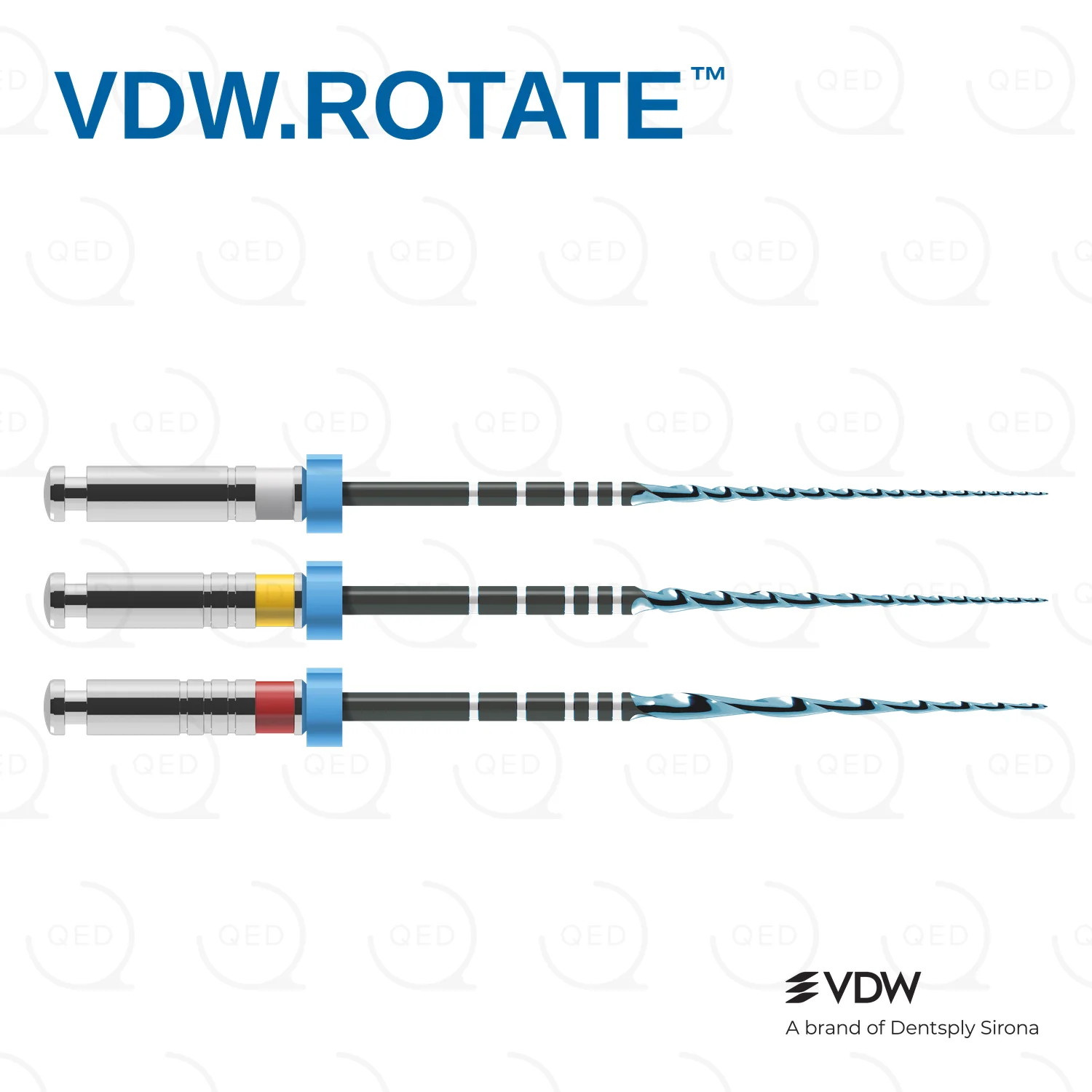
vdw.rotate® · basic sequence · 31 mm · 3 files
heat-treated nitiadapted s sectiontry the system
15/.04, 20/.05 and 25/.06 in one sterile blister. vdw describe “an intuitive 3-file basic sequence” and say the range “offers a range of files to effectively master canal anatomies from simple to complex”. this is the cheapest way to find out whether the file suits your hand.
this pack: vdw.rotate® rotary files, assorted, 31 mm (pack of 3)
vdw · vdw gmbh, munich, germany (dentsply sirona)
| contents | 15/.04, 20/.05, 25/.06 – one of each |
| length | 31 mm |
| working part | 16 mm |
| handle | 11 mm, nickel plated · taper rings · iso colour |
| calibration rings | 18, 19, 20, 22, 24 mm, radiopaque |
| supplied | sterile, pack of 3 |
› three files, most cases. glide path, then shape, then finish at 25. larger sizes only if the anatomy asks for them.
› heat-treated wire. vdw say it “strengthens cyclic fatigue resistance of the file and lowers the risk of file breakage”.*
› short learning curve. vdw say “the tactile feeling and the option to use vdw.rotate® files in brushing or in picking motion facilitate quick learning”.
› swap the last file for 25/.04. for narrow, highly curved canals vdw suggest finishing on .04 instead.
“start with an intuitive 3-file basic sequence, then get inspired by the wide range of files.”
vdw, vdw.rotate product brochure menvrotbrc000 rev.1, 2019.
is three files really enough?
for most cases, yes – vdw build the range that way. if the canal is wider than a 25 you carry on into the larger sizes with the same wire and the same feel.
coming from mtwo?
this is the quickest way to try the newer file. same s-section family, with the heat treatment and handle coding added.
› the files singly: 15/.04 · 20/.05 · 25/.06, 31 mm
› for narrow, curved canals: 25/.04, 31 mm
› other lengths: 25 mm
› glide path: vdw c-pilot® assorted, 25 mm · vdw c-pilot® 10, 25 mm
› retreatment: vdw.rotate® retreatment 25/.05, 21 mm
› motor: x-smart® pro+ with apex locator
› lubricant and irrigation: glyde™ file prep · chlorax 5.25% · irriflex® needles
vdw mark their vdw.rotate performance claims “compared to other vdw continuous rotary instruments”, and the cutting-efficiency claim also “compared to a centred rotary cross section”. single use. follow the instructions supplied with the product.
vdw.rotate® basic sequence, 31 mm (3) · heat-treated niti · ref vrot331ast

vdw.rotate® · 15/.04 · 21 mm · 6 files
heat-treated nitiadapted s sectionsingle use
the heat-treated file in vdw’s rotary range. vdw describe a “new heat treatment to increase flexibility without compromising cutting efficiency” and an “adapted s cross section for higher cutting efficiency” – the same s-section family as reciproc® blue, run in continuous rotation. this is the file the basic sequence opens on.
this pack: vdw.rotate® rotary file, iso size 15, .04 taper, 21 mm (pack of 6)
vdw · vdw gmbh, munich, germany (dentsply sirona)
| tip (d0) | 0.15 mm |
| taper | .04 |
| length | 21 mm |
| working part | 16 mm |
| handle | 11 mm, nickel plated · 1 ring for taper .04 · iso colour |
| calibration rings | 18, 19, 20 mm, radiopaque |
| supplied | sterile, pack of 6 |
› heat-treated wire. vdw say the treatment “strengthens cyclic fatigue resistance of the file and lowers the risk of file breakage”.*
› adapted s section. vdw say it “ensures effective debris removal and provides control of the instrument for a swift, thorough and safe preparation”.*
› you can read the taper off the handle. 1 ring on the handle means taper .04, on top of the iso colour. no squinting at the blister.
› radiopaque calibration rings. at 18, 19, 20 mm, so the length shows on the radiograph.
“the new vdw.rotate® file reduces canal transportation and better respects the canal anatomy.”
vdw, vdw.rotate product brochure menvrotbrc000 rev.1, 2019. vdw mark this “compared to other vdw continuous rotary instruments”.
which taper do i choose?
vdw put it simply: “choose taper .06 for the majority of clinical cases”, and “choose taper .04 for narrow and highly curved canals including apical curvature”.
coming from mtwo?
the same s-section idea, with the heat treatment and the handle coding added. see the mtwo range if you want to compare.
› the basic sequence: 20/.05 · 25/.06 · 25/.04, 21 mm
› same file, other lengths: 25 mm · 31 mm
› larger anatomies: 30/.04 · 35/.04 · 40/.04 · 50/.04
› obturation: diadent® dia-pro iso gutta-percha 15/.04 – the same size and taper. the dia-pro paper points stop at 40, so gauge with 40/.04 or a standard point.
› glide path: vdw c-pilot® assorted, 21 mm · vdw c-pilot® 10, 21 mm
› retreatment: vdw.rotate® retreatment 25/.05, 21 mm
› motor: x-smart® pro+ with apex locator
› lubricant and irrigation: glyde™ file prep · chlorax 5.25% · irriflex® needles
vdw mark their vdw.rotate performance claims “compared to other vdw continuous rotary instruments”, and the cutting-efficiency claim also “compared to a centred rotary cross section”. single use. follow the instructions supplied with the product.
vdw.rotate® 15/.04, 21 mm (6) · heat-treated niti · ref vrot621415
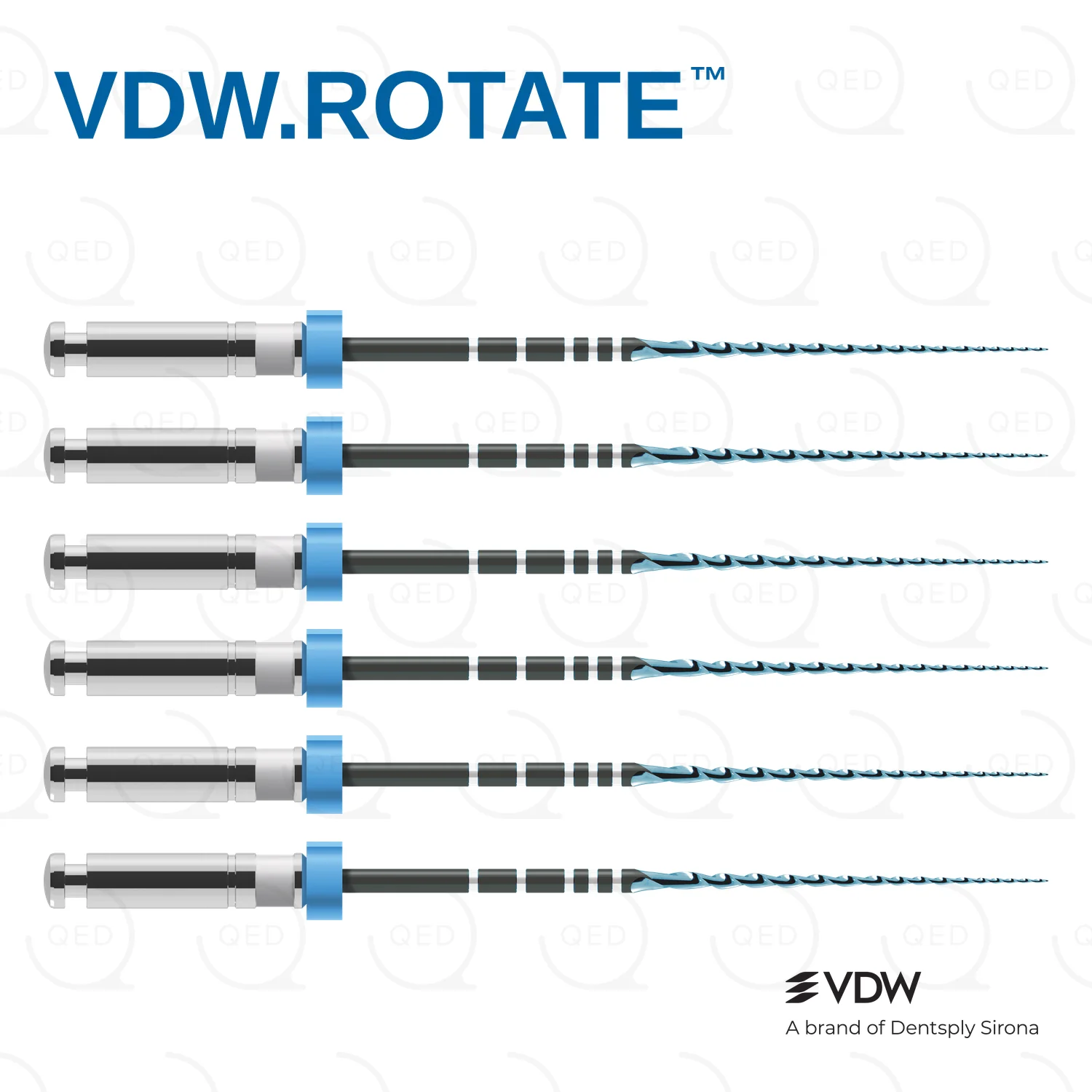
vdw.rotate® · 25/.04 · 21 mm · 6 files
heat-treated nitiadapted s sectionsingle use
the heat-treated file in vdw’s rotary range. vdw describe a “new heat treatment to increase flexibility without compromising cutting efficiency” and an “adapted s cross section for higher cutting efficiency” – the same s-section family as reciproc® blue, run in continuous rotation.
this pack: vdw.rotate® rotary file, iso size 25, .04 taper, 21 mm (pack of 6)
vdw · vdw gmbh, munich, germany (dentsply sirona)
| tip (d0) | 0.25 mm |
| taper | .04 |
| length | 21 mm |
| working part | 16 mm |
| handle | 11 mm, nickel plated · 1 ring for taper .04 · iso colour |
| calibration rings | 18, 19, 20 mm, radiopaque |
| supplied | sterile, pack of 6 |
› heat-treated wire. vdw say the treatment “strengthens cyclic fatigue resistance of the file and lowers the risk of file breakage”.*
› adapted s section. vdw say it “ensures effective debris removal and provides control of the instrument for a swift, thorough and safe preparation”.*
› you can read the taper off the handle. 1 ring on the handle means taper .04, on top of the iso colour. no squinting at the blister.
› radiopaque calibration rings. at 18, 19, 20 mm, so the length shows on the radiograph.
“the new vdw.rotate® file reduces canal transportation and better respects the canal anatomy.”
vdw, vdw.rotate product brochure menvrotbrc000 rev.1, 2019. vdw mark this “compared to other vdw continuous rotary instruments”.
which taper do i choose?
vdw put it simply: “choose taper .06 for the majority of clinical cases”, and “choose taper .04 for narrow and highly curved canals including apical curvature”.
coming from mtwo?
the same s-section idea, with the heat treatment and the handle coding added. see the mtwo range if you want to compare.
› the basic sequence: 15/.04 · 20/.05 · 25/.06, 21 mm
› same file, other lengths: 25 mm · 31 mm
› larger anatomies: 30/.04 · 35/.04 · 40/.04 · 50/.04
› matched obturation: gutta-percha 25/.04 · paper points 25/.04
› glide path: vdw c-pilot® assorted, 21 mm · vdw c-pilot® 10, 21 mm
› retreatment: vdw.rotate® retreatment 25/.05, 21 mm
› motor: x-smart® pro+ with apex locator
› lubricant and irrigation: glyde™ file prep · chlorax 5.25% · irriflex® needles
vdw mark their vdw.rotate performance claims “compared to other vdw continuous rotary instruments”, and the cutting-efficiency claim also “compared to a centred rotary cross section”. single use. follow the instructions supplied with the product.
vdw.rotate® 25/.04, 21 mm (6) · heat-treated niti · ref vrot621425
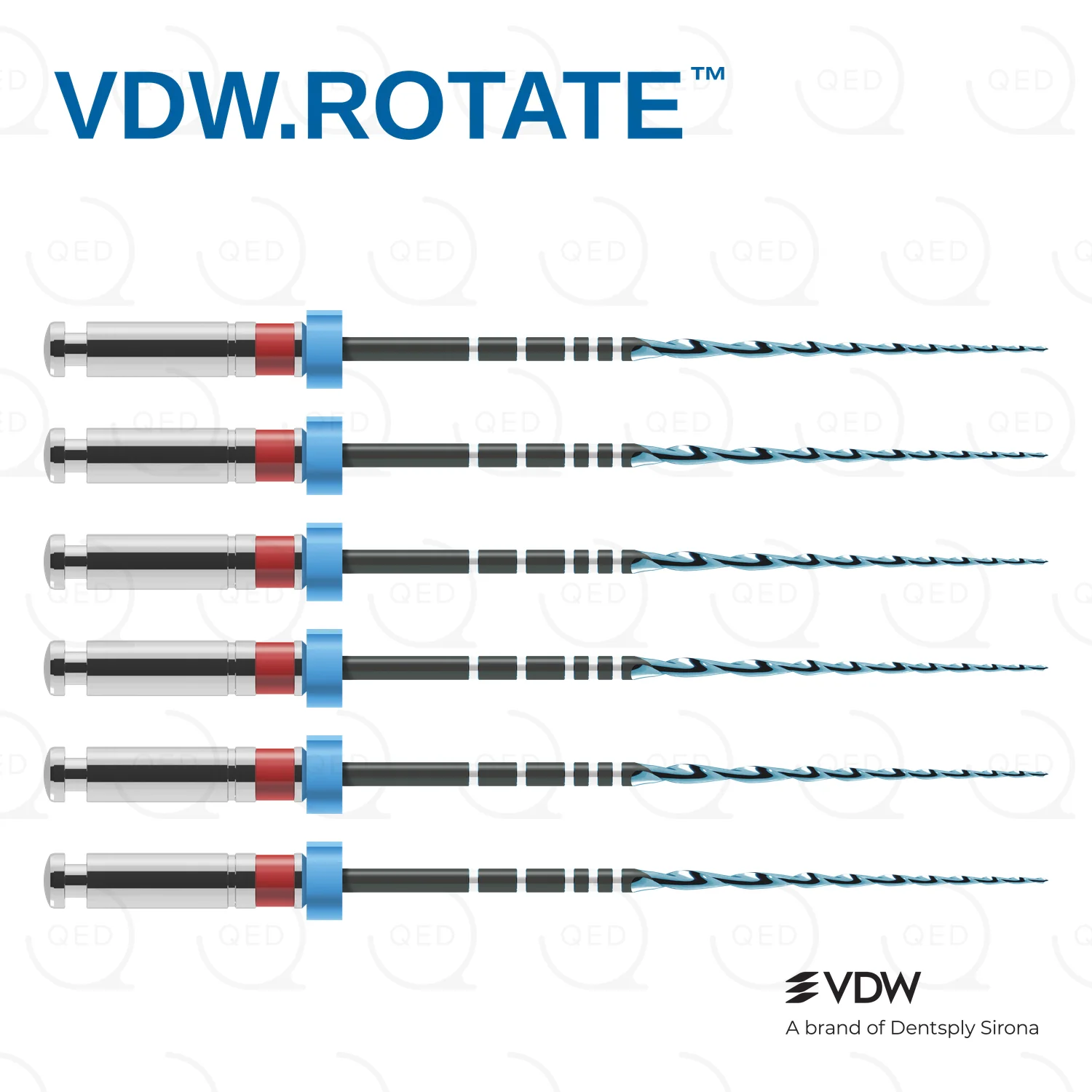
vdw.rotate® · 30/.04 · 21 mm · 6 files
heat-treated nitiadapted s sectionsingle use
the heat-treated file in vdw’s rotary range. vdw describe a “new heat treatment to increase flexibility without compromising cutting efficiency” and an “adapted s cross section for higher cutting efficiency” – the same s-section family as reciproc® blue, run in continuous rotation. this size is for shaping a larger canal once you have reached working length.
this pack: vdw.rotate® rotary file, iso size 30, .04 taper, 21 mm (pack of 6)
vdw · vdw gmbh, munich, germany (dentsply sirona)
| tip (d0) | 0.30 mm |
| taper | .04 |
| length | 21 mm |
| working part | 16 mm |
| handle | 11 mm, nickel plated · 1 ring for taper .04 · iso colour |
| calibration rings | 18, 19, 20 mm, radiopaque |
| supplied | sterile, pack of 6 |
› heat-treated wire. vdw say the treatment “strengthens cyclic fatigue resistance of the file and lowers the risk of file breakage”.*
› adapted s section. vdw say it “ensures effective debris removal and provides control of the instrument for a swift, thorough and safe preparation”.*
› you can read the taper off the handle. 1 ring on the handle means taper .04, on top of the iso colour. no squinting at the blister.
› radiopaque calibration rings. at 18, 19, 20 mm, so the length shows on the radiograph.
“the new vdw.rotate® file reduces canal transportation and better respects the canal anatomy.”
vdw, vdw.rotate product brochure menvrotbrc000 rev.1, 2019. vdw mark this “compared to other vdw continuous rotary instruments”.
which taper do i choose?
vdw put it simply: “choose taper .06 for the majority of clinical cases”, and “choose taper .04 for narrow and highly curved canals including apical curvature”.
coming from mtwo?
the same s-section idea, with the heat treatment and the handle coding added. see the mtwo range if you want to compare.
› the basic sequence: 15/.04 · 20/.05 · 25/.06 · 25/.04, 21 mm
› same file, other lengths: 25 mm · 31 mm
› larger anatomies: 35/.04 · 40/.04 · 50/.04 · 60/.04
› matched obturation: gutta-percha 30/.04 · paper points 30/.04
› glide path: vdw c-pilot® assorted, 21 mm · vdw c-pilot® 10, 21 mm
› retreatment: vdw.rotate® retreatment 25/.05, 21 mm
› motor: x-smart® pro+ with apex locator
› lubricant and irrigation: glyde™ file prep · chlorax 5.25% · irriflex® needles
vdw mark their vdw.rotate performance claims “compared to other vdw continuous rotary instruments”, and the cutting-efficiency claim also “compared to a centred rotary cross section”. single use. follow the instructions supplied with the product.
vdw.rotate® 30/.04, 21 mm (6) · heat-treated niti · ref vrot621430

vdw.rotate® · 35/.04 · 21 mm · 6 files
heat-treated nitiadapted s sectionsingle use
the heat-treated file in vdw’s rotary range. vdw describe a “new heat treatment to increase flexibility without compromising cutting efficiency” and an “adapted s cross section for higher cutting efficiency” – the same s-section family as reciproc® blue, run in continuous rotation. this size is for shaping a larger canal once you have reached working length.
this pack: vdw.rotate® rotary file, iso size 35, .04 taper, 21 mm (pack of 6)
vdw · vdw gmbh, munich, germany (dentsply sirona)
| tip (d0) | 0.35 mm |
| taper | .04 |
| length | 21 mm |
| working part | 16 mm |
| handle | 11 mm, nickel plated · 1 ring for taper .04 · iso colour |
| calibration rings | 18, 19, 20 mm, radiopaque |
| supplied | sterile, pack of 6 |
› heat-treated wire. vdw say the treatment “strengthens cyclic fatigue resistance of the file and lowers the risk of file breakage”.*
› adapted s section. vdw say it “ensures effective debris removal and provides control of the instrument for a swift, thorough and safe preparation”.*
› you can read the taper off the handle. 1 ring on the handle means taper .04, on top of the iso colour. no squinting at the blister.
› radiopaque calibration rings. at 18, 19, 20 mm, so the length shows on the radiograph.
“the new vdw.rotate® file reduces canal transportation and better respects the canal anatomy.”
vdw, vdw.rotate product brochure menvrotbrc000 rev.1, 2019. vdw mark this “compared to other vdw continuous rotary instruments”.
which taper do i choose?
vdw put it simply: “choose taper .06 for the majority of clinical cases”, and “choose taper .04 for narrow and highly curved canals including apical curvature”.
coming from mtwo?
the same s-section idea, with the heat treatment and the handle coding added. see the mtwo range if you want to compare.
› the basic sequence: 15/.04 · 20/.05 · 25/.06 · 25/.04, 21 mm
› same file, other lengths: 25 mm · 31 mm
› larger anatomies: 30/.04 · 40/.04 · 50/.04 · 60/.04
› matched obturation: gutta-percha 35/.04 · paper points 35/.04
› glide path: vdw c-pilot® assorted, 21 mm · vdw c-pilot® 10, 21 mm
› retreatment: vdw.rotate® retreatment 25/.05, 21 mm
› motor: x-smart® pro+ with apex locator
› lubricant and irrigation: glyde™ file prep · chlorax 5.25% · irriflex® needles
vdw mark their vdw.rotate performance claims “compared to other vdw continuous rotary instruments”, and the cutting-efficiency claim also “compared to a centred rotary cross section”. single use. follow the instructions supplied with the product.
vdw.rotate® 35/.04, 21 mm (6) · heat-treated niti · ref vrot621435
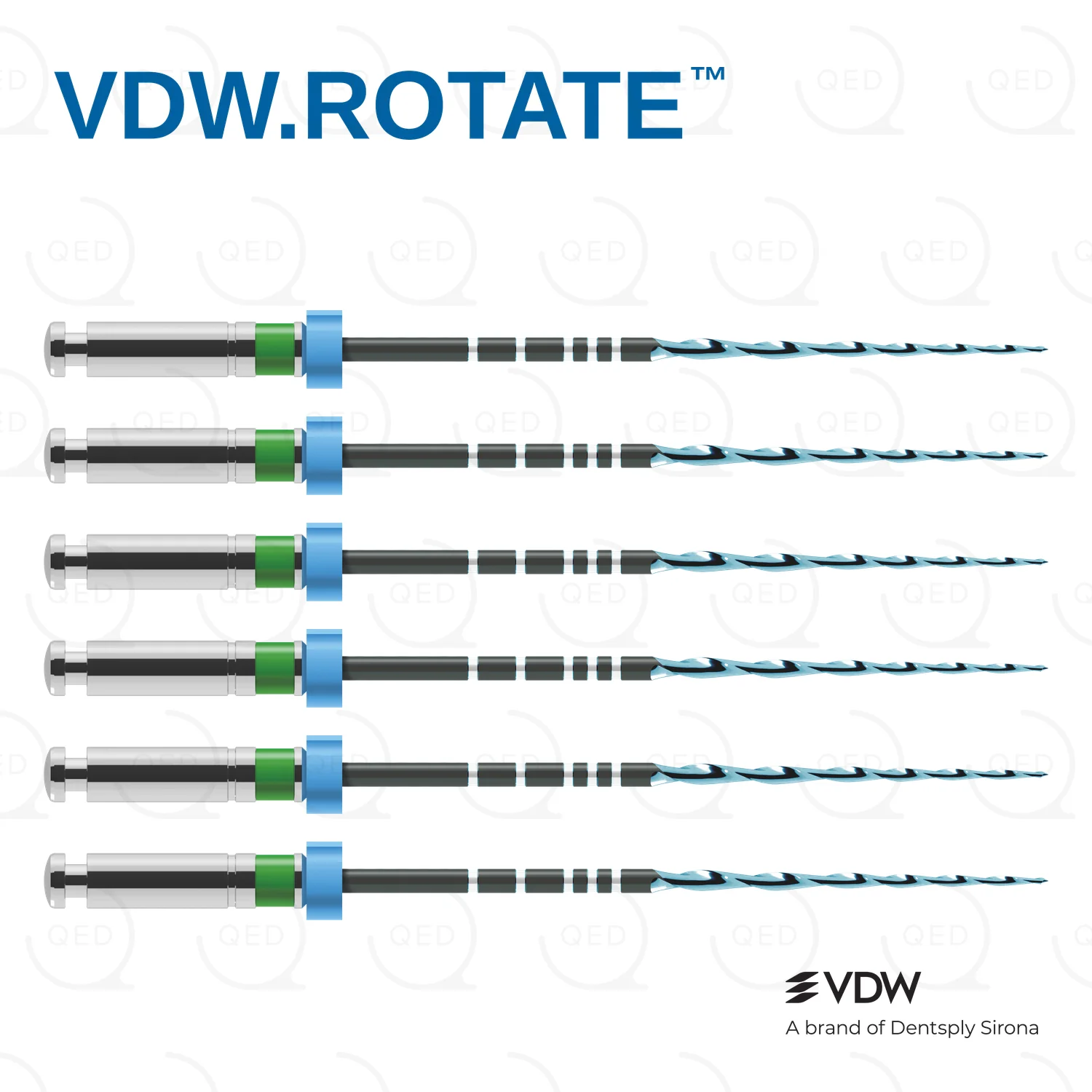
vdw.rotate® · 40/.04 · 21 mm · 6 files
heat-treated nitiadapted s sectionsingle use
the heat-treated file in vdw’s rotary range. vdw describe a “new heat treatment to increase flexibility without compromising cutting efficiency” and an “adapted s cross section for higher cutting efficiency” – the same s-section family as reciproc® blue, run in continuous rotation. this size is for shaping a larger canal once you have reached working length.
this pack: vdw.rotate® rotary file, iso size 40, .04 taper, 21 mm (pack of 6)
vdw · vdw gmbh, munich, germany (dentsply sirona)
| tip (d0) | 0.40 mm |
| taper | .04 |
| length | 21 mm |
| working part | 16 mm |
| handle | 11 mm, nickel plated · 1 ring for taper .04 · iso colour |
| calibration rings | 18, 19, 20 mm, radiopaque |
| supplied | sterile, pack of 6 |
› heat-treated wire. vdw say the treatment “strengthens cyclic fatigue resistance of the file and lowers the risk of file breakage”.*
› adapted s section. vdw say it “ensures effective debris removal and provides control of the instrument for a swift, thorough and safe preparation”.*
› you can read the taper off the handle. 1 ring on the handle means taper .04, on top of the iso colour. no squinting at the blister.
› radiopaque calibration rings. at 18, 19, 20 mm, so the length shows on the radiograph.
“the new vdw.rotate® file reduces canal transportation and better respects the canal anatomy.”
vdw, vdw.rotate product brochure menvrotbrc000 rev.1, 2019. vdw mark this “compared to other vdw continuous rotary instruments”.
which taper do i choose?
vdw put it simply: “choose taper .06 for the majority of clinical cases”, and “choose taper .04 for narrow and highly curved canals including apical curvature”.
coming from mtwo?
the same s-section idea, with the heat treatment and the handle coding added. see the mtwo range if you want to compare.
› the basic sequence: 15/.04 · 20/.05 · 25/.06 · 25/.04, 21 mm
› same file, other lengths: 25 mm · 31 mm
› larger anatomies: 30/.04 · 35/.04 · 50/.04 · 60/.04
› matched obturation: gutta-percha 40/.04 · paper points 40/.04
› glide path: vdw c-pilot® assorted, 21 mm · vdw c-pilot® 10, 21 mm
› retreatment: vdw.rotate® retreatment 25/.05, 21 mm
› motor: x-smart® pro+ with apex locator
› lubricant and irrigation: glyde™ file prep · chlorax 5.25% · irriflex® needles
vdw mark their vdw.rotate performance claims “compared to other vdw continuous rotary instruments”, and the cutting-efficiency claim also “compared to a centred rotary cross section”. single use. follow the instructions supplied with the product.
vdw.rotate® 40/.04, 21 mm (6) · heat-treated niti · ref vrot621440
vdw.rotate® · 50/.04 · 21 mm · 6 files
heat-treated nitiadapted s sectionsingle use
the heat-treated file in vdw’s rotary range. vdw describe a “new heat treatment to increase flexibility without compromising cutting efficiency” and an “adapted s cross section for higher cutting efficiency” – the same s-section family as reciproc® blue, run in continuous rotation. this size is for shaping a larger canal once you have reached working length.
this pack: vdw.rotate® rotary file, iso size 50, .04 taper, 21 mm (pack of 6)
vdw · vdw gmbh, munich, germany (dentsply sirona)
| tip (d0) | 0.50 mm |
| taper | .04 |
| length | 21 mm |
| working part | 16 mm |
| handle | 11 mm, nickel plated · 1 ring for taper .04 · iso colour |
| calibration rings | 18, 19, 20 mm, radiopaque |
| supplied | sterile, pack of 6 |
› heat-treated wire. vdw say the treatment “strengthens cyclic fatigue resistance of the file and lowers the risk of file breakage”.*
› adapted s section. vdw say it “ensures effective debris removal and provides control of the instrument for a swift, thorough and safe preparation”.*
› you can read the taper off the handle. 1 ring on the handle means taper .04, on top of the iso colour. no squinting at the blister.
› radiopaque calibration rings. at 18, 19, 20 mm, so the length shows on the radiograph.
“the new vdw.rotate® file reduces canal transportation and better respects the canal anatomy.”
vdw, vdw.rotate product brochure menvrotbrc000 rev.1, 2019. vdw mark this “compared to other vdw continuous rotary instruments”.
which taper do i choose?
vdw put it simply: “choose taper .06 for the majority of clinical cases”, and “choose taper .04 for narrow and highly curved canals including apical curvature”.
coming from mtwo?
the same s-section idea, with the heat treatment and the handle coding added. see the mtwo range if you want to compare.
› the basic sequence: 15/.04 · 20/.05 · 25/.06 · 25/.04, 21 mm
› same file, other lengths: 25 mm · 31 mm
› larger anatomies: 30/.04 · 35/.04 · 40/.04 · 60/.04
› matched obturation: gutta-percha 50/.04
› glide path: vdw c-pilot® assorted, 21 mm · vdw c-pilot® 10, 21 mm
› retreatment: vdw.rotate® retreatment 25/.05, 21 mm
› motor: x-smart® pro+ with apex locator
› lubricant and irrigation: glyde™ file prep · chlorax 5.25% · irriflex® needles
vdw mark their vdw.rotate performance claims “compared to other vdw continuous rotary instruments”, and the cutting-efficiency claim also “compared to a centred rotary cross section”. single use. follow the instructions supplied with the product.
vdw.rotate® 50/.04, 21 mm (6) · heat-treated niti · ref vrot621450
vdw.rotate® · 60/.04 · 21 mm · 6 files
heat-treated nitiadapted s sectionsingle use
the heat-treated file in vdw’s rotary range. vdw describe a “new heat treatment to increase flexibility without compromising cutting efficiency” and an “adapted s cross section for higher cutting efficiency” – the same s-section family as reciproc® blue, run in continuous rotation. this size is for shaping a larger canal once you have reached working length.
this pack: vdw.rotate® rotary file, iso size 60, .04 taper, 21 mm (pack of 6)
vdw · vdw gmbh, munich, germany (dentsply sirona)
| tip (d0) | 0.60 mm |
| taper | .04 |
| length | 21 mm |
| working part | 16 mm |
| handle | 11 mm, nickel plated · 1 ring for taper .04 · iso colour |
| calibration rings | 18, 19, 20 mm, radiopaque |
| supplied | sterile, pack of 6 |
› heat-treated wire. vdw say the treatment “strengthens cyclic fatigue resistance of the file and lowers the risk of file breakage”.*
› adapted s section. vdw say it “ensures effective debris removal and provides control of the instrument for a swift, thorough and safe preparation”.*
› you can read the taper off the handle. 1 ring on the handle means taper .04, on top of the iso colour. no squinting at the blister.
› radiopaque calibration rings. at 18, 19, 20 mm, so the length shows on the radiograph.
“the new vdw.rotate® file reduces canal transportation and better respects the canal anatomy.”
vdw, vdw.rotate product brochure menvrotbrc000 rev.1, 2019. vdw mark this “compared to other vdw continuous rotary instruments”.
which taper do i choose?
vdw put it simply: “choose taper .06 for the majority of clinical cases”, and “choose taper .04 for narrow and highly curved canals including apical curvature”.
coming from mtwo?
the same s-section idea, with the heat treatment and the handle coding added. see the mtwo range if you want to compare.
› the basic sequence: 15/.04 · 20/.05 · 25/.06 · 25/.04, 21 mm
› same file, other lengths: 25 mm · 31 mm
› larger anatomies: 30/.04 · 35/.04 · 40/.04 · 50/.04
› obturation: the dia-pro .04 range stops at 45, so there is no matched cone at 60/.04. fit from 45/.04 or the standard ml.029™ 60/.02.
› glide path: vdw c-pilot® assorted, 21 mm · vdw c-pilot® 10, 21 mm
› retreatment: vdw.rotate® retreatment 25/.05, 21 mm
› motor: x-smart® pro+ with apex locator
› lubricant and irrigation: glyde™ file prep · chlorax 5.25% · irriflex® needles
vdw mark their vdw.rotate performance claims “compared to other vdw continuous rotary instruments”, and the cutting-efficiency claim also “compared to a centred rotary cross section”. single use. follow the instructions supplied with the product.
vdw.rotate® 60/.04, 21 mm (6) · heat-treated niti · ref vrot621460

vdw.rotate® · 20/.05 · 21 mm · 6 files
heat-treated nitiadapted s sectionsingle use
the heat-treated file in vdw’s rotary range. vdw describe a “new heat treatment to increase flexibility without compromising cutting efficiency” and an “adapted s cross section for higher cutting efficiency” – the same s-section family as reciproc® blue, run in continuous rotation.
this pack: vdw.rotate® rotary file, iso size 20, .05 taper, 21 mm (pack of 6)
vdw · vdw gmbh, munich, germany (dentsply sirona)
| tip (d0) | 0.20 mm |
| taper | .05 |
| length | 21 mm |
| working part | 16 mm |
| handle | 11 mm, nickel plated · 2 rings for taper .05 · iso colour |
| calibration rings | 18, 19, 20 mm, radiopaque |
| supplied | sterile, pack of 6 |
› heat-treated wire. vdw say the treatment “strengthens cyclic fatigue resistance of the file and lowers the risk of file breakage”.*
› adapted s section. vdw say it “ensures effective debris removal and provides control of the instrument for a swift, thorough and safe preparation”.*
› you can read the taper off the handle. 2 rings on the handle means taper .05, on top of the iso colour. no squinting at the blister.
› radiopaque calibration rings. at 18, 19, 20 mm, so the length shows on the radiograph.
“the new vdw.rotate® file reduces canal transportation and better respects the canal anatomy.”
vdw, vdw.rotate product brochure menvrotbrc000 rev.1, 2019. vdw mark this “compared to other vdw continuous rotary instruments”.
which taper do i choose?
vdw put it simply: “choose taper .06 for the majority of clinical cases”, and “choose taper .04 for narrow and highly curved canals including apical curvature”.
coming from mtwo?
the same s-section idea, with the heat treatment and the handle coding added. see the mtwo range if you want to compare.
› the basic sequence: 15/.04 · 25/.06 · 25/.04, 21 mm
› same file, other lengths: 25 mm · 31 mm
› larger anatomies: 30/.04 · 35/.04 · 40/.04 · 50/.04
› obturation: dia-pro iso is made in .04 and .06 only, so there is no matched cone for a .05 preparation. fit from the .04 assorted pack or the standard ml.029™ .02 range.
› glide path: vdw c-pilot® assorted, 21 mm · vdw c-pilot® 10, 21 mm
› retreatment: vdw.rotate® retreatment 25/.05, 21 mm
› motor: x-smart® pro+ with apex locator
› lubricant and irrigation: glyde™ file prep · chlorax 5.25% · irriflex® needles
vdw mark their vdw.rotate performance claims “compared to other vdw continuous rotary instruments”, and the cutting-efficiency claim also “compared to a centred rotary cross section”. single use. follow the instructions supplied with the product.
vdw.rotate® 20/.05, 21 mm (6) · heat-treated niti · ref vrot621520
vdw.rotate® · 25/.06 · 21 mm · 6 files
heat-treated nitiadapted s sectionsingle use
the heat-treated file in vdw’s rotary range. vdw describe a “new heat treatment to increase flexibility without compromising cutting efficiency” and an “adapted s cross section for higher cutting efficiency” – the same s-section family as reciproc® blue, run in continuous rotation.
this pack: vdw.rotate® rotary file, iso size 25, .06 taper, 21 mm (pack of 6)
vdw · vdw gmbh, munich, germany (dentsply sirona)
| tip (d0) | 0.25 mm |
| taper | .06 |
| length | 21 mm |
| working part | 16 mm |
| handle | 11 mm, nickel plated · 3 rings for taper .06 · iso colour |
| calibration rings | 18, 19, 20 mm, radiopaque |
| supplied | sterile, pack of 6 |
› heat-treated wire. vdw say the treatment “strengthens cyclic fatigue resistance of the file and lowers the risk of file breakage”.*
› adapted s section. vdw say it “ensures effective debris removal and provides control of the instrument for a swift, thorough and safe preparation”.*
› you can read the taper off the handle. 3 rings on the handle means taper .06, on top of the iso colour. no squinting at the blister.
› radiopaque calibration rings. at 18, 19, 20 mm, so the length shows on the radiograph.
“the new vdw.rotate® file reduces canal transportation and better respects the canal anatomy.”
vdw, vdw.rotate product brochure menvrotbrc000 rev.1, 2019. vdw mark this “compared to other vdw continuous rotary instruments”.
which taper do i choose?
vdw put it simply: “choose taper .06 for the majority of clinical cases”, and “choose taper .04 for narrow and highly curved canals including apical curvature”.
coming from mtwo?
the same s-section idea, with the heat treatment and the handle coding added. see the mtwo range if you want to compare.
› the basic sequence: 15/.04 · 20/.05 · 25/.04, 21 mm
› same file, other lengths: 25 mm · 31 mm
› larger anatomies: 30/.04 · 35/.04 · 40/.04 · 50/.04
› matched obturation: gutta-percha 25/.06 · paper points 25/.06
› glide path: vdw c-pilot® assorted, 21 mm · vdw c-pilot® 10, 21 mm
› retreatment: vdw.rotate® retreatment 25/.05, 21 mm
› motor: x-smart® pro+ with apex locator
› lubricant and irrigation: glyde™ file prep · chlorax 5.25% · irriflex® needles
vdw mark their vdw.rotate performance claims “compared to other vdw continuous rotary instruments”, and the cutting-efficiency claim also “compared to a centred rotary cross section”. single use. follow the instructions supplied with the product.
vdw.rotate® 25/.06, 21 mm (6) · heat-treated niti · ref vrot621625
vdw.rotate® · 30/.06 · 21 mm · 6 files
heat-treated nitiadapted s sectionsingle use
the heat-treated file in vdw’s rotary range. vdw describe a “new heat treatment to increase flexibility without compromising cutting efficiency” and an “adapted s cross section for higher cutting efficiency” – the same s-section family as reciproc® blue, run in continuous rotation. this size is for shaping a larger canal once you have reached working length.
this pack: vdw.rotate® rotary file, iso size 30, .06 taper, 21 mm (pack of 6)
vdw · vdw gmbh, munich, germany (dentsply sirona)
| tip (d0) | 0.30 mm |
| taper | .06 |
| length | 21 mm |
| working part | 16 mm |
| handle | 11 mm, nickel plated · 3 rings for taper .06 · iso colour |
| calibration rings | 18, 19, 20 mm, radiopaque |
| supplied | sterile, pack of 6 |
› heat-treated wire. vdw say the treatment “strengthens cyclic fatigue resistance of the file and lowers the risk of file breakage”.*
› adapted s section. vdw say it “ensures effective debris removal and provides control of the instrument for a swift, thorough and safe preparation”.*
› you can read the taper off the handle. 3 rings on the handle means taper .06, on top of the iso colour. no squinting at the blister.
› radiopaque calibration rings. at 18, 19, 20 mm, so the length shows on the radiograph.
“the new vdw.rotate® file reduces canal transportation and better respects the canal anatomy.”
vdw, vdw.rotate product brochure menvrotbrc000 rev.1, 2019. vdw mark this “compared to other vdw continuous rotary instruments”.
which taper do i choose?
vdw put it simply: “choose taper .06 for the majority of clinical cases”, and “choose taper .04 for narrow and highly curved canals including apical curvature”.
coming from mtwo?
the same s-section idea, with the heat treatment and the handle coding added. see the mtwo range if you want to compare.
› the basic sequence: 15/.04 · 20/.05 · 25/.06 · 25/.04, 21 mm
› same file, other lengths: 25 mm · 31 mm
› larger anatomies: 30/.04 · 35/.04 · 40/.04 · 50/.04
› matched obturation: gutta-percha 30/.06
› glide path: vdw c-pilot® assorted, 21 mm · vdw c-pilot® 10, 21 mm
› retreatment: vdw.rotate® retreatment 25/.05, 21 mm
› motor: x-smart® pro+ with apex locator
› lubricant and irrigation: glyde™ file prep · chlorax 5.25% · irriflex® needles
vdw mark their vdw.rotate performance claims “compared to other vdw continuous rotary instruments”, and the cutting-efficiency claim also “compared to a centred rotary cross section”. single use. follow the instructions supplied with the product.
vdw.rotate® 30/.06, 21 mm (6) · heat-treated niti · ref vrot621630
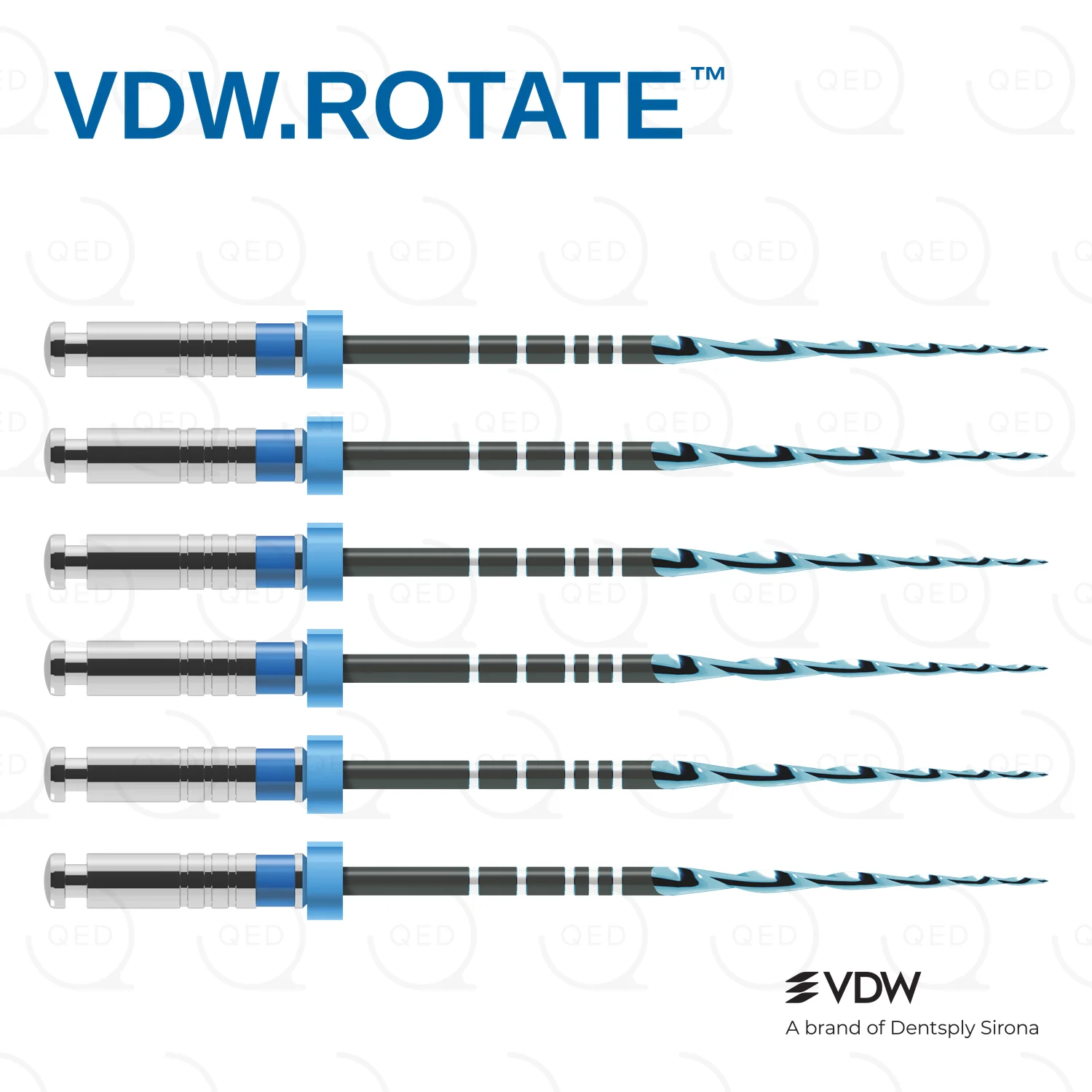
vdw.rotate® · 35/.06 · 21 mm · 6 files
heat-treated nitiadapted s sectionsingle use
the heat-treated file in vdw’s rotary range. vdw describe a “new heat treatment to increase flexibility without compromising cutting efficiency” and an “adapted s cross section for higher cutting efficiency” – the same s-section family as reciproc® blue, run in continuous rotation. this size is for shaping a larger canal once you have reached working length.
this pack: vdw.rotate® rotary file, iso size 35, .06 taper, 21 mm (pack of 6)
vdw · vdw gmbh, munich, germany (dentsply sirona)
| tip (d0) | 0.35 mm |
| taper | .06 |
| length | 21 mm |
| working part | 16 mm |
| handle | 11 mm, nickel plated · 3 rings for taper .06 · iso colour |
| calibration rings | 18, 19, 20 mm, radiopaque |
| supplied | sterile, pack of 6 |
› heat-treated wire. vdw say the treatment “strengthens cyclic fatigue resistance of the file and lowers the risk of file breakage”.*
› adapted s section. vdw say it “ensures effective debris removal and provides control of the instrument for a swift, thorough and safe preparation”.*
› you can read the taper off the handle. 3 rings on the handle means taper .06, on top of the iso colour. no squinting at the blister.
› radiopaque calibration rings. at 18, 19, 20 mm, so the length shows on the radiograph.
“the new vdw.rotate® file reduces canal transportation and better respects the canal anatomy.”
vdw, vdw.rotate product brochure menvrotbrc000 rev.1, 2019. vdw mark this “compared to other vdw continuous rotary instruments”.
which taper do i choose?
vdw put it simply: “choose taper .06 for the majority of clinical cases”, and “choose taper .04 for narrow and highly curved canals including apical curvature”.
coming from mtwo?
the same s-section idea, with the heat treatment and the handle coding added. see the mtwo range if you want to compare.
› the basic sequence: 15/.04 · 20/.05 · 25/.06 · 25/.04, 21 mm
› same file, other lengths: 25 mm · 31 mm
› larger anatomies: 30/.04 · 35/.04 · 40/.04 · 50/.04
› matched obturation: gutta-percha 35/.06
› glide path: vdw c-pilot® assorted, 21 mm · vdw c-pilot® 10, 21 mm
› retreatment: vdw.rotate® retreatment 25/.05, 21 mm
› motor: x-smart® pro+ with apex locator
› lubricant and irrigation: glyde™ file prep · chlorax 5.25% · irriflex® needles
vdw mark their vdw.rotate performance claims “compared to other vdw continuous rotary instruments”, and the cutting-efficiency claim also “compared to a centred rotary cross section”. single use. follow the instructions supplied with the product.
vdw.rotate® 35/.06, 21 mm (6) · heat-treated niti · ref vrot621635

vdw.rotate® · 40/.06 · 21 mm · 6 files
heat-treated nitiadapted s sectionsingle use
the heat-treated file in vdw’s rotary range. vdw describe a “new heat treatment to increase flexibility without compromising cutting efficiency” and an “adapted s cross section for higher cutting efficiency” – the same s-section family as reciproc® blue, run in continuous rotation. this size is for shaping a larger canal once you have reached working length.
this pack: vdw.rotate® rotary file, iso size 40, .06 taper, 21 mm (pack of 6)
vdw · vdw gmbh, munich, germany (dentsply sirona)
| tip (d0) | 0.40 mm |
| taper | .06 |
| length | 21 mm |
| working part | 16 mm |
| handle | 11 mm, nickel plated · 3 rings for taper .06 · iso colour |
| calibration rings | 18, 19, 20 mm, radiopaque |
| supplied | sterile, pack of 6 |
› heat-treated wire. vdw say the treatment “strengthens cyclic fatigue resistance of the file and lowers the risk of file breakage”.*
› adapted s section. vdw say it “ensures effective debris removal and provides control of the instrument for a swift, thorough and safe preparation”.*
› you can read the taper off the handle. 3 rings on the handle means taper .06, on top of the iso colour. no squinting at the blister.
› radiopaque calibration rings. at 18, 19, 20 mm, so the length shows on the radiograph.
“the new vdw.rotate® file reduces canal transportation and better respects the canal anatomy.”
vdw, vdw.rotate product brochure menvrotbrc000 rev.1, 2019. vdw mark this “compared to other vdw continuous rotary instruments”.
which taper do i choose?
vdw put it simply: “choose taper .06 for the majority of clinical cases”, and “choose taper .04 for narrow and highly curved canals including apical curvature”.
coming from mtwo?
the same s-section idea, with the heat treatment and the handle coding added. see the mtwo range if you want to compare.
› the basic sequence: 15/.04 · 20/.05 · 25/.06 · 25/.04, 21 mm
› same file, other lengths: 25 mm · 31 mm
› larger anatomies: 30/.04 · 35/.04 · 40/.04 · 50/.04
› matched obturation: gutta-percha 40/.06
› glide path: vdw c-pilot® assorted, 21 mm · vdw c-pilot® 10, 21 mm
› retreatment: vdw.rotate® retreatment 25/.05, 21 mm
› motor: x-smart® pro+ with apex locator
› lubricant and irrigation: glyde™ file prep · chlorax 5.25% · irriflex® needles
vdw mark their vdw.rotate performance claims “compared to other vdw continuous rotary instruments”, and the cutting-efficiency claim also “compared to a centred rotary cross section”. single use. follow the instructions supplied with the product.
vdw.rotate® 40/.06, 21 mm (6) · heat-treated niti · ref vrot621640
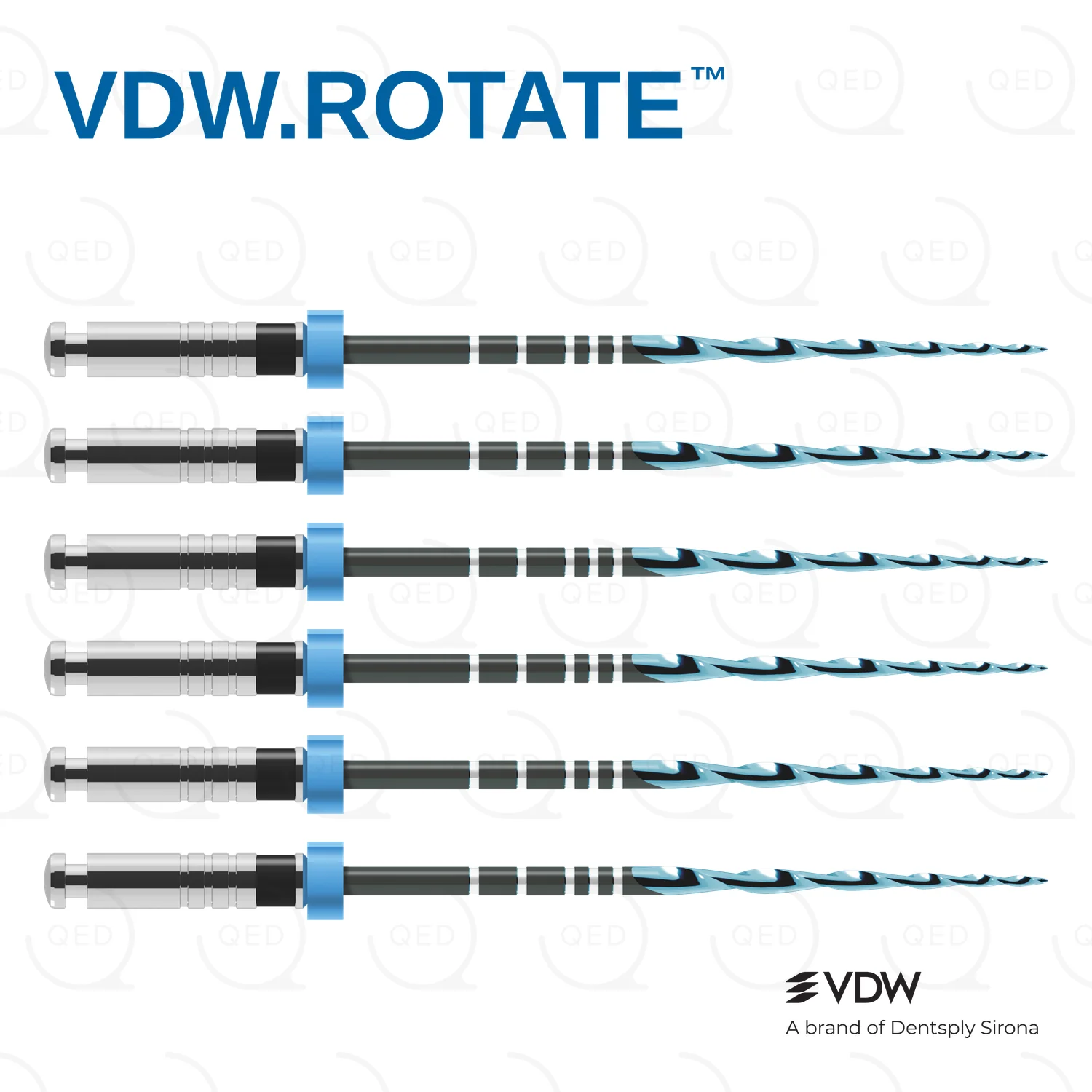
vdw.rotate® · 15/.04 · 25 mm · 6 files
heat-treated nitiadapted s sectionsingle use
the heat-treated file in vdw’s rotary range. vdw describe a “new heat treatment to increase flexibility without compromising cutting efficiency” and an “adapted s cross section for higher cutting efficiency” – the same s-section family as reciproc® blue, run in continuous rotation. this is the file the basic sequence opens on.
this pack: vdw.rotate® rotary file, iso size 15, .04 taper, 25 mm (pack of 6)
vdw · vdw gmbh, munich, germany (dentsply sirona)
| tip (d0) | 0.15 mm |
| taper | .04 |
| length | 25 mm |
| working part | 16 mm |
| handle | 11 mm, nickel plated · 1 ring for taper .04 · iso colour |
| calibration rings | 18, 19, 20, 22 mm, radiopaque |
| supplied | sterile, pack of 6 |
› heat-treated wire. vdw say the treatment “strengthens cyclic fatigue resistance of the file and lowers the risk of file breakage”.*
› adapted s section. vdw say it “ensures effective debris removal and provides control of the instrument for a swift, thorough and safe preparation”.*
› you can read the taper off the handle. 1 ring on the handle means taper .04, on top of the iso colour. no squinting at the blister.
› radiopaque calibration rings. at 18, 19, 20, 22 mm, so the length shows on the radiograph.
“the new vdw.rotate® file reduces canal transportation and better respects the canal anatomy.”
vdw, vdw.rotate product brochure menvrotbrc000 rev.1, 2019. vdw mark this “compared to other vdw continuous rotary instruments”.
which taper do i choose?
vdw put it simply: “choose taper .06 for the majority of clinical cases”, and “choose taper .04 for narrow and highly curved canals including apical curvature”.
coming from mtwo?
the same s-section idea, with the heat treatment and the handle coding added. see the mtwo range if you want to compare.
› the basic sequence: 20/.05 · 25/.06 · 25/.04, 25 mm
› same file, other lengths: 21 mm · 31 mm
› larger anatomies: 30/.04 · 35/.04 · 40/.04 · 50/.04
› obturation: diadent® dia-pro iso gutta-percha 15/.04 – the same size and taper. the dia-pro paper points stop at 40, so gauge with 40/.04 or a standard point.
› glide path: vdw c-pilot® assorted, 25 mm · vdw c-pilot® 10, 25 mm
› retreatment: vdw.rotate® retreatment 25/.05, 21 mm
› motor: x-smart® pro+ with apex locator
› lubricant and irrigation: glyde™ file prep · chlorax 5.25% · irriflex® needles
vdw mark their vdw.rotate performance claims “compared to other vdw continuous rotary instruments”, and the cutting-efficiency claim also “compared to a centred rotary cross section”. single use. follow the instructions supplied with the product.
vdw.rotate® 15/.04, 25 mm (6) · heat-treated niti · ref vrot625415

vdw.rotate® · 25/.04 · 25 mm · 6 files
heat-treated nitiadapted s sectionsingle use
the heat-treated file in vdw’s rotary range. vdw describe a “new heat treatment to increase flexibility without compromising cutting efficiency” and an “adapted s cross section for higher cutting efficiency” – the same s-section family as reciproc® blue, run in continuous rotation.
this pack: vdw.rotate® rotary file, iso size 25, .04 taper, 25 mm (pack of 6)
vdw · vdw gmbh, munich, germany (dentsply sirona)
| tip (d0) | 0.25 mm |
| taper | .04 |
| length | 25 mm |
| working part | 16 mm |
| handle | 11 mm, nickel plated · 1 ring for taper .04 · iso colour |
| calibration rings | 18, 19, 20, 22 mm, radiopaque |
| supplied | sterile, pack of 6 |
› heat-treated wire. vdw say the treatment “strengthens cyclic fatigue resistance of the file and lowers the risk of file breakage”.*
› adapted s section. vdw say it “ensures effective debris removal and provides control of the instrument for a swift, thorough and safe preparation”.*
› you can read the taper off the handle. 1 ring on the handle means taper .04, on top of the iso colour. no squinting at the blister.
› radiopaque calibration rings. at 18, 19, 20, 22 mm, so the length shows on the radiograph.
“the new vdw.rotate® file reduces canal transportation and better respects the canal anatomy.”
vdw, vdw.rotate product brochure menvrotbrc000 rev.1, 2019. vdw mark this “compared to other vdw continuous rotary instruments”.
which taper do i choose?
vdw put it simply: “choose taper .06 for the majority of clinical cases”, and “choose taper .04 for narrow and highly curved canals including apical curvature”.
coming from mtwo?
the same s-section idea, with the heat treatment and the handle coding added. see the mtwo range if you want to compare.
› the basic sequence: 15/.04 · 20/.05 · 25/.06, 25 mm
› same file, other lengths: 21 mm · 31 mm
› larger anatomies: 30/.04 · 35/.04 · 40/.04 · 50/.04
› matched obturation: gutta-percha 25/.04 · paper points 25/.04
› glide path: vdw c-pilot® assorted, 25 mm · vdw c-pilot® 10, 25 mm
› retreatment: vdw.rotate® retreatment 25/.05, 21 mm
› motor: x-smart® pro+ with apex locator
› lubricant and irrigation: glyde™ file prep · chlorax 5.25% · irriflex® needles
vdw mark their vdw.rotate performance claims “compared to other vdw continuous rotary instruments”, and the cutting-efficiency claim also “compared to a centred rotary cross section”. single use. follow the instructions supplied with the product.
vdw.rotate® 25/.04, 25 mm (6) · heat-treated niti · ref vrot625425

vdw.rotate® · 30/.04 · 25 mm · 6 files
heat-treated nitiadapted s sectionsingle use
the heat-treated file in vdw’s rotary range. vdw describe a “new heat treatment to increase flexibility without compromising cutting efficiency” and an “adapted s cross section for higher cutting efficiency” – the same s-section family as reciproc® blue, run in continuous rotation. this size is for shaping a larger canal once you have reached working length.
this pack: vdw.rotate® rotary file, iso size 30, .04 taper, 25 mm (pack of 6)
vdw · vdw gmbh, munich, germany (dentsply sirona)
| tip (d0) | 0.30 mm |
| taper | .04 |
| length | 25 mm |
| working part | 16 mm |
| handle | 11 mm, nickel plated · 1 ring for taper .04 · iso colour |
| calibration rings | 18, 19, 20, 22 mm, radiopaque |
| supplied | sterile, pack of 6 |
› heat-treated wire. vdw say the treatment “strengthens cyclic fatigue resistance of the file and lowers the risk of file breakage”.*
› adapted s section. vdw say it “ensures effective debris removal and provides control of the instrument for a swift, thorough and safe preparation”.*
› you can read the taper off the handle. 1 ring on the handle means taper .04, on top of the iso colour. no squinting at the blister.
› radiopaque calibration rings. at 18, 19, 20, 22 mm, so the length shows on the radiograph.
“the new vdw.rotate® file reduces canal transportation and better respects the canal anatomy.”
vdw, vdw.rotate product brochure menvrotbrc000 rev.1, 2019. vdw mark this “compared to other vdw continuous rotary instruments”.
which taper do i choose?
vdw put it simply: “choose taper .06 for the majority of clinical cases”, and “choose taper .04 for narrow and highly curved canals including apical curvature”.
coming from mtwo?
the same s-section idea, with the heat treatment and the handle coding added. see the mtwo range if you want to compare.
› the basic sequence: 15/.04 · 20/.05 · 25/.06 · 25/.04, 25 mm
› same file, other lengths: 21 mm · 31 mm
› larger anatomies: 35/.04 · 40/.04 · 50/.04 · 60/.04
› matched obturation: gutta-percha 30/.04 · paper points 30/.04
› glide path: vdw c-pilot® assorted, 25 mm · vdw c-pilot® 10, 25 mm
› retreatment: vdw.rotate® retreatment 25/.05, 21 mm
› motor: x-smart® pro+ with apex locator
› lubricant and irrigation: glyde™ file prep · chlorax 5.25% · irriflex® needles
vdw mark their vdw.rotate performance claims “compared to other vdw continuous rotary instruments”, and the cutting-efficiency claim also “compared to a centred rotary cross section”. single use. follow the instructions supplied with the product.
vdw.rotate® 30/.04, 25 mm (6) · heat-treated niti · ref vrot625430
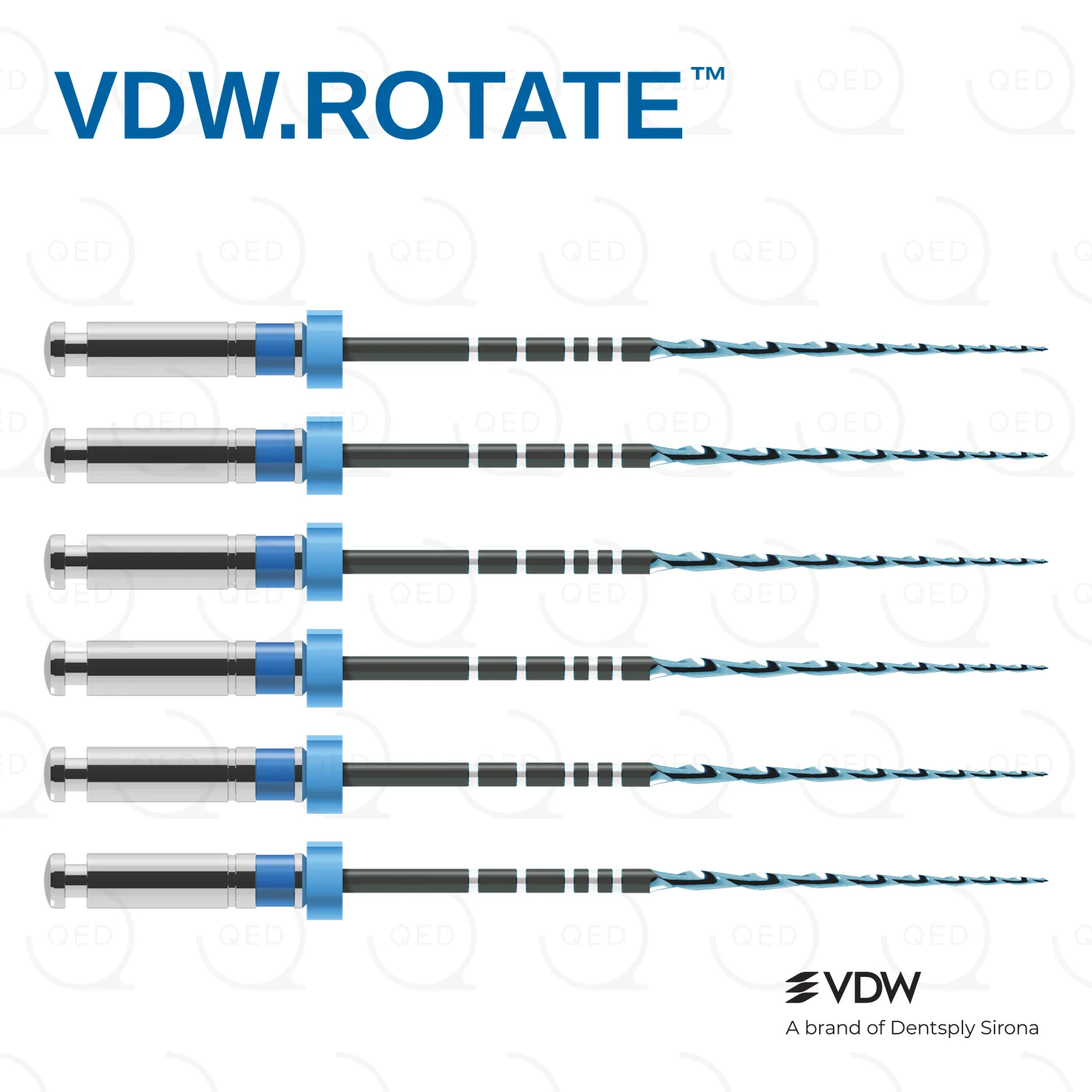
vdw.rotate® · 35/.04 · 25 mm · 6 files
heat-treated nitiadapted s sectionsingle use
the heat-treated file in vdw’s rotary range. vdw describe a “new heat treatment to increase flexibility without compromising cutting efficiency” and an “adapted s cross section for higher cutting efficiency” – the same s-section family as reciproc® blue, run in continuous rotation. this size is for shaping a larger canal once you have reached working length.
this pack: vdw.rotate® rotary file, iso size 35, .04 taper, 25 mm (pack of 6)
vdw · vdw gmbh, munich, germany (dentsply sirona)
| tip (d0) | 0.35 mm |
| taper | .04 |
| length | 25 mm |
| working part | 16 mm |
| handle | 11 mm, nickel plated · 1 ring for taper .04 · iso colour |
| calibration rings | 18, 19, 20, 22 mm, radiopaque |
| supplied | sterile, pack of 6 |
› heat-treated wire. vdw say the treatment “strengthens cyclic fatigue resistance of the file and lowers the risk of file breakage”.*
› adapted s section. vdw say it “ensures effective debris removal and provides control of the instrument for a swift, thorough and safe preparation”.*
› you can read the taper off the handle. 1 ring on the handle means taper .04, on top of the iso colour. no squinting at the blister.
› radiopaque calibration rings. at 18, 19, 20, 22 mm, so the length shows on the radiograph.
“the new vdw.rotate® file reduces canal transportation and better respects the canal anatomy.”
vdw, vdw.rotate product brochure menvrotbrc000 rev.1, 2019. vdw mark this “compared to other vdw continuous rotary instruments”.
which taper do i choose?
vdw put it simply: “choose taper .06 for the majority of clinical cases”, and “choose taper .04 for narrow and highly curved canals including apical curvature”.
coming from mtwo?
the same s-section idea, with the heat treatment and the handle coding added. see the mtwo range if you want to compare.
› the basic sequence: 15/.04 · 20/.05 · 25/.06 · 25/.04, 25 mm
› same file, other lengths: 21 mm · 31 mm
› larger anatomies: 30/.04 · 40/.04 · 50/.04 · 60/.04
› matched obturation: gutta-percha 35/.04 · paper points 35/.04
› glide path: vdw c-pilot® assorted, 25 mm · vdw c-pilot® 10, 25 mm
› retreatment: vdw.rotate® retreatment 25/.05, 21 mm
› motor: x-smart® pro+ with apex locator
› lubricant and irrigation: glyde™ file prep · chlorax 5.25% · irriflex® needles
vdw mark their vdw.rotate performance claims “compared to other vdw continuous rotary instruments”, and the cutting-efficiency claim also “compared to a centred rotary cross section”. single use. follow the instructions supplied with the product.
vdw.rotate® 35/.04, 25 mm (6) · heat-treated niti · ref vrot625435
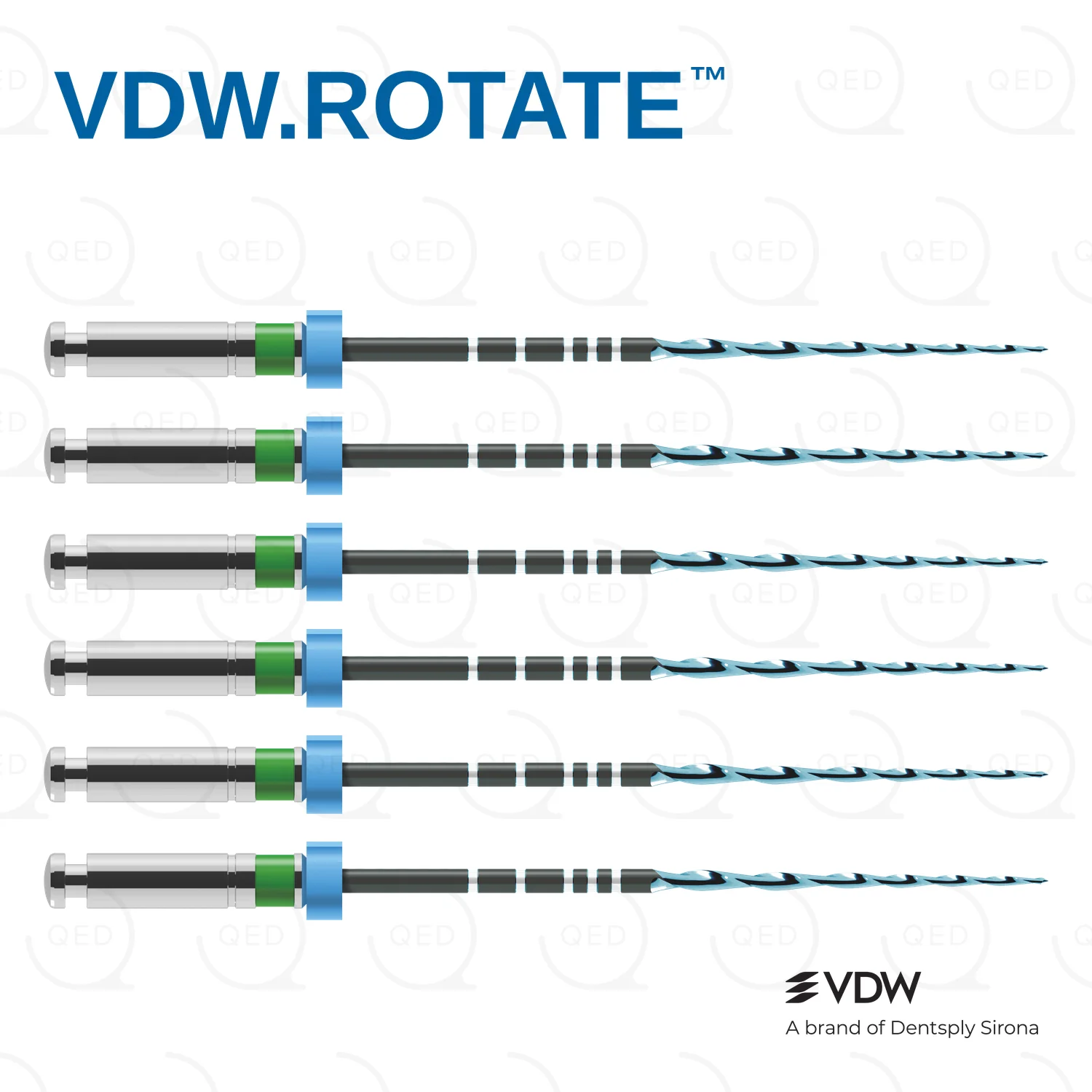
vdw.rotate® · 40/.04 · 25 mm · 6 files
heat-treated nitiadapted s sectionsingle use
the heat-treated file in vdw’s rotary range. vdw describe a “new heat treatment to increase flexibility without compromising cutting efficiency” and an “adapted s cross section for higher cutting efficiency” – the same s-section family as reciproc® blue, run in continuous rotation. this size is for shaping a larger canal once you have reached working length.
this pack: vdw.rotate® rotary file, iso size 40, .04 taper, 25 mm (pack of 6)
vdw · vdw gmbh, munich, germany (dentsply sirona)
| tip (d0) | 0.40 mm |
| taper | .04 |
| length | 25 mm |
| working part | 16 mm |
| handle | 11 mm, nickel plated · 1 ring for taper .04 · iso colour |
| calibration rings | 18, 19, 20, 22 mm, radiopaque |
| supplied | sterile, pack of 6 |
› heat-treated wire. vdw say the treatment “strengthens cyclic fatigue resistance of the file and lowers the risk of file breakage”.*
› adapted s section. vdw say it “ensures effective debris removal and provides control of the instrument for a swift, thorough and safe preparation”.*
› you can read the taper off the handle. 1 ring on the handle means taper .04, on top of the iso colour. no squinting at the blister.
› radiopaque calibration rings. at 18, 19, 20, 22 mm, so the length shows on the radiograph.
“the new vdw.rotate® file reduces canal transportation and better respects the canal anatomy.”
vdw, vdw.rotate product brochure menvrotbrc000 rev.1, 2019. vdw mark this “compared to other vdw continuous rotary instruments”.
which taper do i choose?
vdw put it simply: “choose taper .06 for the majority of clinical cases”, and “choose taper .04 for narrow and highly curved canals including apical curvature”.
coming from mtwo?
the same s-section idea, with the heat treatment and the handle coding added. see the mtwo range if you want to compare.
› the basic sequence: 15/.04 · 20/.05 · 25/.06 · 25/.04, 25 mm
› same file, other lengths: 21 mm · 31 mm
› larger anatomies: 30/.04 · 35/.04 · 50/.04 · 60/.04
› matched obturation: gutta-percha 40/.04 · paper points 40/.04
› glide path: vdw c-pilot® assorted, 25 mm · vdw c-pilot® 10, 25 mm
› retreatment: vdw.rotate® retreatment 25/.05, 21 mm
› motor: x-smart® pro+ with apex locator
› lubricant and irrigation: glyde™ file prep · chlorax 5.25% · irriflex® needles
vdw mark their vdw.rotate performance claims “compared to other vdw continuous rotary instruments”, and the cutting-efficiency claim also “compared to a centred rotary cross section”. single use. follow the instructions supplied with the product.
vdw.rotate® 40/.04, 25 mm (6) · heat-treated niti · ref vrot625440

vdw.rotate® · 50/.04 · 25 mm · 6 files
heat-treated nitiadapted s sectionsingle use
the heat-treated file in vdw’s rotary range. vdw describe a “new heat treatment to increase flexibility without compromising cutting efficiency” and an “adapted s cross section for higher cutting efficiency” – the same s-section family as reciproc® blue, run in continuous rotation. this size is for shaping a larger canal once you have reached working length.
this pack: vdw.rotate® rotary file, iso size 50, .04 taper, 25 mm (pack of 6)
vdw · vdw gmbh, munich, germany (dentsply sirona)
| tip (d0) | 0.50 mm |
| taper | .04 |
| length | 25 mm |
| working part | 16 mm |
| handle | 11 mm, nickel plated · 1 ring for taper .04 · iso colour |
| calibration rings | 18, 19, 20, 22 mm, radiopaque |
| supplied | sterile, pack of 6 |
› heat-treated wire. vdw say the treatment “strengthens cyclic fatigue resistance of the file and lowers the risk of file breakage”.*
› adapted s section. vdw say it “ensures effective debris removal and provides control of the instrument for a swift, thorough and safe preparation”.*
› you can read the taper off the handle. 1 ring on the handle means taper .04, on top of the iso colour. no squinting at the blister.
› radiopaque calibration rings. at 18, 19, 20, 22 mm, so the length shows on the radiograph.
“the new vdw.rotate® file reduces canal transportation and better respects the canal anatomy.”
vdw, vdw.rotate product brochure menvrotbrc000 rev.1, 2019. vdw mark this “compared to other vdw continuous rotary instruments”.
which taper do i choose?
vdw put it simply: “choose taper .06 for the majority of clinical cases”, and “choose taper .04 for narrow and highly curved canals including apical curvature”.
coming from mtwo?
the same s-section idea, with the heat treatment and the handle coding added. see the mtwo range if you want to compare.
› the basic sequence: 15/.04 · 20/.05 · 25/.06 · 25/.04, 25 mm
› same file, other lengths: 21 mm · 31 mm
› larger anatomies: 30/.04 · 35/.04 · 40/.04 · 60/.04
› matched obturation: gutta-percha 50/.04
› glide path: vdw c-pilot® assorted, 25 mm · vdw c-pilot® 10, 25 mm
› retreatment: vdw.rotate® retreatment 25/.05, 21 mm
› motor: x-smart® pro+ with apex locator
› lubricant and irrigation: glyde™ file prep · chlorax 5.25% · irriflex® needles
vdw mark their vdw.rotate performance claims “compared to other vdw continuous rotary instruments”, and the cutting-efficiency claim also “compared to a centred rotary cross section”. single use. follow the instructions supplied with the product.
vdw.rotate® 50/.04, 25 mm (6) · heat-treated niti · ref vrot625450

vdw.rotate® · 60/.04 · 25 mm · 6 files
heat-treated nitiadapted s sectionsingle use
the heat-treated file in vdw’s rotary range. vdw describe a “new heat treatment to increase flexibility without compromising cutting efficiency” and an “adapted s cross section for higher cutting efficiency” – the same s-section family as reciproc® blue, run in continuous rotation. this size is for shaping a larger canal once you have reached working length.
this pack: vdw.rotate® rotary file, iso size 60, .04 taper, 25 mm (pack of 6)
vdw · vdw gmbh, munich, germany (dentsply sirona)
| tip (d0) | 0.60 mm |
| taper | .04 |
| length | 25 mm |
| working part | 16 mm |
| handle | 11 mm, nickel plated · 1 ring for taper .04 · iso colour |
| calibration rings | 18, 19, 20, 22 mm, radiopaque |
| supplied | sterile, pack of 6 |
› heat-treated wire. vdw say the treatment “strengthens cyclic fatigue resistance of the file and lowers the risk of file breakage”.*
› adapted s section. vdw say it “ensures effective debris removal and provides control of the instrument for a swift, thorough and safe preparation”.*
› you can read the taper off the handle. 1 ring on the handle means taper .04, on top of the iso colour. no squinting at the blister.
› radiopaque calibration rings. at 18, 19, 20, 22 mm, so the length shows on the radiograph.
“the new vdw.rotate® file reduces canal transportation and better respects the canal anatomy.”
vdw, vdw.rotate product brochure menvrotbrc000 rev.1, 2019. vdw mark this “compared to other vdw continuous rotary instruments”.
which taper do i choose?
vdw put it simply: “choose taper .06 for the majority of clinical cases”, and “choose taper .04 for narrow and highly curved canals including apical curvature”.
coming from mtwo?
the same s-section idea, with the heat treatment and the handle coding added. see the mtwo range if you want to compare.
› the basic sequence: 15/.04 · 20/.05 · 25/.06 · 25/.04, 25 mm
› same file, other lengths: 21 mm · 31 mm
› larger anatomies: 30/.04 · 35/.04 · 40/.04 · 50/.04
› obturation: the dia-pro .04 range stops at 45, so there is no matched cone at 60/.04. fit from 45/.04 or the standard ml.029™ 60/.02.
› glide path: vdw c-pilot® assorted, 25 mm · vdw c-pilot® 10, 25 mm
› retreatment: vdw.rotate® retreatment 25/.05, 21 mm
› motor: x-smart® pro+ with apex locator
› lubricant and irrigation: glyde™ file prep · chlorax 5.25% · irriflex® needles
vdw mark their vdw.rotate performance claims “compared to other vdw continuous rotary instruments”, and the cutting-efficiency claim also “compared to a centred rotary cross section”. single use. follow the instructions supplied with the product.
vdw.rotate® 60/.04, 25 mm (6) · heat-treated niti · ref vrot625460

vdw.rotate® · 20/.05 · 25 mm · 6 files
heat-treated nitiadapted s sectionsingle use
the heat-treated file in vdw’s rotary range. vdw describe a “new heat treatment to increase flexibility without compromising cutting efficiency” and an “adapted s cross section for higher cutting efficiency” – the same s-section family as reciproc® blue, run in continuous rotation.
this pack: vdw.rotate® rotary file, iso size 20, .05 taper, 25 mm (pack of 6)
vdw · vdw gmbh, munich, germany (dentsply sirona)
| tip (d0) | 0.20 mm |
| taper | .05 |
| length | 25 mm |
| working part | 16 mm |
| handle | 11 mm, nickel plated · 2 rings for taper .05 · iso colour |
| calibration rings | 18, 19, 20, 22 mm, radiopaque |
| supplied | sterile, pack of 6 |
› heat-treated wire. vdw say the treatment “strengthens cyclic fatigue resistance of the file and lowers the risk of file breakage”.*
› adapted s section. vdw say it “ensures effective debris removal and provides control of the instrument for a swift, thorough and safe preparation”.*
› you can read the taper off the handle. 2 rings on the handle means taper .05, on top of the iso colour. no squinting at the blister.
› radiopaque calibration rings. at 18, 19, 20, 22 mm, so the length shows on the radiograph.
“the new vdw.rotate® file reduces canal transportation and better respects the canal anatomy.”
vdw, vdw.rotate product brochure menvrotbrc000 rev.1, 2019. vdw mark this “compared to other vdw continuous rotary instruments”.
which taper do i choose?
vdw put it simply: “choose taper .06 for the majority of clinical cases”, and “choose taper .04 for narrow and highly curved canals including apical curvature”.
coming from mtwo?
the same s-section idea, with the heat treatment and the handle coding added. see the mtwo range if you want to compare.
› the basic sequence: 15/.04 · 25/.06 · 25/.04, 25 mm
› same file, other lengths: 21 mm · 31 mm
› larger anatomies: 30/.04 · 35/.04 · 40/.04 · 50/.04
› obturation: dia-pro iso is made in .04 and .06 only, so there is no matched cone for a .05 preparation. fit from the .04 assorted pack or the standard ml.029™ .02 range.
› glide path: vdw c-pilot® assorted, 25 mm · vdw c-pilot® 10, 25 mm
› retreatment: vdw.rotate® retreatment 25/.05, 21 mm
› motor: x-smart® pro+ with apex locator
› lubricant and irrigation: glyde™ file prep · chlorax 5.25% · irriflex® needles
vdw mark their vdw.rotate performance claims “compared to other vdw continuous rotary instruments”, and the cutting-efficiency claim also “compared to a centred rotary cross section”. single use. follow the instructions supplied with the product.
vdw.rotate® 20/.05, 25 mm (6) · heat-treated niti · ref vrot625520
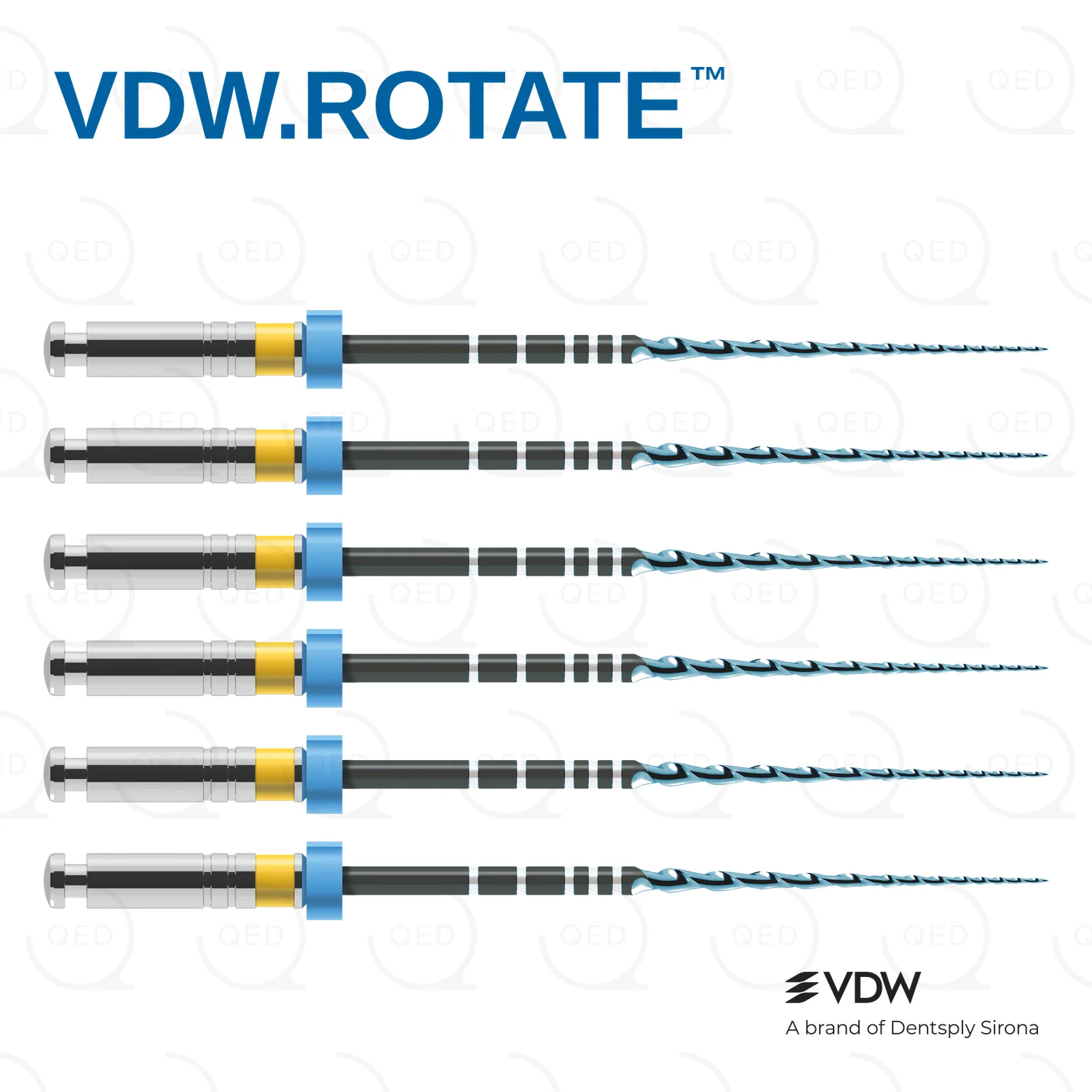
vdw.rotate® · 25/.06 · 25 mm · 6 files
heat-treated nitiadapted s sectionsingle use
the heat-treated file in vdw’s rotary range. vdw describe a “new heat treatment to increase flexibility without compromising cutting efficiency” and an “adapted s cross section for higher cutting efficiency” – the same s-section family as reciproc® blue, run in continuous rotation.
this pack: vdw.rotate® rotary file, iso size 25, .06 taper, 25 mm (pack of 6)
vdw · vdw gmbh, munich, germany (dentsply sirona)
| tip (d0) | 0.25 mm |
| taper | .06 |
| length | 25 mm |
| working part | 16 mm |
| handle | 11 mm, nickel plated · 3 rings for taper .06 · iso colour |
| calibration rings | 18, 19, 20, 22 mm, radiopaque |
| supplied | sterile, pack of 6 |
› heat-treated wire. vdw say the treatment “strengthens cyclic fatigue resistance of the file and lowers the risk of file breakage”.*
› adapted s section. vdw say it “ensures effective debris removal and provides control of the instrument for a swift, thorough and safe preparation”.*
› you can read the taper off the handle. 3 rings on the handle means taper .06, on top of the iso colour. no squinting at the blister.
› radiopaque calibration rings. at 18, 19, 20, 22 mm, so the length shows on the radiograph.
“the new vdw.rotate® file reduces canal transportation and better respects the canal anatomy.”
vdw, vdw.rotate product brochure menvrotbrc000 rev.1, 2019. vdw mark this “compared to other vdw continuous rotary instruments”.
which taper do i choose?
vdw put it simply: “choose taper .06 for the majority of clinical cases”, and “choose taper .04 for narrow and highly curved canals including apical curvature”.
coming from mtwo?
the same s-section idea, with the heat treatment and the handle coding added. see the mtwo range if you want to compare.
› the basic sequence: 15/.04 · 20/.05 · 25/.04, 25 mm
› same file, other lengths: 21 mm · 31 mm
› larger anatomies: 30/.04 · 35/.04 · 40/.04 · 50/.04
› matched obturation: gutta-percha 25/.06 · paper points 25/.06
› glide path: vdw c-pilot® assorted, 25 mm · vdw c-pilot® 10, 25 mm
› retreatment: vdw.rotate® retreatment 25/.05, 21 mm
› motor: x-smart® pro+ with apex locator
› lubricant and irrigation: glyde™ file prep · chlorax 5.25% · irriflex® needles
vdw mark their vdw.rotate performance claims “compared to other vdw continuous rotary instruments”, and the cutting-efficiency claim also “compared to a centred rotary cross section”. single use. follow the instructions supplied with the product.
vdw.rotate® 25/.06, 25 mm (6) · heat-treated niti · ref vrot625625

vdw.rotate® · 30/.06 · 25 mm · 6 files
heat-treated nitiadapted s sectionsingle use
the heat-treated file in vdw’s rotary range. vdw describe a “new heat treatment to increase flexibility without compromising cutting efficiency” and an “adapted s cross section for higher cutting efficiency” – the same s-section family as reciproc® blue, run in continuous rotation. this size is for shaping a larger canal once you have reached working length.
this pack: vdw.rotate® rotary file, iso size 30, .06 taper, 25 mm (pack of 6)
vdw · vdw gmbh, munich, germany (dentsply sirona)
| tip (d0) | 0.30 mm |
| taper | .06 |
| length | 25 mm |
| working part | 16 mm |
| handle | 11 mm, nickel plated · 3 rings for taper .06 · iso colour |
| calibration rings | 18, 19, 20, 22 mm, radiopaque |
| supplied | sterile, pack of 6 |
› heat-treated wire. vdw say the treatment “strengthens cyclic fatigue resistance of the file and lowers the risk of file breakage”.*
› adapted s section. vdw say it “ensures effective debris removal and provides control of the instrument for a swift, thorough and safe preparation”.*
› you can read the taper off the handle. 3 rings on the handle means taper .06, on top of the iso colour. no squinting at the blister.
› radiopaque calibration rings. at 18, 19, 20, 22 mm, so the length shows on the radiograph.
“the new vdw.rotate® file reduces canal transportation and better respects the canal anatomy.”
vdw, vdw.rotate product brochure menvrotbrc000 rev.1, 2019. vdw mark this “compared to other vdw continuous rotary instruments”.
which taper do i choose?
vdw put it simply: “choose taper .06 for the majority of clinical cases”, and “choose taper .04 for narrow and highly curved canals including apical curvature”.
coming from mtwo?
the same s-section idea, with the heat treatment and the handle coding added. see the mtwo range if you want to compare.
› the basic sequence: 15/.04 · 20/.05 · 25/.06 · 25/.04, 25 mm
› same file, other lengths: 21 mm · 31 mm
› larger anatomies: 30/.04 · 35/.04 · 40/.04 · 50/.04
› matched obturation: gutta-percha 30/.06
› glide path: vdw c-pilot® assorted, 25 mm · vdw c-pilot® 10, 25 mm
› retreatment: vdw.rotate® retreatment 25/.05, 21 mm
› motor: x-smart® pro+ with apex locator
› lubricant and irrigation: glyde™ file prep · chlorax 5.25% · irriflex® needles
vdw mark their vdw.rotate performance claims “compared to other vdw continuous rotary instruments”, and the cutting-efficiency claim also “compared to a centred rotary cross section”. single use. follow the instructions supplied with the product.
vdw.rotate® 30/.06, 25 mm (6) · heat-treated niti · ref vrot625630
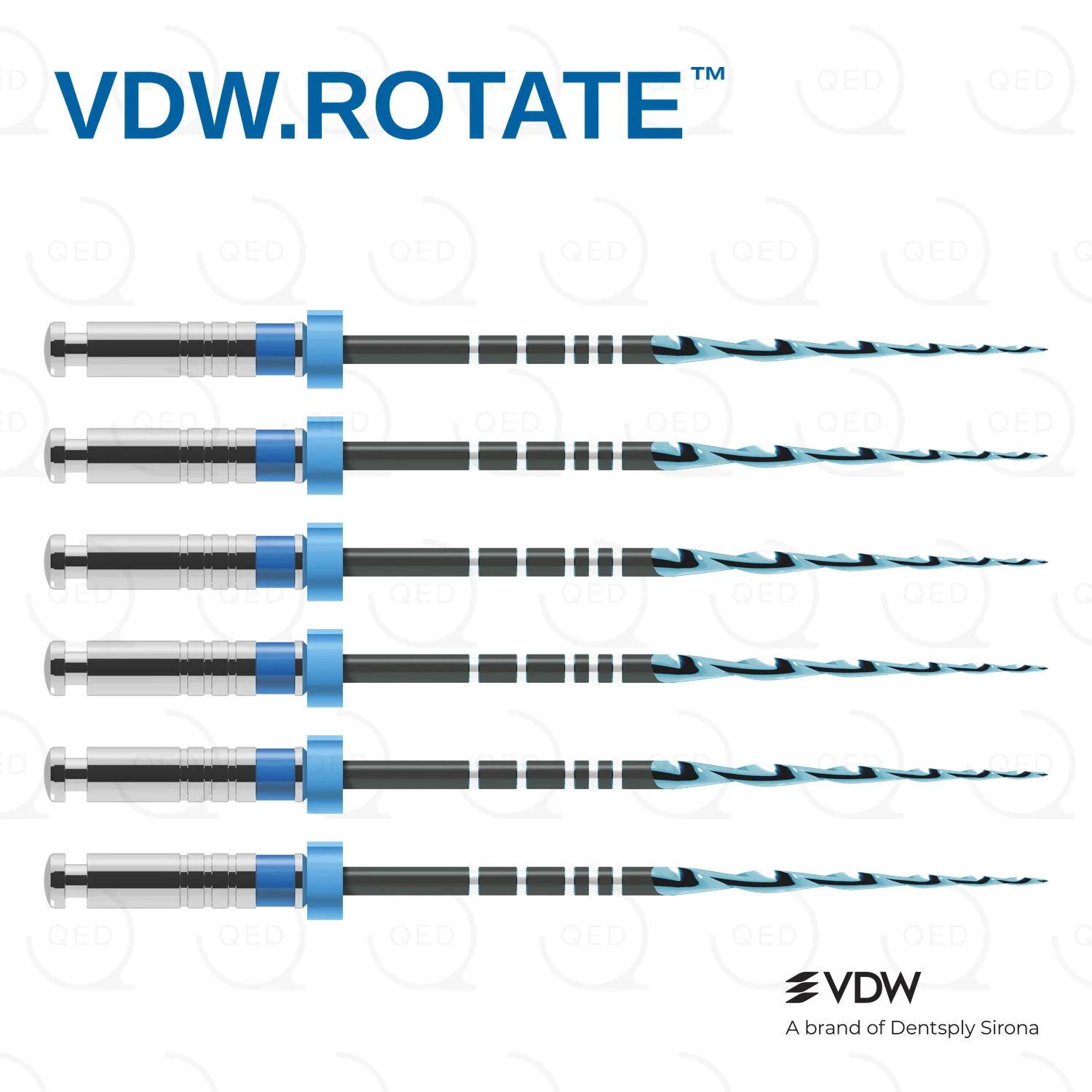
vdw.rotate® · 35/.06 · 25 mm · 6 files
heat-treated nitiadapted s sectionsingle use
the heat-treated file in vdw’s rotary range. vdw describe a “new heat treatment to increase flexibility without compromising cutting efficiency” and an “adapted s cross section for higher cutting efficiency” – the same s-section family as reciproc® blue, run in continuous rotation. this size is for shaping a larger canal once you have reached working length.
this pack: vdw.rotate® rotary file, iso size 35, .06 taper, 25 mm (pack of 6)
vdw · vdw gmbh, munich, germany (dentsply sirona)
| tip (d0) | 0.35 mm |
| taper | .06 |
| length | 25 mm |
| working part | 16 mm |
| handle | 11 mm, nickel plated · 3 rings for taper .06 · iso colour |
| calibration rings | 18, 19, 20, 22 mm, radiopaque |
| supplied | sterile, pack of 6 |
› heat-treated wire. vdw say the treatment “strengthens cyclic fatigue resistance of the file and lowers the risk of file breakage”.*
› adapted s section. vdw say it “ensures effective debris removal and provides control of the instrument for a swift, thorough and safe preparation”.*
› you can read the taper off the handle. 3 rings on the handle means taper .06, on top of the iso colour. no squinting at the blister.
› radiopaque calibration rings. at 18, 19, 20, 22 mm, so the length shows on the radiograph.
“the new vdw.rotate® file reduces canal transportation and better respects the canal anatomy.”
vdw, vdw.rotate product brochure menvrotbrc000 rev.1, 2019. vdw mark this “compared to other vdw continuous rotary instruments”.
which taper do i choose?
vdw put it simply: “choose taper .06 for the majority of clinical cases”, and “choose taper .04 for narrow and highly curved canals including apical curvature”.
coming from mtwo?
the same s-section idea, with the heat treatment and the handle coding added. see the mtwo range if you want to compare.
› the basic sequence: 15/.04 · 20/.05 · 25/.06 · 25/.04, 25 mm
› same file, other lengths: 21 mm · 31 mm
› larger anatomies: 30/.04 · 35/.04 · 40/.04 · 50/.04
› matched obturation: gutta-percha 35/.06
› glide path: vdw c-pilot® assorted, 25 mm · vdw c-pilot® 10, 25 mm
› retreatment: vdw.rotate® retreatment 25/.05, 21 mm
› motor: x-smart® pro+ with apex locator
› lubricant and irrigation: glyde™ file prep · chlorax 5.25% · irriflex® needles
vdw mark their vdw.rotate performance claims “compared to other vdw continuous rotary instruments”, and the cutting-efficiency claim also “compared to a centred rotary cross section”. single use. follow the instructions supplied with the product.
vdw.rotate® 35/.06, 25 mm (6) · heat-treated niti · ref vrot625635
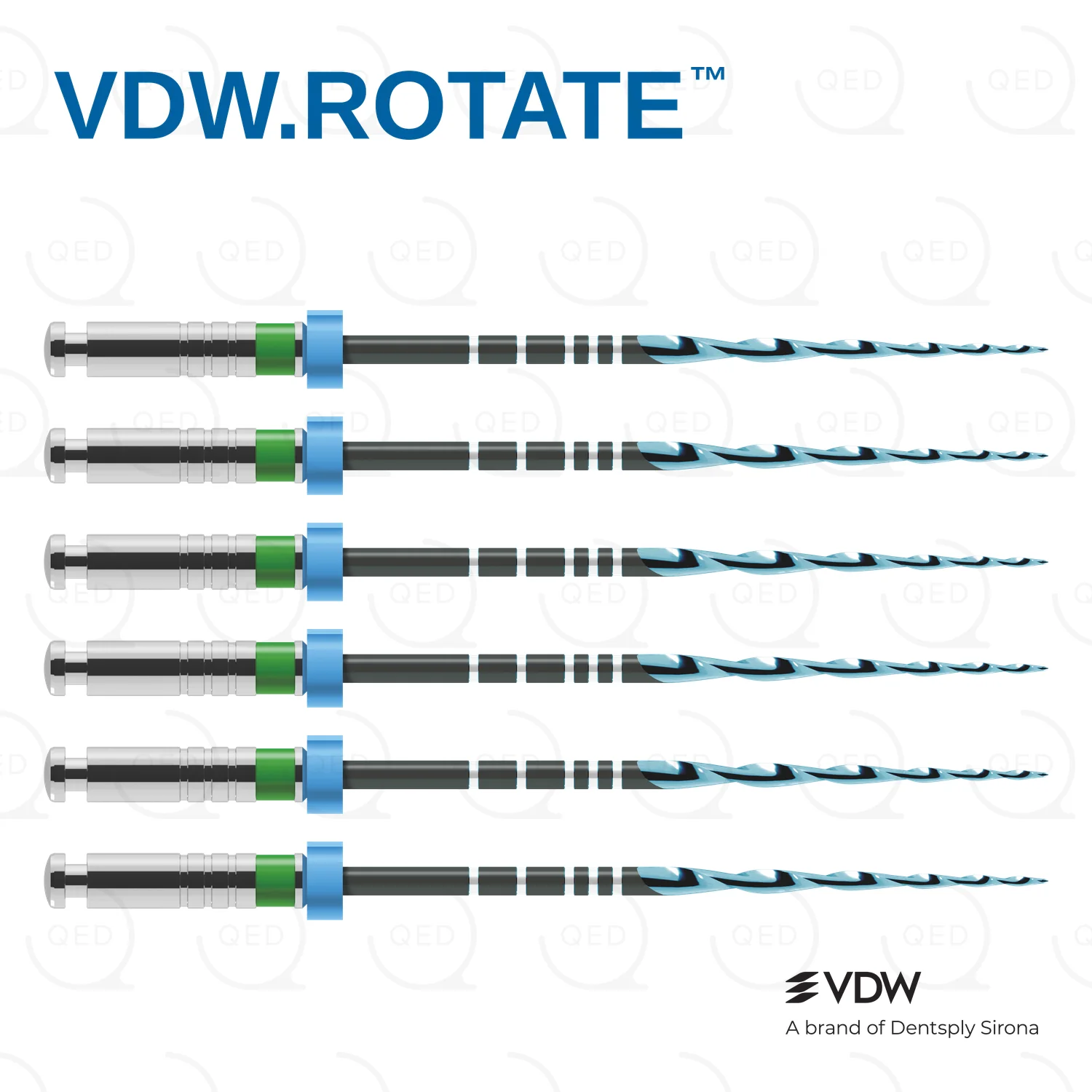
vdw.rotate® · 40/.06 · 25 mm · 6 files
heat-treated nitiadapted s sectionsingle use
the heat-treated file in vdw’s rotary range. vdw describe a “new heat treatment to increase flexibility without compromising cutting efficiency” and an “adapted s cross section for higher cutting efficiency” – the same s-section family as reciproc® blue, run in continuous rotation. this size is for shaping a larger canal once you have reached working length.
this pack: vdw.rotate® rotary file, iso size 40, .06 taper, 25 mm (pack of 6)
vdw · vdw gmbh, munich, germany (dentsply sirona)
| tip (d0) | 0.40 mm |
| taper | .06 |
| length | 25 mm |
| working part | 16 mm |
| handle | 11 mm, nickel plated · 3 rings for taper .06 · iso colour |
| calibration rings | 18, 19, 20, 22 mm, radiopaque |
| supplied | sterile, pack of 6 |
› heat-treated wire. vdw say the treatment “strengthens cyclic fatigue resistance of the file and lowers the risk of file breakage”.*
› adapted s section. vdw say it “ensures effective debris removal and provides control of the instrument for a swift, thorough and safe preparation”.*
› you can read the taper off the handle. 3 rings on the handle means taper .06, on top of the iso colour. no squinting at the blister.
› radiopaque calibration rings. at 18, 19, 20, 22 mm, so the length shows on the radiograph.
“the new vdw.rotate® file reduces canal transportation and better respects the canal anatomy.”
vdw, vdw.rotate product brochure menvrotbrc000 rev.1, 2019. vdw mark this “compared to other vdw continuous rotary instruments”.
which taper do i choose?
vdw put it simply: “choose taper .06 for the majority of clinical cases”, and “choose taper .04 for narrow and highly curved canals including apical curvature”.
coming from mtwo?
the same s-section idea, with the heat treatment and the handle coding added. see the mtwo range if you want to compare.
› the basic sequence: 15/.04 · 20/.05 · 25/.06 · 25/.04, 25 mm
› same file, other lengths: 21 mm · 31 mm
› larger anatomies: 30/.04 · 35/.04 · 40/.04 · 50/.04
› matched obturation: gutta-percha 40/.06
› glide path: vdw c-pilot® assorted, 25 mm · vdw c-pilot® 10, 25 mm
› retreatment: vdw.rotate® retreatment 25/.05, 21 mm
› motor: x-smart® pro+ with apex locator
› lubricant and irrigation: glyde™ file prep · chlorax 5.25% · irriflex® needles
vdw mark their vdw.rotate performance claims “compared to other vdw continuous rotary instruments”, and the cutting-efficiency claim also “compared to a centred rotary cross section”. single use. follow the instructions supplied with the product.
vdw.rotate® 40/.06, 25 mm (6) · heat-treated niti · ref vrot625640

vdw.rotate® · 15/.04 · 31 mm · 6 files
heat-treated nitiadapted s sectionsingle use
the heat-treated file in vdw’s rotary range. vdw describe a “new heat treatment to increase flexibility without compromising cutting efficiency” and an “adapted s cross section for higher cutting efficiency” – the same s-section family as reciproc® blue, run in continuous rotation. this is the file the basic sequence opens on.
this pack: vdw.rotate® rotary file, iso size 15, .04 taper, 31 mm (pack of 6)
vdw · vdw gmbh, munich, germany (dentsply sirona)
| tip (d0) | 0.15 mm |
| taper | .04 |
| length | 31 mm |
| working part | 16 mm |
| handle | 11 mm, nickel plated · 1 ring for taper .04 · iso colour |
| calibration rings | 18, 19, 20, 22, 24 mm, radiopaque |
| supplied | sterile, pack of 6 |
› heat-treated wire. vdw say the treatment “strengthens cyclic fatigue resistance of the file and lowers the risk of file breakage”.*
› adapted s section. vdw say it “ensures effective debris removal and provides control of the instrument for a swift, thorough and safe preparation”.*
› you can read the taper off the handle. 1 ring on the handle means taper .04, on top of the iso colour. no squinting at the blister.
› radiopaque calibration rings. at 18, 19, 20, 22, 24 mm, so the length shows on the radiograph.
“the new vdw.rotate® file reduces canal transportation and better respects the canal anatomy.”
vdw, vdw.rotate product brochure menvrotbrc000 rev.1, 2019. vdw mark this “compared to other vdw continuous rotary instruments”.
which taper do i choose?
vdw put it simply: “choose taper .06 for the majority of clinical cases”, and “choose taper .04 for narrow and highly curved canals including apical curvature”.
coming from mtwo?
the same s-section idea, with the heat treatment and the handle coding added. see the mtwo range if you want to compare.
› the basic sequence: 20/.05 · 25/.06 · 25/.04, 31 mm
› same file, other lengths: 21 mm · 25 mm
› larger anatomies: 30/.04 · 35/.04 · 40/.04 · 50/.04
› obturation: diadent® dia-pro iso gutta-percha 15/.04 – the same size and taper. the dia-pro paper points stop at 40, so gauge with 40/.04 or a standard point.
› glide path: vdw c-pilot® assorted, 25 mm · vdw c-pilot® 10, 25 mm
› retreatment: vdw.rotate® retreatment 25/.05, 21 mm
› motor: x-smart® pro+ with apex locator
› lubricant and irrigation: glyde™ file prep · chlorax 5.25% · irriflex® needles
vdw mark their vdw.rotate performance claims “compared to other vdw continuous rotary instruments”, and the cutting-efficiency claim also “compared to a centred rotary cross section”. single use. follow the instructions supplied with the product.
vdw.rotate® 15/.04, 31 mm (6) · heat-treated niti · ref vrot631415
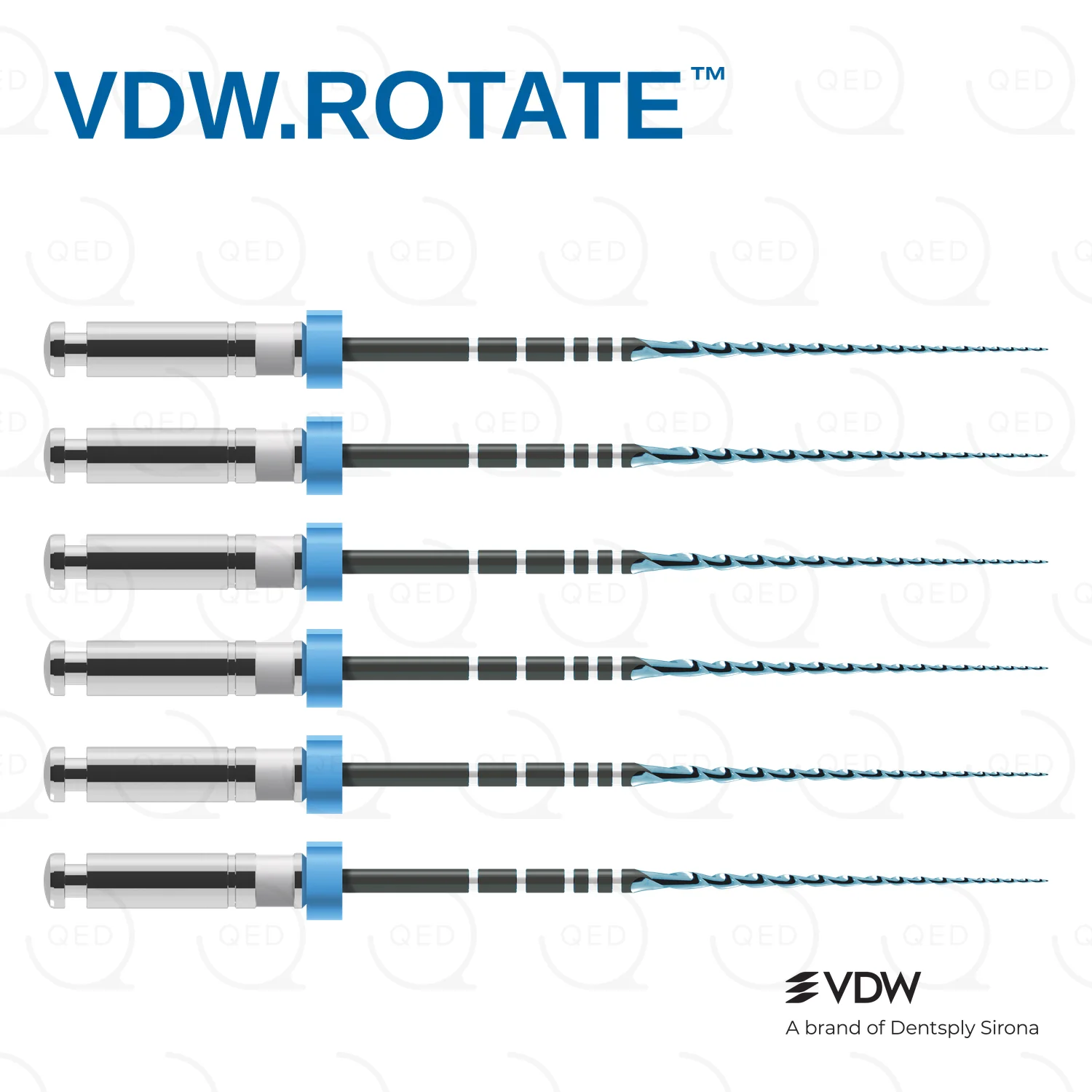
vdw.rotate® · 25/.04 · 31 mm · 6 files
heat-treated nitiadapted s sectionsingle use
the heat-treated file in vdw’s rotary range. vdw describe a “new heat treatment to increase flexibility without compromising cutting efficiency” and an “adapted s cross section for higher cutting efficiency” – the same s-section family as reciproc® blue, run in continuous rotation.
this pack: vdw.rotate® rotary file, iso size 25, .04 taper, 31 mm (pack of 6)
vdw · vdw gmbh, munich, germany (dentsply sirona)
| tip (d0) | 0.25 mm |
| taper | .04 |
| length | 31 mm |
| working part | 16 mm |
| handle | 11 mm, nickel plated · 1 ring for taper .04 · iso colour |
| calibration rings | 18, 19, 20, 22, 24 mm, radiopaque |
| supplied | sterile, pack of 6 |
› heat-treated wire. vdw say the treatment “strengthens cyclic fatigue resistance of the file and lowers the risk of file breakage”.*
› adapted s section. vdw say it “ensures effective debris removal and provides control of the instrument for a swift, thorough and safe preparation”.*
› you can read the taper off the handle. 1 ring on the handle means taper .04, on top of the iso colour. no squinting at the blister.
› radiopaque calibration rings. at 18, 19, 20, 22, 24 mm, so the length shows on the radiograph.
“the new vdw.rotate® file reduces canal transportation and better respects the canal anatomy.”
vdw, vdw.rotate product brochure menvrotbrc000 rev.1, 2019. vdw mark this “compared to other vdw continuous rotary instruments”.
which taper do i choose?
vdw put it simply: “choose taper .06 for the majority of clinical cases”, and “choose taper .04 for narrow and highly curved canals including apical curvature”.
coming from mtwo?
the same s-section idea, with the heat treatment and the handle coding added. see the mtwo range if you want to compare.
› the basic sequence: 15/.04 · 20/.05 · 25/.06, 31 mm
› same file, other lengths: 21 mm · 25 mm
› larger anatomies: 30/.04 · 35/.04 · 40/.04 · 50/.04
› matched obturation: gutta-percha 25/.04 · paper points 25/.04
› glide path: vdw c-pilot® assorted, 25 mm · vdw c-pilot® 10, 25 mm
› retreatment: vdw.rotate® retreatment 25/.05, 21 mm
› motor: x-smart® pro+ with apex locator
› lubricant and irrigation: glyde™ file prep · chlorax 5.25% · irriflex® needles
vdw mark their vdw.rotate performance claims “compared to other vdw continuous rotary instruments”, and the cutting-efficiency claim also “compared to a centred rotary cross section”. single use. follow the instructions supplied with the product.
vdw.rotate® 25/.04, 31 mm (6) · heat-treated niti · ref vrot631425
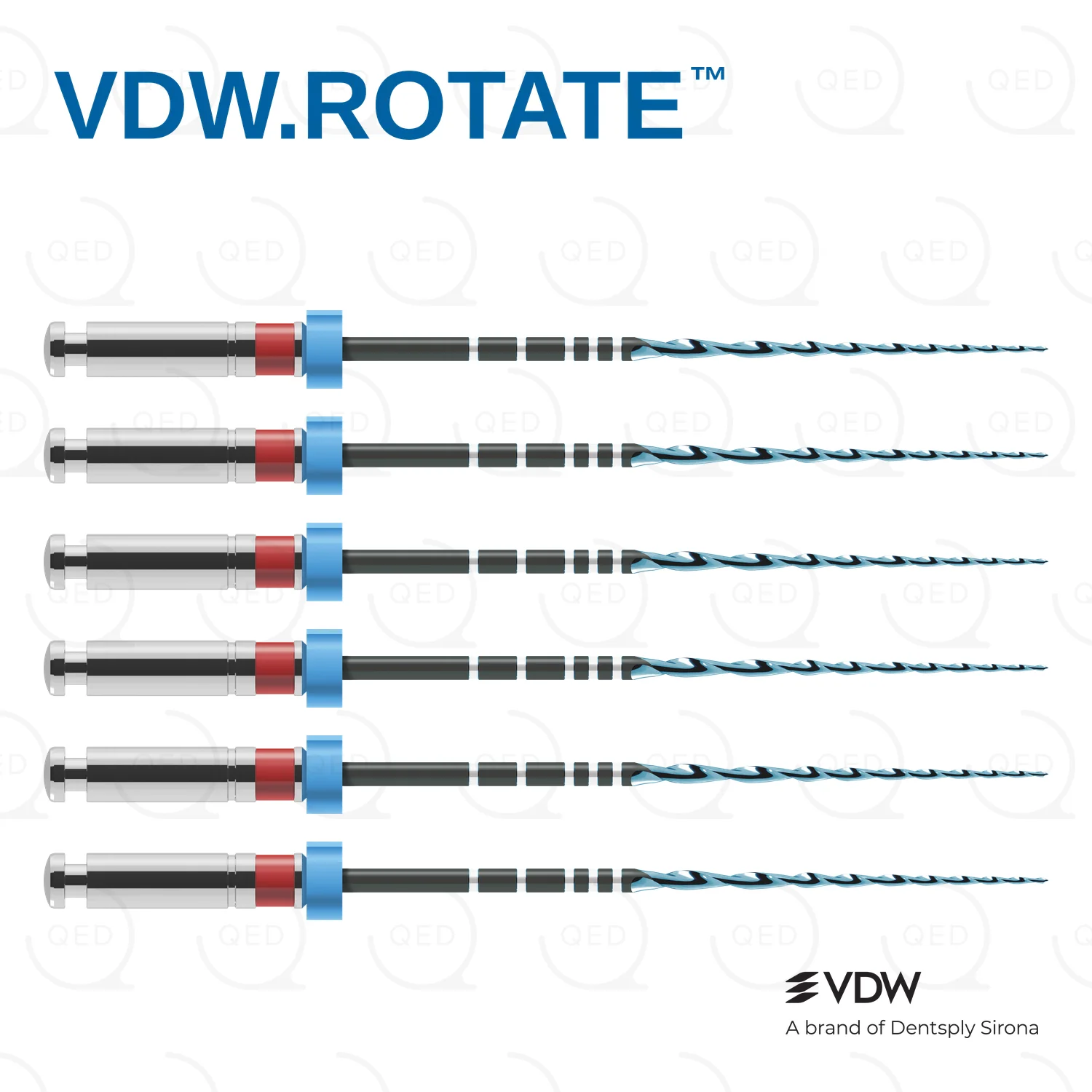
vdw.rotate® · 30/.04 · 31 mm · 6 files
heat-treated nitiadapted s sectionsingle use
the heat-treated file in vdw’s rotary range. vdw describe a “new heat treatment to increase flexibility without compromising cutting efficiency” and an “adapted s cross section for higher cutting efficiency” – the same s-section family as reciproc® blue, run in continuous rotation. this size is for shaping a larger canal once you have reached working length.
this pack: vdw.rotate® rotary file, iso size 30, .04 taper, 31 mm (pack of 6)
vdw · vdw gmbh, munich, germany (dentsply sirona)
| tip (d0) | 0.30 mm |
| taper | .04 |
| length | 31 mm |
| working part | 16 mm |
| handle | 11 mm, nickel plated · 1 ring for taper .04 · iso colour |
| calibration rings | 18, 19, 20, 22, 24 mm, radiopaque |
| supplied | sterile, pack of 6 |
› heat-treated wire. vdw say the treatment “strengthens cyclic fatigue resistance of the file and lowers the risk of file breakage”.*
› adapted s section. vdw say it “ensures effective debris removal and provides control of the instrument for a swift, thorough and safe preparation”.*
› you can read the taper off the handle. 1 ring on the handle means taper .04, on top of the iso colour. no squinting at the blister.
› radiopaque calibration rings. at 18, 19, 20, 22, 24 mm, so the length shows on the radiograph.
“the new vdw.rotate® file reduces canal transportation and better respects the canal anatomy.”
vdw, vdw.rotate product brochure menvrotbrc000 rev.1, 2019. vdw mark this “compared to other vdw continuous rotary instruments”.
which taper do i choose?
vdw put it simply: “choose taper .06 for the majority of clinical cases”, and “choose taper .04 for narrow and highly curved canals including apical curvature”.
coming from mtwo?
the same s-section idea, with the heat treatment and the handle coding added. see the mtwo range if you want to compare.
› the basic sequence: 15/.04 · 20/.05 · 25/.06 · 25/.04, 31 mm
› same file, other lengths: 21 mm · 25 mm
› larger anatomies: 35/.04 · 40/.04 · 50/.04 · 60/.04
› matched obturation: gutta-percha 30/.04 · paper points 30/.04
› glide path: vdw c-pilot® assorted, 25 mm · vdw c-pilot® 10, 25 mm
› retreatment: vdw.rotate® retreatment 25/.05, 21 mm
› motor: x-smart® pro+ with apex locator
› lubricant and irrigation: glyde™ file prep · chlorax 5.25% · irriflex® needles
vdw mark their vdw.rotate performance claims “compared to other vdw continuous rotary instruments”, and the cutting-efficiency claim also “compared to a centred rotary cross section”. single use. follow the instructions supplied with the product.
vdw.rotate® 30/.04, 31 mm (6) · heat-treated niti · ref vrot631430
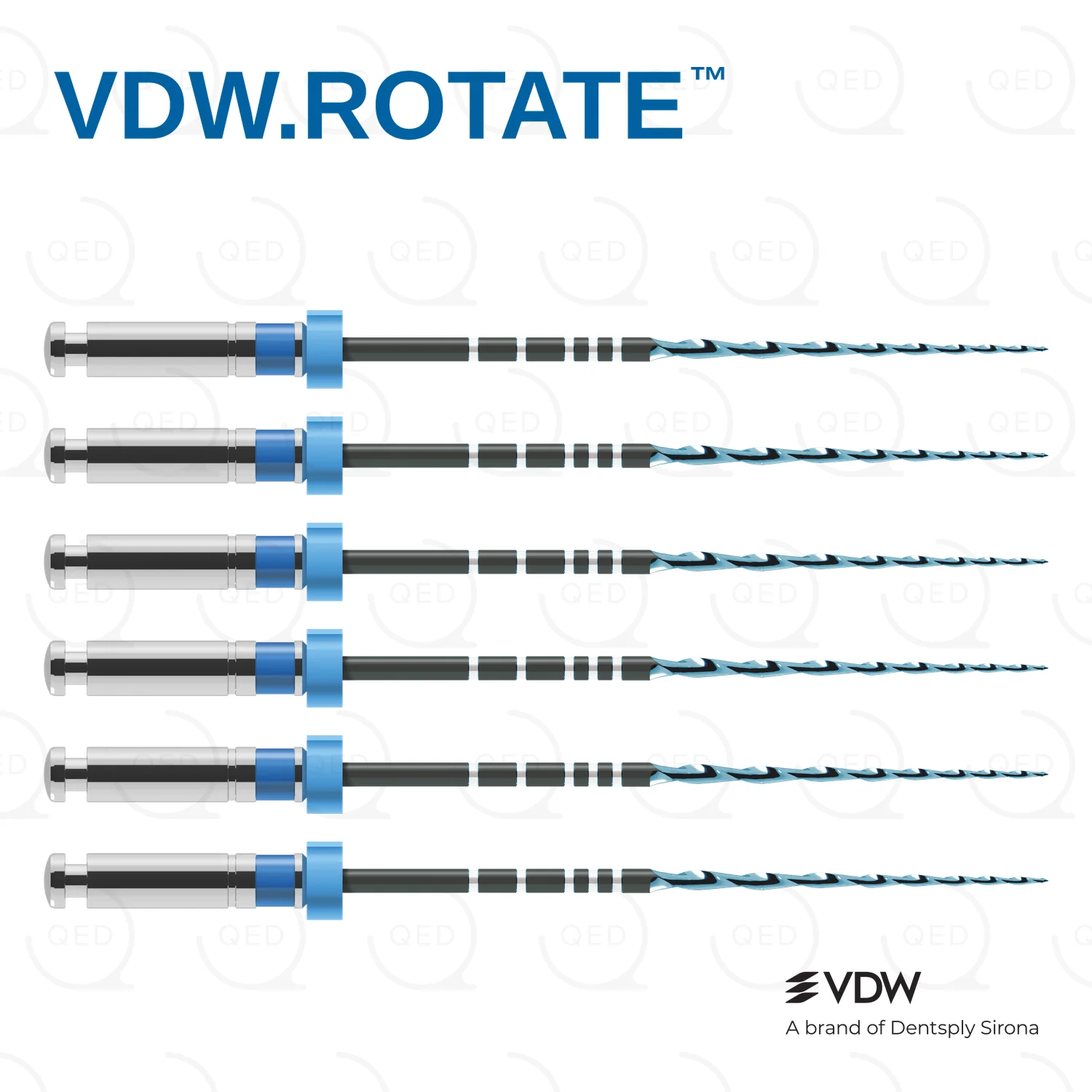
vdw.rotate® · 35/.04 · 31 mm · 6 files
heat-treated nitiadapted s sectionsingle use
the heat-treated file in vdw’s rotary range. vdw describe a “new heat treatment to increase flexibility without compromising cutting efficiency” and an “adapted s cross section for higher cutting efficiency” – the same s-section family as reciproc® blue, run in continuous rotation. this size is for shaping a larger canal once you have reached working length.
this pack: vdw.rotate® rotary file, iso size 35, .04 taper, 31 mm (pack of 6)
vdw · vdw gmbh, munich, germany (dentsply sirona)
| tip (d0) | 0.35 mm |
| taper | .04 |
| length | 31 mm |
| working part | 16 mm |
| handle | 11 mm, nickel plated · 1 ring for taper .04 · iso colour |
| calibration rings | 18, 19, 20, 22, 24 mm, radiopaque |
| supplied | sterile, pack of 6 |
› heat-treated wire. vdw say the treatment “strengthens cyclic fatigue resistance of the file and lowers the risk of file breakage”.*
› adapted s section. vdw say it “ensures effective debris removal and provides control of the instrument for a swift, thorough and safe preparation”.*
› you can read the taper off the handle. 1 ring on the handle means taper .04, on top of the iso colour. no squinting at the blister.
› radiopaque calibration rings. at 18, 19, 20, 22, 24 mm, so the length shows on the radiograph.
“the new vdw.rotate® file reduces canal transportation and better respects the canal anatomy.”
vdw, vdw.rotate product brochure menvrotbrc000 rev.1, 2019. vdw mark this “compared to other vdw continuous rotary instruments”.
which taper do i choose?
vdw put it simply: “choose taper .06 for the majority of clinical cases”, and “choose taper .04 for narrow and highly curved canals including apical curvature”.
coming from mtwo?
the same s-section idea, with the heat treatment and the handle coding added. see the mtwo range if you want to compare.
› the basic sequence: 15/.04 · 20/.05 · 25/.06 · 25/.04, 31 mm
› same file, other lengths: 21 mm · 25 mm
› larger anatomies: 30/.04 · 40/.04 · 50/.04 · 60/.04
› matched obturation: gutta-percha 35/.04 · paper points 35/.04
› glide path: vdw c-pilot® assorted, 25 mm · vdw c-pilot® 10, 25 mm
› retreatment: vdw.rotate® retreatment 25/.05, 21 mm
› motor: x-smart® pro+ with apex locator
› lubricant and irrigation: glyde™ file prep · chlorax 5.25% · irriflex® needles
vdw mark their vdw.rotate performance claims “compared to other vdw continuous rotary instruments”, and the cutting-efficiency claim also “compared to a centred rotary cross section”. single use. follow the instructions supplied with the product.
vdw.rotate® 35/.04, 31 mm (6) · heat-treated niti · ref vrot631435
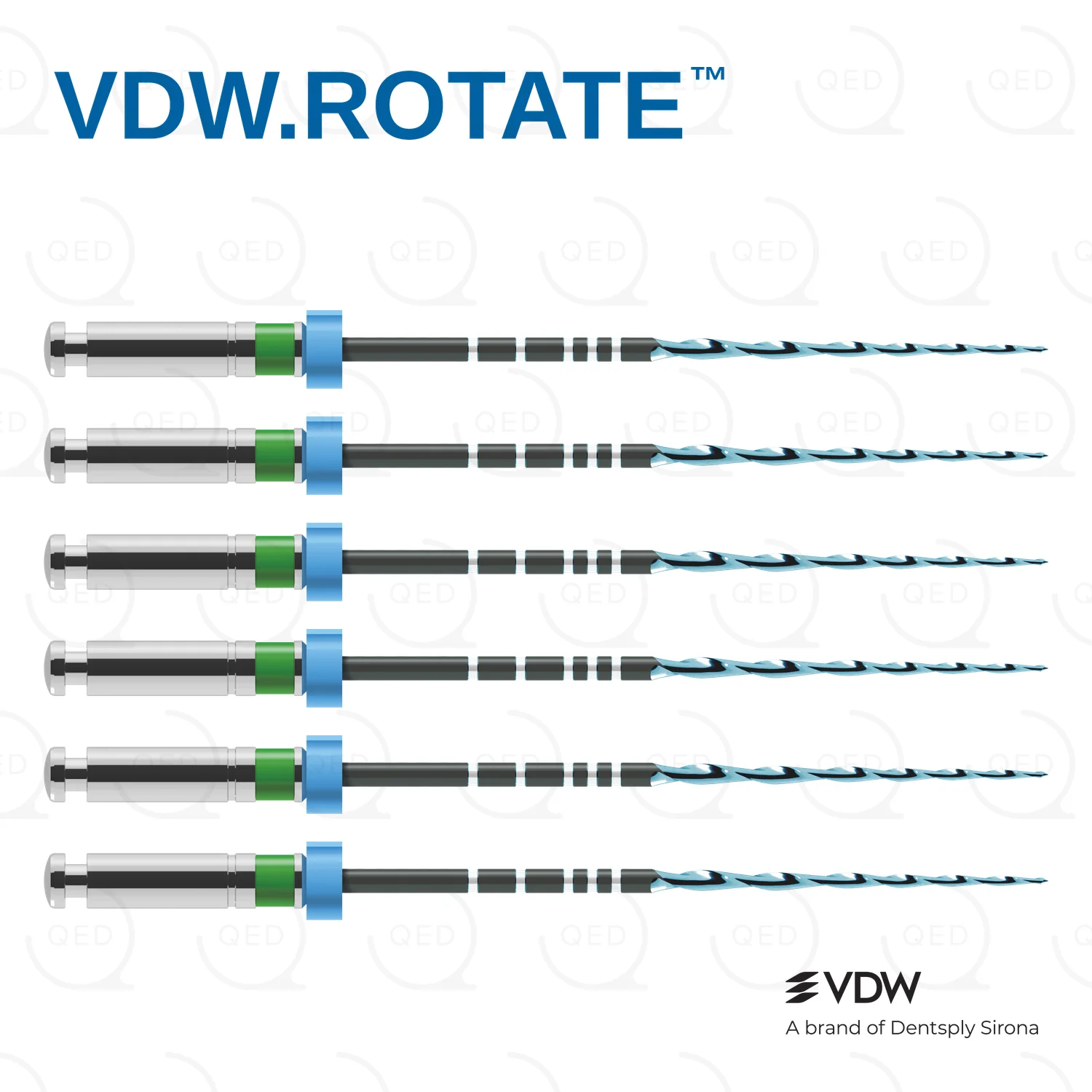
vdw.rotate® · 40/.04 · 31 mm · 6 files
heat-treated nitiadapted s sectionsingle use
the heat-treated file in vdw’s rotary range. vdw describe a “new heat treatment to increase flexibility without compromising cutting efficiency” and an “adapted s cross section for higher cutting efficiency” – the same s-section family as reciproc® blue, run in continuous rotation. this size is for shaping a larger canal once you have reached working length.
this pack: vdw.rotate® rotary file, iso size 40, .04 taper, 31 mm (pack of 6)
vdw · vdw gmbh, munich, germany (dentsply sirona)
| tip (d0) | 0.40 mm |
| taper | .04 |
| length | 31 mm |
| working part | 16 mm |
| handle | 11 mm, nickel plated · 1 ring for taper .04 · iso colour |
| calibration rings | 18, 19, 20, 22, 24 mm, radiopaque |
| supplied | sterile, pack of 6 |
› heat-treated wire. vdw say the treatment “strengthens cyclic fatigue resistance of the file and lowers the risk of file breakage”.*
› adapted s section. vdw say it “ensures effective debris removal and provides control of the instrument for a swift, thorough and safe preparation”.*
› you can read the taper off the handle. 1 ring on the handle means taper .04, on top of the iso colour. no squinting at the blister.
› radiopaque calibration rings. at 18, 19, 20, 22, 24 mm, so the length shows on the radiograph.
“the new vdw.rotate® file reduces canal transportation and better respects the canal anatomy.”
vdw, vdw.rotate product brochure menvrotbrc000 rev.1, 2019. vdw mark this “compared to other vdw continuous rotary instruments”.
which taper do i choose?
vdw put it simply: “choose taper .06 for the majority of clinical cases”, and “choose taper .04 for narrow and highly curved canals including apical curvature”.
coming from mtwo?
the same s-section idea, with the heat treatment and the handle coding added. see the mtwo range if you want to compare.
› the basic sequence: 15/.04 · 20/.05 · 25/.06 · 25/.04, 31 mm
› same file, other lengths: 21 mm · 25 mm
› larger anatomies: 30/.04 · 35/.04 · 50/.04 · 60/.04
› matched obturation: gutta-percha 40/.04 · paper points 40/.04
› glide path: vdw c-pilot® assorted, 25 mm · vdw c-pilot® 10, 25 mm
› retreatment: vdw.rotate® retreatment 25/.05, 21 mm
› motor: x-smart® pro+ with apex locator
› lubricant and irrigation: glyde™ file prep · chlorax 5.25% · irriflex® needles
vdw mark their vdw.rotate performance claims “compared to other vdw continuous rotary instruments”, and the cutting-efficiency claim also “compared to a centred rotary cross section”. single use. follow the instructions supplied with the product.
vdw.rotate® 40/.04, 31 mm (6) · heat-treated niti · ref vrot631440

vdw.rotate® · 50/.04 · 31 mm · 6 files
heat-treated nitiadapted s sectionsingle use
the heat-treated file in vdw’s rotary range. vdw describe a “new heat treatment to increase flexibility without compromising cutting efficiency” and an “adapted s cross section for higher cutting efficiency” – the same s-section family as reciproc® blue, run in continuous rotation. this size is for shaping a larger canal once you have reached working length.
this pack: vdw.rotate® rotary file, iso size 50, .04 taper, 31 mm (pack of 6)
vdw · vdw gmbh, munich, germany (dentsply sirona)
| tip (d0) | 0.50 mm |
| taper | .04 |
| length | 31 mm |
| working part | 16 mm |
| handle | 11 mm, nickel plated · 1 ring for taper .04 · iso colour |
| calibration rings | 18, 19, 20, 22, 24 mm, radiopaque |
| supplied | sterile, pack of 6 |
› heat-treated wire. vdw say the treatment “strengthens cyclic fatigue resistance of the file and lowers the risk of file breakage”.*
› adapted s section. vdw say it “ensures effective debris removal and provides control of the instrument for a swift, thorough and safe preparation”.*
› you can read the taper off the handle. 1 ring on the handle means taper .04, on top of the iso colour. no squinting at the blister.
› radiopaque calibration rings. at 18, 19, 20, 22, 24 mm, so the length shows on the radiograph.
“the new vdw.rotate® file reduces canal transportation and better respects the canal anatomy.”
vdw, vdw.rotate product brochure menvrotbrc000 rev.1, 2019. vdw mark this “compared to other vdw continuous rotary instruments”.
which taper do i choose?
vdw put it simply: “choose taper .06 for the majority of clinical cases”, and “choose taper .04 for narrow and highly curved canals including apical curvature”.
coming from mtwo?
the same s-section idea, with the heat treatment and the handle coding added. see the mtwo range if you want to compare.
› the basic sequence: 15/.04 · 20/.05 · 25/.06 · 25/.04, 31 mm
› same file, other lengths: 21 mm · 25 mm
› larger anatomies: 30/.04 · 35/.04 · 40/.04 · 60/.04
› matched obturation: gutta-percha 50/.04
› glide path: vdw c-pilot® assorted, 25 mm · vdw c-pilot® 10, 25 mm
› retreatment: vdw.rotate® retreatment 25/.05, 21 mm
› motor: x-smart® pro+ with apex locator
› lubricant and irrigation: glyde™ file prep · chlorax 5.25% · irriflex® needles
vdw mark their vdw.rotate performance claims “compared to other vdw continuous rotary instruments”, and the cutting-efficiency claim also “compared to a centred rotary cross section”. single use. follow the instructions supplied with the product.
vdw.rotate® 50/.04, 31 mm (6) · heat-treated niti · ref vrot631450

vdw.rotate® · 60/.04 · 31 mm · 6 files
heat-treated nitiadapted s sectionsingle use
the heat-treated file in vdw’s rotary range. vdw describe a “new heat treatment to increase flexibility without compromising cutting efficiency” and an “adapted s cross section for higher cutting efficiency” – the same s-section family as reciproc® blue, run in continuous rotation. this size is for shaping a larger canal once you have reached working length.
this pack: vdw.rotate® rotary file, iso size 60, .04 taper, 31 mm (pack of 6)
vdw · vdw gmbh, munich, germany (dentsply sirona)
| tip (d0) | 0.60 mm |
| taper | .04 |
| length | 31 mm |
| working part | 16 mm |
| handle | 11 mm, nickel plated · 1 ring for taper .04 · iso colour |
| calibration rings | 18, 19, 20, 22, 24 mm, radiopaque |
| supplied | sterile, pack of 6 |
› heat-treated wire. vdw say the treatment “strengthens cyclic fatigue resistance of the file and lowers the risk of file breakage”.*
› adapted s section. vdw say it “ensures effective debris removal and provides control of the instrument for a swift, thorough and safe preparation”.*
› you can read the taper off the handle. 1 ring on the handle means taper .04, on top of the iso colour. no squinting at the blister.
› radiopaque calibration rings. at 18, 19, 20, 22, 24 mm, so the length shows on the radiograph.
“the new vdw.rotate® file reduces canal transportation and better respects the canal anatomy.”
vdw, vdw.rotate product brochure menvrotbrc000 rev.1, 2019. vdw mark this “compared to other vdw continuous rotary instruments”.
which taper do i choose?
vdw put it simply: “choose taper .06 for the majority of clinical cases”, and “choose taper .04 for narrow and highly curved canals including apical curvature”.
coming from mtwo?
the same s-section idea, with the heat treatment and the handle coding added. see the mtwo range if you want to compare.
› the basic sequence: 15/.04 · 20/.05 · 25/.06 · 25/.04, 31 mm
› same file, other lengths: 21 mm · 25 mm
› larger anatomies: 30/.04 · 35/.04 · 40/.04 · 50/.04
› obturation: the dia-pro .04 range stops at 45, so there is no matched cone at 60/.04. fit from 45/.04 or the standard ml.029™ 60/.02.
› glide path: vdw c-pilot® assorted, 25 mm · vdw c-pilot® 10, 25 mm
› retreatment: vdw.rotate® retreatment 25/.05, 21 mm
› motor: x-smart® pro+ with apex locator
› lubricant and irrigation: glyde™ file prep · chlorax 5.25% · irriflex® needles
vdw mark their vdw.rotate performance claims “compared to other vdw continuous rotary instruments”, and the cutting-efficiency claim also “compared to a centred rotary cross section”. single use. follow the instructions supplied with the product.
vdw.rotate® 60/.04, 31 mm (6) · heat-treated niti · ref vrot631460

vdw.rotate® · 20/.05 · 31 mm · 6 files
heat-treated nitiadapted s sectionsingle use
the heat-treated file in vdw’s rotary range. vdw describe a “new heat treatment to increase flexibility without compromising cutting efficiency” and an “adapted s cross section for higher cutting efficiency” – the same s-section family as reciproc® blue, run in continuous rotation.
this pack: vdw.rotate® rotary file, iso size 20, .05 taper, 31 mm (pack of 6)
vdw · vdw gmbh, munich, germany (dentsply sirona)
| tip (d0) | 0.20 mm |
| taper | .05 |
| length | 31 mm |
| working part | 16 mm |
| handle | 11 mm, nickel plated · 2 rings for taper .05 · iso colour |
| calibration rings | 18, 19, 20, 22, 24 mm, radiopaque |
| supplied | sterile, pack of 6 |
› heat-treated wire. vdw say the treatment “strengthens cyclic fatigue resistance of the file and lowers the risk of file breakage”.*
› adapted s section. vdw say it “ensures effective debris removal and provides control of the instrument for a swift, thorough and safe preparation”.*
› you can read the taper off the handle. 2 rings on the handle means taper .05, on top of the iso colour. no squinting at the blister.
› radiopaque calibration rings. at 18, 19, 20, 22, 24 mm, so the length shows on the radiograph.
“the new vdw.rotate® file reduces canal transportation and better respects the canal anatomy.”
vdw, vdw.rotate product brochure menvrotbrc000 rev.1, 2019. vdw mark this “compared to other vdw continuous rotary instruments”.
which taper do i choose?
vdw put it simply: “choose taper .06 for the majority of clinical cases”, and “choose taper .04 for narrow and highly curved canals including apical curvature”.
coming from mtwo?
the same s-section idea, with the heat treatment and the handle coding added. see the mtwo range if you want to compare.
› the basic sequence: 15/.04 · 25/.06 · 25/.04, 31 mm
› same file, other lengths: 21 mm · 25 mm
› larger anatomies: 30/.04 · 35/.04 · 40/.04 · 50/.04
› obturation: dia-pro iso is made in .04 and .06 only, so there is no matched cone for a .05 preparation. fit from the .04 assorted pack or the standard ml.029™ .02 range.
› glide path: vdw c-pilot® assorted, 25 mm · vdw c-pilot® 10, 25 mm
› retreatment: vdw.rotate® retreatment 25/.05, 21 mm
› motor: x-smart® pro+ with apex locator
› lubricant and irrigation: glyde™ file prep · chlorax 5.25% · irriflex® needles
vdw mark their vdw.rotate performance claims “compared to other vdw continuous rotary instruments”, and the cutting-efficiency claim also “compared to a centred rotary cross section”. single use. follow the instructions supplied with the product.
vdw.rotate® 20/.05, 31 mm (6) · heat-treated niti · ref vrot631520
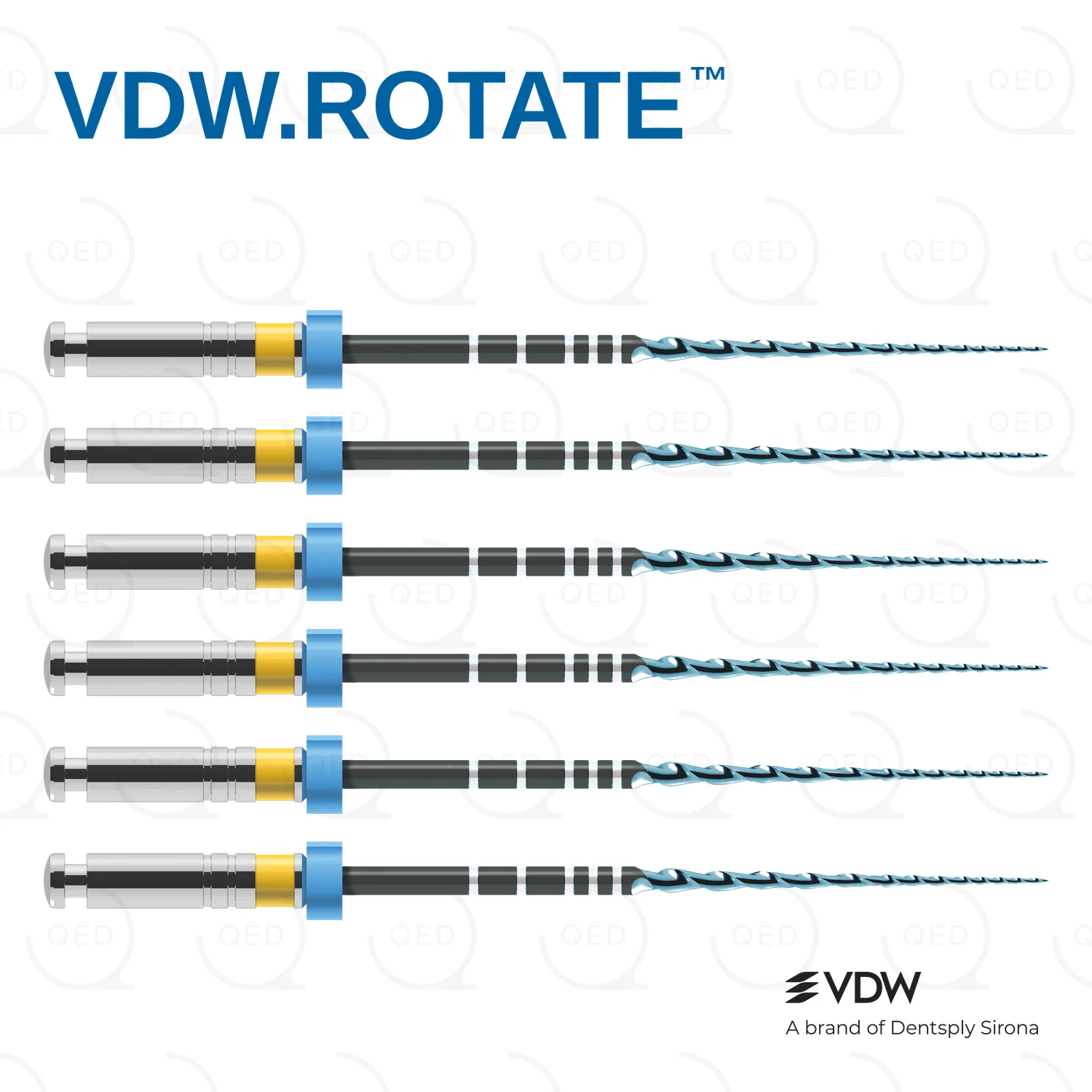
vdw.rotate® · 25/.06 · 31 mm · 6 files
heat-treated nitiadapted s sectionsingle use
the heat-treated file in vdw’s rotary range. vdw describe a “new heat treatment to increase flexibility without compromising cutting efficiency” and an “adapted s cross section for higher cutting efficiency” – the same s-section family as reciproc® blue, run in continuous rotation.
this pack: vdw.rotate® rotary file, iso size 25, .06 taper, 31 mm (pack of 6)
vdw · vdw gmbh, munich, germany (dentsply sirona)
| tip (d0) | 0.25 mm |
| taper | .06 |
| length | 31 mm |
| working part | 16 mm |
| handle | 11 mm, nickel plated · 3 rings for taper .06 · iso colour |
| calibration rings | 18, 19, 20, 22, 24 mm, radiopaque |
| supplied | sterile, pack of 6 |
› heat-treated wire. vdw say the treatment “strengthens cyclic fatigue resistance of the file and lowers the risk of file breakage”.*
› adapted s section. vdw say it “ensures effective debris removal and provides control of the instrument for a swift, thorough and safe preparation”.*
› you can read the taper off the handle. 3 rings on the handle means taper .06, on top of the iso colour. no squinting at the blister.
› radiopaque calibration rings. at 18, 19, 20, 22, 24 mm, so the length shows on the radiograph.
“the new vdw.rotate® file reduces canal transportation and better respects the canal anatomy.”
vdw, vdw.rotate product brochure menvrotbrc000 rev.1, 2019. vdw mark this “compared to other vdw continuous rotary instruments”.
which taper do i choose?
vdw put it simply: “choose taper .06 for the majority of clinical cases”, and “choose taper .04 for narrow and highly curved canals including apical curvature”.
coming from mtwo?
the same s-section idea, with the heat treatment and the handle coding added. see the mtwo range if you want to compare.
› the basic sequence: 15/.04 · 20/.05 · 25/.04, 31 mm
› same file, other lengths: 21 mm · 25 mm
› larger anatomies: 30/.04 · 35/.04 · 40/.04 · 50/.04
› matched obturation: gutta-percha 25/.06 · paper points 25/.06
› glide path: vdw c-pilot® assorted, 25 mm · vdw c-pilot® 10, 25 mm
› retreatment: vdw.rotate® retreatment 25/.05, 21 mm
› motor: x-smart® pro+ with apex locator
› lubricant and irrigation: glyde™ file prep · chlorax 5.25% · irriflex® needles
vdw mark their vdw.rotate performance claims “compared to other vdw continuous rotary instruments”, and the cutting-efficiency claim also “compared to a centred rotary cross section”. single use. follow the instructions supplied with the product.
vdw.rotate® 25/.06, 31 mm (6) · heat-treated niti · ref vrot631625

vdw.rotate® · 30/.06 · 31 mm · 6 files
heat-treated nitiadapted s sectionsingle use
the heat-treated file in vdw’s rotary range. vdw describe a “new heat treatment to increase flexibility without compromising cutting efficiency” and an “adapted s cross section for higher cutting efficiency” – the same s-section family as reciproc® blue, run in continuous rotation. this size is for shaping a larger canal once you have reached working length.
this pack: vdw.rotate® rotary file, iso size 30, .06 taper, 31 mm (pack of 6)
vdw · vdw gmbh, munich, germany (dentsply sirona)
| tip (d0) | 0.30 mm |
| taper | .06 |
| length | 31 mm |
| working part | 16 mm |
| handle | 11 mm, nickel plated · 3 rings for taper .06 · iso colour |
| calibration rings | 18, 19, 20, 22, 24 mm, radiopaque |
| supplied | sterile, pack of 6 |
› heat-treated wire. vdw say the treatment “strengthens cyclic fatigue resistance of the file and lowers the risk of file breakage”.*
› adapted s section. vdw say it “ensures effective debris removal and provides control of the instrument for a swift, thorough and safe preparation”.*
› you can read the taper off the handle. 3 rings on the handle means taper .06, on top of the iso colour. no squinting at the blister.
› radiopaque calibration rings. at 18, 19, 20, 22, 24 mm, so the length shows on the radiograph.
“the new vdw.rotate® file reduces canal transportation and better respects the canal anatomy.”
vdw, vdw.rotate product brochure menvrotbrc000 rev.1, 2019. vdw mark this “compared to other vdw continuous rotary instruments”.
which taper do i choose?
vdw put it simply: “choose taper .06 for the majority of clinical cases”, and “choose taper .04 for narrow and highly curved canals including apical curvature”.
coming from mtwo?
the same s-section idea, with the heat treatment and the handle coding added. see the mtwo range if you want to compare.
› the basic sequence: 15/.04 · 20/.05 · 25/.06 · 25/.04, 31 mm
› same file, other lengths: 21 mm · 25 mm
› larger anatomies: 30/.04 · 35/.04 · 40/.04 · 50/.04
› matched obturation: gutta-percha 30/.06
› glide path: vdw c-pilot® assorted, 25 mm · vdw c-pilot® 10, 25 mm
› retreatment: vdw.rotate® retreatment 25/.05, 21 mm
› motor: x-smart® pro+ with apex locator
› lubricant and irrigation: glyde™ file prep · chlorax 5.25% · irriflex® needles
vdw mark their vdw.rotate performance claims “compared to other vdw continuous rotary instruments”, and the cutting-efficiency claim also “compared to a centred rotary cross section”. single use. follow the instructions supplied with the product.
vdw.rotate® 30/.06, 31 mm (6) · heat-treated niti · ref vrot631630
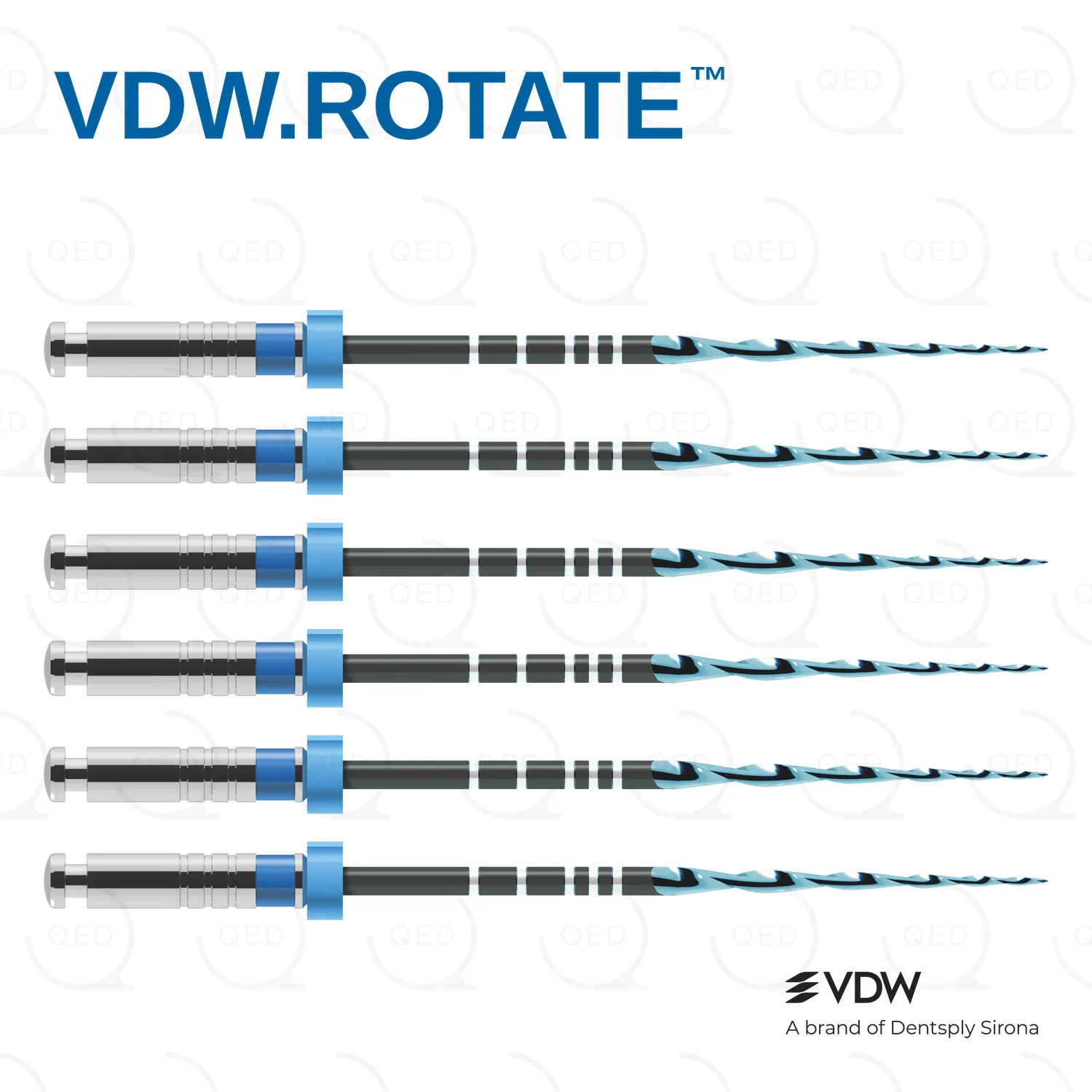
vdw.rotate® · 35/.06 · 31 mm · 6 files
heat-treated nitiadapted s sectionsingle use
the heat-treated file in vdw’s rotary range. vdw describe a “new heat treatment to increase flexibility without compromising cutting efficiency” and an “adapted s cross section for higher cutting efficiency” – the same s-section family as reciproc® blue, run in continuous rotation. this size is for shaping a larger canal once you have reached working length.
this pack: vdw.rotate® rotary file, iso size 35, .06 taper, 31 mm (pack of 6)
vdw · vdw gmbh, munich, germany (dentsply sirona)
| tip (d0) | 0.35 mm |
| taper | .06 |
| length | 31 mm |
| working part | 16 mm |
| handle | 11 mm, nickel plated · 3 rings for taper .06 · iso colour |
| calibration rings | 18, 19, 20, 22, 24 mm, radiopaque |
| supplied | sterile, pack of 6 |
› heat-treated wire. vdw say the treatment “strengthens cyclic fatigue resistance of the file and lowers the risk of file breakage”.*
› adapted s section. vdw say it “ensures effective debris removal and provides control of the instrument for a swift, thorough and safe preparation”.*
› you can read the taper off the handle. 3 rings on the handle means taper .06, on top of the iso colour. no squinting at the blister.
› radiopaque calibration rings. at 18, 19, 20, 22, 24 mm, so the length shows on the radiograph.
“the new vdw.rotate® file reduces canal transportation and better respects the canal anatomy.”
vdw, vdw.rotate product brochure menvrotbrc000 rev.1, 2019. vdw mark this “compared to other vdw continuous rotary instruments”.
which taper do i choose?
vdw put it simply: “choose taper .06 for the majority of clinical cases”, and “choose taper .04 for narrow and highly curved canals including apical curvature”.
coming from mtwo?
the same s-section idea, with the heat treatment and the handle coding added. see the mtwo range if you want to compare.
› the basic sequence: 15/.04 · 20/.05 · 25/.06 · 25/.04, 31 mm
› same file, other lengths: 21 mm · 25 mm
› larger anatomies: 30/.04 · 35/.04 · 40/.04 · 50/.04
› matched obturation: gutta-percha 35/.06
› glide path: vdw c-pilot® assorted, 25 mm · vdw c-pilot® 10, 25 mm
› retreatment: vdw.rotate® retreatment 25/.05, 21 mm
› motor: x-smart® pro+ with apex locator
› lubricant and irrigation: glyde™ file prep · chlorax 5.25% · irriflex® needles
vdw mark their vdw.rotate performance claims “compared to other vdw continuous rotary instruments”, and the cutting-efficiency claim also “compared to a centred rotary cross section”. single use. follow the instructions supplied with the product.
vdw.rotate® 35/.06, 31 mm (6) · heat-treated niti · ref vrot631635

vdw.rotate® · 40/.06 · 31 mm · 6 files
heat-treated nitiadapted s sectionsingle use
the heat-treated file in vdw’s rotary range. vdw describe a “new heat treatment to increase flexibility without compromising cutting efficiency” and an “adapted s cross section for higher cutting efficiency” – the same s-section family as reciproc® blue, run in continuous rotation. this size is for shaping a larger canal once you have reached working length.
this pack: vdw.rotate® rotary file, iso size 40, .06 taper, 31 mm (pack of 6)
vdw · vdw gmbh, munich, germany (dentsply sirona)
| tip (d0) | 0.40 mm |
| taper | .06 |
| length | 31 mm |
| working part | 16 mm |
| handle | 11 mm, nickel plated · 3 rings for taper .06 · iso colour |
| calibration rings | 18, 19, 20, 22, 24 mm, radiopaque |
| supplied | sterile, pack of 6 |
› heat-treated wire. vdw say the treatment “strengthens cyclic fatigue resistance of the file and lowers the risk of file breakage”.*
› adapted s section. vdw say it “ensures effective debris removal and provides control of the instrument for a swift, thorough and safe preparation”.*
› you can read the taper off the handle. 3 rings on the handle means taper .06, on top of the iso colour. no squinting at the blister.
› radiopaque calibration rings. at 18, 19, 20, 22, 24 mm, so the length shows on the radiograph.
“the new vdw.rotate® file reduces canal transportation and better respects the canal anatomy.”
vdw, vdw.rotate product brochure menvrotbrc000 rev.1, 2019. vdw mark this “compared to other vdw continuous rotary instruments”.
which taper do i choose?
vdw put it simply: “choose taper .06 for the majority of clinical cases”, and “choose taper .04 for narrow and highly curved canals including apical curvature”.
coming from mtwo?
the same s-section idea, with the heat treatment and the handle coding added. see the mtwo range if you want to compare.
› the basic sequence: 15/.04 · 20/.05 · 25/.06 · 25/.04, 31 mm
› same file, other lengths: 21 mm · 25 mm
› larger anatomies: 30/.04 · 35/.04 · 40/.04 · 50/.04
› matched obturation: gutta-percha 40/.06
› glide path: vdw c-pilot® assorted, 25 mm · vdw c-pilot® 10, 25 mm
› retreatment: vdw.rotate® retreatment 25/.05, 21 mm
› motor: x-smart® pro+ with apex locator
› lubricant and irrigation: glyde™ file prep · chlorax 5.25% · irriflex® needles
vdw mark their vdw.rotate performance claims “compared to other vdw continuous rotary instruments”, and the cutting-efficiency claim also “compared to a centred rotary cross section”. single use. follow the instructions supplied with the product.
vdw.rotate® 40/.06, 31 mm (6) · heat-treated niti · ref vrot631640

instruments · wam classic tweezers · cross-locking
a conventional tweezer only holds while somebody is squeezing it. the classic is cross-locking – the jaws are shut at rest and stay shut on their own, with serrated tips for grip. the practical difference shows up between hands: a nurse can pass it across, or set it down loaded, and whatever is in it is still in it. cotton, wedges, posts, paper points – the small things that are a nuisance to pick up twice.
this item: wam classic tweezers, cross-locking jaws, serrated tips
made by wam, france · german stainless steel · wam ref ct
| cross-locking | closed at rest. the grip does not depend on hand pressure, so nothing is released by accident when attention moves elsewhere |
| serrated tips | for hold on small, light items that a smooth jaw lets slip |
| general purpose | cotton, wedges, posts and paper points. for gutta percha cones and other long cylindrical items, the endo tweezers has jaws grooved for the job |
| autoclave it open | wam’s maintenance instruction is explicit: instruments should be open during autoclave sterilisation. on a tweezer that locks shut by itself, that means holding the jaws open deliberately – the one step easy to miss. clean and lubricate the movable parts first |
› the specialised one wam endo tweezers – safety catch and grooved jaws, cut for cones and points.
› what it holds diadent® mmpp™ paper points.
› isolation oraseal™ caulking – for the other half of keeping the field where you put it.
classic or endo?
both lock. the classic is the everyday one for small objects; the endo adds a safety catch and jaws grooved lengthways and across, made for long cylindrical things like gutta percha cones. plenty of surgeries keep one of each.
can they be autoclaved?
yes. wam’s maintenance instruction covers it: clean, lubricate the moving parts, then steam sterilise – with the instrument open, which on a self-locking tweezer takes a deliberate press. new ones get rinsed in distilled water, cleaned, lubricated and autoclaved before first use. ask us for the full document.
wam classic tweezers · cross-locking jaws · serrated tips · cotton, wedges, posts and points · wam france · ref wam-ct
instruments · wam endo tweezers · self-locking
ordinary tweezers ask you to keep squeezing, and a cone coated in sealer is the last thing you want to hold by hand pressure alone. these work the other way round: the jaws are cross-action, closed at rest and held shut by the instrument rather than by you, with a safety catch. wam’s own line says it best – the item will not be released until you decide.
this item: wam endo tweezers, self-locking cross-action with safety catch, grooved and serrated jaws
made by wam, france · german stainless steel · wam ref et · class i medical device, ce marked
| cross-action, self-locking | closed at rest with a safety catch. press the handle to open – the grip does not depend on your hand pressure |
| grooved and serrated jaws | longitudinal and transversal grooves, serrated tips – what stops a round, slippery thing rotating out of the grip |
| made for cylindrical things | wam’s stated use: posts, paper points, gutta percha points and matrices – what a flat-jawed tweezer handles worst |
| autoclave it open | wam’s maintenance instruction is explicit: instruments should be open during autoclave sterilisation. on a tweezer that locks shut by itself, that means holding the jaws open deliberately – the one step easy to miss. clean and lubricate the movable parts first |
› what it holds diadent® ml.029™ gutta percha and mmpp™ paper points.
› the other wam tweezer wam classic tweezers – the conventional pattern, for everything that is not a cone.
› seal with neosealer® ezflo – the sealer that makes the cone slippery in the first place.
› gauge a cone diadent gp gauge – calibrate and cut back to size.
why tweezers that stay shut?
the moment you most want a firm grip is the moment your hand is busy with something else. a cross-action jaw holds without being held.
how do these differ from the classic?
both lock. the endo adds the safety catch and grooved jaws for long cylindrical items; the classic is the general one, for cotton, wedges and small objects.
can they be autoclaved?
yes. wam’s maintenance instruction covers it: clean, lubricate the moving parts, then steam sterilise – with the instrument open, which on a self-locking tweezer takes a deliberate press. new ones are rinsed in distilled water, cleaned, lubricated and autoclaved before first use. ask us for the full document.
wam endo tweezers · self-locking cross-action · safety catch · grooved, serrated jaws · for posts, points and cones · wam france · ref wam-et


 Facebook
 X
 Instagram
 Pinterest
